Originally published April 3, 2008
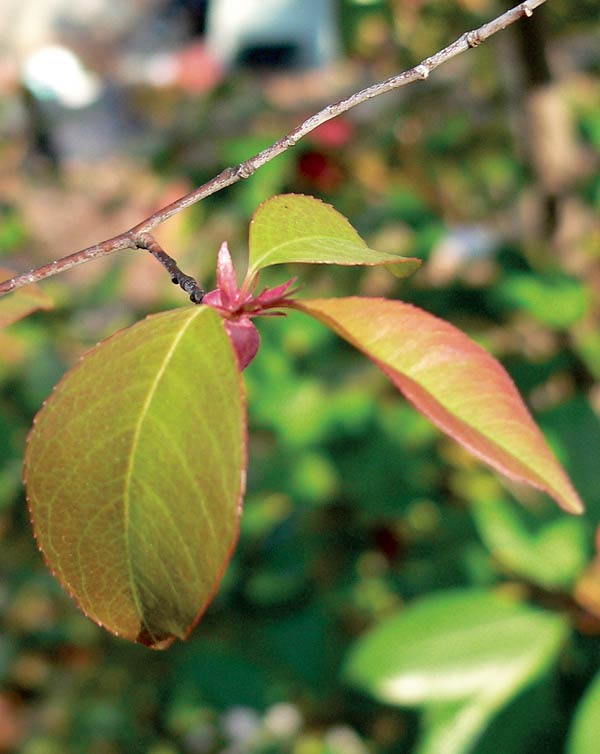
Young wild cherry leaves have subtle beauty. Photo by Ken Moore
By Ken Moore
Last Saturday, I saw a roadside spectacle as beautiful as any deliberately designed garden landscape. Nature’s inter-planting of yellow sassafras and pink redbud resulted in what may be best described as “roadside impressionism.†Fortunately, the recent cold spells have extended the flowering of these early bloomers.
Now, amidst all this beauty, I noticed another of nature’s seasonal designs. Less welcome to most folks are the webbed nests of tent caterpillars that appear in wild cherries, Prunus serotina, and cultivated apples, cherries and plums. Some homeowners cause tree injury in the practice of burning the nests. If there is an urge to battle this particular cycle of nature, a twist with a cloth-tipped stick will harmlessly extract the nests.
Originally published May 1, 2008
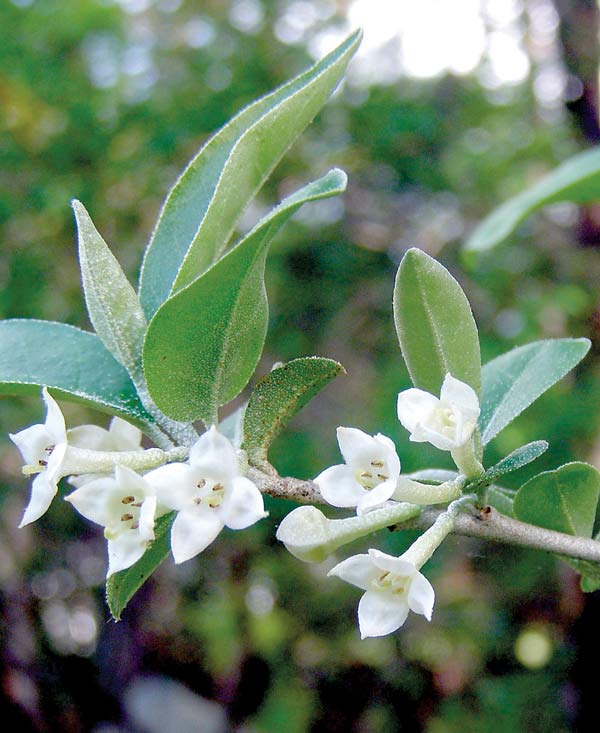
Autumn olive is an ‘Ill-natured Agnes’. Photo by Ken Moore
By Ken Moore
The Haw River Assembly’s Earth Day walk along the Haw River revealed a spectacular display of an ill-natured plant.
No sooner had we entered the forest on the northeast side of the US 64 bridge than several walkers inquired about the heavy, perfumed fragrance wafting on the spring breeze. We eventually became accustomed to that scent, which accompanied us for half of our leisurely mile-long excursion along the river. Some portions of the path were almost tunnel-like passageways through thorny thickets of this exotic shrub bearing countless clusters of tiny, white, four-petal flowers in the axils of silvery leaves.
Originally published April 28, 2008
By Ken Moore
Seven-year-old Flora Arnsberger accompanied her dad, Matthew, on a woods walk with me several months ago. Knowing that her dad often took her on nature walks, I suggested that Flora be my “junior naturalist†assistant. She delighted us by finding things that we older folks were simply too big and preoccupied to notice.
Originally published April 21, 2008
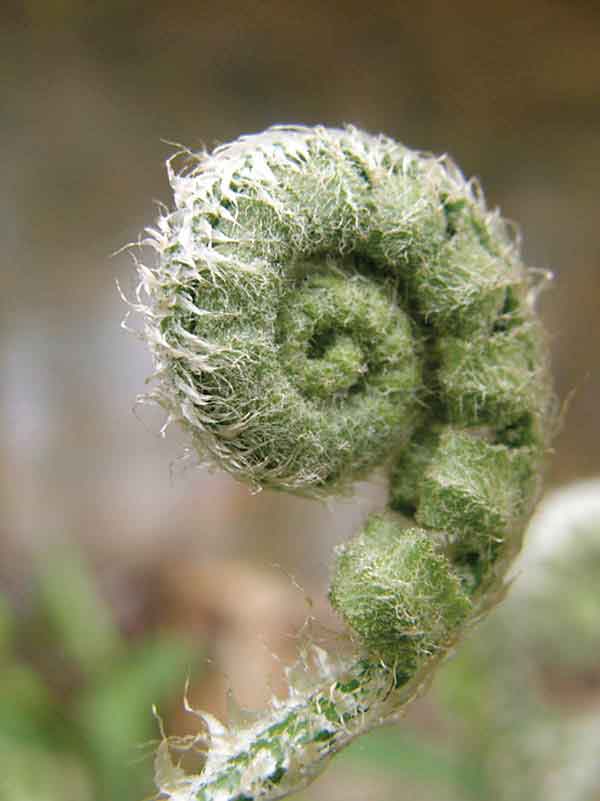
Fiddlehead of Christmas fern is protected by a hairy jacket. Photo by Dave Otto
By Ken Moore
A few days ago, local wildlife photographer Dave Otto sent me beautiful images of a Christmas fern (Polystichum acrostichoides) fiddlehead and a flower cluster of wild azalea (Rhododendron pericymenoides) expressing themselves along Bolin Creek in Carrboro.
Those fiddleheads are a definite sign of spring. Once they begin unfurling their new leaves, we can usually be confident that the warm growing season has finally arrived and we can move forward with our vegetable and flower gardening pursuits – but hold it right there!! Remember last year, when we had a serious frost about this time that resulted in some real setbacks for tender garden plants as well as our native flora.
Originally published April 14, 2008
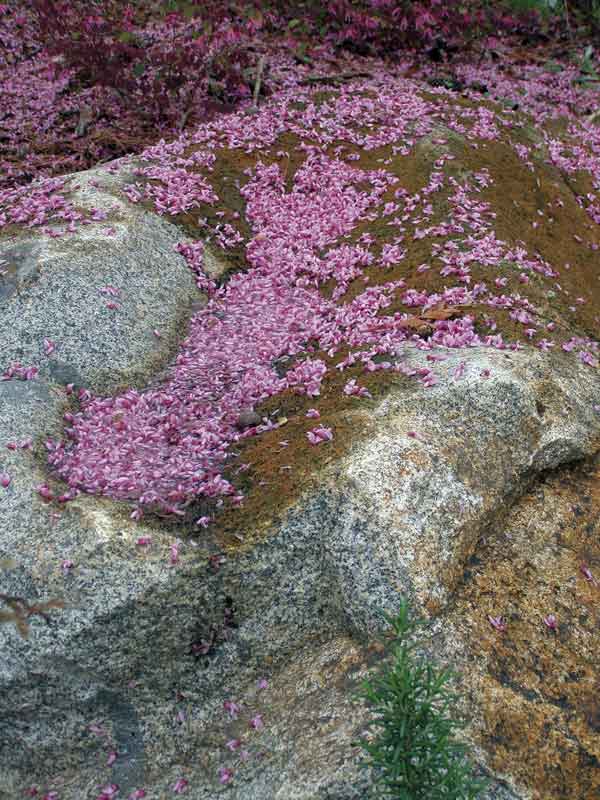
A redbud floral garden carpet. Photo by Ken Moore
By Ken Moore
The cool weather extension of the flowering of native trees and shrubs is resulting in a visual overload. The colorful images range from redbud flowers carpeting the ground, to the spectacle of whole roadside forest edges dripping with pale-violet hanging flower clusters of the deadly, non-native Chinese Wisteria, Wisteria sinensis.
In between redbud and dogwood there is sassafras

Three types of leaves characterize the sassafras tree. Photo by Betsy Green Moyer
By Ken Moore
Flora Columnist
As the pink-colored redbuds are now giving way to the pure-white dogwoods, your eye may catch some yellow tints produced by another native tree that flowers before the emergence of its leaves.
Sassafras, Sassafras albidum, common throughout eastern North America, has a really special plant heritage. As Paul Green describes in Paul Green’s Plant Book, “It was especially fancied in late Elizabethan England because of Sir Walter Raleigh’s colonists on Roanoke Island sending back sassafras bark and roots to be used medicinally.â€
Failing to discover gold along the Virginia and Carolina coasts, the early settlers, following in the footsteps of earlier Spanish explorers further south, shipped tons of sassafras back to England, where sassafras tea houses became fashionable.
Green also described how citizens of the Cape Fear River Valley used the tea as a healthy spring tonic, prescribed by doctors in the old days for thinning the blood.
Sassafras has an almost sacred heritage among the eastern Native American cultures. Descriptions of uses are countless. Particularly engaging are recent accounts by descendants of the North Carolina Lumbees. Commonly repeated was the recollection “that Sassafras was the most often used herb in their households as they were growing up.†This comes from Herbal Remedies of the Lumbee Indians, by Arvis Locklear Boughman and Loretta O. Oxendine, and is one of my favorite references for North Carolina plant and cultural heritage.
Before the FDA banned its use in 1960, root bark provided the flavoring for root beer. Not banned, however, is the traditional use of powdered, dried leaves for the distinctive Creole gumbo filet.
The Lumbees were one of many tribes that considered it taboo to burn the wood of sassafras, so special was that tree. And I recall a description that it was most important to use a sassafras stick for the stirring in soap making.
While I enjoy sassafras tea now and then, my real celebration of sassafras is that it is such an exceptionally beautiful tree. It is usually missed in the deep forest, where specimens here and there reach high into the canopy. I notice it most often along our rural roadsides. They are easily spotted at this time of year, when the bare branches are tipped with clusters of tiny lemon-yellow flowers, and in the fall, when the leaves make a brilliant orange-red display. In the winter season, you can identify sassafras by its characteristically horizontal-spreading branches with the swollen round-budded tips turned upward, like fingers stretching upward from an open palm.
Occasionally, sassafras may be spotted along the edges of our urban streets. I was thrilled to discover one last week that I have been passing for years without seeing! It is on the south side of Homestead Road, just a couple of hundred feet east of the Seawell School Road intersection. Look for the utility pole and the speed-limit sign. I heap praise on the utility workers who maintain that roadside for allowing that sassafras to remain. Perhaps there are a few local folks who also consider sassafras special.
Email Ken Moore at flora@carrborocitizen.com. Find previous Ken Moore Citizen columns at The Annotated Flora (carrborocitizen.com/flora).

Clusters of tiny, lemon-yellow flowers adorn sassafras before leaf emergence. Photo by Betsy Green Moyer

Redbud’s many shades of pink. Photo by Ken Moore
By Ken Moore
Flora Columnist
Native pink-flowered redbud, Cercis Canadensis, is right on schedule beginning its three-week-long flowering. It will be followed in a week or two by the pure-white Flowering Dogwood, Cornus florida. The combination of these two native trees’ spring awakenings gives us four to five weeks of flowering with a dramatic overlapping of the two.
In recent years, this extended beautiful beginning of our natural Piedmont spring has been overshadowed by the short, week-long blinding white explosion of the exotic Bradford Pear, Pyrus calleryana ‘Bradford’, over-planted along city streets and in parking lots and residential landscapes.
However, along rural highways, where one’s eye is not distracted by invading pears, you’ll find stretches of redbuds, beginning first with a hint of dark pink before the flowers fully open, brightening the forest edges with clouds of pastel pink. I really want to call redbud “pinkbud,†and I wonder that perhaps some colorblind botanist never really appreciated this tree’s progression through the full spectrum of pink colors.
Some folks enjoy tasting the buds and young flowers as a sweet snack. If you are so inclined, then you can’t avoid appreciating how much the mature pale-pink flowers look like pea flowers. The telltale bean pods hanging from the tree in the late summer let you know that this tree is indeed a member of the bean family. And the distinctive lime-green, heart-shaped leaves are a delight to behold through the long growing season.
Now, before the redbuds begin turning over their show of pink to the white of dogwoods, get up close to a dogwood and look for its flower buds. The flattened, flyer saucer-shaped flower buds perched upright on short stems were visible as early as the beginning of last fall. Closer examination will reveal four bracts tightly enclosing each swollen bud. Keep a constant watch on those buds and you may be surprised to witness those four bracts unfolding and enlarging, turning from green to pure white, as they become what we think of as the four petals of a dogwood flower.
They’re not petals at all. I still feel the wonder of discovery when I first learned that those four “false†petals were the magical expansions of the small bracts that protected that flower bud all winter. A hand magnifier will help you discover a tight cluster of several tiny yellow “true†flowers in the center of those four white bracts. Think ahead to next fall and realize that if successfully pollinated by insects, those little flowers will produce clusters of bright-red berries that provide essential nourishment for fall migrating birds.
I keep an eye out for seedlings of redbud and dogwood wherever they may appear in my yard and garden beds. When I spot one, I am quite likely to leave it in place to become a specimen plant, having learned that what nature plants generally succeeds better than what I plant.
At this season of the spring equinox, take time to enjoy and be appreciative in following nature’s several-week progression of redbuds and dogwoods.
Email Ken Moore at flora@carrborocitizen.com. Find previous Ken Moore Citizen columns at The Annotated Flora (carrborocitizen.com/flora).
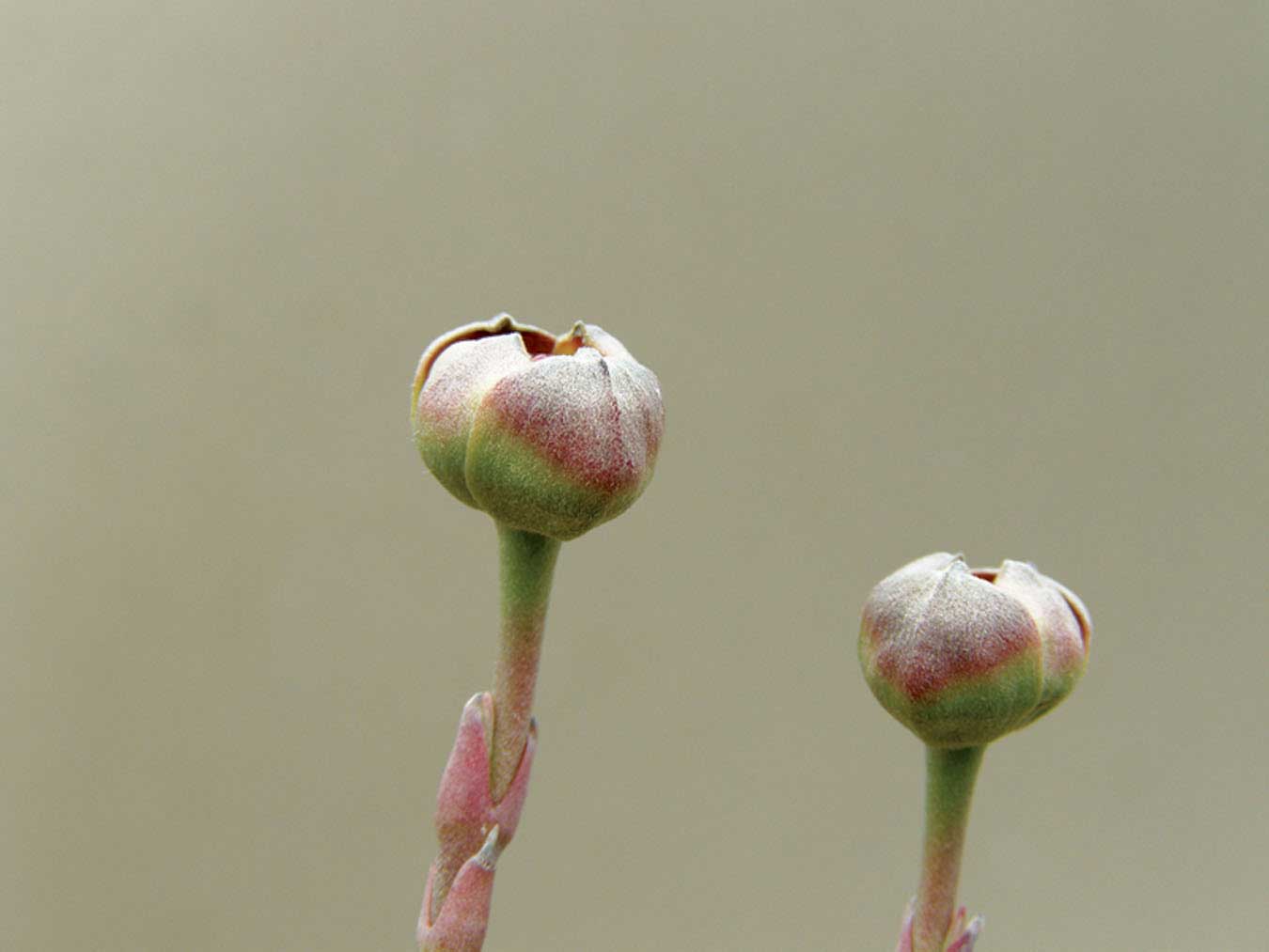
Watch Dogwood buds closely as they open to reveal the tiny yellow flowers within those four white bracts. Photo by Ken Moore
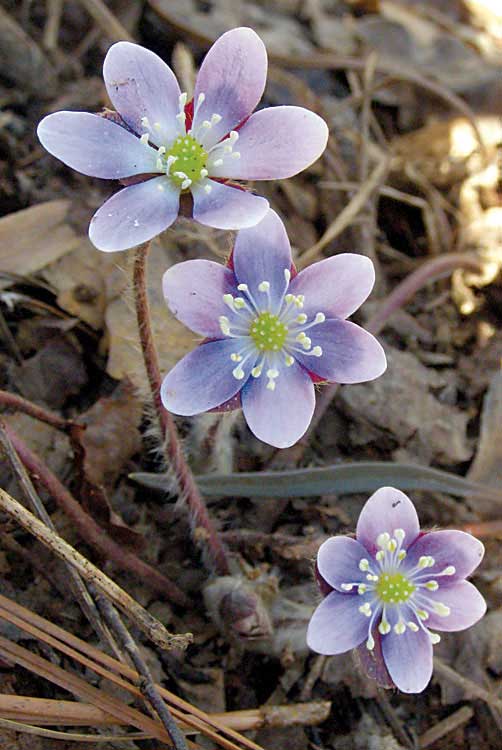
Harbinger of spring: flowers of Hepatica. Photo by Ken Moore
By Ken Moore
Flora Columnist
You have to take care to avoid stepping on the Hepaticas when you approach the bench to sit and enjoy the sights and sounds along New Hope Creek at the old mill site. It’s springtime on Triangle Land Conservancy’s Johnston Mill Nature Preserve; Hepaticas and other spring wildflowers are emerging.
Johnston Mill Nature Preserve is just one of several that Triangle Land Conservancy (TLC) manages throughout Chatham, Durham, Johnston, Lee, Orange and Wake counties. It is well worth your investigating the website, www.tlc-nc.org, for site descriptions and a schedule of seasonal interpretive walking and canoe excursions in these preserves.
The 296-acre Johnston Mill Nature Preserve is my favorite because it has so many diverse habitats and there are some really interesting botanical features there. Those Hepaticas are one of them. Hepatica americana, commonly called Liverleaf, usually occurs on mature forest slopes above the flood plain. Here in the Johnston tract, they are scattered among the carpets of Trout Lily, Erythronium americanum, and Spring Beauty, Claytonia virginica, on the low-lying areas bordering the creek. The traditional first sign of spring is the emergence of the Hepatica flower just above the forest leaf litter. The blue color of that flower is indescribable. When you spot the flowers, look for the three-lobed evergreen leaves, which turn deep burgundy before they decompose to make way for the new leaves.
Another spring harbinger, Spicebush, Lindera benzoin, is easy to spot throughout the flood plain; look for tiny lemon-yellow flowers on the bare branches of head-high shrubs. Those inconspicuous flowers produce brilliant red berry-like fruit in late summer.
A second interesting feature for me is the warty bark of Celtis laevigata, commonly called Hackberry or Sugarberry. The smooth trunk of this tree is usually covered with wart-like corky growths, but a particular grove of trees near the old Johnston Mill site sports such dramatically warty bark that they are easily imagined to be characters from a Tolkienesque plot. You have to see them to believe them!
And another seeing-is-believing feature is the Lilliputian forest of American Beech, Fagus grandifolia, high up on the Bluff Trail. Normally, beech trees occur on the moist lower slopes, not high up on dry ridges. Here, however, a few large beech trees near the top of the slope were blown down during Hurricane Fran in 1996. Those trees were loaded with beech nuts. Each time I visit, I visually try to excavate the roots to determine whether that dwarf beech forest is the result of hundreds of sprouting beechnuts or vegetative sprouts from the extensive far-reaching root system of those original trees. It could be a combination of both.
More a wonder than a feature is the old, blown-over sycamore, Platanus occidentalis, on the creek bank. Though much of its massive root system is exposed, the tree, another Tolkienesque image, continues to survive and is a living demonstration of the complexity of a single-tree root system.
There is so much to see, and I advise you that if you don’t get outside now you’ll miss the awesome emergence of spring.
This coming Saturday, March 15, TLC is continuing its 25th year anniversary celebration with an all-day “Open House†at the Johnston Mill Nature Preserve. All are welcome, young and old, families and friends, to join in on this day-long walking celebration. What an appropriate way to pay tribute to TLC for protecting over 10,000 acres of natural areas in our region.
From 9 to 11 a.m., volunteer birders stationed throughout the preserve will help visitors spot and identify the many birds that migrate through or call Johnston Mill home. The roster of bird species here is so diverse that the preserve has been made a part of the North Carolina Birding Trail.
During the afternoon, from 1 to 4 p.m., volunteer naturalists and botanists will take over, helping visitors spot the Hepaticas and other features of spring. Spring is proceeding so rapidly now that there are budding surprises with each passing day.
All day long, volunteers will be on hand to greet visitors and share information about TLC. Parking for the open house is available at both entrances to the preserve: on Mt. Sinai Road and on Turkey Farm Road. For personal safety, TLC advises visitors to park on the shoulder of Turkey Farm Road if the lots are full. Visit the website for a Johnston Mill locator map.
Email Ken Moore at flora@carrborocitizen.com. Find previous Ken Moore Citizen columns at The Annotated Flora (carrborocitizen.com/flora).
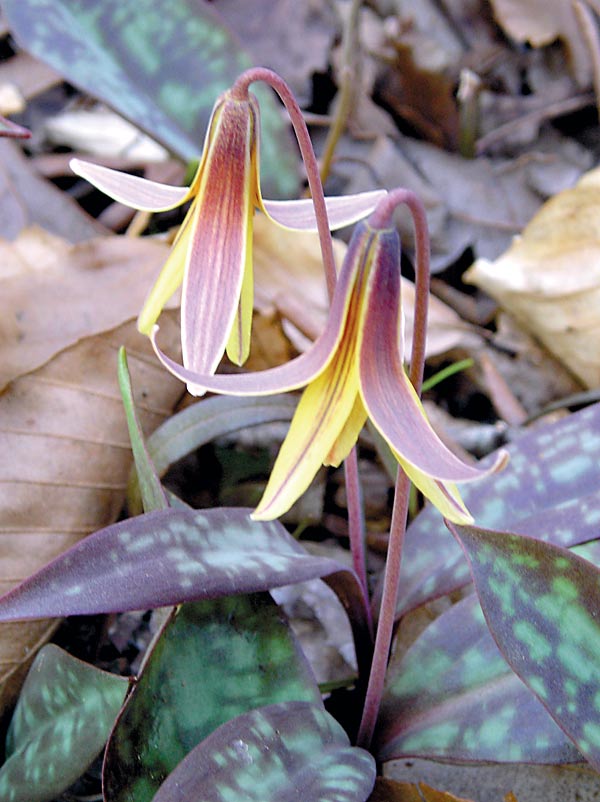 You have only a couple of weeks to catch the fleeting Trout Lily. Photo by Dave Otto
By Ken Moore
Flora Columnist
Some of our most beautiful woodland flowers are called spring ephemerals because their visible presence is fleetingly brief. They emerge from the forest floor in the chilly late winter to take advantage of the full sunlight that’s absent once the forest canopy is in full leaf.
By mid-April, some of these early risers will have flowered, made fruit, dispersed seed and returned to dormancy. The Trout Lily is a classic spring ephemeral. I failed to interrupt my busy indoor pace a few years ago and I missed the pageantry of this little woodland lily. That had a dramatic impact on me. I no longer take lightly the passing of seasons. The budding, flowering, leafing, fruiting and return to dormancy of plants are cherished as special separate annual occurrences.
The fleeting presence of the Trout Lily makes me want to linger over it – quietly hoping I will be privileged to see it again next year. I saw some in flower this past weekend down along the Rocky River on Triangle Land Conservancy’s White Pines Preserve south of Pittsboro. Dave Otto photographed some early ones this past week down along Bolin Creek in Carrboro.
If you are going to catch them this year, you will have to get out there soon. You can’t miss them. In some places like the Botanical Garden, the Adams’ Tract and the several local Triangle Land Conservancy preserves, they are literally carpeting the forest floor along trails through the low woods and leading upslope from the creek bottoms.
Light colored speckles on the green leaves most likely explain the common name, Trout Lily. Perhaps we should call it Speckled Trout Lily. That little golden-yellow flower with three sepals and three petals, looking like six similar petals, is a true lily. Down on hands and knees, take a closer look at the swollen triangular-shaped capsules at the ends of the stems where the flowers occurred. By the end of March, when the plant has just about disappeared for the year, that lily capsule will have deposited its seeds for dispersal by ants along the forest floor.
Some folks call this lily Dogtooth Violet and they are passionate about their common name. I don’t know the origin of this one; it is definitely not a violet, but I can understand how some imaginative soul may have likened each of those six petals to a canine’s tooth. Now use your imagination when viewing the burgundy colored stamens protruding from the petals. What do you think of Yellow Adder’s Tongue as another name for Trout Lily? Simply using the official Latin name, Erythronium americanum, is an easier option.
You will see many other woodland flowers close to the ground during the next couple of weeks. Be particularly on the lookout for one called Pennywort, Obolaria virginica. It is seldom seen because it remains hidden a few inches above the leaf litter. Only a keen eye will spot this diminutive wildflower in the Gentian family. Visit Dave Otto’s Bolin Creek photo exhibit, continuing through March in Carrboro’s Town Hall, to view a spectacular image of the Pennywort. When you see it, remember that in reality it is only a couple of inches tall. If you ever find one, you’ll never forget it. But you have to go walking in the woods to find it.
Special appreciation to Dave Otto for this week’s photos.
Email Ken Moore at flora@carrborocitizen.com. Find previous Ken Moore Citizen columns at The Annotated Flora (carrborocitizen.com/flora).
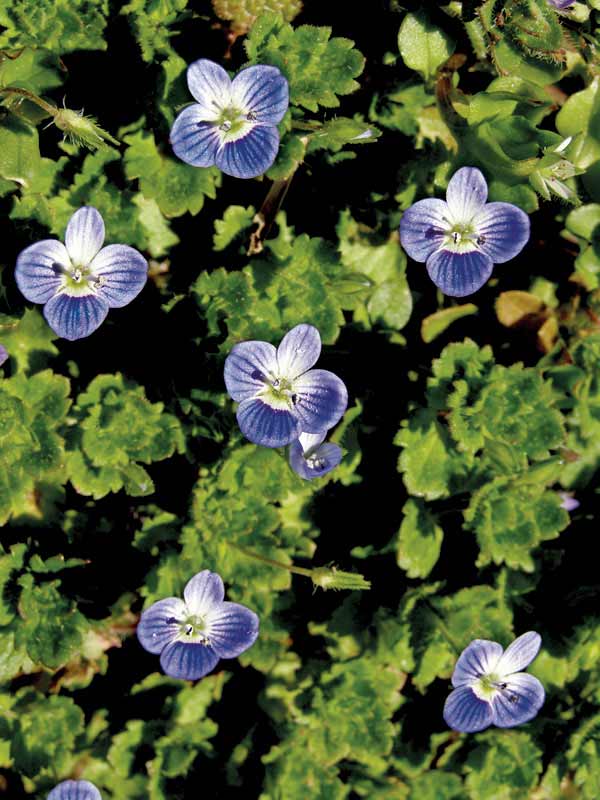
Tiny speedwells blooming now in local yards. Photo by Ken Moore
By Ken Moore
Flora Columnist
I’m lucky to live where neighbors have not legislated against hanging laundry out to air dry. In addition to saving electricity and having sun-fresh clothes, I soak up some natural Vitamin D and have the opportunity to enjoy the late February blooming yard.
Many of you have a blooming yard, but you may move over it too quickly to enjoy the diversity of flowers scattered there. But if you have one of those deliberate lawns of turf grass — severely maintained with fertilizers, herbicides and copious amounts of water — you will not have a blooming yard.
To have a blooming yard, you must set about to maintain a “freedom lawn.†Such a lawn is not really too much of a challenge to create and maintain. To succeed, all you have to do is nothing. Your yard will become filled with all sorts of volunteer plants that produce flowers during the growing season. In flower now is an assortment of winter annuals that begin growing in the late fall and burst forth with flowers in early February. February and March snows and ice storms merely provide an extra blanket of warmth from freezing temperatures. Flowering close down on the ground seems to be an advantage during typical cold weather.
You may have to get down on hands and knees to conduct some “belly-button botany†observations to appreciate the floral display. One of my favorites is the lowly common chickweed, Stellaria media. This bane of the lawn perfectionist can shine up at you like hundreds of little bright stars speckled across a bed of pale-green chickweed foliage. Close observation of the tiny quarter-inch diameter flowers will reveal five pure white petals that are split like rabbit ears, appearing to be ten petals. Gently pull one double petal away from the flower to enjoy the tiny white rabbit ears in the palm of your hand. I can’t resist doing that!
Rather than curse the lowly chickweed, being a lazy, carefree gardener, I simply let this early-spring annual romp around on the yard and through garden beds. The tender foliage makes a tasty addition to salads and it is a treat relished by my two parakeets. By late spring, it’s gone, out of sight, until the next winter.
My truly favorite of all the many early-spring yard flowers is the beautiful little speedwell, Veronica persica. Hundreds of blue flowers greeted my downward glances as I was hanging out the laundry a couple of days ago. I never cease to be humbled by the clean beauty of this little quarter-inch-broad four-petal flower when examined at close range.
As did the common chickweed, the speedwell accompanied the Europeans to North America long ago. The speedwell has an herbal heritage as a beneficial diuretic tea that also aids blood purification. For me, the sheer beauty of the flower is reason enough to value underfoot in one’s yard. Looking down on a warmish, sunny winter day to see dozens of them is to experience a “splendor in the grass.â€
Email Ken Moore at flora@carrborocitizen.com. Find previous Ken Moore Citizen columns at The Annotated Flora (carrborocitizen.com/flora).
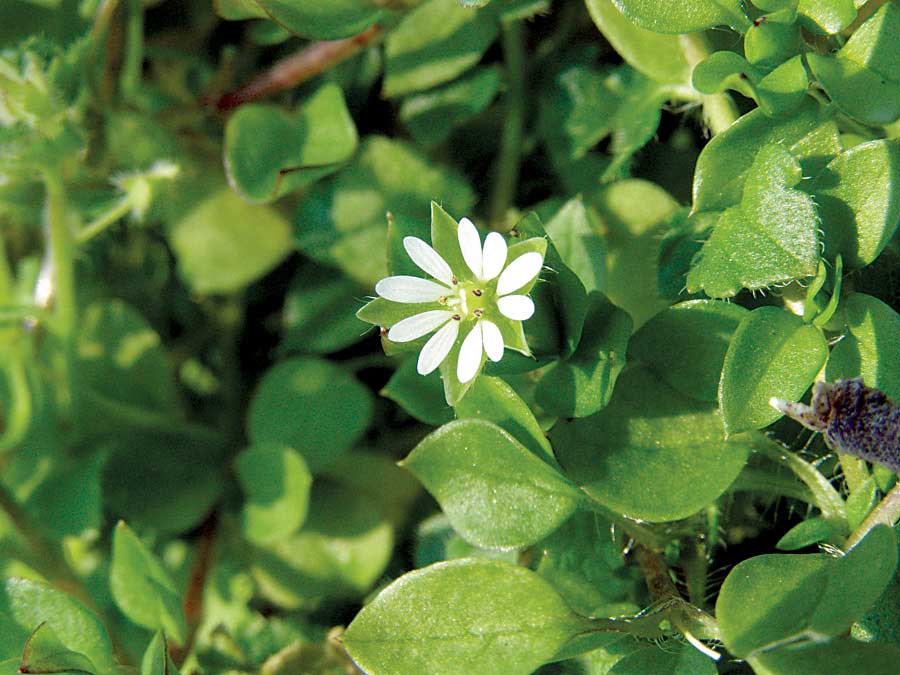
Chickweed flower has five rabbit ear-like petals. Photo by Ken Moore