Pendulous male catkins of American Hazelnut. Photo by Ken Moore
By Ken Moore
Flora Columnist
Be on the lookout for a multi-stemmed shrub that appears to be decorated with pendulous, 4-to-6-inch strips of yellow yarn. If you examine these streamers closely, gently tap several of them. You’ll be surprised by the clouds of pollen. The streamers are staminate catkins, which are pendulous clusters of petalless male flowers providing pollen for the much-less-obvious petalless female flowers.
The challenge of this botany lesson is to find the female flowers. You’ll have to look closely to find tiny swollen buds with clusters of rosy red threads protruding from the bud tips. These short red threads are the stigmas of the hidden female flowers. The exposed stigmas catch the passing pollen that is required for those flowers to produce hazelnuts.
Yep, you’ve guessed it, that shrub is American Hazelnut, Corylus Americana, and yes, they are quite tasty, but the wild critters usually beat us to the feast. We must rely on the orchards of Eurasian hazelnut species for the tasty nuts we purchase in stores.
Hazelnut is a common large woodland shrub in our forests, but it is most noticeable growing along woodland edges and sewer and power-line rights-of-way where the additional sunlight promotes heavy flower and nut production.
Another common shrub, similar in appearance to the hazelnut, is Tag Alder, Alnus serrulata. You will commonly find it along stream banks and pond edges. It likes to have its feet in the water. Tag Alder catkins are not quite as long as those of hazelnuts. The easiest way to distinguish between the two shrubs is to spot clusters of what appear to be miniature pine cones. The little cones of the Tag Alder are generally one-half-inch long. They remain on the branches well into the second year. Your second challenge here, as with the hazelnut, is to locate the small swollen buds of the female flowers with red stigma threads reaching out for wind-borne Tag Alder pollen.
Now you’re ready for your botany quiz. Why don’t these early- spring-flowering natives have showy petals? Reflect for a bit. Our early Piedmont springs are intermingled with our late Piedmont winters and native plants have devised cleaver strategies for success in the on-again, off-again cold weather. These plants don’t waste energy producing showy flowers to attract insect pollinators. Early-spring temperatures are too cold for significant insect activity, so these plants depend on the wind to assist in pollination. Flower petals, in addition to wasting plant energy, would simply get in the way of wind pollination.
Taking a close-up look at the beauty of petalless flowers is a pure delight; it makes me feel like I’ve never had a better day! I hope you will make your day better with a closer look. Better yet, take your kids and friends out with you and give them a better day by sharing your closer look at nature’s subtler beauties.
Email Ken Moore at flora@carrborocitizen.com. Find previous Ken Moore Citizen columns at The Annotated Flora (carrborocitizen.com/flora).
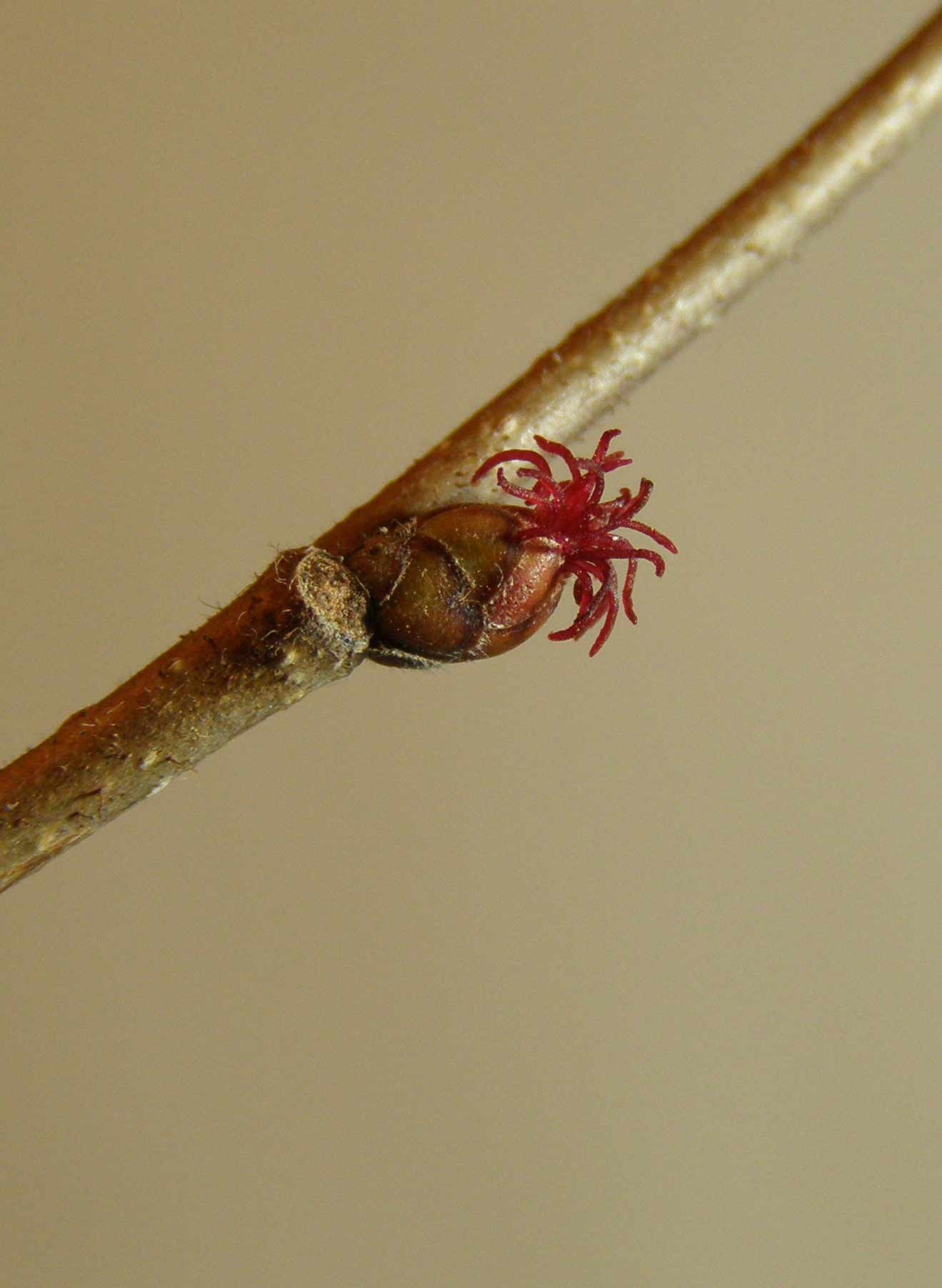
Female Hazelnut Flowers. Photo by Ken Moore
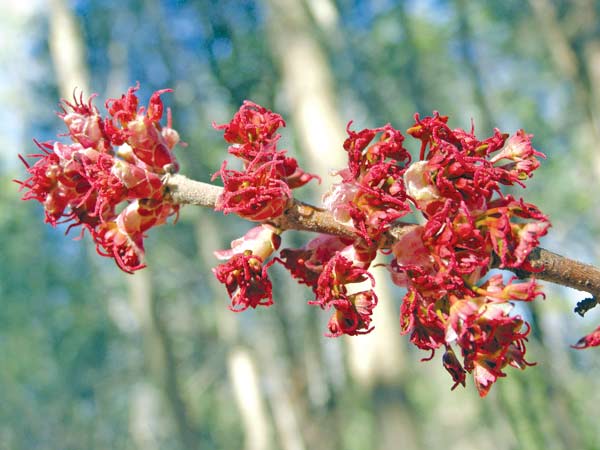
Red flowers of female Red Maple. Photo by Ken Moore.
By Ken Moore
Flora Columnist
In February, I love observing the daily swelling of buds, the bright coloring of stems and the flowering of tiny winter annuals on the ground and shrubs and trees above. Simultaneously, this constant assault of springtime awakenings makes me panic with the realization that well-intentioned chores and worthy projects set aside for the winter months are far from completed.
My moods of panic result in negative outbursts like “I hate spring!†and “spring is highly over-rated!†My annual vocal springtime pronouncements are by now expected by friends. My gardening friend, Sally, always thoughtfully reminds me that the word “hate†should be eliminated from one’s vocabulary and she offers sincere condolences that I find anything but joy with the re-awakenings of spring.
On reflection, I realize that my indoor winter projects never get my necessary attention because there is so much of interest in the outdoors.
For instance, in spite of the continuing freezing weather, we are entering the peak season of flowering of Red Maples, Acer rubrum. During the next several weeks, we will be seeing dense red clusters on leafless branches. These clusters of tiny flowers can be fully appreciated only with a close-up view with a sharp eye. I make use of a 10x hand lens, though most any hand-held reading magnifiers will suffice.
Maple flowers lack the obvious petals we see on most flowering plants. A close look will reveal that these clusters contain only female or male parts on each flower. Now we’re entering a botany lesson as well as taking a peak at the sex lives of plants. Maple trees are described as polygamous. Some trees have only male flowers, clusters of stamens; other trees have only female flowers, clusters of pistils. Sometimes a single tree will have perfect flowers – i.e., male and female parts in the same flower. The male tree of pollen-bearing stamens has an overall yellowish tint. The female flowers have two embryonic winged seeds, ovules, having a common stalk, the style, splitting at the top into two curly tips, the stigmas. Wind-borne pollen from the stamens lands on the stigmas to fertilize the little ovules. The little ovules, in just a few weeks, grow to become those fun-to-watch and fun-to-throw winged “helicopter†maple seeds we know so well. The female trees are generally the ones with the brilliant red color.
Take a magnifying lens outdoors for a closer look. I promise you will find that nature has produced a beautiful work of art. It will help you to know that maples are opposite-branched so the flower clusters are opposite each other.
Alternate-branched elms, Winged Elm, Ulmus alata, Slippery Elm, U. rubra, and American Elm, U. americana, are also flowering now. Their tiny flowers are copper-reddish in color. Take a real close look at them and see if you can determine whether you have male flowers, female flowers or perfect flowers.
If you wait until official spring to take this closer-look adventure, you’ll only be seeing elm and maple seeds covering the ground all over town.
Email Ken Moore at flora@carrborocitizen.com. Find previous Ken Moore Citizen columns at The Annotated Flora (carrborocitizen.com/flora).
Signs of spring and birds’ nests
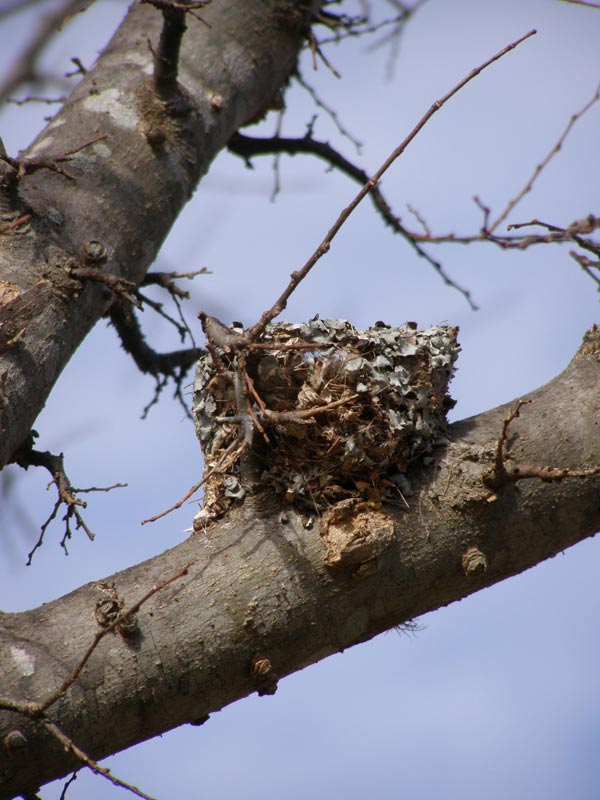
Sturdily built nest of a clever bird architect. Photo by Ken Moore
By Ken Moore
Flora Columnist
The familiar signs of spring for most of us are already evident. Crocuses and Japanese Apricot, Prunus Mume, are in flower and daffodils are showing flower buds. But these are foreigners, long ago established in our cultivated gardens. True signs of spring are the deepening stem colors and swelling flower and leaf buds in the wilds of nature’s garden. This past weekend, four of us enjoyed discovering some of these spring signals along Bolin Creek trails in the university’s Carolina North Preserve (Horace Williams Tract).
Following are descriptions of some early-spring signals. But first I must digress to share what we saw while crossing a field. We spied a really beautiful tiny lichen-encrusted bird nest situated about ten feet above us on a lateral limb of a small Hackberry tree, Celtis laevigata. We thought the architect to be a hummingbird. The nest appeared so sturdy we could imagine it being used a second season. We’ll return in late spring to investigate. What a clever bird to site the nest in this particular Hackberry: the trunk and lower limbs are abnormal with numerous thorny, twisted twig growths emerging from the characteristic warty bark. It presents a very unappealing climb for predators.
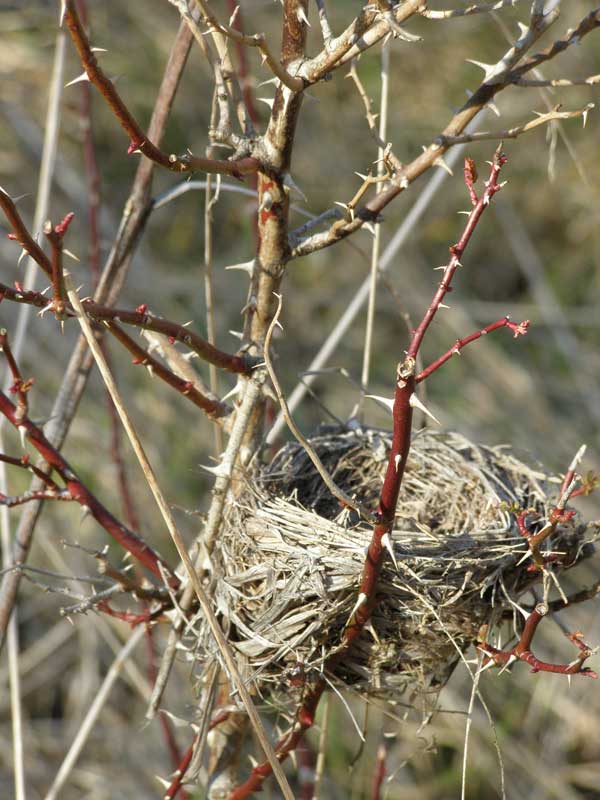
In the tall grass beneath the tree, we discovered another small nest, this one of grass and moss, only two feet above the ground. It was neatly constructed in a thorny Carolina Rose, Rosa carolina, another site rather uninviting for potential predators. Perhaps one of the smaller sparrow species was responsible for this nest. Hopefully, the accompanying photographs are enough for proper identification of either or both by a Citizen reader.
The lower nest drew our attention to the burgundy color of the rose stems securing it. Sure signs of spring are the deepening colors of the previous year’s stem growth on many species of trees and shrubs. Like the Carolina rose, Sourwood, Oxydendron arboreum, and Silky Dogwood, Cornus amomum, turn burgundy red. The yellow green stems of streamside willows are easy to spot at long distances. The polished yellow-green branch tips of the common sweetgum, Liquidambar styraciflua, are subtler, but well worth a closer look. On your walks, be alert for other tree and shrub stem colors during these late-winter weeks.
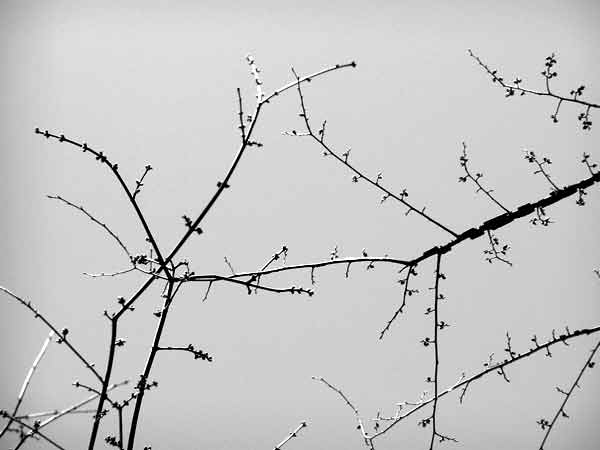
Swollen buds are another sign of approaching spring. We observed that the tiny round flower buds of spicebush, Lindera benzoin, are quite swollen, a prelude to clusters of little yellow flowers that cast a yellow glow across floodplain forests in March before leaves emerge. More noticeable are the swelling red buds of Red Maple, Acer rubrum. The effect will be spectacular in mid-February when those maple flowers are viewed against the blue sky.
If you don’t already regularly enjoy outdoor walks, begin them now during this warm spell to see how many other signs of spring you can find. Don’t let the cold weather that will surely return keep you inside. Even in bitter cold, you will discover that these true signs of spring are hardily persistent.
Email Ken Moore at flora@carrborocitizen.com. Find previous Ken Moore Citizen columns at The Annotated Flora (carrborocitizen.com/flora).
“Dead of winter†summer reflections
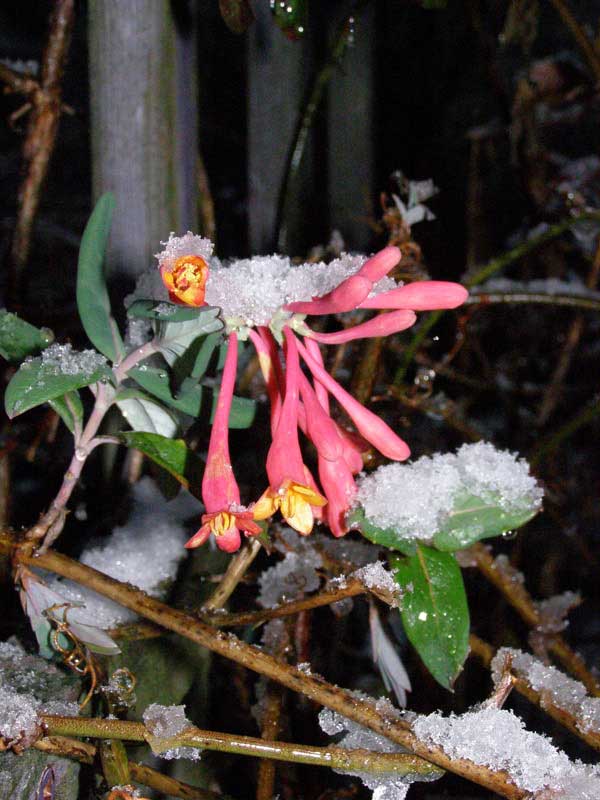
Coral Honeysuckle flowering in mid-winter. Photo by Ken Moore
By Ken Moore
Flora Columnist
It’s the dead of winter, and two summer-flowering vines have captured my interest. A Coral Honeysuckle, Lonicera sempervirens, caught my eye two weeks ago when it screamed across my deck for attention from beneath its cap of snow! Several clusters of scarlet tubular flowers continue to flower in spite of the subsequent below-freezing temperatures. It’s the nature of this native vine to flower off and on throughout the summer into mid-December. Flowering now in midwinter is unusual. But, hey, that’s nature!
Normally, you may glimpse a few red flower clusters reaching out from the forest edge or roadside in late spring and early summer. More noticeable, however, are the masses of flowers where gardeners have established a Coral Honeysuckle on a mailbox, fencepost or other trellis structure in full sunlight. If you pause attentively for just a few minutes, you will likely be rewarded with a sighting of a hummingbird that can’t resist the nectar-filled flowers. Most nurseries now carry one or more cultivars of the Coral Honeysuckle, selected for vigorous re-blooming throughout the season. For me, the pure species puts on just as much of a show.
Coral Honeysuckle is common throughout our forests and roadsides. Unfortunately, we seldom notice this common vine because it does not thrive in forest shade or on sunny sites in competition with numerous exotic invasives, most particularly the Japanese Honeysuckle, Lonicera japonica. The Japanese Honeysuckle is loved by many because of its nectar-rich white flowers that scent up fields and woodland edges on warm early-summer evenings. However, this is not reason enough to allow such an invasive pest to continue covering our wild and cultivated landscapes.
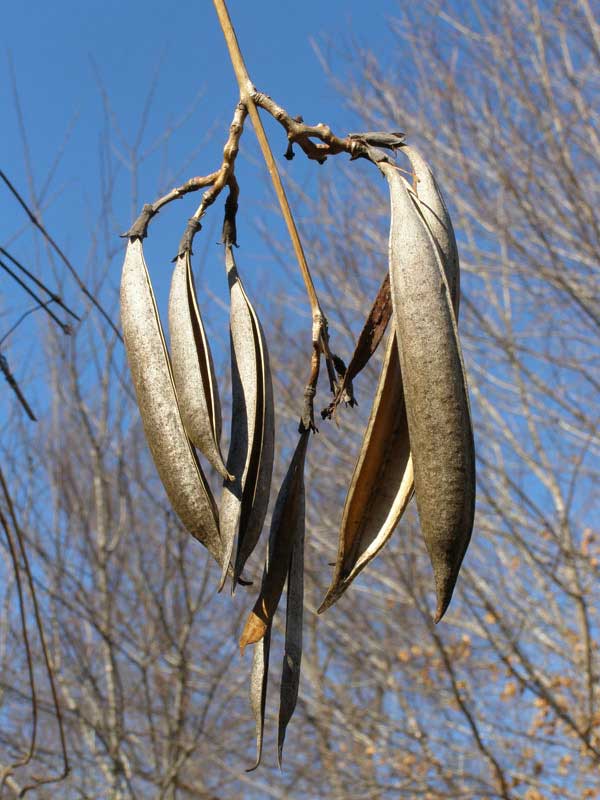
My second winter-interest native vine is the Trumpet-creeper, Campsis radicans. Its orange tubular flowers (also irresistible to hummingbirds) are commonly seen hanging from vines on fence posts, trees and abandoned chimneys everywhere in the midsummer. In the winter months, the curious 4-to-7-inch-long brownish, dry, bean pod-like fruit at the ends of outstretched stems are a real curiosity to many folks who do not connect them with those summer flower clusters. I enjoy watching those hanging seed pods dancing around in the winter winds.
A special curiosity for me this winter was noticing several goldfinches hanging onto the Trumpet-creeper pods near my birdfeeders. Several days of repeated observations proved to me that those birds were diligently extracting the thin wafer-like seeds from within the pods that were slightly splitting along the sides. I tried in vain to get close enough to photograph that discovery, but those smart birds were not about to let me capture their secret. I’m accustomed to goldfinches going for the thistle and sunflower seed, but I never imagined the Trumpet-creeper as a food source for them.
These two vines are worth seeking out in local garden centers for a late-winter planting in your home landscape. Not only are you providing nectar for hummingbirds during the warm season, you are providing seed for goldfinches and winter interest for yourself during the cold months.
Email Ken Moore at flora@carrborocitizen.com. Find previous Ken Moore Citizen columns at The Annotated Flora (carrborocitizen.com/flora).
Robert Frost moments in the Adams Tract
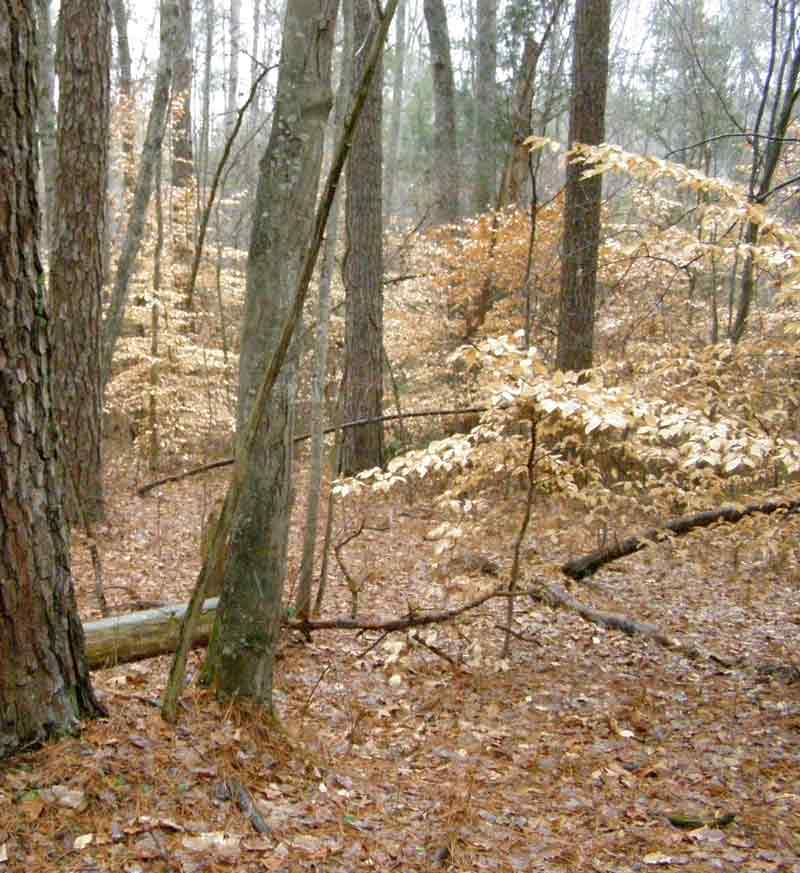
American Beech leaves glistening gold everywhere. Photo by Ken Moore
By Ken Moore
Flora Columnist
A small group of us were rewarded with some beautiful and dramatic surprises during our woods walk on the Adams Tract this past Saturday afternoon. It was very cold, the rain began to fall, and it was two hours before the Tar Heel basketball game. It’s hard to believe that a small group of 11 adults and two lively youngsters would set off into the woods at the edge of Wilson Park at such a moment. But we did, and we were rewarded.
At the beginning of our adventure, I asked the two youngsters, Flora and Jasper, to serve as junior naturalists and lead us forward. Flora immediately initiated a game called “Find that Tree.†She beat us all to the base of the biggest of several sycamores and explained that she could find it because of the bark. We all admired the brilliant white upper trunks of the big trees brightening the dark gray day.
We left the big white trees behind down on the low ground as Flora ran ahead up hill into the piney woods to find leaves of different trees to show us. Young Jasper was proud to find a cone of one of the three different common pines, and that discovery was so important that it did not matter what pine it was.
As we walked from the top of the gently sloped pine forest to the steeper slopes of older deciduous trees, the sight of a distant lone sycamore down on Bolin Creek made us pause. A few steps beyond, we were stopped in our tracks by a thicket of young American Beech trees. They characteristically hold onto their leaves through the winter season. I don’t believe any of us were properly prepared for the Lilliputian forest of copper brown leaves glistening gold everywhere at eye level. A memorable moment, indeed.
We followed the trail down to the creek past big trunks of Tulip Poplars, White, Black, Northern Red and Southern Red Oaks, each with distinctive identifying bark, Flora and Jasper picking up different oak leaves along the way. By this time, the rain had turned to sleet. And as we stood along the creek’s edge, eagerly anticipating snow flakes, our various conversations were abruptly halted by a Red-shouldered Hawk swooping past us and settling not far away on a tree branch at eye level for easy viewing. The group was reverently silenced immediately until all had a good look before the hawk took flight again.
The continued silence was broken only by the crisp sounds of sleet striking tree limbs and the forest floor. Among the woods walkers was my gardening friend Sally, who described how wonderful it would be if we could remain silent long enough to hear the sleet change to snow. Walking out of the woods, the sleet did become quieter and quieter as it slowly turned to snow.
That was definitely a Robert Frost “Stopping By Woods On A Snowy Evening†moment:
“The only other sound’s
the sweep
Of easy wind and
downy flake.â€
Email Ken Moore at flora@carrborocitizen.com. Find previous Ken Moore Citizen columns at The Annotated Flora (carrborocitizen.com/flora).
Experience a winter walk in the woods
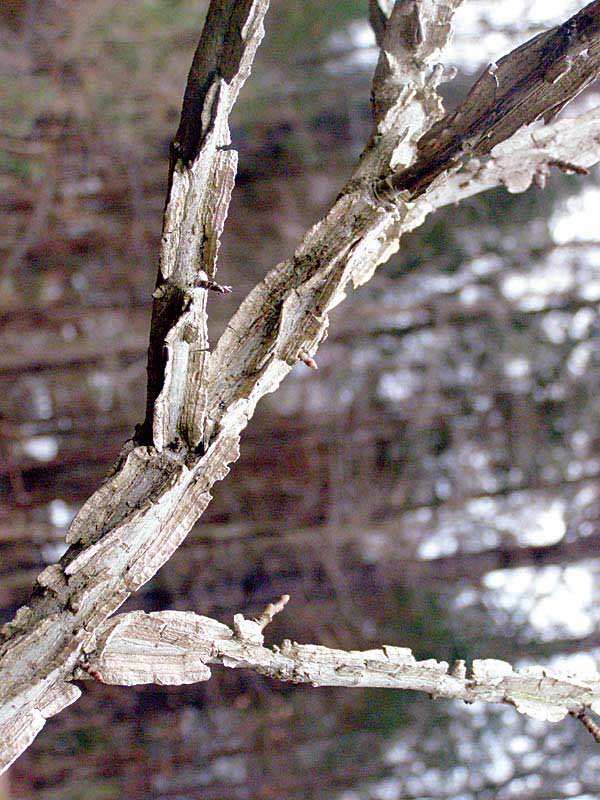
Flat corky Winged Elm branch. Photo by Ken Moore
By Ken Moore
Flora Columnist
I relish the winter woods; there is much to see, many subtleties of interest and beauty that are masked in the summer by dense foliage. The varied terrain of bare trees and the deafening silence of the winter woods are reasons enough to bundle up and become part of that scene. read more…
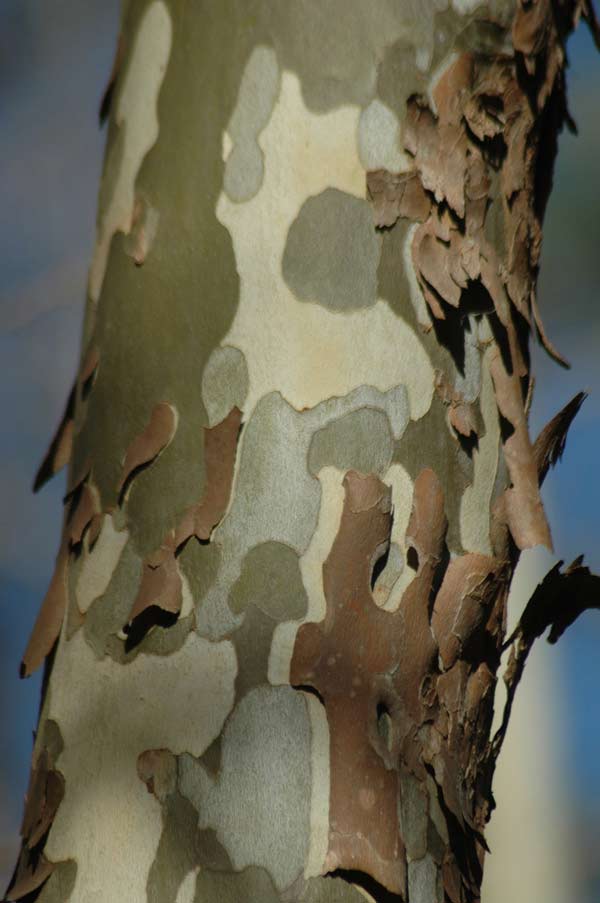
Sycamore bark peels off to change the coarser grey-brown-green bark of the lower trunk to a smooth stark white trunk above. Photo by Peter White.
By Ken Moore
Flora Columnist
Botanical Garden director Peter White loves trees. Chatting with him over a coffee at Open Eye, I mentioned featuring the Sycamore (Platanus occidentalis) in The Citizen’s “Flora†column. He enthusiastically responded with numerous stories.
Its beauty is somewhat obscured by the foliage during the growing season, but in the winter no tree in the Carolinas is like the sycamore with its distinctive bark and habit. The base is somewhat like a typical tree bark. Now, I’ll leave it to your imagination to visualize a “typical†bark. As your eye travels up the trunk of the tree, you will notice bark peeling off in large irregular scales colored from gray and tan to green. Further upwards, the trunk becomes very smooth and snow white in color, reaching skyward to the very branch tips. During the winter months, even viewed from speeding vehicles, the stark white stems along riverbanks are unmistakable. It occurs throughout our state – one of our most magnificent native trees.
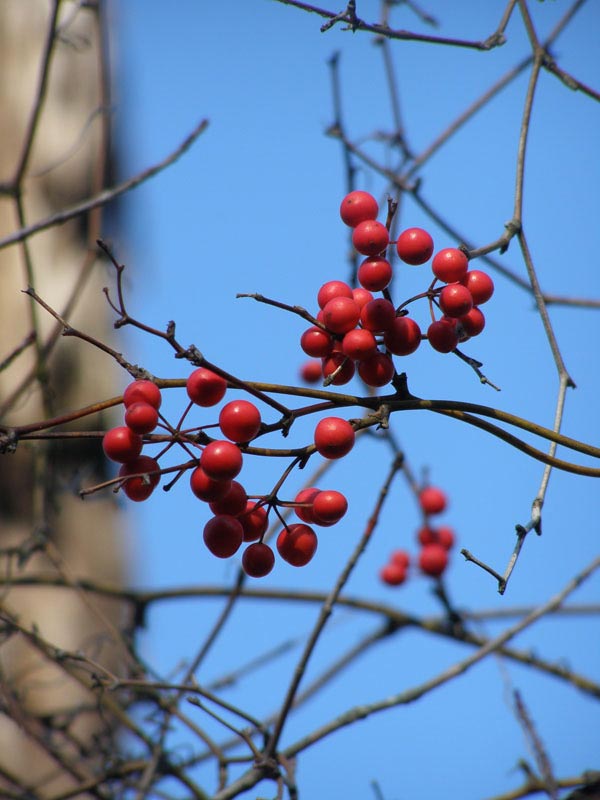
The brilliant red of Red-berried Swamp Smilax adorns bare tree branches in swampy sites. Photo by Ken Moore
By Ken Moore
Flora Columnist
If you are expert at using your “owl eyes†while driving, you may spot some red berries that are neither holly nor dogwood. Like holiday lights, these red berries are strung up in tangles and thickets. I’m describing the fruit of one of the species of catbrier, Smilax sp., that folks curse when they encounter them in the wild.
Most of the Smilax species bear round clusters of black fruit. One of them, the Coral Greenbrier, or Red-berried Swamp Smilax, Smilax walteri, sports brilliant red berries. Unlike the Common Greenbrier, Smilax rotundifolia, and Catbrier, Smilax bona-nox, this red-berried Smilax is most commonly found in the standing waters of the bogs and swamps of the Sandhills and coastal plain. Rarely will you spot it in our eastern Piedmont.

Rachel and Alex Beck hugging a big tree near the Adams Tract trailhead kiosk in Carrboro’s Wilson Park. Photo by Ken Moore.
By Ken Moore
Flora Columnist
Years ago, a tradition was begun by the Eno River Association: Volunteers led New Year’s Day walks along the river that flows through Hillsborough and north through Durham to Falls Lake. Enthusiastic walkers turned out for hikes on some very cold days, and in recent years hundreds of appreciative walkers show up to share the beauty of the river’s winter woods on the year’s first day.
Here in our own community, we are fortunate to have nice trails along low-lying greenway corridors and the Botanical Garden’s nature trails, Mason Farm Reserve and the Battle Park forest between Forest Theater and the Chapel Hill Community Center.
The newest resource for local walkers is Carrboro’s Adams Tract, easily accessed at Wilson Park on Williams Street. The town’s Public Works Landscape Division has installed trail markers and provided laminated maps illustrating locations of labeled specimen trees. The trail and tree ID maps, for use while walking the trails, are available at the Wilson Park Trailhead kiosk.
It is easy to extend the leisurely walk on the Adams Tract to a much longer hike if you wish to explore the adjoining forested Bolin Creek greenway and adjacent hundreds of acres of the university’s Horace Williams property.
This New Year’s Day, take time out for a walk in the woods. Look for a special tree that speaks to you and give it a hug. Take your family and friends. Some trees require more than one person for a hug. Or, each individual can adopt a different special tree. Make a personal resolution to take this walk at least once a week. If not for the tree, do it for yourself.
The winter months are great times for woods walks. Sunlight streams down through the canopy of bare tree limbs to show off, here and there, clumps of evergreen ferns and evergreen wildflowers soaking up the winter sunlight.
My thrill is seeing the lay of the land, the ups and downs of slopes, and all the different kinds of trees. If you pause to observe, you will begin to detect the variety of textures and colors of tree trunks. Most are distinctive enough to allow you to identify them without their leaves. Sometime in January or February, I’m going to lead a tree identification walk on the Adams Tract to prove this to you.
But don’t wait for me. This New Year’s Day, get yourself out there in the woods for a walk in search of your very own huggable tree. And while you’re hugging it, don’t forget to look up to the very top. You will not forget that hug!
And good wishes from me to you and your tree for 2008.
Email Ken Moore at flora@carrborocitizen.com. Find previous Ken Moore Citizen columns at The Annotated Flora (carrborocitizen.com/flora).

A holiday for your cardinal flower

By Ken Moore
Flora Columnist
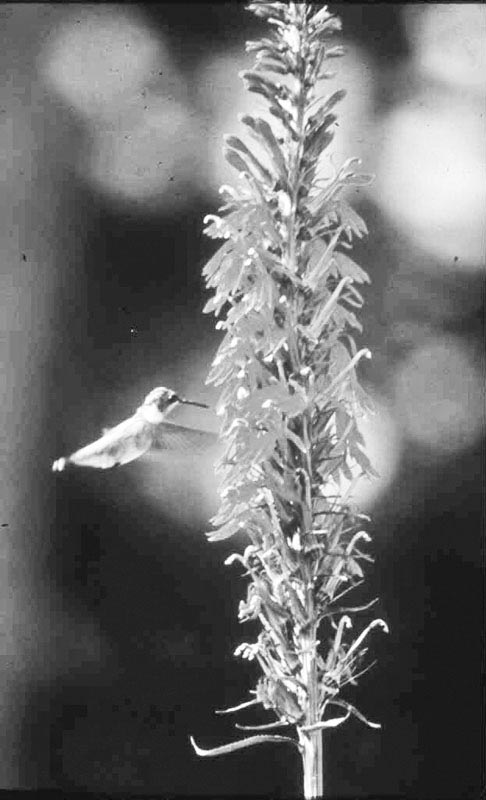
Have you checked on your Cardinal Flower lately? You are likely thinking, “Hey, this is the holiday season and Cardinal Flower, Lobelia cardinalis, blooms in the late summer. This is the season for holly and mistletoe and hoping for snow.â€
But think back to the late-summer brilliant red of Cardinal Flowers and the hummingbirds so attracted to them. If you are a gardener and you’ve been challenged in keeping Cardinal Flower through the winter, now is the time to give a little holiday attention to those plants.
You need to check them now. If the base of the plant has been covered by fallen leaves, or if you are one of those “putting-the-garden-to-bed-for-the-winter†types, you may have carefully covered your plants with mulch. Pull away the mulch, and hopefully you’ll discover that the rosettes of leaves at the base of this past season’s flowering stems are still green. Make certain those shiny green leaves lying flat on the ground are exposed to sunlight all through the winter months.
Though Cardinal Flower is common throughout the state, how often have you seen it growing in the wild, and where have you observed it growing? It is almost always observed along the edge of a pond, stream or ditch. It depends on the action of flowing water to clear away the seasonal leaf litter to insure those basal rosettes are exposed to the winter sunlight. Those green leaves are soaking up the winter sun, actively storing up the necessary energy to grow tall and flower during the next summer season. The winter sunlight allows them to remain vigorous even in summer’s heavily shaded situations. Let those basal rosettes remain covered too long and you can count on losing your plants.
In cultivation, Cardinal Flower responds well to growing in a naturally moist spot or situated near a bird bath or beneath an air conditioner, where a little extra moisture is routine. It will grow well, however, in a regular garden bed, sun or shade, as long as care is taken to provide ample moisture during droughts.
I grow Cardinal Flowers in pots on the deck. Sitting in trays of water they never go dry, and I enjoy the hummingbirds visiting the red columns of flowers up really close during mid-summer through early fall.
Looking ahead to next summer, give your Cardinal Flowers a little attention this holiday season. If you don’t have any in your garden, be nice to yourself and plan to include some this coming spring.
Email Ken Moore at flora@carrborocitizen.com. Find previous Ken Moore Citizen columns at The Annotated Flora (carrborocitizen.com/flora).