The Fiddler’s Companion
© 1996-2009 Andrew Kuntz
_______________________________
HOME
ALPHABETICAL FILES REFERENCES
|
COLM - COLV |
|
Notation
Note: The tunes below are recorded in what
is called “abc notation.” They
can easily be converted to standard musical notation via highlighting with
your cursor starting at “X:1” through to the end of the abc’s, then “cutting-and-pasting”
the highlighted notation into one of the many abc conversion programs
available, or at concertina.net’s incredibly handy “ABC Convert-A-Matic” at http://www.concertina.net/tunes_convert.html **Please note that the abc’s in the Fiddler’s
Companion work fine in most abc conversion programs. For example, I use
abc2win and abcNavigator 2 with no problems whatsoever with direct
cut-and-pasting. However, due to an anomaly of the html, pasting the abc’s
into the concertina.net converter results in double-spacing. For
concertina.net’s conversion program to work you must remove the spaces
between all the lines of abc notation after pasting, so that they are
single-spaced, with no intervening blank lines. This being done, the F/C
abc’s will convert to standard notation nicely. Or, get a copy of
abcNavigator 2 – its well worth it.
[AK] |
COLM DANAGHER’S. AKA and see “Jim Keeffe’s
(Polka) [2],” “Michael
Murphy’s Slide,” “Rachael
Finch’s Fancy,” “Siobhán Hurl’s.”
Irish, Slide.
COLM O’DONNELL’S. Irish, Reel. E Minor. Standard tuning. AA’BB’. Source for notated version:
Colm O’Donnell (b. 1962, outside Aclare,
COLONEL [1]. Irish, Reel. D Major. Standard tuning. AAB. Kerr (Merry Melodies), vol. 4; No. 161, pg. 19.
X:1
T:Colonel [1]
M:C|
L:1/8
R:Reel
S:Kerr – Merry Melodies, vol. 4, No. 161
(c. 1880’s)
Z:AK/Fiddler’s Companion
K:D
cA A/A/A (fd)ec | dEEF GABd | cA
A/A/A (fd)ec | defg aAAd :|
|| A2 (ag) fedc | B2 (ba) gfed | c2
(ag) fedc | defg aAAd |
Aaag fedc | Bbba gfed | c/c/c (Ac)
dBBc | defg afed ||
COLONEL [2], THE. AKA and see “The
Bucket.” Scottish, Country Dance Tune (9/8 time). The air along with dance
instructions appears in the Bodleian
Manuscript (kept at Bodleian Library,
COLONEL BAIRD [1]. Scottish, Jig. F Major. Standard tuning. AABB. Composed by “the late
Mrs. Oswald of Auchicruive,” for more on whom see "Miss Johnston of Hilton's Fancy".
Carlin (The Gow Collection), 1986;
No. 326. Gow (Fourth Collection of Strathspey Dances), 2nd
ed., originally 1800; pg. 18.
X:1
T:Colonel Baird [1]
M:6/8
L:1/8
R:Jig
N:”Slowish”
B:Gow – Fourth Collection of
Strathspey Dances (1800)
Z:AK/Fiddler’s Companion
K:F
c|(cf).c (cf).d|c2c ~c2d|(cA).F (BG).E|F2F ~F2c|(cf).c (cf).d|c2c ~c2d|(cA).F (BG).E|F3 F2:|
|:B|{A/B/}c2c AFA|{c}B2B GEG|(FG).A (FG).A|{c}B2A
G2B|{A/B/}c2c AFA|”tr”B2B GEG|~F>GA (BG)E|F3 F2:|
COLONEL BAIRD [2]. Scottish, Strathspey. E Minor. Standard tuning. AB. Stewart-Robertson
(The Athole Collection), 1884; pg.
247.
X:1
T:Colonel Baird [2]
M:C
L:1/8
R:Strathspey
B:Stewart-Robertson – The Athole Collection (1884)
Z:AK/Fiddler’s Companion
K:Emin
e>EE>F G>A B<G|F>d A<B G>A F<D|e>EE>F G>A B<f|g>e f<^d B<e e2|
e>EE>F G>AB>G|F<d A>d G>A F<D|E<GF<A G>B A<c|B>G B/A/G/F/ G<E E>B||
e>f g<e B<bg<e|f>e d<g f/g/a/f/ d>f|e>f g<e B<bA<a|g>ef>^d B<ee<B|e>f g<e B<bg<e|
f>e d<g f/g/a/f/ df|g<ef<^d e>B A<F|G>A
B/A/G/F/ G>EE>B||
COLONEL BOYLE OF SHEWALTON.
Scottish, Jig. B Flat Major. Standard tuning. ABB. Composed by Nathaniel
Gow (1763-1831). Colonel John Boyle, a country gentleman from the estate of
Shewalton, Ayrshire, was brother to David Boyle, an advocate and Lord
Justice-General. He was Colonel of the Ayrshire militia, and died unmarried in
1837. Gow (Sixth Collection of Strathspey Reels), 1822; pg. 9.
X:1
T:Col. Boyle of Shewalton
M:6/8
L:1/8
R:Jig
N:”Slow”
C:Nathaniel Gow (1763-1831)
B:Gow – Sixth Collection of
Strathspey Reels (1822)
Z:AK/Fiddler’s Companion
K:Bb
(3A/B/G/|~F>GF {Bc}d2 c/B/|~G>AG {AB}c>BA/G/|F>GF {Bc}d2 B/A/|G>BA B2 (3A/B/G/|F>GF {Bc} d2 c/B/|
G>AG {AB}c>BA/G/|~F>GF
{Bc}d2 B/A/|G>BA B2||:f|f>gf {ga}b>ag|f>gf fdB|f>gf {ba}b>ag|
{b}fed {d}c2F|~F>GF {Bc}d2
c/B/|G>AG {AB}c>BA/G/|~F>GF {Bc}d2 B/A/|G>BA B2:||
COLONEL BYNG'S
FAVORITE. Scottish, Strathspey. D Major.
Standard tuning. AAB. Composed by Nathaniel
Gow (1763-1831). “In playing this Tune the 2nd Strain is to be played 8
notes higher alternately.” Carlin (The
Gow Collection), 1986; No. 24. Gow (Fourth Collection of Strathspey
Dances), 2nd ed., originally 1800; pg. 34.
X:1
T:Colonel Byng’s Favorite
M:C
L:1/8
R:Strathspey
C:Nathaniel Gow (1763-1831)
B:Gow – Fourth Collection of
Strathspey Dances (1800)
Z:AK/Fiddler’s Companion
K:D
d|(d/c/)B/A/ {c}d>A FDDF|GE
{E}e>d cAA{c)d|(d/c/).B/.A/ {c}d>A FDDF|G>E{E}A>F D3:||
G|(FD) A<D FD~D>F|(GE) B>E
GE~E>G|(F<D) A>D FDD>F|{F}G<E {E}A>F D3G|
(FD) A>D FD~D>F|(GE) B>E
GEE>G|F>DA>F B>GA>F|{F}G>E {E}A>F D3||
COLONEL CALL'S. Scottish, Strathspey. A Major. Standard tuning. AB. Composed by
Alexander Walker in honor of Colonel Call of the 3rd Bombay Regiment of Light
Infantry, Her Majesty's Indian Army. A note in
COLONEL CAMPBELL OF MONZIE’S FAVORITE.
Scottish,
Strathspey. C Aeolian. Standard tuning. AB. Glen (1981) finds the tune first in
print in Joshua Campbell's 1778
collection (pg. 68). The title may refer to Colonel Robert Campbell of Finab
and Monzie, M.P. for Argyllshire who purchased the estate of Inverawe House in
1765. He died in 1790 and was succeeded by his son, Lieutenant-General
Alexander Campbell. Carlin (The Gow
Collection), 1986; No. 25. Gow (Third
Collection of Niel Gow’s Reels), 1792; pgs. 8-9 (3rd ed.).
X:1
T:Colonel Campbell of Monzie’s
Favorite
M:C
L:1/8
R:Strathspey
B:Gow – 3rd Collection of Niel Gow’s Reels, 3rd ed.,
pg. 8 (orig. 1792)
Z:AK/Fiddler’s Companion
K:Cmin
G|cccG A3F|GGGE (F/E/)D/C/
B,D|”tr”(C/B,/)C/D/ “tr”(E/D/)E/F/ “tr”G/F/G/=A/ BG|G<DB>D {D}C3G|
cccG A3F|GGGE (F/E/D/C/)
B,D|”tr”(E/D/E/).F/ “tr”(G/F/G/).=A B>dB>e|dBfd {=B}c2 c/d/e/f/||
g<c”tr”g>f gccd|f>gfd
B>cd>f|gc”tr”g>f gcce|dBfd {d}c2 c/d/e/f/|
gc”tr”g>f gccd|(f/g/=a/)b/ (f/e/d/)c/
“tr”B>cdf|g>bf>g dfGc|BG(G/F/)E/D/ {D}C2C||
COLONEL CATHCART. Scottish. John Glen (1891) finds the tune first in print in John Riddell's 1782 collection (pg. 59).
X:1
T:Collonel Crafurd’s Reel (sic)
M:C|
L:1/8
R:Reel
S:Bremner – Scots Reels (c. 1757)
Z:AK/Fiddler’s Companion
K:F
A | F>CA,C F/F/F A>F | G/G/G
B>A GDDE | F>CA,C F/F/F cf | dfcf “tr”A>GF:|
e | f>gag fefc | d/d/d b>a
gdde | f>gag fefc | dfcf “tr”A>GFe | f>gag fefc |
d/d/d ba gdde | fca(g f)(cd)(A |
B)GcB “tr”A>GF ||
COLONEL CROCKET. AKA and see "The Route,"
"Jenny on the Railroad."
Old-time, Breakdown. A Dorian. Standard tuning. AABB. From the playing of Ky.
fiddler Bruce Greene. Jim Taylor (et al) – “The Civil
War Collection, vol. 2.”
X:1
T:Colonel Crockett [2]
M:C
L:1/8
R:Reel
S:Bruce Greene
N:From a transcription by John
Lamancusa, by permission; see http://www.mne.psu.edu/lamancusa/tunes.htm
Z:AK/Fiddler’s Companion
K:Ador
A2 AB cABA | cABA e2 EF | G2 GA BGAG
| BGAG EAAB |
A2 AB cABA | cABA e2 EF | G2 GA BGAG
| BGAG EAAB :|
|: A2A2 ABcd | efge dBGB | d2 ef
gefd | cBAG EAAB |
A2A2 ABcd | efge dBGB | d2 ef gefd |
cBAG EAAB :||
COLONEL CROKETT [2].
American, Reel. The melody appears under this title in George P.
Knauff's Virginia Reels, volume III (
X:1
T:Colonel Crockett [1]
M:2/4
L:1/8
R:reel
B:George P. Knauff’s Virginia Reels, vol. 3 (Baltimore, 1839)
Z:AK/Fiddler’s Companion
K:C
(g/f/)|(e/c/B/c/)
(G/c/B/c/)|(e/c/g/e/) c(d/e/)|(f/d/^c/d/) (A/d/c/d/)|(f/d/a/f/) d(g/f/)|
(e/c/B/c/) (G/c/B/c/)|(e/c/g/e/)
c(f/g/)|(a/f/g/e/) (f/d/e/c/)|(G/c/B/d/) c:|
|:(g/f/)|e/f/g e/f/g|(e/f/g/e/) c2|f/g/a f/g/a|(f/g/a/f/) d2|
e/f/g e/f/g|(e/f/g/e/) (c/e/f/g/)|(a/f/g/e/)
(f/d/e/c/)|(G/c/B/d/) c:||
COLONEL
DAVID STEWART OF GARTH'S REEL. AKA and see "This is no my ain House."
Scottish, Reel. A Major. Standard tuning. AB. Composed by renowned Perthshire
fiddler-composer Niel Gow (1727-1807). The tune appears twice in Gow's
publications; in the Sixth Collection
(1822), and, under the original title, in the First Collection (1784). John Glen (1895) sees it as simply a
transformation of the older Scots tune "This is no my ain House.” The
melody has also been described as a set of “De’il Stick the/da Minister.”
Colonel David Stewart of Garth (1772-1829) was a career army office, who, late
in life wrote an account of Highlanders and Highland customs that did much to
romanticize the militant nature of the Highlanders (for more on whom see “Lieutenant Colonel David
Stewart” and “David Stewart”). Stewart
composed as well; at least one tune of his made it to the Gow collections, “An Original Gallic Air.” Gow (Sixth Collection of
Strathspey Reels), 1822; pg. 4.
X:1
T:Colonel David Stewart of Garth’s Reel
M:C
L:1/8
R:Reel
C:Niel Gow (1727-1807)
B:Gow – Sixth Collection of
Strathspey Reels (1822)
Z:AK/Fiddler’s Companion
K:A
a|e2 Ac/d/ eAcA|d<fe>c B/B/B
Ba|{f}e2 Ac/d/ eAcA|dfec A/A/A Aa|{f}e2 Ac/d/ eAcA|
d<fe>c B/B/B Ba|{f}e2 Ac/d/
eAcA|dfec A/A/A A||d|c(ee)a face|d<f”tr”e>c B/B/B B>d|
c(ee>)a faec|dfec A/A/A
A>d|c(ee>)a face|d<f”tr”e>c B/B/B B>d|ceae faec|d<f”tr”e>c
A/A/A A||
COLONEL FARQUHARSON OF
INVERCAULD. Scottish, Strathspey. D Minor.
Standard tuning. AAB. Composed by Alexander Walker.
COLONEL FORBES'
QUICKSTEP. Similarities in the 'A' part and
less so in the 'B' part to Bayard's "General Taylor's March."
Riley (Flute Melodies), 1814, vol. 1;
No. 72.
COLONEL
FRASER (An Ardtaoiseac
Fraser). AKA –
“Colonel Frazer.” AKA and see “The Donaghmore,”
“Malloy’s Favorite,” “Molloy’s Favourite [2],” "The Green Fields of Ireland."
Irish, Reel. G Major ('B' and 'D' parts) and G Mixolydian ('A' and 'C' parts)
[O'Neill/Krassen & 1915]: G Major (‘A’, ‘B’ & ‘D’ parts) & G
Major/Mixolydian (‘C’ part) [Miller]: G Major (Mitchell, O'Neill/1850 &
1001). Standard tuning. AABCD (Miller): ABCDE (Mitchell): ABCC'DE
(O'Neill/Krassen): AA'BCD (O'Neill/1915, 1001 & 1850): AABBCCDDEE (Taylor).
The tune is a favorite of uilleann pipers, and is known as one of the ‘big’
piping tunes. Versions vary from all-major tonality to one or more parts in the
Mixolydian mode. It was first recorded on a wax cylinder by Irish-American
piper Patsy Touhey (1865-1923), whom Francis O’Neill said was a “genial,
obliging and unaffected wizard of the Irish pipes.” Seán Keane identifies it a reel from the north
***
Patsy and Mae Tuohey around 1900.
***
Flute player Seamus Tansey relates
that Colonel Fraser was an English landlord in
X:1
T:Colonel Fraser
M:C|
L:1/8
R:Reel
S:O’Neill – 1001 Gems (1907), No. 520
Z:AK/Fiddler’s Companion
R:Reel
K:G
dc|:BGAF D>G (A}(3GFG|AFcF
dFcF|BGAF DGGg|1 fdcA d2 cA:|2 (3fed cA BG G2||
dggf g2 bg|fdcB ABcA|Gg{a}gf
gbag|fdcA BG G2|gfge d2 dc|(3Bcd BG ABcA|
GBAc (3Bcd eg|fdcA BG G2||B>d
(3ddd BGdG|AFcF (3ABc AF|B>c (3ddd BGdG|
cAFG AG G2|B>d (3ddd BGdG|AFcF
(3ABc AF|(3GAB (3ABc (3Bcd eg|fdcA BG G2||
(3BcB GB (3BdB GB|(3ABA FA (3AcA
FA|(3BcB GB (3BdB GB|{d}cAFG AG G2|
(3BcB GB
GBGB|(3ABA FA FAFA|GBAc (3Bcd eg|fdcA D2 cA||
COLONEL FRASER OF
KNOCKY. Scottish, Strathspey. G Major.
Standard tuning. AAB. Stewart-Robertson (The
Athole Collection), 1884; pg. 171.
X:1
T:Colonel Fraser of Knocky
M:C
L:1/8
R:Strathspey
B:Stewart-Robertson – The Athole Collection (1884)
Z:AK/Fiddler’s Companion
K:G
c|d2 B>d G>Gd>B|d>e B<d e<AA>e|d2 B>d G>Gd>B|c>ed>A B<GG:|
c|B>GB>d c>ed>B|c>eB>d e>AA>c|B>GB>d c>ed>B|c>eB>g B>GG>c|
B>GB>d
c>ed>B|c>eB>d e>AA>c|B>G (3Bcd (3def g>B|c>ed>A
B<GG||
COLONEL G.S. (SCOTTY) MORRISON.
AKA – “Col. G.S. (Scotty) Morrison.” Canadian, Pipe March (6/8 time). D Major.
Standard tuning. AA’BB’CCDD’. Composed by Pipe Major Don Carrigan for a former
Colonel of the Black Watch, Royal Highlanders of Canada. Shears (Gathering of the Clans Collection, vol. 1),
1986; pg. 36.
X:1
T:Col.
Garden's Birth day
C:R.
Petrie
S:Petrie's
Second Collection of Strathspey Reels and Country Dances &c.
Z:Steve
Wyrick <sjwyrick'at'astound'dot'net>,
N:Petrie's Second Collection, page 15
L:1/8
M:C
R:Strathspey
K:G
B|G>AB<G
c>AB<G|c<AB<G E<AF<D|G>AB<G c<AB<G|d>Bc<A
G2G:|
B|d>eg<d
e<gd<B|c<aB<g A>GF<D|d>eg<d e<gd<B|c<Ad>B
G2GB|
d<eg<d
e<gd<B|c<aB<g A>GF<D|d<gb<g d<gd<B|c<Ad>B
G2G|]
COLONEL GLENN. Irish, Reel. G Major. Standard tuning. AB. Named for astronaut and
senator John Glenn of Ohio (?). Composed by uilleann piper Andy Conroy, of
X:1
T:Colonel
Glenn
C:Andy
Conroy
L:1/8
M:C
K:G
ge|dB B2 AG
G2|Bd d2 edge|dB B2 AG G2|edgB A2 Bc|dedB AG G2|
Bd d2
edge|dB B2 gedB|AGAB G2||ga|bg g2 ag g2|eB B2 AG G2|
DB B2 AG
G2|edgB A2 ga|bg g2 ag g2|eB B2 AG G2|dB B2 gedB| AGAB G2||
COLONEL H.F. CAMPBELL. Scottish, Strathspey. G Major. Standard tuning. AAB. The melody appears
in Misses White's 1797 collection. Glen (The
Glen Collection of Scottish Dance Music), vol. 2, 1895; pg. 16.
X:1
T:Colonel H.F. Campbell
M:C
L:1/8
R:Strathspey
S:Glen Collection, Vol. 2 (1895)
Z:AK/Fiddler’s Companion
K:G
G2d2 d>Bdg | egdg AFDF | G2d2
d>Bdg | egfa g2g :| g>ab>a gddg | egdg AFDF |
g>ab>a gddg | egfa g2g2 |
f>ab>a gddg | egdg AFDF | G2d2 d>Bdg | egfa g2g2 ||
COLONEL HAMILTON OF
PENCAITLAND'S STRATHSPEY. Scottish, Strathspey
("slow"). C Major. Standard tuning. AAB. Composed by Nathaniel
Gow (1763-1831), son of the famous fiddler Niel, and adjudged by many the
better and more accomplished musician due to a superior education (he played
the trumpet and cello in addition to the violin). Nathaniel was a most
successful orchestra leader and music publisher but was not as shrewd as his
father in business matters, for he bankrupted ultimately. Nevertheless, he was patronized by the Scottish
nobility and the Gentlemen of the Caledonian Hunt, and even received pensions
from various sources, including king George IV.
***
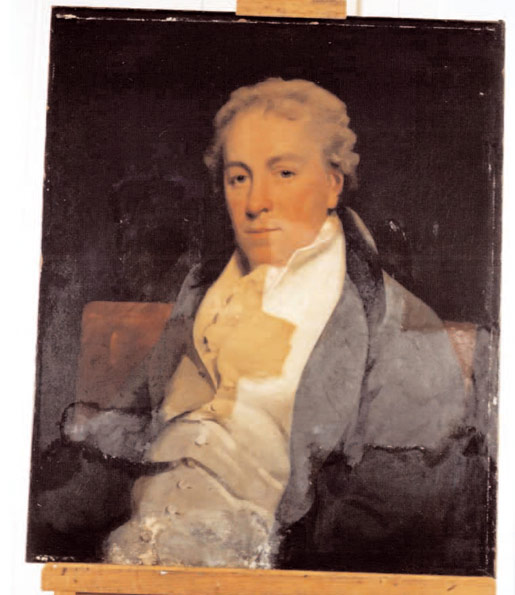
Colonel John Hamilton, painted by Henry
Raeburn
***
Colonel John Hamilton of Pencaitland
(1751-1804), to whom Nathaniel dedicated the tune, was laird of
Pencaitland House,
X:1
T:Colonel Hamilton of Pencaitland’s
Strathspey
M:C
L:1/8
R:Strathspey
C:Nathaniel Gow (1763-1831)
B:Gow – 2nd Collection of Niel Gow’s Reels, pg.13, 3rd
ed. (orig. 1788)
Z:AK/Fiddler’s Companion
K:C
“tr”E/>D/|Cc (d/c/).B/.A/
(A/G/).F/.E/ {E}c2|Cc “tr”cB/A/ Bdd>e|(f>e)dc {c}B2 AG|(A/B/c/B/)
(d/c/)B/A/ Gcc:||
e/d/|c>g (e/f/g/a/) gc
(a/g/f/e/)|”tr”fa/g/ (f/e/).d/.c/ “tr”Bd de/d/|”tr”c>d”tr”e>f gefa|ge
(f/e/).d/.c/ Gc ce/d/|
cg (e/f/g/a/) gc
(a/g/f/e/)|”tr”fa/g/ (f/e/)d/c/ Bd dg/f/|{f}”tr”e>d{d}”tr”c>A
G.E.F.G|(A/B/).c/.B/ (d/c/).B/.A/ G[Ec][Ec]||
COLONEL HAMILTON OF PENCAITLAND’S WELCOME HOME.
Scottish, Air (9/8 time). B Flat Major. Standard tuning. AAB. Composed
by Nathaniel
Gow (1763-1831), son of the famous Perthshire fiddler-composer Niel, who
also composed “Colonel
Hamilton of Pencaitland’s Strathspey.” Gow (Fourth Collection of
Strathspey Dances), 2nd ed., originally 1800; pg. 32.
X:1
T:Colonel Hamilton of Pencaitland’s
Welcome Home
M:9/8
L:1/8
R:Air
C:Nathaniel Gow (1763-1831)
B:Gow – Fourth Collection of
Strathspey Dances (1800)
Z:AK/Fiddler’s Companion
K:Bb
D|B,2(F F)DB {B}A2C|B,2(F F)DF
GAB|dcB .F(.D.B) {B}A2C|B,DF BFD B,2:||
e|”tr”d2(f f)df e2c|d2(f f)df
“tr”g>ab|”tr”d2(f f)df e2c|”tr”d>ef ecA B2e|
”tr”d2(f f)df e2c|”tr”d>ef ecA B2e|”tr”d2(f f)df gab|f2 g/a/ bfd gec|fdB ecA
B3||
COLONEL HAMILTON'S
DELIGHT. AKA and see "Hamilton House [1]." Scottish, Jig.
G Major. Standard tuning. AABBCC'. Composed by Joseph Reinagle (1762‑1836)
around 1783 or earlier. Joseph was the English-born son of an Austrian trumpet
player who lived in Portsmouth, and first gained prowess on horns. He gave them
up French Horn and trumpet, according to Groves Dictionary of Music and
Musicians, due to his brother’s skill on them, but, later returned to them
after the death of his sibling. He transferred his skill to the violin and
cello, and gained great fame as a teacher and performer on those instruments.
It was Reinagle who taught Nathaniel Gow the cello, and he became leader of St.
Cecelia’s Hall, Edinburgh. the theatre band. After a two-year stay in Dublin,
Reinagle moved to London and became a prominent cellist with orchestras there,
and even a principal player for the Haydn and Salomon concerts. The tune
appears in Niel Gow's Strathspey Reels,
the Sharpe Manuscript, and
COLONEL HOPKINS (An Ardtaoiseac Opcins). Irish, Reel. G Major. Standard
tuning. AAB (O'Neill/Krassen): AA'B (O'Neill/1850). O'Neill (Krassen), 1976;
pg. 107. O'Neill (Music of Ireland: 1850
Melodies), 1903/1979; No. 1260, pg. 237.
X:1
T:Colonel Hopkins
M:4/4
L:1/8
R:Reel
S:O’Neill – Music of
Z:AK/Fiddler’s Companion
K:G
ge|dBGB d2 ef|g2 af gfed|bgaf gfed|1
BedB A2:|2 egfa g2||GA|B2 dB A2 BA|
GABG AGFD|B2 dB A2 BA|GABG A2
ge|dBGB d2 ef|g2 af gfed|bgaf gfed|egfa g2||
COLONEL IRWIN. AKA and see “Planxty Irwin.”
COLONEL JOHN IRWIN. AKA and see "Planxty
Irwin."
COLONEL
COLONEL MACBEAN. AKA and see "Colonel McBain's."
COLONEL MACDONELL’S STRATHSPEY. Scottish, Strathspey. E Dorian. Standard tuning. AABB. McGlashan (A Collection of Reels), c. 1786; pg. 6.
X:1
T:Colonel MacDonell’s Strathspey
M:C|
L:1/8
R:Strathspey
S:McGlashan – Reels (c. 1786)
Z:AK/Fiddler’s Companion
K:Edor
e| G<E E2 D>G G<B| A/A/A e<A c>A e<A| G<E E2 D>G G<B| c>AB>G A/A/A e:|
|:f| g<g a/g/f/e/ d/c/B/A/ G<B| c/d/e A>Bc>d e>f| g<g a/g/f/e/ d/c/B/A/ G<B| c>AB>G A/A/A e:|
COLONEL MANUS
O'DONNELL. Irish, Planxty (6/8 time). A
Dorian. Standard tuning. One part. Composed by blind Irish harpter Turlough O'Carolan
(1670-1738). Complete Collection of
Carolan's Irish Tunes, 1984; No. 126, pg. 90‑91.
COLONEL McBAIN'S (An Ardtaoiseac Mic Baeitine). AKA – “Colonel McBean.” AKA and see
"Boston Rattlers',"
"Brian Boru’s March [1],"
"Dan Sullivan's Reel,"
"The Devonshire Reel [1],"
"The Duke of Clarence Reel,"
"General McBean," "Hobb's Favorite," “Johnny’s Wedding,” "Miss
Abercrombie's Reel," “Mother’s
Delight,” "Seán Frank," “Sporting Paddy [3],” "Sporting Molly." Scottish (originally),
Irish; Reel. G Minor (most versions): E Minor (O'Neill). Standard tuning. AB
(Howe, O'Neill, Surenne): AAB (Gow, Honeyman, Hunter, McGlashan): AABB (Cole).
Glen (1891) finds the earliest publication of the tune in Robert Bremner's 1768 2nd collection
(pg. 101). O’Neill (1922) remarks: “’Col. McBain's Reel’ first appeared
in print in Bremner's 2nd Collection
of Scots Reels, or Country Dances, London 1768, and reprinted in McGoun's Repository of Scots and Irish Strathspeys,
Reels, etc., Glasgow 1803. Its
popularity was not confined to
X:1
T:Colonel MacBean
M:C|
L:1/8
R:Reel
B:Stewart-Robertson – The
Athole Collection (1884)
Z:AK/Fiddler’s Companion
K:Gmin
c|B/c/d Gd BGdG|A/B/c Fc AFcA|B/c/d Gd BGdG|^F/G/A DF G2G:|
A|~(B2 B)f B/B/B fd|cdcB ABcA|G(gg)a bag^f|g/a/b a^f ~g2 ga|
g/a/b fd ~Bdfd|cdcB ABcA|Bdg^f gdce|dBcA G2G||
X:2
T:Colonel McBain
M:C|
L:1/8
R:Reel
B:O’Neill – Dance
Music of
Z:AK/Fiddler’s Companion
K:Emin
EF|GBEF GEBE|FADE FDAD|GBEF GEBE|FADF E2 EF|
GBEF GEBE|FADE FDAD|G2 GF GBdB|AFDF E2||EF|
G2 GF GBdB|ABAG FAAF|Eee^d ef|gefd Beef|gfge dedB|
ABAG FGAF|Beed BcdB|AFDF E2||
X:3
T:Colonel McBain's Reel
M:4/4
L:1/8
S:Rice-Walsh manuscript
Z:Paul Kinder
R:Reel
K:E Dorian
EF|GEBE GABG|FDAD FGAF|GEBE GABc|dBAF E2 EF|
GEBE GABG|FDAD FGAF|GEBE GABc|dBAF E2||
ef|gefd edBc|dBAG FD D2|gfed edBA|Beed e2 ef|
gefd edBc|dBAG FD D2|EFGA B2 Bc|dBAF E2||
X:4
T:Col.
Macbean's Reel
C:R.
Petrie
S:Petrie's
Second Collection of Strathspey Reels and Country Dances &c.
Z:Steve
Wyrick <sjwyrick'at'astound'dot'net>,
N:Petrie's Second Collection, page 14
L:1/8
M:C|
R:Reel
K:Gm
c|(B/c/d)
(Gd) BGdG |(A/B/c) (Fc) AFcF|(B/c/d) (Gd) BGdG |^F/G/A DF G2 G, :|
A|B3f
B/B/B (fd)|cdcB ABcA|G(gga) bag^f|gba^f g2 (ga)|
(g/a/b)
(fd) Bdfd|cdcB ABcA|Bdg^f gdce |dBcA G2G |]
COLONEL McBAIN’S FANCY. AKA – “Colonel MacBain’s Fancy.” AKA and see “Mrs. Gordon of Cairness.” Canadian,
Reel.
T:Colonel
McBain’s Fancy
L:1/8
R:Reel
Z:AK/Fiddler’s Companion
K:Amix
a | A2 ec
e2 ea | f2 af feea | A2 ec e2 ea | cdec BABc | A2 ec e2 ea | f2 af feef |
a2 af e2 ae
| cdec BABc || a2 af e2 ae | f2 af feef | a2 af e2 ae | cdec BABc |
a2 af e2 ae
| f2 af feef | agaf e2 ae | cdec BABc || A2 eA A2 fe | A2 af feea |
A2 eA A2 fe | cdec BABc | A2 eA A2
fe | A2 af feef | a2 af e2 ae | cdec BABc ||
COLONEL McDONALD OF LOCHGARIE’S. Scottish, Strathspey. A Major.
Standard tuning. AAB. The melody appears in Malcolm MacDonald of Dunkeld’s 2nd Collection, dedicated to
the Earl of Breadalbane. MacDonald (A
Second Collection of Strathspey Reels), 1789; pgs. 5-6.
X:1
T:Colonel McDonald of Lochgarie’s
M:C
L:1/8
R:Strathspey
S:MacDonald – Second Collection of Strathspey Reels (1789)
Z:AK/Fiddler’s Companion
K:A
E | G/B/B B>c e>fgf | e>cBG
F/F/F “tr”F2 {E/F/} | G/B/B B>c
e>fgf | e>cB>G E/E/E E :|
a | {g/a/}b>geg {g/a/}b>geg |
ab/a/ ga/g/ “tr”f>efa | {g/a/}b>geg {g/a/}b>geg | a>fb>g e/e/e
eg/a/ |
{g/a/}b>geg bgeg | ab/a/ ga/g/
“tr”f>efg | e>f {e/f/}g>f e>cB>e | “tr”c>B e>G E/E/E E ||
COLONEL McKAY. Scottish, Reel. C Major. Standard tuning. AAB. John Glen (1891) finds
the earliest printings of the tune in Robert
Bremner's 1768 2nd collection (pg. 112) and Daniel Dow's c. 1775 collection (pg. 12).
Petrie (2nd Collection of Strathspey
Reels and Country Dances), 1796; pg. 22.
X:1
T:Col.
Mackay's Reel
C:R.
Petrie
S:Petrie's
Second Collection of Strathspey Reels and Country Dances &c.
Z:Steve
Wyrick <sjwyrick'at'astound'dot'net>,
N:Petrie's Second Collection, page 22
%
No listing for this tune in Gore's Index
L:1/8
M:C
R:Reel
K:C
e|c(CCE)
G3_B|AFEC DF_B,D|(C/D/E/F/ G)
e|(c/d/e/f/
g)c acgc|ecgc f(dde)|(c/d/e/f/ g)c acgc|fdec G(cce)|
(c/d/e/f/
g)c acgc|fdec (B/A/B/c/ d)e|cGEC FAG_B|A(aTgf) ecc|]
COLONEL MERCER OF
ALDIE’S.
Scottish, Strathspey. D Mixolydian. Standard tuning. AAB. The tune was
printed by Malcolm MacDonald of
Dunkeld in his 2nd Collection, dedicated to the Earl of Breadalbane.
MacDonald (A Second Collection of
Strathspey Reels), 1789; pg. 9.
X:1
T:Colonel Mercer of Aldie’s
M:C
L:1/8
R:Strathspey
S:MacDonald – 2nd Collection of Strathspey Reels (1789)
Z:AK/Fiddler’s Companion
K:Dmix
A | D/D/D (A>F) A>BAF | C/C/C
C2 C>E c>E | D/D/D A>F A>BAG | F>D d>^c d>D D :|
f | d/d/d f>d e>dfd | c/c/c
c>e gece | d/d/d f>d e>df>d | d>BA>G F>DD>f |
d/d/d f>d e>dfd | c/c/c
(c>e) g>ecg | a>fge f>de^c | B<d”tr”AG F>D D ||
COLONEL MIKE. American?, Reel. G Major ('A' part) & E Minor ('B' part). Standard
tuning. AABBAA. Harding’s All-Round
Collection), 1905; No. 67, pg. 21.
X:1
T:Colonel Mike
M:2/4
L:1/8
R:Reel
S:Harding’s All Round Collection, No. 67 (1905)
Z:AK/Fiddler’s Companion
K:G
Gz ^dz|z/e/c/e/ d/B/A/G/|dz
Fz|z/G/e/B/ d/e/g/b/|gz ^dz|z/e/c/e/ d/B/A/G/|
dz Fz|z/D/C/A,/ G,z::E/B/G/E/
B/G/E/B/|c/A/E/c/ A/E/c/z/|F/B/A/F/ B/A/F/c/|B/G/E/F/ (G/F/E/)z/:|
COLONEL
MONTGOMERY. Scottish, Strathspey. D Major.
Standard tuning. AAB (Gow): AABB' (Athole). Composed perhaps for Hugh
Montgomerie (1739-1819) of Coilsfield, the 12th Earl of Eglinton.
Montgomerie (or Montgomery) was a successful soldier who served in
***
Hugh Montgomery, 12th
Earl of Eglinton (1739-1813), in the uniform of the Black Watch.
***
Carlin (The Gow Collection), 1986; No. 26. Gow (The First Collection of Niel Gow’s Reels), 1784 (revised 1801); pg.
14. Stewart-Robertson
(The Athole Collection), 1884; pg.
91.
X:1
T:Colonel Montgomery
M:C
L:1/8
R:Strathspey
B:Stewart-Robertson – The
Athole Collection (1884)
Z:AK/Fiddler’s Companion
K:D
d>BA>F E>DEF|d>BA>F E>D B,2|d>BA>F E>DE>g|f>e d<f ef d2:|
A<d f>d g>ef>d|A<d f>d e>d B2|1 A>d
f>d g>ef>d|e>fa>f ef d2:|2 A<d f>d g>ef>d|e/d/e/f/
a>f ef d2||
COLONEL MONTGOMERY'S
WELCOME HAME. Scottish. Glen (1891) finds the
earliest printing of the tune to be in Robert
Riddell's 1787 collection (pg. 19).
COLONEL O’HARA. Irish, Planxty. F Major. Standard tuning. AB. Composed by blind Irish
harper Turlough O'Carolan (1670-1738). Donal O’Sullivan believes the title may
refer to Sir Charles O’Hara of
COLONEL
PICKERING’S MARCH TO
COLONEL REID’S MARCH. American (?), March. The melody
appears in the music manuscript copybook of Henry Livingston, Jr.
COLONEL
COLONEL RIDLEY'S
QUICKSTEP. Scottish, March (6/8 time). A
Minor. Standard tuning. AB. Composed by Abraham
MacIntosh. The original version was in A Major, and set in minor by Nigel
Gatherer. Gatherer (Gatherer’s Musical
Museum), 1987; pg. 20.
COLONEL ROBERTSON [1]. AKA and see “The
Massacre of Glencoe [2].” Scottish, Canadian; March (6/8 time). D Major
(Miller & Perron, Perlman, Sweet): G Major (Sweet). Standard tuning. AA’B
(Miller & Perron, 2nd Ed.): AABB' (Miller & Perron): AABB’CC
(Perlman): AA'BB'CC' (Sweet). Composed by L. Beaton and dedicated to a Colonel
of the Toronto Highlanders, a battalion of the Canadian Army. Source for
notated version: Jimmy Halliday (b. 1924, Eldon, Queen’s County,
X:1
T:Colonel Robertson [1]
M:6/8
L:1/8
R:March
K:D
a | fed A2d | BGB A2a | fed A2d |
c2e e2a | fed A2d | BGB A2d |
BGd cAe | d3 z2 :| f/g/ | afd f2a |
fef def | gfg ecA |1 gfg efg | afd f2a |
fef d2A | BGd cAe | d3 z2 :|2 gfg
e2A | dfA ece | faf d2A | BGd cAe | d3 z2 ||
COLONEL ROBERTSON [2]. Scottish, Strathspey. E Minor. Standard tuning. AAB. The melody is
attributed to Niel Gow in the Gow’s 2nd
Collection (1788). The title may refer to Colonel Alexander Robertson (see
“Colonel Robertson of Strewan’s Welcome Home” below, for more), like Gow from
Perthshire. Gow (Second Collection of
Niel Gow’s Reels), 1788; pg. 12 (3rd edition). Stewart-Robertson
(The Athole Collection), 1884; pg.
156.
X:1
T:Colonel Robertson
M:C
L:1/8
R:Strathspey
B:Stewart-Robertson – The
Athole Collection (1884)
Z:AK/Fiddler’s Companion
K:Edor
B2 B>A B>EE>F|A>d B/A/G/F/ D/E/F/G/ A>d | B2 B>A B>de>f | d>B d/B/A/F/ E2 E2 :|
e>fe>d B/A/B/d/ e2|d>ed>B A/F/A/B/ d>f | e>fe>d e/d/e/f/ g>e | d>B d/B/A/F/ E2 E>d |
e>fe>d B/A/B/d/ e2|d>ed>B A/F/A/B/ d>f | g>ef>d e>Bd>A|d>A B/A/G/F/ B2E2 ||
COLONEL
ROBERTSON OF LAWERS STRATHSPEY.
Scottish, Strathspey. D Major. Standard tuning. AAB. The melody appears
in the 4th collection of Malcolm
MacDonald of Dunkeld, a volume dedicated to the Countess of Breadalbane.
MacDonald (A Fourth Collection of
Strathspey Reels), 1797; pg. 8.
X:1
T:Colonel Robertson of Lawers
M:C
L:1/8
R:Strathspey
S:MacDonald – 4th Collection of Strathspey Reels (1797)
Z:AK/Fiddler’s Companion
K:D
F/E/ | D>A, D<F D>A, D<F
| “tr”E>DEF F<A A2 | B>
(A/4B/4c/) | d>AF>A d>e
{g}fe/d/ | B<ed<f e2 eg | f<a “tr”a>f gfed | (B/c/d) AF D2
D(A/4B/4c/) |
d>AFA d>e g/f/e/d/ |
B<ed<f e2 e>f | d>dA B<d AF | “tr”E>DEF D2D ||
COLONEL
ROBERTSON OF STREWAN’S WELCOME HOME. AKA and see “Wearmouth Lads.” Scottish, Jig. E Dorian.
Standard tuning. AAB. Composed by the great Perthshire fiddler Niel Gow
(1727-1807) in honor of Colonel Alexander Robertson of Struan (also Strowan) in
Perthshire. Many of the Robertson lands in Perthshire had been annexed as a
result of the family’s involvement in the Rising of 1745, and the remainder
eventually devolved upon Alexander, who obtained a restitution of the Strowan
in 1784. This was perhaps in part due to his service in the 82nd
Hamilton Regiment. The 82nd was raised in 1778 by the 8th
Duke of Hamilton for service in the war in
***
The news of the return of the
Robertson estates in 1784 must have struck a responsive chord in Perthshire, as
evidenced by Gow’s composition and the song below, by poetess Maighriread
NicGriogair of Struan (whose brothers settled in
|
‘S èibhinn naidheachd ri chluinntinn Gun d’ fhuair gach oighre am fearann Nix o thionndaidh a’ chuibhle ‘S gun deach ‘n t-aonta ud thairis Sàr-cheann fine bha cliùiteach As fhiach a chuir siud an aithris Tighearna Shruthain o’n ghiubhsaich Thighinn gu dùthchas a sheanar |
The news is exciting to hear That each heir has been granted
land Now that the Wheel has turned So that the Act has been approved; The excellent chieftain who was
renowned Is worthy of this account; The Laird of Struan from the
pinewood Is to come into his ancestral
heritage |
***
Gow (Second Collection of Niel Gow’s Reels), 1788; pg. 12 (3rd
edition).
X:1
T:Colonel Robertson of Strewan’s
Welcome Home
M:6/8
L:1/8
R:Jig
C:Niel Gow
B:Gow – 2nd Collection of Niel Gow’s Reels, pg. 12 (1788)
Z:AK/Fiddler’s Companion
K:E Minor
B,|”tr”E2.e (G2.e)|”tr”F2D
AFD|”tr”E2e (G2e)|”tr”B>^c^d e2 e/f/|”tr”g>fe d^cB|(AF).d DEF|
”tr”E2e G>AB|B,^C^D E2:||B|(e2b)
“tr”g2e|”tr”f2d (af).d|e2b g2b|”tr”B>^c^d e2 e/f/
|”tr”g>fe d^cB|(AF).d DEF|”tr”E2e
G>AB|B,^C^D E2B|(e2b) “tr”g2e|”tr”f2d (af).d|
e2b g2b|”tr”B>^c^d e2
e/f/|”tr”g>fe d^cB|(AF).d DEF|”tr”E2e G>AB|B,^C^D E2||
COLONEL RODNEY (An Ardtaoiseac Rodnaig). AKA and see “Brandlings.” Irish, Reel. A Major.
Standard tuning. AB (O’Neill): AABB (Martin & Hughes). The Irish name for
the Scottish tune “Brandlings,” composed by Abraham Mackintosh but appearing in
John Watlen's 1798 2nd collection. Source for notated version: Chicago fiddler
James Kennedy who had the tune from his father, a celebrated local fiddler from
Ballinamore, County Leitrim [O’Neill]. Martin & Hughes (Ho-ro-gheallaidh), 1990; pg. 39. O'Neill
(O’Neill’s Irish Music), 1915/1987;
No. 236, pg. 125. O'Neill (Krassen), 1976; pg. 107. O'Neill (Music of
Ireland: 1850 Melodies), 1903/1979; No. 1263, pg. 237. O'Neill (Dance
Music of Ireland: 1001 Gems), 1907/1986; No. 531, pg. 99. Coleman Music Center CHC 009, flute player Éamonn Cullen –
“The Coleman Archive, vol. 2: The Home Place” (2005. Various artists).
|
See also listings at: Alan Snyder’s Cape Breton Fiddle
Recording Index Jane Keefer’s Folk Music Index: An
Index to Recorded Sources Alan Ng’s Irishtune.info |
X:1
T:Colonel Rodney
M:C|
L:1/8
R:Reel
S:O’Neill – Dance Music of
Z:AK/Fiddler’s Companion
K:A
c>A (3AAA eAce|eaga fedc|d>B
(3BBB fBde|fefg afed|c>A (3AAA eAce|
eaga fedc|defg abaf|(3efg ae
cAAz||e2 ce Aece|aAgA fAeg|f2 df Bfdf|bBaB gBfB|
(3efe ce aece|eaga fedc|defg abaf|(3
efg ae cAAz||
X:2
T:Colonel Rodney
R:reel
Z:Larry Sanger from a tape of a tape of a tape...of John Doherty.
Z:In this performance John varied the tune remarkably little, but
Z:played just 2.5 times.
M:4/4
K:A
d|:cA A/A/A eAcd|eaga fedc|dB B/B/B fBde|fefg afed|
cA A/A/A eAcd|eaga fedc|defg abaf|1 e/f/g ae cAAd:|2 e/f/g ae cAAf||
|:e/f/e ce Aece|aAgA fe^de|f/g/f ^df Bfdf|bBaB gBf^d|
e/f/e ce Aece|aAgA fAec|dcde fgaf|1 e/f/g ae cAAf:|2 e/f/g ae cAAd||
COLONEL ROGERS (Coirnéal Mhac Ruaidhrí). AKA – “Colonel Roger’s Favorite,”
“Colonel Rogers Fancy.” AKA and see “The
Joys of Youth,” “McKenna’s [1] (Reels).,”
“Seán McKenna’s [1].” Irish, Reel. G
Major. Standard tuning. AB (most versions); AA’BB’ (Harker/Rafferty).
Breathnach (1963) states the second turn of this tune is similar to the turn of
Petrie’s No. 154 in his Complete
Collection (edited by Stanford). The tune was recorded by flute player John McKenna
(1880-1947) in
|
See also listing at:
Alan Ng’s Irishtune.info |
X:1
T: Colonel Rogers
S: Liam Og O'Flynn
D: The Piper's Call
M: 4/4
L: 1/8
Z: Transcribed by Dennis J. Gormley
K: G
(3DEF|G2 dB cAFA|GABc dBcA|G2 dB
cAFA|GBAF G3 F|
G2 dB cAFA|GABc defg|afge fdcA|GBAF
G2 :|
|:ge|fdde fdcA|dggf g2ag|fdde
fdcA|GBAF G2 ge|
fdde fdcA|dggf g2ag|~f3d ecAF|GBAF G2:|
..........................
COLONEL SMITH’S LAMENT. Scottish, Slow Air (4/4 time).
D Major. Standard tuning. AB. Composed by the great Scots fiddler J. Scott Skinner (1843-1927). Colonel George Smith
Grant came into the Glenlivet distillery at Minmore in 1901, after the death of
George Gordon Smith, his uncle. The Smiths detested the fact that some
distilleries made their whisky with steam heated boilers. Distillers who
employed such a measure should not be allowed to call their product Scotch
whisky, he complained to the whisky commission, and received the legal
acknowledgement that only he could call his product ‘The Glenlivet,’ although
others could use it as a suffix. See also Skinner’s tune “Glenlivet [1].” Skinner (Harp and Claymore), 1904; pg. 148.
X:1
T:Colonel Smith’s Lament
M:C
L:1/8
R:Slow Air
C:J. Scott Skinner (1843-1927)
S:Skinner – Harp and Claymore (1904)
Z:AK/Fiddler’s Companion
K:D
A<A ({A}d2) ed f2 | e>df>e
ed ({d}B2) | A<A d2 (ed) ({d}f2) | ed Bd ({B/d/}B)A A2 |
A<A ({A}d2) ed f2 | edf>e ed
B2 | AA d2 ed f2 | ed Bd BA A2 || A<A ({A}f2) A<A ({A}d2) |
A<A f>d ed ({d}B2) | A<A f2
A<A d2 | ef af ({f}e)d d2 | A<A ({A}f2) A<A ({A}d2) |
A<A a>f ({f}e)d ({d}B2) |
A<A ({A}d2) (ed f2) | a>f ({f}e)d ({B/d/}B)A A2 ||
..........................
COLONEL TAYLOR’S. AKA and see “The Beauty Spot.”
..........................
COLONEL THORNTON. Scottish, Strathspey; Canadian, Reel.
***
His whole life was devoted to sports of the field. He showed great
partiality
for falconry, being determined to bring the sport to the height of
perfection but
his sporting interests and abilities were varied. In a walking match, he
went four
miles in thirty-two minutes and a half a second. He was able to jump his
own
height (5 feet, 9 inches)—in response to a considerable wager. In
another match
he jumped over six five-barred gates in six minutes, then repeating the
same
feat on horseback. With respect to shooting, either with fowling-piece,
rifle or
air-gun, Colonel Thornton has given the most incontestable proofs of the
steadiness of his hand and the wonderful correctness of his sight, not
only in
bringing down the game, but also at the mark, in which his precision has
never
been surpassed.
***
He married in 1806 Miss Cawson of
X:1
T:Colonel Thornton
M:C
L:1/8
R:Strathspey
B:Stewart-Robertson – The Athole Collection (1884)
Z:AK/Fiddler’s Companion
K:C
B,|A,/A,/A, E>A, C3E|B,>G,D>G, E>G,D>G,|A,/A,/A, E>A, C>A,E>C|B,>G,D>B, E2A:|
|:B,|A,<A, A2 E<
|:E|C/B,/A, E>A, C/B,/A, E>A,|B,/A,/G, D>G, EG,DG,|C/B,/A, E>G, C/B,/A, E>A,:|
|:B,|A,<A,
A2 EE A2|G>ED>G B,<G, D>B,|A,<A, A2 E<
X:2T:Colonel ThorntonS:Sandy MacIntyreZ:abc transcription wil macaulay wil@syndesis.comZ:http://www.interlog.com/~torocelt/tuneofthemonth.htmlA:Cape Breton R:ReelM:C|L:1/8K:ADorA| E(A,A,B,) C2 CE | DCB,D ECDB, | E(A,A,B,) C/C/C CE | DB,GB, (G,A,) A,:|B,| (G,A,)A,A EA,EA | GEDG B,G,G,B, | (G,A,)A,A EA,EA| GEDB, A,/A,/A, A,B,| (G,A,)A,A GAAE | GEDC B,DDA | E(A,A,B,) C/C/C CE | DB,GB, (G,A,) A,||B,| A,aag {ab}agea | gedg BAGB| Aaab {ab}ageg | dBgB A2 AB |Aaab {ab}ageb | gedg BAGB | cBAB cdec | dBgB A2A||
COLONEL
W. MARSHALL OF THE 79th REGIMENT OF FOOT. Scottish, Strathspey. C Major.
Standard tuning. AB. Composed by William Marshall (1748-1833).
The Colonel Marshall referred to in the title was Marshall's third (and only
surviving) son, also named William, who served in the Napoleonic Wars and lost
his right arm at the battle of Quatre Bras, just prior to Waterloo. He retired
to live in the house built by his father, Newfield and was remembered as a
popular figure in the district of Aberlour/Craigellachie in his later years
(Cowie, The Life and Times of William
Marshall, 1999). It was he who honored his father with a gravestone in Bellie
Cemetery, Fochabers. The Colonel’s regiment, the 79th Regiment of Foot was also
known as The Queen's Own Cameron Highlanders, and although a Scottish regiment
it usually had a number of Englishman in it at any one time (Farwell, 1981).
X:1
T:Colonel W. Marshall of the 79th Regiment of Foot
M:C
L:1/8
R:Strathspey
S:
Z:AK/Fiddler’s Companion
K:C
E/F/|G>A G<E G>AGE|c>d e/d/c/B/ A/G/F/E/ (DE/F/)|G>A G<E G>A G<f|
E<c g>e d2 c||e/f/|g>a g<e g>a g<e|(fg/a/) (a/g/)f/e/ fdd(e/f/)|g>a g<e c>d c>G|
(A<a) (g>f) e2 de/f/|g>a g<e g>a g<e|(fg/a/) (a/g/)f/e/ fdd(e/f/)|c>d c<G A>c (B/A/)(G/F/)|E>G c/e/g/e/ d2c||
COLONEL WEMYSS [1]. Scottish, Reel. F Major. Standard tuning. AAB. Stewart-Robertson (The Athole Collection), 1884; pg. 233.
X:1
T:Colonel Wemyss
L:1/8
M:C|
R:Reel
B:Stewart-Robertson – The Athole Collection (1884)
Z:AK/Fiddler’s Companion
K:F
C|F2 AF ABcf|AFcF EGGA|F2 AF ABcA|dfeg ~fFF:|
g|a/g/f/e/ fc ABcf|AFcF EGGg|fefc ABcA|dfeg fFFg|
afge
fdcB|AFcF EGGB|AfcF Bcde|fcdB AFF||
COLONEL WEMYS' REEL
[2]. Irish, Reel. G Major. Standard
tuning. ABC. A different tune than #1 of the same title. O'Neill (O’Neill’s Irish Music), 1915; No. 296,
pg. 148.
X:1
T:Col. Wemys’ Reel [2]
M:4/4
L:1/8
R:Reel
S:O’Neill – O’Neill’s Irish Music (1915)
Z:AK/Fiddler’s Companion
K:G
g2 dc B2 AG | FGAB cAAf | gfgd cBAG
| DGAc BGGz | g2 dc B2 AG | FGAB cAAf |
gfgd cBAG | DGAc BG G2 || B |
(DG)(BG) (DG)(BG) | (DG)(BG) cAAB | (DG)(BG) (DG)(BG) |
(DG)(Ac) BGGB | DGBG DGBG | DGBG
cAAc | Bdef gedc | BdAc BG G || g |
efge fgab | gfge fdde | efge fgag |
fefd g2 Bd | efge dBgB | ceBd AFED | GABG EGce | dBcA G2z2 ||
COLORED ARISTOCRACY. AKA and see "Southern Aristocracy." Old‑Time, Breakdown. USA, West Virginia. G Major. Standard tuning. AB (Silberberg): AA'BB' (Brody). This late 19th century or c. 1900 tune is more correctly categorized as a cakewalk (which suggests ragtime from its syncopated rhythms) rather than a fiddle tune though the popularized version apparently comes from old-time fiddler Sanford Rich, a resident of Arthurdale, West Virginia in August of 1936. Arthurdale, according to Kerry Blech and Gerald Milnes, was a resettlement camp for displaced persons during the depression, a project of Elanor Roosevelt’s, and it was there at a festival of folk heritage that musicologist Charles Seeger (father of New Lost City Ramblers member Mike Seeger) recorded the Rich Family for the Library of Congress (AFS 3306 B2). Gerald Milnes has located Sanford’s son, Elmer Rich, an elderly man who still fiddles and who remembers the event. Mike Seegar learned the tune at a young age by playing the aluminum recordings in his parent’s house. It became one of the first tunes recorded by his group the New Lost City Ramblers in the early 1960’s, and introduced the song to “revival” era fiddlers.
***
The
second chord in the accompaniment has been variously played as both an E minor
and an E major. The origin of the title remained obscure, although it was
speculated that it derived from Reconstruction sentiments (or resentments)
about the perceived attitude (either within or without the black community) of
some African-Americans (i.e. that “Colored Aristocracy” was a gentrification of
“Uppity N....r”). However, Peter Shenkin tracked the title to a piece of sheet
music from a 1902 revue entitled “In Dahomey,” which starred the famous
African-American vaudeville duo Williams and Waltker. The music (entitled
“Leader of the Colored Aristocracy”) is credited to Will Marion Cook, words by
James Weldon Johnson (later of Harlem Renaissance fame), published by Harry Von
Tilzer. Another “Coloered Aristocarcy” dates from 1899 credited to one Gus W.
Bernard (published by the Groene Co.); it is listed as a “Cake-walk” on the cover.
Neither the Bernard tune or the one published by Tilzer is the “Colored
Aristocracy” played by fiddlers, however. Bob Buckingham reports that a
fiddling preacher of his aquaintance named Buck Rife (originally from the
Beckley WV area) calls the tune "The Young Man Who Wouldn't Hoe Corn"
and gave that he had it as a youngster learning clawhammer banjo from an uncle.
Brody (Fiddler’s Fakebook), 1983; pg.
72. Phillips (Fiddlecase Tunebook),
1989; pg. 11. Phillips (Traditional
American Fiddle Tunes), vol. 2, 1995; pg. 33. Silberberg (Tunes I
Learned at Tractor Tavern), 2002; pg. 25.
X:1
T:Colored Aristocracy
M:C
L:1/8
R:Cakewalk or March
Z:AK/Fiddler’s Companion
K:E Minor
D2E2F2 | G3A GED2 | G6A2 | B2Bc BAG2 | E8 | e3f gfe2 | d3e d2B2 | A2B2c2^c2 |
d2D2E2F2 | G3A GED2 | G6A2 | B2Bc BAG2 | E6 e2 | e3f gfe2 | d^cde d2B2 |
BAB(d d)B A2 | G6 || e2 | g3a ged2 | e8 | e2eg e2d2 | B8 | c2cd e2 dc | BABc d2 B2 |
A2B2c2^c2 | d2^d2e2f2 | g3a ged2 | e8 | e2eg e2d2 | B8 | c2cd e2dc | BABc d2B2 |
BAB(d d)BA2 | G6 ||
..............
COLOSSEUM, THE. AKA and see “Coliseum,” "Kay's Hornpipe," “Pet of the House.” Scottish, Irish;
Hornpipe. A Major. Standard tuning. AB (Kerr): AABB (Honeyman). See also note
for “Once Upon my Cheek.” Honeyman (Strathspey, Reel and Hornpipe Tutor),
1898; pg. 44. Howe (1000 Jigs and Reels),
c. 1867; pg. 60. Kerr (Merry Melodies),
vol. 1; No. 4, pg. 42.
X:1
T:Colosseum, The
T:Kay’s Hornpipe
M:C
L:1/8
R:Hornpipe
S:Honeyman – Strathspey, Reel and Hornpipe Tutor (1898)
Z:AK/Fiddler’s Companion
K:A
E2|A2 A2 A>cB>d|c2 c2
c>ed>f|e>ag>f e>dc>B|A>ce>^d f>e=d>B|
A2 A2 A>cB>d|c2 c2
c>ed>f|e>ag>f (3efe (3dcB|A2 a2 A2:|
|:e>d|c>ea>e
c>ea>e|d>fa>f d>fa>f|e>gb>g e>gb>g|a>gb>a
g>fe>d|
c>ea>e
c>ea>e|d>fa>f d>fa>f|e>gb>g d>gb>g|a2 (a2 a2):|
COLPIE'S HORNPIPE [1]. English, Hornpipe. England, Northumberland. B Flat Major. Standard
tuning. AABB. Seattle (William Vickers),
1987, Part 2; No. 247.
COLPIE'S HORNPIPE [2]. English, Hornpipe. England, Northumberland. B Flat Major. Standard
tuning. AABB. Seattle (William Vickers),
1987, Part 2; No. 248.
COLQUHALZIE/COLYNHALZIE
FIR TREES. Scottish, Strathspey. G Major. Standard
tuning. AB. Composed by James Stewart-Robertson, editor of The
Athole Collection. Kerr (Merry
Melodies), vol. 3; No. 39, pg. 7. Stewart-Robertson (The Athole Collection", 1884; pg. 181.
X:1
T:Colquhalzie Fir Trees
M:C
L:1/8
R:Strathspey
C:James Stewart-Robertson
B:Stewart-Robertson – The Athole Collection (1884)
Z:AK/Fiddler’s Companion
K:G
B|G>AB>g d<B B>g|d>Bg>B d<B B>g|G>AB>g d<B B>g|a>fg>B A/A/A A>B|
G>AB>g d<B B>g|d>Bg>B d<B B>d|e<g d>B e>dB>g|a>fg>B A/A/A (A||B)|
G/G/G B>c d<B B>d|g>ed>B A/A/A A>B|G/G/G B>c d<B B>g|
a/g/f/e/
g>e d<B B>d|e>fg>e d<b g>d|e<gd>B A/A/A A||
COLUMBIA HORNPIPE. American, Hornpipe. D Major. Standard tuning. AABB. There has been a
suggestion the tunes with names such as this may have been named after 19th
century engineering feats. There was, for example a famous Columbian
Exposition, and a 19th century packet ship called the Columbia, although what connection these
might have with the tune, if any, is unknown. The most famous American Columbia, however, was a square-rigger
that became the first American sailing ship to navigate the globe, returning to
her home port of Boston on August, 10, 1790, having originally set sail in
1787. While on the voyage the Columbia paid visit to the barely explored
Pacific Northwest, and there discovered a river that her captain, Robert Grey,
named after the ship. Cole (1000 Fiddle
Tunes), 1940; pg. 107. Ryan’s Mammoth
Collection, 1883; pg. 144.
X:1
T:Columbia Hornpipe
M:2/4
L:1/8
R:Hornpipe
S:Ryan’s Mammoth Collection (1883)
Z:AK/Fiddler’s Companion
K:D
A/>B/A/>^G/ A/>B/A/>G/ |
A/>d/.f d/>f/.a | =g/>a/g/>f/ e/>f/e/>d/ | c/>d/c/>B/
A/>G/F/>G/ |
A/>B/A/>&G/
A/>G/A/>G/ | A/>d/.f d/>f/.a | g/>f/e/>d/ c/>A/B/>c/ |
dfd z :|
|: e/>d/c/>B/ A/>B/c/>A/
| d/>e/f/>g/ a/>b/c’/>d’/ | e’/>d’/c’/>b/ a/>g/f/>e/ |
f/>g/a/>b/ a/>c/d/>^d/ |
e/>d/c/>B/ A/>B/c/>A/ |
d/>e/f/>g/ a/>b/c’/>d’/ | e’/>d’/c’/>b/ a/>g/f/>e/ |
dfd z :|
COLUMBIA JIG. Irish, Jig. B Dorian. Standard tuning. AA’BB’. Composed by Chicago
fiddler Liz Carroll, who may originally have set it in A Minor. The tune is
named for Columbia, Missouri.
X:1
T:Columbia
Jig, The
M:6/8
L:1/8
C:Liz Carroll
R:Jig
K:BDor
A||:BBB dcB|BcB BAF|AFB ABc|dfd ecA|!
BFF AFF|dBB BAc|dfd ecA|1 dAc B2 A:|2 dAc B2 b ||!
~a3 geg|eAc B2 d|cAc dBd|cAc B2 a|!
bBB aBB|gBB fec|A/A/AA cdf|1 edc B2 b:|2 edc B2 A||!
"B part variation"
||:~a3 geg|eAc B2 d|cec dfd|cAc B2 a|!
bBB aBB|gBB fec|A/A/AA cdf|1 edc B2 b:|2 edc B2 A||!
X:2
T:
Columbia Jig, The
M: 6/8
L: 1/8
R: Reel
K: Ador
C: Liz Carroll
S: Dan Leonard
E | ~A3 cBA | ABA AGE | GAG GAB | cec dBG |!
AEE GEE | cAB AGB | cec dBG| cAB A2 :|!
a | ~g3 fdf | eAB A2c | BGB cdc | BGB A2A |!
aAA gAA | fEEeEE | ~G3 Bde| dcB A2f ||!
~g3 fdf | eAB A2c | B/A/GB cdc | BGB ~A3 |!
aAA gAA | fEE eEE | ~G3 Bde| dcB A2 ||
COLUMBUS COTILLION.
American, Printed c. 1792. A precursor to the play-party song “Going to Boston,” and the old-time
tune “Goodbye Girls,
I’m Going to Boston.”
COLÚN NELSON. AKA and see “Nelson’s Pillar.”
COLÚR GLAS, AN. AKA and see “The Green Pigeon.”
COLVILLE'S RANT. Canadian, Reel. Canada, Cape
Breton. Canadian Broadcasting Corp. NMAS 1972, Natalie
MacMaster - "Fit as a Fiddle" (1993).
_______________________________
HOME
ALPHABETICAL FILES REFERENCES
© 1996-2009 Andrew Kuntz
Please help
maintain the viability of the Fiddler’s Companion on the Web by respecting the
copyright.
For further information see Copyright and Permissions Policy or contact the author.
[COMMENT1]This was
Font/Pitch 1,10 - Off.
[COMMENT2]This was Font/Pitch 1,10 - On.
[COMMENT3]This was Font/Pitch 1,10 - Off.
[COMMENT4]Note: The change to pitch (12) and font (1) must be converted manually.