The Fiddler’s Companion
© 1996-2010 Andrew Kuntz
_______________________________
HOME ALPHABETICAL
FILES REFERENCES
|
DON - DOV |
|
Notation
Note: The tunes below are recorded in what
is called “abc notation.” They
can easily be converted to standard musical notation via highlighting with
your cursor starting at “X:1” through to the end of the abc’s, then
“cutting-and-pasting” the highlighted notation into one of the many abc
conversion programs available, or at concertina.net’s incredibly handy “ABC
Convert-A-Matic” at http://www.concertina.net/tunes_convert.html **Please note that the abc’s in the Fiddler’s
Companion work fine in most abc conversion programs. For example, I use
abc2win and abcNavigator 2 with no problems whatsoever with direct cut-and-pasting.
However, due to an anomaly of the html, pasting the abc’s into the
concertina.net converter results in double-spacing. For concertina.net’s
conversion program to work you must remove the spaces between all the lines
of abc notation after pasting, so that they are single-spaced, with no
intervening blank lines. This being done, the F/C abc’s will convert to
standard notation nicely. Or, get a copy of abcNavigator 2 – its well worth
it. [AK] |
DON AND KELLY'S WALTZ. American, Waltz. D Major. Standard tuning. AB. Composed by Daniel
Steinberg (Mt. View, CA) in 1992 for the wedding of some friends; it was
conceived "as a kind of cowboy waltz." Matthiesen (Waltz Book II), 1995; pg. 15.
DON FISCO. American, Reel. D Major. Standard tuning. AABB. Sweet (Fifer’s Delight), 1964/1981; pg. 71.
DON FRONT IN BRASS. English,
Jig. A Major. Standard tuning. AABBCC. The melody is unique to London
publishers Charles and Samuel Thompson’s 1757 country dance collection. Thompson (Compleat Collection of 200
Favourite Country Dances, vol. 1), 1757; No. 123.
X:1
T:Don Front in Brass
M:6/8
L:1/8
B:Thompson’s Compleat Collection of 200 Favourite Country Dances, vol. 1 (London, 1757)
Z:Transcribed and edited by Flynn Titford-Mock, 2007
Z:abc’s:AK/Fiddler’s Companion
K:A
d|:efe ece|fdf ecA|efe ecA|BGE Bcd|efe ece|fdf ece|fga ecA|BGE Bcd:|
|:c2a ece|fdf ecA|c2a ece|fdB Bcd|c2a ece|fdf ece|aga ecA|BGE Bcd:|
|:ecA acA|ecA fga|ecA acA|BGE
Bcd|ecA acA|ecA acA|fga ecA|BGE Bcd:||
DON MESSER’S BREAKDOWN.
Canadian, Breakdown. C Major. Standard tuning. AABB. Composed by Canadian radio
and TV fiddler Don Messer (1909-1973), a highly influential musician from the
Maritimes who helped to define the “Down East” style of fiddling. Messer was
originally from New Brunswick but was hired in 1939 by radio station CFCY in
Charlottetown, Prince Edward Island, to anchor its fiddle broadcasts. By 1950
Messer could be heard throughout Canada and the northeastern United States and
became perhaps the most influential fiddler of the mid-20th century in North
America. Transplaned French-Canadian fiddler Omer Marcoux (Concord, N.H.)
played a similar sounding tune but, not knowing the title or where he had it
from, called it simply "Reel #2 in C" [Miskoe & Paul, 1994; pg. 18].
Source for notated version: fiddler Dawson Girdwood (Perth, Ontario) [Begin].
Begin (Fiddle Music in the Ottawa Valley:
Dawson Girdwood), 1985; No. 6, pg. 20. Messer (Anthology of Favorite Fiddle Tunes), 1980; No. 4, pg. 5.
X:1
T:Don Messer’s Breakdown
L:1/8
M:C|
S:From a transcription by Carmelle Begin of the
playing of fiddler Dawson Girdwood.
K:C
G3 (F||E>C)E>G c2 (e>a)|(3gag e>a
g>ec>A|(d^c)de f>dB>d|
(c>B)((3cB)A G2 (G>F)|E>CE>G c2
(e>a)|(3gag e>a g>ec>A|
d^cd>e f>dB>d|1 (c>e) (3dcB c2
G>F:|2 c2 (3dcB c2 (GF)||
|:E2G2c2e2|(g3 g/2)g/4a/4 g2) ((3efg)|a2g2
({f/g/}f2)e2|d>ed>c B2 (cBA|
G2 (FG)B2 GB|1 (g3 g/2)g/4a/4 g2) (3efg|a2g2
f>dB>d|c>Bc>d c2 (G>F):|2
g3 a g2 (3e/f/g/|a2 g2 f>dB>d|c2 z2
[E4c4]||
DON MESSER'S BROADCAST. Canadian, Reel. Condor 977‑1489,
"Graham and Eleanor Townsend Live at Barre, Vermont."
DON PEDRO. English, Country Dance Tune
(2/4 time). A Major. Standard tuning. AABB. The melody is unique to Charles and
Samuel Thompson’s 1765 country dance collection. Thompson (Compleat
Collection of 200 Favourite Country Dances, vol. 2), 1765; 83.
X:1
T:Don Pedro
M:2/4
L:1/8
B:Thompson’s Compleat Collection of 200 Favourite Country Dances, vol. 2 (London, 1765)
Z:Transcribed and edited by Flynn Titford-Mock, 2007
Z:abc’s:AK/Fiddler’s Companion
K:A
a|ecAf|”tr”f2 ea|ecAc|”tr”B2 Ba|ecAf|”tr”f2 ea|ecdB|A3:|
|:e|cefe|aedc|bgec|d
“tr”B2e|cefe|aedc|fdcB|A3:||
DON REED’S BREAKDOWN. Canadian, Reel. Composed by
Sarnia, southwestern Ontario, fiddler John(ny) Durocher (1934-1989), for a
(then) young fiddle player from Sudbury, Ontario. Reed became a three-time
North American fiddle champion, and currently plays with the Canadian
country-and-western group “South Mountain.” Durocher was born the youngest of
sixteen children, to a modest family of few resources. He quit school in his
young teens to help make family ends meet and remained a factory worker for
most of his life, not even possessing a drivers license. John came to fiddling
when he found a broken fiddle in the trash one day and asked the owner for
permission to retrieve it; with some repair work he had his first instrument. A
few lessons from a local teacher (which served to teach him how to read and
write music), were all the formal music education John received. He was a
prolific composer of fiddle tunes, however, and named them for sports and
current events, family and friends and topics of his day, explains Ritchie.
Durocher’s music was picked up by radio fiddler Don Messer, who included many
of his tunes in his broadcasts and printed collections, helping Durocher to
become quite influential in the Ontario scene for his over 400 compositions.
[For more see Ron Ritchie, “John Durocher: A Gifted Composer,” Fiddler Magazine, vol. 12, No. 2, Summer
2005, pgs. 25-27].
DON SIDE. Scottish, Strathspey. G Major. Standard tuning. AB (Surenne): AABB (Perlman): AABBCCDD (Athole, Bremner, Gow, Kerr, Skye). Glen (1891) finds the earliest printing of the tune in Robert Bremner's 1757 collection (pg. 63). Don side refers to the River Don in Scotland. The famous Scots fiddle-composer, James Scott Skinner, told an old joke about a drunk who boards a train trying to get home to his home ‘on the Don side.’ He boards a first train for Stonehaven and is quickly shown the door by a guard—he tries another, only to be told its going to Ballater and he is once again mistaken. Finally he pours himself into the compartment of yet another train, one that happens to be occupied by the then-famous evangelists Moody and Sankey, on their way to revival meetings in Peterhead. "Naturally, in his drunken state, the man made himself a bit of a nuisance,” says Skinner. "Moody gazed at him, more in pity than in condemnation, and then spoke slowly and deliberately:
***
“Do you know
where you’re going to, sir?” he said.
“Na,” came the answer.
“Well, you’re going to
perdition,” was the stern rejoinder.
“Eh?” exclaimed the
maudlin one, waking up somewhat; “I’m in the wrang train again!”
***
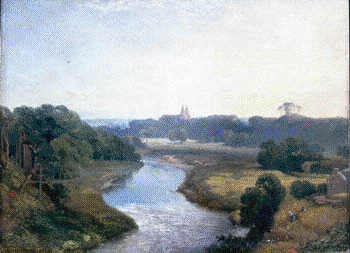
View of St. Machers from the River Don. James Cassie (Inverurie 1819-1879)
***
The strathspey was recorded on a 78
RPM disc by Cape Breton fiddler Angus Allan Gillis. Source for notated version:
Eddy Arsenault (b. 1921, St. Chrysostom, East Prince County, Prince Edward
Island) [Perlman]. Bremner (Scots Reels),
c. 1757; pg. 63. Gow (Complete Repository),
Part 1, 1799; pg. 11. Kerr (Merry
Melodies), Vol. 2; No. 120, pg. 15. Lowe (A Collection of Reels & Strathspeys), 1844. McGlashan (Collection of Strathspey Reels), c.
1780/81; pg. 21. MacDonald (The Skye Collection), 1887; pg. 93.
Perlman (The Fiddle Music of Prince
Edward Island), 1996; pg. 187. Stewart-Robertson
(The Athole Collection), 1884; pg.
166. Surenne (The Dance Music of Scotland),
1852; pgs. 132-133. Rounder
7103, Joseph Cormier – “Joseph Cormier and Friends: Old Time Wedding Reels and
Other…” Rounder 82161-7032-2, Bill Lamey – “From Cape Breton to Boston and
Back: Classic House Sessions of Traditional Cape Breton Music 1956-1977”
(2000).
|
See also listings at: Alan Snyder’s Cape Breton Fiddle
Recording Index |
X:1
T:Don Side
M:C
L:1/8
R:Strathspey
B:Stewart-Robertson – The Athole Collection (1884)
Z:AK/Fiddler’s Companion
K:G
A|G/G/G B>G A>G E<A|G/G/G B>G A>GB>G|c>AB>G A>GE>e| d>cB>A B<GG:|
|:f|g>dg>B A>GE>e|g>dg>B ~g>dg>a|b/a/g/f/ g>B A>G E<e| d>cB>A B<GG:|
DON TREMAINE'S REEL. Canadian, American; Reel. Canada, Ontario. D Major. Standard tuning.
AABB (Brody, Phillips, Songer): AA'BB' (Kaufman). Composed by Barrie, Ontario,
fiddler Graham Townsend, (copyright 1961) and named for the announcer of the
CBC television show “Don Messer’s Jubilee.” The melody is a past favorite at
New England contra dances. Source for notated version: Tom McCreesh and Jay
Ungar (N.Y.) [Phillips]. Brody (Fiddler’s
Fakebook), 1983; pg. 88. Kaufman (Beginning
Old Time Fiddle), 1977; pg. 18. Phillips (Traditional American Fiddle Tunes), vol. 1, 1994; pg. 73. Songer (Portland Collection), 1997; pg. 63. Folkways FTS 31098, Ken Perlman ‑ "Clawhammer
Banjo and Fingerstyle Guitar Solos." Front Hall 01, Fennigs All Stars‑
"The Hammered Dulcimer."
X:1
T:Don Tremaine's Reel
S:New England, via PR
M:4/4
L:1/4
K:D
"D"A/2B/2A/2G/2 F/2D/2E/2F/2|"G"G/2F/2G/2A/2 B/2c/2d/2B/2|\
"A7"A/2c/2e/2g/2 f/2d/2e/2c/2|"D"d/2A/2F/2G/2 AF/2G/2|
"D"A/2B/2A/2G/2 F/2D/2E/2F/2|"G"G/2F/2G/2A/2 B/2c/2d/2B/2|\
"A7"A/2c/2e/2g/2 f/2d/2e/2c/2|"D"dd/2d/2 dz::
"G"g/2a/2g/2e/2 "D"f/2g/2f/2d/2|"A7"e/2f/2e/2d/2 c/2A/2e/2f/2|\
"G"g/2f/2e/2g/2 "D"f/2e/2d/2f/2|"A7"ea/2^g/2 ae/2f/2|
"G"g/2a/2g/2e/2 "D"f/2g/2f/2d/2|"A7"e/2f/2e/2d/2 c/2B/2A/2F/2|\
"G"G/2F/2E/2G/2
"D"F/2E/2D/2F/2|"A7"E/2D/2E/2F/2 "D"D2:|
DONAGHADEE. Scottish, Jig. C Major. Standard tuning. AABB. Kerr (Merry Melodies), vol. 3; No. 281, pg.
31.
X:1
T:Donaghadee
M:6/8
L:1/8
R:Jig
S:Kerr – Merry Melodies, vol. 3, No. 281
(c. 1880’s)
Z:AK/Fiddler’s Companion
K:C
c2c c2c|edc efg|c2c c2c|Bdc BAG|c2c
c2c|edc efg|a2g f2e|dcB c3:|
|:g2g g2g|gag edc|d2d d2d|ded
BAG|g2g g2g|gag edc|a2g f2e|dcB c3:|
DONAGHMORE, THE. AKA and see “Colonel Fraser.” Irish, Reel. Ireland,
Sliabh Luachra region of the Cork-Kerry border. Seamus Ennis recorded the great
Sliabh Luachra fiddle master Padraig O’Keeffe playing this tune in 1949. Spin CD1001, Eoghan O’Sullivan, Gerry Harrington, Paul De
Grae - “The Smoky Chimney” (1996).
DÓNAL A’ CLUMPER’S
REEL. AKA and see “The Gleanntan Reel [2].”
DÓNAL DE BARRA’S
(JIG).
Irish, Jig. Ossian OSS CD 130, Sliabh Notes – “Along
Blackwater’s Banks” (2002. Learned by accordion player Donal Murphy from De
Barra in music classes in Templeglantine, County Limerick).
DÓNAL DE BARRA’S (SLIDE). Irish, Slide (12/8 time). D Major. Standard
tuning. AABB. Dónal De Barra was an accordion player and music teacher from
County Limerick. Bulmer & Sharpley (Music
from Ireland), vol. 4, 1979(?); No. 85 (appears as untitled slide).
Mulvihill (1st Collection),
1986; No. 5, pg. 115.
DONAL
DON. Scottish, March (2/4 time). G
Major. Standard tuning. AB.
X:1
T:Donal Don
D:Jock Tamson's Bairns, May You Never Lack a Scone
Z:Nigel Gatherer
L:1/8
M:2/4
K:G
B2 d>B | AG E2 | A2 B>A | GE D2 | B2 d>B | AG E/F/G/A/ | Bd
BA | G2 G2 ||
D2 D>E | DG GF | E2 E>D | EA AF | D2 D>E | DG GA | Bd BA |
G2 G2 |]
DONAL MOR. Irish. Composed in memory of James MacCafferty's brother Donal. Green Linnet SIF‑1084, Eugene O'Donnell & James
MacCafferty ‑ "The Foggy Dew" (1988).
DONAL O'BRIEN. Irish, Planxty (3/4 time). A Minor. Standard tuning. One part. The tune
is attributed to blind Irish harper Turlough O'Carolan (1670-1738), thought
Donal O’Sullivan, in his definitive work on the bard could find no
incontrovertable evidence of its origin. Complete
Collection of Carolan's Irish Tunes, 1984; No. 112, pg. 82.
DONAL
O'CONNOR’S. Irish, Slide (12/8). G Major. Standard tuning. AABB. Treoir.
X: 1
T: Donal O'Connor's
S: Treoir
M: 12/8
L: 1/8
Q: 350
Z: Transcribed by Bill Black
R: slide
K: G
A | B3 cBA G2 E D2 D | EFG A2 B c3 cBA |
B3 cBA G2 E D2 D | EFG AFD G3 G2 :|
E | D2 B BAB d2 B BAB | D2 G A2 B c2 A ABA |
D2
B BAB d2 B BAB | ABA FGA G3 G2 :|
DONAL OG. Irish, Slow Air (3/4 time). G Major. Standard tuning. One part. Ó
Canainn (Traditional Slow Airs of Ireland),
1995; No. 28, pg. 29.
DONAL O’GRADY. AKA
and see “Buck(e)y Highlander,”
"Daniel of the Sun [1]"
(Donall na Greine),” “Potatoes and
Butter,” "Teddy/Thady you
Gander," “Talk as you please.”
Irish, Jig. G Major. Standard tuning. AABBCC. See “Donald
Na Greanna” for a minor-key version of the melody. Kennedy (Jigs
& Quicksteps, Trips & Humours), 1997; No. 30, pg. 9.
DONALBANE. Scottish, Canadian; Reel or Strathspey. Canada, Cape Breton. A Major. Standard
tuning. AABB. See the related Cape Breton tune “Margaree Reel.” The historical Donalbane
was Donald III, King of Scots and son of Duncan I. In a fight for a contested
crown Donalbane beseiged Edinburgh Castle and was proclaimed King through the
Celtic custom of tanistry. His was the last reign (1094-1097) of a Celtic king
in Scotland and a kingdom goverened according to their customs. Kennedy
(Traditional Dance Music of Britain and
Ireland: Reels and Rants), 1997; No. 35, pg. 10. Kerr (Merry
Melodies), vol. 4; No. 11, pg. 4. Wilson (Companion to the Ballroom), 1815; pg. 80. AM
79602 2000-2, Ashley MacIsaac - “Close to the Floor” (1992). CAT-WMR004, Wendy
MacIssac - “The ‘Reel’ Thing” (1994). Parlophone PMC 1144, Jimmy Shand –
“Jimmy’s Fancy” (appears as “Donald Bane”).
X:1
T:Donalbane
M:C
L:1/8
R:Strathspey
S:Kerr – Merry Melodies, vol. 4, No. 11 (c. 1880’s)
Z:AK/Fiddler’s Companion
K:A
a|e/e/e
e>d c>de>c|A<e c<a (f2 e)a|e/e/e e>d c>de>c|B/B/B
c>e (f2 e):|
|:g|a>ga>f
e<c A>g|a>e f<a f2 (ef/g/)|a>ga>f a>f e<c|B/B/B c>e
(f2 e):|
DONALD ANGUS BEATON. Canadian, Jig. Canada, Cape Breton. G Minor. Standard tuning. AABB’.
Composed by Cape Breton fiddler and composer Dan R. MacDonald (1911-1976) in
honor of Mabou fiddler Donald Angus Beaton (1912-1982). Cameron (Trip to Windsor), 1994; pg. 60.
DONALD ANGUS BEATON’S. Canadian, Strathspey. Canada,
Cape Breton. Composed by Cape Breton fiddler Sandy MacInnis in honor of Mabou
fiddler Donald Angus Beaton (1912-1982). Smithsonian
Folkways Records, SFW CD 40507, The Beaton Family of Mabou – “Cape Breton
Fiddle and Piano Music” (2004).
DONALD BACCAGH’S
LAMENT. Irish, Slow Air (4/4 time).
Ireland, County Derry. B Flat Major. Standard tuning. AB. “A County of Derry
Air” (Petrie). Stanford/Petrie (Complete
Collection), 1905; No. 1021, pg. 259.
X:1
T:Donald Baccagh’s Lament
M:C
L:1/8
R:Air
N:”A County of Derry air.”
B:Stanford/Petrie – Complete Petrie Collection of Ancient Irish
Music, No. 1021 (1905)
Z:AK/Fiddler’s Companion
K:Bb
Bc/d/|edcB G2 FD|F2 GB c2 d/e/f|edcB
GB FD|{G}F2 {F}GB B3||
B/c/d|edef g2 fd|ce/f/ gf f2 bg|fd
e/d/c/B/ G2 FD|{G}F2 GB B3||
DONALD BLUE. Shetland, Shetland Reel or March. Shetland, Mainland district (also
Papa Stour and Fetlar). D Major. Standard tuning. AB (Flett & Flett): AABB
(Anderson, Brody, Hunter, Martin & Hughes). The melody was collected under
a different name by the English musicologist Pat Shuldham‑Shaw. David
Murray (Music of the Scottish Regiments,
Edinburgh, 1994) writes, “The first pipe major of the 2nd Battalion
(of the Scots Fusilier Guards) was Donald MacPherson, who transferred from the
Black Watch; and it is, perhaps, a result of this connection that the Scots
Guards play as their ‘Lights Out’ call, the march ‘Donald Blue’, as do the
Black Watch and, indeed, did the Gordons, and that the pipe bag covers of the
Scots Guards are in the Black Watch tartan” (pg. 122). Source for notated
version: Tom Anderson and Aly Bain (Shetlands) [Brody]; Fraser Hughson (Aith,
Shetland) via Tom Anderson (Lerwick, Shetland) [Anderson & Georgeson].
Anderson & Georgeson (Da Mirrie
Dancers), 1970; pg. 25. Brody (Fiddler’s
Fakebook), 1983; pg. 87. Flett & Flett (Traditional Dancing in Scotland), 1964; pg. 220. Hunter (Fiddle
Music of Scotland), 1988; No. 211. Martin & Hughes (Ho-ro-gheallaidh), 1990; pg. 31. Philo 2019, Tom Anderson and Aly Bain‑ "The
Silver Bow."
X:1
T:Donald Blue
M:C
L:1/8
R:Reel
K:D
dBAF AFAB|dBAF E2D2|cBAF AF A2|BBBA
B2e2:|
|:ABde fafd|fafd ed B2|ABde
fafd|BBBA B2d2:|
DONALD CAIRD('S COME
AGAIN). Scottish, Strathspey. The melody is
mentioned by Alexander Campbell in Albyn's
Anthology (1812) when he states in a footnote, "This air is a dancing
measure or slow strathspey, danced by two highlandmen with appropriate gesture,
but without the fling or gambol peculiar to the quicker strathspey or
reel."
DONALD CAMERON'S POLKA. AKA and see “Donald Cameron’s Reel.” Canadian, Reel.
Canada, Cape Breton. G Major. Standard tuning. AABB. Despite the polka
appelation Brody identifies the tune as a reel coming from the Shetland
Islands. Source for notated version: Joseph Cormier (Cape Breton &
Massachusetts) [Brody]. Brody (Fiddler’s
Fakebook), 1983; pg. 87. Rounder 7004, Joe Cormier‑
"The Dances Back Home" (1977). Rounder 7006, Theresa and Marie
MacLellan‑ "A Trip to Mabou Ridge."
DONALD CAMERON’S REEL. AKA and see “Donald Cameron’s Polka.”
Canadian, Reel. Canada; Cape Breton, Prince Edward Island. G Major. Standard
tuning. AABB. Perlman (1996) identifies the tune as coming from Cape Breton,
though Brody (1983) prints the source originally as the Shetland Islands.
Source for notated version: Sterling Baker (b. Mid-1940's, Montague, Northeast
King’s County, Prince Edward Island) [Perlman]. Perlman (The Fiddle Music of Prince Edward Island), 1996; pg. 47.
DONALD COUPER. See “Donald Couper and His Man.”
Scottish, English.
DONALD COUPER AND HIS
MAN. Scottish, Reel (2/4 time). D Major.
Standard tuning. AB. Probably the same as Playford’s “Donald Couper,” printed
in 1657. Words to the tune go:
***
Donald Couper and his man,
They’ve gane to the fair;
They’ve gane to coort a bonny lass,
But fint a man wis there;
But he haes gotten an auld wife,
An she’s come hirplin hame;
An she’s fa’n ower the buffet-stool,
An brake her rumple-bane.
***
Sing, hey Donald, how Donald,
Hey Donald Couper;
He’s gane awa to coort a wife,
An he’s come hame ifhoot her.
***
"That it was a Scots tune can
be seen in the mention it receives in a satirical poem about the Highlanders
written by a certain Colonel Cleland in 1697:
***
Trumpets sounded, skeens were glancing
Some were 'Donald Couper' dancing (Williamson).
***
Aird (Selections
of Scotch, English, Irish and Foreign Airs), vol. II, c. 1786; No. 9, pg.
4. Johnson (Scots Musical Museum,
vol. IV), 1792. Flying Fish FF358, Robin Williamson ‑
"Legacy of the Scottish Harpers, vol. 1" (1984).
X:1
T:Donald
Couper and His Man
M:2/4
L:1/8
R:Reel
S:Aird,
vol. II (c. 1786)
Z:AK/Fiddler’s Companion
K:D
d |
B/c/d/e/ dA | B(ee)d | B/c/d/e/ dB | gfed | B/c/d/e/ dA | BddB | gfe ||
(f/g/) | adba | fe ef/g/ | adba |
{g}f2 e(f/g/) | adba | g/f/e/d/ f/e/d/c/ | B/c/d/e/ dB | gfe ||
DONALD DOW. AKA and see "Lady
Charlotte Murray [3]." Scottish, Strathspey. F Major. Standard tuning.
AB. An excellent composition by Daniel Dow
(d. 1783) who hailed from Kirkmichael, Perthsire, who may also have been called
Donald. The tune was originally named "Lady Charlot Murray's Reel."
Carlin (The Gow Collection), 1986;
No. 421. Gow (Complete Repository),
Part 3, 1806; pg. 28. Surenne (Dance
Music of Scotland), 1852; pgs. 44-45.
X:1
T:Donald Dow’s Strathspey
M:C
L:1/8
R:Strathspey
S:Gow – 3rd Repository (1806)
Z:AK/Fiddler’s Companion
K:F
d|c>F (d/c/B/A/) cFFd|c<A
f>A cGG>d|c>F (d/c/B/A/) cAA>f|{f}e>d ec f2 fd|
c>F (d/c/B/A/) cFFd|c<A f>A
cGG>d|c>F (d/c/B/A/) cAA>f|{f}e>d ec f2f||
d|c<A f>A dfAf|c<A f>A
cGG>d|c<A f>A cfAf|{f}e>d ec f2 f>d|c<A f>A cfAf|
c<A f>A cG ~G>B|{B}A>G
AF Accf|{f}e>d ec f2f||
DONALD IAN RANKIN. Scottish, March (6/8 time) or Jig. F Major. Standard. ABCD. Fairly
recently composed by a Scottish dance‑band leader who lived and worked in
Liverpool, Andrew Rankine. Martin (Ceol
na Fidhle, vol. 3), 1988; pg. 34.
DONALD JOHN THE TAILOR (Domhnull Iain an Taillear). AKA and see “Ardrishaig.” Canadian, Strathspey (can also be
played as a reel). Canada, Cape Breton Island. A Dorian (Jerry Holland recorded
it in G Dorian). Standard. AAB. Donald John 'the Tailor' (Domhnull Iain an
Taillear) Beaton {who was known as Dan} was a fidder from the picturesque Cape
Breton, Nova Scotia, village of Mabou Coal Mines who lived from 1856 to 1919.
Kate Dunlay and co-authors (1986, 1996) note that during his day he was a
popular and accomplished musician who garnered a legendary reputation in Cape
Breton music circles, to the extent he is remembered and venerated to modern
times. Pipers call the tune “Ardrishaig,” a place name, which was originally
published as a strathspey in Robert MacKinnon’s Collection of Highland Pipe Music (1901-1906). Source for notated
version: Colin Boyd [Dunlay & Reich]; Mary MacDonald [Dunaly &
Greenberg]. Dunlay and Greenberg (Traditional
Celtic Violin Music from Cape Breton), 1996; pg. 26. Dunlay and Reich (Traditional Celtic Fiddle Music from Cape
Breton), 1986; pg. 33. Boot (BOS) 7231, Jerry
Holland‑ "Master Cape Breton Fiddler" (1982). Celtic CX001,
Colin J. Boyd (c. 1936). Decca 14026 (78 RPM), "Colin J. Boyd" (c.
1936). Rounder Records , John L. MacDonald – “Formerly of Foot Cape Road:
Scottish Fiddle Music in the Classic Inverness County Style” (2005). Shanachie
CB1, Colin J. Boyd - “Pioneer Scottish Fiddle” (1979). 02 50399, Dave MacIssac
- “Nimble Fingers” (1995).
DONALD MACDONALD. Scottish, Pipe Tune. Although a common Highland name, the title may
perhaps refer to the Donald MacDonald, brother of Keppoch, who was the first
standard bearer of the bratach bhan,
or white banner, the flag of Bonnie Prince Charlie in 1745. Green Linnet GLCD SIF 1176, The Tannahill Weavers – “Leaving
St. Kilda” (appears as first tune of “Islay Charms Set”).
DONALD MACGUGAN'S RANT (Port Dhomhnaill Mhic Guthagain). See "Donald MacGuggan's Tune." Scottish
(originally), Canadian; Reel. Canada, Cape Breton. D Major. Standard. AABB.
Cape Breton fiddlers play the parts of the tune in reverse order from the
Scottish collections, with the exception of the Gesto Collection, and the parts tend to be more complex. Gaelic
verses are printed in Gesto. Source
for notated version: Kinnon Beaton (Cape Breton) [Dunlay & Greenberg]; Carl
MacKenzie (Cape Breton) [Dunlay and Reich]. CDAB. Dunlay & Greenberg (Traditional Celtic Violin Music from Cape
Breton), 1996; pg. 78. Dunlay and Reich (Traditional Celtic Fiddle Music from Cape Breton), 1986; pg. 53.
Jones [ed]. (Complete Tutor Violin),
c. 1815; pg. 2. Kerr (Merry Melodies),
vol. 2; No. 156, pg. 18. MacDonald (The
Skye Collection), 1887; pg. 51. MacDonald (The Gesto Collection). Shears (The
Cape Breton Collection of Bagpipe Music), 1995. Stewart-Robertson
(The Athole Collection), 1884; pg.
107. Celtic CX 048, Theresa MacLellan. DAB‑3, 26‑1,
Kinnon Beaton‑ "Cape Breton Fiddle I" (1982. Appears as “Donal
MacGuggan’s Tune”). Rounder 7003, John Campbell‑ "Cape Breton Violin
Music" (1976. Listed as "Reel on D"). Unity Gain U-1002, Dave
MacIsaac - “Celtic Guitar” (1986).
X:1
T:Donald MacGugan’s Rant
M:C|
L:1/8
R:Reel
B:Stewart-Robertson – The
Athole Collection (1884)
Z:AK/Fiddler’s Companion
K:D
A|d2 d>e d/d/d d>c|BABc dAAB|d2 d>e d/d/d d>c|BABc d2d:|
|:A|d>BAF A/A/A A2|gfed edBc|dBAF A/A/A A2|BABc d2d:|
X:2
T:Donald Mc Guggan's Rant.
M:C
L:1/8
B:Complete Tutor Violin (c. 1815)
Z:Dr. Evan Jones [Ed.]
K:D
d>B A>F A/A/A A2 | gfed edBe | d>B AF A/A/A A2 | BAAB d2 (de) :|| d2 (df) d/d/d (dB) | (dB) B/B/B dB AB |
d2 (df) d/d/d d2 | BAAB d2 (de) | d2 df d/d/d (dB) | dB B/B/B dBAB | defd e/e/e e2 | BAAB d2 (de) |]
DONALD MACGUGGAN'S
TUNE. AKA and see "Donald MacGugan's Rant" which may be a
less elaborate version.
DONALD MACISAAC’S RETIREMENT. Canadian, Jig. Canada, Cape Breton.
Composed by Cape Breton fiddler Wendy MacIsaac. WS
031703, Wendy MacIsaac – “Timeline” (2003).
DONALD MACLEAN OF
LEWIS. Jig. Celestial
Entertainment CECS001, Brenda Stubbert (Cape Breton) - “In Jig Time!” (1995).
DONALD MACLEAN'S
FAREWELL TO OBAN. Scottish, Pipe March (2/4 time). A
Major. Standard. AABBCCD. Composed by Archibald MacNeill, a blind piper from
the island of Gigha. It has been said, unkindly and perhaps apocryphally, that
Donald (“Wee Donald”) Maclean of Skye came to Oban to compete for a piping
trophy, but when his performance failed to inspire the judges to award him a
prize commensurate with his own perceptions of his skill, he left in a huff.
However, accounts of the event differ, and Donald’s nephew, George Hendry,
writes to offer this except from the Piping
Times (vol. 15, No. 8, May, 1963), written on the occasion of Donald’s
emigration with his wife and daughter to Hobart, Tasmania:
***
Most pipers all over the world have heard of Donald by reputation, and
even the few
who have not, will know his name as well as they know their own, for at
Oban in 1938
when most of the ringside judges considered that Donald had easily won
the masters’
March, Strathspey and Reel, but he in fact was unplaced. Archie MacNeill
said, “Well,
this will by your farewell to Oban, Donald.” Donald, like a good
sportsman, was not
particularly put out by the result, but he was delighted when Archie, as
a requiem for
lost hopes, composed for him “Donald MacLean’s Farewell to Oban.
***
Oban is a port town on the west
coast of Scotland and the embarktion point for the sea trip to the western
isles. It is also known as the name of a famous single malt scotch whisky and
of the distillery located near the harbor. Musicologist and indexer Charles
Gore has remarked that Scottish accordion player Phil Cunningham brings
Shetland fiddler Aly Bain to Oban on occasion and they play ‑ as an
encore ‑ “Donald McLean's Farewell to Oban” with a couple of "bum
notes" thrown in at carefully chosen intervals, perhaps “to illustrate his
distemper...or maybe it's an indication that he (MacLean) wasn't that good and
the judges were right.” Source for
notated version: the most famous modern exponent of the Highland West‑coast
fiddling style, Angus Grant (Fort William, Scotland) [Hardie]. Hardie (Caledonian Companion), 1992; pg. 117. Green Linnet SIF‑104, The Tannahill Weavers ‑
"The Celts Rise Again" (1990). Green Linnet SIF‑1067, The
Tannahill Weavers ‑ "Land of Light" (1986). Topic 12T5354, Mary
MacDonald - “Cape Breton Scottish Fiddle,” vol. 2 (1978).
DONALD MACLELLAN. Canadian, Strathspey. Canada, Cape Breton.
Composed by Donald MacLellan. WS 031703, Wendy
MacIsaac – “Timeline” (2003).
DONALD MACLELLAN JIG, A. Canadian, Jig. Canada, Cape Breton. A Mixolydian. AABB. Source for
notated version: Donald MacLellan (Cape Breton) [Dunlay & Greenberg].
Dunlay & Greenberg (Traditional Celtic
Violin Music of Cape Breton), 1996; pg. 109. Celtic
SCX 57, Donald MacLellan - “The Fiddlers of Cape Breton” (unlisted after
“Walking the Floor”).
DONALD MACLEOD’S REEL. Scottish, Reel. A Minor. Standard tuning. AABB. Martin (Ceol na Fidhle), vol. 4, 1991; pg. 8.
DONALD MANSON’S REEL. Scottish, Reel. A Dorian. Standard tuning. ABCD. Martin (Ceol na Fidhle), vol. 3, 1988; pg. 16.
DONALD McINTOSH. Scottish, Jig. A Major. AEae. AABBCCDD. This tune, which have been
composed for either bagpipe or fiddle, is unknown in other texts beside the c.
1714 Brown, according to Johnson (1983). Source for notated version: the Brown
MS. [Johnson]. Johnson (Scottish Fiddle
Music in the 18th Century), 1984; No. 48, pg. 113.
DONALD McPHERSON'S
LAMENT. AKA - "Donald MacPherson's
Lament." Scottish, Slow Air (4/4 time). D Major. Standard tuning. AABB.
Composed by J. Scott Skinner (1843-1927), the
self-proclaimed “Strathspey King.” It originally appeared in his Harp and Claymore collection. Martin (Ceol na Fidle), vol. 1, 1991; pg. 9
(includes a harmony part). Skinner (Harp and Claymore), 1904; pg. 147.
X:1
T:Donald MacPherson’s Lament
M:C
L:1/8
N:”Slow”
R:Pibroch
C:J. Scott Skinner (1843-1927)
S:Harp and Claymore (1904)
Z:AK/Fiddler’s Companion
K:D
A | ({f/g/}f2) ea fd (e/d/)B |
({c}d2) (Af) ({f}e3) A | ({f/g/}f2) ea fd e/d/B | {A}(dA) ({A}e)A ({A}d2 d)z ||
({B/d}B2) (dB) (A2d2) | (dB) (df)
({f}e3) A | ({f/g/}f2) (ea) (fd) (e/d/)B | (~dA) {e/f/}(e>d) (d2d) ||
DONALD MORISON, BEAULY. Scottish, Reel. Composed by
Alexander Grant, who has been called “The Wonderful Genius of Tomnahurich.”
Henderson (Flowers of Scottish Melody),
1935.
DONALD NA GREANNA. AKA and see “Daniel of the Sun [3].” Irish, Jig. D Minor. Standard tuning. AABBCCDDEE. See “Donal O’Grady” for a major-key version of the melody. O’Farrell (Pocket Companion, vol. IV), c. 1810; pgs. 118-119.
X:1
T:Donald na Greanna
M:6/8
L:1/8
R:Jig
S:O’Farrell – Pocket Companion, vol. IV (c. 1810)
Z:AK/Fiddler’s Companion
K:Dmin
d/4e/4f/4g/4 | (a/b/)ag fdd | f/g/ag fdc | Add d2c | Add def/g/ | a/b/ag fdd |
f/g/ag fdc | Acc c2d | Acc c2 :: d/e/ | f3g3 | (a/b/)ag fdc | Add d2c | Add d2e |
f3g3 | (a/b/)ag fdc | Acc c2d | Acc c2d :: (BBA/G/) (AAG/F/) | GGF/D/ FDc |
Add d2c | Add d2c | (BBA/G/) (AAG/F/) | (GGF/D/) FDc | Acc c2d |
Acc c2 :: d/e/ | fdd gdd | aba/g/ fdc | Add d2c | Add d2e | fdd gdd | a/b/ag fdc |
Acc c2d | Acc c2 :: A/G/ | FDD GEE | AF/G/A/F/ cAG | Add d2c | Add d2 A/G/ |
FDD GEE | AF/G/A/F/
cAG | Acc c2d | Acc c2 :|
DONALD QUAICH. Scottish, Reel. A Minor. Standard tuning. AAB. "Very old,"
states Gow (1802). Carlin (The Gow
Collection), 1986; No. 479. Gow (Complete
Repository), Part 2, 1802; pg. 23. Kerr (Merry Melodies), vol. 2; No. 62, pg. 9. Stewart-Robertson
(The Athole Collection), 1884; pg.
48.
X:1
T:Donald Quaich
M:C|
L:1/8
R:Reel
B:Stewart-Robertson – The
Athole Collection (1884)
Z:AK/Fiddler’s Companion
K:Amin
c2eA B/B/B dG|c2eA aAeA|c2eA B>cdG|c>deA B^G A2:|
c3g B/B/B dG|c3g c/c/c ge|faeg dgBG|c>deA B^G A2|
c3g
B/B/B dG|c3g c/c/c ge|faeg dgBG|c>deA B^G A2||
DONALD STEWART THE
PIPER. Scottish, Reel. D Major. Standard
tuning. AB (Martin): ABB' (Hardie). Composed by Scottish virtuoso performer and
composer J. Scott Skinner (1843-1927), though only
first published in J. Murdoch Henderson's Scottish
Music Maker (1957), some thirty years after Skinner's death. Source for
notated version: fiddler Jean-Ann Callender (Aberdeen) [Martin]. Hardie (Caledonian Companion), 1986; pg. 19.
Martin (Traditional Scottish Fiddling),
2002; pg. 122. Green Linnet GLCD 3105, Aly Bain -
“Lonely Bird” (1996). Rounder 7004, Joe Cormier ‑ "The Dances Down
Home" (1977).
X:1
T:Donald Stewart the Piper
M:4/4
L:1/8
R:Reel
K:D
(3DDD FA d3 A |\ dcBA GFED|(3CCC A,C ECA,C|edcB AGFE|(3DDD FA d3 A|
defa gfed|BcdB Aagf|1 edcB AG FE:|2 edcB AG Ac||
|:(3ddd fd Adfa|^gaba =gfed|(3ccc Ac EDCB,|Acea ^ga=ge|(3ddd fd Adfa|
^gaba
=gfed|BcdB AdcB|AGFE DAFE:|
DONALD THE DANCER. Related to "Kennedy's Jig,"
"Katy is Waiting," "Lark in the Morning [1],"
"Sunday is My Wedding Day,"
"Hills of Glenurchie,"
"Waves of Torey [1],"
"The Tenpenny." See note for "The Red Brick House in
Georgia Town."
DONALD TO YOUR SOALS. Scottish, Strathspey. A Dorian. Standard tuning. AABB. Kerr (Merry Melodies), vol. 3; No. 57, pg. 8.
X:1
T:Donald to your Soals
M:C
L:1/8
R:Strathspey
S:Kerr – Merry Melodies, vol. 3, No. 57
(c. 1880’s)
Z:AK/Fiddler’s Companion
K:Ador
E<AA>G A>BA>G|E<A
A>G A2 (AG)|E<AA>G A>Bc>e|d>cB>A G3A:|
|:c<ee>A d/c/B/A/
e<A|c<ee>A c2 (AB)|c<ee>A c/d/e/f/ ge|e/d/c/B/ d/c/B/A/ G3B:|
DONALD WILLIE AND HIS
DOG. Scottish, Pipe Tune (9/8 time).
Scotland, Shetland Isles. A Major. Standard tuning. AABBCCDD. Composed by
Donald Morrison who was inspired while helping Willie Morrison, South Uist,
Shetland, to round up sheep on a hill with his dog. Martin (Ceol na Fidhle, vol. 3), 1988; pg. 46.
Martin (Traditional Scottish Fiddling),
2002; pg. 83. Culburnie COL 113D, Aladair Fraser &
Tony McManus – “Return to Kintail” (1999.
DONALD’S AWA TAE THE
WAR. Scottish, Jig. A Major. Standard.
AAB.
X:1
T:Donald's Awa Tae the War
S:Loose Sheet - Ayr & Prestwick
Strathspey & Reel Soc
Z:Nigel Gatherer
M:6/8
L:1/8
K:A
e|a2 A ABA|cdc cBA|e2 f e2 c|cBA B2
e|a2 A ABA|cdc cBA|
e2 f e2 c|BGB A2:|]e|efg a2 g|fdf
edc|efg a2 g|fdf e2 c|
efg a2 e|faf ecA|e2 f e2 c|BGB A2
e|efg a2 g|fdf edc|
efg a2 g|fdf e2 c|aga a2 e|faf
ecA|e2 f e2 c|BGB A2|]
DONALD’S PIPES. See “Lord
Forbes’ March,” “Piobaireachd
Dhomnail.”
DONALD'S SPRING. AKA and see "Bonnie Ower the Hills at Night" (?). Shetland, Shetland Reel. Shetland, Whalsay. 'Spring' means 'tune'.
DÓNALL A’ PHUMPA (Dónall/Dan the Pump).
Irish, Reel. G Major. Standard tuning. AB. Editor Jackie Small (CRÉ V) says the tune is related to “The Coalminer” in the second part.
Source for notated version: Kerry fiddler Denis Murphy [Breathnach]. Breathnach
(CRÉ V), 1999; No. 147, pg. 74.
DÓNALL BRAN. Irish, Air (2/4 time). D Major (tune appears in Joyce with no flats or
sharps, however this seems amiss, and the tune plays much better in two sharps ‑
A.K.). Standard tuning. AB. Source for notated version: William Elliot Hudson
(a well known Irish patriot and scholar of the last century) {Joyce}. Joyce (Old Irish Folk Music and Songs), 1909;
No. 775, pg. 379.
X:1
T:Donall Bran
M:2/4
L:1/8
R:Air
N:”With spirit”
S:Joyce – Old Irish Folk Music and Songs (1909)
Z:AK/Fiddler’s Companion
K:D
(3A/B/c/ | dDDF | E/D/E/F/ EF | dDDF
| EF/A/ B (3A/B/c/ | dDDF | E/D/E/F/ EF | dc BA/F/ |
EF/A/ B> || F | AB/c/ dB | edcB |
AB/c/ dB | cd e>A | fedc | dcBA | d/c/B/A/ B/A/G/F/ | EF/A/ B ||
DONALL NA GREINE. AKA and see "Daniel of
the Sun [1]."
DONAN’S MAZURKA. Irish, Mazurka (3/4 time). D Major. Standard tuning. AABB. Tubridy (Irish Traditional Music, Book Two),
1999; pg. 3.
X:1
T:Donan’s Mazurka
M:3/4
L:1/8
K:D
AF|D2 D2 FA|d2d2 cd|e2 ed cd|E2 EG
FE|D2 D2 FA|d2d2 cd|e2 ef ge|d4:|
|:af|d2 de fg|B2B2 Ac|e2 ef ge|a2 af
af|d2 de fg|B2 B2 Ac|e2 df ge|d4:|
DONCASTER
HORNPIPE, THE.
English, Hornpipe. The melody comes from the playing of English
concertina player Gordon Cutty (Kelloe, near Ferryhill, outside Durham), who
was recorded by Peter Kennedy in 1954. At the time, the 54 year old Cutty, who
had been miner by trade and was then a surface laborer, was still playing for
old fashioned dances in a local band. Cutty learned his instrument from the
playing of his father, also a concertinist, and had a repertoire that included
local hornpipes composed by William Graham of South Hetton, a friend of his
father’s and a violinist and composer of local renown [Kennedy].
DONCASTER
RACES.
AKA – “Chepstow Races,” “Rasus Cas Gwent.” English, Jig. G Major.
Standard tuning. AABB. The melody appears to have originally been Welsh in
origin, and can be found as “Rasus Cas-Gwent” in Llywelyn Alaw’s (Thomas D.
Llywelyn of Aberdare) 1858 manuscript collection. See also the Cadw Twmpath Collection. At some point
it acquired the English title which honors the races at Doncaster in South
Yorkshire, home of the St. Leger stakes. Callaghan (Hardcore English), 2007; pg. 57. South Riding Tunebook 1, 1996.
X:1
T:Rasus
Cas-Gwent
T:Chepstow
Races
M:6/8
L:1/8
Q:130
S:Cadw
Twmpath Collection
R:Jig
A:Wales
Z:brian_martin12345@yahoo.com
K:G
gBc dGA|BDF
GBd|gBc dBA|B^ce def|
gBc dGA|BDF
GBd|efg afd|aef g3:||
|:fdA
FAd|e^cA GAc|dfa afd|egf e2A|
fdA
FAd|e^cA GAc|dfa afd|1 gba “Fine”g3:||2 gB^c def||
DONE GONE [1]. AKA ‑ "All I've Got's Done Gone." Old‑Time, Bluegrass. USA, Widely known, especially among Texas-style fiddlers. B Flat Major ('A' part) & G Aeolian ('B' part). Standard tuning. AABBAA (Brody, Songer): AA'BB'CC' (Reiner & Anick): ABCDD (Christeson, 1973): AABBCCDD (Christeson, 1984). "Done Gone" (played in a flat key that is generally unusual for Southern fiddlers) has been credited to an old fiddler from the Texas Panhandle named Matt Brown, who was a regionally well‑known musician but who did not record. The story of the origins of the tune has it that Brown was trying to hitch a ride after being stranded some twenty‑eight miles outside of Amarillo; he attempted to flag down one car which passed him, and while waiting for another he composed "Done Gone." If the story is true it must have been in the early days of the automobile, for Brown died in 1915 (see also “Kelly’s Waltz”). The tune was Texas fiddler Eck Robertson’s signature piece and was recorded by him for Victor records in 1923 (backed with “Sallie Johnson/Billie in the Lowground”). Georgia fiddler Clayton McMichen recorded the tune with guitarist Riley Puckett, in the key of C major. Sources for notated versions: Kenny Baker [Brody]; Bob Walters (Burt County, Nebraska) [Christeson, 1973]; Cecil Hammack (Waynesville, Missouri) [Christeson, 1984]; Eck Robertson (Texas) [Phillips]; J.T. Perkins [Phillips]. Brody (Fiddler’s Fakebook), 1983; pg. 88. R.P. Christeson (Old Time Fiddlers Repertory, vol. 1), 1973; pg. 177 (#1). R.P. Christeson (Old Time Fiddlers Repertory, vol. 2), 1984; pg. 22, No. 2. Phillips (Traditional American Fiddle Tunes, vol. 1), 1994; pg. 73 (two versions). Reiner & Anick (Old Time Fiddling Across America), 1989; pg. 135. Songer (Portland Collection), 1997; pg. 64. In the repertoire of Texas fiddler Bob Wills. Brunswick 396 (78 RPM), Clark Kessinger (Kessinger's 1929 version was copied directly from the Eck Robertson Victor disc, notes Mark Wilson and Guthrie Meade). County 202, "Eck Robertson: Famous Cowboy Fiddler." County 412, "Fiddling Doc Roberts" {Ky.} (appears as "All I've Got's Done Gone" {learned from black musician Owen Walker [Madison Cty., Ky.]}). County 507, Clayton McMichen {Ga.} ‑ "Old‑Time Fiddle Classics." County 747, Clark Kessinger {W.Va.}‑ "Sweet Bunch of Roses." County 714, Kenny Baker‑ "High Country." Flying Fish FF 90468, Critton Hollow ‑ "Great Dreams" (1988). Flying Fish FF 70572, Frank Ferrel – “Yankee Dreams: Wicked Good Fiddling from New England” (1991). Rounder 1010, Ed Haley‑ "Parkersburg Landing" (1976. Hayley perhaps learned his version from Clark Kessinger). MCA‑162, Tommy Jackson‑ "Square Dances Without Calls." Missouri State Old Time Fiddlers' Association, Uncle Bob Walters - "Old Time Fiddlers' Repertory" (1976). Prize 498‑02, Carl Jackson‑ "Bluegrass Festival." Sonyatone STR‑201, Eck Robertson {Texas}‑ "Master Fiddler." Victor 19372 (78 RPM), Eck Robertson (1923). Terry Morris – “For the Record.”
DONE GONE [2]. Old-Time, Breakdown. C Major ('A' part) & A Minor ('B' and 'C'
parts). Standard tuning. AA'BCC. The melody is related to "Charleston No.
1." Source for notated version: Ruthie Dornfeld (Seattle) [Phillips].
Phillips (Traditional American Fiddle
Tunes), Vol. 1, 1994; pg. 74.
DONEGAL [1], THE. AKA and see “The
Donegal Reel.”
DONEGAL [2], THE. AKA and see “The
Donegal Hornpipe.”
DONEGAL BOYS. AKA and see “The Groves
of Mt. Talbot,” "I Wish I Never
Saw You," "Magic Slipper
[1]," "Maud(e) Millar
[2],” “The Montua,” “Morrison’s (Reel) [2],” “Mrs. Smullen’s,” "My Love is Fair and Handsome
[1]," "Paddy
McFadden's [1]." Irish, Reel. The name Donegal is Gaelic for ‘castle
of the strangers.’ Printed in Ryan's
Mammoth Collection of 1050 Reels and Jigs, (pg. 51) 1883, but dropped when
the edition metamorphasized into Cole's
1000 Fiddle Tunes, 1940. Appears in The
Devil's Box, vol. 21, No. 4, Winter 1987, pg. 48.
X:1
T:Donegal Boys
M:C|
L:1/8
R:Reel
K:G
dcBA GFEF | G2 BG dG Be | dcBA GFED
| Bee^d efge | dcBA GFEF |
G2 BG dG Be | dcBA GFEF | Bee^d e2
ef :: g2 gf gbag | fdad bdad |
g2 gf gbag | fgaf g2d2 | g2 gf gbag
| fdad bdad | gfef gfed | Beed efge :|
DONEGAL CASTLE
HORNPIPE. Irish, Hornpipe. Ireland, County
Donegal. G Major. Standard tuning. AABB. Composed by Donegal fiddler Francie
Dearg Byrne. Francie & Mickie Byrne – “Ceol na
dTead.” “The Donegal Fiddle.”
X:1
T:Donegal Castle Hornpipe
S:Paul O'Shaughnessy
Z:Juergen.Gier@post.rwth-aachen.de
M:C|
L:1/8
R:Hornpipe
K:G
(3def | gdBd (3gbg (3fbf | ecAG FAdB
| (3GFG eG (3FEF df | (3gfg ba gfed |\
gdBd (3gbg (3fbf | ecAG FAdB | (3GFG
eG (3FEF df | (3gfg ba g2 :: AG |\
FAdA fd^cd | BGBd gdBd | ^cdef gece
| (3d^cd (3fdB (3ABA (3GAG |\
(3FAd (3fdA (3FAd (3fdA | (3GBd
(3gdB (3GBd (3gdB |\
(3^cBc c'b agfe|(3ded ^ce d2 :|
DONEGAL DIMPLE’S REEL. Irish, Reel. D Major. Standard tuning. AABB. White’s Unique Collection, 1896; No. 60, pg. 11.
X:1
T:Donegal Dimple’s Reel
M:2/4
L:1/8
R:Reel
S:White’s Unique Collection (1896), No. 60
Z:AK/Fiddler’s Companion
K:D
(3A/B/c/ | d/c/d/A/ G/F/E/D/ |
G/E/F/D/ {F}E/D/B,/A,/ | D/F/E/G/ F/A/G/B/ |
A/d/c/e/ d/f/e/g/ | f/d/A/F/
G/F/E/D/ | G/E/F/D/ {F}E/D/B,/A,/ | D/F/E/G/ F/A/G/B/ |
(A/d/)(c/e/) d :: (3A/B/c/ |
d/c/d/f/ e/d/c/A/ | d/f/a/f/ g/f/g/e/ | d/c/d/f/ e/c/A/c/ |
(B/A/)(G/B/) .A (3A/B/c/) | d/c/d/f/
e/d/c/A/ | d/f/a/f/ g/f/g/e/ | a/f/g/e/ f/d/e/c/ | A/g/f/e/ d :|
DONEGAL DOUGHERTYS, THE. Irish, Reel. D Major. Standard tuning. AA’BB’.
Composed by County Cavan/Philadelphia fiddle player and composer Ed Reavy
(1898-1988) in honor of his friend Neil Doherty and his son John of Glenties,
Donegal, and Philadelphia. The Doherty’s (or, Dougherty, in America) were part
of the fiddling Donegal Doherty clan which included the famous fiddling
brothers John, Mickey and Simon. Reavy (The
Collected Compositions of Ed Reavy), No. 47, pg. 49.
X:1
T:The Donegal Doughertys
R:Reel
C:Ed Reavy
M:2/2
L:1/8
Z:Joe Reavy
N:In memory of the many talented Dougherty families. First, of course there
N:was Neil and his son John, who were from the Glenties. Neil, a very close
N:friend of Ed's and a gifted fiddler, was a special talent. Ed praised Neil as
N:"a little known master of his trade." The tune also comemorates Charlie
N:Dougherty and his wife Mary ("dear people"), no relation to Neil. And
N:finally the tune recalls John, the tinker, and his musical family from the
N:same region of the Glenties.
K:D
D2 FA dfaf | gece dcAG | FEFG A^GAB | cBcG ED^CE | DEFD G2 FG |
ABcA dcde | fgaf cded |1 cAGE EDCE :|2 cAGE EDDc || d2 fd fafd |
cAGF EFGE | d2 fd fafd | cdeg fddf | (3agf (3gfe fdec | dcAG FEFG |
(3AAG AB cBcd |1 faeg fddc :|2 (3efg ed cAGE ||
DONEGAL HIGHLAND. Irish, Highland. Green Linnett GLCD 1137,
Altan - "Island Angel" (1993. Learned from the playing of fiddler
Charlie O'Neill, originally from Ardara, Co. Donegal, lately of Moy Co.
Tyrone).
DONEGAL HORNPIPE, THE. Irish, Hornpipe. Recorded by County
Cavan/Philadelphia fiddler Ed Reavy (1898-1988) for Victor (21593B) in Camden,
New Jersey, in 1927.
DONEGAL LASS. Irish, Jig. D Major. Standard tuning. AABB. Composed by tin whistle
player Brian Finnegan.
X:1
T:The Donegal Lass
R:Jig
C:Brian Finnegan
D:Brian Finnegan: When The Party's
Over
M:6/8
L:1/8
K:D
Ace aed|cdBA3|GBdG3|FAdF3|Ace
aed|cdBA2a|aed cdB|ABGA3:|!
|:GBdG3|FAdF3|e2e ecA|e2e
ecA|GBdG3|FAdF2a|aed cdB|ABGA3:||
DONEGAL LASSES [1]. AKA and see “McFadden’s
Handsome Daughter.” Irish, Reel.
DONEGAL LASSIES [2]. AKA and see “London Lasses [1].”
Irish, Reel. G Major. Standard tuning. AAB. O’Brien (Jerry O’Brien’s Accordion Instructor), 1949.
X:1
T:Donegal Lassies [2]
L:1/8
M:C|
S:Jerry O’Brien’s Accordion Instructor (1949)
Z:AK/Fiddler’s Companion
K:G
G2 BG dGBG|eaag ef g2|G2 BG dGBG|egdB AGEF|
G2 BG dGBG|eaag efga|bgag egfa|gedB AGEF:|
||gfgd e2 dB|dG (3GBG Bd d2|gabg (3ege d2|egdB AGEF|
gfgd
e2 dB|dG (3GBG dega|bgag egfa|gedB AGEF||
DONEGAL LASSIES [3]. AKA and see “Duncan
Davi(d)son.”
DONEGAL JIG, THE. AKA and see “Milestone (Jig).” Irish, Jig. A
composition of the classically-trained Irish musician Arthur Darley, who
collected and performed traditional music in the early 20th century
and who lived for a time in Dunkineely, County Donegal. The tune entered
tradition and was collected in The
Northern Fiddler from the playing of Donegal fiddler Danny O'Donnell
(though it was misnamed as "The Milestone"). The name Donegal is
Gaelic for ‘castle of the strangers.’ Caoimhin Mac Aoidh was able to ascertain
that the O’Donnell/Doherty piece printed in The
Northern Fiddler was a composite of two of three different four-part double
jigs that Doherty had learned from Darley. The “The Donegal Jig” is parts
5-6-7-8 of Doherty’s piece, while parts 1,2,3 and 4 are a separate untitled
Darley composition (the third Darley jig does not appear in The Northern Fiddler). Mac Aoidh states that, “for the record, John
preferred to play them the other way around than as they are listed” in the
book.
DONEGAL MAZURKA [1]. Irish, Mazurka (Waltz). Ireland, County Donegal. G Major. Standard
tuning. AABB (Carlin): AA'BB (Phillips). Source for notated version: John
Doherty (Phillips). Carlin (Master
Collection), 1984; pg. 165, No. 295. Phillips (Fiddlecase Tunebook), 1989; pg. 15. Comhaltas Ceoltoiri 10, John
Doherty.
DONEGAL MAZURKA [2]. Irish, Mazurka. D Major. Standard tuning (fiddle). AB. Source for
notated version: Frankie Kennedy and M. Mooney [Sullivan]. Sullivan (Session Tunes), vol. 3; No. 34, p. 13.
DONEGAL POLKA, THE. Irish, Polka. A tune composed by a Mr. Oliver,
Bandmaster of the 'Donegal Milita Band', to act as an overture to O'Carolan's
"Hawk of Ballyshannon," and dedicated to Lady Cecilia Conygham
(published by Marcus Moses, it can be found in Dublin's Irish Traditional Music
Archive) {Caoimhin Mac Aoid, 1994}.
DONEGAL RAMBLER (Fánaí Thir Chonaill).
AKA and see “Blind Norry’s,” “Blind Nora O’Neill,” “McFadden’s (Reel) [5].” Irish,
Reel. A Major. Standard tuning (fiddle). AB. See also the related “Lady Louden’s Strathspey.”
Editor Jackie Small (CRÉ V) says the
tune is also played in the key of D (see “McFadden’s”) and the key of C.
Donegal fiddler Hugh Gillespie recorded the tune in New York in the 1930’s.
Source for notated version: accordion player Bobby Gardiner [Breathnach].
Breathnach (CRÉ V), 1999; No. 140, p.
71. Claddagh CCF29CD, Gerry O’Connor & Eithne Ní
Uallacháin – “Lá Lugh.” Green Linnet GLCD 3066, “Hugh Gillespie—Classic
Recordings of Irish Traditional Fiddle Music” (reissue recording).
DONEGAL REEL (Ríl Dhún na nGall). AKA - "The Donegal." AKA and see
“Antrim Reel,” “Miss Brown’s
Fancy [1],” “Miss Brown’s Reel,”
“Una Bhain Ni Chuinneagain.”
Irish, Reel. Ireland, County Sligo, Donegal. D Major. Standard tuning (fiddle).
AABB. The tune is known in County Donegal as “Una Bhain Ni Chuinneagain.” The
name Donegal is Gaelic for ‘castle of the strangers.’ O’Neill (1922) says about
his source: “It may be remarked that Mr. Dunne was a farmer of the
townland of Kilbraugh not far from Thurles, Tipperary. From his wonderful
repertory of dance tunes, generously contributed some years ago, many have been
selected.” Peter Kennedy finds related tunes in the “My Love is Fair and Handsome
[1],” "I Wish I Never Saw You,"
"Magic Slipper [1].” tune
family. Randy Miller (2006) notes the tune resembles “Miss Brown’s,” “a reel
familiar to 19th century New Hampshire and western Massachusetts
fiddlers.” See also the similar first part of “The Fantastic Reel.” Sources for notated versions: the
Patrick Dunne manuscript [O’Neill]; Seán McGuire with the Four Star Quartet
[Miller & Perron]; fiddler Kathleen Morris (Corlisheen, Ballyrush, Co.
Sligo) [Flaherty]; set dance music recorded live at Na Píobairí Uilleann,
mid-1980’s [Taylor]. Allan's Irish
Fiddler, No. 66, p. 17. Flaherty (Trip
to Sligo), 1990; p. 58. Kennedy (Traditional
Dance Music of Britain and Ireland: Reels and Rants), 1997; No. 36, p. 11. Miller & Perron (Irish Traditional Fiddle Music), 1977;
vol. 3, No. 44. Miller & Perron (Irish
Traditional Fiddle Music), 2nd Edition, 2006; p. 63. Mulvihill (1st Collection), 1986; No.
41, p. 127. O’Neill (Waifs and Strays of
Gaelic Melody), 1922; No. 247. Ryan’s
Mammoth Collection, 1883; p. 37. Taylor (Music for the Sets: Yellow Book), 1995; p. 20. Atlantic Music ATLD 0193, Howie MacDonald - “The Celidh
Trail” (1993). Atlantica Music 02 77657 50222 26, Howie MacDonald - “Atlantic
Fiddles” (1994). Avoca 139, Sean Magurie‑‑ "Music of
Ireland." Coleman Music Center CHC 009, fiddlers Johnny Henry & Joe
Dowd – “The Coleman Archive, vol. 2: The Home Place” (2005. Various artists).
Flying Fish FF089, The Red Clay Ramblers ‑ "Chuckin' the Frizz"
(1979). Philo FI 2018, "Jean Carignan Plays the Music of Coleman, Morrison
& Skinner."
|
See also listings at: Alan Snyder’s Cape Breton Fiddle
Recording Index Jane Keefer’s Folk
Music Index: An Index to Recorded Sources Alan Ng’s Irishtune.info |
X:1
T:Donegal Reel [1], The
M:4/4
L:1/8
S:Pat. Dunne manuscript
Z:Paul Kinder
R:Reel
K:D
A, | D2 DE FEFA | dFAF BFAF | E2 EF GFGA | (3Bcd AF EGFE |
D2 DE FEFA | dFAF ABde | (3fga ec dABG | (3FGF EF D2 ||
A2 | defg afdf | afdf a2 (3agf | edef gfed | edef g2 (3gfe |
defg afdf | afdf abag | (3fgf (3efe dABG| (3FGF EF D2 ||
DONEGAL REEL [2]. AKA and see “Blacksmith’s Fancy.”
DONEGAL TINKER, THE. Irish, Reel. G Major (Part A, B, C)
& D Major (Part D). Standard tuning. ABCD. Henrick Norbeck identifies the
tune as “a version of the Donegal version” of “The Jolly Tinker [2].” Cathal Hayden.
X:
1
T:The Donegal Tinker
S:Cathal Hayden CD
N: Scribed from CD by Dan Flynn 21 Oct 01
M:4/4
L:1/8
Q:280
K:G
P:A
d4cAGc|AddB cAGc |Addc AdcA|GEED CDEG |
Ad (3ddd fd (3ddd|adfd cAGc | Ad (3ddc AdcA |GE (3EED CDEG |]
P:B
AD (3DDD A,D (3DDD|ADAd cAGc| ADFA (3EEE EG|AdcA G4|
AD (3DDD A,D (3DDD |ADAd cAGc| ADFA (3EEE EG|AdcA GcAG |]
P:C
Ad (3ddd c2Ac |dA (3AAA afgf|Ad d2c3A |cdefg2 fg|
d4c2Ac|d2 (3AAA afgf|Ad d2c3A|(3B^cd efg2 fg|]
P:D
K:D
ad (3ddd adbd |ad (3ddd adgd|ad (3ddd ad gd|^cdef g2fg|
d2 (3ddd bd (3ddd |adfg adfg |abaf gfed |cdef gefe|]
DONEGAL TRAVELLER REEL. AKA and see “Boreen Reel,” “Drunken Tinker,” “Gillespie’s.” Irish, Reel. D Major (Carlin):
C Major (Mulvihill). Standard tuning. AB. Sometimes also played in A Major. The
tune was recorded on a 78 RPM disc by Hugh Gillespie, a Donegal fiddler much
influenced by Michael Coleman. Finbar Dwyer recorded the melody as
“Gillespie’s” in his honor. The name Donegal is Gaelic for ‘castle of the
strangers.’ Source for notated version: L. Donnelly [Mulvihill]. Black (Music’s the Very Best Thing), 1996; No.
60, pg. 31. Carlin (Master Collection),
1984; pg. 127, No. 216. Mulvihill (1st
Collection), 1986; No. 158, pg. 43. Green Linnett
GLCD 1119, Cherish the Ladies - "The Back Door" (1992. Learned from
Joe Madden).
X:1
T: Donegal Traveller
S: Hugh Gillespie
Q: 350
Z: transcribed by B.Black
R: reel
M: 4/4
L: 1/8
K: D
d2 FA DAFA | d2 fd Beec | d2 FA DAFA | gbag fddc |
d2 FA DAFA | d2 fd ce a2 | bgaf gefd | ceag fd d2 ||
a^gab afdf | abaf ge e2 | ad d2 Addf | gbag fdde |
a^gab afdf | abaf geef | gbag fagf | egfe fddc ||
X:2
T:Donegal
Traveller, The
T:Gillespie’s
T:Drunken
Tinker, The
T:Boreen
Reel, The
R:reel
S:Session
at Shoot the Crows, Sligo, 1992
Z:id:hn-reel-401
Z:transcribed by henrik.norbeck@mailbox.swipnet.se
M:C|
L:1/8
K:A
A2EA
CAEA|A2 cA GABG|~A3B cAGc|1 d2 ed cABG:|2 d2ed cAAc||
~e3d ecAc|~e2c dcBc|1 eA~A2 fA~A2|eAed cAAc:|2 d2 dc
dcBA|Feed cdBc||
DONEY. See “My Little Dony.”
DONIZETTI, LA. Italian?, Galop (2/4 time). D
Major. Standard tuning. AABB. From the volume New and Scientific
Self-Instructing School for the Violin (Providence, R.I., 1847), by George
Saunders, “Professor of Music and Dancing.”
X:1
T:Donizettie, La
M:2/4
L:1/8
R:Galop
B:George Saunders - New and
Scientific Self-Instructing School for the Violin, No. 37, pg. 30.
N:Providence, R.I., 1847
Z:AK/Fiddler’s Companion
K:D
A/d/|(3f/g/f/.e .d.c|(3B/c/B/.A
dF|(3F/G/F/.E BC|(3E/F/E/.D Af|(3f/g/f/.e dc|
(3B/c/B/.A dF|(3F/G/F/.E
BC|D2D::.d/.c/|(3c/B/c/.B .f.e|(3^d/e/f/.e .a.c|
(3c/d/c/.B .f.^G|(3B/c/B.A
.E.c|(c/d/c/.B .f.e|(3^c/d/f/.e .a.c|(3c/d/c/.B .F.^G|A2 A:||
DONKEY BRAYS, THE. English, Country Dance Tune (6/8 time). A
Major. Standard tuning. AABB. Barnes (English
Country Dance Tunes), 1986.
DONKEY ON THE RAILROAD TRACK. Old-Time, Breakdown. “Jenny on the
Railroad” (?). Document 8040, “The Hill Billies/Al
Hopkins and His Buckle Busters: Complete Recorded Works in Chronological Order,
Vol. 2” (reissue).
DONKEY RIDING. AKA and see "Bonny Laddie,"
"Highland Laddie," "High Caul/Caul’d Cap." New
England, English; Reel. A Major (Welling): G Major (Wade). Standard tuning.
AABB (Welling): AB (Wade). Wade (Mally’s
North West Morris Book), 1988; pg. 20. Welling (Welling’s Hartford Tune Book), 1976; pg. 8.
DONNACHA MAC SHUINN. AKA and see "Duncan
MacQueen."
DONNA'S GOT A RAMBLING
MIND. Old‑Time. USA, Piedmont
region of N.C. GDgd tuning. In the repertoire of the late Odell Thompson (d.
1994) and Joe Thompson, Black fiddler from Orange County, Piedmont region of
N.C. It is one of Joe Thompson’s favorite tunes for calling at a frolic.
DONNA'S JIG. New England, Jig. D Major ('A' part) & A Major ('B' part).
Standard. AABB. Written in the Canadian quarille style by Tony Parkes for his
wife at the time, Donna Hinds/Hébert. Hinds/Hébert (Grumbling Old Woman), 1981; pg. 26.
DONNCAD UA DUNLAINGE. AKA and see "Denis Delaney."
DONNCHA LYNCH’S. AKA and see “Ballydesmond
Polka [1].”
DONNCHADH MacCATHAL OG. AKA and see "Denis O'Conor
[2]."
DONNCHA’S SLIDE. Irish, Slide (12/8 time). D Major. Standard. AA’BB. Composed by
Falmouth, Massachusetts, musician and writer Bill Black, dedicated to dancing
instructor Donncha Ó Muinecháin. Black (Music’s
the Very Best Thing), 1996; No. 224, pg. 120.
X:1
T: Donncha's Slide
C: © B. Black
Q: 400
R: slide
M: 12/8
L: 1/8
K: D
B |: A2 F B2 F dcd efg | f2 d a2 f e3-edB |
A2 F B2 F dcd efg |1 a2 f gfe d3 dcB :|
|2 a2 f gfe d3-d2 || e | def def cde cde |
def
edB ABA AFG | A2 B def e2 f gfe | f2 a gfe d3-d2 :|
DONNELL O’DALY. AKA and see “Young Bridie
O’Malley” (Brid Og Ni Mhaille). Irish, Air (3/4 time). D Minor. Standard.
One part. The song is generally known by the “Young Bridie” title in modern
times. Another variant is “I’m a
Young Little Girl” (Is Cailin Beag Og me). Source for notated version:
“From Mary O’Flaherty, Arran-More, 11th Sept., 1857" [Stanford/Petrie].
Stanford/Petrie (Complete Collection),
1905; No. 374, pg. 95.
X:1
T:Donnell O’Daly
M:3/4
L:1/8
R:Air
N:”Andante”
S:Stanford/Petrie (1905), No. 374,
pg. 95
Z:AK/Fiddler’s Companion
K:D Minor
D/E/ | F2G2A2 | d2A2 (3cAF |
(G2F2)F2 | F4 (de) | f2e2 de | d3e d/c/A/G/ |
A2d2d2 | d4 (de) | (f2e2) (de) | d3e
(d/c/)A/G/ | A2 (GF) (D>C) | C4 (DE) |
F2G2A2 | d3A (cAF) | {A}G2 F2F2 | F4
||
DONNELLY’S (REEL). AKA and see “Callan Lasses [2].” Irish, Reel. Gael-Linn CEFDC 165, Máire O’Keeffe – “Cóisir.”
DONNEZ-MOI LES. AKA and see "Petite ou
Grosse."
DONNEZ-MOI MON CHAPEAU ("Give Me My Hat" or "Catch My
Hat").
Cajun, Two-Step. USA, Louisiana. A Major. Standard. AA(Vocal)AAB(Vocal)AABAA.
According to Raymond Francois (1990), related songs are Leo Soileau's 1935
"Attrape-moi, Je Tombe"
and his "La Valse de la Rosa;"
also related is "Attrapez-moi
Mon Chapeau." Source for notated version: Gervais Quibodeauz and Iry
LeJeune (La.) [Francois]. Francois (Yé
Yaille, Chère!), 1990; pgs. 116-117. Goldband
Records BG-LP7740, Iry LeJeune. La Louisiane Records LL-143, Ambrose
Thibodeaux.
DONNIE CAMPBELL’S CELTIC
SERANADE. Canadian, Jig. Canada, Cape Breton.
G Major. Standard. AABB’. Composed by fiddler Brenda Stubbert (b. 1959, Point
Aconi, Cape Breton, Nova Scotia). Cranford (Brenda
Stubbert’s), 1994; No. 128, pg. 44.
DONNIE MACGREGOR. Scottish, Green Linnet GLCD SIF 1176, The
Tannahill Weavers – “Leaving St. Kilda” (appears as last tune of “Islay Charms
Set”).
DONNY BROOK [1]. AKA and see “O’Flynn’s Fancy,”
“(I’m) Over Young to
Marry,” “The Pretty Lass,” “Were You at the Fair?” Irish, Reel.
G Major. Standard. AA’B. Levey (Dance
Music of Ireland, 2nd Collection), 1873; No. 66, pg. 29.
X:1
T:Donny Brook [1]
M:2/4
L:1/8
R:Reel
S:Levey – Dance Music of Ireland, 2nd Collection (1873)
Z:AK/Fiddler’s Companion
K:G
B/c/ |: d/B/G/A/ B/A/B/c/ | d/G/G/A/ (B/A/)A | d/B/G/A/ B/A/B/d/ |1
e/f/g/e/ d/B/B/c/ :|2 e/f/g/e/ d/B/B/d/ || g(g/e/) a(a/f/) | g(g/e/) (d/B/)B |
g(g/e/) a(a/f/) | g/a/g/e/ (d/B/)B | g(g/e/) a(a/f/) | g/a/g/e/ d/c/B/A/ |
G/F/G/A/
B/A/B/d/ | e/f/g/e/ (d/B/)B ||
DONNYBROOK [2]. Irish? "Stop Reel." G Major. Standard. AABA. Called a 'stop
reel' presumably because the 'B' part has several halting syncopations in it. Harding’s All Round Collection, 1905;
No. 199, pg. 63.
DONNYBROOK BOY, THE. AKA and see “Friendly Jack,” “Jackson’s Frolic,” “Kitty of Oulart,” “The Mulberry Bush." Irish, Jig. D
Major. Standard. AABB. See note for “Jackson’s Frolic.” Kerr (Merry Melodies), vol. 1; No. 12, pg. 36.
O’Neill (Dance Music of Ireland: 1001
Gems), 1907/1986; No. 284.
X:1
T:Donnybrook Boy
M:6/8
L:1/8
S:Kerr – Merry Melodies, vol.
1 (c. 1886)
Z:AK/Fiddler’s Companion
K:D
(fg | a2)d fed | a2d fed \ b2g a2f |
efe efg | a2d fed | a2d fed | b2g a2f | ede d2 :|
|: A | dcd efg | fed cBA | BdB AFD |
EFE E2A | dcd efg | fed cBA | BdB AFD | EFE D2 :|
DONNYBROOK FAIR [1]. AKA and see “Boys from the
Lough,” “Corovoth Jig,” "Cunningham's Fancy," “Humors of Donnybrook,” "The Joy of My Life," “Joys of (My) Life,” “The Joys of Youth [2],” "Fisherman's Lilt," “Oh! Irishmen Never Forget,” "Old Horned Sheep,” “Our Own Little Isle." Irish,
Double Jig. G Major. Standard tuning. AABB (Roche): AABB' (Allan, Mallinson,
Perlman, Tubridy). O’Neill prints the
tune as “Joy of My Life.” It was recorded fairly often in the 78 RPM era,
according to Philippe Varlet, and is now considered something of a ‘beginner’s
tune’, and thus not often heard on modern recordings. It may have travelled to
Prince Edward Island through the 78 records. Source for notated version: Kevin Chaisson (b. 1950, Bear River,
Prince Edward Island) [Perlman]. Allan's
Irish Fiddler, No. 4, pg. 2. Cotter (Traditional
Irish Tin Whistle Tutor), 1989; pg. 47. Giblin (Collection of Traditional Irish Dance Music), 1928; No. 87.
Mallinson (Essential), 1995; No. 93,
pg. 40. O'Neill (1915 ed.), 1987; No. 138 (appears as "Joy of My
Life"). Perlman (The Fiddle Music of
Prince Edward Island), 1996; pg. 129. Roche
Collection, 1982; vol. 1, pg. 42, No. 95. Tubridy (Irish Traditional Music, vol. 1), 1999; pg. 35. Bobby Casey – “Taking Flight.” James Keane – “Roll Away the
Reel World.”
X:1
T:Donnybrook Fair [1]
M:6/8
L:1/8
R:jig
Z:transcribed by Caroline Foty
K:G
|: ~G3 AGA|Bee dBA|~B3 GAB|AGE
GED|~G3 AGA|Bee dBA|
~B3 GAB|1 AGF G2D :|2AGF G2d|
|:~g3 fed|ege dBA|Bee dBA|Bee e2f|1
~g3 fed|ege dBA|~B3 GAB|
AGF G2d :|2~g3 ~a3 bge dBA|~B3
GAB|AGF G2||
X:2
T:Donnybrook
Fair [1]
L:1/8
M:6/8
S:Jerry O’Brien’s Accordion Instructor
(1949)
Z:AK/Fiddler’s Companion
K:G
D|GFG
AGA|Bge dBA|BAB GAB|AGE GED|
GFG AGA|Bge
dBA|BAB GAB|AGF G2:|
|:f|gfe
fed|efg dBA|Bee dBA|Bee e2f|1 gfe fed|efg dBA|
BAB GAB|AGF G2:|2 gbg faf|ege
dBA|BAB GAB|AGF G2||
DONNYBROOK FAIR [2]. Irish, Double Jig. G Major. Standard tuning. AABB. A second variant of
the tune from the Roches. Roche
Collection, 1927/1982; vol. 1, pg. 42, No. 96.
X:1
T:Donnybrook Fair [2]
M:6/8
L:1/8
R:Jig
S:Roche – vol. 1, No. 96 (1927)
Z:AK/Fiddler’s Companion
K:G
D|GDG AGA|BAB gdc|{c}BAB GBA|GEE
{F}E2D|GDG AGA|
BAB gdc|BAB G2B|AGF G2::B|def
g2e|fed e2B|ded dBA|
Bee e2g|Bdg dBA|Bdd d2A|{c}BAB
G2B|AGF G2:|
DONOCHA BAN. AKA and see "Fair‑Haired
Denis."
DONOGH O'SULLIVAN'S
REPLY. AKA and see "Get Up Old Woman and
Shake Yourself."
DONOGHUE’S REEL. Irish, Reel. Shanachie 78030, Danú – “Think
Before You Think” (2000).
DONSIDE LASSES, THE. Scottish, Reel. A Major. Standard tuning. AAB.
Composed by Alexander Walker. Walker (A
Collection of Strathspeys, Reels, Marches, &c.), 1866; No. 4, pg. 2.
DON'T BE FOOLISH. AKA and see “Anderson’s Reel
[3],” "The Flowers of
Redhill [1]" (Blathanna an Chnoic Rua), "The Hod Carrier," "Jilly Neary's Favourite,” “Wild Irishman [6].”
DON'T BE LAZY. AKA and see "Buckle My Shoe,"
"The Foxhunter's Jig [2]."
DON'T BE TEASING (Na Bi Ag Buaidread). Irish, Double Jig. D Major. Standard tuning.
AABB. Source for notated version: Sterling Baker (b. Mid-1940's, Morell,
North-East Kings County, Prince Edward Island; now resident of Montague)
[Perlman]. O'Neill (Dance Music of
Ireland: 1001 Gems), 1907/1986; No. 350,pg. 72. Perlman (The Fiddle Music of Prince Edward Island),
1996; pg. 137.
X:1
T:Don’t be Teasing
M:6/8
L:1/8
R:Jig
S:O’Neill – Dance Music of Ireland: 1001 Gems (1907), No. 350
Z:AK/Fiddler’s Companion
K:D
B|AFD DFD|AFA dcB|AFD DFD|EFG
Bcd|AFD DFD|
AFA d2A|B/c/dB cec|d3 d2:||:g|afd
dcd|Bcd AFD|
afd dcd|Bcd e2f|afd dcd|Bed cBA|Bgf
ecA|d3 d2:|
DON'T BOTHER ME (Na Bi A'm Bodarad). AKA and see "The Bashful Bachelor [2],"
"Courting Them All [2],"
"The Moving Bog(s) [2],"
"Miss Rae's Reel,” "Rachael Rae.” Irish, Reel. D Major. Standard
tuning. AAB (O'Neill/1850): AABB' (O'Neill/Krassen). The tune was recorded as
“Danny Meehan’s” on the first Altan recording (Green Linnet SIF 1078). O'Neill
(Krassen), 1976; pg. 122. O'Neill (Music
of Ireland: 1850 Melodies), 1903/1979; No. 1342, pg. 251.
X:1
T:Don’t Bother Me
M:C|
L:1/8
R:Reel
S:O’Neill – Music of Ireland (1903), No. 1342
Z:AK/Fiddler’s Companion
K:D
DFAc d2 (3ABc|defd ecAc|d2 Ac
BAGF|EFGE FD D2:|
||d2 fd (3fga fd|g2 bg ecAc|d2 fd
(3fga fd|efge fd d2|d2 fd (3fga fd|
g2 bg ecAc|d2 Ac BAGF|EFGE FD D2||
DON'T BURY ME. See "Devillier
Two-Step."
DON'T COME HOME DRUNK, JOHNNY. AKA and see "Johnny, Don't Come Home
Drunk."
DON'T DRINK NUTHIN'
BUT CORN. AKA and see "Muskrat"
(?). Old‑Time, Breakdown. USA, southwestern Va. A fiddle and banjo tune
and title characteristic of Patrick County, Va. (Tom Carter & Blanton Owen,
1976).
DON'T GET MARRIED. See "Country Gentlemen."
DON'T GET TROUBLE IN
MIND. American. Mike Yates (2002) calls
this “a very simple tune that follows a widely employed metrical pattern.” He
identifies variants as a laughing song from the late 19th century
called “Quit That Ticklin’ Me”, and “Run, Molly, Run.” It was recorded in the
78 RPM era by the Ward Family of Galax, Virginia, at least twice; once as the
Bogtrotters Band and once in 1927 as Crockett Ward and his Boys (Okeh 45304).
Fields Ward waxed it in 1929 for Gennett, who did not issue the recording,
although it did finally appear on Historical HLP 8001. Folkways
LP 2342, Rufus Crisp. Musical Traditions MTCD0231, Sam Connor & Dent Wimmer
(Copper Hill, Floyd County, Va.) – “Far on the Mountain, Vols. 1 & 2”
(2002).
DON'T LEAVE ME ALONE (Na Gaf Me an Aonar). Irish, Slip Jig (9/8). G Major. Standard
tuning. AABB. See also the related “Old
Mother Goose.” O'Neill (Krassen), 1976; pg. 85. O'Neill (Music of
Ireland: 1850 Melodies), 1979; No. 1159, pg. 218.
X:1
T:Don’t Leave Me Alone
M:9/8
L:1/8
R:Slip Jig
S:O’Neill – Music of Ireland (1903), No. 1159
Z:AK/Fiddler’s Companion
K:G
g2 f efg dcB|e2 A ABG FED|g2f efg
dcB|c2 B AGF G2:|
|:B2c dcB dcB|e2A ABG FED|B2 c dcB
dcB|c2 B AGF G2:|
DON'T LET YOUR DEAL GO
DOWN [1]. Old‑Time, Bluegrass; Country
Rag. USA; Mo., Texas. G Major. Standard tuning. AABB. The tune is built on a
circle of fifths. Source for notated version: Phillips credits the 'B' part to
Bob Wills. Phillips (Fiddlecase TuneBook),
1989; pg. 16. Caney Mountain Records CLP 228, Lonnie
Robertson (Mo.) ‑ "Fiddle Favorites." Voyager 309, Benny &
Jerry Thomasson - "The Weiser Reunion: a Jam Session" (1993).
DON'T LET YOUR DEAL GO
DOWN [2]. AKA and see "How Far to
Goodland." Old-Time, Country Rag. G Major. Standard tuning. AABB. The 'A'
parts of versions #1 and #2 are the same, though the 'B' parts differ. Phillips
(Traditional American Fiddle Tunes),
vol. 2, 1995; pg. 42.
DON'T NAG ME. AKA and see "Casse Pas ma
Tete."
DON'T TOUCH THAT GREEN
LINNET. Irish. Composed by fiddler Tommy Peoples, originally from east
Donegal. The liner notes to the album say that it is named "after a small
bird, to which innocent children got too close, unaware of its
voraciousness," however, Green Linnet is also the name of a Connecticut
record label and one may surmise there is another meaning here. There have been
several serious artists’ complaints about the business practices of the company
regarding them over the years. See also Peoples’ “La Cosa Mulligan.” Tommy Peoples – “The Quiet Glen.”
DON'T TOUCH WHAT YOU
SEE. AKA and see "Touche Pas Ca Tu Vois."
DON'T YOU REMEMBER THE
TIME? Old‑Time, Waltz. USA,
Mississippi. A Major: G Major: C Major (Silberberg). Standard tuning. One part
(Silberberg): AA'. Sources for notated versions: St. Regis String Band (revival
band from N.Y.) [Spandaro]; Leslie Freeny with Freeny's Barn Dance Band (Miss.)
[Phillips]; Bruce Reid [Silberberg]. Phillips (Traditional American Fiddle Tunes), Vol. 2, 1995; pg. 249.
Silberberg (Tunes I Learned at Tractor Tavern), 2002; pg. 37. Spandaro (10 Cents a Dance), 1980; pg. 20. OKeh 45508 (78 RPM), 1930, Freeny's Barn Dance Band (Leake
County, Miss. ‑ a twin fiddle string band). Adelphi 01, St. Regis String
Band ‑ "Backroad Breakdown."
DON'T
YOU WANT TO GO TO HEAVEN, UNCLE JOE?
AKA and see "Uncle Joe," "Hop High/Light
Ladies," "Did You Ever See the
Devil, Uncle Joe."
DOODLER'S HORNPIPE. New England, Hornpipe. G Major. Standard tuning. AABB. Composed by
Ralph Page. Page (Ralph Page Book of
Contras), 1969; pg. 17.
DOODLETOWN FIDDLER, THE. AKA and see "Doodletown Fifer [2]."
DOODLETOWN FIFER [1], THE. AKA ‑ "This Old Man (He Played One).”
DOODLETOWN FIFER [2], THE. AKA ‑ "Doodletown Fiddler."
AKA and see "Year of Jubilo,"
"Kingdom Coming." American,
March (2/4 time). USA, southwestern Pa. D Major. Standard tuning. AABA. This
tune is easily recognized as the more common "Kingdom Coming",
derived from a minstrel song credited to Henry Clay Work ("The Year of Jubilo"). There was
a now abandoned village called Doodletown in the heart of the Hudson Valley's
Harriman State Park, but there is no evidence that is the Doodletown
referenced. Source for notated version: George Fisher (fifer from Somerset
County, Pa., 1962) [Bayard]. Bayard (Dance
to the Fiddle), 1981; No. 173, pgs. 124‑125.
DOODLEY DOODLEY DANK. AKA and see “The Cock and the
Hen.” Irish, Slip Jig. Ireland, County Donegal. A popular slip jig in
County Donegal, recorded by Con Cassidy, for one.
DOOISH. Irish, Jig. G Dorian. Standard tuning. AABBCC.
X:1
T:Dooish
C:Tommy Peoples
S:Tommy Peoples
D:The Quiet Glen
Z:Juergen.Gier@post.rwth‑aachen.de
L:1/8
R:Jig
M:6/8
K:Gdor
dcA GFD|~F2F FGA|d2A GAc|~d3 g2a|bga
gfd|\
(3fff d cAF|Gdc AGF|DGG G3::g2a
gfd|~f3 ~a2f|\
gfd ~c2d|cAG FGA|~g3 a/g/fd|(3fff d
(3ggg d|\
(3fff d AGF|DGG G2::~B2d AcA|GFD
FGA|BdB AcA|\
GBd g2a|bgg aff|g/a/bg fdc|(3fff d
cAF|DG^F G2:|
DOOLEY'S FANCY (Roga Ui Dublaig). AKA and see “Diamond
Reel.” Irish, Reel. A Major. Standard tuning. AB (O'Neill/1850 & 1001):
AA'B (O'Neill/Krassen). O'Neill (Krassen), 1976; pg. 139. O'Neill (Music of
Ireland: 1850 Melodies), 1903/1979; No. 1439, pg. 267. O'Neill (Dance
Music of Ireland: 1001 Gems),
1907/1986; No. 676, pg. 120.
X:1
T:Dooley’s Fancy
M:C|
L:1/8
R:Reel
S:O’Neill – Dance Music of
Ireland: 1001 Gems (1907), No.
676
Z:AK/Fiddler’s Companion
K:A
e2|cAEA ceae|dcBA GABd|cAce
agaf|eagb afed|cAEA ceae|dcBA GABd|
cAce a2 af|edcB A2||fg|a2 ge
fecA|dcBA GAfg|a2 ge fece|fagb aefg|
agag fedc|dcBA GABd|(3cBA eA
fagb|afed ceae||
DOON DA ROOTH. Shetland, Dance Tune (21/8 time!). G Major. Standard tuning. AABB. This
tune, which is probably a spinning tune (according to Tom Anderson), has abrupt
changes in metre that are perhaps better notated broken down into 12/8 and 9/8
portions. "The 'rooth' is an Unst (island) word for the leather part that
holds the 'flee', where the thread goes in, on a spinning wheel" (Anderson
& Georgeson, 1970). Jack Campin (jc@purr.demon.co.uk) identifies the tune as one of many
variants of “The Rock and a Wee
Pickle Tow,” a Lowland Scots tune which also coincidentally was originally
a women’s spinning song. Nigel Gatherer, however, maintains “Doon da Rooth” is
a Shetland version of Gow’s “Drown Drouth,”
and that the Shetland title has less to do with a spinning connection than it
does with a particular pronunciation of Gow’s title. Source for notated
version: J.J. Stickle (Shetland) [Anderson & Georgeson]. Anderson &
Georgeson (Da Mirrie Dancers), 1970;
pg. 16.
X:1
T:Doon da Rooth
L:1/8
M:12/8
K:G
D|:G2G B<dB g>BB (2AG)|
L:1/8
M:9/8
B2d e>dB A2B|
L:1/8
M:12/8
G2G B>dB g>BB (2AG|
L:1/8
M:9/8
{Bc}B2 A B>GG G2:|
L:1/8
M:12/8
|:d|{gf}g2g (2dg e>dB (2AG|
L:1/8
M:9/8
B2d e>ee e2f|
L:1/8
M:12/8
{gf}g2g (2dg e>dB (2AG|
L:1/8
M:9/8
{Bc}B2A B>GG G2:|
DOON JIG, THE. AKA and see “Humors of Ballingarry.”
Irish, Double Jig. G Major. Standard tuning. AABB. O’Neill prints the tune as
“Humors of Ballingarry,” points out Paul de Grae. The village of Doon is near
Kiskeam, County Cork (also called Doonasleen). Mulvihill (1st Collection), 1986; No. 56, pg. 77.
DOON REEL [1], THE (Ríl an
Dúna). AKA and see “Callaghan’s (Reel) [1],”
"gCeirtlin Snaithe in
Aimhreidh,” “Nellie Donovan."
Irish, Reel. Ireland, Sliabh Luachra. D Mixolydian (Breathnach): D Major
(McNulty): G Major (Taylor). Standard tuning. AB (Breathnach): AAB (Taylor):
AABB (McNulty). Moylan (1994) notes there are several reels associated with
fiddler and farmer Cal Callaghan from Doon, all of them being known as either
‘the’ or ‘a’ ‘Doon Reel’. Callaghan was the uncle of fiddler Pádraig O’Keeffe,
who absorbed the older man’s repertoire and called them “Doon reels.” The
village of Doon is near Kiskeam, County Cork (also called Doonasleen), and is
the birth place as well of O'Keeffe's
mother Margaret Callaghan, who played the concertina and probably the fiddle.
Breathnach (1976) says the first part is related to “Kate Kelly’s Fancy” and “Nellie
(O’)Donovan.” “Ravelled Hank of Yarn
[1]” and “The Russians are Coming”
are also related tunes. Some similarities to Donegal fiddlers John and Mickey
Doherty’s “Bonnie Bunch of Ferns.”
Sources for notated versions: fiddler Denis Murphy, 1966 (Gneeveguilla, Co.
Kerry, Ireland), who had the tune from Pádraig O’Keeffe, who got it “from my
uncle in Doon” (i.e. Callaghan)
[Breathnach]; set dance music recorded live at Na Píobairí Uilleann,
mid-1980’s [Taylor]. Breathnach (CRÉ II),
1976; No. 270, pg. 139. McNulty (Dance
Music of Ireland), 1965; pg. 7. Taylor (Music
for the Sets: Yellow Book), 1995; pg. 19. Taylor (Music for the Sets: Blue Book), 1995; pg. 14.
|
See also listing at: Alan Ng’s Irishtune.info |
X:1
T:Doon Reel [1], The
T:Callaghan’s
M:C|
L:1/8
R:Reel
H:Also played in G, #388
Z:id:hn-reel-786
Z:transcribed by henrik.norbeck@mailbox.swipnet.se
K:D
~F3A GEEG|FDDF ABAG|~F3A GEEG|1 AFGE
FDDE:|2 AFGE FD~D2||
|:Adde dcAB|AGFG ABcA|1 d2de
dcAB|=cBAF G2FG:|2 d2fd Adfd|d2fd e^cAG||
DOON REEL [2], THE. AKA and see “Speed the Plow [2],” “O’Keeffe’s Reel [2],” “O’Keeffe’s Speed the Plow,”
“Tom Billy’s.” Irish, Reel. County Kerry. One of the six reels in the “Doon
Reel” set played by Co. Kerry fiddle master Pádraig O’Keeffe.
|
See also listing at: Alan Ng’s Irishtune.info |
DOON REEL [3], THE. AKA and see “The Celebrated Opera (Reel),” “The Chorus Reel,” “(A) Galway Reel,” “Gleann Eoghain.” Irish, Reel. Ireland,
Sliabh Luachra region of the Cork-Kerry border. D Major. Standard tuning. AB
(Mulvihill): AA’B (Moylan): AABB (Mallinson). One of the “Doon Reels” in
Padraig O’Keeffe’s set, obtained from his uncle, Cal Callaghan of Doon, Kerry.
Paddy Cronin, also from County Kerry, recorded the tune in Boston on a Copley
Records 78 RPM under the title “The Doon Reel No. 2” (paired with and followed
by “Quinn’s” AKA “The Mountain Top”). Cronin lived in the Boston area for much
of his adult life, but returned to County Kerry in the early 1990’s. Source for
notated version: Brendan Mulvihill (Baltimore, Md.) [Mulvihill]. Breathnach (CRÉ II), 1976; No. 154, pg. 82. Mallinson
(Essential), 1995; No. 28, pg. 13.
Mulvihill (1st Collection),
1986; No. 56, pg. 15. Topic 12T312, “Billy Clifford.”
Topic 12T357, Johnny O’Leary - “Music for the Set” (1977).
|
See also listing at: Alan Ng’s Irishtune.info |
X:1
T:Gleann Eoghain
T:Doon Reel [3]
M:4/4
L:1/8
R:Reel
B:Breathnach CRÉ II, No. 154
K:G
AG|F2.DB ABAG|FDFG A2d2|F2 DF
ABAF|GFEF GBAG|D2 DF ABAG|
FD(3EFG A2d2|F2 DF ABAF|GFEF
G2||Bc|(3dcB (3cBA BGFG|Adcd A2Bc|
D2 cA BG {A/G/F/}G2|AdcA G2 (3ABc|d2
cA BG {A/G/F/}G2|Ad {e/d/c/}d2 efge|
dBcA BG {A/G/F/}G2|AdcA G2||de|fd
{e/d/c/}d2 fd {e/d/c}d2|fdfg abag|
fd{e/d/c/}d2 fd {e/d/c}d2|(3Bcd ef
gbag|fd{e/d/c}d2 fd {e/d/c/}d2|fdfg abag|
f2 af {a}gfed|(3Bcd ef g2||
DOON REEL [4], THE. AKA and
see “Callaghan’s (Reel) [3],”
“The Concert Reel [4],” “Denis Murphy’s (Reel) [1],” “Now She’s Purring,” “O’Callaghan’s Reel.”
DOON REEL [5], THE. AKA and
see “Old Connemara Stockings,”
“Padraig O’Keeffe’s (Reel),”
“Quinn’s Reel [1].” Irish, Reel. D Major.
Standard.
|
See also listing at: Alan Ng’s Irishtune.info |
DOON REEL [6], THE. Irish, Reel. Source
for notated version: accordion
player Johnny O’Leary (Sliabh Luachra region) [Moylan]. Moylan (Johnny O’Leary), 1994; No. 94, pg. 54.
Peoples (Fifty Irish Fiddle Tunes),
1986; 32.
DOON REEL [7], THE. Irish,
Reel. D Major. Standard tuning. AABB (Miller): AA’BB’ (Connolly & Martin).
Source for notated version: a 78 RPM Copley Records recording of Kerry fiddler
Paddy Cronin (who paired it with “Quinn’s”) [Connolly & Martin]. Connolly
& Martin (Forget Me Not), 2002;
pgs. 22-23. Miller (Fiddler’s Throne),
2004; No. 147, pg. 96. Copely Records 9-113 (78 RPM),
Paddy Cronin (195?). John Edwards Memorial Foundation JEMF‑105, Paddy
Cronin ‑ "New England Traditional Fiddling" (1978).
|
See also listing at: Alan Ng’s Irishtune.info |
X:1
T:Doon Reel, The [7]
T:Leather
Buttons
M:C|
L:1/8
R:Reel
N:Also
played with double parts
D:De
Danann: The Mist Covered Mountain
Z:id:hn-reel-248
Z:transcribed by henrik.norbeck@mailbox.swipnet.se
K:D
DFAF
BFAF|DFAF EGFE|D2FA BAFA|1 (3Bcd ec dBAF:|2 (3Bcd ec dBAB||
d2fd
Adfd|d2fd BABc|d2fd Adfa|afeg fddc|d2fd Adfd|d2fd ~e3f|gfec dcBA|(3Bcd ec
dBAF||
DOON THE BRAE. AKA and see “The Clans,” “Down the Brae,” “The Old Crossroads,” “The Rocks of Brae.” Scottish (originally),
Irish; March (4/4 time). A Minor (Songer). Standard tuning. AA’BB’. “Doon the
Brae” is frequently rendered in the key of E Minor. It is sometimes heard as
the accompanying melody for the contra dance The Grand March, and in New
England it has additionally been employed for the contra dance "British
Sorrow." In Ireland it appears under the alternate titles “The Old
Crossroads” or “The Clans.” Source for notated version: Portland banjo and
piano player Maria Flasca, originally from Long Island, N.Y. [Songer]. Songer (Portland Collection), 1997; pg. 65. Alcazar Dance
Series FR 204, Rodney Miller ‑ "New England Chestnuts 2" (1981.
Appears as “Rocks of Brae”). Liverpool Ceili Band - “Champions Twice” (1965.
Appears as “The Clans”).
X:1
T:Down the Brae
M:4/4
L:1/8
R:March
K:Emin
B,|:E3F G3A|B2e2 dB2A|G>FGB
AFDE|F2EF D2B,2|
E3F G3A|B2e2 dB2A|G>FGB
AFDE|1F2E2 E3B,:|2F2E2 E3A
|:B2e2 e2de|f>gfe dB2B|A3B
d3e|dBAB d2BA|
B2e2 e2de|f>gfe dB2A|G>FGB
AFDE|1F2E2 E3A:|2F2E2E4|
DOON THE BURN DAVIE
[1].
Scottish, Air. Scottish. The tune appears in Thomson's Orpheus Caledonius (1725), attributed in the first edition to Queen
Mary's secretary David Rizzio, also an accomplished lutenist and singer. The
ascription was removed in later editions, and Rizzio's authorship is considered
doubtful now. The melody was also published in the Scots Musical Museum.
DOON THE BURN DAVIE
[2].
Shetland, Flugga Dance Tune (6/8 time). G Major. Standard tuning. AAA'BB. Cooke
compared versions #1 and #2 and found no similarity. The 'flugga' is a local
country dance of the Shetlands. Source for notated version: Tom Robertson
(Delting, Shetland) [Cooke]. Cooke (The
Fiddle Tradition of the Shetland Isles), 1986; Ex. 23, pg. 75.
DOON THE WATER. Scottish, Reel. A Major. Standard tuning. AABB’. Nigel Gatherer
explains that ‘going doon the water’ was a Glaswegian expression referring to
‘down the River Clyde’(i.e. to the sea) when, in Victorian times, thousands
would holiday at the resorts along the coast of west Scotland. Kerr (Merry Melodies), vol. 4; No. 33, pg. 6.
X:1
T:Doon the Water
M:C|
L:1/8
R:Reel
S:Kerr – Merry Melodies, vol. 4, No. 33
(c. 1880’s)
Z:AK/Fiddler’s Companion
K:A
c/c/c c2 cBce | c/c/c c2 cBce | fgag
fedc | dcBA GBBd :|
|: c/c/c c2 ceea | c/c/c c2 ceea |1
f/f/f f2 fedc | dcBA GBBd :|2
fgag fedc | dcBA GBBd ||
DOONAGORE REEL. AKA and see “The Boys of 45,”
“Micko Russell’s Reel [2].”
Irish, Reel. G Major. Standard tuning. AA’B. Doonagore translates as “the hill
of the goats,” and is a village near the home of whistle player Micho Russell
in Doolin, north County Clare. Treoir,
1973. Cló Iar
Chonnachta CICD 165, John Wynne & John McEvoy – “Pride of the West”
(2007.Learned from Ballyfarnon flute player Josie McDermott). GTD Heritage HCD
104, Micho Russell – “The Limestone Rock” (1990. Appears as first tune in “The
Sisters Reel” set). Green Linnet GLCD
1211, Kevin Crawford – “In Good Company” (2001. Learned from Trim,
County Meath, concertina/accordion player Micheál Ó Raghallaigh). Josie
McDermott – “Darby’s Farewell.”
|
See also listing at:
Alan Ng’s Irishtune.info |
X:1
T:Doonagore Reel, The
M:4/4
L:1/8
Q:180
S:Gearoid O hAllmhurain
R:Reel
P:ABAB
A:Doolin, Co. Clare
N:Packie & Micho Russel
Z:Transcribed by Paul Kinder
K:G
A>F|:D>GGE F>GAd|B>GGG
A>BcA|d2 c>A B>GGA|1B>dcA GBAF:|2B>dcA G2 (3Bcd||!
g2 g>e f>dde|f>age
f>dd2|g2 g>e f>dde|d>efa g2 Bd|!
g>bag f>ddc|B>GGG
A>BcA|d2 c>A B>GGA|B>dcA G2||!
X:2
T:Micho Russell's
T:Doonagore
M:4/4
L:1/8
R:Reel
Z:Andrew Pickering
K:G
GF|DG G2 FGAc|BG G2 ABcA|d2 cA BG
G2|AdcA GFEF|
DG G2 FGAc|BG G2 ABcA|d2 cA BG
G2|AdcA G2:|
ef|g2 ge fd de|fdge fd de|g2 ge
fdd^c|defd g2 gf|
gbag fddc|B2 BG ABcA|d2 cA BG
G2|AdcA G2:|
DOONEY ROCK. AKA and see “Seán Ryan’s Jig [2].”
Irish, Jig. A Minor. Standard tuning. AABB. Composed by fiddle and whistle
player Seán Ryan (d. 1985) of Nenagh, County Tipperary. Ryan won the
All-Ireland senior fiddle championship in 1955 and 1956. Miller (Fiddler’s Throne), 2004; No. 32, pg. 31.
Ryan (The Hidden Ireland), No. 8.
DOORKNOCKER, THE. See "Ystwffwl."
DOORUS MILL. Irish, Jig. E Minor. Standard tuning. Composed by County Cork accordion
player Jackie Daly in honor of his former house. Doorus Mill is a lovely old
cottage beside a ruined flour mill on edge of the sea. The mill was built by an
exiled French aristocrat who built the cottage for his mistress; it dates from
the early 1800s. Green Linnet SIF‑1105, Patrick
Street ‑ "Irish Times" (1989).
X:1
T:Doorus Mill
M:6/8
L:1/8
K:Emin
F|GEE FDD|ECC DEF|GEE FDD|FEE E2F|
GEE FDD|ECC DEF|GAB AFD|B,EE E2::
F|~G2G BAG|DFA cBA|GFG AGA|Bee e2f|
dBB ^cAA|BGG AFF|EFG AFD|1B,EE E2:|2B,EE E3|
K:Edor
|:eBe gfe|fdf agf|eBe gfe|dBB B3|
eBe gfe|dcd fed|edB AGA|1Bee
e3:|2Bee e2|
|:f|dBB cAA|cBB B2f|dBB cAA|BGE E2f|
dBB cAA|BGG AFF|EFG AFD|B,EE E2:||
DOPPLEPOLKA. AKA and see "Pretty Baby,"
"National Schottische,"
"Military Schottische,"
"Russische Polka." German,
Polka.
DORA DEAN. Old-Time, Country Rag. F Major (‘A’
part) & D Minor (‘B’ part). From the playing of Eastern Kentucky/W.Va.
fiddler Ed Hayley. Similar to “I Don’t
Love Nobody.” Tom, Brad & Alice.”
DORAN'S ASS. AKA and see "Finnegan's
Wake" [2]?. American, March or Reel. USA, southwestern Pa. D Major.
Standard tuning. AB. According to Bayard (1981) the title is the one the tune
is most commonly known by, and comes from a "stage Irish" song (known
in Pennsylvania as a folk song, "Dolan's Ass"). Source for notated
version: Hiram Horner (fifer from Fayette/Westmoreland Counties, Pa., 1944, who
learned it from Scots fifer David P. Henderson) [Bayard]. Bayard (Dance to the Fiddle), 1981; No. 276,
pgs. 231‑232.
DORAN'S HORNPIPE. Irish, Hornpipe. A Major. Standard tuning. AABB. O'Neill (O’Neill’s Irish Music), 1915; No. 383,
pg. 183.
X:1
T:Doran’s Hornpipe
M:2/4
L:1/8
R:Hornpipe
S:O’Neill – O’Neill’s Irish Music (1915)
Z:AK/Fiddler’s Companion
K:A
(3d/e/d/ | c/>d/e/>c/ AA |
d/>e/f/>d/ B (3d/e/d/ | c/>d/e/>c/ A/>Bc/>A/ | cB B (3d/e/d/
| c/>d/f/>d/ B d/>d/ |
c/>e/c/>A/ (3B/c/d/ B/>G/ |
AAA :: A | f/>=f/^f/>d/ Af | e/>^d/e/>c/ Ae | d/>e/f/>e/
d/>c/B/>A/ | GB B e/>c/ |
A/>c/B/>d/ c e/>e/ |
d/>c/d/>f/ a g/>f/ | e/>a/g/>f/ (3e/f/e/ (3d/c/B/ | AAA :|
DORCHESTER HORNPIPE. English, Hornpipe. England, Dorset. B Flat Major. Standard tuning.
AABB. Dorchester, the chief town of Dorset, was established and named by the
Romans Durnovaria, with the first element of the name derived from the Welsh dwrn, meaning ‘a clenched fist’,
probably in reference to the Iron Age hill fort near the town. Trim (Thomas Hardy), 1990; No. 56.
DORCHESTER MARCH. AKA and see “Dorsetshire March.”
DORINE HORNPIPE. Old‑Time, Fiddle Tune. The title appears in a list of traditional
Ozark Mountain fiddle tunes compiled by musicologist/folklorist Vance Randolph,
published in 1954.
DORNAN LUACRA GLAS, AN. AKA and see "The
Bunch of Green Rushes [1]."
DORNAN ROS, AN. AKA and see "The Bunch of
Roses [3]."
DORNOCH LINKS. Scottish, March or Quickstep (2/4 time). A Major. Standard tuning.
AABB. The tune appeared to Bayard (1981) to be a set of the one he collected as
"Hazel Dean." Kerr (Merry Melodies), vol. 1; No. 11, pg. 48.
Martin (Ceol na Fidhle, vol. 3),
1988; pg. 14.
X:1
T:Dornoch Links
L:1/8
M:2/4
K:A
a/>f/|eA cB/c/|eA Aa/f/|eA
cB/c/|fB Bc/d/|e/f/e/d/ cB/A/|ce a>c|df Be/d/|cA A:|
|:e|a2 ef/g/|ae/d/ cB/A/|a2
e/f/e/c/|dB Bg|a2 ef/g/|ae/d/ cB/A/|df Be/d/|cA A:|
DOROTHEE. Dutch, Country Dance Tune (cut
time). D Major. Standard tuning. AABB. The tune dates to cc. 1770. Barnes (English Country Dance Tunes, vol. 2),
2005; pg. 116 (appears as “Seven for the Seven Stars in the Sky”, the name of a
country dance by Fried de Metz Herman set to the tune).
DORRINGTON. Northumbrian. One of the "missing tunes" of William Vickers'
1770 Northumbrian dance tune manuscript. May be "Dorrington Lads."
DORRINGTON LADS. AKA and see "Willy
Allan's Favourite." English, Jig (9/8 time). England, Northumberland.
G Major. Standard tuning. AAB. "'Dorrington Lads' has always been a great
favourite with each successive generation of small‑pipe players; notably,
the celebrated Willy Allan (after whom it is sometimes named 'Willy Allan's
Favourite'). It is stated that in his last moments, when exhorted by the
bystanders to think of the solemn circumstances in which he was placed, he
exclaimed, with some degree of peevishness, 'Hand me the pipes, an' I'll gie ye
'Dorrington Lads' yet,' and expended his failing strength in attempting to
sound the bagpipes. This was about 1760" (Stokoe). Northumbrian Pipers' Tune Book, vol. 2; pg. 71. Bruce & Stokoe
(Morthumbrian Minstrelsy), 1882; pg.
151.
X:1
T:Dorrington Lads
L:1/8
M:9/8
S: Bruce & Stokoe – Northumbrian Minstrelsy
Z:AK/Fiddler’s Companion
K:G
e|dGB dB/c/d/B/ gdB|dGB dB/c/d/B/ cAe|dGB dB/c/d/B/ gdB|
c2A AB/c/d/B/ cA:|
|:e|d2g feg fdg|feg fdf ec/d/e/c/|d2g feg fdf|c2A Ac/d/e/c/ cAe|
dBg fdg f/e/d/f/g/e/|dBg fdf ec/d/e/c/|dBg fdg f/e/d/f/g/e/|
c/B/A/B/c/B/
Ac/d/e/d/ cA||
DORSET FOUR HAND
REEL [1].
English, Reel. G Major. Standard tuning. AABB. F&W
Records 4, "The Canterbury Country Orchestra Meets the F&W String
Band."
X:1
T:Dorset Four-Hand Reel
M:2/4
L:1/8
K:G
GB GB|GBd2|Ac BA|GBd2|ce ge|dBd2|AB/2c/2 BA|G2 G2:|
|:gf
ed|gf ed|gf ed|c BA2|fed2|fed2|d2Ac|BG G2:|
DORSET FOUR HAND
REEL [2].
English, Reel. A Major. Standard tuning. AA. F&W
Records 4, "The Canterbury Country Orchestra Meets the F&W String
Band."
X:1
T:Dorset Four Hand Reel [2]
M:C|
L:1/8
R:Reel
K:A
E2|A2 ce aecA|d2f2d2f2|A2 ce
aecA|B2e2B2e2|A2 ce aecA|
d2f2d2f2|e2 gf edcB|A2
a2a2::cd|e2c2e2c2|f2d2f2d2|
e2c2e2c2|B2e2
e3e|e2c2e2c2|f2d2f2d2|e2 gf edcB|A2a2a2:|
DORSET FOUR HAND
REEL [3]. English, Reel. G Major. Standard tuning.
AABB. For dancing a Dorset four hand reel, version [3] is played twice through,
followed by version [2] played twice through in a medley. Barnes (English Country Dance Tunes, vol. 2),
2005; pg. 32.
X:1
T:Dorset Four Hand Reel [3]
M:C|
L:1/8
R:Reel
K:G
BA|G2B2d2 cB|c2e2c2e2|G2B2d3c|B2A2A2
BA|G2B2d2 cB|
c2e2c2e2|G2B2d3c|B2G2G2::d2|g2g2 gf
e2|d2d2 dcB2|
A2 AB c2d2|e2d2d2 ef|g2g2 gf e2|d2d2
dc B2|A2 AB c2A2|G4 G4:|
DORSETSHIRE HORNPIPE, THE. English, Hornpipe. D Major (Kennedy, Raven): B
Flat Major (O’Neill, Wilson). Standard tuning. AABB. One of the tunes
associated by Emmerson (1971) with the stage character solo‑hornpipe
dance. The melody also can be used for a schottische. The name Dorset stems
from the Latin term Dornsaete,
signifying the people whom made their homes around the Roman city of Dorchester
(Matthews, 1972). Source for notated version: Wilson’s Companion to the Ballroom (1816) [O’Neill]. Kennedy (Fiddlers Tune Book), vol. 1, 1951; No.
12, pg. 6. O’Neill (Waifs and Strays of
Gaelic Melody), 1922; No. 319. Raven (English
Country Dance Tunes), 1984; pg. 166.
X:1
T:Dorsetshire Hornpipe, The
L:1/8
M:C|
K:D
ag|fefg agfe|dcdf A2 AG|FAdf gfed|cdef e2 ag|
fefg agfe|dcdf A2 AG|FAdf egce|d2d2d2:|
|:cd|edcB ABcd|edef e2de|fedc Bcde|fefg f2 AG|
FA d2 GB e2|Ad f2 Bd g2|f2 ed Bdce|d2d2d2:|
X:2
T:Dorsetshire Hornpipe, The
M:4/4
L:1/8
S:Wilson's Companion to the Ballroom 1816
Z:Paul Kinder
R:Hornpipe
K:Bb
fe|dcde fedc|BABd F2 FE|DFBd edcB|A2 c2 c2 fe|
dcde fedc|BABd F2 FE|DFBd ceAc|B2 B2 B2:|
|:AB|cBAG FGAB|c2 c2 c2 Bc|dcBA GABc|d2 d2 d2 FE|
DF
B2 EG c2|FB d2 GB e2|d2 cB FBAc|B2 B2 B2:||
DORSETSHIRE MARCH, THE. AKA – “Dorchester March,” “Dorcestershire
March.” English, Scottish; March. England; Lincolnshire, North‑West. D
Major. Standard tuning. AB (Huntington, Miller): AABB (Knowles, Sumner). The
name Dorset stems from the Latin term Dornsaete,
signifying the people whom made their homes around the Roman city of Dorchester
(Matthews, 1972). Early printings of the melody appear in the Gillespie
Manuscript (Perth, Scotland, 1768, pg. 112), entitled “A Collection of the Best
and Most Favourite Tunes for the Violin,” followed by numerous printings in
London around the year 1770 in fife and flute tutors and march collections.
Winstock (1970) says the march was common in the Revolutionary War period in
the British army.
***
The melody was popular in America in the Revolutionary and
post-war eras, as attested to the number of times it appears in musicians
copybooks, including those of Sally and Eliza Marchant (Newport, 1783), Lucy
Muzzey (Vermont, 1795), George Willis (1795), fluters Henry Beck (1786) and
John Greenwood, and John Curtiss (Cheshire, Connecticutt, 1800), to name just a
few. “Dorsetshire March” appears in the music manuscript copybook of Henry Livingston,
Jr. Livingston purchased the estate of
Locust Grove, Poughkeepsie, New York, in 1771 at the age of 23. In 1775 he was
a Major in the 3rd New York Regiment, which participated in
Montgomery’s invasion of Canada in a failed attempt to wrest Québec from
British control. An important land-owner in the Hudson Valley, and a member of
the powerful Livingston family, Henry was also a surveyor and real estate
speculator, an illustrator and map-maker, and a Justice of the Peace for
Dutchess County. He was also a poet and musician, and presumably a dancer, as
he was elected a Manager for the New York Assembly’s dancing season of
1774-1775, along with his 3rd cousin, John Jay, later U.S. Chief
Justice of Governor of New York. Source for notated version: the 1823-26 music
mss of papermaker and musician Joshua Gibbons (1778-1871, of Tealby, near
Market Rasen, Lincolnshire Wolds) [Sumner]; the c. 1800 music copybook of
William Litten, a ship’s fiddler, who finally settled in Martha’s Vineyard
[Huntington].
***
Aird (Selection of Scotch,
English, Irish and Foreign Airs), vol. 6, 1803; pgs. 72-73. Huntington (William Litten's), 1977; pg. 38 (appears
as “Dorchester March”). Johnson (A Further Collection of Dances, Marches,
Minuetts and Duetts of the Latter 18th Century), 1998; pg. 14
(set as a duet). Knowles (Northern Frisk),
1988; No. 116 (includes harmony part). Miller (Fiddler’s Throne), 2004; No. 335, pg. 197. Sumner (Lincolnshire Collections, vol. 1: The Joshua
Gibbons Manuscript), 1997; pg. 73 (originally set in the key of ‘C’ major).
X:1
T:Dorsetshire March
M:C
L:1/8
S:William
Sidney Mount (1807-1868) manuscripts
N:Mount
dates his manuscript page for this tune “Stony Brook (Long Island, New York).
N:August 30th
1843.” At the top right of the page is the note “Old Music.” The melody
N:can be
found in manuscripts from Britain.
Z:Transcribed
by Andrew Kuntz
K:D
D2 | F2
D>F A2 F>A | d2 A>d f2 d>f | a2 b>a g2 “tr”(fe/4f/4) | e2 e>e
e2 D2 |
F2 D>F
A2 F>A | B2 g>e {d}c2 B>A | B>cd>g fedc | d2 d>d d2 :|
|: A2 | d2
f>d B2 d>B | A>Fd>B (AGFD) | FAdc B>AG>F | {F}E2 E>E E2
D>E |
F2 D>F A2 F>A | B>cd>e
{d}c2 B>A | Bbag f2 (ed/4e/4) | d2
d>d d2 :|
DORSINCILLY (The End of the Valley). Scottish, Strathspey. A Major.
Standard tuning. AABCCD. Composed by the great Scots fiddler-composer J. Scott Skinner (1843-1927). Skinner (Harp and Claymore), 1904; pgs. 98-99.
X:1
T:Dorsincilly
M:C
L:1/8
R:Strathspey
N:”With fire and force.”
C:J. Scott Skinner (1843-1927)
S:Skinner – Harp and Claymore (1904)
Z:AK/Fiddler’s Companion
K:A
E | {G}[A2A2] A,>C E/E/E
{G}[A2A2] | B2 B,>B G<E E<e | {G}[A2A2] A,>C .E.A.c.A | .d<.f
.B<.e c<A A :|
C | F2 A>F C<F ({G}A>)c |
B>G E<e G<EE>G | F2 A>F C<F ({G}A>)c | d>f B<e
c<A A>C |
F2 A>F C<F ({G}A>)c |
B>G E<e G<E~E>G | {G}[A2A2] A,>C .E.A.c.e | d<f B<e c<A
A ||
|: e | ({g}a2) A>c (3ece ({g}a2)
| ({^a}b2) B>b g<ee>e’ | ({g}a2) A>c (3eac’ (3e’c’a | d’<f’
b<e’ c’<a a :|
c | “tr”f2 a>f (c<f) a>c’ |
b>g e<e’ g<ee>g | f2 a>f (c>f) (ac’) | d’f’ be’ c’<a
a>c | f2 a>f (c<f) (a>c’) |
.b/.a/.g/.f/ ee’ g<ee>g |
({g}a2) A>c .e.ac’e’ | d’f’ b’e’ c’<a a ||
DORSTREAM
MARCH.
English (?), March (4/4 time). D Major. Standard tuning. AABB. The tune
appears in the late 18th century music manuscript of Henry
Livingston, Jr., who purchased the estate of Locust Grove, Poughkeepsie, New
York, in 1771 at the age of 23. In 1775 he was a Major in the 3rd
New York Regiment, which participated in Montgomery’s invasion of Canada in a
failed attempt to wrest Montreal from British control. An important land-owner
in the Hudson Valley, and a member of the powerful Livingston family, Henry was
also a surveyor and real estate speculator, an illustrator and map-maker, and a
Justice of the Peace for Dutchess County. He was also a poet and musician, and presumably
a dancer, as he was elected a Manager for the New York Assembly’s dancing
season of 1774-1775, along with his 3rd cousin, John Jay, later U.S.
Chief Justice of Governor of New York. The melody by this title does not appear
in British or other American manuscripts or publications of the era.
X:1
T:Dorstream
March
M:4/4
L:1/8
R:March
S:Henry Livingston’s manuscript
copybook, late 18th century
Z:AK/Fiddler’s Companion
K:D
A>F | D2
d>A F2 A>F | G2g4 e>g | f>ad>f e>gc>e | d2 d>d d2 :|
|: A>c |
e2 c>e g2 e>g | f>ad>f e2 A>c | e2 c>e g2 e>g |
f>ad>f e2 A>F |
D2 d>A
F2 A>F | G2g4 e>g | f>ad>f e>gc>e | d2 d>d d2 :|
DORYMAN LOBSTER BOIL
REEL, THE. Canadian, Reel. Canada, Cape
Breton, Nova Scotia. D Major. Standard tuning. AABB. Composed by Cheticamp, Cape
Breton, fiddler Donny LeBlanc, who plays regularly at Saturday afternoon
sessions at the Doryman Beverage Room in Cheticamp. Presumably he likes their
lobster. Cook (Night in the Kitchen
Collection), 1996; pg. 33.
DOSSAN OF HEATHER, A. Irish. Ireland, County Donegal. Learned by Packie Manus Byrne from his
uncle, “Big Pat” Byrne. Duval & Jones (A
Dossan of Heather: Irish traditional music from Packie Manus Byrne of Donegal
for tin whistle, fiddle or flute), 2000.
DOT SNEDDEN. Canadian, Reel. Canada, Cape Breton. A Major.
Standard tuning. AB. Composed by Cape Breton fiddler Dan R. MacDonald
(1911-1976). Cameron (Trip to Windsor),
1994; pg. 4.
DOTH NOT A MEETING
LIKE THIS? (Ann Ne Nac Teagmail
Mar Seo?)
Irish, Air (6/8 time, "gaily"). G Major. Standard tuning. AB. O'Neill
(Music of Ireland: 1850 Melodies),
1979; No. 614, pg. 108.
X:1
T:Doth not a meeting like this?
M:6/8
L:1/8
R:Air
N:”Gaily”
S:O’Neill – Music of Ireland (1903), No. 614
Z:AK/Fiddler’s Companion
K:G
D|G>AG B>AB|G>Bd
e2d|g>fe edB|B<AA A2D|G>AG BAB|GBd e2d|
g>fe edB|cEF G2||d|d>ef
gfe|a>ge edB|d>ef gdB|
BAA A2d|G>AG BAB|GBd e2d|g>fe
edB|cEF G2||
D'OU VIENS-TU P'TIT
BONHOMME? AKA ‑ "Le Petit
Bossu." French, Scottish (2/4 time). G Major. Standard tuning. AAB.
Traditional tune from the Auvergne province of central France. Stevens (Massif Central), 1987, vol. 1; No. 10.
DOUBLE BRIDGES. Old‑Time, Fiddle Tune. According to the Troy Herald of July 6th, 1926, the tune was played at a fiddlers'
convention at the Pike County Fairgrounds (Cauthen, 1990).
DOUBLE CLOG DANCE. American, Clog or Hornpipe. G Major ('A' part) & D Major ('B' part). Standard tuning. AABB. Howe notes that his source was Jimmy Norton, the ‘Boss Jig Player’, perhaps a band-leader or principal instrumentalist for a band in the Boston, Massachusetts area. The tune was arranged for 9 parts—violins, clarionet (sic), coronet, bass, flute, viola, trombone, cello and piano—in another of Howe’s publications, Howe’s Full Quadrille Orchestra (No. 262). Howe (1000 Jigs and Reels), c. 1867; pg. 31. Kerr (Merry Melodies), Vol. 2; No. 414, pg. 46.
X:1
T:Double Clog Dance
L:1/8
R:Clog
S:Howe – 1000 Jigs and Reels (c. 1867)
Z:AK/Fiddler’s Companion
K:G
B>c | d>^cd>f g>e=c>A | G>FG>A B>GD>B, | G>FA>G B>Ac>B | d>ce>d A2 B>c |
d>^cd>f g>e=c>A | G>FG>A B>GD>B, | G,>gf>e d>ef>d | d>^c=c>A G2 :|
|: F>G | A>BA>G F>Ad>f | e>fe>^c A>ce>g | f>ed>f e>d^c>e | (3dfe (3dcB A2 F>G |
A>BA>G
F>Ad>f | e>fe>^c A>ce>g | f>ed>f e>d^c>e | d2f2d2
:|
DOUBLE DUTCH. American, Quickmarch (6/8
time). A Mixolydian. Standard tuning. AABB. The melody appears in a few late
18, early 19th century musicians’ copybooks, such as the 1801
manuscript of Abel Shattuck (1759-1816), and (in drum notation) Benjamin
Clark’s Drum Book (1797). ‘Double Dutch’ was slang for talking in an
unintelligible foreign language, or talking gibberish. Miller (Fiddler’s Throne), 2004; No. 33, pg. 31.
DOUBLE EAGLE MARCH. AKA and see "Under the
Double Eagle."
DOUBLE EDGE WALTZ. Old‑Time, Waltz. USA, Cumberland Plateau region of Ky. In the
repertoire of African-American fiddler Cuje Bertram (Cumberland Plateau region
of Ky.) and recorded by him on a 1970 home recording, made for his family.
DOUBLE ENTENDRE, LA.
English, Country Dance Tune (2/4 time). G Major. Standard tuning. AABB.
The melody was first published in John Johnson’s Choice Collection of 200
Favourite Country Dances, vol. 6 (London, 1751). It subsequently made the
rounds of all the London music publishers of the time, with subsequent
printings in John Walsh’s Compleat Country Dancing Master, volume the Fifth
(London, 1754), David Rutherford’s Complete Collection of 200 of the Most
Celebrated Country Dances (London, 1756), Charles and Samuel Thompson’s
1757 country dance collection, and Thorowgood & Horne’s guitar tutor of
1763. Thompson (Compleat Collection of 200 Favourite Country Dances,
vol. 1), 1757; No. 194.
X:1
T:Double Entendre, La
M:2/4
L:1/8
B:Thompson’s Compleat Collection of 200 Favourite Country Dances, vol. 1 (London, 1757)
Z:Transcribed and edited by Flynn Titford-Mock, 2007
Z:abc’s:AK/Fiddler’s Companion
K:G
B2 dB|c2 Ac|B2 dB|c2A2|B2 dB|cdef|gedc|B2G2:|
|:B2
GB|c2 ec|B2 GB|AFED|g2 dB|cdef|gedc|B2 G2:||
DOUBLE FILE. Old‑Time, Breakdown. USA, North Carolina. A Major. AEae tuning.
AABB. The tune "bears an obvious resemblance" to the commonly found
"Leather Breeches,"
says Bill Hicks (1972), who also sees similarities to Emory Bailey and Burl
Hammonds version of "Camp Chase."
Source for notated version: Fuzzy Mountain String Band (N.C.) [Brody]; Gaither
Carlton (Deep Gap, N.C. Carlton was the father‑in‑law of guitar
great Doc Watson) [Fuzzy Mountain String Band]. Brody (Fiddler’s Fakebook), 1983; pg. 89. Rounder
0010, "Fuzzy Mountain String Band" (1972. Learned from Gaiter
Carlton). Rounder CD 0371, Mac Bendord and the Woodshed All-Stars - “Willow”
(1996. Learned from Gaither Carleton). Kicking Mule 216, Alan Block‑
"New England Contra Dance Music."
X:1
T:Double File
C:Traditional
S:Gaither Carlton, Deep Gap, NC
H:From tape of Mr. Carlton recorded
by
H:Tom Carter, 3/18/72.
Z:Joel Shimberg
M:C|
K:Amix
e4g4|B3cB4|ccef(a2a2)|afec BA3:|E2Ac
BAcA|
E2Ac BAFA|E2Ac BAcd|1efec
BAFA:|2efed cBAc||
DOUBLE HEAD, THE. “Rakes of Clonmel [2].”
Irish, Jig. A Dorian. Standard tuning. AABB. Ryan’s credits the composition to
one ‘R. Nagle,’ however, it is a close variant of the traditional Irish melody
“Rakes of Clonmel.” Cole (1000 Fiddle
Tunes), 1940; pg. 67. Ryan’s Mammoth
Collection, 1883; pg. 97.
DOUBLE HORNPIPE. AKA and see "Box (the) Fox,"
"Blockhouse Dutchman."
USA, southwestern Pa. D Major. Standard tuning. AB. Bayard (1981) says it was
well‑known in southwestern Pa. Source for notated version: Issac Morris
(Greene County, Pa., 1930's) [Bayard]. Bayard (Dance to the Fiddle), 1981; No. 299B, pgs. 253‑254.
DOUBLE KISSES. AKA – “Kiss Her Twice.” Scottish, Reel. C Major. Standard tuning. AAB.
John Glen (1891) finds the earliest printing of this tune in Robert Bremner's 1757 collection. The
reel also appears in the 1770 music manuscript collection of Northumbrian
musician William Vickers, as “Double Kisses or, Kiss hir Twise.” Unfortunately,
nothing is known about Vickers. Aird (Selection of Scotch, English, Irish and
Foreign Airs), vol. II, 1782; No. 185, pg. 69. Bremner (Scots Reels), 1757; pg. 75. MacDonald (The Skye Collection), 1887; pg. 120. Stewart-Robertson
(The Athole Collection), 1884; pg.
66.
X:1
T:Double Kisses
R:Reel
B:Bremner – Scots Reels (1757)
Z:AK/Fiddler’s Companion
K:C
e | c2GE c2de | c2GE dDDe | c2GE cdec | eagf ecc :|
(e/f/ | g)cge (gcc)(e/f/ | g)cge a(dd)(e/f/ | g)cge afge | f(a”tr”gf) e(cc)(e/f/ |
g)cge g(cc)(e/f/ | g)cge a(dd)g | aegd ecdB | A(a”tr”gf) e(cc) ||
X:2
T:Double Kisses or Kiss Hir Twise
M:C|
L:1/8
R:Reel
S:William Vickers’ music manuscript book (Northumberland, 1770)
K:C
“tr”c2 GB cdec|c2 GE FDDB|c2 GE cdec|Aagf ecc:|
|:g|gc a/g/f/e/ gcca|gc a/g/f/e/ fdda|gc a/g/f/e/ gc a/g/f/e/|eagf ecc:|
DOUBLE LEAD THROUGH. English, Country Dance Tune (4/4 time). C Major ('A' and 'C' parts)
& G Major ('B' part) {Carlin}: G Major & D Major {Barnes}. Standard
tuning. AABCC' (Carlin): AABB'CC' (Barnes). Barnes (English Country Dance Tunes), 1986. Carlin (Master Collection), 1984; pg. 34, No. 41. Antilles
(Island) AN-7003, Kirkpatrick & Hutchings - "The Compleat Dancing
Master" (1973). Front Hall Records 010, Fennig's All‑Stars‑‑"The
Hammered Dulcimer Strikes Again."
DOUBLE SET BACK. English, Reel and Morris Dance Tune 2/2 time). C Major (Carlin): G
Major (Callaghan, Mallinson). Standard tuning. ABB (Carlin): ABB' (Bacon): AABB
(x4), AA (Callaghan, Mallinson). From the village of Headington, Oxfordshire,
in England's Cotswolds. The tune is a variant of “Morning Star [2],” and was collected
by Cecil Sharp from Headington Quarry, a morris dance side he encountered in
1899. Sharp published the tune in 1909. Anglo concertina player (and
bricklayer) William “Merry” Kimber (1872-1961), Sharps informant on the
Headington Quarry morris dance tradition, recorded the tune in 1946. Bacon (The Morris Ring), 1974; pg. 186.
Callaghan (Hardcore English), 2007;
pg. 34. Carlin (Master Collection),
1984; pg. 35, No. 42. Mallinson (Mally’s
Cotswold Morris Book), 1988, vol. 2; No. 20, pg. 11.
X:1
T:Double Set Back
M:4/4
L:1/8
R:Morris Dance Tune
N:From Headington, Oxfordshire,
Cotswolds
K:G
Bc|dedB GABG|ABAF D2 Bc|d2 gfedcB|ce
A2 A2 Bc|
dedB GABG|ABAF D2 Bc|d2 gf
edcA|B2G2G2||
Bc|d2g2d2 Bc|d2g2d2 Bc|d2 gf edcB|ce
A2A2 Bc|
d2g2d2 Bc|d2g2d2 Bc|d2 gf edcB|ce
A2A2||
DOUBLE SHUFFLE, THE. American, Breakdown. D Major. Standard tuning.
AABB. Ford (Traditional Music in America),
1940; pg. 78.
X:1
T:Double Shuffle, The
M:2/4
L:1/8
B:Ford – Traditional Music in America (1940)
Z:AK/Fiddler’s Companion
K:D
(A/B/|A)F A>F|E(F F)(A/B/|A)F
A>F E(D D)(A/B/|A)F A>F|
E(F F)(A/B/|A)F A>F|E(D
D)z/::e/|fa f>e|d(B B>)e|fa a>f|
e(d d>)e|fa f>e|d(B
B)(d/B/|A)F A>F E(D D)z/:|
DOUBLE THE CAPE. AKA and see "Dick's Maggot."
English, Dance Tune (3/2 time). England, North‑West. G Major. Standard
tuning. AAB. Knowles (Northern Frisk),
1988; No. 35.
DOUBLE TOP. English, Jig. G Minor (‘A’
part) & B Flat Major (‘B’ part). Standard tuning. AA’BB’. Composed in 1989
by English caller, musician and choreographer Charles Bolton. Barnes (English Country Dance Tunes, vol. 2),
2005; pg. 33.
DOUBTFUL
SHEPHERD. English, American; Country Dance
Tune (cut time). G Major. Standard tuning. AABB (Morrison): AABBB (Barnes). The
country dance tune dates to at least the year 1780 when it appears in Thompson’s Compleat Collection of 200
Country Dances, Vol. 4, published by Charles and Samuel Thompson. Bruce
Olson also finds it in Bride’s Favourite
Collection of 200 Country Dances, Cotillons and Allemands, published by
Robert Bride, although the date of publication is unclear, but no earlier than
1773. There appears a song “The Doubtful Shepherd,” also called “When Delia on
the plain appears,” printed on a single-sheet published in Salisbury around the
year 1775; country dance tunes often derived from popular single sheet ballads.
“Doubtful Shepherd” appears in the music manuscript collection of the Browne
family, local Northumbrian musicians, from the early 19th century.
Barnes (English Country Dance Tunes),
1986. Morrison (Twenty-Four Early
American Country Dances, Cotillions & Reels, for the Year 1976), 1976;
pg. 23.
T:Doubtful Shepherd
M:C|
L:1/8
K:D
g2d2 cBAG|F2A2 A4|E2GE F2AF|G2B2 d2g2|\
g2d2 cBAG|F2A2 A4|E2GE F2AF|G2G2 G4::dBdB G2G2|
AFAF D4|E2GE F2AF|{AB}c2B2 B2A2|\
dBdB
G2G2|AFAF D4|B2dB c2ec|d2f2 g4:|
DOUBTING VIRGIN, THE. AKA and see "Woman's Work is Never Done,"
"Shall I, shall I," "O
that I had never married," "The Soldier's Departure."
English, Air (4/4 time). G Minor. Standard tuning. AAB. The air appears in the
ballad opera Momus turned Fabulist
(1729). The tune has several names, some listed as alternates above, all
derived from various ballads sung to it. Chappell (Popular Music of the Olden Times), vol. 2, 1859; pgs. 150‑151.
X:1
T:Douting Virgin, The or, Woman’s
Work is Never Done
L:1/8
M:C
S:Chappell – Popular Music of the Olden Time
(1859)
Z:AK/Fiddler’s Companion
K:Gmin
B3c A2B2|G2G2 A2 GF|B3c A2d2|G2^F2
G4:|
B3c d2e2|c2B2A2 GF|B3c d2e2|c2B2
c4|d2B2c2A2|
B2G2^F2 =ED|B3c A2d2|G2^F2 G4||
DOUCETTE’S DREAM. Canadian, Two-Step (cut time). Canada, Prince Edward Island. G Major.
Standard tuning. AABB. Source for notated version: from fiddler Joseph Doucette
(b. 1910, West Prince County, Prince Edward Island), who said off-handedly it
was “something he dreamt” [Perlman]. Perlman (The Fiddle Music of Prince Edward Island), 1996; pg. 151.
DOUCETTE’S REEL. Canadian, Reel. Canada, Prince Edward Island. G Major. Standard tuning.
AABB. Perlman (1996) says the tune is probably related to the “Bashful Bachelor Hornpipe.” Source
for notated version: from fiddler Joseph Doucette (b. 1910, West Prince County,
Prince Edward Island) who learned the tune in his childhood from his father Joe
Doucette, around 1917 [Perlman]. Perlman (The
Fiddle Music of Prince Edward Island), 1996; pg. 57.
DOUCHIG FOR SPORT. Irish, Air (3/8 time). A Minor. Standard tuning. AB. O’Farrell (National Irish Music for the Union Pipes),
1804; pg. 37.
X:1
T:Douchig
for Sport
M:3/8
L:1/8
R:Air
S:O’Farrell
– National Irish Music for the Union
Pipes (1804)
Z:AK/Fiddler’s Companion
E A A/B/ | A2 || B | c>e e/f/ | g e d/c/ | B G B | c>d e | e f g | a2 b/a/ | g e e | d>e d/c/ |
B
G B | c B G | E A ^G | A2 ||
DOUG MACMASTER’S. Canadian, Hornpipe. G Major. Standard tuning. AABB’. Paul Cranford
thinks it likely the tune has an Irish provenance. The arrangement and title,
he says, comes from a 1958 solo recording by MacMaster at the home of Doug and
Peg MacMaster. Source for notated version: Winston Fitzgerald (1914-1987, Cape
Breton) [Cranford]. Cranford (Winston
Fitzgerald), 1997; No. 49, pg. 19.
DOUG MACPHEE. Canadian, Reel. Canada, Cape Breton. D Major. Standard. AABB. Composed
by fiddler Brenda Stubbert (b. 1959, Point Aconi, Cape Breton, Nova Scotia) for
accompanist Douglas MacPhee. Cranford (Brenda
Stubbert’s), 1994; No. 56, pg. 20. Brenda Stubbert
- “Tamerack ‘er Down” (1985).
DOUG MACPHEE’S DOUBLE
CLOG. Canadian, Clog (4/4 time). Canada,
Cape Breton. B Flat Major. Standard tuning. AB. Composed by Cape Breton fiddler
and composer Dan R. MacDonald (1911-1976). Cameron (Trip to Windsor), 1994; pg. 68.
DOUG MACPHEE’S
FAVORITE. Canadian, Jig. Canada, Cape Breton.
A Major. Standard tuning. AABB’. Composed by fiddler Brenda Stubbert (b. 1959,
Point Aconi, Cape Breton, Nova Scotia). Cranford (Brenda Stubbert’s), 1994; No. 83, pg. 31.
DOUG MACPHEE’S JIG. Canadian, Jig. Canada, Cape Breton. B Flat Major. Standard tuning.
AABB’. Composed by Cape Breton fiddler and composer Dan R. MacDonald
(1911-1976). Cameron (Trip to Windsor),
1994; pg. 47.
DOUG MACPHEE’S VISIT TO BELLE COTE. Canadian, Jig. Canada, Cape Breton.
C Major. Standard tuning. AABB. Composed by fiddler Jerry Holland (Inverness,
Cape Breton). Cranford (Jerry Holland’s),
1995; No. 216, pg. 62. Cranford Publications CP-R2,
“Jerry Holland Solo” (1988).
DOUGAL MORE. Scottish, Strathspey. D Major.
Standard tuning. AA’BB’. Composed by Carl Volti.
Kerr (Merry Melodies), vol. 4; No.
50, pg. 8.
X:1
T:Dougal More
M:C
L:1/8
R:Strathspey
S:Kerr – Merry Melodies, vol. 4, No. 50
(c. 1880’s)
Z:AK/Fiddler’s Companion
K:D
F>G A<F B>c d<B|c>d
e<c d3f|g>ab>g a>fd>f|1 g>fe>d (3cBA (3GFE:|2
g<B c>A d3f||:a>b a<f
d>e f<d|g>a b<g e3f|a>b a<f d>e f<d|1 B<e g>f
e3f:|2 (3cBA (3gfe d3 z||
DOUGAN’S FANCY (Ansacht Uí Dhúgáin). Irish, Reel. D Major. Standard tuning. AB.
Source for notated version: fiddler William Jones (County Fermanagh), from the
mid-20th century Liam Donnolly (County Tyrone & Belfast) collection
[Breathnach]. Breathnach (CRÉ IV),
1996; No. 205, pg. 93.
DOUGHBOY RAG. Old-Time, Country Rag. C Major. Standard tuning. AA'B. The title refers
to an early Texas swing group sponsored by the Light Crust flour company. It
was first recorded for Vocalion in 1933 by Lee O’Daniel and the Light Crust
Doughboys.
***
The Light Crust Doughboys, 1931.
***
Source for notated version: fiddler
Lewis Franklin (Texas) [Phillips]. Phillips (Traditional American Fiddle Tunes), vol. 2, 1995; pg. 43. Vocalion 2633 (78 RPM), Lee O’Daniel and the Light Crust
Doughboys (1933).
DOUGHERTY'S FANCY. AKA and see "The Pet of the
Pipers." Irish, Jig. A Major. Standard tuning. AABB. O'Neill
(Krassen), 1976; pg. 27.
DOUGIE AND JOHNNY.
Canadian, Reel. Canada, Cape Breton. D Major. Standard tuning. AAB.
Composed by the late Cape Breton fiddler and composer Jerry Holland
(1955-2009), remembering the styles of Dougie MacPhee and Johnny Wilmot.
Cranford (Jerry Holland: The Second Collection), 2000; No. 106, pg. 41. Jerry Holland – “Crystal Clear” (2000).
DOUGIE AND MALCOLM. Canadian, Jig. Canada, Cape Breton. D Major (‘A’ part) & A Major
(‘B’ part). Standard tuning. AA’BB’. Composed by fiddler Jerry Holland
(Inverness, Cape Breton). Cranford (Jerry
Holland’s), 1995; No. 222, pg. 64. Miller (Fiddler’s Throne), 2004; No. 34, pg. 32. BM
91, Buddy MacMaster – “Cape Breton Violinist” (appears as “Doug and
Malcolm’s”). Buddy MacMaster – “Glencoe Hall” (1991). Fiddlesticks cass., Jerry
Holland - “A Session with Jerry Holland” (1990).
|
See also listings at: Alan Snyder’s Cape Breton Fiddle
Recording Index |
DOUGIE “THE FIDDLER”. Canadian, Reel. Canada, Cape Breton. E Dorian.
Standard tuning. AABB. Composed by the late Cape Breton fiddler Jerry Holland
(1955-2009). Cranford (Jerry Holland: The Second Collection), 2000; No.
157, pg. 59.
DOUGIE’S FAVORITE SQUIRREL.
Canadian, Reel. Canada, Cape Breton. A Major. Standard tuning. AAB.
Composed by the late Cape Breton fiddler Jerry Holland (1955-2009). Cranford (Jerry
Holland: The Second Collection), 2000; No. 6, pg. 3.
|
See also listings at: Alan Snyder’s Cape Breton Fiddle
Recording Index |
DOUGIE’S LIAM.
Canadian, Reel. Canada, Cape Breton. D Major. Standard tuning. AABB.
Composed by the late Cape Breton fiddler Jerry Holland (1955-2009). Cranford (Jerry
Holland: The Second Collection), 2000; No. 86, pg. 34.
DOUGIE’S LIKES.
Canadian, Reel. Canada, Cape Breton. A Major. Standard tuning. AB.
Composed by the late Cape Breton fiddler Jerry Holland (1955-2009). Cranford (Jerry
Holland: The Second Collection), 2000; No. 16, pg. 7.
DOUGLAS. Scottish, Hornpipe. C Major. Standard tuning. AABB. Not "Douglas's
Favorite Hornpipe," but some similarities to "Quindaro Hornpipe." The name Douglas
was originally a Celtic place-name,
meaning ‘the black stream’. Stewart-Robertson
(The Athole Collection), 1884; pg. 299.
X:1
T:Douglas
M:C|
L:1/8
R:Hornpipe
B:Stewart-Robertson – The Athole Collection (1884)
Z:AK/Fiddler’s Companion
K:C
GE|C2 c4 Bc|dBGB ~c2 cd|ecec fdfd|gece dBGE|C2 c4 Bc|dBGB ~c2 Bc|
dBdB cAGF|G2 G2 G2::ef|gfed c_BAG|A2 F2 F2 fg|agfe dcBA|
B2 G2 G2 ef|gege fafa|gege fafa|geaf edcB|c2 c2 c2:|
DOUGLAS('S) FAVORITE HORNPIPE. AKA and see "Doug's Favorite," "Ice on the Pumphandle," "The Mountain Hornpipe [1],"
"The Mountains of Kerry,"
"Shape's Hornpipe" (Pa.),
"Hopple's Tune" (Pa.), “Woody’s Hornpipe.” American, Hornpipe. G
Major. Standard tuning. AABB (Cole, White): AB (Bayard). Bayard (1944)
identifies this tune as a "quite well known dance air" generally
known in published collections as "Douglas Favorite or "The Mountain
Hornpipe." In local Pennsylvania tradition the tune showed considerable
variation. In notes to the tune in his 1981 book Bayard thought it "at
least a little older than the mid‑nineteenth century." Source for
notated version: David P. Gilpin, Connellsville, September 22, 1943 (learned at
Dunbar, Pennsylvania) [Bayard]. Bayard (Hill
Country Tunes), 1944; Nos. 81, 82, 83. Cazden, pg. 18. Cole (1000 Fiddle Tunes), 1940; pg. 102. Ford
(Traditional Music in America), 1940;
pg. 71. Hardings Original Collection,
No. 11. Howe's School for the Violin,
p. 34. White's Unique Collection,
1896; No. 104, pg. 19.
X:1
T:Douglass’
Favorite Hornpipe
L:1/8
R:Hornpipe
S:White’s Unique Collection (1896); No.
104
Z:AK/Fiddler’s Companion
K:G
Gg/>d/
e/d/B/G/ | Gg/>d/ e/d/B/G/ | D/G/B/G/ A/G/B/G/ | D/G/B/d/ c/B/A/G/ |
Gg/>d/
e/d/B/G/ | Gg/>d/ e/d/B/G/ | g/f/g/d/ e/c/A/F/ | [B,G][B,G][B,G]z :|
|: B>c
dd | c/B/c/d/ ee | A>B c/B/c/A/ | G/g/f/a/ gg | d/B/d/g/ e/c/e/g/ |
f/d/f/a/ g/f/g/e/ | d/B/d/g/
e/c/A/F/ | [B,G][B,G][B,G]z :|
DOUGLAS HORNPIPE. AKA and see “Joe MacKinnon’s
Reel.”
DOUGLAS MACFARLANE’S
VICTORY. Canadian, Reel. A Mixolydian.
Standard tuning. AABBCCDD. Composed by Pipe Major Alexander S. (Piper Alex)
MacDonald (1892-1966), originally from Cape Breton who later moved to Ontario.
MacDonald played the fiddle as well as the pipes, according to Paul Stewart
Cranford (1995), and some of his compositions were included in MacQuarrie’s
1940 Cape Breton Collection. The tune
has erroneously been called “The Missing Reel.” Cranford (Jerry Holland’s), 1995; No. 63, pg. 19.
DOUG'S FAVORITE. AKA and see "Douglas's
Favorite Hornpipe," "Mountain
Hornpipe [1]." American, Dance Tune. G Major. Standard tuning. AABB.
Ford (Traditional Music in America),
1940; pg. 71.
DOUG'S JIG. Canadian, Jig. Canada, Cape Breton.
A Major. Standard tuning. AABB'. Composed by Cape Breton piano player and
accompanist Margaret MacPhee (b. 1913, Broad Cove Banks, Inverness County).
Cook (Night in the Kitchen Collection),
1996; pg. 40.
DOUN THE BURN DAVIE. See "Doon the Burn Davie."
DOUN THE BURNIE. Scottish, Reel. C Major. Standard tuning. AABB'. Kerr (Merry Melodies), vol. 3; No. 136, pg.
16.
X:1
T:Doun the Burnie
M:C
L:1/8
R:Reel
S:Kerr – Merry Melodies, vol. 3, No. 136
(c. 1880’s)
Z:AK/Fiddler’s Companion
K:C
c2ed c2Gc|d2 fe (dc)AB|c2 ed
c2Gc|AcGF (EC)C2:|
|:c2 ef g2 ec|defg afdB|1 c2 ef g2
ec|dfed eccG:|2 cede cGEG|FAGF (EC) C2||
DOUN (IN) YOUN BANKS. Scottish, Reel. Instructions for a dance to this tune were written down
in 1752 by John McGil, dancing master at Girvan, for his students. The tune
appears in the Skene MS of c. 1610. Robin Williamson says it is possibly the
same air referred to as "By a Bank as I Lay," which was performed for
Elizabeth I at Killingworth in 1575. Flying Fish,
Robin Williamson ‑ "Legacy of the Scottish Harpers, vol. 2."
DOUNE
OF INVERNOUGHTY, THE. Scottish, Reel. E Minor. Standard
tuning. AAB. Composed by Alexander Walker. The Doune of Invernoughty (or
Invernochty) lies on the north bank of the River Don near the village of Strathdon.
It is a fortified earthwork stronghold associated with the Earls of Mar, and
features an impressive motte that dates to the late 12th and early
13th centuries. It is considered today on the finest earthwork
castles surviving in Scotland
***
Aerial view of the Doune of Invernochty
***
Walker (A Collection of Strathspeys, Reels, Marches,
&c.), 1866; No. 139, pg. 47. Ceilidh Music
2049, Carl MacKenzie – “And His Sound is Cape Breton.”
DOURALING. Irish?, Jig. A Mixolydian. Standard tuning. AABB. Kennedy (Jigs & Quicksteps, Trips & Humours), 1997; No. 31, pg. 9. O’Farrell (Pocket Companion), c. 1805; pg. 24.
X:1
T:Douraling
M:6/8
L:1/8
R:Jig
S:O’Farrell – Pocket Companion (c. 1805)
Z:AK/Fiddler’s Companion
K:Amix
e/d/ | c2A AEA | c2A AEA | B2c ded | B2G GAB | c2c d2d |
efe ef=g | a2e e2d | c2A A2 :: e | aba efg | f2d ded | BcB g2d |
B2G GAB | c2c d2d | efe efg | a2e e2d | c2A A2 :|
DOUSE THE MONKEY. AKA and see "The
Boys of Ballysadare [2],” "The
Dublin Lasses [1]," “The Eve,” “(A) Galway Reel [6],” "Miss Roden's Reel," "Miss Roddy's," "Last Night's Work."
DOVE [1], THE. AKA and see “When she answered me, her voice
was low.” Irish, Air (2/4 time). A Major. Standard tuning. One part.
Stanford/Petrie (Complete Collection),
1905; No. 614, pg. 154.
X:1
T:Dove, The [1]
M:2/4
L:1/8
S:Stanford/Petire (1905), No. 614
Z:AK/Fiddler’s Companion
K:A
A/B/ | c2 BA | Be BA | A3B | eB ef |
g2 fe | e3B | eB ed |
c2 BA | G3 A/B/ | c2 BA | Be B>A
| A3 ||
DOVE [2], THE. Irish, Air (3/4 time). G Major. Standard
tuning. AAB. Stanford/Petrie (Complete
Collection), 1905; No. 615, pg. 154.
X:1
T:Dove, The [2]
M:3/4
L:1/8
N:”Andante”
S:Stanford/Petire (1905), No. 615
Z:AK/Fiddler’s Companion
K:G
G2 | G3A B2 | (c2B2) B2 | B4 G2 |
G3A B2 | {B}(A2G2) G2 | G4 :|
|| (Bc) | d2 (ed) (cB) | B2 (cB)
(AG) | (E4G2) | A2 (BA) (GE) |
G2 (AG) (ED) | D4 z2 | B2 cB AG | A2
BA GE | G4 G2 | D2E2G2 | (A3B) (AG) | E4 ||
DOVE COT, THE. Scottish, Air (4/4 time). A Major. Standard
tuning. AB. Composed by the great Scots fiddler-composer J.
Scott Skinner (1843-1927), who called it variously a “marching air” or a
“slow air or even song.” A dove cot, sometimes called a ‘doo’cot’ in Scotland,
is a birdhouse of varying sizes for keeping doves or pigeons.
***
|
|
***
Skinner (The Scottish Violinist); pg. 30. Skinner (Harp and Claymore), 1904; pgs. 160-161.
X:1
T:Dove Cot, The
M:C
L:1/8
R:”Marching Air”
N:”Slowly and languidly.”
S:Skinner – The Scottish
Violinist
Z:AK/Fiddler’s Companion
K:A
E2 | (c2 {e}d>c) (e2 A>{c}B) |
(A4 {B/A/}G2) (B>c) | (d2 c>d) (f2 G>e) | c6 E2 |
c2 {e}d>c (e2 A>{c}B) | (A4
G2) (B>c) | d2 c>d (f2 G>e) | A6 || c2 |
(c2 {e}d>c) (f2 c>f) | (e4 d2)
.d2 | (d2 {f}e>d) (g2 d>g) | (f4e2) .e2 |
a2 .e2 .c2 .B2 | (^Agfe) (dFG=A) |
c2 (^E>=E) B2E2 | A6 ||
DOVECOAT PARK. AKA – “Dovecote Park.” Scottish, Jig or March (6/8 time). D Major.
Standard. ABCD (Sweet): AABBCCDD' (Martin). A very popular march composed by J.
Braidwood. The tune appears in many collections for Highland bagpipes. The
“Dovecote” spelling appears more often, and derives from the words “dove cot,”
meaning an aviary or birdhouse (large or small) for keeping doves or pigeons.
Martin (Ceol na Fidhle), vol. 2,
1988; pg. 7. Pipe Major W. Ross’s
Collection of Highland Bagpipe Music. Sweet (Fifer’s Delight), 1964; pg. 34. Tradition 2118, Jim MacLeod & His Band ‑
"Scottish Dances: Jigs, Waltzes and Reels" (1979).
X:1
T:Dovecoat
Park
M:6/8
L:1/8
R:March
Z:AK/Fiddler’s Companion
K:D
f | AAA B2A
| Adf a2g | fef Adf | afd e2f | AAA B2A | Adf a2g | fga ecA | (d3d2) ||
g | fga d2e
| fed a2f | e2e ABc | e<gf e2g | fga d2e | fed a2g | fga ecA | (d3d2) ||
f | Adf fef
| Adf a2g | fed Adf | (3e3e2) f | Adf fef | afd B2g | fga ecA | (d3d) ||
fg | afd
Adf | fed B2d | Adf afd | (e3e) fg | afd Adf | fed B2g | fga ecA | (d3d2) ||
DOVEHOUSES. English, Slow Air (4/4 time). G Major/D Mixolydian. Standard tuning.
AA'B. Modern composition by Pat Knowles. Knowles (Northern Frisk), 1988; No. 143.
DOVER PIER. English, Country Dance Tune (2/4 time). B Flat Major. Standard tuning.
AABB. The tune dates to 1791. Shakespeare mentions Dover Pier in the beginning
of Act III of Henry V, which opens with the chorus setting the scene, asking
the audience to “suppose that you have seen the well apppointed King at Dover
pier…the hempen tackle, shipboys climbing. Hear the shrill whistle…(and feel
the) creeping wind.” The name Dover itself is derived from one of the many
words for water in the language of the Celtic Britons (before the time of the
Romans who called the same place Dubris). Julius Caesar landed at Dover in 55
BC, and it subsequently became a Roman port. William the conqueror hastened to
finish fortifying the castle just after the battle of Hastings in 1066 to
consolidate his victory, although the castle that exists today was build by
Henry II in the 1180’s. Dover Castle became noted for its royal meetings and
romances. Barnes (English Country Dance
Tunes), 1986. Front Hall 03, Dudley Laufman‑‑"Swinging
on a Gate."
DOVE'S FIGARY. AKA ‑ "Chestnut." English, Country Dance Tune (2/2 time). A Minor. Standard tuning. AABB. The melody appears as "Chestnut" in Playford’s The English Dancing Master (1651) as a vehicle for a longways dance for six. It was also published by J. Johnson in Wright's Compleat Collection of Celebrated Country Dances, c. 1740-2. ‘Figary’ is a word derived from the word ‘vagery’, and means a frolic or whim; a synonym perhaps for the word ‘maggot’ as used to refer to dance tunes. Raven (English Country Dance Tunes), 1984; pg. 13 & pg. 45 ("Chestnut").
X:1
M:C|
L:1/8
A2e2d2c2 | B3A ^G2E2 | A2B2c2c2 | d2 cd e4 :: e2 ef g2 fe | d2 de f2 ed |
e2e2d2 dc | de f2 e4 | e2 ef g2 fe | d2 de f2 ed | c2A2A2d2 | B3c A4 :|
_______________________________
HOME
ALPHABETICAL FILES
REFERENCES
© 1996-2010 Andrew Kuntz
Please help maintain
the viability of the Fiddler’s Companion on the Web by respecting the
copyright.
For further
information see Copyright and Permissions Policy or
contact the author.
[COMMENT1]This was
Font/Pitch 1,10 - Off.
[COMMENT2]This was
Font/Pitch 1,10 - On.
[COMMENT3]This was
Font/Pitch 1,10 - Off.
[COMMENT4]Note: The change to pitch (12) and font (1) must
be converted manually.