The Fiddler’s Companion
© 1996-2010 Andrew Kuntz
_______________________________
HOME ALPHABETICAL FILES REFERENCES
|
REA - RED |
|
Notation
Note: The tunes below are recorded in what
is called “abc notation.” They
can easily be converted to standard musical notation via highlighting with
your cursor starting at “X:1” through to the end of the abc’s, then
“cutting-and-pasting” the highlighted notation into one of the many abc
conversion programs available, or at concertina.net’s incredibly handy “ABC
Convert-A-Matic” at http://www.concertina.net/tunes_convert.html **Please note that the abc’s in the Fiddler’s
Companion work fine in most abc conversion programs. For example, I use
abc2win and abcNavigator 2 with no problems whatsoever with direct
cut-and-pasting. However, due to an anomaly of the html, pasting the abc’s
into the concertina.net converter results in double-spacing. For
concertina.net’s conversion program to work you must remove the spaces
between all the lines of abc notation after pasting, so that they are
single-spaced, with no intervening blank lines. This being done, the F/C
abc’s will convert to standard notation nicely. Or, get a copy of
abcNavigator 2 – its well worth it.
[AK] |
READ HOUSE RANT. See “Reed House.”
X:1
T:
M:6/8
L:1/8
R:Air
S:Stanford/Petrie (1905), No. 672
Z:AK/Fiddler’s Companion
K:D
A/>G/ | Ad=c (BA).B | =cAF GFG |
AFD EDE | D3 D2 A/G/ | Add/c/ B2d |
=cAF G2B | AFD EDE | D3 D2 || A/G/ |
Add/e/ fef | gfe/d/ cAG |
Adf ed{f}e | d2e f2 A/G/ | Ad=c BAB
| =cAF GFG | AFD EDE | D3 D2 ||
READY FOR THE DANCE.
Canadian, Reel. Canada, Cape Breton. D Major. Standard tuning. AB.
Composed by the late Cape Breton fiddler and composer Jerry Holland
(1955-2009). Cranford (Jerry Holland: The Second Collection), 2000; No.
134, pg. 51.
READY PENNY, THE. Scottish, Strathspey ("Slowish"). G
Mixolydian. Standard tuning. AAB (Gow): AA'B (Alburger). Composed by the great
Scottish fiddler-composer Niel Gow (1727-1807). ‘Ready penny’ = money in the hand.
A version appears in John Hall's (c. 1788‑1862) collection called the
University MS., credited to Niel Gow. Alburger (Scottish Fiddlers and Their Music), 1983; Ex. 91, pg. 146. Carlin (Gow Collection), 1986; No. 207. Gow (The First Collection of Niel Gow’s Reels),
1784 (revised 1801); pg. 31.
X:1
T:Ready Penny, The
B:Beauties of Gow 3 (1819)
Z:Nigel Gatherer
L:1/8
M:4/4
R:Strathspey
K:G
D<GBG c=F A2|DGBG dGBg | =fadf cF A2|g>de>c d>cBG|
DGBG c=F A2|DGBG dGBg | =fadf cF A2|G>EDC B,>A,B,G,||
gdgb =fF A2|gdgb =fagd | =fadf cF A2 |g>de>c d>cBG|
gdgb =fF A2|gdgb =fagd | =fadf cF A2 |G>EDC B,>A,B,G,|]
REAL IRISH TOPPER, THE. Irish, Air (4/4 time). G Major. Standard
tuning. One part.
***
Now drink away, my boys, and don't you be dry,
For handfuls of money we'll surely let fly;
'Tis many a long year in the cold grave we'll lie
Where whiskey nor beer won't be near us.
***
Source for notated version:
"Sent to me...during 1884 by Mr. Francis Hogan of South Lodge, Brenormore,
near Carrick‑on‑Suir, a good musician and a great entusiast in
Irish music and songs" (Joyce). Joyce (Old
Irish Folk Music and Song), 1909; No. 272, pg. 129.
X:1
T:Real Irish Topper, The
M:C
L:1/8
R:Air
N:”Spirited”
S:Joyce – Old Irish Folk Music
Z:AK/Fiddler’s Companion
K:G
D|G>ABc d3e|=f3 e>e d3c|BABc
d<dcA|GAGF D2 dc|
B<BAG A2 GF|DGG>A
BABc|def<d dc A>F|G4G3||
REAL McCOY, THE. Irish, Reel. A Major. Standard tuning. AABB. Composed by fiddler and pianist Josephine
Keegan (b. 1935), of Mullaghbawn, south
REAL POLKA [1]. English, Polka.
REAL POLKA [2]. English, Polka.
REAL POLKA [3]. English, Polka.
REAL THING, THE (An Rud Ceart). Irish, Hornpipe. D Major. Standard tuning.
AABB. Source for notated version:
X:1
T:Real Thing, The
M:2/4
L:1/8
R:Hornpipe
S:O’Neill – Music of
Z:AK/Fiddler’s Companion
K:D
(d/>B/) | (3A/B/A/ F/>A/
f/>dA/>d/ | (3B/d/B/ G/>B/ g/>d/B/>d/ |
(3c/d/c/ A/>c/ g/>e/c/>e/ |
d/>c/d/>f/ a/>f/d/>B/ | (3A/B/A/ F/>A/ f/>d/A/>d/ |
(3B/d/B/ G/>B/ g/>d/B/>d/ |
(3c/d/c/ A/>c/ g/>e/c/>e/ | df d :: (3A/B/c/ |
df/>d/ d/>f/e/>d/ |
fa/>f/ f/>dg/>B/ | A/>dc/>B/ A/>GF/>E/ |
d/>fa/>f/ g/>ec/>A/ |
df/>d/ d/>fe/>d/ | fa/>f/ f/>d/g/>B/ | A/>dc/>B/
A/G/F/E/ | DD D :|
REALT CILL-CAINNIG. AKA and see "The Star of
Kilkenny."
REALT NA MUMAN. AKA and see "The Star of Munster."
REAPER, THE (An Spealadoir). AKA and see "Cuckoo's Nest [14]," "Jacky Tar," "Come
Ashore, Jolly Tar, With Your Trowsers On," "The Trowsers On."
REAPER OF GLANREE. Irish, Set Dance. The title (as “Reaper of Dunree”) appears in a list
of tunes in his repertoire brought by Philip Goodman, the last professional and
traditional piper in Farney, Louth, to the Feis Ceoil in Belfast in 1898
(Breathnach, 1997). While mostly traditional in his repertoire, Goodman
regularly played several novelty or ‘popular’ tunes. Bulmer & Sharpley (Music from
REAPING_HOOK, THE. AKA and see “(An)
Corrán.”
REAPING
THE
X:1
T:Reaping the
M:9/8
L:1/8
R:Slip Jig
S:O’Neill – Music of
Z:AK/Fiddler’s Companion
K:E Minor
B>cB B2A GFE | G>AG B2g f2e |
B>CB B2A GFE | G2A Be^d e2 :|
|| B>cB g2g fed | B>cB g2g f2e
| B>cB g2g fga | g>fe Be^d e3 |
B>cB g2g fed | B>cB gag fga |
bag gfe fga | gab Be^d e3 ||
REATA AN CURAIG. AKA and see "The Curragh
Races [1]."
REATA MIULLEANN-CEARR. AKA and see "The
Mullingar Races [2]."
REATUIDE I CORCAIG, AN. AKA and see "The Rambler in
Cork."
REAVY’S (REEL). AKA and see “The Hunter’s House.”
REAVY’S GRAND HORNPIPE. Irish, Hornpipe. D Major. Standard. AABB’. Composed by County
Cavan/Philadelphia fiddler and composer Ed Reavy (1898-1988). Reavy (The Collected Compositions of Ed Reavy),
No. 114, pg. 127.
REAVY’S HORNPIPE. AKA and see “Lad O’Beirne’s
(Hornpipe)." Outlet 3002, Paddy Cronin‑
"Kerry's Own Paddy Cronin" (1977).
REBEL RAID [1]. Old-Time, Breakdown. A Major. AEae tuning. From John Scotland Hannah,
who grew up in
X:1
T:Rebel Raid [1]
M:C
L:1/8
R:Reel
N:From a transcription by John Lamancusa, by permission http://www.mne.psu.edu/lamancusa/tunes.htm
Z:AK/Fiddler’s Companion
K:A
EF|”A”A2 AB cAcd|ecdB cA2B|”E”cABA
GABd|”A”cAAF E2 CB,|”A”A,2 AB cAcd|
ecdB cA2B|”E”cABA GABd|”A”cA2G
A2EF|A2A2 ABcA|Bc cA2c|”E”dcBA GABg|
”A”afed cA2F|E2A2 ABcA|BcdB cA2c|”E”dcBA GABd|”A”cA2G A2eg||”D”abag abag|
“A”afed cdec|”E”dcBA GABg|”A”afed
cdeg|”D”abag abag|”A”afed cdec|
“E”dcBA GABd|”A”cA2G
A2eg|”D”a2a2=g4|”A”efed cdec|”E”dcBA GABg|
“A”afed cdeg|”D”a2a2=g4|”A”efed
cdec|”E”dcBA GABd|”A”cA2G A4||
REBEL(S) RAID [2]. Old-Time, Breakdown.
REBEL RAID [3]. Old-Time, Breakdown. A version in the repertoire of West Virginia/easter
REBEL WAR SONG (Eiridh Na Finnacha' Gaelach). AKA and see "The Jacobite War Song."
Scottish, March (4/4 time). D Major. Standard tuning. AABB. Hunter (1979)
remarks that the tune is a "well‑known Gaelic song praising the
REBEL'S FAREWELL, THE. Irish, Air (3/4 time). G Major. Standard
tuning. One part. Source for notated version: "Patrick MacDowell...the
distinguished sculptor: born in
REBEL'S ROAD. See “Rebel Raid [2]."
REBRAND, THE. English, Reel. G Major. Standard tuning. AAB.
Kennedy (Traditional Dance Music of
RECEIPT FOR DRINKING. See "O'Carolan's
Receipt for Drinking," "Planxty Stafford," "Dr. John Stafford." One of the
most famous of O'Carolan's bacchanalian compositions.
RECLUSE HORNPIPE. Scottish, Hornpipe. E Flat Major. Standard tuning. AAB. The source for
the tune, British fiddler Hiram Hosey, played in the J. Scott Skinner mode,
according to Paul Cranford, “…lots of bow work and flourishes.” Source for
notated version: Tom Doucet (Nova Scotia/eastern Mass., who learned it from a
c. 1930’s Beltone 78 RPM of Scottish fiddler Hiram Hosie/Hosey) [Phillips].
Phillips (Traditional American Fiddle
Tunes), vol. 2, 1995; pg. 218. Fiddler FRLP001,
Tom Doucet - “The Down East Star.” Rounder CD 11661-7033-2, Natalie MacMaster – “My Roots are
Showing” (2000).
RECOLLECTION OF THAT
DAY, THE (O Chiadainn an
lò). Scottish,
Slow Air (3/4 time). A Minor ('A' part) & C Major ('B' part). Standard
tuning. AABB. "This is an air to which Alexander Fraser of Leadclune,
formerly mentioned, who flourished about a century ago, used to repeat
fragments of Ossian. There are also words by a Lachlan MacLean, from the Isle
of Mull" (Fraser). Fraser (The Airs
and Melodies Peculiar to the
X:1
T:Recollection of that day, The
T:O Chiadainn an lò
M:3/4
L:1/8
R:Air
S:Fraser Collection (1874)
Z:AK/Fiddler’s Companion
K:C
c e>g | a2 A2 c>d | e2 zc d>e | g2G2 A>c | [G2c2] zG c>d | e2A2 G>E | [B,2D2] ze g>c |
(A2G2) [B,D]>C|C3 :: C E>G | [C4 A2] G2 A>c|[Gc] zd e>G | A2G2 A>c | [E2c2] zC E>G |
[C4A2] G2 A>c|[G2c2] zd e>g | a2 c2 d>c|c2 z :|
RECONCILIATION, THE ("An Reiteacad" or
"An Reidteact"). AKA and see “Humphrey’s Hornpipe [2],”
"Humphrey's Reel," “Olive Branch Hornpipe.” Irish,
Hornpipe or Reel. A Major. Standard tuning. AABB. Francis O’Neill probably
sourced this tune (as he did a few others) from Ryan’s Mammoth Collection
(1883), where it appears as a hornpipe under the title “The Olive Branch” (a
title that is, points out Paul de Grae, the source for O’Neill’s
“Reconciliation” name). Martin
& Hughes (Ho-ro-gheallaidh),
1990; pg. 38. O'Neill (Krassen), 1976; pg. 190. O'Neill (Music of Ireland: 1850 Melodies),
1903/1979; No. 1670, pg. 310. O'Neill (Dance
Music of
|
See also listings at: Alan Snyder’s Cape Breton Fiddle Recording
Index Jane Keefer’s Folk
Music Index: An Index to Recorded Sources Alan Ng’s Irishtune.info |
X:1
T:Reconciliation, The
M:C|
L:1/8
R:Reel
S:O’Neill
– Dance Music of
Z:AK/Fiddler’s Companion
K:A
A2 cA eAfA|eAfA ecBc|A2 cA eAfA|ecBc AFEF|
A2 cA eAfA|eAfA ecBc|ABAF Ecdf|ecBc A2:|
|:A2 ce a2 af|efed cdBc|A2 ce a2 ag|fbba gbeg|
agae faec|dBcA BAFG|ABAF Ecdf|ecBc A2:|
T:The Reconciliation
M:4/4
L:1/8
S:Brian Conway
Z:AK/Fiddler’s Companion
K:A
EFG|:A2 (3cBA e(Af)(A|e)(Af)(A e)(dB)c|A2 (3cBA e(Af)(A|e)(cB)c A(FE)F|
A2 (3cBA e(Af)(A|e)(Af)(A ecBc|(3ABA FA EAcf|1 e(cB)c AFEF:|2 e(cB)c A3A||
|:[CFA] ce a3f|efde ceBc|ABce ~a3g|(fb)ba gefg|agae faec|
(3dcB ({c}B)A BAFA|(3ABA FA EAcf|1e(cB)c A3A:|2 e(cB)c A||
RECOVERY [1], THE. English, Reel. F Major (Raven): C Major
(Howe): D Major (Callaghan). Standard tuning. One part (Raven): AABBCA (Howe):
AABBCC (Callaghan). The melody appears in the music manuscript book of fiddler
John Burk, dated 1821. Unfortunately, nothing is known of Burk, although he may
have been from the north of
X:1
T:Recovery, The [1]
M:2/4
L:1/8
S:Howe – 1000 Jigs and Reels (c. 1867)
Z:AK/Fiddler’s Companion
K:C Major
.G.c.B.c | (d/c/d/e/) d2 | (gf).d.B | (c/B/c/d/) c2 | .G.c.B.c | {e}(d/c/d/e/) d2 |
(gf).d.B | c2c2 :: (gf)dB | cecG | FF {G}(F/E/F/G/) | F2 (EG) | (gf)dB | (ce)cG |
FF (F/E/F/D/) | C2z2 :|
K:G
ee/e/ee | e3f | (edcB) | (c/B/c/d/) e2 | dd/d/dd | d3e | (dcB^A) | G4 ||
X:2
T:Recovery, The [1]
M:2/4
L:1/8
Z:AK/Fiddler’s Companion
K:F
cfcf | g/f/g/a/ gg | c’bge | f/e/f/g/ ff | cf cf | g/f/g/a/ gg | c’bge | fa f2 |
c’bge | fafc | BB B/A/B/c/ | B/d/c/B/ A/c/f/a/ | c’bge |
fafc | =B/c/e/d/ c/_B/A/G/ | Ff F2 :|
RECOVERY [2], THE. AKA and see "Madam(e) Frederick." Scottish,
Strathspey. D Major. Standard tuning. AB. The tune was later known as
"Madam Frederick" after a celebrated stage dancer. Kerr (Merry Melodies), vol. 1; Set 17, No. 3,
pg. 11.
X:1
T:Recovery, The [2]
M:C
L:1/8
R:Strathspey
B:Kerr – Merry Melodies, vol. 1, pg. 11
(c. 1880’s)
Z:AK/Fiddler’s Companion
K:D
D>E F>G A>B
(A<F)|D>FA>F A<d d<f|D>EF>G A>B (A<F)|E<e
g/f/e/d/ c<e e<f|
D>E F>G A>B
(A<F)|D>FA>F A<d d(f/g/)|a>f (d<A) B<e b>a|g>fe>d
c<e e<f||
d<d f>d a>df>d|A<d
f>d b/a/g/f/ e<f|d<d f>d a>df>d|B<d B/A/G/F/ E<e
e<f|
d<d f>d a>df>d|A<d f>d
b/a/g/f/ e<f|d<f d>A B<d A<F|A>G F>E D<d d<f||
RECOVERY (REEL) [3], THE. Irish, Reel. D Major. Standard
tuning. AABB. Bill Black (1996) remarks the tune commemorates a good friend’s
recovery from a serious illness. Black (Music’s
the Very Best Thing), 1996; No. 304, pg. 163.
X:1
T: The Recovery Reel
C: © B.Black
Q: 350
R: reel
M: 4/4
L: 1/8
K: D
D | A,DFA dcBA | FDED ABBA | A,DFA dcBd | fafe d3 D |
A,DFA dcBA | FDED ABBA | Addc defd | ABFE D3 :|
A | BddB ABde | fBde faba | faab afed | Adfe d4 |
fd (3dcd ad (3dcd | abag fedB | Addc defg | afef d3 :|
RECOVERY [4], THE. Scottish, Strathspey. A Major. Standard tuning. AB. The melody appears in Malcolm MacDonald’s 2nd Collection, dedicated to the Earl of Breadalbane. It is however, probably a composition by William Marshall, to whom MacDonald gave no credit. MacDonald (A Second Collection of Stathspey Reels), 1789; pg. 3.
X:1
T:Recovery, The [4]
M:C
L:1/8
N:”Slow”
R:Strathspey
S:MacDonald – 2nd Collection of Strathspey Reels (1789)
Z:AK/Fiddler’s Companion
K:A
c | “tr”A,>B,”tr”C>D E>FEC
| “tr”A>CE>C EAAc | “tr”A,>B,”tr”C>D “tr”E>FEC | B,c (d/c/B/A/)
G<BBc |
“tr”A,>B,”tr”C>D EFEC |
A,>CEC E<A Ac/d/ | ecAE Fd”tr”f>e | ~d>cBA GBB || c | A<A c>A
e>Ac>A |
E>AcA (f/e/d/c/) Bc | A<A
c>A e<A c>A | “tr”f>A (F/E/D/C/) A,BBc | A<A c>A e>AcA |
E>AcA (f/e/d/c/) Bc | A>cAE
F>AFD | {F}E>D {D}CB, A,AA ||
RECREATION REEL. American, Reel. G Major. Standard tuning. AABB. Composition attributed
to one Frank Livingston in Ryan’s Mammoth
Collection (1883). Cole (1000 Fiddle
Tunes), 1940; pg. 43. Ryan’s Mammoth
Collection, 1883; pg. 70.
X:1
T:Recreation Reel
M:2/4
L:1/8
R:Reel
S:Ryan’s Mammoth Collection (1883)
Z:AK/Fiddler’s Companion
K:G
{D/4E/4F/4}G>F G/A/B/c/ | d/g/b/a/
g/d/B/A/ | {D/4E/4F/4}G>F G/A/B/G/ | A/d/B/G/ A/G/E/D/ |
{D/4E/4F/4}G>F G/A/B/c/ |
d/g/b/a/ g/d/B/G/ | {d/4e/4g/4}g/f/e/d/ c/B/A/G/ | F/e/d/F/ G2 :|
|: {g/4a/4}b/a/g/f/ (g/d/)z/d/ |
e/g/f/e/ (d/B/)z/z/ | {g/4a/4}b/a/g/f/ (g/d/)z/d/ | e/g/f/a/ g2 |
{g/4a/4}b/a/g/f/ (g/d/)z/d/ |
e/g/f/e/ (d/B/)z/z/ | {D/4E/4F/4}G/F/G/A/ B/d/g/d/ | e/g/f/a/ g2 :|
RECRUIT, THE. AKA and see "New
Hornpipe," "Grant's Rant."
Scottish, Hornpipe. D Major. Standard tuning. AAB. Kerr (Merry Melodies), vol. 1; No. 7, pg. 42.
X:1
T:Recruit, The
M:C
L:1/8
R:Hornpipe
S:Kerr – Merry Melodies, vol. 1, pg. 42
(c. 1880’s)
Z:AK/Fiddler’s Companion
K:D
(F>G)|A3B
A>FD>F|A>Fd>B A>FD>F|G>BG>E F>AF>D|E2 (3EEE E2
(A>G)|
F>DF>A c2
(e>f)|e>dc>B A2 (e>d)|c>ec>A B>dB>^G|A2 (3AAA A2:|
(c>d)|e3f
e>cA>c|e>ca>f e>cA>c|d>fd>B c>ec>A|B2 (3BBB B2
(3ABc|
d3B A>FD>F|G>AB>c d2
(c>B)|A2 (G>F) E>GF>E|D2 (3ddd d2||
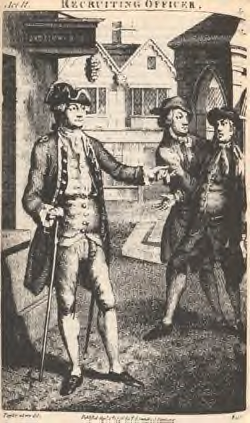
RECRUITING OFFICER, THE. AKA – “Miss Williamson of
Oldfield’s Jigg.” English, Jig. D Major. Standard tuning. AABB. The Recruiting
Officer (1706) is the name of a famous comedy by George Farquhar
(1678-1708), popular throughout the 18th century and still
occasionally staged today. The air “The Recruiting Officer” was employed in
ballad operas, such as Henry Potter’s The
Decoy (1733). The melody was published by John Young in his 1st
edition of the second volume of the Dancing Master (
***
The Recruiting Officer. William
Smith as Plume at
***
The melody appears in several 18th
and 19th century musicians’ manuscript collections including William
Vickers (Northumberland, 1770), Rev. Robert Harrison (Brampton, Cumbria, 1820),
Thomas Hammersley (
X:1
T:Recruiting Officer, The
M:6/8
L:1/8
R:Jig
S:Willaim Vickers’ music manuscript
book (Northumberland, 1770)
Z:AK/Fiddler’s Companion
K:D
A|def edc|d3 AGF|GAB AGF|E3 E3|def
edc|
BgB AGF|GAB Adc|d3 D2::g|fed agf|g3
a3|
Bcd efd|c3A3|agf edc|dcB AGF|GAB
Adc|d3 D2:|
RED ADMIRAL BUTTERFLY, THE. Irish, Slip Jig. RCA
5798-2-RC, "James Galway and the Chieftains in
RED AND ALL RED. English, Country Dance Tune
(2/4 time). G Major. Standard tuning. AABB. The melody was originally published
by Charles and Samuel Thompson in Thompson’s
Compleat Collection of 200 Favourite Country Dances (
X:1
T:Red and all Red
M:2/4
L:1/8
B:Thompson’s Compleat Collection of 200 Favourite Country Dances, vol. 1 (London, 1757)
Z:Transcribed and edited by Flynn Titford-Mock, 2007
Z:abc’s:AK/Fiddler’s Companion
K:G
GA|BABd|G2 GA|BABc|{B}A2 AA|BBdd|fed ^c|d2 dd|d2::BB|cBcd|e2 dc|
cBAG|d2
ef|gfed|cBAG|d2 de|c2 cd|B2 Bc|A2 df|gedc|B2 cA|G2 GG|G2:||
RED
APPLE JUICE.
AKA and see “Red Rocking Chair.”
RED APPLE RAG [1]. Old‑Time, Country Rag.
X:1
T:Red Apple Rag
M:2/4
L:1/16
Q:122
S:from Cyril Stinnett
R:Reel
A:
N:Cyril stated that he
learned this from hearing it played by Arthur
N:Smith on the Grand Old Opry over the radio in
the 30's. Apparently it
N:is an original composition by Arthur Smith.
D:as recorded by Cyril Stinnett on his album
"Cyril Stinnett Plays His
D:Favorite Old Time Tunes.
Z:B. Shull, trans.; R. P. LaVaque, ABCs
K:G
DC|(B,C)D(F GF)GA|BdBA GBA(G|EF)G(A
cB)c2|(ede)(c c)BcA|!
(d^cd)(e fe)d(e|fa)f(e e)de(f|gb)ge d(BA)F|G6:|!
B(c|d2)e(f gf)g2|(bab)(g g)a(ge)|cde(f
gf)g(e|ag)e(c c)B(cA)|!
(d^cd)(e fe)d(e|fa)fe d2e(f|gbge d(BA)F|G6:|!
RED APPLE
RAG [2]. Old‑Time, Country Rag. C
Major (‘A’ part) & G Major (‘B’ part). Standard tuning. AB. Source for
notated version: Greg Canote
(Seattle) [Silberberg]. Silberberg (Tunes I Learned at Tractor
Tavern), 2002; pg. 126.
RED BEE, THE. Irish, Reel. B Minor. Standard tuning. AABBCC.
Composed by Joe Liddy.
X:1
T:The Red Bee
C:Joe Liddy
S:Mary Crowley
R:reel
M:4/4
L:1/8
K:Bm
de|f2 BA BAFA|d2 cA BF (3GFE|FB (3cBA
Bcde|fded cAde|
fB (3BBB cBAF|EFAB cBce|fafe
cBAF|EFAc B2:|:cA|
B2 cB fBcB|afge fecA|B2 cB fBcB|AFEF
ABcA|
B2 cB fBcB|afge fece|fafe cBAF|EFAc
B2:|:Bc|
d2 fd adbf|afef edBc|defd edfe|dBAF
E2 FA|
d2 fd adbf|afef edBA|fB (3cBA
FEFA|BdcA B2:
RED BIRD [1]. Old‑Time, Breakdown.
RED BIRD [2]. Old-Time, Breakdown.
REDBIRD [3]. See “Old Joe Redbird.”
REDBIRD HORNPIPE. American, Hornpipe. A Major. Standard tuning. AAB. Source for notated
version: Joey McKenzie [Phillips]. Phillips (Traditional American Fiddle Tunes), vol. 2, 1995; pg. 219.
RED BIRD REEL. Old‑Time, Breakdown.
RED BLANKET, THE. AKA and see "The
Ewe Reel," "The
Ew(i)e Wi' the Crooked Horn [1]," "The Ram with the Crooked
Horn," "Bob with the One
Horn [2]," “Green Blanket,”
"Miss Huntley's,"
"My Love is Far Away,"
"The Lowlands of Scotland,"
"Peter Street [2]," "The Kerry Lasses [1]," "The Merry Lasses," "Go and See the Fun," "The Pretty Girl in Danger,"
"Sweet Roslea and the
Sky Over It," "The Foe." Irish, Reel.
RED BOX, THE. Irish, Reel. G Major. Standard tuning. AABB.
Composed by guitarist Arty McGlynn. Green Linnet SIF‑1109,
Altan ‑ "The Red Crow" (1990).
X:1
T:Red Box Reel
R:Reel
D:Milltown Malbay Concertina Recital
Z:Adrian Scahill
M:4/4
L:1/8
K:G
afge fddB|cABG ADD2|FD (3EFG
A3B|cBAB cd (3efg|\
afge fddB|cABG ADD2|FD (3EFG
A3B|cAGd ADD2:||\
~c3e gcec|~d3f adfd|~g2ba ~f2af|eafd
e^cAB|\
~c3e gcec|~d3f adfd|~g2ba fedB|AFGE
D3d:||\
RED BRICK HOUSE IN
GEORGIA TOWN, THE. American, Breakdown. A Dorian.
Standard tuning. AB. "The five forgoing tunes (previous tunes untitled
except for 'Swallow Tail'), Nos. 44‑48, have been placed together because
they are cognates‑‑descendants (so far as we can make out from the
internal evidence of their melodic lines, phrasal structure and formulae) of
some single original melody. Numerous other versions and variants belonging to
this tune‑family have been recorded from singers or players in the
British‑American tradition, and some of them are referred to below.
Beside the five versions grouped together here, the present collection contains
another member of this widespread family: No. 89 (Bonaparte Crossing the Alps),
under which further data will be found. All six tunes are inextricable one from
another in our tradition; and comparison of each one with the others, and with
other identifiable published versions, simply adds to the tale of overlapping
resemblances, and heightens the certainty that they all derive from some common
original. That the parent tune must have originated at some fairly remote
period is indicated by the number and diversity of the extant versions and variants,
and by the fact that they form part of the folk music tradition everywhere in
the
RED BUCK. Old-Time, Breakdown.
***
Green are the woods where Sandy flows,
And Peace it dwelleth there;
In the valley the bear they lie secure,
The red buck roves the knobs.
***
Abner Vance was a
RED BULL [1], THE. English, Air (6/8 time). F Major. Standard
tuning. AB. The tune is named after the Red Bull Playhouse, which formerly
stood in
X:1
T:Red Bull, The [1]
L:1/8
M:6/8
S:Chappell – Popular Music of the Olden Times
(1859)
Z:AK/Fiddler’s Companion
K:F
F|F2F G2A|FEF E3|D3 C2F|F2E F2F|F2F G2A|FEF E3|D3 =C2F|F2E F3||
A2=B cdc|def edc|d3 A=Bc|c2=B
c2G|E2F G>AG|c>_BA B3|A3 G2F|F2E F2||
RED BULL [2], THE.
RED COAT, THE. Scottish, Strathspey. A Mixolydian. Standard
tuning. AABB. Pipe tune. MacDonald (The
Skye Collection), 1887; pg. 48.
X:1
T:Red Coat, The
M:C
L:1/8
S:Strathspey
S:MacDonald – Skye Collection (1887)
Z:AK/Fiddler’s Companion
K:D
g|B<AB<d e>deg|GGBA
G>GGd|B>A B<d e>de>a|g<e g>B A>A A:|
|:g|a>da>g e>de>g|G<G
B>A G>GGg|a>da>g e>d e<a|g<e g>B A>AAg|
a>da>g e>d e<g|G<G
B>A G>GGd|B<AB<d e>d e<a|g<e g>B A>A A:|
RED CROSS. American, Hornpipe. D Major. Standard tuning. AABB. Cole (1000 Fiddle Tunes), 1940; pg. 107. Ryan’s Mammoth Collection, 1883; pg.
143.
X:1
T:Red Cross
M:2/4
L:1/8
R:Hornpipe
S:Ryan’s Mammoth Collection (1883)
Z:AK/Fiddler’s Companion
K:D
A | e/>f/e/>d/
c/>A/B/>c/ | d/>A/f/>A/ d/>A/f/>A/ | e/>f/e/>d/
c/>A/B/>c/ | .d.f .a.A |
e/>f/e/>d/ c/>A/B/>c/ |
d/>A/f/>A/ d/>A/f/>A/ | e/>f/e/>d/ c/>A/B/>c/ | dfd :|
|: A | A/>B/c/>d/
e/>f/g/>e/ | f/>f/f/>f/ f/>f/e/>d/ | c/>c/c/>c/
c/>A/B/>c/ | .dd/>f/ .a.A |
A/>B/c/>d/ e/>f/g/>e/ |
f/>f/f/>f/ f/>f/e/>d/ | c/>c/c/>c/ c/>A/B/>c/ | dfd :|
RED CROW, THE. Irish, Reel. A Dorian. Standard tuning. A
modern composition by fiddler Mairéad Ní Mhaonaigh of the group Altan. Caoimhin
Mac Aoidh explains the there is a blackbird found in
X:1
T:The Red Crow
M:C|
L:1/8
K:ADor
A,2EA, B,G,G,B, A,2EG FDEG | AGED
EA,A,D ECDC B,G,G,B, |
A,2EA, B,G,G,B, A,2EG FDEG |1 AGED
EA,A,C DB,G,B, A,2(3G,A,B, :|
|2 AGED EA,A,C DB,G,B, A,2 (3AAA [|
A2eA ceAc eAce dcBA | G2dc BdGB dGBd
edcB |
A2eA ceAc eAcb ageg | age^c d=fed
=cABG A2AG |
A2eA ceAc eAce dcBA | G2dc BdGB dGBd
edcB |
A2aA gAfA (3AAA cA BAGB | cABG AGED
RED EAR QUADRILLE. American, Quadrille.
RED FERRET’S FANCY, THE. Scottish, Reel. A Major. Standard tuning.
AABB’. Composed by Louise MacKenzie. Martin & Hughes (Ho-ro-gheallaidh), 1990; pg. 21.
RED FOX [1]. Old‑Time, Breakdown.
RED FOX [2], THE. English, Reel. A Dorian. Standard tuning.
AABB. Raven (English Country Dance Tunes),
1984; pg. 193.
RED FOX [3], THE (An Sionnac Ruad). AKA and see "Let Erin Remember the Days
of Old." Irish, Air (4/4 time, "with spirit"). G Major.
Standard tuning. AB. O'Neill (Music of Ireland: 1850 Melodies),
1903/1979; No. 390, pg. 68.
X:1
T:Red Fox, The [3]
M:C
L:1/8
R:Air
N:”With spirit”
S:O’Neill – Music of Ireland (1903),
No. 390
Z:AK/Fiddler’s Companion
K:G
D2|G2 G>A B2 B>c|d2d2 c2
B>c|d3 e B2G2|A3F GFED|G2 G>A B2 Bc|d<d d2 c2 Bc|
d2 de B2G2|A4 G2||Bd|g2g2 f2 ed|e2
dB d2 BA|G2 G>A BAGB|A4 G2 Bd|g2g2 f2 ed|
e2 dB d2 BA|G2 ge dBGB|A4 G2||
RED FOX WALTZ. Old‑Time, Waltz.
RED HAIRED BOY, THE (An Giolla Ruad).
AKA and see "The Duck
Chewed/Chews Tobacco," “The
First of May [3]," "Gilderoy
[2]" (Ire.), "Giolla Rua" (Ire.), "Johnny Dhu," "The Little Beggarman" (Ire.),
"The Little Beggar Boy,"
"An Maidrin Rua(dh)" (The
Little Red Fox),” "The Old Soldier (with
a Wooden Leg) [2]" (W.Va.), "Old Soldier," "The Red Haired Lad," "The Red Headed/Haired Irishman" (Ky.),
"Wooden Leg" (W.Va.). Irish
(originally), Scottish, English; Air or Hornpipe: American, Canadian; Reel
or Breakdown. A Mixolydian. Standard.
AABB (most versions): AA’BB’ (Moylan). 'Red Haired Boy' is the English translation
of the Gaelic title "Giolla Rua" (or, Englished,
"Gilderoy"), and is generally thought to commemorate a real-life
rogue and bandit, however, Baring-Gould remarks that in Scotland the
"Beggar" of the title is also identified with King James V. The song
was quite common under the Gaelic and the alternate title "The Little
Beggarman" (or "The Beggarman," "The Beggar")
throughout the
***
Bandits, fairies and the tune all come together in an Irish tale, representing the capricious results of humans coming in contact with fairy-induced music. In the tale “The Red Haired Boy” was played somewhat under duress by uilleann piper Donnchadh Ó Sé from Lóthar, one of the best pipers in the parish of Priory. Donnchadh came by some of his music from contact with the supernatural, a not uncommon claim, but this time with a twist. It seems that he and his brother were gathering seaweed at Faill an Mhada Rua when they heard beautiful ethereal music nearby; Dónall stood by, afraid, but Donnchadh followed the sounds up the cliff and was able to commit them to memory. Returning home he strapped himself into his pipes and played the melody he heard, but afterwards was stuck down ill, becoming bedridden for three months before recuperating. Each time he played the tune the same would happen—he would suffer, for illness always followed. One day Donnchadh had the ill fortune to meet with a ruffian, who evidently knew of the circumstance and demanded at the point of a pistol that the piper play the fairy tune. Donnchadh obligingly reached for his pipes, and soon found that the brute was ignorant of the music and so was able to placate him with “An Giolla Rua” (Breathnach, The Man and His Music, 1997, pg. 38.
***
Sources
for notated versions: J.P. Fraley (
X:1
T:Red
Haired Boy
L:1/8
M:C|
S:Jay Ungar
K:A
A>G|E2A2
(A>B) c>d|e>f ec d2cd|e2A2 (A>B)c>A|(B>A) E>F =G2 G>F|
E2A2
(A>B) c>d|(e>f) e>c d2c>d|e a2 b a>=g e>d|c2A2A2:|
|:e>f|(=g>f
g>a (g>f) e>f|(=g>)f e>c d2c>d|e2A2 (A>B) c>A|(B>A)
E>F =G3F|
E2A2 (A>B) cd|(e>f) e>c
d2cd|e a2 b a>=g e>d|(3cdc A2A2:|
RED-HAIRED CHARLES. Irish. Gael-Linn CEF060, “Paddy Glackin.”
RED-HAIRED GIRL [1], THE (An Cailín Ruadh/Rua). Irish, Air (3/4 time). G Mixolydian. Standard tuning. AB. "Forde took this down in 6/8 time, which disguises its character. It really belongs to the 'Narrative' class in 3/4 time, to which I have restored it. One of several tunes of this name" (Joyce). The song tells of a young man who spends lavishly on the object of his desire, only to have her to off with another; still, he says, if he had it to do over again he would do the same. Source for notated version: Hugh O'Beirne, professional fiddler from Ballinamore, Co. Leitrim, c. 1846. Joyce (Old Irish Folk Music and Songs), 1909; No. 567, pg. 300.
X:1
T:Red-Haired Girl, The [1]
M:3/4
L:1/8
R:Air
N:”Moderately Slow”
S:Joyce – Old Irish Folk Music and Songs (1909)
Z:AK/Fiddler’s Companion
K:G Mixolydian
(3d/e/f/ | ge f>e dA | cAG>A cd | ef d2 cA | cd d3 e/f/ | ge f>e de |
cA G>A cd | ef d2 cA | GG G3 || A | GA d2 de | fd e2 de | cA G2 Ac |
dd d2 (3def | gg g>e fg | af e>d cd | ec d>e cA | GG G3 ||
RED-HAIRED GIRL [2], THE (An Cailín Ruadh). Irish, Slow Air (4/4 time). D
Dorian. Standard tuning. AAB. "From the Carey MSS. One of several airs
known by this name. A variant of the Buchail Caol Dubh, altered in time (p. 52,
above)" (Joyce). Joyce (Old Irish
Folk Music and Songs), 1909; No. 679, pg. 340.
X:1
T:Red-Hairded Girl, The [2]
M:C
L:1/8
R:Air
N:”Slow.”
S:Joyce – Old Irish Folk Music
and Songs (1909), No. 679
Z:AK/Fiddler’s Companion
K:D Dorian
de | f3e dcAG | F3G EDCE | F2G2A2E2
| {D/E/}D3D D3 :| G | A2A2f2 e/d/c/e/ | d3d dcAB |
c3A defe | d3d d2 de | f3e dcAG |
F3G EDCE | F2G2A2E2 | {D/E/}D3D D2 ||
RED HAIRED GIRL [3], THE (An Cailín Ruad). AKA and see "I'd Roam Through Asia." Irish, Air
(3/4 time). D Major. Standard tuning. AB. O'Neill (Music of Ireland: 1850 Melodies), 1903/1979; No. 12, pg. 3.
X:1
T:Red Haired Girl, The [3]
M:3/4
L:1/8
R:Air
N:”With feeling.”
S:O’Neill – Music of
Z:AK/Fiddler’s Companion
K:D
A/G/ FE|D2 FG AB/c/|d2 ed/c/ AG|F2
DE DB,|C2 zA/G/ FE| D2 FG AB/c/|
d2 ed/c/ AG| F2 DE DD|D3||F/G/ AA|f2
de dc| d2 de dc|d2 ed/c/ AG|
F2 DE DB,|C2 zA/G/ FE| D2 FG AB/c/|
d2 ed/c/ AG|F2 DE DD|D3||
RED HAIRED GIRL [4], THE (An Cailín Ruad). Irish, Air (3/4 time, "with
feeling"). D Major. Standard tuning. AB. O'Neill (Music of Ireland: 1850 Melodies), 1903/1979; No. 13, pg. 3.
X:1
T:Red Haired Girl, The [4]
M:3/4
L:1/8
R:Air
N:”With feeling”
S:O’Neill – Music of
Z:AK/Fiddler’s Companion
K:D
A/G/ FA|B>G ED CE|D2 E/F/G
FA|B>G EC DD|D3 A/G/ FA|d2 {ed}cd ec|
d3 A/G/ FA|B>G EC DD|D3||A/G/
FA|d2 cd/e/ dB|GE F>G FA|
d2 cd/e/ fd|d{ed}c/>B/ A>G
FA|d2 (c/d/e/f/) dB|G>E FG A/B/=c|B>G EC DD|D3||
RED HAIRED GIRL [5], THE (An Cailín Ruadh). Irish, Air (3/4 time,
"slow"). D Mixolydian. Standard tuning. One part. Source for notated
version: a manuscript collection dated 1861 of Rev. James Goodman, an Anglican
cleric who collected primarily in County Cork [Shields]. Shields (Tunes of
the
RED HAIRED GIRL OF
TULLOCH, THE. Scottish, Strathspey. B Minor.
Standard tuning. AAB. Pipe tune. MacDonald (The
Skye Collection), 1887; pg. 69. Martin (Ceol
na Fidhle), vol.3, 1988; pg. 38. Martin (Traditional Scottish Fiddling), 2002; pg. 11.
X:1
T:Red Haired Girl of Tulloch, The
M:C
L:1/8
R:Strathspey
S:MacDonald – Skye Collection (1887)
Z:AK/Fiddler’s Companion
K:D
B<B d>e f>e f<a|A<A
c>B A>ce>c|B>Bd>e f>ef>^g|a>fe>c B<B f2:|
d>fB>f d<f B>f|c<e
A>e c<e A>e|d<f B>f d<f B>f|a>fe>c B<B f2|
d>fB>f d>fB>f|c>eA.e
c>eA>e|B<B d>e f>ef>^g|a>fe>c B<B f2||
RED HAIRED HAG, THE (An Cailleac Ruad). Irish, Double Jig. A Mixolydian.
Standard tuning. AABB. O'Neill (Krassen), 1976; pg. 42. O'Neill (Music of
Ireland: 1850 Melodies), 1903/1979; No. 923, pg. 172. O'Neill (Dance
Music of Ireland: 1001 Gems),
1907/1986; No. 157, pg. 41.
X:1
T:Redhaired Hag, The
M:6/8
L:1/8
R:Jig
S:O’Neill – Dance Music of
Z:AK/Fiddler’s Companion
K:A
f|ecA aeA|cde =gfg|B=GG dGG|Bcd
d2f|ecA aeA|cde fga|def =gdB|ecA A2:|
|:e|agf ecA|cde fga|B=GB dBG|Bcd
d2e|agf ecA|cde a3|def =gdB|ecA A2:|
REDHAIRED LAD, THE, THE. AKA and see "The
Red Haired Boy."
RED-HAIRED LASS. AKA and see "Jim Seery's,"
"The Kildoney Lasses,” "Old Pigeon on the Gate," “Peter Kennedy’s Fancy,” "Shearing the Sheep [1].” Irish,
Reel.
|
See also listings at: Alan Snyder’s Cape Breton Fiddle
Recording Index Jane Keefer’s Folk Music Index: An
Index to Recorded Sources Alan Ng’s Irishtune.info |
X:1
T:Red-Haired Lass, The
R:reel
Z:From Josephine Marsh at Kilfenora
1996.
Z: Transcribed by Thom Pratt
M:4/4
L:1/8
K:G
DGGF ~G2 BG|GABG ~AGEG|DGGF
GABd|egdB AGEG|\
DGGF ~G2 BG|GABG ~AGEG|DGGF
GABd|egdB ~c2Bc||\
~d2 gd edgd|degd BGBc|~d2 gd
edef|gedB ~c2 Bc|\
~d2 gd edgd|degd BGBd|~c2 cA ~B2
BA|GA (3Bcd gedB||\
RED-HAIRED MAIDEN. AKA and see "Colleen Rue [1],"
"As I Roved Out On
a Summer Morning," "I'd
Roam Through Asia," "Kind
Sir, Be 'Aisy,'" "Sails
Were Unfurled."
RED HAIRED MAN'S WIFE
[1], THE (An Cailin Deas
Ruad). AKA and
see "Pretty Red
{Haired} Girl [1]." Irish, Air (3/4 time). D Dorian. Standard tuning.
One part. Roche Collection, 1982,
vol. 1; No. 44, pg. 23.
RED HAIRED MAN'S WIFE [2], THE
("bEan An Fir Ruad" or "Beann an Fhir Ruaidh"/"Bean an
Fhir Rua"). AKA and see "The Caves of Cong," "Loch Lein," "Thios ag Beal Bearnais."
Irish, Air (3/4 time).
***
A letter I'll send by a friend down to the
sea shore,
To let her understand I'm the man that does
her adore.
And if she'd but lave that slave I'd forfeit
my life,
And she'd live like a lady and ne'er be the red-haired man's wife.
***
Sean
Ó Boyle (1976) relates a story told by the 19th century Tyrone
novelist William Carleton, who recorded that his mother was once asked to sing
the English version of "Bean an Fhir Rua." She said, "I'll sing
it for you, but the English words and the air are like a quarelling man and his
wife--the Irish melts into the tune but the English doesn't." "An
expression," states Carleton, "scarcely less remarkable for its
beauty than its truth." The
title appears in a list of tunes in his repertoire brought by Philip Goodman,
the last professional and traditional piper in Farney, Louth, to the Feis Ceoil
in
X:1
T:Red Haired Man’s Wife, The [2]
M:3/4
L:1/8
R:Air
S:Stanford/Petrie (1905), No. 359
Z:AK/Fiddler’s Companion
K:D
cd | e2fd ec | d3fec | A4 GF | G2A2c2
| d4 cd | e2 fd ec | d3 fec |
A4 GA | E2D2D2 | D4 || =cB | A2G2 EF
| D3E F2 | G3 AGF |
G2A2 Bc | d4 A/B/c/d/ | eg fd ec | d3 fec | A4 GA | E2 D2D2 | D4 ||
RED HAIRED MAN'S WIFE
[3], THE (bEan An Fir
Ruad). Irish, Air
(3/4 time). D Dorian (Roche): D Major/Mixolydian (Stanford/Petrie). Standard
tuning. AB (Stanford/Petrie): AAB (Roche). Stanford/Petrie notes this version
is as “sung in
X:1
T:Red Haired Man’s Wife, The [3]
M:3/4
L:1/8
R:Air
S:Stanford/Petrie (1905), No. 357
Z:AK/Fiddler’s Companion
K:D
f>e | d2 edcA | c2 dcAG |
(F>E)FAGE | E2D2D2 | D4 || DE | F2G2 AB |
=cAdcAG | A2d2 cd/e/ | d4 D>E |
F2 GFED | F2G2 AB | =cA dcAG |
A2c2 de | f4 ef | d2 edcA | cAdcAG |
FEFAGE | E2 D2D2 | D4 ||
REDHAIRED MAN'S WIFE
[4], THE (Bean An Fir
Ruad). Irish,
Slow Air (3/4 time). G Major. Standard tuning. AAB. O'Neill (Music of Ireland: 1850 Melodies), 1903/1979;
No. 412, pg. 72.
X:1
T:Redhaired Man’s Wife, The [4]
M:3/4
L:1/8
R:Air
M:”Slow”
S:O’Neill – Music of
Z:AK/Fiddler’s Companion
K:G
(A/B/4c/4d/4e/4f/4g/4)|a2 bg af|g2
a>g fe|d2d2 cA|c2 d2 (6A/B/c/d/e/f/|g4 fg|
a2 bg af|g2 ag fe|d2 d2 cA|{B}A2G2
GA|{F}G4:|
||dc|{c}BABdcA|GFGdcA|G2 GB
A/G/F/A/|G2A2 Bc|{c}d4 (A/B/4c/4d/4e/4f/4g/4)|
a2|bg af|g2 (3agf (3gfe|d2 de
cA|{B}A2G2 GA|{F}G4||
RED-HAIRED MAN’S WIFE
[5], THE. Irish, Air (3/4 time). E Flat Major.
Standard tuning. One part. Another variation of the main theme. Source for
notated version: “From P. MacDowell, Esq.” [Stanford/Petrie]. Stanford/Petrie (Complete Collection), 1905; No. 358, pg.
90.
X:1
T:Red Haired Man’s Wife, The [5]
M:3/4
L:1/8
R:Air
S:Stanford/Petrie (1905), No. 358
Z:AK/Fiddler’s Companion
K:E_
ed | {d}c2 B>G FG | E3 FGB |
{A}c3 GBG | {G}F2E2E2 | E4 E>F | G2B2cd |
e3 dcB/c/ | d3 cBG | B2 c>e
d/>c/B/G/ | {G}F4 EF | G2B2 cd | e3 dfe | d3 cBG |
B2 c>e d/>c/B/G/ | {G}F4 ed |
c/e/d/c/ BGFG | E3 FGB | {A}c3 GBG | F2E2E2 | E4 ||
RED HAIRED MARY. Irish, Air (4/4 time). G Dorian. Standard tuning. AB. Joyce (Old Irish Folk Music and Songs), 1909;
No. 504, pg. 275.
RED HAND, THE. Irish, Polka. G Major. Standard tuning. AABB.
Composed by Falmouth, Massachusetts, musician and writer Bill Black. Black (Music’s the Very Best Thing), 1996; No.
212, pg. 114.
X:1
T: The Red Hand
C: © B. Black
Q: 300
R: polka
M: 2/4
L: 1/8
K: G
G>B Bd | cA FA | GB Ac | Bg d2 |
g>d BG | cG EC | D>E FD | G2 G2 :|
dg fg | a>g fe | dg Bd | cB A2 |
G>A
Bd | ce ge | d>B cA | G2 G2 :|
RED HANDKERCHIEF. AKA and see "Cerveny
Satecek."
RED HAWK WALTZ. AKA and see “Clark’s Waltz.”
Old-time, Waltz. USA, Missouri. Rounder 0157, Art
Galbraith (Springfield, Mo.) - "Simple Pleasures."
RED HEADED GIRL, THE. AKA and see "Cottage By the Sea."
RED HEADED IRISHMAN. AKA and see “Gilderoy [2],” “The Little Beggarman,” "The Old Soldier (with
a Wooden Leg) [2]," "The Red Haired Boy."
RED HEATH. English, Country Dance Tune
(whole time). F Major. Standard tuning. AABB. The melody is unique to London
publishers Charles and Samuel Thompson’s 1765 country dance collection. Thompson
(Compleat Collection of 200 Favourite Country Dances, vol. 2),
1765; No. 156.
X:1
T:Red Heath
M:C
L:1/8
B:Thompson’s Compleat Collection of 200 Favourite Country Dances, vol. 2 (London, 1765)
Z:Transcribed and edited by Flynn Titford-Mock, 2007
Z:abc’s:AK/Fiddler’s Companion
K:F
cfed “tr”c2 BA|GABc BAGF|cfed “tr”c2 BA|GBAG F4::ecgc acgc|ecgc a2g2|
ecgc
acgc|Gc=Bd c4::fa af d2 ge|c2 fc A2F2|f2 af d2 ge|c2 fA F4:||
RED HEIFER, THE. This tune was one of four listed by Laura
Ingells Wilder in her novel Little House
in the Big Woods, in the chapter called “Dance at Grandpa's.” The
protagonist remembered at the dance, set after the Civil War, and four tunes
the fiddler played: “Money Musk,” “The Red Heifer,” “Devil’s Dream,” and
“Arkansas Traveller.” Three are extremely well-known, however, “The Red
Heifer,” if an actual fiddle tune, appears to be lost.
RED HILL, THE. Canadian, Jig. Canada, Cape Breton. C Major.
Standard tuning. AABB’. Composed by Cape Breton fiddler and composer Dan R.
MacDonald (1911-1976). Cameron (Trip to
Windsor), 1994; pg. 48.
RED HILLS. Old-Time, Breakdown. A Mixolydian. Standard or AEae tunings. AA'AA'BB.
The tune is played slower than the normal breakdown tempo. Source for notated
version: Bruce Green [Phillips]. Phillips (Traditional
American Fiddle Tunes), vol. 2, 1995; pg. 110.
RED HILLS POLKA.
Old-Time, Polka. USA; Illinois, Missouri. D Major. Standard tuning. AB.
The tune is was sourced to an elderly woman from Red Hills, Illinois, who had
no title for it so called it after her home town. Gordon McCann has information
that it may have been derived from a German march. Source for notated version:
Bob Holt (1930-2004, Ava, Missouri), learned from the Allen Street Band
(Springfield, Mo.) who had it from Gary Harrison [Beisswenger & McCann].
Beisswenger & McCann (Ozarks Fiddle Music), 2008; pg. 67. Rounder CD 0432, Bob Holt – “Got a Little Home to Go to”
(1998).
RED HOT BREAKDOWN. Old‑Time, Breakdown. Carryon Records
002, "Ace Weems and the Fat Meat Boys."
RED HOUSE. AKA and see "Where/Whar wad
Our Gudman/bonny Annie lye/laye," "Where/Whar wad our guidman
lie." English, Scottish; Country Dance Tune (2/2 or cut time). A Minor
(Barnes): G Minor (Barlow, Kidson, Knowles). Standard tuning. ABC (Kidson,
Knowles): AA'BBCC (Barlow, Barnes). Kidson notes this was a popular tune in the
early 18th century and greatly used in period ballad operas and as a country
dance. John Glen traces the tune to Henry Playford's 9th edition of
the Dancing Master (London, 1695; it
also appears in the 12th edition, 1703 and again in 1716), Roberts finds it in
D’Urfy’s Wit and Mirth; or, Pills to
Purge Melancholy, while Bayard (1981) finds it in John Gay's 1729 Polly (Air 9-- Polly was Gay's sequel to his famously successful ballad opera, the
Beggar's Opera), Fielding's Grub‑Street Opera, and Walsh's
1719 Country Dancing Master (No.
111). It appears in Walsh’s Dancing
Master of 1731 (No. 111) and in Oswald’s Companion (VIII, 1755, pg. 22). Kidson also finds it in Polly (1729), and further states its
appearance in Lover's Opera (1730)
and Fashionable Lady (1720). The
melody is also thought to be the ancestor of the song air popularly known as
"(D'ye ken) John Peel”; Miss A.G.
Gilchrist explored this relationship in her article “The Evolution of a Tune:
‘Red House’ and ‘John Peel’” in the Journal
of the English Folk Dance and Song Society (IV, 80-84). Kidson (1890)
relates the story that the writer of the song "John Peel" adapted his
words to an mixolydian or major Scots air (almost identical to "Red
House") called "Whar wad bonny Anne lie" or "Whar wad our
guidman lie" which was sung to send his child to sleep by its granny.
Bayard (in his article “A Miscellany of Tune Notes,” Studies in Folklore, pgs. 162-163) finds that earlier sets seem to
have been minor-mode and later ones, major.
***
Graham Christian (writing in CDSS News, issue #188, January/February
2006) provides some remarkable sleuthing of the title based on the melody’s
appearance in a volume entitled Neue und
Curieuse Theatrialische Tantz-Schul, by Venetian choreographer Gregorio
Lambranzi, published in Nuremburg. Engraved plates in the book depict scenes
from the Commedia dell’Arte, and one
page depicts the “Red House” tune above four comic dancers. Christian believes
this may link the tune with the Commedia
dell’Arte, and especially with the travelling troupes of Italian Comedy.
While the staging effects for well-established theatres in city centers were
quite elaborate, the travelling troupes made do with much less sophisticated
sets. One of the most common was to paint flats on each side of the stage in a
red brick pattern, to depict the respectable houses that the comic actors would
soon turn into an uproar. Christian argues that the English creation of the
social dance called the Red House may
be an instance of melodic and visual adaptation of music and “comic pranks of
Italian Comedy.”
***
The melody was collected in reel
form by Bayard (1981) in southwestern
***
The dance Red House is remarkable
for the equality of its action, notes dance-leader Graham Christian, with steps
being initiated by the first man, then the first woman, each followed by
sequential heys; alternating partner “chases.”
***
Barlow (Complete Country Dances from Playford’s Dancing Master), 1985; No.
339, pg. 82. Barnes (English Country
Dance Tunes), 1986. Kidson (Old English
Country Dances), 1890; pg. 4. Knowles (A
Northern Lass), 1995; pg. 17.
X:1
T:Red House
L:1/8
M:C|
S:Oswald – Companion (1755)
Z:AK/Fiddler’s Companion
K:G
BA|G2 g4 fe|d4 B4|A2 =f4 ed|c4 A4|G2
g4 fe|d4 B4|cB AG F2 A2|B2 G4:|
Bc|dc BA GABc|d4 B4|cB AG =FGAB|c4
A4|dc BA GABc|d4B4|cB AG F2 A2| B2 G4||
X:2
T:Red House
M:C|
L:1/8
S:Henry Playford – Dancing Master, 9th edition
(1695)
K:Gmin
G2g4 fe|d3 B4|A2 f4 ed|c2 dc
dcBA|G2g4 fe|d4 B4|cBAG FG A2|1
B2G2 G4:|2 B2G2G2||:Bc|dcBA
GABc|d4B4|cBAG FGAB|c4A4|
dcBA GABc|d4B4|cBAG FG
A2|B2G2G2:||:Bc|d2 d2 d2 Bc|d2d2d2 AB|
c2 c2 c2 AB|c2c2c2 Bc|d2d2d2
Bc|d2d2d2 AB|cBAG FG A2|1 B2G2G2:|2 B2G2G4||
X:3
T:untitled fiddle tune
M:C
L:1/8
S:Collected in south western
Pennsylvania by S. Bayard, 1944
K:G
[B2g2]-|[B2g2][B2g2] BABB|[B2g2][B2g2]
B2 BB|c2c2 AGAB|c2c2 A2 AB|
[B2g2][B2g2] feBB|[B2g2][B2g2] B2
{B}cB|{D2A2]B2 cBAF|G4 z4:|
Bc|d2d2 [DB]GBc|d2d2 B2BG|c2c2
AFAB|c2c2A2 Bc|
d2d2 B[GB]Bc|d2d2B2G2|A2B2{B}cB
AF|G4 z3||
RED HOUSE OF
RED JOAK. English, Dance Tune (4/4 time). G Major. Standard tuning. The melody appears in Walsh’s third book of Lancashire tunes (Lancashire Jigs, Hornpipes, Joaks, etc.) published around the year 1730. The title is one of a series of Jokes or Joaks (with different colors in the title: white, green, brown, etc.), taking off on the immense popular success of “The Black Joke.”
X:1
T:Red Joak
B:Walsh
M:4/4
L:1/8
K:G
ba| g3a g2 B2| dBde d2 ba| g3 a g2 B2|A4 A2 ba| g3 a g2 B2| dBde d2 ba|\
g2 e2 d2 B2| G4 G4:: e2| d2 F2 BcdB| d2 G2 g3 e| d2 G2 BcdB| A4 A2 e2|\
d2 G2 BcdB| d2 G2 g3 a| bage gedB|G4 G2:: D2| GABG BcdB| GABG Bcde| \
d2
B2 cBAG| A4 A2 D2| GABG BcdB| GABG Bcde| d2 B2 dBAG G4 G2:|
RED LICK. Old-Time, Breakdown. D Major. A “crooked’ tune, having an extra beat at
the end of both ‘A’ and ‘B’ parts. The tune was played by Kentucky fiddler
Lella Todd, as well as by Billy Stamper, who also lived in the same area. Rounder Records, Billy Stamper – “Traditional Fiddle Music
of Kentucky, vol. 2: Along the Kentucky River.”
RED LION HORNPIPE [1]. American, Irish(-American); Hornpipe. USA, Missouri, New England. B
Flat Major. Standard tuning. AABB. The composition is credited to one Zeke
Backus in Ryan’s/Cole's 1000, one of several credited to him. Backus may have
been a blackface-minstrel performer. Although there is no record of a ‘Zeke’,
the Backus family (especially Charles) were prominent mid-19th
century minstrels, touring the country and even spending time in San
Francisco. Source for notated version:
Cyril Stinnett (Oregon, Missouri) [Christeson]. R.P. Christeson (Old Time Fiddlers Repertory, vol. 2),
1984; No. 36, pg. 24. Coe, George H., album of violin music. Cole (1000 Fiddle Tunes), 1940; pg. 88. Ford (Traditional Music in America), 1940; pg.
112. Miller & Perron (New England
Fiddlers Repertoire), 1983; No. 56. Mulvihill (1st Collection), 1986; No. 34, pg. 99. Phillips (Traditional American Fiddle Tunes), vol.
2, 1995; pg. 219. Ryan’s Mammoth
Collection, 1883; 122. Tolman (Nelson
Music Collection), 1969; pg. 15. White’s
Unique Collection, 1986; No. 98, pg. 18. Glen Arm
MG-100, Kevin Quinn – “Music from the Glens” (c. 197?). Rounder 0215, James
Bryan ‑ "The First of May" (1986).
X:1
T:Red Lion Hornpipe [1]
L:1/8
M:C|
K:B_
|:F2|BF dB fd bf|dB Ac BA GF|GE DE CE cd|ec dB BA GF|BF dB fd bf|
dB Ac BA GF|GE DE CE cd|ec Ac B2:: FE|DB FD BF dB|fb fd BA GF|
GB Ac Bd fa|bg f=e f2 (3fga|bf dB ge cA|BG ec BA GF| GE DE CE cd|ec Ac B2:|
RED LION HORNPIPE [2]. English, ‘Old’ Hornpipe (3/2 time). D Major (ED&S): B Flat Major
(Ashman, Geoghegan). Standard tuning. AABB. The melody appears in Walsh’s third
collection of Lancashire tunes (Lancashire
Jiggs, Hornpipes, Joaks, etc.) published c. 1730. There were several Red
Lion inns in old England; an Elizabethan-era Red Lion was located in the
Strand. The Gunpowder Plot conspirators of 1605 arranged to meet, under
pretence of holding a hunting party, at a pack-horse inn called the Red Lion at
Dunsmoor Heath, near the London Road near to Dunchurch. The tune appears in
several English musicians’ manuscript collections, including John Moore
(referenced below), John Clare (Helpton, Northants, 1820), John Rook (Warerton,
1840), and William Mittel (New Romney, Kent, 1799). It is one of the
"missing tunes" from William Vickers' 1770 Northumbrian dance tune
manuscript, listed in the contents but not found in the ms. Source for notated
version: a c. 1837-1840 MS by Shropshire musician John Moore [Ashman]. Ashman (The Ironbridge Hornpipe), 1991; No. 24b,
pg. 6. English Dance and Song, vol.
48, No. 1, Spring 1986, pg. 12. Geoghegan (Compleat Tutor for the Pastoral or New Bagpipe), c. 1745-46; pg.
25. Offord, 1985 (John of the Greeny Cheshire Way); pg.
47. Wilson (Companion to the Ball Room),
1816.
X:1
T:Red Lyon Hornpipe [2]
B:Walsh
M:3/2
L:1/8
K:Gm
BdBd DEFD E2 C2 |BdBd FBAc B2 B,2| BdBd DEFD E2 gf| edcB FBAc B2 B,2::\
Bdfd BdcB A2 F2| DFBF GFGE D2 B,2| Bdfd BdcB A2 F2|DFBF DBAc B4:|
X:2
T:Red Lyon Hornpipe [2]
M:3/2
L:1/8
S:Geoghegan – Compleat Tutor for the Pastoral or New Bagpipe (c. 1745-46)
Z:AK/Fiddler’s Companion
K:B Flat
Bdcd DEFD E2C2 | Bdcd FBAc B2D2 |
Bdcd DEFD F2 gf | edcB FBAc B4 :|
|: Bdfd BdcB “tr”A3F2 | DFBF GFGE
E2C2 | Bdfd BdcB A2gf | edcB FBAc B4 :|
X:3
T:Red Lion
M:3/2
L:1/8
R:”Old” or Triple Hornpipe
S:John Rook manuscript (Warerton,
1840)
K:D
dfdf FGAF G2E2|dfdf Adce d2D2|dfdf
FGAF G2 ba|gfed Adce d2D2||
dfaf efed c2A2|FAdA BABG F2D2|dfaf
dfed c2A2|FAdF Edce d4||
RED LITTLE HILL, THE (An Cnuicín Ruadh). Irish, Air (4/4 time). D Minor.
Standard tuning. AB. Source for notated version: Norry Dwane, Glenosheen, Co.
Limerick: 1850 (Joyce). Joyce (Old Irish
Folk Music and Songs), 1909; No. 154, pg. 78.
X:1
T:Red Little Hill, The
T:An Cnuicín Ruadh
M:C
L:1/8
R:Air
S:Joyce – Old Irish Folk Music and Songs
(1909)
Z:AK/Fiddler’s Companion
N:”With expression”
K:D Minor
fe|d2c2d2 DE|F2G2 {A} d2 dc|{A}B2 AG
A2 GF|D2 DE F2 (3A=Bc|
d2c2d2 DE|F2G2 {A}d2 cB|ABAG A2
GF|D2D2D2||AG|
A2 de f2 ef|gfed d2 AG|A2 de f2
ed|cB A2d2 fe|
d2c2d2 DE|F2G2 {A}d2 dc|{A}B2 AG A2
GF|D2D2D2||
RED MILL, THE. Canadian, Reel. Canada, Cape Breton
Island. Composed by Dan Hughie
MacEachern.
RED NECK MOTHER. AKA and see "Terry's Rag."
RED PETTICOAT HORNPIPE. English, Hornpipe. D Major. Standard tuning. AABB. From Geminiani's The Entire New and Compleat Tutor for the
Violin. In addition to the early 19th century Hardy family
manuscripts (Dorset), the tune can be found in the music manuscripts of John
Clare (Helpstone, Northants, 1820) and William Brown (Romford, Essex, 1797).
Callaghan (Hardcore English), 2007;
pg. 23. Trim (Thomas Hardy), 1990;
No. 92.
RED PHILIP (Pilib Ruadh). Irish, Air (3/4 time). G Major/G Mixolydian.
Standard tuning. AB. "Phil Gleeson of Coolfree near Ballyorgan in the Co.
Limerick, from whom I took down this air (about 1852), had a memory richly
stored with Irish airs, songs and folklore. He was a noted singer, and such an
inimitable whistler that at some distance he was able to puzzle the best ear as
to what sort of 'musical instrument' he played" (Joyce). Joyce (Old Irish Folk Music and Dance), 1909;
No. 6, pg. 6.
X:1
T:Red Philip
T:Pilib Ruadh
M:3/4
L:1/8
R:Air
S:Joyce – Old Irish Folk Music
Z:AK/Fiddler’s Companion
N:”Moderate time”
K:G
G2 GFGA|G2 GFGA|c2 cAGA|=F3G A2|G2 GFGA|G2
GF (3GAc|
d2 d/c/A/G/ A>G|G4G2||=fe (3edc
de|eddcde|d>c/4A/4 d/>c/A/G/ GA|
=F3G A2|G2 GFGA|G2 GF (3GAc|D3
d/c/A/G/ A>G|F4G2||
RED PIPER, THE. Welsh, Air (3/4 time). C Minor. Standard
tuning. One part. Walker (1924) calls the melody “an inspiration of really
great power.” Walker (History of Music in
England), 1924; No. 115, pg. 326.
X:1
T:Red
Piper, The
L:1/8
M:3/4
K:Cb
C2 CDEF|G4
G2|c2 cedc|G2=B2d2|c2G2E2|A2G2F2|
EGFEDC|C4
=B,2|C2 CDEF|G4 G2|c2 cedc|G2=B2d2|
C2G2E2|A2
GFED|E>D C2 =B,2|C4 cd|e2e2f2|
d3c B2|c2
cedc|c2 =B2 d2|c2G2E2|A2G2F2|
G2=B2d2|c2G2E2|A2
GFED|E>D C2=B2|C6||
RED PLAID, THE. Scottish, Strathspey. A Minor. Standard
tuning. AABB. Gatherer (Gatherer’s
Musical Museum), 1987; pg. 34. Kerr (Merry
Melodies), vol. 4; No. 141, pg. 17.
X:1
T:Red Plaid, The
M:C
L:1/8
R:Strathspey
S:Kerr – Merry Melodies, vol. 4, No. 141
(c. 1880’s)
Z:AK/Fiddler’s Companion
K:Amin
E<A A>B c2 c>e|d>cB>A
G>AB>G|E<A A>B c2 c>d|e>a e/d/c/B/ (c<A) A2:|
|:e<a a>g e<a a>e|d<g
g>e d<g g>d|e<a a>g e<a a>e|g>d e/d/c/B/ (c<A) A2:|
RED, RED ROSE [1]. Scottish, Jig. D Major. Standard tuning. AABB. Kerr (Merry Melodies), vol. 2; No. 309, pg.
34.
X:1
T:Red, Red Rose [1]
M:6/8
L:1/8
R:Jig
S:Kerr – Merry Melodies, vol. 2, No. 309
(c. 1880’s)
Z:AK/Fiddler’s Companion
K:D
A|DED E2F|d2c B2A|B2A B2d|e3 def|DED
E2F|
D2c B2A|B2A B2c|(d3 d2)::A|d2f
e2d|Bcd A2F|
A2A g2f|f3 eag|f2a f2d|Bcd AGF|A2A
B2c|(d3 d2):|
RED, RED ROSE [2]. AKA and see "Low Down
in the Broom." Scottish, Strathspey. D Major (Kerr): C Major (Howe).
Standard tuning. AB (Howe): AABB (Kerr). The title comes from Robert Burns'
song "My Love
is Like a Red Red Rose", originally written to William Marshall’s “Mrs. Hamilton of Wishaw,” which
appears as "Major Graham of Inchbrakie" in Gow's First Collection (2nd ed.). Later G.F. Graham replaced the melody
for Burns’ song with the old Scots air "Low Down in the Broom."
***
O my love is like a red red rose,
That’s newly sprung in June;
O my love is like a melodie
That’s sweetly played in tune.
As fair thou art my bonnie lass,
So deep in love am I,
And I will have thee still my dear
Till a’ the seas gang dry.
***
The air
appears in the Scots Musical Museum
(No. 402). In 1881 “Red, Red Rose” became the march past of the British army’s
Loyal North Lancashire Regiment (whose 1st and 2nd
Battalions were made up of an amalgamation of the 47th West
Lancashire Regiment and the 81st Loyal Lincoln Volunteers),
apparently to match their emblem, the Red Rose of Lancashire (the origins of
which were in the Wars of the Roses). The Loyals amalgamated again in 1970with
the Lancashire Regiment to become the Queen’s Lancashire Regiment, keeping
“Red, Red Rose” as their regimental march (David Murray, Music of the Scottish Regiments, Edinburgh, 1994; pg. 209). Also,
prior to 1881, the 73rd Perthshire Regiment also played the tune as
their march, although when they became the 2nd Battalion of The
Black Watch, they switched to “Highland Laddie,” to match the 1st
battalion. Howe (1000 Jigs and
Reels), c. 1867; pg. 127. Kerr (Merry Melodies), vol. 3; No. 27, pg. 6.
T:Red, Red Rose [2]
M:4/4
L:1/8
R:Air
S:Howe – 1000 Jigs and Reels (c.
1867)
Z:AK/Fiddler’s Companion
K:C
G/E/ | (C>CD>E) (c>BAG) | A>Gac d2 (cd/e/) | (C>CDE) (d>BAG) | (A>GAB) c3 ||
G
| (cedc) (A<c) (GE) | G>G fe d2 (g>f) | (egec) (A>cGE) | G>GAB
c3 ||
RED REGAN AND THE NUN
[1]. Irish, Air (4/4 time). C
Major/Mixolydian. Standard tuning. One Part. Stanford/Petrie (Complete Collection), 1905; No. 418, pg.
106.
X:1
T:Red Regan and the Nun [1]
M:C
L:1/8
R:Air
N:”Andante”
S:Stanford/Petrie (1905), No. 418
Z:AK/Fiddler’s Companion
K:C
GA | _B2D2E2F2 | G3FE2 DE | FE
D>E C2C2 | C6 EF | G2G2c2d2 | e4 fe dc |
B2 AB G2G2 | G6 EF | G2G2c2d2 | e4
fe dc | B2 AB GA BG | c3 d {c}(e2 d)c |
_B2 D2E2F2 | G3 F E2 DE | FE D>E
C2C2 | C6 ||
RED REGAN AND THE NUN
[2]. Irish, Air (4/4 time). B Flat
Major: E Flat Major. Standard tuning. One part. Stanford/Petrie (Complete Collection), 1905; Nos.
419-420, pg. 106.
X:1
T:Red Regan and the Nun [2]
M:2/4
L:1/8
R:Air
S:Stanford/Petrie (1905), No. 419
Z:AK/Fiddler’s Companion
K:E_
B | cB/c/ eG | AB/c/ BG/E/ | F>G
EE | E3 e/f/ | g>a gf/e/ | f>g fe |
de/d/ cB | B3 e/f/ | g>a gf/e/ |
f>g fe | de/d/ cB | e3d | cB/c/ eG |
AB/c/ BG/E/ | ~FF/G/ EE | E3 ||
X:2
T:Red Regan and the Nun [2]
M:C
L:1/8
R:Air
S:Stanford/Petrie (1905), No. 420
Z:AK/Fiddler’s Companion
K:B_
F | G2 FG | B2D2 | E2 FG | F2 DB, |
C>B,CD B,2 B,2 | B,6 Bc |
d3e d2 cB | c3d c2B2 | A2 BA G2F2 |
B6 A2 | G2 FG B2D2 |
~(E2FG) F2 DB, | ~C3D B,2 B,2 | B,6
||
RED RIVER JIG. Canadian, Breakdown. Canada, Manitoba. A Mixlydian ('A' & 'B'
parts) & D Major ('C' part). Standard tuning. ABBCC. The tune is derived
from the famous French-Canadian step-dancing tune “La grande gigue simple” (AKA – “La
jig du Bas-Canada” and “Gigue simple”), and is a Métis fiddling favorite under
the “
RED RIVER RISING. Old‑Time. Refers to the Native North American uprising in the Red
River region of Western Canada in the late 1800's?? The title appears in a list
of traditional Ozark Mountain fiddle tunes compiled by musicologist/folklorist
Vance Randolph, published in 1954.
RED RIVER VALLEY. American, Two-Step. The redoubtable tune ubiquitous to old songsters
and children’s music books. “Red River Valley” is usually played as a two-step
by fiddlers, or as a breakdown for dances. In the movie The Grapes of Wrath, Henry Fonda sings the tune to his mother while
dancing with her (in ¾, waltz, time).
RED RIVER WALTZ [1]. Canadian, Waltz. C Major. Standard tuning. AB. Composed by Maritime
fiddler Don Messer (1909-1973). Messer (Anthology
of Favorite Fiddle Tunes), 1980; No. 171, pg. 116‑117. MCA Records MCAD 4037, “The Very Best of Don Messer” (1994).
RED RIVER WALTZ [2]. Old‑Time, Waltz. USA, Ala. C Major. Standard tuning. AB. Source
for notated version: Charles Stripling with the Stripling Brothers (Ala.)
[Phillips]. Phillips (Traditional
American Fiddle Tunes), vol. 2, 1995; pg. 300. County
401, "The Stripling Brothers." Vocalion 5366, Stripling Brothers
(Ala.) {1929}.
RED ROBIN. Canadian, Jig. Canada, Cape Breton. F Major. Standard tuning. AABB. Composed
by Cape Breton fiddler and composer Dan R. MacDonald (1911-1976). Cameron (Trip to Windsor), 1994; pg. 58.
RED ROCKING CHAIR. AKA and see “Red Apple Juice.” Old Time.
EDae tuning.
RED RODRICK’S DUN COAT (Casag Lachdunn Ruairdh Ruaidh). Scottish, Strathspey. A Dorian.
Standard tuning. AAB. Arranged by Keith MacDonald, editor of the Skye Collection. MacDonald (The Skye Collection), 1886; pg. 81.
X:1
T:Red Rodrick’s Dun Coat
T:Casag Lachdunn Ruairdh Ruaidh
M:C
L:1/8
R:Strathspey
S:MacDonald – Skye Collection (1887)
Z:AK/Fiddler’s Companion
K:Ador
G|A<A B>G A<A A2|G>B
g>e dB G2|A<A B<G A<A A2|d>eg>f eA A:|
e<e a>e g>ea>e|gage
degd|e<ea<e g>ea>g|efge a>fe>f|e<eg<e a<e g>e|
dedc BA G2|edBd A<A A2|G<A
B<g fe A<A||
RED RORY’S JIG. Canadian, Jig. Canada, Cape Breton. G Major. Standard tuning. AABB’.
Composed by fiddler Jerry Holland (Inverness, Cape Breton). Cranford (Jerry Holland’s), 1995; No. 271, pg. 78.
Fiddlesticks cass., Jerry Holland - “Fathers and Sons”
(1992).
RED ROSE [1], THE (An Ros Dearg). Irish, Double Jig. G Major. Standard tuning.
AABB. O'Neill (Dance Music of Ireland: 1001 Gems), 1986; No. 315, pg. 67.
X:1
T:Red Rose, The [1]
M:6/8
L:1/8
R:Jig
S:O’Neill – Dance Music of 1001 Gems (1907), No. 315
Z:AK/Fiddler’s Companion
K:G
d/B/|GAG GBd|gfg e2d|ege dBG|ABA A2
d/B/|GAG GBd|
gfg e2d|ege dBG|AGG G2 :: d | gab
bag|fag fed| ege dBG|
ABA A2d|gab bag|gfg e2d| ege dBG|AGG
G2:|
RED ROSE [2], THE.
English, Jig. G Minor. Standard tuning. AABB. The melody is unique to
London publisher Charles and Samuel Thompson’s 1765 country dance collection.
Thompson (Compleat Collection of 200 Favourite Country Dances, vol. 2),
1765; No. 76.
X:1
T:Red Rose, The [2]
M:6/8
L:1/8
B:Thompson’s Compleat Collection of 200 Favourite Country Dances, vol. 2 (London, 1765)
Z:Transcribed and edited by Flynn Titford-Mock, 2007Z:abc’s:AK/Fiddler’s Companion
K:Gmin
G/A/|BGG GAB|cAA ABc|BAG AG^F|GGG GGA|BGG GAB|cAA ABc|BAG AG^F|GGG G2:|
|:B/c/|ddd
gdd|Acc fcc|dBB cAA|BGG A^FD|ddd gdd|Acc fcc|BGG A^FF|(G3 G2):||
RED SHOES, THE. Canadian, Reel. Canada; Prince Edward Island,
Cape Breton. A Mixolydian. Standard tuning. AB. Paul Cranford (1997) notes that
the first published version, in The Cape
Breton Collection (1940), had minor intervals throughout. Winston
Fitzgerald set it in pipe tuning. Composed by Cape Breton fiddler and composer
Dan R. MacDonald (1911-1976). Sourcse for notated versions: Francis MacDonald
(b. 1940, Morell Rear, North-East Kings County, Prince Edward Island)
[Perlman]; Winston Fitzgerald (1914-1987, Cape Breton) [Cranford]. Cranford (Winston
Fitzgerald), 1997; No. 90, pg.
38. Perlman (The Fiddle Music of Prince
Edwards Island), 1996; pg. 105.
RED SKIN GAL. American, Country Rag. G Major. Standard tuning. AB. Source for notated
version: Gary Lee Moore (Seattle) [Silberberg]. Silberberg (Tunes I
Learned at Tractor Tavern), 2002; pg. 125.
RED SPECKLED HEN, THE. Scottish, Pipe Tune. Traditional. Plant Life Records PLR‑017, "The Tannahill
Weavers" (1979).
RED STAR LINE, THE.
American, March (2/2 time). D Major. Standard tuning. AB. A modern
composition by contra and English dance musician Kathy Talvitie of the groups
Joyful Noise and Hold the Mustard. The Red Star Line was an American steamship
company of the latter 19th century. Barnes (English Country Dance Tunes, vol. 2), 2005; pg. 7 (appears as
“Autumn in Amherst,” the name of a dance set to the tune by Philippe Callens).
RED STEER. AKA and see "Brown's Dream
[1],” “John Brown’s Dream."
Old-Time, Breakdown. GDgd tuning. From the playing of fiddler John Dykes, of the
Kingsport, Tennessee, area, leader of the Dykes Magic City trio. The tune as a
member of the “John Brown’s Dream” family of tunes. Richard Blaustein sees
similarities in the ‘A’ part with
Dykes’s “Callahan Reel” and a tune called “Boatman”; and in the ‘B’ part
with “Paddy Won’t You Drink Some Good Old Cider.” Old
Homestead OHCS 191, "Dykes Magic City Trio" (Eastern Tenn.)
{originally recorded on a Brunswick 78, 1927}.
|
Honking Duck: Dykes Magic City Trio (1927) – Red Steer http://honkingduck.com/mc/node/350 |
RED STOCKING(S) [1], THE. AKA ‑ "Stocuide Deirge." AKA
and see "Saddle the Pony [1]."
English, Irish; Jig. G Major. Standard tuning. AB (Moylan): AABB (Kennedy, O’Neill,
Raven). Source for notated version: accordion player Johnny O’Leary (Sliabh
Luachra region of the Cork-Kerry border) [Moylan]. Kennedy (Fiddlers Tune Book), Vol. 2, 1954; pg.
40 (includes an alternative 'B' part). Moylan (Johnny O’Leary), 1994; No. 231, pgs. 133-134. O'Neill (Music of Ireland: 1850 Melodies),
1903/1979; No. 774, pg. 144. Raven (English
Country Dance Tunes), 1984; pg. 105.
|
See also listings at: Jane Keefer’s Folk Music Index: An
Index to Recorded Sources Alan Ng’s Irishtune.info |
X:1
T:Red Stocking, The [1]
M:6/8
L:1/8
R:Jig
K:G
(3D/E/F/|GBA G2B|def gdB|GBA G2B|AFD AFD|GBA G2B|
def gfg|ecA dBG|FEF G2:|
|:(3A/B/c/|ded dcB|def gdB|ded dcB|AFD AFD|
ded
dcB|def gfg|ecA dBG|FEF G2:|
RED STOCKINGS [2]. AKA and see “Kick the
World Before You,” "The
Priest's Leap [2]." Irish, Slip Jig. D Mixolydian. Standard tuning. AB
(Cole, Ryan): AAB (Kennedy). Cole (1000
Fiddle Tunes), 1940; pg. 75. Kennedy (Fiddler’s
Tune-Book: Slip Jigs and Waltzes), 1999; No. 66, pg. 15. Ryan’s Mammoth Collection, 1883; pg. 107.
X:1
T:Red Stockings [2]
M:9/8
L:1/8
R:Slip Jig
S:Ryan’s Mammoth Collection (1883)
Z:AK/Fiddler’s Companion
K:D
A | FGA D2B AFD | FGA D2=c (B2.A) |
FGA D2B AFD | =cBc E2F (G2A) |
FGA D2B AFD | FGA D2=c (B2A) | FGA
D2B AFD | =cBc E2F G2 || A |
dcd D2B AFD | dcd A2g (f2e) | dcd
D2B AFD | =cBc E2F (G2.A) | dcd D2B AFD |
dcd A2g gfe | def efd cBA | BdB AGA
B2 ||
RED SUNSET WALTZ. Scottish, Waltz. Scotland, Shetland Islands. A composition of the
Shetland fiddler/composer Gideon Stove. Great Meadow Music
GMM 2002, Rodney Miller & David Surette – “New Leaf” (2000).
RED TOM OF THE HILLS. Irish, Reel. G Major. Standard tuning. AABB. Composed by the late
County Cavan/Philadelphia, Pa., fiddler Ed Reavy (1898-1988). The title is
named for a ceili-loving character of Reavy’s boyhood acquaintance from
“somewhere in the Monaghan hills.” Joseph Reavy relates his father recalled Tom
had something of a palsy and that his had shook at times--Ed’s mother, however,
said the man was not to be pitied, for his shaking drove the knife that much
deeper into the butter at tea-time. Reavy (The
Collected Compositions of Ed Reavy), No. 2, pg. 2.
X: 2
T:Red Tom of the Hills
M:C
L:1/8
C:Ed Reavy
S:The Collected Compositions of Ed Reavy
R:Reel
N:Tom came from somewhere in the Monaghan
N:Hills-no one knew exactly where. He loved to ceili and "pack it in"
N:Tom had a "shakey" hand that could have been a trial to most. But you
N:would never know it from the way Tom could slap large cuts of butter
N:on his bread at tea time. Mom Reavy said Tom's hand was not to be
N:pitied "for it always shook deeper into the butter."
Z:Joseph Reavy
K:G
|GF|DG (3GFG DE =FD|GABc defa|gfdc (3Bcd BG|(3ABc AF DE=FD
| G2 dG c=FA^F|G(ABc) defa|gfdc B2 (3dcB|cAFA G2:||Bd|g2
bg afbg|(3gfg bg BGGe|=f a^f gfaf|(3fef af dcBc|dg (3gfg bg
(3gfg|BGBd
gdBd|=fefa g^fga|fdcA G2:||
RED TOP BOOTS, POCKET FULL OF MONEY.
Old-Time, Breakdown. USA, Kentucky. ADad tuning. The tune is similar to “Sally Goodin'.”
RED WING. American (originally), English, Canadian, Australian; Air and Two‑Step.
USA; Wisconsin, Missouri, western Massachusetts, western New York,
Pennsylvania, Arizona. England, East Anglia. Canada, Prince Edward Island. G
Major. Standard tuning. AB (Perlman): ABB (): AA'B (Phillips): AA’BB’
(Johnson). “Red Wing” was composed by the prolific songwriter Kerry Mills in
the early years of Tin Pan Alley and published in 1907. Jim Kimball explains it
was subtitled "An Indian Fable" or "An Indian Intermezzo"
and was part of a fad for things Native-American that swept the country in the
first decade of the 20th century. Kimball believes it was commonly recorded on
early 78's as a Two Step. In addition to “Red Wing,” Mills also composed “Barn
Dance,” "Georgia Camp Meeting"
and "Whistlin' Rufus" all
of which have entered American fiddling tradition. It begins, "There Once
was an Indian maid..." which Woody Guthrie turned into his song
"There Once Was a Union Maid." The melody was a very popular staple
at northern Wisconsin old time dances (Leavy) and was also recorded as having
been in the repertoire of Arizona fiddler Kenner C. Kartchner, and Buffalo Valley,
Pa., region dance fiddler Harry Daddario. It was also popular in New England,
and in Québec, has been called “an almost canonical part of the Franco-American
tune repertory” (liner notes, “Mademoiselle, voulez-vous danser?”). In East
Anglia, England, the melody was a common dance tune, while in America various
singing calls for western squares were set to the tune.
***
Now the moon shines tonight on pretty Red Wing,
The breeze is sighing, the night bird's crying
For afar 'neath his star her brave is sleeping,
While Red Wing's weeping her heart away.
***
These words, which refer to World
War I, appeared in England, where “Redwing” was played by country musicians as
a polka:
***
Oh the moon shines bright on Charlie Chaplin
His shoes are cracking, from want of blacking,
And his little baggy trousers they want mending,
Before they send him, to the Dardanelles. (Courtesy of Ed Caines)
***
Folklorist Jim Kimball posted on the
internet the delightful tidbit that he once knew an elderly Seneca Indian named
Avery Jimerson, who was a fine traditional singer from the Allegany
reservation. It seems that Avery had a particular fondness for "Red
Wing" (Kimaball speculates because of both musical content and racial
pride) and remembered an older chief who had played it on fiddle for community
square dances. Kimball himself remebers the tune being used for singing calls
around western New York, though in recent times it seems to have gone out of
favor with callers, “but the old‑timers still like to sing along with the
chorus.” Australian Graham McDonald added that “Redwing’s” popularity traversed
the Pacific to that continent and was played by “just about every old‑time
dance musician in Australia, and used for just about every possible dance, even
the waltz.” Tom Paley informs that a Swedish tune, “Wanderer’s Tune from Boda”
is nearly identical with “Red Wing” and won a prize for its composer on Swedish
radio sometime in the 1930’s.
***
Several writers have noted that Schumann’s "The Happy Farmer,” piano solo Op. 68, No. 10, bears a resemblance to “Red-Wing,” although only in the first part.
***
Source for notated version: Johnny
Morrissey (1913-1994, Newtown Cross, Queens County, Prince Edward Island; late
of Vernon River) [Perlman]. S. Johnson (The
Kitchen Musician No. 4: Collection of Fine Tunes), 1983 (revised 1991,
2001); pg. 9. Perlman (The Fiddle Music
of Prince Edward Island), 1996; pg. 155. Phillips (Traditional American Fiddle Tunes), vol. 2, 1995; pg. 111.
Silberberg (Tunes I Learned at Tractor Tavern), 2002; pg. 127. Sweet (Fifer’s Delight), 1965/1981; No. or pg.
26. GRT Records 9230-1031, “The Best of Ward Allen”
(1973). Sparton Records SP 210, “Ward Allen Presents Maple Leaf Hoedown, vol.
2.” June Appal JA 014, John McCutcheon ‑ "The Wind that Shakes the
Barley" (1977). Kicking Mule KN‑327, "Scartaglen" (1984).
Leader LED 2053, Kyle Creed/Camp Creek Boys – “Virginia Reel.” MCA Records MCAD
4037, “The Very Best of Don Messer” (1994). Missouri State Old Time Fiddlers
Association 001, Pete McMahan ‑ "Ozark Mountian Waltz." Ok
45477 (78 RPM), The Fox Chasers. Old Hat Records OH-1, Old Hat Band - "The
Old Hat Concert Party." Smithsonian Folkways Records SFW 40116, “Mademoiselle,
voulez-vous danser?” (1999. Marcel Robidas. Various artists). Topic TSCD607,
Billy Cooper, Walter & Daisy Bulwer – “English Country Music” (2000.
Originally recorded 1962). Wild Goose WGS 320, Old Swan Band – “Swan-Upmanship”
(2004).
X:1
T:Red Wing
M:4/4
L:1/8
K:G
G2 GD GA B2|d2 de d2B2|c2 ce gf
e2|d2 de d2B2|c2 cB A2c2|
BcBA G2B2|1 A2E2F2G2|ABAG F2D2:|2 A2E2F2A2|G2D2||
|:g2f2|e4 e3c|e2g2f2e2|d4
B4|G2d2e2d2|d4 A4|1
z2 d2e2d2|d4 B4|z2d2:|2 z2
c2B2A2|G3D GABd|g4 g4||
REDBIRD... See "Red Bird...
REDDIGAN’S. AKA and see “Abbey
Reel,” “The Irish-American,” “Moher Reel,”
"The Pullet,” “Tuohey’s Favorite.” Irish, Reel. A Dorian.
Standard tuning. AB. Miller (Fiddler’s
Throne), 2004; No. 237, pg. 145. RM-01, Randy
Miller – “Lore of the Fingerboard” (1990).
REDDING FAIR. English, Country Dance Tune (6/8 time). E Minor. Standard tuning.
AA'BB. Barnes (English Country Dance
Tunes), 1986.
REGAN’S JIG (Port an Riagánaigh). Irish, Double Jig. D Major. Standard tuning.
AABB. Source for notated version: accordion player Sonny Brogan (County
Sligo/Dublin, Ireland) [Breathnach]. Breathnach (CRÉ I), 1963; No. 35, pg. 15.
REDESDALE HORNPIPE, THE. AKA and see “The
Underhand.” English, Hornpipe. G Major. Standard tuning. AABB. Composed by
James Hill, originally born in Dundee, Scotland, but who lived much of his life
in Gateshead, northern England (near Newcastle). EFDSS
CD13, Bursledon Village Band – “Hardcore English” (2007. Various artists).
MFY014, “The Bursledon Village Band.”
X:1
T:Redesdale Hornpipe
M:4/4
L:1/8
R:Hornpipe
C:James Hill (Gateshead)
K:G
(3def|gdBd GB (3def|gdBd G2 AB|cAFA
DFAc|ed^cd B2 (3def|
gdBd GB (3def|gdBd G2 AB|cAFA DFAB|A2
G2 G2:|
|:GA|BGFG DGFG|BGFG D2 AB|cAFA
DFAc|ed^cd B2 GA|
BGFG DGFG|BGFG D2 AB|cAFA DFAB|A2
G2G2:|
REDHAIRED LASS. See "Red Haired Lass."
REDICAN’S BOW. Irish, Reel. D Major. Standard tuning. AA’BB’.
X:1
T:Redican's Bow
N:from Mairéad Ní Mhaonaigh
C: Larry Redican?
M:4/4
L:1/8
R:Reel
K:D
D2 FD A,DFD|E2 GE B,EGE|D2 dA BAFD| E2 ED EGFE|
D2 FD A,DFD|E2 GE B,EGE|D2 dA BAFD|1EDEG FDDC:|2EDEG FDD2||
FBBA B2 Bc|dBcA BdcB|A2 cA eAcA|ABce faec|
FBBA B2 Bc| dBcA B2 Bc|dBcA BAFD|1 ABce faec:|2 ABcA BAFE ||
X:1
T:Redican’s Bow
N:from
Andrea McFarland
M:4/4
L:1/8
K:D
P:Played (AA) B
|:D2 FD A,DFD|E2 GE B,EGE|D2 dA BAFD|1 E2 ED EGFE:|2 CDEG FE D2 ||
|:B2 BA B2 Bc|dBcA BdcB|A2 cA eAcA|ABce faec|
B2 BA B2 Bc| dBcA B2 Bc|dBcA BAFB|1 ABce faec:|2 ABcA BAFE ||
REDICAN'S JIG [1]. AKA and see “Gráinne’s Jig,”
“Tommy Peoples’ (Jig)."
Irish, Jig. G Major. Standard tuning. AABBCC. The title refers to Dublin-born
Irish-American musician Larry Redican (1908-1975), however, the tune appears to
be “Gráinne’s Jig,” by Donegal fiddler Tommy Peoples, named after his youngest
daughter. Source for notated version: tenor banjo player Tommy Finn (b. 1964,
Marlow, Ballymote, County Sligo) [Flaherty]. Bulmer & Sharpley (Music from Ireland), vol. 3, No. 48.
Flaherty (Trip to Sligo), 1990; pg.
46. Green Linnett GLCD
1119, Cherish the Ladies - "The Back Door" (1992. Learned from the
playing of Paddy Glackin).
REDICAN'S (JIG) [2]. Irish, Jig. F Major. Standard tuning. AAB. Source for notated version:
tenor banjo player Tommy Finn (b. 1964, Marlow, Ballymote, County Sligo)
[Flaherty]. Flaherty (Trip to Sligo),
1990; pgs. 48-49.
REDICAN’S JIG [3]. AKA and see “Larry Redican’s
(Jig).”
REDICAN’S (REEL). AKA and see “Fahy’s [3]," “The Galway Reel [2],” “McGlinchy’s [1].”
REDICAN’S (REEL) [2]. AKA and see “Rags and Tatters,”
“Rattigan’s.” Irish, Reel.
REDICAN'S MOTHER. AKA and see "The Barony Jig
[1]," "The Fisherman's
Jig," "The Green Gates [2],"
"Trealock Lauder,” "The River Lee," “Turlough, the Brave.” Irish, Slip Jig. D Major. Standard tunng. The tune is sometimes
attributed to Dublin-born New York musician Larry Redican (1908-1975), however
it appears under the title "Trealock Lauder" in O'Farrell's Pocket Companion (c.1800) and as the first part of
"The Barony Jig" in the Roche
Collection, both predating Redican. Bronx flute player Jack Coen (b. 1928) says that his friend Redican had
the tune from his mother. Coen visited Mrs. Redican in Dublin in 1960 and says
she was 104 years old at the time, and played the tin whistle up to the day she
died. The “Redican’s Mother” title comes from Jack Coen and honors the elderly
woman. Drumlin Records BMNCD2, Brian McNamara – “Fort
of the Jewels” (2004). Green Linnet SIF 1057, Mick Moloney (with Jimmy Keane) -
"There Were Roses." Green Linnet GLCD 1119, Cherish the Ladies -
"The Back Door" (1992). Green
Linnet SIF 3067, Jack and Charlie Coen – “The Branch Line” (1992. Reissue of
Topic 12TS337). Topic 12TS337, Jack and Charlie Coen – “The Branch Line”
(1977).
X: 1
T:Green Gates, The
T:Redican's Mother
M:9/8
L:1/8
Q:120
S:learned from David Kidd
R:Slip Jig
P:AABB
Z:Lorna LaVerne
K:D
FAA FAd AFD | FAA FAd B2A | FAA FAd
AFD | FED DFA B2A |
FAA FAd AFD | FAA FAd B2A | FAA FAd
AFD | FED DFA B2A |
f3 faf edB | Aff fef gfe | f3 faf
edB | AFE DFA B2A |
f3 faf edB | Aff fef gfe | f3 faf
edB | AFE DFA B3 |
REDIGGAN’S. AKA and see “Glen of Aherlow
[2].” Irish, Reel. Bulmer &
Sharpley (Music from Ireland), vol.
3, No. 3.
REDMAN'S FAVORITE SCHOTTISCHE. American, Schottische. B Flat Major ('A' part), E Flat Major ('B', 'C'
and 'E' parts) & F Major ('D' part). Standard tuning. ABCDE. Ford (Traditional Music in America), 1940; pg.
159.
X:1
T:Redman’s Favorite Schottische
M:C
L:1/8
R:Schottische
S:Ford – Traditional Music in America (1940)
Z:AK/Fiddler’s Companion
K:Bb
(DE)Fd cd B2 | (F^F)Ge de c2 |
(G^G)Ag ^fg=fe | cA=F=G FE D2 | (DE)Fd cd B2 |
(F^F)Ge de c2 | (G^G)Ag fecA | GA
B2d2B2 ||
K:Eb
(GA)(=Ac) B2g2 | (G_B)(=Ac) B2g2 |
g2B2g2B2 | (ba)fd (cd)cB | (GA)(=Ac)B2g2 |
(G_A)(=Ac) B2g2 | B2b2 b(Bcd) |
e2g2e2z2 || e2 (de) a2c2 | B2 (AB) e2 G2 |
F2 (EF) B2D2 | E2 (DE) G2B,2 | e2
(de) a2c2 | B2 (AB) e2G2 | F2 (EF) B2D2 |
[G,2E2][G,2E2][G,2E2] ||
K:F
ffff f2 ff | f2e2e2z2 | d’2 e2 c’2 e2
| g2f2f2z2 | ffff f2 ff | f2e2e2z2 | c’2 cc (d2e2) |
[A2f2][A2a2][A2f2]z2 ||
K:Eb
bbbb b2g2 | (fed)e B2e2 | f2B2d2B2 |
(fed)e f2B2 | bbbb b2g2 | (fed)e B2e2 |
ff B2c2d2 | [G2e2][G2e2][G2e2]z2 ||
REDMAN'S REEL. AKA and see "Richmond
Cotillion." Old‑Time, Breakdown. D Major ('A' part) & A
Major ('B' part). Standard tuning. AABB. Christeson (1984, pg. 59) says his
"Breakdown #92" by Bill Katon (Missouri) is similar to the
"Redman's Reel" printed in Ira Ford's collection. Bayard finds the
first part known to fiddlers in various parts of the country—see also his
X:1
T:Redman’s Reel
M:2/4
L:1/8
R:Reel
S:Ford – Traditional Music in America (1940)
Z:AK/Fiddler’s Companion
K:D
Ad/e/ f/g/f/e/ | dF A>A | cA/A/
cB/c/ | BA/B/ A/G/F/G/ | Ad/e/ f/g/f/e/ | dF A>A |
cA/A/ Bc | [Fd] [F3d3] :|
K:A
[Ae>]f e/d/c/d/ | [Ae]a c’2 | c’b
b/a/g/a/ | ba a/g/f/e/ | [Ae>]f e/d/c/d/ |
[Ae]a c’>c’ | c’b b/a/g/a/ | ba
[d2a2] :|
REDMOND’S FROLICS. Irish, Reel. G major. Standard tuning. AB. Source for notated version: the Rice-Walsh manuscript, a collection of music from the repertoire of Jeremiah Breen, a blind fiddler from North Kerry, notated by his student [O’Neill]. O’Neill (Waifs and Strays of Gaelic Melody), 1922; No. 235.
X:1
T:Redmond's Frolics
M:4/4
L:1/8
S:Rice-Walsh manuscript
Z:Paul Kinder
R:Reel
K:G
GABc dBcB|AFDc BcAF|GABc dBcB|AFDF AG G2|
GABc dBcB|AFDc BcAF|GABc dBcB|AFDF AG G2||
g2 ag fgag|fdde f2 af|gfgf g2 ag|fdcA BG G2|
g2
ag fgag|fdde f2 af|gfgf gbag|fdcA BGAF||
REDMORE JIG, THE. Irish, Single Jig. D Major. Standard tuning.
ABB. Source for notated version: flutist and farm laborer John Ferguson
(Rathangan, Co. Wexford) [Darley & McCall]. Darley & McCall (The Darley & McCall Collection of
Traditional Irish Music), 1914; No. 74, pg. 34.
X:1
T:Redmore Jig, The
M:6/8
L:1/8
R:Jig
S:Darley & McCall – The Feis
Ceóil Collection (1914), No. 74
Z:AK/Fiddler’s Companion
K:D
F3 F2F | F2d cAF | G3G2G | G2B AFD |
F3 F2F | F2d cAF | G3 G2B |
AFD D3 | FAF FAF | F2d cAF | GBG GBG
| G2B AFD | FAF FAF |
F2d cAF | G3 GAB | AFD D3 |: d2e f2g
| a2g f2g | a2g f2d | e2A A3 |
d2e f2g | a2g f3d | c2A GAB | AFD D3
:|
REDOWA POLKA, THE. English, Polka. D Major {Carlin}: G Major ('A'
and 'B' parts) & C Major ('C' part) {Callaghan, Plain Brown, Trim}.
Standard tuning. AABB (Carlin): AABBCC (Callaghan, Plain Brown, Trim).
"Redowa" is the name of a waltz-like dance movement popular in the
nineteenth century, in ¾ time. The dance originated in Bohemia and involved a
change of weigh that, while appearing graceful to the onlooker, involved a
level of skill that could only be brought off by better dancers. Eventually
hybrid forms were created—the Polka Redowa and the Redowa Polka. The Polka Redowa
was a polka dance set to redowa music in ¾ time; while a Redowa Polka was a
redowa dance set to polka music in 2/4 time. Published versions date to the
1850’s (see http://nla.gov.au/nla.mus-an6304054),
particularly an 1853 collection (published by in Australia by James Turner
Grocott) of dance music arranged or composed by Louis Jullien (1812-1850), a
prominent showman, composer, publisher and concert organizer of the mid-19th
century. He preformed at Drury Lane and the Zoological Gardens in London, yet
in the end squandered his fortune and died a pauper in France. The ‘B’ part is
melodically similar to that of “The Girl with the Blue Dress
On [1].” Music manuscript versions of the tune can be found in the Thomas
Hardy family manuscripts (Dorset, early 19th century) and the
Michael Turner manuscript (Warnham, Sussex, 1842-52). In the John Clare
manuscript the piece appears under the generic title “Polka” although written
in 6/8 time, according to Barry Callaghan (2007). Callaghan (Hardcore English), 2007; pg. 69. Carlin
(Master Collection), 1984; No. 7, pg.
18 (appears as "The Redower Polka"). Plain Brown Tune Book,
1997; pg. 36. Trim (Thomas Hardy),
1990; No. 57.
X:1
T:Redowa Polka, The
M:4/4
L:1/8
K:G
|:GB d2d2d2|dedc B4|GA B2GA
B2|B2A2A4|
AB c2c2c2|cdcB A4|FG A2 FG A2|A2G2
G4:|
|:GB d2 g2d2|d2c2 cBc2|FA
c2f2e2|e2d2 d^cd2|
GB d2g2d2|d2c2 cBc2|FA c2f2e2|ddef
g4:||
|:G2Bc BcBc|A2^cd cdcd|B2G2
A2B2|c2e2 a2g2|
G2Bc BcBc|A^cd cdcd|B2G2A2B2|c2c2
c4:|
REDOWER POLKA, THE. AKA and see "The
Redowa Polka."
_______________________________________
HOME ALPHABETICAL FILES REFERENCES
© 1996-2010 Andrew Kuntz
Please help maintain the viability of the Fiddler’s
Companion on the Web by respecting the copyright.
For further information see Copyright and Permissions Policy or contact the author.