The Fiddler’s
Companion
© 1996-2009 Andrew Kuntz
_______________________________
HOME ALPHABETICAL FILES REFERENCES
|
SAIL - SALLO |
|
Notation
Note: The tunes below are recorded in what
is called “abc notation.” They
can easily be converted to standard musical notation via highlighting with your
cursor starting at “X:1” through to the end of the abc’s, then
“cutting-and-pasting” the highlighted notation into one of the many abc
conversion programs available, or at concertina.net’s incredibly handy “ABC
Convert-A-Matic” at http://www.concertina.net/tunes_convert.html **Please note that the abc’s in the Fiddler’s
Companion work fine in most abc conversion programs. For example, I use
abc2win and abcNavigator 2 with no problems whatsoever with direct
cut-and-pasting. However, due to an anomaly of the html, pasting the abc’s
into the concertina.net converter results in double-spacing. For
concertina.net’s conversion program to work you must remove the spaces between
all the lines of abc notation after pasting, so that they are single-spaced,
with no intervening blank lines. This being done, the F/C abc’s will convert
to standard notation nicely. Or, get a copy of abcNavigator 2 – its well
worth it. [AK] |
SAIL AWAY LADIES [1A]. Old‑Time, Breakdown.
***
Paul Wells (
***
If ever I get my new house done,
(I'll) give my old one to my son.
***
Children, don't you grieve and cry.
You'll be angels, bye and bye.
***
Come along, girls, and go with me.
We'll go back to Tennessee.
***
(I) got the news from Shallow (or "Charlotte") Town.
Big St. Louis is a‑burning down.
***
I chew my tobacco and I spit my juice.
I love my own daughter but it ain't no use.
***
(Paul Mitchell and others believe
the words in
***
Another version of this last couplet
goes:
***
I chew my tobacker and I swaller my juice
Sail away, ladies, sail away.
I'd like to go to Heaven, but it ain't no use.
Sail away, ladies, sail away.
***
African-American collector Thomas
Talley, writing in his book Negro Folk
Rhymes (reprinted in 1991, edited by Charles Wolfe), printed a similar but
different text:
***
Sail away, ladies! Sail away!
Sail away, ladies! Sail away!
May de Mighty bless you. Sail away!
***
Nev’ min’ what you daddy say,
Shake yo liddle foot an’ fly away,
“De Devil’ll git you.” Sail away!
***
Kentucky fiddler H.L. Bandy sang the
following lyric to “Sail Away Ladies”, usually associated with the tune “Old
Miss Sally”:
***
I asked that girl to be my beau
***
I asked that girl to be my wife,
She took at me with a butcher knife
***
Uncle Dave Macon also included a
chorus which went, "Don't she rock, Die‑Dee‑Oh?” but Paley
notes that other old recordings have variants like "Don't she rock,
Darneo?" and even "Don't she rock 'em, Daddy‑O?" (which
seems to harken to the beatnik era). Some unknown “revival” wag re-interpreted
***
Don't sheetrock the patio (x3)
Sail away, ladies, sail away
***
Wolfe (1991) finds the song in
several older collections: Brown (1:153), Brewer (165) and a 1903 collection by
William W. Newell, Games and Songs of American
Children (170). It also appears in a modern collection of African-American
songs and games, Jones and Hawes’s Step
It Down (174, as “Horse and Buggy”).
***
English musician Dave Arthur remarks
that the song became popular in Britain in the skiffle craze of the 1950’s, and
appeared on vinyl EP Loneei Donegan Hit Parade vol. 2 (1957), under the title
“Don’t You Rock Me, Daddy-O.” A few years later it appeared on the set-list of
the band The Quarrymen, out of
***
Sources for notated versions:
Highwoods String Band (
|
See also listing at: Jane Keefer’s Folk Music Index: An Index to Recorded Sources |
X:1
T:Sail Away Ladies
L:1/8
M:4/4
Z:AK/Fiddler’s Companion
K:G
g2ga g2d2 | e3d e4 | g2g2 edB2 | d6 d2 | e2ed B2G2 | A3G G4 | B2BE D2E2 |
G3G G4 :: B2BG A2G2 | B3A G4 | B2GE D2E2 | G3G G4 :|
SAIL AWAY LADIES [1B]. Old‑Time,
SAIL AWAY LADIES [1C]. Old‑Time, Breakdown.
SAIL AWAY LADIES [2]. Old‑Time, Breakdown.
SAIL AWAY LADIES [3]. AKA and see "Chinquapin."
Old‑Time, Breakdown.
SAIL HER OWER DA RAFT
TREES. AKA and see "Sailor Ower da
Raft Trees." Shetland, Shetland Reel. G Major. Standard tuning. AABB. A
traditional reel which
SAIL ROUND THE ROCKS, THE. Irish, Slip Jig. G Major. Standard tuning
(fiddle). AB. P.W. Joyce (Old Irish Folk Music and Songs, 1909) printed the
tune as an unnamed “Irish Hop Jig” (No. 840). A similarly titled, but
unrelated, tune is "Sailor on the Rock."
Source for notated version: piper Daniel Markey (
SAILING BACK OF WHIDDY (Ag Seolad Taob Le Faoit). Irish, Air (4/4 time). C Major.
Standard tuning. AB. Composed by fiddler James O’Neill (b. 1863, originally
from County Down & Belfast), who, while a sergeant on the Chicago police
force in the first decade of the twentieth century, collaborated with Captain
Frances O’Neill on “Music of Ireland.” O'Neill (Music of Ireland: 1850 Melodies), 1903; No. 56, pg. 10.
SAILING DOWN THE RIVER. AKA and see "Davy, Davy,"
"Going Down the River,"
"Paddy Won't You Drink Some
(Good Old) Cider."
SAILING IN THE
X:1
T:Sailing in the
M:C
L:1/8
R:Air
S:Joyce – Old Irish Folk Music and Songs
(1909)
Z:AK/Fiddler’s Companion
K:G
G2 BG E2D2|GABc d4|e2 ee edBd|e4
d4|G2 BG E2D2|GABc d4|edBG A2 BA|G6 z2||
SAILING INTO
X:1T:Sailing into Walpole M:4/4L:1/8R:ReelZ:Andrew PickeringN:Posted to the woodenflute mailing list January 2002K:AdorA2 AG AcBA|G2 GE GEDG|A2 AG ABcd|eged cAdc|AG G2 AG G2|GEDE GDEG|A2 AG ABcd|1 eged cA dc:|2 eged cA A2||eg g2 eaaf|gedB cA A2|eg g2 eaag|age^c d2 ef|g2 ge a2 af|gedB cA A2|c2 gc acgc|eage d4:|
SAILING ON THE OCEAN. AKA and see "Sugar Hill."
Old‑Time, Breakdown.
SAILOR BOY, THE. Irish, Slow Air (3/4 time). G Major. Standard.
One part. Source for notated version: "Mr. J.C. MacGowan of Newtownards, a
good amateur musician," c. 1873 (Joyce). Joyce (Old Irish Folk Music and Song), 1909; No. 317, pg. 148.
X:1
T:Sailor Boy, The
M:3/4
L:1/8
R:Air
N:”Rather slow”
S:Joyce – Old Irish Folk Music and Songs (1909)
Z:AK/Fiddler’s Companion
K:G
B|dd/B/ d>e BB|AG G3A|BA/G/ A2
Bd|ee d3G|Bd g2 ba|g/e/d/e/ d2 gf|
E/d/B d>e BB|AG G3||
SAILOR CUT DOWN IN HIS
PRIME, THE. English, Waltz. A favorite tune of
multi-instrumentalist Walter Bulwer (1888-c. 1972), of Shipdham,
SAILOR DON. Canadian, Jig. Canada, Cape Breton. A Major.
Standard tuning. AABB. Composed by fiddler Dougie MacDonald. Cranford (Jerry
Holland: The Second Collection), 2000; No. 233, pg. 86.
SAILOR JACK (Sean An Loingseoir). Irish, Air (2/4 time). G Major. Standard
tuning. AB. O'Neill (Music of Ireland:
1850 Melodies), 1903/1979; No. 615, pg. 108.
X:1
T:Sailor Jack
M:2/4
L:1/8
R:Air
N:”Moderate”
S:O’Neill – Music of
Z:AK/Fiddler’s Companion
K:G
g|dB A>G|GBD z/E/|GG c>B|B A2
g|dB A>G|GBD z/E/|GB A>G|G2 z||
B|c>B cd|ed g>e\dB AB/d/|e3
g|dB A>G| GBD z/E/|GB A>G|G2 z||
SAILOR LAD(DIE). AKA and see "Sodger Lad(die)."
Scottish, English; Jig.
X:1
T:Sailor
Laddie
M:6/8
L:1/8
S:Aird, vol. II (1782)
Z:AK/Fiddler’s Companion
K:G
g | B>AG GDE | A>BA ABd | e/f/gG GDE | GAG B2G |
cAc BGB | ABA ABd | e/f/gG GDE | GAG G2 :|
|: e/f/ | gag gdB | Aaa a2g | def gdB | gb/a/g/f/ gdB |
c>de
gdB | aAA ABd | e/f/gG GDE | G>AG G2 :|
SAILOR LASSIE, THE. Scottish. John Glen (1891) finds the earliest
appearance of the tune in print in Robert
Bremner's 1768 2nd collection (pg. 107).
SAILOR LOVED A
FARMER'S DAUGHTER, A (Inion An Toice,
Agus An Mairnealach). Irish, English; Air (3/4 time). B Flat Major. Standard tuning. ABB. The
title is from the Irish collector Edward Bunting's 1840 collection, however,
O'Sullivan (1983) states his translation of the Irish is incorrect and should
be "The Wenches Daughter and the Sailor." The tune may be found in
Stanford's "Songs of Old Ireland" (pg. 83) with new words by Alfred
Perceval Graves entitled "A Sailor Lad wooed a Farmer's Daughter." In
the English tradition it was collected from a Warwickshire farmer c. 1900, in
almost the same version as Bunting's. Source for notated version: Bunting was
given the tune by "G. Petrie, Esq.
SAILOR
ON THE ROCK (Maraí ar an
gCarraig). AKA and see
"Johnny With the
Queer Thing." Irish, Reel.
|
See also listings at: Jane Keefer’s Folk Music Index: An
Index to Recorded Sources Alan
Ng’s Irishtune.info |
T:Sailor on the Rock
M:C|
L:1/8
K:D
A|defd BAFB|AD(3FED FAAc|defd
BAFB|ABdf edBc|D2fd BAFB|
ADFD FAAB|defd BAFB|ABdf
e2||de|fa(3a^ga fedf|g3a bgeg|faag fedB|
ABdf e2
de|fa(3a^ga fedf|g3a bgeg|fgfe d3B|ABdf (3efe d||
X:2
T:Sailor on the Rock, The
R:reel
S:Mary Bergin
Z:id:hn-reel-192
M:C|
L:1/8
K:D d2fd BAFB|AD (3FED FAAB|defd BAFB|1 ABdf (3efe dA:|2 ABdf (3efe de||
|:faag fd (3Bcd|~g3a bgeg|1 faag fedB|ABdf (3efe de:|2 ~f3e
dedB|ABdf (3efe dA||
SAILOR ON THE ROPE. Irish, Reel. A Dorian. Standard tuning. AB. Carlin (Master Collection), 1984; No. 206, pg.
122.
SAILOR OWER DA RAFT TREES. AKA and see "Sail Her Ower
Da Raft Trees/Rough Trees/Rofftree," "Lady Mary Ramsay('s) [1]."
Shetland, Shetland Reel. Shetland, Whalsay. D Major. ADae tuning. AABB. "Lady Mary Ramsay('s) [1]"
was originally a Scottish strathspey, moulded in the Shetlands to "the
faster vigorous and choppy bowing action common to Shetland reel playing"
(Cooke). There is more than one tune by this title. Source for notated version:
Andrew Poleson (Whalsay, Shetland) [Cooke].
SAILOR SET DOWN ON THE
SHORE. A fiddle tune in the c. 1840’s collection
of painter William Sidney Mount, of Long Island, whose brother Robert Nelson
Mount worked as an itinerant dancing master.
SAILOR SET ON SHORE. AKA and see "Sailor's Return [1],"
"Sailors On Shore," "Eilleen Curran [1]."
SAILOR’S, THE. AKA and see “The Barren Rocks of Aden.” Irish,
Polka. Bulmer & Sharpley (Music from
SAILORS ARE ALL AT THE
BAR, THE. English, Air (9/8 time). England,
Northumberland. G Major. Standard tuning. AABB. While one might imagine a bevy
of sailors in a local pub, the title actually has to do with the fact that
ships needed to be floated above a sand bar on the River Tyne, presumably
waiting until the tide came in to allow them safe passage over it. "(This
tune) was all that remained of what had evidently been a longer ballad when
Bell's 'Rhymes of the Northern Bards' was published in 1812, and it was
included in that work. The tune is above a century old, and is very likely one
of the old bagpipe hornpipes" (Bruce & Stokoe).
***
The sailors are all at the Bar,
They cannot get up to Newcastle; (x2)
Up with smoky Shields,
And hey for bonny Newcastle; (x2)
***
See also the similar “Drunken Sailor” from the McFarlane
manuscript, and Daniel Wright’s “The
Rolling Hornpipe.” Bruce & Stokoe (Northumbrian
Minstrelsy), 1882; pg. 128.
X:1
T:Sailors Are All at the Bar, The
L:1/8
M:9/8
S:Bruce & Stokoe – Northumbrian Minstrelsy (1882)
Z:AK/Fiddler’s Companion
K:G
BGB AFA G2B|AcA FAF AcA|BGB AFA G2c|def gdc BAG:|
|:F2f
ege f3|cde fcB AGF|G2g ege g3|def gdc BAG:|
SAILOR'S BONNET, THE (“Bairéad an Mháirnéalaigh” or “Boinéad na
tSeoltóra”).
AKA and see "Highlander's Bonnet."
Irish, Reel. D Major. Standard. ABB (Reiner & Anick): AABB (most versions):
AABB’ (Moylan). The “Sailor’s Bonnet” is the third tune of a famous medley by
Sligo fiddler Michael Coleman (1891-1945), following “The Tarbolton” and “Longford Collector,” frequently
played at Irish sessions down to this day.
The first part is usually played single, and the second part doubled,
totalling eight and sixteen bars, respectively. Harry Bradshaw and Jackie Small
note that, while Coleman helped to popularize it, “The Sailor’s Bonnet” had
been comparatively unknown until the 78 RPM recording of it by the duet of
Leitrim flute player John McKenna (1880-1947) and Sligo fiddler James Morrison
(d. 1947), which predates Coleman’s 1934 recording.
***
Breathnach (1963) notes that O’Brien
has another setting in his Irish Folk
Music (176). The ‘B’ part of “Sailor’s Bonnet” is similar to the second
part of the American breakdown “Billy in the Lowground.”
Sources for notated versions: fiddler Jean Cariginan (Montreal, Canada)
[Brody]; fiddler Seán McGuire (1927-2005, Belfast, Ireland) [Miller &
Perron]; piper Matthew Tiernan/Maitiu Mac Tighearnain (Ireland) [Breathnach];
Michael Coleman (Co. Sligo/New York) [Reiner & Anick]; accordion player
Johnny O’Leary (Sliabh Luachra region of the Cork-Kerry border) [Moylan]; New
Jersey flute player Mike Rafferty, born in Ballinakill, Co. Galway, in 1926
[Harker]. Breathnach (CRÉ I), 1963;
No. 157, pg. 62. Brody (Fiddler’s
Fakebook), 1983; pg. 243. Harker (300
Tunes from Mike Rafferty), 2005; No. 127, pg. 38. Lyth (Bowing Styles in Irish Fiddle Playing, vol.
1), 1981; 48. Mallinson (Essential),
1995; No. 64, pg. 28. Miller & Perron (Irish
Traditional Fiddle Music), 1977; vol. 1, No. 10. Miller & Perron (Irish Traditional Fiddle Music), 2nd
Edition, 2006; pg. 102. Moylan (Johnny
O’Leary), 1994; No. 279, pg. 159. Reiner & Anick (Old Time Fiddling Across America), 1989; pg. 159. Sullivan (Session Tunes), vol. 2; No. 5, pg. 3.
Taylor (Through the Half-door), 1992;
No. 45, pg. 31. Tubridy (Irish
Traditional Music, vol. 1), 1999; pg. 23. Coleman
Music Center CHC 009, fiddler Andy Davey (1928-2005) – “The Coleman Archive,
vol. 2: The Home Place” (2005). Folkways FW 8876, Kevin Burke‑
"Sweeney's Dream." Gael-Linn CEF 045, “Paddy Keenan” (1975). Green
Linnet SIF‑1110, Johnny Cronin, Paddy Cronin, James Kelly & Johnny
McGreevy ‑ "My Love is in America: The Boston College Irish Fiddle
Festival" (1991). Leader LEA 2004, Martin Byrnes. Mulligan 002, The Bothy
Band‑ "1975." Philo 2001, "Jean Carignan" (appears as
third tune of "Tarbolton Reel Medley" and learned from a Michael
Coleman record made in the mid 1930's). Shanachie 33001, Michael Coleman‑
"The Wheels of the World." Shaskeen - "Shaskeen Live."
|
See also listings at: Jane Keefer’s Folk
Music Index: An Index to Recorded Sources Alan Ng’s Irishtune.info |
X:1
T:Sailor’s Bonnet, The
M:C|
L:1/8
R:Reel
K:D
A2 FA df f2|dfef dBBd|A2 FA
defe|dBAF ADDB|A2 FA df f2|
afef dBBd|A2 FA defe|dBAF AD D2:|
|:~a2 ab afdf|afef dB ~B2|fb(3bbb
bafa|(3bbb af feef|bf f2 afef|afef dBBd|
A2 FA defe|dBAG FA D2:|
SAILOR'S COMPLAINT, THE. English, Air (3/4 time). F Major. Standard
tuning. AA'B. The air appears in Walsh's Musical
Miscellany, vol. iv. Chappell (1859) says many sea songs were written to
this tune, the most famous of which was "Cease, Rude Boreas," written
by G.A. Stevens.
***
Come and listen to my ditty,
All ye jolly hearts of gold;
Lend a brother Tar your pity,
Who was once so stout and bold.
But the arrows of Cupid,
Alas! have made me rue;
Sure, true love was ne’er so treated,
As am I by scornful Sue.
***
Chappell (Popular Music of the Olden Time), Vol. 2, 1859; pg. 165.
X:1
T:Sailor’s Complaint, The
M:3/4
L:1/8
R:Air
S:Chappell – Popular Music of the Olden Time (1859)
Z:AK/Fiddler’s Companion
K:F
Ac|B2 AGFE|F2G2 Ac|B2 AGFE|1 F4:|2
F3||
A BA|d3 c BA|G>A B2 AG|F3 D EG|C4
GA|B2 AG cE|F2G2 fd|c3 A BG|F4||
SAILOR'S CRAVAT, THE (Carabat An Loingseoir). AKA and see “Reel of Tralishlane.” Irish, Reel. D
Major. Standard tuning. AB (O'Neill/1850 & 1001): AA'BB' (O'Neill/Krassen).
O'Neill (Krassen), 1976; pg. 140. O'Neill (Music
of Ireland: 1850 Melodies), 1903/1979; No. 1446, pg. 268. O'Neill (Dance Music of Ireland: 1001 Gems),
1907/1986; No. 681, pg. 121. Green Linnet Records,
Jack and Charlie Coen – “The Branch Line” (1992. Reissue of Topic Records album
recorded in 1977. Learned by Jack Coen from accordion player Paddy O’Brien).
X:1
T:Sailor’s Cravat, The
M:C|
L:1/8
R:Reel
S:O’Neill – Dance Music of
Ireland: 1001 Gems (1907), No.
681
Z:AK/Fiddler’s Companion
K:D
d2 fe dcBd |ABFB ADFA|d2 fe
dcBd|AFDF GEEz|
d2 fe dcBd|ABFB ADFA|d2 fe dcBd|AFEG
FD D2||
AddA BAFA|defd Beez|AddA BcdB|AFGE
FD D2|
AddA BAFA|defd Beez|AddA Bgfe|dBAG
FD D2||
SAILOR'S DANCE, THE. English, Air (2/2 time). B Flat Major.
Standard tuning. AABB'. The tune was composed by English composer Henry Purcell
for his "Dido and Aeneas" (1689). Emmerson (1971) believes the tune
is very suggestive of the common‑time 'modern' hornpipe rhythm. Emmerson
(Rantin’ Pipe and Tremblin’ String),
1971; No. 91, pg. 165.
SAILOR'S DELIGHT, THE. English, Slip Jig. England, Northumberland. G
Major. Standard tuning. AABB. Seattle (William
Vickers), 1987, Part 2; No. 368.
SAILOR’S FANCY. English, Reel or Hornpipe. F Major. Standard tuning. AABB. Knowles (A Northern Lass), 1995; pg. 21.
SAILOR'S FAREWELL, THE (Slán an Mhairnéalaigh). AKA and see "Reynold's Reel," "The Sailor's Return [2]," "Mulhaire's Reel," “New Town Bridge,” "The Rough Road," "Joe Cooley's Reel [2]."
Irish, Reel. G Major. Standard tuning. AABB. Source for notated version: from
the whistling of Jimmie Ward, 1966 (Miltown Malbay, Co. Clare, Ireland)
[Breathnach]. Breathnach (CRÉ II),
1976; No. 146, pg. 78.
SAILOR'S HORNPIPE [1].
AKA and see "College Hornpipe,"
“Duke William’s Hornpipe,”
"Jack's the Lad [1],"
"Lancashire Hornpipe [1]." English (originally), American; Reel, Hornpipe,
or Breakdown. England, Northumberland. USA; New York, southwestern Pa., West
Virginia, Alabama, Arkansas. G Major (Most versions): D Major (Sweet): B Flat
Major (Hardings, Seattle/Vickers). Standard tuning. AABB. Originally titled the
"College Hornpipe" this melody became known as the "Sailor's
Hornpipe" through its association with the performance of the hornpipe
dance, typically performed on the stage in nautical costume (see notes for
"College Hornpipe"). At the turn of the 18th century a
sailor was a favorite character of the musical stage and the nautical theme
became so associated with the dance that many hornpipes were generically
labeled a 'sailor's hornpipe'. The dance itself features a distinctive
'side-cutting' step. The style retained its popularity throughout the century,
and none‑less than J. Scott Skinner, the
famous Scottish violinist who was also a dancing master, taught the dance at
***
”at Drury lane, May 1740, Yates ..is .. billed to perform a 'hornpipe in the
character of Jacky Tar. There is no mention then or later of anyone
performing 'the' or 'a' sailor's hornpipe. It is always a 'hornpipe in the
character of a sailor'..”
***
As the "College Hornpipe" the tune was in print in 1797 or 1798 by J. Dale of London, and although the melody predates Dale's publication, the English antiquarian Chappell's editor dates it no earlier than the second half of the 18th century. Emerson suggests the comic ballet The Wapping Landlady (1767) was the source of the Sailor Hornpipe that was famously danced by the American dancer Durang for some twenty years at the end of the 18th century. The ballet featured the trials of Jack Tar ashore, and was choreographed by Arnold Fisher (of “Fisher’s Hornpipe” fame). See also note for “College Hornpipe” for more.
***
"Sailor's
Hornpipe" was imported to North America where it entered traditional
repertoire and became fairly widely known, still with its nautical
connotations--so strong was the association, in fact, that it was selected as
the theme song of a popular mid-20th century animated cartoon character, Popeye
the Sailorman. Bronner (1987) reports
the earliest known printing in the United States was in a publication by B.
Carr entitled Evening Entertainments
in the year 1796 (under the "College Hornpipe" title). Although the name "Sailor's
Hornpipe" has been something of a floating title in the United States, it
is probably the 'College' tune under this title which was cited as having
commonly been played for country dances in Orange County, New York, in the 1930's
(Lettie Osborn, New York Folklore Quarterly). Similarly in American tradition,
it was played at a fiddle contest in Verbena, Alabama, in 1921 (as noted in the
Union Banner of October 27, 1921),
and also in another 1920's contest in Georgia by one R.L. Stephens of Camp
Hill, Alabama (according to the Columbus
(Ga.) Register of December 10‑12, 1926) {Cauthen, 1990}. The title
also appears in a list of traditional Ozark Mountain fiddle tunes compiled by
musicologist/folklorist Vance Randolph, published in 1954. The late Kentucky
fiddler George Lee Hawkins, renowned as a "hornpipe fiddler," played
“Sailors” in the key of F. Sources for notated verisons: W. Franklin George
(W.Va.) [Krassen]; Floyd Woodhull, 1976 (New York State) [Bronner]; Marion
Yoders (fiddler and fifer from Greene County, Pa., 1963) and Brown Hall
(fiddler from Fayette County, Pa., 1956) [Bayard]. Bayard (Dance to the Fiddle), 1981; No. 310E‑F, pgs. 262‑263.
Brody (Fiddler’s Fakebook), 1983; pg.
243. Bronner (Old Time Music Makers of
New York State), 1987; No. 10, pg. 56. Cole (1000 Fiddle Tunes), 1940; pg. 87 (appears as "College
Hornpipe"). Ford (Traditional Music
in America), 1940; pg. 46. Hardings
All-Round Collection, 1905; No. 177, pg. 56. Krassen (Appalchian Fiddle), 1973; pg. 83. Phillips (Traditional American Fiddle Tunes), vol. 2, 1995; pg. 222. Seattle
(William Vickers), 1987; No. 439
(appears as "College Hornpipe"). Sweet (Fifer’s Delight), 1965/1981; pg. 41. Folkways
FA 2472, Roger Sprung‑ "Progressive Bluegrass, vol. 3." Decca
DL 74601, Bill Monroe‑ "Bluegrass Instrumentals." New World NW
293, Rodney Miller ‑ "Instrumental Dance Music 1780's‑1920's."
Paramount 3017 (78 RPM), 1927, John Baltzell {Baltzell was a native of Mt.
Vernon, Ohio, as was minstrel Dan Emmett (d. 1904). Emmett returned to the town
in 1888, poor, but later taught Baltzell to play the fiddle}. Topic TSCD607, Walter
& Daisy Bulwer – “English Country Music” (2000. Originally recorded 1962).
X:1
T:Sailor’s Hornpipe [1]
T:College Hornpipe
M:C
L:1/8
R:Hornpipe
B:Harding’s All Round Collection, No. 177 (1905)
Z:AK/Fiddler’s Companion
K:B Flat
B>A|B2 B,2 B,2 F>E|D>F B2 B>dc>B|c2C2C2 c>B|A>cf>=e f2 g>a|
b>ag>f g>fe>d|e>dc>B B>AG>F|G>BA>c B>dc>e|d2B2B2:|
|:F>E|D>FB>F E>FB>F|G2E2E2 G>F|=E>Gc>G E>Gc>G|A2F2F2 e>d|
e2g2 g>fe>d|e>dc>B B>AG>F|G>BA>c B>df>e|d2B2B2:|
SAILOR'S HORNPIPE [2] (Crannciuil an Mairnealaig). AKA and see “The Manchester Hornpipe [1],”
"Rickett's Hornpipe." English,
Scottish, Shetland, Irish; Hornpipe. D Major. Standard tuning. AABB. A version
of the melody also under the “Sailor’s Hornpipe” title appears in the music
manuscript copybook of fiddler John Burks, dated 1821. Unfortunately, nothing
is known of Burks although he may have been from the north of
X:1
T:Sailor’s Hornpipe [2]
M:C|
L:1/8
R:Hornpipe
S:O’Neill – Dance Music of
Z:AK/Fiddler’s Companion
K:D
(3ABc|dcdA FAdf|edcB A2 fg|afaf
bagf|edcB A2 fe|
dcdA FAdf|edcB A2 fg|afdg
bgec|d2d2d2:|
|:(3efg|afaf d2 ga|bgbg e2 fg|afaf bagf|edcB A2 fe|
dcdA FAdf|edcB A2 fg|afdg bgec|d2d2d2:|
X:2
T:Sailor’s Hornpipe [2]
M:C|
L:1/8
R:Hornpipe
S:John Burks’ music manuscript copybook, dated 1821
Z:AK/Fiddler’s Companion
K:B Flat
F2|BABF DFBd|edcB AGFE|DFBd edcB|ABGA F2F2|
BABF DFBd|edcB AGFE|DFBF GecA|B2B2B2:|
|:d2|(fd)(dB) (Bd)(df)|(fe)(ec) (ce)(eg)|fddB geec|dfAc BAGF|
BABF DFBd|edcB AGFE|DFAF GecA|B2B2B2:|
SAILOR'S HORNPIPE [3] (Crannciuil an Mairnealaig). AKA and see “Dan Cameron’s Favorite,” “Miss Gayton’s Hornpipe.”
Irish, Hornpipe. D Major. Standard tuning. AABB. O'Neill (Krassen), 1976; pg.
169 (1st Setting). O'Neill (Music of Ireland: 1850 Melodies), 1903/1979;
No. 1577, pg. 292 (1st Setting). O'Neill (Dance Music of
X:1
T:Sailor’s Hornpipe [3]
M:C|
L:1/8
R:Hornpipe
S:O’Neill – Dance Music of
Z:AK/Fiddler’s Companion
K:D
AG|FAdc d2 AG|FAdc d2 A^G|Aced
cBA^G|Aced cBA=G|
FAcd d2 AG|FAdc d2A2|BcdB
cdec|f2d2d2:|
|:ef|gfge c2 Ac|dcdB A2GF|GABG
FGAF|EDEF E2 ef|
gfge c2 ec|dcdB A2 ^GA|BcdB
cdec|f2d2d2:|
SAILOR'S HORNPIPE [4] and [5]. In southwestern
SAILOR’S HORNPIPE [6]. Scottish, Hornpipe. A Major. Standard tuning. AA’BB. Kerr (Merry Melodies), vol. 4; No. 275, pg.
29.
X:1
T:Sailor’s Hornpipe [6]
M:C|
L:1/8
R:Hornpipe
S:Kerr – Merry Melodies, vol. 4, No. 275
(c. 1880’s)
Z:AK/Fiddler’s Companion
K:A
(cd)|ecea fagf|ecea fagf|efec
dedB|cdcA B2cd|
ecea fagf|ecea fagf|gbge
faf^d|e2g2e2:|
|:(cB)|ABcd efga|f2B2 B2(B^A)|Bc^de
fgab|g2e2e2(cd)|
ecag fedc|dBba gfed|cecA
BdBG|A2c2A2:|
SAILOR’S (HORNPIPE)
[7]. AKA and see “Morpeth Rant [1],” “West’s Hornpipe.” English, Hornpipe or
Reel. B Flat Major. Standard tuning. AAB. Jamie Knowles (1993) identifies this tune
as an unusual version of “Morpeth Rant.” Source for notated version: the music manuscript of Joseph Kershaw, a
musician from Slackcote, Saddleworth, North West England who began his entries
around the year 1820 [Kershaw]. Joseph Kershaw Manuscript, 1993; No. 74.
SAILOR'S JACKET, THE (Casog an Loingseoir). AKA and see "Come to your Tay,” “McDonagh’s (Reel) [2].” Irish,
Reel. D Major/Mixolydian. Standard tuning. AAB. See also similarly structured
tunes "P.J. Conlon's," "Kitty in the Lane [1],"
"The Ballinafad Reel [1],"
"Jenny Picking Cockles,"
"Take Her Out and Air Her
[2]." Source for notated version: tin whistle player Jimmy McGettrick
(b. 1909, Aughris, Rathmullen, Ballymote, Co.
X:1
T:Sailor’s Jacket, The
M:C|
L:1/8
R:Reel
S:O’Neill – Dance Music of
Z:AK/Fiddler’s Companion
K:D
dfec A2 AB | cdef {a}gfge | dfec A2
AB | cBcG ED D2 :| d2 fd adfd | c2 ec gcec |
d2 fd adfd | eaag ed d2 | defg afge
| cdef g2 fg | (3agf (3gfe fded | ea{b}ag ed d2 ||
SAILORS ON SHORE. AKA and see "Sailor's Return [1],"
"Eileen Curran [1]," "Sailor(s) Set on Shore." Irish
(originally), American; Reel. G Minor. Standard tuning. AABB. Sources for
notated versions: New Hampshire Fiddlers' Union [Phillips]; the 1938
typewritten manuscript of New Hampshire fiddler John Taggart (1854-1943)
entitled “Recollections of a Busy Life” (New Hampshire Historical Society,
Concord, N.H.). Taggart wrote in his ms. that the tunes “were all taught me
during my boyhood days in Sharon (N.H.), by the various fiddlers in that
vicinity” [Miller]. Miller points out that
|
See also listings at: Jane
Keefer’s Folk Music Index: An
Index to Recorded Sources Alan Ng’s
Irishtune.info |
X:1
T:Sailors Set on Shore
M:
L:1/8
R:Reel
S:Howe – 1000 Jigs and Reels (c. 1867)
Z:AK/Fiddler’s Companion
K:G Minor
BAGF DGGB | AFcF dFcF | BAGF DGGA |
BABc dgga | bgaf gdde | fdcB AF F2 |
BAGF DGGA | BdcA BG G2 :: G2 g2 gagf
| F2f2 fgfd | E2g2E2 ga | bgaf dgga |
Bggf dgge | fdcB AF F2 | BAGF DGGA |
BdcA BG G2 :|
SAILOR’S POLKA, THE. AKA and see “Barren Rocks of Aden.” Irish, Polka.
Bulmer & Sharpley (Music from
SAILOR'S RANSOM, THE. Irish (?), Reel. A Major. Standard tuning
(fiddle). AABB. Cole (1000 Fiddle Tunes),
1940; p. 49. Ryan’s Mammoth Collection,
1883; p. 78.
X:1
T:Sailor’s Ransom , The
M:2/4
L:1/8
R:Reel or Hornpipe
S:Ryan’s Mammoth Collection (1883)
Z:AK/Fiddler’s Companion
K:A
e/d/ | c/e/d/c/ B/d/c/B/ | A/c/B/A/
.G.E | A/G/B/A/ d/c/B/A/ | B/f/e/^d/ .e(e/=d/) |
c/e/d/c/ B/d/c/B/ | A/c/B/A/
G/E/F/G/ | A/c/B/A/ G/B/A/G/ | AcA :|
|: (3e/f/g/ | a/g/b/a/ g/f/e/d/ |
c/f/e/d/ .c.A | G/A/B/c/ d/c/B/A/ | B/e/^d/f/ .e(f/g/) |
a/g/b/a/ g/f/e/d/ | c/f/e/d/ .c.A |
e/^d/f/e/ =d/B/G/B/ | AcA :||
SAILOR'S RETURN [1], THE (Fillead an Mairnealaig). AKA and see "Eileen Curran [1]," “Maura Connolly’s,” "Sailor(s) Set on Shore," "Sailors on Shore." Irish, Reel. G Dorian
(O'Neill): A Dorian (Breathnach). Standard tuning (fiddle). AB. Paul
|
See also listings at: Jane Keefer’s Folk Music Index: An
Index to Recorded Sources Alan Ng’s Irishtune.info |
X:1
T:Sailor’s Return, The [1]
M:C|
L:1/8
R:Reel
S:O’Neill – Dance Music of Ireland: 1001 Gems (1907)
Z:AK/Fiddler’s Companion
K:Gmin
BAGF DGGB|AFcF dFcF|BAGF (3D=E^F
GA|BABc dgga|(3bag a^f gdd=e|
FdcB AF F2|BAGF (3D=E^F GA|BdcA BG G2||Ggg^f
gag=f|Fff=e fgaf|
Ggg^f dgga|(3bag af dgga|(3bag (3agf
gdd=e|fdcB AF F2|BAGF (3D=E^F GA| BdcA BG G2||
SAILOR'S RETURN [2], THE. AKA and see “Belharbour Reel,” “Fisherman’s
Farewell,” "Mulhaire's Reel,"
“New Town Bridge,” "Reynold's Reel,"
"The Rough Road," "The Sailor's Farewell." Irish, Reel. G
Major. Standard tuning. AABB.
|
See also listing at: Alan Ng’s Irishtune.info |
X:1
T:Sailor’s Return, The [2]
T:Belharbour Reel, The
T:Sailor’s Farewell, The
T:Rough Road, The
R:reel
C:Chris Droney
Z:id:hn-reel-193
Z:transcribed by henrik.norbeck@mailbox.swipnet.se
M:C
L:1/8
K:G
DG~G2 DGBd|~g3d egdB|A2GB A2BA|GBAF
GFEF|
DG~G2 DGBd|g2 gd egdB|G2 (3Bcd
gedc|1 BGAF G2GE:|2 BGAF G2AB||
|:dggf gGBd|g2 af gfed|eaag
abag|e2ag edBc|
dggf gGBd|g2af gedB|GA (3Bcd gedc|1
BGAF G2AB:|2 BGAF G2GE||
”Variations:”
dG~G2 DG (3Bcd|g2 dg egdB|~A3G
AdBA|G2AG FAEA|
dG~G2 DG (3Bcd|d2 dg eBdB|GA (3Bcd
gedc|BGAF ~G3B:|
|:dggf gG (3Bcd|gbaf gfed|eaag
abag|eaag edBc|
dgga gdBd|g2af gedB|GA (3Bcd
gedc|BGAF ~G3B:|
SAILORS SET ON SHORE. AKA and see "Sailors on Shore."
SAILOR’S TRIP TO LIVERPOOL, THE. AKA and see “The Boyne Hunt [1],” “The Perthshire Hunt” “The Popcorn.” Irish, Reel. Ireland, County Donegal. The tune, a version of “The Boyne Hunt,” was collected in 1903 from Proinseas Mac Suibhne, a farmer and schoolmaster from Fawans, Kilmacrennan, Donegal by Padraig Mac Aodh O’Neill, who published it in his Songs of Uladh. Mac Suibhne learned it from an old fiddler by the name of Aodh Gordon of Ceis Lionain. Caoimhin Mac Aoidh (1994) states he only heard the title used one other time, on a private recording by Donegal fiddler Mickey Doherty.
SAILOR'S WIFE [1]. AKA and see “Leith County Dance.”
Scottish, Jig. D Minor (Glen, Gow, Phillips, Songer): E Minor (Kerr,
Silberberg). Standard tuning. AB (Gow/Carlin, Silberberg): AABB
(Gow/Repository, Kerr, Phillips). It was reportedly popular in
X:1
T:Sailor’s Wife, The [1]
L:1/8
M:6/8
S:Glen Collection
Z:AK/Fiddler’s Companion
K:D Minor
DEF (E2D)|d2e f2g|agf edc|(A/=B/cA)
GEC|DEF (E2D)|d2e f2g|agf ed^c|d3 D3:|
|:fga fga|fga agf|ecg ecg|ecg
(g2e)|fga agf efg gfe|def ed^c|d3 D3:|
X:2
T:Sailor's Wife, The
S:
Z:Nigel Gatherer
R:jig
M:6/8
L:1/8
K:Em
EFG F2 E|e2 f g2 a|bag fed|BdB
AFD|EFG F2 E|
e2 f g2 a|bag fe^d|e3 e3::gab
gab|gab bga|fda fda|
fda agf|gab bag|fga agf|efg fe^d|e3
e3:|]
SAILOR'S WIFE [2]. Shetland, Shetland Reel. From the
S(P)AILPIN FANACH. AKA and see "The Girl I Left Behind Me [1]."
SAILS WERE UNFURLED. AKA and see "Colleen Rue [1],"
"As I Roved Out on
a Summer Morning," "I'd
Roam Through Asia," "Kind
Sir, Be 'Aisy,'" "Red‑haired
Maiden."
SAINT... See "St. ...".
SAIR FYEL'D, HINNY (Sin I Ken'd Thou). English, Air (3/4 time).
***
Sair fyel'd, hinny, Sair fyel'd now;
Sair fyel'd, hinny, Sin' I ken'd thou.
Aw was young and lusty,
Aw was fair and clear;
Aw was young and lusty,
Mony a lang year. (Bruce & Stokoe)
***
Bruce & Stokoe (Northumbrian Minstrelsy), 1882; pg. 92.
X:1
T:Sair Feyl’d, Hinny
L:1/8
M:3/4
S:Bruce & Stokoe – Northumbrian Minstelsy
Z:AK/Fiddler’s Companion
K:C Minor
E2 ED CC|B2 BA Ge|E2 DE CC|ef dB c2:|
Gd
ef dB|Gd ef d2|Gd ef dB|ce d=B c2||
SAITH NOS OLAU (Seven Light Nights). Welsh, Jig. D Minor. Standard tuning. One
part. Williamson (English, Welsh,
Scottish and Irish Fiddle Tunes), 1976; pg. 42.
SAITHEADH A' BHÁID (The Launching of the Boat). Irish, Reel.
X:1
T:Launching The Boat
C:Francie Byrne
M:C|
K:D
c|:d2fd AGFA|BE~E2 BAFA|d2fd
AGFD|EFGA BABc|\
defd AGFA|BE~E2 BAFG|A2FA dAFD|EFDE
FDFA::\
fd~d2 fdad|fadf a3f|ge~e2 (3gfe
be|gbeg beag|\
fadf edBc|defd AGFG|(3ABA FA
dAFD|EFDE FDFA:|
SÄKKIJÄRVEN POLKKA. Scandinavian, Polka. A Minor. Standard tuning. AABBCCAA. Private
Collection, A. Kuntz.
X:1
T:Säkkijärven polka
M:2/4
L:1/8
R:Polka
K:Amin
{e}ae d/d/c/c/|cB B/B/A/B/|ed
c/c/B/B/|cA A(c/e/)|ae d/d/c/c/|cB B/B/A/B/|
ed/d/ c/c/B|A z az::A/B/c/d/ ea|a^g
(g/a/)b|e/^f/^g/a/ bc’|ba (a/^g/)a|
A/B/c/d/ ea|a^g g/a/b|ee/e/ ^f^g|a z
a z::e(e/c/ A/A/A/c/|e(e/c/) A/A/A/c/|
ee fe|d/e/d/c/ BB/c/|dd/c/
B/B/B/c/|dd/c/ B/B/B/c/|dd ed|c/d/c/B/ AA/c/|ee/c/ A/A/A/c/|
ee/c/ A/A/A/c/|ee ag|f/g/f/e/
d>e|ff ed|c/d/c/B/ Ac|B/c/B/A/ ^GB|Az (A>c):||
SAL GOT A MEATSKIN. Old‑Time, Song tune. AKA and see "Little Girl Goin to the
Country."
SAL LET ME CHEW YOUR ROSIN
(SOME). Old‑Time. Decca 5137 (78 RPM), Curly Fox (Ga.) {1935}. Recorded for
Gennet (GE 16637) by the Tweedy Brothers (W.Va. brothers Henry, George, and
Charles playing two fiddles and a piano) in 1930, but unissued.
SAL WENT DOWN TO THE
CIDER MILL. AKA ‑ "Sal's Gone Down
to the Cider Mill." Old‑Time, Breakdown. USA, north Georgia. D
Major. Standard tuning. AABB. The ditty sung to the melody has to do with
alcoholic beverages. Source for notated version: Jay Ungar (N.Y.) who had the
tune from the Skillet Lickers (Ga.) [Kuntz].
***
Sal went down to the cider mill,
The one that's up on the top of the hill.
***
Sal went down to the mill one day,
Drank each drink till she couldn't get away.
***
I asked that gal to marry me,
She said no just as quick as you please.
***
Sal went down to the cider mill,
Drank each drink till she got her fill.
***
Sal went down to the cider mill,
Drank each drink and she couldn't sit still.
***
Sal and the boys went huckleberry pickin',
They all fell down and Sal got a lickin'. (Kuntz)
***
Kuntz (Ragged but Right), 1987; pg. 328. County
506, The Skillet Lickers‑ "Old Time Tunes (Vol. 1)." Philo 1040, Jay Ungar and Lyn Hardy‑
"Catskill Mountain Goose Chase" (1977).
X:1
T:Sal Went Down to the Cider Mill
L:1/8
M:2/4
B:Kuntz – Ragged but Right
K:D
{c}dd/B/ d>d|e/d/c/B/
A>A|B/A/B/c/ e/B/A/G/|F/D/E D2:|
|:de/c/ de/c/|de/c/ de/c/|d/e/f/d/
B/A/B/c/|e/B/A/F/ [D2D2]:|
SAL WILL YOU MARRY ME? See
“Sal, Won’t You Marry Me.”
SAL WITH THE RUN DOWN
SHOES. See “Sally with the Run Down
Shoes.”
SAL, WON'T YOU MARRY
ME. AKA – “Sal Will You Marry Me.” Old‑Time,
Breakdown. USA, West Virginia. G Major.
Standard tuning. AABB. The tune is ultimately sourced to West Virginia fiddler
Melvin Wine’s repertoire. Source for notated version: Pete Sutherland (Vt.)
[Phillips]. Phillips (Traditional
American Fiddle Tunes), 1994; pg. 213. Silberberg (93 Fiddle Tunes I Didn’t Learn at the Tractor Tavern), 2004; pg.
38. Heritage XXXIII, Judy Hyman ‑
"Visits" (1981). Marimac AHS 2, Melvin Wine – “Hannah at the
Springhouse” (1989). Rounder 1133/1134, Ed Haley – “Grey Eagle, vol. 2” (1997.
Reissue).
SALAMANCA {REEL} [1]
(Seisd/Cor Salamanca). AKA and see "Boyle's Reel,"
"The Coronation Reel,” "The Maigue's Tide," "Salamander," "The
Tartan Plaid," "The Wild
Salamanca." Irish, Scottish, English; Reel or Hornpipe. D Major.
Standard tuning. AB (Breathnach CRÉ 2,
O'Neill {all versions}): AABB (most versions): AABBCCDD (Breathnach, CRÉ 1).
Bayard (1981) says it is "probably no older" than the early
19th century, and, though apparently once‑popular (inferred from the
number of printings) it is of unknown origin. Breathnach (1976) gives that the
tune is named after Wellington’s victory of the Peninsular Campaign in Spain in
1812 and not for the Irish college (or, for that matter, the famous 19th
century racehorse of the same name), however, there reportedly is a seminary in
Salamanca, Spain, where many Irish priests have studied. Salamanca lies 107
miles northwest of Madrid, and there Wellington won a spectacular victory over
the imperial French forces, commanded by one of Napoleon’s Marshalls, Auguste
Marmont, who was wounded in the battle. Wellington promptly marched for Madrid
and forced the French puppet King Joseph Bonaparte (the older brother of
Napoleon) to flee with his government. The tune was collected, with parts
reversed, by Samuel Bayard in southwestern
|
See also listings at: Jane Keefer’s Folk
Music Index: An Index to Recorded Sources Alan Ng’s Irishtune.info |
X:1
T:Salamanca Reel, The
M:C|
L:1/8
R:Reel
S:O’Neill – Dance Music of
Ireland: 1001 Gems (1907), No.
603
Z:AK/Fiddler’s Companion
K:D
dB|A>D (3FED A>D (3FED|Adcd
fdcd|B<E (3GFE B>E (3GFE|Beed cdeg|
fddg fdcA|Bdce dfag|fdec dBAG|FGEF
D2||fg|afdg bgeg|fdec dcBA|Bdce dfeg|
fagb a2 fg|abaf gfeg|fdec dfag|fdec dBAG|FGEF
D2||
X:2
T:Salamanca Reel, The
R:Reel
D:Bothy Band 1975
Z:id:hn-reel-73
Z:transcribed by henrik.norbeck@mailbox.swipnet.se
M:C|
L:1/8
K:D
AD (3FED AD (3FED|Adcd fdcd|BE~E2 BE~E2|Beed cdeg|
fB~B2 fB~B2|fgfe dfag|fdec dBAG|1 FGEF D2dB:|2 FGEF D2fg||
|: afdg bgeg|fdec dcBc|Addc defg|(3aba gb a2fg|
~a3f ~g3e|~f3e dfag|fdec dBAG|1 FGEF D2fg:|2 FGEF D2dB||
SALAMANCA [2]. AKA and see "Miss Thornton's {Reel},”
"The Maid of the Forest,"
"Down the Street," "Spike Island Lasses [2],"
"O'Loughlin's Reel,"
"The Creeping Mouse,"
"Lady Ann Hope [1],"
"Thro the Fields [1],"
"The Boat Street Lasses,"
"Coming Thro' the
Field(s)," "Bashful Bachelor."
SALAMANCA [3]. AKA and see "Tie the Ribbons [1]," "Jimmy the Creelmaker," "The Pigeon House," "The Dandy Reel," "The Hills of Clady," "The Clady Reel," "O'Connell's Trip to
Parliament [2]," "Big
Pat's (Dandy) Reel," "Trim
the Bonnet."
SALAMANCA
WALTZ. English (?), Waltz. G Major. Standard tuning. AAB. O’Farrell (Pocket Companion, vol. IV), c. 1810; pg.
142.
X:1
T:Salamance Waltz
M:3/8
L:1/8
R:Waltz
S:O’Farrell – Pocket Companion, vol. IV (c. 1810)
Z:AK/Fiddler’s Companion
K:G
D | G/F/G/A/B/c/ | dBB | cAA |
BGD | G/F/G/A/B/c/ | dBB | cAA | G2 :|
|: G/B/ | d2 B/G/ | e2 g/e/ | d
d/B/c/A/ | BG G/B/ | d2 B/G/ | e2 g/e/ | d d/B/c/A/ | G2 :|
|: d | add | ggg | add | g2
G/B/ | d2 B/G/ | e2 g/e/ | d d/B/c/A/ | G2 :|
SALAMANDER, THE. AKA and see "Salamanca {Reel} [1].”
SALEM HORNPIPE. American, Hornpipe. G Major. Standard tuning. AABB (Cole): AA'AA'BB
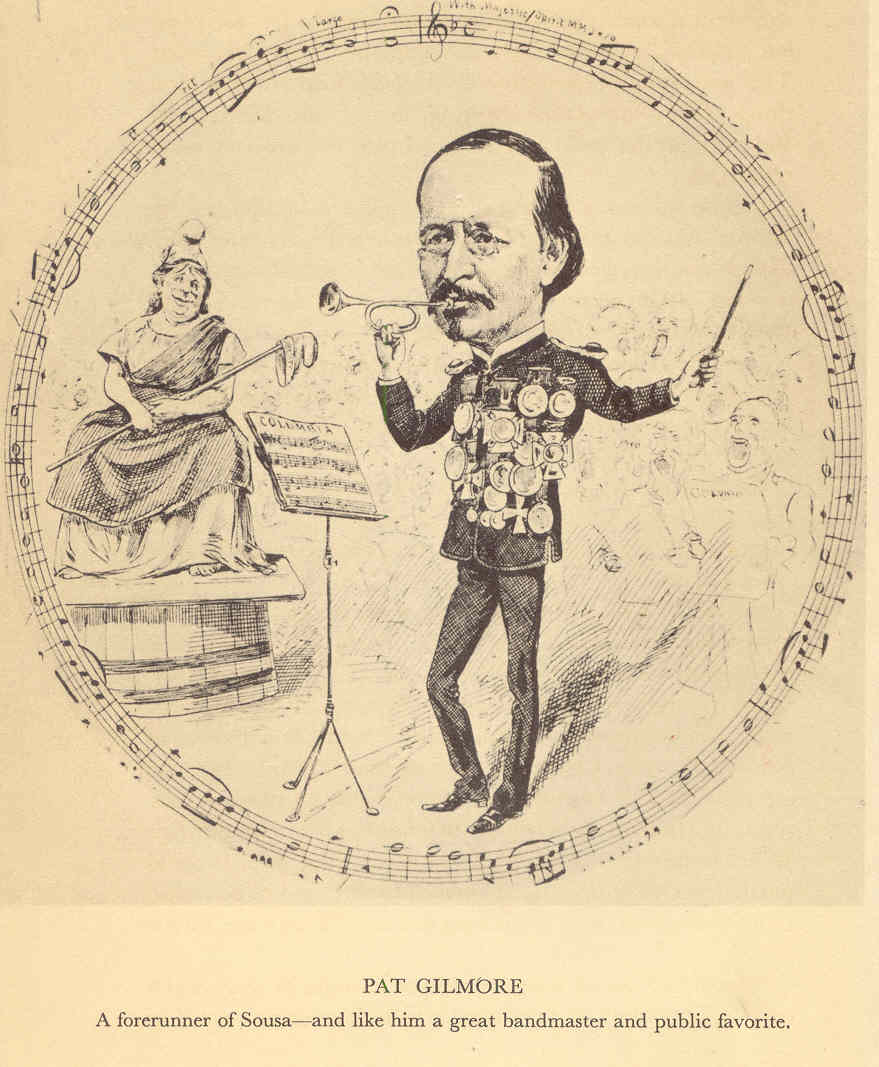
(Phillips). Composition credited to one P.S. Gilmore in Ryan’s Mammoth Collection (1883). Patrick
Sarsfield Gilmore was a musician, a cornet virtuoso and brass band leader
in the
***
P.S. Gilmore, who organized and led for many years the famous band
bearing his name,
was a member of Ordway’s Aeolians in Boston, 1851, where he sat on the
end and
played the tambourine. June 24, 1851, he began an engagement in
Hartford, Conn.,
with the above company. P.S. Gilmore was born near Dublin, Ireland,
December 25,
1829; he died at St. Louis, Mo., September 24, 1892. (pg. 62).
***
Gilmore came to the United States at
the age of 20, and, rather than having been born “near Dublin” as Rice says, he
was born in Ballygar, County Galway. His most famous composition, according to
many, was his band arrangement of “When Johnny Comes Marching Home” (published
under the pen name of Lewis Lambert), which first appeared as part of “The
Soldier’s Return March.” At one time in his life Gilmore was famed as the
impresario who led an orchestra of 1000, a choir of 10,000, and six bands in a
huge 50,000 seat auditorium as part of the 1872 World Peach Jubilee and
International Music Festival in Boston. Source for notated version: Armin
Barnett [Phillips]. Cole (1000 Fiddle
Tunes), 1940; pg. 87. Phillips (Traditional
American Fiddle Tunes), vol. 2, 1995; pg. 223. Ryan’s Mammoth Collection, 1883; pg. 120. White’s Unique Collection, 1896; No. 134, pg. 24.
X:1
T:Salem Hornpipe
M:2/4
L:1/8
R:Hornpipe
S:White’s Unique Collection (1896), No. 134
Z:AK/Fiddler’s Companion
K:G
(B/A/) | G(G/A/) B/d/G/B/ | c/d/e/c/
d/g/G/B/ | c/d/e/c/ d/g/G/B/ | (c/a/)(B/g/)
(A/f/)(G/E/) |
F/d/f/e/ d/c/B/A/ | G(G/A/) G/d/G/B/
| c/d/e/c/ d/g/G/B/ | c/d/e/f/ g/d/e/c/ | B[B,G][B,G] :|
|: (B/c/) | (d/<g/)B/d/
(G/B/)d/g/ | (f/<a/)g/e/ (d/f/)a/c’/ | b/>g/a/>f/ g/e/d/B/ |
(c/<e/)(A A)B/c/ | (d/<g/)B/d/
(G/B/)d/g/ | (f/<a/)g/e/ (d/f/)a/c’/ | b/>g/a/>f/ g/e/d/c/ | (B/d/)G G
:|
SALES TAX TODDLE. Old-Time, Breakdown.
SALIMONY WALTZ. American, Waltz. D Major (Matthiesen): G Major. Standard tuning. AABB.
The “Salimony/Salimonie Waltz” was composed by fiddler and retired
schoolteacher Fred Weaver, of
X:1
T:Salimony Waltz
M:3/4
L:1/8
S:Eric Robertson
Z:Transcribed by Ethan Hack
R:Waltz
K:D
FA3 A>B | A>F E2 D2 | B3A
B>c | B4 A2 | FA3 A>B | A>F E2 D2 | E3 D E>F |
G2 F2 E2 | FA3 A>B | A>F E2 D2
| B3A B>c | d4 d>e | f4 f>d | A4 F>A |
G2 F2 E2 |1 D6 :|2 D4 A2 |: f3e
f>g | a2 f2 d2 | c3d (3cBA | E6 |
c3B c> d | e4 e>f | g2 f2
e>d | Bd3 A2 | d3e f>g | a4 f2 | g3a (3gfe |
B4 d>e | f4 f>d | A4 F>A |
G2 F2 E2 |1 D4 A2 :|2 D6 ||
X:2
T:Salamonie Waltz
M:3/4
L:1/8
C:Fred Weaver
S:Fred Weaver,
I:Fred named this tune after the
I:which ran abouut 20 miles from his
home.
Z:transcribed by Joel Shimberg
R:Waltz
K:D
F2A2 A>B|A2F2D2|B2 G2 D2|G,4
DE|FA3 A>B|A2 F2 D2|
E4 EF|E2-(3E F ED2|F2A2 A>B|A2 F2
D2|B2 G2 D2|G,4zf|
f3 edB|A2F2A2|G2F2E2|D6::f3
efg|a2f2d2|
c3 d c B|A3zAB|c3
Bcd|e2f2g2|f2d2B2|A4z2|
d3
efg|a2f2d2|g4b2|b4z2|a3fdB|A2F2A2|
G2F2E2|D6:|
SALLIE... See "Sally..."
SALLIE COOPER. See “Sally
Cooper.”
SALLIE GOODEN. See "Sally Gooden."
SALLIE IN THE WILDWOOD. See "Sally
in the Wildwood."
SALLIE JOHNSON. See "Sally Johnson."
SALLOW OLD WOMAN, THE. See "Caillich/Cailleach Odhar [1]."
[COMMENT1][COMMENT2][COMMENT3][COMMENT4][COMMENT5][COMMENT6][COMMENT7][COMMENT8]
SALL’S DELIGHT. Irish (?), Reel. D Major. Standard tuning. AABB. Given as “Sally’s Delight”
in the index of O’Farrell’s volume. O’Farrell (Pocket Companion, vol. II), c. 1806; pg. 84. Jerry O’Sullivan – “O’Sullivan meets O’Farrell” (2005).
X:1
T:Sall’s Delight
M:
L:1/8
R:Reel
S:O’Farrell – Pocket Companion, vol. II (c. 1806)
Z:AK/Fiddler’s Companion
K:D
F2 AF dFAF | F2 AF BEEG | F2 AF dFAF
| BGEA FD D2 :|
d2 eg fdec | d2 eg fd B2 | d2 eg
fdec | dBAG FA D2 |
d2 eg fdec | dfeg fd B>f | agfe
dcBA | Bcde fd d2 :|
_______________________________
HOME
ALPHABETICAL FILES REFERENCES
© 1996-2009 Andrew Kuntz
Please help
maintain the viability of the Fiddler’s Companion on the Web by respecting the
copyright.
For further information see Copyright and Permissions Policy or contact the author.
[COMMENT1]This was Font/Pitch 1,10 - Off.
[COMMENT2]This was Font/Pitch 1,10 - On.
[COMMENT3]This was Font/Pitch 1,10 - Off.
[COMMENT4]Note: The change to pitch (12) and font (1) must be converted manually.
[COMMENT5]This was Font/Pitch 1,10 - Off.
[COMMENT6]This was Font/Pitch 1,10 - On.
[COMMENT7]This was Font/Pitch 1,10 - Off.
[COMMENT8]Note: The change to pitch (12) and font (1) must be converted manually.