The Fiddler’s
Companion
© 1996-2010 Andrew Kuntz
_______________________________
HOME
ALPHABETICAL FILES REFERENCES
|
GIB - GIV |
|
Notation
Note: The tunes below are recorded in what
is called “abc notation.” They
can easily be converted to standard musical notation via highlighting with
your cursor starting at “X:1” through to the end of the abc’s, then
“cutting-and-pasting” the highlighted notation into one of the many abc
conversion programs available, or at concertina.net’s incredibly handy “ABC
Convert-A-Matic” at http://www.concertina.net/tunes_convert.html **Please note that the abc’s in the Fiddler’s
Companion work fine in most abc conversion programs. For example, I use
abc2win and abcNavigator 2 with no problems whatsoever with direct cut-and-pasting.
However, due to an anomaly of the html, pasting the abc’s into the
concertina.net converter results in double-spacing. For concertina.net’s
conversion program to work you must remove the spaces between all the lines
of abc notation after pasting, so that they are single-spaced, with no
intervening blank lines. This being done, the F/C abc’s will convert to
standard notation nicely. Or, get a copy of abcNavigator 2 – its well worth
it. [AK] |
GIANT’S CAUSEWAY. Irish, Reel. Composed by County
Tipperary fiddler Seán Ryan (d. 1985). Ryan (Seán Ryan’s Dream), 15.
GIBBIE GREY'S. Shetland, Shetland Reel. Named for the Shetlandman who played the tune.
Front Hall 018, How to Change a Flat Tire ‑
"Traditional Music of Ireland and Shetland.
GIBSON'S WHISKEY. Scottish. Composed by J. Scott Skinner.
GIDD. Scottish. John Glen (1891) finds the earliest appearance of this tune
in print in Joshua Campbell's 1778
collection (pg. 28).
GIE THE LASSES MAIR
O’T. Scottish. A variant of "The Lass of Patie's Mill,” or
"Peaty's/Paty's Mill,” combined with another strain. Aird (Selection),
vol. 3; No. 556.
GIE THE MAWKING MAIR
O’T. AKA and see "Drunken Wives of Carlisle.”
..........................
GIFT FROM THE FAIRIES. Irish, Slip Jig (9/8 time).
From the playing of Donegal fiddler Mickey Doherty (older brother of John
Doherty and a member of the famous traveller musical family) who said he had it
from the fairies. It was recorded in the field in 1949 by Kevin Danaher and
Sean O’ hEochaidh of the Irish Folklore Commission. Capelhouse
Records, James Kelly – “Traditional Irish Music” (1996).
..........................
GIGA. AKA and see "Lord
Elcho's Favourite.” Scottish, Slow Jig. G Minor. Standard tuning. AABB.
This generically named tune ('giga'=jig) was composed by James Oswald, but also
published by Nathaniel
Gow who gave no composer credit. Alburger (Scottish Fiddlers and Their Music), 1983; Ex. 78, pg. 128.
..........................
GIGGA. A generic term used in the 17th and the early 18th century for the form
now known as a jig, or a tune in 6/8 time.
..............
GIGGE-A-GOGGE. AKA and see "Woodystock."
..............
GIGHT CASTLE. Slow Air. C Minor. The tune was played by
Hector MacAndrew and Winston Fitzgerald, and was apparently composed by
MacAndrew. Jack Campin notes a similarity to Angus Fitchet’s “Lament for Will Starr.” Dominion LP 1333, Hector MacAndrew – “The Fiddler’s
Companion” (c. 1960’s).
..........................
GIGUE. A French Canadian form, where step dancing is mostly to (2/4) reels, not to (6/8) jigs. The work Gigue has several meanings in France, including the jig-dance, a leg of lamb (gigot, or veal gigue), a girl with long legs, 13th century string instruments, and others.
..............
GIGUE, LA. French, Dance Tune ('A' part in 2/4 time, 'B' part in 6/8). G Major.
Standard tuning. AABB. Stevens (Massif
Central), 1987, Vol. 2; No. 114.
GIGUE À CELINA. AKA and see “Reel à Célina.”
GIGUE À COGNE PICARD, LA. French-Canadian, Reel. D Major. Standard tuning. AA’BB’CC. This
‘crooked’ tune is often played for step-dancing. Source for notated version:
from accordion players Philippe Bruneau and Clément Breton [Remon &
Bouchard]. Remon & Bouchard, vol. 1, 1996; No. 18.
GIGUE À JULIE, LA.
French-Canadian, In the
repertoire of Louis Beaudoin (1921-1980, Burlington, Vt.). A-L 001, Lisa Ornstein & André Marchand – “One Fine
Summer’s Day/Par un beau Samedi d’ été” (2009).
GIGUE À JOS BERNATCHEZ, LA. French-Canadian, Reel. D Major/Mixolydian. Standard tuning. AABB. A
‘crooked’ tune, the ‘A’ part having six measures and the ‘B’ part four. Source
for notated version: Liette Remon, who learned the tune from her father,
Réginald (Petit-Pabos, Gaspésie), who in turn learned it from his grandfater,
Jos Bernatchez [Remon & Bouchard]. Remon & Bouchard, vol. 2, 1997; No.
16. Les Têtes de violon - “Le talencourt.” 30 Below TB
001CD, Les têtes de violon (Bouchard et al) – “Airs Tordus/Crooked Tunes”
(1998). 30 Below TB-123-CD, Liette Remon – “Un p’tit air de famille.”
GIGUE À l’ENVERS, LA. French-Canadian, Reel. D Major. Standard tuning. AABB. From an obscure
recording from the beginning of the 20th century. Remon & Bouchard, vol. 1,
1996; No. 24.
GIGUE À MA TANTE
ALFREDA, LA. French-Canadian, Reel. D Major.
Standard tuning. AA’BB. A ‘crooked’ tune with the first part in cut time and
the second in 3/4 time. Guy Bouchard notes that the tune is one that is not
very melodic but is very well suited to the Sayguenay region step-dancing
style. Recorded by Louis Boudreault. Source for notated version: fiddler Lisa
Ornstein (Maine) [Remon & Bouchard]. Remon & Bouchard, vol. 2, 1997;
No. 3.
GIGUE À PADDY (Paddy's Jig). French-Canadian, Jig. G Major. Standard
tuning. AA'BB'. Cuillerier (Joseph Allard),
1992; pg. 6. Bluebird B-4889-b (78 RPM), Joseph
Allard.
X:1
T:Gigue a`
Paddy
C:Joseph
Allard
M:6/8
L:1/8
Z:Transcribed
by Bruce Osborne
K:G
d|gfg
efg|afd def|gfg efg|afd def|!
g2 g aga|bgg
bge|dcB AGA|BGG G2:|!
|:E|DGB
AGA|Bcd efg|G2 B AGA|BGE E2 D|!
DGB AGA|Bcd efg|dcB AGA|BGG G2:|!
GIGUE À PHILLIBERT, LA.
French-Canadian, Reel. A popular Québec crooked tune from the repertoire
of fiddler Louis “Pitou” Boudreault (Saguenay region). 30
Below TB 001CD, Les têtes de violon (Bouchard et al) – “Airs Tordus/Crooked
Tunes” (1998).
GIGUE À PIERRE
CHARTRAND, LA.
French-Canadian, Reel. G Major. Standard tuning. AA’BB’. Source Bruneau plays
this ‘crooked’ tune in the key of F
Major (the ‘A’ part has four measures, the ‘B’ part 6). Source for notated
version: accordion player Phillipe Bruneau [Remon & Bouchard]. Remon &
Bouchard, vol. 2, 1997; No. 15. Phillipe Bruneau &
Pierre Chartrand - “La gigue québécoise.” Les Têtes de violon - “Le
Talencourt.”
GIGUE À TOMMY (MÉDEE), LA. French-Canadian, Jig (3/4 time). G Major. AA’BBC. Guy Bouchard points
out that source Boudreault, like many Québecois fiddlers, changes the number
and order of the parts of the tune at each repetition. For this particular
transcription the order was AAABBC, AAAAABBBC, AAAAAABBB, AAAABBC. Source for
notated version: Louis ‘Pitou’ Boudreault (Saguenay region, Québec) [Remon
& Bouchard]. Remon & Bouchard, vol. 1, 1996; No. 7.
GIGUE CANADIENNE (Canadian Jig). French-Canadian, Jig. G Major. Standard
tuning. AA'BB'. Cuillerier (Joseph Allard),
1992; pg. 7. Victor 263522-b (78 RPM), Joseph Allard.
X:1
T:Gigue
Canadienne
C:Joseph
Allard
M:2/4
L:1/16
Z:Transcribed
by Bruce Osborne
K:G
dc|B2GB
cAFA|d^cde dBGB|DFAB cBcB|AGFE DB,DG|!
B2B2
cBce|dBge dBGB|DFAB cAFG|A2G2 G2:|!
|:ga|bgfg
dega|bgfg dega|ba^ga ea^ga|ba^ga ef=ga|!
bgfg dega|bgfg defg|(3aba (3gag
(3fgf (3efe|defe g2:|!
GIGUE DE LA DÉBAUCHE. French-Canadian, Jig. G Major. Standard tuning (fiddle). AA'BB'. Strong
similarities to the Irish jig “The
Eavesdropper,” although it may be an instance of musical coincidence.
Cuillerier (Joseph Allard), 1992; pg.
7. Bluebird B-1107-a (78 RPM), Joseph Allard.
X:1
T:Gigue de
la Débauche
C:Joseph
Allard
M:6/8
L:1/8
Z:Transcribed
by Bruce Osborne
K:G
d|g2 B
BAG|Bdd dBG|cec BdB|AFA def|
g2 B BAG|Bdd
dBG|cec BdB|AcA G2:|
|:B|def g2
g|faf d2 d|def gfg|a2 a gbb|
gbg faf|ege dBG|cec BdB|AFA G2:||
GIGUE DE LA CHAISE BERCANTE, LA.
French-Canadian. In the repertoire of Burlington, Vt., fiddler Louis
Beaudoin (1921-1980), named for a favoured rocking chair from which he liked to
play tunes. A-L 001, Lisa Ornstein & André
Marchand – “One Fine Summer’s Day/Par un beau Samedi d’ été” (2009).
GIGUE DE M. LASANTÉ, LA. French-Canadian, Jig (3/2 time). G Major. Standard tuning. AA’BB’.
Source for notated version: Mr. Lasanté (Abitibi, Québec), via Lisa Ornstein
[Remon & Bouchard]. Remon & Bouchard, Vol. 1, 1996; No. 14. MP2036, La Bottine Souriante - “Je voudrais changer
d’chapeau.”
GIGUE DE TERREBONNE. AKA – “Reel de Terrebonne.” French-Canadian, Reel. D Major. Standard
tuning. AABB. From the repertoire of French-Canadian accordion player Alfred Montmarquette.
Source for notated version: accordion player Raynald Ouellet (Québec) via Dan
Compton (Portland, Oregon) [Songer]. Songer (Portland Collection), 1997; pg. 84. Thirty
Below TB035, G. Labbe, B. Bourque et al - “Hommage a Alfred Montmarquette.”
GIGUE DES
CAPUCHONS (Hood Dance). French-Canadian, Jig. D Major. Standard
tuning. AA’BB’. A capuchon is an item
of apparel—a hood that covers the head. Source Joseph Allard (1873-1947) played
the tune ‘square’ (i.e. equal parts of equal measures), however, Rémi Laporte
played the tune with a measure of 9/8 at the beginning of the second part.
Source for notated version: fiddler Rémi Laporte (Saint-Liguori, Québec) [Hart
& Sandell]. Hart & Sandell (Dance
ce Soir), 2001; No. 11, pg. 45.
X:1
T:Gigue des
Capuchons
C:Joseph
Allard
M:6/8
L:1/8
Z:Transcribed
by Bruce Osborne
K:D
g|faa
afa|gfe d2 e|faf ede|fdf efg|!
faa afa|gfe
d2 e|faf ede|fdd d2:|!
|:F|A3
G3|FAd fed|cBc edc|dfe dcB|!
A3 G3|FAd fed|cBc edc|dfe d2:|!
GIGUE DES PAROISSIENS. French-Canadian, Jig. D Major.
Standard tuning. AABB.
X:1
T:Gigue des
Paroissiens
C:Joseph
Allard
M:6/8
L:1/8
Z:Transcribed
by Bruce Osborne
K:D
A|AFA
dfa|agf efg|fdf fed|cee ecA|!
AFA dfa|agf
efg|afd gec|edd d2:|!
|:D|DFA
dcB|ABA FAF|DFA DFA|A,CE A,CE|!
DFA dcB|ABA FAd|fef gec|edd d2:|!
GIGUE DES SUCRES. French-Canadian, Jig. G Major. Standard tuning. AA'BB'. The 'A' part is
the same as "Portland Fancy [1]."
Cuillerier (Joseph Allard), 1992; pg.
9. Victor 263932-b (78 RPM), Joseph Allard.
X:1
T:Gigue des
Sucres
C:Joseph
Allard
M:6/8
L:1/8
Z:Transcribed
by Bruce Osborne
K:G
G|D2 G D2
G|DGA B3|cBc ABc|e2 d B2 G|!
D2 G D2
G|DGA B3|cBc DEF|GBA G2:|!
|:d|g3
f3|ece d3|cBc ABc|e2 d B2 d|!
g3 f3|ece d3|cBc DEF|GBA G2:|!
GIGUE DES TOURISTES. AKA and see "Quadrille de
Beauharnois."
GIGUE DU BONHOMME, LA.
French-Canadian, Jig. A traditional tune in the repertoire of Gaspésie
fiddler Yvon Mimeault (b. 1928, Mont-Louis), who said it was a favorite of his
father, Odilon, also a fiddler. Yvon Mimeault – “Y’
était temps!/It’s About Time.”
GIGUE DU COMMERCE.
French-Canadian, Jig. G Major. Standard tuning (fiddle). AABB. Recorded
by Québec fiddler Joseph Allard. Raz de Marée/Tidal
Wave – “Marche du St-Laurent” (2010)
X:1
T:Gigue de commerce
M:6/8
L:1/8
S:Joseph Allard
D:Raz de Marée/Tidal Wave – “Marche
du St-Laurent” (2010)
Z:AK/Fiddler’s Companion
K:G
B3 BAG|c2c efg|d2B {c}BAG|FAA
AFD|G2B {c}BAG|
c2e efg|d2g fed|1 cBA GDG:|2 cBA
GBd||:e2c efg|d2B {c}B2d|
e2c efg|bag fed|e2c efg|d2B
{c}B2g|fed cBA|1 G3-GBd:|2 G2-GDG||
GIGUE DU DIAMANT BLEU. French-Canadian, Reel. D Major.
Standard tuning. AA’BB’C.
X:1
T:Gigue du diamante bleu
M:2/4
L:1/8
R:Reel
S:Transcribed by fiddler Pascal
Gemme (of the group Genticorum) http://tradquebec.over-blog.com/archive-1-2007.html
K:D
a/g/|:f/d/e/d/ f/d/e/f/|g/b/a/f/
ea/g/|f/d/e/d/ f/d/e/f/|1 g/b/a/f/ da/g/:|2 g/b/a/f/ dA/d/||
|:fe/d/ f/d/e/d/|B/d/A/d/
B/d/A/d/|fe/d/ fe/d/|1 c/A/B/c/ dA/d/:|2 c/A/B/c/ d/A/B/c/||
d/c/d/A/ F/A/F/A/|G/B/G/B/
F/A/F/A/|d/c/d/A/ F/A/F/A/|G/A/B/c/ d(3A/B/c/|
d/c/d/A/ F/A/F/A/|G/D/B,/D/
F/A/F/A/|d/c/d/A/ F/A/F/A/|G/A/B/c/ da/g/||
GIGUE DU
FORGERON (Blacksmith’s Dance). French-Canadian, Jig. D Major. Standard tuning.
AA'BB'. Source for notated versions: Joseph Allard (1873-1947, Woodland,
Montréal, Québec) [Cuillerier, Hart & Sandell]. Cuillerier (Joseph Allard), 1992; pg. 9. Hart & Sandell (Dance ce Soir), 2001; No. 12, pgs. 45-46. Bluebird B-1104-a (78 RPM), Joseph Allard.
X:1
T:Gigue du
Forgeron
C:Joseph
Allard
M:6/8
L:1/8
Z:Transcribed
by Bruce Osborne
K:D
A|dcd
AFA|dfb a2 f|gfg Ace|dfd AFA|!
dcd AFA|dfb
a2 f|gfg Ace|d2 d d2:|!
|:g|b3
-bag|faa agf|gfg Ace|ba^g a2 a|!
gbb bag|faa agf|gfg Ace|d2 d d2:|!
GIGUE DU PERE DOIRON, LA.
French-Canadian, Jig. A traditional tune in the repertoire of Gaspésie
fiddler Yvon Mimeault (b. 1928, Mont-Louis), learned from friend and fiddler
Ferdinand Dionne (Kamouraska). Yvon Mimeault – “Y’
était temps!/It’s About Time.”
GIGUE DU PÈRE MATHIAS. French-Canadian, Reel. D Major.
Standard tuning. AA’BB’CC’. The melody was composed by accordion player Adélard
Thomassin, who played with the influential folk group Les Montagnards
Laurentien.
X:1
T:Gigue du père Mathias
M:2/4
L:1/8
C:Adélard Thomassin
R:Reel
S:Transcribed by fiddler Pascal
Gemme (of the group Genticorum) http://tradquebec.over-blog.com/archive-1-2007.html
K:D
d/B/|:A/F/F/F/ Ad/B/|A/F/F/F/
Ed/B/|A/F/F/F/ Ad/B/|1 A/F/E/F/ Dd/B/:|2 A/F/E/F/ D2||
|:A/c/e/c/ B/{c}B/A|A/c/e/c/
B/{c}B/A|A/c/e/c/ B/{c}B/A|1 B/A/B/c/ d/d/d:|2 B/A/B/c/ d/c/d/e/||
|:fd BA/G/|F/A/F/A/ E/A/d/e/|fd
BA/G/|1 F/A/B/c/ d/c/d/e/:|2 F/A/B/c/ dd/B/||
GIGUE DU PETIT PETE
PAYETTE. French‑Canadian, Jig. D
Major. Standard tuning. AABB.
GIGUE DU SOUS-MARIN. French-Canadian, Jig. G Major. Standard tuning. AA'BB'. Cuillerier (Joseph Allard), 1992; pg. 10. Bluebird B-1279-b (78 RPM),
Joseph Allard.
X:1
T:Gigue du
Sous-Marin
C:Joseph
Allard
M:6/8
L:1/8
Z:Transcribed
by Bruce Osborne
K:G
B|BAB G2
D|B,2 E D2 B|BAB d2 B|G2 B A2 B|!
cBc A2 G|F2
G A2 B|cBc fed|cBA B2 B|!
BAB G2 D|B,2
E D2 B|BAB d2 B|G2 B A2 B|!
cBc A2 G|F2
G A2 B|cBc fed|cBA G2:|!
|:B/c/|d2 d
e2 d|g3 -gfg|a3 -aga|b3 -bab|!
d'2 B d2
g|gfe d2 g|fed cBA|B3 -BBc|!
d2 d e2 d|g3
-gfg|a3 -aga|b3 -bab|!
d'2 B d2 g|gfe d2 g|fed cBA|G4
-G:|!
GIGUE DU VIOLONEUX. French-Canadian, Jig. D Major. Standard tuning. AA'BB'. The 'A' part is
reminiscent of "Captain Jinks." Cuillerier (Joseph Allard), 1992; pg. 10. Victor
263648-b (78 RPM), Joseph Allard.
X:1
T:Gigue du
Violoneux
C:Joseph
Allard
M:6/8
L:1/8
Z:Transcribed
by Bruce Osborne
K:D
e|f2 d
AFA|B2 A d2 f|efg B2 c|d2 e f2 g|!
aba AFA|B2 c
d2 f|efg B2 c|edd d2:|!
|:d|g3
-gag|f2 d fgf|efe ede|fdB B2 A|!
g3 gag|f2 d fgf|e2 d efg|ABc d2:|!
GIGUE FOR GENNY. AKA and see "Greenholm."
English, Country Dance Tune (6/8 time). G Major. Standard tuning. AAB. Barnes (English Country Dance), 1986.
GIGUE SIMPLE. AKA and see “(La) grande
gigue simple.”
GILBERT CLANCY'S REEL (Gilibeart Mhac Fhlannchadha). AKA and see "Bímid ag Ól," “Courting in the Garden,” “James Ryan’s Favourite,” “John Reid’s Favourite,” “Seán Reid’s Reel,” "The West Wind [1].” Irish, Reel. G Major.
Standard tuning. AB. O'Sullivan (1983) sees motivic connections between this
tune and Bunting's "Whish,
Cat from under the Table." Gilbert Clancy (died c. 1957) was a flute
and concertina player from Islandbawn, County Clare, father of piper Willie
Clancy (1918-1973) and friend to blind piper Garrett Barry, an influential
musician of the region who died around 1900. Source for notated version: piper
Willie Clancy/Liam Mac Flannchedha (Miltown Malbay, County Clare, [Breathnach].
Breathnach (CRÉ I); No. 83, pg. 37.
Cranitch (Irish Fiddle Book), 1988;
154. Mitchell (Dance Music of Willie
Clancy), 1983; 15. Tara 2002, Christy Moore ‑
"The Iron Behind the Velvet" (1978. Learned from the late Willie
Clancy). Piping Pig Productions PPPCD001, Jimmy O’Brien-Moran – “Seán Reid’s
Favourite” (1996. Appears as “Seán Reid’s Favourite”).
GILDA ROY. Old-Time, Breakdown. USA, south-eastern Kentucky. C
Major. Standard tuning. ABC. No musical relation to the tune that is usually
known as “Gilderoy” or “Red Haired Boy.” The title, however, is a corruption of
“Gilderoy” which itself is an Englished version of the Gaelic giolla ruadh, or ‘red-haired boy’. The
tune was recorded in 1937 by the Lomax’s for the Library of Congress from the
playing of Kentucky fiddler W.H. Stepp. Source Salyer played the ‘f’ notes so
that they sound almost ‘f#’. Similarities with the "Billy in the Lowground"
family of tunes. Source for notated version: from a
1941 home recording of fiddler John M. Salyer (Salyersville, Magoffin County,
Kentucky), by his sons, Glen and Grover [Titon]. Titon (Old-Time Kentucky Fiddle Tunes), 2001; No. 48, pg. 79. Berea College Appalachian Center AC-003, “John M. Salyer:
Home Recordings 1941-1942, vol. 2” (1993). Bruce Greene – “Leatherwood
Stocking.”
GILDEROY [1]. Scottish (originally), English, Irish; Hornpipe, Reel and Air. A Minor.
Standard tuning. AABB. An earlier, minor key, relative of what was later called
"The Red Haired Boy" family
of tunes. Caoimhin Mac Aoidh explains that the name ‘Gilderoy’ is an English
corruption of the Gaelic words ‘Giolla Ruaidh’; giolla is generally taken to
mean a servant or a young person, while ruaidh
literally means red, though when used in conjunction with a person it refers to
red hair. Interestingly, he mentions that in modern Scotland and Ireland
hunting and fishing stalkers or guides are still referred to in anglicised form
as ‘Gilles’. The hero of the ballad “Gilderoy” was a historical personage, a
Scottish freebooter of the notorious Clan MacGregor, seven of whose gang were
taken by the Stewarts of Athol and hanged in Edinburgh in July, 1638. Robin
Williamson maintains the ballad was well known as far away as England by the
middle of the 17th century, a decade or two later. An early printing appears in
the Gillespie Manuscript of Perth,
1768. The title appears in Henry Robson's list of popular Northumbrian song and
dance tunes, which he published c. 1800. Barnes (English Country Dance Tunes, vol. 2), 2005; pg. 49. Kennedy (Fiddlers Tune Book), vol. 1, 1951; No.
28, pg. 14. McGibbon (Scots Tunes, book
III), 1762; pg. 70. Raven (English
Country Dance Tunes), 1984; pg. 188. Flying Fish
FF 358, Robin Williamson ‑ "Legacy of the Scottish Harpers, vol.
1."
X:1
T:Gilderoy [1]
M:C|
L:1/8
R:Hornpipe
K:Amin
E2 | A2 AB cBcd | efec d2 cd | edcB
ABcA | B^GEE E2 EG |
A^GAB cBcd | efec d2 cd | ea^ga edcB
| c2A2A2 :|
|: ef | g2 ga gfef | gfec d2 cd |
edcB ABcA | B^GEE E2 EG |
A^GAB cBcd | efec d2 cd | ea^ga edcB
| c2A2A2 :|
X:2
T:Gilder Roy [1]
M:C
L:1/8
R:Air
N:”Slow”
S:McGibbon – Scots Tunes, book III, pg. 70
(1762)
Z:AK/Fiddler’s Companion
K:Amin
E2 | A2 A>B c>Bc>d |
({c/d/}e2) “tr”(d>c) (d>e) (c>d) | ({c/d/}e2)G2 c<AG<E | G6
“tr”(cB) |
(A^G)AB (cBc)d | (e>d)(e>f) e2
(ag) | (fe)(dc) “tr”B3A | A6 :: (e>f) | (g>f)(g>a) g2 “tr”(f>e) |
{d/e/}(fe)(dc) d2 c>d |
({c/d/}e2)G2 (c/4B/2<A) (G/4F/2<E) | (G4G2) “tr”(cB) |
(A^GA)B (cBc)d | (e>d)(e>f) e2
(ag) | (fe)(dc) “tr”B3A | A6 :|
GILDEROY [2]. AKA and see "Black Rock [2]"(Pa.),
"The Duck Chewed Tobacco"
(Va.), "Guilderoy," "Gilder Roy," "Gilda Roy,"
"Gilroy," "Gilderoy's Reel," "Injun Et a Woodchuck [2]"
(Pa.), "Mairi ban Og,"
"Nellie on the Shore" (Pa.),
"The Old
Soldier (with a Wooden Leg) [2]," "Red Haired Boy," "Wooden Leg.” Scottish, Reel; Old‑Time, Breakdown.
USA; Ky., Va., Ohio, Pa., Mass. A Minor/Mixolydian. Standard tuning. AABB. The
title Gilderoy is an Englished version of the Gaelic 'Gilleruadh' or 'Giolla
Ruadh', meaning red‑haired lad or youth. Historically, Gilleruadh was the
nickname of a famous Scottish highwayman named Patrick McGregor who was
captured and executed in 1636; the song describes his exploits and moralizes on
his fate. John Purser says the tune was known by around 1660 as it was referred
to in a broadside of that period. Glen records that the tune was first printed
in the British Isles in 1726 (where it appears in Alexander Stuart's Musick for Allan Ramsay's Collection of
Scots Songs, pg. 194, in the key
of ‘A’), in William Thompson's Orpheus
Caledonius of 1733 and again in 1742, though Cazden (et al, 1982) dates the
tune as "possibly from 1650," perhaps to coincide with the demise of
the famous highwayman [which is speculation since no sources were cited]. It
quickly became popular and appears in the later 18th century Scottish collections
of Aird, Bremner, Gillespie (1768), Oswald (1744
in A Second Collection of Curious Scots Tunes, later republished with
different variations in his Caledonian Pocket Companion), McGibbon, and
McLean (1772) {where it is ascribed to Robert McIntosh}. The Scots national
poet, Robert Burns, set one of his early lyrics to it, called "From Thee,
Eliza." Macfarlane, in his 'Studies' claimed this tune, among others, was
a Gaelic melody, and postulated that an analysis of airs for alteration of
musical accent and the introduction of what he termed 'slurs' could detect
which tunes had been originally Gaelic but were altered to fit English lyrics.
Bayard (1981), Cazden (et al, 1982) and others have long determined that
'Guilderoy', in both vocal and instrumental settings, stems from the protean
'Lazarus' air (see also "Bonaparte's Retreat"), and numbers among one
of the half‑dozen or so most extensively used melodies in the entire
English-speaking folk tune repertory (see JWFSS, I, 142). Elaborates Bayard:
"This melody is one of several which provide some index of the extent to
which the local tradition is independent of commerical printed collections of
fiddle tunes. Bub Yaugher's (Pennsylvania-collected) variant represents the
version in which 'Guilderoy' seems always to be known in western Pennsylvania‑‑distinctive
in melodic outling, and invariable played in the mixolydian mode. As might be
expected the tune is not always known under this name, which is, however, the
one most often attached to it. The mixolydian version of 'Gilderoy' is
undoubtedly Irish: the editor has repeatedly heard it performed by Irish
fiddlers in Massachusetts, and they have always played this version, in
variants rather close to the Pennsylvania sets. The printed collections, on the
other hand, nearly always give the tune in dorian or aeolian tonality, which
corresponds to the tonality of its well known (English and) Scottish versions.
Tune versions like this, therefore, present good evidence for the comparative
freedom of the Pennsylvania folk fiddlers from influence of printed
collections, and for the independence and authenticity of their tradition. The
reason for the tenacity of the name 'Guilderoy' is that the famous song by that
name was frequently sung to forms of this tune in British tradition"
(Bayard, 1944). Flood (1906) claims the tune as Irish and says it was
originally called "Molly MacAlpin," a lament written soon after five
members of that family (also called Halpin or Halfpenny) were outlawed. Another
related Irish tune, likewise in the Lazarus family, include the oft-heard
"Star of the County Down" (in duple and triple versions). The title
appears in a list of traditional Ozark Mountain fiddle tunes compiled by
musicologist/folklorist Vance Randolph, published in 1954. The alternate
Pennsylvania titles given above are floaters‑‑"Injun Et a
Woodchuck" comes from the ditty sung to the tune:
***
Injun et a woodchuck,
(or: I'll be darned if he didn't.)
He had no time for to skin it. (Bayard, 1981)
***
Sources for notated versions: Irvin
Yaugher Jr. (Mt. Independence, Pennsylvania, October 19, 1943; learned from his
great‑uncle) [Bayard, 1944]: seven southwestern Pa. fiddlers [Bayard,
1981]. American Veteran Fifer, No.
35. Bayard (Hill Country Tunes),
1944; No. 85 (appears as "Guilderoy"). Bayard (Dance to the Fiddle), 1981; No. 169A‑G, pgs. 119‑122.
"Calliope," pg. 438. Cazden, pg. 32. Edinburgh Musical Miscellany, I, 240. Harding’s Original Collection, No. 51. Howe's Diamond School for the Violin, 1861; pg. 39. Jigs and Reels, pg. 8. Johnson,
The Scots Musical Museum (edition of 1853), I, No. 56, II, No. 220. S.
Johnson (The Kitchen Musician No. 4:
Collection of Fine Tunes), 1983 (revised 1991, 2001); pg. 12. JFSS, II, 119. JWFSS, I, 142. Krassen, 1973; pg. 81. O'Neill, Music of Ireland, No. 1748. O'Neill Irish Music, No. 356. Reavy, No. 90. Robbins, No. 131. Roche Collection, vol. 3; No. 188. Sannella,
Balance and Swing (CDSS). Smith, The Scottish Minstrel, vol. 2, 18. Southern Folklore Quarterly, VI, pg. 8
(appears as "The Duck Chewed Tobacco"). Edison
52022 (78 RPM), John Baltzell {Baltzell lived in Mt. Vernon, Ohio, the same
home town as minstrel Dan Emmett (d. 1904). Emmett taught Baltzell to play the
fiddle when he returned to the town, poor, in 1888}. Redwing Music RWMCD 5410,
Abby Newton – “Castles, Kirks and Caves” (2001).
X:1
T:Gilderoy [2]
M:4/4
L:1/8
R:Reel
K:Amix
F2|EA2B A2 cd|efec d2 cd|edcB A2
Bc|BAGF G2 ED|
EA2B A2cd|efec d2 cd|ea2b
aged|c2A2A2:|
|:ef|g2 gf gfef|gfec d2 cd|e2A2
ABcA|BAGF G2 ED|
EAAB A2 cd|efec d2 cd|eaab a2
ed|c2A2A2:|
GILDEROY [3]. See “Gilda Roy.”
GILDEROY [4]. American, Reel. A Minor. Standard tuning. AABB. A version of the Irish
tune “Take Her Out and Air Her
[3]” and “Touch Me if You
Dare [1].” Alan Jabbour collected a version from Glen Lynn, Virginia,
fiddler Henry Reed, that the latter identified as a “British field march”
played by the retreating British at the Battle of New Orleans. Ford (Traditional
Music in America), 1940; pg. 43.
X:1
T:Gilderoy [4]
M:2/4
L:1/8
R:Reel
S:Ford – Traditional Music in America
(1940)
Z:AK/Fiddler’s Companion
K:Amin
A/B/ | cB/A/ BB/A/ | G/A/B/c/
d/B/G/B/ | cB/A/ BA | E/AB/ AA/B/ |
cB/A/ BB/A/ | G/A/B/c/ d/B/G/B/ |
gB/A/ BA | E/AB/ A :: A/B/c/d/ ee/f/ |
g>g BA | a>a cB | E/AB/ A :|
GILDEROY [5]. Old-Time, Breakdown. C Major.
Standard tuning. From the playing of Magoffin County, eastern Kentucky fiddler
John Salyer (1882-1952), who called it “Gilda Roy.”
GILE MEAR. AKA and see “Mo Gile Mear.”
GILE MO CHROÍ. AKA and see “Brightness
of My Heart.”
GILE MOCHRAIDHE. AKA and see "Brightness
of My Heart."
GILES FARNABY'S GIGGE. English, Dance Tune (common time). Even though called a jig, the tune
is in common time; here the word jig denotes a spirited dance.
GILES ROY POLKA. American, Polka. C Major. Standard tuning. AA'BCC'. Source for notated
version: Henry Landry [Phillips]. Phillips (Traditional
American Fiddle Tunes), Vol. 2, 1995; pg. 347.
GILIBEART MHAC
FHLANNCHADHA (Gilbert Clancy’s
{Reel}). AKA
and see “Gilbert Clancy’s Reel.”
GILL CAN, THE. AKA and see "Loch Leven Castle,"
"Miss Lyle's Reel." Shetland.
GILLA MACHREE. AKA – “Giolla mo Chroi.” Irish, Slip Jig. G Major. Standard. AA’BB’. O’Neill (Waifs and Strays of Gaelic Melody), 1922; No. 191.
X:1
T:Gilla Machree
M:9/8
L:1/8
S:Capt. F. O'Neill
Z:Paul Kinder
K:G
G2 G G2 B dBG|E2 A ABG FED|1G2 G G2 A Bcd|efg agf g2 z:|
2G3 GFG Bcd|efg agf g2||:d|gag gfe dcB|A2 A ABG FED|
1gag
gfe dBd|efg agf g2:|2gag bag afd|efg agf g2z||
GILLANADROUAR. AKA and see "The Drovers Lads,"
"Gillan the Drover," "Daniel of the Sun [1],"
"Donall na Greine,"
"From the Court to the
Cottage," "Girls of the
West," "I gave to my Nelly,"
"Thady/Teddy you Gander,"
"'Tis sweet to think,"
"The Leg of (a) Duck,"
"Buck(e)y Highlander,"
"O my Dear Judy," "O My Dear Father, Pity your
Daughter," "She is the Girl that
can do it," "Nelly's Jig,"
"The Bonny Highlander,"
"Petticoat Loose [1],"
"The Bottle of Brandy,"
"Bully for You," "The
Western Jig."
GILLAN THE DROVER
("Giolla na Drover" or "Gillan an Drover"). AKA and see "The
Drover Lads," "Gillanadrouar,"
"Gille Na Drobhair," et al. Irish,
English, Scottish; March (6/8 time) or Highland Jig. England, Northumberland. F
Major (O'Neill): G Major (Peacock). Standard. AABBCCDD (Kerr):
AABB'CCDDEEFFGGHHII (O'Neill, Peacock). The tune with the Englished title (a
corruption of the Gaelic “Giolla na Drover“ {sometimes “Gillan an Drover”}
meaning “The Drover Lads”) is claimed by both Irish and Scots. O'Neill styles
it an "ancient Irish March," and thought it was (in 1915)
"considerably over a century old." O’Neill’s dating is confimed by Northumbrian
sources for the tune is printed in Peacock’s
Tunes (c. 1805) and the title appears in Henry Robson's list of popular
Northumbrian song and dance tunes, which he published c. 1800. Peacock notes
that it should be played at a slow tempo. The tune seems to Bayard (1981) to be related
to the marching air "Domhnall na Greine" (Daniel of the Sun), and thus the
many related airs in that family. See also the related “Grumbling Rustic.”
***
Despite the popular image of long
range cattle drives as an American ‘wild west’ phenomenon, such drives were
common in Britain in the 18th century, often originating in Scotland
and routing through Carlisle and the west, or by the valleys of North Tyne and
Coquet in the east through to Northumberland. There was a great cattle market
at Falkirk (called the Falkirk Tryst) in Scotland. Drovers’ places of call can
be traced by the names of still-existing inns, such as the Cat and Bagpipe in
East Harlsey in Yorkshire, the Drovers’ Inns at Boroughbridge and Wetherby,
Drovers’ Rest in Cumberland, Drovers’ Call between Gainsborough and Lincoln,
and two Highland Laddie’s—one in Nottingham and one near Norwich, at St. Faiths
(Collinson, 1975). So important was Scottish beef to England that Highland
drovers were allowed to keep their arms (for defense of themselves and their
herds from the depredations of the notorious Scottish cattle theives) following
Culloden and the Disarming Act of 1747.
***
Beef, however, was not the only
Scottish export to head south at the hands of drovers. Many farms in the
Highlands had whisky stills, and a field of barley shimmering in the wind
surely meant a whisky still was nearby. In 1797 there were some 200 stills in
operation in the parish of Glenlivet, and the 4th Duke of Gordon,
for one, felt that the making of whiskey was a divine right of his tenants,
although he was finally pressured by London to at least tax the trade. Drove routes were used by the inhabitants of
Glenlivet to convey the liquor south, and many a sturdy well-laden Highland
garron could be seen on the Braes of Livet winding their way up to the water
shed of the Ladder hills down through Glen Nochty, Strathdon and on the the lowlands
and borders (Moyra Cowie, 1999).
***
Breathnach
(CRÉ II), 1976; No. 16 (appears as
untitled jig). Campbell (Albyn's
Anthology), 1816, vol. 1; No. 12, pg. 100. Kerr (Merry Melodies), vol. 3; No. 272, pg. 30. MacDonald (The Skye Collection), 1887; pg. 176.
McGoun's (Repository of Scots and Irish
Airs), c. 1800. O'Neill (O’Neill’s Irish Music), 1915/1987; No.
104, pgs. 58‑59. Peacock (Peacock’s
Tunes), c.1805/1980; No. 29, pg. 12. Front
Hall FHR‑08, Alastair Anderson ‑ "Traditional Tunes"
(1976. From the playing of Colin Ross). Green Linnet SIF 1047, John
Cunningham - "Fair Warning" (1983).
X:1
T:Gillan
the Drover
M:6/8
L:1/8
R:March
S:O’Neill –
O’Neill’s Irish Music (1915)
Z:AK/Fiddler’s Companion
K:F
FAc (f3 |
f/)g/a/g/f/e/ f2d | (c<A)A A2G | (c<A)A A2G | FAc (f3 | f/)(g/a/g/f/e/)
f2d | cAF GAG |
cAF G2 A ::
FAc cAc | dBd (c/B/A/G/F) | (c<A)A A2G | (c<A)A A2G | FAc c(A/B/c) |
d>ef
(d/c/B/A/G/F/) | GAG G2A |1 GAG G2A :|2 GAG G2 |: (f/g/) | a3g3 | f3 cAF | cAA
A2G |
cAA A2
(f/g/) | a2g3 | f3 (d/c/B/A/G/F/) | GAG G2A | GAG G2 :: (B/c/) | dBd cAc | BGB
(c/B/A/G/F) |
cAA A2G |
cAA A2B/c/ | d(B/c/d) c(A/B/c) | BGB (c/B/A/G/F) | GAG G2A | GAG G2 :|
|: A |
(FA/B/c/A/) f3 | (f/g/a/g/f/e/) f2d | cAA A2G | cAA A2G | F(A/B/c/A/) f3 |
(f/g/a/g/f/e/) f2d |
cAF GAG |
cAF G2 :: A | F(A/Bc/A/) F(A/B/c/A/) | (dB/c/d/B/) (c/B/A/G/F) | cAA A2G |
cAA A2G |
F(A/B/c/A/) F(A/B/c/A/) | d>ef (d/c/B/A/G/F/) | GAG G2A | GAG G2 :|
B/c/ |
.d.df (cA).c | .d.df (cA).F | cAA A2G | cAA ABc | .d.df (cA).c | .d.df
(c/B/A/G/F) |
GAG G2A |
GAG G2 :: A | FAA GBB | FAA cAF | cAA A2G | cAA A2G | FAA GBB |
Acc Bdd |
cAF GAG | cAF G2 :: (B/c/) | dfd cAc | dfd cAF | cAA A2G | cAA A2 B/c/ |
dfd cAc |
dfd cAc | GAG G2A | GAG G2 :|
GILLAN'S APPLES [1]
("Uballide Uí Gillain," "Uballa Mic Gealain" or "Úllaí
Uí Ghiolláin"). AKA - “Gillian’s
Apples.” AKA and see "Apples in
Winter [2],” "Fruit for the
Ladies," "Jackson's
Growling Cat," “Jackson’s
Stranger [2],” "The Longford Jig,"
"Rise the Grouse," "Rouse the Grouse.” Irish, Double Jig. G
Major ('A' part) & D Major ('B' part) {O'Neill/Krassen. Tubridy}: D Major
('A' and 'C' parts) & A Mixolydian ('B' and 'D' parts) {Breathnach,
O'Neill/1001, 1850 & 1915}. Standard tuning. AABB (O'Neill/Krassen): AA'BB'
(Breathnach, Mallinson, Tubridy): AABBCCDD (Mulvihill, O'Neill/1001, 1850 &
1915). The tune was renamed by O’Neill in honor of his source, John Gillan, “to
avoid confusion” as the title on the original manuscript was “Apples in Winter”
and O’Neill already had a tune by that name (Irish Folk Music, pg. 93). O’Farrell prints a version as “The
Apples in Winter.” The tune is often called “Gillian’s Apples,” a miss-hearing
of the name Gillan. See also the related “Humors of Dingle [1].” Sources
for notated versions: from
the manuscript collection of retired businessman and Irish music enthusiast
John Gillan, collected from musicians in his home county of Longford and the
adjoining Leitrim [O’Neill]; fiddler Patrick
Kelly, 1966 (Cree, Co. Clare, Ireland) [Breathnach]; Brendan Mulvihill
(Baltimore, Md.) [Mulvihill]. Breathnach (CRÉ
II), 1976; No. 7, pg. 5. Breathnach (CRÉ
II), 1976; No. 22 (appears as “Gan ainm/No title”). Bulmer & Sharpley (Music from Ireland), 1974, vol. 2, No. 39. Cotter (Traditional Irish Tin Whistle Tutor),
1989; No. 47. Jordan (Whistle and Sing),
1975; 26. Mallinson (Enduring), 1995;
No. 24, pg. 10 (appears as “Gillian’s Apples”). Mulvihill (1st Collection), 1986; No. 29, pg. 70. O'Neill (O’Neill’s Irish Music), 1915/1987; No.
170, pg. 94. O'Neill (Krassen), 1976; pg. 75. O'Neill (Music of Ireland: 1850 Melodies), 1979; No. 1111, pg. 209. O'Neill
(Dance Music of Ireland: 1001 Gems),
1986; No. 287, pg. 62. Tubridy
(Irish Traditional Music, vol. 1),
1999; pg. 34. Vallely (Learn to Play Tin
Whistle with the Armagh Pipers Club), vol. 2, No. 1. Green Linnet SIF 1058, Matt Molloy & Seane Keane ‑
"Contentment is Wealth" (1985). Shanachie SHA 34008, Andy McGann
& Paddy Reynolds (1977). Shanachie 79022, “The Chieftains #2.”
X:1
T:Gillan’s
Apples [1]
L:1/8
M:6/8
K:D
g3 B2A|GAG
GBd|ege edB|dBA A2B|dgg gdB|
GBd g2a|bag
fge|1 fdc def:|2 fdc d2e||
|:faa
faa|faa afd|gbb gbb|gbb bag|faa faa|
faa afa|bag
fge|1 fdc d2e:|2 fdc def||
GILLIAN’S APPLES [2]. Irish, Double Jig. D Major. Standard tuning. AABB. Source for notated
version: Brendan Mulvihill (Baltimore, Md.) [Mulvihill]. Mulvihill (1st Collection), 1986; No.
28, pg. 70.
GILLAN'S REEL. AKA – ‘Gillian’s Reel.” Scottish, Reel. A
Major. Standard tuning. AB (Hunter): AABB (Brody). Composed by Peter
Milne (1824-1908), the Tarland Minstrel, a self‑taught fiddler and
one of J. Scott Skinner's teachers as well as his
friend. Milne earned a living playing in theaters until his career deteriorated
from opium addiction, reducing him to eking a livelihood from busking on ferry‑boats
crossing the Firth of Forth. He died in 1908, destitute, in an insane asylum.
“Gillan’s Reel” is sometimes nowadays called “Gillian’s Reel.” Source for
notated version: Jerry Holland (Cape Breton, Nova Scotia) [Brody]. Brody (Fiddler’s Fakebook), 1983; pg. 119
(Appears as “Gillian’s Reel”). Henderson (Flowers
of Scottish Melody), 1935. Hunter (Fiddle
Music of Scotland), 1988; No. 230. Green Linnet
GLCD 3105, Aly Bain - “Lonely Bird” (1996). Rounder 7004, Joseph Cormier‑
"The Dances Down Home" (1977). Rounder 7008, "Jerry
Holland."
X:1
T:Gillian's Reel
T:Gillan’s Reel
C:Peter Milne (1824-1908)
M:4/4
L:1/8
R:Reel
K:A
|:A2 cA {d}B2 dB|c2 ec dBAG|A2 ce fgaf|edcB AGFE|AEAc BEBd|cdec dcBA |(3A/2A/2A/2 Ace fgaf|1 edcB A2 FG:|2 edcB A2 fg||
|:a2 fa g2 eg|f2 df ecBA|{b}a2 fa gaba|gfe^d e2 fg|agfa gfeg|fedf ecBA|
(3A/2A/2A/2
Ace fgaf|1 edcB A2 gf:|2 edcB A2 (3GFE||
GILLE CALUM. See “Gillie Calum.”
GILLE CRÙBACH (The Crippled Boy). AKA
and see “Calum Crubach,” “Miss Drummond of Perth [1].”
Canadian, Strathspey. Canada, Cape Breton. A Mixolydian. Standard. AA’BB.
Shears (Gathering of the Clans
Collection, vol. 1), 1986; pg. 42 (pipe setting).
GILLE DONN, AN (Brown-Haired Lad, The). Scottish, Lament (4/4 time). D
Dorian. Standard tuning. AB. The melody was collected by musicologist Margaret
Shaw in the early 1930’s on the outer Hebrides island of South Uist. The song
tells of the loss of a lover who was drowned when ship was lost in the Sound of
Canna. Source for notated version: Mrs. Peigi MacRae & Angus John Campbell
(South Uist) [Shaw]. Shaw (Folksongs and
Folklore of South Uist), 1977; Maggie’s Music
MMCD222, Bonnie Rideout – “Scottish Fire” (2000).
X:1
T:An Gille Donn
L:1/8
M:C
S:Margaret Shaw – Folksongs and Folklore of South Uist
K:Ddor
GDEF G2 AG|(3FDC D6|DFGA c c2
G|(3Adc A6|GCDF G2 AG|
(3FDC D6||AAAG (3GFD zC|(3DEC DD z4|FGAA
cc zG|(3A/A/dc A6||
GILLE DUBH, CIAR-DUBH, AN. AKA and see "The Dark‑Haired
Youth [2]."
GILLE DUBH MO LAOCHAN, AN. AKA and see “Black but Comely,”
“For a’ that and a’ that,”
“A Man’s a Man for a’ that.”
Scottish, Air (4/4 time). G Major. Standard tuning. AB. The air to a Gaelic song
used by poet Robert Burns for his song “A Man’s a Man for a’ that.”
***
An gille dubh gur fad’ amuigh,
An gille dubh, mo laochan;
An gille dubh gur fad’ amuigh,
An gille dubh, mo laochan.
Cha toirinn bainne ghobhar dhuit,
Na idir bainne chaorach,
Oir leam gur math an airidh thu,
Air bainne chruidh’s na laoigh thu.
***
Martin (Traditional Scottish Fiddling), 2002; pg. 74.
GILLE
DUBH 'S AN T' SLIGE CHREACHANN, AN. AKA and see "The Jet Black Haired Youth."
GILLE NA DROBHAIR. AKA and see "Gillan the Drover"
et al. The tune seems to Bayard (1981) to be related to the marching air
"Domhnall na Greine" (Daniel
of the Sun). Campbell (Albyn's
Anthology), 1816, vol. 1; No. 12, pg. 100. McGoun's (Repository of Scots and Irish Airs), c. 1800. O'Neill, 1915, No.
104 (as "Gillan the Drover").
GILLEAN AN FHEILIDH (Lads in the Kilt). Scottish, Jig. D Major. Standard tuning. AAB.
“Slowly,” directs MacDonald. MacDonald (The
Skye Collection), 1887; pg. 177. Morison (Highland Airs and Quicksteps, vol. 2), c. 1882; No. 39, pg. 23.
X:1
T:Gillean an Fheilidh
T:Lads in the Kilt
M:6/8
L:1/8
R:Jig
S:MacDonald – Skye Collection (1887)
Z:AK/Fiddler’s Companion
K:D
e|:d>BA A2B|dfe dBA|d>BA
B2g|aAa f2e:|
d>ef g>eg|a>Aa
f>ed|d>ef g>eg|a>Aa f2e|d>ef g>eg|a>Aa f>ef|d>BA
B2g|
a>Aa f2e|d>ef g>eg|a>Aa
f>ef|d>ef g>eg|a>Aa f2e|d>ef g2{A}A|a2 {A}A f>ef|
d>BA B2g|aAa f2e||
X:2
T:Gillean an fheilidh
T:Lads in the Kilt
M:6/8
L:1/8
N:”Slowly”
R:March
S:Morison – Highland Airs and Quicksteps, vol. II, No. 39 (c. 1882)
Z:AK/Fiddler’s Companion
K:D
e |: d>BA A2B | “tr”dfe dBA |
d>BA B2g | aAa “tr”f2e :|
“tr”d>ef g>eg | a>Aa
f>ed | “tr”d>ef g>eg | a>Aa “tr”f2e |
d>ef g>eg | a>Aa f>ef |
d>BA “tr”B2g | a>Aa “tr”f2e | d>ef g>eg |
a>Aa f>ef | d>ef g>eg |
a>Aa “tr”f2e | “tr”d>ef g2{A}A | a2{A}A f>ef |
d>BA “tr”B2g | aAa “tr”f2e ||
GILLEAN BAN A' MHUILLEIR. AKA and see "Miller Lads."
GILLEAN OF CROYDON. AKA and see “Mall Peatly,” “Moll Pately.” English. Heard by John
Hawkins in 17th century taverns, or music houses, who disdainfully noted:
***
...Fidlers and others, hired by the master of the house;
such as in the night season werewont to parade the city
and suburbs under the title of Waits...Half a dozen of
fidlers would scrape "Sellinger's Round"," or "John,
Come Kiss Me," or "Old Simon the King" with divisions,
till themselves and their audience were tired, after which
as many players on the hautboy would in the most harsh
and discordant tones grate forth "Greensleeves," "Yellow
Stockings," "Gillean of Croydon," or some such common
dance tune, and the people thought it fine music.
GILLERUADH. AKA and see "Gilderoy."
GILLESPIE'S HORNPIPE ("Crannciuil Mic Gilla-Epscoip" or
"Cornphiopa Mhic Ghiolla Easbaig). AKA and see “The Leinster Hornpipe.” Irish,
Hornpipe. A Major (O'Neill): G Major (Breathnach). Standard tuning. AB
(Breathnach): AABB (O'Neill). Source for notated version: fiddler Alex Kerr
(Co. Antrim, Ireland) [Breathnach]. Breathnach (CRÉ II), 1976; No. 306, pg. 156. O'Neill (Krassen), 1976; pg. 206.
O'Neill (Music of Ireland: 1850 Melodies), 1903/1979; No. 1741, pg. 324.
O'Neill (Dance Music of Ireland: 1001
Gems), 1907/1986; No. 917, pg. 157.
X:1
T:Gillespie’s Hornpipe
M:C|
L:1/8
R:Hornpipe
S:O’Neill – Dance Music of Ireland: 1001 Gems (1907), No. 917
Z:AK/Fiddler’s Companion
K:A
ed|cBAc BAGB|Aaga fecA|GBEB
Bcdf|edcd B2 ed|
cBAc BAGB|Aaga fecA|GABc
defg|a2A2A2:|
|:cd|eaga eaga|eaga fecA|GABc
dcde|fedc B2cd|
eaga eaga|eaga fecA|GABc
defg|a2A2A2:|
GILLESPIE’S (REEL). Irish, Reel. Bulmer & Sharpley (Music
from Ireland), vol. 4, No. 28.
GILLIAN HEAD. Canadian, Reel. Canada, Cape
Breton. E Major. Standard tuning. AABB’. Composed by the late Cape Breton fiddler
and composer Jerry Holland (1955-2009). It is named after one of his fiddle
students, the great granddaughter of Tom Marsh (Lingan, Cape Breton County),
whom Holland heard play as a young boy (Cranford). Cranford (Jerry Holland:
The Second Collection), 2000; No. 146, pg. 55.
GILLIAN’S APPLES. See “Gillan’s Apples.”
GILLIAN'S REEL. See “Gillan’s Reel.” Canadian, Reel.
Canada, Cape Breton.
GILLIE CALLAM DA
PHEITHEIN. AKA and see "Gillie Calum."
G(H)ILLIE CALLUM (The Lad Malcolm). AKA and see "Keelum Kallum (taa fein),"
"Sword Dance," "Tail Tod(d)le." AKA – “Gillie Callam da
pheithein.” Scottish, Strathspey. A Mixolydian. Standard tuning. AB (Howe,
Surenne): AAB (most versions): AABB (Johnson, Skinner): ABBCDDEE (Martin):
AABBCCDDEEFFGGHHIIJJ (Morison): AABBCCDDEEFFGGHHIIJJKKLL (Gow/1st Collection). One of the
core tunes of Scottish repertoire, sometimes published (especially in older
collections) with numerous variation sets. The earliest record of the tune is
in David Young's 1734 Drummond Castle
Manuscript (in the possession of the Earl of Ancaster at Drummond Castle;
sometimes called the Duke of Perth MS because of the inscription); Glen (1891)
finds it also in Bremner's 2nd Collection
or Scots Reels or Country Dances (London, 1768, pg. 108) under the title
"Keelum Kallum taa fein." “Gillie Callum” retained its popularity
into the next century, and J.S. Skinner, who was a
dancing master as well as a celebrated violinist, taught the dance at such
places as Elgin and Balmoral (where among other dances he had four children
dance Gillie Callum "in a masterly style, such as has not been witnessed
in this locality before") {Aberdeen
Free Press}. In fact, Skinner included the tune later in his collection The Scottish Violinist, under the title
"Sword Dance." Several sources note that this is the tune generally
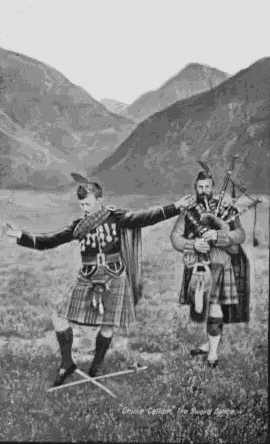
played as a Strathspey and Reel for the Highland Sword Dance, and the melody is
today familiar in association with a Highland sword dance
in which great care is taken not to displace the crossed swords on the ground
during the exercise.
***
Scottish tradition has it that it
was first danced by a king of the Scots, Malcolm Canmore (O’Neill says the name
is an English version of the Gaelic Callum
a chinn mhoir, which “signifies as ‘Callum of the big head’), in
celebration of his victory at the Battle of Dunsinane in the year 1054. This
story goes that Malcolm slew an opponent, then in triumph placed his enemy’s
sword on the ground, crossing it with his own, and danced between them in
triumph (Martin, 2002). Another tradition says that it is a dance of prophesy,
for to touch the swords during the dance bodes ill with respect to the coming
battle. O’Neill (1922) maintains that Callum “incurred the displeasure of the
highlanders by marrying a Saxon princess which involved many unpopular changes.
Gillie Callum, or Callum’s tax-gatherer (an odious official everywhere) has
been immortalized in melody, while the traditional story is well nigh forgotten.”
There are puirt‑a‑beul
words to the tune which begin:
***
Gille Callum da pheighinn, (Gille Callum two pennies,
Gille Callum da pheighinn, Gille Callum two pennies,
Da pheighinn, da pheighinn, Two pennies, two pennies,
Gille Callum bonn‑a‑sia! Gille Callum 'coin of six'.)
***
The Gille Calum was performed not
only by men, but (at least on some occasions) by women. Elizabeth Grant of
Rothiemurchus wrote of the festivities at Kinrara, the home of the Duchess of
Gordon, Jane Maxwell:
***
We are often over at Kinrara, the Duchess having perpetual dances,
either in
the drawing room or the servants hall and my father returning these
entertainments
in the same style. A few candles lighted up bare walls, at short
warnings fiddles
and whisky punch were always at hand and then gentles and simples reeled
away in company till the ladies thought the scene becoming more
boisterous
that they liked remaining in; nothing more however, a highlander never
forgets his
place, never loses his native inborn politeness, never presumes upon on
favour.
***
She follows this passage with a
description of the beautiful dancing of Lady Jane Montague, who not only danced
the Gille Calum but Sean Triudhas as well.
***
Source for notated version: Chicago
police officer and Highland piper William Walsh [O’Neill]. Carlin (The Gow Collection), 1986; No. 66 (with
variations) {appears as "Gillie Callam Da Pheithein"}. Gow (First Collection of Strathspey Reels),
1784 (revised 1801); pg. 2 (appears as “Gillie Callam da pheithein”). Gow (Complete Repository), Part 4, 1817; pg.
35. Honeyman (Strathspey, Reel and
Hornpipe Tutor), 1898; pg. 20 (appears as "Ghillie Callum"). Howe
(1000 Jigs and Reels), c. 1867; pg.
45. Hunter (Fiddle Music of Scotland), 1988; No.
124. S. Johnson (A Twenty Year Anniversary Collection), 2003; pg. 13. Kerr (Merry Melodies), vol. 1; Set 5, No. 3, pg. 5. MacDonald (The Skye Collection), 1887; pg. 14.
Martin (Ceol na Fidhle), vol. 4,
1991; pg. 18. Martin (Traditional
Scottish Fiddling), 2002; pg. 52. McGlashan
(A Collection of Reels), c. 1786; pg.
26. Morison (Highland Airs and
Quicksteps, vol. 1), c. 1882; No. 35, pgs. 19-20 (includes variation sets
attributed to Niel Gow). O’Neill (Waifs
and Strays of Gaelic Melody), 1922; No. 103. Skinner (Harp and Claymore), 1904; pg. 113. Stewart-Robertson
(The Athole Collection), 1884; pg. 9
(appears as "Gille Calium"). Surenne (Dance Music of Scotland), 1852; pg.139. Celtic
CX45, Wilfred Gillis - “Arisaig Airs.”
|
See also listings at: Jane Keefer’s Folk
Music Index: An Index to Recorded Sources |
X:1
T:Gille Callum
M:C|
L:1/8
R:Strathspey
S:McGlashan – Reels (c. 1786)
Z:AK/Fiddler’s Companion
N:”The Original Sett” (sic)
K:Amix
A<A c>e d2 BG|A<A c>e d2 c>A|E<E G>B d2 B>G|A<A c>e dB e2|A<A c>e d2 B>G|
A<A ce d2 c>A|BEBe d2 B>G|A<A c>e B/c/d e2||A<A c>A g2 B>G|A<A c>A a2 ae|
G2 g2 d2 B>G|A<A c>A dB e2|A<A c>A g2 B>G|A<A c>A a2 ae|g2 a/g/f/e/ d2 B>G|
A<A c>A B/c/d e2||A<A c>A AgBG|A<A c>A AacA|aefd egBG|A<A c>e B/c/d e2|
A<A c>A AgBG|A<A c>A AacA|gbeg dgBG|A<A c>E B/c/d e2||
|:A<A c>A G/G/G BG|A<A c>A A/A/A c>A|c>ABA G/G/G B>G|A<A c>A B/c/d e2:|
|:A<A c>e dgBG|A<A c>e AacA|a/g/f/e/ fd gdBG|A<A c>e B/c/d e2:|
|:A2 cA BGBG|A2 cA cAcA|cAcA BGBG|A<A c>A B/c/d e2:|
|:A<A
c>e AgBG|A<A c>e AacA|gaeg dgBb|gaeg dg e2:|
X:2
T:Gille Callum
M:C|
L:1/8
S:Strathspey
B:Stewart-Robertson – The Athole Collection (1884)
Z:AK/Fiddler’s Companion
K:A
e|:AAc>e d2 B>G|AAc>e d2 c>A|B>EB>e d2 B>G|AAc>e d>B e2:|
||AAc>e =g2 B>G|AAc>e a2 c>A|a2 c>A =g2B>G|AAc>e d>B e2|
AAc>e =g2 B>G|AAc>e a>ba>f|=g>ag>e d>=gB>G|AAc>e d>B e2|]
X:3
T:Gillie Callum - Sword Dance
T:Keellum Kallum
M:4/4
L:1/8
S:Officer William Walsh, Chicago
Z:Paul Kinder
K:C
A2 cA d2 BG|A2 cA d2 cA|B2 ge d2 BG|A2 cA dB e2:||
A2 cA g2 BG|A2 cA a2 cA|a2 cA g2 BG|A2 cA dB e2|
A2 cA a2 BG|A2 ce aeae|g>a (3gfe d<gB<g|e<a (3efg (3Bcd e2||
GILLIECRANKIE. AKA and see "Killiecrankie."
Scottish. The melody appears under this spelling in McGibbon’s Scots Tunes, book II (c. 1746) and the Gillespie Manuscript (1768), inscribed
"A Collection of the Best and Most Favourite Tunes for the Violin...Perth.
Collected and Transcribed by James Gillespie M,DCC,LX,VIII."
GILLIS FAVOURITE. Canadain, Reel. Canada, Cape Breton. D Major/Mixolydian. Standard
tuning. AA’BB’. Various Cape Breton fiddlers have reversed the parts. Source
for notated version: Angus Chisholm (Cape Breton) [Dunlay & Greenberg].
Dunlay & Greenberg (Traditional
Celtic Violin Music of Cape Breton), 1996; pg. 77. Decca
14017, Alex Gillis and Alcide Aucoin/The Inverness Serenaders (c. 1936).
GILLIS MOUNTAIN. Canadian. Canada, Cape Breton. The tune
appears on an early Rankin Family album and references the Cape Breton
hill-side where the Gillis family used to live generations ago, still locally
called Gillis Mountain although the family moved on.
GILLISDALE. Canadian, Reel. Canada, Cape Breton. G Mixolydian. Standard tuning. AB.
The tune was played by the Inverness Serendaders, Johnny Wilmot and Donald
Angus Beaton. Source for notated version: Donald MacLellan (Cape Breton)
[Dunlay & Greenberg]. Dunlay & Greenberg (Traditional Violin Music of Cape Breton), 1996; pg. 99. Rounder RO7023,
Natalie MacMaster - “No Boundaries” (1996).
GILMORE'S HORNPIPE (Crannciuil Mic Gilla-Muire). Irish, Hornpipe. G Major. Standard
tuning. AABB. O'Neill (Krassen), 1976; pg. 188. O'Neill (Music of Ireland: 1850 Melodies), 1903/1979; No. 1662, pg. 309.
X:1
T:Gilmore’s Hornpipe
M:2/4
L:1/8
R:Hornpipe
S:O’Neill – Music of Ireland (1903), No. 1662
Z:AK/Fiddler’s Companion
K:G
B/A/ | GG/A/ B/d/G/B/ | c/d/e/c/
d/g/G/B/ | c/a/B/g/ A/g/G/e/ | F/d/f/e/ d/c/B/A/ |
GG/A/ B/d/G/B/ | c/d/e/c/ d/g/G/B/ |
c/d/e/f/ g/d/e/c/ |BG G2:|
|: B/c/ | d/g/B/d/ G/B/d/g/ |
f/ag/e/ d/f/a/c’/ | b/g/af/ g/e/d/B/ | c/e/A AB/c/ |
d/g/B/d/ G/B/d/g/ | f/ag/e/
d/f/a/c’/ | b/g/a/f/ g/e/d/c/ | BG G :|
GILROY. AKA and see "Gilderoy."
GILSAW. Old‑Time, Breakdown. USA, Missouri. D Major. Standard. AABB. It
is on Missouri fiddler Charlie Walden’s list of ‘100 essential Missouri fiddle
tunes’. Source for notated version: Fred Stoneking [Silberberg]. Silberberg (93 Fiddle Tunes I Didn’t Learn at the
Tractor Tavern), 2004; pg. 15 (appears as “Gill Saw”). Marimac 9059-CD, Lynn ‘Chirps’ Smith – “Midwestern Harvest”
(1994). Missouri State Old Time Fiddlers Association 001, Pete McMahan ‑
"Ozark Mountain Waltz."
GILSLAND'S HORNPIPE
[1]. Scottish, Hornpipe. D Major.
Standard tuning. AA'BB'. Kerr (Merry
Melodies), vol. 3; No. 322, pg. 35.
X:1
T:Gilsland’s Hornpipe
M{C
L:1/8
R:Hornpipe
S:Kerr – Merry Melodies, vol. 3 (c.
1880’s)
Z:AK/Fiddler’s Companion
K:D
(FG) || A2A2A2 (FA) | BcdB A2 (FG) |
AFAF AFAF | GABG E2 (FG) | A2A2A2 (FA) |
BcdB A2d2 | cdef gedc |1 dAFA DEFG
:|2 d2d2d2 |: (cd) | ecA^G Aceg | fdA^G Adfa |
gbeg fadf | edcB AABc |dcdeA BGgf |
edcB AGFE | FdAg fdce | d2d2d2 :|
GILSLAND HORNPIPE [2]. English; Hornpipe. England, Northumberland. D Major. Standard tuning.
AABBCCDDEEFF. Gilsland, notes Graham Dixon (1995), is a town in Northumberland
located near the border with Cumberland, on the banks of the River Irthing,
famous for its spa. Reg Hall (1998) says the tune has been credited to
Northumbrian musician Jock Davidson, reputed to have been a superb fiddler, a
contemporary of Northumbrian musician Ned Pearson (b. 1875). Davidson’s
nickname was ‘Kielder Jock’, which Hall says points to his origins in the
ancient civil parish of Kielder, Northumberland, directly on the border with
Scotland. However, according to Dixon (1995), George Hepple, whose grandfather
was taught to dance by Northumbrian fiddler and composer, teacher and dancing
master Robert Whinham (1814-1893), claimed it was one of Whinham’s
compositions. While the tune appears in several
different collections, a solid attribution has not been found. Source for
notated version: Jock Davidson’s early 20th century manuscript, at
the Morpeth Chantry Bagpipe Museum [Dixon]. Dixon (Remember Me), 1995; pg. 66 (variations by Keilder Jock). Topic 12TS283, Tom Hunter & Billy Ballantine – “Holey
Ha’Penny.” Topic TSCD 669, Tom Hunter & Billy Balentine (et al) – “Ranting
and Reeling: Dance Music of the north of England” (1998. Fiddle and piccolo
players recorded 1954 in a byre near Ashley Grove near Bewcastle, Cumberland).
GIMLET, THE. AKA and see AKA and see “Bhíosa lá I bport
láirge,” "The Dainty Besom Maker,"
“Forgive the muse that
slumbered,” “I’d mourn the hopes that leave me,” “Johnny’s Grey Breeks [2],”
"The Old Lea Rig," "Little Mary Cullinan," "Little Sheila Connellan,” “Maureen from Giberland,” “Port Láirge,” “The Rose Tree [1],” “The
Rose Tree in Full Bearing." Scottish, Country Dance Tune. The tune appears
in the Bodleian Manuscript (in the
Bodleian Library, Oxford), inscribed "A Collection of the Newest Country
Dances Performed in Scotland written at Edinburgh by D.A. Young, W.M.
1740." It is probably the same air published as “The Gimblet” in Walsh’s Caledonian Country Dances (Book III, No.
20) and by Breathnach (Coel Rince,
vol. 4, No. 38) as “An Bhíomlóg.” Oswald (Caledonian
Pocket Companion), book 10, c. 1760.
X:1
T:Gimblet, The
M:2/4
L:1/8
B:Oswald – Caledonian Pocket Companion, book 10 (c. 1760)
K:D
d/B/A/F/ AA/B/|d (3e/f/g/
f/e/e/f/|d/B/A/F/ AA/B/|d (3e/d/e/ f/d/d:|
|:f/d/d/f/ (ag/)f/|g/a/b/a/
g/e/e/f/|d/B/A/F/ AA/B/|d (e/d/e/ f/d/d:|
GIN A BODY MEET A BODY. AKA and see "Comin'
Through the Rye." Scottish, English; "Very Slow" Strathspey
and Air. England, Northumberland. B Flat Major (Gow): G Major (Peacock).
Standard tuning. AAB (Gow): AABB (Peacock). Carlin (The Gow Collection), 1986; No. 67. Gow (Complete Repository), Part 2, 1802; pg. 4. Peacock (Peacock’s Tunes), c. 1805/1980; No. 16,
pg. 6.
X:1
T:Gin a body meet a body
M:C
L:18
R:Air
S:Gow – 2nd Repository
(1802)
Z:AK/Fiddler’s Companion
K:Bb
B|F<F F>d {d}c>Bcd|F<F
~G>F {F}B3G|F<F f>d (e/d/)c/B/ cd|F<F ~G>F B3:|
(d/e/)|f>eBd c>Bcd|f>dBd g3
a//b/|f>de>c d>Bcd|F<F ~G>F {F}B3 (d>e)|
f>dBd c>B c(d/e/)|(f/e/)(d/c/)
Bd/f/ g3 (a/b/)|f>g (g/f)(e/d/) gc c>d|F<F ~G>F {F}B3||
GIN I HAD A BONNIE
LASS/LASSIE, LITTLE SLEEP WAD SAIR ME. AKA and see “Go About Your Business,” “The North Loch.” Scottish, Canadian; Reel. Canada,
Cape Breton. G Mixolydian (Dunlay & Greenberg, Dunlay & Reich): G
Dorian (Athole, Kerr). Standard. AAB (Athole, Kerr): AABB (Dunlay & Reich).
The tune is usually played in G Mixolydian in Cape Breton, though occasionally
the ‘b’ notes are flatted. Similarly, Scottish settings are generally in
Dorian, though there are exceptions (such as the setting in the Gesto Collection). The tune is found by
Dunlay & Greenberg first in print in Bremner’s
Collection (1751-1761) under the
title “The North Loch.” Source for notated version: Duncan MacQuarrie (Cape
Breton) [Dunlay & Greenberg, Dunlay & Reich]. Dunlay & Greenberg (Traditional Celtic Violin Music of Cape
Breton), 1996; pg. 98. Dunlay & Reich (Traditional Celtic Fiddle Music of Cape Breton), 1986; pg. 60. Kerr
(Merry Melodies), vol. 2; No. 211,
pg. 23. Lowe (Collection), 1844.
MacDonald (The Gesto Collection). Stewart-Robertson
(The Athole Collection), 1884; pg.
190. CLM 1000, Carl MacKenzie‑
"Tullochgorum" (1979). Decca 14023 (78 RPM), The Inverness Serenaders
(appears as "Go About Your Business"). Marquis ERAD 169, David
Greenberg - “Celtic Memories” (1996). Rounder 7004, Joe Cormier‑
"The Dances Down Home" (1976. Appears as "Go About Your
Business").
X:1
T:Gin I Had a Bonny Lassie
M:C|
L:1/8
R:Reel
B:Stewart-Robertson – The Athole Collection (1884)
Z:AK/Fiddler’s Companion
K:Gmin
d|BGdG B>cdf|AFcF A2FA|BGdG B>cdg|fdcA G2G:|
f|gagd gbgd|fgfc A2Ff|gagd gbgd|Bdgd B2Gd|gagd gbgd|
fgfc
A2FA|BgcA dBbg|fdcA G2G||
GIN THOU WERT MINE OWN
THING. AKA and see "A Scotch Song ," "An thou were my ain thing."
Scottish, English; Country Dance Tune and Air. The air appears parodied in John
Gay's Beggar's Opera (1729) under the
title "Oh what pain it is to part." Raven (English Country Dance Tunes), 1984; pg. 55.
GIN
YE KISS MY WIFE, I'LL TELL THE MINISTER. Scottish, Pastoral Air (4/4 time).
A Minor. Standard. AAB. "Very old air." This was the original tune
for the Sean Trews/Triubhas, an ancient Highland dance in which the dancers
wear tartan trousers rather than the sporran and kilt. Source for notated
version: Mr. “Old air. Communicated by Mr. John Stuart” (Keith, Banffshire,
Scotland) [Skinner]. Hardie (Caledonian
Companion), 1992; pg. 50. Skinner (Harp
and Claymore), 1904; pg. 59. Skinner (The
Scottish Violinist), pg. 21. Culburnie CUL110,
Abby Newton – “Crossing to Scotland” (1997). Maggie's Music MM107, Maggie
Sansone with Ensemble Galilei - "Music in the Great Hall" (1992).
X:1
T:Gin Ye Kiss My Wife, I’ll Tell the
Minister
M:C
L:1/8
R:Air
N:”or the original tune for ‘Sean
Trews’”
S:Skinner – Scottish Violinist
Z:AK/Fiddler’s Companion
K:Amin
EA A<A {A}.B2 .E2 | (cd/c/ B)A dB
G2 | EA A<A {A}.B2.E2 |
(c2 .B).A/.B/ G[B,E] [B,2E2] :|
e>f {f}gd {d}B2 BG | {G}A2 A>B dBBd |
e>f {f}ge {e}B2 BG | A<A
{A}B>A G[B,E] [B,2E2] | e>f {f}gd {d}B2 BG |
{G}A2 A>B dBBd | e>f {f}ge
{e}ae {e}gB | A<A {A}B>A G[B,E] [B,2E2]||
GIN
YE WILL NOT TAKE HER (TURN HER OVER TO ME). Irish (?), Air (6/4 time). G Major. Standard tuning. AB. Source for
notated version: Heymann adapted the tune from Daniel Wright’s Aria Di Camera (London, c. 1730).
Heymann (Secrets of the Gaelic Harp),
1988; pgs. 99 & 101.
GIN YE WON NE TAKE ME YE MAY LET ME BE.
Scottish, Air (3/2 time). G Major. Standard tuning. AABBCCDD. McGibbon (Scots Tunes, book II), c. 1746; pg. 52.
X:1
T:Gin ye won ne take me ye may let
me be
M:3/2
L:1/8
R:Air
N:”Quick”
S:McGibbon – Scots Tunes, book II, pg. 52 (c. 1746)
Z:AK/Fiddler’s Companion
K:G
G3AG2B2G2Bc | d2d2 edcB A4 |
G2B2G2B2G2Bc | d2cB g2d2B4 :|
|: g3ag2d2 B2(AG) | d3e dedB A4 |
g3ag2d2B2AG | (gfga)b2d2B4 | (gfga)g2d2B2AG |
d3e (ded)B A4 | G3F EFGA B2d2 |
“tr”(ede)f g2d2B4 :: GBAB GDEF GABc |
d2 gf edcB ADEF | GBAB GDEF GABc |
d2 ef “tr”gfg)d B4 :: (gfg)a “tr”(gfg)d “tr”B2AG |
dcde dedB Adef | gbab gfgd B2 (AG) |
(gfg)a (gab)d Bdef | gfga gfgd “tr”B2 (AB) |
G2d2 edcB AcBA | GAGF EFGA BABd |
edef g2d2B4 :|
GIN YOU MEET A BONNY
LASS. AKA and see "If I Get a Bonnie Lass"
(Shetland).
GINGER BLUE. American, Jig or Quadrille. A Major ('A' part) & D Major ('B'
part). Standard tuning. AABB'. The title appears in a stanza from a song called
“Gooseberry Wine,” appearing in African-American collector Thomas Talleys book Negro Folk Rhymes (reprinted in 1991,
edited by Charles Wolfe). Wolfe thinks the stanza belongs to a pre-Civil War
minstrel song, and that ‘Dr. Ginger Blue’ was probably a stock character from
minstrel shows. Talley’s version goes:
***
Now ‘umble Uncle Steben,
I wonders whar youse gwine?
Don’t never tu’n yo back, Suh,
On dat good ole gooseberry wine!
***
Oh walk chalk, Ginger Blue!
Git over double trouble.
You needn’ min’ de wedder
So’s de win’ don’t blow you double
***
Did you ever see de lak?
Dat good ole sweet gooseberry wine
Call Uncle Steben back.
***
Wolfe finds versions in The Popular National Songster (Phila.,
1848, pgs. 157-158), Brown (3:557) and White (381). Fork (Traditional Music in America), 1940; pg. 34.
GINGER RIDGE QUADRILLE. Old‑Time, Quadrille. USA, Ohio. Edison
52450 (78 RPM), 1928, John Baltzell {Baltzell was a native of Mt. Vernon, Ohio,
the same home town as minstrel Dan Emmett (d. 1904). Emmett taught Baltzell to
play the fiddle sometime after he returned to Mt. Vernon, poor, in 1888}.
GINGER’S FAVOURITE. AKA and see “The Butcher’s March.” Irish, Jig.
GINGLING GEORDIE. AKA and see "Wylam Away,"
"Ginleing Geord(i)e."
GINLEING GEORD(I)E. AKA and see "Wylam Away,"
"Wile Him Away." Scottish,
English. England, Northumberland. Published in Henry Playford's 1700 collection
of Scottish tunes (Original Scots Tunes).
GINLEY'S FANCY (Rogha Mhig Fhionnaile). AKA and see "The Day I Met Tom Moylan,” “Ivy Leaf [4],” “The Man of the House,” “The Merry Thatcher,” "Mind My Border," "Mind My Brother," “Miss Kelly’s Favourite,” “Old Tom,” “The
New Potatoes,” "Sally Grant,"
“Through the Heather."
Irish, Reel. E Minor. Standard tuning. AA'B. Printed in O’Neill as “The Man of
the House.” Related to “Autumn Leaves,” “Handsome Sally [1]” and “Paddy Carthy’s Reel [2].” Source
for notated version: accordion player Joe Burke (Ireland) [Breathnach].
Breathnach (CRÉ III), 1985; No. 130,
pg. 62. Outlet Records SOLP 1015, Joe Burke ‑
"Galway's Own" (1971).
GINNIE PIN YOUR BONNET
ON. AKA and see “Spoil the Dance.” Scottish, Reel. E Minor.
Standard tuning. AABB’. The tune was recorded by Irish flute player Matt Molloy
on his album “Heathery Breeze” under the title “Spoil the Dance.” Kerr (Merry Melodies), vol. 4; No. 89, pg. 12.
X:1
T:Ginnie Pin Your Bonnet On
M:C|
L:1/8
R:Reel
S:Kerr – Merry Melodies, vol. 4, No. 89
(c. 1880’s)
Z:AK/Fiddler’s Companion
K:Emin
E2 ED F2FD|D2 (EF) DFAF|E2 ED F2
FD|DFAF E2e2:||
dBBA dBA^c|dBBA d2 (e^c)|dBBA
dBA^c|dBAF E2e2|
dBBA dBA^c|dBBA d2 (e^c)|faef
defd|BdAF E2e2||
GIOBARACH, AN. AKA and see "Within
a Mile of Dublin [1]," "The
Meadow in Bloom," "Through
the Fields [3]," "The Club Reel,"
"The Kerry Lasses [2],"
"Sarah's Reel," "You're a long time a courting,"
"The Road to Dublin," "A mile from Dublin [1],"
"The Maid of Ballintra."
GIOLCAC FAOI BLAT, AN. AKA and see "The Besom in
Bloom."
GIOLLA AN BIMHOIR. AKA and see “Captain O’Kane.”
Stanford Petrie, 1905; No. 1378.
GIOLLA CEACTA MAISEAC. AKA and see "The Handsome
Plowboy."
GIOLLA DUBH
O'GLAMHARAIN. AKA and see "The Dark‑Visaged Lad
O'Gloran."
GIOLLA GRUAMACH, AN. AKA and see "The Sullen Boy."
GIOLLA MO CHROI. AKA and see “Gilla Machree.”
GIOLLA NA DAYHIE. Irish, Air (6/8 time). D Major. Standard tuning. One part. Joyce (Old Irish Folk Music and Song), 1909;
No. 439, pg. 248.
X:1
T:Giolla na Dayhie
M:6/8
L:1/8
B:Joyce – Old Irish Folk Music
and Songs, No. 439 (1909)
Z:AK/Fiddler’s Companion
K:D
d2d dAG|FAA B2A|{c}e2e cAA|FAA B2A|
d>ed dcB|ABG FGA|Bcd ABA|FGF
E2D||
GIOLLA NA DROVER. AKA and see "Gillan the Drover."
GIOLLA NA GRUAIGE
BAINE. AKA ‑ "The Fair Haired Lad." Irish,
Single Jig. A Dorian. Standard tuning. AAB. Roche
Collection, 1983, vol. 3; No. 110, pg. 34.
GIOLLA NA SCRIOB. AKA and see "The Beardless Boy,"
"The Dissipated Youth [1],"
"Kate Kearney," "When the cock crows it is
day [3]," "The Big Bow Wow."
GIOLLA RUA(D), AN. AKA and see "Redhaired Lad," "Red Haired Boy."
GIORNOVICHI. Scottish, Reel. F Major.
Standard tuning. AB. Giovanni Mane Giornovichi
(1735-1804) was a late-Classical period composer, born in Sicily (some say
in a ship off the coast of the country). He studied with Lolli and was a
proficient violinist, and a very good composer who traveled the Continent
widely. Unfortunately, Giornovichi did not possess an excess of good judgment
and decorum to accompany his talent, and his life seems to have been one flight
from scandal to another, propelling his wanderings. He spelled his name
variously depending on the country he was in, and was also known as Giornovici,
Jarnovich, and Jarnovic, and he was nearly as famous as a billiards player (by
which he earned his living during fallow musical times). The composer was in
London in the 1790’s, but left for Russia by the end of the decade. He died
there in 1804, reportedly immersed in a game of billiards. Surenne (Dance Music of Scotland), 1852; pg. 56.
X:1
T:Giornovichi
M:C
L:1/8
R:Reel
S:Surenne – Dance Music of Scotland, pg. 56
(1852)
Z:AK/Fiddler’s Companion
K:F
c | fc c2 fcc2 | defg ec c2 | dfcf
BfAf | (B/4c/2<d) cB AFFc | fcc2 fcc2 | defg ec c2 |
dfcf BfAf | (B/4c/2<d) cB AFF ||
f | bagf eg c’2 | f2 ed cfaf | edcB Acfa | bgaf egg2 |
fc c2 acc2 | defg ecc2 | dbca BgAf |
(B/4c/2<d) cB AFF ||
GIORRIA SA bhFRAOCH (The Hare in the Heather). AKA and see “The Hare in the Heather.”
GIORRIA SAN ARBHAR, AN. AKA and see "The Hare in
the Corn."
GIPPIE GET YOUR
HAIRCUT. AKA and see "Chippy/Tippie/Johnny/Hippie Get
Your Hair Cut." Old‑time, Breakdown. USA, W. Va. C Major.
Standard tuning (fiddle). AAB (Phillips/1989): AA'B (Phillips/1994) {the 'B'
part is irregular}. Words to the tune go:
***
Johnny get your hair cut, hair cut, hair cut,
Johnny get your hair cut, hair cut short.
Johnny get your hair cut, hair cut, hair cut,
Johnny get your hair cut like a sport.
***
Joel Shimberg reports that West
Virginia fiddler Melvin Wine sang the fragment "Gippy get your hair cut
short like mine" to the melody. Source for notated version: Clark Kessinger
(W.Va.) [Phillips]. Phillips (Fiddlecase
Tunebook), 1989; pp. 20‑21. Phillips (Traditional American Fiddle Tunes), vol. 1, 1994; p. 97. County Records 536, Clark Kessinger.
GIPSIES CAME TO LORD
M____'S GATE, THE. AKA ‑ "The Gypsies Cam'
to Our Lord's Yett." Irish, Air (4/4 time). G Dorian. Standard tuning
(fiddle). One part. "In the district around Newtownards, a version of the
Scotch ballad, 'The Gypsies cam' to our lord's yett', was sung to this (Irish)
air" (Joyce). Joyce (Old Irish Folk
Music and Song), 1909; No. 334, p. 154.
X:1
T:Gipsies came to Lord M….’s Gate,
The
M:C
L:1/8
R:Air
S:Joyce – Old Irish Folk Music and Songs (1909)
Z:AK/Fiddler’s Companion
K:G Dorian
D|G2G2 A3G|F2D2D3D|B2c2
defc|d2G2G3A|B2c2 defe|dcAG|F2 GA|
B2A2 GBAG|F2 D2 D3||
GIPSIE'S
ROUND. AKA and see "Upon a Summer's Day." English,
Country Dance Tune (6/4 time). G Mixolydian. Standard tuning. AB. The air
appears in the Fitzwilliam Virginal Book,
set or composed by the famous English composer William Byrd. Chappell notes
that round dances were as popular as longways dances in England, and that they
were as in as much favor at the Elizabethan-era court as at the countryside
Maypole. Gypsies were often depicted in old plays as singing, dancing, or
making music. Chappell (Popular Music of
the Olden Time), vol. 1, 1859; pg. 255.
X:1
T:Gipsie’s
Round
M:6/4
L:1/8
S:Chappell
– Popular Music of the Olden Time
(1859)
Z:AK/Fiddler’s Companion
K:G
Mixolydian
d6 B4G2 | B3c d2 B4G2 | c4 B2 c4d2 | (e6 e6) |
d6 B4G2 | B3cd2 B4G2 | c4B2 c4d2 | (e6 e6) ||
c4B2 c4d2 | e4f2 e6 | c4B2 c4d2 | e6 e4d2 |
e4 e2d3cB2 | A4 G2 A3Bc2 | d3c B2c2 A4 |
G6
G4d2 | e6 d3cB2 | A4 G2 A3Bc2 | d3c B2c2 A4 | G4 C2D2 G4 ||
GIPSY HORNPIPE [1], THE. Irish, Hornpipe. G Major. Standard tuning.
AABB. Source for notated version: "...copied from (a) very old well‑writen
manuscript lent to me in 1873 by Mr. J. O'Sullivan, of Bruff, Co.
Limerick" (Joyce). Joyce (Old Irish
Folk Music and Song), 1909; No. 229, pg. 111.
X:1
T:Gipsy Hornpipe [1]
M:2/4
L:1/8
S:Joyce – Old Irish Folk Music and Songs (1909)
Z:AK/Fiddler’s Companion
K:G
D|G2 GA|GB dB|cBcd|efge|dB
GG|G>ABG|AF D2|D3D|
G2 GA|GB dB|cBcd|efge|dggd|ec AF|G2
GG|G3:|
|:d|d2 Bd|BG Bd|edcB|cdeg|d2
Bd|edcB|AF D2|D2 Bc|
d2 Bd|BG Bd|edcB|cdef|gfgd|ec AF|G2
GG|G3:|
GIPSY'S HORNPIPE [2], THE. AKA ‑ "The Gypsy's Hornpipe."
GIPSY’S HORNPIPE [3], THE.
X:1
T:Gipsy's Hornpipe
R:hornpipe
C:?James Hill
S:Kohler's Violin Repository
Z:Transcribed by Nigel Gatherer
M:4/4
L:1/8
K:G
d>c|B>cA>B G>AF>G|E>FG>E D2(3DEF|G2D>G B2G>B|d>cB>c A2d>c|
B>cA>B G>AF>G|E>FG>E D2g>f|e>cA>G F>DE>F|A2G2G2:|
G>F|E2e2 e>cA>G|F>Ad2 d2e>f|g>fe>d c>BA>G|(3cdc (3BcB A2G>F|
E2e2
e>cA>G|F>Ad2 d2e>f|g>fe>d f>ed^c|e2d2d2:|
GIRL DRESSED IN BLUE, THE. See “The Dark Girl Dressed in Blue.”
GIRL FOR ME, THE (An Cailin Ab Fearr Liom). Irish, Jig. G Major. Standard
tuning. AABB. Roche Collection, 1983,
vol. 3; No. 98, pg. 30.
GIRL FROM KILLENCARE, THE. Irish, Jig. D Major. Standard tuning. AABB.
Composed by County Cavan/Philadelphia fiddler and composer Ed Reavy
(1898-1988). Reavy (The Collected
Compositions of Ed Reavy), No. 92, pg. 103.
X: 92
T:The Girl From Killencare
R:jig
C:Ed Reavy
M:6/8
L:1/8
Z:Joe Reavy
N:Ed has long cherished a love for the
N:written and spoken word. He might have
N:been a poet if his educational opportunities
N:had taken a different route. One of his earlier
N:verses talks of this lassie from Killencare:
N:Though frost may come and the winter's snow,
N:And bitter winds down the mountains blow,
N:I'll see you here again, my dear,
N:When spring comes 'round to Killencare.
K:G
A/2G/2 | FDF ABc | dAF BGE | FDF ABc | dfd cAG | FAF A,DE |
DFA cBA | ged CAC | edc d2 :: f/2g/2 | afd dcd | Bcd efg | fdf ged |
cEF GFE | DFA dAF | EGB efg | fdf gec | edc d2 :||
GIRL FROM LETTERMORE, THE. AKA and see “Little Diamond [2].”
GIRL FROM LOWER IRELAND, THE (Cailin Ua Iacdar Na Eirinn). Irish, Air (3/4 time,
"gracefully"). D Major. Standard tuning. AB. O'Neill (Music of
Ireland: 1850 Melodies), 1903/1979; No. 340, pg. 59.
X:1
T:Girl from Lower Ireland, The
M:3/4
L:1/8
R:Air
N:”Gracefully”
S:O’Neill – Music of Ireland (1903), No. 340
Z:AK/Fiddler’s Companion
K:D
A2|d2g2fe|dc AG FG|AB {d}cA
GB|A2d2d2|d4 A2|d2g2 fd|c2 AG FG|
Ac d2 FD|E2 {F/E/}D2D2|d4||FG|A2A2
de|fa gf ed|d2 ed cA|A4 FG|
A2A2 de|fa gf ec|d3c AG|E2
{F/E/}D2D2|D4||
GIRL FROM OLD BRIDE
STREET, THE. Irish, Jig. D Major. Standard
tuning. AABB. Composed by Falmouth, Massachusetts, musician and writer Bill
Black, in honor of his wife. Black (Music’s
the Very Best Thing), 1996; No. 70, pg. 36.
X:1
T: The Girl from Old Bride Street
C: © B. Black
Q: 300
R: jig
M: 6/8
L: 1/8
K: D
A | DFA dAd | FAd fef | agf gfe | fdB BAB |
DFA dAd | FAd fef | bag fgf | edc d2 :|
A | FBB fBB | f2 a fef | def cde | dBA B2 A |
FBB
fBB | fac dfa | bag fgf | edc d2 :|
GIRL FROM THE COUNTRY. AKA and see "The
Honeymoon Reel."
GIRL I LEFT BEHIND ME [1], THE (or "An Spailpin Fanach"). AKA and see "As Slow Our Ship," "Brighton Camp," "The Gal I Left Behind Me," "Pretty Little Girl (I Left Behind Me) [2]," "An S(p)ailpin Fanach [1]," "The Rambling Laborer," "The Wandering Harvest Labourer." Old‑Time, American, Irish, Scottish, English; Air, Hornpipe, March, Two‑Step, Polka, Set, Sword, Country and Morris Dance Tune (2/4 time). G Major (almost all versions): A Flat Major (O'Sullivan/Bunting): C Major (Ashman). Standard tuning. One part (Linscott, Raven): AB (Bayard, O'Sullivan/Bunting, Shaw): AABB (Ashman, Brody, Ford, Kennedy, Perlman, Phillips, Sweet, Tubridy): AABBCC (Hall & Stafford).
***
There are conflicting assertions about the both the provenance and antiquity of “The Girl I Left Behind Me,” a popular traditional melody claimed vociferously by both the English and Irish. It does appear to date to the 18th century, but that general date is almost all that can be said for certainty at this time. Irish claims revolve around the melodies appearance under the title “The S(p)ailpin Fanach” (or “The Rambling Laborer), words and music printed in Dublin in 1791, although Bunting (1840) asserts it was known much earlier. Bunting himself collected the tune from an elderly Irish harper, Arthur O’Neill, in the year 1800. Several authors (Moffat) have noted its resemblance to the Irish melody “The Rose Tree in Full Bearing,” accompanied by suggestions that “The Girl I Left Behind Me” is a derivative tune. Alfred Moffat, in his Minstrelsy of Ireland (1897, pg. 14), was perhaps the first to recognize the connection, although others (such as Samuel Bayard) finds little relationship between the two. Moffat thought it was also true that the British knew the melody as “Brighton Camp,” dating from the 1758-1759 encampments of Admirals Rodney and Hawke, but that the original Irish provenance still held, citing its “Irish flavour” as well as the “Rose Tree” resemblance. In Moffat’s view, the version of the air that Bunting printed was “a mere parody on the genuine (Irish) air,” an opinion that early 20th century English musicologist Frank Kidson (writing in Groves, 1910) agreed with. Bunting’s version, stated Kidson, along with the version of the melody employed by Moore, “quite destroy the strongly marked rhythm of the simple marching form.” The latter named person refers to Thomas Moore and his song “As slow our ship,” published in Irish Melodies (1818), which used “The Girl I Left Behind Me” as the vehicle for his words. 20th century music writer Sigmund Spaeth simply called it an Irish folk-tune, “first written down in 1800.”
***
Claims of English provenance are just as forceful, although occasionally vague. For example, Linscott (Folk Songs of Old New England, 1939), maintained that was derived from an old British marching song, and that “in Queen Elizabeth’s time it was very popular and was played when a man-of-war weighed anchor or when a regiment moved in or out of town.” The assertion is perhaps apocryphal, for the same is said of a few other melodies (“Off She Goes,” for example). Although “The Girl I Left Behind Me’s” employment as a military leave-taking is a persistent and repeated assertion, there is little actual evidence that it was employed for that purpose, at least before the American Civil War. English musicologist William Chappell (1859) dated the song “Brighton Camp” (which employs the “Girl I Left Behind Me” melody) to 1758, associating the title with the encampments at Brighton established there and at other locations on the coast of England to watch for the French fleet, which had been threatening an invasion of the island. When the English navy defeated the French later in 1759, the fears that established the watch camps dissipated and then were ridiculed in pantomime and farce in London. Parenthetically, the once fishing-village of Brighton, in east Sussex, became very popular in the next decade riding on the growing fashion for bathing. While still a prince, George IV visited the spa starting in 1783 and purchased an estate nearby, engaging famous architect John Nash to transform it into the elegant oriental Pavilion that is today a tourist attraction. Brighton was again the location of a military encampment of many thousands of men in the summers of 1793-95, again in response to fears of a French invasion.
***
Unfortunately, there are no surviving early printings of the melody under the title “Brighton Camp” that have been found. Chappell alluded to manuscripts in his possession which did establish the connection, but they were not named by him, nor have any surfaced since. It is known, however, that the song air “The Girl I Left Behind Me” seems to have quickly entered military tradition as a marching air around the beginning of the 19th century. Interestingly, Bunting and Chappell communicated about the tune, with the former writing in 1840 to the Englishman that: “It is a pretty tune, and has been played for the last fifty years, to my knowledge, by the fifes and drums, and bands of different regiments, on their leaving the towns for new quarters.” It is was said by Chappell that the melody was printed in a manuscript of c. 1770 in the possession of a Dr. Rimbault, and that it appears in march form in manuscript collections of military music from that pre-(American) Revolutionary era, although he specifies none by name, and, indeed, none have been found by subsequent researchers. Its specific use as a military leave-taking march—already referred to and often repeated—is said to have dated to before the American revolution when a British naval vessel set sail or an army unit left for service abroad. Nevertheless, while plausible, there is no solid evidence it was generally employed this way. It may be that the story of the naval leave-taking aspect— apocryphal or not—was the inspiration for Moore’s “As slow our ship” song.
***
Frank Kidson (Groves, 1910) discusses the problem of dating the tune with any certainty, although he does attest that a manuscript in his possession ‘dates it with certainty to 1797’. However, the earliest corroborated citation for a printed version of the song is in Issue 72 of Charms of Melody (approximately 1805-6). There is a reference to the song in a songbook called The New Whim of the Night, or the Town and Country Songster for 1799 wherein there is a song entitled "The Girls we love so dearly" written by R. Rusted to the tune "The Girl I left behind me.” Kidson points to a printing of “Brighton Camp” with the “Girl I Left Behind Me” melody in the publication The Gentleman’s Amusement c. 1810, an English publication. Fuld (The Book of World-Famous Music: Classical, Popular and Folk) finds the melody under the same title in a Irish publication, Hime's Pocket Book for the German Flute or Violin (Dublin, n.d., vol. III, p. 67), and asserts it is the earliest extent publication of the melody. He also notes that the song “Girl I Left Behind Me” appears in Bell's Rhymes of the Northern Bards (1812). Kidson has a version from a musician’s manuscript book dating from around 1815, which he reprinted in Songs of the Georgian Period, (Moffat & Kidson). A published version under the title “Brighton Camp or The Girl I Left Behind Me” indicates that both titles were in currency for the melody and can be found in Riley’s Flute Melodies (1816), an American publication. “The Girl I Left Behind Me” appears in the music manuscript of Shropshire musician John Moore of c. 1837-1840.
***
There are a few literary references to the song or melody. For example, “The Girl I Left Behind Me,” clearly a reference to the military use of the song, was the title of a chapter (XXX) in William Makepeace Thackeray’s Vanity Fair (1848), an indictment of self-centered and foolish people set in the Napoleonic era. The English novelist Thomas Hardy, himself an accordionist and fiddler, mentioned the tune in scene notes to The Dynasts (1904), also set during the wars with Napoleon:
***
A June sunrise; the beams struggling through
the window curtains.
A canopied bed in a recess on the left. The
quick notes of 'Brighton
from fifes and drums without.
***
***
at his side, he said:
***
"Dull music, Mr. Merry."
***
"So dull, sir, that I can't dance to it," returned the midshipman.
"Nor
do I believe there is a man in the ship who would not rather hear 'The
girl I left behind me,' than those execrable sounds."
***
“The Girl I Left Behind Me” has a long and illustrious history in America, although not, as some would like to believe, prior to the beginning of the 19th century. Paul Tyler finds the tunes in music manuscript books of Abel Shattucks (c. 1801) and John Carrol (c. 1804-1812). The latter was a military fifer and fiddler at Fort Niagra who succumbed to influenza in 1812, prior to hostilities with Britain. As mentioned, it appears in Rileys Flute Melodies, published in several volumes in New York beginning in 1814. Dolph (1929) prints a standard text popular at the time of the Civil War, which was a great favorite with Gen. George Custer, and is still the official regimental song of the 7th Cavalry (see also "Garryowen"). "My grandfather tells me that he heard it played by bands in both armies at the Battle of Pea Ridge, Arkansas, in 1862" (Vance Randolph, Ozark Folksongs, Vol. III, 1980). Cauthen (1990) finds reference to its being played during the Civil War in an account by Georgia fiddler Ben Smith of the 12th Alabama Infantry; she calls it a "show tune" which was popularized during that war and which entered folk tradition through discharged soldiers. The United States army troop [The Old Guard] at Fort Snelling, Minesota, considered it a favorite in the 19th century. The melody appears in Bruce and Emmett’s Drummers’ and Fifers’ Guide, published in 1862 to help codify and train the hordes of new musicians needed for service in the Union Army early in the American Civil War. Therein it is remarked: “This air and (drum) beat is generally played at the departure of the soldiers from one city (or camp) to another” [George Bruce was a drum major in the New York National Guard, 7th Regiment, and had served in the United States Army as principal drum instructor at the installation at Governor’s Island in New York harbor. Emmett was none-other than Daniel Decatur Emmett, a principal figure in the mid-19th century minstrel craze and composer of “Dixie” (ironically turned into a Confederate anthem during the war) and “Old Dan Tucker,” among other favorites. Emmett had been a fifer for the 6th U.S. Infantry in the mid-1850’s]. Today it remains in use by the U.S. Army and is played at the United States Military Academy at West Point as part of the medley for the cadets’ final formation at graduation.
***
Notwithstanding its popularity as a song or martial air, "The Girl" gained renewed currency as a dance tune in the South. Linscott (1939) remarks that in New England it was a great march favorite and that it "has always been popular as a country dance tune." The piece was a 'catagory tune' in an 1899 Gallatin, Tenn., fiddle contest; each fiddler would play his (or her?) rendition, with the best version winning a prize (C. Wolfe, The Devil's Box, vol. 14, No. 4, 12/1/80). It was cited as having commonly been played at Orange County, New York country dances in the 1930's (Lettie Osborn, New York Folklore Quarterly), and was in the repertoire of Arizona fiddler Kenner C. Kartchner whose hey-day was in the early 20th century. Also in repertories of Uncle Jimmy Thompson (1848‑1931) {Texas, Tenn.) as "The Girl I Left Behind," Mainer Mellie Dunham (Henry Ford's champion fiddler in the late 1920's), and Buffalo Valley, Pa., dance fiddlers Harry Daddario and Ralph Sauers. It was recorded for the Library of Congress by folklorist/musicologist Vance Randolph in the early 1940's from Ozark Mountain fiddlers.
***
Morris and sword dance versions in this setting of the tune have been collected from the Abingdon, Handsworth, Bampton, Longborough, and Lichfield, England, areas, {the latter has a 'C' part which is the tune 'Here we go round the Mulberry bush...'}. Barnes (2005) prints a 3-part morris dance version from Lancashire. It was a hit of the late 20th century folk revival in England, its popularity spurred by Bill Leader, Reg Hall and Bob Davenport’s influential recording “English Country Music” (1965), a limited release which featured Norfolk fiddler Walter Bulwer and his wife Daisy (piano), and Billy Cooper (hammered dulcimer). The recording became a collector’s item until it was re-released on LP by Topic Records in 1976. In Scotland "The Girl I Left Behind Me" was the name of a solo dance with twelve steps and was performed to "The Girl..." melody. This Scottish dance was transported to Cape Breton and entered dance tradition there where it was performed during the 19th century. Elias Howe (c. 1867) printed the tune along with contra-dance directions in 1000 Jigs and Reels.
***
Sources
for notated versions: harper Arthur O'Neill, 1800 (Ireland) [Bunting]; John
McDermott (New York State, 1926) [Bronner]; 10 southwestern Pa. fifers and fiddlers
[Bayard, 1981]; William Garrett with Hack's String Band [Phillips]; a c.
1837-1840 MS by Shropshire musician John Moore [Ashman]; caller George Van
Kleeck (Woodland Valley, Catskill Mtns., New York) [Cazden]; Angus McPhee (b.
c. 1924, Mt. Stewert, Queens County, Prince Edward Island) [Perlman]; the
Rice-Walsh manuscript, from the playing of Jeremiah Breen, a famous blind
fiddler of North Kerry in the late 1800’s (Thomas Rice was his pupil), via
Chicago Police Sergeant James P. Walsh [O’Neill]. American Veteran Fifer, No. 64. Ashman (The Ironbridge Hornpipe), 1991; No. 2b, pg. 1 Barnes (English Country Dance Tunes, vol. 2),
2005; pg. 49 (3-part Lancashire morris dance version). Bayard (Dance to the Fiddle), 1981; No. 338A‑J,
pg. 322‑325. Brody (Fiddler’s
Fakebook), 1983; pg. 119. Bronner, 1987; No. 4, pg. Bruce‑Emmett (Fifer's Guide), 1880; pg. 52. Bunting,
1840; pg. 43. Cazden (Dances from
Woodland), 1945; pg. 9. Cazden, 1955; pg. 14. Chappell (Popular Music of the Olden Times), vol.
2, 1859; pgs. 187‑188 (appears as "Brighton Camp"). Ford (Traditional Music in America), 1940; pg.
116. Hall & Stafford, 1974; pg. 12. Hazeltine (Instructor in Martial Music), 1820; pg. 29. Howe, Diamond School for the Violin, 1861;
pgs. 51, 61, 62. Howe (1000 Jigs and
Reels), c. 1867; pg. 89. Hulbert, 182?; pg. 19. Jarman (Old Time Fiddlin' Tune)s; No. or pg. 7.
S. Johnson (The Kitchen Musician No. 4:
Collection of Fine Tunes), 1983 (revised 1991, 2001); pg. 13. Karpeles (A Selection of 100 English Folk Dance Airs),
1951; pg. 31. Kennedy (Fiddlers Tune Book),
vol. 1, 1951; No. 55, pg. 27. Kerr (Merry
Melodies), vol. 3; pg. 41. Linscott (The
Folk Songs of Old New England), 1939; pg. 79‑80. Moffat, (202 Gems), pg. 8. Neal (Esperance Morris Book), 1910; pg. 19. Old Fort Snelling Instruction Book for the
Fife, 1974; pg. 35. O'Malley, 1919; pgs. 26, 35. O'Neill (Music of
Ireland: 1850 Melodies), 1903/1979; No. 972. O'Neill (Dance Music of
Ireland: 1001 Gems), 1907/1986;
No. 972, pg. 167 (appears as "The Spalpeen Fanach"). O’Neill (Waifs and Strays of Gaelic Melody),
1922; No. 52. O'Sullivan/Bunting, 1983; No. 57, pgs. 87-90. Ostling, 1939; pg.
10. Perlman (The Fiddle Music of Prince
Edward Island), 1996; pg. 153. Phillips
(Traditional American Fiddle Tunes), vol. 1, 1994; pg. 97. Raven (English Country Dance Tunes), 1984; pg.
94. Riley (Flute Melodies), 1814;
vol. 1, No. 349. Sharp (Country Dance
Tunes), Set 1, 1911; pg. 1. Sharp (Sword
Dance Tunes), 1911‑1913; Book 1, 5, Book 3, pgs. 4 & 12. Shaw (Cowboy Dances), 1943; pg. 382. Sweet (Fifer’s Delight), 1964/1981; pg. 45. Tubridy (Irish Traditional Music,
vol. 1), 1999; pg. 10. White's
Excelsior Collection, 1907; pg. 72. Augusta
Heritage Records 003, Ernie Carpenter, "Elk River Blues: Traditional Tunes
From Braxton County, W.Va." (appears as "Pretty Little Girl I Left
Behind Me"). BEJOCD-28, The Mellstock Band – “The Dance at the Phoenix: Village Band
Music from Hardy’s Wessex and Beyond.” Brunswick
(78 RPM), John McDermot (central N.Y.), 1926 (appears as last tune of
"Virginia Reel Medley"). Cassette C-7625, Wilson Douglas - "Back
Porch Symphony." Mag, Hubert and Ted Powers‑ "Powers Town
Music." Edison 51381 (78 RPM), Jasper Bisbee (Mich.), 1923. Folk Legacy
Records FSA‑17, Hobart Smith ‑ "America's Greatest Folk
Intsrumentalist" (appears as middle tune of "Banjo Group 2").
Gennett 6826 (78 RPM), Doc Roberts (Ky.). OKeh 45150 (78 RPM), Franklin Co.,
Va., fiddler Howard Maxey {1882-1947} (1927). Paramont 3017 (78 RPM), 1927,
John Baltzell (Mt. Vernon, Ohio). RCA Victor LCP 1001, Ned Landry and His New
Brunswick Lumberjacks ‑ "Bowing the strings with Ned Landry."
Topic TSCD607, Billy Cooper, Walter & Daisy Bulwer – “English Country
Music” (2000. Originally recorded 1962). Topic TSCD752, Walter & Daisy
Bulwer, Billy Cooper – “Stepping Up” (2004.
Compilation CD). Tradition TLP 1007, Richard Chase ‑ "Instrumental
Music of the Southern Appalachians," 1956. Victor 36402A (78 RPM),
Woodhull's Old Tyme Masters (N.Y.), 1941. Voyager 340, Jim Herd - "Old
Time Ozark Fiddling." CD, Alan Jabbour, James Reed, Bertram Levy – “A Henry
Reed Reunion” (2002).
|
See also listings at: Jane Keefer’s Folk Music Index: An
Index to Recorded Sources Alan Ng’s Irishtune.info |
X:1
T:The Girl I Left Behind Me
M:2/4
L:1/8
S:Hime's Pocket Book for the German Flute
or Violin, vol. III (c.1810) [from Fleischmann, no. 5244]
K:G
g/f/|ec BA|BG EF|G3/2A/ G/A/B/c/|d3/2B/ gf/g/|ec BA|BE E/F/G/A/|B/A/G/F/ EF|
G2G:|]|:e|ef gf/e/|fB Bd|ef g/f/e/d/|e3/2f/ gf/g/|ec BA|BE E/F/G/>A/|
B/A/G/F/ EF|G2G||B/c/|dB gf/g/|dB ba/g/|f/e/d/c/ B/A/G/F/|E/G/F/A/ G:|]
X:2
T:Girl I Left Behind Me, The
M:2/4
L:1/16
S:Rice_Walsh manuscript
Z:Paul Kinder
R:March
K:G
gf|edB^c dBA=c|BAGF EDEF|GFGA GABc|dedc B2gf|
(3efg de (3Bcd Ac|BAGF EDEF|GFED EGFA|G4 G2:|
|:BA|Bdef gfgb|agfe d2Bd|edef gfed|(3efg af g2fg|
(3efg de (3Bcd Ac|BAGF EDEF|GFED EGFA|G4 G2:|
|:gf|(3efg dB (3cde cA|(3Bcd BG FDEF|GBdB cdec|(3efg (3fga gfed|
(3efg dB (3cde cA|(3Bcd BG FDEF|GFED EGFA|G4 G2:|
|:GF|DGBd dcAB|cBGB BAFA|DGBd dcAg|(3fga gf gdBG|
DGBd dcAB|cBGB BAFA|BAGA (3Bcd FA|G4 G2:|
|:dc|BA (3Bcd ed (3efg|(3fga gf gdBG|BA (3Bcd ed (3efg|(3fga gf g2fg|
(3efg dB (3cde cA|(3Bcd BG FDEc|(3BdB GB (3AcA FA|G4 G2:||
X:3
T:Girl I Left Behind Me, The
M:2/4
L:1/16
H:John Carroll manuscript c. 1804-1812
Z:Paul Tyler
B:55.2
K:G
g2|edcB cBAG|GABG E3F|G2G2 GABc|d3c B3g|
edcB cBAG|GABG E2BA|GFED EGFA|G3 G3::
c2|B2d2 e2f2|g2ed B3A|B2d2 egfg|e4 g3e|
edcB cBAG|GABG E2BA|GFED EGFA|G4 G2:|
X:4
T:Girl I Left Behind Me, The
L:1/8
M:2/4
S:Shaw
– Cowboy Dances
Z:AK/Fiddler’s Companion
K:G
g/f/|ed c/B/A/G/|AG E>F|GG
G/A/B/c/|d2 B(g/f/)|ed c/B/A/G/|AG E>G|FA DE/F/|
G2G2||GB
de/f/|gd B>G|Bd ef|g2 f(g/f/)|ed c/B/A/G/|AG E>G|FA DE/F/|G2G2||
GIRL I LEFT BEHIND ME
[2], THE. English, Sword Dance Tune. A Major.
Standard tuning. One part. A variation of version #1, from the Kirkby Malzeard
area of England. Karpeles & Schofield (A
Selection of 100 English Folk Dance Airs), 1951; pg. 27. Raven (English Country Dance Tunes), 1984; pg.
77.
X:1
T:Girl I Left Behind Me, The [2]
L:1/8
M:2/2
S:Kirkby Malzeard
K:A
A2E2F2G2|A4 A2z2|e2c2d2B2|c2A2A4|e2c2d2e2|f2B2B4|e2c2d2B2|
c2A2B2G2|A2E2F2G2|A4 A3G|A2c2e2f2|a2e2d3G|A2c2e2f2|a4 g3f|
f2e2c2B2|c2A2
F3G|A2E2F2G2|(A4 A2) z2||
GIRL I LEFT BEHIND ME
[3], THE. Old-Time, Breakdown. G Major.
Standard tuning. AABB. The accompaniment to this old-time setting of the melody
begins on an E minor chord. Songer (Portland
Collection), 1997; pg. 84. Rounder 0010,
"Fuzzy Mountain String Band" (1972. Learned from Glen Lyn, Va.,
fiddler Henry Reed via Alan Jabbour).
GIRL I LEFT BEHIND ME
[4], THE. Old-Time, Breakdown. USA, North
Carolina Piedmont (Sandhills) region. The entire ‘B’ part is played over an E
Major chord. Marimac 9064, Lachlan Shaw – “Sally with
the Run-Down Shoes.”
GIRL I LOVE [1], THE (An Cailin Do Graduigim). Irish, Air (4/4 time,
"playful"). D Major. Standard tuning. AB. O'Neill (Music of
Ireland: 1850 Melodies), 1903/1979; No. 423, pg. 74.
X:1
T:Girl I Love, The [1]
M:C
L:1/8
R:Air
S:O’Neill – Music of Ireland (1903), No. 423
Z:AK/Fiddler’s Companion
N:”Playful”
K:D
D>F|A2 AB AF E>F|A>B dd
d3B|AF dB AF E>F|DEFG A2 d>c|Bd AF EGFE|
D>EFA d2 d>c|B2 AF A2 FD|E4
D2||D>F|Ad Bd AF E>F|D2D2 D2 DF|
A>BAF Abde|f>e df e2 de|f>e
df edBc|BadF A2 d>c|B2 AF A2 FD|E4 D2||
GIRL I LOVE [2], THE. AKA and see "The Field of Flowers." Irish,
Double Jig. G Major: E Major. Standard tuning. AB. The tune was composed in the
first half of the 18th century by the Irish "gentleman piper" and
composer Larry Grogan, who also wrote the famous "Allie Croker." Sources for notated
versions: “From P. Carew’s MSS”, “From Mr. (P.W.) Joyce” [Stanford/Petrie].
Stanford/Petrie (Complete Collection),
1905; Nos. 540, 949 & 959, pgs. 137, 242 & 244.
X:1
T:Girl I love, The [2]
M:6/8
L:1/8
R:Jig
S:Stanford/Petrie (1905), No. 540
N:”Petrie marks this ‘bad set’. See
No. 949 and compare with No. 959. Ed.”
Z:AK/Fiddler’s Companion
K:G
g | fed cAG | cAA A2g | f2d cAF |
AGG G2g | fed cAA | cde eag | fed cAF | AGG G2 ||
d | e/f/gg ged | egg g2d | e/f/gg
ged | ea^g a2g | e/f/gg ged | cde eag | fed cAF | AGG G2 ||
X:2
T:Girl I Love, The
M:6/8
L:1/8
R:Jig
S:Stanford/Petrie – Complete Collection, No. 959 (1905)
Z:AK/Fiddler’s Companion
K:E
(3B/c/d/|edB AGF|AFF F2E|dcB AFE|FEE
E2(3B/c/d/|
edB AFE|AFF F2E|dcB AFE|FEE
E2||G/A/|Bee Bee|B=dd Bdd|
Bee Bee|dcd e2f|gfe dBA|BFF
(A/B/)ce|dcB AFE|FEE E2||
GIRL IN DANGER, THE. Irish,
Reel or Highland. G Major. Standard tuning. AABB. Kennedy (Traditional Dance Music of Britain and Ireland: Reels and Rants),
1997; No. 52, pg. 14.
GIRL IN GREEN, THE. Scottish, Jig. G Major. Standard tuning. AABB.
Kerr (Merry Melodies), vol. 3; No. 275,
pg. 30.
X:1
T:Girl in Green, The
M:6/8
L:1/8
R:Jig
S:Kerr – Merry Melodies, vol. 3, No. 275
(c. 1880’s)
Z:AK/Fiddler’s Companion
K:G
ded BGB|c2B A2G|DGG GFG|ABA ABc|ded
BGB c2B A2G|
DGG EGG|DGG G3::ded Bdg|ecc c3|efe
^cea|
fdd d3|gfe dcB|edc BAG|DGG EGG|DGG
G2:|
GIRL IN THE DRESS, THE. AKA and see “The Dark Girl (Dressed) in
Blue [4],” “Denis Murphy’s
Slide [1],” “The Gleanntán (Slide),”
“Julia Clifford’s Slide [1],”
“Murphy’s (Slide),” “Napoleon
Crossing the Alps [2],” “Pádraig
O’Keeffe’s Slide [1].”
GIRL OF BRUREE, THE. Irish, Slow Air (3/4 time). D Mixolydian.
Standard tuning. AAB. Source for notated version: "...copied from (a) well‑written
manuscript lent to me in 1873 by Mr. J. O'Sullivan, of Bruff, Co.
Limerick" (Joyce). Joyce (Old Irish
Folk Music and Song), 1909; No. 249, pg. 120.
X:1
T:Girl of Bruree, The
M:3/4
L:1/8
R:Air
N:”Slow and with expression”
S:Joyce – Old Irish Folk Music and Songs (1909)
Z:AK/Fiddler’s Companion
K:D
GA|B2=c2B2|A4 (3ABc|d2 d>c AF|G4
FG|A2F2 ED|F2G2E2|D6|D4:|
AG|A2d2e2|f3g e>d|d>c defd|e3d
(3cAG|A2d2e2|f3g e>d|(d4 d)e|f4 (5DEFGA|
B2=c2B2|A4 (3ABc|d2 d>c AF|G4
FG|A2F2 ED|F2G2E2|D6|D4||
GIRL OF KNOCKLONG, THE. Irish, Air (4/4 time). E Minor/G Major.
Standard tuning. One part. Learned by Joyce as a boy in Limerick. Joyce (Old Irish Folk Music and Song), 1909;
No. 97, pg. 50.
X:1
T:Girl of Knocklong, The
M:C
L:1/8
R:Air
S:Joyce – Old Irish Folk Music and Songs (1909)
Z:AK/Fiddler’s Companion
K:G
gf|e2e2e2 dB|A2 (3GED
E3F|G2A2G2G2|G6d2|d2 dB d2 ef|g3f ef d2|
e2 dB G2 GA|B6d2|d2dB d2 ef|g3f ef
d2|e2 dB G2Bd|e6d2|d2 dB d2 ef|
g3f ef d2|e2 dB G2 Bd|e6 DE|G2g2
f2d2|e2 d>c BGED|G2A2G2G2|G6||
GIRL OF THE (BIG)
HOUSE, THE (“An Cailín Na
Tig Moir” or “Cailín an Tí Mhóir”). AKA – “Girl of the House.” AKA and see "The Housekeeper." Irish, Double Jig
or Air. D Major (Levey, O'Neill): D Mixolydian (Breathnach). Standard tuning.
AABB (Levey, O'Neill): AABB' (Breathnach). The title may refer to the maid of
the manor, and is usually called “The Housekeeper” in English, says Breathnach
(1976). Petrie (who printed it in his first collection, 1855) notes it was a
once a very popular dance tune in the counties of Cork, Kerry and Limerick,
"in all of which it is considered to be very ancient, and to have been
originally used as a march." Goodman prints a different setting under the
title “The House Keeper” (No. 82), while Levey gives it as “The Girl of the
House.” Alan Ward, in the booklet to the recording "Music from Sliabh
Luachra,” concludes that the Denis Murphy/Julia Clifford version came
from Tom Billy Murphy:
***
"... as, for instance, the characteristic rapid notes linking the
end of the second part with the re-commenced first part [i.e.two
groups of quadruplets played in the
time of three] follow the same
pattern as those linking the second and third parts of the well-known
jig from Tom Billy transcribed as no. 48 in CRE2 and played by
Denis and Julia on SAG ['The Star Above the Garter']."
***
Sources for notated versions:
fiddler Denis Murphy, 1966 (Gneeveguilla, Co. Kerry, Ireland) [Breathnach]; the
collector P.W. Joyce [Petrie]. Breathnach (CRÉ
II), 1976; No. 40, pg. 23. Ceol
(The Man and His Music), ii, 4. Goodman (Tunes
of the Munster Pipers), I, pg. 35. Levey (Dance Music of Ireland, 2nd Collection), 1873; No. 68,
pg. 30 (appears as “The Girl of the House”). O'Neill (Music of Ireland: 1850
Melodies), 1903/1979; No. 196, pg. 34 (appears as the air "The Girl of
the Big House"). O'Neill (Dance
Music of Ireland: 1001 Gems), 1907/1986; No. 998, pg. 172 (appears as
"The Girl of the Big House"). Roche
Collection, 1983, vol. 1; No. 98, pg. 43. Stanford/Petrie (Complete Collection), 1905; No. 995. Julia Clifford –
“Humours of Lisheen.”
X:1
T:Girl of the Big House, The
M:6/8
L:1/8
R:Jig
S:O’Neill – Dance Music of Ireland: 1001 Gems (1907), No. 998
Z:AK/Fiddler’s Companion
K:D
{G}F2D {A}G2E|AGE EDD|{G}F2D
{A}G2E|AGE d2z|
{G}F2D {A}G2E|AGE EDD|D=cA
GFE|{G}FDD {F}EDD:|
|:ABA AGF|GAG GFG|ABA cAG|Add d2e|fed cAG|FGF GFE|
dcA
GFE|{G}FDD {A}EDD:|
GIRL OF THE GOLDEN
TRESSES, THE. AKA and see "Madam If You Please."
GIRL ON A LOG. Old‑Time, Fiddle Tune. The title appears in a list of traditional
Ozark Mountain fiddle tunes compiled by folklorist/musicologist Vance Randolph,
published in 1954.
GIRL SIPPED DOWN, THE. Old‑Time. Recorded by Alabama fiddler D.
Dix Hollis (1861‑1927) for the Silvertone label (Sears), 1924.
GIRL THAT BROKE MY HEART [1], THE (An
Cailin A Bris Mo Croide). AKA - “Girl Who Broke My Heart.”
Irish, Reel. Ireland, County Kerry. G Aeolian ('A' part) (Gm) & G Major
('B' part) {Brody}: G Dorian (O'Neill). Caoimhin Mac Aoidh (1994) relates that
in County Donegal this tune was played after the marriage vows were exchanged
for the bachelors in the congregation while the couple was in the Sacristy
signing papers. See also the first part of “Thompson’s Reel” for a similar melody.
See also the related “Spirvin’s Fancy.”
Source for notated version: Kevin Burke (County Sligo/Portland, Oregon)
[Brody]. Brody (Fiddler’s Fakebook),
1983; pg. 120. Flaherty (Trip to Sligo),
1994; 123. O'Neill (O’Neill’s Irish Music),
1915/1987; No. 282, pg. 143. O’Neill (Dance
Music of Ireland), 1907; No. 456. O'Neill (Music of Ireland: 1850 Melodies), 1979; No. 1176, pg. 222. CCF2, Cape Cod Fiddlers –
“Concert Collection II” (1999). Copley DWL‑9‑617,
Jack Wade‑ "Ceili Music From Ireland." Folkways FW 8876, Kevin
Burke‑ "Sweeney's Dream." Gael‑Linn CEF 068, Sean
Montgomery‑ "An Fhidil." Mulligan LUN 021, Kevin Burke‑
"If the Cap Fits." Outlet 3002, Paddy Cronin‑ "Kerry's Own
Paddy Cronin” (1977). Shaskeen OS‑360, Joe Burke, Andy McGann, and Felix
Dolan‑ "A Tribute to Michael Coleman" (c. 1965).
X:1
T:Girl Who Broke My Heart, The [1]
M:C|
L:1/8
R:Reel
S:O’Neill – Music of Ireland (1903), No. 1176
Z:AK/Fiddler’s Companion
K:G Minor
(dc) | BGFD E~C3 | DG{A}G^F GABc |
d=efd cAGF | D(E{G}FE) F2 (dc) |
BGFD E~C3 | DG{A}G^F GABc | d=efd
cAGF | DG{A}G^F G2 || (D^F) |
G2 (Bd) gdBG | F2 (Ac) fcAF | G2
(Bd) gdBd | “tr”c=Bcd cAFA |
G2 (Bd) gdBG | F2 (Ac) fcdB | GABd
cAGF | D(G{A}G^F) G2 ||
GIRL THAT/WHO BROKE MY
HEART [2] (An Cailin a Bris Mo
Croide). Irish,
Reel. G Major/Mixolydian. Standard tuning. AB (Flaherty, O'Neill/1001): AABB
(O'Neill/Krassen, Taylor/Tweed). A more major key variation than version #1.
Source for notated version: flute player Sonny McDonagh (b. 1926, Rinnarogue,
Bunninadden, Co. Sligo) [Flaherty]. Flaherty (Trip to Sligo), 1990; pg. 123. O'Neill (Krassen), 1976; pg. 91.
O'Neill (Dance Music of Ireland: 1001
Gems), 1986; No. 456, pg. 89. Taylor (Traditional Irish Music: Karen
Tweed’s Irish Choice), 1994; pg. 18. Green Linnet
GLCD 3009, Kevin Burke - "If the Cap Fits" (1978).
X:1
T:The girl who broke my heart
N:usually played in G (with a hint
of minor)
R:reel
M:4/4
L:1/8
Z:transcribed by Paul de Grae
K:Amix
ed|cA ~A2 FEDF|EAA^G ABcd|efge
dcAG|EGGF G2 ed|
~c2 BA FD ~D2|EAA^G ABcd|efge
dcAG|1EAA^G A:|
2 EAA^G AEGB||
A2 ce aecA|G2 Bd gdBG|A2 ce
aece|dcde dB^GB|
A2 ce aecA|G2 BD gdBG|ABce
dcAG|EAA^G A4:|
GIRL THAT LOOKS SO
CLEVER O!
AKA and see "O Little Girl What
Makes You Look So Clever," "Darkey Under the Woodpile,"
"Susan Lick the Ladle."
GIRL THAT WEARS GREEN, THE. Irish, Jig. G Major. Standard tuning. AABB. Source for notated version: manuscripts in the possession of Chicago Police Sergeant James O’Neill, originally from County Down—many of them were from his father [O’Neill]. O’Neill (Waifs and Strays of Gaelic Melody), 1922; No. 114.
X:1
T:Girl That Wears Green, The
M:6/8
L:1/8
S:Sergt. James O'Neill manuscripts
Z:Paul Kinder
K:G
G|G>Bd e>dB|gBB dBG|A>Bd e>dB|BAA A2 D|
G>Bd e>dB|gBB dBG|A>Bd edB|AGG G2:|
|:g|geg aga|geg aga|gag/2f/2 gee|d>ef BAG|
GBd
edB|gBB dBG|ABd edB|AGG G2:||
GIRL WHO BROKE MY
HEART. See "Girl That Broke My Heart."
GIRL WITH THE BLUE
DRESS ON [1], THE. AKA and see “Babes in the Woods [1],” “Din
Tarrant’s,” “Pat McNicholas’,” “Tony Lowe’s Polka [1].” English,
Polka and/or Morris Dance Tune (2/4 time). G Major. Standard tuning. AABB. A
standard in the English dance repertoire, often heard played at American contra
dances as well. The melody is used for a polka step in the North‑West
morris dance tradition of England. The ‘B’ part is melodically similar to the “Redowa Polka.” S. Johnson (The Kitchen Musician No. 4: Collection of
Fine Tunes), 1983 (revised 1991, 2001); pg. 8. Kennedy (Fiddler’s Tune Book), vol. 2, 1954; pg.
25. Mallinson (100 Polkas), 1997; No. 57, pg. 22. Raven (English
Country Dance Tunes), 1984; pg. 146. Sannella, Balance and Swing (CDSS). Wade (Mally’s
North-West Morris Book), 1988; pg. 12.
|
See also listings at: Alan Snyder’s Cape Breton Fiddle
Recording Index Jane Keefer’s Folk Music Index: An
Index to Recorded Sources |
X:1
T:Girl with the Blue
Dress On, The [1]
R:polka
M:2/4
L:1/8
K:G
de/d/ cA/c/|BG
G/F/G/B/|AF F/E/F/G/|AG GB|
de/d/ cA/c/|BG
G/F/G/B/|AF F/E/F/G/|AG G2:|
|:g/d/B/d/ g>g|fe
e/d/e|f/c/A/c/ f>f|ed d/c/B/A/|
GB/d/ g>g|fe e/f/g|fa
ef|ag g2:|
GIRL WITH THE BLUE
DRESS ON [2], THE. AKA and see “Shane O’Neill’s
March.” American, March (2/4 time). USA, southwestern Pa. G Major. Standard
tuning. AB. A fife piece, the favorite of the Rices Landing Band, a martial
organization from Greene county Pa. No relation to version #1. John Hartford
finds the tune printed by O’Neill as “Shane
O’Neill’s March.” Influential eastern Ky./W.Va. fiddler Ed Haley played
this tune and Charlie Acuff played a cousin to this tune, also in the key of G
Major (Hartford). Source for notated version: Marion Yoders (Greene County,
Pa., 1960) [Bayard]. Bayard (Dance to the
Fiddle), 1981; No. 246, pg. 205. Rounder 0392,
John Hartford - “Wild Hog in the Red Brush (and a Bunch of Others You Might Not
Have Heard)” {1996}.
GIRL WITH THE BLUE
DRESS ON [3], THE. Old‑Time. USA, West Virginia.
A West Virginia tune, according to Doc White of Ivydale, W.Va., often played by
influential blind eastern Kentucky fiddler Blind Ed Haley. See the related
“Give the Fiddler a Dram [2].”
GIRL WITH THE HANDSOME
FACE, THE. AKA and see "The Swallow's Tail Reel," "Miss Wright's Reel," "The Family Estate," "Joshua Gray," "Molloy's Night Cap," "Mollie's Bonnet," "The Queen's Wedding," "McKenna's
Reel," "The Pride of the
Ball," "The Pigeon
on the Gate [1]," "Take your
Hand Away," "The Steeple
Chase [1]."
GIRL WITH THE LAUGHING
EYES, THE (An Cailin Leis
Na Miogsuile). AKA and see “The Lame Fisherman,”
"Paddy Killoran's [1],"
“Sweeney’s Dream.” Irish, Reel. D
Major. Standard tuning. AB (O'Neill/1850 & 1001): AA'B (O'Neill/Krassen).
Breathnach (CRÉ III), 1985; No. 108
(appears as “Gan ainm/No title”). O'Neill (Krassen), 1976; pg. 156. O'Neill (Music of Ireland: 1850 Melodies),
1903/1979; No. 1528, pg. 282. O'Neill (Dance
Music of Ireland: 1001 Gems), 1907/1986; No. 745, pg. 130.
X:1
T:Girl with the Laughing Eyes, The
M:C|
L:1/8
R:Reel
S:O’Neill – Music of Ireland (1907), No. 1528
Z:AK/Fiddler’s Companion
K:D
(3ABc | d2 FG Adef | gfed fdBc | d2FG
A2 AB | AGEG FDDA |
d2 FG Adef | gfed fdBc | d2 FG A2 ag
| faef d2 || (3efg | afbf afdf |
gfed cd (3efg | afbf afdf | abag fd
(3efg | afbf afdf | gfed fdBc | d2 FG A2 ag | faef d2 ||
GIRLS AT MARTINFIELD, THE. Scottish, Reel. E Major. Standard tuning. A
modern composition by Scottish accordion player and producer Phil Cunningham. Canadian Broadcasting Corp. NMAS 1972, Natalie MacMaster -
"Fit as a Fiddle" (1993).
GIRLS FOR SALE. AKA and see “Jackson’s
Morning Breeze.”
GIRLS FOR SALE—THE OLD WAY. Irish,
Jig. The title is associated with the jig “Tobin’s
Favourite.”
GIRLS, HAVE YOU SEEN
GEORGE? (A chailini, an
bhfaca sibh Seoirse?). See "Conchubhar
Mhac Coireibhe" (Conor Macareavy).
GIRLS I HAVE COURTED, THE (Cailinide Do Bias A Suiride). Irish, Air (3/4 time,
"playful"). G Major. Standard tuning. AB. O'Neill (Music of Ireland: 1850 Melodies),
1903/1979; No. 439, pg. 77.
X:1
T:Girls I Have Courted, The
M:3/4
L:1/8
R:Air
N:”Playful”
S:O’Neill – Music of Ireland (1903), No. 439
Z:AK/Fiddler’s Companion
K:G
D/E/4F/4 GB|A2 GE FA/B/|c2 Bd cA|G2
AG {A}G>F|D3 D/E/4F/4 GB|A2 GE FA/B/| c2 Bd ec|A2 FA GG|G3||
z/ B/4c/4 df|g2 gf/e/ dc|B2 AB/c/
dd|c2 A>F GF|D3 D/E/4F/4 GB| A2 GE FA/B/|c2 Bd ec|A2 FA GG|G3||
GIRLS
OF BAINBRIDGE/BANBRIDGE, THE
(Cailinide/Cailini Ua Droiciod-Na-Banna). AKA and see “Gwynt
y Glan.” Irish, Double Jig. D Major. Standard tuning. AABB. In Wales the
tune is known as “Gwynt y Glan” (The White Wave). Banbridge is located in
County Down about 15 miles south of Belfast; a market town on the upper Bann
river and a gateway to the Mourne Mountains. It was once an important stop on
the Dublin to Belfast stagecoach route, which led to an important feature of
the town. A hill to the south of the Bann presented such a problem to the
horsedrawn Royal Mail coaches that Banbridge was threatened with a bypass in
favor of another route, a pending disaster for trade. In 1834 enterprising
townspeople dug an underpass in the center of the wide main street, lowering
the hill and splitting the street. At the same time, an overpass was constructed
to allow traffic to move cross-wise. The underpass is still called ‘The Cut’,
while the bridge above, named the Downshire Bridge, is known locally as The
Jinglers Bridge. A statue has been erected in the town square to Captain
Francis Crozier, a native son who died in the search for a North-West Passage. Source for notated version: fiddler
Dawson Girdwood (Perth, Ottawa Valley, Ontario) [Begin]. Begin (Fiddle Music from the Ottawa Valley),
1985; No. 70, pg. 80 (appears as “The Girls of Baine Bridge”). O'Neill (Krassen), 1976; pg. 27.
O'Neill (Music of Ireland: 1850 Melodies),
1903/1979; No. 812, pg. 151. O'Neill (Dance
Music of Ireland: 1001 Gems), 1907/1986; No. 83, pg. 30. Coleman Music Center CHC 009, fiddler Joe O’Dowd (1913-1987)
– “The Coleman Archive, vol. 2: The Home Place” (2005. Various artists). Green
Linnett SIF1035, Brian Conway & Tony De Marco - "The Apple in
Winter" (1981. Learned from "a rare non-commercial" recording by
Sligo/N.Y. fiddler Michael Coleman).
X:1
T:Girls of Banbridge, The
M:6/8
L:1/8
R:Jig
K:D
B|AFA dcB|BAG FED|FAD FED|CDE
EFG|AFA dcB|BAG FED|(f<a)f gec|ded d2:|
|:B|AFA
dfa|agf efg|(f<a)g fed|cde e2A|AFA dfa|agf efg|(f<a)f gec|ded d2:|
GIRLS OF CASTLEBAR. AKA and see “Maids of Castlebar.”
GIRLS OF COUNTY MAYO. AKA and see “Johnny When You Die [1],” “Mayo Lasses,” “Old Maid(s) of Galway.”
Irish, Reel.
GIRLS OF FARRANFORE, THE. AKA and see “The Pride of Rathmore.” Irish, Reel.
See note for “Gneevguilla Reel.”
GIRLS OF OUR TOWN [1], THE (Na Cailinide Ar Bailesa). Irish, Air (6/8 time, "with
spirit"). D Major. Standard tuning. AB. O'Neill (Music of Ireland: 1850 Melodies), 1903/1979; No. 574, pg. 101. Green Linnet GLCD 1128, Brendan Mulvihill and Donna Long -
“The Morning Dew” (1993. Appears as “Girls of the Town.” Mulvihill remarks the
tune was favored by his first cousin, Jerry Mulvihill, for his classes in
dance.)
X:1
T:Girls of Our Town, The [1]
M:6/8
L:1/8
R:Air
N:”With spirit”
S:O’Neill – Music of Ireland (1903), No. 574
Z:AK/Fiddler’s Companion
K:D
A|d>ed f>gf|e>de
d2d|f>ef dfa|b3 a2 b/c’/|d’c’b ad’f|e>de fdB|A>BA Adf|e3 d2||
a|afd dd’c’|baf a2a|f>ed dcd|(e3
e2)a|afd dd’c’|baf a2A|A>BA Adf|e3 d2||
GIRLS OF OUR TOWN [2], THE. Scottish, Reel. E Dorian/D Major. Standard
tuning. AABB’. The tune just above this on the page in Kerr’s is “The Boys of
Our Town.” Kerr (Merry Melodies),
vol. 4; No. 81, pg. 11.
X:1
T:Girls of Our Town [2]
M:C|
L:1/8
R:Reel
S:Kerr – Merry Melodies, vol. 4, No. 81
(c. 1880’s)
Z:AK/Fiddler’s Companion
K:D
(gf) | eBBA (3Bcd (ef) | eBBA d3f |
eBBA ceef | defe d2 :|
|: ef | g2 fg (e3g) | fgaf d2 ef |1
g2 fg e2 fe | (dB)AB d2 :|2 gabg egfe | dBAB d2 ||
GIRLS OF THE FACTORY.
See “Cailíní in Fhactory.”
GIRLS OF THE TOWN. AKA and see “Charley the Prayermaster,” “I Will if I Can [2].”
GIRLS OF THE WEST. AKA and see "The Bonny
Highlander," "The Bottle
of Brandy," "Buck(e)y
Highlander," "Bully for You,”
"Daniel of the Sun [1],"
"Donall na Greine," "From the Court to the Cottage,"
"I gave to my Nelly," "The Leg of (a) Duck," "Nelly's Jig," "O My Dear Father, Pity Your
Daughter," "O my Dear Judy,"
"Petticoat Loose [1],"
"She is/She’s
the girl that can do it," "Sonny Dan," "Thady/Teddy you Gander," "'Tis sweet to think," "The Western Jig."
GIRLS TAKE CARE HOW
YOU MARRY. AKA and see "An Seanduine
Coileailte," "The Silly Old
Man [1]," “Give Us
a Drink of Water [2],” "Just at the height of her
bloom," "The Swaggering
Jig [1]," "The Noggin of Cream,"
"Tiggit along the Room,"
"Welcome the Piper,"
"The Drunken Gauger [1],"
"The Munster Rake," "The old woman's consort,"
"Taim in Arreir dTigh an Oil."
GIRLS WILL YOU TAKE
HIM? (A Cailinide/Cailini An Togfad Sib E?). Irish, Reel. D Mixolydian. Standard.
AB (O'Neill/1850 & 1001): AA'B (O'Neill/Krassen). O'Neill (Krassen), 1976;
pg. 144. O'Neill (Music of Ireland: 1850
Meloldies), 1903/1979; No. 1464, pg. 271. O'Neill (Dance Music of Ireland: 1001 Gems), 1907/1986; No. 695, pg. 123.
X:1
T:Girls Will You Take Him?
M:C|
L:1/8
R:Reel
S:O’Neill – Dance Music of Ireland: 1001 Gems (1907), No. 695
Z:AK/Fiddler’s Companion
K:D Mixolydian
D3E FGAF|D2 AF GECE|D3 E FGAB|cAdB
cAGE|D3 E FGAF|D2 AF GECE|
D3E FGAB|cAdB cAGB||Addc dfed|AcBd
cAGB|Adde fdeB|cAdB cAGE|
Addc dfed|AcBd cdeg|agef
{a}gfed|cAdB {d}cAGE||
GISBURN PROCESSIONAL. English, Morris Dance Tune (6/8 time). G Major. Standard tuning. AB
(Raven): ABA (Barnes). From the area of Gisburn, England, in the Ribble Valley,
where morris dancers performed at local functions dating to at least 1916.
There are other, unrelated, processionals from different communities (see
"Tideswell Processional," "Fieldtown Processional"). Barnes
(English Country Dance Tunes, vol.
2), 2005; pg. 50. Raven (English Country Dance Tunes), 1984; pg.
83.
X:1
T:Gisburn Processional
M:6/8
L:1/8
R:March
K:G
dc|B2B BAB|d2B BAB|c2e g2e|d2B
BAB|c2A AGA|B2G G2B|
A2B A2B|A2d d2c|B2B BAB|d2B BAB|c2e
g2e|d2B BAB|
c2A AGA|B2G G2F|E2e d2c|B3 G::Bc|d2c
Bcd|e2f g2a|
b2a gfe|d2B Bcd|e2e ecA|d2d dBG|c2A
B2G|F2A d2:|
GIT ALONG. Old‑Time. Bluebird 5488B, Gid Tanner and
His Skillet Lickers (North Ga.) {1934}.
GIT ALONG, CINDY. AKA and see "Cindy." Old
Time, Song and Breakdown. G Major. Standard tuning. AABB.
***
I went out in the new ground to gather a sack of corn
The 'possum set the dogs on me and the raccoon blowed the horn.
Git along home Cindy, Cindy, it'll soon be sundown.
***
Ford (Traditional Music of America), 1940; pg. 58.
GITANE. French, Valse (3/4 time). G Mixolydian. Standard tuning. AA'BB'.
Composed by E. Montbel. Stevens (Massif
Central), vol. 1, 1987; No. 67.
GITTIN' UPSTAIRS. AKA and see "Such
a Gettin' Upstairs [1]."
GIULLAN NAM BO. AKA and see "The Cow Boy."
GIVE EAR TO A
FROLICSOME DITTY. AKA and see "Have You Heard of a
Frolicsome Ditty." AKA ‑ "The
Rant," "Jolly
Gentleman's Frolic," "The City
Ramble."
GIVE
ME A BOTTLE OF I DON'T KNOW WHAT. See "Dance All Night."
GIVE ME A LASS WITH A
LUMP OF LAND. Irish, Jig. G Major. Standard
tuning. AABB. See the related “Butcher’s
March [2].” Source for notated version: copied from James Aird’s Selections of Scotch, English, Irish and Foreign Airs (1782-97)
[O’Neill]. Miller & Perron (Irish
Traditional Fiddle Music), 1977; Addenda. Miller & Perron (Irish Traditional Fiddle Music), 2nd
Edition, 2006; pg. 21. O’Neill (Waifs and
Strays of Gaelic Melody), 1922; No. 122.
X:1
T:Give Me A Lass With A Lump of Land
M:6/8
L:1/8
S:Aird's Selections 1782-97
Z:Paul Kinder
K:G
A>Bd "tr"e2 A|"tr"f2 A "tr"e2 A|A>Bd e2 A|gfe dBG| A>Bd "tr"e2 A|"tr"f2 A e2 f|g>ag g>fe|dB>g d>BG:|
|:g>ag "tr"f2 e|f2 g "tr"a3|gag gfe|d2 g dBG| gag gfe|"tr"f2 g "tr"aga|b>ag g>fe|dg>e d>BG:||
GIVE ME CHAW OF
TOBACCO. AKA and see "Bear Creek's Up." Old‑Time,
Breakdown. USA, Mississippi. A variation of "Sally Goodin'" in G Major. Vocalion 5295 (78 RPM), James Claunch (guitar backup by
Jimmy Carter).
GIVE ME MY HAT. AKA and see "Donnez-moi
Mon Chapeau."
GIVE
ME THE GIRL THAT'S RIPE FOR JOY. AKA and see "Captain Money's March.”
American? March (whole time). G Major. Standard tuning. AABB. The melody
appears in Daniel Steele’s New and
Complete preceptor for the German Flute (Albany, N.Y., 1815). Mattson &
Walz (Old Fort Snelling... Fife),
1974; pg. 63.
X:1
T:Give me the girl that’s ripe for
joy
M:C
L:1/8
R:March
S:Steele – New and Complete Preceptor for the German Flute (1815)
K:G
dc|B2 B>B BdcB|A2 A>A A2 Bc|d2
cB AcBA|G2 G>G G2:|
|:gf|e2 dd d2 (3GBd|c2 BB B2 gf|e2
d>d d2 cB|AGFE D2 dc|
B2 B>B BgdB|A2 A>A ABcdB
d|egdB AcBA|G2 G>G G2:|
GIVE ME YOUR HAND (Tabhair domh do Lámh). AKA - “Mihi Manum.” Irish, Air (6/8 time)
{"boldly"} or Waltz (i.e. Bulmer & Sharpley). G Major/Mixolydian
(Brody, Matthiesen): G Mixolydian (Mallinson, O'Neill, O'Sullivan/Bunting,
Tubridy). Standard tuning. One part (Brody, Mallinson, Ó Canainn, O'Neill): AB
(Tubridy): ABC (Matthiesen). The index of the Irish collector Edward Bunting's
1840 collection gives that the piece was composed in 1603 by Ruainn Dall
O'Catháin (d. 1653), or familiarly Rory Dall (Ó Cahan), originally an Ulster
harper who performed and composed primarily in Scotland (the Gaelic appelation
‘dall’ means ‘blind’). Rory Dall is said to also have been an accomplished
performer on the bagpipes and was much respected by the Highland gentry. There
is some indication that O'Catháin changed
his name to Morrison while in Scotland. The O’Catháin/O’Cahans were a powerfull
clan in parts of Antrim and Derry, which lands were called the O’Cahan country,
and were loyal pledges to Hugh O’Neill, whose harper Rory Dall was said to be
(O’Neill, 1913). A legendary account, related by Francis O’Neill (1913), gives
some idea of the lasting loyalty of fuedal obligation. It seems that “Give Me
Your Hand” (or, in Latin, “Mihi Manum”) became renowned in Rory Dall’s
lifetime, and that both tune and the story of its composition (related below)
reached the ear of King James the Sixth, who bade the harper appear at the
Scottish court. He performed the tune and so delighted the king that James
familiarly laid his royal hand on the musician’s shoulder. When he was asked by
a courtier if he realized the honor the king had shown him by the action, Rory
is said to have replied: “A greater than King James has laid his hand on my
shoulder.” Who was that man? cried the King. “O’Neill, Sire,” proudly said the
harper, standing up. Rory’s branch of the family came into conflict with the
powerful O’Donnell clan of
***
An account of the occasion of Rory Dall’s composing this
tune is included in harper Arthur O'Neill's Memoirs
(MS 46, pg. 27), and goes:
***
(Rory Dall) took a
fancy to visit Scotland where there were
great harpers. He
took his retinue (or suit) with him. Amongst
other visits in
the style of an Irish chieftain he paid one to a
Lady Eglinton, and
she not knowing his rank in a peremptory
manner demanded a
tune which he declined, as he only came
to play to amuse
her, and in an irritable manner left the house.
However, when she
was informed of his consequence she
eagerly contrived
a reconciliation and make an apology, and
the result was
that he composed a tune for her ladyship, the
handsome tune of
"Da Mihi Manum" (Give Me Your Hand)
on which his fame
spread thro' Scotland.
***
The melody's popularity was long-lived, as attested by its
appearance in many collections througout the 18th century, including
Wright's Aria di Camera (1730),
Neal's Celebrated Irish Tunes (c.
1742—a revised date from the oft-given 1721 or 1726, this based on watermark
research—see the appendix to the 2001 edition of O’Sullivan’s Carolan), Burk Thumoth's Twelve English and Irish Airs (c.
1745-50), Thompson's Hibernian Muse
(c. 1786), Brysson's Curious Selection of
Favourite Tunes (c. 1790, and Mulholland's Ancient Irish Airs (1810).
The Latin title first appears in the Wemyss manuscript of 1644 and in
the Balcarres manuscript of 1692, though the English or Gaelic translations
were not given until Bunting’s 1840 edition (Sanger & Kinnaird, 1992). In
modern times this ancient harp air has entered modern Irish playing tradition,
and is a favorite in County Donegal, for one. Sources for notated verisons:
Bunting noted the tune in 1806 from the elderly harper Arthur O'Neill
[O'Sullivan/Bunting]; Planxty (Ireland) [Brody]; Jay Ungar (West Hurley, New
York) [Matthiesen]; O’Neill credits himself with the version in his Music of Ireland, though it seems nearly
identical to Bunting’s versions. Brody (Fiddler’s
Fakebook), 1983; pg. 120. Bulmer & Sharpley (Music from Ireland), 1974, vol. 1, No. 83. Johnson (The Kitchen
Musician No. 5: Mostly Irish Airs), 1985 (revised 2000); pg. 10. Mallinson
(Enduring), 1995; No. 97, pg. 41.
Matthiesen (Waltz Book II), 1995;
pgs. 20 & 21. Ó Canainn (Traditional
Slow Airs of Ireland), 1995; pgs. 20-21. O'Neill (Music of Ireland: 1850 Melodies), 1979; No. 406, pg. 71. O’Neill,
1913; pg. 60. O'Sullivan/Bunting, 1983; No. 63, pgs. 97-98. Tubridy (Irish Traditional Music, vol. 1), 1999; pg. 40. Bay 203, Jody Stecher‑ "Snake Baked a
Hoecake." Polydor 2383 397, Planxty‑ "Planxty Collection"
(appears as "Tabhair Dom Do Lamh"). RCA 5798-2-RC, "James Galway
and the Chieftains in Ireland" (1986). Shanachie 79009,
"Planxty" (appears as "Tabhair Dom Do Lamh"). Shanachie
79012, Planxty ‑ "The Planxty Collection" (1974).
|
See also listing at:
Alan Ng’s Irishtune.info |
X:1
T:Give Me Your Hand
M:6/8
L:1/8
R:Air
N:”Boldly”
S:O’Neill
– Music of
Z:AK/Fiddler’s Companion
K:G
D|EGG G2D|EGG G2D|EGG GAB|Bed B2 A/G/|AAe BBd|AA/B/A/G/ E2D|
EGG g2G|EGG g2D|EGG gab|dd/b/a/b/ g2G|EGG GAB|Bed B2 A/G/|
AAe BBd|AAB/d/ e2 d/B/|dde g2 e/d/|eeg a2 g/e/|ggd/e/ ggd/e/|gga b3|
bbb b2 a/g/|a/g/a/b/a/b/ a2 g/f/|eeg/e/ dde/d/|BBd/B/ A2G|GGB/d/ =f2 e/d/|
eeg e2 d/B/|ddg BBd|Ac/B/A/G/ G2||
X:2
T:Tabhair Dom Do La/mh
T:Give Me Your Hand
C:Rory Dall O'Cathain
B:Robin Williamson "The Pennywhistle Book p 60
Z:By Phillip L. Sexton
M:6/4
L:1/4
Q:55
K:G
D|EGG G2D|EG>A G2D|EGG GAB|B"tr"ed/2e/2 B2A/2G/2|
AAe/2d/2 BBd/2B/2|AA/2B/2 A/2G/2 "tr"E2D|EGG G2D|EGG G2||
D|"sm"EGG GAB|d/2e/2 d/2B/2 A/2B/2 G2D|EGG GAB|Bed B2A/2G/2|
AAe/2d/2 BBd/2B/2|AA/2B/2 c/2d/2e2d/2B/2|dde "sm"g2e/2d/2|
ee (3g/2e/2g/2 a2 d/2e/2|gg d/2e/2 gg d/2e/2|gg (3a/2g/2a/2 b3|bbb b2a/2g/2|
aa/2g/2 a/2b/2 a2g/2f/2|~e3/2f/2(3g/2f/2e/2 ddg|~B3/2d/2 c/2B/2 A2(3c/2B/2A/2|
GG/2A/2 B/2d/2 "sm"=f2e/2d/2|eeg e2d/2B/2|ddg BBd/2B/2|AA/2B/2 (3c/2B/2A/2 G2||
X:3
T:Give Me Your Hand
Z:Chords by Ken Laberteaux
M:3/4
L:1/8
K:G Major
D2|"C"E2 G2 G2|"G/B"G4 D2|"C"E2 G2
G2|"G/B"G4 D2|"C"E2 G2 G2|
"G"G2
A2B2 |"Bm"B2 e2 d2|"Em"B4 AG|!
"Am"A2 A2 ed|"Em"B2 B2 dB|"Am"A3 B
AG|"C"E4 D2|"C"E2 G2 G2|
"G/B"G4D2|"C"E2
G2 G2|"G/B"G4 D2|!
"C"E2 G2 G2|"G"G2 A2 B2|"D"D3 B
"/F#"AB|"G"G4 D2|"C"E2 G2 G2|
"G/B"G2
A2B2|"Bm"B2 e2 d2|"Em"B4 AG|!
"Am"A2 A2 ed|"Em"B2 B2 dB|"Am"A2 A2
Bd|"C"e4 dB|"G"d2 d2 e2|
"Em"g4ed|"Am"e2
e2 g2|"D"a4 ge|!
"G"g2 g2 de|"G/B"g2 g2 de|"C"g2 g2
"D"a2|"G"b6|"G"b2 b2 b2|
"Em"b4ag|"Am"ag
ab ab|"D"a4 gf|!
"C"e2 e2 ge|"G/B"d2 d2 gd|"G"B2 B2
dB|"D"A3 c BA|"G"G2 G2 Bd|
"G7"=f4ed|"C"e2
e2 g2|"Am"e4 dB|!
"G"d2 d2 gd|"Em"B2 B2 dB|"D"A3 c
BA|"G"G4|]!
GIVE THE FIDDLER A
DRAM [1]. See "Dance All Night."
GIVE THE FIDDLER A
DRAM [2]. AKA ‑ "Fiddler a Dram,”
"Fiddler’s Dram."
Unrelated to "Dance All Night." Old‑Time, Breakdown.
GIVE THE FIDDLER A
DRAM [3]. See "Pretty Polly Ann [1]"
recorded by Bob Carlin. Old‑Time, Breakdown.
GIVE THE FIDDLER A
DRAM [4]. Old‑Time, Breakdown.
GIVE
THE FIDDLER A DRAM [5]. Old‑Time, Breakdown.
GIVE THE GIRL HER
FOURPENCE. Irish, Reel. Shanachie SH-78010, Solas - “Sunny Spells and Scattered
Showers” (1997).
GIVE US A DRINK OF
WATER [1] (Tabair Duinn Deoc
Uisge). AKA and
see “Drown Drowth,” “Jackson’s Jig [5],” "There is No Milk in the House."
Irish, Slip Jig. G Major. Standard tuning (fiddle). AAB. Sources for notated
versions: piper Willie Clancy (1918-1973, Miltown Malbay, west Clare)
[Mitchell]; piper and flute player Tommy Hunt (b. 1908, Lissananny, Ballymote)
[Flaherty]; set dance music recorded at Na Píobairí Uilleann, late 1980’s
[Taylor]. Cranitch (Irish Fiddle Book),
1996; pg. 59. Flaherty (Trip to Sligo),
1990; p. 132 (appears as “Unknown”). Mitchell (Dance Music of Willie Clancy), 1993; No. 123, p. 100. O'Neill (O’Neill’s Irish Music), 1915; No. 222,
p. 118. O'Neill (Music of Ireland: 1850
Melodies), 1903; No. 1131, p. 214. O'Neill (Dance Music of
X:1
T:Give Us a Drink of Water [1]
M:9/8
L:1/8
R:Slip Jig
K:G
D|GBd gdc BAG|BdB cAA A2B|GBd gdc
BAG|BcA BGG G2:|
d|g2g efg fed|g2g efg a2d|g2g bag
fed|efg agf g2d|g2g efg fed| g2g efg a2a|bag agf ged|efg agf g2||
GIVE US A DRINK OF
WATER [2]. AKA and see "The Drunken Gauger [1],"
"Girls take care how you marry,"
"Just at/in the
height of her bloom," "The
Munster Rake," "The Noggin of
Cream," "Oh! The Marriage,"
“She was the Proud One,”
"The Silly Old Man," "The Swaggering Jig [1],” "Taim in Arrears," "Taim in Arreir dTigh an Oil,"
"Tiggit along the Room,"
"Welcome the Piper."
Irish, Slip Jig. G Major. Standard tuning (fiddle). AAB. The tune was recorded
under this title by The Bothy Band, and bears no relation to "Give Us a
Drink of Water [1]." In fact, the titling of this tune (usually known
nowadays as “The Swaggering Jig”) appears idiosyncratic to the Bothy Band, and
may be a mistake on the album notes. Alewine (The Maid that Cut Off the Chicken’s Lips), 1987; p. 19. Green Linnet SIF 3011, The
Bothy Band – “1975.”
X:1
T:Give Us a Drink of Water [2]
T:The Swaggering Jig
D:The Bothy Band 1975
M:9/8
L:1/8
R:Slip Jig
K:G
BGG AGE DEG | BGG GFG A2A | BGG AGE
DEG | cBA BGE D2D :||
Bdd dge dBG | B2d dBG ABc | Bdd dge
dBG | cBA BGE D2D :||
GIVE US ANOTHER (Tabair Duinn Ceann Eile). Irish, Reel. D Major. Standard
tuning (fiddle). AA'B. See also the related “Master McDermott’s Reel.”
O'Neill (Krassen), 1976; p. 157. O'Neill (Music
of Ireland: 1850 Melodies), 1903; No. 1530, p. 282. O'Neill (Dance Music
of Ireland: 1001 Gems), 1907; No.
746, p. 130.
X:1
T:Give Us Another
M:C|
L:1/8
R:Reel
S:O’Neill – Dance Music of
Ireland: 1001 Gems (1907), No.
746
Z:AK/Fiddler’s Companion
K:D
D2 (3FED FAAB|defd BdAd|(3BBB BA
FAdB|1 AGFD EGFE:|2
AGFD (3EFE D2||defg afdf|afdf eB
{c}(3BAB|defg afdf|abaf e2d2|
defg afbf|afdf edBA|(3BBB BA
FAdB|AGFD EGFE||
_______________________________
HOME ALPHABETICAL
FILES REFERENCES
© 1996-2010 Andrew Kuntz
Please help maintain the viability of the Fiddler’s Companion
on the Web by respecting the copyright.
For further information see Copyright and Permissions Policy or
contact the author.
[COMMENT1]This was
Font/Pitch 1,10 - Off.
[COMMENT2]This was Font/Pitch 1,10 - On.
[COMMENT3]This was Font/Pitch 1,10 - Off.
[COMMENT4]Note: The change to pitch (12) and font (1) must be converted manually.