The Fiddler’s Companion
© 1996-2010 Andrew Kuntz
_______________________________
Home Alphabetical Files References
|
TOM - TON |
|
Notation
Note: The tunes below are recorded in what
is called “abc notation.” They
can easily be converted to standard musical notation via highlighting with your
cursor starting at “X:1” through to the end of the abc’s, then
“cutting-and-pasting” the highlighted notation into one of the many abc
conversion programs available, or at concertina.net’s incredibly handy “ABC
Convert-A-Matic” at http://www.concertina.net/tunes_convert.html **Please note that the abc’s in the Fiddler’s
Companion work fine in most abc conversion programs. For example, I use
abc2win and abcNavigator 2 with no problems whatsoever with direct
cut-and-pasting. However, due to an anomaly of the html, pasting the abc’s
into the concertina.net converter results in double-spacing. For
concertina.net’s conversion program to work you must remove the spaces
between all the lines of abc notation after pasting, so that they are
single-spaced, with no intervening blank lines. This being done, the F/C
abc’s will convert to standard notation nicely. Or, get a copy of
abcNavigator 2 – its well worth it.
[AK] |
TOM A BEDLAM. AKA and see "Fly Brass,"
"The Jovial Tinker." English,
Ballad Air (cut time). A Minor. Standard tuning. AAB. The air appears in Musick's Delight on the Cithren (1666).
Bedlam, the popular contracted name for the
TOM AN t-SEARREACH (Knoll of the Foal). AKA
and see “Heather Island.” Scottish,
Air.
TOM AND JERRY [1]. Old‑Time,
***
Sources for notated versions: Ardell
Christopher (
***
Beisswenger & McCann (Ozarks
Fiddle Music), 2008; pgs. 35 & 88. Christeson (Old Time Fiddlers Repertory, vol. 1), 1973; pg. 23. Brody (Fiddler’s Fakebook), 1983; pg. 278.
Thede (The Fiddle Book), 1967; pg.
50. Also published in Howe’s Musician’s
Omnibus (1864).
***
American Heritage 1,
Herman Johnson‑ "Champion Fiddling." County 707, Major Franklin‑
"
|
See also listing at: Jane Keefer’s Folk Music Index: An
Index to Recorded Sources |
X:1
T:Tom and Jerry
S:Sam Bush, Repertoire Tape, 1985
Z:Transcribed by Nigel Gatherer
M:2/4
L:1/8
K:A
EF|A2 Ac BAGB|ABcA ecAG|Acea (3f=gf
ed|cedf edcB|
AAec BAGB|ABcA ecAG|Acea (3f=gf
ed|cAec A2:|]
eg|aeca ecBc|defg agfg|egbe (3fgf
eg|agbg aece|
aeca ecBc|defg agfg|egbe (3fgf
eg|agbg a2:|]
TOM AND JERRY [2]. Scottish, Reel. D Major. Standard tuning. AABB. Apparently, this was
the original tune from which the old‑time version derived. It’s
provenance is labelled as “Scotch” in Ryan’s/Cole’s, although with what
authority is not known. Perhaps the earliest recording is from 1905 by
violinist Charles D’Alamaine, born in 1871 in
X:1
T:Tom and Jerry
B:Ryan's Mammoth Collection (facsimile 1995)
N:labelled "Scotch" in the
book
Z:Transcribed by Nigel Gatherer
M:2/4
L:1/8
K:D
A2|d2 fd efge|d2 fd efge|dfad' c'bag|fgab
agfe|
d2 fd efge|d2 fd efge|dfad'
c'bag|fgef d2:|]
AG|FAdA FAdA|GBdB GBdB|ABcd
efge|fgef dcBA|
FAdA FAdA|GBdB GBdB|ABcd efge|fgef
d2:|]
TOM AND JERRY [3]. Scottish?, Reel. C Major. Standard tuning. AABB. Howe (c. 1867) prints directions to a contra-dance with the tune. Hardings All Round Collection, 1905; No. 43, pg. 13. Howe (1000 Jigs and Reels), c. 1867; pg. 81.
X:1
T:Tom and Jerry [3]
M:2/4
L:1/8
R:Reel
S:Howe – 1000 Jigs and Reels (c. 1867)
Z:AK/Fiddler’s Companion
cc c/d/e/c/ | d2 c :: B/c/ | dd/B/ Ge/f/ | gg/e/ cd/e/ | f/e/f/g/ a/g/f/e/ | d/c/B/A/ G/A/B/c/ |
dd/B/ Ge/f/ | gg/e/ cd/e/ | f/e/f/d/ cB | d2c :|
TOM
AND JERRY [4]. AKA and see "Highland Laddie."
English, March or Polka (2/4 time). England, Yorkshire. D Major. Standard
tuning. AABB. The tune is the well-known "Highland Laddie." See note
on the literary characters Tom and Jerry in “Tom and Jerry” [1]. Source for
notated version: an MS collection by fiddler Lawrence Leadley, 1827-1897
(Helperby, Yorkshire) [Merryweather & Seattle]. Merryweather & Seattle
(The Fiddler of Helperby), 1994; No.
118, pg. 63.
TOM AND MARY. English, Jig. G Major. Standard
tuning. AABB. The melody first appears in print (as do many in Charles and
Samuel Thompson’s 1757 country dance collection) in John Johnson’s Choice
Collection of 200 Favourite Country Dances, vol. 6 (London). Thompson (Compleat
Collection of 200 Favourite Country Dances, vol. 1), 1757; No. 19.
X:19
T:Tom and Mary
M:6/8
L:1/8
B:Thompson’s Compleat Collection of 200 Favourite Country Dances, vol. 1 (London, 1757)
Z:Transcribed and edited by Flynn Titford-Mock, 2007
Z:abc’s:AK/Fiddler’s Companion
K:G
G2A B2c|dcB A2B|c2d e>dc|B>cd {e}d2B|cde cBA|Bcd BAG|ABc BcA|BG2 G2:|
|:d|g>ab
g2d|ef/g/e d2B|cde gdc|”tr”B3 A2D|G2B d2B|e/f/ge d2G|E2c BcA|BG2 G2:||
TOM BÁN’S. Irish, Reel. G Major. Standard tuning. AABB. Source for notated
version: the late tin whistle player Micho Russell (Doolin, County Clare),
named for Tom Bán, a local fiddler from whom Russell obtained the tune [Black].
Black (Music’s the Very Best Thing),
1996; No. 298, pg. 160.
X:1
T: Tom Ban's
S: Micho Russell
Q: 350
R: reel
Z:Transcribed by Bill Black
M: 4/4
L: 1/8
K: G
e | d2 d2 BGBd | egfa g3 e | d2 de dBGA | BAAB A3 B |
d2 d2 BGBd | egfa g2 fg | a2 ag fdef | gbaf g3 :|
e | dg (3gfg dg (3gfg | dg (3gfg agfg | a2 ab agfg | agfe dcBc |
dg
(3gfg dg (3gfg | dg (3gfg agfg | a2 ag edef | gbaf g3 :|
TOM BARRETT'S. AKA and see “The Queen’s Polka,” “Top of the Maol.” Irish, Polka.
Breathnach. Tom Barrett was a fiddler from Listowel,
TOM BHETTY’S HORNPIPE. AKA and see “Duck’s Eyeball [2],” “Rainbow Schottische.” Irish,
Hornpipe. In the repertoire of Tommy Bhetty McCarthy. See note for “Rainbow
Schottische.”
TOM BHEATTY’S WALTZ. See “Tommy Bheatty’s Waltz.”
TOM BIG
TOM BILLY MURPHY’S. AKA and see “Sheehan’s (Jig).
Irish, Jig. E Minor. Standard tuning. AABB. Source O’Leary remarked that Kerry
musician Murphy had a vast repertoire, a “world of music”: “Padraig (O’Keeffe)
got all his music from Tom Billy. Poor Tom wouldn’t see him at all, Padraig
taking it down shorthand” (Moylan). This tune was often paired with “Hennigan’s Favourite” by O’Leary.
See also the related “Jackson’s
Post-Chaise.” Source for notated version: accordion player Johnny O’Leary
(Sliabh Luachra region of the Cork-Kerry border) [Moylan]. Moylan (Johnny O’Leary), 1994; No. 182, pg. 105.
TOM BILLY'S {JIG} [1] (Port Tom Billy). AKA and see "The Ball (Humours) of Ballynafeidh,"
"The Banks of Lough Gowna,"
"The Clare Jig [1]," "Delaney's Drummers," "The
Kitten and the Frog," "Kitty
in the Fog," “The Mug of
Brown Ale [2],” “Old Man Dillon,”
"One Bottle More [2],"
"Paddy in London" [2],
"Paddy O'Brien's (Jig)
[3],” “The Raffle Jig,” "The Rambler From Clare [1]," "The Stonecutter's Jig," “Winter Apples [2],” "Young Tom Ennis." Irish, Jig. A
Mixolydian. Standard tuning. AABB'CC' (Breathnach, Mulvihill, Songer): AA’BB’C
(Moylan). Tom Billy Murphy (1879-1944), a native of Ballydesmond, west Kerry,
was an influential fiddler and teacher in the Sliabh Luachra region of the
Cork-Kerry border during the early twentieth century, and was a contemporary of
the great Kerry fiddler Padraig O’Keeffe. Tom Billy himself learned much of his
repertoire from a blind fiddle player named Taidhgin an Asail (Tadhg O
Buachalla/Tadeen the Fiddler). Source Johnny O’Leary played extensively with
fiddler Denis Murphy who was known for his vast repertoire, much of it Tom
Billy’s. O’Leary never heard Murphy play this particular tune until he recorded
it however, “He kept tunes up his sleeve all the time that I usen’t get. I got
the land of my life when I asked him for it and ‘I thought you had it’, he
says, ‘I always had that after Tom Billy.’ But he knew well I hadn’t it.” Sources for notated versions: fiddlers Julia Clifford & Denis
Murphy (west
TOM BILLY'S (JIG) [2]. AKA – “Tom Billy’s Favourite.” AKA and see “Blathana an earraigh,” “Flowers of Spring [2],” “Katie’s Fancy.” Irish, Jig. A Dorian. Standard
tuning. AA’BB’. Sources for notated versions: accordion player Johnny O’Leary
(Sliabh Luachra region of the Cork-Kerry border) [Moylan]; set dance music
recorded at Na Píobairí Uilleann in the late 1980’s [
X:1
T:The Flowers of Spring
T:Tom Billy's Jig
B:Breathnach, CRE II, no. 31
S:Denis Murphy
R:double jig
M:6/8
L:1/8
K:Ador
G|ABA ABd|edB G2 B|dBB GBB|ABd efg|
(4ABcA ABd|edB G2 B|dBB GBB|ABA A2:|
|:d|eaa {b}aga|bab age|ege GBd|ede
{a}ged|
eaa {a}aga|bab age|(4efge dBG|ABA
A2:|
TOM BILLY’S (JIG) [3]. AKA and see “Chalk Sunday.”
Irish, Jig. A Major. Standard tuning. AA’BB’.
X:1
T: Tom Billy's
M: 6/8
R: Jig
S:From Maurice O'Keeffe, who learned
it from Johnny Dennihy who said it was from
S:blind fiddler Tom Billy Murphy.
K: A
A2B cBc | Ace a2f | ecA BAF | BcB
{d}BAF |
A2B cBc | Ace a2f | ecA BAB |1 cAA
AFE :||2 cAA A2f ||
ece a2f | ece a2f | ecA BAF | BcB
{d}BAF |
A2B cBc | Ace a2f | ecA BAB |1 cAA
A2f :||2 cAA AFE||
TOM BILLY’S (JIG) [4]. AKA and see “The Cordal Jig,” “Julia Clifford’s (Jig) [2],” “Padraig O’Keeffe’s (Jig) [2],”
“Wren’s Nest [2].” Irish, Jig. A
version of O’Neill’s “Morgan Rattler.”
TOM BILLY’S JIG [5]. AKA and see “Rattle
the Quilt.” Irish, Jig. A note with the tune in Treoir says “—see Padraig Ó
Caoimh’s manuscript.” Treoir, vol. 2,
No.3, pg. 12. Whirling Discs WHRL001, Dervish –
“Harmony Hill.”
TOM BILLY’S (SLIDE). Irish, Slide (12/8 time).
TOM BILLY’S FAVOURITE
[1]. AKA and see “Denis Murphy’s Slide” [2]. Globestyle Irish CDORBD 085, The Kerry Fiddle Trio - “The
Rushy Mountain” (1994. Reissue of Topic recordings).
TOM BILLY’ S FAVOURITE
[2]. See “Tom
Billy’s Jig [2]."
TOM BILLY’S FAVOURITE
[3]. See “Dingle Regatta.”
TOM BILLY’S HORNPIPE. AKA and see “Mike
Sullivan’s Hornpipe [1]."
TOM BILLY'S POLKA [1] (Polca Tom
Billy). AKA and see “Ballydesmond Polka” [3], “Gneevequilla Polka.” Irish, Polka.
TOM BILLY’S (POLKA)
[2]. AKA and see "Lass o' Gowrie [1]," "Loch Erroch Side," “Loch Ericht
Side,” "I'm O'er
Young to Marry Yet [3]," "Lakes
of Sligo," “Over the Hills
to Glory,” "Rocky Road to
Dublin [4]" (Pa.). Irish, Polka.
TOM BILLY’S REEL [1]. AKA and see “McBand’s Reel.”
Irish, Reel. Ceol, vol. 5, No. 1.
TOM BILLY’S REEL [2]. AKA and see “Humours
of Scartaglen,” “The Gleanntán
Reel [4],” “The New Post Office.”
Irish, Reel. D Major. Standard tuning. AABB. The title honors Tom Billy
Murphy of Kingwilliamstown (1879-1944), an influential fiddler in the Sliabh
Luachra region of the Cork/Kerry border. The melody is heard in both two- and
three-part versions under the various alternate titles. Source for notated version: accordion player
Eoghan O’Sullivan and fiddler Gerry Harrington (
TOM BILLY’S (REEL) [3]. AKA and see “Charlie
Mulvihill’s (Reel) [2],” “Cronin’s
Fancy Hornpipe,” “The Doon Reel [2],”
“The Kilfenora Reel [3],” “O’Keeffe’s Reel [2],” “O’Keefe’s Speed the Plow,”
“Speed the Plow [2].” Irish, Reel.
D Major. Standard tuning. AABB. Not “Tom Billy’s Reel” [1] or [2]. Bulmer &
Sharpley (Music from
X:1
T:Tom Billy's Reel
T:O'Keefe's Plow
M:C|
L:1/8
R:Reel
N:O'Keefe's Plow
Z:Roger Landes
K:D
dcdA BAFB|AF F/2F/2F EFDE|F/2F/2F AF
G/2G/2G BG|ABde fdec|d/2d/2d dA BAF
B|AF F/2F/2F/2 EFDE|F/2F/2F AF
G/2G/2G BG|1ABde fe e/2e/2e:|2ABde fdde||
fa a/2a/2a afdf|g/2g/2g fg edBd|fa
a/2a/2a bafd|ABde fe e/2e/2e|fa a/2a/
2a afdf|g/2g/2g fg|{f}edBA|F/2F/2F
AF G/2G/2G BG|1ABde fe e/2e/2e:|2ABde fdec||
TOM BILLY’S (REEL) [4]. AKA and see “Bank of Turf [1]." Tommy Peoples – “The Iron
Man” (appears as “Tom Billy’s”).
TOM BILLY’S WALTZ. Irish, Waltz. D Major. Standard tuning. AA’BB’. Source for notated
version: accordion player Johnny O’Leary (Sliabh Luachra region of the
Cork-Kerry border) [Moylan]. Moylan (Johnny
O’Leary), 1994; No. 272, pg. 155.
TOM BOWLING. English, Air. A song composed
by Charles Dibdin
(1745-1814), a very popular English musical dramatist of his era, in memory of
his older brother Thomas Dibdin. Charles was the 18th son of a
silvermaker, understandably driven to poverty, and Tom was some 29 years older
and something of a father-figure to Charles. The elder brother had been an
***
Here, a sheer hulk, lies poor Tom Bowling
The darling of the crew;
No more he’ll hear the tempest howling
For death has broach’d him to.
His form was of the maliest beauty,
His heart was kind and soft,
Faithful, below he did his duty,
But now he’s gone aloft.
***
It is well-recorded that the song
was American transcendentalist Henry David Thoreau’s favourite song.
TOM BRIGGS' (JIG). American, Dance Tune (2/4 time). D Major. Standard tuning. AABB. In this case the term "jig" refers
to a kind of syncopated old‑time dance tune, much associated with the
banjo and almost always in 2/4 time; it does not refer here to the more
familiar 6/8 Irish jig. John Hartford (Devils
Box) thinks the use of the word ‘jig’, as in 'jig dancing' and the
derogatory name for African-Americans, is derived from this. However, the term
‘jig’ in the British Isles long has been used generically for any kind of solo
dance step, and it is likely the same usage migrated to America. Tom Briggs,
according to Edward Le Roy Rices’ Monarchs
of Minstrelsy (New York, 1911) was:
***
...one of the earliest and greatest banjo performers in minstrelsy; when
he first went
on the stage, in the early 40’s, he travelled under the name of Fluter.
He invented the
banjo thimble in 1848 [used for rapid tremolo picking],
and it came into general use three
years later. He was the first to
do the bell chimes [i.e. harmonics] , and gave imitations
of a horserace on the banjo. He played successful engagements in the
40’s and 50’s with
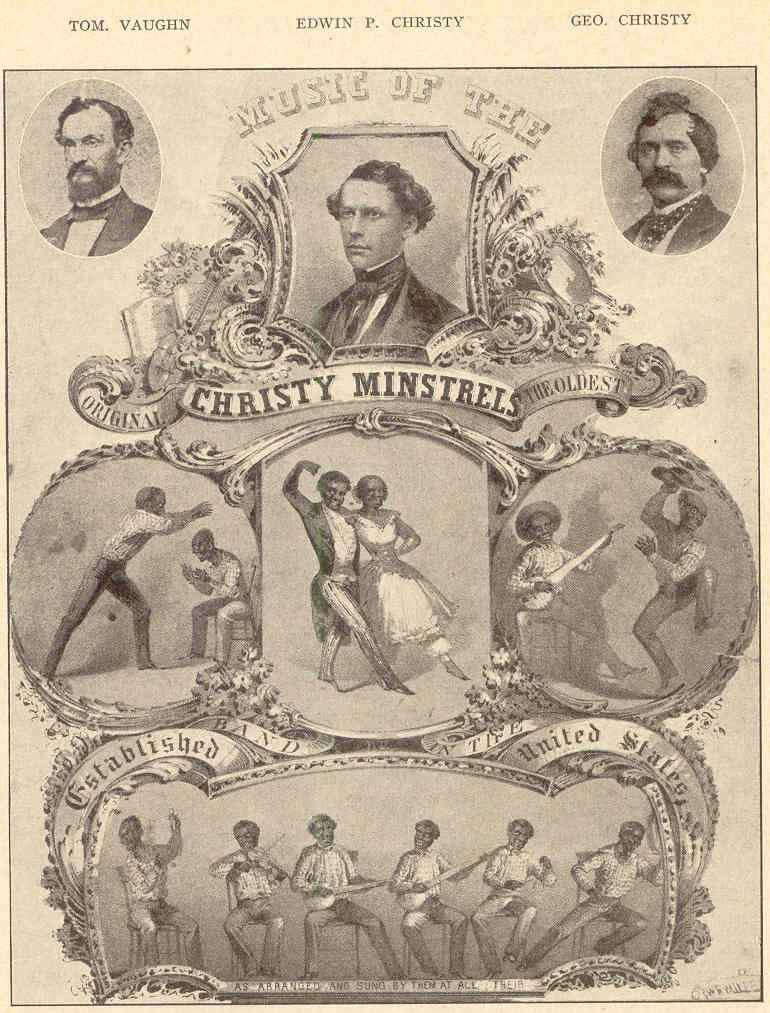
Wood’s Minstrels, likewise Buckley’s Serenaders. September 20 1854, he left New York
with E.P. Christy’s Minstrels to play an engagement in San Francisco; he
contracted an
illness on the way, and was unable to play. Tom Briggs died in San
Francisco October 23,
1854; aged 30 years. (pg. 46)
***
Briggs had been taught to play by
one of the first minstrel performers, Billy Whitlock, an original member of the
seminal Virginia Minstrels (Dan Emmett’s group) and was quite famous as a
banjoist in his day. Unfortunately, as Rice mentions above, he contracted
typhoid fever while crossing the jungles of the
X:1
T:Tom
Brigg’s
M:2/4
L:1/8
R:”Jig”
S:Ryan’s Mammoth Collection (1883)
Z:AK/Fiddler’s Companion
K:D
D |:
D/F/z/A/ d/A/F | G/B/z/d/ d/g2 | D/F/z/A/ d/A/F/ | E4 | D/F/z/A/ d/A/F |
G/B/z/d/ g2 |
f/e/d/f/
e/d/c/e/ | z/d/A/F/ D2 :: f/a/z/a/ a/f/a | f/a/z/f/ e/f/d | g/b/z/g/ b/g/b |
g/b/z/f/ e/f/d |
f/a/z/f/
a/f/a | f/a/z/f/ e/d/e/g/ | f/e/d/f/ e/d/c/e/ | z/d/A/F/ D2 :|
TOM BRODERICK’S JIG. AKA and see "Bob Thompson's Favourite,"
"The Coravat Jig [1]," “The Geese in the Bog [2],” "The Green Meadow [2]," "The Humours of Limerick [2],"
"Jackson's Walk to
Limerick," "Jackson's
Trip to Limerick," "Jackson's
Coola," “The Lark’s March,” “Mist on the Meadow,” “Morrison’s Fancy,” "The Mountain Lark [5]," "The Piper's Frolic," “Thrush in the Straw [1],” “Tom Broderick’s Jig,” "Tuhy's Frolic," "Twice Tricked,” "Wiseman's Favourite." Irish,
Jig. D Major. Standard tuning. AABBCCDDEE. Tom Broderick was a neighbour of
young Mike Rafferty’s in Ballinakill, who gave him this tune along with several
others [Harker]. Source for notated version:
|
See also listings at: Alan Snyder’s Cape Breton Fiddle
Recording Index Jane Keefer’s Folk Music Index: An
Index to Recorded Sources Alan Ng’s Irishtune.info |
TOM BROWN'S BURLETTA. AKA and see "Jiggs On Parade."
American Veteran Fifer, 1927; No. 30.
TOM BUSBY'S. Irish, Double Jig. E Dorian. Standard tuning. AABB. Piper Tom Busby
emigrated from
TOM CAT RAG. Old-Time, Breakdown. G Major. Standard tuning. AB. Source for notated
version: Jack Link [Silberberg]. Silberberg (Tunes I Learned at Tractor
Tavern), 2002; pg. 158.
TOM CAWLEY’S. AKA – “The Wind off the
Lake.” AKA – “Tommy Cowley’s.” Irish, Jig. G Major. Standard tuning. AABB. Tom
Cawley was a fiddler from the Tubbercurry, Doocastle, County Sligo, region who
emigrated to the United States in the early 20th century. He made
some important recordings during the “golden age” of Irish traditional music in
the 1920’s-1940’s, often paired with another fiddler, Francis Cashin. The duo
recorded “The Silver Tip” in 1929, and a year later recorded in Chicago the
reel “Wheels of the World.” Cawley eventually settled in New York and played in
various bands in Harlem in the 1930’s (personal communication from his
grandson, Matt Cawley). He died around 1940. Source for notated version: fiddler Johnny McGreevy (Ireland)
[Breathnach]. Breathnach (CRÉ III),
1985; No. 3, pg. 3 (appears as “Tommy Cowley’s Jig”). Treoir, vol. 32, No. 4. Green Linnet Records SIF
1023, Joe Shannon & Johnny McGreevy ‑ "The Noonday Feast"
(1980).
X: 1
T: Tom Cawley's
N: "TC was a fiddler from Doocastle,
Co.Sligo" (near Brendan Tonra's
N: home town - BB)
M: 6/8
L: 1/8
Q: 325
S: Treoir 32/4
Z: Transcribed by Bill Black
R: jig
K: G
D | GBB BAB | GBB BAG | FAA A2 D | FAA A2 D |
GBB BAB | GBB BAG | def gdc | BGG G2 :|
g | aba
afd | gag gfe | d^cd gdB | BAA A2 g |
aba
afd | gag gfe | d^cd gd=c | BGG G2 :|
TOM
CLAIR’S MAGGIE. AKA and see “Lady’s Bonnet,” “Reel with the Beryle.” Irish, Reel.
E Minor. Standard tuning. AA’B. O’Neill (1922) remarks: “The first part
of Mr. Clair's tune differs but little from ‘Drowsy Maggie’ in common
circumstances.” O’Neill (Waifs and Strays of Gaelic Melody),
1922; No. 300.
X:1
T:Tom Clair's Maggie (#300)
M:4/4
L:1/8
S:noted from Clair's playing by Capt. F. O'Neill
Z:Paul Kinder
R:Reel
K:Emin
B|:"tr"E2 BE dEBE|"tr"E2 BE AFDF|1"tr"E2 BE d2 d2|e2 dB AFDF:|
2GFEF GFGB|dedB AFDF||(3Bcd ef e3 g|
fd ~d2 fd ~d2|g2 "tr"gf g2 g2|afdf afdf|
a2 "tr"af g2 eg|e2 ef B3 A|DGGF GABd|(3efg dB
AFDF||
TOM CLARK’S FANCY. AKA and see “Green Fields
of Ros(s)beigh,” “The Kerry Reel [1].”
Irish, Reel. Recorded by County Cavan/Philadelphia fiddler and composer Ed
Reavy (1898-1988) for the Victor company in
TOM COLLINS’. Irish, Jig. Philippe Varlet suggests it is a version of “The Angry Peeler.” Moher
– “Over the Edge.”
TOM CONNER'S JIG (Port Taim, Uí Chonchúir). Irish, Jig. D Major. Standard
tuning. AABB. Breathnach (1976) notes that Tom Connor was an old fiddler from
County Cork who liked to play this tune for dancers. Source for notated
version: fiddler Denis Murphy, 1967 (Gneeveguilla, Co. Kerry, Ireland)
[Breathnach]. Breathnach (CRÉ II),
1976; No. 57, pg. 33. Spin CD1001, Eoghan O’Sullivan,
Gerry Harrington, Paul De Grae - “The Smoky Chimney” (1996).
TOM CONNOR'S HORNPIPE (Cornphíopa Thomáis Uí Chonchuir). AKA and see “Killaloe Hornpipe,” “Widow Cantwell’s Fancy.” Irish,
Hornpipe. G Major. Standard tuning. AABB. The melody was collected by O’Neill
as “The Widow Cantwell’s Fancy” and, in the mid-19th century, by
Church of Ireland cleric and uilleann piper James Goodman (1828-1896) as “The
Killaloe Hornpipe.” Source for notated version: fiddler Denis Murphy, 1970 (Co.
Kerry, Ireland) [Breathnach]. Breathnach (CRÉ
II), 1976; No. 304, pg. 155.
TOM CROMWELL. AKA and see “Kerry No. 1.” Irish, Polka. D Major. Standard tuning.
AABB. Source for notated version: set dance music recorded at Na Píobairí
Uilleann, mid-1980’s [Taylor]. Taylor (Music
for the Sets: Yellow Book), 1995; pg. 34.
TOM DEERING'S RAMBLES. American, Reel. G Major. Standard tuning. AABB. Composition credited to
Edwin Christie in Ryan’s
Mammoth Collection. This is not the Edwin Christy of blackface minstrel
fame, however, but rather a journeyman composer of light music from Boston by the
name of Edwin P. Christie. Cole (1000
Fiddle Tunes), 1940; pg. 39. Ryan’s
Mammoth Collection, 1883; pg. 65.
X:1
T:Tom Deering’s Rambles
M:
L:1/8
R:Reel
S:Ryan’s Mammoth Collection (1883)
Z:AK/Fiddler’s Companion
K:G
GB dg | ea/g/ f/d/e/f/ | g/d’/c’/e/ d/c’/b/d/
| ^c/d/b/a/ f/d/=c/A/ | GB dg | ea/g/ f/d/e/f/ |
g/d’/c’/e/ d/c’/b/d/ | ^c/b/a/f/ g2
:: {g/a/}g/f/g/a/ b/g/d/B/ | a/>a/”tr”a {^g/a/}f/>d/”tr”d |
{^c/d/}g/a/b/c’/ d’/b/g/b/ |
a/d’/^c’/d’/ =c’/a/f/d/ | {g/a/}g/f/g/a/ b/g/d/B/ |
a/>a/”tr”a {^g/a/}f/>d/”tr”d |
{^c/d/}g/a/b/c’/ d’/b/c’/a/ | b/g/a/f/ g2 :|
TOM DEY STRATHSPEY. Scottish, Strathspey. A Major. Standard tuning. AAB. Composed by
Scottish fiddler-composer J. Scott Skinner (1843-1927). The melody appears in
J. Murdoch Henderson’s collection of Skinner’s music published in 1957 (The
Scottish Music Maker). Source for notated version: Peter Chaisson, Jr. (b.
1942, Bear River, North-East Kings County, Prince Edward Island) [Perlman].
Cranford (Jerry Holland: The Second Collection), 2000; No. 13, pg. 6.
Henderson (The Scottish Music Maker), 1957. Perlman (The Fiddle Music of Prince Edward Island),
1996; pg. 194. Jerry Holland – “Crystal Clear” (2000).
Rounder Records 7057, Jerry Holland – “Parlor Music” (2005).
|
See also listing at: Alan Snyder’s Cape Breton Fiddle
Recording Index Jane Keefer’s Folk Music Index: An
Index to Recorded Sources |
X:1
T:Tom Dey
M:C
L:1/8
R:Strathspey
C:J. Scott Skinner
K:A
c3d|e4 f3e ce3 A3B|c4 B3A FA3 EC3|D4
F3D C3E A3a|ec3 Ac3 B4 (3B2c2d2|
e4 f3e ce3 A3B|c4 B3A FA3 EC3|D4 F3D
(3C2E2A2 (3c2e2a2|ec3 Bc3 A4:|
|:e4|a4 b3a gb3 e4|f4 (3f2a2f2 ea3 c3A|dB3 e3d ce3 c3A|B3d (_d2e2f2 e4 (3e2f2g2|
af3 b3a gb3 e4|fd3 (3f2a2f2 ea3
c3A|(3F2G2A2 (3B2c2d2 (3c2d2e2 (3f2g2a2|(3e2d2c2 (3B2A2G2 A4:||
TOM DILLANE’S. AKA and see “Dillane’s Hornpipe.” Irish, Hornpipe. D Major. Standard
tuning. AABB. Black (Music’s the Very
Best Thing), 1996; No. 334, p. 178.
X:1
T: Tom Dillane's
S: M. Mulvihill
Q: 325
R: hornpipe
Z:Transcribed by Bill Black.
M: 4/4
L: 1/8
K: D
AG | (3FED FA d2 dA | (3Bcd ef g2 g2 | fafd eged | c2 A2 ABAG |
(3FED FA d2 dA | (3Bcd ef g2 g2 | fafd (3efg ec | d2 d2 d2 :|
fg | afdf afdf | bgeg bgeg | afdf afdf | e2 A2 ABAG |
(3FED
FA d2 dA | (3Bcd ef g2 g2 | fafd egec | d2 d2 d2 :|
TOM DOWD'S FAVOURITE (Rogha Thomáis Uí Dhubhda). AKA and see "Maide Fuinnseoige." Irish, Reel. E
Minor ('A' part) & G Major ('B' part). Standard tuning (fiddle). AB. The
tune is related to “The Ashplant [1].”
Source for notated version: flutist John Keegan/Seán Mac Aodhgain (Ireland)
[Breathnach]. Breathnach (CRÉ I),
1963; No. 115, p. 48.
X:1
T:Tom Dowd’s Favorite
M:C|
L:1/8
R:Reel
K:Emin
GA|BE~E2 GEDE|GEDE G3A|BE~E2
GED2|BcdB A2 GA|
BE~E2 GEDE|GEDE G3A|BE~E2 GED2|BcdB
A2EF||
G2 G2 GBdB|G2 GB AGED|G2 GF
GABd|gedB AGEF|
G2 G2 GBdB|G2 GB AGED|G2 GF
GABd|gecB A2||
TOM DUFF. Irish, March. G Major. Standard tuning. AB. Roche Collection, 1982, vol. 2; No. 330, p. 57.
TOM FAOI BLAT, AN. AKA and see "The Bush in
Bloom."
TOM FITZMAURICE'S REEL. AKA and see "Corney is
Coming." Irish, Reel. D Mixolydian. Standard tuning (fiddle). AA'B.
O'Neill (Krassen), 1976; p. 161.
TOM FITZMORRIS’S [1]. AKA and see “The Hawthorn Blossom.”
Irish, Reel. G Major. Standard tuning (fiddle). AAB. Identified by Philippe
Varlet. Source for notated version: fiddler Andrew Davie (b. 1928, Cloonagh,
Mullaghroe, Keash) [Flaherty]. Flaherty (Trip
to Sligo), 1990; p. 113 (appears as “Unknown”).
TOM FITZMORRIS’S [2]. Irish, Reel. A Major. Standard tuning. AAB. Identified by Philippe
Varlet. Source for notated version: fiddler Andrew Davie (b. 1928, Cloonagh,
Mullaghroe, Keash) [Flaherty]. Flaherty (Trip
to Sligo), 1990; p. 114 (appears as “Unknown”).
TOM FLEMING'S. AKA and see “Fahy’s Jig (3) “Matt Hayes’s Jigs.” Irish, Jig. D
Major. Standard tuning (fiddle). AABB. Named after the local source, Co. Kerry,
Ireland, button accordionist Tom Fleming, the leader of the Brosna Ceili Band. However,
the tune is a composition of fiddler Paddy Fahy’s. Source for notated version:
accordion player Johnny O’Leary (Sliabh Luachra region of the Cork-Kerry
border) [Moylan]. Moylan (Johnny O’Leary),
1994; No. 343, p. 193. Green Linnet SIF 1075, John
Whelan & Eileen Ivers - "Fresh Takes" (1987. Learned from Tom
Fleming). John Whelan (et al) – “The Big Squeeze.”
TOM FOWLER’S HORNPIPE. AKA and see “Tom
Tollin’s Hornpipe.” AKA – “Tom Tolley’s.” English, Hornpipe.
TOM FRIEL’S. Irish, Jig. Cotter (Traditional Irish Tin Whistle Tutor),
1989; 46.
X:1
T:Tom Friel's
D: Mary Mac Namara: The Blackberry Blossom
D: Bernard O'Sullivan and Tommy Mac Mahon: Clare Concertinas
Z: I wrote Mary Mac Namara's version in D
Z: despite she plays it in G because it is Described like a D tune in NG's
Index of tunes
Z: and because it suits more the Uilleann Pipes
B: Geraldine Cotter's Tutor for the Tin Whistle
R:Jig
M:6/8
L:1/8
K:D
: dcd fed | BdB AFE | DFA fed | efe ABc |\
dcd fed | BdB AFE | DFA fed | AFE D2A :||\
: dcd baf | baf edB | dfb afd | efe edB |\
dcd baf | baf edB | AFA fed | AFE D2A :||
TOM HEPPLE’S POLKA. English, Polka. England, Northumberland. Topic
12TS283. Topic TSCD 669, Adam Gray (et al) – “Ranting and Reeling: Dance Music
of the north of England” (1998. Gray, born in 1903, was a fiddler and policeman
who lived in Bardon Mill, Northumberland).
TOM HICKEY. Old-Time, Breakdown. In the
repertoire of fiddler James “Skeeter” Walden (Busch, Arkansas). See note for “Rachel [1].”
TOM HILL'S HORNPIPE (Cornphíopa Thomáis a Chnoic). Irish, Hornpipe. D Major. Standard
tuning. AABB. Source for notated version: fiddler John Kelly/Seán O'Kelly
(Ireland) [Breathnach]. Breathnach (CRÉ I),
1963; No. 212, pg. 85.
TOM HOWARD'S HORNPIPE. Scottish, Hornpipe. A Major. Standard tuning. AABBAA. Kerr (Merry Melodies), vol. 1; No. 16, pg. 44.
X:1
T:Tom Howard’s Hornpipe
M:C
L:1/8
R:Hornpipe
S:Kerr – Merry Melodies, vol. 1, pg. 44
(c. 1880’s)
Z:AK/Fiddler’s Companion
K:A
A>Bc>d
e>ca>e|f>ga>f e>ca>e|f>ga>f e>cA>c|B>AG>F
E2E2|A>Bc>d e>ca>e|
f>ga>f
e>ca>e|f>ag>f e>dc>B|A2c2A2::B>cd>e
d>BG>B|A>ce>g a2 e>g|
a>fd>f
e>cA>c|B>AG>F E2 F>A|B>cd>e d>BG>B|A>ce>g a2
b>a|g>bg>e f>af>^d|e2g2e2:|
TOM IS GONE TO THE FAIR. Irish, Hornpipe. G Major. Standard
tuning. AABB. "From memory, as I heard it played in early days"
(Joyce). Joyce (Old Irish Folk Music and
Song), 1909; No. 11, pgs. 8‑9.
X:1
T:Tom is gone to the fair
M:C
L:1/8
R:Hornpipe
S:Joyce – Old Irish Folk Music and Songs (1909)
Z:AK/Fiddler’s Companion
K:G
B>A|G2 DG BGBd|c>BAB
cdef|g>fgd ecBG|EcBA GFED|
G2 DG BGBd|c>BAB cdef|g>fec
BGED|E2G2G2:|
|:Bd|e2 dB GBdg|fdcA GFED|EA A2
B>AGE|EcBA GFED|
G>FGA BABd|cBcd edef|g>fec
BGED|E2G2G2:|
TOM JONES. English, Jig. D Major. Standard tuning. One part (O’Neill): AABB (Thompson). A very popular English melody that appears in numerous mid-18th century publications and musicians’ manuscripts, named for the title character of Henry Fielding’s novel The History of Tom Jones, a Foundling (1749). It was first printed by London publishers R. Baldwin in The London Magazine; or, The Gentleman’s Monthly Intelligencer (1750), S. Urban in Gentleman’s Magazine and Historical Chronical, David Ruthford in his Choice Collection of Sixty of the Most Celebrated Country Dances (1750), and John Johnson in his Choice Collection of 200 Country Dances, vol. 5 (1750). This was followed by printings in Walsh’s Compleat Country Dancing Master, vol. 5 (London, 1754), Charles and Samuel Thompson in their Compleat Collection of 200 Favourite Country Dances, vol. 2 (London, 1765), and James Aird in Selections of Scotch, English, Irish, and Foreign Airs, vol. 5 (Glasgow, 1797). “Tom Jones” also appears in the music manuscript collections of Northumbrian musician William Vickers (1770) and Cheapside, London, musician Walter Rainstorp (begun in 1747). In America, it appears in the music copybooks of Luther Kingsley (Mansfield, Conn., 1795), flute player John Bartlett (Mass., 1790), and keyboard player John Ives (New Haven, Conn., c. 1800). Source for notated version: copied from Aird’s Selections of Scotch, English, Irish and Foreign Airs [O’Neill]. O’Neill (Waifs and Strays of Gaelic Melody), 1922; No. 95. Thompson (Compleat Collection of 200 Favourite Country Dances, vol. 2), 1765; No. 200.
X:1
T:Tom Jones (#95)
M:6/8
L:1/8
S:Aird's Selections 1782-97
Z:Paul Kinder
K:D
[A3c3a3] [A3c3g3]|fdf ecA|d2 f ecA|d2f ecA|
dcd ede|fef gfg|a2 d c2 B|A3 A3|
D2 F E2 G|F2 A G2 F|GAB ABc|B3 A3|
GFG AGA|BAB cBc|d2 G F2 E|D3 D3||
X:2
T:Tom Jones
M:6/8
L:1/8
B:Thompson’s Compleat Collection of 200 Favourite Country Dances, vol. 2 (London, 1765)
Z:Transcribed and edited by Flynn Titford-Mock, 2007
Z:abc’s:AK/Fiddler’s Companion
K:D
a3 g3|fdf ecA|d2f ecA|d2f ecA|dcd ede|fef ^gfg|a2d cdB|(A3 A3):|
|:D2F
E2G|F2A EFG|F2d AB=c|{d}(B3 B2)F|GFG AGA|BAB ^cBc|d2G FGE|D3 D3:||
TOM KEANE'S REEL (Ríl Thomáis Uí Chéin). AKA – “Tom Kane’s.” AKA and see “Monaghan Twig [1],” “The Tinker’s Apron.” Irish, Reel. A
Dorian. Standard tuning. AA'B. The tune is named after Dublin fiddler John
Kelly Sr.’s uncle. Philippe Varlet says Breathnach should have transcribed the
tune in two sharps (A Mixolydian). Source for notated version: fiddler John
Kelly (Ireland) [Breathnach]. Breathnach (CRÉ
III), 1985; No. 152, pg. 71. Gael‑Linn
Records CEF 018, John Kelly & Willie Clancy ‑ "Seoda Ceoil
I" (1968).
X:1
T:Tom Keane’s Reel
R:Reel
Z:Adrian Scahill
M:4/4
L:1/8
K:G Mixolydian
A|BGGA BGdG|BGG2 F3A|BGGA BGdG|1
BGA2 G3A:|2 BGA2 G2Bc||\
dgga dedc|Bcde f2ef|dgga dedc|BG
(3ABA G2Bc:||
X:2
T:Tom Kane's Reel
R:Reel
M:4/4
L:1/8
K:G
BGGA BGdG|BGGE =F3c|BGGA BcdG|1 BGFA G3A:|2 BGFA G4|]
dggf d3c|Bcde =f3e|dggf dedc|1 BGAF G3B:|2 BGAF G4|]
TOM MACCORMACK'S. Canadian, Jig. Canada, Cape Breton. C Major. Standard tuning. AABB’.
Composed by Cape Breton fiddler Angus Chisholm (1908-197). Cranford (Jerry Holland’s), 1995; No. 217, pg. 63.
Breton Books and Records BOC 1HO, Winston “Scotty”
Fitzgerald - “Classic Cuts” (reissue of Celtic Records CX 40). Rounder 7001,
Joe Cormier ‑ "Scottish Violin Music from Cape Breton Island"
(1974).
TOM MAHON’S. Irish, Single Jig. G Major. Standard
tuning. AABB. Source for notated version: Joe Keegan, father of fiddler and
pianist Josephine Keegan, and himself a flute player, “from the County Laois
side of Partartington” [McGuire & Keegan]. McGuire & Keegan (Irish Tunes by the 100, vol. 1), 1975;
No. 99, pg. 27.
TOM MARSH’S HORNPIPE. Canadian, Hornpipe. Canada, Cape Breton, Nova Scotia. B Flat Major.
Standard tuning. AABB. The tune was composed by Cape Breton musician Vincent
MacGillivray. Source for notated version: Winston Fitzgerald (Cape Breton)
[Cranford]. Cranford (Winston Fitzgerald),
1997; pg. 5. Fiddler FRLP001, Tom Doucet (Nova
Scotia/eastern Mass.) - “The Down East Star.” Rounder Records 7057, Jerry
Holland – “Parlor Music” (2005).
TOM McCOLL'S FAREWELL. Irish (?), Reel. A Minor. Standard tuning. AA'BB'. Welling (Hartford Tunebook), 1976; pg. 26
(includes one variation).
TOM
McELVOGUE’S. Irish,
Jig. G Major. Standard tuning. AA’BB’.
X:1
T:Tom McElvogue's
R:jig
C:Tom McElvogue
D:Across the Waters
Z:Jeff Myers
M:6/8
L:1/8
Q:3/8=102
K:G
~G3 ~d3|cAG FAF|~G3 ~d3|dge =fdc|
G2G dBd|cAG FAF|GBd cAG|1 FAF G2 D:|2 FAF G2 d|
|:~g3 gfd|fed cAF|G2G ~d2d|cAG FAF|
~G2g ege|fed cAF|G2G ~d3|1 cAF G2d:|2 cAF G2D||
`
TOM McGUIRE'S [1]. Irish, Reel. D Major. Standard tuning. ABCD. Taylor (Where’s the Crack), 1989; pg. 17.
TOM McHALE'S JIG.
Irish, Jig. D Major. Standard tuning. AABB. Source for notated version: Tom
McHale, a tin whistle player from County Roscommon [McGuire & Keegan].
McGuire & Keegan (Irish Tunes by the
100, vol. 1), 1975; No. 24, pg. 6.
TOM McKERRON. Scottish, Reel. A Major. Standard tuning. AABB. Composed by Charlie McKerron.
X:1
T:Tom McKerron
M:4/4
L:1/8
R:Reel
C:Charlie McKerron
K:A
ga
| ec (3ccc BcAF | EC (3CCC B,CA,B, | C2 EC FCEC |
DF AF EGBG | ec (3ccc BcAF | EC (3CCC B,CA,B, | C2 EC DFAF |
EGBG A2 :: eg | g a2 a feec | A2 A2 FEEe |
ae(3eee feec | Bcec B2 ce | g a2 a feec | A2 A2 FE E2 |
C2 EC DFAF | EGBG A2 :| AB |:
TOM McVICAR’S. Irish, Polka. Bulmer & Sharpley (Music from Ireland), vol. 2, No. 75.
TOM MELLIN’S. English, “Old” Hornpipe (3/2
time). Offord (John of the Greeny
Cheshire Way), 1985. Beautiful Jo BEJOCD-36, Dave
Shepherd & Becky Price – “Ashburnham.”
TOM MICK’S. See “Port Tom Mick’s.”
TOM
MORAN’S FANCY. Irish, Slide (12/8 time).
Breathnach (CRÉ II), 1976; No. 80
(appears as untitled slide).
TOM MORRISON’S
FAVOURITE. AKA and see “Rakes of Clonmel [2].” Irish, Jig. A
Dorian. Standard tuning. ABB’. Tom Morrison was a concert flute player from
west Kerry. Source for notated version: accordion player Johnny O’Leary (Sliabh
Luachra region of the Cork-Kerry border) [Moylan]. Moylan (Johnny O’Leary), 1994; No. 264, pg. 151.
TOM MORRISON’S REEL. Irish, Reel. G Major. Standard tuning. AABB’. The tune was recorded as
a schottische on a 78 RPM in 1927 by Tom Morrison as “Sweet Flowers of Milltown,” and
is a variant of the “Off to
California” family of tunes. Morrison (1889-1958), the ‘Dunmore Flash’, was
a flute player from near Glenamaddy, in the Dunmore area of County Galway.
Morrison sometimes partnered with renowned fiddler Michael Coleman for duet
recordings. Songer (Portland Collection),
1997; pg. 196. Green Linnett GLCD Kevin Burke -
“Portland.”
TOM MURRAIN, AN (The Hillock of Bent-Grass).
Scottish, Air. A lost tune attributed to the harper John Garbh Maclean, Laird
of Coll.
TOM NOKES' JIG. AKA and see "Rantin'
Roaring Willie," "The
Mitford Galloway," "Come Open the Door, Sweet
Betty." English, Slip Jig. C Major ('A' part) & A Minor ('B'
part). Standard tuning. AABB'. Tom Nokes was an English actor popular during
the reign of Charles II. Chappell (1859) notes that "Come Open the Door, Sweet
Betty" appears in the first part of "Tom Nokes' Jig," and though
the time is different, they are evidently founded on a common ancestor or that
one is a derivative of the other. The air appears in Apollo's Banquet (1669). Chappell (Popular Music of the Olden Time), vol. 2, 1859; pg. 148.
X:1
T:Tom Nokes’ Jig
M:9/8
L:1/8
S:Chappell – Popular Music of the Olden Time (1859)
Z:AK/Fiddler’s Companion
K:C
e2|dBG A2B cde|dBG A2B c2:|
|:c|BcA ^G2E G^FE|1 AAB ^G2A B2:|2
AAB ^G2A A2||
TOM PRICK’ITS FAVOURITE. English, Country Dance Tune (2/4 time). G Major. Standard tuning.
AABB. The melody and title are unique to London publisher Charles and Samuel
Thompson’s 1765 collection. Thompson (Compleat Collection of 200
Favourite Country Dances, vol. 2), 1765; No. 38.
X:1
T:Tom Prick’its Favourite
M:2/4
L:1/8
N:The ‘c’ note in the seventh measure of the 1st part may be played sharp.
B:Thompson’s Compleat Collection of 200 Favourite Country Dances, vol. 2 (London, 1765)
Z:Transcribed and edited by Flynn Titford-Mock, 2007
Z:abc’s:AK/Fiddler’s Companion
K:G
g2 fe|d2e2|dcBA|B2G2|g2 fe|d2g2|fdec|d4:|
|:d2
cB|ceac|BcBG|AFED|ABcd|ef g2|dcBA|G4:||
TOM RAE REEL. Canadian, Reel. Canada, Cape Breton. Composed by the late Inverness,
Cape Breton, Nova Scotia, fiddler Dan R. MacDonald. Paul Stewart Cranford says
it was one of the prolific MacDonald’s best-known reels. MacDonald (Heather
Hill Collection). Rounder SS‑0145, Carl
MacKenzie (Nova Scotia) ‑ "Traditional Music on Rounder: A
Sampler" (1981). Rounder CD 11661-7033-2, Natalie MacMaster – “My Roots
are Showing” (2000).
TOM RILEY POLKA, A. Old-Time.
X:1
T:A Tom Riley Polka
C:from John W. Summers
H:JWS learned this tune from Tom
H:Riley, fiddler from KY.
N:The figures in the first 2 halves
of
N:bars 1 and 2 were frequently used
by
N:JWS. The second note is tied to
the lower
N:note of the double-stop, while the
upper
N:note of the d-s is caught by a
scooping
N:down of the bow hand.
Z:Transcribed by Joel Shimberg
M:C|
L:1/8
Q:375
K:G
vduc|vBuG u+G2B2+ +G2vB2+ GG|uEuC
u+C2E2+ v+C2E2+ (3EFE|\
DEFG ABcA|"a"BG
+G2B2+"a"[G2B2]:|
Bc|:"b"d2B2"b"g4|(3fgf
e2 (+e2c2+ +e2e2+)|\
e2"c"d"c"e
dAFG|A2G2"d"G2B"d"c|
"e"d2B2"e"g3
B|c2A2a3g|f2 "f"AB cAFA|1"f"G6Bc:|\
+B2g2+ +gB+ +gB+ +g2B2+||
"options:"z4z4|"a"B2
GG"a"G2||"b"d2Bd"b"g4||"c"d"c"d||\
"c"d2||"d"GBG""B||"e"d2Bd"e"g3||"f"a2e2f2|1
"f"g6||
TOM SAWYER. Old‑Time. The title appears in a list of "forgotten"
tunes compiled by W.E.G. of Verbena, Chilton County, Alabama, appearing in the Union Banner of September 29, 1921
(Cauthen, 1990).
TOM SIMPSON TUNE, THE. Old‑Time, Breakdown. USA, Missouri. C
Major. Standard tuning. AABB. Christeson: "Tom Simpson was a Dixon,
Missouri, fiddler who migrated to Granite City, Illinois, as quite a number of
others did, during World War I. There were many job openings in Granite City at
the time." Source for notated version: John Aaron (Dixon, Missouri)
[Christeson]. R.P. Christeson (Old Time
Fiddlers Repertory, vol. 2), 1984; pg. 37.
TOM(M) STEELE ("Tomas Stiul" or "Tomas Ua
Cruaid").
AKA and see "Cill Beathach," “Drogheda Lasses,” “Hand Me Down the Tackle,” "The Hielanman's Kneebuckle,"
"The Laurel Groves.," “The Pure Drop [2],” "Reidy Johnson's [2]." Irish,
Reel. D Major. Standard tuning. AB (O'Neill/1850 & 1001): AAB
(Miller & Perron/2006): AABB'
(Cranford/Holland, Miller & Perron/1977): AA'BB' (O'Neill/Krassen). Tom
Steele was a colleague of the Irish patriot Daniel O'Connell. The title appears
in a list of tunes in his repertoire brought by Philip Goodman, the last
professional and traditional piper in Farney, Louth, to the Feis Ceoil in
Belfast in 1898 (Breathnach, 1997). The tune was recorded by the Flanagan
Brothers in 1928, and by Sligo fiddler Michael Coleman in 1921 (albeit under
the title “Reidy Johnston’s,” the name of a female Irish-American accordion
player). Dublin piper Tommy Reck recorded the melody as a pipe solo in his
first commercial release, for the Copley label, paired with “The Scholar” and
“The Salamanca.” Pipers tend to call the tune “Hand Me Down the Tackle.” Source
for notated version: fiddler Séamus & Manus McGuire (Co. Sligo) [Miller
& Perron]. Carlin (Master Collection),
1984; No. 214, pg. 126. Cranford (Jerry Holland: The Second Collection),
2000; No. 106, pg. 41. Miller & Perron (Irish
Traditional Fiddle Music), 1977; vol. 1, No. 2. Miller & Perron (Irish Traditional Fiddle Music), 2nd
Edition, 2006; pg. 107. O'Neill (Krassen), 1976; pg. 109. O'Neill (Music of
Ireland: 1850 Melodies), 1903/1979; No. 1271, pg. 239. O'Neill (Dance
Music of Ireland: 1001 Gems),
1907/1986; No. 539, pg. 100. Copley 9-191, Tommy Reck.
Outlet 3002, Paddy Cronin‑ "Kerry's Own Paddy Cronin" (1977).
Rounder Records 7057, Jerry Holland – “Parlor Music” (2005). Smithsonian
Folkways SFW CD 40481, Brian Conway – “First Through the Gate” (2002).
|
See also listings at: Alan Snyder’s Cape Breton Fiddle
Recording Index Jane Keefer’s Folk
Music Index: An Index to Recorded Sources Alan Ng’s Irishtune.info |
X:1
T:Tom Steele
M:C|
L:1/8
R:Reel
S:O’Neill – Dance Music of
Ireland: 1001 Gems (1907), No.
539
Z:AK/Fiddler’s Companion
K:D
d>D (3DDD F>A (3ABc|dfaf
gfec|d>D (3DDD Fadc|BGEF GABc|
d>D (3DDD F>A (3ABc|dfaf (3gag
bg|afge fdec|BGEF GABc||
d2 fd adfd|(3ded af gfec|d2 fd
adfd|BGEF GABc|
d2 fd adfd|(3ded af g2 fg|(3agf
(3gfe fdec|BGEF GABc||
TOM(M) STEELE [2]. AKA and see “The Killavil Reel [1],” “Mick Finn’s,” “Tilly Finn’s.” Irish, Reel. D
Major. Standard tuning. AA’BB’. The tune is (mistakenly?) called “Tom Steele”
in Flaherty’s book, perhaps because the ‘B’ part has some small resemblance to
“Tom Steele [1].” The usual title for the melody is “Killavil Reel.” Source for
notated version: fiddler Peter Horan (b. 1926, Kilavil, County Sligo)
[Flaherty]. Flaherty (Trip to Sligo),
1990; pg. 70.
TOM SULLIVAN'S. AKA and see “Gather
‘Round the Fire.” Irish, Polka. D Major. Standard tuning. AB (Cowdery):
AABB (Sullivan): AABB’ (Mallinson). The melody is based on a melodic variant of
"The Job of Journey Work
[1]." See also the related "Matt Hayes's Polka [2]."
Cowdery (The Melodic Tradition of Ireland),
1990; Ex. 33A, pg. 91. Mallinson (100
Polkas), 1997; No. 83, pg. 32. Sullivan (Session Tunes), vol. 2; No. 20, pg. 9. Globestyle
Irish CDORBD 085, Jackie Daly - “The Rushy Mountain” (1994. Reissue of Topic
recordings).
TOM SULLIVAN'S
HORNPIPE. Canadian, Hornpipe. G Major.
Standard tuning. AABB. Credited to Jim Magill by Jarman, but may be an attempt
to gain copyright. Jarman, 1944; pg. 4.
TOM TAILOR’S HIGHLAND. AKA and see “The
Teelin (Highland).”
TOM THE BARBER. English, Jig. F Major. Standard
tuning. AABB. The tune appears in the music manuscript copybook of Henry
Livingston, Jr. Livingston purchased
the estate of Locust Grove, Poughkeepsie, New York, in 1771 at the age of 23.
In 1775 he was a Major in the 3rd New York Regiment, which participated
in Montgomery’s invasion of Canada in a failed attempt to wrest Montreal from
British control. An important land-owner in the Hudson Valley, and a member of
the powerful Livingston family, Henry was also a surveyor and real estate
speculator, an illustrator and map-maker, and a Justice of the Peace for
Dutchess County. He was also a poet and musician, and presumably a dancer, as
he was elected a Manager for the New York Assembly’s dancing season of
1774-1775, along with his 3rd cousin, John Jay, later U.S. Chief
Justice of Governor of New York. There is a Child ballad, “Willie O’Winsbury”
(#100), that has the alternate titles “John Barbour,” “Johnny Barbary” and “Tom
the Barber,” about a lad who seduces the king’s daughter but he charms the
ruler, who forgives all. The title “Tom the Barber” may have ‘stuck’ due to
associations with a historical figure, one Tom the Barber who led anti-Irish
riots in London in the 1730’s.
X:1
T:Tom the Barber
M:6/8
L:1/8
R:Jig
S:Henry Livingston’s manuscript
copybook, late 18th century
Z:AK/Fiddler’s Companion
K:F
|: c/B/ | AFF F2A | BGG G2e |
({g}f)ed cdB | AFF F2 :|
|: f/g/ | aga fga | “tr”gfg efg |
“tr”gfg efg | “tr”fef agf |
ecc c2c | dBd bdc | “tr”cAc acA |
BAB dcB | AFF F2 :|
TOM THE BLACKSMITH. AKA and see "The Boyne Hunt
[1]."
TOM THE BOOGER. Old-Time, Breakdown. USA, central West Virginia. DGdg tuning. Augusta Heritage Recordings AHR-004C, Harvey Sampson and the
Big Possum String Band – “Flat Foot in the Ashes” (1986/1994. Learned by
Calhoun County, W.Va., fiddler Harvey Sampson from the playing and singing of
his father. Sampson did not recall anyone else ever playing it).
TOM THE FISHERMAN. AKA and see "Bumper
Allen's Delight," “Dairymaid [4],”
"Tabhair pog don
Bhrideoig sa Leaba," "The
Maids of Tipperary," "Kiss
the Maid in Bed."
TOM THE TAILOR’S. Irish, Highland. Ireland, Donegal.
TOM TINKER [1]. AKA and see "Tom Tinker's My
True Love."
TOM TINKER [2]. English, Country Dance Tune (3/4 time). G Major. Standard tuning. AAB.
The air appears in Playford's Dancing
Master (1650‑98). Chappell (Popular Music of the Olden Times),
vol. 1, 1859; pgs. 310‑311.
TOM TINKER'S MY TRUE LOVE. English, Air and Country Dance Tune (3/4 time). F Major. Standard
tuning. AAB. Published by Playford, The
English Dancing Master (1651) [appears as "Tom Tinker"], John
Gay, The Beggar's Opera (1729)
[appears as "Which way shall I turn me?"], and D'Urfey, Pills to Purge Melancholy (vol. VI,
1720). Kidson (1922) declares it is a "very coarse song." Chappell (Popular Music of the Olden Times), vol.
1, 1859; pg. 311. Raven (English Country
Dance Tunes), 1984; pg. 67 & 46.
X:1
T:Tom Tinker’s My True Love
M:3/4
L:1/8
R:Air
S:Beggar’s Opera (1729)
Z:AK/Fiddler’s Companion
K:F
d2 de fd|g2d2d2|B2G2G2|G4 DD|GF GA
Bc|d2d2A2|F2D2D2
D6|d2 de fd|g2d2d2|B2G2G2|G4 D2|GF GA Bc|d2d2A2|F2D2D2|D6||
A3B AG|F2D2D2|B3 c BA|G2E2E2|c3d
cB|A2d2c2|B2G2G2|G6||
TOM TOLLIN’S. AKA – “Tom Tollus Hornpipe,” “Tom Tolley’s Hornpipe,” “Tom Fowler’s
Hornpipe.” Scotch, English, Welsh; Hornpipe. G Major. Standard tuning. AABB.
First printed by Scottish Borders printer James Aird in his Selections of Scotch English, Irish and Foreign Airs, vol. 1 (Glasgow, 1778).
It appears in the 19th century manuscripts of English musicians Rev.
Robert Harrison (Brampton, Cumbria, 1820) and James Winder (Wyresdale,
Lancashire, 1835-41), both under the title “Tom Fowler’s Hornpipe.” The tune
appears in Robin Huw Bowen’s pocket tune book collection Llewely Alaw,
No. 32. It appears to be a version of “Tom Fowler’s/Tom
Tolley’s,” particularly in the ‘A’ part, although the ‘B’ part has an
additional eight bars more than “Tom Fowler’s Hornpipe.” In America, a version
of the tune appears under the title “General
Wayne’s March” in Samuel Holyoke’s Instrumental
Assistant (Albany, N.Y., 1800). Aird (Selections),
vol. 1, 1778. Callaghan (Hardcore English),
2007; pg. 25. EFDSS CD13, Magnetic North – “Hardcore
English” (2007. Various artists). YDW CD05, Magnetic North – “The Miller’s
Jig.”
X: 1
T:Tom Tollin’s Hornpipe
M:4/4
L:1/16
S:Llewelyn Alaw MSS National Library of Wales. NLW MSS 329-337
R:Hornpipe
Z:Mary Humphreys
K:G
B3c | d3cB3A G3gf3g | e8 d4 B4 | c3de3d c3BA3G | G3FA3F D3CB,3A, |
B,3CD3E F3GA3B | c8 e4 d4 | c3BA3G
D3GF3A | G4 B4 G4 :|
|: d4 | g4 b3g d4 b4 | a8 g4 g4 | b3ag3f a3gf3e | e8 d4 d4 |
g3dd3d a3dd3d | b3dd3d c'3dd3d | b3db3d c'3dc'3d | b3db3d c'3dc'3d |
c'3ba3g f3ed3c| c8 a8 | a3gf3e d3cB3A | B8 g8 |
g3fe3d c3BA3G | E8 e8 | d3cB3A D3GF3A|G4 B4 G4 :|
X:2
T:Tom Tolley’s Hornpipe
M:2/4
L:1/8
R:Hornpipe
K:G
B/c/|d/c/B/A/ G/g/f/g/|e2 d2|c/d/c/B/ A/B/A/G/|F2E2|D/E/F/G/
AB|
c>d/2e/4 dc|B/A/G/A/ DF|G3::d|gb/g/
ea/g/|f2d2|
ga/g/ ea/g/|f2 de/f/|g/d/d/d/
g/d/d/d/|g/d/g/d/ g/d/d/d/|g>f e/d/c/B/|
A/B/A/G/ F>E|D/E/F/G/ AB|c>d/2e/4
dc|B/A/G/A/ DF|G3:|
TOM TRAINOR’S. Irish, Jig. E Major/Mixolydian. AA’BB’. Learned by Karen Tweed from
fiddle player Tom Trainor. Taylor (Traditional
Irish Music: Karen Tweed’s Irish Choice), 1994; pg. 2.
TOM TULLY. Irish, Set Dance (2/4 time). G Major. Standard tuning. AABB. O’Neill (O’Neill’s Irish Music), 1915; No. 400,
pg. 192.
X:1
T:Tom Tully
M:2/4
L:1/8
R:Set Dance
S:O’Neill – O’Neill’s Irish Music (1915)
Z:AK/Fiddler’s Companion
K:G
(B/c/) | (d/c/B/A/) (B/g/f/g/) |
e2d2 | (c/d/)(c/B/) (A/B/)(A/G/) | F3E2 | D/E/F/G/ AB |
(c>d/2e/4) dc | B/A/G/A/ EF | G3
:: d | g(b/g/) e(a/g/) | f2d2 | gb/g/ ea/g/ | f2 de/f/ |
g/d/d/d/ g/d/d/d/ | g/d/g/d/
g/d/d/d/ | g>f e/d/c/B/ | A/B/A/G/ F>E |
D/E/F/G/ AB |(c>d/2e/4)
dc|B/A/G/A/ EF | G3 :|
TOM WAGNER. AKA ‑ "Wagoner [2]."
Old‑Time, Breakdown. USA, Arizona. C Major. Standard tuning. AA'BBCC.
Arizona fiddler Kenner C. Kartchner said: "(Tom was the) son of Dan
(Wagner), (and) a wealthy Texas cowman and banker (who had a famous ranch in
the panhandle). They held rodeos, with the best fiddlers extent. One of them
composed this hoedown in honor of Tom" (Shumway). Source for notated
version: Kenner C. Kartchner (Arizona) [Shumway]. Shumway (Frontier Fiddler), 1990; pg. 271.
TOM WARD'S DOWNFALL (Bascadh Thomáis Mhic an Bháird). AKA and see "Bascadh Thomais Mhic an
Bhaird," “Follow
Me Down to Carlow [3]," “Let
a Body Lie with You,” “The
Long Hills of Mourne [2],” “The
Mourne Mountains [1].” Irish, Reel. G Major. Standard tuning. AB (Perlman):
AABB (Breathnach, Miller & Perron, Moylan): AABB' (Flaherty). A rare
version of “Tom Ward” is called “The American Reel,” according to Caoimhin Mac
Aoidh (1994). This alternate version was imported home to County Donegal by
fiddler Charlie Doherty (of the famous fiddling Doherty family) when he
returned after his years in America. During the 78 RPM era the melody (under
the “Tom Ward” title) was recorded by Sligo fiddlers Michael Coleman in 1927
and Paddy Killoran in 1939 (paired with “McGovern’s Favorite”). In was recorded
by Peter Conlon in 1929 as the follow-up tune to “The Coalminer’s,” according
to Philippe Varlet, although the label on the record called the medley “The
Fiddler’s Delight.” O’Neill prints the tune as “The Mourne Mountains.” Barrel
Rafferty, Galway flute player Mike Rafferty’s father, knew the tune by the
title “Follow Me Down to Carlow,” although that title is usually applied to
other melodies. A closely related American old-time tune is the Kentucky melody
“"Merriweather.” Sources for
notated versions: piper Pat Brophy/Patrick Ó Broithe (Ireland) [Breathnach];
fiddler Kathleen Morris (Corlisheen, Ballyrush, County Sligo) [Flaherty];
accordion player Johnny O’Leary (Sliabh Luachra region of the Cork-Kerry
border) [Moylan]; Peter Chaisson Sr. (b. 1929, Bear River, North-East King’s
County, Prince Edward Island) [Perlman]; fiddler Seán McGuire (1927-2005,
Belfast, Ireland) & flute player Roger Sherlock [Miller & Perron].
Breathnach (CRÉ I), 1963; No. 90, pg.
39. Bulmer & Sharpley (Music from
Ireland), vol. 3, No. 29. Flaherty (Trip
to Sligo), 1990; pg. 59. Lyth (Bowing
Styles in Irish Fiddle Playing, vol. 1), 1981; 59. Miller & Perron (Irish Traditional Fiddle Music), 1977;
vol. 2, No. 33. Miller & Perron (Irish
Traditional Fiddle Music), 2nd Edition, 2006; pg. 108. Moylan (Johnny O’Leary), 1994; No. 239, pg. 138.
Perlman (The Fiddle Music of Prince
Edward Island), 1996; pg. 55. Green Linnet GLCD
1175, Cherish the Ladies – “New Day Dawning.” Green Linnet GLCD 1187, Cherish
the Ladies – “One and All: the best of Cherish the Ladies” (1998). Intrepid
Records, Michael Coleman - “The Heyday of Michael Coleman” (1973). Outlet SOLP
1001, "Sean McGuire & Roger Sherlock."
|
See also listings at: Jane Keefer’s Folk Music Index: An
Index to Recorded Sources Alan Ng’s Irishtune.info |
X:1
T:Tom Ward’s Downfall
T:Mourne Mountains, The
R:reel
Z:id:hn-reel-436
Z:transcribed by henrik.norbeck@mailbox.swipnet.se
M:C|
L:1/8
K:G
BG~G2 GEDG|EDEG AEGA|DEGA ~B3d|ed~d2
egdc|
BG~G2 GEDG|EDEG AEGE|DEGA ~B3d|1
egdc BGGA:|2 egdc BAGB||
|:dggf gedg|eaab a2ga|bg~g2
agef|gedc BGGB|
dggf gedg|eaab a2ga|bg~g2 agef|1
gedc BAGB:|2 gedc BGGA||
TOM WARD’S (JIG). AKA and see “The Clare Jig [2]," “Old Kilfenora (Jig).” Irish,
Jig. G Major.
TOM WELL'S PIECE. American, Jig or Quadrille. USA, southwestern Pa. C Major. Standard.
ABC. Tom Wells was a skilled fiddler of great repute in the neighborhood of Oad
Forest, Greene County, Pa. Source for notated version: Tom Wells via John
Tustin (fiddler from Greene County, Pa., 1944) [Bayard]. Bayard (Dance to the Fiddle), 1981; No. 487,
pgs. 452‑453.
TOMAHAWK. Old-Time, Breakdown. GDgd tuning. Probably composed by fiddler Tommy
Jackson. In the repertoire of Ward Jarvis.
TOMAS MO DEARBRATAIR. AKA and see "My Brother Tom."
TOMAS OG MAC AENGUSA. AKA and see "Young Tom Ennis."
TOMAS UA CRUAID. AKA and see "Tom Steele."
TOMAS UA GAILLIM. AKA and see "Galway Tom [1]."
TOMBIGBEE WALTZ. AKA and see "Gum Tree Canoe,"
"Tom Big Bee River." Old‑Time,
Waltz. G Major. Standard tuning. AB (Mathiesen): AA'BB' (Phillips). The melody
is named for the Tombigbee River which flows from northeastern Mississippi into
the Alabama River. Tombigbee is rumored to mean ‘coffinmaker’ in one of the
Native American languages. A song
version, “Tom Big Bee River,” attributed to S.S. Steele, was printed in Heart
Songs – Melodies of Days Gone By, published in 1909 by World Syndicate
Publishing Company (Cleveland; New York), although it is much older. From the
dialect employed in the lyrics, minstrel origins are indicated. S.S. Steele and
A.F. Winnemore (1847) are credited with words and music in Garson’s Laura Ingles Wilder Songbook.
***
On Tom-big-be River so bright I was born,
In a hut made of husks ob de tall yaller corn,
And dar I fust meet mid my Jula so true,
An I row'd her about In my gum-tree canoe.
***
Chorus:
Singing row away, row, O'er the waters so
blue,
Like feathers we'll float in my gum-tree canoe.
***
All de day in de flied de soft cotton I
hoe,
I tink ob my Jula an sing as I go;
Oh, I catch her a bird, wid a wing ob true blue,
An at night sail her 'round in my gum-tree canoe.
***
There are even Australian versions
of the song, printed in the early 20th century. Source for notated
version: Tom Jackson via James Bryan [Matthiesen, Phillips]. Matthiesen (Waltz Book I), 1992; pg. 50. Phillips (Traditional American Fiddle Music), vol.
2, 1995; pg. 314. Copper Creek 0164, Tom Sauber, Brad Leftwich, Alice Gerard – “Been There
Still” (appears as “Gum Tree Canoe”). Rounder 0175, James Bryan ‑
"Lookout Blues" (1983. Learned from Tom Jackson). Davis Unlimited,
Indian Creek Delta Boys (1976. Learned from Benny Woods: "Benny says that
an old girlfriend of his used to sing this 'old-fashioned waltz'.). Marimac CD,
Dan Gellert.
X:1
T:Tombigbee Waltz
L:1/8
M:3/4
K:C
{Bc}BA|G2 B2 B2|{B}d4 BA|G2 B2 B2|{B}d4 B2|cB A2 A2|A2 B2 d2|e4 d2|
B4 {Bc}BA|G2 B2 B2|{B}d4 BA|G2 B2 B2|{B}d4 B2|cB A2 A2|A2 B2 d2|e2 d2 B2|G4:|
|:d2|g4 d2|g4 d2|e3 d e2|d4 B2|cB A2 A2|A2 B2 d2|e4 d2|B4 d2|g4 d2|g4 d2|
e3
d e2|d4 B2|cB A2 A2|A2 B2 d2|e2 d2 B2|G4 :|
TOMBREACKACHIE'S
STRATHSPEY. Scottish, Strathspey. D Major.
Standard tuning. AAB. Composed by William Marshall (1748-1833).
Tombreakachy is a farm in lower Glen Livet. Moyra Cowie (The Life and Times of William Marshall, 1999) says that people were
often known by the names of their farms and that Marshall wrote in one of his
letters that he had a great fondness for “Tombreakachy and old Croughly.”
Marshall, Fiddlecase Edition, 1978;
1822 Collection, pg. 36.
X:1
T:Tombreackachie’s Strathspey
L:1/8
M:C
S:Marshall – 1822 Collection
Z:AK/Fiddler’s Companion
K:D
B|A>D A<F EB,B,B|A<D
A<F|~G>A B/A/G/F/ EB,B,B|A>D A<F ADD:|
f|d>fd>f eEEf|d>fd>f
BdAF|G<eF<d Eeeg|f<d e>c dDDf|d>fd>f eEEf|d>fd>f BdAF|
G<eF<d Eeeg|f<d e>c
dDD||
TOMEEN O’DEA’S REEL. AKA – “Thomaisin O’Dea’s.”
Irish, Reel. G Major. Standard tuning. AB. The tune closely shares melodic
material with “An tSeanbhean Bhocht”
and “Bantry Bay Hornpipe,” with
which it is paired in the Tubridy book. See also the related “Glenmore Hunt.” Breathnach (CRÉ I), 1963; No. 98. Breathnach (Folk Music and Dance of Ireland), 1971;
20. Tubridy (Irish Traditional Music,
vol. 1), 1999; pg. 25.
TOMGRANEY CASTLE [1]
(Caislean Tuaim-Greine). AKA and see “Loch
Levan/Lavan Castle,” “Tuamgraney Castle,”
"The Humours of Tuamgraney."
Irish, Hornpipe. A Dorian. Standard tuning. AABB. The tune is note-for-note the
Scottish reel “Loch Levan Castle.” Tomgraney, or Tuamgraney, is in east Clare.
See also notes for “Loch Leven Castle” and “Tuamgraney Castle.” O'Neill (Dance Music of Ireland: 1001 Gems),
1907; No. 949, pg. 162.
X:1
T:Tomgraney Castle [1]
M:C|
L:1/8
R:Hornpipe
S:O’Neill – Dance Music of Ireland: 1001 Gems (1907), No. 949
Z:AK/Fiddler’s Companion
K:A Dorian
cB|A2 AB AGEG|AGAB cBcd|efga
gedc|B2G2G2 cB|
A2 AB AGEG|AGAB cBcd|(3efg fa
gede|c2A2A2:|
|:eg|a2 ab ageg|agab a2 ge|dega
gedc|B2G2G2 cB|
A2 AB AGEG|AGAB cBcd|(3efg fa
gede|c2A2A2:|
TOMGRANEY CASTLE
HORNPIPE [2]. Irish, Hornpipe. E Minor. Standard
tuning. AABB. Some similarities to version #1, and melodically and structurally
to "Sailor on the Rope."
Source for notated version: fiddler Andrew Davey (b. 1928, Cloonagh,
Mullaghroe, Keash) [Flaherty]. Flaherty (Trip
to Sligo), 1990; pg. 113.
TOMIN ADEA. Irish, Reel. G Major. Standard tuning. AABB’.
X: 1
T:Tomin Adea
M:4/4
L:1/8
S:Castle Ceili Band
R:Reel
K:G
BGAG EGDG|EAAG A2 GA|BGAG EGDG|EG G2 EG G2:|
|:G2 Bd edBG|GbdB A2 A2|1G Bd edBG|dBAc BG G2:| 2G2 Bd
efga|bgaf gfed:|
TOMMY BEN’S. Canadian, Jig. Canada, Cape Breton. D Major. Standard tuning.
AA’BB’A”A”’BB’. Composed by fiddler Jerry Holland (Inverness, Cape Breton).
Cranford (Jerry Holland’s), 1995; No.
230, pg. 67. Fiddlesticks cass., Jerry Holland -
“Fathers and Sons” (1992).
TOMMY BHETTY'S WALTZ. Irish, Waltz. Ireland, County Fermanagh. G Major. Standard tuning.
AABB. Composed by Tommy 'Bhetty' Maguire, a fiddler from Kinawley, County
Fermanagh. Caoimhin Mac Aoidh says McGuire, a big man, is the fiddler who
passed the tune to Altan’s Ciaran Curran. Mac Aoidh explains his middle name is
pronounced “vetty” and is part of the old Gaelic naming practice whereby a
person receives the name of either their mother or father (or perhaps a
significant member of the family), although with the appropriate grammatical
aspiration (in McGuire’s case, the letter ‘h’ added to his mother’s name,
Betty). The source for fiddler Brendan Begley’s version is a 45 or 78 RPM
recording by the famous button accordion player Joe Cooley. Chart Records CHCD 015, Brendan Begley, Seamus Glackin &
Michael O'Brien – “Crossroads Ceili” (appears as the second “Cooley’s Waltz”).
Green Linnet SIF‑1109, Altan ‑ "The Red Crow" (1990).
Kieran Hanrahan – “Irish Tenor Banjo.”
X:1
T:Tommy Bhetty’s Waltz
M:3/4
L:1/8
Q:180
K:G Major
|:D2|G3BdB|G3BdB|d2b3a|ga fg ef|
G3BdB|G3 BdB|D2F2A2|c2~B2A2|
G3BdB|G3BdB|d2b3a|ga fg ef|dg3Bc|d3cAF|G2B2BA|G3:|
|:gfg|a2f2d2|A2F2D2|C2b3a|ga fg ef|d3ed2|B3AB2|D2F2A2|c2~B2A2|
d2Bc dB|db3af|g2b3a|ga fg ef|dg3Bc|d3c AF|G2B2BA|G3:|
X:2
T:Tom Bhetty's Waltz
T:Cooley's Waltz #2
R:waltz
M:3/4
L:1/8
D:"Crossroads Ceili", Brendan Begley on accordion
Z:Han Speek
K:G
|:G3B d2|G3B d2|g b3 a2|~g2 f2 e2|G3B d2|G3B d2|D3 F AB|c2 B2 A2|
G3B d2|G3B d2|g b3 ~a2|g2 ~f2 e2|dg2 B(3Bc^c|d3 c AF|G3B AF|
[1 G4 (3DEF:|2 G4 fg|
|:~a2 ~f2 ~d2|~A2 ~F2 ~D2|C2 b2 a2|g2 ~f2 e2|d4 ed|{_B}B4 AB|
D3 FGA|c2 B2 A2|
d4 (3Bcd|{_b}b2 a2 g2|gb3 a2|g3 ~f2e|d2 g2 (3Bc^c|d3 cAF|G3B AF|
[1 G4 efg:|2 G3 DEF:|
TOMMY COEN'S REEL (Ríl Thomáis Uí Chomhain). AKA and see "Christmas Eve [2]," "The Castle Reel [1]." Irish, Reel.
G Major. Standard tuning. AABBCC. The tune was composed by the late Irish
musician Tommy Coen (1910-1974). Coen was born in Urrachree, East Co. Galway,
but moved with his family to Salthill, just west of Galway City, in the late
1920s. He started out as an accordion player, but later switched to the fiddle
and it is for his skill on the latter instrument he is remembered. Coen worked
as a conductor on Connemara buses and is said to have been inspired by the
local scenery when composing his tunes. Flute player Mike McHale was overheard
to tell a story about Coen during a concert at the East Durham Irish Arts
Festival in 2000 (communicated by Mike Hogan). McHale was a boy who had picked
up the tin whistle, and was entertaining himself by noodling around with it
during his bus ride on his way home from school. Hearing him, the vehicle’s
conductor approached him a asked, “Can you play that thing?” McHale answered,
"A couple of tunes, Sir." "Well then" said the conductor,
"My name is Tommy Coen, will you come to the back of the bus, I have a
fiddle under the seat." Later, according to his student Séamus Walshe
(Taylors Hill, Galway), when Coen’s health failed he returned to accordion
playing, “putting his fiddle playing into the box. I think he wrote a total of
about six tunes” (Miller & Perron, 2006). Some similarities to “Cottage in the Grove [3]."
Source for notated version: Tommy Coen, playing fiddle, 1960 (Salthill, Co.
Galway, Ireland) [Breathnach]. Breathnach (CRÉ
II), 1976; No. 140, pg. 75. Green Linnet SIF‑1110,
Brendan Mulvihill ‑ "My Love is in America: The Boston College Irish
Fiddle Festival" (1991). Green Linnet GLCD 1127, “Martin Hayes” (1993).
Tara 2002, Christie Moore ‑
"The Iron Behind the Velvet" (1978).
|
See also listings at: Alan Ng’s Irishtune.info |
TOMMY COEN’S (REEL)
[2].
AKA and see “Coen’s Memories,”
“Cottage in the Grove [1],”
“Paddy Canny’s.” Irish, Reel. D
Minor. Standard tuning. AABB. Source for notated version: a 1974 concert by
Denis Ryan and P.J. Hernon [Miller & Perron]. Miller & Perron (Irish Traditional Fiddle Music), 1977;
vol. 3, No. 35 (appears as “Denis Ryan Reel”). Miller & Perron (Irish Traditional Fiddle Music), 2nd
Edition, 2006; pg. 108.
|
See also listings at: Alan Ng’s Irishtune.info |
X:1
T:Coen’s Memories
T:Tommy Coen’s
T:Cottage in the Grove, The
R:reel
C:Tommy Coen (1910-1974)
D:De Danann: The Mist Covered
Mountain
D:Music at Matt Molloy’s
Z:id:hn-reel-227
Z:transcribed by henrik.norbeck@mailbox.swipnet.se
M:C|
L:1/8
K:Edor
EDB,A, B,EFA|B2eB dBAF|D2DF E2DB,|A,DFD EDB,A,|
B,E~E2 DEFA|B2eB dBAF|DEFA dBAF|1 DEFD E2EF:|2 DEFD D2EA||
|:Be~e2 fedB|eBfe dBAF|~A3B d2fd|edef d2BA|
Be~e2 fedB|e2fe dBAF|DEFA dBAF|1 DEFD E2EA:|2 DEFD E2EF||
“Variations”
~E3D EFGA|B2eB dBAF|DEFD E2DB,|A,B,DF EDB,A,|
B,E~E2 DEFA|Be~e2 dBAF|DEFA B2AF|1 DEFD E2EF:|2 DEFD E2EA||
|:Be~e2 fedB|e2fe dBAF|AFAB d2fd|edef d2BA|
Be~e2 fedB|egfe dBAF|DEFA B2AF|1 DEFD E2EA:|2 DEFD E2EF||
TOMMY COME TICKLE ME. A Midwest U.S. dance tune title.
TOMMY COWLEY'S JIG (Port Thomáis Mhic Amhalaí). See “Tom
Cawley’s.”
TOMMY DON’T GO. Old-Time, Waltz. USA, Texas. D Major. Standard tuning. One part. From
the playing of Texas panhandle fiddler Frankie McWhorter, who at one time was a
member of Bob Wills band. The tune may have derived from a Civil War-era melody
called “The Fourth of July Waltz.”
TOMMY GUNN'S. Irish. Green Linnet Records 1058, Matt Molloy
& Sean Keane ‑ "Contentment is Wealth" (1985).
TOMMY GUNN’S REEL (Ríl Thaimí Mhic Giolla Dhuinn). Irish, Reel. E Minor. Standard
tuning. AB. Tommy Gunn is a fiddler from near Belfast, Northern Ireland. Source
for notated version: the mid-20th century collection of Liam Donnelly (County
Tyrone and Belfast), collected from the playing of fiddler Tommy Gunn
(Derrylin, County Fermanagh) [Breathnach]. Breathnach (CRÉ IV), 1996; No. 151, pg. 73.
TOMMY HILL’S. Irish, Hornpipe. D Major. Standard tuning. AABB. No relation to “Tommy
Hill’s Favorite Hornpipe.” Mulvihill (1st
Collection), 1986; No. 18, pg. 93.
TOMMY HILL'S FAVORITE
HORNPIPE. AKA and see “Bryant’s Favorite Hornpipe,”
"Byrne's Hornpipe" [1].
Irish, Hornpipe. D Major. Standard tuning. AA'BB. Recorded on 78 RPM in New
York by renowned County Sligo fiddler Michael Coleman (1891-1945), who played
it as the second tune in a medley with “Byrne’s Hornpipe.” Coleman began the
tune on the ‘B’ part, as Randy Miller suggests, “perhaps as a way to add
interest to the medley whose two tunes both have ‘A’ parts in the key of D and
‘B’ parts that begin on an E note within the dominant chord.” Miller &
Perron (Irish Traditional Fiddle Music),
1977; vol. 3, No. 10. Miller & Perron (Irish
Traditional Fiddle Music), 2nd Edition, 2006; pg. 124. Intrepid Records, “The Heyday of Michael Coleman” (1973).
|
See also listing at:
Alan Ng’s Irishtune.info |
X:1
T:Tommy Hill’s Favourite
R:hornpipe
D:Sean Keane: Jig It in Style
Z:id:hn-hornpipe-80
M:C|
L:1/8
K:D
(3ABc|d2fd ceAF|GFGB AFD2|(3gag fg
efdf|(3efe (3dcB AGFG|
d2fd ceAF|GFGB AGFE|DdcB (3ABA
(3GFE|(3DED CE D2:|
|:gf|eBef gfga|(3bag af gfef|gafg
efdf|(3efe (3deB A2 (3ABc|
d2fd ceAF|GFGB AGFE|DdcB (3ABA
(3GFE|(3DED CE D2:|
TOMMY HUNT'S JIG. Irish, Slip Jig. G Major. Standard tuning. A version of “Riding a Mile,” "A Mile To Ride." Bulmer & Sharpley
(Music from Ireland), vol. 2, No. 56.
Shanachie 79023, "Chieftains 3" (1971/1982).
TOMMY JOHNSON (Tomasin Mac Seoin). Irish, March (6/8 time) or Jig. D Major.
Standard tuning. AABB. Levey (Dance Music
of Ireland, 2nd Collection), 1873; No. 21, pg. 9. O'Neill (Music of Ireland: 1850 Melodies),
1903/1979; No. 1821, pg. 342.
X:1
T:Tommy Johnson
M:6/8
L:1/8
R:March or Jig
S:O’Neill – Music of Ireland (1821)
Z:AK/Fiddler’s Companion
K:D
a3g3 | fdf ecA | d2f ecA |d2f ecA | dcd ede | fef gfg | a2G F2E |
D3D2 :|
|: (D2F) (E2G) | (F2A) G2F | GAB ABc
| B3A3 | GFG AGA | BAB cBc | d2G F2E | D3 D2 :|
TOMMY LOVE. AKA and see "John
Lover('s Gone)," "John the Lover," "Poor
Johnny's Gone to (the) War." Old‑Time, Breakdown. Standard
tuning. A popular band piece and dance tune in the N.C./Va. Blue Ridge region,
known particularly as "Tommy Love" in the Patrick County, Va. area. County 201, The Old Virginia Fiddlers (Patrick County, Va.) ‑
"Rare Recordings, 1948‑49." Flying Cloud FC-023, Kirk Sutphin -
"Fiddlin' Around." Rounder 0057, Delmar Pendleton (Lone Ivy section,
Woolwine, Patrick County, Va.) ‑ "Old Originals, vol. 1" (1978).
TOMMY MACQUESTON REEL. Cape Breton, Reel. Composed by Cape Breton, Nova Scotia, fiddler Dan R.
MacDonald. Rounder 7011, "The Beatons of Mabou:
Scottish Violin Music from Cape Breton" (1978).
TOMMY MAYLAND’S REEL. Irish, Reel. D Major. Standard tuning. AABB. Source for notated
version: Brendan Mulvihill (Baltimore, Md.) [Mulvihill]. Mulvihill (1st Collection), 1986; No.
204, pg. 55.
TOMMY McMAHON'S REEL. AKA and see "The Sligo Reel
[1]." Irish, Reel. G Major. Standard tuning. AABB. The tune is not
McMahon’s, but rather an older one which he popularized. Carlin (Master Collection), 1984; No. 220, pg.
129. Green Linnet GLCD3092, Bernard O’Sullivan &
Tommy McMahon - "Clare Concertinas.”
TOMMY McQUESTON’S. Canadian, Reel. Canada, Cape Breton. F Major. Standard tuning. AABB.
Composed by Cape Breton fiddler and composer Dan R. MacDonald (1911-1976).
Cameron (Trip to Windsor), 1994; pg.
33.
TOMMY MULHAIRE’S JIG. AKA and see “Carolan’s Fancy
[1],” “Castletown Conners [2],"
“Ned Coleman’s Jig [2],” “O’Carolan’s Fancy [2].” Irish, Jig.
G Major. Standard tuning. AABB. According to New York button-accordion player
Jim Coogan, the tune was composed by Martin Mulhaire from Eyrecourt, County
Galway, in honor of his father Tommy, a music teacher and composer. Fiddler Seamus
Connolly, however, says that it was Tommy himself who "put this lovely jig
in circulation around 1958. He composed the tune during the time he lived
near Eyrecourt in Co. Galway, just before he settled in Galway City…” Tommy
Mulhaire played fiddle and accordion, among other instruments, remarks
Connolly, and was a sought-after teacher who had a talent for encouraging young
musicians. The title “Castletown Conners” is sometimes miss-applied to this jig
owing to the fact that the two were famously recorded together in a medley. Source for notated version: Jim
McElhone (County Derry) [Mulvihill]. Connolly & Martin (Forget Me Not), 2002; pgs. 112-113.
Mulvihill (1st Collection),
1986; No. 6, pg. 66. Tara Records 4008, “Josephine
Marsh” (1996. Appears as “O’Carolan’s Fancy”).
|
See also listing at: Alan Ng’s Irishtune.info |
X:1
T:Tommy Mulhaire’s Jig
T:Castletown Conners [2]
M:6/8
L:1/8
R:Jig
Z:AK/Fiddler’s Companion
K:G
G/F/ | EDE G2A | Bde dBd | edB GAB |
ABA AGF | EDE G2A |
BAB dBd | edB GAB | AGF G2 :|B | ded
def | {a}gfe fdB | ABA ABd |
egf e2f | g2e fed | edB ~g3 | edB
GAB | AGF G2 B|ded def|g2a fdB|
ABA ABd|egf e2f|g2e fed|edB ~g3|edB
GAB|AGF G2||
TOMMY PEOPLES’ (JIG). AKA and see “Gráinne’s Jig,”
“Redican’s Jig [1].” Irish, Jig. G Major.
Standard tuning. AABBCC. The alternate title, “Gráinne’s Jig,” is the name of
Donegal fiddler Tommy Peoples’ youngest daughter, and the tune is usually
attributed to him. Karen Tweed (1994) remarks the tune was “a once very popular
accordion competition tune.” Mallinson (Enduring),
1995; No. 57, pg. 25. Taylor (Traditional
Irish Music: Karen Tweed’s Irish Choice), 1994; pg. 7.
TOMMY PEOPLES’ JIG [2]. AKA and see “King of the Pipes.”
TOMMY PEOPLES’ JIG [3]. AKA and see “Pay the Reckoning.”
TOMMY PEOPLES' (REEL)
[1]. AKA and see “Frankie Kennedy’s,” “Jenny Nettle's Fancy,” “Paul
Montegue’s Reel,” “Tim Dillon’s.” Irish,
Reel. D Major. Standard tuning. AB (Breathnach): AAB (Taylor). Alternate titles
include “Frankie Kennedy’s” and “Jackie Daly’s,” for the famous Irish flute and
accordion players, respectively. Philippe Varlet finds Bronx fiddler Eileen
Ivers recorded it as “Paul Montegue’s Reel” on the first “Cherish the Ladies”
album, but notes it was first recorded in the early 1980’s by Cathal McConnell
(on solo tin whistle) and the Boys of the Lough as “Tommy Peoples’”. Source for
notated version: fiddler Jim Mulqueeny [Breathnach]. Breathnach (CRÉ V), 1999; No. 206, pg. 97 (appears
as “Ríl Thaidgh Diolún/Tim Dillon’s). Taylor (Where’s the Crack?), 1989; pg. 15. Ossian
OSS 70, Boys of the Lough – “In the Tradition” (1981). Ossian OSS 84, Boys of
the Lough – “Open Road.” Green Linnett GLCD 1137, Altan - "Island
Angel" (1993). Topic 12TS422, Boys of the Lough – “In the Tradition.”
World Music Network, RGNET 1006, Altan – “Irish Music: A Rough Guide” (reissue
of the “Island Angel” track). Birkin Tree – “A Cheap Present.”
X:1
T:Tommy Peoples [1]
R:reel
C:Trad
D:Altan : Island Angel
M:4/4
L:1/8
K:D
|:B3 c dBAF|B3 c dfed|B3 c d3 B|
ABde fded|\
B3 c dBAF|B3 c dfed|B3 c d3 B|ABde
fdec||\
dfaf bfaf|dfaf ~g2 fg| afge d3
B|ABde fdec|\
dfaf bfaf|dfaf ~g2 fg| afge d3B|ABde
fded:|
TOMMY PEOPLES’ (REEL)
[2]. AKA and see “The Milkmaid [4],” “Mooney’s Reel.” Irish, Reel. G Major.
Standard tuning. AB. See also the related “Two
Forty.” Sources for notated versions: set dance music recorded at Na
Píobairí Uilleann, late 1980’s [Taylor]; Donegal fiddler Tommy Peoples
[Breathnach]. Breathnach (CRÉ II),
1976; No. 166, pg. 87 (appears as “Gan anim/Untitled”). Taylor (Music for the Sets: Blue Book), 1995;
pg. 26.
TOMMY PEOPLES’ (REEL)
[3]. AKA and see “Beautiful Gortree.” Irish, Reel. E
Major. Standard tuning. The title “Tommy Peoples” comes from Scots fiddler John
McCusker’s (formerly of the Battlefield Band) solo album.
X:1
T:Tommy Peoples' [3]
T:Beautiful Gortree
M:4/4
L:1/8
C:Tommy Peoples
Z:transcribed by Ted Hastings
S:Alistair McCulloch (GFW)
R:reel
K:E
e‑c|BE (3EEE E2 F(B|~cB)GB
{f}g2 b‑g|f‑e(gf e)c‑Be|(~fgf)e c(BGF)|!
{D}E3‑F G‑FEG|(3BBB G‑B
g2 b‑g|f3‑e (gfe)c(|1 B)(GFG) E2:|2 B(GFG)E(e~fe)||!
{f}g ~f‑e b(e~ge)|e(f~fe) ceBe|(~fgf)e
b(e~ge)|(Bc‑c)(B‑ ‑Bc)e(f‑|‑fg)(~feb)(e~ge)|!
e(f~fe) ceBe|(~fgf)e cee(c|1 BG)FG
E(e~fe):|2 B‑GFG E2||
TOMMY PEOPLES’ (REEL)
[4]. AKA and see “The Oak Tree.” Irish, Reel. D Major. Standard tuning.
AB. A different tune than “Tommy Peoples Reel” [1]. Source for notated version:
Tommy Peoples (County Donegal) [Breathnach]. Breathnach (CRÉ II), 1976; No. 191, pg. 100 (appears as “Gan anim/Untitled”).
TOMMY PEOPLES’ (REEL)
[5]. AKA and see “The Turnpike Reel.” Irish, Reel. A Major. Nigel
Gatherer feels the ‘A’ part is a version of the old Scottish tune “Clean Pea(se) Straw/Strae.”
Tommy Peoples himself has denied authorship of the melody, and says in fact
that a number of tunes that carry his name were not composed by him. Mairead Ni Mhaonaigh and Frankie Kennedy – “Ceol Aduaidh”
(appears as “Tommy Peoples”, their source for the tune). Liam O’Flynn – “The
Pipers Call” (appears as part of Carrigaholt Set). Green Linnet GLCD 1211,
Kevin Crawford – “In Good Company” (2001). Tommy Peoples – “Waiting for the
Call.” Paul McGrattan – “The Frost is all Over.”
X:1
T:Tommy Peoples’ (Reel) [5]
R:Reel
Z:Adrian Scahill
M:4/4
L:1/8
K:G
G2BG cGBG|ADDE FGAF|G2BG cGBG|Addc
AGGF:||\
g2dg egde|g2bg agef|g2dg egdB|cBAc
BGG2:||
X:2
T:Tommy
Peoples’ [5]
R:reel
M:C|
L:1/8
Z:Transcribed by Bill Reeder
K:G
"G"G2BG "C"cG"G"BG|"D"AD~D2
"D"FGAF|"G"G2BG "C"cG"G"BG|
"D"Addc "G"BGGD|!
"G"G2BG "C"cG"G"BG|"D"AD~D2 "D"FGAF|"G"G2BG "C"cG"G"BG|
"D"A2dc
"G"BGG2||!
"G"g2dg "G"Bgdg|"G"g2dg
"Am"eaaf|"G"g2dg "G"BgdB|"Am"cAdc
"G"BGG2:||!
TOMMY PEOPLES’ (REEL)
[6]. AKA and
see “Return to Milltown.”
TOMMY
PEOPLES’ (REEL) [7]. AKA – “The
Oak Tree.” Irish, Reel. D Major. Standard tuning. AAB. A different tune
than “Tommy Peoples Reel” [1] and [4]. Vallely (Armagh Pipers Club Play 50 Reels), 1982; No. 48, pg. 23.
X:1
T:Tommy
Peoples’ Reel [7]
M:C|
L:1/8
R:Reel
K:D
G |: FAAF
D2 FD | EA,CE AGFE | FGAF D2 FD | EA,CE D3G :|
FDFA dAFA |
GFGB edcB | cdec A2 cA | BE^GB A2 Bc |
dcBA (3Bcd e2 | (3efe (3dcB AGFE |
FGAF D2 FD | EA,CE D3 ||
TOMMY PEOPLES’ (REEL)
[8]. Irish,
Reel. G Major. Standard tuning. The second of two reels is a set entitled
“Tommy Peoples’” by fiddler Mairead Ni Mhaonaigh and flute player Frankie
Kennedy on their album “Ceol Aduaidh.”
X:1
T:Tommy Peoples' [8]
D:Ceol Aduaidh
M:C|
K:G
GA|B2BA B2ge|d2ge dBGA|B2BA B2ge|dBAc BGGA|\
B2BA B2ge|d2ge dBGA|B2BA B2ge|dBAc BGG2||\
gfed edBd|gfed e3f|gfed effe|afge dfaf|\
gfed edBd|gfed e3f|gbag fage|d2ge dB|]
TOMMY PEOPLES’ (REEL) [9]. AKA and see “The Mint in the Corn.”
MY PEOPLES’ (REEL) [10]. AKA and see “Lady Gordon’s Reel [1],” “Matt Peoples [3].” Irish, Reel. D
Major.
TOMMY REGAN. Irish, Air (2/4 time). D Mixolydian/E Dorian. Standard tuning. One
part. Source for notated version: From John Dulhanny (Costello Bay) at
Arran-More, 10th Sept., 1857" [Stanford/Petrie]. Stanford/Petrie (Complete Collection), 1905; No. 375, pg.
95.
X:1
T:Tommy Regan
M:2/4
L:1/8
R:Air
N:”Andante”
S:Stanford/Petrie (1905), No. 375
Z:AK/Fiddler’s Companion
K:D Mixolydian
d/e/ | fe d/B/A/F/ | D>E F/G/A |
B/G/ A/F/ EE | E3 A/F/ | E>F E/F/A/B/4c/4 |
d>e Bd/e/ | fe d/B/A/B/ | d3 A/F/
| E>F E/F/A/B/4c/4 | de Bd/e/ | fe d/B/A/B/ |
d3 d/e/ | fe d/B/A/F/ | DE F/G/A |
B/G/A/F/ EE | E3 ||
TOMMY SULLIVAN. Canadian, Hornpipe. D Major. Standard tuning. AABB. Messer (Way Down East), 1948; No. 70. Messer (Anthology of Favorite Fiddle Tunes),
1980; No. 116, pg. 72.
X: 1
T:Tommy
Sullivan's Hornpipe
R:Hornpipe
M:2/4
L:1/16
Z:Transcribed
by Bruce Osborne
K:D
FG|Adfd
Adfd|Adge B2ed|cdec A2Bc|defd A2FG|
Adfd
Adfd|Adge B2ed|cdec AABc|d2f2 d2:|
|:FG|A2f2
fgfe|B2g2 g3e|cdec A2Bc|defd A2FG|
A2f2 fgfe|B2g2 g3e|cdec AABc|d2f2
d2:|
TOMMY
SULLIVAN’S. Irish, Jig. A Major. Standard tuning. AABB. O’Brien (Irish Folk Dance Music).
X: 1
T: Tommy Sullivan's
S: J. O'Brien: "Irish Folk Dance
Music"
M: 6/8
L: 1/8
Q: 325
R: jig
K: A
cAF E2 F | ABc dce | cAF E2 F | ABA AFE |
cAF E2 F | ABc dcd | efe ecA | BcB AFE :|
Acc Acc | Acc dcB | Acc Acc | ABA AFE |
Acc Acc | ABc efg | afe ecA | BcB AFE :|
K:G %Transposed from A
BGE D2 E | GAB cBd | BGE D2 E | GAG GED |
BGE D2 E | GAB cBc | ded dBG | ABA GED :|
GBB GBB | GBB cBA | GBB GBB | GAG GED |
GBB
GBB | GAB def | ged dBG | ABA GED :|
TOMMY TULLY’S AIR. Irish, Air. Composed by Terry Tully It appears in the Irish Pipe Band
Association publication of July, 1987 (No. 47, pg. 30), Irish
Tunes Old and New, compiled by Pipe Major Terry Tully of the St. Lawrence
O'Toole Pipe Band, Dublin.
TOMMY
WHELAN'S REEL (Ríl Thomáis Uí
Fhaoláin). AKA
and see "The Shores of Lough
Reagh," "Humours
of Loughrea." Irish, Reel. G Major/E Minor. Standard tuning. AB.
Source Paddy Carty also called the tune “Shores of Lough Reagh.” Tommy
Whelan was a member of the famed Ballinakill Ceili Band (Ballinakill is in East
Galway). Sources for notated
versions: flute player Paddy Carty (Ireland) [Breathnach/CRÉ III]; fiddler
Tommy Coen and flute player Eddie Moloney (Co. Galway) [Breathnach/CRÉ II]. Breathanch (CRÉ II), 1976; No. 197, pg. 102 (appears
as “Gan anim/Untitled”). Breathnach (CRÉ
III), 1985; No. 87, pg. 43. Green Linnet SIF 3067,
Charlie and Jack Coen – “The Branch Line.” Shanachie Records 29001, "Paddy
Carty" (1976).
X:1
T:Tommy Whelan's
T:Humors of Loughrea
T:Shores of Loughrea
R:reel
M:C|
L:1/8
K:G
DE|~G3A BA~A2|bgag egdB|GFGA
BAGE|ABAG EGDE|!
~G3A BA~A2|bgag egdB|GFGABAGE|ABAG
E2||!
ef|gfeg fdBd|~g2 ef gaba|ge~e2
edBd|ea~a2 ag e2|!
gfeg fdBd|~g2 ef gaba|gfge agaf|dgbg
egdB||!
TOMMY’S CHANCE.
English, Jig. G Major. Standard tuning. AABB. The melody was also
published by John Johnson in his 200 Favourite Country Dances, vol. 8
(London, 1758). Thompson (Compleat Collection of 200 Favourite
Country Dances, vol. 1), 1757; No. 150.
X:1
T:Tommy’s Chance
M:6/8
L:1/8
B:Thompson’s Compleat Collection of 200 Favourite Country Dances, vol. 1 (London, 1757)
Z:Transcribed and edited by Flynn Titford-Mock, 2007
Z:abc’s:AK/Fiddler’s Companion
K:G
gdB
G3|gdB G3|gfe dcB|cBA G3|DFA d3|DFA d3|d^cB AGF|GFE D3:|
|:dfa afd|afd “tr”d3|agf edc|”tr”c3 B3|dBG ecA|fdf “tr”g3|ege faf|g3 G3:||
TOMMY’S E FLAT CLOG. AKA and see “The Scarlet Clog.”
Canadian, Clog. Named for Digby, Nova Scotia, fiddler Tommy Doucette, who cut
many 78's on a home disc cutter in Boston in the 1940's and 50's.
TOMMY’S FAVORITE. AKA and see “Thrush in the Straw [2].”
TOMMY’S JIG. Canadian, Jig. Canada, Prince Edward Island. G Major. Standard tuning.
AABB. Perlman (1996) thinks the tune probably originated in Cape Breton. Source
for notated version: Charlie Sheehan (b. 1907, Bear River, North-East Kings
County, Prince Edward Island) [Perlman]. Perlman (The Fiddle Music of Prince Edward Island), 1996; pg. 126.
TOMMY’S MAZURKAS. Irish, Mazurka. A set of three mazurkas, the middle of which was
composed by Donegal fiddler Tommy Peoples. Green
Linnet GLCD 1211, Kevin Crawford – “In
Good Company” (2001. First and third tunes from Tommy’s daughter Siobhán
Peoples).
TOMMY'S TARBUKAS. Scottish, Reel. G Minor. Standard tuning. AABB. Composed by Scottish
fiddler Alasdair Fraser in honor of Tommy Hayes, an Irish bodhran player.
Tarbukas are a set of small drums similar to bongo drums, sometimes spelled
‘darbukas’ or ‘dharboukas’. Fiddler
Magazine, vol. 3, No. 1, Spring 1996; pg. 16. Songer (Portland Collection), 1997; pg. 197. Sona
Gaia/Narada, Alasdair Fraser - "The Road North" (1989). Green Linnet
SIF 3099, Sharon Shannon – “Out the Gap.”
TOMORROW ISN'T SUNDAY. AKA and see "Demain
C'est Pas Dimanche."
TOMORROW MORNING (Maidin Amarac). AKA and see “Morning Fair,” “Texarkana Hornpipe.” Irish, Hornpipe. D
Major. Standard tuning. AABB. The tune appears by the alternate titles in
Ryan’s/Cole’s. See notes for “Morning Fair” and “Manchester Hornpipe [1]” for
discussion. Cotter (Traditional Irish Tin
Whistle Tutor), 1989; 32. O'Neill (Krassen), 1976; pg. 188. O'Neill (Music of Ireland: 1850 Melodies),
1903/1979; No. 1661, pg. 309. O'Neill (Dance
Music of Ireland: 1001 Gems), 1907/1986; No. 878, pg. 151.
X:1
T:Tomorrow Morning
R:Hornpipe
M:4/4
L:1/8
K:D
dAFA defd | ecAc efge |1 fafd Bded |
c2A2 A2fe :|2 fafd Acec | d2dc d4 ::\
afdf a2gf | gece g2ag | fafd Bded |
c2A2 A2fe |\
dAFA defd | ecAc efge | fafd Acec |
d2dc d4 :|
TOM’S TAVERN. Irish, Polka. Composed by Ron Kavana. Green
Linnet GLCD 1175, Cherish the Ladies – “New Day Dawning.” Green Linnet GLCD
1187, Cherish the Ladies – “One and All: the Best of Cherish the Ladies”
(1998).
TON, THE. Scottish, March (2/4 time). A Major. Standard
tuning. AABB. Martin (Ceol na Fidhle),
vol. 2, 1988; pg. 37.
TÔN ALARCH. AKA and see “The Swan Song.”
TON
PAPA ET TA MAMAN M'A JETE DEHORS
(Your Dad and Your Mom Threw Me Out). Cajun, Two-Step (4/4 time). USA, southwestern
Louisiana. D Major. Standard tuning. ABCC(Vocal)BCC(Vocal)BCC(Vocal)BCC. This
song was one of the first recorded by Mayuse LeFleur and Leo Soileau in the
late 1920's. A related song is Mayuse LaFleur's "Ton Pere m'a Mis Dehors." Source for
notated version: Lawrence Walker & Mitch D'Avy (La.) [Francois]. Francois (Yé Yaille, Chère!), 1990; pgs. 299-300. Arhoolie 427, Lawrence Walker – “Cajun Honky Tonk – The
Khoury Recordings.” Swallow-Khoury Records, Lawrence Walker.
TON PERE M'A MIS
DEHORS. See "Ton Papa et Ta Maman m'a Jete
Dehors."
TON 'TIT BEC EST DOUX. See "Valse des Meches."
TONE ROWE'S JIG. AKA - “Tone Rowe.” AKA and see “Brendan Tonra’s,” "Tonra's Jig,” “Tonroe’s" Irish, Jig. D Major.
Standard tuning. AABB (Miller & Perron, Songer, Taylor): AABB’ (Mallinson).
See also listings under the alternate titles. The jig has assumed this garbled
name through the ‘folk process’ but was originally composed in 1957 by fiddler
Brendan Tonra (‘Tone Rowe’s Jig’=’Tonra’s Jig’) of the village of Gowlaun,
Doocastle, County Mayo (near the Sligo-Mayo border), and Boston. Brendan told
Randy Miller that it was the third tune he ever composed, two years before he
emmigrated to America. The first time he played the tune in public was at a fleadh
in County Longford in 1958, and by 1960 was pleased to hear it had been
recorded by both Sean Maguire
and the Liverpool Ceili Band. Sources for notated versions: Irish fiddler Kevin
Burke (Portland Oregon) [Songer]; set dance music recorded live at Na Píobairí
Uilleann, mid-1980’s [Taylor]. Bulmer & Sharpley (Music from Ireland), vol. 3, No. 69. Mallinson (Enduring), 1995; No. 38, pg. 16. Miller
& Perron (Irish Traditional Fiddle
Music), 1977; vol. 2, No. 34. Songer (Portland
Collection), 1997; pg. 197. Taylor (Music
for the Sets: Yellow Book), 1995; pg. 28. Outlet
SOLP 1001, "Sean McGuire & Roger Sherlock." Shanachie 29009, Andy
McGann & Paul Brady – “It’s a Hard Road to Travel” (1977. Appears as “Carmen’s
Amber”). Wild Asparagus 004, Wild Asparagus - “Call of the Wild” (1993).
|
See also listings at: Jane Keefer’s Folk Music Index: An
Index to Recorded Sources Alan Ng’s Irishtune.info |
X:1
T:Tonra’s Jig
T:Tone Rowe’s Jig
T:Brendan Tonra’s
M:6/8
L:1/8
K:D
G|~F3 AFE|EDB, A,B,D|~F3 GFG|ABF
A2G|!
~F3 AFE|EDB, A,B,D|~F3 GFG|BAF D2:|!
|:g|f2d dcd|edc Bcd|f2d dcd|ABF
A2g|!
f2d dcd|edc Bcd|f/g/af gec|dAF D2:|!
TONGADALE REEL. Scottish, Reel. Composed by Farquhar MacDonald. Cruinn Comhla – The Well Travelled Fiddler’s Collection (1995).
TONGS BY THE FIRE [1] (An T-Ursul Taob Na Teinne). AKA and see "Come to the Raffle." Irish,
Double Jig. G Major. Standard tuning. At least once recorded under the
‘mondegreen’ title “Tongues of Fire.” AABB (O'Neill). O'Neill (O’Neill’s Irish Music), 1915; No. 180,
pg. 98. O'Neill (Music of Ireland: 1850
Melodies), 1903/1979; No. 962, pg. 179. O'Neill (Dance Music of Ireland: 1001 Gems), 1907/1986; No. 185, pg. 45. Ryan’s Mammoth Collection, 1883; pg.
84.
|
See also listing at: Alan Ng’s Irishtune.info |
X:1
T:Tongs by the Fire [1]
R:Jig
M:6/8
L:1/8
K:G
G2B cAF | Gge dBG |1 c3 B3 | ABG FED
:|2 cBA Bdg | fef g3 :: gdB gdB |\
gaf gdB | gfg fag | fdd def | g3 f3
| efe def | gdB ABc | BGG G3 :|
TONGS BY THE FIRE [2], THE. AKA and see “Ballinamere Jig,” "Father Morrison's Delight,” “Molloy’s Favorite (Jig),” “Molloy’s Jig,” “Moss Martin’s,” “O’Connell’s Welcome to Dublin.”
Irish, Double Jig. Ireland, County Sligo. E Dorian. Standard tuning. AAB.
Philippe Varlet thinks the tune may be a variant of “Contentment is Wealth.” Source
for notated version: fiddler Peter Horan (b. 1926, Kilavil, County Sligo) [Flaherty].
Flaherty (Trip to Sligo), 1990; pg.
64.
TONIGHT MY SHEEP WILL
BE RESTLESS. AKA and see “A nochd gur faoin mo
chadal dhomh.”
TONIGHT SLEEP HAS
FORSAKEN ME. AKA and see “A nochd gur faoin mo
chadal dhomh.”
TONN AN ATLANTAIGH. AKA and see “Atlantic Wave.”
TONRA'S JIG (Port Uí Thomhnra). AKA - "Tonroe's Jig." AKA and see “Brendan Tonra’s,” "Tony Rowe's Jig," "Tone Rowe's Jig." Irish, Jig. D Major.
Standard tuning. AABB (Flaherty): AA'BB' (Breathnach, Harker/Rafferty). The
melody was composed in 1957 by Boston musician Brendan Tonra, while he was
still living in his native Gowlaun, County Mayo. It was his third composition
and he played it at a Longford Fleadh soon after. Tonra was a fiddler in the
Tara Ceili Band in the 1950’s, although the melody was popularized through a
recording by the Liverpool Ceili Band and their fiddler, Sean McGuire. Through
the ‘folk process’ the title has become garbled or ‘distressed’ and sometimes
appears as “Tone Rowe’s” or “Tony Rowe’s.” Sources for notated versions:
accordionist James Keane (Ireland) [Breathnach]; fiddler Jimmy Murphy (b. 1938,
Meelick, near Swinford, County Sligo) [Flaherty]; fiddler Dawson Girdwood
(Perth, Ottawa Valley, Ontario) [Begin]; New Jersey flute player Mike Rafferty,
born in Ballinakill, Co. Galway, in 1926 [Harker]. Begin (Fiddle Music from the Ottawa Valley: Dawson Girdwood), 1985; No.
35, pg. 47. Breathnach (CRÉ III),
1985; No. 20, pg. 10. Bulmer & Sharpley (Music from Ireland), vol. 3, No. 69. Flaherty (Trip to Sligo), 1990; pg. 42. Harker (300 Tunes from Mike Rafferty), 2005; No. 177, pg. 55 (appears as
“Brendan Tonra’s Jig”). Miller & Perron (Irish Traditional Fiddle Music), 2nd Edition, 2006; pg.
39. Coleman Center CD CC004, Phillip Duffy & Kevin
Brehony – “The Mountain Road” (1999. Various artists. “A Compilation of tunes
popular in South Sligo.” Appears as “Brendan Tonra’s”). Green Linnet Records
SIF 1026, James Keane ‑ "Roll Away the Reel World" (1978).
Outlet SOLP 1007, Seamus Tansey – “Best of Seamus Tansey” (197?). Outlet SOLP
1002, Sean McGuire – “Irish Traditional Fiddling” (197?). Viva W103, Sean McGuire – “Irish Jigs and Reels” (c. 1960’s,
a reissue of “Sean Maguire Plays,” the first recording of McGuire that
Josephine Keegan accompanied on piano).
|
See also listing at: Alan Ng’s Irishtune.info |
X:1
T:Tonra’s Jig
T:Tone Rowe’s
L:1/8
M:6/8
K:D
DE|:F3 A2E|EDB, A,DE|FAA G2B|cAG cAG|~F3
AFE|EDB, A,DF|B/c/dB AFE|DCE D2:|
|:g|fdd dcd|edc Bag|fef dcd|cAG
Ade|fdd dcd|edc Bag|f/g/af gec|1 dAF D2:|2 dfe dAG||
TONROE'S JIG. AKA and see "Tonra's Jig."
TONVA, LA.
English, Country Dance Tune (2/4 time). G Major. Standard tuning.
AABBCCDD. The melody is unique to Charles and Samuel Thompson’s Compleat
Collection, vol. 3 (London, 1773). Thompson (Compleat Collection
of 200 Favourite Country Dances, vol. 3), 1773; No. 151.
X:1
T:Tonva, La
M:2/4
L:1/8
B:Thompson’s Compleat Collection of 200 Favourite Country Dances, vol. 3 (London, 1773)
Z:Transcribed and edited by Flynn Titford-Mock, 2007
Z:abc’s:AK/Fiddler’s Companion
K:G
g/f/g/a/
gd|e/d/e/f/ eB|cAGF|G/F/G/A/ GG|g/f/g/a/ gd|e/d/e/f/ eB|cAGF|G2G2:|
|:Bd/B/ BG|[c2e2][c2e2]|Bd/B/ BG|[D2B2g2][D2B2g2]|Bd/B/
BG|[c2e2][c2e2]|cAGF|G2G2:|
|:BBAB|ccBc|ddcB|A2A2|BBAB|ccBe|dcBA|G2G2:|
|:DD/F/ EE/G/|FF/A/ GD|EE/G/ FF/A/|G2 G2|DD/F/ EE/G/|FF/A/ GD|EE/G/
FF/A/|G2G2:||
TONY DALTON’S. AKA and see “Old Cork
Hornpipe,” “Peter Wyper’s [2],”
Irish, Hornpipe. Tara Records 4008, “Josephine Marsh”
(1996).
TONY LOWE'S POLKA [1] (Polca Antaine Mhic Lú). AKA and see “Babes in the Woods [1],” “Din
Tarrant’s,” “Girl with
the Blue Dress On [1]," “Pat McNicholas’.”
Irish, Polka. G Major. Standard tuning. AA'BB. Source for notated version:
piper Joe Shannon & fiddler Johnny McGreevy (Ireland) [Breathnach].
Breathnach (CRÉ III), 1985; No. 80,
pg. 38. Bulmer & Sharpley (Music from
Ireland), vol. 3. Green Linnet Records SIF 1023,
Joe Shannon & Johnny McGreevy ‑ "The Noonday Feast" (1980).
Mulligan Lun 027, Martin O’Connor - “A Connaughtman’s Rambles” (appears as
middle tune of “Polkas,” side 1, track 3).
TONY LOWE’S POLKA [2]. AKA and see “Tuar Mór Polka [1],”
“Toormore Polka [2],” “Wallace’s Cross.” Irish, Polka. D Major.
Standard tuning. AABB. Taylor (Music for
the Sets: Blue Book), 1995; pg. 7.
TONY MOLLOY’S. AKA and see “Molloy’s Jig.”
TONY O’SULLIVAN’S. AKA and see “The Butlers of
Glen Avenue.”
TONY ROWE'S JIG. AKA and see "Tone Rowe's Jig,"
"Tonra's Jig."
TONY'S RANT. AKA and see "Cotillon
(Youth's the Season)." AKA ‑ "Zoney's
Rant."
TONY
SMITH’S BARNDANCE. AKA and see “The New Broom [3].
_______________________________________
Home Alphabetical Files
References
© 1996-2010 Andrew Kuntz
Please help maintain the viability of the Fiddler’s
Companion on the Web by respecting the copyright.
For further information see Copyright and Permissions Policy or contact the author.