The Fiddler’s
Companion
© 1996-2009 Andrew Kuntz
_______________________________
HOME ALPHABETICAL FILES REFERENCES
|
ROC |
|
Notation
Note: The tunes below are recorded in what
is called “abc notation.” They
can easily be converted to standard musical notation via highlighting with
your cursor starting at “X:1” through to the end of the abc’s, then
“cutting-and-pasting” the highlighted notation into one of the many abc
conversion programs available, or at concertina.net’s incredibly handy “ABC
Convert-A-Matic” at http://www.concertina.net/tunes_convert.html **Please note that the abc’s in the Fiddler’s Companion
work fine in most abc conversion programs. For example, I use abc2win and
abcNavigator 2 with no problems whatsoever with direct cut-and-pasting.
However, due to an anomaly of the html, pasting the abc’s into the
concertina.net converter results in double-spacing. For concertina.net’s
conversion program to work you must remove the spaces between all the lines
of abc notation after pasting, so that they are single-spaced, with no
intervening blank lines. This being done, the F/C abc’s will convert to
standard notation nicely. Or, get a copy of abcNavigator 2 – its well worth
it. [AK] |
ROCDAIRE GRANDA. AKA and see "(An) Ugly Customer."
X:1
T:
M:4/4
L:1/8
K:Emin
EFGF E2B2|EFGF E2B2|c2 Ac B2GB|1 AG
F2 E2 D2:|2 AG F2E4:|
G2 BB G2B2|AGFG A2dd|G2BB G2B2|agfe
d2D2|
G2BB G2B2|AGFG A2dd|BdcB
AcBA|G2F2G2D2||
ROCHE HORNPIPE. Scottish, Hornpipe. D Major. Standard tuning. AABB. Kerr (Merry Melodies), vol. 3; No. 323, pg.
35.
X:1
T:Roche Hornpipe
M:C
L:1/8
R:Hornpipe
S:Kerr – Merry Melodies, vol. 3, No. 323
(c. 1880’s)
Z:AK/Fiddler’s Companion
K:D
(AG) | FDFD d2 (de) | fdfd BcdB |
AFdF GFED | CEEE E2 (DE) |
FDGE AFBG | ABcd efge | fafd egec |
d2d2d2 :|
|: (fd) | cABc d2 (fd) | cABc d2
(AG) | FAdA GFED | CEEE E2 (DE) |
FDGE AFBG | ABcd efge | fafd egec |
d2d2d2 :|
X:1
T:Rochelle, La
M:2/4
L:1/8
S:Aird, Vol. II (1782)
Z:AK/Fiddler’s Companion
K:D
a | affa | affa | bgec | d/c/d/e/ da | affa | affa | bgec | d2d :|
|:
e/d/ | cccc | dd de/f/ | gggg | f/e/f/g/ ff | cccc | dd de/f/ | gedc | d2 d :|
ROCHES FAVOURITE. Irish, Set Dance. RCA 5798-2-RC, "James
Galway and the Chieftains in
|
See also listing at: Jane Keefer’s Folk Music Index: An
Index to Recorded Sources |
X:1
T:
L:1/8
M:C|
K:D
f>(d e)>d d2 d>d|d>(B
A)>G F2 F>F|f>(d e)>d d2 B>B|A3 A A4|
f>(d e)>d d2 d>d|d>(B
A)>G F2 F>G|A>(BA)>(G F)>DE>F|D8:|
|:A>(BA)>(G
F)>DD>D|E>(DE)>F G2 B>B|A>(BA)>(G
F)>DD>D|E>(DE)>F G2 B>B|
A>(BA)>(G
F)>DD>D|E>(DE)>F G2 F>G|A>(BA)>(G F)>DE>F|D8:|
X: 1
T:
M:4/4
L:1/8
Z:Transcribed
by Bruce Osborne
K:C
g/a/g/^f/|a>ge>d
c>B (3cde|d2A2 A3c|B2F2 F>EF>B|A2G2 G2g/a/g/^f/|
a>ge>d
c>B (3cde|d2A2 A3c|B>G^F>G e>dB>G|c2e2 c2:|
|:E>F|(3G^FG
(3cBc (3e^de (3g^fg|f2A2 A3c|B2F2 F>EF>B|A2G2 G2E>F|
(3G^FG (3cBc (3e^de (3g^fg|f2A2
A2A>c|B>G^F>G e>dB>G|c2e2 c2:|
ROCK ABOUT MY SARO
JANE. Old‑Time, Song Tune. County 521, Uncle Dave Macon and His Fruit Jar Drinkers ‑
"Original Recordings 1925‑1935."
ROCK ALONG JOHN TO
ROCK ALL THE BABIES TO SLEEP.
Old-Time, Waltz. USA, Missouri. G Major. Standard tuning. AA’BB. A waltz
derived from a song of the same name that was recorded by a number of early
country music stars, including Jimmie Rodgers (1932), Uncle Dave Macon (1926),
and the Leake County Ramblers (1928). The lyrics depict a man who stays at home
‘rocking all the babies to sleep’, deserted by a wife who has left to enjoy the
nightlife of the town. Source Robertson learned it in Shenandoah, Iowa, during
a stint playing for a radio station there. The tune is known in Yorkshire as “Fire
Burning Bright.” Source
for notated version: Lonnie Robertson (1908-1981, Springfield, Mo.)
[Beisswenger & McCann]. Beisswenger & McCann (Ozark Fiddle Music),
2008; pg. 125. Rounder CD 0375, Lonnie Robertson –
“Lonnie’s Breakdown” (1996. Originally recorded 1978).
|
See also listing at: Jane Keefer’s Folk Music Index: An
Index to Recorded Sources |
ROCK AND RYE POLKA. American, Polka.
ROCK AND RYE RAG. Related to "I Don't Love
Nobody."
ROCK AND THE/A WEE PICKLE TOW, THE/A.
AKA and see "Captain Collins,"
"The Carawith Jig," "Green Goose Fair [1]," "The Highlander's March," "Montrose's March," "The Onehorned Cow [2]," "O'Sullivan Mor(e's March) [1],"
"Painneach na nUbh [1],"
"Pickle Tow," "The Pretender's March," "The Retreat," "Scottish March," "The Scotch March [1]," "Tadeen the Fiddler," "Wee Pickle Tow." Shetlands, English,
Irish, Scottish; Air or Jig.
X:1
T:Rock and wee pickle Tow, The
M:6/8
L:1/8
N:”Slow”
S:Gow – 4th Repository (1817)
Z:AK/Fiddler’s Companion
K:F
C|C/D/FF (AF)A|(cf)A G2 c/B/|(AF)G A2~G|AFF F2:|
f|d(df) ~d2f|d(df) (dc)A|c(cd) c2d|(cf)A G2A|B>cd dBd|
{d}cBA G2B|(AF)G A2~G|AFF F2f|(f/e/)dd ~d2f|(f/e/)dd {de}f2d|
(d/c/)cc c2a|{ga}b2a {a}g2 (f/4g/4a/)|bag fed|(cf)A G2 (f/4g/4b/)|afg a>bg/b/|aff f2||
X:2
T:Rock & a wi pickle Tow, A
M:3/4
L:1/8
R:Air
N:”Slow”
S:McGibbon – Scots Tunes, book II, pg. 55 (c. 1746)
Z:AK/Fiddler’s Companion
K:G
D2 | E2G2A2 | B4d2 | (e>fg)B2 | A4 “tr”(f>e/2f/4) | g2G2A2 | “tr”B3A (B/c/d) | B2G2(GA) | G4 :|
|: (gf) | e2e2g2 | e2 efg2 | “tr”(e>de)fgf | “tr”e3dB2 | d3ed2 | d2e2f2 | g2fedc | ({c}”tr”B2) AB G2 |
c2B2c2 | d2e2f2 | (gf)(ed)(cB) | “tr”A4 “tr”(f>e/2f/4) | g2G2A2 | “tr”B2 (A<G) G>A) G4 :|
ROCK ANDY. AKA – “I’ll Learn You How to Rock Andy.” AKA and see “Rock Candy.” Old‑Time, Breakdown. A Mixolydian.
Standard tuning. AA’B. From
***
Then Massy he sold me
Then they took me down by the riverside
And learned me how to rock Andy.
***
Cho.:
You can rock them ladies but you can’t rock me (x3)
I’ll learn you how to rock Andy.
***
The title is a corruption of ‘Rock
Candy’, the name of a now-forgotten dance form, explains Mark Wilson, which
makes more sense than Owen Chapman’s story that involves a farmer who took his
slave down to the river to practice throwing rocks at Yankee soldiers. Titon
(2001) identifies the tune as being in the “Paddy on the Turnpike” family,
related to “Ducks on/in the Pond”
and the high part of “June Apple.”
Source for notated version: Owen “Snake” Chapman (Canada, Pike County, Ky.,
1995) [Titon]. Titon (Old-Time
ROCK CANDY. Old‑Time, Breakdown.
ROCK, JENNY ROCK. Old-Time, Breakdown. G Major. Standard tuning. AABB. The 'B' part
accompaniment is basically an 'E' Minor chord until the ending 'G' chord. See
the related tunes "Wild Horse"
and "Rich Mountain." Source for
notated version: Red Herron [Phillips]. Phillips (Traditional American Fiddle Tunes), vol. 1, 1994; pg. 201.
ROCK, LITTLE JULIE. Old‑Time, Breakdown.
ROCK OF CASHEL. See "Rocks of Cashel."
ROCK OF MUFF. AKA - “Star of
ROCK ON THE
***
Dumbarton,
the rock on the
***
McGuire & Keegan (Irish
Tunes by the 100, vol. 1), 1975; No. 18, pg. 5.
ROCK THE CRADLE. AKA and see "The Humours of the
Priest's House," "Miss
Johnson [2]," "Miss Johnson of Houghton
Hall," "The Muster Bank,"
"The Mountainy Man, “Rocking the Cradle."
ROCK THE CRADLE JOE
[1]. See also related part 'B' of "Sally Ann [2].” Old‑Time,
Breakdown.
***
('B') Rock the cradle Lucy, rock the cradle low,
Rock the cradle Lucy, Rock the Cradle Joe.
***
Rock the cradle Lucy, rock the cradle high,
Rock the cradle Lucy, don't let that baby cry. (Kuntz)
***
('A') Can't get up, can't get up,
Can't get up in the morning;
What we gonna do if the baby cries?
Rock the cradle Joe.
***
('B') Rock the cradle, rock the cradle,
Rock the cradle Joe;
Rock the cradle, rock the cradle,
Rock it nice and slow.
(Johnson)
***
What’ll we do when the baby cries
I don’t know;
What’ll we do when the baby cries
Rock that cradle Joe.
***
Variations of the words, however,
were in tradition as “Uncle Joe Cut Off His Toe,” a nursery rhyme which has
variants with verses which also resemble some of the “Old Joe Clark” verses:
***
Uncle Joe cut off his toe
And hung it up to dry;
The ladies began to laugh
And Joe began to cry.
***
Chorus:
Rock the cradle, rock the cradle,
Rock the cradle, Joe.
'I will not rock, I shall not rock,
For the baby is not mine.' (Version ‘C’, Number 97, The Frank C. Brown Collection Of
***
Lani Herrmann finds a similar verse
in the biography of Jennie Devlin (1865-1952) by her granddaughter Katharine D.
Newman (Urbana, IL: Univ of Illinois Press, 1995; "an Illini Book").
Allan Lomax recorded this version as a recitation by “Grandma Deb,” one of the
names by which Jennie Devlin was known. It seems to echo the
***
O, rock the cradle, John,
O, rock the cradle, John,
There's many a man
Rocks another man's child
When he thinks he's rocking his own.
***
Apparently a "Rocke the Cradle,
John" "was licensed by Laurence Price in 1631 in
|
See also listing at: Jane Keefer’s Folk Music Index: An
Index to Recorded Sources |
X:1
T:Rock the Cradle Joe [1]
M:2/4
L:1/8
B:Kuntz – Ragged but Right
K:D
f/g/|aa/g/ f/e/f/g/|aa/g/
f/e/f/g/|aa/b/ a/g/e|[Af]>[Ag] [Af][Ae]|[Af]f/e/ d/e/g/e/|
ff/e/ de/f/|g/f/e/d/ c/A/B/c/|d>e
d::c/B/|A[A/e/][A/e/] c[c/e/][c/e/]|d/c/d/e/ [d/f/]d/e/f/|g/f/g/f/ g<a|
f>g f/e/d/B/|A[A/e/][A/e/]
c[c/e/][c/e/]|d/c/d/e/ [d/f/]d/e/f/|g/f/e/d/ c/A/B/c/|d>e d:|
ROCK THE CRADLE JOE
[2]. Old-Time, Breakdown. A version
of “Rock the Cradle Joe [1].” From the
playing of West Virginia fiddler Franklin George, who learned the tune from Jim
Farthing, originally from Franklin County, Va. Gerry Milnes says this version
“maintains much more character and melody” than the “watered-down” version that
has long been a staple of “revival” fiddlers’ conventions. Shanachie Records 6040, Gerry Milnes & Lorriane Lee
Hammond – “Hell Up Coal Holler” (1999).
ROCK THE CRADLE JOE
[3].
ROCK THE/THAT CRADLE
LUCY. AKA – "Rock
That Baby, Lucille.” Old‑Time, Breakdown.
***
Rock that cradle Lucy, rock that cradle long,
Rock that cradle Lucy, keep that baby warm.
***
Rock that cradle Lucy, rock that cradle spry,
Rock that cradle Lucy, don't let that baby cry.
***
Rock that cradle Lucy, rock it Lucy Long,
Rock that cradle Lucy, keep that baby warm. (Kuntz)
***
The tune was recorded by the
Georgian string band the Cofer Brothers (Joseph Scott gives that Leon Coffer’s
wife was seven months pregnant with Leon Jr. at the time). Sources for notated
versions: Max Collins (
X:1
T:Rock the Cradle Lucy
M:2/4
L:1/8
B:Kuntz – Ragged but Right
K:D
(=f|f/)a/f/e/ dB|c(e
e>)e|g/a/g/e/ Bc|d>(e d(=f|f/)a/f/e/ dB|c(e e2)|g/a/g/e/ Bc|d>d d(B||
A)[df] [d/f]d/[d/f/]d/|A[df]
[d/f/][d/f/][d/f/][d/f/]|A[ce] [c/e/][c/e/][c/e/][c/e/]|
A[ce] [c/e/][c/e/][c/e/][c/e/]|A[df]
[d/f/]d/[d/e/]d/|A[df] [d/f/][d/f/][d/f/][d/f/]|
g/f/e/c/ Ac|d>e d||
ROCK THAT BABY,
LUCILLE. AKA and see "Rock the Cradle, Lucy." Old‑Time,
Breakdown.
X:1
T:
M:6/8
L:1/8
K:C
C2E GFE|D2E F2A|GAG GBd|cBc AGE|C2E GFE|D2E F2A|GAG GBd|cdc c3:|
|:gag
gag|e2c cBA|G2c B2c|e2d d^cd|gag gag|e2c cBA|G2c B/c/dB|cdc c3:|
ROCKEBY. AKA and see “Captain
White(‘s Jig) [1],” “Lady Pert’s
Reel.”
ROCKET [1], THE. Scottish, Hornpipe. D Major
(Kerr): F Major (Cranford/Holland). Standard tuning. AABB. A 19th
century hornpipe written in the ‘
X:1
T:Rocket Hornpipe, The
[1]
M:C|
L:1/8
R:Hornpipe
S:Honeyman – Strathspey, Reel and Hornpipe Tutor (1898)
Z:AK/Fiddler’s Companion
K:F
cde|f2 F2 F2 g^f | g2 G2
G2 ga | bagf efga | ge c2 c2 de | f2 F2 F2 g^f |
g2 G2 G2 ga | bagf efge
| f2 a2 f2 ::cB | Afcf afcA | Bfdf bfdB | Afcf afcB |
A2 G2 G2 cB | Afcf afcA
| Bfdf bfdB | bagf afge | f2 f2 f2 :||
ROCKET [2], THE. English, Country Dance Tune (whole time). D Major. Standard tuning. AABB. The melody was first published in Charles and Samuel Thompson’s Compleat Collection, vol. 3 (London, 1773). It is one of numerous melodies from the Thompson collection that were entered into the 1788 music manuscript copybook of fiddlers John and William Pitt Thompson (Norwich, Conn.). Thompson (Compleat Collection of 200 Favourite Country Dances, vol. 3), 1773; No. 92.
X:1
T:Rocket, The [2]
M:C
L:1/8
N:The ‘G’ note in measure four may be played sharp.
B:Thompson’s Compleat Collection of 200 Favourite Country Dances, vol. 3 (London, 1773)
Z:Transcribed and edited by Flynn Titford-Mock, 2007
Z:abc’s:AK/Fiddler’s Companion
K:D
f|e>de>c
d A2B|AG/F/ EA/G/ F D2 f|e>de>d c a2 d|cB/A/ BA/G/ A3:|
|:g|f>ga>f g b2 g|e>fg>e f a2f|dABF G E2g|faAc d3:||
ROCKEY ROAD, THE. AKA and see “The
Reel of Rio,” “The Road to Rio.”
ROCKFIELD COTTAGES, THE (Teachíní Ghort na gCloch). Irish, Reel. G Major. Standard
tuning. AAB. The title is a reference to a place very near source Grier’s
house, called “Newpark,” in Gort Leitreach, Farnaught, County Leatrim. Source
for notated version: fiddler and uilleann piper Stephen Grier, who wrote his
manuscripts in the 1880's [Breathnach].
Breathnach (CRÉ IV), 1996; No. 102,
pg. 54.
ROCKFIELD
REEL. Irish, Reel. B Minor. Standard tuning. AB.
Composed by Lunasa member Donogh Hennessy.
X:1
T:Rockfield Reel
C:Donogh Hennessy
Z:Philippe Varlet
S:Lunasa - Redwood (2003)
L:1/8
M:4/4
R:reel
K:Bm
FBBA B2dB | AF~F2 dFAF | DBBA Bcdf | e2ef edBA |
FBBA B2dB | AF~F2 dFAF | DBBA Bcde | fgfe dBBA |
FBBA B2dB | AF~F2 dFAF | DBBA Bcde | fbaf gfef |
dBBA B2dB | AF~F2 dFAF | DBBA ~B3 A | (3Bcd BA Bcde ||
~f3 b bafb | af~f2 fedf | eBBA ~B3 f | edBA Bcde |
~f3 b bafb | af~f2 fedf | e2ba bafa | (3efe eb bafe |
~f3 b bafb | af~f2 fedf | eBBA ~B3 f | edBA (3Bcd BA |
~F3 A Bcde | ~f3 g fedf | edBf edBf | edef edBA ||
ROCKFORD. English?, Hornpipe. C Major. Standard tuning. AABB. Hardings All-Round, 1905; No. 95, pg.
30.
X:1
T:
M:C
L:1/8
R:Hornpipe
S:Harding’s All Round Collection, No. 95 (1905)
Z:AK/Fiddler’s Companion
K:C
(3GAB|c2c2 BcdB|dGec g2e2|c2c2
Bcde|dBcA Ggfd|c2c2 BcdB|
cGec g2e2|fdec dBGB|cedB c2::gf|efed
^cABc|f2 [A2e2][A2f2] fe|
dedc BGAB|c2 [G2d2][G2e2]GG|AFAc
fefg|agec Bdgf|ecGE FAdc|BGAB c2:|
ROCKING
A BABY THAT’S NONE OF MY OWN. Irish, Lament.
ROCKING HORSE OF
REELIG, THE.
Scottish, Strathspey. A Major. Standard tuning. AABB. Composed by Dr.
John Turner; musician, teacher, performer, composer and director of the Jink
and Diddle School of Scottish Fiddling, held yearly in Valle Crucis, North
Carolina. Johnson (A Twenty Year Anniversary Collection), 2003; pg. 5. Turner (Melodies in the Scottish Style), 1984.
ROCKING IN A WEARY
LAND. Old‑Time, Breakdown.
***
Isaiah 32:1-2 Behold,
a king shall reign in righteous and a prince
shall rule in judgment. And a man shall be as a hiding place from the
wind, and a covert from the tempest; as rivers of water in a dry place,
as a shadow of a great rock in a weary land.
***
Jesus was referred to by American
Christians as the ‘rock in a weary land.’ Silberberg (Tunes I Learned at
Tractor Tavern), 2002; pg. 131.
ROCKING STEP, THE. See “Scott Skinner’s Rockin’ Step.”
ROCKING MY SUGAR LUMP. AKA – “Who’s Been Rocking My Sugar Lump?” Old-Time, Breakdown. Lowe
Stokes’ variation of the old standard “Boil The(m) Cabbage Down [1],”
recorded in 1930 with his band The Swamp Rooters, which included Bert Layne on
fiddle and Arthur Tanner on banjo, among others. A 1952 recording in the John
Quincy Wolf Folklore Collection at
***
All around this
ring, my sweet sugar lump,
All around this ring we go.
All around this ring, my sweet sugar lump,
All around this ring we go.
***
Ladies rocking, my sugar lump,
Oh, ladies rocking, my sugar lump.
Ladies rocking, my sugar lump,
Oh, turn back, sinners, turn.
***
Rock a little faster, my sugar lump,
Oh, rock a little faster, my sugar lump,
Rock a little faster, my sugar lump,
Oh, turn back, sinners, turn.
Document DOCD8045, Lowe
Stokes in Chronological Order, vol. 1: 1927-1930 (1999 reissue).
ROCKING PONY. AKA and see "Rackin' Pony."
Old‑Time, Breakdown. Mentioned in a news account as having been played at
the 1922 Georgia Old Time Fiddlers' Association state championship held in
ROCKING THE CRADLE (Luasgugad an Cliaban). AKA – “Rocking a Baby
that’s none of my Own.” AKA and see "I
Sat in the Vale." Irish, Slow Air (6/8 time). D Mixolydian/Major. A
piece in which the cry of a baby is mimicked by the fiddle. O’Neill found the
song and air almost entirely forgotten and had an imperfect setting himself.
The one he printed in Music of Ireland
was taken from an American publication of c. 1850, though he found a “fair
version” in Smith’s Irish Minstrel (
***
is lowered in pitch, and the fiddler holding a long old-fashioned
door key firmly between the teeth lightly touched the bridge of
his instrument with it at appropriate passages. Those expert
In manipulation produced very amusing if not edifying results.
***
A good description of “Rocking the
Cradle,” remarks O’Neill (1913), can be found in the biography of John
Coughlan, the Australian piper. According to Caoimhin Mac Aoidh, the great
Sliabh Luachra fiddler player Padraig O’Keeffe employed the technique (which
can be heard recorded on his album “Kerry Fiddles”), though it was also known
and used in Donegal by John
Doherty and references were even made regarding it in
X:1
T:Rocking the Cradle
B:Music of Ireland, F. O'Neill, no. 547
N:slow
M:6/8
Z:Transcribed by Paul de Grae
L:1/8
K:D
D/E/|FFF GGA/G/|FFD EDD/E/|FFF GAG|EDD
D2:|
A/B/|=c>dc B>^cd|AA/B/A/G/
FDD|=c>dc BAF|
A>B^c d2 d|d>ef
d>ef|AA/B/A/G/ FDD/E/|
F/G/F/E/D/F/ EAG|EDD D2||
X:2
T:Rocking the Cradle
M:6/8
L:1/8
B:Waifs and Strays
S:Sergt. James O'Neill
Z:Paul Kinder
R:Air
K:D
"Andante"D/2E/2|FFF GGA/2G/2|FFD EDD/2E/2|FFF GAG|FED D2:||!
A/2B/2|=c>dc B>^cd|AA/2B/2A/2G/2 FDD|=c>dc BAF|A>B^c d2 d|!
d>ef d>ef|AA/2B/2A/2G/2 FDD/2E/2|F/2G/2F/2E/2D/2F/2 EAG|FDD D2||!\\
ROCKING THE
CRADLE [2].
AKA and see "Bounce upon Bess," "Come all you good fellows,"
“Kissing and Drinking [3],”
"Larry O Lashem," “Love and Hospitality,” "The Parson in/on his Boots,"
“The Priest and/in His
Boots [1],” "Paddy's
Trip from Dublin," "There are Sounds of Mirth,"
"The Tivoli," "Sagart na
mBuataisi." Irish, Jig.
ROCKINGHAM CINDY. AKA and see "I
Get My Whiskey from Rockingham." Old‑Time, Breakdown & Song.
D Major: G Major (Silberberg). Standard or ADae (Tommy Jarrell) tuning. AABC.
Source for notated version: Greg Canote (Seattle) [Silberberg]. Silberberg (Tunes
I Learned at Tractor Tavern), 2002; pg. 132. Cartunes
105, Bruce Molsky and Bob Carlin – “Take Me as I Am” (2004. Sourced to Tommy Jarrell).
County Records, Tommy Jarrell – “Banjo Album.” Marimac 9009, Chad Crumm ‑
"Old Time Friends" (1987).
ROCKIT GALOP. American, Galop. G Major ('A' part) & E Flat Major ('B' part).
Standard tuning. AA'BB'. The Rockit Galop was a combination of steps, including
redowa, glissade, waltz and galop, but starting with a rocking movement (hence,
no doubt, the name). Ford (Traditional
Music in America), 1940; pg. 154.
ROCKMILLS HORNPIPE. Irish, Hornpipe. A Major. Standard tuning. AB. "Copied from an old
Cork music book. Rockmills (is) near Mitchelstown, Co. Cork" (Joyce).
Joyce (Old Irish Folk Music and Song),
1909; No. 157, pgs. 79‑80.
X:1
T:Rockmill’s Hornpipe
M:C
L:1/8
R:Hornpipe
S:Joyce – Old Irish Folk Music and Songs
(1909)
Z:AK/Fiddler’s Companion
K:A
EAAA Acec|cBBA Bceg|agae fece|eccA
BFAF|
EAAA Acec|cBBA Aceg|agae fece|edBG
A2A2||
Beed ceag|fgfe ceag|agae fece|eccA
BFAF|
EAAA Acec|cBBA Bceg|agae edcf|edBG
A2A2||
ROCKS HORNPIPE. AKA and see "Prime's
Hornpipe," "O'Dwyer's
Hornpipe [1]." American, Breakdown. D Major. Standard tuning. AB.
"Fiddlers spell the local title of this Irish tune as we give it here; but
they always pronounced it 'Jirrock's', stressing the last syllable. It has long
been quite popular in Fayette County, but has not thus far turned up elsewhere
in western Pennsylvania. Other variants are O'Neill, Music of Ireland,
No. 1597; Joyce 1909, No. 63 {Prime's Hornpipe}" (Bayard, 1944). Source
for notated version: Irvin Yaugher Jr., Mt. Independence, Pennsylvania, October
19, 1943 (learned from his great‑uncle) [Bayard]. Bayard (Hill Country Tunes), 1944; No. 93.
ROCKS OF ANTILUCE. AKA and see "The Pride of
Kildare," "My
Heart with Love is Breaking," "The Waterloo Reel [5]," "The Scotch Patriot's Reel," "The Scotch Rose," "The Rakes of Drumlish,"
"The Duke of Gordon's
Favourite," "Duke Gordon,"
"The Duke of Gordon's Rant,"
"Lord Gordon’s Reel."
ROCKS OF BAWN, THE. Irish, Slow Air. Claddagh
4CC 32, Willie Clancy – “The Pipering of Willie Clancy, vol. 1” (1980).
ROCKS OF BRAE. AKA and see "Doon the Brae,"
“Down the Brae.”
ROCKS OF CASHEL [1], THE. AKA and see “Carrigaline,”
“The Milestone [2],” "Steeplechase [2]." Irish, Reel. C
Major. Standard tuning. AB. Versions were recorded by Sligo fiddler Paddy
Killoran as “The Steeplechase,” and printed by O’Neill under the title
“Carrigaline.” Source for notated
version: Brendan Mulvihill (Baltimore, Md.) [Mulvihill]. Cole (1000 Fiddle Tunes), 1940; pg. 48.
Mulvihill (1st Collection),
1986; No. 117, pg. 31 (appears as “The Rock of Cashel”). Ryan’s Mammoth Collection, 1883; pg. 75. White’s Unique Collection, 1896; No. 91, pg. 16.
X:1
T:Rocks of Cashel [1]
M:2/4
L:1/8
R:Reel
S:White’s Unique Collection (1896), No. 91
Z:AK/Fiddler’s Companion
K:C
((3G,/A,/B,/ | C/)B,/C/D/ (E/G/)G |
A/d/d/e/ d/c/A/B/ | {d}c/B/c/A/ G/E/c/A/ |
(G/F/).E/.D/ E((3G,/A,/B,/ |
C/)B,/C/D/ (E/G/)G | A/d/d/e/ d/c/A/B/ |
{d}c/B/c/A/ G/E/c/A/ | G/F/E/D/ Cz
|| “tr”c(e/c/) g/c/e/c/ | a/g/f/e/ B/c/d/B/ |
“tr”c(e/c/) g/c/e/c/ | a/g/f/d/
c/G/A/B/ | “tr”c(e/c/) g/c/e/c/ | a/g/f/e/ B/c/d/B/ |
“tr”c(e/c/) g/c/e/c/ | (a/g/)f/d/ c
||
ROCK(S) OF CASHEL [2], THE (Carraig Na G-Caiseal). Irish, March (cut time). G Major
(O’Neill/1850): D Major (O’Neill/1913). Standard tuning. AABB (O’Neill/1913):
AABBC (O’Neill/1850). Cashel is a town in County Tipperary famous for the huge
outcropping of limestone rock which looms nearby, upon which can be found the
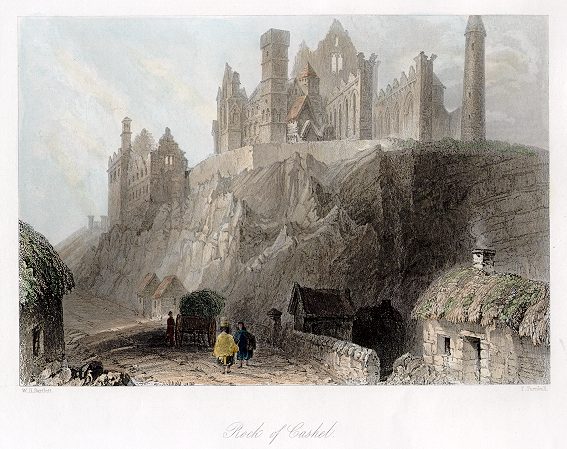
ruins of both the town's ancient fortress and a cathedral—the Rock of Cashel. It was early the seat of the kings
of Munster, the Eoghanachta, and Brian Boru was crowned there in AD 977. In
1101 Muircheartach O’Brien ceded the Rock of Cashel to the Church, and it was a
religious center until sacked by Cromwellian forces in 1647. At least one
version of the tune was known in the mid‑18th century for it was a
favourite tune of the Reverend Dr. Campbell (a friend of Edmund Burke, Johnson,
Boswell and Goldsmith) who stated it was danced to at Cashel in 1775. It “was a
tune which seemed to inspire particular animation,” he wrote in his 1778 work A Philosophical Survey of the South of
Ireland (O’Neill, 1910 & 1913). Bunting publishes in his third
collection a version of “Rocks of
Cashel” under the title “The Chorus Jig.”
The melody appears in the music manuscript copybook of Ann Winnington, c. 1810,
a resident of New York. Aird (Selection of Scotch, English, Irish and
Foreign Airs) vol. 4 (c. 1793). McGoun (Repository
of Scots and Irish Airs), c. 1800. O'Neill (Music of Ireland: 1850 Melodies), 1979; No. 1819, pg. 342. O’Neill
(1913), pg. 420.
X:1
T:Rocks of Cashel, The [2]
M:C|
L:1/8
R:March
S:O’Neill – Music of Ireland (1903), No. 1819
Z:AK/Fiddler’s Companion
K:G
.G.B d2 e/d/c/B/ d2 | .G.B d2
e/d/c/B/ A2 | .G.B d2 e/d/c/B/ d2 | gedB cAAB :|
|: .G.B c/B/A/B/ .g.B c/B/A/B/ |
.G.B c/B/A/B/ cAAB | .G.B c/B/A/c/ .d.B c/B/A/B/ |
gedB cAAB :| .B.d g/f/e/d/ g2 | .B.d
g/f/e/d/ gb | .B.d g2 g/f/e/d/ g2 | gedB cAAB |
.G.B c/B/A/B/ c/B/A/B/ c/B/A/B/ |
.G.B c/B/A/B/ cAAB |
.G.B c/B/A/B/ c/B/A/B/ c/B/A/B/ |
gedB cAAB ||
X:1
M:2/4
L:1/8
S:O’Farrell – National Irish Music for the Union Pipes (1804)
Z:AK/Fiddler’s Companion
K:D
|: DF d2 | cB/A/ d2 | DF dF | BE EF | DF d2 | cB/A/ d2 | dB AG/F/ | GE EF :|
|: DF Fd | FE FA | DF Fd | GE EF | DF/G/ AF | BG cA | dB AG/F/ | GE EF :|
X:3
T:Rocks of Cashel [2]
M:C|
L:1/8
S:The music manuscript copybook of Ann Winnington, New York, c. 1810
Z:AK/Fiddler’s Companion
K:D
DF A2 B/A/G/F/ A2 | DF A2 B/A/G/F/ (ED) | DF A2 B/A/G/F/ Ac | dB AF GEEF |
DF dd/c/B/A/ d2 | DF d2 d/c/B/A/ df | DF d2 d/c/B/A/ d2 | dB AF GEEF :|
|: DF G/F/E/F/ G/F/E/F/ G/F/E/F/ | DF G/F/G/F/ GEEF | DF G/F/E/F/ G/F/E/F/ G/F/E/F/ |
dB
AF GEEF :|
ROCKS OF CASHEL [3], THE. Scottish (originally Irish), Strathspey. D
Major. Standard tuning. AABBCCDD. Some similarity to version #2. Carlin (The Gow Collection), 1986; No. 516. Gow
(Complete Repository), Part 2, 1802;
pg. 24.
X:1
T:Rocks of Cashel, The [3]
M:C
L:1/8
R:Strathspey
S:Gow – 2nd Repository
Z:AK/Fiddler’s Companion
K:D
F|D>FAB (B/A/)G/F/
A2|D>FA>F GEE>F|D>FA>B {B}AG/F/ A>c|{c}d>B AF GEE:|
|:F|DF d>f (e/f/)d/c/ d2|DA
d>f e>d e<f|(DF) dg (f/e/)d/c/ d2|d>B AF GEE:|
|:F|(3DEF (3~FEF (3~FEF (3~FEF|(3DEF
(3FEF GEEF|(3DEF (3~FEF FABc|
{Bc}d>B AF GEE:|
|:F/D/|DA df (f/e/d/)c/ d2|DA df
(f/e/d/)c/ d2|DA df ge~e>f|DA df f/e/d/c/ {c}(d2|
d>)B AF GEE:|
ROCKS OF CONNEMARA, THE. Irish, Reel. D Dorian. Standard tuning. AABB.
Composed by Falmouth, Massachusetts, musician and writer Bill Black. Black (Music’s the Very Best Thing), 1996; No.
81, pg. 42.
X:1
T: Rocks of
C: © B. Black
Q: 350
R: reel
M: 4/4
L: 1/8
K: C
DE | FDGE FDCA, | DEFG AcBc | ed d2 ad d2 | f2 ed cAGE |
FDGE FDCA, | DEFG AcBc | A2 GA FAEA | CDEC D2 :|
DE | F2 cF dFcF | fede fdcd | ed d2 ad d2 | cBce dcAG |
F2
DE FGAB | c2 eg agfe | d3 e f2 ed | cAGE D2 :|
ROCKS OF DUNAMAISE, THE. Irish,
Hornpipe. Composed by County Tipperary fiddler Seán Ryan (d. 1985). Ryan (Seán Ryan’s Dream), 30.
ROCKWOOD, THE. Canadian, Reel. Canada, Cape Breton. D Major.
Standard tuning. AB. Composed by Cape Breton fiddler and composer Dan R.
MacDonald (1911-1976). Cameron (Trip to
Windsor), 1994; pg. 26.
ROCKY FORD. Old-Time, Breakdown. USA, Kentucky. G Major. Standard tuning. AB. Source
for notated version: Darley Fulks (1895-1990, Compton, Wolfe County, Ky., 1977)
[Titon]. Titon (Old Time Kentucky Fiddle Tunes), 2001; No. 137, pg. 163.
ROCKY ISLAND. Old-Time. AEac#. Yodel-Ay-Hee 008, One Eyed
Dog - "Traditional Mountain Tunes" (1993).
ROCKY MOORLAND, THE (Riasc Na Carraige). Irish, Air (4/4 time,
"tenderly"). G Dorian. Standard tuning. One part. O'Neill (Music of Ireland: 1850 Melodies),
1903/1979; No. 344, pg. 60.
X:1
T:Rocky Moorland, The
M:C
L:1/8
R:Air
N:”Tenderly”
S:O’Neill – Music from
Z:AK/Fiddler’s Companion
K:G Minor
B>c|d2 cB G2 BA|(G4 G2)
B>c|d2d2 dBfd|e6 de|f2 dc d=e ^f2|g3f d2g2|
f2 dc B2c2|d4 d=e|f2 dc d=e ^f2|g3f
d2g2|f2 dc dcBG|B3 A G2f2|
f2 dc Bcd=e|^f2 a2 g2 =fd|c3B
G2G2|(G4 G2)||
ROCKY MOUNTAIN [1]
Old‑Time, Breakdown. D Major. Standard tuning. AABB. A tune by this name
was mentioned in the humorous dialect story "The Knob Dance,"
published in 1845, set in eastern
ROCKY MOUNTIAN [2]. American, Reel.
ROCKY MOUNTAIN FIDDLE CAMP.
Canadian, Jig. Canada, Cape Breton. D Major. Standard tuning. AABBCCDD.
Composed by the late Cape Breton fiddler and composer Jerry Holland, in memory
of the Rocky Mountain Fiddle Camp, a summer music tutoring week where he was an
instructor. Cranford (Jerry Holland: The Second Collection), 2000; No.
273, pg. 98.
ROCKY MOUNTAIN GOAT. AKA and see "Railroad(ing)
Through the Rocky Mountains," "Damon's Window/Winder," “Devil in Georgia [2],” "Drunken Billy Goat," “Grand Hornpipe [1],” "Mud Fence,” “Ride the Goat Over the
Mountains,” and “Swiss Chalet."
Old‑Time, Breakdown.
ROCKY MOUNTAIN
HORNPIPE [1]. American, Hornpipe. D Major.
Standard tuning. AABB. Galbraith family lore has it that this was the oldest
piece in their repertoire, dating back to the 1829’s. Similarities to “Zack Wheat’s Piece.” Source for notated
version: Art Galbraith (
ROCKY MOUNTAIN
HORNPIPE [2]. Old‑Time, Breakdown. D Major.
Standard tuning. AABB. Samuel Bayard (1944) remarks that the apparent "inspiration"
of his source's (Emery Martin) tune is a common
***
"No doubt some such
re-combinations have been further modified and ended up as entirely new
melodies; others, like this one, bear with them the traces of their
development. However, another explanation of this tune, and one not at all
outside the bounds of probability, might be advanced. 'Sweet Ellen' is not a
rare tune in south western
ROCKY PALACE. AKA and see "Rocky Pallet."
Old-Time, Breakdown. C Major. Standard tuning. From the playing of
ROCKY PALLET. AKA and see "Peas and
Cornbread," "Rocky Palace." Old‑Time,
Breakdown.
X:1
T:Rocky Pallet
L:1/8
M:C|
S:Jay Ungar
Z:AK/Fiddler’s Companion
K:C
(g2|g2) eg (ab)ag|e c2 (^d
e)gec|dedc A c3|(e3 [eg] e2) (g2|g2) eg abag|e c2 (^d e)gec|
dedc A B3|c3d c2:||GF|E [C2E2] (D
[C2E2]) c(e|e)efg e2c2|dedc A c3|
(e3 [eg] e2) GF| E [C2E2] (D [C2E2])
c(e|e)efg e2c2|dedc A B3|(c3 d) c2||
|:(3G,A,B,|(CB,)CE (GE)CE|(FD)FG
(AB)cA|(CB,)CE (GE)CG,|(B,C)DB, G,2 (3G,A,B,|
(CB,)CE (GE)CE|(FE)FG (AB)cA|(GA)cA
(Bc)dB|(c3d) c2:|
ROCKY RIDGE. Canadian, Jig.
ROCKY ROAD [1]. AKA and see "Angeline the
Baker." Spudchucker Productions, Bert Edwards
(N.C.) ‑ "Bert's Bombaree."
ROCKY ROAD [2]. AKA and see "Rocky Road to
Dublin."
ROCKY ROAD [3]. AKA and see “The Reel of Rio,” “The Road to Rio.”
ROCKY ROAD CINDY. AKA and see "I
Get My Whiskey from Rockingham." Old‑Time, Breakdown.
***
I got it from a little girl way down in Rockingham.
***
Refrain
Rocky Road Cindy, rocky road to town,
Rocky Road Cindy, way down in Rockingham.
***
I went down to Rockingham, I did not go to stay,
I fell in love with a pretty girl and I could not get away.
***
Lips as red as a red rose, her hair was huckleberry brown,
The sweetest girl I ever saw, way down in Rockingham.
***
First I kissed Cindy once and then I kissed her twice,
I'll tell you where I kissed her, gonna kiss her there tonight.
(Kuntz)
Kuntz (Ragged but Right), 1987; pg. 335‑336. County 507, Earl Johnson and His Clodhoppers‑ "Old‑Time
Fiddle Classics." Philo 1023, Jay Ungar and Lyn Hardy‑ "Songs,
Ballads and Fiddle Tunes" (1975. Learned from Earl Johnson's late 1920's
recording).
X:1
T:Rocky Road Cindy
T:I Get My Whiskey from Rockingham
L:1/8
M:2/4
B:Kuntz – Ragged but Right
K:A
[c/e/][B/e/][A/e/][B/e/]|[Ae][F/A/][F/A/]
[Ae][F/A/][F/A/]|
[Ae][F/A/][F/A/]
[A/e/][B/e/][ce]|[c/e/][B/e/][A/e/][c/e/] [B/e/][A/e/]F/A/|
EE/E/ EA|cc/B/ c/B/A|E/F/A/c/
B/A/F/(A/|c)c B/A/F/G/|A2 :|
|:zc|[e2e2][e2e2]|[e2a2]
[ea](3e/f/g/|aa f/e/c/d/|e>f [A2e2]|[A3a3] [Aa]|
f/e/c/d/ e/c/A|cA E/F/A/B/|A2:|
ROCKY ROAD THROUGH
GEORGIA. Old-Time, Breakdown. Merriweather Records, Pat Kingery – “I Kind of Believe it’s
a Gift.”
ROCKY ROAD TO DENVER. AKA and see “Oh My Foot,” “Where is My Other Foot?” Old-Time,
Breakdown. USA, Ozarks. G Major. Standard tuning. AA’BB’. A relative of the
familiar
ROCKY ROAD TO DINAH'S
HOUSE. Old‑Time, Breakdown and Song.
Recorded by Fiddlin' John Powers {b. 1877} and his family band (Russel County,
southwest Va.) in August, 1924 for Victor, however, the side was not issued by
the company. The family re-recorded the song for Edison in October, 1925.
ROCKY ROAD TO DUBLIN
[1] ("An Botar Sgreagmar Go Baile-Ata-Cliat" or "An Bothar
Carrach go Baile Atha Cliath"). AKA and see "Black Burke," "Black Rock [3],” "The Rocky Road [2]." Irish, Slip Jig or Air
(9/8). A Dorian (most versions): A Mixolydian (O'Neill/1915 & 1001).
Standard tuning. One part (Stanford/Petrie): AB (Harker/Rafferty): AAB (Allan,
O'Neill/Krassen): AABB (Cole, Hardings, Kerr, Tubridy): AABB' (Brody, Roche):
ABC (Breathnach, Kennedy): AABC (O'Neill/1850, 1001 & 1915). Breathnach
(1985) identifies the rocky road of the title as a road in the neighborhood of
Clonmel, and says that nurses in south Munster had a saying used “as a
qualification for hiring: ‘They can sing
and dance the baby to the Rocky Road.’ O’Neill (1913) states a special
dance was performed to this melody. The title appears in a list of tunes in his
repertoire brought by Philip Goodman, the last professional and traditional
piper in Farney, Louth, to the Feis Ceoil in Belfast in 1898 (Breathnach,
1997). “Rocky Road to Dublin” was also made into a song and distributed in an
anonymous broadside of the 19th century. It goes:
***
In the merry month of May from my home I started
Left the girls of Tuam nearly broken‑hearted
Saluted Father dear, kissed my darlin' Mother
Drank a pint of beer my grief and tears to smother
Then off to reap the corn, and leave where I was born
I cut a stout blackthorn to banish ghost and goblin,
And frightened all the dogs on the rocky road to Dublin,
**
Chorus:
One, two, three, four five, hunt the hare and turn her
Down the rocky roaad, and all the ways to Dublin
Whack fol‑lol‑de‑ra.
***
In Mullingar that night I rested limbs so weary,
Started by daylight next morning light and airy,
Took a drop of the pure, to keep my heart from sinking,
That's an frishman's cure, whene'er he's on for drinking,
To see the lasses smile,
laughing all the while,
At my curious style, 'twould set your heart a‑bubbling,
They ax'd if I was hired, the wages I required,
Till I was almost tired of the rocky road to Dublin.
***
In Dublin next arrived, I thought it such a pity,
To be so soon deprived a view of that fine city,
Then I took a stroll out among the quality,
My bundle it was stole in a neat locality;
Something crossed my mind, then I looked behind,
No bundle could I find upon me stick a‑wobblin',
Enquiring for the rogue, they said my Connaught brogue
Wasn't much in vogue on the rocky road to Dublin.
***
From there I got away my spirits never failing,
Landed on the quay as the ship was sailing,
Captain at me roared, said that no room had he,
When I jumped aboard, a cabin found for Paddy
Down among the pigs, I played some funny jigs
Danced among the rigs, the water round me bubblin'
When off to Holyhead I wished myself was dead,
Or better far, instead, on the rocky road to Dublin.
***
The boys of Liverpool, when we safely landed,
Called myself a fool, I could no longer stand it;
Blood began to boil, temper I was losin'
Poor old Erin's isle they began abusin'
"Hurrah my soul!" says I, my shillelagh I let fly,
Some Galway boys were by, saw I was a hobble in,
Then with a loud Hurrah, they joined in the affray,
We quickly cleared the way, for the rocky road to Dublin.
***
The title is among those mentioned
in Patrick J. McCall’s 1861 poem “The Dance at Marley,” the first three stanzas
of which goes:
***
Murtagh Murphy’s barn was full to the door when the eve
grew dull,
For Phelim Moore his beautiful new pipes had brought to charm them;
In the kitchen thronged the girls - cheeks of roses, teeth of pearls -
Admiring bows and braids and curls, till Phelim’s notes alarm them.
Quick each maid her hat and shawl hung on dresser, bed, or wall,
Smoothed down her hair and smiled on all as she the bawnoge entered,
Where a shass of straw was laid on a ladder raised that made
A seat for them as still they stayed while dancers by them cantered.
***
Murtagh and his vanithee had their chairs brought in to
see
The heels and toes go fast and free, and fun and love and laughter;
In their sconces all alight shone the tallow candles bright -
The flames kept jigging all the night, upleaping to each rafter!
The pipes, with noisy drumming sound, the lovers’ whispering sadly drowned,
So the couples took their ground - their hearts already dancing!
Merrily, with toe and heel, airily in jig and reel,
Fast in and out they whirl and wheel, all capering and prancing.
***
“Off She Goes,” “The Rocky Road,” “The Tipsy House,” and
“Miss McLeod,”
“The Devil’s Dream,” and “Jig Polthogue,” “The Wind that Shakes the Barley,”
“The First o’May,” “The Garran Bwee,” “Tatther Jack Welsh,” “The River Lee,”
-
As lapping breakers from the sea the myriad tunes at Marley!
Reels of three and reels of four, hornpipes and jigs galore,
With singles, doubles held the floor in turn, without a bar low;
But when the fun and courting lulled, and the dancing somewhat dulled,
The door unhinged, the boys down pulled for “Follow me up to Carlow.”
***
Sources for notated versions: piper
Seamus Ennis (Ireland) [Breathnach]; New Jersey flute player Mike Rafferty,
born in Ballinakill, Co. Galway, in 1926 [Harker]. Allan's Irish Fiddler, No. 36, pg. 9. Breathnach (CRÉ III), 1985; No. 58, pg. 29. Brody (Fiddler’s Fakebook), 1983; pg. 233. Cole
(1000 Fiddle Tunes), 1940; pg. 64.
Giblin (Collection of Traditional Irish
Dance Music), 1928; 64. Hardings All
Round Collection, 1905; No. 180, pg. 57. Harker (300 Tunes from Mike Rafferty), 2005; No. 301, pg. 101. Kennedy (Fiddler’s Tune-Book: Slip Jigs and Waltzes),
1999; No. 69, pg. 16. Kerr (Merry
Melodies), vol. 2; No. 221, pg. 25. Levey (Dance Music of Ireland). O'Neill (O’Neill’s Irish Music), 1915/1987; No. 219, pg. 117. O'Neill
(Krassen), 1976; pg. 79. O'Neill (Music
of Ireland: 1850 Melodies), 1903/1979; No. 1116, pg. 211. O'Neill (Dance Music of Ireland: 1001 Gems),
1907/1986; No. 411, pg. 82. Roche
Collection, 1982, vol. 2; No. 257, pg. 25. Ryan’s Mammoth Collection, 1883; pg. 95. Spandaro (10 Cents a Dance), 1980; pg. 26.
Stanford/Petrie (Complete Collection),
1905; No. 548, pg. 139 (appears as “The Rocky Road”). Tara
Records TA 1002, Seamus Ennis ‑ "The Pure Drop" (1973).
Transatlantic 341, Dave Swarbrick‑ "Swarbrick 2."
|
See also listings at: Jane Keefer’s Folk Music Index: An
Index to Recorded Sources Alan Ng’s Irishtune.info |
X:1
T:Rocky Road to Dublin [1]
M:9/8
L:1/8
K:Ador
ege d2B A2G|E2A A2B c2d|ege d2B
A2c|B2G G2A Bcd:|
|:e2a a2f g3|e2a a2f ged|e2a a2f
g2e|d2B G2A Bcd:|
X:2
T:Rocky Road, The
M:9/8
L:1/8
S:Stanford/Petrie (1905), No. 548
Z:AK/Fiddler’s Companion
K:Amin
e2c d2B A3 | E2A A2B c2d | e2c d2B
A2c | B2G G2A Bcd | e2c d2B A3 |
E2A A2B c2d | e2g ^f2a g2e | d2B G2A
Bcd | e2a a2^g a3 | e2a a2f ged |
e2a a2f g2e | d2B G2A Bcd | e2a a2g
g3 | e2a a2^f g2a | b2g a2^f g2e } d2B G2 A Bcd ||
ROCKY ROAD TO DUBLIN
[2].
American, Reel. USA, southwestern Pa. D Major. Standard tuning. AB. Bayard
(1981) thinks the tune is of British Isles origin, though he is unable to trace
it. The title is a floater in America. Sources for notated versions: James
Taylor (Pa., 1930's) and Filby (Pa., 1944) [Bayard]. Bayard (Dance to the Fiddle), 1981; No. 303A‑B,
pg. 257.
ROCKY ROAD TO DUBLIN
[3]. Old‑Time,
Breakdown. G Major (Phillips): A Major (Silberberg). Standard. ABB' (Phillips):
AABB (Silberberg). Source for notated versions: Kenny Baker [Phillips,
Silberberg]. Phillips (Traditional
American Fiddle Tunes), vol. 2, 1995; pg. 114. Silberberg (93 Fiddle Tunes I Didn’t Learn at the
Tractor Tavern), 2004; pg. 36. County 744, Kenny
Baker‑ "Dry and Dusty" (1973). Broadway 5122-1 (78 RPM), 1924,
Osey Helton (Asheville, N.C.). Library of Congress, 1940, Osey Helton, Edison BA 5024, Allen Sisson –
“Rocky Road to Dublin” (78 RPM, 1925).
|
See also listing at: Jane Keefer’s Folk Music Index: An
Index to Recorded Sources |
ROCKY ROAD TO DUBLIN
[4]. AKA
and see "Loch Erroch Side,"
“Loch Ericht Side,” "I'm
O'er Young to Marry Yet [3]," "Over the Hills to Glory,"
"The Lass of Gowrie," “Lass
o’ Gowrie [1],” "The Lakes of
Sligo," “Tom Billy’s
(Polka) [2].” American, Reel. USA, southwestern Pa. D Major. Standard. AB.
Bayard (1981) thinks the tune is descended from an air that has seen service as
a reel, strathspey, and song air, in several versions with several titles
(listed as alternates above). Source for notated version: Emery Martin (fiddler
from Pa., 1946; learned from Max Hohl, a "soldier in the Spanish
War") [Bayard]. Bayard (Dance to the
Fiddle), 1981; No. 304, pg. 258.
ROCKY ROAD TO DUBLIN
[5].
Old-Time, Breakdown. USA, Missouri. D Major. Standard. AABB. Does not appear to
be any of the previous versions. Source for notated version: Casey Jones (Mo.)
[Phillips]. Phillips (Traditional
American Fiddle Tunes), vol. 1, 1994; pg. 202.
ROCKY ROAD TO DUBLIN [6]????. Misc. listings: The title appears in a list of traditional Ozark
Mountain fiddle tunes compiled by musicologist/folklorist Vance Randolph,
published in 1954. Rounder
0047, Wilson Douglas‑ "The Right Hand Fork of Rush's Creek."
ROCKY ROAD TO DUBLIN
[7].
Old-Time, Two-Step. Appears as "Breakdown #98" in Christeson (1973,
pg 68), known under this title by Cy Kines but better known under the titles
"Richmond Cotillion,"
"Richmond Polka," "Robert E. Lee Swing," and
"Redman's Reel."
ROCKY ROAD TO DUBLIN
[8]. Old-Time, Breakdown. Recorded by Allan Sisson in
the beginning of the 78 RPM era. It
appears to be a modal tune.
ROCKY ROAD TO JORDAN. Old-Time, Breakdown. D Major. From the playing of Dwight “Red” Lamb.
“Rocky Road to Jordon” is one of ‘100 essential Missouri tunes’ listed by
Missouri fiddler Charlie Walden.
ROCKY ROAD TO TEXAS. Old‑Time. The tune was recorded for the Library of Congress by
musicologist/folklorist Vance Randolph from Ozark Mountain fiddlers in the
early 1940's.
ROCKY RUN. Old‑Time. The title appears in a list of traditional Ozark
Mountain fiddle tunes compiled by folklorist/musicologist Vance Randolph,
published in 1954.
___________________________________________
HOME ALPHABETICAL FILES REFERENCES
© 1996-2009 Andrew Kuntz
Please help maintain the viability of the Fiddler’s
Companion on the Web by respecting the copyright.
For further information see Copyright and Permissions Policy or contact the author.