The Fiddler’s Companion
© 1996-2010
Andrew Kuntz
_______________________________
HOME ALPHABETICAL FILES REFERENCES
|
PEA - PER |
|
Notation
Note: The tunes below are recorded in what
is called “abc notation.” They
can easily be converted to standard musical notation via highlighting with
your cursor starting at “X:1” through to the end of the abc’s, then
“cutting-and-pasting” the highlighted notation into one of the many abc
conversion programs available, or at concertina.net’s incredibly handy “ABC
Convert-A-Matic” at http://www.concertina.net/tunes_convert.html **Please note that the abc’s in the Fiddler’s
Companion work fine in most abc conversion programs. For example, I use
abc2win and abcNavigator 2 with no problems whatsoever with direct cut-and-pasting.
However, due to an anomaly of the html, pasting the abc’s into the
concertina.net converter results in double-spacing. For concertina.net’s
conversion program to work you must remove the spaces between all the lines
of abc notation after pasting, so that they are single-spaced, with no
intervening blank lines. This being done, the F/C abc’s will convert to
standard notation nicely. Or, get a copy of abcNavigator 2 – its well worth
it. [AK] |
PEA PATCH JIG. AKA and see "Mechanics'
Hall Jig." American, Dance Tune (2/4 time). D Major. Standard tuning.
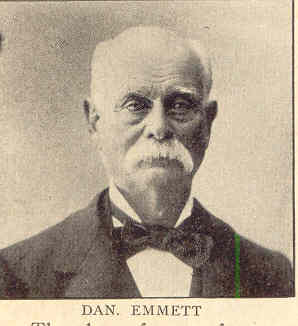
ABB. Composed by Ohio (minstrel) Dan Emmett in
1845. A 'jig' was an old‑time name for a kind of syncopated banjo tune,
likely derived from the usage of ‘jig’ as a generic dance, or, just possibly,
as a derogatory association with African-American dancing. These kinds of ‘jig’
tunes, prevalent in the Howe/Ryan publications and similar mid-19th
century volumes, have nothing to do with the Irish 6/8 jig, for these tunes
were always in 2/4 time. Howe categorizes the melody as a schottische. See note
for “Camp Meeting [1]” for a
sketch of Emmett. Cole (1000 Fiddle Tunes),
1940; pg. 82. Howe (1000 Jigs and Reels),
c. 1867; pg. 53. Ryan’s Mammoth
Collection, 1883; pg. 114.
X:1
T:Pea Patch Jig
M:2/4
L:1/8
C:Dan Emmett
R:Schottische
S:Howe – 1000 Jigs and Reels (1867)
Z:AK/Fiddler’s Companion
K:D
E |: (3A/A/A/A z/A/G/B/ | z/A/d/f/ e2 | (3f/f/f/f z/e/d/e/ |1 z/c/d/B/ A/F/E/D/ :|2
z/c/d/B/ AA, |: z/A/G/E/ C/A,/z | z/A/G/E/ C/A,/z | z/A/G/E/ C/D/E/F/ |
^G/E/F/D/ C/A,/z/A2 :: _B2A, z/ A,2 | z/A/F/D/ C/A,/z/ A,2 | _B2 A, z/ A,2 |
z/A/F/D/ C/A,/z/ A,2 | A/^g/{b}a/e/ c/A/B/^G/ | A/^g/{b}a/e/ c/A/B/^G/ |
A/f/{a}g/e/ d/B/G/B/ | A/f/{a}g/e/ d/B/G/B/ :: A/a/(3a/a/a/ c/a/B/a/ |
A/a/(3a/a/a/ c/a/B/a/ | A/g/(3g/g/g/ d/g/B/g/ | A/g/(3g/g/g/ d/g/B/g/ :|
PEA SOUP (La soupe aux pois). AKA and see "Woodchopper's Reel."
PEA STRAW. AKA and see "Pease Strae," "Clean Pea(se) Straw/Strae."
PEACE. Scottish, Strathspey. A Minor. Standard tuning. AABB. Composed by Lord
Balanden. Carlin (The Gow Collection),
1989; No. 203.
PEACE OF THE VALLEY, THE (Suaimneas Na Gleanna). Irish, Air (4/4 time). C Major.
Standard tuning. AB. A composition by Balfe. O’Neill was criticized by some in
the traditional circle for his inclusion of several of Balfe’s compositions in
his Music of Ireland, on the grounds
that “Balfe’s music...was not Irish at all, even if he was.” O'Neill (Music of Ireland: 1850 Melodies),
1903/1979; No. 497, pg. 87.
X:1
T:Peace of the Valley, The
M:4/4
L:1/8
R:Air
N:”Moderate”
S:O’Neill – Music of Ireland (1903), No. 497
Z:AK/Fiddler’s Companion
K:C
zG|G2 A>G GEGc|e6 e2|e2 d>c B2
d>G|c4 z2||G>A|B2 c>B B2 {d}c>B|
e2 g2 (3g^fe (3edc|c B2 Gc B2A|G4 z2
zG|G2 A>G GEGc|e2 dc f2 ga|
G2 c>d c B2 G|(g4 g)f/e/
d/c/B/A/|_A2 G2 e{f/e/}dfe|c4 z2||
PEACE RIVER BREAKDOWN, THE. Canadian, Breakdown. D Major. Standard tuning.
AABB. Composed by Ernest Couvrette. Messer (Anthology
of Favorite Fiddle Tunes), 1980; No. 16, pg. 17. Smithsonian Folkways SFW CD 40126, Bob McQuillen & Old
New England – “Choose Your Partners!: Contra Dance & Square Dance Music of
New Hampshire” (1999).
PEACEFUL CORCOMORE.
Irish, Slow Air. Composed by concertina player Chris Droney (Bell
Harbour, County Clare), named for the ruins of an abbey not far from his home
town. Droney is the veteran of several influential céilí bands, including the
Aughrim Slopes, Kilfenora, and, latterly, the Four Courts. Cló Iar-Chonnachta CICD 161, Chris Droney – “Down from Bell
Harbour” (2005).
PEACEMAKER('S
HORNPIPE), THE {An Siocantaide/Siotadoir}. AKA and see "Ryth
Wyth." English, Irish; Hornpipe. G Major. Standard tuning. AABB.
Kennedy, Vol. 1, 1951; No. 2, pg. 1. O'Neill (Krassen), 1976; pg. 189. O'Neill
(Music of Ireland: 1850 Melodies),
1903/1979; No. 1666, pg. 310. O'Neill (Dance
Music of Ireland: 1001 Gems), 1907/1986; No. 880, pg. 152. Raven (English Country Dance Tunes) 1984; pg.
159.
X:1
T:Peacemaker, The
M:C|
L:1/8
R:Hornpipe
S:O’Neill – Dance Music of Ireland: 1001 Gems (1907), No. 880
Z:AK/Fiddler’s Companion
K:G
A2|GBdB cBAG|cBcd c2 BA|GBdB
cBAG|d2DD D2D2|
GBdB cBAG|cBcd efge|dedc
BGAF|G2G2G2:|
|:d2|gfga gfed|cBcd c2c2|agab
agfe|f2 dd d2 ef|
gfga gfed|cBcd efge|dedc
BGAF|G2G2G2:|
PEACH BLOSSOM HORNPIPE. American, Hornpipe. F Major. Standard tuning. AABB. "Can be used
as a Clog,” notes Ryan. Cole (1000 Fiddle
Tunes), 1940; pg. 99. Ryan’s Mammoth Collection, 1883; pg. 135. Green Linnet SIF 3067, Jack and Charlie Coen – “The Branch
Line” (1992. Reissue of Topic 12TS337). Topic 12TS337, Jack and Charlie Coen –
“The Branch Line” (1977).
X:1
T:Peach Blossom Hornpipe
M:C|
L:1/8
R:Hornpipe
S:Ryan’s Mammoth Collection (1883)
Z:AK/Fiddler’s Companion
K:F
(cB) | A>cf>a (3gab (eg) | (3fga (fc) A>cA>F | E>FG>A B>cd>B | c>AG>F E>G(cB) |
A>cf>a (3gab (eg) | (3fga (fc) A<cA>F | B>dc>B A>GF>E | F2A2F2 :: (AB) |
B>AG>F E>Gc>B | A>cf>c a>cf>c | B>AG>F E>Gc>B | A>cB>d c2 (BA) |
d>Bb>a
g>fe>d | c>Ad>c B>AG>F | E>dc>B A>GF>E | F2A2F2
:|
PEACH
BLOSSOMS, THE. Irish, Barndance (cut time). D
Major. Standard. AABBCC. The tune was recorded in New York in 1935 by the
famous fiddler James Morrison (1893-1947), known as “The Professor” because of
his concentration on teaching, although he also recorded many times in the years
between 1921 and 1936. Morrison was born in Lackagh, Drumfin, County Sligo.
Source for notated version: Paddy Ryan [Treoir].
Treoir, Vol. 32, No. 1, 2000; pg. 22. Green Linnet SIF 1150, “The
Moving Cloud.”
X:1
T:Peach
Blossoms, The
L:1/8
M:C|
R:Barndance
S:Treoir
K:D
A2|Adfd Adfd|B2 g2 g2 ed|ceae cea^g|b2a2a2 AG|
Adfd Adfd|B2 =g2 g2 ed|ceba ^ga=ge|d2 d2 d2:|
|:A2|(3AAA A2 Bcde|fdAF A2A2|cBGE c2c2|bafd A2A2|
(3AAA A2 Bcde|fdAF A2A2|dcBc dgfe|d2 d2 d2:|
|:^dc|BDGB dgbg|a2 e2 e2 ag|(3fgf c2 c2 fe|d2 B2 B2 dc|
BDGB
dgbg|a2 e2 e2 ag|fdcA dcAF|G2 G2 G2:|
PEACH TREE LIMB. AKA and see "Flop-Eared
Mule [1]."
PEACHES AND CREAM. AKA - "Peaches and Honey." Old‑Time, Breakdown. USA,
Texas. D Major. Standard. AABB. Similar to "Levantine's Barrel" and "Bummer's Reel [1]". Source for
notated version: Benny Thomasson & Pete Martin (Texas) [Phillips]. R.P.
Christeson (Old Time Fiddlers Repertory,
Vol. 2), 1984; pg. 54 (taken from an old 78 RPM). Phillips (Traditional American Fiddle Tunes. Vol. 1),
1994; pg. 182.
PEACHES AND HONEY. AKA and see "Peaches and Cream."
PEACOCK [1], THE. AKA and see "Sweet Coothill Town."
PEACOCK [2], THE. See “The
Peacock’s Feather [1].” Irish, March.
PEACOCK [3], THE. English, March (cut time). G Major. Standard
tuning. AABB. Aird (Selections), vol. 2, c. 1786; Pg. 6, No. 17.
X:1
T:Peacock, The [3]
M:C|
L:1/8
S:Aird, Selections of Scotch, English, Irish and Foreign Airs, vol. II (1786).
Z:AK/Fiddler’s Companion
K:G
fe | d2B2B2 AB | d2d2e2 de | f2f2 fgfe | d2B2B2 :|
|: fg | a2a2 a2 gf | b2a2 a2 gf | g2f2e2d2 | a2 A2A2 fe |
d2B2B2 AB | d2d2e2 de | f2f2 fgfe | d2B2 B2 :|
X:2
T:Peacock, The [3]
M:C
L:1/8
S:John Rook manuscript (Wigton, Cumbria, 1840)
K:G
f>e|d2B2B2 AB|d2d2 e2 de|f2f2 fgfe|d2B2B2:|
|:fg|a2a2 a2 gf|b2a2a2 gf|g2f2e2d2|a2A2A2 fe|
d2B2B2AB|d2d2e2
de|f2f2 fgfe|d2B2B2:|
PEACOCK
FOLLOWED/FOLLOWS THE HEN, THE. AKA and see “Brose and Butter,” "Cuddle Me, Cuddy," "Brose and Butter," "Mad Moll [1],” “Up and Down Again,” "The Virgin Queen," "Yellow Stockings." English; Jig
(9/8 time), Old Hornpipe, and Air. England, Northumberland. A Dorian. Standard
tuning. AABB (Bruce & Stokoe): AABBCCDDEEFFGG (Peacock). "This tune
has been claimed as Scottish, and has appeared in the collections of that
country under the title of 'Brose and Butter', but in reality it is one of the
old English bagpipe hornpipes of the kind so plentiful in the 17th century and
in the former part of the 18th. The earliest copy of the tune we have been able
to discover is in Playford's Dancing
Master, part II, of the edition of 1698, where it appears under the name of
'Mad Moll'; it is nearly identical with our pipe tune as above noted. A
slightly different version of the tune was also known by the names of 'Yellow
Stockings' and 'The Virgin Queen'‑‑the latter title seeming to
identify it with Queen Elizabeth, as the name of Mad Moll does with her sister
Queen Mary, who was said to be subject to fits of mental aberration. The words
of 'The Virgin Queen' or of 'Mad Moll' are not known to exist, but they
probably consisted of some fulsome panegyric on Queen Elizabeth at the expense
of her (un)fortunate sister. Allen Ramsey, in his Tea Table Miscellany, published in 1740, printed Dean Swift's song
of 'Oh! My Kitten, My Kitten!' to the second version of this tune, and called
it 'Yellow Stockings.' This, so far as we have been able to trace, is the first
appearance of the air in a Scottish publication. Upwards of half a century
later it attained great popularity in that country under the name of 'Brose and
Butter', as before mentioned" (Stokoe). It appears in Northumberland
musician William Vickers’ 1770-72 music manuscript under the title “Cuddle Me,
Cuddy.” The following lyrics, fairly suggestive, appear in Joseph Cawhall’s A Beuk o’ Newcassel Sangs (1888):
***
A’ the neet ower an’ ower,
neet = night
An’ a’ the neet ower agyen—
A’ the neet ower an’ ower,
The peacock followed the hen.
A Hen’s a hungerie dish,
A geusse is hollow within;
geusse =
goose
There’s nee deceit iv a puddin’;
‘no deceit in a pudding’
A pye’s a dainty thing.
***
Bruce & Stokoe (Northumbrian Minstrelsy), 1882; pgs. 152‑153.
Peacock (Peacock’s Tunes), 1980; No.
46, pg. 21. Front Hall FHR‑08, Alistair Anderson
‑ "Traditional Tunes" (1976).
X:1
T:Peacock Followed the Hen
T:Cuddle Me, Cuddy
M:9/8
L:1/8
S: Bruce & Stokoe – Northumbrian Minstrelsy (1882)
Z:AK/Fiddler’s Companion
K:Ador
c>de cAA cAA|c>de cAA B2G|c>de cAA cAA|B>cd dgd B2G:|
c>de
gee gee|c>de gee f2d|c>de gee gee|B>cd dgd B2G:|
PEACOCK JIGG. English, Jig. E Major. Standard tuning. AABBCC. The melody appears in Walsh’s third collection of Lancashire tunes (Lancashire Jiggs, Hornpipes, Joaks, etc.) published around the year 1730.
X:1
T:Peacock Jigg
B:Walsh
M:6/4
L:1/8
K:E
E6 G4 A2| B2 G2 E2 e4 B2| cd e2 c2 B2 AGFE| F6 B,6| E6 G4 A2|\
B2 G2 E2 e4 d2| cd e2 c2 f2 d2 B2| e6 E6::\
g6 e2 dc B2| e6 e4 B2| cd e2 c2 B2 AGFE| F6 B,4 fg |a6 e6| fg agfe d4 B2|\
cd
e2 c2 f2 d2 B2 e6 E6:|
PEACOCK RAG. AKA and see "Starlight Clog,"
"Nightingale (Clog) [2],"
"The Mason‑Dixon
Schottische," "Parkersburg
Landing," "Limber Neck
Blues." Old‑Time, Bluegrass; Country Blues or Rag. D Major.
Standard tuning. One part (Lowinger): AABB (Brody, Christeson, Phillips):
AA’BB’ (Beisswenger & McCann, Silberberg). Popularized by, and often
ascribed to, Arthur Smith (Tenn.) {1929‑30}. According to a story told by
Jim Nelson (Fiddle-L 4.1.10) a cousin of Smith’s, a fiddler by the name of Clay
Smith (Fairview Heights, Ill., although originally from middle Tennessee),
learned the tune from the playing of Wade Ray, a popular radio fiddler
on KMOX in St. Louis in the 1930s and 40s. Clay told Nelson that he played the
tune for Arthur Smith at a family get-together back in Tennessee, and that soon
after that Smith recorded it for Bluebird Records. Originally “Peacock Rag” may have been a turn of the century
ragtime composition which made its way into the old‑time repertoire (Dr.
Charles Wolfe/B. Poss). East Kentucky fiddler Ed Hayley knew the tune as
"Parkersburg Landing," while Mississippi musicians Narmour and Smith
recorded it as "Limber Neck Blues." Sources for notated versions:
Chubby Wise [Brody]: Gus Vandergriff (Pulaski County, Missouri) [Christeson];
Glenn Rickman (1901-1982, Hurley, Missouri) [Beisswenger & McCann].
Beisswenger & McCann (Ozark Fiddle Music), 2008; pg. 112. Brody (Fiddler’s Fakebook), 1983; pg. 215. R.P.
Christeson (Old Time Fiddlers Repertory,
vol. 1), 1973; pg. 152. Lowinger (Bluegrass
Fiddle), 1974; pg. 24. Phillips (Traditional
American Fiddle Tunes), vol. 2, 1995; pg. 97. Silberberg (93 Tunes I Didn’t Learn at the Tractor
Tavern), 2004; pg. 34. American Heritage 1, Herman
Johnson‑ "Champion Fiddling." County 547, Arthur Smith‑
"Fiddlin' Arthur Smith and His Dixie‑Liners, vol. 2" (1978).
Gusto 104, Chubby Wise‑ "30 Fiddler's Greatest Hits."
|
See also listing at: Jane Keefer’s Folk
Music Index: An Index to Recorded Sources |
X:1
T:Peacock Rag
% Nottingham Music Database
S:Folk Camps, via EF
M:4/4
L:1/8
K:G
F/2G/2|"D"Af-f/2e/2d|"D"A2 ^GA|"G"Bg -g/2f/2e|"E7"B2 ed|"A7"ca -a/2e/2g/2e/2|
"A7"fe Bc|"D"d/2c/2d/2f/2 -"G"f/2d/2B|"A7"AF G^G|"D"Af -f/2e/2d|"D"A2 ^GA|
"G"Bg -g/2f/2e|"E7"B2 ed|"A7"ca -a/2e/2g/2e/2|"A7"fe Bc|\
"D"d/2c/2d/2f/2 -"A7"f/2c/2e|"D"d2 a^a|"B7"bb/2^a/2 b/2a/2b|"B7"a2 gf|"E7"ee/2f/2 ^g/2b/2g/2f/2|"E7"e3d|\
"A7"ca -a/2e/2g/2e/2|"A7"fe Bc|"D"d/2c/2d/2f/2 -"G"f/2d/2B|"A"A2 a^a|"B7"bb/2^a/2 b/2a/2b|"B7"a2 gf\
"E7"ee/2f/2
^g/2b/2g/2f/2|"E7"e3d|"A7"ca -a/2e/2g/2e/2|"A7"fe
Bc|\
"D"d/2c/2d/2f/2
-"A7"f/2c/2e|"D"d3||
PEACOCK'S FANCY [1]. AKA and see "Footy," “Footy Agyen the Wa’.” English,
Jig. England, Northumberland. G Major. Standard tuning. AABB. "Although
not originally written for the small pipes, this tune owes its celebrity with
pipers to the circumstances that it was a great favourite with John Peacock and
the later players. The song of 'Footy', which is sung to it, was better adapted
to the tastes of a ruder age than to those of the present time" (Bruce
& Stokoe). John Peacock was a legendary Northumbrian piper, credited with
extending the range of the instrument through the innovation of adding keys to
the plain chanter. Although renowned in his time, Peacock fell on hard times
toward the end of his life, and had to rely on the generosity of others in the
piping community. "…Peacock (was a) celebrated Northumbrian piper, who
came to Newcastle originally from Morpeth, and was perhaps the best small‑pipes
player who lived, although not a scientific performer. He was one of the
Incorporated Company of Town Waits in Newcastle, and in 1805 in conjunction
with William Wright, published a small oblong book of Tunes for the Northumbrian Small Pipes, of which only two or three
copies are now known to exist" (Bruce & Stokoe). Peacock lived from
1754(or 6) to 1817 and was taught by William Lamshaw at a time when the
smallpipes were just beginning to decline in popluarity. The title appears in
Henry Robson's list of popular Northumbrian song and dance tunes ("The
Northern Minstrel's Budget"), which he published c. 1800. Bruce & Stokoe
(Northumbrian Minstrelsy), 1882; pg.
175. Raven (English Country Dance Tunes),
1984; pg. 117.
X:1
T:Peacock’s Fancy
L:1/8
M:6/8
S:Bruce & Stokoe – Northumbrian Minstrelsy (1882)
Z:AK/Fiddler’s Companion
K:G
D|G3 B2G|c2A B2G|c2A Acd|(e3 e2)f|g2e f2d|B2d g2e| DBG A2G|(E3 E2):|
|:f|g2f efg|a2f d2f|g2e faf|(e3 e2)f|g2e f2d|B2d g2e| dBG A2G|(E3 E2):|
PEACOCK’S FANCY [2]. Scottish, Hornpipe. A Major. Standard tuning. AABB. Source for notated
version: Winston Fitzgerald (Cape Breton), who had the tune from Koehler’s Violin Repository [Cranford].
Cranford (Winston Fitzgerald), 1997;
pg. 2.
PEACOCK'S FEATHER [1], THE (Cleite na Péacóige). AKA – “The Peacock.” Irish,
Hornpipe. D Dorian: E Minor (O’Farrell). Standard tuning. AABB. The tune was
printed in O’Farrell’s Pocket Companion
(IV, 125, c. 1810) as a march under the title “The Peacock.” The tune was
recorded by the Tulla Ceili Band. Source for notated version: fiddler Frankie
Gavin (Ireland) [Breathnach]. Black (Music’s
the Very Best Thing), 1996; No. 287, pg. 154. Breathnach (CRÉ III), 1985; No. 218, pg. 100.
O’Farrell (Pocket Companion, vol. IV), c. 1810; pg. 125 (appears as “The
Peacock”). Shanachie Records 29008, Frankie Gavin ‑
"Traditional Music of Ireland" (1977). Shanachie Records 34009,
Frankie Gavin & Alex Finn.
X:1
T:The Peacock's Feather
C:Trad
R:Reel
M:C
K:Edor
L:1/8
BA | GEFD E2 EF | GFGB A2 GA | Beed
edBA |1 G2 B,C D2 BA :|2 G2 F2 E2 Bc |
d3 B e4 | edB^G A2 Bd | d2 Be edBA |
G2 B,C D2 BA |
GEFD E2 EF | GFGB A2 GA | Beed edBA
| G2 E2 E2 ||
X:2
T: Peacock's Feather [1]
S: De Danann
Q: 325
R: hornpipe
Z:Transcribed by Bill Black
M: 4/4
L: 1/8
K: Ddor
AG | F2 E2 D2 DE | FGFA G2 FG | Adde dcAG | FDA,B, C2 AG |
F2 E2 D2 DE | FGFA G2 FG | Adde dcAG | FDEC D2 :|
AB | c2 cA d2 dA | dca^f G2 FG | adde dcAG | FDA,B, C2 AG |
F2 E2 D2 DE | FGFA G2 FG | Adde dcAG | FDEC D2 :|
X:3
T:Peacock, The
M:C|
L:1/8
R:March
S:O’Farrell – Pocket Companion, vol. IV (1810)
Z:AK/Fiddler’s Companion
K:Emin
G2G2A2 GA | B2e2 dcBA | G2E2E2 :: d3e dcBA | B2e2e2 fg | d3e dcBA |
G2E2D2
BA | G2E2E2 D>E | G2G2A2 GA | B2e2 dcBA | G2E2E2 :|
PEACOCK'S FEATHER [2], THE (Cleite na Péacóige). Irish, Hornpipe. D Major. Standard
tuning. AA'BB (Breathnach): AA’BB’ (Black, Harker/Rafferty). Black identifies
this as an East Galway tune,, recorded by the band De Danann. However, Caoimhin
Mac Aoidh attributes it to Joe Holmes of County Antrim, a singer and fiddler
who brought the tune to Galway in the early 1970’s. It seems that Holmes and a
young Len Graham would travel to stay with friends, the Keanes of
Caherlistrane, and introduced the tune on one of his visits. Sources for
notated versions: fiddler Frankie Gavin (Ireland) [Breathnach]; New Jersey
flute player Mike Rafferty, born in Ballinakill, Co. Galway, in 1926 [Harker].
Black (Music’s the Very Best Thing),
1996; No. 286, pg. 154. Breathnach (CRÉ
III), 1985; No. 219, pg. 100. Harker (300
Tunes from Mike Rafferty), 2005; No. 253, pg. 78. Old
Bridge Music OBM 07, Máire Ní Chathasaigh & Chris Newman - "The Living
Wood” (where they note it is associated with Joe Holmes). Shanachie Records
29008, Frankie Gavin ‑ "Traditional Music of Ireland" (1977).
Shanachie Records 34009, Frankie Gavin & Alex Finn (1977).
|
See also listings at: Jane Keefer’s Folk Music Index: An
Index to Recorded Sources Alan Ng’s Irishtune.info |
X:1
T: Peacock's Feather [2]
S: De Danann
Q: 325
R: hornpipe
Z:Transcribed by Bill Black
M: 4/4
L: 1/8
K: D
DE | FEED A2 AB | defd B2 ef | gefd edBd | AFDF E2 DE |
FEED A2 AB | defd B2 ef | gefd edBd |1 AFDF D2 :|2 Adaf de ||
fg | afge fdec | defd (3BcB ef | gefd edBd | AFDF E2 DE |
FEED
A2 AB | defd B2 ef | gefd edBd |1 Adaf de :|2 AFEF D4 ||
PEACOCK’S FEATHER [3], THE (Cleite na Péacóige). AKA and see “House in the Glen [1].” Irish,
Jig. D Major. Standard tuning. AABB. “House in the Glen” is a related tune.
Source for notated version: accordion player Johnny O’Leary (Sliabh Luachra
region of the Cork-Kerry border) [Moylan]. Moylan (Johnny O’Leary), 1994; No. 125, pgs. 72-73. Gael-Linn CEF132, Johnny O’Leary - “An Calmfhear/The Trooper” (1989).
PEACOCK FEATHERS [4].
English, Hornpipe. G Major. Standard tuning. AABB. The melody appears in
the music manuscript copybook of fiddler John Burks, dated 1821 (a photocopy in
the ed. possession). Unfortunately nothing is know of Burks, although he may
have been from the north of England.
X:1
T:Peacock Feathers [4]
M:C|
L:1/8
R:Hornpipe
S:John Burks’ music manuscript,
dated 1821
N:The ‘B’ part is only 7 measures
long in the ms., with a 4th
N:and 5th measure
collapsed into one.
N:A reconstructed ‘B’ part from the
4th measure on might go:
N:…|FGAF D2
dc|Bdcd BcAc|GBdg edcB|Agdc BGAF|G2G2G2:|
K:G
df|g2 (dB) GABA|FGAF DEDC|B,DGB
Aced|cBAG FA Df|g2 dB GABG|
FGAF DEDC|B,DGB cdec|BGAF
G2G2::dc|Bdcd BcAc|GBdg edcB|
cded cBAG|D2 dc BdBd|GBcg edcB|Agdc
BGAF|G2G2G2:|
PEACOCK’S MARCH. English, March (4/4 time). England, Northumberland. G Major. Standard
tuning. AABB. John Peacock was a famous Northumbrian piper and composer of
tunes at the turn of the 19th century (see note for “Peacock’s Fancy [1]”).
Raven (English Country Dance Tunes),
1984; pg. 180. Bruce & Stokoe (Northumbrian
Minstrelsy), 1882; pg. 174.
X:1
T:Peacock’s March
M:C
L:1/8
R:March
S:Bruce & Stokoe – Northumbrian Minstrelsy
Z:AK/Fiddler’s Companion
K:G
(de/f/)|g2 d>d d2 B>A|B2 G>G G2 AB|cBAG edcB|A>GA>G A2 (de/f/)|
g2 d>d d2 B>A|B2 G>G G2A2|Bd de/c/ B2A2|G2 G>G G2:|
|:d>B|A2 A>A AGAB|cB cd/e/ d2 c2|A/G/A/B/ c/d/e/f/ gdBG|A2 A>A A2dB|
BGBd
cAce|de/f/ ge d2c2|Bdec BdcA|G2 G>G G2:|
PEACOCK’S TUNE. English (originally), Scottish, Air (6/8 or 3/4 time). England,
Northumberland. G Major. Standard tuning. AABB. "This march
("Peacock's March") and air were both the composition of John
Peacock, the celebrated Northumbrian piper, who came to Newcastle originally
from Morpeth, and was perhaps the best small‑pipes player who lived,
although not a scientific performer. He was one of the Incorporated Company of
Town Waits in Newcastle, and in 1805 in conjunction with William Wright,
published a small oblong book of Tunes
for the Northumbrian Small Pipes, of which only two or three copies are now
known to exist" (Bruce & Stokoe). Peacock lived from 1754(or 6) to
1817 and was taught by William Lamshaw at a time when the smallpipes were just
beginning to decline in popluarity. Peacock helped to modernize the instrument,
commissioning a set of pipes with four keys from maker John Dunn. Lerwick (Kilted Fiddler), 1985; pg. 58. Bruce
& Stokoe (Northumbrian Minstrelsy),
1882; pg. 174.
X:1
T:Peacock’s Tune
M:6/8
L:1/8
S:Bruce & Stokoe – Northumbrian Minstrelsy
Z:AK/Fiddler’s Companion
K:G
B/c/|d>ed d>cB|gfg d2 B/c/|d>ed dcB|AAA A2 B/c/|
d>ed d>cB|gfg d2c|Bcd BcA|GGG G2:|
|:G/A/|BAB cBc|dcd ede|fef gdB|AAA A2 d/c/|
BAB cBc|def g2 f/e/|dec BcA|GGG G2:|
PEADER FITZPATRICK’S REEL. AKA and see “The
Leitrim Bucks,” “The Leitrim
Gregg’s Pipes.” Irish, Reel. Peader Fitzpatrick was a well-known County
Leitrim fiddler.
PEADER O’RIADA’S JIG. Irish, Double Jig. Composed by Peader O’Riada.
PEADER’S NEW CALF. Irish, Reel. D Major. Standard tuning. AABB. Composed by Falmouth,
Massachusetts, musician and writer Bill Black, in honor of a West Clare flute
player who left a session Black was playing in to return home to attend the
birthing, only to return later. Black (Music’s
the Very Best Thing), 1996; No. 346, pg. 184.
X:1
T: Peadar's New Calf
C: © B. Black
Q: 350
R: reel
M: 4/4
L: 1/8
K: D
D | FAdc BF (3FEF | GBAF ED (3DED | CEGE FAde | fagf e2 de |
fdBd AF (3FEF | GBAF EDCB, | A,CEG FAdB | AFEF D3 :|
e | fdBd bafe | dB (3BAB dBAB | dfaf bfag | fage d2 de |
fdBd
AF (3FEF | GBdB AF (3FEF | afge fdBd | AFEF D3 :|
PEADAR’S REEL. AKA and see “Boil the Breakfast Early.”
Irish, Reel. G Major (‘A’ part) & D Mixolydian (‘B’ and ‘C’ parts).
Standard tuning. AABC. Miller (Fiddler’s
Throne), 2004; No. 229, pg. 140. Tradition/Everest
2120, Kilfenora Fiddle Ceili Band – “Irish Traditional Fiddle Music.”
PEAIDÍ A’ CHLÁIR. AKA and see “Paddy from Clare.”
PEAIDÍ SPÓRTÚIL. AKA and see “Sporting Paddy.”
PEAL WEDDING, THE. English. England, Northumberland. A modern
composition by Northumbrian fiddler Willie Taylor, well-known among
Northumbrian musicians.
PEAR TREE HORNPIPE. Scottish, Hornpipe. F Major. Standard tuning. AABB. The tune is
attributed to Tyneside fiddler and composer James Hill, in Kohler’s Violin
Repository (Edinburgh, 1881-1885). The Pear Tree was a pub in Tyneside (see
also “The Hawk”, another Tyneside establishment). Honeyman (Strathspey, Reel and Hornpipe Tutor),
1898; pg. 50.
X:1
T:The Pear Tree
R:hornpipe
C:James Hill
Z:Kohler's Violin Repository
M:4/4
L:1/8
K:F
C2|F(Ac)(B A)(cf)(a|g)beg afcB|AfcA GdBG|EFGE C2C2|
F(Ac)(BA)(cf)(a|g)beg afcB|AfcA GdBE|G2F2F2:|
(fg)|a(^g af) cfAf|dfcf dfcf|a(^gaf) cdef|{a}=g^fga g2(=fg)|
a(^g
af) cfAf|dfcf dfcf|(de)fd (ef)ge|f2a2f2:|
PEARL OF THE FAIR POLE
OF HAIR. Irish, Air (3/4 time). E Flat Mixolydian.
Standard tuning. AB. Stanford/Petrie (Complete
Collection), 1905; No. 624, pg. 157.
X:1
T:Pearl of the fair pole of hair
M:3/4
L:1/8
R:Air
S:Stanford/Petrie (1905), No. 624
Z:AK/Fiddler’s Companion
K:Eb
_d2 cB ce | c2 BA ce | B2 AG (3GFE |
F2 EE E2 | _d2 cB ce | c2 BA ce |
B2 AG (3GFE | F2 EE E2 || E2 GB ARF
| F2 EE E2 | _d2 cB (3cBG |
F2 GB B>c | _d2 cB (3cBG | B>A
GF Ee | e2 B>A (3GFE | F2 EE E2 ||
PEARL OF THE FLOWING
TRESSES, THE (Pearla na
Gruaige Scaoilte). AKA ‑ "Pearla Na Gruaige Scaoilte.” Irish, "Rather
Slow" Air (3/4 time). G Dorian. Standard tuning. AB. O'Neill (Music of Ireland: 1850 Melodies),
1903/1979; No. 284, pg. 49.
X:1
T:Pearl of the flowing tresses, The
M:3/4
L:1/8
R:Air
N:”Rather slow”
S:O’Neill – Music of Ireland
(1903), No. 284
Z:AK/Fiddler’s Companion
K:G
D2 | G2G2 (G>A) | G4 fd | c2A2
A>G | F4 GA | B2B2 A>G | ^F2G2 c>A |
A2G2G2 | G4 || d2 | g2g2g2 | a4 g2 |
(gf) (dc) (d=e) | f4 g/f/d/>c/ | B2B2 AG |
^F2G2 (c>A) | A2 G2G2 | G4 ||
PEARL OF THE
IRISH NATION [1]. Irish, Air (4/4 time). G Dorian. Standard tuning. AB. Roche Collection, 1982, vol. 3; No. 29,
pg. 8.
PEARL OF THE
IRISH NATION [2]. Irish, Air and Song Tune (6/8 time). D Mixolydian. Standard tuning. AB.
"There is a song to this air written by Patrick O'Kelly, a wandering
peasant poet of the beginning of the last century, who discloses his name in
the last verse: a custom found in other songs" (Joyce). The song begins:
***
Though many there be that daily I see,
Of virtuous beautiful creatures,
With red rosy cheeks and ruby lips,
And likewise comely features:
Yet there is none abroad or at home,
In country or town or plantation,
That can be compared to this maiden fair—
The Pearl of th’ Irish Nation.
***
Joyce (Old Irish Folk Music and Songs), 1909; No. 45, pg. 25.
X:1
T:Pearl of the Irish Nation [2]
M:6/8
L:1/8
S:Joyce – Old Irish Folk Music and Songs
(1909)
Z:AK/Fiddler’s Companion
K:Dmix
G/E/|DEG A2A|A<dc B2G|EAG EDE|G3
E2D|DEG A2 A|Adc B2G|EAG EDE|D3 D2||
B|cBc d2d|dBA B2G|GBd dBA|B3 d2D|DEG
A2A|A<dc B2G|EAG EDE|D3 D2||
PEARL OF THE
WHITE BREAST [1]. Irish, Slow Air (3/4 time). C Major. Standard tuning. One part.
"Different from the two airs of the same name in Petrie and Bunting"
(Joyce). Source for notated version: "Copied from a MS. collection lent
Mr. Pigot by James Hardiman, the historian of Galway and editor of Hardiman's Irish Minstrelsy"
(Joyce). Joyce (Old Irish Folk Music and
Song), 1909; No. 752, pg. 371.
PEARL OF THE WHITE
BREAST [2] (Pearla na m-Brollac
Baine). AKA ‑
"Pearla Na‑M‑Brollac Baine." AKA and see "Snowy‑Breasted
Pearl." Irish, Air (4/4 time). F Major. Standard tuning. AB
(Stanford/Petrie): AAB (O’Neill). The tune was recorded (as "Pearla an
Vroley Vaun") by the Belfast
Northern Star of July 15, 1792, as having been played in competition by one
of ten Irish harp masters at the last great convocation of ancient Irish
harpers, the Belfast Harp Festival, held that week. O'Neill (Music of Ireland: 1850 Melodies),
1903/1979; No. 511, pg. 89. Stanford/Petrie (Complete Collection), 1905; No. 623, pg. 156.
X:1
T:Pearl of the White Breast [2]
M:C
L:1/8
R:Air
N:”Slow with feeling”
S:O’Neill – Music of Ireland (1903), No. 511
Z:AK/Fiddler’s Companion
K:F
cd/e/|f>e dc f3d|cAGF G2 AB|c2 AF
BA G>F|F6:|
cB|Acdf e3c|fe d>c c3c|defa
gfed|c6||
PEARL POLKA, THE. English, Polka. G Major. Standard tuning.
AABBCC. Trim (Thomas Hardy), 1990;
No. 55.
PEARL O’SHAUGHNESSY’S
BARNDANCES. Irish, Barndances. Two tunes, the
first in four parts, though in Donegal it is often played as two separate
barndances, according to Maire O’Keeffe. Fiddler Pearl O’Shaughnessy is the
mother of Irish musician Paul O’Shaungnessy, and, as a nameless tune picked up
from her playing, it became associated with her and gained her name. The tunes
were recorded on a 78 RPM in 1946 by Danny O’Donnell, simply called “Irish Barn
Dance.” The ‘A’ part of the tune appears Dave Townsend’s Second Collection of English Country Dance Tunes (1983) as the ‘A’
part of “Fred Pigeon’s No. 2.” Spin CD1001, Eoghan
O’Sullivan, Gerry Harrington, Paul De Grae - “The Smoky Chimney” (1996. Learned
from Tralee fiddler Maire O’Keeffe, who had them from Pearl O’Shaunghnessy, of
Donegal and Scottish origins).
X:1
T:Pearl O’Shaughnessy’s Barndances
M:4/4
L:1/8
K:G
Bc|d2 G2 G2 AB|c2 E2 E2 G2|FGAB
cBAc|e2 d2 dcBc|
X:2
T:Pearl O’Shaughnessy’s Barndances
S:Danny O'Donnell
Z:Juergen.Gier@post.rwth-aachen.de
L:1/8
M:C|
K:D
df|a2a2 a^gba|f2f2 fedf|a2g2
e2c2|b2a2 fedf|\
a2a2 a^gba|f2f2 fedf|a2g2 e2ce|d2d2
d2::ag|\
f<ad2 dfaf|g<be2 e2gf|edcB
Acfe|dAce b2ag|\
f<ad2 dfaf|g<be2 e2gf|(3ege cB
Acfe|d2d2 d2:|
Bc|dBed B2g2|fege c3d|f2ed f2ed|B2A2
B2Bc|\
dBed B2g2|fege c3d|f2ed ^cdef|g2b2
g2:|
|:dg|b2b2 bd'c'b|a2e2 e2ag|f2ed
f2ed|B2A2 B2Bg|\
b2b2 bd'c'b|a2e2 e2ag|f2ed
^cdef|g2b2 g2:|
PEARL QUADRILLE. American, Quadrille. The tune was recorded for Edison in 1924 by Ohio
fiddler John Baltzell, but was unissued.
PEARL WEDDING. English, Reel. D Major. Standard
tuning. AABB. Composed by the highly respected Borders fiddler Willy Taylor (d.
2000). Callaghan (Hardcore English),
2007; pg. 45.
PÉARLA AN ACHAIDH
MHÓIR. AKA and see "Pride of Ahamore."
PÉARLA AN BHROLLAIGH
BHAIN. AKA and see "The Pearl of the White Breast,"
"Snowy-Breasted Pearl." Irish.
PÉARLA NA gCLUAINTE. AKA and see "The Pride
of Cloontia."
PEARLY DEW. Old‑Time. USA, Ky. Recorded Anthology of
American Music, 1978, Pete Steele (Ky.) ‑ "Traditional Southern
Instrumental Styles."
PEARSON’S CLOG. Candian, Clog. D Major. Standard tuning. AA’BB’. Source for notated
version: fiddler Dawson Girdwood (Perth, Ottawa Valley, Ontario) [Begin]. Begin
(Fiddle Music in the Ottawa Valley:
Dawson Girdwood), 1985; No. 17, pg. 30.
PEAS AND BEANS. Scottish. There is an anecdote, given first by John Glen (1895) {and
repeated by Alburger in 1983}, which relates a story of the famous Scots
fiddler Niel Gow, who had stopped into the Princes Street (Edinburgh) music
shop of one Penson and Robertson in 1793. He had been looking for a bow and
tried several, but nothing suited him. "Then he noticed a copy of
"Peas and Beans," which he had just published, on the counter. The
shopkeeper saw him pick it up and said, 'If you play that over without a pause
or mistake, I will make you a present of the bow'. Niel played, and the man was
astonished at his skill, saying, 'You must have seen that piece before!' 'To be
shoore,' said Niel, 'I saw it fifty times when I was making it,'" and bow
in hand he walked briskly out of the store. Unfortunately the story is not
true. The composition was not Niel's but his son Nathaniel's
and was not published in the former's lifetime, and there was no music‑seller
in Princes Street in 1793; aside, as Alburger says, the possibility that an
Edinburgh music‑seller would not recognize the famous Niel Gow.
PEAS AND CORNBREAD. AKA and see "Rocky Pallet."
PEAS IN A POD [1]. Irish, Reel. Composed by County Tipperary fiddler Seán Ryan (d. 1985).
Ryan (Seán Ryan’s Dream), 23.
PEAS IN THE POD [2]. AKA and see "Peas in the Pot,"
"Piece in the Pot."
PEAS IN THE POT. AKA and see "Piece in the
Pot," "Peas in the Pod."
Old-Time, Breakdown. USA, Kentucky. G Major. Standard tuning. AA'B. Source for
notated version: Clyde Davenport (Ky.) [Phillips]. Phillips (Traditional American Fiddle Tunes),
1994; pg. 182.
PEAS ON THE HEARTH (Pis ar an Iarta). AKA and see "Dance Light
for My Heart Lies Under Your Feet," "The Humours of
Parteen/Purteen/Panteen," "Whip the Cat from Under
the Table," "Foxy Mary,"
"Huish the Cat," "Bimid ag Ol [1]," "Gilibeart Mhac Fhlannchadha,"
"Pis ar an Iarta,"
"Bemthe goal." See note for “Jackson’s Humours of Panteen.”
PEAS UPON A TRENCHER. See "Pease Upon a Trencher."
PEASANT'S DANCE [1]. American, Hornpipe. A Major. Standard tuning. AABB. The title is in
quotes in Ryan’s Mammoth Collection, usually denoting that it came from
a stage play, opera, ballet or similar work. Cole (1000 Fiddle Tunes), 1940; pg. 107. Ryan’s Mammoth Collection, 1883; pg. 145.
X:1
T:Peasant’s Dance [1]
M:2/4
L:1/8
R:Hornpipe
S:Ryan’s Mammoth Collection (1883)
Z:AK/Fiddler’s Companion
K:A
(3e/f/g/ | a/e/c/e/ G/A/c/e/ |
f/d/B/A/ G/A/E/A/ | C/E/D/F/ B/c/d/B/ | c/e/c/A/ .B(3e/f/g/ |
a/e/c/e/ E/A/c/e/ | f/d/B/A/
G/A/E/A/ | c/e/c/A/ B/d/B/G/ | AAA :: (3A/c/d/ |
e/c/A f/d/B | A/G/A/c/ B/A/G/F/ |
E/C/D/F/ E/G/F/A/ | d/f/c/e/ .B(3A/c/d/ |
e/d/c f/d/B | a/g/a/f/ e/c/c/e/ |
d/f/e/d/ c/B/A/G/ | AAA :||
PEASANT’S DANCE [2].
English, Jig. G Major. Standard tuning. AABB. The melody was first
printed by David Rutherford in his Choice Collection of Sixty of the Most
Celebrated Country Dances (London, 1750), also included in his later Complete
Collection of 200 Country Dances, vol. 2 (London, 1760). It was penned into
the music manuscript copybooks of London fiddler Thomas Hammersley (1790), and,
in America, in the 1790 copybook of fiddler Linnaeus Bolling (Buckingham County,
Virginia) and the 1794 copybook of flute player Micah Hawkins (New York). It
can even be heard played by the mechanism of a musical clock by Norwich, Conn.,
master Thomas Harland, dating from the 1770’s. Thompson (Compleat
Collection of 200 Favourite Country Dances, vol. 1), 1757; No. 174.
X:1
T:Peasant’s Dance [2]
M:6/8
L:1/8
B:Thompson’s Compleat Collection of 200 Favourite Country Dances, vol. 1 (London, 1757)
Z:Transcribed and edited by Flynn Titford-Mock, 2007
Z:abc’s:AK/Fiddler’s Companion
K:G
B2c
ded|c2B ABc|dBG E2A|FDF G3::B2G c2A|B2G A2g|dBG E2A|FDF G3:|
|:g2d gdB|g2B a2B|Bcd E2A|FDF G3::BdB (c2e)|(A2c) (B2d)|G2B AcA|FDF G3:||
PEASCOD TIME. AKA and see "The Hunt is Up (When the
Cock He Crows)." English, Ballad Air. By the end of the sixteenth
century the air "The Hunt is Up" was known by this title, which means
the time when the field‑peas are gathered. Under this "Peascod"
title the tune was appropriated by two other famous ballads, "The Lady's
Fall" and "Chevy Chase."
PEASE BRIDGE. Scottish, Strathspey. D Minor. Standard tuning. AAB. Composed by Abraham Macintosh, appearing in his Thirty New Strathspey Reels Etc. (Edinburgh,
c. 1792). At the time the bridge (located in north Berwickshire not far from
Pease Bay) was complete, in 1786, it was the highest in the world—some 140
above the water below. Glen (The Glen
Collection of Scottish Music), vol. 1, 1891; pg. 45. S. Johnson (A Twenty
Year Anniversary Collection), 2003; pg. 15. Maggie’s
Music MM203, Ceoltoiri – “Celtic Lace” (1992).
X:1
T:Pease Bridge
M:C
L:1/8
R:Strathspey
S:Glen Collection, vol. 1 (1891)
Z:AK/Fiddler’s Companion
K:Dmin
f/e/|d>AF>A
d>ef>d|c<e A>c G<cD<^c|d>AF>A d>ef>d|ef/g/ gf/e/
fdd:|
f/g/|a>fd>a f<d
a>f|g<e d>g e<c g>e|a>fd<a f<d a>f|ef/g/ gf/e/
fddf/g/|
a>fd>a f<d
a>f|g>ec>g ecef/g/|(3afa (3geg (3fdf (3e^ce|d<B A>G FDD||
PEASE STRAE/STRAW. AKA and see "Bathget Boys," "Clean Pea(se) Straw/Strae," "Pea Straw" (U.S.). Scottish, English, American; Reel or Country Dance Tune. England, Northumberland. D Mixolydian or D Major (Johnson). Standard tuning. AB (Surenne): AAB (Athole, Johnson, Skye): AABB' (Barnes, Seattle/Vickers). A popular dance tune in the British Isles and America throughout the 18th century and into the 19th. Instructions for a country dance to the melody can be found in the Scottish Holmain Manuscript, c. 1710‑50, where it is alternately titled "Bathget Boys," and the tune itself is contained twice in the Gillespie Manuscript of Perth (1768). Johnson (1988) also prints a contra dance of the same name with the melody. Flett and Flett (1964) record that the same Scottish dance went by different names according to which tune was played to accompany it in a particular locale; thus the dance also was called "Duke of Perth" and "Brown's Reel" in East Fife, Perthshire and Angus, and "Keep the Country, Bonny Lassie" in the upper parts of Ettrick. The title Pease Strae for the series of steps was used in the area around Lanarkshire, Ayrshire, Arran and Galloway, and was taught by all the local dancing masters. An English version was printed c. 1740 in the imprint MWA, 200 Country Dances (pg. 79), and the title appears in Henry Robson's list of popular Northumbrian song and dance tunes ("The Northern Minstrel's Budget"), which he published c. 1800. The melody was recorded as one of the tunes danced to at a 1752 "turtle frolic" at Goats Island, near Newport Rhode Island (a turtle frolic was a special event which occurred when a West Indies turtles, towed astern from the Caribbean, arrived in port). Later, the piece appeared in print in America in A Collection of Contra Dances, printed in Walpole, New Hampshire, in 1799.
***
Barnes
(English Country Dance Tunes, vol.
2), 2005; pg. 75. Charlton Memorial Tune
Book, 1956; pg. 21. Gow (Complete
Repository), Part 3, 1806; pg. 36. Johnson (Twenty‑Eight
Country Dances as Done at the New Boston Fair), Vol. 8, 1988; pg. 7.
Kerr (Merry Melodies), Vol. 1; pg. 10
(appears as "Clean Pea Strae"). MacDonald (The Skye Collection), 1887; pg. 72. Mooney, pg. 25. Morrison (Twenty-Four Early American Country Dances, Cotillions & Reels, for
the Year 1976), 1976; pg. 35. Seattle (William Vickers), 1987, Part 2; No. 203. Stewart-Robertson
(The Athole Collection), 1884; pg.
86. Surenne (Dance Music of Scotland),
1852; pg. 117. North Star NS0038, "The Village
Green: Dance Music of Old Sturbridge Village."
|
See also listings at: Jane Keefer’s Folk Music Index: An
Index to Recorded Sources |
X:1
T:Pease Strae
M:C|
L:1/8
R:Reel
B:Stewart-Robertson – The Athole Collection (1884)
Z:AK/Fiddler’s Companion
K:D
A|defd gefd|eA A/A/A c2 c>e|defd gefd|egfe d2d:|
f|afdf afdf|eA A/A/A c2 c>f|afdf afdf|egfe d2 d>f|
afdf afdf|eA A/A/A c2 c>f|afge fdec|Agfe d2d||
PEAS(E) UPON A
TRENCHER [1] (Pis Air An Mias). AKA and see "The Time I've
Lost in Wooing." English, Scottish; Country Dance Tune (2/4 time); Irish,
Air. F Major (Raven): G Major (Merryweather & Seattle, O'Neill). Standard
tuning. AB (O'Neill): AABB (Merryweather & Seattle, Raven). A trencher is
an oblong trough‑shaped shallow dish formerly used instead of a plate.
The melody appears in a number of musicians’ manuscript copybooks, including
those of Henry Beck (1786), John Fife (compiled 1780-1804 in Perthshire,
Scotland, and possibly at sea), Oliver White (Conn., 1775), fifer Aaron
Thompson (New Jersey, 1777-1782), and Ebenezer Bevens (Middletown, Conn.,
1825), among others. In print it can be found in James Aird’s Selection of
Scotch, English, Irish and Foreign Airs, vol. 1 (Glasgow, 1782), Neil
Stewart’s Select Collection of Scots, English, Irish and Foreign Airs,
Jiggs, and Marches (Edinburgh, 1788), and in numerous fife tutors and
martial publications of the early 19th century. It was a melody in
John O’Keefe’s opera The Poor Soldier (1784), and can even be heard
played by a musical clock of 1798-99, from the shop of famous New Jersey
clockmakers Leslie and Williams. Source for notated version: an MS collection
by fiddler Lawrence Leadley, 1827-1897 (Helperby, Yorkshrire) [Merryweather
& Seattle]. Merryweather & Seattle (The
Fiddler of Helperby), 1994; No. 125, pg. 65. O'Neill (Music of Ireland,
1850 Melodies), 1903; No. 533, pg. 93. Raven (English Country Dance Tunes), 1984; pg. 150. Riley (Flute
Melodies), vol. 1, 1814; pg. 92.
X:1
T:Pease Upon a Trencher [1]
M:2/4
L:1/8
K:F
C|F>EFG|A2 AA|G>FGA|B2
AG|F>EFG|A>Bcf|cAB>G|F2F:|
|:f|f>FFG|A2 AA|B>GGA|B2
AG|F>EFG|A>Bcf|cAB>G|F2F:|
PEAS UPON A TRENCHER [2].
English, American. G Major. Standard tuning. AABB. The melody saw
martial use as the signal for breakfast and supper, sounded by fifers. It was
used for this purpose as early as 1816 when it’s use was identified in a volume
called The Martial Music of Camp Dupont, published in Philadelphia. This
version of the melody appears in Alvan Robinson’s Massachusetts Collection
of Martial Musick, first published in Maine in 1818 (with later editions in
1820 and 1824). Johnson (A Further Collection of Dances, Marches, Minuetts
and Duetts of the Latter 18th Century), 1998; pg. 15. Mattson
& Walz (Old Fort Snelling…Fife), 1974; pg. 98.
X:1
T:Peas Upon a Trencher [2]
M:2/4
L:1/8
K:G
GA GA|B2B2|AGAB|c2
BA|GABc|dedc|Bcdc|G2G2:|
|:gd GA|G2G2|ae
AB|A2A2|GABc|dedc|Bcdc|G2G2:||
X:2
T:Peas Upon a Trencher [2]
M:C
L:1/8
S:Aaron Thompson manuscript
(1777-1782, pg. 32)
K:G
GDGA B2B2|AGAB c2c2|GABc dedB|BGdB
G2G2:|
|:gdde/f/ gddc|BGAB c2c2|gdde/f/ gddc|BGdB G2G2:||
PEAT FIRE FLAME, THE. Scottish, Scotch Measure or March (4/4 time).
Scotland, Hebrides Islands. E Minor. Standard tuning. AABB.
PEATA AN MAOIR. Irish, Polka. Ireland, West Kerry. D Major. Standard tuning. AABB. Mac
Amhlaoibh & Durham (An Pota Stoir:
Ceol Seite Corca Duibne {The Set Dance Music of West Kerry}), No. 49, pg.
32.
PEATA AN TIGE. AKA and see "The Pet of the
House."
PEATA BEAG IS A
MHÁTHAIR. See "Is Trua gan Peata 'n
Mhaoir agam [1]."
PEATA BEAG MO MHÁTHAR. See "Is
Trua gan Peata 'n Mhaoir agam."
PEATA GEAL DO
MHÁTHAR/MATAR. AKA and see "Your Mother's Fair Pet,"
"Is Trua gan
Peata 'n Mhaoir agam."
PEATA MAMAÍ [1] (Mamma's Pet). AKA and see "Mama's Pet [1]," "Timothy Downing," "Downing's Reel," "The First House in Connaught."
Irish, Reel. A Dorian. Standard tuning. AB. Breathnach (1963) states Hardeback
(1921, No. 3) has a “faulty version” which he calls “The First House in
Connaught.” Source for notated version: piper Seán Potts (Ireland)
[Breathnach]. Breathnach (CRE I),
1963; No. 106, pg. 45.
PEATA MHAMAÍ [2] (Mamma’s Pet). AKA and see “Lilies of the Field.” Irish, Reel.
D Major. Standard tuning. AAB. Source for notated version: Bernard Bogue
(Counties Monaghan and Tyrone) [Breathnach]. Breathnach (CRE IV), 1996; No. 105, pg. 55.
PEATA MHAMAÍ [3] (Mama’s Pet). Irish, Reel. D Major/Mixolydian (‘A’ part)
& D Major (‘B’ part). Standard tuning. AA’BB. Source for notated version:
fiddler Paddy Nugent (Pomeroy, County Tyrone), from the mid-20th century
collection of Liam Donnolly (County Tyrone & Belfast) [Breathnach].
Breathnach (CRE IV), 1996; No. 189,
pg. 88.
PEATA SA CHISTINEACH, AN. AKA and see "The Pet in
the Kitchen."
PEATAD SEANATAIR. AKA and see "Grandfather's
Pet."
PÊCHEUSE, LA. French-Canadian, Reel. Canada, Québec. D Major. Standard tuning. AA’BC.
A ‘crooked’ tune, with extra beats in the third and sixth measures of the ‘C’
part. The first tune Chicoutimi fiddler Louis Boudreault learned on the fiddle,
who said “When my mother heard me her eyes filled with tears, knowing full well
I would become a fiddler” (Guy Bouchard). Recorded by André Marchand and
Jean-Paul Loyer. Remon & Bouchard (25
Crooked Tunes), Vol. 2, 1997; No. 4.
PECKET’S HORNPIPE. English, (Old) Hornpipe (3/2 time). E Major. Standard tuning. AABB. The melody appears in Walsh’s third collection of Lancashire tunes (Lancashire Jiggs, Hornpipes, Joaks, etc.) published around the year 1730.
X:1
T:Peckets Hornpipe
B:Walsh
M:3/2
L:1/8
K:E
agfe defd e2 E2| GABG F2 f2 d4| cBAc BAGB e2 E2| AGFE B,2 ^D2 E4::\
GBGE
GBGE ^D2 F2| AcAF AcAF G2 B2| fafe egec dfdB| agfe Bedf e4:|
PECKERWOOD. Old-Time, Breakdown. USA, Kentucky. G Major. Standard tuning. AABB. The
tune is a regional Cumberland Plateau tune. Souce Davenport (b. 1921) learned
it from his father when he was a boy. Source for notated version: Clyde
Davenport (Monticello, Wayne County, Ky.) [Titon]. Titon (Old Time Kentucky
Fiddle Tunes), 2001; No. 122, pg. 149. Berea
College Appalachian Center AC002, Clyde Davenport – “Puncheon Camps” (1992).
PECKHOVER WALK
HORNPIPE. AKA and see "Fisher's Hornpipe." English,
Hornpipe. England, Yorkshire. D Major. Standard tuning. AABB. The tune is a
variant of the well-known "Fisher's Hornpipe." Source for notated
version: an MS collection by fiddler Lawrence Leadley, 1827-1897 (Helperby,
Yorkshire) [Merryweather & Seattle]. Merryweather & Seattle (The Fiddler of Helperby), 1994; No. 20,
pg. 33.
PEDDLAR FROM ERNE. AKA and see "The
Merchant From the Erne."
PEDDLAR’S PUNCH, THE. Irish, Reel. G Major. Standard tuning. AA’BB.
Composed by the late Philadelphia, Pa./County Cavan fiddler Ed Reavy
(1898-1988). Reavy (The Collected
Compositions of Ed Reavy), No. 5, pg. 5.
X:1
T:The Peddlar's Punch
M:2/2
L:1/8
C:Ed Reavy
S:The Collected Compositions of Ed Reavy
R:Reel
N:Ed likes a title that can be taken in more
N:than one way. In this one you don't know which punch of the peddler
N:is the most lethal. He might pack quite a wallop if you cross him,
N:but take just one good sup of his poteen and you'll be lucky if you
N:don't take total leave of your senses.
Z:Joseph Reavy
K:G
DF|G2 BG DGBF|=F2 [FA]F CFAF|G2 GB DGBc|dgfd (3cBA FA|
G2 BF DGBG | =F2 [FA]F CFAF|GABc (3dcB (3cBA |1 GBAF DGGF:|2
GBAF DGGA||B2 ge fdcB|A=F (3FEF ABcA|G2 ge fd^cd|gfga gfdc|
Bdge fdcB|A=F (3FEF ABcA|GABc defa|gbag fdcA:||
PEDEAN DANCE IN TEKILE. AKA - "Pandean Dance in Tekeli." Printed in the Welch MSS.
See "A Favourite Pandean
Dance."
PEDESTAL, THE. Canadian, Clog. C Major ('A' part) & A
Minor ('B' part). Standard tuning. AB (Messer): AA'BB' (Begin, Hardings).
Source for notated version: fiddler Dawson Girdwood (Perth, Ottawa Valley,
Ontario) [Begin]. Begin (Fiddle Music
from the Ottawa Valley: Dawson Girdwood), 1985; No. 53, pg. 62. Hardings All Round Collection, 1905; No.
164, pg. 52. Messer (Way Down East),
1948; No. 86. Messer (Anthology of
Favorite Fiddle Tunes), 1980; No. 162, pg. 110.
PEEK-A-BOO WALTZ. American, Canadian; Waltz. USA; Arizona, Arkansas, Missouri, Alabama,
Tenn., Virginia, New York. Canada, Prince Edward Island. D Major (most versions):
G Major (Howard Marshall). Standard tuning. AB (Silberberg): AABB (Phillips):
AA’BB’(Perlman). Some have ascribed Swedish origins for this waltz which became
popular in the United States in the early part of the 20th century, though Paul
Gifford thinks this is unlikely and suspects it was in fact a 19th‑century
American composition. He believes that the similarity of “Peek-a-Boo” to a
genuine Scandinavian tune, "Life in the Finnish
Woods" (well-known to the Scandinavian population of the mid-west), is
the reason for the confusion, but maintains this is a coincidence and that the
tunes are not derivative or cognate. The waltz has been attributed to William
J. Scanlon (1856-1898), who published it in 1881. Scanlon was a singer who began his career as a child, and by his
early teens was accompanying lectures at temperance meetings to sing hymns and
provide a musical interlude between sermons.
He toured the New England temperance circuit for seven years, until, at
the age of 20, the bright lights and big city called him. Forming a team with an Irish comedian by the
name of William Cronin, he performed on the early vaudeville stage, until finally
he made it to Broadway. Scanlon was performing in the show Mavourneen (which opened Sept. 28, 1891 in New York’s 14th
Street Theater) when he began to show signs of mental instability, a condition
which worsened through the autumn of that year, even though he continued to
perform. His final break came on Christmas Day of that year, and on January 7th,
1892, he was institutionalized for reasons of insanity at the Bloomingdale
Asylum in White Plains, New York, where he remained until his death six years
later. Seattle fiddler Vivian Williams believes the title “Peek-a-boo Waltz”
may have derived from the popular song “Peekaboo, I See You,” written in the
mid-19th century.
***
The melody was recorded by Uncle
Dave Macon, and by fiddler J.C. Glasscock of Steppvile, Alabama, for Gennett
Records in 1927, though the side was not issued. The title appears in a list of
traditional Ozark Mountain fiddle tunes compiled by musicologist/folklorist
Vance Randolph, published in 1954. The waltz was in the repertoire of Galax,
Virginia, old time fiddler Luther Davis. The song appears in Ira Ford’s Traditional Music in America (1940). See
also the closely related “Svensk Anna’s
Waltz.” Sources for notated versions: Attwood O’Connor (b. 1923, Milltown
Cross, South Kings County, Prince Edward Island) [Perlman]; Glenn Berry
[Silberberg]. Perlman (The Fiddle Music
of Prince Edward Island), 1996; pg. 173. Phillips (Traditional American Fiddle Tunes), Vol. 2, 1995; pg. 294. Ruth
(Pioneer Western Folk Tunes), 1948;
No. 136, pg. 48. Silberberg (Tunes I Learned at Tractor Tavern), 2002;
pg. 116. Front Hall
FHR‑021, John McCutcheon ‑ "Barefoot Boy with Boots On"
(1981. Learned from hammered dulcimer player Paul Van Arsdale, Tonawanda, N.Y.,
who had it from his grandfather). GRT Records 9230-1031, “The Best of Ward
Allen” (1973). Sparton Records, SP210, “Ward Allen Presents Maple Leaf Hoedown,
Vol. 2.” Voyager VRCD 344, Howard Marshall & John Williams – “Fiddling
Missouri” (1999. Appears as “Art Galbraith’s Peekaboo Waltz,” learned from Art
Galbraith in kitchen sessions in the 1960’s). CD, Alan Jabbour, James Reed,
Bertram Levy – “A Henry Reed Reunion” (2002).
X:1
T:Peek-a-Boo Waltz
L:1/8
M:3/4
K:D
FG|A2f2e2|d2c2B2|A2F2B2|A4 FG|A2f2e2|d2c2d2|e3 ^d ef|e4 FG|
A2f2e2|d2c2B2|A2F2B2|A4 A_B|=B2g2f2|e2B2c2|d3 c de|d4 FG|
A4f2|A4 A_B|=B4g2|B4 Bd|c3 d c2|B3 c B2|A3 B AG|F4 FG|A4f2|
A4
A_B|=B4g2|B4 Bd|c2B2A2|g2f2e2|d2A2F2|D4||
PEEKING PUP, THE. Irish, Waltz. G Major. Standard tuning. AABB.
X:1
T:Peeking Pup Waltz, The
C:Sharon Shannon
L:1/8
M:3/4
R:Waltz
K:G
GE | D3 G G2 | G3 F G2 | A3 B c2 | d3 d c2 |\
B3 G G2 | B3 G G2 | A3 B c2 | A3 G E2 |\
D3 G G2 | G3 F G2 | A3 B c2 | d3 d c2 |\
B3 G G2 | A3 B A2 | G6 | G4 ::\
de | g3 d d2 | g3 d d2 | c3 B c2 | B3 G G2 |\
g3 d d2 | g3 d d2 | c3 B c2 | A4 GE |\
D3 G G2 | G3 F G2 | A3 B c2 | d3 d c2 |\
B3 G G2 | A3 B A2 | G6
| G4 :|**
PEEL THE WILLOW. AKA and see "She Goes [1],"
"Off She Goes For Butter and Cheese," "Up She Got and Off She Went."
American, Jig. USA, southwestern Pa. E Flat Major. Standard tuning. AB. A
version of the very popular English country dance tune "Off She
Goes." Source for notated version: Hiram White (fiddler from Greene
County, Pa., 1930's; he also called the tune "Blackberry Blossom")
[Bayard]. Bayard (Dance to the Fiddle),
1981; No. 544G, pg. 487.
PEELER AND THE GOAT, THE (An Siotcoimeadaide Agus An Ga) AKA and see "Bansha Peelers,” “Cabin Buck,” “Cavan
Buck" Irish (originally), American; Single Jig, Slide (12/8 time) or
Air. USA, southwestern Pa. A Dorian (Bayard, Kennedy, Moylan, O'Neill, Roche):
E Dorian (Bayard, Mac Amhlaoibh & Durham). Standard tuning. AABB (Kennedy,
Mac Amhlaoibh & Durham, Roche): AB (Bayard, O'Neill). The title comes from
a satirical Munster song about the institution of a police force in Ireland by
Sir Robert Peel; thus, a 'peeler' became a nineteenth century slang term for a
policeman. The earliest Bayard found the tune was from Nov., 1842, in the
Dublin Citizen's Magazine (reprinted
by Moffat {1897}). O’Neill (1913) records that the song was composed by Darby
Ryan (1779-1855), who lived near Lisheen, County Tipperary. Some place Ryan in
Bansha, a small village half‑way on the road between Cahir and Tipperary
Town. A Donegal song, “An Gabhar Ban," is nearly exactly the same tune,
and its words, while not comical, are similarly about an altercation between a
goat and authority figures. Sources for notated versions: Scottish fifer Dick
Gibson via Hiram Horner (fifer from Westmoreland and Fayette Counties, Pa.,
1960) and Mrs. Anastasia Corkery (Pa., 1930's; originally from County Cork)
[Bayard]; accordion player Johnny O’Leary (Sliabh Luachra region of the
Cork-Kerry border) [Moylan]. Bayard (Dance
to the Fiddle), 1981; No. 443, pgs. 4412‑413 and Appendix No. 40, pg.
589. Henebry, 1928; pg. 224 (2 sets). JIFSS, No. 6, pg. 27. JFSS, vol. 2, pg.
259 (2 sets). Kennedy (Traditional Dance Music of Britain and
Ireland: Jigs & Quicksteps, Trips & Humours), 1997; No. 152, pg.
37. Kidson (A Garland
of English Folksongs), 1926; pg. 76. Mac Amhlaoibh & Durham (An Pota Stoir: Ceol Seite Corca Duibne {The
Set Dance Music of West Kerry}), No. 72, pg. 43 (appears as “Gan Ainm”
{untitled}). Moylan (Johnny O’Leary),
1994; No. 306, pg. 176. O'Neill (O’Neill’s Irish Music), 1915/1987; No.
214, pg. 114. O'Neill (Music of Ireland:
1850 Melodies), 1903/1979; No. 296, pg. 51. Petrie‑Stanford (Complete Collection), 1903‑06; No.
839. Roche Collection, 1982, Vol. 2;
No. 241, pg. 21.
X:1
T:Peeler and the Goat, The
M:6/8
L:1/8
R:Air
N:”Lively”
S:O’Neill – Music of Ireland (1903), No. 296
Z:AK/Fiddler’s Companion
K:A Minor
A/B/|c2A BAG|A2B c2d|efe d2c|B2G
GAB|c2A BAG|A2B c2d|e^fg =fed|e2A A2||
^f|g2e dcd|e^f^g a2b|age d2g|B2G
GAB|c2A BAG|A2B c2d|e^fg =fed|e2A A2||
PEELER CREEK WALTZ. Old‑Time, Waltz. G Major ('A' part) & E Minor ('B' part).
Standard tuning. AB (Matthiesen): AABB (Johnson, Phillips). Mandolinist Kenny
Hall learned the tune when young (c. 1930's) from a woman in Texas. An
alternate title, “Feed Your Babies Onions,” is sometimes employed for the tune
derived from Hall’s sung verse. The melody resembles in some parts “Temperance Reel.” Source for notated version:
Jim Ringer via Jay Ungar (West Hurley, New York) [Matthiesen]; Ron Kane and
Skip Gorman [Phillips]. Johnson (The
Kitchen Musician's Occasional: Waltz, Air and Misc.), No. 1, 1991; pg. 4.
Matthiesen (Waltz Book II), 1995; pg.
43. Phillips (Traditional American Fiddle
Tunes), vol. 2, 1995; pg. 295. Philo 1008, "Kenny Hall" (1978).
PEELER’S AWAY WITH MY
DAUGHTER, THE. AKA and see “Hills of Glenorchy [1],” “Jackson’s Delight [2],” “Jolly Corkonian.” Irish, Double Jig. A
Dorian. Standard tuning. AABB. Peeler = policeman, after Sir Alfred Peel, the
prime mover behind the British police force. Bayard assigns this tune to the
quite large group he called the “Hillside
[2]” family of tunes. Kerr (Merry
Melodies), vol. 4; No. 208, pg. 23.
X:1
T:Peeler’s Away with my Daughter,
The
L:1/8
M:6/8
S:Kerr (IV, 208)
K:A Dorian
Gf|eAA ABd|ede g2e|dBG GAG|BGB
dgf|eAA ABd|ede g2a|g2e dBG|ABA A:|
z|:B|eaa age|aga b2a|gag gdB|gag
gab|aba age|aga b2a|g2e dBG|ABA A2:|
PEELER'S CAP. AKA and see "Peeler's Jacket"
[2], "Flannel Jacket,"
"Hibernia's Pride."
PEELER'S JACKET [1]. AKA and see "The Boys
of the Lake [2]," "Collin's
Reel [1]," "Corkonian Reel,"
"Emminence Breakdown,"
"Ike Forrester's Reel [1],"
"Merry Blacksmith," "Paddy on the Railroad,"
"Peeler's Reel/Policeman's Reel," "The Railroad [2]," "The Shepherd in/on the Gap."
Irish, Reel. D Major. Standard tuning. AB. 'Peeler' was a slang term for a
policeman in Ireland, a reference to Sir Robert Peel who originated the Irish
police force in the mid‑19th century. Cole (1000 Fiddle Tunes), 1940; pg. 22. Ryan’s Mammoth Collection, 1883; pg. 45. White’s Unique Collection, 1896; No. 91, pg. 16.
X:1
T:Peeler’s Jacket [1]
M:C|
L:1/8
R:Reel
S:Ryan’s Mammoth Collection (1883)
Z:AK/Fiddler’s Companion
K:D
A2 | Adcd BAFA | Adcd BAFA | ABde
fded | Bdef gfed | dcdA BAFA |
Adcd BAFA | ABde fdec | dBAF D2 ||
(fg) | abag fgfe | dcdA BAFA |
ABde fded | Bdef e2 (fg) | abag fgfe
| dcdA BAFA | ABcd fdec | dBAF D2 ||
PEELER'S JACKET [2] (Casog An Sitmaor/Sitmaoir). AKA and see "Flannel Jacket," "Hibernia's Pride," “New Policeman's [2],” "Peeler's Cap."
Irish, Reel. G Major. Standard tuning. AB (O'Neill/1850 & 1001,
Stanford/Petrie): AABB (Cranitch, Mulvihill): AABB' (O'Neill/Krassen). Petrie
(1855) dates the tune "no older" than the 18th century, and notes
“Same as ‘Flannel jacket’.” Source for notated version: “A Munster reel. From
(the Irish collector) Mr. Joyce” [Stanford/Petrie]; Mr. Michael Kilkelly of
Athlone, 1889 [Joyce]; “My mother” [Mulvihill]. Cole (1000 Fiddle Tunes), 1940; pg. 28 (2nd tune), pg. 32 (7th tune), pg.
43 (2nd tune). Cotter (Traditional Irish
Tin Whistle Tutor), 1989; 66. Cranitch (Irish
Fiddle Book), 1996; pg. 83. Ford (Traditional
Music in America), 1940; pg. 29. Giblin (Collection of Traditional Irish Dance Music), 1928; 10. Harding's Original Collection, 1928; No.
78. Joyce (Ancient Irish Music),
1873; No. 6. Joyce (Old Irish Folk Music
and Songs), 1909; No. 204, pg. 101 (appears as untitled reel). Mulvihill (1st Collection), 1986; No.
206, pg. 56. O’Brien (Jerry O’Brien’s
Accordion Instructor), 1949. O'Neill (Krassen), 1976; pg. 93. O'Neill (Music of Ireland: 1850 Melodies),
1903/1979; No. 1184, pg. 223. O'Neill (Dance
Music of Ireland: 1001 Gems), 1907/1986; No. 463, pg. 90. Petrie, 1855;
vol. 2, pg. 39. Robbins, 1933; No. 117. Roche
Collection, vol. 1, No. 141. Stanford/Petrie (Complete Collection), 1905; Nos. 584 and 893, pgs. 147 & 226. Cló Iar-Chonnachta CICD 173, Brian Conway – “Consider the
Source” (2008).
|
See also listings at: Alan Snyder’s Cape Breton Fiddle
Recording Index Jane Keefer’s Folk Music Index: An
Index to Recorded Sources Alan Ng’s Irishtune.info |
X:1
T:Peeler’s Jacket [2]
L:1/8
M:C|
K:G
G2 BG DGBG|FGAB c2 Bc|Bggf d2
eg|fdcA BGAF|G2 BG DGBG|
FGAB c2 Bc|dggf d2 eg|fdcA
BGGz||gagf d2 ef|gfga bgaf|gagf d2 eg|
fdcA BGGz|gagf d2 ef|gfga bgaf|gbag
fdeg|fdcA BGAF||
X:2
T:Untitled/Peeler’s Jacket [2]
R:Reel
N:This is a distanced variant of the
usual tune
L:1/8
M:2/4
S:Joyce - Old Irish Folk Music and Songs (1909)
Z:AK/Fiddler’s Companion
K:G
d/c/|B/G/G/G/ GA/G/|F/D/D/D/
G/A/B/c/|d/g/g/g/ fd/c/|B/d/c/A/ F/D/d/c/|
B/G/G/G/ GA/G/|F/G/A/B/
c/A/B/c/|d/g/g/e/ f/a/a/g/|f/d/c/A/ G||
B/c/|d/g/g/f/ dg/a/|b/g/a/g/
f/d/d|f/a/a/g/ f/d/e|f/d/c/A/ F/D/D|D/G/G/A/ BB/c/|
d/g/g/a/ b/g/a/g/|fd/e/
f/d/c/A/|B/d/c/A/ G||
X:3
T:Peeler’s Jacket, The
M:C
L:1/8
R:Reel
S:Stanford/Petrie,
No. 893 (1905)
Z:AK/Fiddler’s Companion
K:G
DGBG DGBG|DGBG c2 Bc|dggf d2g2|fdcA BGAF|DGBG DGBG|
DGBG c2Bc|dggf d2g2|fdcA BG G2||g2gf d2(3def|g2 ga bgaf|g2gf d2g2|
fdcA BG G2|g2gf d2(3def|g2 ga bgaf|gfgb afge|fdcA BG G2||
PEELER'S
JACKET [3]. AKA and see "Oh My Foot," "Where's My Other Foot,"
"Temperance Reel," "Teetotaler('s Reel)." Irish,
American; Reel. G Major. Standard tuning. AA'BB'. This tune is better-known as
“Temperance Reel.” Howe (c. 1867)
prints directions to a contra-dance set to the tune, and includes it in a
section of tunes from Jimmy Norton, the “Boss Jig Player.” Presumably Norton
was a band-leader or principal instrumentalist in the Boston, Massachusetts,
area in the mid-19th century. Source for notated version: William
Shape (Greene County, Pa., 1944) [Bayard]. Bayard (Dance to the Fiddle), 1981; No. 286B, pg. 240. Howe (1000 Jigs and Reels), c. 1867; pg. 32.
White and Robbins.
X:1
T:Temperance
Reel
M:2/4
L:1/8
R:Reel
S:Howe – 1000 Jigs and Reels (c. 1867)
Z:AK/Fiddler’s Companion
K:G
(3DEF | (G{A}G/)F/ G/A/B/c/ | (d/B/)g/e/ d/B/A/c/ | (B/E/){F}E/D/ E/F/G/A/ |
(B/G/)(A/F/) G/F/E/D/ | D/(G/{A}G/)F/ G/A/B/c/ | (d/B/)g/e/ d/B/A/c/ |
(B/E/){F}E/D/ E/F/G/A/ | (B/d/).A/.F/ G :: B | (B/e/)e/d/ e>f | (g/e/)a/f/ g/f/e/d/ |
(B/d/)d/e/ d>e | (g/e/)a/f/ g/f/e/d/ | (B/e/)e/d/ e>f | (g/e/)a/f/ g/f/e/d/ |
(B/E/){F}E/D/
E/F/G/A/ | (B/d/).A/.F/ G :|
PEELER'S JACKET [4]. AKA and see “The Lonesome Reel,” “Sean Reid’s Reel.” Irish, Reel. F Major (Danu): G Major
(Harker/Rafferty). Standard tuning. AB (Danu): AABB (Harker/Rafferty). Kells Music 9509, Mike and Mary Rafferty – “The Dangerous
Reel” (). Shanachie 78030, Danú – “Think Before You Think” (2000).
X:1
T:Peeler's Jacket [4]
R:reel
D:Danú, "Think Before You Think", 9a
Z:Jeff Lindqvist
M:C|
L:1/8
K:F
FD||C~F3 A~F3|BGEG c2cF|CFFG ~A3c|BGEF GFFE|
CFFG ~A3A|BGEG cBcd|efge ~f2cf|ecBG GFEC|
CFFG ~A2FA|B~G3 c3F|CFFG ~A3c|BGEF GFFE|
CFFG ~A2FA|BGEG cBcd|efge ~f2cf|ecBG GFAB||
cffe ~f2cf|ecdf ecBG|cffe fcdf|ecBG GFAB|
cffe ~f2cf|ecdf ecBG|cffg afgf|ecBG GFAB|
cffe ~f2cf|ec (3def ecBG|cffe ~f2cd|ecBG GFAB|
cffe ~f2cf|ec (3def ecBG|cffg afgf|ecBG GAFE||
PEELER’S JACKET [5]. AKA and see “Michael Carney’s Reel,” “Ravelled Hank of Yarn [1].”
Irish, Reel. G Major. Standard tuning. Columbia 33350-F (78 RPM), Michael Carney & James
Morrison.
PEELER'S JIG, THE. AKA and see "Oro, a Thaidhg, a Ghra,"
"Barney's Goat," "Skin the Peeler(s)," "Late Home at Night."
PEELER'S POCKET, THE (Póca an Philéara). Irish, Reel. G Major. Standard. See
also the related “Money Musk.” Source
for notated version: fiddler Jim Mulqueeny, 1966 (Kilfenora, Co. Clare,
Ireland) [Breathnach]. Breathnach (CRÉ II),
1976; No. 204, pg. 105.
PEELER'S REEL. AKA and see "The
Policeman's Reel," "The
Merry Blacksmith," "The Peeler's
Jacket [1].”
PEELER'S RETURN, THE. AKA and see "The Policeman's Return," "The Humours of Whiskey [2],"
"The Bridge of Athlone
[1]," "Humours of Derry," "Dillon's Fancy [2]," "The Crossroads Frolic," "Deel of the Dance," "Dever the Dancer," "Barranna mora Chlann Conncha,"
"Plearaca an Fuisce."
PEELY CUIT BAN. AKA and see "The Long White
Cat."
PEEP O' DAY [1]. Scottish, Reel. D Major. Standard tuning. AABB. Composed by "N.
Gow" (Niel or Nathaniel?), according to Ryan/Cole, although John Glen
(1891) finds the earliest printing of this tune in Robert Ross's 1780 collection. Nigel
Gatherer says he has been unable to find the tune in any of the Gow
collections, leading to the conclusion the attribution by Ryan is erroneous. Although
perhaps unrelated to the title of this reel, Don Meade finds that the Peep o’
Day Boys referred to Protestant gangs that terrorized the Ulster Catholic
population in the late 18th century (who visited homes at dawn in
search of arms or to give the message to leave and “go to Hell or Connacht”).
Perhaps it is a reference to the most popular title by Mrs. Favell Lee Mortimer
(1802-1878), an English writer in the mid 19th century, was The Peep of Day; or, a Series of the
Earliest Religious Instruction the Infant Mind is Capable of Receiving, a
children’s Bible primer. Published in 1833 when the author was aged 31, it was
hugely successful and sold at least a million copies in thirty-eight languages,
“including Yoruba, Malayalam, Marathi-Balbodh, Tamil, Cree, Ojibwa, and French”
(see Todd Pruzan, “Global Warning,” The
New Yorker, April 11, 2005, pg. 34-41). Mrs. Mortimer, however, was a
particularly acerbic and opinionated writer, and sometimes downright sadistic.
In the opening chapter of Peep of Day
she writes (for children, remember!):
***
God has covered your bones with flesh. Your flesh is soft and warm. In
your flesh there is blood.
God has put skin outside, and it covers your flesh and blood like a
coat…How kind of God it was
to give you a body! I hope that your body will not get hurt.
***
Will your bones break?—Yes, they would, if you were to fall down from a
high place, or if a cart
were to go over them…How easy it would be to hurt your poor little body!
***
If it were to fall into the fire, it would be burned up…If a great knife
were run through your body,
the blood would come out. If a great box were to fall on your head, your
head would be crushed.
If you were to fall out of the window, your nick would be broken. If you
were not to eat some food
for a few days, your little body would be very sick, your breath would
stop, and you would grow
cold, and your would soon be dead.
***
Cole (1000 Fiddle Tunes), 1940; pg. 34. Ryan’s Mammoth Collection, 1883; pg. 60.
X:1
T:Peep o’ Day [1]
M:C|
L:1/8
R:Reel
S:Ryan’s Mammoth Collection
(1883)
Z:AK/Fiddler’s Companion
K:D
A |: (3.d.d.d (dA) BdAF | AFAg fdBc
| (3.d.d.d (dA) BdAF | GFEF GABc |
{e}d^cdA BdAF | ABde fdef | {a}gfge
fedf | edce dAFA :|
|: abaf afdf | gefd | edBe | afdf
abaf | edef d2 (df) |
afdf abaf | gbfa edBe | (3.d.d.d
(dA) BdAF | ABde (fd) d2 :|
PEEP O' DAY [2]. Scottish. No relation to “Peep o’ Day” [1]. Hamilton’s Universal Tunebook, 1844.
PEEP O' DAY [3]. Scottish, Reel or Strathspey. G Major (Aird, Kennedy): D Major (Howe).
Standard tuning. AAB. Howe sets the tune as a strathspey, Aird as a reel. Aird (Selection
of Scotch, English, Irish and Foreign Airs), vol. II, 1783; Nos. 173, pg.
64. Howe (1000 Jigs and Reels), c.
1867; pg. 133. Kennedy (Traditional Dance
Music of Britain and Ireland: Reels and Rants), 1997; No. 154, pg. 36.
X:1
T:Peep o’
Day [3]
M:C|
L:1/8
S:Aird,
vol. II (1782)
Z:AK/Fiddler’s Companion
K:G
G2 BG dGBG | A/A/A Bd e2g2 | G2 BG dGBG | cABG E2 D2 :|
|| g>age dBGB | gage agab | gage dBGB | cABG “tr”E2D2 |
g>age
dBGB | (gage) agab | gbeg dgBG | cABG “tr”E2D2 ||
PEEP O' DAY RANGER, THE. Irish, Air (6/8 time). D Dorian. Standard
tuning. AB. Source for notated version: Mr. Flattely of Mayo, via Forde
(Joyce). Joyce (Old Irish Folk Music and
Songs), 1909; No. 488, pgs. 269‑270.
PEER OF LEITH, THE. Scottish, Slow Air (4/4 time). D Major.
Standard tuning. ABBC. McGibbon (Scots
Tunes, book II), c. 1746; pg. 38.
X:1
T:Peer of Leith, The
M:C
L:1/8
R:Air
N:”Slow”
S:McGibbon – Scots Tunes, book II, pg. 38 (c. 1746)
Z:AK/Fiddler’s Companion
K:D
E | F2A2e3c | (d>c)(BA) “tr”B3A |
F2A2e2 ({d}c)B | “tr”A3B (A/B/c)E2 |
F2A2e3f | (e/f/a/f/) (e/f/e/c/)
“tr”B3c | (AB/c/) (Bc/d/) (ce)(fe) | (dc)”tr”(BA) (A/B/c)E2 ||
|: F4 F>GE>F | G2(GA) (G/A/B)
AG | “tr”(FE)FA (FA)(EF) | A>Bc>B (A/B/c)E2 |
F>EF>A F>AE>F | “tr”(G>FG)A (G/A/B) (A^G) | (AB/c/) (Bc/d/)
c(ef)e |
(dc)”tr”(B>A)
(A/B/c)E2::F2A2”tr”e3c | (dc)(BA) “tr”B3A | F2A2e2{d}(cB) |
”tr”A3B (A/B/c) E2 | F2A2e3f | (e/f/a/f/) (e/f/e/c/) B3c | (AB/c/) (Bc/d/)
(ce)(fe) |
(dc)”tr”(BA) (A/B/c)E2 :: f4
f>ae>f | g2 (ga) (g/a/b) “tr”(a>g) | “tr”(f>ef)a (fa)(ef) |
a>^ga>b a2e2 | (fef)a f2(ec) |
e2(ef) g3e | fa”tr”(^gf) ed”tr”(cB) | A3B (A/B/c) E2 :|
PEERIE DUNTER, DA (The Little Duck). Shetland, Jig. A Major.Standard
tuning. AAB. "Composed (by Tom Anderson) in the summer of 1975 while
watching the antics of a baby Eider duck swimming just off the rock where Tom
was sitting at Avensgarth, Eshaness. The 'Dunter' is the Shetland name for the
Eider duck" (Anderson). Anderson (Ringing
Strings), 1983; pg. 27.
PEERIE HOOSE
AHINT/AHUNT THE BURN, DA (The Little House
Behind/By the Stream). AKA and see “Fay’s Hornpipe,”
"Fey's Hornpipe" (English).
Shetland Islands, March or Reel. G Major. Standard tuning. AABB. The title is
Shetland dialect for “The Little House by the Stream,” in other words, the
out-house. Williamson (English, Welsh,
Scottish and Irish Fiddle Tunes), 1976; pg. 46. BBC Records REB 84M, Tom Anderson's Shetland Fiddle Band ‑
"Scottish Fiddlers to the Fore." CAT-WMR004, Wendy MacIssac - “The
‘Reel’ Thing” (1994). Olympic 6151, The Shetland Fiddlers' Society ‑
"Scottish Traditional Fiddle Music" (1978).
PEERIE HOOSE UNDER DA
HILL, DA (The Little House
Under the Hill).
Shetland, Shetland Reel. Shetland, Nesting (district of Mainland Shetland). G
Major. Standard tuning. AABB. A traditional reel, "well known over the
most of the country districts of Shetland" (Anderson). Anderson (Ringing Strings), 1983; pg. 92.
PEERIE WEERIE. See “Perrie Werrie.”
PEERLESS HORNPIPE. American, Hornpipe. C Major (Cole, Phillips, Ryan): G Major (Miller).
Standard tuning. AABB. Source for notated version: Joey McKenzie [Phillips].
Cole (1000 Fiddle Tunes), 1940; pg.
112. Phillips (Traditional American
Fiddle Tunes), vol. 2, 1995; pg. 215. Miller (Fiddler’s Throne), 2004; No. 304, pg. 180. Ryan’s Mammoth Collection, 1883; pg. 149.
X:1
T:Peerless Hornpipe
M:2/4
L:1/8
R:Hornpipe
S:Ryan’s Mammoth Collection (1883)
Z:AK/Fiddler’s Companion
K:C
G | c/G/E/G/ C/G/E/G/ | F/G/D/G/
F/G/D/G/ | (E/G/)c/d/ (e/c/)f/e/ | d/c/B/A/ .G(3G/A/B/ |
c/G/E/G/ C/G/E/G/ | F/G/D/G/
F/G/D/G/ | (E/G/)c/d/ (e/d/)c/B/ | c[Ec][Ec] :: (Bc) |
d/B/G/B/ d/B/g/f/ | e/c/G/c/
e/c/a/g/ | ^f/d/A/d/ f/d/b/a/ | g/a/f/g/ e/f/d/e/ |
c/G/E/G/ C/G/E/G/ | F/G/D/G/
F/G/D/G/ | (E/G/)c/d/ (e/d/)c/B/ | c[Ec][Ec] :|
PEEVISH CHILD, THE (An Paisdin Neimneac). AKA and see “The Troubled Child.” Irish, Slow Air (2/4
time). G Minor (O’Neill): G Dorian (Stanford/Petrie). Standard tuning. AB.
Attributed to the 18th century Co. Leitrim harper Jerome Duigenan by collector
George Petrie. See note for “The Troubled Child.” O'Neill (Music of Ireland: 1850 Melodies), 1903/1979; No. 474, pg. 83.
Stanford/Petrie (Complete Collection),
1905; No. 590, pg. 149.
X:1
T:Peevish Child, The
M:2/4
L:1/8
R:Air
N:”Slow”
S:O’Neill – Music of Ireland (1903), No. 474
Z:AK/Fiddler’s Companion
K:Gmin
G>A BG/E/|F>G AB/c/|dA
cA/G/|F3F|GG/A/ B/G/F/D/|
F>G AB/c/|d>A
c/A/F/A/|G3G||d>e dc|d/b/a/^f/ g2|d>c BG|
F>G AB/A/|GG A/G/F/D/|F>G
AB/c/|d>A c/A/F/A/|G3 G||
PEG A RAMSAY. Irish, English; Air (4/4 time). C Major (Chappell): D Mixolydian
(Kines). Standard tuning. AB (Chappell): ABB (Kines). The tune appears in
William Ballet's Lute Book of 1594,
and a Scottish version in the Rowallan Manuscript (c. 1629) under the title
“Maggie Ramsay.” John Glen (Early
Scottish Melodies, 1900) believes Scottish sources predate English ones,
and says that the William Ballet tune is merely an English version of the
Rowallan one (believing the Ballet book not to have the antiquity claimed for
it). Grattan Flood (1906) explains that it was curiously called a "dump
tune" by Thomas Nash in 1596 (in his Have
with you to Saffron Walden), and again in his 1598 "Shepherd's
Holiday" when he alluded to "Roundelays, Irish Hayes, "Cogs and
Rongs, and Peg a Ramsay."
Shakespeare, in Twelfth Night
(act ii, sc 3) refers to the dance when Sir Toby calls Maluolio a "Peg a
Ramsay" and also makes mention of "merry dumps," "dreary
dumps," "deploring dumps," and "doleful dumps."
Perhaps because of the latter three references Chappell (1859) thought the dump
a slow dance (see "The Irish Dumpe"), while Cowyn equates it with the
Irish "duan" of "dan" (meaning a song or poem). According
to Flood (not always the most accurate of researchers, and sometime notoriously
erroneous), it referred to the music of an ancient Irish harplike instrument,
the "tiompan" or timpan. The timpan was also popular in England in
the 15th and 16th centurys, and the words "dump" and
"thump," which mean to "pluck" and "strike" the
timpan entered the English language, originally in connection with the
instrument. Thus Shakespeare's reference to a "merry dump" is
explained as descriptive of a technique of playing or a type of sharp musical
attack (See "Dump"). Chappell says that Ramsey was a town in
Huntingdonshire which was formerly an important burg, called "Ramsey the
rich" before the destruction of its abbey. In later years the title “Peg-a
Ramsay,” meaning ‘Peg from Ramsey’ became the name “Peggy Ramsay.” “Bonny Peggy Ramsay” with bawdy words
appears in Wit and Mirth (1719) and
exactly fit the tune in Dr. Bull's manuscript boot, states Kines (1964). They
begin:
***
Bonny Peggy Ramsay that any man may see;
And bonny was her face with a fair freck I'd eye;
Neat is her body made and she hath good skill,
And round are her bonny arms that work well at the mill
With a hey tro‑lo‑del, hey tro‑lo‑del, hey tro‑lo‑del
lil;
Bonny Peggy Ramsay that works well at the mill.
***
A second
tune for “Peg a Ramsay” is cited by Chappell, that of “Watton Town’s End,” to
which several songs were sung, including that of “Bonny Peggy Ramsay”
***
Chappell (Popular Music of the Olden Time), vol.
1, 1859; pg. 248. Kines (Songs From
Shakespeare's Plays and Popular Songs of Shakespeare's Time), 1964; pg. 10.
X:1
T:Peg-a
Ramsey
M:C
L:1/8
S:Chappell
– Popular Music of the Olden Times (vol. 1, 1859)
N:Chappell
printed the version from William Ballet’s Lute Book
Z:AK/Fiddler’s Companion
K:C
d2e2f2d2 | e2c2c2e2 | d2B2G2A2 | B4 c4 ||
B2A2B2G2 | A2G2D2D2 | G2G2G2A2 | B4c4 ||
X:2
T:Maggie Ramsay
M:2/4
L:1/8
S:Rowallan Manuscirpt (c. 1629)
K:D
Bc dc|dB D2|GE B,E|G2A2::GE B,E|FD DA|GE B,E|G2A2:|
PEG HUGLESTONE’S HORNPIPE. English, Hornpipe. C Major. Standard tuning. AABB. The melody appears in Walsh’s third collection of Lancashire tunes (Lancashire Jiggs, Hornpipes, Joaks, etc.) published around the year 1730.
X:1
T:Peg Huglestones Hornpipe
B:Walsh
M:4/4
L:1/8
K:C
GF| E2 A4 GA| c4 dcBA| c2 e2 dcBA| d2 B4 GF| E2 A4 GA| c4 cBcA| c2 e2 dcBA|\
G2 E4:: gf| e2 g2 fedc| d2 g2 edcB| c2 e2 dcBA| d2 B6| e3 f gefg| fefg a4| \
agfe
dcBA| G2 E4::
PEG McGRATH’S REEL. AKA and see “Micho
Russell’s (Reel) [6],” “Upstairs in
a Tent [1].” Irish, Reel. G Major. Standard tuning. AABB. Peg McGrath
(1948-1995) was a flute player whom Martin Mulvihill heard playing this tune in
a session at a Fleadh Cheoil in Listowel, according to Matt Molloy. Source for
notated version: the Bridge Ceili Band [Mulvihill]. Mulvihill (1st Collection), 1986; No.
47, pg. 12. Ossian OSS CD 130, Sliabh Notes – “Along
Blackwater’s Banks” (2002).
X:1
T:Peg McGrath's
T:Micho Russell's
R:reel
D:Catherine McEvoy with Felix Dolan
(track 5b)
D:Paul McGrattan and Paul
O'Shaughnessy: Within a Mile of Dublin
M:C|
L:1/8
K:G
~B3G ~A3G|FDAD BDAF|DGGF G2GE|FDDc
ABcA|
BdBG ABAG|FDAD BDAF|DGGF G2GE|FdcA
BGGz:|
|:dggf gzag|fdde fdcA|dggf gzfg|a2ga
b~g3|
bggf gbag|fdde ~f3g|azag abag|fddc
ABcA:||
PEG McGRATH’S REEL [2].
AKA and see “Trip to Birmingham.”
PEG RYAN'S. AKA and see “Egan’s Polka [1],”
“Kerry Polka [1].” Irish, Polka. G
Major. Standard tuning. AABB (Taylor/Tweed): AABBCC (Mac Amhlaoibh &
Durham, Miller & Perron). Peg Ryan is a musician from Murroe, east County
Limerick. Often played in D Major. Bulmer & Sharpley (Music from Ireland), 1976, vol. 4, No. 77 (appears as “Egan’s”).
Mac Amhlaoibh & Durham (An Pota Stoir:
Ceol Seite Corca Duibne {The Set Dance Music of West Kerry}), No. 50, pg.
32. Miller & Perron (101 Polkas),
1978; No. 17. Miller & Perron (Irish
Traditional Fiddle Music), 2nd Edition, 2006; pg. 134. Taylor (Traditional
Irish Music: Karen Tweed’s Irish Choice), 1994; pg. 35.
X:1
T:Peg Ryan’s
R:Polka
Z:Transcribed by Robert Eckert
M:2/4
L:1/16
K:G
B2D2E2D2|B2D2E2D2|G4A3B|A2G2E2D2|\
B2D2E2D2|B2D2E2D2|G4A3B|A2G2G2A2:|\
B2d2B2 dB|A2G2E2D2|G4A3B|A2G2E2D2|\
B2d2B2 dB|A2G2E2D2|G4A3B|A2G2G4:|
PEG WARREN’S. Irish, Slide (12/8 time). G Major. Standard tuning. AABB. Source for
notated version: recorded in November, 1970, by Breadan Breathnach from the
playing of accordion player Johnny O’Leary (Sliabh Luachra region of the
Cork-Kerry border); O’Leary learned the tune from Peg Warren of Maulykeavane, a
village in the same region [Moylan]. Moylan (Johnny O’Leary), 1994; No. 5, pg. 5.
PEGG IN THE SETTLE. AKA and see "Drowsy Maggie [1]."
PEGGIE IS OVER YE SIE WI’ YE SOULDIER. Scottish. From the Skene Manuscript (c. 1615). Bayard finds a modern American variant of the song and tune in the Lomax’s Our Singing Country (1941) under the title “The Lame Soldier,” recorded in Indiana in 1938. In the song Peggy leaves her husband to follow a soldier overseas, but afterwards is mistreated by him. Bayard says the second line of the Lomax tune is nearly identical with the first and second lines of the Skene MS air, and feels the Indiana song must be a derivative in both tune and words.
X:1
T:Peggie is Over Ye Sie Wi’ Ye Souldier
M:3/8
L:1/8
K:C
cde|edd|geg|a3:|c’ba|bag|a’2 b|a2 b|c’ba|geg|a2 a|A3||
PEGGIE’S DUMPLING. Scottish, Reel. A Major. Standard tuning. AABB. Composed by Carl
Volti, born Archibald Milligan in Glasgow in 1849. Volti, a fiddler,
composed many tunes found in the Kerr’s collections and also published several
tutors, albums of popular songs, national overtures, etc. (Nigel Gatherer).
Kerr (Merry Melodies), vol. 4; No. 8,
pg. 4.
X:1
T:Peggie’s Dumpling
M:C|
L:1/8
R:Reel
S:Kerr – Merry Melodies, vol. 4, No. 8
(c. 1880’s)
Z:AK/Fiddler’s Companion
K:A
(ce)ea f2 df | e2ce d2Bd | (ce)ea f2
df | ecAc B2A2:|
|:cBAB ceec |dfec Bcde | cBAB ceec |
dfec B2A2:|
PEGGIE'S WEDDING. See "Peggy's Wedding."
PEGGY AROON. AKA and see "Peggy, My Darling."
PEGGY BAND. English, Jig. G Major. Standard
tuning. AABB. The melody originally appears in Charles and Samuel Thompson’s Compleat
Collection, vol. 3 (London, 1773). It was entered into the commonplace
books of Elisha Belknap (Framingham, Mass., 1780), and fiddlers John and
William Pitt Turner (Norwich, Conn., 1788). Numerous tunes from the Thompson’s
1773 collection appear in the Turners’ collection. In the Belknap collection it
is called “Peggy Band, a Retreat” indicating military use as a melody played to
signal end of duties in the evening. There are different tunes under the title
“Peggy Band, a Retreat.” One such is in the manuscripts of Perthshire musician
John Fife, 1780, and fifer William Morris
of Hunterdon County, N.J., 1776, which tune is called “Peggy Bawn” in
James Aird’s Selections of Scotch, English, Irish and Foreign Airs, vol.
5, 1797. It is reasonable to assume the “Peggy Band” title is a corruption of
“Peggy Bawn.” Thompson (Compleat Collection of 200 Favourite Country
Dances, vol. 3), 1773; No. 138.
X:1
T:Peggy Band
M:6/8
L:1/8
B:Thompson’s Compleat Collection of 200 Favourite Country Dances, vol. 3 (London, 1773)
Z:Transcribed and edited by Flynn Titford-Mock, 2007
Z:abc’s:AK/Fiddler’s Companion
K:G
d|B2c d2g|B2c d2g|gfe dcB|”tr”B3 A2d|B2c d2g|B2c d2g|fed de^c|(d3 d2):|
|:B/c/|d>ed
B2d|(d3 c2) A/B/|c>dc ABc|(c3 B2)d|g2G GAG|g2G G2e|dcB BcA|(G3 G2):||
PEGGY BAWD. See “Peggy Bawn.”
PEGGY BAWN (Mairgreadin Ban). AKA and see "Peggy Bawd." Irish,
Scottish; Slow Air (3/4 time). D Major (most versions): G Major (O’Farrell/Pocket).
Standard tuning. AB (O’Farrell, O'Neill): ABB (Gow/Repository): AABB
(Gow/Carlin). “Old,” says Gow (1806). Carlin (The Gow Collection), 1986; No. 554 (appears as “Peggy Bawd”). Gow (Complete Repository), Part 3, 1806; pg.
12. O’Farrell (National Irish Music for
the Union Pipes), 1804; pg. 17. O’Farrell (Pocket Companion, vol. IV), c. 1810; pg. 92. O'Neill (Music of Ireland: 1850 Melodies),
1979; No. 207, pg. 36.
X:1
T:Peggy Bawn
M:3/4
L:1/8
R:Air
S:Gow – 3rd Repository (1806)
Z:AK/Fiddler’s Companion
K:D
(A/B/)c | d2 (fd) (ec) | d>B G2
AF | D2 (FA) (Bc) | d4 (A/B/c) | d2 (fd) (ec) |
d>B G2 AF | D2 (FA) (Bc) | d4 |:
~d>e|f2 ~f2 g>e | (fd) B2 cd | e2 [A2e2] f>d |
(d2c2) (A/B/c) | d2 f>d ec |
d>B G2 (A>F) | D2 (FA) (Bc) | d4 :|
PEGGY BROWNE. AKA and see "Maggie Brown's Favorite,"
"Miss Brown's Fancy [2],"
"Peggy Brown's Favorite," "Planxty Browne."
PEGGY DARBY. The tune appears as “Peggy Darby, or The Dandies Irish” in vol. 3 of James Aird's Airs (the tune is better known as "Bonnie Lass o' Fyvie,
O").
PEGGY GRIEVES ME. Scottish. The melody appears in the Gillespie
Manuscript of Perth, 1768.
PEGGY, I MUST LOVE
THEE. Scottish, Air (4/4 time). D Major.
Standard tuning. AABB. Chappell (1859)
asserts this tune was appropriated from the English "The Deel Assist the
Plotting Whigs," composed by Purcell (from 180 Loyal Songs, 1685), a notion which John Glen (Early Scottish Melodies, 1900) dismisses
as absurd. Glen prints the tunes side by side, and there in fact seems little
resemblance between them. Playford published the “Peggy, I must love thee” air
as “A New Scotch Tune” in his Apollo’s
Banquet (fifth edition) of 1687 and Musick’s
Handmaid (Part II, 1689, again, “composed by Purcell”). As “Peggy I Must
Love Thee” it was published in Adam Craig’s Scottish collection (1730).
Stenhouse, in notes to the Scots Musical
Museum, maintains that the Scots air predated Purcell, and that Purcell
“may have put a bass to it.” John Playford, in Apollo’s Banquet, noted that it was “A Scotch Tune in fashion.”
Sets of words were published to the tune by Allan Ramsay in his Tea Table Miscellany (1724). Glen finds
variants in the Leyden and the Blaikie manuscripts (1692), under the titles
“Maggie I must love thee” and “Yet, Meggie, I must love thee.” The Blaikie air
differs from Playford’s in the second strain, as does the “Magie I must love
thee” in the Margaret Sinkler manuscript Music Book (1710). McGibbon (Scots Tunes, Book 1), c. 1746; pgs. 2-3.
Maggie’s Music MM220,
Hesperus – “Celtic Roots.”
X:1
T:Peggie I must love the(e)
M:C
L:1/8
R:Air
N:”Slow”
S:McGibbon – Scots Tunes, Book 1 (1746)
Z:AK/Fiddler’s Companion
K:D
E | F2A2A3c | B>cBA “tr”F3E | F2A2 (A>B)(c>d) | “tr”B3A A3E | F2A2A2 (af) |
(e/f/e/c/) (d/c/B/A/) “tr”B3A | F2A2 (A>B) (c/B/c/d/) | “tr”B3A A2 (AB) |
c2e2 “tr”e3f | (e>f)(e>c) “tr”B3A | c2 (e>f) “tr”3e3f | g2(g>a) “tr”f3e | (f2{f/g/}a2) e2f2 |
c2 (ac) “tr”B3A | F2A2 (A>B)(c>d) | “tr”B3A A2 :: E | F2A2A3c | B>c (B/c/B/A/) “tr”F3E |
F2 (A>B) A2 (af) | (e/f/e/c/) (d/c/B/A/) “tr”B3A | F2A2 (A/B/c/d/) (e/c/B/A/) |
“tr”B3A A2 (A/B/B>A/B/4) | c2 (e>f) e3f | (e/f/e/c/) (e/c/B/A/) “tr”B3A | c2 e>f e3f |
g2 (g/f/g/)a/ “tr”f3e | f{g/f/e/f/}c/e/ f2 | (3c/B/A/ (3e/d/c/ ac “tr”B3A | F2A2 A>B (c/B/c/)d/ | “tr”B3A A2 :|
X:2
T:Scotch Tune in Fashion, A
M:C|
L:1/8
S:Playford – Apollo’s Banquet (1687)
K:G
D|E2G2G3B|AB AF E3D|E2G2 GA BG|A4 G3::c|B2d2d3e|de dB A3G|
B2d2d3e|=f2 e/f/g e3d|d2 e/f/g d3B|A2=f2A3B|D3E GA BG|A4 G3||
X:3
T:Yet Meggie I must love thee
M:C
L:1/8
S:Blaikie manuscript (1692)
K:G
D2|E2G2G3B|AB AG G3D|EF G2 GA BG|A4G2::G2|B2d2d3e|
de dB A3G|B2d2d3d|edef d3d|e2g2d3B|A2g2 A3G|D2G2 GABG|A4 G2||
X:4
T:Deel assist the plotting Whigs, The
M:C
L:1/8
S:180 Loyal Songs (1685)
K:G
dB|G3A B2 AG|A2e2e2g2|d3B dB AG|AB AF D2 dB|G3A B2 AG|
A2e2e3f|gab a gf eg|B2d2d2||a2|e3d ef ga|b3a g2G2|A3A cB cd|
e2c2c2Ac|BA BG ge dB|AB AG E3A|D3d AB cd|B2A2G2||
PEGGY IS A BRIGHT
YOUNG THING. English, Reel. D Major. Standard
tuning. AAB. Kennedy (Traditional Dance
Music of Britain and Ireland: Reels and Rants), 1997; No. 155, pg. 37.
PEGGY IS YOUR HEAD
SICK?
AKA and see "Mourne
Mountains [1]," "The Purty Girl,"
"Bascadh Thomais Mhic an Bhaird." Irish, Air (2/4 time). Ireland,
County Louth. E Major. Standard tuning. AB. When played as a dance tune it is
often called “The Long Hills of Mourne,” remarked George Petrie, although it
does not appear to resemble the tune that usually goes by that name (which is
also called “The Old Bush Reel”). Stanford/Petrie (Complete Collection), 1905; No. 768, pg. 192.
X:1
T:Peggy is your head sick?
T:Long Hills of Mourne, The
M:2/4
L:1/8
S:Stanford/Petrie (1905), No. 768
Z:AK/Fiddler’s Companion
K:E
G/E/ E/G/ EC/D/ | G/F/ F/G/ FE/C/ |
B/C/ E/F/ G/F/ G/B/ | c/>d/ e/B/ (A/G/) .F/.E/ |
G/E/ E/>F/ EC/B,/ | G/F/ F/>G/
FE/C/ | B,/C/ E/F/ G/F/G/B/ | c/d/ e/B/ A/G/ F/E/ ||
B/e/ e/>f/ e c/B/ | c/f/ f/g/ f
e/c/ | B/c/ e/f/ g/f/ e/c/ | B/c/4d/4 e/B/ A/G/ F/E/ |
B/e/ e/>f/ e c/B/ | c/f/ f/>g/
f e/c/ | B/c/ e/f/ g/f/ e/c/ | B/c/4d/4 e/B/ A/G/ F/E/ ||
PEGGY LEVIN (Ni Sleabin). AKA and see "Bonny Portmore,” “Margaret Lavin.”
PEGGY MENZIES. Scottish, Reel. G Major. Standard tuning. AABB. MacDonald (The Skye Collection), 1887; pg. 97. Stewart-Robertson
(The Athole Collection), 1884; pg.
157.
X:1
T:Peggy Menzies
M:C|
L:1/8
R:Reel
B:Stewart-Robertson – The
Athole Collection (1884)
Z:AK/Fiddler’s Companion
K:C
f|~g2 dg Bgdg|~g2 dB A2 AB|~g2 dg gaba|gedB A2A:|
|:B|dGdB
dGdg|dGdB A2AB|dGdB gaba|gedB A2A:|
PEGGY MORTON. Irish, Planxty (2/4 time). C Major. Standard tuning. AB. Composed by
blind Irish harper Turlough O'Carolan (1670-1738). Complete Collection of Carolan's Irish Tunes, 1984; No. 104, pg. 78‑79.
PEGGY MORRISSEY. AKA and see “Pretty Maggie Morrissey.”
PEGGY, MY DARLING. AKA ‑ "Peggy Aroon." Irish, Air (6/8 time). C Major.
Standard tuning. One part. Source for notated version: "Patrick MacDowell,
the distinguished sculptor, born in Belfast 1799, died in 1870" (Joyce).
Joyce (Old Irish Folk Music and Song),
1909; No. 558, pgs. 295‑296.
PEGGY NA LEAVIEN. AKA and see "Bonny Portmore."
PEGGY NI LEAVAN. AKA and see "Bonny
Portmore."
PEGGY, NOW THE KING'S
COME. Northumbrian. Title appears in
Henry Robson's list of popular Northumbrian song and dance tunes ("The
Northern Minstrel's Budget"), which he published c. 1800.
PEGGY O'HARA'S WEDDING. Irish, Air (2/4 time, "with spirit"). G Major/G Mixolydian.
Standard tuning (fiddle). AB. "The song of which this is the air is a
comic or ironical description, in Irish, of the fun and rout at the wedding,
very much celebrated in Connaught. A copy will be found in Hardiman's 'Iar
Connaught,' p. 286: composed by MacSweeny, a Connaught poet. This air...(was)
taken down by Forde from Paddy Conneely junior" (Joyce). Joyce (Old Irish Folk Music and Song), 1909;
No. 477, p. 264.
X:1
T:Peggy O’Hara’s Wedding
M:2/4
L:1/8
R:Air
N:”With spirit”
S:Joyce – Old Irish Folk Music and Songs (1909)
Z:AK/Fiddler’s Companion
K:G
d/>c/ | .B.B.c.A | .A.G.G.G |
.F.G.A.B | .c2 d>c | .B.B.c.A | G2 AB | {B}c2 AF | G2G ||
c | de=fg | =fdcc | de=fg | =fd c2 |
de=fg | de=fg | aage | =f2 ec | BBcA | .A.G.GA/B/ | c2 AF | G3 ||
PEGGY ON THE SETTLE (Mairgreadin Air An Suideacan). AKA and see "Kitty Clover('s)," "Boil the Breakfast Early."
Irish, Reel. A Dorian. Standard tuning (fiddle). AAB. See also the related “In and Out (of) the Harbor.”
O'Neill (Music of Ireland: 1850 Melodies), 1903; No. 1245, p. 234.
O'Neill (Dance Music of Ireland: 1001
Gems), 1907; No. 518, p. 97.
X:1
T:Peggy on the Settle
M:C|
L:1/8
R:Reel
S:O’Neill – Dance Music of
Ireland: 1001 Gems (1907), No.
518
Z:AK/Fiddler’s Companion
K:Ador
egfd eA (3AAA|edBd eA (3AAA|egfd eA
(3AAA|BGdc BGBd:|
||edef g2 ag|edef gdBd|edef g2
ga|bgaf gdBd|
edef g2 ag|edef gdBd|gdBd g2 ga|bgaf
gfed||
PEGGY RYAN’S FANCY. AKA and see “The Murroe Polka.”
Irish, Polka. Ireland, County Kerry. See also “Peg
Ryan.” Shanachie
79025, Chieftains - “Chieftians 5"
(appears as 2nd of “Three Kerry Polkas”).
PEGGY WAS MISTRESS OF
MY HEART. Irish, Air (6/8 time). G Major.
Standard tuning (fiddle). AB. "A 'Cailying' tune. A 'Caily' (Irish
'Ceilidhe') is an evening visit to a neighbour's house, chiefly to have a
gossip. Usually there were several persons together; and certain lively songs
were often sung during such visits" (Joyce). Source for notated version:
Hugh O'Beirne, professional fiddler from Ballinamore, Co. Leitrim, c. 1846
(Joyce). Joyce (Old Irish Folk Music and
Songs), 1909; No. 595, p. 309.
PEGGY
WAS THE PRETTIEST LASS IN AW THE TOWN. Scottish. Published in Henry
Playford's 1700 collection of Scottish dance music.
PEGGY WHIFFLE'S. AKA and see similar tunes "Ratcatcher's
Reel," "Clem Titus Jig,"
"Evansville Reel," "Wide Awake Reel." American, Reel. A
Major. Standard tuning. AABB. Cole (1000
Fiddle Tunes), 1940; pg. 40.
PEGGY’S JIG. Canadian, Jig. Canada, Cape Breton. Composed by Ingonish, Cape Breton,
fiddler Mike MacDougall (1928-1982), for his wife Peggy Donovan. Atlantica Music 02 77657 50222 26, Richard Wood - “Atlantic
Fiddles” (1994).
X:1
T:Peggy's Jig
M:6/8
L:1/8
C:Mike MacDougall
R:Jig
K:G
c| BdB GBd| cec E2 G| FAF DFA| GBG
D2 c| BdB GBd|
!| cec E2 G| FED AFD| G3 G| B| ded
dBd| gbg d2 g| faf A2 B|
!|cec B2 c| ded dBd| gbg d2 g|1 fed
cAF| G3 G :|2 fed afd| g3 g|
PEGGY'S MILL. AKA and see "Lass of
Patie's Mill."
PEGGY'S NETTLES. Irish. Composed by Noel Ryan, guitar player for the group Danú, in
honor of his mother who once roused him from a deep sleep on evening, armed
with stinging nettles in case verbal persuasion did not work. Shanachie 78030, Danú – “Think Before You Think” (2000).
PEGGY’S WALTZ. Irish, Waltz. Composed by guitarist Denis Cahill. Green Linnett GLCD 1181, Martin Hayes & Dennis Cahill -
“The Lonesome Touch” (1997).
PEGGY'S WEDDING [1]. English, Scottish; Jig. D Major (Kennedy, Raven): C Major (Athole, Gow). Standard tuning. AAB (Gow): AABB (Athole, Kennedy, Raven). John Glen (1891) finds the earliest printing of this tune in Robert Bremner's 1757 collection; it also is contained in the 1768 Gillespie Collection of Perth. Bremner (Scots Reels), 1757; pg. 54 (appears as “Peggie’s Wedding”). Carlin (The Gow Collection), 1986; No. 401. Gow (Complete Repository), Part 3, 1806; pg. 21. Kennedy (Fiddlers Tune Book), Vol. 2, 1954; pg. 35. Raven (English Country Dance Tunes), 1984; pg. 106. Stewart-Robertson (The Athole Collection), 1884; pg. 110.
X:1
T:Peggie’s Wedding [1]
M:6/8
L:1/8
R:Jig
B:Stewart-Robertson – The Athole Collection (1884)
Z:AK/Fiddler’s Companion
K:C
cdc c2c|ceg gec|cdc c2c|Bcd dBG|cdc c2c|ceg gec|faf ege|Bcd dBG:|
|:cdc
g2c|e2c g2c|cdc g2c|Bcd dBG|cdc gec|edc gec|faf ege|Bcd dBG:|
PEGGY'S WEDDING [2]. AKA and see “The Green
Meadow(s) [1],” “Over the Moors to Maggie [2],.” Irish, Country Dance (4/4
time, "with spirit"). G Major. Standard tuning. AABCC. Source for
notated version: "Michael Walsh, a good professional fiddler, Strokestown,
Co. Roscommon" (Joyce). Joyce (Old
Irish Folk Music and Song), 1909; No. 673, pgs. 336‑337.
X:1
T:Peggy’s Wedding [2]
M:C
L:1/8
R:”A Country Dance”
N:”With spirit: not too fast.”
S:Joyce – Old Irish Folk Songs
and Music (1909), No. 674
Z:AK/Fiddler’s Companion
K:G
GFGA BABd | efed BAGA | BAAB A2 GE |
EAAc BAGE | GFGA BABd | efed BAGA |
DGGA G2 ED | EGGA G2G2 :| bagb agef
| gfge dBGB | eaab a2 ge | baab a2 ga |
bagb agef | gfge dBGB | egga g2 ed |
egga g2g2 | bagb bgef | gfge dBGB | eaab a2 ge |
baab a2 ga | babg agae | gfge dBGB |
egga g3 ed | egga g2g2 |: efed Bdde | gfge dBGB |
EAAB A2 GE | EAAB A2A2 | efed Bddf |
efge dBAG | DGGA G2 ED | DGGA G2G2 :||
PEGING AWL. English. England, Northumberland. One of the "missing tunes"
from William Vickers' 1770 Northumbrian dance tune manuscript. Perhaps the
folksong "Peg and Awl," referring to cobbler's tools.
PEGLEG. Old-Time, Breakdown. C Major. Standard tuning. AABB. Source for notated
version: Lotus Dickey (Indiana) [Phillips]. Phillips (Traditional American Fiddle Tunes), vol. 1, 1994; pg. 183. Bear Wallow BUC-215, Roger Howell - "A Plain Story
Simply Told."
PEIS-RINCE UI
LANNAGAIN. AKA and see "Lannigan's Ball."
PELL-MELL. AKA and see “Fy, Nay,
Prithee John.”
PELTAN LEANBAC, AN (The Childlike Star). Irish, Air (4/4 time). E Flat
Major. Standard tuning. AB. A version of Petrie’s “John Doe” (No. 738). Stanford/Petrie (Complete Collection), 1905; No. 1520,
pg. 380.
PELTON LONNIN'. AKA and see "Felton Lonnin(g)."
PEN RHAW (The Spade Head). Welsh, Air. The tune appears in Edward Jones’s
first edition of Musical and Poetical Relicks
of the Welsh Bards (1784). Kidson (Groves)
says there is considerable affinity in this melody with “John Come Kiss Me Now,” a tune
common in England and Scotland in the 16th and 17th
centuries.
PENINGTON’S RANT.
English, Jig. B Flat Major. Standard tuning. AABB. The melody was first
published by John Johnson in his Choice Collection of 200 Favourite Country
Dances, vol. 6 (London, 1748). Johnson also published (in 1748) a melody
called “Pennington’s Maggot,” so perhaps Pennington was a dancing master.
Thompson (Compleat Collection of 200 Favourite Country Dances, vol. 1),
1757; No. 30.
X:1
T:Penington’s Rant
M:6/8
L:1/8
N:The ‘E’ note in the fourth measure of the 2nd part may be played natural.
B:Thompson’s Compleat Collection of 200 Favourite Country Dances, vol. 1 (London, 1757)
Z:Transcribed and edited by Flynn Titford-Mock, 2007
Z:abc’s:AK/Fiddler’s Companion
K:Bb
(A/B/4c/4)|:B>AG F>ED|EFG FED|cde dcB|AcB AGF|BAG FED|
EFG FED|FAe dec|1 (B3 B2) (A/B/4c/4):||2 (B3 B2)c||:dcB fed|cBA edc|
BAG
dcB|ABG ^FED|D^FA cBA|Bcd edc|d^fg BcA|(G3 G2) (A/B/4/c/4):||
PENLLYN. A sonata for bardic harp, from 17th century manuscripts. Rounder 3067, Alan Stivell ‑ "Renaissance of the
Celtic Harp" (1982).
PENNAN DEN. Scottish, Slow Air (4/4 time). D Minor. Standard tuning. AAB. Composed
by James Watt (1832‑1909) of Pennan, near Fraserburgh. Watt in his early
years was a sailor and fisherman who later became a teacher in his village. He
made some violins, but was more in demand as a dance‑fiddler. Source for
notated version: George Riddell (Scotland) [Henderson]. Hardie (Caledonian Companion), 1992; pg. 100.
Henderson (Flowers of Scottish Melody),
1935.
PENNILESS
TRAVELLER, THE (An Gabalac Gan
Airgiod). AKA
and see "When Sick
is it Tea You Want? [1]" "Go to the Devil and
Shake Yourself [1]," "Come From the Devil
and Shake Yourself." Irish, Double Jig. C Major (O’Neill/MOI): G Major
(O’Neill/Waifs). Standard tuning. AABB (O’Neill/MOI): AABB’ (O’Neill/Waifs).
O’Neill (1922) remarks: “The above is an old strain which appeared in
print at least as early as 1798 in a much simpler setting under the name
"Go to the Devil and Shake Yourself". It was included in six Collections of Country Dances published
in London in that year. It has been confused with "Get Up Old Woman and
Shake Yourself", an entirely different
tune. None of the names appear in Bunting, Petrie or Joyce collections.
Another name for this tune is ‘When You Are Sick 'Tis Tea You Want’, but a tune
so named in the Petrie Collections is a different 8 bar melody.” O'Neill (Music of Ireland: 1850 Melodies), 1903/1979; No. 772, pg. 144.
O’Neill (Waifs and Strays of Gaelic
Melody), 1922; No. 156.
X:1
T:Penniless Traveller, The
M:6/8
L:1/8
S:Capt. F. O'Neill
Z:Paul Kinder
K:G
B/2c/2|dgg gfe|ded dBc|dgg g2 a|bag "tr"e2 d|
dgg gfe|ded dBd|gbg a/2b/2c'a|bgg g2:|
|:B/2c/2|dBG GFG|ecc c2 d|eAA ABG|Edd d2 B|
1dgg gfe|ded dBd|gbg a/2b/2c'a|bgg g2:|
2dgg faa|gbb abc'|d'bg a/2b/2c'a|bgg g2||
PENNINGTON'S FAREWELL. American. Information about the
piece with a story similar to the "MacPherson's
Lament" or "Last of
Callahan" type of gallows tunes, comes from UCLA's D. K. Wilgus, in
his paper "The Hanged Fiddler Legend in Anglo-American Tradition."
Edward Alonzo Pennington was a Kentucky businessman known for his sharp deals,
a passer of counterfeit money, a horse thief and murderer--and a fiddler--whose
career came to an untimely end in 1845.
It seems that Pennington, feeling that he was to imminently be brought
to justice for his misdeeds, fled to Texas just ahead of the authorities. Given the state of communications and the
obscure state of the law in Texas at the time (Texas was still a territory and
nominally part of Mexico until 1846), Pennington might have remained at large
in the fringes of the west, as did so many others with shady pasts. However, Pennington, perhaps unwisely,
continued to publicly exercise his talent on the fiddle and was recognised one
night by a Kentucky visitor as he played for a camp dance in Lamar County. He was executed for his crimes, but, similar
to MacPherson or Callahan, when brought to the gallows he asked for his fiddle
and played a tune he composed called "Pennington's Farewell," then
recited the following rhyme:
***
Oh, dreadful, dark and dismal day,
How have my joys all passed away!
My sun's gone down, my days are done,
My race on earth has now been run.
***
This couplet will be recognised as a
standard "goodnight" form typical of 17th century ballads,
but also as the opening stanza of the ballad "Frankie Silvers" about
a North Carolina murderess hanged in 1833. Wilgus states he could find no
published record of the tune, but an elderly distant relative of Pennington's
who fiddled in her earlier years, remembered "Pennington's Farewell"
as the piece better known as "Blackberry
Blossoms," a variant of "The
Last of Callahan." When Wilgus, in 1965, was able to record live
performances of the tune entitled "Pennington's Farewell" he found
the association to be correct, though none of the fiddlers knew the
hanged-fiddler story attached to the melody. Billy Cornette says his Kentucky ancestors
called the tune known as “Too
Young to Marry” (and a myriad of other titles) by the name of “Pennington’s
Farewell.”
PENNSYLVANIA FIFERS, THE. AKA and see "Jaybird."
American, Reel. USA, southwestern Pa. D Major. Standard tuning. AB. A version
of the British air "Ladies
Briest/Breast Knot(s)," better known in the United States as
"Jaybird." Source for notated version: Clyde Lloyd (fifer from
Indiana County, Pa., 1952) [Bayard]. Bayard (Dance to the Fiddle), 1981; No. 176C, pg. 128.
PENNSYLVANIA POLKA. American, Polka. USA, Pa. In the repertory of Buffalo Valley, Pa.,
region dance fiddler Harry Daddario.
PENNSYLVANIA
QUICKSTEP [1], THE. AKA and see "The Village
Quickstep," "Bartlett's
Quickstep," "Minnie Moore."
American, March (6/8 time). USA, southwestern Pa. D Major. Standard tuning.
AABB'C. A fife march popular in the Civil War. Sources for notated versions:
Hiram Horner (fifer from Westmoreland and Fayette Counties, Pa., 1960) and
Edward Mundell (Greene County, Pa., 1944) [Bayard]. Bayard (Dance to the Fiddle), 1981; No. 634A‑B,
pgs. 558‑559.
PENNSYLVANIA
QUICKSTEP [2], THE. AKA and see "The Squirrel
Hunters," "Squirrel Hunting," "Dilly's Favorite," "Old Common Time," "N....r in/on the Woodpile [1],"
"Jenny
Put the Kettle On (We'll All Take Tea) [3]." American, March (2/4
time). USA, southwestern Pa. A Mixolydian. Standard tuning. AB. Source for
notated version: Clyde Lloyd (fifer from Indiana County, Pa., 1952) [Bayard].
Bayard (Dance to the Fiddle), 1981;
No. 220F, pg. 176.
PENNY CANDLE, THE. Irish, Reel. D Major. Standard tuning. AABB.
Taylor (1922) notes this melody is a composition of influential Co. Tipperary
button accordion player Paddy O'Brien (1922-1991, son of noted fiddler Dinny
O'Brien), who named it after Maeve Binchy's novel Light a Penny Candle. Binchy was herself an admirer of Irish music.
Taylor (Crossroads Dance), 1992; No.
16, pg. 14. Green Linnet GLCD 1187, Cherish the Ladies
– “One and All: the best of Cherish the Ladies” (1998). Shaskeen - "Mouse
Behind the Dresser."
PENNY WEDDING REEL. Scottish, Reel. D Minor. Standard tuning. AAB. Composed by Nathaniel
Gow (1763-1831). A ‘penny wedding’ is one in which the guests all
contribute a dish for the after-ceremony celebration, or one in which the
guests all contribute something to the new couple to defray the cost of the
festivities. Sir David Wilkie (1785-1841) painted The
Penny Wedding in 1818. Carlin (The
Gow Collection), 1986; No. 311. Gow (Fifth Collection of Strathspey
Reels), 1807; pg. 13.
X:1
T:Penny Wedding Reel
M:C
L:1/8
R:Reel
C:Nathaniel Gow (1763-1831)
B:Gow – Fifth Collection of
Strathspey Reels (1809)
Z:AK/Fiddler’s Companion
K:Dmin
A,|DA2F ECGE|DA2G AD d=B|cGAF
ECGE|DAcE {E}D2D:||f|
(d/e/f/g/) af gcge|(d/e/f/g/) af
adfa|(d/e/f/g/) af gcge|
f>d e>^c d2 Df|(d/e/f/g/) af
gcge|(d/e/f/g/) af gefd|ecd=B cCGE|DdcE {E}D2D||
PENNYCUICK HOUSE. Scottish, Slow Air (6/8 time).
C Major. Standard tuning (fiddle). AABB. Composed by Niel Gow, Jr. (c.
1795-1823), the son of Nathaniel Gow and the grandson of family scion Niel Gow.
While it looks like a jig on paper, Gow directed it be played ‘Slowly’. The
younger Niel briefly joined his father’s music publishing firm, and was showing
great promise as a talented performer and composer before his untimely death.
His father collected and published his son’s compositions in a Collection of Slow Airs, Strathspeys and
Reels, being the Posthumous Compositions of the late Niel Gow, Junior,
dedicated to the Right Honourable, the Earl of Dalhousie, by his much obliged
servant, Nathaniel Gow (Edinburgh, 1849). Pennycuick House,
Midlothian, Scotland, takes its name from the nearby village of Pennycuick,
anciently spelled Penicok, from the Gaelic Pen-y-coc,
or the Cuckoo’s hill. The mansion, which featured a Grecian portico of eight
columns, was built in 1761 by Sir James Clerk, Baronet, and was surrounded by a
wooded park. Johnson (A Twenty Year Anniversary Collection), 2003; p. 9.
X:1
T:Pennycuick House
M:6/8
L:1/8
C:Niel Gow Jr.
R:Slow Air
S:Niel Gow Jr. – Collection
of Slow Airs, Strathspeys and Reels, etc.
(1849)
K:C
G|{F}EDE CEG|”tr”c>de
G2A|~c>dc e2d|cGE [B2D2]G|{F}EDE CEG|
“tr”c>de G2A|cdc ~fga|gec
c2::f|e2f gaf|efd cde|(gf).e (ed).c|
(cB).A (AG).F|{F}EDE CEG|cde G2A|cdc
~fga|gec c2:|
PEN-RHAW. Welsh, Air. A traditional Welsh harp air. Robin Huw Bowen remarks that
the piece has been a vehicle in the past for penillion, a type of singing verses to harp airs which demands that
the singer start after the harp, render the song (of a different metre and
phrase length) in counterpoint, and finish at the same time! Flying Fish FF70610, Robin Huw Bowen – “Telyn Berseiniol Fy
Ngwlad/The Sweet Harp of My Land” (1996).
PENOBSCOT MEMORY. New England, Waltz. G Major. Standard tuning (fiddle). AB. A modern
composition by Vince O'Donnell. Hinds/Hébert (Grumbling Old Woman), 1981; p. 32.
PENRUDDOCK. English, Country Dance Tune
(4/4 time). A Minor (‘A’ part) & A Major (‘B’ part). Standard tuning
(fiddle). AABB. A modern composition by Brian Jenkins. Barnes (English Country Dance Tunes, vol. 2),
2005; pg. 120 (appears as “Sleeping in the Attic”, the name of a country dance
by Philippe Callens set to the tune).
PENTLAND HILLS. AKA and see "The
Battle of Pentland Hills." Scottish, Slow Air (3/4 time). G Major.
Standard tuning (fiddle). AAB (Hardie): AABBCCDD (Johnson). Composed by James
Oswald (1711‑69) of Dumfermline and published in his Caledonian Pocket Companion (1747‑c.1769). Oswald lived
varioulsy in Edinburgh and, to the Scottish capitol's loss, from 1741 in London
where he was a dancing master, singer, composer and music publisher. Johnson
(1984) thinks it probably dates to the time of Oswald's Edinburgh years in the
late 1730's. It also appears in Davie's Caledonian
Repository (1829, 1850) and in Flores
Musicae (where the title is perhaps mistakenly "The Battle of Pentland
Hills"‑‑there was a battle in those hills {at Rullion Green in
1666}, says Johnson, but the tune is clearly a pastoral air and not a battle
piece). The Pentlands are a range of hills south‑west of Edinburgh which
were used for hunting and hawking in the days of King Robert the Bruce in the
early part of the 14th century. Neil (1991) anecdotally relates:
***
The story of the 'Pentland Deer Hunt' is described by Will Grand
(FSA Scotland). Sir William wagered with King Robert that the
two royal hounds, 'Help' and 'Hold', would kill a white deer,
released for the dogs to chase 'before she crossed the March
Burn in Glencorse valley or forfeit his life.' Fortunately St.
Clair won the wager and 'in gratitude for his deliverance', he
is said to have built the Church of St. Katherine‑in‑the‑Hopes.
***
Source for notated version: Flores Musicae, 1773‑c.1775 (p.
53) [Johnson]. Davies, Caledonian
Repository (Book 1, 2nd Series), 1850. Hardie (Caledonian Companion), 1992; p. 46. Johnson (Scottish Fiddle Music in the 18th Century), 1984; No. 21, pp. 51‑52.
Neil (The Scots Fiddle), 1991; No.
19, p. 25.
PEOPLE’S CHOICE, THE. Irish, Jig. D Major. Standard tuning (fiddle). AABB. Composed by Falmouth, Massachusetts, writer and musician Bill Black. Black (Music’s the Very Best Thing), 1996; No. 182.
X:1
T: The People's Choice
C: © B. Black
Q: 320
R: jig
M: 6/8
L: 1/8
K: D
D | FED AFA | BGB Bcd | fdB AFA | dAF ECE |
FED AFA | BGB Bcd | fdd add | cec d2 :|
e | fed edc | dcB AFA | fdd bag | fga ece |
fed
edc | dcB AFA | fdd add | cec d2 :|
PEPIN ARSENAULT. Canadian, Reel. Canada, Cape Breton. G Dorian. Standard tuning
(fiddle). AA’B. Composed by Inverness, Cape Breton, Nova Scotia, fiddler Jerry
Holland. Cranford (Jerry Holland’s),
1995; No. 191, p. 54. Fiddlesticks
cass., Jerry Holland - “Lively Steps” (1987). Green Linnett GLCD 1119, Cherish
the Ladies - "The Back Door" (1992).
PEPPER'S
BLACK [1]. English, Country Dance Tune (6/4
time). G Major. Standard tuning (fiddle). AB. The air was published by Playford
in his English Dancing Master of
1650, though it appears it is considerably older. “Pepper’s Black” was
mentioned by Nashe as a dance tune in a 1596 work, Have with you to Saffron-Walden:
***
inveighing against dauncing, one Sunday
evening, when his
wench or friskin was footing it aloft on the
greene, with foote
out and foote in, and as busie as might be at Rogero, Baselino,
Turkelony,
All the flowers of the broom, Pepper is black, Greene
Sleeves,
Peggy Ramsey, came sneaking behind a
tree, and lookt on,…
***
Chappell
records that a 1569 ballad by Elderton, entered at the Stationers' Hall and
called “Prepare ye to the Plough,” was directed to be sung to “Pepper’s Black.”
Chappell (Popular Music of the Olden Time),
vol. 1, 1859; p. 290. Raven (English
Country Dance Tunes), 1984; p. 41 (a facsimile copy of Playford’s
printing).
X:1
T:Pepper’s
Black [1]
M:6/4
L:1/8
S:Chappell
– Popular Music of the Olden Times
(1859)
Z:AK/Fiddler’s Companion
K:G
A2B2c2 c3c c2 | A2B2c2 c3B c2 | B2c2d2 d3 ecd | B6 G6 ||
PEPPER’S BLACK [2]. AKA and see “Kettledrum.” English,
Country Dance Tune (2/2 time). A Minor. Standard tuning (fiddle). AB. A
different tune than “Pepper’s Black [1]." Sharp notes: “‘Peppars Black’ to
the tune of ‘Kettledrum’.” Sharp (Country
Dance Tunes), 1909; p. 63.
X:1
T:Pepper’s Black
M:2/2
L:1/8
S:Sharp – Country Dance Tunes (1909)
Z:AK/Fiddler’s Companion
K:A Minor
efgf e2d2|A2f2A2f2|efgf e2d2|A2f2
d4|efgf e2d2|A2f2A2f2|efgf e2d2|A2f2 d4||
efga g3a|g3a g2e2|fg a2a2^g2|a6
fg|agfe defd|e4 A4|F2A2A2f2|d8||
PER ROST VALS. Swedish, Waltz. G Major. Standard tuning. AA'BB. A traditional waltz,
in the style of ("efter") one Per Rost. Source for notated version:
Dave Kaynor (Montague, Mass.), learned from a group called Spaelimenninir
[Matthiesen]. Matthiesen (Waltz Book II),
1995; pg. 45.
PERCY BROWN'S POLKA. English (originally), New England; Polka. C Major (Carlin): G Major
(Callaghan). Standard tuning. ABC. Percy Brown (1903-) was an influential
melodeon player from Aylsham, Norfolk. The ‘B’ part is shared with the Irish
polka “I’ll Tell My Ma (When I go Home).” Callaghan (Hardcore English), 2007; pg. 46. Carlin (Master Collection), 1984; No. 8, pg. 18. Miller & Perron (101 Polkas), 1978; No. 90.
X:1
T:Percy Brown’s Polka
M:4/4
L:1/8
R:Polka
S:Percy Brown (Aylsham, Norfolk)
K:G
D2B2 BA B2|D2B2 BA B2|D2B2
A2G2|F2E2A2E2|1
E2c2 cBc2|E2c2
cBc2|D2E2F2G2|A2F2E2D2:|2 E2c2 cBc2|
B2A2 A3G|G2F2E2F2|(G4
G4)||:D2G2B3B|c2B2B3B|
B2A2A3B|A2G2G4:|d2D2
DED2|E2c2c3A|c2E2F2E2|
D2d2 d3c|d2D DE D2|E2c2 c3A|G2F2E2F2|(G4 G4)||
PÈRE LEON. French-Canadian (?), Reel. G Major. Standard tuning. AB (Silberberg):
AA'BB'. Source for notated version: Sande Gillette [Silberberg]. Private
collection (circulated among contra-dance musicians). Silberberg (Tunes
I Learned at Tractor Tavern), 2002; pg. 117.
X:1
T:Père Leon
L:1/8
M:C
K:G
(3DEF|G2 GF GEDC|~B,2 A,CB,G,
G,2|B3B cBAG|FGAB A2 (3DEF|
G2 GF GEDC|~B,2 A,DB,G, G,2|B3B
cBAG|1 FDEF G2:|2 FDEF G2G2||
B3B cBAG|BGBd gd (3BBB|B3B cBAG|FGAB
A2 GA|BGBd cBAG|
BGBd gd (3BBB|BGBB cBAG|1 FDEF G2 GA:|2
FDEF G4||
PERFECT CURE, THE (An Uile-Íoc). AKA and see "The Long Dance," “Long John’s Wedding.” English,
Irish; Single Jig. D Major (Kennedy, Raven): G Major (Williamson). Standard
tuning. AABB. Paul Burgess (Tradtunes
list 09.06.06) writes that this tune was originally a ‘novelty jumping song’
performed by J.H. Stead at various music halls in London, and cites one such
venue as Weston’s Music Hall (later the Hackney Empire) in the 1850’s. It was
composed as a ‘novelty schottische’, although the dotted duple rhythm has since
been altered to triple time (a common enough occurrence in aurally learned
traditional music). Burgess writes that the chorus to the song began: “Oh, I’m
the Perfect Cure…”, which became a popular expression in Victorian London.
Alfred Rosling Bennet, in his 1924 reminiscence London and Londoners in the Eighteen-Fifties and Sixties [Chapter
VI, Street Entertainers] remembered: “About 1860 came Stead with his ‘Perfect
Cure’, which raged through the land like an influenza. We had a lot of musical
education since then, but what modern composition has rivalled the renown of
that to-all-appearance silly production? In later years it was stated that this
popular performed was a relative of Mr. ‘Pall-Mall’ Stead” (a reference to the
editor of the Pall Mall Gazette from 1883 to 1880, William Thomas Stead). It
has been suggested that spirits and other intoxicants (such as laudanum) are
‘the perfect cure.’
***
Parenthetically, Lord Henry Cockburn
(1779-1854), in his posthumously published memoir Memorials of His Time (1856),
records the following anecdote of the health system of Edinburgh c. 1800
(where each physician seemed to have his own idiosyncratic curatives), and
exposes period attempts to extract medical proficiency:
***
In 1800 the people of Edinburgh were much occupied about the removal of
an evil
in the system of their Infirmary; which evil, though strenuously
defended by able men,
it is difficult now to believe could ever have existed. The medical
officers consisted
at that time of the whole members of the Colleges of Physicians and
Surgeons, who
attended the hospital by a monthly rotation; so that the patients had
the chance of
an opposite treatment, according to the whim of the doctor, every thirty
days. Dr.
James Gregory, whose learning extended beyond that of his profession,
attacked
this absurdity in one of his powerful, but wild and personal, quarto
pamphlets. The
public was entirely on his side; and so at last were the managers, who
resolved
that the medical officers should be appointed permanently, as they have
ever since
been. Most of the medical profession, including the whole private
lecturers, and
even the two colleges, who all held that the power of annoying the
patients in their
turn was their right, were vehement against this innovation; and some of
them went
to law in opposition to it. (pgs.
96-97).
***
Breathnach styles the melody as a
single jig in 12/8 time. It is played as a slide in County Kerry. The first
part of the double jig “Long John’s
Wedding” and “Long John’s Wedding March” are the same, although the second
parts are not. See also the Orkney Islands tune “The Rope Waltz” for a tune with similar
melodic material.
***
Source for a notated version:
accordion player James Gannon (Streamstown, County Westmeath) [Breathnach].
Breathnach (CRÉ IV), 1996; No. 66,
pg. 33. Kennedy (Fiddler’s Tune Book),
vol. 2, 1954; pg. 46. Raven (English
Country Dance Tunes), 1984; pg. 101. Townsend (A Second Collection of English Country Dance Tunes), 1983.
Williamson (English, Welsh, Scottish and
Irish Fiddle Tunes), 1976; pg. 18. Claddagh
Records CC56CD, Seán Ó Duinnshléibhe – “Beauty an Oileáin: Music and Song of
the Blasket Islands.”
|
See also listing at: Jane Keefer’s Folk
Music Index: An Index to Recorded Sources |
X:1
T:Perfect Cure, The
L:1/8
M:6/8
K:D
A/G/|FGA D2d|cde A2G|FGA D2F|(E3 E2)A/G/|FGA Dcd|
cde A2G|FGA ABc|d3 D2::d/e/|fed e2d|cdB A2e|
fed c2d|e3a2g|fed e2d|cdB A2B|ABA B2^c|d3D2:|
PERFECT WIFE, THE. AKA and see “(An)
Phis Fhluich,” “O’Farrell’s
Welcome to Limerick.”
PERHAPS
YOU AND I WILL BE JUDGED IN ONE DAY. Irish, Air (3/4 time). E Flat
Major. Standard tuning. One part. Stanford/Petrie (Complete Collection), 1905; No. 692, pg. 174.
X:1
T:Perhaps you and I will by judged
in one day
M:3/4
L:1/8
S:Stanford/Petrie (1905), No. 692
Z:AK/Fiddler’s Companion
K:Eb
GA | B2e2d2 | e2f2g2 | e2d2B2 | B4
Bc | _d2c2B2 | c2=d2e2 | B2A2 FE | F4 _dc |
B2A2F2 | E2E2 FG | A2B2 GE | F4
B>A | B2e2 “tr”de/f/ | e2B2 AB | F2E2E2 | E4 ||
PERIL WALTZ. French‑Canadian, Waltz. B Flat Major. Standard tuning. AA'BB'.
Carlin (Master Collection), 1984; No.
84, pg. 55.
PERIWIG, THE (A' Phiorbhuic). AKA ‑ "Fry'd Periwig,”
“Pirriwig." Scottish, Pipe Reel. G Major. Standard tuning. AB (Surenne):
AAB (Fraser). Periwig is a corrupt form of the French word perruque, which itself stems from the Latin word pilus, or hair. The wigs came into
fashion probably due to the French monarch Louis XIV, who had long curled locks
much admired when he was young, but who became increasingly bald early. When Louis started wearing a wig they
immediately became status symbols of one’s importance in the French court, and
the fashion quickly spread to other countries. In 1655 Louis appointed 48
wig-makers, and the first wigmakers guild was established in Paris the next
year. Wigs were not cheap due to the relative scarcity of quality materials and
high demand, and there were periodic concerns about dubious origins of raw
materials. In England during the Great Plague of 1665 and 1666, there were even
rumours that the hair of plague victims was used in the wigs' manufacture. Upon the death of Louis in 1715 the fashion
for large, elaborate periwigs began to wane, and by 1720 shorter, smaller wigs
were to be seen. Apropos of Fraser’s story below, the wearing of wigs was
adopted by the clergy only some 20 years after coming into fashion with the
laity, as they were initially seen as worldly and vain. Come they did, however, and periwigs stayed
in fashion with clergy again some 20 years longer than with the laity, who had
adopted the smaller wigs of the 18th century.
***
By the
beginning of the 19th century the fashion for wigs in Britain was
over, save for a few conservative circles.
Henry Cockburn (1779-1854), writing in his book Memorials of His Time (published posthumously in 1856), writes of
older Scots gentry of the era and their wariness of fashions that might appear
disloyal:
***
In nothing was the monarchical principle more
openly displayed or insulted than in the
adherence to, or contempt of, hair-powder. The
reason of this was, that this powder,
and the consequent enlargement and complexity
of the hair on which it was displayed,
were not merely the long-established badges of
aristocracy, but that short and undressed
crops had been adopted in France. Our loyal,
therefore, though beginning to tire of the
greasy and dusty dirt, laid it on with profuse
patriotism, while the discontented exhibited
themselves ostentatiously in all the Jacobinism
of clean natural locks. (pg. 62)
***
Captain Simon Fraser, in his note on
the tune, suggests the notion that wigs were becoming old-fashioned even in the
Highlands at the end of the 18th century.
***
"Whether the subject matter of this air was a real or imaginary periwig,
the editor is not prepared to assert; but so popular was it, as sung by the
gentlemen mentioned in the prospectus, that a roar of laughter succeeded each
verse, infinitely longer than any verse of the song, in every company where they
were prevailed upon to attempt it. An anecdote told of Mr. Fraser of Culduthel,
renders it probable that he was the composer of this beautiful sprightly air.
He was at a baptismal entertainment at the editor's grandfather's, where the
presence of the them minister of Boleskine, a very old and venerable clergyman,
could not restrain his propensity for exciting mirth. He sat next but one to
the minister, and found means, over his neighbor's shoulder, to tickle below
the parson's large wig with a long feather, or blade of corn, or some such
thing. As the glass went round, the old man got very uneasy, but suspected
nobody; he at last got up in a rage, dreading an earwig or spider had got into
his wig, and shook it over the blazing fire, but unfortunately lost his hold of
it. It was too fat to admit of salvation; and with the immoderate laugh
excited, it remained frying there, till it had almost suffocated the company,
whilst the minister's bald pate produced a second laugh at his expense, in
which he partook with the greatest good humor, and enjoyed it more when told
how it happened. The real name of the air is the 'Fry'd Periwig', rendering
this its probable origin; but the song turns it into a thousand ideal shapes,
which nobody could better delineate than the adept who thus gave it the first
celebrity"
***
A similarly titled reel in E Minor
is "The Pirriwig." Fraser (The Airs and Melodies Peculiar to the
Highlands of Scotland and the Isles), 1874; No. 74, pg. 27. Surenne (Dance Music of Scotland), 1852; pg. 121. Maggies’s Music
MM220, Hesperus – “Celtic Roots.”
|
See also listings at: Alan Snyder’s Cape Breton Fiddle
Recording Index |
X:1
T:Periwig, The
T:A’ Phiorbhuic
M:C
L:1/8
R:Pipe Reel
S:Fraser Collection (1874)
Z:AK/Fiddler’s Companion
K:G
B|:g3b agfa|gfeg dB B2|g3b agfa|gef^d e/e/e g2|
g3b agfa|gfeg dBBd|gfgb agfa|gef^d e/e/e g2:|
|:dB B/B/B dBBg|eBBA GEEg|dB B/B/B dBBa|gef^d e/e/e g2|
dB
B/B/B dBBg|eBBA GEEF|dB B/B/B dBBa|gef^d e/e/e g2:||
PERNOD. Scottish, Waltz. B Minor. Standard tuning. ABB'. The first half of the
tune was composed in 1984 by Scottish fiddler Johnny Cunningham at a cafe in
Paris, while drinking Pernod, and the second part was written in the Isle of
Skye, with Michael O'Domhnaill [Matthiesen]. Matthiesen (Waltz Book II), 1995; pg. 44. Green Linnet
- "Relativity."
PERPETUAL MOTION. English, Jig. B Flat Major. Standard tuning. AA’BB’. Composed in 1990
by John Stapleton. Barnes (English
Country Dance Tunes, vol.. 2), 2005; pg. 99.
PERRIE WERRIE, THE. AKA – “Peerie Weerie,” "Pirrie
Wirrie." AKA and see “The Avonmore,” “The Blackwater Foot/Reel.” Scottish, Reel.
G Mixolydian. Standard tuning. AAB. ‘Perrie’ or ‘Peerie’ is dialect in the
Shetlands and some parts of the Orkneys, meaning ‘little.’ Its origins are
unclear, although the word may have derived from the Norwegian dialect word piren, meaning niggardly or thin. ‘Weer’
is sometimes used as a superlative of ‘wee’ or small. In this context the title
may mean “the smallest of the small.” The AUP Scots dictionary gives the
meaning of the phrase ‘peerie-weerie’ as a ‘small creature’ and says the it dates
from the 19th century, found in Shetland and Perthshire. Irish
variants go by the titles “The Avonmore” and “The Blackwater Foot” or
“Blackwater Reel.” Paul Stewart Cranford remarks that Cape Breton fiddler Bill
Lamey played the tune with a raised 7th tone, similar in mode to the
Irish variants rather than the mixolydian (lowered 7th) mode
Scottish settings. Carlin (The Gow
Collection), 1986; No. 459. Cranford (Jerry Holland: The Second
Collection), 2000; No. 199, pg. 74 (Cape Breton setting). Gow (Complete Repository), Part 2, 1802; pgs.
16-17. MacDonald (The Skye Collection),
1887; pg. 101. Stewart-Robertson
(The Athole Collection), 1884; pg.
167. Culburnie CUL 113D, Alasdair Fraser & Tony
MacManus – “Return to Kintail” (1999. Learned from Cape Breton fiddler Buddy
MacMaster). Green Linnett GLCD 1137, Altan - "Island Angel" (1993.
Learned from Edinburgh fiddler John Martin). Rounder 82161-7032-2, Bill Lamey – “From Cape Breton to Boston
and Back: Classic House Sessions of Traditional Cape Breton Music 1956-1977”
(2000).
|
See also listings at: Alan Snyder’s Cape Breton Fiddle
Recording Index Jane Keefer’s Folk
Music Index: An Index to Recorded Sources |
X:1
M:C|
L:1/8
R:Reel
B:The Athole Collection
Z:AK/Fiddler’s Companion
K:G
c|BGGA GAGc|BGGB gdec|BGGA GAGB|A=FFA c3:|
A|Bdde dedc|Bdde gdec|Bdde dedB|A=FFA c3A|
Bdde dedc|Bdde g2 d|gbeg dgBg|A=FFA c3||
PERRODIN TWO STEP. AKA and see “Ardoin Two-Step,”
"Two-Step des Perrodins."
Cajun, Two‑Step (4/4 time). D Major. Standard tuning. AABB (Francois):
AA'BB' (Reiner & Anick). The song is named for the Perrodin family and was
first recorded by Angelas LeJeune, Dennis McGee and Ernest Fruge. A related
tune is Merlin Fontenot's "Pas de
Deux a Elia," according to Raymond Francois. Sources for notated
versions: Cajun fiddler Wallace "Cheese" Read (b. Eunice, La., 1924)
[Reiner & Anick]; Raymond Francois (La.) [Francois]. Francois (Yé Yaille Chère!), 1990; pgs. 248-249.
Reiner & Anick (Old Time Fiddling
Across America), 1989; pg. 155. Arhoolie 5021,
Wallace "Cheese" Read ‑ "Cajun House Party" (1979).
PERRON'S REEL. New England, Reel. A Major. Standard tuning. AABB. Composed by
contra-dance musician and composer Bob McQuillen (Peterborough, New Hampshire)
for fiddler/caller Jack Perron. Miller & Perron (Irish Traditional Fiddle Music), 1977; Addenda. Miller & Perron
(Irish Traditional Fiddle Music), 2nd
Edition, 2006; pg. 97.
PERRY'S VICTORY [1]. AKA and see "Butler County." American, Jig or March (6/8 time). USA, southwestern Pa. G Major. Standard tuning. AB or AABB. Bayard (1981) says “Perry’s Victory” is at least as old as the 18th century, and has a "tantalizing" general resemblance to an Irish song tune called "A Ghaoith o'n Deas" (O Southern Breeze), with an especially close resemblance in the 'B' part. Also generally similar are the melodies "The Men of Garvagh" and "The Black Dance." The title references the victory on September 10, 1813, when Commodore Oliver Hazard Perry defeated and captured a British squadron of warships at the Battle of Lake Erie. The battle, fought during the War of 1812, secured control of Lake Erie for the United States and enabled General William Henry Harrison to conduct a successful invasion of Western Upper Canada. Harrison subsequently defeated the British and Indians at the Thames River on October 5, 1813. The dual victories of Lake Erie and the Thames provided an important morale boost to the young country and gave the United States a much stronger bargaining position at the peace talks. The Treaty of Ghent, signed on Christmas Eve 1814, ended the War 1812.
***
Perry’s
Victory on Lake Erie
***
Sources for
notated versions: The Pittsburg Pioneers (martial) Band via Hiram Horner (fifer
from Westmoreland and Fayette Counties, Pa., 1960), the Hoge MS. (a
Pennsylvania fife MS.), Mary Ann Rogers (fiddler from Greene County, Pa.,
1930's) [Bayard]. Bayard (Dance to the
Fiddle), 1981; No. 565A‑C, pgs. 501‑502.
PERRY'S VICTORY [2]. AKA and see "Haste
to the Wedding [1]." From the Jabbour Library of Congress recording.
PERRY'S VICTORY [3]. American, Jig. D Major. Standard tuning. AABB. A slight resemblance
only to "Perry's Victory" [1]. Source for notated version: Wilhemina
Scott [Phillips]. Phillips (Traditional
American Fiddle Tunes), vol. 2, 1995; pg. 375.
Rounder CD1518, Various Performers – “American Fiddle Tunes” (1971. Played by
Mrs. Ben Scott on fiddle and Myrtle B. Wilkinson on banjo).
PERRYSVILLE FAIR. American, Jig. USA, southwestern Pa. G Major: D Major: A Major.
Standard tuning. AA'BB'. Sources for notated versions: Samuel Losch (Juniata
County, Pa., 1930's), Irvin Yaugher (Fayette County, Pa., 1944), Charles Martin
(Fayette County, Pa., 1946), Thomas Patterson (Elizabeth, Pa., 1930's), Curtis
Cooper (Armstrong County, Pa., 1954), Edgar Work (Indiana County, Pa., 1949)
[Bayard]. Bayard (Dance to the Fiddle),
1981; No. 520A‑F, pgs. 467‑469.
PERSANNE, LA. French, Country Dance (2/4 time). C Major. Standard tuning. AABBCC. From the contradance book (tunes with dance instructions) of Robert Daubat (who styled himself Robert d’Aubat de Saint-Flour), born in Saint-Flour, Cantal, France, in 1714, dying in Gent, Belgium, in 1782. According to Belgian fiddler Luc De Cat, at the time of the publication of his collection (1757) Daubat was a dancing master in Gent and taught at several schools and theaters. He also was the leader of a choir and was a violin player in a theater. Mr. De Cat identifies a list of subscribers of the original publication, numbering 132 individuals, of the higher level of society and the nobility, but also including musicians and dance-masters (including the ballet-master from the Italian opera in London). Many of the tunes are written with parts for various instruments, and include a numbered bass. Daubat (Cent Contredanses en Rond), 1757; No. 8.
X:1
T:Persanne, La
M:2/4
L:1/8
S:Daubat – Cent Contredanses en Rond (1757), No. 8
Z:AK/Fiddler’s Companion
K:C
C2 | C2C2 | C2{a}g2 | fdAB | cG C2 | C2C2 | C2 {a}g2 | fdAB | c2 :|
|: c’c’ | bg e^f | g2 =ff | e/a/g/f/ e/d/c/d/ | ec c’c’ | b/g/e/^f/ | g2 =ff | e/a/g/f/ e/d/c/B/ | c2 :|
|:
E2 | GEFA | D2 F2 | ED/C/ B,C | DG, E2 | GEFA | D2F2 | {F}ED/C/ G,B, | C2 :|
PERSIAN DANCE, A. AKA and see "Gallopede,"
"Persian Ricardo." English, Country Dance Tune (2/4 time). England;
Shropshire, Lincolnshire. G Major (Ashman): D Major (Sumner). Standard tuning.
AABBCC. The tune is well-known nowadays under the “Gallopede” title, especially
at New England contra dances, although many early 19th century
English fiddlers’ manuscripts list it under the “Persian” or “Persian Ricardo”
title. In addition to the printed collections below, it appears under that
title in the separate 19th century music manuscripts of Lancashire
musicians James
Nuttall and William
Tildsley. Source for notated version: a c. 1837-1840 MS by Shropshire
musician John Moore [Ashman]; the 1823-26 music mss of papermaker and musician
Joshua Gibbons (1778-1871, of Tealby, near Market Rasen, Lincolnshire Wolds)
[Sumner]. Ashman (The Ironbridge Hornpipe),
1991; No. 61, pg. 24. Sumner (Lincolnshire
Collections, vol. 1: The Joshua Gibbons Manuscript), 1997; pg. 22 (appears
as “Persion”).
PERSIAN HUNT, THE. English, Reel. D Major. Standard tuning. AAB.
Kennedy (Fiddlers Tune Book), vol. 2,
1954; pg. 13. Raven (English Country
Dance Tunes), 1984; pg. 172.
PERSIAN RICARDO. AKA and see "Gallopede,"
"Persian Dance." English, Country Dance Tune. The melody, commonly
known as "Gallopede," appears under this title in the John Clare MS.
(c. 1830’s). However, the tune was originally published in Preston’s 24
Country Dances for 1801.
PERSIE HOUSE REEL. Scottish, Reel. E Minor. Standard tuning.
AAB. Composed by Kirkmichael, Perthshire, fiddler Robert Petrie. Petrie (Collection of Strathspey Reels and Country
Dances), 1790; pg. 20.
X:46
T:Persie
House Reel
C:Robert
Petrie
S:Petrie's
Collection of Strathspey Reels and Country Dances &c., 1790
Z:Steve
Wyrick <sjwyrick'at'astound'dot'net>, 3/20/04
N:Petrie's
First Collection, page 20
L:1/8
M:C
R:Reel
K:Em
B
| E/E/E BE GBEG | FDAD FADF | GEBE GBAc
| BGAF GEE :| f | Bgeg bgeg | dafg afdf
|
Bgeg
bgeg | BaTgf geef | Bgeg bgeg | dafg afdf | gef^d eBcA | GBAF GEE |]
PERT, DECEITFUL MINX, THE (An Bhradog Bhreagach). AKA and see "An Bhradog Bhreagach."
PERTH
ASSEMBLY. Scottish, Reel. F Major. Standard
tuning (fiddle). AAB (Hunter, MacDonald, Stewart-Robertson): AABB
(Cranford/Fitzgerald). Composed by Samson Duncan (1767‑1837), born at
Kinclaven. He was an excellent fiddler and played with some of the most famous
fiddlers and bands of the time‑‑Niel, Nathaniel and John Gow. He
was also musician to the Laird on Aldie at Meidlour House.
***
Perth,
Perth and Kinross, has been a settlement since Roman times and may be older.
During the 15th century it was regarded as the capitol of Scotland.
While the title “Perth Assembly” may refer to a hunting or gentlemen’s club or
to the Presbyterian synod, there is some thought, perhaps outdated, that it
references ancient ceremonies. There is
a sword dance called The Perth Assembly that is thought by some to have derived
from a ceremonial dance performed by the powerful chieftains who gathered at
Perth on occasion to swear allegiance to the king. Claymore swords were
arranged in a circle on the ground, points pointing in, and the dance performed
over them.
***
Sources for notated versions:
Winston Fitzgerald (1914-1987, Cape Breton) [Cranford]; Lowe’s Set, Book 1
[Henderson]. Cranford (Winston Fitzgerald),
1997; No. 157, p. 62. Henderson (Flowers
of Scottish Melody), 1935. Hunter (Fiddle
Music of Scotland), 1988; No. 262. MacDonald (The Skye Collection), 1887; p. 150. Stewart-Robertson (The Athole Collection), 1884; p. 208. Ron Gonella – “Scottish Violin Music” (1966). Smiddymade
SMD615, Pete Clark – Even Now: The Music of Niel Gow.”
X:1
T:Perth Assembly
M:C|
L:1/8
R:Reel
B:The Athole Collection
Z:AK/Fiddler’s Companion
K:F
c|A2cA B2dB|c2Ac BGGB|A2cA Bcde|fcdB AFF:|
f|a2fa g2eg|~f2df ecce|d2Bd c2Ac|~B2GB AFFf|
aafa ggeg|ffdf ecce|ddBd ccAc|defg af~f||
PERTH HUNT, THE. AKA and see "The
Perthshire Hunt," "The Boyne
Hunt [1]."
PERTH RACES. Scottish, Jig. A Major. Standard tuning (fiddle). AABB’. The melody
appears in the 3rd collection of Malcolm MacDonald of Dunkeld,
dedicated to Miss Drummond of Perth. See note for “Perthshire
Hunt” for more on the races. MacDonald (A
Third Collection of Strathspey Reels), c. 1792; p. 6.
X:1
T:Perth Races
M:6/8
L:1/8
R:”A Jigg”
S:MacDonald – 3rd Collection of Strathspey Reels (c. 1792)
Z:AK/Fiddler’s Companion
K:A
E | ABA cAc | ega ecA | def ecA |
GBB B2E | ABA cAc | ega ecA | def Bed |
cAA A2 :: g | aga ecA | fga ecA |
def ecA | GBB B2g |1 aga ecA | def ecA |
EFA Bed | cAA A2g :|2 aga fga | gba
gfe | fga Bed | cAA A2 ||
PERTH WALTZ. AKA and see “Sheguiandah
Bay.”
PERTHSHIRE AIR. Scottish, Slow Air (3/4 time). D Major. Standard tuning. AABB'. Martin
(Ceol na Fidhle), vol. 2, 1988; pg.
33.
PERTHSHIRE ASSEMBLY. See "Perth Assembly."
PERTHSHIRE HUNT, THE. AKA ‑ "Perth Hunt." AKA and
see "The Boyne Hunt [1],” "Highland Skip [2]," "Molly Maguire [2]," "Niel Gow's Reel [1]," “The Popcorn,” "Richmond Hill [2]," “The Sailor’s Trip to Liverpool.”
Scottish, Reel. A Major (most versions): D Major (Miller): C Major (Jones).
Standard tuning. AB (Surenne): AAB (most versions): AABB (Honeyman): AABB’
(Athole). The melody was composed by Miss M.(agdaline?) Stirling of Ardoch,
Perthshire, around 1788. The Stirlings were an old Perthshire family, a branch
of whom held lands in the parish of Muthill. Magdaline was a friend of Niel Gow
and his son Nathaniel, who published a few of her compositions in their
publications. She also published compositions under her own name. Caoimhin Mac
Aoidh (1994) maintains the tune was commissioned for the Perthshire Hunt Ball.
Hunter (1988) notes its opening "is one of the best examples of the use of
the upstroke beginning to reels." As "Richmond Hill" the melody
appears in George P. Knauff's Virginia
Reels, volume II (Baltimore, 1839). In Ireland the tune goes by the title
“The Boyne Hunt.”
***
This from George Penny’s Traditions
of Perth, Containing Sketches of the Manners and Customs (1836, pg. 41).
***
Horseracing and archery were
formerly much practiced in this quarter. It is a well authenticated
fact, that the affair of 1745 [i.e.
Bonnie Prince Charlie’s Jacobite rebellion] was concocted at the
Perth races, which, prior to that
period, were attended by noblemen from all parts of the kingdom.
The disastrous events of that year
put a stop to these amusements, and scattered the Scottish
gentry to different parts of the
continent; the effects of which were felt for 30 years. About 1784,
the exiled families began to return,
and many of the forfeited estates being restored, a new impulse
was given to the country. Many of
the gentlemen formed themselves into a body, styled the Perth-
shire Hunt, and a pack of fox hounds
was procured, and placed under the management of an
experienced huntsman. Their meetings
were held in October, and continued for a week, with balls
and ordinaries every day. When the
Caledonian Hunt held their meetings here, the assemblies
continued for a fortnight. The
present excellent racecourse was formed after the enlargement of
the North Inch, and for a time the
Perth Turf was among the best frequented in Scotland. Although
races have continued to be held
pretty regularly, they have lately greatly declined in point of attraction;
seldom extending beyond two days,
where they formerly occupied a week.
***
Source for notated version: Hector MacAndrew [Martin]. Glen (The Glen Collection of Scottish Music), vol. 2, 1895; pg. 5. Gow (The 2nd Collection of Niel Gow’s Reels), 1788; pg. 2. Honeyman (Strathspey, Reel and Hornpipe Tutor), 1898; pg. 34. Hunter (Fiddle Music of Scotland), 1988; No. 247. Jones [Ed.] (Complete Tutor Violin), c. 1815; pg. 4. Kerr (Merry Melodies), vol. 1; Set 10, No. 2, pg. 8 (appears as "The Perth Hunt"). MacDonald (The Skye Collection), 1887; pg. 19. Martin (Traditional Scottish Fiddling), 2002; pg. 124. Miller & Perron (Irish Traditional Fiddle Music), 1977; vol. 3, No. 4. Skinner (The Scottish Violinist), pg. 29. Skinner (Harp and Claymore), 1904; pg. 104. Stewart-Robertson (The Athole Collection), 1884; pg. 4. Surenne (Dance Music of Scotland), 1852; pg. 62. IRC Records, Michael Coleman - “The Musical Glory of Old Sligo” (1967).
|
See also listings at: Alan Snyder’s Cape Breton Fiddle
Recording Index Jane Keefer’s Folk Music Index: An
Index to Recorded Sources Alan Ng’s Irishtune.info |
X:1
T:Perth Hunt, The
T:Perthshire Hunt, The
L:1/8
M:C|
S:Reel
B:The Athole
Collection
Z:AK/Fiddler’s Companion
K:A
F|E2 CE A,ECE|A,ECE FB,B,F|~E CE A,ECA|ceBd cAA:|
|:e|cAeA fAeA|cAeA fBBe|1 cAeAfAeA|EFAB cAA:|2 ceAc dfBc|EFAB cAA|]
“variations:last ending”
ceAc dfBa|gbeg aAA|]
X:2
T:Perthshire Hunt
M:C
L:1/8
R:Reel
C:Miss Stirling of Ardoch
S:Gow – 2nd Collection of Niel Gow’s Reels (1788)
Z:AK/Fiddler’s Companion
K:A
F|”tr”E2 CE A,ECE|A,ECE
FB,B,F|”tr”E2 CE A,AcA|ceBd cAA:||
e|(c/B/A) eA fAeA|(c/B/A) ec
fBBe|(c/B/A) eA fAeA|”tr”E>FAB cAAe|
(c/B/A) eA fAeA|(c/B/A) ec fBBd|ceAc
dfB>c|”tr”EFAB cAA||
PERTHSHIRE LASSES, THE. Scottish, Reel. B Flat Major. Standard tuning.
AAB. Composed by Alexander Walker. Walker (A
Collection of Strathspeys, Reels, Marches, &c), 1866; No. 39, pg. 15.
PERTHSHIRE VOLUNTEERS. Scottish, Strathspey or Highland Schottische. A Major. Standard tuning.
AB (Kerr): AAB (most versions). The Perthshire Volunteers were the 90th
Light Infantry Regiment, who later became the second battalion of the
Cameronians (Scottish Rifles). The regiment was raised in 1794 by Mr. Thomas
Graham, Laird of Balgowan, afterwards Lord Lynedoch, on his return from the
siege Toulon where he had gone as a volunteer.
The King gave permission only reluctantly to Graham, who despite his
volunteering had very little military experience, but Graham received advice
and assistance from Lord Moira, who had much military experience in the
American wars. The uniform consisted of the regular red coat, faced with buff,
although the men wore light grey cloth pantaloons, leading to the corps being
dubbed the “Perthshire Grey-Breeks.” The regiment served with distinction in
Egypt at the beginning of the 19th century, then in Ireland and the
East Indies during most of the Napoleonic period. According to Keith
MacDonald's Skye Collection the
melody was composed by one "Miss Sterling" (who composed
"Perthshire Hunt"??). All other volumes omit composer credit,
including Gow (1800). Source for notated version: “As played by Alex. F.
Skinner,” who was J. Scott’s older brother, and a powerful violinist in his own
right [Skinner]. Carlin (The Gow
Collection), 1989; No. 204. Glen (The
Glen Collection of Scottish Music), vol. 2, 1895; pg. 6. Gow (Fourth
Collection of Niel Gow’s Reels), 2nd ed., originally 1800; pg.
28. Kerr (Merry Melodies), vol. 3;
No. 198, pg. 23. MacDonald (The Skye
Collection), 1887; pg. 16. Skinner (Harp
and Claymore), 1904; pg. 91. Stewart-Robertson (The Athole Collection), 1884; pg. 4. Beltona
BL2096 (78 RPM), Edinburgh Highland Reel and Strathspey Society (1936).
|
See also listing at: Alan Snyder’s Cape Breton Fiddle
Recording Index |
X:1
T:Perthshire Volunteers
M:C
L:1/8
S:Strathspey
B:Stewart-Robertson – The Athole Collection (1884)
Z:AK/Fiddler’s Companion
K:A
A|E>A c/d/e c2 A>c|d>B dcBA G<BB>d|c>A c/d/e c2 A<c|d>fe>d c<AA:|
||g|a>e a/g/f/e/ a2 e<c|d>B d/c/B/A/ G<BB>g|a>e a/g/f/e/ a2 e<c|d>B d/c/B/A/ E<AA>d|
c>eG>e F>dE>c|d>B d/c/B/A/ G<BB>d|c>ed>f e<ag<b|a/g/f/e/ a>e c<AA|]
X:2
T:Perth-Shire
Volunteer's Strathspey
S:Petrie's
Second Collection of Strathspey Reels and Country Dances &c.
Z:Steve
Wyrick <sjwyrick'at'astound'dot'net>,
N:Petrie's Second Collection, page 8
L:1/8
M:C
R:Strathspey
K:A
A|EA
c/d/e c2 Ac|d>B d/c/B/A/ G(BBc)|EA c/d/e c2 Ac|d<Be>d cAA :|
g|a>e
a/g/f/e/ a2 ec|dB d/c/B/A/ G(BBg)|ae
a/g/f/e/ a2 ec|dB d/c/B/A/ E(AAd)|
ceGe
FdEc |dB d/c/B/A/ G(BBd)|cedf eagb |a/g/f/e/ ae cAA |]
PERTHSHIRE YEOMANRY. AKA and see "Lady Herriot Hay's Reel."
Scottish, Strathspey. Composed by John Bowie
(1759‑1815), a musician and music‑seller of Perthshire who
published it in 1801.
_______________________________________
HOME ALPHABETICAL FILES REFERENCES
© 1996-2010 Andrew Kuntz
Please help maintain the viability of the Fiddler’s
Companion on the Web by respecting the copyright.
For further
information see Copyright and Permissions
Policy or contact the author.