The Fiddler’s
Companion
© 1996-2010 Andrew Kuntz
_______________________________
HOME
ALPHABETICAL FILES REFERENCES
|
COM - COMP |
|
Notation
Note: The tunes below are recorded in what
is called “abc notation.” They
can easily be converted to standard musical notation via highlighting with
your cursor starting at “X:1” through to the end of the abc’s, then
“cutting-and-pasting” the highlighted notation into one of the many abc
conversion programs available, or at concertina.net’s incredibly handy “ABC
Convert-A-Matic” at http://www.concertina.net/tunes_convert.html **Please note that the abc’s in the Fiddler’s Companion
work fine in most abc conversion programs. For example, I use abc2win and
abcNavigator 2 with no problems whatsoever with direct cut-and-pasting.
However, due to an anomaly of the html, pasting the abc’s into the
concertina.net converter results in double-spacing. For concertina.net’s
conversion program to work you must remove the spaces between all the lines
of abc notation after pasting, so that they are single-spaced, with no
intervening blank lines. This being done, the F/C abc’s will convert to
standard notation nicely. Or, get a copy of abcNavigator 2 – its well worth
it. [AK] |
COM SEAN LEIS NA
CNOCAIB. AKA and see "Old as the Hills."
COMA LEAM FEIN A'
MINISTEAR. AKA and see "What Care I for the Minister?"
COMACD'S TUILE LE DO UILLEANN. AKA and see "More Power to Your Elbow."
COMB YOUR HAIR AND
CURL IT (Cior Do Gruaig Agus
Case E). AKA
and see “Coleman’s (Slip Jig)
[2],” “Mount the Hair and
Curl it.” Irish, Slip Jig. E Minor.
Standard tuning. AB (O'Neill): AAB (Tubridy): AABB (Miller & Perron,
Williamson). The melody was recorded by famed
|
See also listings at: Jane Keefer’s Folk Music Index: An
Index to Recorded Sources Alan Ng’s Irishtune.info |
X:1
T:Comb Your Hair and Curl It
M:9/8
L:1/8
R:Slip Jig
Z:AK/Fiddler’s Companion
K:E Dorian
B2E E2F G2A|B2e eBe dBA|B2E E2F
G2A|BcB A2G FED:|
g2e efe e2f|g3 efg afd|g2e efe
e2c|d2B ABG FED|
g2e efe e2f|g3 efg afd|g3 afd
g2e|d2B ABG FED||
COMBINATION RAG. Old‑Time, Country Rag. Fashioned by the East Texas Serenaders
from bits of other rag tunes. Recorded by Serenaders fiddler Daniel Wiliams for
COMBINED EFFORT. Canadian, Jig.
COMBS, THE. See notes for "The Kitchen Comb," "Jacksons' Combs."
COME AGEN YE'RE
WELCOME. AKA and see "You're Welcome Charlie Stewart."
Shetland, Shetland Reel. Shetland, Unst. G Major. Standard tuning. AA'BB'. Source
for notated version: J.J. Stickle (Shetland) [Anderson & Georgeson].
Anderson & Georgeson (Da Mirrie
Dancers), 1970; pg. 23. Topic 12TS379,
"Shetland Folk Fiddling, vol. 2" (1978).
COME ALL YE FAIR
MAIDENS. Irish, Air (6/8 time). G Major.
Standard tuning. One part. O’Neill (1913) points out this is an example of the
class of tunes facetiously termed “Come, all ye...” on account of the
comparatively large number of songs which began with those words in British
Isles tradition. Source for notated version: "Ned Goggin the professional
fiddler of Glenosheen Co. Limerick (1844 to 1850)" {Joyce}.
***
Come all ye fair maidens, take warning by me,
And never look up to the top of a tree;
For the leaves they will wither and the roots they will die;
And my love has forsak'n me, and sorry am I,
My dear, and sorry am
***
Joyce (Old Irish Folk Music and Song), 1909; No. 167, pg. 84.
COME ALL YOU GOOD
FELLOWS. AKA and see "Bounce Upon Bess," “Kissing and Drinking," "Larry O Lashem," "Paddy's Trip from Dublin,"
"The Parson in/on his Boots,"
"The Priest and/in his
Boots [1],” “Rocking the Cradle
[2],” "Sagart na mBuataisi," “There are sounds of mirth,"
"The Tivoli."
COME ALL YOU MAIDS
WHERE’ER YOU BE. Irish, Air (4/4 time). A Minor.
Standard tuning. One part. Source for notated version: “From (the Irish
collector) Mr. Joyce” [Stanford/Petrie]. Stanford/Petrie (Complete Collection), 1905; No. 456, pg. 115.
X:1
T:Come all you maids where’er you be
M:C
L:1/8
N:”Andante”
S:Stanford/Petrie (1905), No. 456
Z:AK/Fiddler’s Companion
K:A Minor
cB | A2E2 GE DE | G2G2G2 cd |
e2e2d2e2 | c4 E2 cd | e2e2d2e2 |
A2 AG E2 DE | G2G2G2 AB | c4 B2 cB |
A2 AG ED E^G | A4 z ||
COME
ALL Y’UNITED IRISHMEN, AND LISTEN UNTO ME [1]. Irish, Air (6/8 time). G Minor. Standard tuning. One part. The United Irishmen
led the rising of 1798. Source for notated version: “(The Irish collector) Mr.
Joyce, from Joseph Martin and Peggy Cudmore” [Stanford/Petrie]. Stanford/Petrie
(Complete Collection), 1905; No. 463,
pg. 117.
X:1
T:Come all y’united-Irishmen, and listen
unto me [1]
M:6/8
L:1/8
R:Air
N:”Allegretto”
S:Stanford/Petrie (1905), No. 463
Z:AK/Fiddler’s Companion
K:G Minor
d/c/ | B2G A2F | G2F D2C | D=EF G2G
| G3 G2F | G2G B2c | d2c f2d |
c2A F2A | (B3B2)A | G2G B2c | d2c
f2d | c2A FGA | (B3B2) d/c/ |
B2G A2F | G2F D2C | DEF G2G | G3 G2
||
COME
ALL UNITED IRISHMEN AND LISTEN UNTO ME [2]. Irish, Air (4/4 time). F Mixolydian. Standard tuning. AB. Source for
notated version: “Set by Mr. Joyce from Joseph Martin” [Stanford/Petrie].
Stanford/Petrie (Complete Collection),
1905; No. 464, pg. 117.
X:1
T:Come all united Irishmen and
listen unto me [2]
M:C
L:1/8
R:Air
N:”Con spirito”
S:Stanford/Petrie (1905), No. 463
Z:AK/Fiddler’s Companion
K:F
c>B | A2A2 AG FA | c2c2 _e>d
c=e | f2A2 A>G FA | B4 c2 c>B | A2A2 A>G FA |
c3 d _e>d ce | d>c AF G3F |
(F4 F2) || cd | _e>d c/A/G A2 cd | _e d/c/A f2A2 |
~B4 {c/d/}c2 c>B | A2A2 A>G FA
| c3 d _ed ce | dc AF {A}G3F | F4 F2 ||
COME AGAIN YOU'RE
WELCOME. AKA and see "Come Agen Ye're Welcome."
COME ALONG AND KEEP
YOUR PROMISE (Teann a nall is cum
do ghealladh).
Scottish, Strathspey. C Minor. Standard tuning. AB. This tune "is an air
to which the editor has heard his father sing several good verses, but is infinitely
better as a dancing tune, and forms an exquisite medley with No. 145 ("I'll Kiss the Bonny Lassie, Oh!"),
which follows it" (Fraser). The title perhaps references a promise to
“come out” for the 1745 rebellion. Fraser (The
Airs and Melodies Peculiar to the
X:1
T:Come Along and Keep Your Promise
M:C
L:1/8
R:Strathspey
B:Stewart-Robertson – The Athole Collection (1884)
Z:AK/Fiddler’s Companion
K:E_
e|B<G G>F E/F/G/A/ B>G|B<G G>F G<B c2|B<G G>F E/F/G/A/ B>F|
G<c e>c d>^B c2|B<G G>F E/F/G/A/ B<G|B<G G>F G<B c2|B<G G>F E/F/G/A/ B>A|
G>FE>g f>d c||g|e>g f<d g<c B<G|e<gf<d b<d c2|e>g f<d g<c B<G|B<G G>F G>=B c2|
e>g f<d g<c B>G|e<gf<d b<d c2|g<bf<g e>cB>A|G>F E<g f>d c2||
COME ALONG JOHN. AKA
and see “Johnny
Walk Along with Your Paper Collar On,” “Walk Along John [1].” American, Breakdown.
X:1
T:Come Along John
M:2/4
L:1/8
S: Viola “Mom” Ruth – Pioneer Western Folk Tunes (1948)
Z:AK/Fiddler’s Companion
K:G
D|:G>GAd|B/d/A/d/ B/GD/|G>GAd|B/G/A/F/ G>D:|
e2{(f/)e2)|f/e/d/f/ e/d/B/A/|d<d f/ed/|B/G/A/F/ Gd|
e2{(f/)e2)|g/f/e/g/
f/e/d/B/|d<e f/ed/|B/G/A/F/ G2||
COME ALONG WITH ME [1] (Tar Liomsa). Irish, Air (2/4 time, "with force").
G Major. Standard tuning. AB. O'Neill (Music
of Ireland: 1850 Melodies), 1903/1979; No. 343, pg. 59.
X:1
T:Come Along with Me [1]
M:2/4
L:1/8
R:Air
S:”With force”
S:O’Neill – Music of Ireland (1903), No. 343
Z:AK/Fiddler’s Companion
K:G
D|G2 A>F|G2 A>c|d2
c>A|G>F D>F|G2 A>F|G2 (3ABc|d2 e>c|(d2d)||B/c/|
d2 f>d|G2 d>c|B2 c>A|G>F
D>F|G2 A>F|G2 (3ABc|d2 c>A|(G2 G2)||
COME ALONG WITH ME [2]. AKA and see "Fahy's Jig [1],”
“The Green Forest." Irish, Double
Jig. G Major. Standard tuning. AABB. A version was printed in Martin
Mulvihill’s collection as “The Green Forest.” Source for notated version:
accordion player Finbar Dwyer [Breathnach]. Breathnach (CRÉ III), 1985; No. 24, pg. 12. O'Neill (Dance Music of Ireland: 1001 Gems), 1907/1986; No. 337, pg. 70.
X:1
T:Come Along with Me [2]
M:6/8
L:1/8
R:Jig
S:O’Neill – Dance Music of Ireland: 1001 Gems (1907), No. 337
Z:AK/Fiddler’s Companion
K:G
g|dBG GFG|GBd efg|dBG GBd|ecA
ABc|dBG EFG|DGB ABc|dec BcA|BGG G2:|
|:B|gfg GBd|gbg afd|gfg GBd|ecA
A2d|gfe ded|cBc ABc|dec BcA|BGG G2:|
COME ASHORE. See "Come Ashore,
Jolly Tar, with Your Trousers/Trowsers On."
COME
ASHORE, JOLLY TAR, WITH YOUR TROUSERS/TROWSERS ON. AKA and see "The Cuckoo," "Cuckoo's Nest [14]," "Come Ashore," "The Trousers On," "Jacky Tar," "An Spealadoir," "The Reaper," "I do confess thou art sae
fair." Scottish, Reel. E Minor: D Minor (Kidson). Standard tuning. AB:
AABBCC (Kidson). A large tune family that includes versions well-known under
the “Cuckoo” or “Cuckoo’s Nest” titles. The tune was published twice by late
18th century Glasgow publisher James Aird
(in his A Selection of English, Irish,
and Foreign Airs, adapted for the Fife, Violin and German Flute, vol. I, c.
1775 or 1776, which includes a fourth part), probably because of its
association with the popular stage character dance 'The Sailor's Hornpipe',
which Emmerson (1971) says was referred to as 'Jacky Tar' in that city's
dancing schools of the time. The rather strange title may refer to the renowned
sexual appetites of sailors released to port after a long voyage. Many captains
refused shore leave when in port to prevent desertions, and instead ferried out
boatloads of ‘companions’ for shipboard recreation. The tune also appears in
the Gillespie Manuscript of Perth (1768).
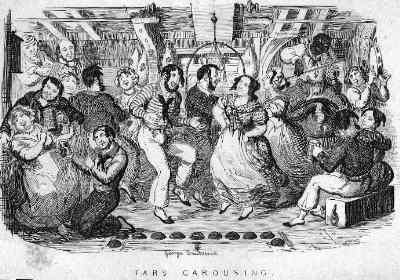
Of interest may be Cruickshank’s drawing of
“Tars Carousing,” from one of Dibdin’s
song folios.
***
The melody also appears in a
numerous British musicians’ music manuscript copybooks, including those of
Lawrence Leadley (Helperby, Yorkshire, c. 1840’s), George Spencer (Leeds, West
Yorkshire, 1831), John Clare (Helpstone, Northants, c. 1820), William Vickers
(Northumberland, 1770), James Winder (Wyresdale, Lancashire, 1835), John Fife
(Perthshire, Scotland, c.1780), and the Rev. Robert Harrison (Brampton,
Cumbria, 1820). It does not appear to have been exported to America under the
“Come Ashore…title,” at least as evidenced by the absence of the title in
American musicians’ manuscript copybooks. See note for "Cuckoo's
Nest" for more. Aird (Selection),
vol I, 1782; No. 190. Callaghan (Hardcore
English), 2007; pg. 16. Kidson (Old
English Country Dances), 1890; pg. 15 (from a MS. dated "Falkirk,
1824").
X:
1
T:Come Ashore Jolly Tar with your Trousers On
T:Jacky Tar
T:Cuckoo’s
Nest
M:4/4
L:1/8
C:As played by John Adams
S:18th C London Stage Hornpipe
A:England
H:18th C London Stage Hornpipe
Z:John Adams
K:G
BA | GFGE g2 fe | dBGB d2 cB | AGFE D2 d^c | d2 A2 A2 BA | GFGE g2 fe
| dBGB d2 cB | AGFE DEFA |1G2 E2 E2:|2 G2 E2 E4||: e2 ef g2 fe | d2 B2
B3 B | ABde faef | d2 A2 A2 Bd | e2 ef g2 fe | dBGB d2 cB | AGFE DEFA
|1 G 2 E2 E4 :|2 G2E2 E2 GA |: BGEG BAGF | E6 FG| AFDF AFDF | AGFE D2
EF | GF GE g2 fe | dBGB d2 cB | AGFE DEFA |1G2 E2 E2 EG :|2 G2 E2 E2 ||
X:2
T:Come Ashore, Jolly Tar, Your Trousers On
M:C
L:1/8
R:Hornpipe
S:Frank Kidson – Old English Country Dances (1890)
Z:AK/Fiddler’s Companion
K:F
AG|FEFD f2 ed|cAFA c2 BA|GFED C2 cB|c2 G4 AG|
FEFD f2 ed|cAFA c2 BA|GFED C2 EG|F2D2D2:|
|:Ac|d2e2f2
ed|c2A2 A3c|GAcd egde|c2G2G2 AG|
FEFD f2 ed|cAFD c2 BA|GFED C2 EG|F2D2D2:|
|:FG|AFDF AGFE|D4 z2 EF|GECE cEDE|GFED C2 Ac|
dcde
f2 ed|cAFA c2 BA|GFED C2 EG|F2D2D2:|
COME AWA' IN. Shetland, Reel. G Major. Standard tuning. AABB. Composed by Shetland fiddler,
composer, teacher and collector Tom Anderson (1980). Anderson (Ringing Strings), 1983; pg. 76.
COME BACK BOYS, LETS FEED THE
HORSES. Old-Time, Breadown. A Major. AEae tuning. Kerry Blech sees some
possible similarity to Edn Hammons’ “Let's
Hunt the Horses.” The tune is known as a West Virginia tune (some times
attributed to a member of the Hammons’ family, although this cannot be
verified), and has been popularized in recent times by Jimmy Tripplet and Gerry
Milnes. Dwight Diller also has a version.
COME BACK TO ERIN (Tar Ar Ais Go Eirinn). Irish, Slow Air (4/4 time). D Major
(Roche): C Major (O'Neill). Standard tuning. AB. Composed by Claribel (Roche).
O’Neill gives credit to collaborator and fiddler James O’Neill for the version
he prints in Music of Ireland. The
title appears in a list of tunes in his repertoire brought by Philip Goodman,
the last professional and traditional piper in Farney, Louth, to the Feis Ceoil
in Belfast in 1898 (Breathnach, 1997). While mostly traditional in his
repertoire, Goodman regularly played several novelty or ‘popular’ tunes. Source
for notated version: Chicago Police Sergeant James O’Neill, a fidder originally
from County Down and Francis O’Neill’s collaborator [O’Neill]. O'Neill (Music of Ireland: 1850 Melodies),
1903/1979; No. 194, pg. 34. Roche
Collection, 1982; vol. 1, pg. 32, No. 68.
X:1
T:Come Back to
M:4/4
L:1/8
R:Air
N:”Slow”
S:O’Neill – Music of Ireland (1903), No. 194
Z:AK/Fiddler’s Companion
K:C
G2 c>B c2 ^F>G|B2 A>F A2
G2|E2 F>G A3 A|A2 d>c Bc/B/ A_A|G2 c>B c2 ^F>G|
B2 A>F A2 {B/A/}G2|E2 F>G A2
B>c|d2 AB c3 z||E2 c>B A2 ^D>E|F2 E>D D2 C2|B,2 B>A G2 ^F>E|
G2 ^F>F E3 z|E2 {d}c>B A2
^D>E|F2 E>^G B2 A2|c2 A>^F d2 BG|D^DE^F G3F||
COME BY THE HILLS. AKA and see “Buachaill ó’n
Éirne.”
COME (LET US) DANCE
AND SING. AKA and see "La Belle Catharine [1]," "Inkle and Yarico [1]." English,
Scottish, New England; Reel and Country Dance Tune. England, Dorset. D Major.
Standard tuning. AB (Kerr): AABB (Brody, Kennedy, Miller & Perron, Raven):
AABA (Trim). The title “Come Let Us Dance and Sing” is the name of a song set
to the popular country dance air “La Belle Catharine.” Bayard (1981) dates the
tune from the 18th century, and says it has been a much‑favored
tune of fifers. Jim Taylor (1996) notes that it was played by fifers in the early
19th century and in the American Civil War. Carlin (1977) speculates
(without discernable evidence) that the tune may be related to a Shaker hymn
bearing the same name. In fact, as “La Belle Catharine” it was published in
Preston’s New Istruction for the German Flute (London, 1780), predating
the Shakers, and was a favorite country dance in England and the
Post-Revolutionary United States. In modern times the melody has been a staple
of northern (United States) contra-dance repertoire. Charles Waterton, in his
book Wanderings in South America, etc.
(1879), visited the Caribbean island of Barbados around 1820 and heard a
variant of the song there, which went:
***
Come let us dance and sing,
While Barbadoes [sic] bells to ring;
Quashi scrapes the fiddle-string,
And Venus plays the lute.
***
See note for “Inkle and Yarico” for
more. Source for notated version: Fennig's All Stars (New York) [Brody,
Carlin]. Brody (Fiddler’s Fakebook),
1983; pg. 72. Carlin (English Concertina),
1977; pg. 38. Kennedy (Fiddler’s Tune
Book), vol. 2, 1954; pg. 22. Kerr (Merry
Melodies), vol. 1; No. 21, pg. 29. Miller & Perron (New England Fiddlers Repertoire), 1983;
No. 74. Raven (English Country Dance
Tunes), 1984; pg. 145. Trim (Thomas
Hardy), 1990; No. 86 (appears as "La Belle Catharine"). Adelphi 2004, Delaware Water Gap‑ "String Band
Music." Front Hall 01, Fennigs All Stars‑ "The Hammered
Dulcimer." PearlMae Muisc 004-2,
Jim Taylor – “The Civil War Collection” (1996).
X:1
T:Come Dance and Sing
L:1/8
M:C|
K:D
|:A2|d2 cd e2 de|f2d2 de dc|B2e2 ef ed|c2A2A2(3ABc|
d2 cd e2 de|f2d2 de dc|B2e2 dc Bc|d4d2:|
|:AG|F2A2 AB AG|F2A2A3G|F2A2d2f2|ed cB A2AG|
F2A2 AB AG|F2A2A2 Bc|d2d2 fefg|a2A2A2:|
COME DOWN AND LET ME
IN. AKA and see "The Top of the Morning."
COME FOLLOW (FOLLOW
ME). AKA and see "The Spanish Gipsy." The air appears
under this title, taken from the first line of several ballads to the tune, in
the ballad opera The Fashionable Lady
(1730).
COME
FROM THE DEVIL AND SHAKE YOURSELF. AKA and see "Go to the Devil and
Shake Yourself [1]," "When sick is it tea you
want? [1]," "The
Penniless Traveller," "The
Irish Newsman."
COME FY, LET'S A' TO
THE BRIDAL. AKA and see “Blithesome Bridal,” “Bremner
and the kirk would let me be,” “Blythesome bridal,” “Come fy let's a' to the
bridal,” “Come Let's A’ to the Bridal.” “Come to the Bridal,” “I’m the Boy for Bewitching
Them,” “Let us waa to the
wedding.” “The Jolly Pedler’s [4],”
“Silly Old Man [2].” Scottish, Jig (9/8
time). A Major. Standard tuning. AABB. Kerr (Merry Melodies), vol. 3; No. 232, pg. 26.
X:1
T:Come Fy, Lets a’ to the Bridal
L:1/8
M:9/8
K:A
A2A A2f ecA|B2B Bce (f2a)|A2A A2f
ecA|B2B cBc F3:|
|:a2a aba gfe|c2e efc efg|a2a aba
gfe|c2f fg^e f3:|
COME GET ME. AKA and see "Viens m' Chercher."
COME GET YOUR NUBBIN. Old‑Time, Fiddle Tune. The title appears in a list of traditional
Ozark Mountain fiddle tunes compiled by musicologist/folklorist Vance Randolph,
published in 1954. It is perhaps related to Jesse Wallace’s “Nubbin,” although no evidence exists to ascertain
it.
COME HAP ME WITH THY
PETTICOAT. Scottish, English; Air or Reel.
England, Yorkshire. G Major. Standard tuning. AAB. Source for notated version:
a MS collection by fiddler Lawrence Leadley, 1827-1897 (Helperby, Yorkshire)
[Merryweather & Seattle]. McGibbon (Scots
Tunes, book II), c. 1746; pg. 42. McGlashan (Collection of Scots Measures), 177?; pg. 9. Merryweather &
Seattle (The Fiddler of Helperby),
1994; No. 121, pg. 64.
X:1
T:Come hap me with thy Peticoat
(sic)
M:C|
L:1/8
R:Reel
B:McGlashan – Collection of Scots Measures (177?)
Z:AK/Fiddler’s Companion
K:G
g|dBAG EDEG|d>edB d3g|dBAG
G>ABd|e>ged e3g|dBAG E>DEG|
d>gdB d3g|dBA>B
G>ABd|e>ged e3||g|d>ega g/a/b ag|d>edB d3e|
d>ega g/a/b ag|e>ba>g
e3g|d>ega g/a/b ag|d/g/f/e/ d/c/B/c/ d3g|
e/d/c/B/ c/B/A/B/ G/F/G/A/
B/A/B/d/|e/d/e/f/ g/f/e/^d/ e3||
X:2
T:Come hap me with thy Petticoat
M:C|
L:1/8
N:”Brisk”
S:McGibbon – Scots Tunes, book II, pg. 42
(c. 1746)
Z:AK/Fiddler’s Companion
K:G
g3 | d3B “tr”A3G | E3DE2G2 | d4 d3B |
d6g2 | d3B”tr”A3G | “tr”E3D E2G2 |
e4”tr”e3d | e6 :: g2 | d3e g3a |
(gab2) “tr”(a3g) | d3ed2B2 | d6g2 | d2e2g2a2 |
(gab2) “tr”(a3g) | e3b “tr”a3g |
e6g2 | d3eg3a | (gab2) “tr”a3g | d3ed2B2 | d6g2 |
(ed)(cB) (cB)(AG) | “tr”E3D E2G2 |
e6”tr”e3d | e6 :: g2 | (ded)B c(BAG) | (EG)(DG) E2G2 |
(dBd)e (ded)B | d6g2 | (ed)(cB)
(cB)(AG) | EGED E2G2 | (ede)g (eg)(ed) |
e6 :: g2 | (dBd)e (deg)a | (g3a/b/)
“tr”(a3g | d(gfe) (dcB)c | d6e2 | d2(ef) (gfg)a |
(g3a/b/) “tr”a3g | e3b (aba)g |
“tr”e6g2 | (dBd)e (deg)a | g3(a/b/) “tr”a3g |
d(gfe) d(cBc) | d6g2 | (ed)(cB)
(dB)(AG) | EGDG “tr”(EDE)G | e3g (ege)d | e6 :|
COME HASTE TO THE
WEDDING. AKA and see "Haste to the Wedding."
Irish, Jig. D Major. Standard tuning. AABB. "The tune 'Come, Haste to the
Wedding', of Gaelic origin, was introduced in the pantomime 'The Elopement' in
1767. This version is known as the Manx tune and was printed by the Percy
society in 1846. It is the basis for the Manx ballad, 'The Capture of
Carrickfergusby,' written by Thurot in 1760 (Linscott)." One of the tunes
associated with the dance "Lady in the
COME HERE SON. Old‑Time, Breakdown & Song Tune.
COME IF YOU CAN.
English, Country Dance Tune (2/4 time). D Major. Standard tuning. AABB.
The melody appeared first in print in London publisher John Hinton’s Universal
Magazine of Knowledge and Pleasure, 2:32, 1758. Thompson (Compleat
Collection of 200 Favourite Country Dances, vol. 2), 1765; No. 3.
X:1
T:Come if you can
M:2/4
L:1/8
B:Thompson’s Compleat Collection of 200 Favourite Country Dances, vol. 2 (London, 1765)
Z:Transcribed and edited by Flynn Titford-Mock, 2007
Z:abc’s:AK/Fiddler’s Companion
K:D
DF/A/ DF/A/|A/F/D/F/ E/C/B,/A,/|DF/A/ d/f/e/d/|c/A/E/^G/ AA,:|
|:Ac/e/
g/e/c/A/|Ad/f/ a/f/d/A/|FA/d/f/ E/G/c/g/|f/d/A/c/ dD:||
COME IN FROM THE RAIN ("Tar Astac On Baisdead" or "Taristeac
On Baisteac"). Irish, Single Jig. E Aeolian. Standard tuning. AABB. O'Neill (O’Neill’s Irish Music), 1915; No. 204,
pg. 110. O'Neill (Krassen), 1976; pg. 71. O'Neill (Music of Ireland: 1850 Melodies), 1903/1979; No. 1104, pg. 208.
O'Neill (Dance Music of
X:1
T:Come in from the Rain
M:6/8
L:1/8
R:Single Jig
S:O’Neill – Dance Music of
Z:AK/Fiddler’s Companion
K:Emin
A|B2E EFE|d3 A2G|F2D DED|F2G A2c|B2E
EFE|d3 e2f|g2e f2d|e3 e2:|
|:f|gfe b2e|gfe b2e|f2d A2g|f2g
a2f|gfe b2e|gfe b2e|f2d Bcd|e3 e2:|
COME IN THE EVENING. AKA and see "The Kelso Races,"
"The Welcome," "A Western Lilt," "The Lark in the Morning [1],"
"Galway Tom [1]," "Galloway Tom [2]," "Gallua
Tom," "An Buachaillin Bui,"
"The Goats’ Horn(s),"
"The Spotted Cow," "The Little Yellow Boy," "The Thrush's Nest."
COME INTO THE ROOM, I
WANT YOU.
AKA and see “Johnny
When You Die [1],” “Mayo Lasses,” “Old Maid(s) of Galway.”
Irish, Reel.
COME INTO THE TOWN. Irish, Jig. D Major. Standard tuning. AAB. Source for notated version:
fiddler Jimmy Murphy (b. 1938, Meelick, near Swinford, Co.
COME JOLLY BACCHUS. AKA and see "The Weaver's
March," "The Gallant Weaver,"
"Twenty-First of August,"
"The Tenth of June," "(Glorious) First of August," "The Constant Lover," "The
Swedes Dance at the new Playhouse," "Frisky Jenny," "Charles of Sweden." English,
Air (cut time). B Flat Major. Standard tuning. AAB. This old melody has seen
much use as the vehicle for ballads, which Chappell (1859) outlines. "Come
Jolly Bacchus" is perhaps its best‑known title, and is the song
written to it in The Devil to Pay. In
Playford’s Dancing Master the tune
was known as "Frisky Jenny" and "The Tenth of June,” and, in the
third volume, as "The Constant Lover." Walsh, in his Lady's Banquet, gives it as "The
Swedes Dance at the new Playhouse," and in The Devil to Pay and The Rival
Milliners or The Humours of Covent Garden it was known as "Charles of
Sweden," while in The Beggar's
Wedding it appears as "Glorious First of August." Chappell also
notes it was the melody to which many topical broadsiders printed their
ballads. See Bayard's (1981) note to "Pretty Polly" (No. 294, pg. 250)
for more information. Chappell (Popular
Music of the Olden Times), vol. 2, 1859; pgs. 109‑110.
X:1
T:Come Jolly Bacchus
T:Charles of
M:C|
L:1/8
S:Chappell – Popular Music of the Olden Time (1859)
Z:AK/Fiddler’s Companion
K:Bb
F2 FF D2 EF|G2G2F4|GA B2A Bc|d2d2
B4:|
||d2 ed c2 BA|B2c2A2F2|GA B2 A2
Bc|Bc de c4|
F2 FF D2 EF|G2G2 F4|GA B2A2
Bc|d2c2B4||
COME
KISS WITH ME (COME CLAP WITH ME). AKA and see "Newburn Lads," "Kail and Knockit Corn," "The Bob of Fettercairn."
Scottish, Reel or Air. "The Bob of Fettercairn" is the title Neil Gow
gave to the tune in his third collection, but it was known half a century
earlier than that as the song "Come Kiss With Me, Come Clap With Me."
In the Shetlands the same tune was known as "Kail and Knockit Corn"
(kail and bruised oats) which was also a song still in oral tradition during
the 1970's (Cooke, 1986)./ Bayard believes the tune to be a special development
of "Boyne Water."
COME LASSES AND LADS
[1]. English, Air (6/8 time). D Major
(Raven): G Major (Kerr). Standard tuning. AB (Raven): AABB (Kerr). Kerr (Merry Melodies), vol. 3; No. 404, pg.
44. Plain Brown Tune Book, 1997; pg. 29. Raven (English Country Dance Tunes), 1984; pg. 121.
X:1
T:Come Lasses and Lads [1]
M:6/8
L:1/8
R:Jig
K:G
GAB g2g | agf e2g | ded d2B | (d3
d2) B | B2e e^de | B2e e2f | gfe f2^d | (e3e2) :|
|: d | ded g2f | (e3e2)e | efe a2g |
(f3 f)ga | b2g a2f | gfe d2B | cde dgf | (g3g2) :|
COME LASSES AND LADS
[2]. English, Air (6/8 time). G Major. Standard
tuning. AB. The earliest copy that Chappell (1859) finds of this ballad,
"still popular" at the time he was writing, is in Westminster Drollery (part ii., 1672)
where it is titled "The Rural Dance about the May‑pole: the tune,
the first Figure‑Dance at Mr. Young's Bal, in May, '71." By the time
Cecil Sharp commented on the song in English
Folk Song (1907) it had ceased to be sung in folk tradition. Sharp, a
critic of Chappell due to his meddling with traditional tunes through
over-editing them, points out that “the modulation to the relative minor at the
middle cadence is obviously the addition of a latter day musician.” Chappell's
song is taken from Pills to Purge
Melancholy (vol. iii., 1719).
***
You lasses and lads, take leave of your Dads,
And away to the Maypole hie,
There ev’rey he has got him a she,
And the minstrels standing by.
For Willy has got his Gill, and Johnny has his Joan,
To jig it, jig it, jig it, jig it, jig it, up and down.
***
Chappell (Popular Music of the Olden Time), Vol. 2, 1859; pg. 114.
X:1
T:Come Lasses and Lads [2]
L:1/8
M:6/8
S:Chappell – Popular Music of the Olden Time (1859)
Z:AK/Fiddler’s Companion
K:G
d|d>ed B2G|G>AG F>EF|GED
G2D|(B,3 B2)G|
G>AG E2E|A>BA F2A|B>^cd
d2c|(d3d2)||d|d>ed A2B|
(c3 c>)de|dB2 A2G|(F3 F2)f|gd2
ed2|c2B ABc|B>AG G2F|(G3G2)||
COME LET
COME, LET US DRINK
ABOUT. English, Air (2/4 time). E Flat
Major. Standard tuning. AAB. Chappell's (1859) version comes from an annonymous
half‑sheet ballad, though he finds another version in Vocal Miscellany (vol. ii, 1734) and The Aviary (1745).
***
Come, let us drink about,
And drive away all sorrow;
For perhaps we may not,
For perhaps we may not,
For perhaps we may not
Meet again tomorrow.
***
Chappell (Popular Music of the Olden Time), vol. 2, 1859; pg. 180.
X:1
T:Come, Let Us Drink About
L:1/8
M:2/4
S:Chappell – Popular Music of the Olden Time
Z:AK/Fiddler’s Companion
K:Eb
B2 B>A|G>A B2|E>E
F>F|G2E2:|
F2 F>E|D>E F2|F2 F>A|G>A
B2|e2 e>d|c>d e>c|B>c B>A|G2E2||
COME LET US PREPARE. English, Air (6/8 time). G Major. Standard tuning. One part. The tune
appears in
X:1
T:Come Let Us Prepare
M:6/8
L:1/8
R:Air
S:Chappell – Popular Music of the Olden Time
Z:AK/Fiddler’s Companion
K:G
D|GAB BAG|FGA AGF|GAB BAG| B(d2 d2)
c/B/|
cee edc|BAG d2 c/B/|cBc ABc|B (G2
G2)||
COME LET'S A' TO THE
BRIDAL. AKA and see “Come Fy, Lets a’ to the Bridal.”
Scottish, Jig (9/8 time). G Major. Standard tuning. AABB. Kerr (Merry Melodies), vol. 2; No. 255, pg.
28.
X:1
T:Come Fy, Lets a’ to the Bridal
L:1/8
M:9/8
K:A
A2A A2f ecA|B2B Bce (f2a)|A2A A2f
ecA|B2B cBc F3:|
|:a2a aba gfe|c2e efc efg|a2a aba
gfe|c2f fg^e f3:|
COME LET'S BE MERRY. English, Country Dance Tune (3/4 time). D Major. Standard tuning. AAB.
Barnes dates the tune c. 1727. Barnes (English
Country Dance Tunes), 1986.
COME LIVE WITH ME, AND
BE MY LOVE. English, Air (3/4 time). B Flat
Major (Chappell): A Minor (Kines). Standard tuning. One part (Kines): ABB
(Chappell). The air appears in
***
Come live with me and be my love,
And we will all the treasures prove.
That hills and valleys, dale and field,
And all the craggy mountains yield.
***
Marlow's tragedy The Jew of Malta, c. 1591, contains the
first two lines of a song to the air:
***
Thou, in whose groves, by Dis above,
Shall live with me, and be my love.
***
Walton's Angler (1653) alludes to the song:
***
It was a handsome milkmaid, that had not attained so much age
and wisdom as to load her mind with any fears of many things
that will never be, as too many men often do; but she cast away
all care, and sung like a nightingale; her voice was good, and the
ditty fitted for it" it was that smooth song which was make by Kit
Marlow now at least fifty years ago.
***
It seems spurious to Kines (1964)
that Christopher Marlow should have written the song, for the verses appear in
a shortened form in Shakespeare's "Sonnet to sundry notes of music"
and parts of verses 2 and 3 are quoted in The
Merry Wives of Windsor (Act III, Scene 1). For other references see
Chappell's notes on the song. Chappell (Popular
Music of the Olden Time), vol. 1, 1859; pg. 123. Kines (Songs From Shakespeare's Plays and Popular
Songs of Shakespeare's Time), 1964; pg. 25.
COME NOW OR STAY (Tar Anois No Fan). Irish, Jig. D Major. Standard tuning. AABB.
O'Neill (Krassen), 1976; pg. 51. O'Neill (Music
of Ireland: 1850 Melodies), 1903/1979; No. 1001, pg. 187. O'Neill (Dance Music of
X:1
T:Come Now or Stay
M:6/8
L:1/8
R:Jig
S:O’Neill – Dance Music of
Z:AK/Fiddler’s Companion
K:D
F/G/|ABA d2f|afb afd|e/f/ge
d/e/fd|ecA AFG|ABA d2f|afb afd|f/g/af gec|ded d2:|
|:f|edc BAG|F2D GFE|A2F Bcd|cee
egf|edc BAG|F2D GFE|ABd e/f/ge|fdd d2:|
COME, O DARK HAIRED
WOMAN (Siubhal, A Bhean
Dubh-O). AKA
and see "Go Home, Go
Home, Dear Cousin."
COME O'ER THE BOURN,
BESSIE TO ME. AKA and see "Over the broome,
Bessy," "Browne Besse, sweet Besse, come over to me." Irish,
English; Air (3/2 time). F Major/G Mixolydian. Standard tuning. AB. This melody
is claimed as Irish in origin by Grattan Flood (1906), who dates it from the
second half of the 16th century (it should be noted that Flood made many claims
for Irish provenance of old British Isles tunes). Flood, however, states it was a very popular melody in
England. Chappell (1859) dates it earlier than Flood, to the early part of the
16th century, and gives stylistic reasons why this is so: "No melody in
the Mixolydian mode which begins, like this...as if in the scale of F, is at
all likely to have been composed later than the first quarter of the
century." In the British Museum Chappell found a composition written
"no later" than 1530 which begins with the first phrase of the tune as
it appears in Dorothy Welde's book, and refers to something earlier still, but
well‑known at the time. Walker (1924) agrees with Chappell regarding the
antiquity of the melody, and says it is “very probably of (an) earlier date
than (its) first occurrence in Elizabethan collections.” It was mentioned by
Shakespeare in King Lear (act iii,
sc. 6):
***
Wantest thou eyes at trial, Madam?
Come o'er the bourn, Bessy, to me.
***
It appears in Dorothy Welde's Lute Book, and the University Library of
Cambridge's Lute MSS (Dd. xiii. II). The first verse goes:
***
Come o'er the bourn, Bessy,
Come o'er the bourne Bessy,
Sweet Bessy come over to me.
And I shall thee take,
And my dear lady make
Before all other that ever I see. (Kines)
***
Chappell (Popular Music of the Olden Time), vol. 1, 1859; pg. 121. Kines (Songs From Shakespeare's Plays and Popular
Songs of Shakespeare's Time), 1964; pgs. 54‑55.
COME O'ER THE STREAM,
CHARLIE. See "Come Over the Stream to Charlie."
COME OPEN THE DOOR,
SWEET BETTY. AKA and see "Rattling, Roaring Willie,"
"The Mitford Galloway,"
"Tom Nokes’ Jig." English,
Country Dance Tune and Air (6/8 time). A Minor. Standard tuning. AB. This
melody, notes Chappell (1859), appears in both the Pepys Collection and the
Roxburghe, entitled "John's Earnest Request; or, Betty's compassionate
love extended to him in a time of distress" which also records it as "a pleasant new tune, much in
request." The strain appears in
the first part of "Tom Nokes' Jig" (Apollo's Banquet, 1669), though in the Nokes tune the time has been
altered to a quick 9/8; it is either derived from "Come Open the
Door" or else both are from some earlier common ancestor, states Chappell.
Chappell (Popular Music of the Olden Time),
vol. 2, 1859; pg. 147.
X:1
T:Come Open the Door, Sweet Betty
L:1/8
M:6/8
S:Chappell – Popular Music of the Olden Time
(1859)
Z:AK/Fiddler’s Companion
K:A Minor
A3|GEC D2B|c3 ^G2A|=GGEC D2E|A2z
A3|GEC D2B|c3 ^G2A|=GEC D2E|(A3A2)||
B|c>bc d>cB|c3 B2c|A>^GA
d2B|^G2z A3|=GEC D2B|c3 ^G2A|=GEC D2E|A3||
COME OVER THE STREAM
TO CHARLIE. AKA ‑ "Come O'er the Stream,
Charlie." AKA and see "Crossing
the Stream," “Maclean’s Welcome.” Scottish, English; Waltz. G Major.
Standard tuning. AB (Kerr, Martin): AAB (Kennedy, O'Neill, Raven): AABCC
(Barnes). The "Come O'er the Stream to Charlie" title comes from
words set to the tune by Scottish poet James Hogg in his '''Jacobite Relics of
Scotland''' (1821) where it appears under the title "Maclean's
Welcome". In his note on the song (p. 301) Hogg says: "The air is beautiful,
but the ingenious Captain Frazer has a better set of it in his collection.''
Charles Gore ('''Scottish Fiddle Music Index''') finds the melody in Gale's
'''Pocket Companion''' (c.1800). Christine Martin (2002) says the tune appears
in The Ballroom (1827) as “The
Guracha,” a Spanish dance. Source for notated version: Chicago Police Sergeant
James O’Neill, a fiddler originally from County Down and Francis O’Neill’s
collaborator [O’Neill]. Barnes (English Country Dance Tunes, vol. 2),
2005; pg. 139 (appears as “Waltz Country Dance”). Kennedy (Fiddlers Tune Book), vol. 1, 1951; No. 74, pg. 36. Kerr (Merry Melodies), vol. 3; No. 306, pg.
33. Martin (Traditional Scottish
Music), 2002; pg. 39. O'Neill
(Music of Ireland: 1850 Melodies),
1903/1979; No. 153, pg. 27. Raven (English
Country Dance Tunes), 1984; pg. 136.
X:1
T:Come Over the Stream to Charlie
T:Crossing the Stream
M:3/4
L:1/8
R:Air or Waltz
S:O’Neill – Music of
Z:AK/Fiddler’s Companion
K:G
G2|G3B d2|d2B2e2|d2B2g2|d2B2A2|G3 B
d2|d2B2 GE|D2 B2A2|G4:|
d2|g3f g2|e3f g2|e2 a3g|(f2d2)
d2|g3f g2|e2d2c2|B2A2G2|d4 B2|
c3d c2|B2d2g2|edcBAG|(B2 A2) d2|g3 f
e2|d2g2e2|d2g2f2|g4||
COME, SHEPHERDS, DECK
YOUR HEADS. English, Dutch; Air (4/4 time). D Dorian
(Chappell, version #1): G Minor (Chappell, version #2). Standard tuning. AB.
The air appears in Friesche Lust‑Hof
(1621), Nederlandtsche Gedenck‑Clanck
(1625), Bellerophon of Lust tot Wysheyt
(Amsterdam, 1622), and Gesangh der Zeeden
(Amsterdam, 1662). Chappell (Popular
Music of the Olden Time), vol. 1, 1859; pgs. 168‑169 (two versions).
COME
SIT DOWN BESIDE ME MY OWN HEART’S DELIGHT. Irish, Air (3/4 time). F Major. Standard tuning. One part. “From the
Bennad glens” [Stanford/Petrie]. Stanford/Petrie (Complete Collection), 1905; No. 651, pg. 163.
X:1
T:Come sit down beside me my own
heart’s delight
M:3/4
L:1/8
R:Air
S:Stanford/Petrie (1905), No. 651
Z:AK/Fiddler’s Companion
K:F
cB | A2F2 AB | cd ed cA | {c}(B2A2)
F2 | F4 c_e | d2c2 BA | B2c2 de |
f2 f_edB | c4 c_e | d2c2 BA | B2c2
de | f2 f_edB | c4 d>cB | A2F2 AB |
cd _ed cA | {c}B2A2F2 | F4 ||
..........................
COME,
SWEET LASS (THIS BONNY WEATHER). AKA and see "Greenwich
Park." English, Air. The melody appears under this title in John Gay's Beggar's Opera (1729) and in all
editions of Pills to Purge Melancholy, and is associated with the 18th
century theatre. In the second part of Playford's Dancing Master (1698) it is
known as "Greenwich Park." John Purser says there is an English
manuscript source from c. 1704-1707, and an undated songsheet that attributes
the music to “Mr. Clarke.” Scots composer James Oswald (who lived in London)
included the tune in his 1744 collection A Second Collection of Curious
Scots Tunes. Chappell (Popular Music
of the Olden Time), vol. 2, 1859; pg. 73. Raven (English Country Dance Tunes), 1984; pg. 66.
Redwing Music RWMCD 5410, Abby Newton –
“Castles, Kirks and Caves” (2001).
..........................
COME TELL ME IN PLAIN. Irish, Air (3/4 time). B Flat Major. Standard tuning. AAB. Source for
notated version: “From Mr. R.A. Fitzgerald” [Stanford/Petrie]. Stanford/Petrie
(Complete Collection), 1905; No. 776,
pg. 194.
X:1
T:Come tell me in plain
M:3/4
L:1/8
R:Air
N:”Andante”
S:Stanford/Petrie (1905), No. 776
Z:AK/Fiddler’s Companion
K:Bb
F2 | G2G2F2 | GA B2c2 | d2e2 cB |
A2F2F2 | G2G2F2 | GA B2c2 | d2e2A2 | B4 :|
|| d2 | e2d2c2 | d4 fd | e2d2c2 | d4
fd | e2d2 cB | A2F2 FG/A/ | B2c3B | A2F2F2 |
G2G2F2 | GA B2c2 | d2e2A2 | B4 ||
..........................
COME TIE MY PETTICOAT
TIGHTER, O. Northumbrian. Title appears in
Henry Robson's list of popular Northumbrian song and dance tunes, which he
published c. 1800.
..........................
COME TILL THE
BOTTLEHOUSE. See "Come to the Bottlehouse."
..........................
COME TO DINNER (Tar Go Di'n Proinn). Irish, Jig. A Dorian (‘A’ part) & A Major
(‘B’ part). Standard tuning. AABB. O'Neill (Music
of Ireland: 1850 Melodies), 1903/1979; No. 1013, pg. 189. O'Neill (Dance Music of Ireland: 1001 Gems),
1907/1986; No. 228, pg. 52.
X:1
T:Come to Dinner
M:6/8
L:1/8
R:Jig
S:O’Neill – Dance Music of Ireland: 1001 Gems (1907), No. 228
Z:AK/Fiddler’s Companion
K:Ador
e|c<AA A2A|EAB cBA|B<GG
G2G|BGB gdB|c<AA A2B|cde agf|gec Bed|c<AA A2:|
K:A
|:e|aga bag|aec Ace|dBG EGB|Acf
efg|aga bag|aec Ace|dBG EGB|c<AA A2:|
..........................
COME TO THE
BOTTLEHOUSE (Tar Go Di AN
Teac-Osda).
Irish, Reel. A Major. Standard tuning. AABB. Printed in 1883 (as "Come
Till the Bottlehouse") in Ryan's
Mammoth Collection of 1050 Reels and Jigs {No. 50}, but deleted when that
volume metamorphasized into Cole's 1000
Fiddle Tunes in 1940. A bottlehouse was a drinking establishment that
typically sold only whiskey in the barrel and beer in bottles. The Devil's Box, vol. 21, No. 4, Winter
1987, pg. 48 (appears as "Come Till the Bottlehouse"). Mulvihill (1st Collection), 1986; No.
174, pg. 47 (appears as untitled reel). O'Neill (Krassen), 1976; pg. 128.
O'Neill (Music of Ireland: 1850 Melodies),
1903/1979; No. 1377, pg. 256. Ryan’s
Mammoth Collection, 1883; pg. 51.
X:1
T:Come to the Bottlehouse
M:C|
L:1/8
R:Reel
S:Mulvihill - 1st Collection (1986)
K:A
B|cBAc BAFE|FBBA B2ed|cBAc BAFE|FdcB
A2 ed|cBAc BAFE|
FBBA B2 ed|cBAc BAFE|FdcB
A2||(3efg|a2 ge (3fga ec|
B2BA BdcB|A2 ae (3fga ec|dfed cA
A2|a2 ge (3fga ec|B2 {c}BA BdcB|
A2 ae (3fga ec|dfed cA A2||
..........................
COME TO THE BOWER. A love song that reportedly Sam Houston had his three fifers (or
sometimes one fifer) and drummer play as a marching song at the Battle of San
Jacinto. The song was considered somewhat risque at the time. See Abernathy (Singing Texas).
..........................
COME TO THE BRIDAL. AKA and see “I’m the Boy for Bewitching Them,” “Jolly Pedler’s [4].” Irish, Slip Jig. G Major. Standard tuning. AABB. Also in Mulvihill (1st Collection, 1986; No. 8, pg. 108) as “The Bridal.” Source for notated version: copied from James Aird’s Selections of Scotch, English, Irish and Foreign Airs (1782-97) [O’Neill]. O’Neill (Waifs and Strays of Gaelic Melody), 1922; No. 195.
X:1
T:Come to the Bridal
M:9/8
L:1/8
S:Aird's Selections 1782-97
Z:Paul Kinder
K:G
D|GAG Gge dBG|ABA ABd e2 g|GAG gfe dBG|ABc BAG E2:|
|:d|gdg
gag fed|edB gab a2 b|gab abg fed|efg dBG A2:||
..........................
COME TO THE DANCE (Tar Go D-Ti An Rince). Irish, Reel. G Major. Standard
tuning. AB. Source for notated version: Chicago fiddler Edward Cronin,
originally from County Tipperary. Cronin was a weaver, machinest and composer
and was one of O’Neill’s chief informants for his collections—“he would play on
for hours at a time such tunes as memory presented, his features while so
engaged remaining as set and impassive as the sphinx.” Cronin also boasted he
never forgave nor forgot and injury. [O’Neill]. O'Neill (Krassen), 1976; pg.
105. O'Neill (Music of Ireland: 1850
Melodies), 1903/1979; No. 1251, pg. 235.
X:1
T:Come to the Dance
M:C|
L:1/8
R:Reel
S:O’Neill – Music of Ireland
(1903), No. 1251
Z:AK/Fiddler’s Companion
K:G
D2 | GBdB cAFA | G2 (ge) dBGB | cdec
BcdB | ABcA GFED |
GBdB cAFA | .G(gfg) edBd | cedc BcdB
| cdef g2 || d2 |
gdBd cBcd | edef gfga | bgaf gfed |
egfa g2 (ga) | bgaf gage |
dBGB dBcd | egfa gedB |cdef g2 ||
..........................
COME TO THE MILK. Old‑Time, Fiddle tune. The title appears in a list of Ozark
Mountain fiddle tunes compiled by musicologist/folklorist Vance Randolph,
published in 1954.
..........................
COME TO THE RAFFLE. AKA and see "Tongs by
the Fire [1]." American, Jig. G Major. Standard tuning. AABB. Composition
credited to Jas. Hand (Ryan/Cole), about whom nothing is known but who was
perhaps a band-leader from the Boston, Massachusetts, area in the mid-19th
century. Cole (1000 Fiddle Tunes),
1940; pg. 56. O'Neill (1915 ed.), 1987; No. 180, pg. 98 (appears as "Tongs
by the Fire"). Ryan’s Mammoth
Collection, 1883; pg. 84.
X:1
T:Come to the Raffle
M:6/8
L:1/8
R:Jig
S:Ryan’s Mammoth Collection (1883)
Z:AK/Fiddler’s Companion
K:G
D | GBd cAF | .G(ge) dBG |
(c>e).c BdB | ABG F>ED | GBd cAF | Gge dBd |
cec Bgf | edc d2 :: d | gdB gdB |
gfa gdB | ({a}g)fg eag | fdd def | gbg faf |
ege def | gdB ({B}A)GA | BGG G2 :|
..........................
COME TO YOUR TAY. AKA and see "The Sailor's
Jacket." Irish, Scottish; Reel. D Major. Standard tuning. AABB. See
also similarly structured tunes "P.J.
Conlon's," "Kitty in
the Lane [1]," "The
Ballinafad Reel [1]," "Jenny
Picking Cockles," "Take
Her Out and Air Her [2]." The tune also appears to be a version of the
County Donegal Highland “Ora Stor a’ Ghra,” according to Caoimhin Mac Aoidh.
Cole (1000 Fiddle Tunes), 1940; pg.
28. Kerr (Merry Melodies), vol. 2;
No. 288, pg. 31. Ryan’s Mammoth
Collection, 1883; pg. 52.
X:1
T:Come to
Your
M:C|
L:1/8
R:Reel
S:Ryan’s
Mammoth Collection (1883)
Z:AK/Fiddler’s
Companion
K:D
d2 (dc) A2
(Bc) | d2 (de) fdec | dedB A2 (AB) | =cAGE (ED) D2 | d2 (dc) A2 (Bc) |
d2 (de)
fdec | d2 (dc) A2 (AB) | =cAGE (ED) D2 :: d2 (fd) adfd | ceAe cAeA |
d2 (fd)
adfd | faae fdec | d2 (fd) adfd | c2 (ec) gefg | abag fdec | eaag fdec :|
..........................
COME UNDER MY DIMITY. AKA and see "B'fhearr
liomsa ainnir gan guna,” "Ditherum
Doodle," "I'll
take a glass with a friend," "Late on Saturday Night,"
"Mall Rua," "Moll Roe in the Morning,"
"Moll Roe{'s} [1],"
"Munsterman's Flattery,"
"The Night of the Fun [3],"
"Though late was I plump."
Irish, Jig. D Major. Standard tuning. AABB. See also the slip jig “Captain McDonald’s Favorite.”
New York researcher, musician and writer Don Meade says: “Dimity was a coarse
cotton fabric most often used for bed clothes, which makes [the title] a coarse
invitation.” The tune is oddly-metered in Ryan’s/Cole’s: it should be in 9/8
time as it is clearly a slip jig. Cole (1000
Fiddle Tunes), 1940; pg. 65. Ryan’s
Mammoth Collection, 1883; pg. 95.
X:1
T:Come Under My Dimity
M:6/8
L:1/8
R:Jig
S:Ryan’s Mammoth Collection (1883)
Z:AK/Fiddler’s Companion
K:D
A | Add efd | cde fef | gef g2e |
Add efd | cde aba | gec d2 :|
a | afa ged | cde afa | gef g2e |
afa ged | cde aba | gec d2 :|
..........................
COME UNDER MY PLADDIE. AKA – “Come Under my Plaidie.” AKA and see "Before I Was Married," "Billy O'Rourke's Jig [1],"
“Black Joke [2],” "The Black Rogue [1],"
"Johnny/Johnnie
McGill/MacGill," “Paddy
O’Rourke’s,” "An Rogaire Dubh," "Tibbie Dunbar." Scottish, Jig. G
Major. Standard tuning. AB (Kerr): AABB (Cole, Harding, Johnson, O'Neill,
Perlman, Robbins, Sweet). The title comes from a song by Hector Macneil of
Roslin, Midlothian, from the 18th or early 19th century, and set to the tune
"Johnny McGill." The air is properly a Scotch jig (a jig with Scotch
measure accents) and was first published in 1778 (according to Glen). Burns
also set his lyric Tibbie Dunbar ("O Wilth thou go wi' me, sweet Tibbie
Dunbar") to this air. See Bayard's (1981) note to "Johnny
McGill" for further discussion and sources. Source for notated version:
Peter Chaisson, Sr. (b. 1929, Bear River, North-East Kings County, Prince
Edward Island) [Perlman]. Cole (1000
Fiddle Tunes), 1940; pg. 53. Harding's
Original Collection, No. 132. Jarman (Old
Time Fiddlin' Tunes); No. or pg. 17. Johnson (Scots Musical Museum), vol. 6, 1783; No. 533. Kerr (Merry Melodies), vol. 1; No. 25, pg. 46.
O'Malley, 1919; pg. 7. O'Neill (Music of
Ireland: 1850 Melodies), 1903/1979; No. 915, pg. 170 (appears as "The
Black Rogue"). Perlman (The Fiddle
Music of Prince Edward Island), 1996; pg. 128. Robbins, 1933; No. 77. Sweet
(Fifer’s Delight), 1964/1981; pg. 34. White's Excelsior Collection, pg. 20. Rounder 7004, Joe Cormier ‑
"The Dances Down Home" (1977).
X:1
T:Come Under My Plaidie
M:6/8
L:1/8
R:Jig
Z:AK/Fiddler’s Companion
K:G
g | dBB BAB | dBB B2g | dBB BAB |
GEE E2g | dBB BAB |
dBB BAG | AGA BAB | GEE E2 :: d |
gfg aga | bag fed | gfg aga |
bge ega | Bge afa | geg g2e | dBB
BAB | GEE E2 :|
..........................
COME UP IN THE ROOM I
WANT YOU. AKA and see “The Ballina Lass,” “The Old Maids of Galway [2].”
Irish, Reel. Ireland, County Sligo. G Major. Standard tuning. AB. The tune is
particularly associated with the playing of fiddler Johnny Henry of Doocastle,
on the Mayo-Sligo border. Paul de Grae says the late north Kerry fiddler Paddy
O’Sullivan had a similarly titled tune he called “Into the Room, I Want You,”
although his was a version of “The Mayo Lasses.” Source for notated version:
fiddler Johnny Henry (b. 1922, Cloonlairn, Doocastle, Co. Sligo) [Flaherty].
Flaherty (Trip to Sligo), 1990; pg.
143. Cló Iar Chonnachta CICD 165, John Wynne &
John McEvoy – “Pride of the West” (2007).
|
See also listing at: Alan Ng’s Irishtune.info |
X:1
T:Come Up in the Room, I Want You
M:4/4
L:1/8
R:Reel
Z:Bill Black
K:G
dcBG DGBd|(3efg dg (3efg dB|dcBG
DGBd|(3efg dc BG G2|
dcBG DGBd|(3efg dg efge|d2 BG
DGBd|(3efg dc BG G2||
g2 bg egde|g2 ag ea a2|g2 bg
egdB|dega bg g2|
g2 bg egde|g2 ag ea a2|g2 fg
egdB|dega bg g2||
..........................
COME UP THE BACK
STAIRS. AKA and see "Merry Dance." New England, Jig. G
Major. Standard tuning. AABB. Miller & Perron (New England Fiddler’s Repertoire), 1983; No. 27. Page (Ralph Page Book of Contras), 1969; pg.
3. Sweet (Fifer’s Delight),
1964/1981; pg. 69. Fretless 119, Rodney and Randy
Miller‑‑"Castles in the Air."
X:1
T:Come Up the Back Stairs
M:6/8
L:1/8
K:G
D2B B2A|AGF G2B|d2F FEF|A2G GFE|D2B B2A|AGF GAB|d2F FEF|G3 G2:|
|:d|gfg
bge|edB def|gfg bge|ed^c def|g2g gab|e2d efg|ded def|agf g2:|
..........................
COME UPSTAIRS WITH ME (Tar Suas Na Staigre Liom). Irish, Slip Jig (9/8). G Major.
Standard tuning. AAB (Breathnach, Treoir):
AABB (O’Neill). Sources for notated versions: fiddler Jim Mulqueeny
[Breathnach]; musician and accordion maker Martin Connolly (Ennis) [Treoir]. Breathnach (CRÉ V), 1999; No. 59, pg. 31. O'Neill
(Krassen), 1976; pg. 87. O'Neill (Music
of Ireland: 1850 Melodies), 1903/1979; No. 1172, pg. 221. O'Neill (Dance Music of Ireland: 1001 Gems),
1907/1986; No. 442, pg. 86. Treoir,
vol. 37, No. 4, 2005; pg. 25.
X:1
T:Come Up Stairs with Me
M:9/8
L:1/8
R:Slip Jig
S:O’Neill – Dance Music of Ireland: 1001 Gems (1907), No. 442
Z:AK/Fiddler’s Companion
K:G
D|G2c BAG Bcd|ecA ABG FED|G2c BAG
Bcd|efg faf g2:|
||g|fed d2g fed|ecA ABG FED|fed d2g
fed|efg faf g2g|fed d2g fed|
ecA ABG FED|G2c BAG Bcd|efg faf g2||
..........................
COME WEST ALONG THE
ROAD (Bog Siar A Botar). AKA and see “Arboe [2],” “The
Monasteraden Fancy,” "Over
the Moor to Peggy." Irish, Reel. Ireland, County Sligo. G Major.
Standard tuning. AB. Philippe Varlet reports that the tune was recorded in 1925
by John McKenna
and in the 1940's by the Aughrim Slopes and Moat céilíi bands (who called it
“The Monasteraden Fancy,” Monasteraden being a town on the Roscommon/Sligo
border). “Over the Moor to Peggy” is a related tune. Sources for notated
versions: flute player and piper Frankie Lavin (b. 1940, Cloonshanville, near
Frenchpark, Co. Roscommon) [Flaherty]; set dance music recorded at Na Píobairí
Uilleann, mid-1980’s [Taylor]; a recording of Bobby Gardiner [O’Malley]; Na
Filí [Miller & Perron]; New Jersey flute player Mike Rafferty, born in
Ballinakill, Co. Galway, in 1926 [Harker]. Flaherty (Trip to Sligo), 1990; pg. 150. Harker (300 Tunes from Mike Rafferty), 2005; No. 27, pg. 9. McNulty (Dance Music of Ireland), 1965; pg. 6.
Miller & Perron (Irish Traditional
Fiddle Music), 1977; vol. 3, No. 60 (appears as “Arboe”). Miller &
Perron (Irish Traditional Fiddle Music),
2nd Edition, 2006; pg. 57. O’Malley (Luke O’Malley’s Collection of Irish Music, vol. 1), 1976; No. 59,
pg. 30. O'Neill (Dance Music of Ireland:
1001 Gems), 1907/1986; No. 793, pg. 137. Taylor (Music for the Sets: Yellow Book), 1995; pg. 31. Green Linnett GLCD 1155, Martin Hayes - “Under the Moon”
(1995). Lochshore CDLDL 1215, Craob Rua - “The More That’s Said the Less the
Better” (1992).
|
See also listings at: Jane Keefer’s Folk Music Index: An
Index to Recorded Sources Alan Ng’s Irishtune.info |
X:1
T:Come West Along the Road
M:C|
L:1/8
R:Reel
Q:240
K:G
d2 BG dGBG | GABd efge | d2 BG dGBG |1 ABcd edBc :|2 ABcd ed (3Bcd ||
g2 bg egdg | egdg ed (3Bcd | g2 bg egdB | ABcd ed (3Bcd |
g2 bg egdg | egdg ed (3Bcd | gabg efge | dega bage ||
COME WITH ME NOW (Tar Liom Anois). AKA and see "Tolladh an Leathair," "The Humours of Ayle House,"
"The Kilfinane Jig," "When you go home," "The Connaughtman [2]," "The Shoemaker's Fancy," "Boring the Leather [2],"
"Down the Back Lane."
Irish, Double Jig. D Major. Standard tuning. AABB. O'Neill (Dance Music of Ireland: 1001 Gems),
1986; No. 312, pg. 66.
X:1
T:Come with me now
M:6/8
L:1/8
R:Jig
S:O’Neill – Dance Music of Ireland: 1001 Gems (1907), No. 312
Z:AK/Fiddler’s Companion
K:D
A/G/|FDD F2d|cAA BAG|AFD F2d|cAF
GAG|FDD F2d cAA cde|fge cAG|EDD D2:|
|:A|cBA fed|cAA A2B|cBA fed|cAF
G2A|cBA fed|cAA cde|fge cAG|EDD D2:|
..........................
COME YE BY ATHOLL. Scottish, March. Green Linnet GL-1095, Altan -
"Horse with a Heart" (1989. Learned from Antoin MacGabhann and
Micheal MacAogain).
..........................
COME YE OWER FRAE
FRANCE. AKA and see "The Key(s) of the Cellar,"
"The
Marchioness of Tweed‑dale's Delight." English, Old Hornpipe (3/2
time). G Dorian. Standard tuning. One part. Note: The song is a satire of the
Hanoverian King George I (“Geordie Whelps”), who became King of England and
Scotland in the 18th century.
George transplanted to England an assortment of mistresses and
characters, the fromer being impoverished gentlewomen from Germany, providing
Jacobite songwriters with a broad target and much ribald glee. Several of these
imported characters come in for derision: Madame Kilmansegge, Countess of
Platen, is referred to as "The Sow" in many Jacobite songs, while the
King's favorite mistress, the lean and haggard Madame Schulemburg (afterwards
named Duchess of Kendall) was given the name of "The Goose.” She is the
"goosie" in “Come Ye Ower Frae France,” while the "blade"
is one Count Koningsmark. John, Earl of Mar, was nicknamed “Bobbing John,” an
interesting character in Scottish history. Mar (1675-1732) was a disaffected
Tory minister who had served as one of the Scots commissioners during the Union
negotiations (to unite the kingdoms of Scotland and England), however, once it
was passed he came to understand it was a terrible mistake. To remedy this he
raised the Jacobite standard at Braemar in 1715 on behalf of James, the Old
Pretender and became one of the leaders of the rebellion. Opposed by the The
Duke of Argyll with 35,000 government troops, Mar and his clansmen fought at
Sheriffmuir near Stirling in November, 1715. Although at first it appeared that
the ‘Highland Charge’ would carry the day, the Hanoverian professionals wavered
but held and eventually gained the upper hand, driving the Highlanders back
into the mountains. By February, 1716, the rebellion was quelled and Mar sailed
with James for France and permanent exile.
***
CAM YE O'ER FRAE
***
Cam ye o'er frae France?
Cam ye down by Lunnon? (Lunnon = London)
And his bonny woman?
Were ye at the place
Ca'd the Kittle Housie? (Kittle Housie = Cat House or
Brothel)
Saw ye Geordie's grace
Riding on a goosie?
***
Geordie he's a man
There is little doubt o't;
He's done a' he can
Wha can do without it?
Down there came a blade
Linkin' like my lordie;
(Linkin’ =
tripping along)
He wad drive a trade
At the loom o' Geordie.
***
Though the claith were bad, (claith = cloth)
Blythly may we niffer; (niffer = haggle)
Gin we get a wab, (wab = length
of cloth)
It makes little differ.
We hae tint our plaid, (tint = lost)
Bannet, belt and swordie,
Ha's and mailins braid -- (ha’s and mailins =
houses and farmlands)
But we hae a Geordie!
***
Jocky's gane to France,
And Montgomery's lady;
There they'll learn to dance:
Madame, are ye ready?
They'll be back belyue (belyue = quickly)
Belted, brisk and lordly;
Brawly may they thrive (brawly = well)
To dance a jig wi' Geordie!
***
Hey for Sandy Don!
Hey for Cockolorum!
Hey for Bobbing John,
And his Highland Quorum!
Mony a sword and lance
Swings at Highland hurdie; (hurdie = buttock)
How they'll skip and dance
O'er the bum o' Geordie!
***
Barnes (English Country Dance Tunes, vol. 2), 2005; pg. 40 (appears as “Key
to the Cellar”, the name of a 2004 dance by Jenny Beer set to the tune). Loesberg
(Traditional Folksongs and Ballads of
Scotland, vol. 1), No. 1. COOK 038, Ewan MacColl –
“Black and White.” HR 102, Tannahill Weavers – “The Old Woman’s Dance.” Ossian
OSS 103, Ewan MacColl – “The Jacobite Rebellions.” Shanachie 79045, Steeleye Span
– “Parcel of Rogues.” Dick Gaughan –
“No More Forever.”
X:1
T:Come Ye Ower Frae France
L:1/4
M:3/2
K:G Dorian
BG GD G2|BG GB A/B/c/A/|BG G>D
G2|{cB}AF FA A/B/c/A/|
Gg g>^f g2|Gg ga b/a/g|Gg
a/g/f/e/ f2|{d}cA FA d/c/B/A/:|
COME YOU NOT FROM
NEWCASTLE?
English, Air (4/4 time). D Major. Standard tuning. One part. Northumbrian Pipers’ Tune Book, 1981;
pg. 31.
X:1
T:Come you not from Newcastle?
M:4/4
L:1/8
K:D
A|BdGA G>A GD|BdGd e g2f/e/|dBAG
Ee2 d/c/|dB A>G G3e/f/|
g/f/e/d/ gB Ag2A|GG/A/ B/A/G/F/ Ee2e/f/|g/f/e/d/
gB A>B cd|eB A>G G3||
COMEDIE, LA. French, Country Dance (2/4 time). A Major. Standard tuning. AABBCC. From the contradance book (tunes with dance instructions) of Robert Daubat (who styled himself Robert d’Aubat de Saint-Flour), born in Saint-Flour, Cantal, France, in 1714, dying in Gent, Belgium, in 1782. According to Belgian fiddler Luc De Cat, at the time of the publication of his collection (1757) Daubat was a dancing master in Gent and taught at several schools and theaters. He also was the leader of a choir and was a violin player in a theater. Mr. De Cat identifies a list of subscribers of the original publication, numbering 132 individuals, of the higher level of society and the nobility, but also including musicians and dance-masters (including the ballet-master from the Italian opera in London). Many of the tunes are written with parts for various instruments, and include a numbered bass. Daubat (Cent Contredanses en Rond), 1757; No. 30.
X:1
T:Comedie, La
M:2/4
L:1/8
S:Daubat – Cent Contredanses en Rond (1757), No. 30
Z:AK/Fiddler’s Companion
K:A
G/f/g/a/ | ff{b}af | e2 e/d/e/f/ | eg gf/e/ | fd f/e/f/g/ | ffaf | e2 e/d/e/f/ |
eg .gf/e/ | d2 :: FF/D/ | AA/F/ df/a/ | b2 aa/f/ | gg/e/ fe/d/ | A2 FF/D/ |
AA/F/ | df/a/ | b2 aa/f/ | gg/e/ fe/d/ | d2 :: D/E/F/G/ | A/B/c/d/ e/f/g/e/ |
fd D/E/F/G/ | A/B/c/d/ e/f/g/e/ | f2 D/E/F/G/ | A/B/c/d/ e/f/g/e/ | fd D/E/F/G/ |
A/B/c/d/
e/f/g/e/ | f2 :|
COMELY GARDEN. Scottish, Reel. A Mixolydian. Standard tuning. AAB. One of the most
celebrated compositions by Donald Dow (1732‑83) originally of
Kirkmichael, Perthshire. John Glen (1891) believes the earliest printing of the
tune in Daniel Dow's c. 1775 collection
(pg. 10), though it had appeared earlier in the Gillespie Manuscript of Perth (1768). It is one of the
"missing tunes" from William Vickers' 1770 Northumbrian dance tune
manuscript and was also later published by the Gows. Carlin (The Gow Collection), 1986; No. 410. Gow
(Complete Repository), Part 3, 1806;
pg. 24. Stewart-Robertson (The Athole
Collection), 1884; pg. 13.
X:1
T:Comely Garden
M:C|
L:1/8
S:Reel
B:Stewart-Robertson – The Athole Collection (1884)
Z:AK/Fiddler’s Companion
K:A
e|cA c/d/e a2 (e=g|(fd =g2 B=GGB|cA c/d/e a2 (e=g|d=gBd eA A:|
e|c/B/A eA dee>a|=gdB=G Bdd>e|c/B/A e>A cee=g|d=gBd eAAe|
(c/B/A
e>A cee>a|=gdB=G Bdd>e|(c/B/A ae fd=gd|B=GBd eAA||
COMELY GIRL, BOTH TALL
AND STRAIGHT. Irish, Air (4/4 time). E Minor/G
Major. Standard tuning. One part. Joyce obtained the melody from the Forde
Collection. Joyce (Old Irish Folk Music
and Song), 1909; No. 606, pg. 313.
X:1
T:Comely Girl, both Tall and
Straight
M:4/4
L:1/8
R:Air
B:P.W. Joyce – Old Irish Folk Music and Songs, No. 606 (1909)
Z:AK/Fiddler’s Companion
K:G
(3DEF|G2 FG E2D2|d3e edBA|G3A
BABG|E6 DE|
G2 AG E2D2|d2d2 Bdef|g2 fg e2e2|e6
GA|
Bdef gfed|B2g2B2A2|G3c BABG|E6 Bd|
e3f gfed|B2g2B2A2|GEDE G2G2|G6||
COMELY JANE DOWNING ("Sineid Alain Ni Dounaig" or "Sineid
Datamail m Duibnaig"). AKA and see “Seymour’s Fancy,”
“Tady’s Wattle,” “Tor(r)y Burn Lasses.” Irish, Reel. G
Major. Standard tuning. AB. “Tady’s Wattle” is a related tune. O'Neill
(Krassen), 1976; pg. 143. O'Neill (Music
of Ireland: 1850 Melodies), 1903/1979; No. 1461, pg. 271. O'Neill (Dance Music of Ireland: 1001 Gems),
1907/1986; No. 692, pg. 122.
X:1
T:Comely Jane Downing
M:C|
L:1/8
R:Reel
S:O’Neill – Dance Music of Ireland: 1001 Gems (1907), No. 692
Z:AK/Fiddler’s Companion
K:G
G2 BG BddB|c2 ec ef g2|G2 BG
Bddg|edcB ABcA|G2 BG BddB|cBcd efga|
bgaf gfeg|edcB A2G2||g2 bg agfd|edef
gdBd|g2 bg agfd|edef g2 ga|
bagf gfed|edef gdBd|cBcd efge|dBGB
A2G2||
..........................
COMELY MAIDEN, THE (An Aindear Daiteamuil). Irish, Reel. D Major. Standard
tuning. AA'B (O'Neill/Krassen): AB (O'Neill/1850). Source for notated version:
Martin O’Reilly, a blind piper from Galway city, where he had a dance house for
a number of years, until he fell on hard times. After many years O’Reilly was
rescued from the poorhouse, rehabilitated and won first prize at the pipers’
competition at the annual Feis in 1901. Unfortunately, after a few years more
of fame, O’Reilly once again found himself in the Gort poorhouse, where he
died. [O’Neill]. O'Neill (Krassen), 1976; pg. 124. O'Neill (Music of Ireland: 1850 Melodies),
1903/1979; No. 1353, pg. 253.
X:1
T:Comely Maiden, The
M:C|
L:1/8
R:Reel
S:O’Neill – Music of Ireland
(1903), No. 1353
Z:AK/Fiddler’s Companion
K:D
d2 (dc) dAFA | dbab fbaf | d2 (dc)
dAFA | Beed cABc | d2 (dc) dAFA |
Bbab fbaf | bagf edcB | Aeed cABc ||
d2 (a^g) afdf | abaf e^def |
d2 (a^g) afdf | efed cABc | d2 (a^g)
afdf | abaf e^deg | bgaf gfed | efed cABc ||
..........................
COMERS OF LARGO, A
REELL (sic), THE. Scottish, Air (9/8 time). D Major.
Standard tuning. AB. Published by Henry Playford in his 1700 collection of
Scottish dance music, and the first use in print of the word reel for a tune
title (the tune however is in an odd 9/8 time, not at all what we think of as a
reel today but more akin to the triple‑time hornpipe, states Emmerson
{1971}). The tune is incomplete, and since it is in 9/8, it is obviously not
what we consider today to be a reel, though Alburger thinks it may have been
inaccurately recorded from someone's playing. Alburger (Scottish Fiddlers and Their Music), 1983; Ex. 9, pgs. 26‑27.
..........................
COMET [1], THE. English, Jig. G Major. Standard tuning. AABB.
Originally published in Twenty‑Four
Country Dances for the Year 1758, in December of which year Halley's Comet
made one of its 76 year pilgrimages. English
Dance and Song, vol. 48, No. 1, Spring, 1986, pg. 20. Thompson (Compleat
Collection of 200 Favourite Country Dances, vol. 2), 1765; No. 10.
X:1
T:Comet, The [1]
M:6/8
L:1/8
B:Thompson’s Compleat Collection of 200 Favourite Country Dances, vol. 2 (London, 1765)
Z:Transcribed and edited by Flynn Titford-Mock, 2007
Z:abc’s:AK/Fiddler’s Companion
K:G
D|G>AG B2G|d>ed f2d|gfe dcB|A>BG FED|G>AG B2G|d>ed f2g|afd ge^c|d3 D2:|
|:d|dgb
d2d|cfa c2c|Beg B2B|A>BG FED|GDG BGB|def gfe|dBG cAF|(G3 G2):||
COMET [2], THE. AKA – “Comet Clog.” AKA and see “The Black Swan,” “Doctor Peter’s,” “Down the Glen,” “The Glengesh,” “Minnie Foster,” “Mrs. Minnie Foster.” Irish; Hornpipe or
Clog. F Major. Standard tuning. AA’BB. As “Minnie Foster” it appears in Ryan’s Mammoth Collection (1883) and as
“Down the Glen” in Allen’s Irish Fiddler.
Sean McGuire recorded it as “The Black Swan.” In parts of
X: 1
T: Comet, The [2]
M: 4/4
L: 1/8
Q: 325
S: Luke O'Malley vol 1
Z: Transcribed by Bill Black
R: hornpipe
K: F
(3AB=B | cFAc dFBd | (3cdc Ac fef^f | gceg bcag
| (3fgf ef c2 (3AB=B|
cFAc dFBd | (3cdc Ac fef^f | gebg ecBG |1 (3FAc
(3fac' f'2 :|2 F2 A2 F2 ||
|: (3ef^f | gceg beag | fAcf a2 g^f | gc'=ba
(3gag (3fed |
(3ceg (3c'ge c2 (3A,B,=B, | (3C=B,C A,C FAc^c |
X: 2
T: Comet Clog
M: C|
L: 1/8
S: White’s
Unique Collection (1883), No. 145
Z: AK/Fiddler’s
Companion
R: Clog
(A<.B) | (c>.F)(A>.c) d>FB>d | c>FA>c f>ef>^f | g>ce>g b>ea>g |
(3fef (3gfd c>AB>=B | c>FA>c d>FB>d | c>FA>c f>ef>^f | g>eb>g e>cB>G |
F2A2F2 :: (e>f) | (g>.c)(e>.g) b>eg>b | a>Ac>f aA>f>a | g>c’=b>a a>gf>d |
C2c’2 c>A,B,>=B, | (3C=B,C A,>C F>Ac>^c | (3d^cd D>F B>df>b |
a>cf>a
e>gc>e | [A2f2]a2[A2f2] :|
COMET [3], THE. Irish, Jig. G Major. Composed in honor of the
Halle-Bopp comet by accordion player Eoghan O’Sullivan of the band Smoky Chimney.
X:1
T:The Comet
C:Eoghan O'Sullivan
R:jig
N:also played an octave lower
M:6/8
L:1/8
K:G
g2 g edB|d2 d edB|G2 d edB|dBA ABd|
gfg edB|d2 d edB|G2 B AGA|1BGG
GBd:|2 BGG G2 e||
dgg age|gab age|d2 g age|dgb a2 e|
d2 g age|gfg edB|ded B2 A|1BGG G2 e:|2
BGG G3|
COMET (WALTZ) [4], THE.
English (?), Waltz. D Major. Standard tuning. AABBCC’. Kennedy (Fiddler’s Tune-Book: Slip Jigs and Waltzes),
1999; No. 109, pg. 26.
COMET [5], THE. English, Jig. G Major. Standard tuning. AABBCCAA. Kennedy (Jigs & Quicksteps, Trips & Humours), 1997; No. 21, pg. 7.
X:1
T:Comet [1], The
M:6/8
L:1/8
K:G
(3d/e/f/|g2d d2B|B2G G2B|ABc FGA|G2B D2g|fgd ^cdB|
B2G
G2B|dcA FDF|G2B G2::B|ABc cBA|Bcd dcB|cde edc|
Bcd G2g|dgd ^cdB|B2G G2B|ABc FGA|G2B G2::A|A2d f2d|
^c2e
g2e|e2f g2e|d2e f2d|d2f a2a|d2g b2b|a2f g2e|(d3 d2):|
..........................
COMETE, LA. French, Bourree a Trois Temps (3/8 time). G Major. Standard tuning.
AABB'. Composed by Ph. Prieur. Stevens (
..........................
COMHDHAIL, AN. See "The Congress."
..........................
COMHRA
DONN, AN (“The Brown Casket” or “The Brown
Chest”). AKA and see “An Cófra Donn,” “The Brown Casket,” “O’Connor Donn’s [2],” "The Star of Bethlehem." Irish,
Hornpipe. D Major. Standard tuning. AABB. The alternate title “O’Connor Donn’s”
appears to be a corruption of the Gaelic title. See also the melodically
similar (in the ‘A’ part) “Bonaparte Crossing the
Rhine [1],” “Centenary March,” “Caledonian March.” Sources for
notated versions: accordion player Sonny Brogan (County Sligo/Dublin,
X:1
T:An Comhra Donn
T:The Brown Coffin
T:An Cofra Donn
T:The Brown Chest
C:Traditional
R:Hornpipe
B:Music for the Sets ‑ The Blue Book, David J Taylor
Z:Gordon Turnbull
M:C
K:D
A>BA>G F>Ad>e |
f>gf>e d>cd>A | B>Gd>B A>FD>E | F>EE>D E2 F>G
|
A>BA>G F>Ad>e |
f>gf>e d>cd>A | B>cd>B A>FE>G | [1 F2 D2 D2 F>G:|[2
F2 D2D2 f>g ||
a>fe>d g>fe>c |
d>cd>e f>dA>F | G>AB>G F>Ad>e | (3fed g>f e2 f>g
|
a>g (3fed g>fe>c |
d>cd>e f>dA>F | G>AB>G F>AE>G | [1 F2 D2 D2 f>g:|[2
F2D2 D2 F>G |]
..........................
COMICAL
CORNER. English, Country Dance Tune (2/4
time). G Major. Standard tuning. AABB. The melody also appears (in 4/4 time) in
the 1842 music manuscript collection of Cumbrian musician John Rook. William
Vickers printed a different tune by the same name in his 1770 collection.
Thompson (Compleat Collection of 200 Favourite Country Dances, vol. 2),
1765; No. 11
X:1
T:Comical Corner
M:C
L:1/8
S:John Rook manuscript (
K:G
G2 AB cAFD|G2 AB c2d2|gdcB ecAc|BGAF
G2G2:|
|:g2 b/a/g/f/ gdBG|g2 b/a/g/f/ g2
ga|bgaf gedc|BGAF G2G2:|
X:2
T:Comical Corner
M:2/4
L:1/8
B:Thompson’s Compleat Collection of 200 Favourite Country Dances, vol. 2 (London, 1765)
Z:Transcribed and edited by Flynn Titford-Mock, 2007
Z:abc’s:AK/Fiddler’s Companion
K:G
D|G2 (B/c/d/B/|cAFA|G2 (B/c/d/B/)|c2e2|gd (B/c/d/B/)|ec (A/B/c/A/)|BG (F/G/A/F/)|G2 [G,G]:|
|:d|g2
f/g/a/f/|gdBd|g2 f/g/a/f/|g2b2|af d(e/f/)|gd B(c/d/)|BGDF|G2 [G,G]:||
..........................
COMICAL FANCY. English, Country Dance Tune (2/4 time). A Major. Standard tuning. AABB.
“Comical Fancy” first appeared in R. Baldwin’s London Magazine, or
Gentleman’s Monthly Intelligencer of 1760. It is one of the "missing
tunes" from William Vickers' 1770 Northumbrian dance tune manuscript
collection. Thompson (Compleat Collection of 200 Favourite Country
Dances, vol. 2), 1765; No. 26.
X:1
T:Comical Fancy, The
M:2/4
L:1/8
B:Thompson’s Compleat Collection of 200 Favourite Country Dances, vol. 2 (London, 1765)
Z:Transcribed and edited by Flynn Titford-Mock, 2007
Z:abc’s:AK/Fiddler’s Companion
K:A
aecA|afdB|aecA|(3BBB B2|Abcd ecdB|cedB|(3AAA A2:|
|:cece|BeBe|cedc|(3BBB
B2|cece|face|dBec|(3AAA A2:||
..........................
COMICAL FELLOW, THE. English, Country Dance Tune (6/8 time). D
Major. Standard tuning. AABB (Johnson, Raven): AAAABB (Barnes). Published c.
1776. Barnes (English Country Dance Tunes),
1986. Johnson (Twenty‑Eight Country
Dances as Done at the New
..........................
COMING DOWN FROM
..........................
COMING FROM THE RACES. AKA and see "Kitty Got a
Klinking."
..........................
COMING FROM THE WEDDING (Ag Teacd On Posga/Posad). Irish, Hornpipe. A Major. Standard
tuning (fiddle). AABB. O'Neill (Krassen), 1976; pg. 178. O'Neill (Music of
Ireland: 1850 Melodies), 1903/1979; No. 1621, pg. 301. O'Neill (Dance
Music of
X:1
T:Coming from the Wedding’
M:C|
L:1/8
R:Hornpipe
S:O’Neill – Dance Music of
Z:AK/Fiddler’s Companion
K:A
(3EFG|A2 ce agfe|dcBA GBEc|B2 GB
EBGB|AABc dcdB|
A2 ce agfe|dcBA GBEB|Aceg agaf|edcB
A2:|
|:cd|e2 ce Aece|f2 df Bfdf|e2 ce
Aece|dcBA GABc|
e2 ce Aece|dcde fgaf|eagf edcB|AdcB
A2:|
..........................
COMING HOME FROM THE
BOG (Ag Teacht Abhaile on
bPortach).
Irish, Reel. G Major. Standard tuning (fiddle). AB. The tune has some similarities
to "McFadden's Handsome
Daughter," Breathnach (1985) says, but the turns are not the same. He
records that “My Love is Fair and Handsome” is a Kerry title for the tune and
the “The Gardener’s Daughter” is a name for it in
..........................
COMING INTO LITTLE
ROCK. Old‑Time, Fiddle tune. The
title appears in a list of traditional
..........................
COMING OF SPRING, THE. Irish, Jig. E Minor. Standard tuning. AA’BB’C.
Composed by Paddy O’Brien, originally of
X:1
T:Coming of Spring, The
M:6/8
L:1/8
C:Paddy O’Brien (Tipp.)
S:session player in Listowel
Z:Ken Fleming
R:jig
K:Em
|BEE (3BdB A|BdB BAG|FEF DFA|dfe
dBA|BEE (3BdB A|Bef gfe|dBG FGA|1 BGE E
2A:|2 BGE E2F||GEF (3GAG A|B2A
Be^c|d2A BAG|FAF DEF|G2E FGA|Bef gfe|dBG
FGA|1 BGE E2F:|2 BGE E2f||g2e
ede|Beg bag|f2d d^cd|AFA def|g2e ede|Beg b
ag|fed (3fga f|ged e2f|g2e ede|Beg
bag|f2d d^cd|AFA def|g2e fed|Be^c dfe|dBG FGA|BGE E2A||
..............
COMING OVER THE HILLS ("Ag Teacd Tarsna Na Cnuicib" or "Ag
Teacd Treasna Na Gcnoc"). Irish, Reel. D Mixolydian ('A' part) & D Major/Mixolydian ('B'
part). Standard tuning (fiddle). AAB (O'Neill/1850 & 1001): AABB'
(O'Neill/Krassen). O'Neill (Krassen), 1976; pg. 141. O'Neill (Music of Ireland: 1850 Melodies),
1903/1979; No. 1448, pg. 268. O'Neill (Dance
Music of
X:1
T:Coming Over the Hills
M:C|
L:1/8
R:Reel
S:O’Neill – Dance Music of
Z:AK/Fiddler’s Companion
K:Dmix
BdcA d2 cA|D>G {A}(3GFG AbcA|BdcA
G2 GF|D>F {G}(3FEF ABcA:|
K:D
Addc d2 dc|A>d {e}(3dcd efge|fdec
d2 dc|AGFG AB=cB|Ad{e}dc d2 dc|
A>d {e}(3dcd efge|faef d2 dc|AGFG
AB=cA||
..............
COMIN' OVER THE
MOUNTAIN. AKA and see "Flop-Eared Mule [1]," "Lop-Eared Mule."
..............
COMING 'ROUND THE
MOUNTAIN. Old‑Time, Fiddle Tune. The
title appears in a list of traditional
..............
COMING THRO' KILBLEEN. Scottish, Strathspey. B Flat Major. Standard tuning. AAB. Composed by
Alexander Walker.
..............
COMING THRO’ THE BROOM. AKA and see “Gala Water.”
Scottish, Air (4/4 time). D Major. Standard tuning. One part. Howe (1000 Jigs
and Reels), c. 1867; pg. 131.
X:1
T:Coming Thro’ the Broom
M:4/4
L:1/8
R:Air
S:Howe – 1000 Jigs and Reels (c. 1867)
Z:AK/Fiddler’s Companion
K:D
F2 (E>D) E3F | (A3B AFED) |
(F2E2) E2 (FA) | (BAdc) Az/A/ | (A2Bc d3)e |
(f>edB) d3F | (F2 E>F) (E2FA)
| d3c B2Az | F2 E>D D3z ||
..........................
COMING THROUGH THE
BROOM MY JO. AKA and see “Lord Haddo’s Favorite,” “What ye
wha I met yestreen.” Scottish, Air or Strathspey. A Dorian. Standard tuning.
AABB. Glen (1891) finds the earliest printing of the tune in Robert Bremner's 1757 collection (pg.
25). It also appears in James Oswald’s Caledonian
Pocket Companion of 1760. Glen (The
Glen Collection of Scottish Music), vol. 1, 1891; pg. 23. O’Farrell (Pocket Companion, vol. IV), 1810; pg.
106.
X:1
T:Coming Throw the Broom My Jo
M:C
R:Strathspey
S:Glen Collection, vol. 1 (1891)
K:Ador
A | A/A/A BA cd e2 | dBgB A>GEA |
G/G/G BA GA B2 | D2 EG B>AA :|
|:f/g/ | a>bag ab a2 | gabg aeef |g>age dega | g/f/e/f/ gd B>AA :|
X:2
T:Coming thro’ the Broom my Jo
M:C
L:1/8
R:Air
S:O’Farrell – Pocket Companion, vol. IV (1810)
Z:AK/Fiddler’s Companion
K:Amin
G2A2 {GA}B4 | D4 EDEG | {GA}B2A2A2 :: e | a3ba2e2 | a3ba2e2 | g3ab2a2 |
“tr”g2e2d2
e^f | g2e2g2B2 | d2e2{e}g4 | “tr”e4 d2B2 | B2A2A2 :|
..............
COMING THROUGH THE
FIELD(S). AKA and see "Miss Thornton's {Reel},"
"Thro the Fields [2],"
"The Boat Street Lasses,"
"The Maid of the Forest,"
"Lady Ann Hope [1],"
"The Creeping Mouse,"
"Down the Street," "Spike Island Lasses [2],"
"Salamanca [2]," "O'Loughlin's Reel." The tune
listed as having been commonly played at
..............
COMING THROUGH THE
***
Jaanie she's a poor body,
Jaanie she's no dry;
Drinkin o' a pirrie cups,
Coming through the rye.
***
While Burns' begins:
***
Gin a body meet a body
Comin' thro' the rye.
***
Source for notated version: melodeon
player Denis O’Keeffe (Rathmore, County Kerry) [Breathnach]. Breathnach (CRÉ V), 1999; No. 77, pg. 39. Kerr (Merry Melodies), vol. 3; No. 370, pg.
41. Kerr (Merry Melodies), vol. 4;
No. 4, pg. 3. Sweet (Fifer’s Delight),
1964/1981; pg. 17. Folkways FG 3553, Neil A. Duddy –
“Donegal Piper, vol. 2” (1964). Veteran VT111, Francis Shergold - "Greeny
Up" (1988. Recorded from
X:1
T:Comin Thro’ the
M:C
L:1/8
R:Strathspey
S:Kerr – Merry Melodies, vol. 4, No. 5
(c. 1880’s)
Z:AK/Fiddler’s Companion
K:A
E<E E>c B>A B<c | E<E
F>
|: e>cA>c B>A B<c |
e>c (3Ace f3a | e>cd>B c>A B<c | E<E F>
X:2
T:Comin’ Thro’ the
M:2/4
L:1/8
R:Country Dance
S:Kerr – Merry Melodies, vol. 3, No. 370
(c. 1880’s)
Z:AK/Fiddler’s Companion
K:D
A<AAf | e>def | A>
|: a>fdf | e>def | a>f
d(f/a/) | b3b | a>fg>e | fdef | A>
X:3
T:Comin’ Thro’ the
M:12/8
L:1/8
R:Slide
S:Breathnach – CRÉ V, No. 77
K:D
B | ABA A2f e2d e2f | A2A BAB d3 d2B
|
a2f d2f e2d e2f | a2f dfa b3b3 | a2f
g2e fed e2f | A2A BAB d3 d2 ||
..............
COMING THROUGH THE RYE [2]. Old-Time, Breakdown. USA, Missouri.
A Major. Standard tuning. AA’BB’CC’. The tune bears no relation to the air
“Coming Through the Rye [1],” above. Liner notes to soure Enloe’s recording
suggest similarity with West Virginia fiddler Ellis Hall’s version of “Stony
Fork.” Drew Beisswenger (2008) suggests a composite of associations, with the
‘A’ part resembling “Cripple Creek,” the ‘B’ part the “Little Brown Jug” family
of tunes, and the ‘C’ part “Temperance Reel.” I add that the ‘A’ part is
similar to the French-Canadian “Reel de la Broue.” Source for notated version:
Lymon Enloe (1906-1997, Missouri), who learned the melody from Tony Gilmore
(Jefferson City, Missouri) in the 1920’s [Beisswenger & McCann].
Beisswenger & McCann (Ozarks Fiddle Tunes), 2008; pg. 28. County Records CD-2707, Lymon Enloe – “Fiddle Tunes I
Recall” (originally recorded c. 1973).
COMING TO MIND. Irish, Reel. Composed by flute
player Mike Rafferty. The tune is similar to flute player John Brennan’s “Thrush in the Storm.” Mike & Mary Rafferty – “Road from Ballinakill.”
..........................
COMING UP THE TURNPIKE. AKA – “Coming Up the Pike.” Old‑Time, Breakdown. USA; Arkansas,
Missouri. C Major. Standard tuning. AABB. The tune was recorded for the Library
of Congress in the early 1940's by musicologist/folklorist Vance Randolph, from
COMME VOUS
X:1
T:Comme Vous Voudrés, La
M:C|
L:1/8
S:Daubat – Cent Contredanses en Rond (1757), No. 2
Z:AK/Fiddler’s Companion
K:A
D2 | G2A2B2G2 | A2D2c2A2 | B2d2A2c2 | B2G2F2D2 | G2A2B2G2 | A2D2c2A2 |
B2d2e2f2 | g6 :: d2 | g2a2b2g2 | a2f2e2d2 | e2f2g2B2 | c2B2A2G2 | d2d2e2c2 |
d2B2A2G2
| F2D2d2A2 | B2d2A2c2 | B2D2E2F2 | G4G,2 :|
COMMENCE YE DARKIES
ALL. Old‑Time, Quadrille. A Major.
Standard tuning. ABCD. Undoubtedly from the minstrel repertoire. Ford (Traditional Music in
COMMERCE, THE. English, Quadrille Set. G Major. Standard
tuning. ABC. The first part of a quadrille set, in 6/8 time. See entries for
individual tunes in the set: “The Commerce,” “(Les)
Beaux Arts,” “(Le) Industrie,” “(Le) Union,” and “Manchester Quadrille Part 5.”
Source for notated version: a c. 1847 music manuscript by Ellis Knowles, a
musician from
X:1
T:
C:Ellis Knowles
S:Ellis Knowles Manuscript 1840's
B:Plain Brown Tune Book
M:6/8
L:1/16
N:Posted to Tradtunes
Q:389
K:C
c6 e6 | g6 g2e2A2 | g2e2c2 g2e2c2 | f2e2d2 c2B2A2 | G6 B4 d2 | f6 a4 f2
| e2g2f2 d2g2e2 | c6 c4 ||!
g2 | a4 f2 c2f2a2 | g4 e2 c2e2g2 | f4 d2 B4 G2 | c4 e2 c4 g2 | a4 f2 c2
f2a2 | g4 e2 c'2g2e2 | d4 c2 B3ccB | G6 G4 ||!
F2 | c4 A2 B4 c2 | A6 F2c2d2 | e4 c2 d4 e2 | c6 B4 F2 | c4 A2 B4 e2 | d6
e4 d2 | c2d2c2 B2c2B2 | A6 A8 z2 ||!
COMMODORE, THE. Irish, Reel. D Major. Composed by
X:1
T:Commodore, The
M:4/4
L:1/8
S:
Z:transcribed by Paul de Grae
K:D
(3efg|a2fa gfeg|fedf ecA2|ad (3ddd
bdad|cdef g2fg|
a2fa gfeg|fedf ecAB|(3cBA eA
f2ef|gece d2::AG|
FAde =f2gf|e=c (3cBc cBAG|FABc
d2ed|ceag fddG|
FAde =f2gf|e=ccB cdeg|aged cAAf|gece
d2:|
COMMODORE HOWE’S RAMBLE. English, Jig. G Major (‘A’ part)
& B Flat Major (‘B’ part). Standard tuning. AABB. The melody first appeared
in John Hinton’s Universal Magazine of Knowledge and Pleasure (London,
1758), followed by its printing by R. Baldwin in London Magazine, or The
Gentleman’s Monthly Intelligencer (London, 1759). The title probably
refers to an action in the Seven Years War when, in 1758, a British expedition
commanded by Commodore Howe of the Royal Navy and General Bligh of the army,
attacked Cherbourg, an important seaport in northwestern France. Disembarking
troops, the British destroyed the harbor, the protecting forts, and many of the
French ships. Not finished, the British proceeded south along the French coast
to St. Cast, with troops set ashore near St. Malo in Brittany, south of
Cherbourg. It was there that they French under the Duc d'Aiguillon met them
with a countering force of 15,000 troops, forcing the British to withdraw.
There was a sharp rearguard action by 1,500 men under General Dury, during
which he was wounded. Dury drowned trying to swim towards his ship. Thompson (Compleat
Collection of 200 Favourite Country Dances, vol. 2), 1765; No. 30.
X:1
T:Commodore Howe’s Ramble
M:6/8
L:1/8
B:Thompson’s Compleat Collection of 200 Favourite Country Dances, vol. 2 (London, 1765)
Z:Transcribed and edited by Flynn Titford-Mock, 2007
Z:abc’s:AK/Fiddler’s Companion
K:G
e/f/|gdc BAG|FGA AFD|gdc BAG|FAA A2 e/f/|gdc BAG|FGA AFD|BdB cAF|G[Gg][Gg] [G2g2]:|
K:Bb
B/A/|Bdd
Acc|Bdd Acc|Bdg fdB|Acc c2 B/A/|Bdd Acc|Bdg fab|fdB ecA|BBB B2:||
COMPAICH AG OL, NA. AKA and see "The Jolly
Companions."
COMPLIMENTS TO BUDDY
MACMASTER. Canadian, Reel.
..........................
COMPLIMENTS TO CAMERON
CHISHOLM. See “Maybelle’s
Compliments to Her Brother Cameron.”
..........................
COMPLIMENTS TO GEORGE
GRANT. Scottish, Strathspey. D Major.
Standard tuning. ABBCCD. Composed by Nathaniel Gow
(1763-1831). See also another tune dedicated to Grant, “Mr. George Grant’s Strathspey.”
Carlin (The Gow Collection), 1986;
No. 27.
COMPLIMENTS TO ROY A.
CHISHOLM. Canadian, Reel.
COMPLIMENTS TO SEAN
MAGUIRE. Irish, Hornpipe. B Flat Major.
Standard tuning. AABB’. Composed by fiddler Brendan Mulvihill (
COMPLIMENTS
TO THE BOYS OF THE LOUGH. American, Jig. Composed by fiddler
Frank Ferrel in honor of the Scottish/Irish group the Boys of the Lough. Flying Fish FF70572, Frank Ferrel – “Yankee Dreams: Wicked
Good Fiddling from
COMPLIMENTS
TO THE BROWNS OF DINGWALL. Canadian, Reel.
COMPLIMENTS TO W.K.
JENKINS. See “Nathaniel Gow’s
Compliments to Mr. W.K. Jenkins.”
COMPOSE HEAP, THE. Canadian, Reel.
COMPUTER JOE. Canadian, Reel. Canada, Cape
Breton. A Dorian. Standard tuning. ABCD. Composed by the late Cape Breton
fiddler Jerry Holland (1955-2009). Cranford (Jerry Holland: The Second
Collection), 2000; No. 37, pg. 16.
_______________________________
HOME
ALPHABETICAL FILES REFERENCES
© 1996-2010 Andrew Kuntz
Please help
maintain the viability of the Fiddler’s Companion on the Web by respecting the
copyright.
For further information see Copyright and Permissions Policy or contact the author.
[COMMENT1]This was
Font/Pitch 1,10 - Off.
[COMMENT2]This was Font/Pitch 1,10 - On.
[COMMENT3]This was Font/Pitch 1,10 - Off.
[COMMENT4]Note: The change to pitch (12) and font (1) must be converted manually.