The Fiddler’s Companion
© 1996-2010 Andrew Kuntz
_______________________________
HOME
ALPHABETICAL FILES REFERENCES
|
CAIT - CAMER |
|
Notation
Note: The tunes below are recorded in what
is called “abc notation.” They
can easily be converted to standard musical notation via highlighting with
your cursor starting at “X:1” through to the end of the abc’s, then
“cutting-and-pasting” the highlighted notation into one of the many abc
conversion programs available, or at concertina.net’s incredibly handy “ABC
Convert-A-Matic” at http://www.concertina.net/tunes_convert.html **Please note that the abc’s in the Fiddler’s Companion
work fine in most abc conversion programs. For example, I use abc2win and
abcNavigator 2 with no problems whatsoever with direct cut-and-pasting.
However, due to an anomaly of the html, pasting the abc’s into the
concertina.net converter results in double-spacing. For concertina.net’s
conversion program to work you must remove the spaces between all the lines
of abc notation after pasting, so that they are single-spaced, with no
intervening blank lines. This being done, the F/C abc’s will convert to
standard notation nicely. Or, get a copy of abcNavigator 2 – its well worth
it. [AK] |
CAIT AN CAIDIL AN
RIBHINN AN NOCHD. AKA and see "Where Will She Rest Tonight?"
CAIT BHÓIDHEACH (Bonnie Kate). AKA and see “Bonnie Kate [1].”
CAIT DEAS. AKA and see "Bonnie Kate."
CAIT NI DHUIBHIR (Kitty O’Dwyer). Irish, Air (4/4 time).
CAITH AN tSLIS LÉI. AKA and see “Throw the
Beetle at Her.”
X:1
T:
M:2/4
L:1/8
R:Strathspey
S:Harding’s All Round Collection, No. 160 (1905)
Z:AK/Fiddler’s Companion
K:G
G|Bd g2|(a/g/).f/.e/ g2|Bd
g2|aAAG|Bd g2|a/g/f/e/ g2|BdAc|BGG:|
|:c|Bd dc/B/|ce ed/c/|Bd
dc/B/|eAAd|Bd dc/B/|ce ed/c/|Bd Ad/c/|BGG:|
X:1
T:
M:C|
L:1/8
R:Reel
B:Stewart-Robertson – The
Athole Collection (1884)
Z:AK/Fiddler’s Companion
K:C Minor
e/d/|c2 BG FECD|E2EG BGEe|c2 BG FECc|eceG F/F/F F:|
|:d|efgf e/e/e ed|cBce f/f/f fg|1 efgf e/e/e ed|cBGB c/c/c c:|2
egfg
efde|cBGB cede||
CAITHTEACH CHRON, AN. AKA and see "The Brown
Winnowing Sheet."
CAITILÍN BEAG
m-CATARNAIG. AKA and see "Little Katie Kearney."
CAITILÍN NÍ UALLACHÁIN. See “Caitlin Ni Haullachain.”
CAITILÍN SAN SRAIDIN. AKA and see "Kitty in
the Lane."
CAITILÍN UA UBALL-GORT. AKA and see "Kitty of Oulart."
CAITLIN AG TEACT O'N
REATA. AKA and see "Kitty Got a
Clinking Coming From the Races."
CAITLIN NI AGHRA (Kitty O'Hara). AKA and see "Kitty O'Hara."
CAITLIN NI HUALLACHAIN (h-Uallachain). AKA – “Caitilín Ní Uallacháin (Kathleen
O’Houlihan),” “Katty/Kitty Nowlan [1].”
Irish, Air (3/4 time, “Marked time, not too slow”). D Major. Standard tuning.
AB. A song and harp tune of the Jacobite period in favor of the Stuart
rebellion. The title is an allegorical name for
CAITLIN NI CHUINN. AKA and see "Kitty Quinn."
CAITLIN TIRIAL (Kitty Tyrell). AKA - “Caitlin Triall.” AKA and see "Kitty Tyrell [2]." Irish, Air (3/4
time). A Major (Roche): G Major (Ó Canainn). Standard tuning. AB (Roche): AAB (Ó Canainn). The melody
appears in Cooke’s Selection of Favourite
Original Irish Airs arranged for Pianoforte, Violin or Flute (
CAJUN BANDSTAND. See "Valse d'Evangeline."
CAJUN HOP. Cajun, Dance Tune. Arhoolie 5027, Harry
Choates ‑ "The Fiddle King of Cajun Swing ‑ Original
Recordings 1946‑1949."
CAJUN SPECIAL. See "O.S.T. Special."
CAJUN STRIPPER. See "Bosco Stomp."
CAJUN WALTZ. See "Valse de 'Cadien."
CAKE WALTZ. Old‑Time, Waltz.
CAKE'S ALL DOUGH. AKA and see "Hop High Ladies
(the Cake’s All Dough)," "Miss
McLeod's/MacLeod’s Reel [1]," "Green Mountain [1]," "Walk Jaw Bone [1]," "Billy Boy [2]," "Did You Ever See the
Devil, Uncle Joe?" "Uncle Joe."
X:1
T:
M:C|
L:1/8
R:Reel
B:Stewart-Robertson – The Athole Collection (1884)
Z:AK/Fiddler’s Companion
K:F
f|cffg a2 gf|a2 gf egga|cffg a2gf|ecde ~f2f:|
c|~f2 fd cAAc|BGAF EGGe|~f2 fd cAAc|BgcA F2 Fe|
~f2
fd cAAa|bgaf egga|fefd cAAc|dfeg ~f2f||
CALABRIAN, THE.
English (?), Waltz. A Major (‘A’ and ‘B’ parts) & D Major (‘C’
part). Standard tuning. AABBCC.
CALAD EOCAILL. AKA and see "Youghal
Harbor."
CALAHAN. AKA and see "Callahan," “Callaghan,” "Callahan's
Reel," "Callahan Rag," "Last of Callahan."
CALAHAN RAG. AKA and see "Callahan" and "Callahan Rag."
CALALY MILL. Northumbrian. One of the "lost tunes" of Vickers' 1770
manuscript.
CALAM (CALLUM)
BREUGACH {Lying Malcolm}. See “Calum
Breugach.”
CALD KALE. Scottish. Perhaps “Cauld Kale in
CALDER FAIR. AKA and see “Cawdor Fair,” “The Hawthorne Tree,” "Sing a Song of Sixpence" or
"Song of Sixpence." Scottish, English; Reel or
***
The melody is in the music
manuscript book of Thomas Sands (possibly from
***
If you had followed wisdom as I have followed care,
You’d never have lost your maidenhead by going to Calder Fair!
***
Sources for notated versions: a c.
1837-1840 MS by Shropshire musician John Moore [Ashman]; contained in the 19th
century Joseph Kershaw Manuscript—Kershaw was a fiddle player who lived in the
remote area of Slackcote, Saddleworth, North West England, who compiled his
manuscript from 1820 onwards, according to Jamie Knowles [Kershaw]; the 1823-26
music mss of papermaker and musician Joshua Gibbons (1778-1871, of Tealby, near
Market Rasen, Lincolnshire Wolds), where the tune is set for three
instruments [Sumner]. Ashman (The Ironbridge Hornpipe), 1991; No. 26b,
pg. 7. Harding’s All Round Collection,
1905; No. 13, pg. 4. Howe (1000
Jigs and Reels), c. 1867; pg. 126. Kennedy (Fiddlers Tune Book),
vol. 1, 1951; No. 46, pg. 23. The Joseph
Kershaw Manuscript, 1993; No. 43. Raven (English Country Dance Tunes), 1984; pg. 177. Sumner (
X:1
T:Calder
Fair
M:2/4
L:1/8
S:Howe – 1000 Jigs and Reels (c. 1867)
Z:AK/Fiddler’s Companion
K:G
g/f/e/d/ gd
| dd de/f/ | g/f/e/d/ gd | A/B/c/d/ ee :: d/g/g d/g/g ea ag/a/ |
b/a/g/f/
g/f/e/d/ | e/g/f/a/ gg :|
K:G Minor
b/a/g/a/
b/a/g/b/ | a/g/f/g/ a/g/f/g/ | b/a/g/a/ b/a/g/b/ | ad d2 :|
X:2
T:By the
Border Side As I Did Pass
M:6/8
L:1/8
S:Ashmolean
manuscripts (Nos. 46 & 37, article 128)
K:A Minor
A/A/|A2A
A2G|A2c E3|GGG G2E|G2E G2G|A2A A2G|A2c E2E|EFD E2E|A3 A2||
CALE SMITH'S PASTIME. AKA and see “Fair and
Forty Hornpipe,” “Seven Up.” American,
Reel. A Major. Standard tuning. AABB. Caoimhin Mac Aoidh remarks that the tune
is well known in
X:1
T:Cale Smith’s Pastime
M:2/4
L:1/8
R:Reel
S:Ryan’s Mammoth Collection (1883)
Z:AK/Fiddler’s Companion
K:A
E|.A(A/c/) .e(c/e/)|f/g/a/f/
f/e/c/e/|e/d/B/d/ d/c/A/c/|B/c/B/A/ G/E/F/G/|
.A(A/c/) .e(c/e/)|f/g/a/f/
f/e/c/e/|e/d/B/d/ d/c/A/c/|B/E/G/B/ A:|
|:e|a(a/b/) c’/a/e/c/|{g}f/^e/f/g/
a/e/c/e/|a(a/b/) c’/a/e/c/|f/a/g/b/ a(a/b/)|
c’/b/a/g/ a/g/f/e/|f/g/a/f/ f/e/c/B/|A(A/c/)
e(c/e/)|f/a/g/b/ a:|
CALEDONEAN LADDIE. See "Caledonian Laddie."
CALEDONIAN CANAL. Scottish, Strathspey. D Minor. Standard
tuning. AB. The Caledonian Canal connects the east and west coasts of Scotland,
taking advantage of a geologic feature, the Great Glen, a fault line the runs
the width of the country. It was begun in 1803 and not completed until 1822. It
was not a great success, owing to it being constructed poorly in some places
and too shallow in others, and by the time these problems were collected in the
middle of the century, railroads were performing the task of moving goods more
efficiently. Gow (Fourth Collection of Niel Gow’s Reels), 2nd
ed., originally 1800; pg. 38.
X:1
T:Caledonian Canal
M:C
L:1/8
R:Strathspey
N:”Slowly”
B:Gow- Fourth Collection of Niel
Gow’s Reels (2nd ed., originally 1800)
Z:AK/Fiddler’s Companion
K:Dmin
F|D(dd>)e fdeA|”tr”c>d dC
{CD}c3e|A(dd>)e fd (f/e/).d/.c/|AGFE {E}D3D|D(dd>)e fdeA|
“tr”c>d dC {CE}c3e|A(dd>)e
“tr”f>efg|a>gfe d2d||f/g/|adfd ad (b/a/g/).f/|(e/f/g/a/) (g/e/)(f/d/) c2
cf/g/|adfd ad (b/a/)(g/f/)|
(f/e/).d/.c/ (a/g/f/e/) {e}d2
df/g/|.a/(d/^c/d/) .f/(d/^c/d/) .a/(d/^c/d/) (b/a/g/f/)|(e/f/g/a/ g/f/e/d/) c2
c>e|f>ed^c d=c A<c|G<E c>E {E}D2D||
CALEDONIAN CLUB. American, Strathspey. Ryan’s Mammoth Collection, 1883; pg.
168.
CALEDONIAN HORNPIPE. AKA and see "The
Caledonian Laddie."
CALEDONIAN HUNT [1],
THE. AKA – “Caledonean Hunt.” AKA - "My Love is
in the House." AKA and see "Moniemusk" [Bayard's No. 2].
Scottish; Strathspey or Fling. D Major (most versions): C Major (Harding).
Standard tuning. AB (most versions): AAB (Kerr's): AABB (Harding). Composed by
Sir Alexander Don, 5th Baronet of Newton Don (1751-1815), who, in
1777 along with other local gentry, formed a Society called the Caledonian
Hunt, which met twice a year. (See note for “Sir Alexander Don [1]” for more on
him). The Cross Keys Hotel in Kelso (Borders region) was used as a base. A
***
all running against
each other, being the time of Kelso Races. The
company is composed of
gentlemen of the Turf on both sides of the
Hunt. Foxhounds and
harriers hunt alternately in the mornings. There
is also a concert and
races and next night the gentlemen of the Hunt
give a handsome ball.
After the ladies retired therefrom, the gentlemen
formed a party to
drink their healths and when I got up at 8 they were
still drinking and meant
to sit till hounds went out. This meeting, I heard,
is most expensive of
any. An English Steward was obliged to pay 10
guineas for his room,
though only there 5 nights.
***
The annual event of the Caledonian Hunt was the famous
Caledonian Hunt Ball, an event so fashionable as to be attended by the majority
of gentry of Scotland, and not a few from England. Nathaniel Gow’s band performed music for the occasion for many
years, until music and dance fashions changed fashion. In 1822 King George IV
attended the ball and took pleasure in expressing the satisfaction he derived
from Gow’s music. When Gow presented
his bill to the sponsors of the event, he added, “…my own trouble at pleasure,
or nothing, as his majesty’s approbation more than recompensed me.” At the end
of his life, when Gow became
infirm and financially destitute from the failure of his publishing business,
the noblemen and gentlemen of the Hunt voted Gow 50 pounds per annum for the
remainder of his years in remembrance of his services to them.
***
O’Neill (1922) remarks: “This
favorite first appeared in Ross' Choice
Collection of Scots Reels Country Dances and Strathspeys, Edinburgh 1780.” Carlin (The Gow Collection), 1986; No. 17. Cole (1000 Fiddle Tunes), 1940; pg. 125. Gow (First Collection of Niel Gow’s Reels), 1794 (revised 1801); pg. 7. Harding’s All Round Collection, 1905;
No. 38, pg. 11. Howe (Musician's Omnibus),
No. 2. Huntington (William Litten's),
1977; pg. 20. Joyce (Old Irish Folk Music
and Songs), 1909; pgs. 111‑112. Kennedy (Traditional Dance Music of
X:1
T:Caledonian Hunt, The [1]
M:C
L:1/8
R:Strathspey
B:The Skye Collection (1887)
Z:AK/Fiddler’s Companion
K:D
A|F>A dA B<d A>F|G<B
A>F B(EE>)G|FAdA BdAF|G<B A>G F(DD>)G|
F>A dA B<d A>F|G<B
A>F B(EE>)G|F>Ad>A B/c/d A>G|F>AD>g f<dd||
f|d/e/f/g/ a>f
b>ga>f|d/e/f/g/ a<f g<e e>f|d/e/f/g/ a>f b<ga<f|A<a
a>g fd d>f|
d/e/f/g/ a>f
b>ga>f|d/e/f/g/ a>f gee>g|f>d e<f d>B A<F|A>Bd>e
f>dd||
X:2
T:Caledonian Hunt, The [1]
M:4/4
L:1/8
S:Aird's Selections 1782-97
Z:Paul Kinder
R:Reel
K:D
A|FAdA BdAF|GBAF BEEA|FAdA BdAF|GBAG FDDG|
FAdA BdAF|GBAF BEEG|FAdA B/2c/2d AG|FA Eg fdd||
f|sd/2e/2f/2g/2s af bgaf|sd/2e/2f/2g/2s af geef|sd/2e/2f/2g/2s af bgaf|
Aaag feef|d/2e/2f/2g/2 af bgag|d/2e/2f/2g/2 af geeg|fdef
dBAF|ABde fdd||
CALEDONIAN HUNT [2], THE. Scottish, Reel. A Mixolydian. Standard tuning.
AAB (Glen, Johnson): AABB (Skye). Glen (1891) finds the melody first in print
in Robert Ross's 1780 collection (pg.
6). Glen (The Glen Collection of Scottish
Dance Music), vol. 1, 1891; pg. 3. S. Johnson
(A Twenty Year Anniversary Collection),
2003; pg. 42. MacDonald
(The Skye Collection), 1887; pg. 54. WS 031703, Wendy MacIsaac – “Timeline” (2003).
X:1
T:Caledonian Hunt, The [2]
M:C|
L:1/8
R:Reel
B:MacDonald – The Skye Collection (1887)
Z:AK/Fiddler’s Companion
K:D
e|cA A/A/A EAA=c|BGdB gded|cA A/A/A
EAA=c|BGgB AA/A/ A:|
|:g|agab abae|gaeg BGdB|agab
abae|degB A/A/A Ag|
abga egdg|Bgdg BgdB|=cAdB dega|gegB
A/A/A A:|
CALEDONIAN HUNT'S
DELIGHT, THE. AKA and see "Ye Banks and Braes."
Scottish, Air (6/8 time). D Major. Standard tuning. AABB. The composition was
credited to “Mr. Miller of
***
Do you know the history of the air”—It is curious enough.—A goo many yeas
ago a Mr. Jas. Miller,…
was in company with our friend, [the organist Stephen] Clarke; & talking of Scots music, Miller
expressed an ardent ambition to be able to compose a Scots air.—Mr.
Clarke, partly by way of
joke, told him, to keep to the black keys of the harpsichord, &
preserve some kind of rhythm; &
he would infallibly compose a Scots air.—Certain it is, that in a few
days, Mr. Miller produced the
rudiments of a air, which Mr. Clarke, with some touches and corrections,
fashioned into the tune
in question…Now to shew you how difficult it is to trace the origins of
our airs, I have heard it
repeatedly asserted that this was an Irish air; nay, I met with an Irish
gentleman who affirmed he
had heard it in
than a Countess, informed me, that the first person who introduced the
air into this country was a
Baronet’s Lady of her acquaintance, who took down the notes from an
itinerant piper in the Isle of
Man. [quoted in The Life and
Works of Robert Burns, 1896, by Robert Burns].
***
See “Caledonian
Hunt [1],” above, for more information on the subject of the title. In
fact, the Hunt as an organization was a supporter of Robert Burns, and Burns
dedicated a later edition of the work to the Caledonian Hunt, writing a new
Dedication in 1787 “To the Noblemen and Gentlemen of the Caledonian Hunt.” He
was rewarded when the Hunt led the subscription list, ordering 100 copies.
***
English musicologists, such as
William Chappell, have pointed out the air bears more than a little resemblance
to a melody in Playford’s Apollo’s
Banquet (1690), called “Lost is my quiet for ever.” Chappell even ascribes
an English provenance for it.
***
Gow (The Second Collection of Niel Gow’s Reels), 1788 (revised edition);
pg. 1.
|
See also listings at: Alan Snyder’s Cape Breton Fiddle
Recording Index Jane Keefer’s Folk Music Index: An
Index to Recorded Sources |
X:1
T:Caledonian Hunt’s Delight, The
M:6/8
L:1/8
R:Air
S:Gow – Second Collection of Niel Gow’s Reels (1788)
Z:AK/Fiddler’s Companion
K:D
A,|:D3 E3{DE}|F>GF
{F}EDE|{DE}F>ED DB,A,|”tr”A,>B,D E>GF/E/|D3 “tr”E3|
F>GF {F}EDE|{DE}F>ED
DB,A,|”tr”A,B,D D3::A2”tr”B AFD|A2”tr”B (AF).D|
(AF).D (AF).D|[G,DB>]AF
E>G/F/E/|D3 “tr”E3{DE}|F>GF {F}EDE|{DE}F>ED DB,A,|”tr”A,B,D D3:|
CALEDONIAN/CALEDONEAN LADDIE. AKA‑ "Caledonian Hornpipe." Scottish, Hornpipe. D Major
(most versions): B‑Flat Major (Howe). Standard tuning. AAB (O’Farrell):
AABB (Cole, Ford, Gatherer, Huntington): AA'BB (Kerr's). Cole (1000 Fiddle Tunes), 1940; pg. 116. Ford
(Traditional Music in America), 1940;
pg. 115 (appears as "Caledonian Hornpipe"). Gatherer (Gatherer’s Musical Museum), 1987; pg.
40. Howe, Musician's Omnibus, No. 2.
Huntington (William Litten's), 1977;
pg. 20. Kerr (Merry Melodies), vol.
2; No. 298, pg. 32. O’Farrell (Pocket
Companion, vol. II), c. 1806; pg. 152. Ryan’s
Mammoth Collection, 1883; pg. 153. White's Unique Collection, 1899; pg. 21.
X:1
T:Caledonian
Laddie
M:C
L:1/8
R:Hornpipe
S:O’Farrell
– Pocket Companion, vol. II (c. 1806)
Z:AK/Fiddler’s Companion
K:D
D2 | D3E {G}FE FA | {c}BA Bd e3f | (dc) (BA) (Bd) (AF) | (GB) (E2 E)G (FE) |
D3E {G}FE FA | {c}BA Bd e3f | (dc) (BA) (Bd) (AG) | FA D2D2 :| de |
f2f2 (gf) (ed) | (cd) (ec) A2 Bc | d2B2 (Bc) (de) | f2B2B2 (cd) | A3B (AF) (EF) |
D2d2d2 (cB) | A3B (BA) (GF) | B2E2E3F | D3E (FD) (FA) | d2d2 {d/e/} f3D |
E3F (GE) (GB) | e2e2 {e/f/} g2 (ef) | (gf) (e^d) eBe=d | (dB) (ce) A2 (Bc) | d3F (EF) (GA) | F2D2D2 ||
CALEDONIAN MARCH. AKA and see "Bonaparte Crossing the
Rhine [1]," "March
of the Die Hards," "Star of
Bethlehem" (
X:1
T:Caledonian March
T:Caledonia
M:4/4
L:1/8
S:Sharon Shannon
R:March
D:Sharon Shannon CD "Out The Gap"
Z:Barney
K:A
DF|:AB AF A2 de|fe fa f2 ed|~B3 d AF ED|DE ED E2 DF|
AB AF A2 de|fe fa f-a ed|B3 d AF EF|
1 D2 DE D2 DF:|2 D2 DE D2 de||
fa af a2 fe|~d3 e f2 de|fd fa ba fa|e2 ef eA de|
fa ab a2 fe|dB de d2 cB|AF dB AF EF|
1 D2 DE D2 de:|2 D2 DE D2 DF||
CALEDONIAN QUICKSTEP. New England, Quickstep. G Major. Standard tuning. AABB. Composed by
Ralph Page. Page (Ralph Page Book of
Contras), 1969; pg. 7.
CALEDONIAN SOCIETY OF
LONDON, THE. Scottish, Strathspey. A Major.
Standard tuning. ABCD. Martin (Ceol na
Fidhle, vol. 3), 1988; pg. 12.
CALEDONIAN’S RANT. English, Reel. F Major.
Standard tuning. AABB. The melody appears in the 1770 music manuscript
collection of Northumbrian musician William Vickers, about whom unfortunately
nothing is known.
X:1
T:Calledonans [sic] Rant, The
M:C|
L:1/8
R:Reel
S:William Vickers’ music manuscript
collection (Northumberland, 1770)
K:F
F|c2 de/f/ {f}e2 ed|cAGF GCCG|c2
de/f/ {f}e2 ed|cbag f3 F:||
|:AcBc AcGc|AcBc A2 {G}F2|AcBc
AcGc|Acfe f2F2|
affc affc|dffc A2 GF|affc d/e/f
f2|cfcA F2F:|
CALEDONIA'S WAIL FOR NIEL GOW, HER FAVOURITE MINSTREL (Caoidh Na H-alb Airson Neill Ghobha). Scottish, Slow Strathspey. B Minor. Standard tuning. AB (Emmerson, Hunter): AAB (Fraser, Skye): AABB (Skinner). The air was the work of the Scottish fiddler and composer Captain Simon Fraser of Knockie (1773‑1852), born at Ardachie near Fort Augustus. Regarding the composer, Hunter (1988) reports that Fraser's contemporary, a fiddler named Captain Macdiarmid, said of him "I never heard anyone make the fiddle speak Gaelic so beautifully." Fraser himself says of his tribute to that most famous of Scots fiddlers, Niel Gow: "This is an effort of the editor's to pay a public tribute of admiration to the memory of that sterling and original genius, Niel Gow, attempted in his own strain. The editor is aware how unnecessary this was, as while there exists any taste for the sprightly national style, brought to such perfection by this individual and his family, his name will live in the models his genius carved out for the cheerful, innocent, and rational amusement of youth; the strain of his music inducing a style of dancing highly conducive to health, athletic agility, and a general elevation of the spirits; and when prudently combined with their juvenile lessons for acquiring a prompt and genteel address, tends to the same effect throughout their advance in years, by giving universal delight. Were this tribute, therefore, worthy of its object, it becomes more due to a self‑taught genius, who has rendered it innecessary by bequeathing to posterity so very captivating a memorial of himself. Vide Vignette." The great Scottish fiddler-composer, J. Scott Skinner, included the tune in his Harp and Claymore collection, and appended in his handwriting on the manuscript page below the music: “The above is a beautiful melody.” Emmerson (Rantin’ Pipe and Tremblin’ String), 1971; No. 99, pg. 177. Fraser (The Airs and Melodies Peculiar to the Highlands of Scotland and the Isles), 1874; No. 148, pg. 60. Hunter (The Fiddle Music of Scotland), 1988; No. 15. MacDonald (The Skye Collection), 1887; pg. 183. Skinner (Harp and Claymore), 1904; pg. 11. Lismor Records, Ron Gonella – “Fiddle Gems” (1976). Scottish Records, Yla Steven – “Back to the Hills” (c. 1977). Rounder Records 82161-7032-2, Bill Lamey – “Full Circle.” Rounder 82161-7032-2, Bill Lamey – “From Cape Breton to Boston and Back: Classic House Sessions of Traditional Cape Breton Music 1956-1977” (2000).
X:1
T:Caledonia’s Wail for Niel Gow Her favourite Minstrel
T:Caoidh na h-Alb airson Neill Ghobha
M:C
L:1/8
R:Slow Strathspey
S:Fraser Collection (1874)
Z:AK/Fiddlers’ Companion
K:D
F|:D<B, B,>C D>EFB|A>FF>E DA,A,(F/E/)|D<B,
B,>C D>
f>d (e/d/)c/d/ B2 (Bc/d/|D<B, B,>C D>EF>B|A<F F>E D>E/F/ A,(F/E/)|
D<B, B,>C D>E Fg|f>d (e/d/)c/d/ (B2B):|
f/^a/|b>c’ d’>c’ b>=af>d|a<f f>e dAAf/^a/|b>c’ d’>c’ b>a f/^a/b/c/’|
d’f (e/d/)(c/e/) B/d/f/d/ B(d/e/)|f[fd’][fd’]e/>d/ c[ca][ca]d/>c/|
[DB]>c d/c/d/^e/ f[F^A][F^A] D/=E/|[DF][DF][DF] (C/D/) [CE][CE][CE] (D/C/)|
B,/C/D/^E/
F<^A, (B,2 B,)||
CALEN O CUSTURE ME. AKA and see "Cailin og
a stuair me."
CALENDAR, THE (An Feilire). AKA and see "Finger the Shift," "Reice an Mhi‑adha." Irish, Double
Jig. E Dorian. Standard tuning. AABBCCDD. See also the related “Young Francis Mooney.” Source for
notated version: fiddler James McEnery, 1965 (Co. Limmerick, Ireland)
[Breathnach]. Breathnach (CRÉ II),
1976; No. 32, pg. 19.
CALGARTH HORNPIPE. English, Hornpipe. F Major. Standard. AABB. Knowles (A Northern Lass), 1995; pg. 19.
CALGARY POLKA. AKA and see "Gaudet Polka."
American (?), Canadian {?}; Polka. F Sharp Minor/A Major. Standard tuning.
AA'BCAA'. Calgary, Alberta, was named in 1876 by Colonel MacLeod, after his
boyhood home, “a little inlet on the sparsely populated island of Mull, with a
few grey cottages and one big house” (Matthews, 1972). The word is Norse in
origin and may have meant an enclosure for calves. Source for notated version:
Mark O'Connor [Phillips]. Phillips (Traditional
American Fiddle Tunes), vol. 2, 1995; pg. 337.
CALIBACHAN. Scottish, Reel. Green Linnett GLCD 1146, The
Tannahill Weavers - "Capernaum" (1994). Green Linnet GLCD 1182, The
Tannahill Weavers - “Choice Cuts” (1997).
CALICO. AKA and see "Want to go to Meeting
and Got No Shoes." Old‑Time, Breakdown. USA; Mississippi,
south-central Kentucky. A Mixolydian (‘A’ part) & A Major (‘B’ part). The
‘Calico’ fiddle tuning, or AEac#, was so-called because it is employed in this
piece. ABB. Calico is an all-cotton fabric woven in plain, or tabby,
weave and printed with simple designs in one or more colors. Calico originated
in Calicut, India, by the 11th century, if not earlier, and in the 17th and
18th centuries calicoes were an important commodity traded between India and
Europe.
***
A tune by this name was learned by
south-central Kentucky fiddler Jim Bowles (1903-1993) from local musicians,
although his cross-tuned version was supposedly not widely known outside his
area. Jim Nelson maintains that Bowles learned the tune from Thomas Page
(Titon, 2001). Titon says the melody is similar to Marcus Martin’s “Citaco.”
The tune was recorded by Herbert Halpert for the Library of Congress from
the playing of Lauderville County, Mississippi, fiddler Stephen B. Tucker in
1939. A rhyme sung to the tune goes:
***
Don't care where in the world I go,
Can't get around for the calico.
***
Source for notated version: Jim Bowles (Rock Bridge, Monroe County,
Kentucky, 1959) [Titon]. Titon (Old-Time
Kentucky Fiddle Tunes), 2001; No. 21, pg. 56. Marimac
9060, Jim Bowles – “Railroading Through the Rocky Mountains” (1994).
CALICO GOWN, THE. English. England, Northumberland. The title
appears in Henry Robson's list of popular Northumbrian song and dance tunes,
which he published c. 1800.
CALIFORNIA. American, Reel. G Major. Standard tuning. AABB. The name California was
given to the land on the Pacific coast of North America, supposedly by Cortez,
who officially called it Santa Cruz. Cortez mistakenly thought the rather
parched bit of real estate was an island (i.e. Baja California) and he and his
men began to refer to it as California after a Spanish romance book about an
island populated by women. Composed by Frank Livingston, a composer probably
from the northeastern United States, about whom nothing is known save that he
contributed several tunes to Ryan’s
Mammoth Collection. Cole (1000 Fiddle Tunes), 1940; pg. 41. Ryan’s Mammoth Collection, 1883; pg.
X:1
T:
M:2/4
L:1/8
R:Reel
S:Ryan’s Mammoth Collection (1993)
Z:AK/Fiddlers’ Companion
K:G
(3d/e/d/(^c/d/)
b/a/g/e/|(3d/e/d/(^c/d/) e/d/B/G/|F/A/f/e/ d/c/B/A/|G/F/G/A/ B/A/B/c/|
(3d/e/d/^c/d/ b/a/g/e/|(3d/e/d/^c/d/
e/d/B/G/|F/A/f/e/ d/c/B/A/|GgG z :|
|:{e/f/}g/f/e/f/ g/f/e/f/|g/f/e/f/
g/f/e/g/|f/e/d/e/ f/e/d/e/|f/e/d/e/ f/e/f/a/|
g/f/e/f/ g/f/e/f/|g/f/e/f/
g/a/b/c’/|d’/b/c’/a/ b/g/a/f/|1g/b/a/f/ ez:|2 g/b/a/f/ gz||
X:1
T:
R:March
M:4/4
L:1/8
N:From Paul Rangel
Z:Transcribed by Bruce Thomson
K:G
|z4D3C|:B,2D2 G3c|B2G2 A2B2|d4
c3B|c2cB A2G2|F2G2 A2B2|
c2d2e2f2|e4 d3c|d4 D3C|B,2D2 G3c|B2G2
A2B2|d4 c3B|
c2cB A2G2|F2G2A2B2|c2d2
cBA2|G4G3F|G4 g4||d4 B3A|B4g4|
f4 A3B|A6 AB|c3B2c2d2|f6 fe|d2d2
efed|B4 g4|d4 B3A|
B4 g4|f4 A3B|A6 AB|c2B2c2d2|f6
fe|d2d2 cBA2|G8:||
CALIFORNIA DANCE. AKA and see “California Hornpipe,”
"Limber Neck Blues," "Mason‑Dixon Schottische,"
"Nightingale (Clog) [2],"
“Parkersburg Landing,” “Peacock Rag,” “Rustic Dance—Scottische [3],”
“Rustic Hornpipe,” “Starlight Clog.”
CALIFORNIA GIRLS. AKA and see “Carmel
Mahoney’s, “O’Mahoney’s.” Irish, Reel.
C Major. Standard tuning. AABBCC. The name California was given to the land on
the Pacific coast of North America, supposedly by Cortez, who officially called
it Santa Cruz. Cortez mistakenly thought the rather parched bit of real estate
was an island (i.e. Baja California) and he and his men began to refer to it as
California after a Spanish romance book about an island populated by women.
Taylor (Where’s the Crack?), 1989;
pg. 8 (appears as “Californian Girl”). Kells Records,
Brendan Begley - “We Won’t Go Home Till Morning.”
CALIFORNIA HORNPIPE. AKA and see “California Dance,” "Limber Neck Blues," "Mason‑Dixon Schottische,"
"Nightingale (Clog) [2],"
“Parkersburg Landing,” “Peacock Rag,” “Rustic Dance—Scottische [3],”
“Rustic Hornpipe,” “Starlight Clog.” American, Hornpipe. F Major. Standard tuning. AABB. The name
California was given to the land on the Pacific coast of North America,
supposedly by Cortez, who officially called it Santa Cruz. Cortez mistakenly
thought the rather parched bit of real estate was an island (i.e. Baja
California) and he and his men began to refer to it as California after a
Spanish romance book about an island populated by women. There is a “California
Hornpipe” in Kohler’s Violin Repository (Edinburgh 1881-1885), credited
there to the great 19th century Tyneside, Newcastle, fiddler and
composer James Hill. Since Hill died in the early 1850’s one might surmise the
name of the tune was inspired by the California Gold Rush of 1849. Cole (1000 Fiddle Tunes), 1940; pg. 113. Ryan’s Mammoth Collection, 1883; pg.
150.
CALIFORNIA QUICKSTEP.
From the repertoire of West Virginia fiddler Sam Hacker. Similarities to
“Rachel [1].”
CALIFORNIA REEL. American, Reel. Ryan’s Mammoth
Collection, 1883; pg. 69.
CALIFORNIA SCOTTISH
FIDDLERS.
Scottish, March. A Major. Standard tuning. AB. Composed by Scottish
fiddler Arthur S. Robertson (b. 1911), of Lerwick Shetland.
X:1
T:California Scottish Fiddlers
M:C
L:1/8
C:Arthur S. Robertson
K:A
E|AcBA F2 DF|E2 cA GABG|AcBc f2
af|feeA cBBz|
AcBA F2 dF|E2 cA GFED|CEAG|F2
dB|GEGB cAA||
d|c=c^cA d2 fd|c2 ac BcdB|cBcA
dfga|fB^df e2 =dB|
c=c^cA EAcA|dcdB FBdB|cBcA dfga|eEGB
cAA||
CALIFORNIA SCHOTTISCHE. AKA and see "Fisherman's
Favorite," "Fred
Wilson's Clog."
CALIFORNIAN GIRL. See “California Girls.”
CALIMBE. West Indian, Air. G
Major. Standard tuning. AABB. Aird (Selection
of Scotch, English, Irish and Foreign Airs), vol. II, 1783; Nos. 175, pg.
64.
X:1
T:Calimbe
M:2/4
L:1/8
S:Aird,
vol. II (1782)
Z:AK/Fiddler’s Companion
K:G
GBGB | GB dc/B/ | AcAc | Ac ed/c/ | GBGB | GB dc/B/ | cB AA | G2 G2 :|
|:
dd “tr”d2 | e.c .c.c | e>e “tr”e2 | gd.d.d | g>g “tr”g2 | e.c.c.c | Bc/A/
GF | G>ABB :|
CALINO CASTURAME. AKA and see "Cailin og
a stuair me." "Colleen Oge Astore."
CALIOPE HOUSE. See “Calliope House.”
CALISTHENIC HORNPIPE. American, Hornpipe. B Flat Major. Standard tuning. AABB. See also the
related “Beebe’s Hornpipe.” Paul de
Grae says: “…reminiscent of the Cape Breton reel ‘The Mortgage Burn’, composed
by Gordon MacLean (The Lighthouse Collection, pg. 1).” Cole (1000 Fiddle Tunes), 1940; pg. 110. Ryan’s Mammoth Collection, 1883; pg.
146.
CALLAGHAN’S (HORNPIPE). Irish, Hornpipe. Ireland, Sliabh Luachra region of the Cork-Kerry
border. G Major. Standard tuning. AA’BB’. Source for notated version: accordion
player Johnny O’Leary (Sliabh Luarchra region), recorded in recital at Na
Píobairí Uilleann, February, 1981 [Moylan]. Bulmer & Sharpley (Music from Ireland), vol. 1, No. 73. Ceol, vol. 2, No. 4. Moylan (Johnny O’Leary), 1994; No. 61, pg. 35. Globestyle Irish CDORBD 085, Padraig O’Keeffe - “The Rushy
Mountain” (1994. Reissue of Topic recordings). Shanachie 79022, “Chieftains
#2.” Topic 12T309, Padraig O’Keeffe, Denis Murphy & Julia Clifford - “Kerry
Fiddles.”
CALLAGHAN’S (POLKA). Irish, Polka. Spin CD1001, Eoghan O’Sullivan,
Gerry Harrington, Paul De Grae - “The Smoky Chimney” (1996. Learned from a
recording made by Seamus Ennis for Radio Eireann of the Sliabh Luachra fiddle
master Padraig O’Keeffe). Topic, Julia Clifford - “The Humours of Lisheen.”
CALLAGHAN’S (REEL) [1]. AKA and see “The Doon Reel [1],”
“The Galtee Rangers.” Irish, Reel.
Ireland, County Kerry. D Major. Standard tuning. AB. Source O’Leary identified
this as ‘another Doon reel’, and explained that all the Doon reels came from
Cal Callaghan, a fiddler and farmer in Doon, Kerry, and a contemporary of Tom
Billy Murphy; his nephew was fiddler Padraig O’Keeffe who learned his uncle’s
tunes and called them “Doon reels.” The tune has been called “a Kerry classic.”
Currently a set of three reels is popular in the South-west of Ireland,
recorded in various combinations by the famous Sliabh Luachra fiddlers Julia
Clifford, Denis Murphy and Padraig O’Keeffe. It consists of “Galtee Rangers,” “The Glountaine Reel” and “Callaghans,”
and, says Paul de Grae, if you start "The Galtee Rangers" in a
session, chances are that everyone will continue into the other two after it.”
Source for notated version: accordion player Johnny O’Leary (Sliabh
Luachra region of the Cork-Kerry border) [Moylan]; Kerry fiddler Denis Murphy
[Bulmer & Sharpley]. Breathnach (CRÉ
III), 1984; No. 88 (appears as untitled reel). Bulmer & Sharpley (Music from Ireland), vol. 4, No. 7.
Moylan (Johnny O’Leary), 1994; No.
295, pg. 171. Claddagh CC5, Denis Murphy & Julia
Clifford - “The Star Above the Garter.” Globestyle Irish CDORBD 085, Denis
Murphy & Julia Clifford - “The Rushy Mountain” (1994. Reissue of Topic
recordings). RTE CD174, “The Sliabh Luachra Fiddle Master Padraig O’Keeffe.”
Tara Records 3001, Planxty - “After the Break.” Topic 12T309, Padraig O’Keeffe,
Denis Murphy & Julia Clifford - “Kerry Fiddles.” TRAD HCD 008, Tommy
Peoples - “Traditional Irish Music” (played in the key of G Major).
CALLAGHAN’S
(REEL) [2]. AKA and see “Ríl Uí Cheallacháin.”
Irish, Reel. Ireland, County Kerry. G Major. Standard tuning. AB (most
versions): AABB (Miller). The third of the three “Doon Reels” learned from
fiddler Cal Callaghan, of Doon, Kerry. Sources for notated versions: fiddler
Denis Murphy (County Kerry) [Breathnach]; banjo player Mick O’Connor [Bulmer
& Sharpley]. Breathnach (CRÉ II),
1976; No. 131, pg. 71. Bulmer & Sharpley (Music from Ireland), vol. 4, No. 3. Miller (Fiddler’s Throne), 2004; No. 133, pg. 88. Vallely (Armagh Pipers Club Play 50 Reels), 1982;
No. 34, pg. 17. Topic Records 12T176, Con Curtin &
Denis McMahon - “Paddy in the Smoke” (1968).
|
See also listing at:
Alan
Ng’s Irishtune.info |
T:Callaghan’s
Reel [2]
M:C|
L:1/8
R:Reel
Z:AK/Fiddler’s
Companion
K:G
G3A Bdgd |
BABG A~E3 | GBAF GABd | (3efg fa gedB | ~G3A Bdgd |
BABG A~E3 |
GBAF GABd | egfa g4 || {a}gfga b2 af | gaba gfed | (3Bcd AB GABd |
e2 af gfed | Gfga b2 af | gaba gfed
| (3Bcd AB GABd | (3efg af gedB ||
CALLAGHAN’S (REEL) [3]. See “O’Callaghan’s Reel.” AKA and see “Concert Reel [4],” “Denis Murphy’s (Reel) [1],” “Doon Reel [4],” “Now She’s Purring.”
CALLAGHAN'S SLIDE (Sleamhnán Uí Chealacháin). AKA – “O’Callaghan’s Slide.” AKA
and see “Pádraig O’Keeffe’s
Favourite.” Irish, Slide (12/8 time). D Major. Standard tuning. AABB.
Source for notated version: fiddler Kevin Burke (County Clare) & accordion
player Jackie Daly (County, Cork, Ireland) [Breathnach]. Breathnach (CRÉ III), 1985; No. 52, pg. 24. Mulligan LUN 039, Kevin
Burke & Jackie Daly ‑ "Eavesdropper" (1981).
CALLAGHAN’S SLIDE [2]. See “Micky Callaghan’s Jig.”
CALLAHAN RAG. Old‑Time. The "Last
of Callahan" or "Callahan." County 403 and Columbia 15570-D (78 RPM), Roane County
Ramblers (1929) {eastern Tenn.}.
CALLAHAN. AKA ‑ "Callahan's Reel," "Callahan Rag," "Fiddler's Farewell [1]," "Last of Callahan,” “McClahan’s March." AKA and see "Old Sport [2].” USA; southwest Va., eastern Tenn., Kentucky, Arkansas, Missouri. Old‑Time, Breakdown. A Major. Standard, AEae or GDgd (Clyde Davenport) tunings. The piece is known simply as "Callahan" in Patrick County, southwestern Va., where it is regarded as one of the older pieces in the fiddler's repertoire and predates the "string band" genre tunes which featured banjo/fiddle combinations (Tom Carter & Blanton Owen, 1976). Bobby Fulcher (1986) concurs regarding the age of the melody and says it belongs to a group of archaic tunes characterized by cross tunings, elaborate bowings and eccentric melody lines: "These droning exotic, richly flavored tunes were not to be danced to, or accompanied by other instruments, but just made interesting listening." Clyde Davenport (b. 1921), of Monticello, Ky., had the tune from his father, who picked it and other similar tunes up from a man named Will Phipps, an "old‑timer" from Rock Creek, Tennessee (who is remembered for being buried with his fiddle in his coffin). Farther west, the title appears in a list of traditional Ozark Mountain fiddle tunes compiled by musicologist/folklorist Vance Randolph, published in 1954. Mark Wilson (in the liner notes to Vol 1 of “Traditional Fiddle Music of Kentucky”) points out that the tune “radically shifts” in fiddle versions from east to west across the state of Kentucky, until it seems that the only similarities between extremes are a similar ascending and descending lines over a drone ‘A’ chord. John Dykes version is played cross-tuned in the key of A, although it sounds in ‘G’ on the recording, either from tuning down or from a faulty recording process.
***
A legend attached to the tune gives that it was written by a condemned man, one Callahan, just before he was executed by hanging; this is, of course, a centuries old tale primarily attached to the Scottish outlaw Macpherson (see "Macpherson's Farewell"), hanged in Banff in the year 1700. D. W. Wilgus, in his article "The Hanged Fiddler Legend in Anglo-American Tradition," extensively explores the "Callahan" legend, first collected in 1909 by Katherine Jackson French near Louden, Kentucky, from two boys who "played and sang 'Callahan's Confession.'" A report by E.C. Perrow in the Journal of American Folklore (25) in 1912 gave that "Some years ago an outlaw named Callahan was executed in Kentucky. Just before his execution he sat on his coffin and played and sang a ballad of his own composing, and, when he had finished, broke his musical instrument over his knee." This story, in almost exactly the same words, was related by elderly Bell County, Kentucky, fiddler Estill Bingham (1899-1990) to Bob Butler and Bruce Greene, also appearing in Suzy Jones Oregon Folklore (Bingham had moved to Oregon for a time before returning to Kentucky):
***
fiddlers there (i.e. Kentucky). It was called 'Callahan.' My dad played
it, and they's a
story goes with it. Well, they had this man
Callahan up to be hung. And he
had his casket made and brought there to the
scaffold where they was aimin'
to hang him, and they asked him if he wanted
any request, any last request-
and he was a fiddler so he said he'd like to
play one more tune. So they
give him his fiddle and he set on the end of
his casket and played that
tune. And he said, 'If they's anybody can
play that tune any better 'n I
can, I'll give 'em my fiddle.' The story
goes that nobody tried, and he
busted his fiddle over the end of his casket.
***
Elderly sources swear the Callahan story "really happened" in Clay County, Kentucky, though other locales also claim the honor. One such elderly source, one Oscar Parks of Deuchars, Indiana, recounted the story to Alan Lomax in 1938. Parks was originally from Livingston County, Kentucky, and had the tale from an old man in nearby Jackson County. According to this version John Callahan was being hanged for killing a man in the course of a feud. This Callahan offered his fiddle to anyone who would join him on the gallows and "sit down with him and play that tune¼" and when no one dared for fear of being involved in the feud Callahan "busted that fiddle all to pieces overt that coffin" (Prior to his death Callahan supposedly married his sweetheart, Betty Larkin, and lived with her "for several months" in the jail in Manchester, Clay County, Kentucky--an interesting union of "Callahan" with the Southern play-party song "Betsy Larkin," "Betsy Diner" or "Rosa Betsy Lina"). Wilgus found there were Callahans (and indeed one John Abe Callahan) involved in feuds in Kentucky, albeit in Breathitt County, and none were recorded as having been hung.
***
Another version of the tale was supplied by a Mrs. Herman R. Staten of Paris, Kentucky, who wrote to the Archive of American Folksong soon after World War II to say that she was a Callahan descendent and that her fiddler-father and an elderly relative told her that the Callahan of the tale was an Isaac Callahan who died in the middle of the 19th century, and "knowing he was to hang, he built his coffin, and taking his fiddle he played while his sister danced upon his coffin." Similar to this is a note by A. Porter Hamblen which gives that Callahan was convicted of murdering a Jewish peddler and was hanged at Barbourville, Kentucky, on May 15, 1835--"At the hour of his execution he requested to be allowed to play a farewell on his violin. While seated on his coffin he played this tune which since has borne his name. He then handed the violin to the sherrif, was lead onto the gallows and the trap sprung, sending Callahan to his maker." Kentucky banjo player Pete Steele (living in Hamilton Ohio) told musicologist Alan Lomax in 1938 the Callahan tale with emphasis on the disposition of the fiddle. In this variant the condemned man sits on his coffin at the place of execution and declares as his last wish that he wants to play "Callahan," and further, that if anyone in the crowd can also play the tune then that individual will be given the fiddle. Someone does play "Callahan," the fiddle is transferred to a new owner and the event proceeds. Jim Talyor (1996) records the variant from Alva Greene (Sandy Hook, Kentucky) that the miscreant (named McClanahan) was an eastern Kentucky man who stole horses from one side in the Civil War, to sell them to the other. Caught and condemned, McClanahan sat astride a horse with a noose around his neck and asked as his last request the time to play a farewell tune. He offered his fiddle to anyone who would come up and play the tune with him, and even thought there were some in the crowd who might have taken him up on it, to do so would associate themselves with him (presumably only compatriots would know his tune by heart) and so there were no takers. McClanahan played is march and, since his offer went wanting, he smashed the fiddle on his horses back bursting it asunder and causing the horse to rear and bolt, thus causing his own demise at the end of the rope.
***
D.W. Wilgus says that some eastern Kentucky and West Virginia sources give the title as "Calloway" (see note below), and place the event in Madison, Boone County, W.Va., dated around 1850. Marion Thede published a version of the piece played by Oklahoma and Arkansas fiddlers as "The Last of Callahan" with the particularly western variant that Callahan was a horse thief caught by a posse and about to be summarily hung. While standing in a wagon underneath a tree limb with a noose around his neck, Callahan was asked for his last words. The outlaw requested instead to play the fiddle one more time, and with the noose still around his neck he played a tune, the likeness of which is remembered as "The Last of Callahan," and handed his fiddle down to one of the bystanders at the fateful event. See also notes for "MacPherson's Lament," "Coleman's March" and "Pennington's Lament." In the repertoire of Kentucky fiddler William H. Stepp, who recorded for the Library of Congress in 1937. Eastern Kentucky fiddler Luther Strong’s version was transcribed for John and Allan Lomax’s book Our Singing Country (1941). Richard Blaustein compares the 78 RPM versions of Cowan Powers (Va.) and John Dykes (Tenn.) and finds their first parts different, although the second parts are similar.
***
Despite the assertion by Wilgus that “Calloway” is a variant of the “Callahan” title, it seems that most of the “Calloway” pieces are a family of (primarily) banjo tunes unrelated to “Callahan” (which itself has a wide variation in melodic contours). There is much variation in collected versions of both tunes, and perhaps a bit of overlap, however. Morgan Sexton (1911-1992) played a “Last of Callahan” in the banjo tuning associated with “Calloway” (eCGCD) that in fact resembles some of the “Calloway” tunes.
***
Source
for notated version: Cyril Stinnet (Mo.) [Christeson]. R.P. Christeson (Old Time Fiddlers Repertory, vol. 2),
1984; pg. 18. Columbia (15570, 78 RPM), Roane County
Ramblers (eastern Tenn., as "Callahan Rag" {1929}). County 403, Roane
County Ramblers. County 788, Clyde Davenport ‑ "Clydescope: Rare
& Beautiful Tunes from the Cumberland Plateau" (1986). Gennett 16087
(78 RPM), Fiddlin' Doc Roberts & Asa Martin (1930. An unreleased master).
Marimac 9009, Dave Spilkia ‑ "Old Time Friends" (1987). Old
Homestead OHCS191, Dykes Majic City Trio (eastern Tenn.), originally recorded
for Brunswick/Vocalion 5181 (1927). Rounder CD-0376, George Lee Hawkins – “Traditional
Fiddle Music of Kentucky, vol. 1” (1997). Victor
19450 (78 RPM) {as "Callahan's Reel"} Fiddlin Cowan Powers (1877‑1952?,
Russell County, S.W. Va. {1924}). Jim Taylor – “The Civil War Collection” (1996.
Appears as “McLanahan’s March”).
|
Fiddling
Powers and Family – Callahan’s Reel (1924) Dykes Magic City Trio – Callahan’s Reel (1927) |
X:1
T:Callahan
M:C|
L:1/8
N:Played in AEae tuning, but noted below as it sounds in standard tuning.
S:Bruce Molsky, based on William H. Stepp’s recording
Z:AK/Fiddler’s Companion
K:A
(A|:A)BcB A2 (3FGF|EFAE FECD|E A,2 c BAce|faec A2 [EA][FA]|
ABcB A2 (3FGF|EFAE FECD|E A,2 c BAce|faec A2 A2:|
|:E A,2 c BAce|faec BAFA|E A,2 c BAce|1 faec A2 A2:|2 faec A2 (c2|
M:2/4
L:1/8
c2)ee||
M:C|
L:1/8
|:aece aece|BAcA BAFA|aece aece|BAce b2 eg|aece aece|
BAcA
BAFA|A,2 Ac BAce|1 faec A2 eg:|2 faec A2 (A||
CALLAHAN'S REEL [2]. AKA and see "Kate Kelly's
Fancy." Irish, Reel. G Major. Standard tuning. AABB'. O'Neill
(Krassen), 1976; pg. 96. Probably the tune recorded by the Library of Congress,
1938, by Patrick Bonner, St. James, Beaver Island, Michigan (as
"Callahan's Reel"). GN1, Joe Thoma ‑
"Up the Track: Traditional Music from Kenmare" (as
"Callaghan's")
CALLAHAN’S REEL [3]. See “Callaghan’s.”
CALLAM SHIARGHLAS. Scottish, March (4/4 time). F
Major. Standard tuning. AB (Surenne): AAB (Gow). The Gows note it is “An Old
Highland Tune”. Carlin (The Gow
Collection), 1986; No. 534. Gow (Third
Collection of Niel Gow’s Reels), 1792; pg. 25 (3rd ed.). Surenne
(Dance Music of Scotland), 1852; pgs.
124-125. Puirt a Baroque – “Kinloch’s Fancy” (1997).
X:1
T:Callam Shiarghlas
M:C
L:1/8
R:March
S:Surenne – Dance Music of Scotland, pgs. 124-125 (1852)
Z:AK/Fiddler’s Companion
K:F
a/g/ | f>F (B/A/G/F/) (E<G)
Ga/g/ | f>FA>c f2 (g/f/e/d/) | c>F (B/A/G/F/) (E<G)G>A | DE/F/
CD/E/ F3a/g/ |
f>F (B/A/G/F/) (E<G) Ga/g/ |
f>FA>c f2 (g/f/e/d/) | c>F (B/A/G/F/) (E<G)G>A | DE/F/ CD/E/ F3
||
c | f>ga>f (g/f/e/d/) c>c |
f>g (a/g/a/b/ g2 c>c | (f/e/f/g/) (f/g/a/b/) (a<d)d>a | g>d
(e/f/g/e/) f3c |
f>ga>f (g/f/e/d/) c>c |
f>g (a/g/a/b/) g2 c>c | (f/e/f/g/) (f/g/a/b/) (a<d)d>a | g>d
(e/f/g/e/) f3 ||
X:2
T:Callam Shiarghlas
M:C
L:1/8
R:March
B:Gow – 3rd Collection of Niel Gow’s Reels, 3rd ed.,
pg. 25 (orig. 1792)
Z:AK/Fiddler’s Companion
K:F
(a/g/)|fF {B}AG/F/ E(GG) a/g/|fFAc
f2 {t}fe/d/|cF {B}AG/F/ E(GG)A|DE/F/ CD/E/ {E}F2F:||c|
“tr”f>g af {g}fe/d/ cc|”tr”f>g
a/g/a/b/|{b}g2 c>c|(f/e/).f/.g/ (f/g/)a/b/ adda|gc (e/f/g/)/e {e}”tr”f2 fc|
“tr”f>g (f/g/}a>f {g}fe/d/
cc|”tr”f>g (a/g/)a/b/ {a}”tr”g2 c>c|”tr”f/e/f/g/ (f/g/)a/b/ (a/g/)f/e/
(d/e/)f/a/|gc (e/f/g/)e/ {e}”tr”f2 f||
CALLAM'S FROLICS. Irish, Air or Slow Strathspey (4/4 time). G Minor. Standard tuning. AAB
(Gow, O’Neill): AABB’ (Howe). The tune ("Callam's Frollock") appears
in Malcolm McDonald's Second Collection (1789, reprinted in
1797), dedicated to the Earl of Breadalbane. MacDonald printed it without
composer credit, although the Gows' attributed authorship to Nathaniel Gow.
MacDonald was Niel Gow's bass player at about the time the tune was published,
and Emmerson (1971) believes the tune was only heard by him played by one of
the Gows, not composed by him, but appropriated. Howe (1000 Jigs and Reels), c. 1867; pg. 120. MacDonald (A Second Collection of Strathspey Reels),
1789; pg. 5. O'Neill (O’Neill’s Irish
Music), 1915; No. 8, pg. 14.
X:1
T:Callam’s Frolics
M:C
L:1/8
N:”Slow”
S:MacDonald – Second Collection of Strathspey Reels (1789)
Z:AK/Fiddler’s Companion
K:G Minor
“tr”G>FDG FD C2 | “tr”B>CDF
G2D2 | “tr”B>Cdg fdc>d | {c}BA/G/ {B}AG/^F/ {F}G2G,2 :|
g>agd Bd “tr”g2 | facf “tr”A2F2 |
Bcdc Bcd2 | Gg (b/a/).g/.^f/ “tr”g2 gd | gdgb dg Bd | Acfc A2 FA |
Bcdc Bd gd/c/ | {c}BA/G/ {B}AG/^F/
G2 G=F/E/ | DC/B,/ A,D (G,2G,2) ||
CALLAN LASSES [1], THE (Na Cailini Ua Callann). Irish, Reel. D Major. Standard
tuning. AB (O'Neill/1850): AAB (O'Neill/Krassen). O'Neill (Krassen), 1976; pg.
150. O'Neill (Music of Ireland: 1850
Melodies), 1903/1979; No. 1493, pg. 276. O'Neill (Dance Music of Ireland: 1001 Gems), 1907/1986; No. 717, pg. 126.
X:1
T:Callan Lasses, The
M:C|
L:1/8
R:Reel
S:O’Neill – Dance Music of Ireland: 1001 Gems (1907), No. 717
Z:AK/Fiddler’s Companion
K:D
AD (3DDD ADFD|ADEA BcdB|AD (3DDD
ADFA|GFEF GABd|AD (3DDD ADFD|
ADFA BcdB|AD (3DDD ADFA|GFEF
GABc||d2 fd AdFA|d2 fd cdec|
d2 fd (3Bcd AF|GFEF GABc|d2 fd
AdFA|d2 fd cdeg|fdec dBAF|GFEF GABd||
CALLAN LASSES [2], THE (Gearrchailí Challainn).
AKA and see “Donnelly’s (Reel).”
Irish, Reel. D Major. Standard tuning. AA’BB’. No relation to “Callan Lasses
[1].” Breathnach (CRÉ V), 1999; No.
163, pg. 80.
CALLANAN’S RETREAT. AKA and see “The Friendly Visit.”
CALLANAUGH LASSES, THE. Irish, Jig. G Major. Standard tuning. AABB.
Source for notated version: Leo Ginley [McGuire & Keegan]. McGuire
& Keegan (Irish Tunes by the 100,
vol. 1), 1975; No. 20, pg. 5.
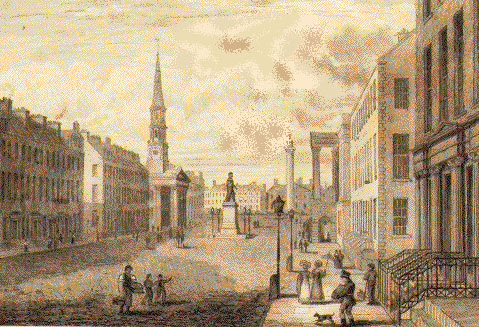
CALLER HERRING. AKA - "Culler Herren." Scottish, Slow Air (4/4 time). B Flat
Major (Neil, Skye): C Major (Carlin): E Flat Major (Martin): G Major
(O’Farrell). Standard tuning. AAB (Martin): ABC (O’Farrell): AABBCC (Neil,
Skye): AABBC (Carlin). The air is perhaps the best‑known composition of Nathaniel Gow
(1763-1831), the youngest son of Niel Gow and student of Scottish fiddlers
Alexander “King” McGlashan and Robert MacIntosh. A well‑known descriptive
piece which has retained popularity to the present (though not nearly to the
extent of pre‑war {WWII} days), it is an attempt to imitate cries of
Newhaven fishwomen as they sold their wares, mingled with chiming of the bells
of St. Andrew's Church, in George Street, Edinburgh. (George
Street, late 18th century.) Gow originally scored the tune for harpsichord
or pianoforte. Lady (Baroness) Nairne
wrote a song to the tune which tells the story of the fishwives who sold fish
caught overnight in the nearby Firth of Forth form door to door in the streets
of the city of Edinburgh to both rich and poor. They carried the fish on their
backs in large baskets or creels, braced with a leather strap which wound
around their foreheads, and "were famous, not only for their characteristic
'singing cries' but also for their personality and salesmanship" (Neil,
1991). Poet Robert Tannahill wrote a comic song called "Caller
Herrin" to the air of "The Cameronian
Rant" in 1808. A sea shanty, “Haul Away the Bowline,” is sung to this
tune.
***
David Allan. “The Edinburgh Fishwife” (c. 1788).
***
Carlin (Master Collection), 1984; No. 149, pg. 90 {appears as "Culler
Herren"). Davie's Caledonian
Repository. MacDonald (The Skye
Collection), 1887; pg. 162. Martin (Traditional
Scottish Fiddling), 2002; pg. 113. Neil (The Scots Fiddle), 1991; No. 13, pg. 17. O’Farrell (Pocket Companion, vol. II), c. 1806;
pgs. 130-131 (appears as “Caller Herrings”).
X:1
T:Caller Herring
M:C
L:1/8
R:Slow Air
S:MacDonald – Skye Collection (1887)
Z:AK/Fiddler’s Companion
K:Bb
F|B2 B>B A2 Bz/c/|(dB) c>B
A(FGA)|B2 B>B A2 Bz/c/|(dB) (cA) B3:|
|:[gb]|[fa][eg][df][eg]
[Bd][Fc][DB][gb]|[fa][eg][df][eg] [Bd][Fc][DB][gb]|
[fa][eg][df][eg]
[Bd][=Bd][ce][df]|gG ~c>B (AF)GA|B2 B>B (A2 B)z/c/|
dG ~c>B (AF)GA|B2 B>B A2
Bz/c/|de c>B B3:|
|:f|b2 b>b a2 bz/a/|(gfed)
cde=e|f2 f>f (=e2 f)z/g/|a>b g>f f3d|e2 e>e d2 e>f|
gG c>B (AFGA)|B2 B>B A2
Bg/e/|d>e d>B [D3F3B3]:|
CALLICOTT'S QUICKSTEP. AKA ‑ "Callicut's March." American, Quickstep (2/4
time). USA, Pennsylvania. D Major. Standard tuning. AABB. A fife tune collected
in Pennsylvania which Bayard (1981) conjectured was composed by an American
musician. Bayard (Dance to the Fiddle),
1981; No. 144A‑B, pgs. 79‑80.
CALLICUT'S MARCH. See "Callicott's Quickstep."
CALLING THE CLANS TO
BATTLE. AKA and see "The Battle of Clontarf."
(March).
CALLINO CASTURAME. AKA and see "Cailin og
a stuair me."
CALLIOPE HOUSE. AKA - “Caliope House.” Scottish, Double Jig. D Major (Taylor): E Major
(Martin & Hughes, Songer). Standard tuning. ABB’ (Martin & Hughes):
AA'BB' (Songer, Taylor). A popular for contra dance sets, composed by Boys of
the Lough mandolin, banjo and concertina player Dave Richardson
(Northumberland) who originally set it in E Major. Songer (Portland Collection), quotes him as saying that he wrote in while
noodling on the mandolin one day while waiting for his daughter to emerge from
the school across from the family home. The title honors Calliope House in
Pittsburgh, Pa., home of piper and arts supporter and administrator George
Balderose (Calliope was the Greek muse of poets and musicians). It has been
suggested that the D Major version came about because of Irish-style tin
whistle and flute players who find fingering in that key much more comfortable.
Both keys seem to be in general use for the tune. See also
X:1
T:Calliope House
C:Dave Richardson
M:6/8
L:1/8
R:Jig
K:E
B|:eBB gBB|fBB gBB|cff f2{gf}e|fge
c2e|~B3 B2G|
B2c e2f|1 gfg gfe|~f3 Bcd:|2 gbg
fec|e3 fga||
|:b3 gbb|fbb gbb|a3 gag|f2e c2e|~B3
B2G|B2c e2f|1
gfg gfe|~f3 fga:|2 gbg fec|e3 Bcd||
CALLIOPE RAG. American, Country Rag. The tune was composed by James Scott. Marimac 9054, The Ill-Mo Boys - "Fine As Frog
Hair" (1993).
CALLIOPE SCHOTTISCHE. Texas, Schottische or Two-Step. C Major. The Lewis Brothers were from
the border area of Texas and New Mexico. Victor
V-40187, The Lewis Brothers (“Calliope Schottische”).
CALLOCH A THEUSA. See “Cailleach a Shúsa.”
CALLOWAY [1]. AKA and see "Callahan."
D.W. Wilgus maintains tune is known as "Calloway" in the 'Breaks of
Sandy' region of eastern
CALLOWAY [2]. Old-Time. Primarily known as a banjo tune, although a version was
fiddled by John Christian of Webster County, West Virginia. According to
Gerrald Milnes, Christian remembered it was the favorite tune of a black buck
dancer who once danced at bars and county fairs in central West Virginia. The tune appears unrelated to the “Callahan”
family of tunes. Variants abound, some quite different from each other,
although the main tune heard today as “Calloway” appears to be derived from the
Hammons family of West Virginia
CALLUM BEG. See “Calum Beag [2].”
CALMFHEAR, AN. AKA and see “The Trooper.”
CALTON HILL. Scottish, Strathspey. B Flat Major. Standard tuning. AAB. Kerr (Merry Melodies), vol. 3; No. 179, pg.
21.
X:1
T:Calton Hill
M:C
L:1/8
R:Strathspey
S:Kerr – Merry Melodies, vol. 3, No. 179
(c. 1880’s)
Z:AK/Fiddler’s Companion
K:Bb
B|F>B d/c/B/A/ B2 (F>B)|G>c
e/d/c/=B/ c<G G>A|B>dc>d B/c/d/e/ f>b|g<e c>A B3:|
|:d|f>B g/f/e/d/ f<B
B>d|e<c g>c a>c g>b|f<B d>b b/a/g/f/ e/d/c/B/|g<e
c>A B3:|
CALUM A' GHLINNE. AKA and see "Malcolm of the
Glen."
CALUM BEAG [1]. Scottish, Hornpipe. A Major. Standard tuning. AA. Martin (Ceol na Fidhle), vol. 2, 1988; pg. 32.
X:1
T:Calum Beag [1]
D:Horses for Courses by the
Riverside Ceilidh Band
Z:Nigel Gatherer
M:4/4
L:1/8
K:F
c>B|A<F F2 C<F
F2|A>FA<c d2 c2|B<G G2 D<G G2|B>AB<c d2 (3cde|
f2 f2 d>c c2|d>cd<f d2
c>A|F2 F2 G2 F>G|A2 F2 F2||
F>D|C>DF>G F2
F>G|A>FA<c d2 c2|d<G G2 B<G G2|B>AB<c d2 (3cde|
f2 f2 d>c c2|d>cd<f d2
c>A|F2 F2 G2 F>G|A2 F2 F2|]
K:G
d>c|B<G G2 D<G
G2|B>GB>d e2 d2|c<A A2 E<A A2|c>AC>d e2 (3def|
g2 g2 e>d d2|e>de<g e2
d>B|G2 G2 A2 G>A|B2 G2 G2||
G>E|D>EG>A G2
G>A|B>GB<d e2 d2|e<A A2 c<A A2|c>Bc<d e2 (3def|
g2 g2 e>d d2|e>de<g e2
d>B|G2 G2 A2 G>A|B2 G2 G2|
CALUM BEAG [2]. Scottish, Country Dance Tune. G Major. Standard tuning. AB. Howe (1000 Jigs and Reels), c. 1867; pg. 141.
X:1
T:Callum
Beg [2]
M:2/4
S:Howe – 1000 Jigs and Reels (c. 1867)
Z:AK/Fiddler’s Companion
K:G
b/a/ | gG c/B/A/G/ |
FA Ab/a/ | gG Bd | g2 a/g/f/e/ | dG c/B/A/G/ | FA AB |
EF/G/ DE/F/
| G2G || d | g>a bg | a/g/f/e/ d>d | g>a bb | ba ad | g>a bb | be
eb | ad f/g/a/f/ | g2g ||
CALUM BREUGACH (Lying Malcolm). AKA – “Malcom the Liar.” Scottish, Canadian;
Strathspey. Canada, Cape Breton. A Dorian. Standard tuning. ABCD (Gow): AABCCB
(Athole). “Very Old” says MacDonald. Paul Cranford notes that the word brogach, also printed as breugach and brougach, means ‘lying’ but can also mean ‘filthy’ or ‘teasing’ as
well. Gow (Second Collection of Niel
Gow’s Reels), 1788; pg. 28 (3rd ed. Appears as “Callam
Brougach”). Gow (Beauties of Niel Gow),
Part 2. Kerr (Merry Melodies), vol.
2; No. 66, pg. 10. MacDonald (The Skye
Collection), 1887; pg. 110 (appears as “Calam Breugach”). Stewart-Robertson
(The Athole Collection), 1884; pg. 52. Culburnie Records CUL102c,
Alasdair Fraser & Jody Stecher – “The Driven Bow” (1988). Green Linnet SIF
1139, “Eileen Ivers” (1994. Recorded with Natalie MacMaster). Rounder 7041,
Doug MacPhee. Rounder 7051, John L. MacDonald with Doug MacPhee – “Formerly of
Foot Cape Road: Scottish Fiddle Music in the Classic Inverness Style” (2002).
Rounder 82161-7032-2, Bill Lamey – “From Cape Breton to Boston and Back:
Classic House Sessions of Traditional Cape Breton Music 1956-1977” (2000).
Tartan Tapes CDTT1004, Karen Steven –
“Heat the Hoose” (1998). Topic 12TS354, Alex Francis MacKay - “Cape Breton
Scottish Fiddle” (c. 1976).
|
See also listings at: Alan Snyder’s Cape Breton Fiddle
Recording Index Jane Keefer’s Folk Music Index: An
Index to Recorded Sources |
X:1
T:Callum Breugach
M:C|
L:1/8
R:Strathspey
B:Stewart-Robertson – The
Athole Collection (1884)
Z:AK/Fiddler’s Companion
K:Amin
B|G<E ~E>G D>EG>B|A/A/A e>A c>Ae>A|G<E E>G D>EG>B| c>AB>G A/A/A e:|
^f|g>g a/g/^f/e/ d/c/B/A/ G>B|A/B/c/d/ e>A c>Ae>^f|g>g a/g/^f/e/ d/c/B/A/ G>B|
c>AB>G A/A/A a2|g<be<g d<gB<G|G<gA<a B<bA<B|G<E ~E>G D>EG>B| c>AB>G A/A/A e||
|:^f|g<e e>g d>eg>a|b<a ag/a/ b<a a>b|g<e e>g d>eg>a|1 b<a a>^g a2b:|2 b<a a>^g a2a||
^f|g>g a/g/^f/e/ d/c/B/A/ G>B|A/B/c/d/ e>A c>Ae>^f| g>g a/g/^f/e/ d/c/B/A/ G>B|
c>AB>G A/A/A a2|g<be<g d<g B>g|G<gA<a B<b A>B|G<E ~E>G D>EG>B| c>AB>G A/A/A e2||
CALUM CRUBACH (Lame Malcolm). AKA and see “Devil in the Kitchen [1],"
“Devil Shake the
Half-Breed [2],” “Gille Crùbach,” “Gurren’s
Castle,” “Miss Drummond
of Perth [1],” "Miss Sarah Drummond of
Perth [1],” “Mountain Reel [4],”
“Our Highland Cousins,” "The Prince of Wales Jig,” “The Titanic Highland,” “Yorkshire Bite [1].” Scottish. The tune
is traditionally played on
***
Calum crubach as a' ghleann
till a null na caoraich thugam
Calum crubach as a' ghleann
till a null na caoraich
***
They pleadingly decry the
introduction of the Lowland shepherd and Cheviot sheep to the Highlands of
Scotland, an event that led to the infamous clearances.
Topic 12TS354, Mary MacDonald - “Cape Breton Scottish Fiddle” (c. 1976).
CALUM DONALDSON. Shetland, March. A Major. Standard tuning. AB (Martin & Hughes):
AA’BB’. Composed by the late Shetland accordion player and piano accompanist
Ronnie Cooper (d. 1982), of Lerwick, a self-taught musician. The tune has
become "popular with fiddlers throughout Britain and especially with
Scottish dance bands" (Cooke, 1986). Martin & Hughes (Ho-ro-gheallaidh), 1990; pg. 28.
X:1
T:Calum Donaldson
R:March
C:Ronnie Cooper
Z:transcribed by Ted Hastings
M:2/4
L:1/16
K:A
EAAG ABcd|eAcA eAcA|Bf‑fe f2‑fg|afec
BdcA|!
EAAG ABcd|eAcA eAcA|Bf‑fe
fgaf|1ecBc A2fg:|2ecBc A2AF||!
agab agfe|fgaf ecBA|Bf‑fe f2‑fg|afec
Befg|!
[1agab agfe|fgaf ecBA|Bf‑fe
f2gf|ecBc A2eg:|!
[2EAAG ABcd|eAcA eAcA|Bf‑fe
fgaf|ecBc A2AF||
CALUM FHIONNLAITH (Malcolm Finlay). AKA – “Calum Findlay.” AKA and see “Malcolm Finlay,” “Larry Down’s.” Culburnie
Records CUL 102, Alasdair Fraser & Jody Stecher – “The Driven Bow” (1988).
Topic 12TS354, Mike MacDougal - “Cape Breton Scottish Fiddle” (c. 1976). Green
Linnet GLCD 3127, Sharon Shannon – “The Best of Sharon Shannon: Spellbound”
(1999. Appears as “Calum Fhionnlaid,” the last tune of the “Bag of Cats”
medley). Tartan Tapes CDTT1004, Clare Mann & Aiden O’Rourke – “Heat the
Hoose” (1998).
CALUM FIGHEADAIR. AKA and see "The
Kilchattan Wedding."
CALUM SGAIRE. Scottish, Song Air. See “Oran
Chaluim Sgàire.”
CALUM’S ROAD. Scottish. Composed by bandleader Donald Shaw.
X:1
T:Calum's Road
C:Donald Shaw
S:Various sessions
Z:Nigel Gatherer
M:4/4
L:1/8
K:D
z2|D2 A>f A4|B<dd>c B>AF>A|B2 d>D F2 E>D|B,<DD>F E4|
D2 A>f A4|B<dd>c B>AF>A|B2 d>D F2 E>D|B,<DD>E D2:|]
F>A|B2 d>c B4|A>BA<E F4|B2 d>c B2 A>B|d2 d>e (3fed (3dBA|
F>A|B2
d>c B4|A>BA<E F2 E>D|B2 d>D F2 E>D|B,<DD>E D2:|]
CALVACADE OF THE BOYNE. AKA and see "Boyne Water."
CALVER LODGE. Scottish, English; Country Dance Tune (2/4 time). D Major (Kerr): G
Major (Howe). Standard tuning. AB. Calver Lodge is a branch of Masonic ritual.
Howe lists it as an “English Country Dance.” It appears in the Scottish Country Dance Book vol. 8 (No.
3). Howe (1000 Jigs and Reels), c.
1867; pg. 71. Jones [Ed.] (Complete
Tutor Violin), c. 1815; pg. 9. Kerr (Merry Melodies), vol. 1;
No. 20, pg. 29. CDLAT001, Jim MacLeod – “Buttons &
Keys, vol. 1: Best of Jim MacLeod.”
T:Calver Lodge
M:4/4
L:1/8
S:Howe – 1000 Jigs and Reels (c. 1867)
Z:AK/Fiddler’s Companion
K:G
d | g3f agfe | d^cde dedB | GedB GedB | c2A2A3d | g3f agfe | d^cde dedB |
GedB GedB | G2g2g2z || B | ABcB AGFA | GABc d3d | dcAc cBGB |
AGAB A3B | ABcB AGFA | GABc d3d | dcAc cBGB | AFGE DDEF ||
X:2
T:Calver Lodge.
M:C
L:1/8
B:Complete Tutor Violin (c. 1815)
Z:Dr. Evan Jones, 2005
K:F
d !segno!| f3 e gfed | ~c=Bcd cdcA | FdcA FdcA | B2 G2 G3 c | f3 e gfed | c=Bcd cdcA |
FdcA cBGA | F2 f2 f2 !fermata!|| a | gaba gfeg | fgab c'3 c' | c'bgb bafg | gfga g3 a |
gaba gfeg | fgab c'3 c' | c'bgb bafb gefd ccde !segno!|]
CAM NA hABHANN. Irish, Air. Ireland, County Donegal. One of the few surviving
compositions of Donegal fiddler Neillidh Boyle (1889-1961), based on the
babbling sounds of a small bend in a stream which ran outside the fiddler’s
front door [Caoimhin Mac Aoidh, 1994].
CAM'
YE BY ATHOL? Cam’ Ye by Atholl? AKA and see “Bonny Prince
Charlie (2),” “Come Ye by Atholl”. Scottish, Air (6/8 time). D Major. Standard
tuning. One part (Neil): AB (Kerr). The words to the tune were by James Hogg,
while the music was by Nathaniel
Gow's son Neil Jr. (Niel Gow's grandson, though note the difference in how
the name is spelled), born about 1795. Neil remained with his father in
***
“Cam’ Ye by Athol?” was selected by
Queen Victoria for John Wilson's (who was the most widely acclaimed singer of
Scottish songs in his day) recital during her visit to Taymouth Castle in 1842;
this shows how much wounds had healed in 100 years of Scottish/English
relations, for the tune is a 'gathering song', written about recruiting
Highlanders for the 1745 Jacobite rebellion in the cause of Bonnie Prince
Charlie against the united Hanoverian throne of England and Scotland. Neil
(1991) states that the song "belongs to the Atholl district of Perthshire
and in particular the Murrays, who played a leading role in the
insurrection," though he remarks that although the tune was inspired by
Highlands sentiments, the song's origin was in the Lowlands of Scotland. Kerr (Merry Melodies), vol. 3; No. 408, pg.
45. Neil (The Scots Fiddle), 1991;
No. 114, pg. 152.
X:1
T:Cam’ Ye by Athol?
M:6/8
L:1/8
R:Air
S:Kerr – Merry Melodies, vol. 3, No. 408 (c. 1880’s)
Z:AK/Fiddler’s Companion
K:D
F>ED (D2B)|AFd F>ED|F>EE
EFA|d>cB BAF|A>Bd edB|
BAF ABd|FE>D dcB|A<DF
(E2D)||d>AA e>AA|f>ed dcB|
A>BA ADE|F<AF (E2D)|d>AA
efg|f>ed dcB|ABA Ade|f<af (e2d)||
CAM' YE OWER FRAE FRANCE. AKA and see "Come Ye Over From France."
CAM
YOU HERE TO COORT/KISS AND CLAP HER. AKA and see "Kiss and Come Again" (?). Shetland,
Shetland Reel. Shetland, Whalsay.
***
Cam you here to kiss and clap or cam you here to scorn,
Or cam you here to kiss a lass and marry in the morn. (Cooke)
***
Greentrax CDTRAX 9009, Andrew Poleson (Whalsey, Shetlands) - “Scottish Tradition 9: The Fiddler and his Art” (1993).
CAMBDELMORE. AKA and see “Ballendaloch’s
Reel.” Scottish, Strathspey. G Major. Standard tuning. AAB. Glen (1891)
finds the melody first in print in Robert
Bremner's 1757 collection. The tune was used by poet Roberts Burns for the
first two versions of his song “Banks of Doon,” beginning in 1791. The River
Doon is in Alloway, near where Burns was born. Bremner (Scots Reels), 1757; pg. 92.
X:1
T:Cambdelmore
M:C
L:1/8
R:Reel
S:Bremner – Scots Reels (c. 1757) pg. 92
Z:AK/Fiddler’s Companion
K:G
d | “tr”B>ABd e/e/e eg | dG”tr”BA (G2 G)d | “tr”B>ABd e/e/e ea | g>eg>B A2 A :|
(a/g/ | b>)ga>e gdeg | dG”tr”(BA) G2 G(g/a/ | b>)ea>g g>aba | g>eg>B A2 A(g/a/ |
b>)ga>e g>deg | dG”tr”BA G2 Gd | “tr”B>ABd e/e/e ea | g>eg>B A2A ||
CAMBELL’S ALLEMAND. Scottish (?), Country Dance Tune (2/4 time). D Major. Standard tuning. AABB. Aird (Selections), vol. II, 1782; No. 136, pg. 50.
X:1
T:Cambell’s Allemand
M:2/4
L:1/8
S:Aird, Vol. II (1782)
Z:AK/Fiddler’s Companion
K:D
d2 fa | d2 gb | afed | ce AG | FA dF | Gceg | fedc | dDFA | d2 (f/g/a) |
d2 (g/a/b) | afed | e2 AG | F2 (f/g/a/)A/ | Bgbg | fedc | d2 D2 :|
|: d2 d’d | c’dbd | ad e/d/c/e/ | gecA | Gbd/G | Fad’f | gedc | dDFA |
d2
d’d | c’dbd | ad e/d/c/e/ | gecA | G2 (b/c’/d’/)G/ | F2 a/b/c’/f/ | gedc | d2D2
:|
CAMBO MARCH, THE. English, March. England, Northumberland. G Major.
Standard tuning. AABBCCDDEEFF. Composed by musician, teacher, composer, dancing
master and fiddler Robert Whinham (1814-1893), originally from Morpeth. Dixon
(1995) explains that Cambo is an estate village associated with nearby
Wallington Hall, on of the ‘Great Houses’ of Northumberland. Source for notated
version: the S.P. Liddell manuscript, dated 1879, along with a reconstruction
of piper Billy Pigg’s version by Colin Ross [Dixon]. Dixon (Remember Me), 1995; pg. 41. Border Keep BK15, Neil Smith – “The Legendary Neil Smith.”
EAR 016-2, Dieth Davidson & Neil Smith – “Big Men – Small Pipes.” Topic
12TS283, Ned Pearson – “Holey Ha’Penny.” Topic TSCD 669, Ned Pearson (et al) –
“Ranting and Reeling: Dance Music of the north of England” (1998. Fiddler Pearson
was born c. 1875 at Cambo, near Morpeth, Northumberland). Topic Records, Ned
Pearson – “Holey Ha’penny.”
CAMBRIDGE
(HORNPIPE) [1], THE. Irish, Hornpipe. A Major. Standard tuning. AABB. The name Cambridge
(from the original in southern England) has an interesting history. Originally
it was called Grantebricge by the Anglo-Saxons, a combination of the Old
English name for bridge (bricge) with
the inherited Celtic name Granta, whose meaning was associated with swamps. The
Normans, when they conquoured Britain, built a castle close by but found the
name difficult to pronounce and step by step changes were introduced so that
the first syllable became Crante-, then Cante-, Can- and finally Cam-
(Matthews, 1972). Taylor (Where’s the
Crack?), 1989; pg. 25.
CAMBRIDGE
(HORNPIPE) [2]. AKA and see “Chief
O’Neill’s Visit,” “Pacific Slope
[1].”
CAMBRIDGE (JIG). Canadian, Jig. Canada, Cape Breton. Composed by
Cape Breton fiddler and composer Dan R. MacDonald (1911-1976). A & M Records 79602 2000-2, Ashley MacIsaac - “Close to
the Floor” (1992).
CAMBRO-BRITON, THE. Welsh, Country Dance Tune (2/4 time). G Major.
Standard tuning. AABB. This melody is from Skillern's Country Dances for 1799 and has some similarities to "Stumpy," and "Duchess of Hamilton's
Strathspey." See Bayard's (1981) note for "Hazel Dean" for more on this tune
family. Mellor (Welsh Dance Tunes),
1935; pg. 9.
CAMCHUAIRT AN
CHONNACHTAIGH. AKA and see “The Connaughtman’s Rambles [3].”
CAMCHUAIRT MHIC
SHIACAIS.
AKA and see “Jackson’s
Rambles [2].”
CAMDEN FAIR. Scottish, Reel. G Major. Standard tuning. AAB. Carlin (Master Collection), 1984; pg. 91, No.
151.
CAMDEN TOWN. See “Return to Camden Town.”
CAMEL’S HUMP, THE. Irish, Reel. E “Arabian”. Standard tuning. AABB.
Composed by Falmouth, Massachusetts, musician and writer Bill Black. Black (Music’s the Very Best Thing), 1996; No.
126, pg. 65.
X:1
T: Camel's Hump
C: © B. Black
Q: 350
R: reel
M: 4/4
L: 1/8
K: C
B,E E2 B,E^GE | B,E^GA _BAFD | B,E E2 B,E^GA | _BAFD E2 ED |
B,E E2 B,E^GE | B,E^GA _BAFD | FE (3EDE ^GE (3EDE | _BAFD E4 :|
eB B2 ^gB B2 | (3c=BA eA fAeA | eB B2 ^gB B2 | afef e2 fe |
eB
B2 ^gB B2 | (3c=BA eA fAeA | B^G G2 AF F2 | BA^GF E4 :|
CAMERON CHISHOLM [1]. Canadian, Reel. Canada, Cape Breton. C Major. Standard tuning. AB.
Composed by Cape Breton fiddler and composer Dan R. MacDonald (1911-1976).
Cameron (Trip to Windsor), 1994; pg.
18.
CAMERON CHISHOLM [2]. Canadian, March. Canada, Cape Breton. Composed by Cape Breton fiddler
Brenda Stubbert (b.1959, Point Aconie, Cape Breton, Nova Scotia). Celestial Entertainment CECS001, Brenda Stubbert - “In Jig
Time!” (1995).
CAMERON CHISHOLM’S
STRATHSPEY. Canadian, Strathspey. Canada, Cape
Breton. E Dorian. Composed by Maybelle Chisholm Doyle in honor of her fiddling
brother, member of a family of fiddlers. See also her composition “Maybelle’s
Compliments to Her Brother Cameron.”
CAMERON GATHERING. AKA and see ““Black Donald the Piper,” “Lochiel’s March,” “Pibroch of Donald Dhu.”
CAMERON HIGHLANDERS, THE. Scottish, March. A Major. Standard tuning.
AABB (Brody): AABBCCD (Hunter). A well‑known march composed by J. Scott Skinner, first printed in his Logie Collection. Skinner titled the
piece after the famous Highland regiment in which his brother Sandy served for
eleven years in the middle of the Victorian era. Sandy survived this experience
and became a dancing master patroned by Sir Charles Forbes of New Strathdon.
Noted as having been played by him in 1921 concert tours as one of the tunes in
the romantically named set "Spey's Fury's" (Alburger). In Ireland the
tune is rendered as a barn dance. Source for notated version: Boys of the Lough
(Scotland/Ireland) [Brody]. Brody (Fiddler’s
Fakebook), 1983; pg. 61. Hunter (Fiddle
Music of Scotland), 1988; No. 347. Skinner (The Scottish Violinist); pg. 30. Philo
1026, The Boys of the Lough‑ "First Album." Shanachie 78030,
Danú – “Think Before You Think” (2000). Topic 12T280, J. Scott Skinner‑
"The Strathspey King."
X:1
T:Cameron Highlanders, The
R:Pipe march
C:J. Scott Skinner
M:4/4
L:1/8
K:Hp
|:A2ecA2eA| f2e2e2a2| A2ecA2eA| c2B2B2c2|A2ecA2eA| f2e2e2a2|
fa ea ca Ba| c2A2A2 :|*|:a2 | f2 ea c2 Aa| c2A2A2a2 |f2 ea c2 Aa|c2B2B2A2|f2 ea
c2 Aa| ec ac e2a2| fa ea ca Ba| c2A2A2:|*|:ec| A<A ec Ae cA|f2e2e2a2| A<A
ec Ae cA| c2B2B2 ec|A<A ec Ae cA |f2e2e2a2| fa ea ca Ba| c2A2A2:|*a2| fa ea
ca Ba| c2A2A2a2|fa ea ca Aa| c2B2B2a2|fa ea ca Aa|ec ac ef ga| fa ea ca Ba|
c2A2A2a2|\ fa ea ca Ba|Aa Ba ca Aa |fa ea ca Aa| c2B2B2ec|\A<A cA eA cA| eA
fA gA aA|fa ea ca Ba|c2A2A2||**
CAMERON HOUSE. AKA and see “The Buckeen,” “George Gubbin’s Delight,” “Humors of Schull,” “Lord Kelly--Strathspey,” "Lord Kelly('s Rant/Reel),"
"Mo Ceoil Sibh a Laochra"
“The Musical Priest,” "The New Bridge of Erin," “The Old Grey Gander,” “Wedding Ring [2].” Scottish, Reel. C
Major. Standard tuning. AAB. The tune appears in James Aird’s Selections of Scotch, English, Irish and Foreign Airs (1782-97).
O’Neill (Waifs and Strays of Gaelic
Melody), 1922; No. 239.
X:1
T:Cameron House
M:4/4
L:1/8
S:Aird's Selections 1782-97
Z:Paul Kinder
R:Reel
K:C
A/2B/2|EAAB cB A2|GGGA Bd c/2B/2A/2G/2|EAAB cAca|ge e/2d/2c/2B/2 cAA:||
e|a"tr"bc'a ee a2|gedg BGGe|a"tr"bc'a ee a2|ge e/2d/2c/2B/2 cAAe|
a"tr"bc'a
ee a2|gedg BGGB|ceAe aec'a|ge e/2d/2c/2B/2 cAA||
CAMERON MACFADDYEN. Scottish. Shanachie 79017, John & Phil
Cunningham ‑ "Against the Storm" (1980).
CAMERON MEN('S)
POLKA [1].
Scottish, Polka. D Major. Standard tuning. One part (Bain): AABB (Miller &
Perron). Bain (50 Fiddle Solos),
1989; pg. 34. Miller & Perron (101
Polkas), 1978; No. 39. CCF2, Cape Cod Fiddlers – “Concert Collection II” (1999).
CAMERON MEN('S)
POLKA [2].
Scottish, Polka. A Major. Standard tuning. One part (Bain): AABB (Miller &
Perron). Bain (50 Fiddle Solos),
1989; No. 23. Miller & Perron (101
Polkas), 1978; No. 40. CCF2, Cape Cod Fiddlers – “Concert Collection II” (1999).
CAMERON WALKER, THE. Canadian, Reel. Canada, Cape Breton. A Dorian.
Standard tuning. AB. A modern composition by Cape Breton fiddler Brenda
Stubbert (b. 1959, Point Aconi, Cape Breton). Cranford (Brenda Stubbert’s), 1994; No. 7, pg. 3. Celestial Entertainment CECS001, Brenda
Stubbert - “In Jig Time!” (1995).
CAMERONIAN(‘S) RANT, THE. Scottish, Reel. G Major (Kennedy, Kerr, O’Farrell): F Major (Athole, Gow, Skinner, Skye, Surenne, Thompson): F Mixolydian (Bremner, McGlashan). Standard tuning. AB (Kennedy, Surenne): AAB (Bremner, Kerr): AABB (O’Farrell, Thompson): AABCCD (Athole, Gow, Skinner, Skye). Glen (1891) finds the melody first in print in Robert Bremner's 1757 collection, although an early version also appears in the 1768 Gillespie Manuscript. English collections predate this however, for it appears in John Walsh’s Compleat Country Dancing Master, volume the Third (London, 1749) and David Rutherford’s Compleat Collection of 200 of the Most Celebrated Country Dances (London, 1756). Other Scots printings are in Niel Stewart’s Reels (Edinburgh, 1775) and James Airds first collection (Glasgow, 1782). The reel is attributed to Rory McLeod by J. Scott Skinner in his Harp and Claymore collection (1904), wherein he also gives “Black Water” as an alternate title. Cowdery (1990) assigns the tune to the "Rakish Paddy" family of tunes, which also includes the famous Scottish piece "Caber Féidh." They are related, he finds, in unusual ways; the motifs and "diagnostic tones" of the "Cameronian" are one beat behind "Caber" in both strains. The two tunes have different cadences however, and on the whole do not sound like arrangements of each other but rather as discrete and distinctive melodies. Another related melody is "John Patterson's Mare," which is a jig-time version of "The Cameronian Rant." Cazden (et al, 1982) discusses "The Cameronian Rant" in connection with "The Boyne Water" and its variants, especially the Scottish melody "Andro and His Cutty Gun," and he remarks that the Scots poet Robert Burns adapted the tune for his satirical "Battle of Sherra-Moor (Sheriff-Muir)" after obtaining the melody from James Oswald's Caledonian Pocket Companion.
***
The name Cameronian refers originally to a militant 17th century sect called "Society People" or "Cameroians" from their founder, Richard Cameron, "a field preacher who advocated a particularly uncompromising from of covenanted Christianity" (David Hackett Fischer, Albions Seed, pg. 616) in the south and west of Scotland. As a splinter group, Cameronians were hunted like animals by the authorities of the day who eventually hanged several leaders, but many survived with religion and fighting spirit intact. The British authorities finally admitted defeat in stamping out the group, but to contain them they hit upon the idea of co-opting them by recruiting members of the sect for the fight against the Roman Catholic highlanders to the north. The result was the fighting regiment called the Cameronians, the only regiment in the British army to bear the name of a religious leader. Mustered in the late 17th century, the regiment first saw battle in 1689 when 1,200 recruits broke a veteran force of 5,000 Jacobites, and earned a reputation for fierceness. In line with their militant religious origins each enlisted man was required to carry a bible in his kit, and even in the 20th century the regiment carried arms to church.
***
The melody appears in the music manuscripts of numerous period musicians, including, in England, Cheapside, London musician Walter Rainstorp (1747), Northumbrian musician William Vickers (1770), and London fiddler Thomas Hammersley (1790). In America, it can be found in the copybooks of Long Island, New York, painter and fiddler William Sydney Mount (1807-1868) on a page dated May 8th, 1845, along with the tunes “Bonnet Makers of Dundee” and “Mathewson’s Hornpipe.” Mount wrote it out twice on the page, once in the key of F, the second time in E flat major. It also appears in the c. 1800 copybook of musician William Patten (perhaps from Philadelphia, Pa.) and the 1789 music book of Cushing Eells (Norwich, Conn.).
***
Aird
(Selections of Scotch, English, Irish and Foreign Airs), vol. 1, 1782;
pg. 38. Bremner (Scots Reels), 1757;
pg. 82. Gow (Complete Repository),
Part 1, 1799; pg. 30. Kennedy
(Traditional Dance Music of Britain and
Ireland: Reels and Rants), 1997; No. 16, pg. 6. Kerr (Merry Melodies), vol. 1; Set 2, No. 6,
pg. 4. MacDonald (The Skye Collection), 1887; pg. 143. McGlashan (Strathspey Reels), c. 177?; pg. 16. O’Farrell (Pocket Companion, vol. III), c. 1808; pg. 44. Skinner (Harp and Claymore), 1904; pg. 123. Stewart-Robertson
(The Athole Collection), 1884; pg.
203. Surenne (Dance Music of Scotland),
1852; pg. 79. Thompson (Compleat Collection of 200 Favourite Country Dances,
vol. 1), 1757; No. 183. Wilson (Companion to the Ball Room), 1816;
pg. 66.
|
See also listings at: Alan Snyder’s Cape Breton Fiddle
Recording Index Jane Keefer’s Folk Music Index: An
Index to Recorded Sources
(Keyword Search for “Cameronian Rant”) |
X:1
T:Cameronian Rant, The
M:C|
L:1/8
R:Reel
B:Stewart-Robertson – The Athole Collection (1884)
Z:AK/Fiddler’s Companion
K:F
f|cF F/F/F cFAF|cF F/F/F c2 Ac|BG G/G/G BGAG|BG G/G/G c2 A:|
G|Fffg fdcA|Fffg fdcA|Ggga gfed|gfga gfed|
dffg fdcA|FAcf e2 cf|e/f/g df e/f/g de|fgag fcd||
|:f|cFdF cFAf|cF F/F/F c2 Ac|BGdG BGAG|BG G/G/G c2A:|
G|Fffg fdcA|Fffg fdcA|Ggga gfed|gfga gfed|
cffg fdcA|FAcf e2 cf|e/f/g df e/f/g de|fgag fcd||
X:2
T:Cameronian Rant, The
M:C|
L:1/8
R:Reel
S:McGlashan – Strathspey Reels
Z:AK/Fiddler’s Companion
K:Fmix
f|c>F F/F/F c>FAf|c>F F/F/F c2 A>d|B>G G/G/G B>G A>d|B>G G/G/G c2 A :|
G|Fff>g fdcA|Fff>g fdcA|Ggg>a gfed|dgg>a gfed|cff>g fdcA|Fff>g e2 cf | e/f/g dg e/f/g dg|e/f/g dg e2 d||
|:f|cFdF cFAf|cF F/F/F c2 Ad|BGdG BGAd|BG G/G/G c2A:|
G|FfFf g/f/e/d/ c/d/c/A/|FfFf g/f/e/d/ c/d/c/A/|GgGg a/g/f/e/ d/c/B/A/| GgGg a/g/f/e/ d/c/B/A/ |
FfFf g/f/e/d/ c/d/c/A/|FfFf e2 cf|e/f/g/e/ d/e/f/d/ e/f/g/e/ d/e/f/d/| e/f/g/e/ d/e/f/d/ e2d ||
X:3
T:Cameronian Rant, The
M:C|
L:1/8
B:Thompson’s Compleat Collection of 200 Favourite Country Dances, vol. 1 (London, 1757)
Z:Transcribed and edited by Flynn Titford-Mock, 2007
Z:abc’s:AK/Fiddler’s Companion
K:F
f|cF F/F/F cFcF|AF F/F/F c2 Ac|BG G/G/G BGBG|BG G/G/G c2 A:|
|:F(ff)g fdcA|F(ff)g fdcA|G(gg)a gfed|G(gg)a gfed|
F(ff)g fdcA|F(ff)g edcf|(e/f/g) dg (e/f/g) dg|(e/f/g) dg e2 f:||
CAMERONIAN REEL [1], THE (Cor Cameronac). AKA and see "Aisling Ui Chiardha,"
"Carey's Reel," "Carey's Dream," "Roger's Fancy." Irish (Scottish?),
Reel. D Major. Standard tuning. AB (Cole, O'Neill/1915 & 1001): AAB
(O'Neill/Krassen): AABB (Taylor): AA’BB’ (Harker/Rafferty): ABC (Mitchell).
David Taylor (1992) points out that the second part has changed since O'Neill (1001 Gems) was first published and that
there are several settings of this tune in common currency. Some superficial
similarity to “Rolling on the
Ryegrass.” Sources for notated versions: piper Willie Clancy (1918-1973,
Miltown Malbay, west Clare) [Mitchell]; set dance music recorded at Na Píobairí
Uilleann in the 1980’s [Taylor]; New Jersey flute player Mike Rafferty, born in
Ballinakill, Co. Galway, in 1926 [Harker]. Breathnach (CRÉ I), 1963; No. 128. Cole (1000
Fiddle Tunes), 1940; pg. 4. Harker (300
Tunes from Mike Rafferty), 2005; No. 36, pg. 12. Mitchell (Dance Music of Willie Clancy), 1993; No.
140, pg. 111. O'Neill (O’Neill’s Irish
Music), 1915/1987; No. 274, pg. 139. O'Neill (Krassen), 1976; pg. 154. O'Neill
(Dance Music of Ireland: 1001 Gems),
1907/1986; No. 731, pg. 128. Ryan’s
Mammoth Collection, 1883; pg. 26. Taylor (Through the Half‑Door), 1992; No. 35, pg. 25. Taylor (Music for the Sets: Yellow Book), 1995;
pg. 6. Tubridy (Irish Traditional Music, Vol. 1), 1999; pg. 20. Shaskeen ‑ "Atlantic Breeze". Green Linnet
SIF 1134, Cherish the Ladies – “Out and About.” Green Linnet GLCD 1187, Cherish
the Ladies – “One and All: the Best of Cherish the Ladies” (1998).
|
See also listings at: Jane Keefer’s Folk
Music Index: An Index to Recorded Sources Alan Ng’s Irishtune.info |
X:1
T:Cameronian Reel, The [1]
M:C|
L:1/8
R:Reel
K:D
B|A2 FA DAFA|GFEF GBdB|A2 FA
DAFA|GBAG FDDB|
AF F2 DF F2|GFEF GBdB|A2 AB A2
FA|B/c/d AG FD D:|
|:B|Addc d2 dA|B/c/d ef gfed|c/B/A
eA fAeA|B/c/d ef gfeg|
faeg faeg|fdec defg|afge fdec|dBAG
FA d:|
X:2
T:Cameronian Reel, The [1]
R:reel
S:Mike Rafferty
D:Mary Bergin: Feadoga Stain 2
D:Out and About, Cherish the Ladies
Z:Lesl & id:hn-reel-32
M:C|
K:D
d3B|:A2FA DAFA|GFEF GBdB|A2FA DFAF|GBAG FddB|
A{B}AFA DAFA|GE~E2 G~G2B|A2FA DFAF|GBAG FddB:||
|:Addc d3A|Bdef gfed|=cAea faeA|(3Bcd ef gfe2|
faea fae2|faeA defg|azge fdeB|dBAG FDD2:||
CAMERONIAN REEL [2], THE. AKA and see “Maid Behind the Bar [1].” Scottish,
Irish; Reel. G Major. Standard tuning. AA’BB’. A ‘G’ major setting of the tune
popular in Irish sessions as “Maid Behind the Bar.” Kerr (Merry Melodies), vol. 4; No. 134, pg. 16.
X:1
T:Cameronian Reel, The [2]
M:C|
L:1/8
R:Reel
S:Kerr – Merry Melodies, vol. 4, No. 134
(c. 1880’s)
Z:AK/Fiddler’s Companion
K:G
(dc)|:Bdde dcBG|Bdde dega|beed
efga|bgaf gfed|
Bdde dcBG|Bdde dega|beed efga|bgaf
g2||
(dc)|Bcdc BGGB|BGdc BGGB|c2 (cd)
eAAB|cAeA (cA)|
Bcdc BGGB|BGdc BGGB|gfed (3efg
(af)|gedB G2||
CAMERONIAN REEL [3], THE. AKA and see “The
Mother’s Delight,” “Old Cameronian.”
Irish, Reel. G Major. Standard tuning. AA’BB. A popular reel in County Donegal,
unrelated to “Cameronian Reel [2].” John Doherty knew it as “Bundle and Go [5],” and his version
shifts tonality between major, mixolydian and dorian modes. Paul de Grae finds
that the tune appears as “The Mother’s Delight” in Breathnach’s CRÉ II (No. 240) in the key of D Minor,
and as “Malloy’s Favorite” in CRÉ III (148) in G, from the playing of
Michael Coleman. Caoimhin Mac Aoidh agrees, saying the tune transcribed from
Doherty in The Northern Fiddler is not his “Cameronian Reel” (which can be
found on Doherty’s CD entitled “The Floating Crowbar”) but is “The Mother’s
Delight.” Source for notated version: fiddler John Doherty (1895-1980, County
Donegal) [Feldman & O’Doherty]. Feldman & O'Doherty (The Northern Fiddler), 1979; pg. 67.
CAMERONIAN'S MARCH. AKA ‑ "Cameronian's Rant"? Scottish, Reel. Instructions
for the reel were written down by John McGill, a dancing master in Girvan in
1752, for his students.
CAMERONIAN'S RANT, THE. AKA and see "The
Cameronian Rant."
CAMERON'S FAVORITE (LANCASHIRE). Scottish, Clog (Hornpipe). G Major. Standard
tuning. AABB. Identified as Scotch in Ryan’s
Mammoth Collection. Cole (1000 Fiddle
Tunes), 1940; pg. 122. Ryan’s Mammoth
Collection, 1883; pg. 160.
X:1
T:Cameron’s Favorite
M:C
L:1/8
R:(Lancashire) Clog
S:Ryan’s Mammoth Collection (1883)
Z:AK/Fiddler’s Companion
K:G
(d>.c) | (B>.d)(g>.f) g2
(d>.c) | B>dg>f g2 d>c | B>ba>g f>ed>^c | d>fa>g
f>ed>c |
B>dg>f g2 d>c |
B>dg>f g2 g>f | e>fg>e f>ga>f | g2b2g2 :: (g>.a) |
(b>.a)(b>.g) a2 (e>.f) |
g>fg>e d2 d>B |
c>de>c B>cd>B | A>^GA>B A2 g>a | b>ab>g a2 e>f |
g>fg>e d2 g>f |
e>fg>e f>ga>g | g2b2g2 :|
CAMERON’S GATHERING. See “Black
Donald’s March to the Isles.” David Murray, in his book Music of the Scottish Regiments
(Edinburgh, 1994), notes that several tunes have had the title “The Cameron’s
Gathering,” one of them called “Chlanna nan con, thigibh a seo ‘s gheibh sibh
feòil” (Sons of dogs, come here and get meat), which is the slogan or war cry
of Clan Cameron. .
CAMERON'S
GOT HIS WIFE AGAIN (Broigas Fada air
Maighistir Ord).
AKA – Cameron Has Got His Wife Again.” Scottish (originally), Cape Breton; Reel
and Strathspey. D Major (most versions): D Mixolydian (Bremner). Standard
tuning. AB (Howe, Surenne): AAB (Carlin, Cranford/Holland, Gow, Honeyman,
Hunter, Kerr): AABB (Bremner, Jones): AABB' (Athole, Skye). A popular and
well-known Scottish reel in both strathspey and reel variants. The title may
refer, somewhat crudely, to Cameron’s wife’s pregnancy. Mary Ann and William
Hastings Hughes, in their book Letters and Recollections of Sir Walter Scott
(1904), record the following in regard to the rather indelicate title and the
prudish King George:
***
…after dinner one day while (Gen?) was playing
in the adjoining room, the King was
particularly pleased with an air and sent the
Duke of Buccleugh to inquire the name:
the boy came running back, and Sir Walter (Scott)
who knew what was coming
longed to intercept him, but there was no
help—“Sir, the air is, Cameron has got
his wife again”—everybody felt awkwardly, but
the King instantly relieved them by
smiling, and pretending to shudder and saying,
“Oh! that is too much for me, you will
send me off from you.”
(pg. 63).
***
Robert
Burns suggested “Cameron’s got his wife again” or “Ruffian’s Rant” as the air
to a bawdy old Scots countryside song, adapted for The Merry Muses of Caledonia (c. 1800), called “Yon, Yon, Yon,
Lassie”:
***
I never saw a silken gown,
But I wad kiss the sleeve o’t;
I never met a maidenhead,
But I wad spear the leave ot’.
O yon, yon, yon, lassie,
Yon, yon, yon;
I never met a bonnie lass
But what wad play at yon.
***
John Glen
(1891) finds the tune earliest in print in Robert
Bremner's 1757 Scots Reels or Country
Dances (pg. 4), while another early version appears in the 1769 Gillespie Manuscript. It also was
included in Northumbrian musician William Vickers’ 1770 music manuscript book.
Later the tune appears in James Aird’s Selection of Scotch, English, Irish
and Foreign Airs (vol. 4, 1796) and in
***
Bremner (Scots Reels), 1757; pg. 4 (appears as
“Cameron has got his Wife again”). Carlin (The
Gow Collection), 1986; No. 238 {listed as a reel}. Cranford (Jerry
Holland: The Second Collection), 2000; No. 92, pg. 37. Gow (Third Collection of Niel Gow’s Reels),
1792; pg. 17 (3rd ed.). Honeyman (Hornpipe, Strathspey and Reel Tutor), 1898; pg. 10. Howe (1000 Jigs and Reels), c. 1867; pg. 127. Hunter (Fiddle Music of Scotland), 1988; No. 93. Jones [Ed.] (Complete Tutor Violin), c. 1815; pg. 3. Kerr (Merry Melodies), vol. 1; Set 14, No. 5, pg. 10. MacDonald (The Skye Collection), 1887; pg. 45.
Stewart-Robertson (The Athole Collection),
1884; pg. 84. Surenne (Dance Music of
Scotland), 1852; pgs. 122-123 (appears as “Cameron’s Wife”). Fife Strathspey and Reel Society – “The Fiddle Sounds of
Fife” (1980). Parlophone GEP8735, Jimmy Shand – “Waltzing Thru’ Scotland.”
Topic TSCD 602, The Four Provinces Orchestra – “Irish Dance Music” (1995.
Appears as “Cameron’s Wife,” and is a reissue of the original 1928 recording).
|
See also listings at: Alan Snyder’s Cape Breton Fiddle Recording
Index |
X:1
T:Cameron’s Got His Wife Again
M:C|
L:1/8
R:Strathspey
B:Stewart-Robertson – The
Athole Collection (1884)
Z:AK/Fiddler’s Companion
K:D
f | d>BA>F A/A/A A>B | d>BA>F E/E/E ~E>c | d>BA>F A<g f>e |
d>BA>F D/D/D D :: g | f>df>a e<g f>e | f>d f<a B/B/B B>g |1 f>df>a e<g f>e |
d>BA>F D/D/D D :|2 f>ga>f e<g f>e |
d>BA>F D/D/D D ||
X:2
T:Cameron
has got his wife again
M:C
L:1/8
R:Strathspey
B:Gow – 3rd Collection of Niel Gow’s
Reels, 3rd ed., pg. 17
(orig. 1792)
Z:AK/Fiddler’s Companion
K:D
B|({A/B/}d>)BAF A/A/A AB|({A/B/}d>)BAF E/E/E Ec|{c}d>BAF Ag”tr”f>e|”tr”d>BAF D/D/D D:||
g|f<df>a e<g”tr”f>e|fdfa B/B/B Bf|(d/e/f/g/) af {f}e>def|{c}d>BAF D/D/D Dg|
f<df<a e<g”tr”f>e|f<df<a B/B/B B>g|f<da<f e<g”tr”f>e|{c}d>BAF D/D/D D||
X:3
T:Cameron’s got his wife again
M:C|
L:1/8
R:Reel
S:William Vickers’ 1770 music manuscript book (Northumberland)
K:D
B|dABF A/A/A AB|dABF E/E/E Ee|dABF Dgfe|dBAF D/D/D D:|
|:g|fdaf egfe|fdfa B/B/B Bg|fdaf egfe|dBAF D/D/D D:|
CAMERONS OF SHEILDAIG, THE. Scottish, March (2/4 time). A Major. Standard
tuning. AABB'CC'D. Composed by K.C. Mackay. Martin (Ceol na Fidhle), ol. 1, 1991; pg. 28.
_______________________________
HOME ALPHABETICAL
FILES REFERENCES
© 1996-2010 Andrew Kuntz
Please help maintain the viability of the Fiddler’s
Companion on the Web by respecting the copyright.
For further information see Copyright and Permissions Policy or
contact the author.
[COMMENT1]This was
Font/Pitch 1,10 - Off.
[COMMENT2]This was Font/Pitch 1,10 - On.
[COMMENT3]This was Font/Pitch 1,10 - Off.
[COMMENT4]Note: The change to pitch (12) and font (1) must be converted manually.