The
Fiddler’s Companion
© 1996-2009 Andrew Kuntz
_______________________________
HOME ALPHABETICAL FILES REFERENCES
|
SIR |
|
Notation
Note: The tunes below are recorded in what
is called “abc notation.” They
can easily be converted to standard musical notation via highlighting with
your cursor starting at “X:1” through to the end of the abc’s, then
“cutting-and-pasting” the highlighted notation into one of the many abc
conversion programs available, or at concertina.net’s incredibly handy “ABC
Convert-A-Matic” at http://www.concertina.net/tunes_convert.html **Please note that the abc’s in the Fiddler’s
Companion work fine in most abc conversion programs. For example, I use
abc2win and abcNavigator 2 with no problems whatsoever with direct
cut-and-pasting. However, due to an anomaly of the html, pasting the abc’s
into the concertina.net converter results in double-spacing. For
concertina.net’s conversion program to work you must remove the spaces
between all the lines of abc notation after pasting, so that they are
single-spaced, with no intervening blank lines. This being done, the F/C
abc’s will convert to standard notation nicely. Or, get a copy of
abcNavigator 2 – its well worth it.
[AK] |
SIR ADAM FERGUSON. AKA and see “Adam Ferguson's Reel,” “Lads of Leith [2],” “Lads of Laois{e},” “Sic a Wife as I hae Gotten.” Scottish, Reel. E Minor. Standard tuning. AAB. John Glen (1891) finds the earliest appearance of the tune in print in John Riddell's 1766 collection (pg. 14). Sir Adam Ferguson (1733-1813) was MP for Ayrshire and a friend of writer Sir Walter Scott (according to Henry Cockburn, Memorials of His Time, 1856).
X:1
T:Sir Adam Ferguson's Reel
T:Lads of
T:Sic a Wife as I hae Gotten
B:Riddell's Collection (via Murdoch
Henderson)
Z:Nigel Gatherer
M:4/4
L:1/8
K:Em
B,EEF E/F/G FE | A,DDE D/E/F ED |
GFED EFGA | Bedc B2 E2 :|]
eB BA/B/ gfed | Adfa gfed | eB BA/B/
gfed | g>bag f2 ed |
eB BA/B/ gfed | Adfa gfed | g>bge
fafd | gfed e2 E2 |]
SIR ALEX MACDONALD'S
REEL. AKA and see “The Braes of Mar [1],” “Johnny Will/Won't You
Marry Me?” “Lord MacDonald [1],”
"Strath Spray's Rant."
Scottish, Reel. D Major. Standard tuning. AABBCC. Appears in David Young's Duke
of Perth MS (also known as the Drummond Castle MS), 1734. Glen (1891) finds it
in Bremner's 1757 collection, where
he directs: “In this Reel the 1st part is played twice over between
the 2nd & last parts.” Bremner (A Collection of Scots Reels), 1757; pg. 22.
X:1
T:Sir Alex’r McDonald’s Reel
M:C|
L:1/8
R:Reel
B:Bremner – Scots
Reels (1757)
Z:AK/Fiddler’s Companion
K:D
F(AA)(f/g/ a)fed | gfed BdBA | F(AA)(f/g/ a)fed | (e/f/g) (f/g/a) “tr”e2 d2 :|
|: FAA>B A>BAF | G/G/G G2 GABG | F(AA>)B (A>B)AF | GBAF “tr”E2D2 :|
|:
(f/g/a) a>b a>baf | g/g/g g2 g>aba | (f/g/a) a>b a>baf | gafg
“tr”e2d2 :|
SIR ALEXANDER CUMMING. Scottish, Reel. G Major. Standard tuning. AAB. Composed by Alexander
Walker in honor of Sir Alexander Cumming, Baronet of Altyre.
SIR
ALEXANDER DON [1]. Scottish, Strathspey. F Major.
Standard tuning. AB. "Composed by Major Logan," asserts MacDonald in
the Skye Collection. The attribution
refers to Major William Logan of Ayr, a well-respected gentleman-fiddler (see “Major Logan’s Frolic”
for more). See note for "Auld Lang Syne,”
for which this tune bears similarities.
***
Sir
Alexander Don, 5th Baronet, of Newton-Don, Berwickshire, was born in
1751 and died in 1815. He married in 1778 the ‘divine’ Lady Harriet (Henrietta
Cunningham), sister of the Earl of Glencairn, a patron of the poet Robert
Burns. The couple’s two daughters died of accidental drowning in 1793, but a
son survived to take the title upon his father’s death. A grandson, William
Don, however, left the army deeply in debt, and had to part with what remained
of the estate. He became a well-known actor and died in 1861 in
***
The melody “The Caledonian Hunt [1]” was composed
by Alexander Don, who, along with other gentry, formed the Caledonian Hunt
society whose annual ball was the
event of the year among the Scottish aristocracy of his era. Sir Alexander even
presented Nathaniel
Gow (whose band often provided the music for the ball) with a valuable
Italian violin, in admiration of Gow’s music. Variation sets for “Miss Ketty Hall” are also attributed
to him (and Nisbet of Dirleton). MacDonald (The
Skye Collection), 1887; pg. 144. Surenne (Dance Music of
X:1
T:Sir Alexander Don [1]
M:C
L:1/8
R:Strathspey
S:MacDonald – Skye Collection (1887)
Z:AK/Fiddler’s Companion
K:F
c/B/|AFF>A Bdd>B|Acc>A
BGGc/B/|AFF>A BddB|c>f e/f/g/e/ fFF c/B/|AFF>A Bdd>B|
AccA BGGc/B/|AFF>A BddB |c>f
e/f/g/e/ fFF||c|f<ag<a f2 cB|AF (d/c/)B/A/ BGGc|
f<ag<a f<a c>A|BG c>B
AFFc|f<ag<a f2 cB|AF (d/c/)B/A/ BGGc|f<ag<a f<a c>A| B<G
c>B AFF||
SIR ALEXANDER DON [2]. Scottish, Strathspey. D Major. Standard tuning. AB. "From the
Opera of Rosina" (Gow). Rosina
(1782) was a very successful comic opera by the once-popular English light
composer William Shield (1748-1829). “Sir Alexander Don” is the theme from the
overture, and sounds quite like “Coming Through the Rye.” Carlin (The Gow Collection), 1986; No. 212. Gow
(The First Collection of Niel Gow’s Reels),
1784 (revised 1801); pg. 10.
X:1
T:Sir Alexander Don’s [2]
M:C
L:1/8
R:Strathspey
S:Gow – First Collection of Niel
Gow’s Reels (1784)
Z:AK/Fiddler’s Companion
K:D
A,|D<D D>F “tr”E>DEF|D<D
D>F A3d|D<D D>F “tr”E>DEF|D>B,B,>A, D3A,|D<D D>F
“tr”E>DEF|
D<D D>F A3d|D<D D>F
E>DEF|D<B, ~B,>A, D3||B|A<F F>D FEEF A<F F>D F3B|A<F
F>D “tr”E>DEF|
D<B,”tr”B>A, D3B|A<F F>D
“tr”FEEF|AFFD [D3B3] (c/d/)|(B/A/G/F/) (G/F/E/D/)
“tr”E>DEF|D<B,”tr”B,>A, D3||
SIR ALEXANDER DON [3]. Scottish, Strathspey. G Minor. Standard tuning. AABCD. Composed by Robert Mackintosh. Glen (The Glen Collection of Scottish Dance Music),
vol. 2, 1895; pg. 35.
X:1
T:Sir Alexander Don
M:C
L:1/8
R:Strathspey
S:Glen Collection, vol. 2
(1895)
Z:AK/Fiddler’s Companion
K:G Minor
d|B<G G>D B,A,G,B|A/G/F c/B/A
fcAf|B<G G>D B,<A,G,<g|f/e/d/c/ d/c/B/A/ BGG:|
d|g<dB<G
b<gd<B|f<cA<F a<fc<A|b<dB<G b<gd<B|c>e
d/c/B/A/ BGGd|
g<dB<G
b<gd<B|f<cA<F a<fc<A|d<bc<a B<gA<^f|g>e
d/c/B/A/ BGG||D|
G,<DB,<G
D<dB<G|A,<FC<F A,<cA<F|G,<DB,<G D<dB<G|c>e
d/c/B/A/ B<GGD|
G,<DB,<G
D<dB<G|A,<FC<F A,<cA<F|G<BD<G B,>DC>E D>CB,>A,
B,G,G,||
d|B/a/g d/c/B b>g d<B|A/G/F
c/B/A a>f c<A|B/A/G d/c/B b>g d<B|
A/B/c d/c/B/A/ BGGd|B/A/G d/c/B
b>g d<B|A/G/F c/B/A a>f c<A|d<bc<a B<gA<^f| g>e
d/c/B/A/ BGG||
SIR ALEXANDER DON [4]. Scottish, Jig. D Major. Standard
tuning. AB. Composed by Nathaniel Gow
(1763-1831) as the first tune in a medley, followed by the reel “Sir Alexander
Don [5].” Gow (Sixth Collection of Strathspey Reels), 1822; pg. 22.
X:1
T:Sir Alexander Don [4]
M:C
L:1/8
R:Jig
C:Nathaniel Gow (1763-1831)
N:The first tune of a jig and reel
medley
N:”Briskly. May be played Slowly
when not Danced.”
B:Gow – Sixth Collection of
Strathspey Reels (1822)
Z:AK/Fiddler’s Companion
K:D
B|AGF {G}FED|DED {G}FED|DED FED|FGA
Bcd|AFA {c}d3|
cBA {c}d3|”tr”B>cd AGF|E>FE
GAB|AGF {G}FED|DED {G}FED|
DED {G}FED|FGA Bcd|AFA {c}d3|cBA
{c}d3|”tr”B>cd AGF|E>FE GAB||
A>BA A2g|”tr”fef d2B|A>GA A2
d/e/|fdB Bcd|A>BA A2 g|”tr”fef d2 d/e/|
fdB AGF|BGE EGB|A>BA A2g|”tr”fef
d2B|A>BA A2d/e/|
fdB Beg|fdf ece|dcB A2 B/c/|dcB
AGF|BGE GAB||
SIR ALEXANDER DON [5]. Scottish, Reel. D Major. Standard tuning. AB. A later composition by Nathaniel Gow
which Collinson (1966) uses as an example of the progress of the Gow family's
compositions away from the strict confines of the old modes and gapped scales.
It was composed as the second tune in a medley set, preceded by the jig “Sir
Alexander Don [4].” Gow (Sixth Collection of Strathspey Reels), 1822;
pgs. 22-23.
X:1
T:Sir Alexander Don’s [5]
M:C
L:1/8
R:Reel
C:Nathaniel Gow (1763-1831)
N:The second tune of a jig and reel
medley
B:Gow – Sixth Collection of
Strathspey Reels (1822)
Z:AK/Fiddler’s Companion
K:D
A|~d2 fd (dc) BA|~d2 fd (dc) BA|~d2
fd ge ^ge|aABc d3A|~d2 fd (dc) BA|
~d2 fd ge ^ge|aA Bc d3||f/g/|bf
.^d.d bB (ba)|(ge) .c.c (aA) ag|(fe)dd “tr”B2 ed|
cABc defg|agfe ^dBba|gfed cAag|fedc Bded|cABc d2D||
SIR ALEXANDER DUNBAR’S
STRATHSPEY. AKA and see “Sir Archibald Dunbar.”
SIR ALEX. McDONALD'S
REEL. AKA –
“Sr. Alexander McDonald’s Reel.” AKA and see “Braes of Mar.” Scottish, Reel. D Major.
Standard tuning. AABBCC. The melody appears in the Drummond Castle Manuscript (in the possession of the Earl of
Ancaster at Drummond Castle), 1734, inscribed "A Collection of the best
Highland Reels written by David Young, W.M. & Accomptant." The melody
also appears in the Robert Bremner's
1757 collection and the Gillespie
Manuscript of Perth (1768) and James Aird’s Selections of Scotch,
English, Irish and Foreign Airs, vol. 1 (Glasgow, 1782). English printings
include Charles and Samuel Thompson’s Compleat Collection, vol. 3
(London, 1773), Straight and Skillern’s Two Hundred and Four Favourite
Country Dances, vol. 1 (London, 1775), and Longman and Broderip’s Compleat
Collection of 200 Favorite Country Dances (London, 1781). Versions in
manuscript form can be found in the 1780 copybook of fiddler John Fife
(Perthshire, Scotland, who also appears to have compiled some of his ms. at
sea), Jeremiah Brown’s (Seabrook, N.H.) 1782 commonplace book, and the 1788
commonplace book of fiddler John and William Pitt Turner (Norwich, Conn.). The
latter probably copied it from the Thompson’s 1773 collection, along with
numerous other tunes from the publication. Thompson (Compleat
Collection of 200 Favourite Country Dances, vol. 3), 1773; No. 135.
X:1
T:Sr Alexander McDonald’s Reel
M:C|
L:1/8
B:Thompson’s Compleat Collection of 200 Favourite Country Dances, vol. 3 (London, 1773)
Z:Transcribed and edited by Flynn Titford-Mock, 2007
Z:abc’s:AK/Fiddler’s Companion
K:D
F(AA)(f/g/)
afed|gfed BdBA|F(AA)(f/g/) afed|(e/f/g) (f/g/a) e2 d2:|
|:F(AA)B ABAF|G/G/G G2 GABG|F(AA)B ABAF|GBAF E2D2:|
|:(f/g/a) ab a>baf|g/g/g g2 gaba|f/g/a ab a>baf|fafg e2 d2:||
SIR ALLAN McLEAN. Scottish. John Glen (1891) finds the earliest printing of the tune in Robert Ross's 1780 collection (pg. 37).
SIR ARCHIBALD
CAMPBELL'S JIG. The version in The Scottish Country
Dance Book is reprinted from a 1788 collection of Joshua Campbell. The first half equals
the first of "Dublin Jig [3]".
Scottish Country Dance Book, 1930‑57,
Pt. 15, No. 3 (second tune).
SIR ARCHIBALD DUNBAR. AKA – “Sir Alexander Dunbar.” Scottish, Strathspey. D Mixolydian.
Standard tuning. The melody was first published (as “Sir Alexander Dunbar”) in
Alexander “King” McGlashan’s 3rd
collection (1786). Sir Alexander Dunbar (1742-1791) of Northfield succeeded to
the title of 5th baronet Dunbar in 1776. Sir Archibald Dunbar
(1772-1847) was his son, and succeeded as 6th baronet. The Dunbar
men appeared to have been typical Scottish aristocrats, concerning themselves
with hunting, fishing and drinking, however one was truly remarkable.
Alexander’s half-brother William Dunbar (1750-1810, by their father’s second
wife) was an explorer, merchant, naturalist and astronomer who emigrated to
America at the age of 21. Establishing himself as a merchant the increasingly
successful Dunbar parlayed himself into a plantation empire along the
Mississippi at Baton Rouge and Natchez. A corresponding friend of President
Thomas Jefferson, Dunbar’s scientific achievements became know to the American
establishment, and Jefferson picked him to lead an expedition into the
unexplored Red River territory west of the Mississippi. AAB (Cranford/Holland,
Gow): AABB (Perlman, Skye): AABB' (Athole, Kerr). Source for notated version:
Paul MacDonald (b. 1974,
|
See also listings at: Alan Snyder’s Cape Breton Fiddle
Recording Index |
X:1
T:Sir Archibald Dunbar
M:C|
L:1/8
R:Strathspey
B:Stewart-Robertson – The
Athole Collection (1884)
Z:AK/Fiddler’s Companion
K:D
F|D/D/D F>D G>E =C>E|D/D/D F>D A>DF>D|A>DF>D G>E=C>E| D<d A>F D/D/D D:|
|:f|d<d f>d g>e=c>e|d<d f>d a>df>d|1
a>df>d ge=ce|D<d A>F D/D/D D:|2 a>df>d g>e=c>e|d<b
a>f d/d/d d||
SIR
ARCHIBALD GRANT OF MONEMUSK'S REEL. AKA and see "Money Musk/Monymusk(, Sir Archibald
Grant of)." Scottish, Strathspey. G Major. Standard tuning. AAB (Alburger,
Johnson, McGlashan): AABB' (Johnson). Either composed or set (the latter
according to a note in Gow's Caledonian
Repository) by Donald/Daniel Dow
(1732‑1783) in 1776, whose c. 1780 Thrity‑Seven
New Reels & Strathspeys is
the earliest appearance of the tune in print. Two earlier tunes are either
models or cognate airs, depending on whether Dow actually did compose the tune
or not, namely "Roy's Wife
of Aldivalloch" and "The
Ruffian's Rant." Sir Archibald founded the town of
X:1
T:Sir
Archibald Grant’s Reel
M:C|
L:1/8
R:Strathspey
S:McGlashan
– Reels (c. 1786)
Z:AK/Fiddler’s Companion
K:G
e|d<G
B>G d>Gc>e|d<G B>G A/B/A ce|d<G B>G B/c/d
d>g|e>cA>d B>G G:|
(g|g)>dd>g
B>gd>f|g>dcg B>gA>f|g>de>g d>gB>g|e>cA>d
B>GG>(g|
g)>dc>g
B>gA>(f|g)>de>g d>gc>g|B>gA>g B>G G||
SIR ARTHUR SHAEN. Irish, Planxty. G Minor. Standard tuning. AB. Composed by Turlough
O'Carolan. Complete Collection of
Carolan's Irish Tunes, 1984; No. 159, pg. 108.
SIR ARTHUR WELLESL(E)Y’S DASH.
English, Waltz. G Major. Standard tuning. AABB. Sir Arthur Wellesley
became the Duke of Wellington, the victor at Waterloo over Napoleon. At the
time of Cahusac’s publication (1809) he was involved in aiding the Portuguese
against in their revolt against the French on the Iberian Peninsula. The
campaign lasted some eight years and eventually culminated in the invasion of
France and the capture of Toulouse in 1814, following which Napoleon abdicated.
Cahusac (Annual Collection of Twenty Four Favorite Country Dances for 1809),
1809; No. 11.
X:1
T:Sir Arthur Wellesly’s [sic] Dash
M:3/8
L:1/8
R:Waltz
B:WM Cahusac – Annual Collection
of Twenty Four Favorite Country Dances for 1809, No. 11 (London)
N:”With proper Directions to each Dance as they are performed at
N:Court, Bath, and all Public Assemblies.”
Z:Transcribed and edited by Flynn Titford-Mock, 2007
Z:abc’s:AK/Fiddler’s
Companion
K:G
(d/c/)|BBB|Bcd|efg|d2
(d/c/)|BBB|ecA|G2 (A/G/)|F2 (d/c/)|
BBB|Bcd|efg|{^g}a2
(f/d/)|B(=g/f/e/d/)|^c(a/b/a/g/)|fdd|d2:|
|:a/f/|def|gab|.c’(c’/a/b/g/)|a/f/dd|{a}gfe|{e}(c/B/A/G/)|.B(d/c/A/B/)|B2:||
SIR CHARLES COOTE. AKA and see "Planxty
Charles Coote." Irish, Planxty. C Major. Standard tuning. AAB.
Composed by Turlough O'Carolan. Complete
Collection of Carolan's Irish Tunes, 1984; No. 18, pg. 34.
X:1
T:Sir
Charles Cotton’s Hornpipe
M:C
L:1/8
R:Hornpipe
B:WM Cahusac – Annual Collection of Twenty Four Favorite Country Dances for 1809, No. 17 (London)
N:”With proper Directions to each Dance as they are performed at
N:Court, Bath, and all Public Assemblies.”
Z:Transcribed and edited by Flynn Titford-Mock, 2007
Z:abc’s:AK/Fiddler’s Companion
K:D
F>G|A2A2
BAGF|G2E2E2zf|gfge cecA|d2D2D2 f>g|
A2d2d3f|ec
a2 aedc|dfBd ce^GB|A2A2A2:|
|:A>G|F2D2D2
d>c|B2G2G2 B>A|^G2 E2 E2 e>d|c2A2A2 zc|
dfaf
dAB=c|BGdB g3e|fadf egec|d2d2d2:|
SIR CHARLES DOUGLAS. AKA and see “Caillich
Odhar.” Scottish, Strathspey. D Major. Standard tuning. AAB. Composed by Nathaniel Gow
(1763-1831) in honor of Sir Charles Douglas, Bart. (d. 1789), a British admiral
and a descendent of the Scottish earls of Morton.
X:1
T:Sir Charles Douglas’s Strathspey
M:C
L:1/8
R:Strathspey
S:O’Farrell – Pocket Companion, vol. III (c. 1808)
Z:AK/Fiddler’s Companion
K:D
ADAF ADDB | ADFD F/G/A d2 | ADFD ADAF | GdFd E23B2 :|
A<d d>f edcB | A<d d>f ef g2 | A<d d>f ecdA | BdFd E2B2 |
A<d d>f edcB | Addf ef g2 | faef dfBd | AdFd E2B2 ||
SIR CHARLES FORBES BART. OF NEWE. Scottish, Strathspey. A Major.
Standard tuning. AB. Composed by Alexander Walker for his patron; he notes
"slow, when not danced."
SIR CHARLES FORBES OF NEW(E) AND EDINGLASSIE. Scottish, Slow Strathspey. F Minor.
Standard tuning. AB. Composed by William Marshall (1748-1833).
X:1
T:Sir Charles Forbes of New and Edinglassie
M:C
L:1/8
R:Strathspey
S:
Z:AK/Fiddler’s Companion
K:Fmin
C|F>GA>B A/G/F/E/ c/B/A/G/|F>GA>B dA, cB/A/|Ge ed/c/ B/A/G/F/ E>G|
B/A/G/F/ A/G/F/E/ F2 FC|F>GA>B A/G/F/E/ c/B/A/G/|F>GA>B cA, cB/A/|
Be ed/c/ B/A/G/F/ E>G|B/A/G/F/ A/G/F/E/ F2F||c|f>ga>f geeg|f>ga>f a/g/f/=e/ fg|
f>gab geeg|f>ec=e f2 fc|f>ga>f geeg|fagb af
g=d|=e/d/c/B/ eB GEEG|F/G/A/B/ cC F2F||
SIR CHARLES SEDLEY'S
MINUET. Scottish, English; Minuet (3/4
time).
X:1
T:Sir Charles Sedley’s Minuet
M:3/4
L:1/8
R:Minuet
Z:AK/Fiddler’s Companion
K:D
d2 fdec | d2e2f2 | A2 BcdB | A2G2F2
| D3 FEG |
F2 DFEG | F2 GFED | A6 :: AFDFA=c |
B2 AB G2 | B^GEGBd |
c2 Bc A2 | ecAceg | fdec d2 | fdec
d2 | Ag f2e2 | d6 :|
X:2
T:Sir Charles Sedley's Minuet
C:Traditional
S:GINA LE FAUX "Masquerades And Operas" Lefaux Music LFM004
N:Ms Le Faux writes to say she “recorded the tune on an 18th century
N:fiddle which is in its original condition with gut strings tuned down to
N:old
pitch. This version is in the key of D, old pitch, and not C.” [A.K.]
S:The CD notes list the 1760 Joseph Barnes manuscript as the source.
M:3/4
L:1/8
K:D
(3ABc |: d2 +d2f2+ +d2f2+ | d2e2f2 | A2 Bc dB | A2G2F2 |
DF EG FA | A2G2A2 | +A,4G4+ +A,4F2+ |[1 +A,4E4+ (3ABc :|
[2 +A,4E4+ AB |: AF DF A=c | B2A2G2 | BG EG Bd | c2B2A2 |
ec Ac eg | f2e2d2 | a4c2 | [d4 dB :| [2 d4 ||
SIR CHARLES'S RANT. English, Jig.
SIR
DAVID DAVIDSON OF CANTRAY. Scottish, Canadian; Reel.
|
See also listings at: Alan Snyder’s Cape Breton Fiddle
Recording Index Jane Keefer’s Folk Music Index: An
Index to Recorded Sources |
T:Sir David Davidson of Cantray
M:4/4
L:1/8
R:Reel
K:D
A|d2 fd cdBd|AdFd EecA|d2 fd
cdAF|GEec d2 dA|
d2 fd cdBd|AdFd EecA|d2 fd cdAF|GEec
d2 d:|
|:f|afdf afba|gfed cdef|gfed
cbag|fedc d2 df|
afdf afba|gfed cBAG|FAdc Bbge|cABc
d3:|
SIR DAVID HUNTER BLAIR('S REEL). Scottish, Reel. F Major (Athole,
Campbell, Kerr, Martin): G Major (Surenne): D Major (Huntington). Standard
tuning. AB (Surenne): AAB (Kerr): AABB (Athole, Huntington, Martin). Sir David
Hunter Blair (1778-1857), 3rd Baronet, Blair, became a religious man
and was involved in the printing of Bibles, as well as serving as the
Deputy-Lieutenant and Convener of the
X:1
T:Sir David Hunter Blair
M:C|
L:1/8
R:Reel
B:The Athole Collection
Z:AK/Fiddler’s Companion
K:F
a|~f2 cd cdcd|cf a2 cf a2|b2 ga gaga|gfef ge c:|
|:g|af
~f2 cfAc|FAcf eg ~g2|af ~f2 cfAc|FAcf ge ~f:|
X:2
T:Sir David Hunter Blair’s Reel
L:1/8
M:C
S:Button & Whitaker’s Selection of Dances, Reels, Waltzes No. 1 (undated, early 19th S:century)
Z:AK/Fiddler’s Companion
K:F
f2 cd cdcd|cf a2 cf a2|b2 ga gaga|gfef ge c2:|
|:af
f2 cA A2|FAcf eg g2|af f2 cA A2|Acfa ge f2:|
X:3
T:Sir David
Hunter Blair
M:C
L:1/8
R:Reel
S:Surenne –
Dance Music of
Z:AK/Fiddler’s Companion
K:G
g2d>e
d>ed>e | d>gb2 d>gb2 | c’2a>b a>ba>b | a>gf>g
a>fd2 | g2d>e d>ed>e | d>gb2 d>gb2 |
c’2 a>b
a>ba>b | a>gf>g a>f d2 || b>gg2 dgBd | GBdg fa a2 | b>g
({a/g/f/}g2) dgBd |
GBdg af g2
| b>gg2 dgBd | GBdg fa a2 | b>g ({a/g/f/}g2) dgBd | GBdg af g2 ||
SIR EDWARD CROFTON. Irish, Planxty (6/8 time). G Major. Standard tuning. AB. Composed by
blind Irish harper Turlough O'Carolan (1670-1738). Complete Collection of Carolan's Irish Tunes, 1984; No. 22, pg. 36.
SIR FESTUS BURKE, PLANXTY (Fiacha a Burc). AKA and see “Festus Burke,” "Planxty Sir Festus Burke,"
"Sir Festus a Burca." Irish, Air or Planxty (2/4 time,
"spirited"). D Major. Standard tuning. AB. The melody, for which no
words are extent, was composed by the blind Irish harper Turlough O'Carolan.
O'Sullivan (1983) notes that Sir Festus Burke was the 5th baronet of Glinsk,
County Galway, who succeeded to the title on the death of his father in 1721
(he was the half-brother of Sir
Ulick Burke, for whom O'Carolan composed another piece). Sir Festus married
the eldest daughter of the Earl of Clanricard, Lady Laetitia, in 1708, though
the union proved barren, and he died around 1730. Source for notated version:
the melody was noted by the Irish collector Edward Bunting from the playing of
harper Charles Fannin in 1792. Complete
Collection of Carolan's Irish Tunes, 1984; No. 9, pg. 30. O'Neill
(Krassen), 1976; pg. 244. O'Neill (Music
of Ireland: 1850 Melodies), 1979; No. 696, pg. 128. O'Sullivan/Bunting,
1983; No. 44, pgs. 70-71. Green Linnet GLCD 1128,
Brendan Mulvihill & Donna Long - “The Morning Dew” (1993. Appears as
“Festus Burke”). Shanachie 79013, Derek Bell - "Carolan's Receipt"
(1987).
X:1
T:Planxty Sir Festus Burke
M:2/4
L:1/8
R:Air
N:”Spirited”
S:O’Neill – Music of
Z:AK/Fiddler’s Companion
K:D
dA de|{a}fe/d/ df|gf/e/ af/d/|cB
AA|B/A?G GB|GB c/d/e|d/c/B/A/ Bc|d2 dz|
af da|a/g/f/e/ da|bg eb|b/a/g/f/
ez|a/g/f/e/ f/g/a/f/|e/d/c/B/ c/d/e/c/|d/B/G/B/ G/B/d/B/|
e/c/A/c/ A/c/e/c/|d/c/B/A/
G/F/E/D/|C/B,/C/D/ E/F/G/E/|FD DF|{G}A2 Az|BG GB|
{d}e2 {d}ez|e/d/B/A/ Aa|g/a/b
f/g/a|gB c/d/e/c/|d2 dz||F/A/d/A/ F/A/F/D/|F/A/d/B/ AF/A/|
BG d/c/d/B/|cA e/d/e/c/|da
eg|g/f/e/f/ ge|d2 zd|GG/B/ GG/B/|AA/a/ Aa/a/|GG/g/ GG/g/|
g/f/e/f/ g/f/e/d/|{g}ae/f/
g/f/e/d/|{a}be/f/ g/f/e/d/|cA AA|B/c/d/c/ B/A/G/F/|A/G/F/E/ G/F/E/D/|AA,
C/D/E/C/|D2 Dz||
SIR GEORGE ABERCROMBIE. Scottish, Strathspey. A Major. Standard tuning. AB. Composed by Alexander
Walker in honor of Sir George Abercrombie, Baronet of Birkenbog and Forglen.
SIR GEORGE CLERK OF
PENNYCUICK. AKA – “Sir George Clark’s
Strathspey.” Scottish, Slow Strathspey. G Major. Standard tuning. AB. The
melody is attributed to Nathaniel Gow
in the 1819 Beauties of Niel Gow. Sir
George (1787-1867) was a Scottish nobleman with Tory sympathies. He was a
successful Member of Parliament and politician, became Master of the Mint in
1845, and President of the (
SIR GEORGE CLARK'S
STRATHSPEY. AKA and see “Sir George Clerk of
Pennycuick.” Scottish, Strathspey. G Major. Standard tuning. AB. Cole (1000 Fiddle Tunes), 1940; pg. 125. Ryan’s Mammoth Collection, 1883; pg.
164.
X:1
T:Sir George Clark’s Strathspey
M:C
L:1/8
R:Strathspey
S:Ryan’s Mammoth Collection (1883)
Z:AK/Fiddler’s Companion
K:G
(g/>a/) | (b<g) ~g2 (d<B)
B2 | (c<e) (c<e) A2 (AB/c/) | (d<B)B2 (G<E)E2 | (c>.A)(B>.G)
(G/F/E/D/) (Dg/a/) |
(b<g)~g2 (d<B)B2 |
(c<e)(c<e) A2 (AB/c/) | (d<B)B2 e<E) (EF/G/) | (G/F/E/D/) (E>.F)
G2G ||
(d/>c/) | (B<d)~d2 (d<b)
(b>.a) | (g<e) (e>.d) d2 (d>.c) | (B<d)~d2 (e<B) c2 |
(d>.A) (B>.G) (G/F/E/D/) (DE/F/) |
(G<B)B2 (B>d)d2 | g>de>d
d2 (7d/e/f/g/a/b/c’/ | (d’<b) (b<g) (g<e) (e<c) | (B<G) {B}(A>)F)
G2G ||
SIR GEORGE MACKENZIE
[1]. Scottish, Reel. A Major. Standard
tuning. AB (Surenne): AAB (Gow). Composed by Niel Gow (1727-1807). The title
honors Sir George Steuart MacKenzie (1780-1848) of Coul, 7nd Bart.,
a landowner who came into possession of his Ross estates in 1796, at a time of
great economic and agricultural change in the Highlands of Scotland. He was a
learned man, a mineralogist, geologist, and agriculturalist. He made
experiments with the hardness and inflamibility of diamonds, and extensively
explored the geology and botany of Iceland. Unfortunately, MacKenzie came to
regard the small subsistence tenants of Rogie to be a hindrance to improving
the Highland economy, an opinion he expanded upon in his book A General View
of the Agriculture of Ross and Cromarty (1813). They refused to switch to
sheep-herding and clung to their oxen, with the result that Sir George had the
majority removed from his estates in 1808, the year that he introduced Cheviot
sheep. Coul said of the landless tenantry: “They live in the midst of filth and
smoke. That is their choice. They will yet find themselves happier and more
comfortable in the capacity of servants to substantial tenants than in their
present condition.” On the other hand, Sir George was wont, as Justice of the
Peace for his region, to be lenient when the circumstances suited him. He could
overlook some illegal distilling: “We know and we feel, that when we inflict
even the lowest penalty directed by law, if the tenant be able to pay he will not
pay his rent.” He married Mary MacLeod, a daughter of the sheriff of
Ross-shire, in 1803, and the couple had nine children. They lived at Coul
House, on the eastern bank of the Blackwater.
***
A Freemason and a science dilettante,
MacKenzie later became passionately interested in phrenology (the ‘science’ of
determining character traits by the contours of the skull) and, in 1820,
published a volume called Illustrations of Phrenology. He later gave
papers defending phrenology when the practice was attacked at the Royal
Society. Osgood MacKenzie, writing in his book A Hundred Years in the
Highlands, gives the following anecdote:
***
"Sir Hector Mackenzie of Gairloch invited Sir George Mackenzie of Coul, Mackenzie of Dundonnell, Mackennzie of Letterewe
and Mackenzie of Kernsary to
join him in an expedition to repress the Gille Dubh [black fairy]. These five
lairds repaired to Loch a Druing
armed with guns with which they
hoped to shoot the fairy. Most of them wore the Highland Dress with dirks at
their side... They
spent the night at Loch a Druing, and slept in John Mackenzie's
barn where couches of heather were prepared for them. They
went all through the woods, but
they saw nothing of the Gille Dubh!"
***
MacKenzie also dabbled in writing,
producing a play for the Edinburgh stage based on his travels in Iceland. It
was called Helga, and is the story of a lover’s triangle. It was roundly
derided by Charles Kirkpatrick Sharpe in his letters, and evidently quickly
disappeared from public view.
***
Carlin (The Gow Collection), 1986; No. 314. Gow (Fourth Collection of
Strathspeys & Dances), 2nd ed., originally 1800; p. 11.
Surenne (Dance Music of
X:1
T:Sir George Mackenzie of Coul [1]
M:C
L:1/8
R:Reel
S:Surenne – Dance Music of
Z:AK/Fiddler’s Companion
K:A
f | e2 cA d2 fd | e2 cA dBBa | e2 cA
e3=g | fded cAAf | e2 cA d2fd | e2 cA dBBa |
e2 cA e3=g | fded cAA || g |
(f/3g/2<a) ec e3f | (f/4g/2<a) ec fBBg | a2 ec e3=g |
fded cAAg | (f/4g/2<a) ec e3g |
(f/4g/2<a) ec fBBg | a2 ec e3=g | fded cAA ||
SIR GEORGE MACKENZIE
[2]. Scottish, Reel. D Major. Standard
tuning (fiddle). AABB'. A variation of version #1. The melody is
attributed to Mr. McLeod of Raasay, Laird and amateur violinist, and was first
published in William Morrison's Collection (1812) under the title “Lady
McKinzie of Coul” (Paul Cranford). The melody is popular among Cape Breton
fiddlers, having been recorded by the influential Winston Fitzgerald. Stewart-Robertson
(The Athole Collection), 1884; p. 92.
|
See also listing at: Alan Snyder’s Cape Breton Fiddle
Recording Index |
X:1
T:Sir George MacKenzie
M:C|
L:1/8
R:Reel
B:Stewart-Robertson – The Athole Collection (1884)
Z:AK/Fiddler’s Companion
K:D
f|d2AF DFAF|d2AF Eece|d2AF DFAF|GBAB FDD:|
|:A|FDAF BGAF|BGAF GEEA|1 FDAF BGAF|A,EGE FDD:|2 FDAF
GABg|fdec dDD||
SIR GEORGE MACKENZIE
OF COUL. See “Sir George MacKenzie [1].”
SIR GEORGE McKENZIE OF COUL'S FAVORITE. Scottish, Slow Strathspey. C Major.
Standard tuning (fiddle). AAB. Composed by Nathaniel Gow
(1763-1831). Carlin (The Gow Collection),
1986; No. 214. Gow (Fifth Collection of Strathspey Reels), 1809; p. 32.
X:1
T:Sir George MacKenzie of Coul’s
Favorite
M:C
L:1/8
R:Strathspey
N:”Slow”
C:Nathaniel Gow (1763-1831)
B:Gow – Fifth Collection of
Strathspey Reels (1809)
Z:AK/Fiddler’s Companion
K:C
E<E {E}c>A {A}GE
[B,2D2]|E<E {E}c>A (Gc)(Ec)|AB/c/ G>A {A}GE [B,2D2]|E<E “tr”c>d
{^d}eEGc:||
(e<g) “tr”g>a {a}ge
“tr”d2|(e<g) (e<a) (e<g) (e<c’)|(e<g) “tr”g>a {a}ge
“tr”d2|(.c.c) {cd}e>d c(EGc)|
(e<g) “tr”e>a {a}ge
“tr”d2|(e<g) “tr”[dg]>a gd eB|c>A {A}GE cE [B,2D2]|E<E “tr”c>d
{^d}e(EGc)||
SIR GEORGE STEWART OF GRANTLEY’ S
STRATHSPEY. Scottish, Strathspey. A Major.
Standard tuning (fiddle). AAB. Attributed to “D.D.” in Gow’s Fourth
Collection (1800), perhaps Daniel Dow (1722-1783), a fiddler-composer and
cotemporary of the renowned fiddler-composer Niel Gow (1727-1807). The latter
had fiddle lessons from the age of 13 from John Cameron, a retainer of Sir
George Stewart of Grandtully, and by the age of 18 was good enough to win a
fiddle contest involving nine other fiddlers, including his mentor Cameron and
Daniel Dow. The title perhaps references Sir George Stewart of Grandtully, 2nd
Baronet of Grandtully (who succeeded to the estates in 1720 and died in 1759),
or his namesake, the 5th Baronet of Grandtully, who died in
1827. It is possible that the tune
originally referenced the 2nd Baronet, and that Nathaniel Gow
revived the tune for the Gows’ Fourth Collection (1800), pandering to
the 5th Barnonet who had been recently raised (1797). Gow (Fourth
Collection of Strathspeys & Dances), 2nd ed., originally
1800; p. 16. Carlin (Gow Collection), 1986; No. 65.
X:1
T:Sir
George Stewart of Grantley’s Strathspey
M:C
L:1/8
R:Strathpsey
C:”D.D”
B:Gow – Fourth
Collection of Niel Gow’s Reels (1800)
Z:AK/Fiddler’s
Companion
K:A
c/>B/|A>FA>E
“tr”F2 EF|A>B {A/B/}c>B AFE {d}c/>B/|AFAE “tr”F2 AB|(c<e)
“tr”B>c AFF:||
c/e/|fceB
~c>BAf|ec”tr”B>c A>F Ec|fceB {d}c>BAf|ecBc AFFc/e/|
”tr”f>afc
e>f (e/d/)c/B/|A>B {A/B/}c>B AFE c/B/|AFAE F2 AB|(c<e) “tr”B>c
AFF||
SIR GUY. English, Air (3/4 time). F Major. Standard tuning (fiddle). AB. The
song appears in the ballad opera Robin
Hood (1730). Songs of Sir Guy are quite old and are mentioned in chronicles
of the 16th and even 15th century. Chappel (1859) quotes William of Nassyngton
who, writing around 1480, mentions stories of Sir Guy as usually sung by
minstrels at feasts, and Puttenham, who wrote in 1589 that they were
"commonly sung by harpers at Christmas dinners and bride‑ales for
the recreation of the lower classes."
***
So toss’d in love as I, Sir Guy!
For Phillis fair, that lady bright
As ever man beheld with eye.
She gave me leave myself to try
The valiant knight with shield and spear;
Ere that her love she would grant me,
Which made me venture far and near.
***
See also “Was Ever a Man So Tost in
Love.” Chappell (Popular Music of the
Olden Time), vol. 2, 1859; pp. 156‑157.
X:1
T:Sir Guy
M:3/4
L:1/8
R:Air
S:Chappell – Popular Music of the Olden Time (1859)
Z:AK/Fiddler’s Companion
K:F
F Ac|f2c2 dB|c3F Ac|f2A2 BG|F3F
Ac|f2c2 dB|c3F Ac|f2A2 BG|F3||
G AF|G2 AB/c/ BA|G3 GAF|G2c2 d=B|c3
c_BA|B2 AB/c/ BA|G3 CFG|A2c2 AG|F3||
SIR HARRY INNES. Scottish. John Glen (1891) finds the earliest appearance of the tune in
print in Angus Cumming's 1780
collection (pg. 18).
SIR HARRY’S FAVOURITE. English (?), Jig (9/8 time). D
Major. Standard tuning. AAB. Kennedy (Fiddler’s
Tune-Book: Slip Jigs and Waltzes), 1999; No. 75, pg. 18.
SIR HARRY'S WELCOME
HOME. AKA and see “The Thistle.” Scottish, Strathspey. G Major.
Standard tuning. AB. Composed by Peter Hardie (c. 1775‑1863) of Dunkeld,
principally remembered as a violin maker. Paul Cranford remarks that this
strathspey was one of the
|
See also listings at: Alan Snyder’s Cape Breton Fiddle
Recording Index |
X:1T: Sir Harry's Welcome HomeT: Strathspey, GC: Peter HardyF: http://www4.ncsu.edu/unity/users/p/pfackler/www/Music/CBTunes.abcL: 1/16M: C|K: G|: dd3 d3B A3G E3e| dd3 d3B G3e g3e| dd3 d3B A3G E3A|[1 GD3 EF3 G4 G3e :| [2 GD3 EF3 G4 G3d |] |: g3d gb3 a3g ef3| g3d gb3 g3d gb3| g3d gb3 a3g e3g|[1 a3b ag3 e4 e3f :| [2 a3b ag3 e4 e3g |]D: Glenn Graham/Rodney MacDonald, Traditionally Rockin', TR1D: Natalie MacMaster, My Roots Are Showing
SIR HENDRY’S
STRATHSPEY. Scottish, Strathspey. B Flat Major.
Standard tuning. AB. The tune was published in 1799 by Thomas Calvert, a
musician from
X:
1
T:Sir Hendry's Strathspey
M:C
L:1/8
Z:Nigel Gatherer
K:Bb
B|F>BDB "tr"F>GBc|BG"tr"F>D D<CCB|FBDB
"tr"F>GBg|\
fBf z e/ eddf|gz/e/ Eg fz/f/ Df|ed"tr"cB B<GGB|
FBDB "tr"F>GBg|fc [B2F2D2] [BFD]||f|b>fd>f B>fd>f|\
ed "tr"cB BGGf|b>fd>f B>fd>f|g>b g/f/d
f2 fg/a/|bfdf g>ecg|fdc z B/B/ G>GB|FBDB F>GBg|\
fc "tr"[B2F2D2] [BFD]|]
SIR HENRY MACDERMOTT
ROE. AKA and see "Henry MacDermot Roe [1]."
SIR JAMES BAIRD('S
FAVORITE).
Scottish, (Slow) Strathspey. A Major. Standard tuning. AB. Sir James and Lady
Baird’s names are included in a broadside sheet which lists the attendees at a
ball at the Kelso Races. He was Sir James Gardiner Baird, 6th
Baronet of Saughton Hall, who died in 1830. Baird was also Lt. Colonel in
command of the East Lothian Yeomanry Cavalry regiment, formed in 1797 as part
of the home guard during the Napoleonic era. See other tunes in the Gow and
other collections for the family: “Miss Baird of Saughton
Hall,” “Lady Baird(‘s) [2].”
Carlin (The Gow Collection), 1986;
No. 215. Gow (First Collection of Neil
Gow’s Reels), 2nd edition 1801 (originally published 1784); pg.
8. Kerr (Merry Melodies), vol. 1; Set
26, No. 1, pg. 16.
X:1
T:Sir James Baird’s Favorite
M:C
L:1/8
R:Strathspey
N:”Slow”
S:Gow – First Collection of Niel Gow’s Reels (2nd edition, 1801)
Z:AK/Fiddler’s Companion
K:A
c/B/|AEE>C “tr”E2 Ec/B/|AFF>E
“tr”F2 F>A|”tr”E>FAA “tr”B>ce>f|e<c B>A “tr”F2 Fc/B/|
AE (E/F/A/)C/ “tr”E2 Ec/B/|AF
(F/A/F/)E/ “tr”F2 FA|~E>FAA ~B>ce>f|(f/e/).d/.c/ (d/c/)B/A/ “tr”F2F||
c/d/|~e>fec e2 e>a|”tr”f>g
(f/g/)a/g/ (f2 ~f>)a|e<c “tr”B>A A>B{A}c>B|A<F ~F>E [C2E2]
[CE]c/d/|
~e>f (f/e/)d/c/ “tr”e2
ea/g/|”tr”(f/e/f/).g/ (f/g/).a/.g/ “tr”f2 fa/f/|(f/e/)(d/c/) (d/c/).B/.A/
~A>BcA|(B/c/).d/.f/ (e/c/).B/.A/ “tr”F2F||
SIR JAMES BAIRD’S (STRATHSPEY).
Scottish, Strathspey. G Major. Standard tuning. AAB. “Very old,” notes
Gow in 1788. As the Gows indicate the tune predates them, the title may refer
to Sir James Baird of Saughtonhall, 2nd Baronet, who died in May,
1715. Gow (2nd Collection of
Strathspey Reels), 1788; pg. 3.
X:1
T:Sir James Baird’s
M:C
L:1/8
R:Strathspey
S:Gow – 2nd Collection of Niel Gow’s Reels (1788)
Z:AK/Fiddler’s Companion
K:G
B/c/|d<G d>B “tr”d2
GB/c/|d>d (e/d/)c/B/ cA AB/c/|dGB<g A<gG<g|d>B {c}BA/G/ DGG:||
e|”tr”d>eg>a (g/a/b/a/) g2|gG
{e}dc/B/ e<A e2|~d>e~g>a (g/a/b/a/) g2|dG {c}BA/G/ DGGe|
~d>e~g>a (g/a/b/a/) gd/c/|Bg
{e}dc/B/ [DA>]B {d}cB/A/|BGdB dg/f/ ec|d>G {c}BA/G/ DGG||
SIR JAMES COLQUHOUN. AKA and see "Earl of
Glencairn [1]." Scottish. John Glen (1891) finds the earliest printing
of the tune in Angus Cumming's 1780
collection (pg. 9). Sir James is mentioned incidentally in Lord Henry
Cockburn’s (1779-1854) book Memorials of
His Time (published posthumously in 1856), in a section on the deplorable
Scottish judge David Rae, Lord Eskgrove, head of the Criminal Court. Cockburn
wrote of Rae that “a more ludicrous personage could not exist,” and went on to
catalogue some of his more egregious courtroom behaviors, including berating a
tailor he had condemned for stabbing a soldier in the stomach—not the least of
his crimes was that in so doing he rent the King’s property, the soldier’s
sash! In another courtroom incident:
***
He had to condemn two or three persons to
die who had broken
into a house at Luss, and assaulted Sir
James Colquhoun and
others, and robbed them of a large sum of
money. He first, as
was his almost constant practice, explained
the nature of the
various crimes, assault, robbery, and
hamesucken—of which
last he gave them the etymology; and he then
reminded them
that they had attacked the house and the
persons within it, and
robbed them, and then came to this
climax—“All this you did;
and God preserve us! Joost when they were
sitten doon to their
denner!” (pg. 114)
SIR JAMES DOUGLAS. Scottish, Strathspey. D Major. Standard tuning. AABB'. Composition
credited to Mathew Gow by Kerr. Kerr (Merry
Melodies), vol. 3; No. 15, pg. 4.
X:1
T:Sir James Douglas
M:C
L:1/8
R:Strathspey
S:Kerr – Merry Melodies, vol. 3, No. 15
(c. 1880’s)
Z:AK/Fiddler’s Companion
K:D
B|:A>DF>D
A>DD>B|A>DF>D F/G/A “tr”B2|A>DF>D A>DF>F|
G>BF>B E/E/E
“tr”B2:||:A<dd>f e>dc>B|A<dd>f e>fg>e|1A<dd>f
e>cd>A|
B>dF>d E/E/E “tr”B2:|2f<a
e<f d<f B<d|A>dF>d E/E/E “tr”B2||
SIR JAMES G. BAIRD,
BART. Scottish, Strathspey. G Major.
Standard tuning. AB. Composed by Robert
Mackintosh. The title references Sir James Gardiner Baird, 6th
Baronet of Saughtonhall, who died in 1830. Baird was also Lt. Colonel in
command of the East Lothian Yeomanry Cavalry regiment, formed in 1797 as part
of the home guard during the Napoleonic era. Glen (The Glen Collection of Scottish Dance Music), vol. 2, 1895; pg. 14.
X:1
T:Sir Jas. G. Baird Bart.
M:C
L:1/8
R:Strathspey
S:Glen Collection, vol. 2
(1895)
Z:AK/Fiddler’s Companion
K:G
B|G>F G<D G>F G<D|E<C
A>G F<A A>B|G>F G<D E<CE<e|d>cB>A B<G G>B|
G>F G<D G>F G<D|E<C
A>G F<A A>B|G>F G<D E>D E<B,|C<A, D>C B,G,G,||
d|g<dg<B g<dd<B|c<A
d>B FAAB/c/|d<Bg<d e<cd<D|E<c B>A B<G G>d|
g<dg<B g<dg<B|c<A
d>G F<A A>B|G>B d<D EGc>e|d>cB>A BGG||
SIR JAMES GRANT. Scottish, Slow Strathspey. E Flat Major. Standard tuning. AAB. Composed
by John Anderson (1737-1808) and printed in his second volume, '''A Collection
of New Highland Strathspey Reels''' (Edinburgh, 1790-91, which contains seven
of his compositions. Little is known about him, although he seems to have
connections to Perthsire and Edinburgh (he died in Inverness). Musicologist
Gavin Greig wrote of Anderson in the '''Aberdeen Journal''' (1908, p. 178),
after reviewing four of Anderson's own pieces from the volume ("Bonny
Links of Aberdeen," "Sir James Grant," "Mr. James
Ramsay," "New Bridge of Dumfries"):
<blockquote>
These exhibit no originality, and
have hardly any melodic interest or value--being little more than mere
exercises in arpeggios. Anderson, indeed, would appear to have been rather an
executant than a composer.. Glen (The
Glen Collection of Scottish Dance Music), vol. 2, 1895; pg. 31. Hunter (Fiddle Music of
X:1
T:Sir James Grant
M:C
L:1/8
R:Slow Strathspey
S:Glen Collection, vol. 2
(1895)
Z:AK/Fiddler’s Companion
K:E Flat
B/A/|G>EB,>E
G,>EB,>E|G>EB,>E D>F FB/A/|G>EB>G e>B g2|A>cB>A
GE E:|
(3B/c/d/|e>BG>B EBeg|eE
c/B/A/G/ AF F2|e>BG>B Eegb|a>gf>a g>e e2|
eBGE GEB,G,|B,/E/F/G/ A/G/F/E/ DF
F2|EBGe Bgeb|A/G/A/G/ F/c/B/A/ GE E||
SIR JAMES M. OF
EDINGIGHT. Scottish, Strathspey. E Minor.
Standard tuning. AAB. Composed by Alexander Walker.
SIR JAMES’S WELCOME. See “Failte
Shir Shenmais.”
SIR JOHN A.
MACDONALD’S REEL.
Canadian, Reel. Composed by
SIR JOHN CATHCART. Scottish. John Glen (1891) finds the earliest printing of the tune in John Riddell's 1766 collection (pg. 27).
SIR
JOHN FENWICK'S (THE) FLOWER AMONG THEM ALL. AKA and see “Long Cold Nights,”
“Mary Scott [2] (the Flower of
Yarrow).” English; Air or Waltz (3/4 time).
***
'They voted twice ower, and so did they wrang him,
They voted twice ower, and so did they bang him,
They voted twice ower, and so did they wrang him,
But Fenwick of Bywell's the flower amang them.'
***
But you know,' continued Sir Walter,
'how common it is for new words to be written to any popular tune.' The
Antiquarian Society of Newcastle some time ago offered a reward for a copy of
the original song, but without a successful result" (Bruce & Stokoe, Northumbrian Minstrelsy).
***
A pair of pipers were hanged at
***
The “Long Cold Nights” title for the
tune stems from a song printed by Playford in Apollo’s Banquet (1687), in Thompson’s Orpheus Caledonius (1725), and later expanded on in a broadside
ballad (see C. M. Simpson’s The British
Broadside Ballad and Its Music, No. 292, for more information). In fact,
the tune was quite popular in the 18th and employed for several songs,
including “Mary Scot” (published in Ramsay’s Poems, 1720). Dance versions of the melody were constructed as the
strathspey “Carrick’s Rant,"
which itself is a development of “Clurie’s
Reel,” printed in the Angus Cumming collection, according to Stenhouse, who
also says that “the tune of Mary Scott was known at least a century before
(either dance melodies) were even heard of.” “Sir John Fenwick…” appears in the
music manuscript collections of Robert Eliot Bewick (
***
Bruce & Stokoe (Northumbrian Minstrelsy), 1882; pgs. 158‑159.
Callaghan (Hardcore English), 2007;
pg. 86. Johnson (The Kitchen Musician No.
5: Mostly Irish Airs), 1985 (revised 2000); pg. 12. Northumbrian
Pipers’ Tune Book, vol. 1. Raven (English
Country Dance Tunes), 1984; pg. 135. Harmonia
Mundi HMU 907186, Andrew Lawrence-King, Paul O’Dette, David Douglass – “Playford:
Apollo’s Banquet” (1998).
|
See also listing at: Jane Keefer’s Folk Music Index: An
Index to Recorded Sources |
X:1
T:Sir John Fenwick’s the Flower Amang Them
M:3/4
L:1/8
S:Bruce & Stokoe – Northumbrian Minstrelsy (1882)
Z:AK/Fiddler’s Companion
K:G
G3 ABc|d2e2g2|d2e2g2|edcBAG|A3 Bcd|e2e2g2|
e2e2g2|e4d2|G3 ABc|d2e2g2|d2e2g2|edcBAG|
c2 dcBA|A2B2d2|e4 d2::g2G2B2|g2G2B2|
g2G2g2|edcBAG|a2A2B2|a2A2B2|a2A2a2|
e4d2|g2G2B2|g2G2B2|g2G2g2|edcBAG|
c2 dcBA|B2 cBAG|A2B2d2|e4 d2:|
SIR JOHN HENDERSON'S
JIGG. English, Jig.
X:1
T:Sir John Henderson’s Jig
M:6/8
L:1/8
R:Jig
B:Gow – 2nd Collection of Niel Gow’s Reels, 3rd ed.,
pg. 15 (orig. 1788)
Z:AK/Fiddler’s Companion
K:G
c|”tr”B2(G G)BG|dBG Bcd|efg dBd|ecA
A2c|”tr”B2(G G)BG|
dBG Bcd|efg dBg|dBG G2:||d|gdg
gbg|gbg afd|efg dBd|ecA A2”tr”f|
gdg gbg|gbg afd|efg dBg|dBG G2d|gdg
gbg|gbg afd|
efg dBd|ecA A2f|gdg bag|”tr”f>ed
afd|efg dBg|dBG G2||
SIR JOHN LOCKHART ROSS. Scottish, Reel. G Dorian. Standard tuning (fiddle). AAB. Carlin (The Gow Collection), 1986; No. 449. Gow
(Complete Repository), Part 2, 1802;
pg. 14 (appears as “Sir John Lockhart Ross’s Reel”). Stewart-Robertson
(The Athole Collection), 1884; p.
197.
X:1
T:Sir John Lockhart Ross
M:C|
L:1/8
R:Reel
B:Stewart-Robertson – The Athole Collection (1884)
Z:AK/Fiddler’s Companion
K:G Minor
D|GABc Bc/d/ cB|AfcB AFcA|GABc B/c/d cB|AFcA G/G/G G:|
A|Ggga g/a/b ag|f=efg afcf|dcdg bagf|cAfA G/G/G GA|Ggga g/a/b ag|
f=efg
afcf|ba/g/ ag/^f/ gf/=e/ fd|cAfA G/G/G G||
SIR JOHN MALCOLM. AKA and see “Munlochy Bridge.” Scottish, Reel. D Major.
Standard tuning (fiddle). AAB. John Glen (1891) finds the earliest appearance
of the tune in print in Robert Bremner's
1757 collection. A more popular name for the tune nowadays is “
X:1
T:Sir John Malcolm
M:C
L:1/8
R:Reel
S:Aird, vol. II (1785)
Z:AK/Fiddler’s Companion
K:D
d | A>Bde fdef | AA/A/ AF A2 Ad | A>Bde fdef | B/B/B dA B2B :|
|| b | a>baf e>def | “tr”A2 A>F A2 Af | a>baf “tr”edef | B/B/B dA B2 Bb |
abfa
“tr”e>def | “tr”A2 AF A2 Ad | ABde fdef | dBdA B2B ||
SIR JOHN MAXWELL. Scottish. John Glen (1891) finds the earliest appearance of the tune in
print in Joshua Campbell's 1778
collection (p. 74). Sir John Maxwell's name heads the subscription list for the
construction of the Glasgow Assembly Hall, built in 1762 (the only
‘gentleman’s’ name on the list).
SIR JOHN SCOTT'S
FAVORITE. Scottish (originally Irish), Slip
Jig. A Major (Gow): G Major (Kennedy). Standard tuning (fiddle). AAB (Gow):
AABBCCDD (Kennedy). Kennedy’s ‘C’ and ‘D’ parts are the tune that Gow prints.
The tune is identified as “Irish” in Gow’s 3rd
Collection (1792). If so, however, the title honors a
X:1
T:Sir John Scott’s Favorite
M:9/8
L:1/8
R:Jig
B:Gow – 3rd Collection of Niel Gow’s Reels, 3rd ed., pp.
20-21 (orig. 1792)
Z:AK/Fiddler’s Companion
K:A
B|(a/b/C).a “tr”B>AF
FEF|(A/B/c).A BAF “tr”d2f|ecA BAF {G}FEF|(A/B/c).A “tr”B>AF A2:||f|
ecA A>BA (f/g/a).f|ecA AcA
“tr”B2f|ecA A>BA (f/g/a).f|ecA B>”tr”AF A2f|
ecA AcA “tr”f>ga|ecA AcA
“tr”B2f|ecA ecA (f/g/a).f|ecA “tr”B>AF A3||
SIR JOHN SHAW STEWART. AKA and see "Mrs.
Crawford/Crawfurd of Donside('s Reel)." Scottish, Strathspey. G Minor.
Standard tuning. AAB. The melody was published by the Gows in First Collection (pg. 4), 1784, but was
claimed by John Riddell who titled it
"Mrs. Crawford of Donside's Reel" and published it in 1766. Sir John Shaw
Stewart (1812) was the 4th Baronet of
X:1
T:Sir John Shaw Stewart’s Strathspey
M:C
L:1/8
R:Strathspey
S:Gow – First Collection of Strathspey Reels (1784)
Z:AK/Fiddler’s Companion
K:G Minor
G|DGG>c (B/c/d)
c>B|A>Fc>F d>Fc>F|D(GG>)c d>=efd|c<A f>A {A}G2G:||
A|G(gg>)a {ga}b2 ag|f>ca>c
f>caf|dgg>a {ga}b2 ag|{g}f>d{d}c>A {A}G2 G>A|
Ggg>a {ga}b2 ag|fcf>g
{fg}a>gfa|g>af>g d>fc>f|A>Fc>A {A}G2G||
SIR JOHN SINCLAIR. Scottish, Air. E Flat Major. Standard tuning. AABB. "Very ancient”
(Gow). There have been many Sir John Sinclairs in Scottish history, and since
Gow labels the tune “very ancient” it is supposed that it referred to a prior
Sir John. However, the Sir John Sinclair (of Ulbster, 1754-1835) of Gow’s time
was a famous Member of Parliament for
***
Sir John Sinclair, by Henry Raeburn (1794).
***
Carlin (The Gow Collection), 1986; No. 557.
SIR JOHN STEWART OF
GRANTULLY [1]. Scottish, Slow Strathspey. F Major.
Standard tuning. AAB. Sir John Stewart was the 3rd Baronett of
Grantully, married to Lady Jane Douglas, and was laird of Grantully (or
Grandtully) castle at the time of the Jacobite rising of 1715. A believer, he
entertained the Pretender at his house in
X:1
T:Sir John Stewart of Grantully
M:C
L:1/8
R:Strathspey
B:Stewart-Robertson – The Athole Collection
Z:AK/Fiddler’s Companion
K:F
c|A<F F>c A/B/c/A/ Fc|~f<c A/B/c/A/ B<G G>c|A<F F>c A/B/c/A/ F>c|f2 a/g/f/e/ f<FF:|
c|f2 a/g/f/e/ f>de>c|e/f/g f/g/a g<d d>e|f2 a/g/f g>de>c|f<d c>B A<F ~F>c|
f2 a/g/f/e/ f>de>c|e/f/g f/g/a g<d d>g|a/g/f g/f/e f/e/d d/c/B|A/B/c/A/ G/A/B/G/ A<FF||
SIR JOHN STEWART OF
GRANTULLY [2]. AKA – “Sir John Stewart of
Grandtullie’s Reel.” Scottish, Strathspey. D Major. Standard tuning. AABB.
McGlashan (A Collection of Reels), c.
1786; pg. 6.
X:1
T:Sir John Stewart of Grandtullie’s (sic) Reel
M:C|
L:1/8
S:McGlashan
– Reels
Z:AK/Fiddler’s Companion
K:D
g|f>de>c
d>BA>F|E>=CC>
B>GA>F G>EF>D|G/F/E/D/ =C>E G>AGE|F<DG<E A<FB<G| d<D D/E/F/G/ A2:|
|:g|f>ed>e d/e/f/g/ a>f|g>e =c>e (g2 g<)a|f>e d<e d/e/f/g/ a>f|a>fd>f a>ba>f|
g>bge
f>af>d|g/f/e/d/ =c>g ec g<e|a<fg<e f<de<c|d/c/B/c/ dF
D:|
SIR
JOHN STEWART OF GRANTULLIE'S RANT. Scottish, Rant. John Glen (1891)
finds the earliest appearance of this tune in print in Neil Stewart's 1761 collection (pg. 29).
SIR
JOHN STEWART OF GRANTULLY'S REEL, A STRATHSPEY. Scottish, Strathspey. F Sharp Minor. Standard. AAB. Composed by Donald/Daniel Dow (1732‑1783), originally of
Kirkmichael, Perthshire. The tune appears in print in his Thirty‑Seven New Reells and Strathspeys (pg. 15), published
around 1776. Alburger (Scottish Fiddlers
and Their Music), 1983; Ex. 41, pg. 64.
SIR JOHN STUART FORBES. Scottish, Strathspey. B Flat Major. Standard tuning. AB. Composed by
Alexander Walker in honor of Sir John Stuart Forbes, Baronet of Fettercairn.
SIR JOHN WHITEFORD. Scottish, Strathspey. E Flat Major. Standard tuning. AAB. Composed by Nathaniel Gow.
Sir John Whiteford (or Whitefoord), 3rd Bart. of Blairqhahan, born
1734, was a major in the 11th Foot Regiment and was described (by
John Kay in Edinburgh Portraits) as
“a remarkably smart, active little man.” He was a Freemason, Master of Lodge
St. James (Tarbolton, Ayrshire), and in 1766 became Senior Grand Warden of
X:1
T:Sir John Whitefoord’s
M:C
L:1/8
R:Strathspey
N:”Very Slow”
S:Gow – First Collection of Niel Gow’s Reels (1784)
Z:AK/Fiddler’s Companion
K:Eb
B,|”tr”E>FEB, C>DEe|B<G
F>E “tr”C2 C>D|”tr”E>FEB, C>DEe|B>G”tr”F>G E2 E:||
a|g>ef>d
e>cB>G|”tr”F>AGE (C2 C>)a|g>edf e>c”tr”B>G|”tr”F>EFG E2
E>g|
egeB ce”tr”B>G|F>AG(B, “tr”C2)
C>D|”tr”E>FEB, CDE>e|B<G “tr”F>G E2 E||
SIR MANLY POWER. English, March. At one time the
regimental march past of the 57th Regiment (
SIR PATRICK BELLEW'S
MARCH (Triall Saoi Padraig
Belleu). Irish,
March (6/8 time). G Major/Mixolydian. Standard tuning. One part
(Stanford/Petrie): AABB (O’Neill). O'Neill (Music
of Ireland: 1850 Melodies), 1903/1979; No. 1823, pg. 342. Stanford/Petrie (Complete Collection), 1905; No. 985, pg.
251.
X:1
T:Sir Patrick Bellew’s March
M:6/8
L:1/8
R:March
S:O’Neill – Music of
Z:AK/Fiddler’s Companion
K:G
ded B2G | d2d BAG | d2d gdB | A2G ABc | d2d B2G | d2d BAG | d2d
gdB | A2G ABG :|
|: G>AG g2d | ece d2c | Bcd ecA |
G2 (A/G/) FED | G>AG gd=f | ece d2c | Bcd ded | e2B ABG :|
SIR PHILLIP MACQUE. See "Sir Phillip McHugh."
SIR PHILLIP McHUGH (An Saoi Pilib Mic-Aeda). AKA – “Phillip McCue,” "Sir
Phillip MacQue." AKA and see “The
Funny Mistake.” Irish, English; Slip Jig. G Major (O'Neill): D Major
(Callaghan, Kennedy, Sing Out).
Standard tuning. AABB. The tune is not the similarly titled “Philip McCue” published by O’Farrell,”
although it is the “Philip McCue” that appears in
|
See also listings at: Jane Keefer’s Folk Music Index: An
Index to Recorded Sources Alan
Ng’s Irishtune.info |
X:1
T:Sir Phillip McHugh
M:9/8
L:1/8
R:Slip Jig
S:O’Neill – Dance Music of
Z:AK/Fiddler’s Companion
K:G
D|G2c BGB c2A|B2d cAG F2D|G2c BGB
c2A|B2d cAF G2:|
|:B|ABA AFD FED|ABA AFD G2B|ABA AFD
FED|B2d cAF G2:|
SIR REGINALD McDONALD [1]. Scottish, Strathspey. Olympic
6151, The Angus Strathspey and Reel Society ‑ "Scottish Traditional
Fiddle Music" (1978).
SIR REGINALD MACDONALD
[2]. Scottish, Reel. A Major. Standard
tuning. AAB. Hunter (Fiddle Music of
X:1
T:Sir Reginald MacDonald [2]
M:C|
L:1/8
S:Reel
B:Stewart-Robertson
– The Athole Collection (1884)
Z:AK/Fiddler’s Companion
K:A
f|e>dcB A2 (A>c|B2 (Bc defa|edcB A2 (A>c|BEGB A2 A:|
f|eAcA eAcA|B2 (Bc defa|eAcA eAcA|BEGB A2 (A>f|
eAcA
eAcA|B2 (Bc defg|aefd cAAc|BEGB A2 A||
SIR ROBERT G. GORDON BART. OF LETTERFOURIE. Scottish, Reel. A Major. Standard tuning.
AAB. Composed by Alexander Walker. Bart. = Baronet.
SIR ROBERT PEEL. Scottish, Reel. B Flat Major. Standard tuning. AABB. Composed by William Marshall (1748-1833). Sir Robert Peel was the
son of Robert Peel, a
***
Sir Robert Peel.
***
X:1
T:Sir Robert Peel
M:C|
L:1/8
R:Reel
B:Stewart-Robertson – The Athole Collection (1884)
Z:AK/Fiddler’s Companion
K:Bb
F|~B2 FE DB,FD|CccB AFcA|~B2 FE DB,FD|CcAF ~B2 B:|
e|dBfB
dBfB|GccB AFFe|dBfB dBfB|GcAF ~B2 B||
SIR ROGER. See "Sir Roger De Coverley."
SIR ROGER DE COVERLEY. AKA and see "Roger of
Coverly," "Old
Roger A Coverdill," "The Maltman (Comes a/on Monday)."
AKA ‑ "Sir Roger," "The Haymakers" (Scottish).
English, Scottish, Irish, New
***
“Roger of Coverly” has had a long
history in English country dance, retaining its popularity almost until the
present-day. One source gives that the air is printed in Playford's Dancing Master, 1650, pg. 167 (though
other sources say it did not appear until later editions of the Dancing Master starting in 1669). Dr.
Rimbault (Notes and Queries, i. No. 8) gives the earliest printing as
Playford’s Division Violin (1685).
Kidson finds it in Playford’s Dancing
Master of 1695 (9th edition, pg. 167), printed with dance
directions. Regarding northern English origins, the antiquarian Chappell (Popular Music of the Olden Times) says
that he had in his possession a manuscript copy of the tune called “Old Roger
of Coverlay for evermore, a Lancashire Hornpipe,” and the a manuscript (in the
British Museum) called The First and
Second division Violin, attributed to John Eccles, 1705, gives the tune as
“Roger of Coverly the true Cheisere way.” Kidson points out that the Calverley
family, from whose ancestors the tune is said to derive its name, have been
ancient inhabitants of the
***
There are other claimants for provenance.
"This survival of old English dances,” the Scotch authority Dauney says,
“is more Irish in character than English or Scottish.” Francis O’Neill quotes
***
As noted above, “Roger of Coverly” has
long been associated with a dance of the same name, which may be more familiar
in modern times, at least in the
***
Charles Dickens featured a description of the dance in A Christmas Carol, during the holiday celebration staged by Fezziwig and company, in which Ebenezer Scrooge takes part. The classic movie version starring Alister Simms holds true to this description, for the fiddler plays the correct tune (quite speedily and well!) during the scene. Dickens writes:
***
there was cake, and there was negus, and
there was a great piece of Cold
Roast, and there was a great piece of Cold
Boiled, and there were mince-
pies and plenty of beer. But the great
effect of the evening came after the
Roast and Boiled, when a fiddler (an artful
dog, mind—the sort who
knew his business better than you or I could
have told it him!) struck up
“Sir Roger de Coverley.” Then old Fezziwig
stood out to dance with Mrs.
Fezziwig. Top couple too, with a good stiff
piece of work cut out for
them; three or four and twenty pair of
partners; people who were not to
be trifled with; people who would dance, and had no notion of walking.
***
English writer George Eliot also
mentions the tune in the novel Silas
Marner (1861) in the passage on the squire’s dinner party. The village
fiddler, a man named Solomon Macey, “a small hale old man with an abundant crop
of long white hair”, plays the tune to summon the guests from the dinning room
to a room cleared for dancing. “’Ay, ay, Solomon, we know what that means’,
said the Squire, rising. ‘It’s time to begin the dance, eh?’”
***
Burchenal (American Country Dances, vol. 1), 1918; pg. 11 (appears as
"Virginia Reel" [3]). Cazden (Jigs,
Reels and Squares), vol. 1; pg. 35. Chappell (Popular Music of the Olden Time), pgs. 534‑535. Cole (1000 Fiddle Tunes), 1940; pg. 53. Harding's Collection, No. 26. Howe (Musician's Omnibus), No. 2, pg. 128.
Huntington (William Litten), 1977;
pg. 27. Kennedy (Fiddler’s Tune-Book:
Slip Jigs and Waltzes), 1999; No. 77, pg. 18. Kerr (Merry Melodies), vol. 1; pg. 27. MacDonald (The Skye Collection), 1887; pg. 169. Moffat (Dances of the Olden Time), pg. 49. O'Neill (O’Neill’s Irish Music), 1915/1987; No. 230, pg. 122. Plain Brown
Tune Book, 1997; pg. 37 (two versions). Raven (English Country Dance Tunes), 1984; pg. 131. The Robbins Collection, pg. 189. Roche Collection, 1982, vol. 2; No. 295, pg. 38 (appears as
"Sir Roger," a Long Dance). Ryan’s
Mammoth Collection, 1883; pg. 81. Trim (Thomas
Hardy), 1990; No. 47.
X:1
T:Sir Roger de Coverley
M:9/8
L:1/8
S:MacDonald – Skye Collection
Z:AK/Fiddler’s Companion
K:G
D|:G2G G2e dBG|A2QA ABG FED|G2G G2e
def|g2G GAG FED:|
|:dBd ece dBG|[F2A2][AA] ABG FED|dBd
ece def|g2G GAG FED:|
|:gag f2e dBG|[F2A2][AA] ABA FED|gag
f2e def|g2g gag fed:|
SIR RONALD MACDONALD. Scottish, Reel. G Minor. Standard tuning. AB (Surenne): AAB (Athole):
AABB' (Kerr). “Very Old” states Gow (1799). The song “Lizzy Lindsay” mentions a
Sir Ronald:
***
Now lassie me thinks you ken little,
If you say that kina ken me,
For my name is Sir Ronald MacDonald,
A chieftain of high degree.
***
Cho:
She has kilted her coat of white satin,
And her petticoat up to the knee,
And she’s gone with Sir Ronald MacDonald
His wife and his darling to be.
***
Gow (Complete Repository), Part 1, 1799; pg. 9. Kerr (Merry Melodies), vol. 3; No. 186, pg.
22. Stewart-Robertson (The Athole
Collection), 1884; pg. 191. Surenne (Dance
Music of
X:1
T:Sir Ronald McDonald’s Reel
M:C|
L:1/8
R:Reel
S:Gow – 1st Repository
Z:AK/Fiddler’s Companion
K:Gmin
B|G/G/G (dc) d3g|fe(c>A)
FGAF|G/G/G (BG) B(dd)f|AFcA G3:|
f|g(ag>f) dfga|fdc>A
fcAf|gag>f dfga|fdc>A G3f|
gag>f dfga|fc (d/c/B/)A/
c>dfa|gafg dfcf|AFcA G3||
SIR SIDNEY SMITH'S
MARCH. See "Sir Sydney Smith's March."
SIR SIMON THE KING. AKA and see “Old
Sir Simon/Symon the King,” "To Old (Sir) Simon the King."
SIR SYDNEY SMITH'S
MARCH. AKA – “Handel’s Gavotte.” English,
March. G Major. Standard tuning. AABB. Composed by James Hook (1746-1827), an
organist and composer originally from
***
Sir William Sidney Smith (1764-1840)
was a British admiral and naval hero during the Napoleonic Wars, especially
remembered for his defence of
***
Sir
Sidney led a colorful life. An adventurer as was as strategist and naval
expert, he had been imprisoned as a spy in
***
It has been said that this tune had
origins in the composer George Friedrich Handel’s music, although this is not
confirmed, and certainly Handel incorporated English music he heard and adapted
it for his own purposes. The tune does appear in
X:1
T:Sir Sydney Smith’s March
M:2/4
L:1/8
K:G
B/c/|dd dd|ed cB|d/c/B/c/ Ad/c/|B/c/A/B/ Gd/c/|B/d/B/d/ A/d/A/d/|
G/d/G/d/ G/F/d/c/|G/c/d/e/ d^c|d3:|
|:A/G/|F/D/F/A/ d/A/B/c/|B2 Bd/c/|B/G/B/d/ g/d/e/=f/|(e2 eg/f/|
e/g/e/g/ d/g/d/g/|c/g/c/g/ B/g/B/g/|e/g/e/g/ d/g/d/g/|c/g/c/g/ B/g/B/g/|
ed cB|ed cB|ed cB|BA AB/c/|dd dd|ed cB|d/c/B/c/ Ad/c/|
B/c/A/B/ Gd/c/|B/d/B/d/ A/d/A/d/|G/d/G/d/ F/d/F/d/|E/d/E/d/ F/d/F/d/|
G/d/G/d/ A/d/A/d/|E/d/E/d/ F/d/F/d/|G/d/G/d/ A/d/A/d/|c/e/d/c/ BA|(G2 G):|
SIR THOMAS SINCLAIR
RAY. Canadian.
SIR TOM IN AN OFFICE.
English, Country Dance Tune (whole time). A Major. Standard tuning.
AABB. The melody appears unique to Charles and Samuel Thompson’s Compleat
Collection, vol. 3 (London, 1773). Dance instructions for “Sr. Tom in an
Office” were printed in the Thompson’s Twenty-Four Country Dances for the
Year 1769. Thompson (Compleat Collection of 200 Favourite Country
Dances, vol. 3), 1773; No. 180.
X:1
T:Sir Tom in an Office
M:C
L:1/8
B:Thompson’s Compleat Collection of 200 Favourite Country Dances, vol. 3 (London, 1773)
Z:Transcribed and edited by Flynn Titford-Mock, 2007
Z:abc’s:AK/Fiddler’s Companion
K:A
a2
(3cde f2 (3Bcd|ecAc BE “tr”E2|a2 (3cde f2 (3Bcd|cABG A2 A,2:|
|:f2 df eaga|(3ced (3cBA e2E2|a2 (3cde f2 (3Bcd|cABG A2 A,2:||
SIR TORQUIL MONROE. Scottish, Jig. A Major. Standard tuning. AAB.
X:1
T:Sir Torquil Monroe
C:Adam Rennie (?)
S:78rpm record
M:6/8
L:1/8
Z:Nigel Gatherer
K:A (orig. in Bb)
E|EAA A2B|cAA A2G|FBB BcA|GEE
E2E|EAA A2B|cAA A2G|
FcB GFG|A3 A2:|d|cde ecA|dff f2A|GAB
BGE|cee e2d|
cde ecA|dff f2A|GAB EFG|A3 A2d|cde
ecA|dff f2A|
GAB BGE|cee e2e|efg agf|edc BAG|FGA
BGE|A3 A2|]
SIR ULICK BURKE(, PLANXTY). AKA and see “Carolan’s Cap [2],” "Planxty Sir Ulick Burke."
Irish, Planxty (cut time). D Minor. Standard tuning. AB (Complete Collection/O’Carolan): AABB (Stanford/Petrie). Composed by
the blind Irish harper Turlough O'Carolan (1670-1738). P.W. Joyce prints the
tune under the title “Carolan’s Cap” in his Old
Irish Folk Music and Songs (1909). Source for notated version: “From Neal’s
collection” (originally published in
X:1
T:Sir Ulick Burk (sic)
M:C|
L:1/8
N:”Fron Neal’s collection.”
S:Stanford/Petrie (1905), No. 730
Z:AK/Fiddler’s Companion
K:Dmin
dcde f2 (ed) | (cd) (cA) G2 FE | F2
FD FGAB | AGA^C DEFG | F2 F/G/A G2G2 |
AGAd c3c | dcde fgfe | (ed) (dc) A4
| c2 (c/d/e) d2 (d/e/f) | fedc A2 (GF) |
c2 (B/c/d) cA FA | GF ED D4 :: A,DDC
DEFD | EDEC EFGE | F2c2 cdcG |
A2d2d4 | {e}fefg (f/g/a) gf | edef
e/f/g fe | dcde fefg | A2 (F/G/A) G4 |
cAAd c2c2 | d2 (d/e/f) fe dc | AG AF
cA dA | GF ED D4 :|
SIR WALTER SCOTT BART. Scottish, Slow Strathspey. B Flat Major. Standard tuning. AABB. Composed
by William Marshall (1748-1833). Sir
Walter Scott, born in 1771, was one of the most famous of all Scottish
writers, whose works were much beloved in his time not only in his native
country, but throughout the English-speaking world. He also was fond on music
and wrote many ballads, famously “Allen a Dale,” “Blue Bonnets Over the Border”
and “MacGregor’s Gathering.”
***
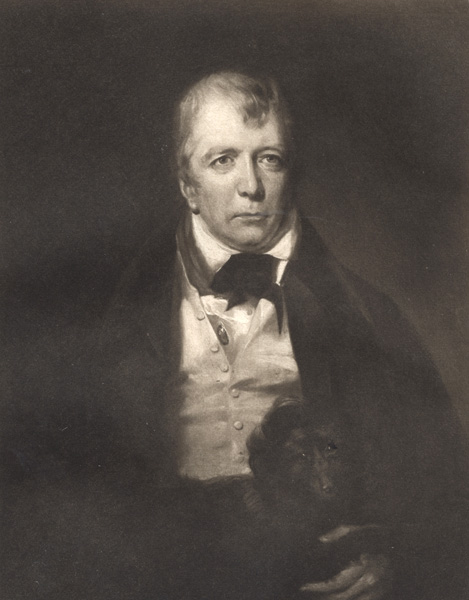
Sir Walter Scott
***
X:1
T:Sir Walter Scott Bart
M:C
L:1/8
S:
Z:AK/Fiddler’s Companion
K:Bb
[DB]>d b>a g/f/e/d/
c2|(B>d) b>c’ d’feb|(B>d) b>a g/f/e/d/ c2|B>DB,f (e/d/)(c/B/)
df:|
|:(B>d) F>f (e/d/)c/B/ G2|B,~B
D~f (e/d/)c/B/ dF|[Ebg]>f (g/a/)b/d/ (f/e/)de c2|
(~FG/A/) (B>d/4e/4f/4)
(e/d/)(c/B/)|df:|
SIR WATKIN WILLIAM
WYNN. AKA and see “The Ash Grove.” Welsh, Scottish; Air (3/8
time). G Major. Standard tuning. AABBCC. "A Welch (sic) air” {Gow}. The
melody is familiar under the title “The Ash Grove.” Sir Watkin Williams-Wynn
(1772-1840), 5th Baronet of Wynnstay (near Ruabon, Debingshire), was
a north Welsh gentleman and land proprietor who raised a troop of cavalry that
saw service in
X:1
T:Sir Watkin William Wynn
M:3/8
L:1/8
N:”Slowish”
R:Air
B:Gow – Fourth Collection of Niel
Gow’s Reels (1800)
Z:AK/Fiddler’s Companion
K:G
D|(GB).d|(BG).B|(A/B/)(c/A/)(B/G/)|AFD|”tr”G/>A/B/>G/A/>F/|(GE)C|DGF|G2:|
|:D|.G(Bd)|(gd).B|(A/B/)(c/d/)(e/^d/)|(ec).A|(G/A/).B/.c/.d/.e/|(dB).G|Ad”tr”^c|
d2
B/=c/|(dg).d|(BG).B|(A/B/)(c/A/)(B/G/)|(AF).D|”tr”G/>A/B/>G/A/>F/|(GE).C|DGF|G2:|
SIR WATKIN'S DELIGHT. AKA and see "Meillionen."
Welsh, Air. The melody appears in Daniel Wright’s Aria di camera (London, 1726), under the title “Mellionen, or Sir
Watkin’s Delight.”
SIR WATKIN’S JIGG. English,
Jig. G Major. Standard tuning. AABB. The melody appears in Johnson’s Choice Collection of 200 Favourite Country
Dances, vol. 5 (
SIR
WILFRID/WILFRED LAURIER MARCH [1]. Canadian, March (6/8 or 12/8 time).
B Flat Major. Standard tuning. AA'BB' (Hinds): AA'BB'C (Carlin). "Good for
48 bar Canadian square figures” (Hinds). Source for notated version: Jean
Carignan (
SIR WILFRED LAURIER’S
[2]. AKA and see “The Stubbert’s Jig.” Canadian, Single Jig
(12/8 time).
SIR WILLIAM GORDON CUMMING’S REEL. Scottish, Reel. G Major. Standard tuning.
AAB The tune is
attributed by Nathaniel Gow to Scots musician and dancing master Duncan
McIntyre (born c. 1765). McIntyre taught Scottish dancing from his residence at
22 Great Marlborough Street, London, towards the end of the 18th
century and published in that city a collection of Scottish tunes in 1796 (A Collection of Slow Airs, Reels and
Strathspeys). He reportedly journeyed to
X:1
T:Sir
William Gordon Cumming’s Reel
M:C|
L:1/8
R:Reel
C:Mr.
MacIntyre
B:Gow – Fifth
Collection of Strathspey Reels (1809)
Z:AK/Fiddler’s
Companion
K:G
G(gg>)a baga|gede dG
“tr”B2|G(gg>)a baga|”tr”g>e dB A/A/A “tr”e2:||
{^g}a>A
e(=g f)def|”tr”g>e dB G/G/G “tr”B2|a>A e(g f)dea|ge dB A/A/A e2|
aA e(g
f)def|gedB GABG|Aaa>b agab|”tr”g>e dB A<B e2||
SIR WILLIAM HOPE'S
SCOTCH-MEASURE. Scottish. The tune appears in Henry
Playford's 1700 collection of Scottish dance music. The collection contains the
first mention of the term 'Scotch Measure' in print.
SIR WILLIAM WALLACE. Scottish, "Pastoral Air." A Major. Standard tuning. AB.
Composed by J. Scott Skinner, appearing in his Harp and Claymore Collection. It commemorates
the Scottish hero William Wallace (b. 1270), who led a revolt against the
English but was finally defeated at the Battle of Falkirk in 1298 by the forces
of Edward I. Hardie (Caledonian Companion),
1992; pg. 114. Skinner (The Scottish
Violinist), pg. 38.
SIRDAR'S MARCH, THE. Scottish, Pipe Quickstep. A Mixolydian.
Standard tuning. AAB. Composed by J. Scott Skinner
who originally published it in his Harp
and Claymore Collection (1904). The title refers to Lord Kitchener. Skinner
(The Scottish Violinist), pg. 33
(includes variation sets). Skinner (Harp
and Claymore), 1904; pg. 52.
X:1
T:The Sirdar—Lord Kitchener
M:C
L:1/8
R:Pipe Quickstep
C:J. Scott Skinner (1843-1927)
S:Skinner – Harp and Claymore (1904)
Z:AK/Fiddler’s Companion
K:A Mix
f | ({f}e2) ce Aece | ({e}d2 Bd
G/A/B/c/ df | ({f}e2 ce Aece | ({c}df B/c/d/B/ “tr”cAA :|
e | ag/f/ ea ceAa | gf/e/ dg Bd Gg |
ag/f/ ea ceAc | df B/c/d/B/ ({B}c)AAe ||
ag/f/ ea ceAa | gf/e/ dg BdGg | A/B/c/d/
e/A/a g/a/f/g/ ec/A/ | d/e/f/d/ B/c/d/B/ ({B}c)AA ||
SIRIUS REEL, THE. Irish, Reel. Composed by flute player Matt
Molloy, in honor of his German Shepherd, Max (see also “Humours of Max”). CAROL 1108, Matt Molloy – “Shadows on Stone.”
_______________________________________
HOME ALPHABETICAL
FILES REFERENCES
© 1996-2009 Andrew Kuntz
Please help maintain the viability of the Fiddler’s
Companion on the Web by respecting the copyright.
For
further information see Copyright and
Permissions Policy or contact the author.