The Fiddler’s
Companion
© 1996-2009 Andrew Kuntz
_______________________________
HOME
ALPHABETICAL FILES REFERENCES
|
ADAM - AH |
|
Notation
Note: The tunes below are recorded in what
is called “abc notation.” They
can easily be converted to standard musical notation via highlighting with
your cursor starting at “X:1” through to the end of the abc’s, then
“cutting-and-pasting” the highlighted notation into one of the many abc
conversion programs available, or at concertina.net’s incredibly handy “ABC
Convert-A-Matic” at http://www.concertina.net/tunes_convert.html **Please note that the abc’s in the Fiddler’s
Companion work fine in most abc conversion programs. For example, I use
abc2win and abcNavigator 2 with no problems whatsoever with direct
cut-and-pasting. However, due to an anomaly of the html, pasting the abc’s
into the concertina.net converter results in double-spacing. For
concertina.net’s conversion program to work you must remove the spaces
between all the lines of abc notation after pasting, so that they are
single-spaced, with no intervening blank lines. This being done, the F/C
abc’s will convert to standard notation nicely. Or, get a copy of
abcNavigator 2 – its well worth it.
[AK] |
ADAM BUCKHAN, O! English, Air (4/4 time).
***
Its doon the Lang Stairs, And strite alang the Close,
All in Baker's Entry, Adam Buckham knows.
O Adam Buckham, O, O Adam Buckham, O;
O Adam Buckham, O, Wiv his bow legs.
***
Bruce & Stokoe (Northumbrian Minstrelsy), 1882; pg. 124.
X:1
T:Adam Buckhan O!
M:C
L:1/8
R:Air
S: Bruce & Stokoe – Northumbrian
Minstrelsy (1882)
Z:AK/Fiddler’s Companion
K:D
G|FA (Ac) (dA) (AF)|GB Bc d3z|ce ef (ge) (ed)|cA Bc d3||
Z|{d/e/}f2 ed cA (Ac)|{B/c/}d2 cB AF (FA)|{G/A/}B2 AG FA (dA)| Bg (ec) d2||
ADAM
ADAM’S FAVORITE. American, Reel.
ADAM’S HORNPIPE.
English, Hornpipe. F Major. Standard tuning. AABB. Goulding (Twenty
Four Country Dances for the Year 1808), 1808; No. 12.
X:1
T:Adam’s Hornpipe
M:C
L:1/8
R:Hornpipe
B:Goulding & Co. – Twenty Four Country Dances for the Year 1808 (London)
N:”With proper Tune & Directions to each Dance (as they may be
N:performed at Court, Bath, and all Public Assemblys.”
Z:Transcribed and edited by Flynn Titford-Mock
Z:abcs’s:AK/Fiddler’s
Companion
K:F
cefa gedc|defd dAGF|BcdB ABcA|dcBA
A2G2|cefa gedc|defd dcBA|
BcdB cagf|gece f2F2::afcA cfaf|gecA
FAcf|defd cefc|
cBAG A2G2|afcA cfaf|gecA FAcf|dbca
BgAf|cBAG A2F2:||
ADELE BLANC-SEC. French, Scottish (2/4 time). F Major. Standard tuning. AA'BB'. Composed
by Frederic Paris. Stevens (
ADELINE. Old-Time, Breakdown.
X:1
T:Adeline
M:C|
L:1/8
S:Bruce Molsky, based on Luther Strong’s version
Z:AK/Fiddler’s Companion
K:A Mix
[e4e4] [e4e4] | efec e3f | edcA BABc
| dcBA [G,G]ABc |
d2 ef gefg | e2c2 dcBA | E2 EF GABG |
[A6A6] [A2B2] ||
M:6/4
L:1/8
[Ac][AA][AB][Ac] [A3A3][A3A3][AB] |
M:C|
L:1/8
[Ac][AA][AB][Ac] [A2A2] [A2e2] |
A,G,A,B, =CDEE | G2 E4 EG |
A2 A2 A,2 A2 | ^CDEC A,3A, | [C3E3]
A, G,A,B,G, | A,3 A,B, (A, G,3) |
[A4A4] A,4 | ^C4 A,3 G,| A,G,A,B,
=CDEE | G2 E4 EG | A2A2A,2A2 |
^CDEC A,2 A,2 | [C3E3] A,2 G,A,B,G,
| A,2 A,B, A,4 ||
ADELINE WALTZ. Old‑Time, Waltz. E Flat Major. Standard tuning. AB. The melody
was composed by Clef Hamman, guitarist for the East Texas Serenaders of the
late 1920's/early 1930's. Although originally played in the key of E Flat, most
modern versions are in D Major. Silberberg (93
Fiddle Tunes I Didn’t Learn at Tractor Tavern), 2004; pg. 1. County 410, "The
ADEW
ADIEU, THE.
English, Country Dance Tune (cut time). B Flat Major. Standard tuning.
ABCD. The melody appears in Charles and Samuel Thompson’s Compleat Collection of 200 Country Dances, vol. 4 (
ADIEU, ADIEU THOU FAITHLESS WORLD. AKA and see “The Hermit of Killarney.” Irish, Air (4/4 time). A Major. Standard tuning. AABB. O’Farrell (Pocket Companion, Vol. 1), c. 1805; pg. 25. Jerry O’Sullivan – “O’Sullivan Meets O’Farrell” (2005).
X:1
T:Adieu, Adieu Thou Faithless World
M:C
L:1/8
R:Air
S:O’Farrell – Pocket Companion (c. 1805)
Z:AK/Fiddler’s Companion
cB | (A>B)AF (E>F)(AB) | c>ecA B2 (e/d/c/B/) | (A>B)AF (E>F)(AB) |
ce”tr”B>c A2 :: A | Acee (f>e)ce | f>e (d/c/B/A/) B2 (e/d/c/B/) | A>BAF (E>F)(AB) |
ce
(B/A/B/c/) A3 :|
ADIEU DUNDEE. AKA – “Adew Dundee.” AKA and see "Bonnie Dundee/Bonney Dundee," “The Hearty Boys of Ballymote,” “Laccaroo Boys,” “Mary of Castlecary,” "Saw Ye My Wee Thing," "The Laccarue Boys" (Ire.). Scottish, March. E Minor. Standard tuning. AABB. A march tune appearing in the fifth part of the Skene MS (a lute MS), c. 1615‑1620 (appears as "Adew Dundee"), the Appendix of Playford's Dancing Master of 1688, and O'Neill's Dance Music of Ireland. The title comes from a ballad called "Jockey's Escape from Dundee," which ends, "Adieu to bonny Dundee." Gatherer (Gatherer’s Musical Museum), 1987; pg. 22. Flying Fish, Robin Williamson ‑ "Legacy of the Scottish Harpers, vol. 2."
ADIEU MY LOVELY PEGGY. Irish, Air (2/4 time). E Flat Major. Standard tuning. AB.
Stanford/Petrie (Complete Collection),
1905; No. 430, pg. 108.
X:1
T:Adieu My Lovely Peggy
M:2/4
L:1/8
S:Stanford/Petrie (1905), No. 430
Z:AK/Fiddler’s Companion
K:E_
E | E>G Bc | ee eG | AG/F/ EG |
B>G FG | B/G/ F/E/ EG/B/ | e>d {d}c>B |
G>E F>E | E2 || Bc/d/ ee fe |
dc B>c | GF EG | BG F>G | B/G/ F/E/ EG/B/ |
e>d {d}c>B | GE F>E | E3 ||
ADIEU ROZA. Cajun. A tune developed into "Les Flammes d'Enfer." An influential version of “Adieu Roza” was recorded by Dennis McGee.
ADIEU TO O'REILLY. Irish, Air (3/4 time). C Mixolydian. Standard tuning. AABB. Joyce (Old Irish Folk Music and Songs), 1909;
No. 257, pg. 124.
X:1
T:Adieu to O’Reilly
M:3/4
L:1/8
R:Air
N:”Tenderly”
S:Joyce – Old Irish Folk Music and Songs
(1909)
Z:AK/Fiddler’s Companion
K:C Mixolydian
CD|EFG>edc|BAG>ECD|EFG>EFD|CC
C2:|
|:EF|G c e2 dc|dcc>B G2|Gc
e>dcB|GA/=B/ c>d|e>dc>BGE|
FAG>EC>D|EFG>EFD|CC C2:|
ADIEU YE YOUNG MEN OF
CLAUDY GREEN. Irish, Air (3/4 time). Ireland,
Derry. A Major. Standard tuning. AB. “Set in the County of Derry, 1834.”
Stanford/Petrie (Complete Collection),
1905; No. 757, pg. 189.
X:1
T:Adieu ye young men of Claudy green
M:3/4
L:1/8
R:Air
N:”Set in the County of Derry,
1834.”
S:Stanford/Petrie (1905), No. 757
Z:AK/Fiddler’s Companion
K:A
A/4B/4c/4d/4 e/f/g/f/ | e>d cd
e/d/c/B/ | c>A GE G/A/B/c/ | d>c Bc/B/ AA |
A3 c/d/ e/f/g/f/ | e>d cd
e/d/c/B/ | c>A GE G/A/B/c/ | ed/c/ Bc/>B/ AA | A3 :|
c/d/ eg | a>f ge fg | e2 dc/d/ eg
| a>f g/f/e/d/ cA | B3 A/4B/4c/4d/4 e/f/g/f/ |
e>d cd e/d/c/B/ | cA GE G/A/B/c/
| d>c Bc/>B/ AA | A3 ||
ADMIRAL, THE. American? Hornpipe. C Major. Standard tuning.
AABB. Not "Admiral's Hornpipe" in Ryan’s
Mammoth/Cole's 1000. Harding’s
All-Round Collection, 1905; No. 89, pg. 28.
X:1
T:Admiral, The
M:C
L:1/8
R:Hornpipe
S:Harding’s All-Round Collection (1905), No. 89
Z:AK/Fiddler’s Companion
K:C
G2|c2 ec d2 fd|e2 ge c2e2|f2 af e2
ge|dedc cBAG|c2ec d2 fd|
e2 ge f2 af|gedc G2B2|c2e2c2::c2|cBcA
Ggfe|fefg agfe|
fd2f ec2e|d2 ec cBAG|c2 ec d2
fd|efge f2 ag|gedc G2B2|c2e2c2:|
ADMIRAL
BENBOW. English, Air (3/4 time). G Major.
Standard tuning. AB. Walker (History of
Music in England, 1924) dates the tune to about 1700. He points out that the
melody is also known as a religious carol {“The Land o’ the Leal” (Church of
England, English Hymnal, 1906), which
is simply “Scots wha hae” sung slowly.} Admiral Benbow was an English admiral
who defeated a fleet of French warships in West Indian waters at the turn of
the 16th century, the only thing marring the victory was the fact that four of
this men‑of‑war refused to join the fight, instead standing-too to
watch. The commanders of those ships did not fare well; two were executed, one
imprisoned for life, and the last died before punishment could be meted out.
The "Admiral Benbow" is the name of the inn in which we first meet
Long John Silver in Robert Louis Stevenson's novel Treasure Island. See also note for the air "Benbow, the Brother Tar."
Chappell collected the ballad from Dale's collection, i. 68. Chappell (Popular Music of the Olden Times), vol.
2, 1859; pg. 92.
X:1
T:Admiral
Benbow
L:1/8
M:3/4
K:G
G>D|G2B2d2|d>c
B2 G>A|B2 cB A>G|G4:|
F>G|A2E2
A>G|F>E D2 GD|G2 GABG|c4 BA|
G2B2d2|d>c
B2 GA|B2 cB A>G|G4||
ADMIRAL GAMBIER’S WALTZ. English, Waltz. F Major. Standard
tuning. AABB. Admiral Lord James Gambier (1756-1833), 1st Baron
Gambier, was a career Royal Navy officer, first attaining his Captain’s rank
during the American Revolution. During the wars with Napoleon, Gambier served
in the Channel Fleet, as Governor of Newfoundland, Lord of the Admiralty, and
in various actions including the 2nd Battle of Copenhagen and the
Battle of Basque Roads. In the latter action Gambier (who had command of the
Channel Fleet) refused to commit his force to shelling the French fleet which
had been driven aground by Lord Cochrane. The latter was furious and made such
a fuss that Gambier demanded a court martial to clear his name. At the time of
Goulding’s publication Gambier had just been awarded the thanks of Parliament
and a peerage, becoming Baron Gambier of Iver. Goulding (Twenty Four Country
Dances for the Year 1808), 1808; No. 11.
X:1
T:Admiral Gambier’s Waltz
M:3/8
L:1/8
R:Waltz
B:Goulding & Co. – Twenty Four Country Dances for the Year 1808 (London)
N:”With proper Tune & Directions to each Dance (as they may be
N:performed at Court, Bath, and all Public Assemblys.”
Z:Transcribed and edited by Flynn Titford-Mock
Z:abcs’s:AK/Fiddler’s
Companion
K:F
C|{G}F/E/F/A/G/E/|{G}F/E/F/G/A/B/|c/d/c/B/A/G/|{G}F/E/F/A/G/E/|{G}F/E/F/A/G/E/|F/A/c/f/G/E/|F2:|
|:[F/A/][G/B/]|[Ac][Ac][Ac]|[d2f2]
e/d/|c/d/c/d/c/A/|[C2G2\ [F/A/][G/B/]|[Ac][Ac][Ac]|[d2f2] e/d/|c/d/c/B/A/G/|F2
:||
ADMIRAL NELSON. AKA and see “Miss Baker’s
(Hornpipe).” Scottish, Reel. F Major. Standard tuning. AB. Attributed to
Dunkeld, Perthshire, fiddler-composer Niel Gow (1727-1807) by Hunter.
Hunter (Fiddle Music of Scotland), 1988; No. 335.
ADMIRAL RODNEY'S
DELIGHT. English, Jig. G Major. Standard
tuning. AA'BBCC. Admiral Rodney won a spectacular victory (the Battle of the Saints)
against a French fleet under Admiral Comte De Grasse in the West Indies in the
year 1782.
***
***
See note
for “Rodney’s Glory [1]” for more
information. The tune was included by Northumbrian musician William Vickers in
his large manuscript collection of 1770, although it originally appeared in
London publisher Charles and Samuel Thompson’s 1765 collection. Seattle (William Vickers), 1987, Part 3; No. 508.
Thompson (Compleat Collection of 200 Favourite Country Dances, vol. 2),
1765; No. 62.
X:1
T:Admiral Rodney’s delight
M:6/8
L:1/8
B:Thompson’s Compleat Collection of 200 Favourite Country Dances, vol. 2 (London, 1765)
Z:Transcribed and edited by Flynn Titford-Mock, 2007
Z:abc’s:AK/Fiddler’s Companion
K:G
gdB ecA|dBG AFD|gdB ecA|1 efg cBG:|2 BdF G3||
|:def gbg|faf e^cA|def gbg|fa^c d2g:|
|:d2e
dBG|F2G AFD|d2g dBG|cAF G2g:||
ADMIRAL'S HORNPIPE. American, Hornpipe. G Major. Standard
tuning. AABB. Cole (1000 Fiddle Tunes),
1940; pg. 101. Ryan’s Mammoth Collection,
1883; pg. 136.
X:1
T:Admirals’ Hornpipe
M:C|
L:1/8
R:Hornpipe
S:Ryan’s Mammoth Collection (1883)
Z:AK/Fiddler’s Companion
K:G
d2 | gdBd gdbg | afdf afc’a | bgfg bgd’b
| agfe defd | gdBd gdbg | afdf afc’a |
bgd’b afc’a | b2g2g2 :: (Bc) | dgfe
dgfe | dcBc d2 (Bc) | dfeg fagb |
c’ad’b a2 (Bc) | dgfe dgfe | dcBc d2
(bc’) | d’bd’b c’agf | g2g2g2 :|
ADRIAN'S HORNPIPE. Old‑Time, Hornpipe or
Breakdown. USA; Missouri, Nebraska. G Major. Standard tuning. AABB. The
original name having been forgotten, the melody was called by
X:1
T:
M:2/4
L:1/8
R:Breakdown
S:Christeson – Old Time Fiddler’s Repertory, vol. 1, No. 121 (1973)
Z:AK/Fiddler’s Companion
K:G
e/f/|gb/a/ ga/g/|e/f/g/e/ d/B/G/B/|A/B/c/d/
e/f/g/f/|e<ab/ a/g/e/f/|
gb/a/ ga/g/|e/f/g/e/
d/B/G/B/|A/B/c/d/ e/f/g/e/|d/B/A/F/ G:|
|:B/A,/|G,/A,/B,/A,/
B,/C/B,/G,/|CC/B,/ C/B,/A,|D>D D/E/F/G/|A/c/B/A/ G/E/D/B,/|
G,/A,/B,/A,/ B,/C/B,/G,/|CC/B,/
C/B,/A,|D>D D/E/F/G/|A/c/B/A/ G:|
ADSON'S SARABAND, NEW. AKA ‑ "New, New Exchange," "Royal Exchange." English, Country
Dance (2/2 time). A Minor. Standard tuning. AABB. Published before 1730. Raven (English Country Dance Tunes), 1984; pg.
13.
ADSON'S SARABAND (Old). AKA and see "The New New
Exchange." English, Country Dance (2/2 time). F Major. Standard
tuning. AABB. Published by Playford in his English Dancing Master (1651)
as a dance tune, "longways for six." The melody is quite old and was
considered part of the traditional repertoire in John Playford's day (Pulver,
1923). Barnes (English Country Dance
Tunes), 1986. Raven (English Country
Dance Tunes), 1984; pg. 39. Sharp (Country
Dance Tunes), 1909/1994; pg. 31.
X:1
T:Adson's Saraband
M:4/4
L:1/8
Q:160
K:F
agfe f2 c2| defg e2 ag | fe d2 d3 c| d6 A2| d2 e2 f3 f| g2 a2 b3 b| ag f 2 e3 d| d6:|
|:
c2 de f3 A |Bc d2 c3 c| de f2 e3 f| g6 a2 | b2 a2 g3 f| e3 d c3 c| de f2 e3 f
f6:|
ADVENT. English, Air or March. D Major.
Standard tuning. AA’BB’. A hymn by English composer John Callcott, employed by
Miller as a march. Miller (Fiddler’s
Throne), 2004; No. 326, pg. 193.
ADVENTURE
AT
X:1
T:Adventure
at
M:6/8
L:1/8
R:Jig
S:Skillern
– Compleat Collection of Two Hundred
& Four Reels…(
K:C
gec gec|a2g
g3|gec gec|f2e e3|gec gec|afc afc|efg gfe|c3 c3:|
|:def
fed|gec gec|def fed|gec ceg|afa afa|geg geg|agf efd|ccc c3:|
ADVICE, THE. Irish, Air (2/4 time). G Mixolydian (O’Neill):
F Mixolydian (Stanford/Petrie). Standard tuning. AB. Source for notated version:
Chicago Police Sergeant James O’Neill, a fiddler originally from County Down
and Francis O’Neill’s collaborator [O’Neill]. O'Neill (Music of Ireland: 1850 Melodies), 1903/1979; No. 519, pg. 91.
Stanford/Petrie (Complete Collection),
1905; no. 764, pg. 191.
X:1
T:Advice, The
M:2/4
L:1/8
R:Air
N:”Moderate”
S:O’Neill – Music of Ireland (1903), No. 519
Z:AK/Fiddler’s Companion
K:G
DGG A/B/ | DE=F G/>F/ | DGG A/B/
| Bc/>B/ AG | DGG A/B/ | DE =F2 |
DGG A/B/ | Bc/B/ {B}AG || GB/>c/
d>d | ec/>e/ d2 | GB/>c/ dB | dc/B/ BA |
GB/>c/ d=f | ec/>e/ d>B |
cBA G/>B/ | dB/G/ AG ||
ADVICE TO THE LADIES. English, Jig. G Major. Standard tuning. AABBCC.
X:1
T:Advice to the ladies
M:6/8
L:1/8
R:Jig
O:Bcd d2
H:via Cock and Bul
K:G
G2B AGF|G2B ABc|B3d3|ABc cBA|G2B AGF|G2B ABc|B3d3|cBA G3:|
|:B2B dBG|ABA Adc|BcB Bcd|e2d efg|B2B dBG|ABA Adc|B3d3|cBA G3:|
|:gfe dcB|ABc def|gfg efg|fdd def|g2de2c|d2B ABc|B3d3|cBA G3:|!
X:2
T:Advice to the ladies - countermelody
M:6/8
L:1/8
C:Jean-Pierre Rasle / Steve Mansfield
R:Jig
K:G
Bcd efg|d6|gfg d3|cBc A3|Bcd efg|d6|gfg d3|edc B3:|
|:BGB BGB|AFA AFA|BGB d3|cde efg|BGB BGB|AFA AFA|BGB d3|edc B3:|
|:Bcd
d2g|gfe dcB|Bcd GAB|BAA ABc|d2B c2A|B2G ABc|gfg d3|edc B3:|
AE FOND KISS. AKA and see "Rory
Dall's Port [1]." Scottish, Air (3/4 time). G Major. Standard tuning.
One part. The melody was originally "Rory Dall's Port," a triple time
tune taken from Oswald (and which some say was Oswald’s own) and used by Robert
Burns for his song of the above name. Rory Dall was an ancient harper,
originally from Ulster, who composed and played primarily in Scotland. Emmerson
(1971) notes the tune is of the character of the ancient 'ports' of the harp, a
slow Gaelic air, rather than the vulgarly termed 'Scottish Waltz.' Burns
composed the heartfelt words, which he set to the tune, in 1791, just after the
departure of the young and beautiful Calrinda, Mrs. M'Lehose, who was
journeying to Jamaica to meet her husband.
Clarinda and the poet were warm friends who had met soon after Burns'
poems were first published, and the two were "obviously attracted to one
another."
***
Glad we never love sae kindly
Had we never loved sae blindly
We had ne'er been broken‑hearted.
***
Burns’ words were in fact an
adaptation or remolding of the poem “One Kind Kiss before we Part” by Robert
Dodsley, and English butler who had risen to be a poet, playwright and major
literary publisher, and whose lines were set to music by James Oswald
(1710-1769). Neil (The Scots Fiddle),
1991; No. 175, pg. 229.
AEDHEAR CHARRAIC MHIC
CHROISE. AKA and see "Carrickmacross Air."
AELION NA RUAEN. AKA and see "Aileen Aroon,"
"Eileen Aroon." Irish, Air.
This famous Irish melody was recorded (with this spelling) by the Belfast Northern Star of July 15th,
1792, as played by one of ten Irish harp masters at the last great convocation
of ancient Irish harpers, the Belfast Harp Festival, held that week (Flood,
1906).
AELTESTER GALOPP. German, Dance Tune. AKA and see "Ben
Walker's Walk‑Around."
AER NA MAIDNE. Irish, Air. G Minor. Standard tuning. AB. Roche Collection, 1982; vol. III, pg. 18.
AERIDEACT NA bPIOBAIRI. AKA and see "The Pipers'
Picnic."
AFFAIRE DE PERRODIN, L'. Cajun, Reel. USA. D Major. Standard tuning. AABB. Greenblatt (The Cajun Fiddle Book), 1985; pg. 11.
AFTER THE BALL. AKA and see "After the Ball is
Over."
AFTER
THE BALL IS OVER. AKA and see "Life On the Ocean Wave,"
"Over the Ocean Waves."
American; Air, Waltz or Quadrille. USA; Pa., Arizona. C Major (Kartchner): G
Major (Bayard). Standard tuning. ABB. Played by Arizona fiddler Kenner C.
Kartchner, who said "I remember this back to 1892. Guess it is much
older." In fact, the song was not at all older, having been copyrighted in
November, 1892, the composition of Poughkeepsie, New York, born composer, banjo
player and lyricist Charles K. Harris (popularized on the variety stage by J.
Aldrich Libby). Music researcher James J. Fuld (The Book of World Famous Music, 1971) says that numerous parodies
were written to this sentimental favorite, reducing it to nonsense. Source for
notated version: McCullough (Pa.), 1959 [Bayard]. Bayard (Dance to the Fiddle), 1981; No. 637B, pg. 561. Ruth (Pioneer Western Folk Tunes), 1948; No.
133, pg. 47.
AFTER THE BATTLE OF
AUGHRIM. AKA and see "Battle of Aughrim." Irish, Reel. Ireland. A Dorian (Am).
Standard tuning. AABB. Brody picked up this title from the Chieftains
recording. Source for notated version: the Chieftains [Brody]. Brody (Fiddler’s
Fakebook), 1983; pg. 21. Kicking Mule 209, Andy
Cahan ‑ "Melodic Clawhammer Banjo." Claddagh 14, Chieftains ‑
"Cheiftains 4." Bay 203, Jody Stecher‑ "Snake Baked a
Hoecake."
AFTER THE BLIZZARD. Irish, Jig. D Major. Standard tuning. AABB. Composed by Falmouth,
Massachusetts, musician and writer Bill Black after weathering the winter of
1996--a particularly harsh one on the North American east coast. Black (Music’s the Very Best Thing), 1996; No.
311, pg. 166.
X:1
T: After the Blizzard
C: © B. Black
Q: 325
R: jig
M: 6/8
L: 1/8
K: D
A | ded BAF | ADD D2 A | ded cBA | FAd B2 A |
ded cdc | Bcd ABc | dAF EDE | FDD D2 :|
A | eff dcB | Add FED | DFA def | baf e2 A |
eff
dcB | Add FED | DFA BGE | FDD D2 :|
AFTER THE HARE. AKA and see “The Ugly Customer.”
American, Reel. A Major. Standard. AABB. Nigel Gatherer notices similarities
with the Scottish tune “Duchess
of Athols’s Slipper.” Cole (1000
Fiddle Tunes), 1940; pg. 34. Ryan’s
Mammoth Collection, 1883; pg. 60.
AFTER THE SUN GOES
DOWN (Tareis Luide Na
Greine). AKA
and see “Albany Beef,” “Buckley’s Fancy,” “Buckley’s Favorite,” “From Night Till Morn,” “Lord St. Clair’s Reel.” Irish,
Reel. G Major. Standard. AB (O'Neill/1001 & 1850): AA'B (O'Neill/Krassen).
“Buckley’s Fancy” is a related tune. O'Neill (Krassen), 1976; pg. 145. O'Neill
(Music of Ireland: 1850 Melodies),
1903/1979; No. 1471, pg. 272. O'Neill (Dance
Music of Ireland: 1001 Gems), 1907/1986; No. 700, pg. 124.
X:1
T:After the Sun Goes Down
M:C|
L:1/8
R:Reel
S:O’Neill – Dance Music of Ireland: 1001 Gems (1907), No. 700
Z:AK/Fiddler’s Companion
K:G
G2 BG EGBG | egfa gedB | G2 BG EGBG
| AcBA GE E2 | G2 BG DGBG |
egfa gedB | (3efg (3fga gedB | AcBA
GE E2 || gfeg fedB | gfga bgef | gfeg fedB |
AcBA GE E2 | gfeg fedB | gfga beeg |
bgaf gedB | AcBA GE E2 ||
AFTON WATER. Scottish, Air (6/8 time). D Major. Standard tuning. One part. The air
used today for this 1786 pastoral song of Robert Burns is not the one he
originally set the song tune, but was substituted by a later editor who thought
it more agreeable. The later air was composed in 1850 by Alexander Hume, of
Edinburgh, a self‑taught musician "who enjoyed an excellent
reputation as a chorister and composer of psalms" (Neil, 1991). Burns'
original setting was to the melody "The Yellow‑Haired Laddie",
and presented to Johnston, the editor of the Scots Musical Museum. Neil (1991) reports that it appears to have
been part of a collection of 12 songs the poet first presented to an admirerer
named Mrs. Stewart of Stair and Afton, and that the Mary named in the song was
probably Mary Campbell (Highland Mary), who was courted by Burns at the time
the song was written. Neil (The Scots
Fiddle), 1991; Nos. 182 & 183, pg. 237 (old and newer melodies).
AG BOGADH LINN GO
MEASÚIL. AKA and see "Moving in Decency."
AG CORNAD AR AN
BRAIMFEAR. AKA and see "Rolling on the Ryegrass."
AG CORNAD SIOS AN CNOC. AKA and see "Rolling
Down the Hill."
AG DUL AMACH AR AN
LEAC OIGHIR DOM. AKA and see "As I Went Out Upon the Ice."
AG DUL CHUIG NA RASAI. AKA and see "Off to the Races."
AG FANACHT LEAT ATA ME. AKA and see "I'm Waiting
for You."
AG IMTEACD GO DI AN
SEILG. AKA and see "Off the the Hunt."
AG IMTEACD GO D'I DOMNAC BROC. AKA and see "Going to Donnybrook."
AG IONFAIRT SA TSEAGAL. AKA and see "Rolling
on the Ryegrass."
AG LOMAIRT NA GCAORAC. AKA and see "Shearing
the Sheep."
AG LUASCANACT FA
CUAIRT. AKA and see "Swinging Around the Circle."
AG MEASGAD NA DIGE. AKA and see "Mixing the
Punch."
AG RINNCE AN LEANB. AKA and see "Dancing the
Baby."
AG ROLLADH SA
BHAIRILLE.
AKA and see “Rolling in the
Barrel.”
AG SUIRÍ LEO AR FAD. AKA and see "Courting Them
All."
AG TEACD ON POSAD. AKA and see "Coming from the Wedding."
AG TEACD TREASNA NA
GCNOC. AKA and see "Coming Over the Hills."
AG TEACHT ABHAILE ON
BPORTACH. AKA and see "Coming Home From the Bog."
AG TRASNÁIL NA CAOILE. AKA and see “Crossing the
Channel.”
AGGIE AND NEIL
MACLENNAN. Canadian, Jig. Canada, Cape Breton.
G Major. Standard tuning. AAB. Composed by fiddler Brenda Stubbert (b. 1959,
Point Aconi, Cape Breton, Nova Scotia). Cranford (Brenda Stubbert’s), 1994; No. 84, pg. 31. Brenda
Stubbert - “Tamerack ‘er Down” (1985).
AGGIE
WHYTE'S (JIG). Irish, Jig. D Major. Standard tuning. AA’BB’. The
tune was unnamed, and O’Malley called it after his source. Source for notated
version: a 1964 tape of fiddler Aggie Whyte [O’Malley]. O’Malley (Luke O’Malley’s Collection of Irish Music,
vol. 1), 1976; No. 107, pg. 54.
X: 1
T: Aggie Whyte's
M: 6/8
L: 1/8
Q: 325
S: Luke O'Malley vol 1
Z: Transcribed by Bill Black
R: jig
K: D
A, | DFA dcd | edc dAF | DFA dAF | A,CE GFE |
DFA dcd | edc d2 f | afd gec | dAF D2 :|
|: f/g/ | afd gec | dcd AFD | fdB gec | dcB A2
f/g/ |
a^ga
ba=g | fdf ecA | dcd AFD | A,CE D2 :|
AGGIE WHYTE'S (REEL). AKA - “Aggie White’s.” AKA and see “Father Ahearn’s,” "Paddy Kelly's." Irish,
Reel. D Major. Standard tuning. AB. Aggie
Whyte was a fiddler player from Ballinakill,
X:1
T: Aggie Whyte's
S: Mike/Mary Rafferty
Q: 350
R: reel
M: 4/4
L: 1/8
K: D
fage d2 Bd | ADFD EFGB | AGAB =cA (3B^cd | eA (3Bcd efge :|
f2 df afdf | f2 df efge | f2 df afdf | eA (3Bcd efge :|
AGGIE
WHYTE’S (REEL) [2]. AKA
and see “Séamus Connolly’s
(Reel),” “The New Found Out,” “Satin Slipper.”
AGGIE WHITE’S CHATTERING MAGPIE. AKA and see “The Chattering Magpie.”
AGGRAVATIN' PAPA. Old‑Time, Country Blues. Adapted by West Virginia fiddler Oscar
Wright from a blues piece on a record. Rounder 0089,
"Oscar & Eugene Wright."
AGHAVAS REEL [1] (Ríl Achadh an Mheasa).
Irish, Reel. E Dorian. Standard tuning. AB. Breathnach (CRÉ V), 1999; No. 144, pg. 72. Gael-Linn CEFCD 146, Séamus McGuire & John Lee – “The
Missing Reel” (learned from flute player John Blessing).
AGHAVAS REEL [2] (Ríl Achadh an Mheasa). Irish, Reel. G Major. Standard
tuning. AB. No relation to “Aghavas Reel [1].” Source for notated version:
fiddler Jim McKiernan (Cloon, County Leitrim) [Breathnach]. Breathnach (CRÉ V), 1999; No. 145, pg. 73.
l’AGREABLE. French, Country Dance (2/4 time). D Major. Standard tuning. AABB. From the contradance book (tunes with dance instructions) of Robert Daubat (who styled himself Robert d’Aubat de Saint-Flour), born in Saint-Flour, Cantal, France, in 1714, dying in Gent, Belgium, in 1782. According to Belgian fiddler Luc De Cat, at the time of the publication of his collection (1757) Daubat was a dancing master in Gent and taught at several schools and theaters. He also was the leader of a choir and was a violin player in a theater. Mr. De Cat identifies a list of subscribers of the original publication, numbering 132 individuals, of the higher level of society and the nobility, but also including musicians and dance-masters (including the ballet-master from the Italian opera in London). Many of the tunes are written with parts for various instruments, and include a numbered bass. Daubat (Cent Contredanses en Rond), 1757; No. 56.
X:1
T:l’Agreable
M:2/4
L:1/8
S:Daubat – Cent Contredanses en Rond (1757), No. 56
Z:AK/Fiddler’s Companion
K:D
af ~fe/2f/2 | af ~fe/2f/2 | gfed | cdeA | af ~fe/2f/2 | af ~fe/2f/2 | gfed | Ac d2 :|
|:
fd a2 | ec a2 | c/e/f/^g/2a/2 bd | cBA2 | fd^ge | b^ged | caB^g | a4 :|
AGRINA’S GREEN VALES. A place name from County Leitrim. Recorded under this title by Leitrim
flute player John McKenna (1880-1947), who recorded in New York many tunes with
Leitrim place-names.
AGUS HO 'MORAG.' Scottish, Air (4/4 time). F Major. Standard. ABC. Morison remarks: “’Morag’ the name by which, for security, Prince Charles Edward (Stuart) was spoken of by his West Highland followers.” Morison (Highland Airs and Quicksteps, vol. 2), c. 1882; No. 11, pg. 6.
X:1
T:Agus ho “Morag”
M:C
L:1/8
R:Air
S:Morison – Highland Airs and Quicksteps, vol. 2, No. 11 (c. 1882)
Z:AK/Fiddler’s Companion
K:F
A2 A>F G>F DC | DF G2A2F2 | A2 A>F G>F DC | DF G2A2F2 ||
F>F F>F F/>D/C DF | G>G A>A G>F AA | F2F2 G>F DC |
DF G2A2F2 || C>C DF ((3G/A/G/F) DC | C>C DF Gc AF | (DF) G2A2F2 ||
AH! LES FRAISES ET LES
FRAMBOISES. See “Fraises et les Framboises.”
AH! SURE SUCH A PAIR. AKA and see “The Lowland Lads.”
Irish, Jig or March (6/8 time). G Major. Standard tuning. AABB. The jig was
originally English, appearing as the air for the song “Ah, sure a pair was
never seen” from Richard Sheridan’s (1751-1816) comic opera The Duenna (1775). The work was staged
at Drury Lane and Covent Garden, London. The music of it was composed by a
father and son, both named Thomas Linley, although the opera is chiefly
remembered for its libretto, the work of Sheridan.
In fact, the libretto was well-enough thought of to form the basis of an opera by
Roberto Gerhard, and for Prokofiev’s Betrothal
in a Monastery. Linley the son was a friend of the young Mozart, while the
elder Linely was Sheridan’s father-in-law.
***
The melody appears in the American
publication Riley’s Flute Melodies
(New York, 1814). New Hampshire flute player Newt Tolman, author of Quick
Tunes and Good Times (1972) and the Nelson
Music Collection (1969), was wont to spontaneously launch into this tune
when playing at contra dances (no matter what anyone else was playing!), just as
a buxom young lass would dance by the band (Dudley Laufman, Fiddle-L 2007).
***
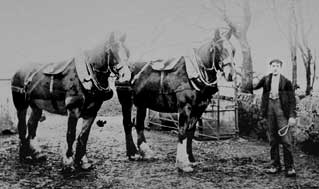
A
Buchan Horseman with Clydesdale working pair, c.
1930
***
Johnson (A Further Collection of Dances,
Marches, Minuetts and Duetts of the Latter 18th Century), 1998;
pg. 5. O'Neill (Music of
X:1
T:Ah, Sure, Such a Pair!
M:6/8
L:1/8
S:O’Neill – Music of Ireland (1903), No. 1835
Z:AK/Fiddler’s Companion
K:G
G|:G>AG B>cB|d>ed
g<ba|gdB cde|dgB A2G|G>AG B>cB|dba g2d|gdB cde|dBG A2G:|
|:B2c d2g|baf gdc|B2 b bag|f2g
adc|BAB cBc|dba g2d|gdB cde|dBG A2G:|
AH, SURELY [1] (Cinnte le Dia). AKA and see "Bearna na Gaoithe," "Killabeg's House," "Killaghbeg House," "The Boys of Twenty‑Five [2],"
[2] "The Windy Gap,"
"The Bonfire [2]." Irish,
Reel. G Major. Standard tuning. AABB. Sources for notated versions: accordion
player Sonny Brogan (County Sligo/Dublin,
X:
1
T: Ah Surely!
S: "Where's the Crack v/1" (DJ Taylor)
Z: B.Black
L: 1/8
M: 4/4
R: reel
K: G
A3 c BG G2 | BGBd g2 fg | eA A2 BGBd | (3efg dB AcBG |
A^GAc B=G G2 | BGBd g2 ga | (3bag ag (3efg fa |\
gedc BG G2 :|
bg g2 agef | gfge dega | bgdg bgdg | eaag a2 ga |
bg g2 agef | gfge dega | (3bag af (3efg fa |\
gedc BG G2 :|
AH! SURELY [2]. Irish, Jig. The tune
was recorded on 78 RPM by fiddler Batt Henry and his Traditional Quartet
Orchestra in Dublin in 1930 for the Parlophone label. Reg Hall (1995) says
Henry was from the small village of Doocastle, on the Sligo/Mayo border, the
same area that was the birthplace of London fiddler Michael Gorman.Topic TSCD602, Batt
Henry’s Traditional Quartet Orchestra – “Irish Dance Music” (1995. A reissue of
the 1930 original).
AH! THE SIGHS THAT COME FRO' THE HEART. English, Air (4/4 time). F Major.
Standard tuning. One part. From the appendix to the King's Manuscripts, kept in the British Museum ‑‑ the
King being Henry VIII, an accomplished musician and composer of airs. William
Cornyshe (1480‑1524), of whom Gibbon (Fall
of the Roman Empire) said was an "admirable poet, musician and
occasional jailbird" at the court of Henry VIII, also has a setting of the
song. Kines (Songs From Shakespeare's
Plays and Popular Songs of Shakespeare's Time), 1964; pg. 70.
AHERLOW JIG. AKA and see "Quinn's Jig,"
"The Spirits of Whiskey [2],"
"Connie O'Connell's
(Jig) [1]," "The Two‑and‑Sixpenny
Girl," "The Money I Want,"
"The Three Little
Drummers [4]," "Ryan's Travels."
Irish, Jig. This was the title printed by Joyce.
AHUNT THE DECKS O'VOE. Shetland, Reel. D Major. Standard
tuning. One part. Flett and Flett identify the tune as "an old family
version of Mr. (Tom) Anderson's."
Source for notated version: the late fiddler, composer and teacher Tom
Anderson (Lerwick, Shetland) [Flett & Flett]. Flett & Flett (Traditional Dancing in Scotland), 1964; pg. 218.
_______________________________
HOME
ALPHABETICAL FILES REFERENCES
© 1996-2009 Andrew Kuntz
Please help
maintain the viability of the Fiddler’s Companion on the Web by respecting the
copyright.
For further information see Copyright and Permissions Policy or contact the author.
[COMMENT1]This was
Font/Pitch 1,10 - Off.
[COMMENT2]This was Font/Pitch 1,10 - On.
[COMMENT3]This was Font/Pitch 1,10 - Off.
[COMMENT4]Note: The change to pitch (12) and font (1) must be converted manually.