The Fiddler’s
Companion
© 1996-2010 Andrew Kuntz
_______________________________
HOME ALPHABETICAL
FILES REFERENCES
|
MISS SA - MIX |
|
Notation
Note: The tunes below are recorded in what
is called “abc notation.” They
can easily be converted to standard musical notation via highlighting with
your cursor starting at “X:1” through to the end of the abc’s, then
“cutting-and-pasting” the highlighted notation into one of the many abc
conversion programs available, or at concertina.net’s incredibly handy “ABC
Convert-A-Matic” at http://www.concertina.net/tunes_convert.html **Please note that the abc’s in the Fiddler’s
Companion work fine in most abc conversion programs. For example, I use
abc2win and abcNavigator 2 with no problems whatsoever with direct cut-and-pasting.
However, due to an anomaly of the html, pasting the abc’s into the
concertina.net converter results in double-spacing. For concertina.net’s
conversion program to work you must remove the spaces between all the lines
of abc notation after pasting, so that they are single-spaced, with no
intervening blank lines. This being done, the F/C abc’s will convert to
standard notation nicely. Or, get a copy of abcNavigator 2 – its well worth
it. [AK] |
MISS SACKVILLE’S FANCY.
English, Country Dance Tune (2/4 time). D Major. Standard tuning. AABB. In
addition to Aird’s 1782 printing the melody under the “Miss Sackville” title
can be found in several 19th century musicians manuscripts,
including those of: William Mittell (1799, New Romney, Kent), H.S.J. Jackson
(1823, Wyresdale, Lancashire), John Fife (c. 1780, Perth, Scotland), and John
Winder (1789, Wyresdale, Lancashire). Miss Sackville may have been from the
household of George Sackville Germain (1716-1785), First Viscount Sackville.
Germain was known as Lord Sackville until 1770, when he took the name Germain
when he inherited estates from Lady Elizabeth Germain. Sackville was a military
man who rose to the rank of major-general in the Seven Years War. He was court
marshaled after the Battle of Minden (1759) when he failed to pursue the
retreating French, thus allowing them to escape. He was restored to power by
King George III, who appointed him secretary of state for America from
1775-1782, during the years of the American War of Independence, a post that he
discharged in a lackluster fashion. Germain had three daughters, Caroline,
Diana and Elizabeth, one of whom might be honored by the title. See also “Watson’s Hornpipe” which shares the
‘A’ part music. Aird (Selection
of Scotch, English, Irish and Foreign Airs), vol. II, 1782; No. 191, pg.
71. Rhianon Records, Barry Dransfield – “Be Your Own
Man.”
X:1
T:Miss
Sackville’s Fancy
M:2/4
L:1/8
S:Aird, Vol.
II (1782)
Z:AK/Fiddler’s Companion
K:D
AF/G/ | Ad/c/ | B/G/B/e/ d/c/B/A/ | d/e/f/d/ Be/f/ | g/e/f/d/ d/c/B/A/ |
AF/G/ Ad/c/ | B/G/B/e/ d/c/B/A/ | d/e/f/d/ B/g/f/e/ | d/f/e/c/ d2 ::
d/f/e/d/ e/c/B/A/ | e/f/g/e/ e/d/A/F/ | G/B/e/G/ F/G/d/F/ | E/F/G/A/ G/F/E/D/ |
d/f/e/d/ e/c/B/A/ | e/f/g/e/ f/e/d/c/ | d/f/A/^c/ B/g/f/e/ | f/d/e/c/ d2 :|
MISS SALLY AT THE
PARTY. AKA and see "I Asked That Pretty Girl to
be My Wife." Old‑Timey, Breakdown. USA, Mississippi. G Major.
Standard tuning. AB. The source for the tune, W.E. Claunch, recorded in 1939
for the Library of Congress, learned the tune from his father, James Claunch.
Tom Rankin (1985) believes the tune to be a regional north-eastern Mississippi
tune played by several fiddlers there, but only found in one other source ‑‑
an Oklahoma fiddler in Marion Thede's fiddle book (under the title "I
Asked That Pretty Girl to Be My Wife").
***
I asked Miss Sally to be my wife,
She stabbed at me with a Bowie knife,
Miss Sally, Miss Sally,
Miss Sally at the party.
***
Source for notated version: W.E.
Claunch (1894‑1958) {Guntown, Mississippi} [Notes for "Great Big Yam
Potatoes"]. Rankin, 1985; Notes for "Great Big Yam Potatoes: Anglo‑American
Fiddle Music from Mississippi." Mississippi
Department of Archives and History AH‑002, W.E. Claunch ‑
"Great Big Yam Potatoes: Anglo‑American Fiddle Music from
Mississippi" (1985).
MISS SALLY EGLISON. Scottish, Reel. John Glen (1891) finds the earliest appearance of the
tune in print in William Marshall's 1781 collection
(pg. 2). In fact it was included in a c. 1788 appendage of a dozen tunes to his
1781 collection. Moyra Cowie (The Life
and Times of William Marshall, 1999) suggests the title is a misprint of
Miss Eglingtoune, a childhood playmate of the Duchess of Gordon, Jane
Alexander, wife of Marshall’s employer, Alexander, the 4th Duke of
Gordon. It was said that when young girls they rode on the backs of swine down
the street in Hynford Close, Edinburgh, and were always up to mischief. Miss
Eglintoune became Lady Wallace. The late Bruce Olson confirmed the title as
“Miss Sally Eglinton’s” by which title
it appears in the four page addendum issue of Marshall’s music housed at the
U.S. Library of Congress.
MISS SALLY HUNTER OF
THURSTON'S JIG. Scottish, Jig. D Major. Standard
tuning. AAB. A popular jig composed by Nathaniel Gow.
Gow (Third Collection of Niel Gow’s Reels), 3rd ed.,
originally 1792; pg. 33. Hunter (Fiddle
Music of Scotland), 1988; No. 293. MacDonald (Skye Collection), 1887; pg. 177. Ian
MacDougall – “From Foot Cape.” Scottish Records SR 33 135, Ron Gonnella –
“Scottish Violin Music from the Gow Collections” (1973).
X:1
T:Miss Sally Hunter of Thurston’s
Jig
M:6/8
L:1/8
R:Jig
S:MacDonald – Skye Collection (1887)
Z:AK/Fiddler’s Companion
K:D
A|DFA “tr”d2A|”tr”B2A “tr”d2A|Bcd
egf|efd cBA|DFA d2A|”tr”B2A Bcd|
egf edc|”tr”d3D2:|g|fed “tr”g2e|c’2a
d’2b|”tr”fef def|efd “tr”cBA|
fed g2e|a2f b2g|”tr”fga Adc|”tr”d3
d2g|fdf geg|afa bgb|
afd Bcd|efd {c}cBA|AFA “tr”d2A|B2A
Bcd|egf edc|”tr”d3 D2||
MISS SALLY KELLY. AKA and see "Susai Ni
Cheallaigh."
MISS SALLY SURMAN’S
DELIGHT. English, Country Dance Tune (cut
time). A Major. Standard tuning. AABB. The melody appears in Johnson’s Choice Collection of 200 Favourite Country
Dances, vol. 5th (London, 1750), set in the key of B Flat.
Barnes (English Country Dance Tunes, vol.
2), 2005; pg. 4 (appears as “The Archbishop II”, the name of the dance
composed for the tune by Fried de Metz Herman, 1991).
MISS SARAH DRUMMOND OF PERTH [1]. AKA and see “Calum Crubach,” “Danse Écossaise,” “Devil Shake the Half-Breed
[2],” “Gurren’s Castle,” "Miss Drummond of Perth [1],”
“Mountain Reel [4]," “Our Highland Cousins,” “Paddy Joe’s
Highland Fling,” “The Perth Highland Fling,” "The Prince of Wales Jig,” “The Titanic Highland,” “Yorkshire Bite [1]." Scottish,
Strathspey. A Minor. Standard tuning. AAB. Composer credit for the tune was
claimed by Niel Gow {1727-1807} (in his 1807 Third Collection, second edition), however the tune appears under
the full title (i.e. referencing Sarah Drummond) in Malcolm MacDonald's 2nd collection
(1789, the volume dedicated to the Earl of Breadalbane). No composer was given
credit to MacDonald by Gow. It also appears in John and Andrew Gow’s A Collection of Slow Airs, Strathspeys and
Reels (London, c. 1795). Andrew (1760-1803) and younger brother John
(1764-1826), sons of Niel, established a publishing business in London in 1788
and were the English distributors for the Gow family musical publications. The
melody has currency among Cape Breton fiddlers. In Donegal it is set as a
Highland (see, for example, Hugh Gillespie’s “Gurren’s Castle”) or as a fling.
Quebec fiddler Joseph Allard recorded the tune as “Danse Écossaise.”
***
The Drummonds were a noble family of
Gow’s home county of Perthshire, loyal to the Jacobite cause for which several
of the family died for or were exiled. Clementina Sarah Drummond (1786-1865)
was the only surviving child and heir of James Drummond (d. 1800), the first
Lord Perth, and Clementina Elphinstone (d. 1822, see “Honorable Miss Drummond
of Perth”), Lady Drummond, from whom she inherited an extensive fortune and
vast Perthshire estates. In 1807 she married Peter Robert Burrell, Lord Gwydyr,
Lord Willoughby of Eresby, a great dandy of the day. Upon their marriage he
joined his wife’s family name to his, upon the insistence of his father-in-law.
Burrell’s parents were also gentry; he inherited the title Lord Gwydyr in 1820
on the death of his father, and Lord Willoughby de Eresby in 1828 (21st
of the line), when his mother died. Thus Clementina became Lady Willoughby de
Eresby. The couple resided at Drummond Castle, where the gardens (now one of
the finest in Scotland) were reshaped into a vast formal parterrein in the
1840’s for Sarah. Queen Victoria planted copper beech trees when she visited
the castle in 1842.
***
Clementina was a patroness of
Almack’s assembly rooms, but was considered “to be the highest stickler and
overly grand,” along with Lady Castlereagh. In fact, she is often featured as a
prime villainess in modern Regency-setting romance novels. Balls were held at
Almack’s every Wednesday night during the Season. Admittance was tightly
controlled by a social elite of women, patronesses, that, in 1814 (according to
a report by Captain Gronow), included Lady Castlereagh, Lady Jersey, Lady
Cowper, Lady Sefton, Mrs. Drummond-Burrell, Princess Esterhazy and Countess
Lieven. A rejected application for a season pass to Almacks was cause for social
ruin, and the cabal of patronesses made sure that the merchant and pretending
classes were kept well away. Curiously, money was not a prime dictator of
acceptance, but rather manners, breeding and rank were the desired elements in
an applicant.
***
There were other melodies composed
for Sarah Drummond: see “Miss Clementina
Sarah Drummond of Perth.” Glen (The
Glen Collection of Scottish Dance Music), vol. 2, 1895; pg. 43. S. Johnson (A Twenty
Year Anniversary Collection), 2003; pg. 25. MacDonald (A
Second Collection of Strathspey Reels), 1789; pg. 1.
X:1
T:Miss Sarah Drummond of Perth [1]
M:C
L:1/8
R:Strathspey
S:MacDonald – Second Collection of Strathspey Reels (1789)
Z:AK/Fiddler’s Companion
K:A Minor
a | A<A “tr”e>d B<d “tr”e2
| d<gB<g d<gB<G | A<A”tr”e<d B<de<(g | a>)eg>B
A2A :|
g | a<ae<a c<a e2 |
g<gd<g Bg d2 | a<ae<a c<ae<g | a<eg<B {B}A2 Ag |
a<ae<a c<a “tr”e2 |
g<gd<g B<g d2 |
a<ae<a g<be<g | a<eg<B {B}A2A ||
MISS SARAH DRUMMOND OF PERTH [2]. Scottish, Strathspey. E Minor.
Standard tuning. AAB. Stewart-Robertson
(The Athole Collection), 1884; pg.
260.
X:1
T:Miss Sarah Drummond of Perth
L:1/8
M:C
R:Strathspey
B:Stewart-Robertson – The
Athole Collection (1884)
Z:AK/Fiddler’s Companion
K:Emin
B,|E3F E/E/E E>F|A>BA>F D>EF>D|B,<E E>D E>FG>e|d>BA>F B2E:|
B|e3f e/e/e e>d|B<d A>F D>EF>D|e3f e/e/e e>d|B<d F>A B2 E>B|
e3
f e/e/e e>d|B<d A>F D>EF>D|B,<E E>D E>FG>e|d<B
A>F B2E||
MISS SARAH MACFADYEN. Scottish, Jig. A Major. Standard tuning. AA’BB’. A modern composition
by Orkney fiddler Jennifer Wrigley. Fiddler
Magazine, bol. 5, No. 2 (Summer 1998); pg. 30. Attic Records ATCD038, Jennifer and Hazel Wrigley – “The
Watch Stone” (1994).
MISS SAYER'S ALLEMANDE. England, Country Dance Tune (4/4 time). D Major (Johnson): F Major
(Barnes). Standard tuning. AABB. The melody dates to 1781 when it was published
in Six Favourite Minuets. The allemande was a couple dance, originally
an import to England from Germany in the 1760’s. Figures from the allemande
were subsequently imported into country dances.
***
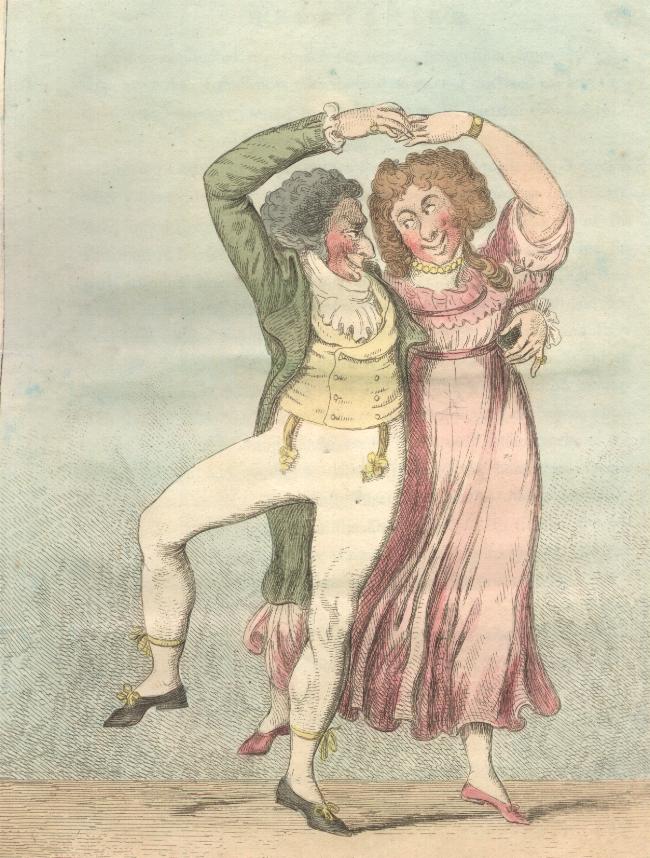
The Allemande, a cartoon by
George Cruickshank (1797).
***
Barnes (English Country Dance Tunes), 1986. Johnson (The Kitchen Musician's Occasional: Waltz, Air and Misc.), No. 1,
1991; pg. 9. Country Dance and Song Society CDS‑7,
Claremont Country Dance Band ‑ "Popular English Country dances of
the 17th and 18th Centuries." Michegan Seasons 001, Olde Michigan
Ruffwater Stringband ‑ "Michigan Winter."
X: 1
T: Miss
Sayer's Allemand
M:2/4
L:1/8
Q:160
S:Playford
O:Manuscript
A:English
K:F
c|aa aa|a3
b|agfe f/2e/2f/2g/2 f>c|aa a3 b|agfr|f3::A2 FC|B2 G2|cB/2c/2 d g|\
f2 e2| A2
FC|B2 GB|AGFE| F4:|
MISS SCOT. Scottish, Reel. B Flat Major. Standard tuning. AAB. The tune was
composed by Robert Macintosh. Glen
(The Glen Collection of Scottish Music),
vol. 1, 1891; pg. 16.
X:1
T:Miss Scot
M:C
L:1/8
R:Reel
S:Glen Collection (1895)
Z:AK/Fiddler’s Companion
K:Bb
(F|D)B,DF (BcB)F|DFBd c(CCE)|FDEG
AFBg|fdcd B/B/B B:|
f|(def)B egfB|cedB A(cce)|(d/c/d/e/
f)B egfd|ecfd B/B/B (Bf)|
(def)B egfd|cedB A(cce)|dBAc
(BAB)F|Ggfd B/B/B B||
MISS SCOTT OF BELVUE. Scottish, Reel. C Major. Standard tuning. AABB. Composed by William
Shepherd. Glen (The Glen Collection of
Scottish Music), Vol. 2, 1895; pg. 21.
X:1
T:Miss Scott of Belvue
M:C
L:1/8
R:Reel
S:Glen Collection, vol. 2 (1895)
Z:AK/Fiddler’s Companion
K:C
g|:ec c2 GcEc|ec c2 defa|ec c2
GcEc|FdEc DEFD:|
|:CE/F/ GE cEGE|CE/F/ GE DEFD|CE/F/
GE cEGE| FdEc DEFD:|
MISS SCOTT OF USAN. Scottish, Cape Breton; Reel. F Major (Athole, Kerr): G Major (Dunlay
& Reich). Standard tuning. AAB (Athole, Dunlay & Reich): AABB' (Kerr).
Source for notated version: John Campbell (Cape Breton) [Dunlay and Reich].
Dunlay and Reich (Traditional Fiddle
Music of Cape Breton Island), 1986; pg. 62. Kerr (Merry Melodies), vol. 2; No. 198, pg. 22. Stewart-Robertson
(The Athole Collection), 1884; pg.
238.
X:1
T:Miss Scott of Usan
M:C|
L:1/8
R:Reel
B:Stewart-Robertson – The
Athole Collection (1884)
Z:AK/Fiddler’s Companion
K:F
A | ~F2 cA c2 fd | ~F2 cA dGGA | ~F2 cA c2 fd | cfAf AFF :|
e | fcfa gdbg | fcfa gdde | fcfa gagc | Acfc Affe | fcfa
gdbg | fcfa gdde | faga fgdf | cAfc AFF ||
MISS SHARPE'S FANCY. AKA ‑ "Miss Sharpe's Favourite." Scottish (originally),
Irish; Jig. D Major. Standard tuning. AAB (Carlin, Gatherer): AABC (O'Neill).
Composed by Charles Sharpe (1750-1813) of Haddam, in honor of his daughter.
Sharpe was the son of William Kirkpatrick of Ailsland, a younger brother of Sir
Thomas Kirkpatrick, 3rd Baronet of Closeburn. On inheriting Hoddom
Castle, Dumfriesshire, in the Borders, Charles changed his name to Sharpe, the
name of his uncle’s line, from whom he inherited the estate. He set to work on
the castle, repairing and improving it, and adding several rooms. Sharpe had a
reputation as an excellent violinist, and also composed music and verse. He was
a friend and correspondent of Robert Burns and Sir Walter Scott. Miss Sharpe’s
mother was Eleonora, daughter of John Renton of Lamberton, and a lady whose
beauty is celebrated in Smollet’s Humphrey
Clinker. See “Mr. Sharpe’s Delight”
for more. Carlin (The Gow Collection),
1986; No. 353. Gatherer (Gatherer’s
Musicial Museum), 1987; pg. 18. Gow (Third
Collection of Neil Gow’s Reels), 1792; pg. 4 (3rd ed.). O'Neill
(O’Neill’s Irish Music), 1915/1987;
No. 194, pg. 105.
X:1
T:Miss Sharp’s Fancy
M:6/8
L:1/8
R:Jig
S:O’Neill – O’Neill’s Irish Music (1915)
Z:AK/Fiddler’s Companion
K:D
f | d2A AFA | B2A AFA | d2A AGF |
EFE A2 B/c/ | d2A AFA | B2A AFA |
B2A ABc | dgf eac | d3 d2 :: f/g/ |
afd dfa | gec ceg | fed dcd | ecA A2 f/g/ |
Afd dfa | gec ceg | fad egc | d3 d2
|| f/g/ | afd dfa | gec ceg | fed dcd | ecA A2G |
FAd FAd | GBd GBd | Agf eac | d3 d2
||
X:2
T:Miss Sharpe’s Fancy
M:6/8
L:1/8
R:Jig or Air
C:Charles Sharpe
B:Gow – 3rd Collection of Niel Gow’s Reels, 3rd ed.,
pg. 4 (orig. 1792)
Z:AK/Fiddler’s Companion
K:D
f|{c}d2A AFA|({G/A/}B2)A
AFA|({B/c/}d2)A {B}AGF|ECA, “tr”A,2 B/c/|s2A AFA|
({G/A/}B2)A ABc|d(gf) (ea)c|d3
“tr”d2:||f/g/|afd (df).a|ged (ce)g|fed {e}”tr”dcd|
ecA A2 (f/g/)|afd dfa|ged
(ce).g|(fa).d (eg).c|{c}d3 “tr”d2 f/g/|afd (df)a|
ged (ce)g|fed {f}”tr”dcd|ecA
“tr”A2G|(FA).d (FA).d|(GB).d (GB).d|(Ag).f (ea).c|{c}”tr”d3 D2||
MISS SHAW’S FAVOURITE. Scottish, Reel. B Minor.
Standard tuning. AB. Morison (Highland Airs
and Quicksteps, vol. 1), c. 1882; No. 32, pg. 17.
X:1
T:Miss Shaw’s Favourite
M:2/4
L:1/8
R:Reel
S:Morison – Highland Airs and Quicksteps, vol. 1 (c. 1882)
Z:AK/Fiddler’s Companion
K:B Minor
A/B/ | d/d/ e/d/ f/f/ e/d/ | a/a/
d/e/ f/f/ e/d/ | {d}c/B/ c/d/ e/e/ a/f/ | e/d/ c/B/ A/A/ A/B/ |
d/d/ e/d/ f/f/ e/d/ | a/a/ d/e/
fa/f/ | e/d/ c/B/ A/A/ B/c/ | dB B>c || df Bf | B/c/ d/e/ fe/d/ |
ce Ae | A/B/ c/d/ e>c | df Bf |
B/c/ d/e/ fa/f/ | e/d/ c/B/ A/A/ B/c/ | dB B ||
MISS SHAW'S REEL. AKA and see "The
Castlecomer Lasses," "Down
the Groves," "Erin's Groves,"
"The Gay Fellow's Favourite,"
"The Good Fluter," "The Green Fields of Erin [1],"
“The Green Groves of Erin [1],”
"The Groves of Erin," "The Heather Breeze," “The Low Highland,” "Mary in the Mall," “Miss Stewart of Grantully [2],” “Padaí Bhilli na Rópaí’s
Highland,” "The Queenstown Lasses."
MISS SHEPHERD. Scottish, Reel. A Dorian. Standard tuning. AAB (Hunter, Martin, Martin
& Hughes, Perlman, Skinner): AABB (Songer). Composed by Scottish fiddling
great J. Scott Skinner (1843-1927), first published
in his Harp and Claymore Collection.
Hunter (1988) reports that Miss Shepherd was a clerk in Strachan's music shop
on Belmont Street in Aberdeen, at one time a favorite meeting place on Saturday
nights for fiddlers. Source for notated version: Paul MacDonald (b. 1974,
Charlottetown, Queens County, Prince Edward Island) [Perlman]. Hunter (Fiddle Music of Scotland), 1988; No.
192. Martin (Traditional Scottish
Fiddling), 2002; pg. 120. Martin & Hughes (Ho-ro-gheallaidh), 1990; pg. 25. Perlman (Fiddle Music of Prince Edward Island), 1996; pg. 98. Skinner (The Scottish Violinist), pg. 27. Skinner
(Harp and Claymore), 1904; pg. 67.
Songer (Portland Collection), 1997;
pg. 137 (appears as “Miss Shepherd’s Reel”). Green
Linnet SIF 3037, Silly Wizard - "Golden, Golden" (1985). Maggie’s
Music MMCD222, Bonnie Rideout – “Scottish Fire” (2000).
X:1
T:Miss Shepherd
M:C|
L:1/8
R:Reel
K:Ador
{G}A|A,B,CD E2 DC|B,GFG
DB,G,B,|A,B,CD E^GAc|BA^GB cAA:|
||^g|a2 ed cBAF|G2 DC B,A,G,^g|a2 ed
cBAc|BA^GB cAA^g|a/a/aed cBAF|
G/G/GDC B,A,G,B,|A,B,CD E^Gac|BA^GB
cAA||
MISS SHEPHERD'S
HORNPIPE. Irish, Hornpipe. G Major. Standard
tuning. AABB. O'Neill (O’Neill’s Irish
Music), 1915; No. 368, pg. 178.
X:1
T:Miss Shepherd’s Hornpipe
M:4/4
L:1/8
R:Hornpipe
S:O’Neill – O’Neill’s Irish Music (1915)
Z:AK/Fiddler’s Companion
K:G
B>A | G3A GABc | dBge dBAG | cBce
dBAG | D2A2A3B | cBcd efge | dBAG (GF)(ED) |
GBAc BdAc | B2G2G2 z :: B | dBGB d2
(gf) | edcB cBAG | (cB)cd (ef)ge | f2d2d3B |
(cB)cd (ef)ge | dBAG GFED | GBAc
BdAc | B2G2G2 :|
MISS SILVIE’S DELIGHT.
English, Country Dance Tune (whole time). F Major. Standard tuning.
AABB. Rutherford ( ), c. 1775.
X:1
T:Miss Silvie's Delight
Z:Rutherford Volume III circa 1775
M:C
L:1/8
K:F
A2|G/G/G BG dGBG|F/F/F AF cFAF|\
G/G/G BG dGBG|DdcA G/G/G G :|] !
f|gdBd gbgd| fcAc fafc|gdBd gbgd|cAFA G/G/G G :|]!
MISS SINGLETON’S REEL. Irish, Reel. G Major. Standard tuning. AB. Source for notated version: manuscripts in the possession of Chicago Police Sergeant James O’Neill, originally from County Down, many from the playing of his father [O’Neill]. O’Neill (Waifs and Strays of Gaelic Melody), 1922; No. 257.
X:1
T:Miss Singleton's Reel
M:4/4
L:1/8
S:Sergt. James O'Neill's manuscripts
Z:Paul Kinder
R:Reel
K:G
e|dBBA GEEG|DB,DE D3 e|dBBA GEEG|DGBG A3 e|
dBBA GEEG|DB,DE D3 e|dBBA GEEG|DGBG A2 z||
e|dBBe dBBe|dBBd e2 eg|dBBd efed|BAGB A2 AB|
deBe
deBe|deBc d2 ef|gefd ecdB|AGED G3||
MISS SITWELL. Scottish, Slow Strathspey. B Flat Major. AAB (Skye): AB (Athole, Gow).
Composed by Nathaniel
Gow (1763-1831), perhaps for a sister or relation of Francis Sitwell (see “Master Francis Sitwell”)
who in 1795 married Anne Campbell, daughter of Sir Illay Campbell of Succoth, 1st
Bart, and Susan Mary Murray. Carlin (The
Gow Collection), 1986; No. 155. Gow (Fourth Collection of Niel Gow’s
Reels), 2nd ed., originally 1800; pgs. 22-23. MacDonald (The Skye Collection), 1887; pg. 128. Stewart-Robertson
(The Athole Collection), 1884; pg.
288.
X:1
T:Miss Sitwell
M:C
L:1/8
R:Slow Strathspey
B:Stewart-Robertson – The
Athole Collection (1884)
Z:AK/Fiddler’s Companion
K:B_
D/C/|B,>FD>F G<C CD/C/|B,>FD>B F>dB>f|d>c B/c/d/B/ c<C CD/C/|
B,>FD>B ~F2 F/E/D/C/|B,>FD>F G<C CD/C/|B,>FD>B F>dB>f|
d>c B/c/d/B/ c<C CD/E/|F<B D>F ~B2B||d/e/|f<b d>f g<c cd/e/|
f<b d>e f<g d>b|f<d b>f g<c cd/e/|f>bd>e f2 fd/e/|f>bd>f g<c cd/e/|
fg/a/
b>a g>fe>d|c>Bd>B c<C CD/E/|F>B G/F/E/D/ ~F2 F>B||
MISS SLOPE'S WALTZER. Scottish, Waltz. C Major. Standard tuning. AABBCC. Carlin (Master Collection), 1984; No. 181, pg.
105.
MISS SMYTH OF METHVEN. Scottish, Reel. A Major. Standard tuning. AABCD. The title refers
perhaps to a daughter of David Smyth(e) (1746-1806) of Methven Castle,
Perthshire, a Lord of the Session, who married first Elizabeth Murray of
Hillhead (d. 1795), and afterwards (Amelia) Euphemia A. Murry (b. 1769) of
Lintrose. The latter was known as “The Flower of Strathmore,” celebrated by
poet Robert Burns in his poem “Blythe was she” after he met her on a visit to
cousin, Sir William Murray of Ochtertyre. This was in 1787 when she was aged
eighteen, already a celebrated “toast” (as Burns put it), and tradition gives
that she did not appreciate Burns’ effort. An oil portrait of Euphemia seated
with her young daughter was painted by William Dyce (1806-1864). There were a
number of children from both marriages, although only three sons and two
daughters survived. The eldest daughter (who was from the first marriage), Camilla
Catherine Campbell Smythe, married the Right Honorable David Boyle, Lord
Justice-Clerk in 1827. She was born around 1776 in Irvine, Ayrshire. The
marriage was the second one for each and they had children together, although
she died only a few years later, in 1830. The title of the melody may refer to
Camilla or to another daughter. Carlin (The
Gow Collection), 1986; No. 290. Gow (Fourth Collection of Niel Gow’s
Reels), 2nd ed., originally 1800; pgs. 28-29. Rounder Records, Buddy MacMaster – “Cape Breton Tradition”
(2003).
X:1
T:Miss Smyth of Methven’s Reel
M:C|
L:1/8
R:Reel
B:Gow – Fourth Collection of Niel
Gow’s Reels (1800)
Z:AK/Fiddler’s Companion
K:A
c|{G}A2 E>C ECA,C|B,(BB>)c
“tr”B>(AFB)|{G}A2 E>C(EF/G/ A).F|ECDB, A,/A,/A, A,:||
d|”tr”c2 ec Acdf|ecAc
“tr”B>AFd|”tr”c2 ec Acdf|ec”tr”B>c A/A/A Ad|”tr”c2 ec Acdf|
ecAc “tr”B>AFB|{G}A2 E>C
(EF/G/ A>)F|ECDB, A,/A,/A, A,||D|”tr”C2 E>C A,<A, E>C|
B,(BB>)c “tr”B>AFB|{G}A2
E>C (EF/G/ A).F|ECDB, A,/A,/A, A,>D|”tr”C2 E>C A,<A, EC|
B,(BB>)c “tr”B>AFB|A2 E>C
A/(B/c/d/ e>)c|d>Be>c A/A/A A||d|{c}e2 e2 ceaf|ecAc “tr”B>AFd|
{c}e2e2 ceaf|ecdB A/A/A A>d|{c}e2
e2 ceac|dbca “tr”B>AFB|{G}A2 E>C (EF/G/ A>)F|E>CD>B, A,/A,/A/
A,||
MISS
SOPHIA CAMPBELL(‘S OF SADDELL’S). AKA and see “Mrs. McGee.” Scottish,
Jig. G Minor (Glen): G Major/Mixolydian (Cranford). Standard tuning. AAB
(Glen): AABB’ (Cranford). Composed by Robert
‘Red Rob’ Mackintosh and first printed in his 1796 collection of tunes.
Originally a minor-key tune, a Cape Breton ‘double-tonic’ version in G has been
circulating since the 1950's when it was recorded (under the title “Mrs.
McGee”) by fiddler Angus Chisholm (Cranford). The melody remains one of the
more popular of MacIntosh’s compositions on Cape Breton. Source for notated
version: fiddler Brenda Stubbert (b. 1959, Point Aconi, Cape Breton, Nova
Scotia) learned the tune from fiddler Arthur Muise (Cheticamp, Cape Breton)
[Cranford]. Cranford (Brenda Stubbert’s),
1994; No. 126, pg. 44. Glen (The Glen
Collection of Scottish Music), vol. 2, 1895; pg. 37.
X:1
T:Miss Sophia Campbell
M:6/8
L:1/8
R:Jig
S:Glen Collection, vol. 2
(1895)
Z:AK/Fiddler’s Companion
K:G Minor
B/c/|d3 (g^fg)|dBG Bcd|c3 (f=ef)|cAF
ABc|d3b3|ag^f g=fe|dcB AG^F|G3 G2:|
B/c/|d3 dBG|dBG Bcd|c3 cAF|cAF ABc|d3
dBG|dBG gfe|dcB AG^F|GGG G2 B/c/|
D3 dBG|dBG Bcd|c3 cAF|cAF ABc|d3
bag|ag^f g=fe|dcB AG^F|G3 G2||
MISS SOPHIA DUFF
STUART'S FAVOURITE. Scottish, Reel. D Major. Standard
tuning. AB. MacDonald (The Skye
Collection), 1887; pg. 75.
X:1
T:Miss Sophia Duff Stuart’s
Favourite
M:C
L:1/8
R:Reel
S:MacDonald – Skye Collection (1887)
Z:AK/Fiddler’s Companion
K:D
A2||FD (3DDD D2 DF|EA, (3A,A,A,
A,A|FD (3DDD D2 DA|Bd ce dB AG|
FD (3DDD D2 DF|EA, (3A,A,A, A,2
A,A|FD (3DDD D2 DA|Bdce d2 de||
fdfd fgaf|eAeA efge|fddf gfed|cABc
dcde|fdfd fgaf|eAeA efge|fddf gfed|cABc dBAG||
MISS SPARK'S MAGGOT. English, Country Dance Tune (6/8 time). G Major. Standard tuning. AABB.
A ‘maggot’ is a unit of liquid measure, equal to a dram, but also meant
something slight or of small consequence. Barnes (English Country Dance Music), 1986.
MISS SPENCE’S REEL. Shetland, Reel. D Major/Mixolydian. Standard tuning. AB. Original from
the Hoseason Manuscript (1862), with
the note "Composed by John Anderson, Voe, (in 1759) and played by him in
the late Mr. Neven of Windhouse's family at Reafirth at a Christmas party, the
majority of Ladies, Miss Spences, and the Reel got their name" (Cooke,
1986). With so many Miss Spence's, how could he miss? Anderson & Georgeson (Da
Mirrie Dancers), 1970; pg. 25. Bain (50
Fiddle Solos), 1989; pg. 41. County CO-CD-2729,
Art Stamper – “Goodbye Girls, I’m Going to Boston” (2000).
MISS STEUART OF URRARD. Scottish. John Glen (1891) finds the earliest appearance of the tune in
print in Daniel Dow's c. 1775 collection
(pg. 16).
MISS STEWARD OF
GRANDTULLY’S REEL.
See “Miss Stewart of Grantully
[3].”
MISS STEWART BUN
RANNOCH AKA and see “Coirsdan Mhór.”
Scottish, Reel. G Major. Standard tuning. AABB'. See also the Scottish
relatives "Ciorsdan Mhór",
"Big Kirsty" and "A' the Way to Galloway,"
and the Irish family of tunes including “All the Way to Galway [1],” “Road to Lindesvoorna [2]."
MacDonald (The Skye Collection),
1887; pg. 85. Stewart-Robertson
(The Athole Collection), 1884; pg.
264.
X:1
T:Ciorsdan Mhór
T:Miss Stewart Bunrannoch
M:C|
L:1/8
R:Reel
B:Stewart-Robertson – The
Athole Collection (1884)
Z:AK/Fiddler’s Companion
K:E Minor
F|G2 GB dBBe|cA A/A/A dBBe|G2 GB dBBe|cABG E2E:|
|:d|efge dBBe|cA A/A/A dBBd|1 efge dBBe|cABG E2E:|2
efge
dgBb|cABG E2E||
MISS STEWART [1]. See “Miss Stewart of Grantully
[2].”
MISS STEWART('S REEL)
[2]. Scottish, Reel. F Major. Standard
tuning. AAB. Composed by Edinburgh fiddler Robert 'Red Rob' Mackintosh (bornc.
1745, d. 1807), whose nickname doubtless was awarded because of his having red
hair. He had thirteen children, three of whom he named Robert. Glen (The Glen Collection of Scottish Dance Music),
vol. 1, 1891; pg. 12. MacDonald (The Skye
Collection), 1887; pg. 188.
X:1
T:Miss Stewart [2]
T:Miss Stewart’s Reel
M:C
L:1/8
R:Reel
S:Glen Collection, Vol. 1
(1891)
Z:AK/Fiddler’s Companion
K:F
c|f2 fc AFFA|G/G/G g>f dfga|f2 fc
AfcA|BdcA F/F/F F:|
c|f2 a/g/f eggb|afba g/g/g g>a|f2
a/g/f egga|fage f/f/f fc|f2 a>f eggb|
afba g/g/g ge|fdBg ecAf|GdcA F/F/F
F||
MISS STEWART [3]. Scottish, Strathspey. B Flat Major. Standard tuning. AAB. Composed by Abraham Macintosh (b. Edinburgh,
1769), a son of Robert Macintosh,
who later in life removed to Newcastle where he was employed as a dancing
master and musician. Glen (The Glen
Collection of Scottish Music), vol. 1, 1891; pg. 41.
X:1
T:Miss Stewart [3]
M:C
L:1/8
R:Strathspey
S:Glen Collection, Vol. 1 (1891)
Z:AK/Fiddler’s Companion
K:B Flat
F|B>cB>c d<f
d>B|c>dcB A<c A<F|B>cBF G>ABG|F>GB>c dBB:|
g|f<BcB bB Bd/e/|f<B g>B Ac
cd/e/|f>Bg>B a>cb>G|F>Ac>e dBBg|
f<BcB bB Bd/e/|f<B g>B Ac
cd/e/|f>dg>e a<cb>g|f<d c>a bBB||
MISS STEWART DERCULLOCH’S REEL. Scottish, Reel. D Major. Standard tuning.
AB. Composed by Kirkmichael, Perthshire, fiddler Robert Petrie. Petrie (Collection of
Strathspey Reels and Country Dances), 1790; pg. 14.
X:1
T:Miss
Stewart Derculloch's Reel
C:Robert
Petrie
S:Petrie's
Collection of Strathspey Reels and Country Dances &c., 1790
Z:Steve
Wyrick <sjwyrick'at'astound'dot'net>, 3/19/04
N:Petrie's
First Collection, page 14
L:1/8
M:C|
R:Reel
K:D
A|d2
(df) e2 (eg) | fdgf e(EE)e | d2 (df) e2 (eg) | fdec dDDA |
d2
(df) e2 (eg) | fdgf e(EE)e | defd efga | fdec dDD ||
f
| abaf dfaf | gbaf g(ee)f | abaf dfaf | ge a/g/f/e/ fddf |
abaf
dfaf | gbaf g(ee)f | dfeg fagb | afge fdd |]
MISS STEWART DOWALLY’S JIGG. Scottish, Jig. A Minor. Standard tuning.
AAB. Composed by Kirkmichael, Perthshire, fiddler Robert Petrie. Petrie (Collection of Strathspey Reels and Country
Dances), 1790; pg. 5.
X:1
T:Miss
Stewart Dowally's Jigg
C:Robert
Petrie
S:Petrie's
Collection of Strathspey Reels and Country Dances &c., 1790
Z:Steve
Wyrick <sjwyrick'at'astound'dot'net>, 3/5/04
N:Petrie's
First Collection, page 5
L:1/8
M:6/8
R:Jig
K:Am
A/B/
| Tc2A ABA | E2A ABc | TBAB GBc | dBG GAB | Tc2A ABA | EAB cde |
def
efd | cAA A2 :| B | cea cea | cea edc | Bdg Bdg | edc BAG | cea cea | cde def |
edc
dcB | cAA A2B | cea cea | cea edc | Bdg Bdg | edc BA^G | AcA BdB |
cec
def | edc dcB | cAA A2 |]
MISS STEWART MITCHELL’S REEL. Scottish, Reel. E Major. Standard tuning.
AAB. Composed by Kirkmichael, Perthshire, fiddler Robert Petrie. Petrie (Collection of Strathspey Reels and Country
Dances), 1790; pg. 20.
X:1
T:Miss
Stewart Mitchell's Reel
C:Robert
Petrie
S:Petrie's
Collection of Strathspey Reels and Country Dances &c., 1790
Z:Steve
Wyrick <sjwyrick'at'astound'dot'net>, 3/20/04
N:Petrie's
First Collection, page 20
L:1/8
M:C
R:Reel
K:E
B
| E2 G>B eBGE | AcGB cFFG | E2GB egbg | faTg>f gee :|
g
| bgeg f(dTcB) | ecBG AFFg | bgeg .f(dTcB) | c(aTgf) geeg |
(b/a/g/f/
e).g f(dTcB) | cABG AFFG | EGAF GBeg | afba gee |]
MISS STEWART OF
ALLANBANK. Scottish, Strathspey. C Minor.
Standard tuning. AAB. Composed by William Shepherd. Glen (The Glen Collection of Scottish Music), vol. 2, 1895; pg. 33.
X:1
T:Miss Stewart of Allanbank
M:C
L:1/8
R:Strathspey
S:Glen Collection, vol. 2
(1895)
Z:AK/Fiddler’s Companion
K:Cmin
G/F/|E>CC>D E>F
G>E|[B,D]>F BG/E/ (D/E/)F/D/ B,G/F/|E>CC>D E>FG>E|Gc/d/
e/d/c/=B/ cCC:|
c/d/|e>dc=B c2 G>E|D>F
BG/E/ (D/E/)F/D/ B,c/d/|e>dc=B c2 G>E|D/E/F/D/ FE/D/ ECCc/d/|
e>dc>=B c2 G>E|D>F BG/E/
D/e/F/D/ B,/A/G/F/|E>CC>D E/D/E/F/ E/F/G/E/|Gc/d/ e/d/c/=B/ cCC||
MISS STEWART OF BOMBAY. See "Miss Stewart's
Jig--of Bombay."
MISS STEWART OF
FASNACLOICH'S. Scottish, Reel. A Major. Standard
tuning. AABBCCDD. Gow (Complete
Repository), Part 4, 1817; pg. 26. Kerr (Merry Melodies), vol. 1; Set 26, No. 2, pg. 16.
X:1
T:Miss Stewart of Fasnacloich’s Reel
M:C|
L:1/8
R:Reel
S:Gow – 4th Repository (1817)
Z:AK/Fiddler’s Companion
K:A
e|A<A ec {f}e2 ec|(f/g/a) ec
fBBa|A<A ec {f}e2 ce|{g}a>f ec eAA:|
|:g|a2 a>e fece|a2 ae fBBg|a2 ae
f>ece|(f/g/a) ec eAA:|
|:e|A<A eA fAeA|fAec fBBa|A<A
eA fAAa|(f/g/a) ec eAA:|
|:(e/4f/4g/)|aece fece|aece
fBBg|aece fece|(f/g/a) ec eAA:|
MISS STEWART OF GARTH
[1]. Scottish, Reel. D Major. Standard
tuning. AAB. The tune was composed by Malcolm
McDonald of Dunkeld, according to John Glen, and appears in his 4th
collection, a volume dedicated to the Countess of Breadalbane. Glen (The Glen Collection of Scottish Music),
vol. 2, 1895; pg. 10. MacDonald (A Fourth
Collection of Strathspey Reels), 1797; pg. 8.
X:1
T:Miss Stewart of Garth’s Reel [1]
M:C|
L:1/8
R:Reel
S:MacDonald – 4th Collection of Strathspey Reels (1797)
Z:AK/Fiddler’s Companion
K:D
D2 DA FDdF | E2 (Ee) GEeg | fdec
dBAF | GBAF D/D/D D2 :|
abaf dfaf | gebe gebe | abaf dfaf |
geaf d/d/d d2 | abaf dfaf |
gebe febe | dfeg fbec | dBAF D/D/D
D2 ||
MISS STEWART OF GARTH
[2]. Scottish, Reel. D Dorian (Welling):
D Minor (Kerr). Standard tuning. AB (Cranford): AAB (Welling): AABB' (Kerr).
The melody appears to be a minor key variant of version #1. Source for notated
version: Winston Fitzgerald (1914-1987, Cape Breton) [Cranford]. Cranford (Winston Fitzgerald), 1997; No. 139, pg.
56. Kerr (Merry Melodies), vol. 3;
No. 168, pg. 20. Welling (Hartford
Tunebook), 1976; pg. 23.
X:1
T:Miss Stewart of Garth [2]
M:C
L:1/8
R:Reel
S:Kerr – Merry Melodies, vol. 3, No. 168
(c. 1880’s)
Z:AK/Fiddler’s Companion
K:Dmin
F | D2 (DE) FGAF | EcGc ECCE | D2
(DE) FGAF | Ddfe d3 :|
f | (da)fg (af)df | egcg ecge |1
(da)fg (af)df | ecge d3 |2 fde^c defd | =cAGE ({F/E/}D3) ||
MISS STEWART OF GARTH [3].
Scottish, Reel. A Mixolydian. Standard tuning. AB. Surenne (Dance Music of Scotland), 1852; pg. 149.
X:1
T:Miss Stewart of Garth [3]
M:C
L:1/8
R:Reel
S:Surenne – Dance Music of Scotland, pg. 149
(1852)
Z:AK/Fiddler’s Companion
K:A
e | cA (c/4d/2<e) cA
(c/4d/2<e) | =g=GGB d3e | cA (c/4d/2<e) cA (c/4d/2<e) | aAAc e3d |
cA (c/4/d2<e) cA (c/4d/2<e) |
=g=GGB d3e | cA (c/4d/2<e) cA (c/4d/2<e) | aAAc e3d ||
c>def =gage | =g=GGB d3B |
c>def gage | aAAc e3d |
c>def =gage | =g=GGB d3B | cdef
efge | aefd efed ||
MISS STEWART OF GRANTULLY [1]. Scottish, Strathspey. A Mixolydian. Standard tuning. AAB. A double-tonic tune composed by Niel Gow (1727-1806), in pipe style (range of nine notes, double tonic). Pulver (1992) says it “can be said to represent the quintessence of Scottish dance melodies.” The tune is a strathspey setting of Gow’s “Miss Stewart’s Reel.” Grandtully (pronounced ‘Grantly’) is situated on the River Tay in Perth and Kinross, Scotland. Grandtully Castle was a stronghold of the Stewarts and dates from the 16th century. and perhaps refers to Clementina or Grizel Stewart, daughters of Sir John Stewart, 4th Bart of Grandtully (d. 1797) and his wife Clementina Stewart (daughter of Charles Stewart of Ballechin), whom he married in 1749. Grizel became a minister’s wife, while Clementina (born around 1759) married in 1782 Alexander Moray, 14th of Abercairny. Alburger (Scottish Fiddlers and Their Music), 1983; Ex. 70, pgs. 108‑109. Carlin (Gow Collection), 1986; No. 156. Gow, First Book of Niel Gow’s Reels (2nd ed.), 1801; pg. 8. Hunter (Fiddle Music of Scotland), 1988; No. 143. MacDonald (The Skye Collection), 1887; pg. 7. Purser (Scotland’s Music), 1992; Ex. 6, pg. 204. Stewart-Robertson (The Athole Collection), 1884; pg. 2.
X:1
T:Miss Stewart of Grantully [1]
M:C
L:1/8
S:Strathspey
B:Stewart-Robertson – The
Athole Collection (1884)
Z:AK/Fiddler’s Companion
K:A
e | AAc>A c/d/e c2 | B<=G B>c d/c/B/A/ G>B | AAc>A c/d/e c2 | A<ae>f c>AA :|
|| g | a>ea>e a/g/f/e/ a>e | =g>dg>d B<=GG>^g | a>ea>e a/g/f/e/ a>e | f>ea>e c>AA>g|
a>ea>e a/g/f/e/ a>e | =g>dg>d B>=GG>B | AAc>A c/d/e c2 | A<ae<f c<AA ||
MISS STEWART OF GRANTULLY [2]. AKA and see "The Castlecomer Lasses," "Down the Groves," "Erin's Groves," "The Gay Fellow's Favourite," "The Good Fluter," "The Green Fields of Erin [1]," “The Green Groves of Erin [1],” "The Groves of Erin," "The Heather Breeze," “The Low Highland,” "Mary in the Mall," "Miss Shaw's Reel," “Padaí Bhilli na Rópaí’s Highland,” "The Queenstown Lasses." Scottish, Reel. A Mixolydian. Standard tuning. AAB. Composed by Dunkeld fiddler-composer Niel Gow (1727-1807). Not the "Miss Stewart's Reel" in Skye Collection composed by McIntyre. The ‘A’ parts are the ones particularly shared (i.e. nearly identical) with “The Green Groves of Erin” and “Padai Bhilli.” The tune is a reel-time version of Gow’s “Miss Stewart of Grantully’s Strathspey,” and perhaps refers to Clementina or Grizel Stewart, daughters of Sir John Stewart, 4th Bart of Grandtully (d. 1797) and his wife Clementina Stewart (daughter of Charles Stewart of Ballechin), whom he married in 1797. Grizel became a minister’s wife, while Clementina (born around 1759) married in 1782 Alexander Moray, 14th of Abercairny. Carlin (The Gow Collection), 1986; No. 291. Glen (The Glen Collection of Scottish Music), vol. 2, 1895; pg. 5. Gow (First Collection of Strathpsey Reels), 1784 (revised 1801); pg. 8. Kerr (Merry Melodies), vol. 1; Set 25, No. 1, pg. 15. MacDonald (The Skye Collection), 1887; pg. 7. Stewart-Robertson (The Athole Collection), 1884; pg. 3.
X:1
T:Miss Stewart of Grantully [2]
M:C|
L:1/8
S:Reel
B:Stewart-Robertson – The
Athole Collection (1884)
Z:AK/Fiddler’s Companion
K:A
e|AAcA eAcA|=GGBG dGB=g|AAcA eAcA|Eaef cAA:|
||B|Aaga eaca|B=gdg B=GGB|Aaga eaca|faef cAAB|
Aaga eaca|B=gdg B=GGB|AAcA dBcA|Ea ef cAA|]
cottish, Reel or Strathspey. A Mixolydian.
Standard. AAB (Glen, Gow): AABB (Kerr).
X:2
T:Miss Stewart [1]
M:C|
L:1/8
R:Reel or Strathspey
S:Glen Collection, vol. 2
(1895)
Z:AK/Fiddler’s Companion
K:A
e|A<AcA eAcA|=G<GBG
dGBg|A<AcA eAcA|Eaef cAA:|
B|Aaga eaca|B=gdg BGGB|Aaga
eaca|faef cAAB|
Aaga eaca|B=gdg BGGB|A<AcA dBcA|Eaef cAA||
MISS STEWART OF
GRANTULLY [3]. Scottish, Reel. A Mixolydian.
Standard tuning. AAB. John Glen (1891) finds the earliest printing of the tune
in Daniel Dow's Thirty Seven New Reels & Strathspeys (Edinburgh, c. 1775, pg.
2). S. Johnson (A Twenty Year Anniversary Collection), 2003; pg. 28.
X:1
T:Miss Stewart of Grantully [3]
M:C
L:1/8
R:Reel
S:Daniel Dow – Thirty
Seven New Reels & Strathspeys, pg. 2
(c. 1775)
Z:AK/Fiddler’s
Companion
K:Amix
^g|a2 (ec) A2 (ce)|g2 d2 BGG^g|a2
(ec) dBge|dBGB eAA:||
f|eAcA ceAg|fdgd BdGf|eAcA ceAg|fdBe
cAAf|
eAcA ceAg|fdgd BdGB|ceAc eace|dgBd
eAA||
MISS STEWART OF PHYSGILL’S
FAVORITE. Scottish, Jig. D Major. Standard tuning. AB. Composed by Nathaniel Gow
(1763-1831). The melody probably honors one of two daughters of Robert Hathorn
Stewart (d. 1818), who, in 1789, married Isabella, the only daughter of Sir
Stair Agnew of Lochnaw, bart. The family seat was Physgil House. Robert and
Isabella had two sons and two daughters: the eldest daughter, Agnes, married in
1816 to John MacCulloch, esq., of Kirkcudbrightshire; Mary (1801-1880) married
in 1824 a naval officer, Rear-Adm. James Hay (1786-1857), R.N.,
of Belton, E. Lothian, 3rd son of Major James Hay of Belton. Given the dates of
the marriages, the ‘Miss Stewart’ of the title was Mary Stewart. Two of their
children were early Victorian-era military officers who died young: Lieutenant
David Hay, of the 22nd Oude Regular Cavalry, one of the defenders of
Lucknow, died in 1868 at age 25; his brother, Commander Hay, R.N., was killed
in New Zealand in 1864 at age 29. Both were brought home to rest in the family
crypt. Gow (Sixth
Collection of Strathspey Reels), 1822; pg. 7.
X:1
T:Miss Stewart of Physgill’s
Favorite
M:6/8
L:1/8
R:Jig
N:”Slow”
C:Nathaniel Gow (1763-1831)
B:Gow – Sixth Collection of
Strathspey Reels (1822)
Z:AK/Fiddler’s Companion
K:D
A|d>ed {e}dcB|(AB).G (FGA)|Bcd e2
(3d/c/B/|Add d2A|d>ed [e}dcB|
(AB).G (FGA)|Bcd e2 (3d/c/B/|Add
d2||a/g/|fdf a2 g/f/|ece g2 f/e|
~d>ef Bcd|e2 (3d/c/B/ A2a|(f/d)z/
g (e/B)z/ f|(d/B)z e (c/A)z d|Bcd e2 (3d/c/B/|Add d2||
MISS STEWART ROBERTSON
OF EDRAYNATE. Scottish, Reel. F Major. Standard
tuning. AA'B (Athole, Skye): AA'BB' (Kerr). "From Stewart Robertson's
Collection" (Skye). James Stewart-Robertson attributes the tune to Robert Petrie. Kerr (Merry Melodies), vol. 3; No. 164, pg. 19. MacDonald (The Skye Collection), 1887; pg. 150. Stewart-Robertson
(The Athole Collection), 1884; pg.
206.
X:1
T:Miss Stewart-Robertson of Edradynate
M:C|
L:1/8
C:Robert Petrie
R:Reel
B:Stewart-Robertson – The Athole Collection (1884)
Z:AK/Fiddler’s Companion
K:F
B|AFAc f2 cf | dfdA BGGB |1 AFAc f2 cf|dfcf AFF :|2 AFcA Bcde |
fcdB AFF :| f | afge f2 cB|AcfA BGGf | afge f2 cB | Acfc AFFf| afge f2 cB |
Acfc BGGB | AFcA Bcde | fcdB AFF ||
MISS STEWART'S FANCY. Scottish, Jig. A Major. Standard tuning. AB. Composed by Abraham Mackintosh, son of Robert
'Red Rob' Mackintosh. Hunter (Fiddle
Music of Scotland), 1988; No. 300.
MISS STEWART'S JIG--OF BOMBAY. Scottish, Jig. D Major. Standard
tuning. AB. Composed by William Marshall
(1748-1833). Hunter (Fiddle Music of
Scotland), 1988; No. 294. Marshall, Fiddlecase
Edition, 1978; 1822 Collection, pg. 32.
X:1
T:Miss Stewart’s Jig—of Bombay
M:6/8
L:1/8
R:Jig
S:Marshall – 1822 Collection
Z:AK/Fiddler’s Companion
K:D
f|d2D D2F | AFD D2F | B,2E EFD | ~C3
A,2f | d2D D2F | AFD D2F|B,2E EFG|FED CB,A, |
d2D D2F | AFD D2F | Egf edc| d3 D2
|| f | d2d faf | dfd faf | B2e efd | ~c3 A2c | d2d faf |
gbg faf|ege cBc | d3 D2f | d2d faf |
dfd faf | B2e efd | ~C3 A2c|def efg|fed cBA| B/c/dB c/d/ec | d3 D2 ||
MISS STEWART'S MINUET. Scottish, Minuet. Composed by Filtz, it appears in the Brown Manuscript, 1714. Filtz was not a
Scottish composer but instead was from Mannheim, Germany; his Scottish
publishers gave his tunes Scottish names. A tune by this title also appears in
the Gillespie Manuscript of Perth,
1768.
MISS STEWART'S REEL. See "Miss Stewart [2]."
MISS
STEWART'S STRATHSPEY (PITTYVAICH). Scottish, Strathspey. G Major.
Standard tuning. AAB. Composed by William Marshall
(1748-1833). Moyra Cowie (The Life and
Times of William Marshall, 1999) finds that Katherine Stewart was born to
Ludovick and Margaret Stewart of Pittyvaich. MacDonald (Skye Collection), 1887; pg. 68. Marshall (Fiddlecase Edition), 1978; 1822 Collection, pg. 40. Rounder RO7023, Natalie MacMaster - “No Boundaries” (1996.
Learned from the playing of Willie Kennedy).
X:1
T:Miss Stewart’s
Strathspey—Pittyvaich
M:C
L:1/8
R:Strathspey
S:Marshall –1822 Collection
Z:AK/Fiddler’s Companion
K:G
G>D G<B
G,>B,G,>B|c>AB>G E<(A A>)B|G>D G<B G,>B,G,~g|d<B
A>G DG G2:|
G<g g2 d>gb>g|a>gb>g
A(a ~a2)|d<g g2 d>gb>a|g<e~d>B D(G G2)| G<g g2 d>gb>g|
a>gb>g A(a ~a2)|g<d b>a
g<d e<g|d<B A>G DG G2||
MISS
STRONACH OF MARNOCH'S STRATHSPEY. Scottish, Strathspey. D Major.
Standard tuning. AB. Composed by William Marshall
(1748-1833), and thought by Collinson (1966) to be one of his best tunes. Miss
Stronach was the daughter of the Reverend Willaim Stronach of Marnoch, a friend
of Marshall’s (Moyra Cowie (The Life and
Times of William Marshall, 1999). Marshall, Fiddlecase Edition, 1978; 1822 Collection, pg. 35.
X:1
T:Miss Stronach of Marnoch’s
Strathspey
M:C
L:1/8
R:Strathspey
S:Marshall – 1822 Collection
Z:AK/Fiddler’s Companion
K:D
F/G/|A>B A<F
A<Bd<f|A>B A<F E/E/E EF/G/|A>B A<F A<Ad<f|
F>D E<F D/D/D DG/A/|A>B
A<F A<Bd<f|A>B A<F E/E/E EF/G/|
A>B A<F A<Bd<f|F>D
E<F D/D/D D||f/g/|a<fd<f A>df>d|
e>df>d e/e/e
ef/g/|a<fd<f e>df>d|B>A B<d F/F/F Ff/g/|a<fd<f
A>df>d|
e>df>d e/e/e e2|~f>de>d
~BAdF|~E>D E<F D/D/D D||
MISS STUART'S. Scottish, Strathspey. G Major. Standard tuning. AB. Not any of the
three "Miss Stewart's". Cole (1000
Fiddle Tunes), 1940; pg. 122. Ryan’s
Mammoth Collection, 1883; pg. 161.
X:1
T:Miss Stuart’s
M:C
L:1/8
R:Strathspey
S:Ryan’s Mammoth Collection (1883)
Z:AK/Fiddler’s Companion
K:G
(G>.A)BG (d>B)(B>.g) |
(b/a/g/f/) (g>.G) BA(A>.B) | G>ABG d>GB>g | (b/a/g/f/) g>e
dB(B<g) |
G>ABG d>GB>g | (b/a/g/f/)
g>G BAA>B | G>ABG d>GB>g | (b/a/g/f/) g>e DB(B<g) ||
(g>.a)(g>.e) (d>b)(g>.d)
| e>gd>B c>AA>d | (g/f/g/a/) (b/a/g/f/) g>de>g | (d<g)
g>e (d<b) b>a |
g>be>g d>GB>g |
(b/a/g/f/) g>G BAAB | G>AB>d e>fg>a | (b/a/g/f/) g>e
dB(B<g) ||
MISS SUPERTEST'S
VICTORY REEL. AKA and see “Hiram’s Hornpipe,” “Uncle Herman’s Hornpipe.” Canadian?,
Reel. D Major ('A' part) & A Major ('B' part). Standard tuning. AABB.
Composed by Sarnia, southwestern Ontario, fiddler John(ny) Durocher
(1934-1989), in honor of the first Canadian-owned boat to win the Harmsworth
International Trophy for speed racing, in 1959. Miss Supertest was in a class
of huge powerboats and was built in Sarnia. John was born the youngest of
sixteen children, to a modest family of few resources. He quit school in his
young teens to help make family ends meet and remained a factory worker for
most of his life, not even possessing a drivers license. John came to fiddling
when he found a broken fiddle in the trash one day and asked the owner for
permission to retrieve it; with some repair work he had his first instrument. A
few lessons from a local teacher (which served to teach him how to read and
write music), were all the formal music education John received. He was a
prolific composer of fiddle tunes, however, and named them for sports and
current events, family and friends and topics of his day, explains Ritchie.
Durocher’s music was picked up by radio fiddler Don Messer, who included many
of his tunes in his broadcasts and printed collections, helping Durocher to
become quite influential in the Ontario scene for his over 400 compositions. [For
more see Ron Ritchie, “John Durocher: A Gifted Composer,” Fiddler Magazine, vol. 12, No. 2, Summer 2005, pgs. 25-27]. Source
for notated version: New England dance caller Ted Sannella [Hebert].
Hinds/Hebert (Grumbling Old Woman),
1981; pg. 16. Ted Sanella, 1981 ‑ Balance
and Swing (CDSSA). Apex Records AL1616, "Don
Messer's Jubilee."
MISS SUSAN CAMPBELL
MONZIES. Scottish, Strathspey. D Major.
Standard tuning. AB. Kerr (Merry Melodies),
vol. 3; No. 3, pg. 3.
X:1
T:Miss Susan Campbell Monzies
M:C
L:1/8
R:Strathspey
S:Kerr – Merry Melodies, vol. 3, No. 3
Z:AK/Fiddler’s Companion
K:D
A<F d>B A>FE>D |
E>FG>E F>D ({C}B,2) | A<F d>B A>FA>d | (ef/g/) “tr”f>e
d>c d2 |
A>F d>B A>FE>D |
E>FG>E F>D ({C}B,2) | A>F d>B A>FA>d | (ef/g/) “tr”f>e
d>c d2 ||
d>ed>A B/d/B/A/ FA |
B>cd>F (G/F/)E/D/ B,2 | d>ed>A B/d/B/A/ FA | (de/f/) e>d
“tr”c>B A2 |
d>ed>A B/d/B/A/ FA |
B>cd>F (G/F/)E/D/ B,2 | A,>DF>D G>EA>d | (ef/g/) “tr”f>e
d>c d2 ||
MISS SUSAN COOPER. Shetland, Reel. D Major. Standard tuning. AABB. Composed by the late
Shetland pianist and piano-accordion player Ronnie Cooper (d. 1982), a
self-taught musician. The tune is named for his sister. It is widely known by
fiddlers throughout Britain and has been popular with Scottish dance bands. It
can be heard as part of the "Flatback Caper" set, played on duelling
mandolins, on Fairport Covention’s album "Full House.” See also his
compositions “Da Tushkar” and “Mickie Ainsworth.” Anderson &
Georgeson (Da Mirrie Dancers), 1970;
pg. 36. Hunter (Fiddle Music of Scotland),
1988; No. 218. Martin & Hughes (Ho-ro-gheallaidh),
1990; pg. 26. Celtic
Crossings CD0299-02, Gearóid Ó hAllmhuráin & Patrick Ourceau – “Tracin”
(1999. Learned from Mabou, Cape Breton, fiddler Rodney MacDonald).
X:1
T:Miss Susan Cooper
C:Ronnie Cooper
R:reel
M:4/4
L:1/8
Q:180
K:A
A2 |\
"D"dfed "G"B2 dB
|"D"A2 FA "D"DAFA |"D"ABde "D"faga
|"A"=g2 f2 "A"eAce |\
"D"dfed "G"B2 dB
|"D"A2 FA "D"DAFA |"D"ABde "D"fa=gf
|"A"eABc "D"d2 :: dc |\
"Bm"Bcde
"Bm"fBBc |"Bm"defg "Bm"a2 gf |"A"e2 ce
"A"Aeca |"A"=g2 f2 "A"eAce|\
"D"dfed "G"B2 dB
|"D"A2 FA "D"DAFA |"D"ABde "D"fa=gf
|"A"eABc "D"d2 :|
MISS SUSAN ELLIOT. Scottish, Reel. G Major. Standard tuning. AABB. Composed by Duncan Macintyre.
Glen (The Glen Collection of Scottish
Music), vol. 2, 1895; pg. 13.
X:1
T:Miss Susan Elliot
M:C|
L:1/8
R:Reel
S:Glen Collection, vol. 2 (1895)
Z:AK/Fiddler’s Companion
K:G
d|g2 bg afge|dBgB aAAf|g2 bg
afge|dBcA G/G/G G:|
|:B|DGB,D G,B,DG|BdgB A/A/A Af|gdbg
afge|dBcA G/G/G G:|
MISS SUSAN GORDON('S REEL--FOCHABERS). Scottish, Reel. F Major. Standard tuning. AB. Composed by William Marshall (1748-1833). According to Moyra Cowie
(The Life and Times of William Marshall,
1999), Miss Susan Gordon was the illegitimate daughter of a housekeeper’s
daughter, Jean Christie, and Marshall’s employer, Alexander, the 4th
Duke of Gordon. Gatherer (Gatherer’s
Musical Museum), 1987; pg. 12. MacDonald (The Skye Collection), 1887; pg. 149. Marshall, Fiddlecase Edition, 1978; 1822 Collection, pg. 50. Stewart-Robertson
(The Athole Collection), 1884; pg.
223. Rounder 7059, Alex Francis MacKay with Gordon
MacLean – “Gaelic in the Bow” (2005).
X:1
T:Miss Susan Gordon
M:C|
L:1/8
R:Reel
B:Stewart-Robertson – The
Athole Collection (1884)
Z:AK/Fiddler’s Companion
K:F
f|F1 FB AB/c/ cf|afcB ABcA|G2 GB Bc/d/ dg|bagf efge|F2FB AB/c/ cf|
afcB ABcA|BdBd AcAc|GABc d2d||f|cfAf cfAf cfaf cBAc|dg=Bg dgBg|
dgba
gfef|cfAf cfAf|cfaf cBAc|BdBd AcAc|GABc d2d||
MISS SUSAN SPALDING’S JIGG. Scottish, Jig. E Minor.
Standard tuning. AAB. Composed by Kirkmichael, Perthshire, fiddler Robert Petrie. Petrie (Collection of Strathspey Reels and Country
Dances), 1790; pg. 6.
X:1
T:Miss
Susan Spalding's Jigg
C:Robert
Petrie
S:Petrie's
Collection of Strathspey Reels and Country Dances &c., 1790
Z:Steve
Wyrick <sjwyrick'at'astound'dot'net>, 2/28/04
N:Petrie's
First Collection, page 6
L:1/8
M:6/8
R:Jig
K:Em
e|B2E
E>FE|BGE E2^c | d^cB AdG|F>EF
D2F | B2E E>FE | B^c^d e=d=c |
BGB AGF | GEE
E2 :| B | efe gfe |bge efg |Tfef
dfg|afd def | efe gfe | bge geB
| ABc BcA |
GEE E2B | efe gfe | bge efg | Tfef dfg | afd def
| gbg faf | egf edc | BcB AGF | GEE E2
|]
MISS SUSAN TRANTER. English, Reel. G Major. Standard tuning. AABB. A modern composition by
R. Bazen. Knowles (A Northern Lass),
1995; pg. 32.
MISS SUSANNA BAIRD. Scottish, Reel. E Minor. Standard tuning. AAB. Composed by Malcolm McDonald, first appearing in
his Collection of Strathspey Reels,
dedicated to Mrs. Baird of Newbyth (who may have been Miss Susanna’s mother?).
Glen (The Glen Collection of Scottish
Music), vol. 1, 1891; pg. 48. MacDonald (Collection of Strathspey Reels, vol. 1); pg. 9.
X:1
T:Miss Susanna Baird’s Reel
M:C|
L:1/8
R:Reel
S: MacDonald – Collection of
Strathspey Reels, vol. 1
Z:AK/Fiddler’s Companion
K:Emin
d | B2 EB GEBE | F2 DA FDAF | B2 EB
GEBE | GBFA BEE :|
f | {a}(gf)ea gbeg | fedg fadf |
(gfe)a gbeg | GBAF BEEf |
{a}(gfe)a gbeg | (fed)g fadf | gbef
dBAF | GBFA BEE ||
MISS SUSANNA RENTON’S
REEL. Scottish, Reel. G Major. Standard
tuning. AB. The tune was published in 1799 by Thomas Calvert, a musician from
Kelso, Scotland. A note with the collection states that Calvert supplied
“a variety of music and instruments, instruments lent out, tun’d and repaired.”
X: 1
T:Miss Susanna Rentons Reel
M:4/4
L:1/8
R:Reel
B:Calvert Collection - Page 5
Z:Nigel Gatherer
K:G
c|BG G/G/ GBG dG|cA A/A/
A"tr"cA eA|BG G/G/ GBG dG|egfa "tr" g2 g||
f|egdg Bgdg|ea"tr"ag
geef|egdg Bgdg|egfa BGGf|
egdg Bgdg|ea a/a/ ga eef|gdbg
afgd|egdg BGG||
MISS SUTHERLAND GUNN (ELGIN). Scottish, Strathspey. F major. Standard
tuning. AB. Composed by J. Scott Skinner. MacDonald
(The Skye Collection), 1887; pg. 165.
X:1
T:Miss Sutherland Gunn (Elgin)
M:C
L:1/8
R:Strathspey
S:MacDonald – Skye Collection (1887)
Z:AK/Fiddler’s Companion
K:F
C|(C<~F F>)G A>G
A<c|d>c {c}(f>A) {A}G>F G<A| C<~F F>G A>B (A<c) |
{c}(d>c) {c})f>A) {A}(G2
F)||c2|{c}d>c {c}f>c d>c A<c| d>c AF GF (D<F) |
(C2 DE) F>G A>G
(A<c)|{c}d>c {c}f>A {A}G2 G>c| {c}(d>c) {c}(f>c) d>c
A<c |
d>c AF GF D_D|(C>F) (_D>F)
C(D/E/ F)(G/A/| ~B(c/d/ c)B/A/ {A}G2 F ||
MISS SWINTON. Scottish. John Glen (1891) finds the earliest printing of the tune in Neil Stewart's 1761 collection (pg. 52).
MISS SYLVIE’S DELIGHT.
See “Miss Silvie’s Delight.”
MISS SYME WILSON. Scottish, Reel. C Major. Standard tuning. AABB'. Composed by William Marshall (1748-1833). Marshall, Fiddlecase Edition, 1978; 1845
Collection, pg. 14.
X:1
T:Miss Syme Wilson
M:C
L:1/8
R:Reel
S:Marshall – 1845 Collection
Z:AK/Fiddler’s Companion
K:C
f | (edcB) c2 GF | EGce fddf | (edcB) c2 GF | EcDF ECC :|
|:f|efge
c’ege|afge fddf|1 efge c’ege | fagf ecc :|2 ecfd geaf| egdf ecc ||
MISS TAYLOR('S
REEL--KEITH). Scottish, Reel. C Major. Standard
tuning. AB (Marshall): AA'B (Athole): AA'BB' (Kerr). Composed by William Marshall (1748-1833). A Scottish fiddler
and composer, Marshall is most famous for his many fine strathspeys. Marshall worked
for much of his life for the Duke of Gordon as the Steward of his Household,
and it is fortunate that the Duke was an enthusiastic supporter and patron of
Marshall’s music. Moyra Cowie (The Life and Times of William Marshall, 1999),
thinks Miss Taylor may have either been the daughter of George Keith who
founded the Milton Distillery of Keith (now owned by Chivas), or the daughter
of a schoolmaster in Keith, Mr. Taylor. Kerr (Merry Melodies), vol. 3;
No. 128, pg. 15. Marshall, Fiddlecase
Edition, 1978; 1822 Collection, pg. 48. Stewart-Robertson
(The Athole Collection), 1884; pg.
81.
X:1
T:Miss Taylor
M:C|
L:1/8
R:Reel
B:Stewart-Robertson - The
Athole Collection (1884)
Z:AK/Fiddler’s Companion
K:C
cBcd cdef|gfed cBAG|1 cEGc EcGc|dDdc cBAG:|2 cEGc dDdB c2c2||
CEGc ecGE|FAde fdBG|cege agfe|gAdc cBAG|EFGc ecGE|FAde fdBG|
geag
fedc|BGdB c2c2||
MISS TAYLOR’S [2]. English, Reel. G Major.
Standard tuning. AABB. Unrelated to “Miss Taylor’s Reel—Keith.” The melody
appears in the music manuscript copybook of fiddler John Burks, dated 1821.
Unfortunately nothing is known of Burks, although he may have been from the
north of England.
MISS THERESA BEATON. Canadian, Jig. Canada, Cape Breton. B Flat Major. Standard tuning.
AABB’. Composed by Cape Breton fiddler and composer Dan R. MacDonald
(1911-1976). Source for notated version: Winston Fitzgerald (1914-1987, Cape
Breton) [Cranford]. Cameron (Trip to
Windsor), 1994; pg. 48. Cranford (Winston
Fitzgerald), 1997; No. 183, pg. 72.
MISS THOMPSON('S
HORNPIPE). AKA – “Miss Thompson’s Reel.”
English, Hornpipe; American, Reel. England, Northumberland. D Major. Standard
tuning. AABB. The tune is very similar to "Fisher's Hornpipe" in the
second part. New England contra dance musician’s play the tune as a reel. See
also note for “Mrs.
Thompson of Gofton’s Strathspey.” Source for notated version: Becky Miller
[Phillips]. Hall & Stafford (Charlton
Memorial Tune Book), 1974; pg. 43. Phillips (Traditional American Fiddle Tunes), vol. 1, 1994; pg. 154. Raven (English Country Dance Tunes), 1984; pg.
185. Flying Fish FF‑250, The Battlefield Band ‑
"Home is Where the Van Is" (1981). Philo 1040, Jay Ungar & Lyn
Hardy ‑ "Catskill Mountain Goose Chase" (1977. Learned from
Jody Stecher). Smithsonian Folkways SFW CD 40126, Northern Spy – “Choose Your
Partners!: Contra Dance & Square Dance Music of New Hampshire” (1999).
X:1
T:Miss Thompson’s
R:Hornpipe
L:1/8
M:C|
K:D
(3ABc|d2 df edcB|A2 AB AGFE|DFAD
DGBG|DFAF GFED|d2 df edcB|
A2 AB AGFE|DFAd
fedc|d2d2d2:||:cd|ecec Acec|fdfd Adfd|gege fdfd|
edcB A2 DG|BGBG DGBd|AFAF DFAd|FAde
fedc|d2d2d2:|
MISS THOMPSON'S REEL. See “Miss Thompson’s Hornpipe.”
MISS THOMSON’S FAVORITE. Scottish, Hornpipe. A Major.
Standard tuning. AABB. Composed by Nathaniel Gow
(1763-1831). Gow (Sixth Collection of Strathspey Reels), 1822; pg. 5.
X:1
T:Miss Thomson’s Favorite
M:2/4
L:1/8
R:Hornpipe
C:Nathaniel Gow (1763-1831)
B:Gow – Sixth Collection of
Strathspey Reels (1822)
Z:AK/Fiddler’s Companion
K:A
E|(A/c/)(e/c/) A/(E/A/c/)|EA
A>E|(A/c/)(e/c/) .A/(E/A/c/)|FBB A/F/|(3E/A/c/ (e/c/) .A/(E/F/G/)|
(A/E/) (c/A/) (e/c/)
a/>g/|~(f/e/)~(d/c/) ~(B/A/)~(G/F/)|EAA::f/g/|(a/g/)(a/g/)
a/e/”tr”f/e/|(a/g/)(a/g/) a/e/f/e/|
(a/g/)(f/e/) d/c/f/e/|(d/c/B/A/)
(G/F/).G/.E/|(A/G/A/G/) (A/G/).A/.F/ .Ea/g/|~(f/e/)~(d/c/)
~(B/A/)~(G/F/)|EAA:||
MISS THORNTON’S JIG. AKA and see “Black Rogue [1].”
MISS THORNTON'S {REEL} ("Seisd Ingean Ui Tornton," "Cor
Ingean Ni Turntuin," "Iníon Uí Dhroighneáin"). AKA and see "The Boat Street Lasses," "Coming Through the Field(s),"
"The Creeping Mouse,"
"Down the Street," "Lady Ann Hope [1]," "The Maid of the Forest," “Miss
Dalton’s,” "O'Loughlin's
Reel,” "Salamanca [2],"
"Spike Island Lasses [2],"
“The Tiger Hornpipe,” “Thro the Fields [2],” "Winding Stream." Irish, Reel. G
Major (most versions): D Major (Moylan). Standard tuning. AB (Breathnach/CRÉ V, Moylan, O'Neill {All versions}):
AAB (Kennedy): ABB' (Breathnach/CRÉ II):
AABB (Brody): AA’BB’ (Taylor/Tweed). Breathnach thought this tune related to
(or derived from) the Scottish strathspey “Lady Ann Hope” and also said that
other names for it were “The Boat Street Lasses,” “The Maid of the Forest,”
“Thro' the fields,” “The Creeping Mouse,” “Down the Street,” “Spike Island
Lasses,” “Salamanca” and “O'Loughlin's Reel.” In Ceol Rince na hEirreann V Breathnach prints a hornpipe version from
Sliabh Luachra fiddler Denis Murphy called the “Tiger Hornpipe,” Sources for
notated versions: fiddler Aggie White (Mrs. Sean Ryan), 1966 (Ballinakill, Co.
Galway, Ireland) [Breathnach/CRÉ II];
accordion player Johnny O’Leary (Sliabh Luachra region of the Cork-Kerry
border), recorded in Dan O’Connell’s pub in Knocknagree, December, 1986
[Moylan]; the c. 1882 music manuscript of piper and fiddler Stephen Grier (Farnought, County Leitrim)
[Breathnach/CRÉ V]; a music manuscript
written the great itinerant fiddler and teacher Pádraig O’Keeffe (County Kerry)
[Breathnach/CRÉ V]. Breathnach (CRÉ II), 1976; No. 172, pg. 90.
Breathnach (CRÉ V), 1999; Nos. 120
(i) & 120 (ii), pg. 62. Brody (Fiddler’s
Fakebook), 1983; pg. 193. Giblin (Collection
of Traditional Irish Dance Music), 1928; 20. Kennedy (Traditional Dance Music of Britain and Ireland: Reels and Rants),
1997; No. 138, pg. 33. Moylan (Johnny
O’Leary), 1994; No. 200, pg. 116. O'Neill (O’Neill’s Irish Music), 1915/1987; No. 232, pg. 123. O'Neill
(Krassen), 1976; pg. 108. O'Neill (Music
of Ireland: 1850 Melodies), 1903/1979; No. 1266, pg. 238. O'Neill (Dance Music of Ireland: 1001 Gems),
1907/1986; No. 534, pg. 100. Taylor (Traditional Irish Music: Karen Tweed’s
Irish Choice), 1994; pg. 30. Green Linnet 1020,
Brenden Mulvihill‑ "The Flax in Bloom." Shanachie 78015, James
Keane – “With Friends Like These” (1998. “My father Patrick, who was from
Lavalla, Ballynacally, County Clare {and a fine fiddle player}, loved to play
‘Miss Thornton’s Reel.’ There’s a
lovely bridge between the second and first parts, and I attribute this great
version to him.”).
X:1
T:Miss Thornton’s Reel
L:1/8
M:C|
R:Reel
S:O’Neill – Dance Music of
Ireland: 1001 Gems (1907), No.
534
Z:AK/Fiddler’s Companion
K:G
D2|G2 Bd gdBd|cBAB cedc|BGAF
GBdg|ecAF GFED|G2 Bd gdBd|
cBAB cedc|BGAF GBdg|ecAF G2||b2 ag
b2 ag|egdg egdg|b2 ag b2 ag|
egfa gfga|bgag bgag|egdg egdg|bgaf
gfed|egfa bedB||
MISS TINKER. Scottish, Reel. F Major. Standard tuning. AAB. Composed by Archibald
Duff. Glen (The Glen Collection of
Scottish Music), vol. 2, 1895; pg. 23.
X:1
T:Miss Tinker
M:C|
L:1/8
R:Reel
S:Glen Collection, vol. 2
(1895), pg. 23
Z:AK/Fiddler’s Companion
K:F
a | f2 cf dfcA | BdcA Ggga | f2 cf
dfcA | BdcA F/F/F F :| B | A/B/c Fc AfcA |
BdcA G/G/G GB | A/B/c Fc AFcA | BdcA
F/F/F FB | A/B/c Fc fdcA |
BGcA Gggb | afgb afge | fdcA F/F/F F
||
MISS TRAVERS. Irish, Reel. G Major. Standard tuning. ABB’CC’. Kerr (Merry Melodies), vol. 4; No. 179, pg.
21.
X:1
T:Miss
Travers
M:C
L:1/8
R:Reel
S:Kerr – Merry Melodies, vol. 4, No. 179 (c.
1880’s)
Z:AK/Fiddler’s Companion
K:G
(3def|g2
(DG) EGDG|EGDG G,A,B,D|EGcA Bcdc|(3Bdg (ba) gfed|
(3ccc (ac)
(3BBB (gB)|dgba gfed|edcB cBAB|cdef gbag||
g2 (DG)
(3EGE (DG)|(3EGE (DB,) G,B,DG|1 cBcA (Bc)d2|dgba gfed:|2
edcB
cBAG|FAdc (BG)G2|:(3gfg (dg) bgag|bgag (fg)a2|1 bagf gfed|
cdef
gbaf:|2(3bag (3agf (3gfe (3fed)|cdef g2||
MISS TROTTER. Scottish, Strathspey. A Major. Standard tuning. AB. Composition
credited to James MacIntosh by Kerr, who prints the tune above MacIntosh’s reel
“Mr. James Trotter,” evidently to be
played as a set. James Macintosh (1791-1879) was, according to J. Murray Neil (The Scots Fiddle, 1991), a member of a
musical family that produced six skilled fiddlers in three generations. James’
father was a contemporary, friend and neighbour of the famous Scots fiddler
Niel Gow’s in Dunkeld, Perthshire, and played in the latter’s band. James and
his brother Charles took lessons from Niel and remained close to the family.
James attempted a career as a joiner, explains J. Murray Neil, but, when
invited to Edinburgh by the Gow sons to play in their band (the ‘Reel players
of Scotland’, a celebrated string band of up to 20 skilled musicians), he at
once departed for the city. In addition to his professional playing, Macintosh
established a reputation as a music teacher in Edinburgh and had several
compositions printed by Lowe (1840) and later Kerr. Kerr (Merry Melodies), vol. 2; No. 39, pg. 7.
X:1
T:Miss Trotter
M:C
L:1/8
R:Strathspey
S:Kerr – Merry Melodies, vol. 2, No. 39
(c. 1880’s)
Z:AK/Fiddler’s Companion
K:A
c|A,>CE<A F<AE>c|d>B
d/c/B/A/ G<BB>c|A,>CE<A F>Ad<f|e>c d/c/B/A/ E<A Ac|
A,>CE<A F<AE>c|d>B
d/c/B/A/ G<BB>c|A,>CE<A F>Ad<f|e>c d/c/B/A/ E<A A||
e|a<ec>e f<ae>c|d>B
d/c/B/A/ G<BB>g|a<ec>e f<ae>c|(3def e>d c<A A>g|
a<ec>e f<ae>c|d>B
d/c/B/A/ G<B B>d|c<Ae>c d<Bf>d|(3cde (3efg a<A A||
MISS TWENTYMAN’S
DELIGHT.
English, Jig. D Major. Standard tuning. AABB. Source for notated
version: the 1823-26 music mss of papermaker and musician Joshua Gibbons
(1778-1871, of Tealby, near Market Rasen, Lincolnshire Wolds) [Sumner]. Sumner
(Lincolnshire Collections, vol. 1: The
Joshua Gibbons Manuscript), 1997; pg. 15. PUG CD
003, Brian Peters – “The Beast in the Box.”
MISS URQUHART OF
MELDRUM. AKA and see "Miss Gordon of Nethermuir."
Scottish, Strathspey. D Major. Standard tuning. AAB. Composed by Issac Cooper.
The tune was later re‑named "Miss Gordon of Nethermuir." Glen (The Glen Collection of Scottish Music),
vol. 2, 1895; pg. 8.
X:1
T:Miss Urquhart of Meldrum
M:C
L:1/8
R:Strathspey
S:Glen Collection (1895),
pg. 8
Z:AK/Fiddler’s Companion
K:D
D>AF>A B/A/B/c/ d>B|A<F
F>D E>A,C>A,|D>AF>A B/A/B/c/ d>B|A<F G>E D2D:|
d>cc>B
B>AA>F|G>eF>d E>A,C>A,|d>cc>B B>AA>g|(3faf (3ece
d2d2|
d>cc>B
B>AA>F|G>eF>d E>A,C>A,|D>AF>A B/A/B/c/ d>B|A<F
G>E D2D2||
MISS
VEARIE HAY. AKA - "Miss Vere Hay."
Scottish, Reel. B Flat Major. Standard tuning. AAB. Composed by Daniel Dow and first appearing in print in
his c. 1775 collection (pg. 8). Dow was an Edinburgh composer and music teacher
who lived from 1732 to 1783, perhaps most famous for his tune “Money Musk.” Dow’s collection of Scots
tunes was called Thirty-seven new
reels and strathspeys (1775) and appears to be the first collection to
include the word "strathspey" in its title. His family is known to
have stayed in Strathardle and his son (John Dow) was born at Kirkmichael. Dow,
whose first name has been given as Daniel or Donald (both acceptable
translations for the Gaelic ‘Domhnull’) was buried in the Canongate Kirk,
Edinburgh on January 20th, 1783. Gow (Complete Repository),
Part 1, 1799; pg. 32. MacDonald (The Skye
Collection), 1887; pg. 192. McGlashan (A Collection of Reels), c. 1786; pg. 27. Stewart-Robertson
(The Athole Collection), 1884; pg.
281.
X:1
T:Miss Vere
Hay
M:C|
L:1/8
R:Reel
B:Stewart-Robertson
– The Athole Collection (1884)
Z:AK/Fiddler’s Companion
K:B_
d|~B2 FD
Cccd|~B2 FD FDdc|BGFD CEDC|B,FDE FB~B:|
g|~fBdB
fBeg|fBdf gccb|fBdB dfbg|fdcB FB~Bg|fBdf Bfdf|
egdf gcce|dBFD FBfd|gecf dB~B||
MISS VERE HAY. AKA and see "Miss Vearie Hay."
MISS W. MACDOWAL OF
ARNDILLY. Scottish, Reel. C Major. Standard
tuning. AAB. Stewart-Robertston
(The Athole Collection), 1884; pg.
79.
X:1
T:Miss W. MacDowal of Arndilly
M:C|
L:1/8
R:Reel
B:Stewart-Robertson – The
Athole Collection (1884)
Z:AK/Fiddler’s Companion
K:C
e/f/|gcac gcac|g<ce<c d2 de/f/|gcac gcec|BGAB ~c2c:|
G|~c2GE cGEc|GcEc d2de|~c2 GE cagf|e<cd<B ~c2 cG|
~c2
GE cGEc|GcEc d2de|cedf egfa|ecdB c2c||
MISS WALKER'S FAVORITE. Irish, Reel. D Major. Standard tuning. AAB. The tune is one of the few
that uilleann piper O’Farrell put his name to (as ‘Farrell’), and presumably it
is his composition. The title may refer to a dancer, or perhaps to the daughter
of a ‘Mr. Walker’, named in another
melody included in Kennedy (Traditional
Dance Music of Britain and Ireland: Reels and Rants), 1997; No. 139, pg.
33. O’Farrell’s Pocket Companion
(vol. 4, pg. 111). O’Farrell (Pocket
Companion, vol. IV), c. 1810; pg. 103. O'Neill (O’Neill’s Irish Music), 1915/1987; No. 290, pg. 146. Jerry O’Sullivan – “O’Sullivan meets O’Farrell” (2005).
X:1
T:Miss
Walker’s Favorite
M:C|
L:1/8
R:Reel
S:O’Farrell
– Pocket Companion, vol. IV (c. 1810)
Z:AK/Fiddler’s Companion
K:D
d2 Fd AdFd
| GdFd edef | d2 Fd AdFd | (gf)ea fd d2 :|
|: (fa)(ab)
afdf | (gb)af ed(eg) | (fa)ab afdf | (gf)ea fd d2 |
fa(ab) afdf | gbaf ed(ef) | gefd
ed(BA) | (Bc)de fd d2 ||
MISS WALKER'S HORNPIPE. Irish, Hornpipe. G Major. Standard tuning. AA'BB. O'Neill (O’Neill’s Irish Music), 1915; No. 376,
pg. 180.
X:1
T:Miss Walker’s Hornpipe
M:4/4
L:1/8
R:Hornpipe
S:O’Neill – O’Neill’s Irish Music (1915)
Z:AK/Fiddler’s Companion
K:G
D2 | G2G2 GBAc | B2G2G3B | dB(gf)
edcB | ABAG FDEF | G2G2 GBAc | B2G2G3d |
gfed fedc |1 d2 de dcBA :|2 d2d2d2
|: c2 | Bd(gf) edcB | cBA^G AGAB | cBcd ecAG |
FGAG FDEF | G2 GG GBAc | BdFA GBdf |
(gf)ge dcBA | G2G2G2 :|
MISS WALLACE [1] (Ingean Uí/Ni Uallais/Bailis). AKA and see "The Flowers of Limerick [3],”
"The Moving Bog(s) [5],"
"An Seomra in Uachtar,"
"The Wallace Twins." Irish, Reel.
G Major. Standard tuning. AB. Source for notated version: Francis O'Neill
learned the tune from an accomplished West Clare flute player (and Chicago
police patrolman) named Patrick "Big Pat" O'Mahony, a man of
prodigious physique of whom he said: "the 'swing' of his execution was
perfect, but instead of 'beating time' with his foot on the floor like most
musicians he was never so much at ease as when seated in a chair tilted back
against a wall, while both feet swung rhythmically like a double pendulum"
[O'Neill, Irish Folk Music]. O'Neill
(Music of Ireland: 1850 Melodies), 1903/1979; No. 1452, pg. 269. O'Neill
(Dance Music of Ireland: 1001 Gems),
1907/1986; No. 685, pg. 121.
X:1
T:Miss Wallace [1]
M:C|
L:1/8
R:Reel
S:O’Neill – Dance Music of
Ireland: 1001 Gems (1903), No.
685
Z:AK/Fiddler’s Companion
K:G
D2|GBAF G2 AF|D2 (3FED ADFD|DGGF
GABc|dcde fdcA|GBAF GBAF|
D2 (3FED ADGF|DG{A}GF GABc|dfeg fdcA||dg{a}gf
gbag|fd (3ddd fdcA|
dg{a}gf g2 fg|agbg ag{a}gf |dg{a}gf
gbag|fgef defg|(3agf ge fdec|dfeg fdcA||
MISS WALLACE [2]. Scottish. John Glen (1891) finds the earliest appearance of the tune in
print in Joshua Campbell's 1778
collection (pg. 26).
MISS WALSH'S FANCY (Roga Ingean Uí Breatnaig). AKA and see “Irish Lilt [2],” “Paddy O’Brien’s (Jig) [2].”
AKA – “Miss Walsh.” Irish, Double Jig. A Major. Standard tuning. AABBCC. The
tune appears as “An Irish Lilt” in Kerr’s Merry
Melodies, c. 1886, Book 2, pg. 27. O'Neill (Dance Music of Ireland: 1001 Gems), 1986; No. 328, pg. 69. Celtic Crossings OWR-0046, Paddy Canny, Peter O’Loughlin,
Gearóid Ó’hAllmhuráin, Micheal O’hAlmhain – “Tradition Music from Clare and
Beyond” (1996). Claddagh CCF36CD, Maeve Donnelly & Peadar O’Loughlin – “The
Thing Itself.” Green Linnet SIF1014, Tim Lyons – “Easter Snow” (1978).
Shanachie 34016, Joe Burke, Andy McGann & Felix Dolan – “The Funny Reel”
(1979).
X:1
T:Miss Walsh
T:Miss Walsh’s Fancy
S:Gearóid Ó hAllmhuráin, “Traditional Music from Clare and Beyond” (11a)
Z:Jerome Colburn
M:6/8
L:1/8
K:F
CDF AFF | cFF AFF | CDF AFF | ~GAG GFD |\
CDF AFF | cFF AFF | ~fef cAF |1 GFD F2 D :|2 GFD FAc ||\
~fef cdc | AFA cde | f2 d cAF | GFD FDC |\
~fef cdc | AFA cde | f2 d cAF |1 GFD FAc :|2 GFD F2 D ||\
CDF Acc | Bdd Acc | CDF AcA | GFD FDC |\
CDF Acc | Bdd Acc | ~fef cAF | GFD F2 D :|**
X:2
T:Miss Walsh
T:Miss Walsh’s Fancy
R:jig
H:Also with parts switched around,
see #297
Z:id:hn-jig-260
Z:transcribed
by henrik.norbeck@mailbox.swipnet.se
M:6/8
K:G
DEG BAG|dGG BAG|DEG BAG|ABA AGE|
DEG BAG|dGG BAG|gfg dBG|AGE G3:|
|:~g3 ded|BGB def|g2e dBG|AGE GED|
~g3 ded|~B3 def|g2e dBG|AGE G3:|
|:DEG Bdd|cee Bdd|DEG BdB|AGA AGE|
DEG Bdd|cee Bdd|~g3 dBG|AGE G3:|
MISS WARDLAW. Scottish, Strathspey. F Major. Standard tuning. AA'B. Carlin (The Gow Collection), 1986; No. 157. Gow
(Fourth Collection of Niel Gow’s Reels), 2nd ed., originally
1800; pg. 21. Stewart-Robertson
(The Athole Collection), 1884; pg.
305.
X:1
T:Miss
Wardlaw
M:C
L:1/8
R:Strathspey
B:Stewart-Robertson
– The Athole Collection (1884)
Z:AK/Fiddler’s Companion
K:F
F>c
A/B/c/A/ d>GB>d|F>c A/B/c/A/ F>fa>f|g>ef>A G>AB>d|1
c>f
a/g/f/e/ f<F A>f:|2 c>f e/f/g/e/ f<FA<c||
f/g/a/g/
f>F G>gg>a|f/g/a/g/ f>c d<f c>A|B/c/d A/B/c G>gg>a|
f>ga>g
f<F A>c|f/g/a/g/ f>F G>gg>a|(3fga (3gfe (3def (3cBA|
(3Bcd (3ABc
G>gg>a|f>ga>g f<FA<f||
MISS WARDLAW'S REEL. English, Reel. England, Yorkshire. G Major. Standard tuning. AAB. Some
distant similarities to "Miss Ward's Reel"
in the 'A' strain. Sources for notated versions: an MS collection by fiddler
Lawrence Leadley, 1827-1897 (Helperby, Yorkshire) [Merryweather & Seattle];
copied from James Aird’s Selection of Scotch, English, Irish and
Foreign Airs (1782-97) [O’Neill]. Merryweather & Seattle (The Fiddler of Helperby), 1994; No. 117,
pg. 63. O’Neill (Waifs and Strays of
Gaelic Melody), 1922; No. 270.
X:1
T:Miss Wardlaw's Reel
M:4/4
L:1/8
S:Aird's Selections 1782-97
Z:Paul Kinder
R:Reel
K:G
D|G2 BG BgdB|G2 BG FAFD|G2 BG BgdB|cAFA G2-G:||
f|g2 df ecAc|BdFA GFED|g2 df ecAc|BdDF G2 Gf|
g2
df ecAc|BdFA GFED|cedf ecAc|BdFA G2 G||
MISS WARD'S REEL. English, Reel. England, Northumberland. G Major. Standard tuning. AABB.
Hall & Stafford (Charlton Memorial
Tune Book), 1974; pg. 59. Raven (English
Country Dance Tunes), 1984; pg. 182.
X:1
T:Miss Ward’s Reel
M:C
L:1/8
R:Reel
K:G
D|G2 BG dBgd|cBAG FADF|E2 CE D2
B,D|CB,DC B,G,G,D|
G2 BG d|gfea fddf|gBgd|cBAG
FADF|EGCE DGB,D|CAA,F GG,G, :|
|:c|Bdga bagf|gfea fddf|gfe^d e=dcc|cEAG
FADF|
GBAG BdcB|ceag fdef|gBcd eEcA|FADF
GG,G,:|
MISS WARRENDER OF
LOCHEND. Scottish, Strathspey. D Major.
Standard tuning. AB. Cole (1000 Fiddle
Tunes), 1940; pg. 128. Ryan’s Mammoth
Collection, 1883; pg. 166.
X:1
T:Miss Warrender of Lochend
M:C
L:1/8
R:Strathpey
S:Ryan’s Mammoth Collection (1883)
Z:AK/Fiddler’s Companion
K:D
f | (d>.D)(A>.F) (E<e)
(e>.f) | d>D A>F A>Bd>A | B>dA>F (E<g) f>e |
d>BA>F (D<d)d>f |
d>DA>F (E<e)e>f |
D>DA>F A>Bd>A | B>dA>c (E<g) f>e | d>BA>F
(D<d)D ||
g | (f>.d)(a>.f) (b<g)
(g>.b) | (a<d) (a>.f) (a<d) a>f | (g<b)(f<a)
({f}e>)de>f | d>BA>F (A<d) d>g |
f>da>f (b<g) g>b) |
(a<d) a>f (a<d) a>f | (g<b)(a<f) ({f}e>)de>f | d>B
A>F (D<d)d ||
MISS WATSON('S REEL). AKA and see "Belhelvie House,"
"The North Bridge of Edinburgh."
Scottish, Strathspey. B Minor. Standard tuning. AABB. Composed by William Marshall. The melody first appears in his 1781 collection,
and again in the 1822 collection though under the title "Belhelvie House,
A Strathspey" in C Minor in the latter publication. Glen (The Glen Collection of Scottish Music),
vol. 2, 1895; pg. 49.
X:1
T:Miss Watson
M:C
L:1/8
R:Strathspey
S:Glen Collection (1895)
Z:AK/Fiddler’s Companion
K:Bmin
B,<B B>F B/B/B d2|c>B
A<c e/d/c/B/ Ac|B,<B B>F B/B/B d2|cBAc B2B,2:|
(d2 d)f d/d/d d2|cBAc e/d/c/B/
Ac|(d2 d)f d/d/d (fd)|cAec B2B,2|
(d2 d)f d/d/d d2|cBAc e/d/c/B/
Ac|(d2 d)f cAec|dBcA B2B,2||
MISS WATT'S JIG--NETHER CLUNY. Scottish, Jig. D Major. Standard tuning. AAB.
Composed by William Marshall (1748-1833). Marshall, Fiddlecase Edition, 1978; 1822
Collection, pg. 31.
X:1
T:Miss Watt’s Jig—Nether Cluny
M:6/8
L:1/8
R:Jig
S:Marshall – 1822 Collection
Z:AK/Fiddler’s Companion
K:D
F2D G2E|F2D G2E|F2D C2D|EFD
CB,A,|F2D G2E|F2D E2d|c2e A2c|d3d3:|
d2f A3|d2f A3|Bcd efg|Bed cBA|d2f
A3|B2d E2G|F2A C2E|D3D3|d2f A3|
d2f A3|Bcd efg|Bed cBA|d2f A2A|B2d
E2E|F2A C2E|D3D3||
MISS WATT('S REEL--NETHER CLUNY). Scottish, Reel. B Flat Major. Standard
tuning. AAB. Composed by William Marshall
(1748-1833). According to Moyra Cowie (The
Life and Times of William Marshall, 1999), Miss Watt lived at Nether Cluny
Farm, at the foot of Jocks Hill near the Dullen Water. Marshall, Fiddlecase Edition, 1978; 1822
Collection, pg. 9. MacDonald (The Skye
Collection), 1887; pg. 138. Stewart-Robertson
(The Athole Collection), 1884; pg.
292. Canadian Broadcasting Corp. NMAS 1972, Natalie
MacMaster - "Fit as a Fiddle" (1993).
X:1
T:Miss Watt
M:C|
L:1/8
R:Reel
B:Stewart-Robertson – The
Athole Collection (1884)
Z:AK/Fiddler’s Companion
K:Bb
F|~B2 dB FBDF|GdcB cCCc|~B2 dB FBDg|fdcd B/B/B B:|
g|fBdb dfbg|fBdB c/c/c ~cg|fBdB dfbg|fdcd B/B/B ~Bg|
fBdB dfbg|fBdB c/c/c cf|bgeg fdBd|cBcd B/B/B ~B||
MISS WEDDERBURN('S
REEL) [1]. AKA and see "Miss Jenny Wedderburn," “Burn o' Cairnie,” "Greenfields of America [1],"
"Molly Brallaghan [1],"
"Old Mother Flanagan,"
"The Carpenter's March,"
"Napoleon's Farewell to
Paris," "The
Grand Conversation of Napoleon," "The Bold Sportsman," "Captain Rock(e’s) [1],"
"McKenna's Dream," "Pratie Apples," "Under the Rose." Scottish, Reel. A Major.
Standard tuning. AB (Surenne): AAB (most versions): AABCCD (Gow). John Glen
(1891) finds the earliest appearance of the tune in print in Joshua Campbell's 1778 collection (pg.
75). Moyra Cowie (1999) suggests Miss Wedderburn was perhaps the daughter of
John Wedderburn, of Auchter House near Dundee. Source for notated version: Carl
MacKenzie (Cape Breton) [Brody]. Brody (Fiddler’s
Fakebook), 1983; pg. 194. Cranford (Jerry Holland: The Second Collection),
2000; No. 27, pg. 12. Gow (Complete
Repository), Part 4, 1817; pg. 27. Hunter (Fiddle Music of Scotland), 1988; No. 248. Kerr (Merry Melodies), vol. 1; Set 25, No. 4,
pg. 15. Stewart-Robertson
(The Athole Collection), 1884; pg. 1.
Surenne (Dance Music of Scotland),
1852; pg. 76; Rounder 7008, "Jerry Holland"
(1976). Carl MacKenzie‑ "Welcome To Your Feet Again."
|
See also listings at: Alan Snyder’s Cape Breton Fiddle
Recording Index Jane Keefer’s Folk Music Index: An
Index to Recorded Sources |
X:1
T:Miss
Wedderburn
M:C|
L:1/8
B:Stewart-Robertson
– The Athole Collection (1884)
Z:AK/Fiddler’s Companion
R:Reel
K:A
F|~E2EF
EFAc|BABc BAFA|~E2EF EFAc|BABc A/A/A A2:|
||c|d2fd
c2ec|BABc BAFc|d2fd c2ec|BABc A/A/A Ac|
dfdf
cece|BABc BAFf|efge a2gf|ecBc A/A/A A2|]
MISS WEDDERBURN [2]. Scottish. John Glen (1891) finds the earliest appearance of the tune in
William Marshall's 1781 collection (pg. 4).
MISS WELCH/WELSH. Scottish, Reel. F Major. Standard tuning. AAB (Athole, Gow): AABB’
(Kerr). "Communicated by Major Molle” (Gow. See more on the Major at “Major Molle). Carlin (The Gow Collection), 1986; No. 292. Gow (Fifth Collection of
Strathspey Reels), 1809; pgs. 34-35. Kerr (Merry Melodies), vol. 4; No. 185, pg. 21. Stewart-Robertson
(The Athole Collection), 1884; pg.
215.
X:1
T:Miss Welsh
M:C
L:1/8
R:Reel
N:”Communicated by Major Molle”
B:Gow – Fifth Collection
of Strathspey Reels (1809)
Z:AK/Fiddler’s Companion
K:F
d|cAAF “tr”f2fd|cAAf cAAf|cAAF “tr”f2fd|cAAF {F}G3:|
g|”tr”f>gag “tr”f2 fd|cAAf cAAc|”tr”f>gag “tr”f2 fd|cAAF {F}G3g|
“tr”f>gag
{e}”tr”f2fd|cAAf cAAc|”tr” f>gaf gefd|cAAF G3||
MISS WELLWOODS FANCY. Scottish, Strathspey. A Major. Standard tuning. AABBCCDDEEFF. See Gow’s very similar (some say plagiarized) tune “The Fallen Hero.” McGlashan (A Collection of Reels), 1786; pg. 45.
X:1
T:Miss Wellwoods Fancy
M:C
L:1/8
R:Strathspey
S:McGlashan – Reels (1786)
Z:AK/Fiddler’s Companion
K:A
c>BA>F E<C EF|EFA>c B>A B2|c>BA>F E<C E>F|E>FA>d c>B A:|
|:c/d/|e>Ac>A e>A c2|d>fc>e B>A B2|c>BA>F E<C E>F|E>FAd c>B A2:|
|:c/d/c/B/ A/B/A/F/ E/F/E/C/ E>F|E/D/E/F/ A/G/A/c/ B/c/B/A/ F2|c/d/c/B/ A/B/A/F/ E/F/E/C/ E>F|E/D/E/F/ A/G/A/d/ c/d/c/B/ A2:|
|:e/a/a c/a/a A/a/a c2|d/e/f/d/ c/e/a/c/ d/c/B/A/ F2|c/d/c/B/ A/B/A/F/ E/F/E/C/ E>F|E/D/E/F/ A/G/A/d/ c/d/c/B/ A2:|
|:c>BE>F E>CE>F|E>FA>c d/c/B/A/ F2|c>eE>F F/E/D/C/ E>F| E>F A/B/c/d/ cB A2:|
|:aeEg
a/g/f/e/ c2|d/c/d/b/ c/B/c/a/ d/c/B/A/ F2|c>eE>F E>CE>F|E>FAd
c>B A2:|
MISS WEMYSS OF DUNDEE. Scottish, Reel. B Minor. Standard tuning. AAB. Composed by J. Walker.
Glen (The Glen Collection of Scottish
Music), vol. 2, 1895; pg. 28.
X:1
T:Miss Wemyss of Dundee
M:C
L:1/8
R:Reel
S:Glen Collection, vol. 2
(1895)
Z:AK/Fiddler’s Companion
K:Bb
A|BFDF EGFA|BFDF ECCA|BFDF EGFB|AcFA
BB,B,:|
d|BfdB AcBA|BfdB A(cc2)|BfdB
AcBA|BGFE DB,B,A|
BfdB AcBA|BfdB AccA|BcdB cdec|dgfe
dBB||
MISS WEYMS OF WEMYS’S
SCOTS MEASURE. Scottish, Scots Measure. F Major.
Standard tuning. AAB. The melody appears in the 4th collection of Malcolm MacDonald of Dunkeld, a volume
dedicated to the Countess of Breadalbane. MacDonald (A Fourth Collection of Strathspeys & Danes), 1797; pg. 9.
X:1
T:Miss Weymes of Wemys’s Scots
Measure
M:C
L:1/8
R:Scots Measure
S:MacDonald – 4th Collection of Strathspey Reels (1797)
Z:AK/Fiddler’s Companion
K:F
FG | AGFE DEFG | A2F2F2 Ac | defd
cAGF | D2G2G2 FG | AGFE DEFG |
AG(AB) f3e | defd cAGA | F2D2D2 ::
de | fgfd cAFA | {f/g/}a2f2f2gf |
“tr”g>fga bagf | d2g2g2ga | bga^f
gefc | defd cAFA | defd cAGA | F2D2D2 :|
MISS WEYMES. AKA – “Miss Weymes of Weymes.” Scottish, "Very Slow" Strathspey. C Minor. Standard tuning. AAB. Carlin (The Gow Collection), 1986; No. 158. Gow (Third Collection of Niel Gow’s Reels), 1792; pg. 27 (3rd ed.). Jones [Ed.] (Complete Tutor Violin), c. 1815; pg. 3.
X:1
T:Miss Weymes of Weymes. a Strathspey.
M:C
L:1/8
B:Complete Tutor Violin (c. 1815)
Z:Dr. Evan Jones, 2005
K:Eb
U:T=!trill!
%%graceslurs false
B, | E2 {d} e>c B>GTFG | TE.F (E/F/G/).F/ ETCCB, | E2 {d} e>c B>GFG | TE>F {EF} G>F ECC :||
E//F//G/ | TA>BAc TG>AGB | {G}F>EFG {G} c2 Tc>d |e>gc>e B>eG>e | TE>F {EF} GF ECC (E//F//G/) |
TA>BAc TG>AGB | {G}F>EFG {G} c2 Tc>d | Te>gc>e B>gG>e | TE>F {EF} G>F ECC |]
MISS WHARTON DUFF. Scottish, Reel or Hornpipe. B Flat Major. Standard tuning. AAB.
Composed by William Marshall (1748-1833). According
to Moyra Cowie (The Life and Times of
William Marshall, 1999), the tune may refer to Lady Ann Wharton Duff, who
married her cousin Richard Wharton of Orton House near Inchberry in lower Spey
side. Ann was a daughter of Lord Duff of Banff. The tune is sometimes heard
transposed to the key of G major at Scottish sessions, and has been played as a
wedding march. Alburger (Scottish
Fiddlers and Their Music), 1983; Ex. 57, pg. 86. Hunter (Fiddle Music of Scotland), 1988; No. 56
(arranged by James Hunter). Marshall, Fiddlecase
Edition, 1978; 1822 Collection, pg. 6. Rounder CD
11661-7033-2, Natalie MacMaster – “My Roots are Showing” (2000). Topic 12TS424,
Jock Tamson’s Bairns (1982).
X:1
T:Miss Wharton Duff
M:C|
L:1/8
R:Reel or Hornpipe
S:Marshall – 1822 Collection
Z:AK/Fiddler’s Companion
K:Bb
B,|B2 c2 d/f/d/B/ A/c/A/F|EgDf C(e/c/) dBAF|B2 c2 d/f/d/B/ A/c/A/F|EgBb d/B/c/A/ B:|
f/g/4a/4|bf (e/d)(/c/B/) (b/f/)e/d/ (e/d/)c/B|egGc (e/c/)d/B/ (B/A/)G/F/|
EgDf
C(e/c/) (d/B/)(A/F/)|(b/f/)d/B/ (e/c/)d/B/ F/B/A/c/ B||
MISS WHARTON DUFF'S
JIG. Scottish, Jig. B Flat Major.
Standard tuning. AB. Composed by William Marshall
(1748-1833). Marshall, Fiddlecase Edition,
1978; 1822 Collection, pg. 6.
MISS WHITEFORD. Scottish, Reel or Strathspey. B Flat Major. Standard tuning. AB
(Surenne): AAB (Cranford/Holland, Gow, Kerr, Stewart-Robertson). John Glen
(1891) finds three tunes by this name in old collections. The earliest
appearance of the first tune in print is in Neil
Stewart's 1761 collection (pg. 69), the second tune in John Riddell's 1782 collection (pg. 57),
and the third in Robert Ross's 1780
collection (pg. 15). Carlin (The Gow
Collection), 1986; No. 430. Cranford (Jerry Holland: The Second Collection),
2000; No. 56, pg. 23. Gow (Complete
Repository), Part 3, 1806; pg. 31 (appears as “Miss Whitefoords Reel”).
Kerr (Merry Melodies), vol. 3; No.
180, pg. 21. Stewart-Robertson
(The Athole Collection), 1884; pg.
283. Surenne (Dance Music of Scotland),
1852; pg. 55.
X:1
T:Miss
Whitefoord
M:C|
L:1/8
R:Reel
B:Stewart-Robertson
– The Athole Collection (1884)
Z:AK/Fiddler’s Companion
K:Bb
d|B2 F>D
FGBg|fdcB cGGc|B2 F>D FGBg|f<d c>d B/B/B ~B:|
g|fg/a/ bg
fdBd|e>cdB c>BGg|fg/a/ bf gbfd|c>B cd B/B/B ~B>g|
fg/a/ bf gbfd|e>cd>B cBGc|BGFD
FGBg|f>dc>d B/B/B ~B||
MISS
WILHELMINA MACDOWAL'S REEL--OF ARNDILLY. Scottish, Reel. C Major. Standard
tuning. AAB. Composed by William Marshall
(1748-1833). Miss Wilehlmina was the daughter of David McDowell Grant of
Arndilly House, a chateau situated at the foot of Ben Aigan in a wooded area.
The father was a land improver whose daughter was baptised in 1804 (Moyra
Cowie, The Life and Times of William
Marshall, 1999). Marshall, Fiddlecase
Edition, 1978; 1822 Collecion, pg. 44.
X:1
T:Miss Wilhelmina MacDowal’s Reel—of
Arndilly
M:C|
L:1/8
R:Reel
S:Marshall – 1822 Collection
Z:AK/Fiddler’s Companion
K:C
e/f/|gcac gcac|g<ce<c d2 de/f/|gcac
gcec|BGAB ~[G,2E2c2] c:|
G|~c2 GE CGEc GcEc d2 de|~c2 GE
cagf|e<cd<B ~c2 cG|~c2 GE cGEc|
GcEc d2 de|cedf egfa|e<c d>B
[G,2E2c2] c||
MISS WILLIAMS' FANCY. English, Country Dance Tune (6/8 time). England, Yorkshire. G Major.
Standard tuning. AABB. Source for notated version: an MS collection by fiddler
Lawrence Leadley, 1827-1897 (Helperby, Yorkshire) [Merryweather & Seattle].
Merryweather & Seattle (The Fiddler
of Helperby), 1994; No. 68, pg. 45.
MISS WILLIAMSON. Scottish, Strathspey. D Major. Standard tuning. AB. Composed by Malcolm McDonald, a fiddler who lived
in Inver, in the parish of Dunkeld. Although little is known about him, he was
a contemporary of Neil Gow's and supposedly played the violincello for him
after the death of Donald Gow. The tune appears in his Collection of Strathspey Reels, vol. 1, dedicated to Mrs. Baird of
Newbyth. Glen (The Glen Collection of
Scottish Music), vol. 1, 1891; pg. 29. MacDonald (Collection of Strathspey Reels,
vol. 1); pg. 12.
X:1
T:Miss Williamson’s Strathspey
M:C|
L:1/8
R:Strathspey
S:MacDonald – Collection of Strathspey Reels, vol. 1
Z:AK/Fiddler’s Companion
K:D
G | FADF GABG | AFdF E2 EG | FADF
GABG | AFdF D2 DG | FADF GABG |
AFdF E2 EG | FADF GABG | Agfe d2 d
|| g | (fed)f efdA | BAdF E2 Eg | (fed)f efdA |
Agfe d2 dg | fedf efdA | BadF E2 EG
| FADF GABG | Agfe d2 d ||
MISS WILLIAMSON OF
OLDFIELD’S JIGG.
AKA and see “The Recruiting
Officer.”
MISS WILLIAMSON OF
POLMONT’S REEL. Scottish, Reel. F Major. Standard
tuning. AAB. The melody appears in the 4th collection of Malcolm MacDonald of Dunkeld, a volume
dedicated to the Countess of Breadalbane. MacDonald (A Fourth Collection of Strathspey Reels), 1797; pg. 7.
X:1
T:Miss Williamson of Polmont’s Reel
M:C|
L:1/8
R:Reel
S:MacDonald – 4th Collection of Strathspey Reels (1797)
Z:AK/Fiddler’s Companion
K:F
C | F2 FB AFAc | G2 Gc BGBd | F2 FB
AFAc | BGcA F/F/F F :| c |
fcfa fcag | fcfa g/g/g “tr”g2 | fcfa
fcag | fdcA F/F/F F2 | fcfa fcag |
fdfa g/g/g “tr”g2 | agfe fdcA | BGcA F/F/F F ||
MISS WILSON. AKA and see "Kelly's Reel,"
"Crawford's Reel [1],"
"The Honeymoon (Reel) [2],"
"Six Mile Bridge," "The Barrack St. Boys," "I Saw Her," "Cheese It," "Shannon Breeze [2]," "Merry Bits of Timber," "The British Naggon," "Knit the Pocky," "My Love is in the House [1],"
"Brides Away," "My Love is in America," "The Bride(s) to Bed," "Corney is Coming."
MISS
WILSON OF CULLINS REEL. Scottish, Strathspey. D Major.
Standard tuning. AABB. Composition credited to William
Marshall (1748-1833) by Alexander
McGlashan. McGlashan (A Collection of
Reels), vol. 3, c. 1786; pg. 3
X:1
T:Miss
Wilson of Cullins Reel
M:C|
L:1/8
R:Strathspey
S:McGlashan
– Collection of Reels (c. 1786)
Z:AK/Fiddler’s Companion
K:D
B | A<D
A>F E<B,B,B | A<D A>F A<D A>F | G>A B/A/G/F/ E<B,B,B |
A<D A>F ADD :|
|:f | d<fd<f eEEf |
d>fd>f B<d A>F | G<eF<d Eeeg | f>d e>c dDD :|
MISS WINNIE MACMULLIN. Canadian, Hornpipe. Canada, Cape Breton. D Major. Standard tuning. AB.
Composed by Cape Breton fiddler and composer Dan R. MacDonald (1911-1976).
Cameron (Trip to Windor), 1994; pg.
70.
MISS WISEMAN'S FANCY (Roga Ingean Ni Uiseman). Irish, Double Jig. G Major.
Standard tuning. AABBCC. O'Neill (Dance Music of Ireland: 1001 Gems), 1986; No. 208, pg. 48.
X:1
T:Miss Wiseman’s Fancy
M:6/8
L:1/8
R:Jig
S:O’Neill – Dance Music of Ireland: 1001 Gems (1907), No. 208
Z:AK/Fiddler’s Companion
K:G
D|DGG GBG|AFD (3D/E/F/GA|fdf ecA|BGd
AFD|
DGG GBG|AFD (3D/E/F/GA|fed ecA|AGG
G2:|
|:B/d/|g/a/g/f/g GFG|f/g/f/^e/f
FGA|fed e/f/ed|cAG FED|
g/a/g/f/g GFG|f/g/f/^e/f FGA|fed ecA|AGG G2:|
|:d/c/|BGd BGd|AFD (3D/E/F/GA|f2d
e2d|cAG FDC|
DGG BGd|AFD (3D/E/F/GA|fed ecA|AGG
G2:|
MISS WOFFINGTONE'S
MINUET. Scottish, Minuet. The melody
appears in the 1768 Gillespie Manuscript
of Perth.
MISS WRIGHT. Scottish, Reel. E Minor. Standard tuning. AA'BB'. Kerr (Merry Melodies), vol. 3; No. 76, pg. 10.
X:1
T:Miss Wright
M:C
L:1/8
R:Reel
S:Kerr – Merry Melodies, vol. 3, No. 76
(c. 1880’s)
Z:AK/Fiddler’s Companion
K:Emin
B|B>E E/E/E E2EF|GEGB eBGE|F>D
D/D/D D2 DE|1 FDFA dAFD:|2 FAd^c BAGA||
|:(Be)ee (ge)ee|(be)ee (ge)ee|1
(fe)dd (Ad)dd|FGEF D2d2:|2 fgef d2(d^c)|BAGF E3||
MISS WRIGHT OF LATON. Scottish, Reel. D Mixolydian. Standard tuning. AABB'. Kerr (Merry Melodies), vol. 3; No. 6, pg. 3.
X:1
T:Miss Wright of Layton
M:C
L:1/8
R:Reel
S:Kerr – Merry Melodies, vol. 3, No. 6
(c. 1880’s)
Z:AK/Fiddler’s Companion
K:D
f|d2(AG) FDAF|E=cGc E=CCE|d2(AG)
FDAF|GE=cE D/D/D D:|
|:g|a/g/f/e/ da fgaf|g/f/e/d/ =cg
efge|1 afdf fgaf|ge=ce d/d/d d:|2 fdge afbg|e=cge d/d/d d||
MISS WRIGHT’S FANCY. English, Hornpipe or Reel. G
Major. Standard tuning (fiddle). AABB. Source for notated version: the 1823-26
music mss of papermaker and musician Joshua Gibbons (1778-1871, of Tealby, near
Market Rasen, Lincolnshire Wolds) [Sumner]. Sumner (Lincolnshire Collections, vol. 1: The Joshua Gibbons Manuscript),
1997; pg. 12.
MISS WRIGHT'S REEL. AKA and see "The
Girl with the Handsome Face," "Joshua
Gray," "The Family Estate,"
"The Village Reel," "Molloy's Night Cap," "Mollie's Bonnet," "The Queen's Wedding," "McKenna's
Reel," "The Pride of the
Ball," "The Pigeon
on the Gate [1]," "Take your
Hand Away," "The Steeple
Chase [1]," "The
Swallow's Tail Reel."
MISS YOUNG('S STRATHSPEY--BANFF). Scottish, Strathspey. C Major. Standard tuning
(fiddle). AB (Kerr): AAB (Athole, Marshall). Composed by William
Marshall(1748-1833). According to Moyra Cowie (The Life and Times of William Marshall, 1999), Miss Young was the
daughter of Archibald Young, the 4th Duke of Gordon’s solicitor in
Banff. Marshall would have known them through his position as Steward of the
Household for the Duke. Kerr (Merry
Melodies), vol. 3; No. 125, p. 15. Marshall, Fiddlecase Edition, 1978; 1822 Collection, p. 47. Stewart-Robertson
(The Athole Collection), 1884; pg.
80.
X:1
T:Miss Young
M:C
L:1/8
R:Strathspey
B:Stewart-Robertson – The
Athole Collection (1884)
Z:AK/Fiddler’s Companion
K:C
E/F/|G>E G<c G>E G<c|e>d c<e d/d/d dE/F/|G>E G<c G>E G<c|F>A G<E C/C/C C:|
e/f/|~g>a g<e ~g>a g<e|c>e g<e d/d/d de/f/|~g>a g<e ~g>a g<e|f<d g>e c/c/c ~cf/g/|
a<f f>a g<e e>g|f<ae<g D/D/D D>E|C>DE>F G>A B<c|G>EF>D C/C/C C||
“variations:
5th measure, ‘B’ part:” a<F F>a g<E E>g|F<aE<g
D/D/D D>E|
MISS Z. LOUGHMAN. Scottish, Slow Strathspey. C Major. Standard tuning (fiddle). AA'B.
Composed by Miss Sharpe of Hoddam (presumably a daughter of Charles Sharpe of
Hoddam—see “Mr. Sharpe’s Delight”). “Miss Sharpe’s Fancy” may have been
composed in her honor by her father. Carlin (The Gow Collection), 1986; No. 159. Gow (Third Collection of
Niel Gow’s Reels), 1792; pg. 23 (3rd ed.).
X:1
T:Miss Z. Loughnan’s Strathspey
M:C
L:1/8
R:Strathspey
C:Miss Sharpe of Hoddam
B:Gow – 3rd Collection of Neil Gow’s Reels, 3rd ed.,
pg. 23 (orig. 1792)
Z:AK/Fiddler’s Companion
K:C
F|(EG).G.G “tr”G>cGE|DC/D/ EC
{B,}A,2 A,F|1 (EG).G.G G>c A/G/F/E/|”tr”D<CDE C2C:|2
EGAB “tr”c>A
A/G/F/E/|”tr”D>CDE C2C||G|”tr”c>d{c/d/}e>d {B}c>AGE|DC/D/ DC{B,}A,2
A,G|
“tr”c>dec fage|”tr”d>cde {B}c2
cG|”tr”c>dec”tr”f>a (a/g/)f/e/|”tr”dc/d/ ec {B}A2 (AB)|
(c>A)GE “tr”G>A
(A/G/)F/E/|”tr”(D/C/)D/E/ (G/F/)E/D/ “tr”C2 C||
MISER, THE. AKA ‑ "'Smairg A Chiurradh
Spiocaire". Scottish, Reel. F Major. Standard tuning. AAB. MacDonald (The Skye Collection), 1887; pg. 188.
MISSES Mc(C)LOUD'S
REEL. See "Miss
McLeod's/MacLeod's Reel [1]." The tune was mentioned by this title in
a humorous dialect story called "The Knob Dance," published in 1845,
set in Eastern Tennessee.
MISSING GUEST, THE. AKA and see “Murphy’s Greyhound,” “O’Reilly’s Greyhound,” “Outdoor Relief.” Irish, Reel. G Major.
Standard tuning. AB. O'Neill (O’Neill’s
Irish Music), 1915; No. 298, pg. 149.
X:1
T:Missing Guest, The
M:4/4
L:1/8
R:Reel
S:O’Neill – O’Neill’s Irish Music (1915)
Z:AK/Fiddler’s Companion
K:G
B2 | edBA GFGA | Bdef g2 ag | edBA
GABc | d2 ed BA A2 | edBA GFGA | Bdef g2 ag |
edBA GABc | d2 ed BA A2 || eaag bgag
| eaaf g2 ed | eaag bgaf | gedB BAAz |
eaag bgag | eaaf g3a | bagf gfed |
cdef g2 ||
MISSING HOME. Canadian, March (cut time).
Canada, Cape Breton. B Minor. Standard tuning. AABB. Composed by fiddlers
Dougie MacDonald and his mentor, Jerry Holland. Cranford (Jerry Holland: The
Second Collection), 2000; No. 63, pg. 26.
MISSING NOTE, THE. English, Reel. England, North‑West. D
Major. Standard tuning. AB. Composed by Gill McKay. Knowles (Northern Frisk), 1988; No. 148.
MISSION QUADRILLE. Old‑Time, Quadrille (6/8). USA, Nebraska. A Major. Standard
tuning. AABB. Source for notated version: Bob Walters (Burt County, Nebraska)
[Christeson]. R.P. Christeson (Old Time
Fiddler’s Repertory, vol. 1), 1973; pg. 122.
MISSISSIPPI. American. A variant of "Even and Odd, Like Tom
With His Hod," "The Tempest [1],"
"Ap Shenkin," "The Dear Little Island," and a
Pennsylvania‑collected untitled square dance. Bayard (Dance to the Fiddle), 1981; No. 506, pg.
461. Bruce & Emmett (Drummer and
Fifer's Guide), 1880; pg. 61.
MISSISSIPPI
BREAKDOWN [1]. Old‑Time, Breakdown. C Major. Standard tuning. County 528, Narmour & Smith ‑ "Mississippi
Breakdown: Traditional Fiddle Music of Mississippi, vol. 1." County 532,
"The Leake County Revelers: 1927‑1930 Recordings" (1975).
Document 8028, The Mississippi Possum Hunters – “Mississippi String Bands, vol.
2” (reissue). Victor 23595 (78 RPM), Mississippi Possum Hunters (1930).
MISSISSIPPI
BREAKDOWN [2]. AKA and see "Circus Piece,"
"Texas Quickstep [3]." Old‑Time,
Breakdown. Unrelated to versions #1 or #3. Columbia
15668 (78 RPM), The Leake County Revelers (1931).
MISSISSIPPI
BREAKDOWN [3].
MISSISSIPPI ECHOES. Old‑Time, Breakdown. USA, Mississippi. C Major. Standard tuning.
AABB. The Ray Brothers were fiddler Will Ray with his brother Vardman on
guitar. Source for notated version: W.E. Ray with the Ray Brothers [Phillips].
Phillips (Traditional American Fiddle
Tunes), vol. 1, 1994; pg. 153. County 528, The Ray
Brothers ‑ "Mississippi Breakdown: Traditional Fiddle Music of
Mississippi, vol. 1." Document 8028, The Mississippi Possum Hunters –
“Mississippi String Bands, Vol. 2” (reissue).
MISSISSIPPI HORNPIPE. American; Hornpipe, Reel. USA. G Major. Standard tuning. AABB. One of
several tunes in Ryan’s Mammoth
credited to composer Frank Livingston. Brody (Fiddler’s Fakebook), 1983; pg. 191. Cole (1000 Fiddle Tunes), 1940; pg. 102. Ryan’s Mammoth Collection, 1883; pg. 137. Flying
Fish 021, Buddy Spicher‑ "American Sampler." Edison 50900 (78
RPM), Joseph Samuels, 1920 (appears as 4th tune of "Miss Johnson's Party
Medley").
X:1
T:Mississippi Hornpipe
M:2/4
L:1/8
R:Hornpipe
S:Ryan’s Mammoth Collection (1883)
Z:AK/Fiddler’s Companion
K:G
(3d/e/f/ | g/d/B/d/ G/B/d/g/ |
e/d/e/f/ a/g/f/e/ | d/g/f/e/ d/B/G/B/ | e/d/c/B/ A(3d/e/f/ | g/d/B/d/ G/B/d/g/
|
e/d/e/f/ a/g/f/e/ | d/g/f/e/
d/c/B/A/ | GbG :: (g/a/) | b/a/g/b/ a/g/f/a/ | g/f/e/g/ f/e/d/f/ | e/d/c/e/
d/B/G/B/ |
e/d/c/B/ A(g/a/) | b/a/g/b/ a/g/f/a/
| g/f/e/g/ f/e/d/f/ | e/d/c/e/ d/f/g/a/ | b/a/g/f/ g :|
MISSISSIPPI JUBILEE. AKA and see "Mississippi Sawyer
[1]." Old‑Time, Breakdown. A version of the well‑known
"Mississippi Sawyer" by Georgia fiddler Earl Johnson and his group,
with the title probably piggy‑backing on the success of "Alabama
Jubilee." County 531, Earl Johnson & his
Clodhoppers ‑ "Old Time String Band Classics, 1927‑1933"
(1975).
MISSISSIPPI LOWDOWN. Old-Time, Country Blues. B Flat Major. Standard tuning. AA'B. Source
for notated version: Lonnie Chatmon with the Mississippi Sheiks [Phillips].
Phillips (Traditional American Fiddle
Tunes), vol. 2, 1995; pg. 88.
MISSISSIPPI MUD. American. R.P. Christeson (Old
Time Fiddler’s Repertory, vol. 1), 1973; No. 76.
MISSISSIPPI QUICK STEP.
American, March (6/8 time). G Major. Standard tuning. AABB’. From Bruce
and Emmett’s Drummer’s and Fifer’s Guide (1862), a Civil War manual for
martial bands. Mattson & Walz (Old Fort Snelling…Fife), 1974;
pg. 73.
MISSISSIPPI SAWYER
[1]. AKA
and see “Downfall of Adam,” "Downfall
of Paris," "Mississippi Jubilee,"
"Love from the Heart."
Old‑Time, Breakdown. Widely known. USA; Virginia, Tennessee, Georgia,
Mississippi, Texas, Oklahoma, Arkansas, Missouri, Pa. D Major (most versions):
D Mixolydian (S. Johnson). Standard tuning. AABB. An extremely well-known
old-time fiddle tune. One of the earliest printings of a tune by this title is
in George P. Knauff's Virginia Reels,
volume IV (Baltimore, 1839), where it appears under the title "Love from
the Heart" (Knauff also printed a "Mississippi Sawyer" in volume
I of his Reels, but this tune is no
relation to "Mississippi Sawyer [1]"). Alan Jabbour believes that
versions printed in older tune collections suggest the coarse part of the tune
was played first, though the fine part is almost universally heard played first
among Southern fiddlers in the 20th century. The tune has been known to
American fiddlers since the early 19th century, and older fiddlers frequently
give the tune's title as "The Downfall of Paris." The melody was known particularly in Texas
around 1935 as "Downfall of Paris" and was recorded in 1939 (for the
Library of Congress) in Tishomingo County, Mississippi, under that title from
the playing of John Hatcher. W.H.A.
Williams suggests the 'A' section of the Irish tune "Rakes of Mallow" was
"appropriated" as the 'A' part of "Mississippi Sawyer."
***
Charles Wolfe elucidates the the
title and states that a 'sawyer' was a boatsman's term for an uprooted tree
whose roots had become partially anchored to the bottom of the stream bed.
Though anchored, the river's currents would cause the trunk to bob up and down,
often causing the tree to break surface rather suddenly in front of an
unsuspecting river craft. On the Mississippi the problem was of such
proportions that special government 'snag boats' patrolled the river in order
to protect against such menaces. He opines: "Since the Mississippi River
trade played a large role in the economic life of most Americans of the 19th
century, it could be expected that most fiddlers of the period would have known
what a 'Mississippi Sawyer' was, whereas the term's significance has been lost
to the majority of contemporary fiddlers" (notes to Rounder Records
"Gid Tanner and the Skillet Lickers ‑ The Kickapoo Medecine
Show"). Mark Twain, a licensed riverboat pilot in addition to being a renowned
writer, knew well the potential menace of sawyers in the river and used the
term in fashioning the name of his literary hero, Tom Sawyer.
***
Ford (1940) relates: "This tune
seems to have a strong appeal among old‑time fiddlers. The writer has
heard it at old fiddlers' concerts from coast to coast. When played by a
fiddler who loses himself in the swing of its rhythm, his listeners may hear
the faint tinkle of anvils, the clinking of horseshoes, and the wetting of sickles and scythes and
cradles. It is lively and exciting, yet soothing. The authorship is credited to
an early sawmill owner, who set up his mill somewhere near the junction of the
Ohio and Mississippi rivers. The first enterprise of its kind so far West, it
created widespread interest among a people whose only means of producing
building materials had been the ax, maul, wedge and rive, and the broadax and
adz. Always referred to as 'The Mississippi Sawyer,' the millwright became a
noted character and people congregated daily at his mill from miles around. It
was a tradition among a later generation that the celebration following the
test run of the mill was the occasion for a picnic that lasted for days. The
picnickers came in covered wagons, well supplied with good things to eat, and
pitched camp in the woods near the mill. All hands took part in handling the
logs and lumber as the work got under way, and tables and a dance platform were
speedily built of the first boards from the saw. After the day's work an open‑air
banquet was served by the woman, and when it was learned that the sawyer was
also a fiddler he was immediately chosen by acclimation to play the opening
tune of the dance. Thus came into being 'The Mississippi Sawyer', one of the
rare old tunes of American fiddle lore."
***
It was a 'catagory tune' for an 1899
fiddle contest in Gallatin, Tenn. Each
fiddler would play his version of the tune; the rendition judged the best would
win the fiddler a prize (C. Wolfe, The
Devil's Box, vol. 14, No. 4, 12/1/80).
***
Emmett Lundy of Galax,
Virginia, said: "This tune is a little difficult to play; they ain't many
fiddlers that can lay it. They play at it, but they don't get all of it"
(Reiner & Anick, 1989). He reportedly felt that fiddlers who did not note
with the fourth finger but instead slid up with the third finger did not play
the tune correctly. It was in the repertory of early 20th century Arizona
fiddler Kenner C. Kartchner (Shumway) and also in repertoires of Uncle Jimmy Thompson
(Texas, Tennessee), and Uncle Bunt Stevens (Tennessee), and Buffalo Valley,
Pa., region Harry Daddario. The tune was recorded for the Library of Congress
by musicologist/folklorist Vance Randolph from Ozark Mountain fiddlers in the
early 1940's, and by Herbert Halpert in 1939 from the playing of Mississippi
fiddlers W.E. Claunch, Stephen B. Tucker and Hardy Sharpe. “Mississippi Sawyer”
is one of ‘100 essential Missouri tunes’ listed by Missouri fiddler Charlie
Walden. Virginia old-time musician Wade Ward played a wonderful, crooked,
version of the melody. Interestingly, the Kessinger Brother’s recording of
“Mississippi Sawyer” was re-released in Québec, with a French title, “Le Reel
Gaspesien.” 78 RPM recordings were numerous (Gus Meade lists 23 early
commercial sides), the earliest being Don Richardson (1916). This was followed
by releases by Al Hopkins (1926), Uncle Jimmy Thompson (1926, as “Karo”),
Ernest Stoneman (1927), Gid Tanner (1928), and the Kessinger Brothers (1929).
Arkie the Arkansas Woodchopper recorded it in 1941.
***
Sources for notated versions: African-American fiddler Bill
Driver (Cole County, Missouri) [Christeson]; Marion Unger (Oklahoma) [Thede]; 9
southwestern Pa. fiddlers [Bayard]; Emmett Lundy (southwestern Va.) [Phillips,
Reiner & Anick]; Alan Garren (Portland, Oregon) [Songer]; Emanuel Wood
(1900-1981, Taney County, Missouri) [Beisswenger & McCann].
***
Print Sources: Adam, 1928; No. 8. Arkansas Arkie Woodchopper Square Dance
Calls, 1940; pg. 24. Bayard (Dance to
the Fiddle), 1981; No. 329A‑I, pgs. 298‑302. Beisswenger &
McCann (Ozark Fiddle Music), 2008; pg. 165. Brody (Fiddler’s Fakebook), 1983; pg. 191. Christeson (Old Time Fiddlers Repertory, vol. 1),
1973; pg. 63. Ford (Traditional Music in
America), 1940; pg. 32. S. Johnson (The
Kitchen Musician No. 4: Collection of Fine Tunes), 1983 (revised 1991,
2001); pg. 4. Kaufman (Beginning Old Time
Fiddle), 1977; pg. 44. Messer (Way
Down East), 1948; No. 26. Messer (Anthology
of Favorite Fiddle Tunes), 1980; No. 50, pg. 33. Phillips (Fiddlecase Tunebook), 1989; pg. 30.
Phillips (Traditional American Fiddle
Tunes), vol. 1, 1994; pg. 153. Reiner (Anthology
of Fiddle Styles), 1979; pg. 10. Reiner & Anick (Old Time Fiddling Across America), 1989; pg. 85. Ruth (Pioneer Western Folk Tunes), 1948; No.
33, pg. 13. Silberberg (Tunes I Learned at Tractor Tavern), 2002; pg.
101. Songer (Portland Collection),
1997; pg. 137. Sweet (Fifer’s Delight),
1965/1981; pg. 78. Thede (The Fiddle Book),
1967; pg. 117 (two versions).
***
Recorded Sources: Bluebird
5433B (78 RPM), The Skillet Lickers. County 201, The Old Virginia Fiddlers‑
"Rare Recordings." CCF2, Cape Cod Fiddlers – “Concert Collection II”
(1999). Cleff’d Ear CD 114, Charlie Acuff. County 531, Earl Johnson & his
Clodhoppers ‑ "Old Time String Band Tunes" (1975. Appears as
"Mississippi Jubilee"). County 535, Emmett Lundy (Va.) ‑
"Round the Heart of Old Galax." County CO-CD-2711, Kirk Sutphin -
"Old Roots and New Branches" (1994). Document DOCD-8006, Earl Johnson
(reissue). Document 8039, “The Hill Billies/Al Hopkins and His Buckle Busters:
Complete Recorded Works in Chronological Order, vol. 1” (reissue). Flying Fish
FF 90415, A. Robic (Bruce Molsky) and the Exertions - “Old Time Music Dance
Party” (1987). Front Hall 01, Bill Spence & Fennigs All Stars‑
"The Hammered Dulcimer." Front Hall FHR‑037, Mark Graham ‑
"Natural Selections" (1987). June Appal 014, John McCutcheon ‑
"The Wind that Shakes the Barley" (1977). Library of Congress
(2738-B-1) recording by Herbert Halpert, 1939, from the playing of the Houston
Bald Knob String Band (Franklin County, Va.). Marimac 9064D, Lauchlin Stamper
& A.C. Overton - “Sally with the Run Down Shoes” (1996). Meadowlands MS‑1,
"Allan Block and Ralph Lee Smith." Mississippi Department of Archives
and History AH‑002, Hardy Sharpe ‑ "Great Big Yam Potatoes:
Anglo‑American Fiddle Music from Mississippi" (1985). Mountain 310,
Tommy Farrell ‑ "Joke on the Puppy" (1976). Musical Traditions
MTCD321-2, Ted Boyd (et al) – “Far on the Mountains, vols. 1 & 2” (2002). PearlMae Muisc 004-2, Jim Taylor – “The Civil War
Collection” (1996). Rounder 1023, Gid Tanner and the Skillet Lickers (c. 1934) ‑
"The Kickapoo Medicine Show." Rounder Select 82161-0476-2, “The Wind
That Shakes the Barley: Hammered Dulcimer Music” (reissues, orig. released
1977). Rural Records RRCF 251, Curly Fox
(1970). Vetco 502, "Fiddlin' Van Kidwell.”
|
See also listing at: Jane Keefer’s Folk
Music Index: An Index to Recorded Sources |
X:1
T:Mississippi Sawyer [1]
M:C|
L:1/8
K:D
F(g|a2) a(f a2) a(f|a2) a(f
ab)a(f|g2) g(e g2) ge|g2 ge abag|
f2 fe fgfe|defg a2af|edef gecA|d2 dd
d2:|
|:fe|d2 fe d2 fe|defg a2 cB|A2 cB A2
cB|ABcd egfe|
d2 fe d2 fe|defg a2 fg|afaf gecA|d2
dd d2:|
X:2
T:Mississippi Sawyer [1]
M:2/4
L:1/16
Q:122
C:Trad.
R:Reel
A:Missouri
B:transcribed in OTFR as tune #88
N:as recorded by Cyril Stinnett in June of 198
Z:B. Shull, trans.; R. P. LaVaque, ABC
K:D
(Ac|d2)fe d2fe|d(ef)(g ab)a(f|e)(dc)B (AB)cd|(ef)ed (cA)(Bc)|!
d2fe d2fe|d(ef)(g ab)a(g|fa)fd (eg)ec|[d3f3][df] [d2f2]:|!
|:(ef|a2)af a2af|a2 a2 b(af)a|g2g(f ga)g(f|gf)g(a bga)(g-|!
f)(ef)a fde(c|d)(ef)(g ab)a(g|fa)fd (eg)ec|[d3f3][df] [d2f2]:|!
X:3
T:Mississippi Sawyer [1]
M:C|
L:1/8
R:Reel
S:Kirk Sutphin
N:From a transcription by John Lamancusa, by permission http://www.mne.psu.edu/lamancusa/tunes.htm
Z:AK/Fiddler’s Companion
K:D
fg|:agfg agfg|afaf bf a2|fg2a gfef|gfge abag|fede fgfe|
defg abag|fedf edc2|1 cd2e d2 fg:|2 d3e d2AB||
|:dcde fgfe|defg afaf|edcB ABcB|ABcB ABAc|
dcde fgfe|defg abag|fedf egfe|1 d3e d2AB:|2 d3e d2||
MISSISSIPPI SAWYER
[2].
American, Reel. C Major (‘A’ part) & G Major (‘B’ part). AB. The melody, no
relation to version #1, appears in George P. Knauff's Virginia Reels, volume I (Baltimore, 1839).
X:1
T:Mississippi
Sawyer [2]
M:2/4
L:1/8
R:Reel
B:George P. Knauff –
Virginia Reels
N:Published in
Baltimore by Geo. Willig n.d. (1839?)
Z:AK/Fiddler’s Companion
K:C
(3d/c/B/|c/e/c’a/ g/e/c/d/|e/g/e/d/ e{f}e/d/|c/e/c’/a/ g/e/c/e/|d/f/d/B/ c
(3d/c/B/|
c/e/c’/a/ g/e/c/d/|e/g/e/d/ e (3d/c/B/|c/e/c’/a/ g/e/c/e/|d/f/d/B/ c||
K:G
d/e/|f/g/a/d/ g/a/b/d/|a/b/c’/a/ b/d’/b/g/|f/g/a/d/ g/a/b/d/|a/c’/a/f/ gg|
[fa][f/a/]d/ [gb][g/b/]d/|[ac’][a/c’/]d/
[bd’][b/d’/]d/[b/d’/]d/|[f/a/]c/[f/a/]d/ [g/b/]d/[g/b/]d/|[a/c’/]a/f/a/ g||
MISSISSIPPI SNAG. Old-Time. USA, north-central Missouri. A ‘Tie-Hacker’ tune i.e. a tune
named for workers who cut ties from the forest for the railroads in the late
1800's. MSOTFA 202-CD, Nile Wilson (Linn County, Mo.).
MISSISSIPPI WALTZ. Old-Time, Waltz. E Major. Standard
tuning. AA’B. Source for notated version: Floyd Engstrom [Silberberg].
Silberberg (Tunes I Learned at Tractor Tavern), 2002; pg. 101.
MISSISSIPPI
SQUARE DANCE - PART 2. AKA and see "Sally Ann."
Old‑Time, Breakdown. OKeh 45533 (78 RPM), 1930,
Freeny's Barn Dance Band (twin fiddle band from Leake County, Mississippi).
MISSOURI HORNPIPE. AKA and see "Republican
Spirit," "Folding
Down the Sheets." The melody appears under this title in several Elias
Howe publications of the nineteenth century.
MISSOURI MUD, THE. AKA and see “Hell in the Mud,” "Stuck in the Mud." Old‑Time,
Breakdown. USA; Missouri, Nebraska. D Major. Standard tuning. AABB. “Missouri
Mud” is one of ‘100 essential Missouri tunes’ listed by Missouri fiddler
Charlie Walden. It was one of the first tunes that collector R.P. Christeson
recorded from Nebraska fiddler Uncle Bob Walters (d. 1960), in November, 1949.
According to Mark Wilson (in the liner notes to Dwight Lamb’s 2005 release) the
original name for the tune was “Hell in the Mud,” and that Dwight Lamb though
the name might have been altered for radio broadcast purposes. Wilson thinks
Walters learned the tune from Missouri fiddler Casey Jones, who moved to Iowa
later in life and came into contact with Walters. Sources for notated versions:
Bob Walters (Burt County, Nebraska) [Christeson, Phillips]; Bob Holt
(1930-2004, Ava, Missouri) [Beisswenger & McCann]. Beisswenger & McCann
(Ozarks Fiddle Music), 2008; pg. 64. R.P. Christeson (Old Time Fiddlers Repertory, vol. 1),
1973; No. 76, pg. 57. Phillips (Traditional
American Fiddle Tunes, vol. 1), 1994; pg. 154. Rounder
Records CDROUN0529, Dwight Lamb – “Hell Agin the Barn Door: More Fiddle and
Accordion Tunes from the Great Plains” (2005. Learned from a radio broadcast of
fiddler Bob Walters). Bob Holt – “The Way I Heard It” (1997).
|
See also listing at: Jane Keefer’s Folk Music Index: An
Index to Recorded Sources |
X:1
T:Missouri Mud, The
M:2/4
L:1/8
R:Breakdown
S:Christeson – Old Time Fiddler’s Repertory, vol. 1, No. 76 (1973)
Z:AK/Fiddler’s Companion
K:D
A,/B,/|[DD][DD] [FA][AA]|B/c/d/B/
A/G/F/E/|[DD>][DD] [DF][AA]|[A,/E/][A,/E/][A,E] [CE]E|
|[DD][DD] [FA][AA]|B/c/d/B/
A/G/F/E/|[A,/E/][A,/E/][A,E] [CE]E|([D2A2] [DA]):|
|:f/g/|af/g/ ae/f/|g/f/g/a/
b/g/f/g/|af/g/ a(3f/g/f/e/d/c/B/ Af/g/|af/g/ ae/f/|g/f/g/a/ b/a/g/f/|e/d/c/B/
A/B/c/A/|(d2 d):||
MISSOURI MULE. AKA
and see “Chinky Pin,” "My Love is/She's But a
Lassie Yet [1]." The title by which Arkansas fiddler Sam Younger calls
this myriad-titled tune.
MISSOURI QUICKSTEP. Old‑Time. The title appears in a list of traditional Ozark
Mountain fiddle tunes compiled by musicologist/folklorist Vance Randolph,
published in 1954.
MISSOURI RAG. Old-Time, Country Rag. C Major.
Standard tuning. AA’BB’. Composed by Lee Roy Stoneking (1907-1989). Drew
Beisswenger (2008) finds a similar, although untitled, tune in R.P.
Christeson’s Old Time Fiddler’s Repertory, vol. 2 (1984, pg. 32) from
the repertoire of Missouri fiddler Lonnie Robertson (1908-1981). Source for
notated version: Fred Stoneking (b. 1933, Missouri), learned from his father
Lee [Beisswenger & McCann]. Beisswenger & McCann (Ozark Fiddle Music),
2008; pg. 139. Fred Stoneking – “Butter the Other
Side” (c. 1980’s. Privately issued).
MISSOURI SPOTTED PONY. Old-Time, Breakdown. C Major.
Standard tuning. AB. See the related “Spotted Pony [3].” Silberberg (Tunes I
Learned at Tractor Tavern), 2002; pg. 101.
MISSOURI WALTZ. Old‑Time, Waltz. USA; Missouri, Pa., Arizona. F Major {Phillips}:
G Major ('A' part) & E Minor ('B' part) {Beisswenger & McCann,
Guntharp}. Standard tuning. AA' (Phillips): AA’BB (Beisswenger & McCann).
Composed in 1914, credited to John Valentine Eppel, arranged by Frederick
Knight. However, some believe that it was actually an earlier composition by
Jelly Settles. Minstrel-type lyrics were later added to it, and despite the
offensiveness of the dialect and content it was designated the official
Missouri state song in 1949. The tune was an "old standby" for
Arizona fiddler Kenner C. Kartchner (early 20th century). The tune was
occasionally played by Missourian Harry S. Truman while he was President on the
piano at the White House, and it had been a campaign song of his in 1944.
Despite this there are reports that Truman despised the tune. Drew Beisswenger
(2008) remarks that it is seldom heard at the more informal fiddlers’
gatherings, although played occasionally for more formal events. Early sound
recordings, according to Gus Meade, include those by harmonica player E.F.
“Poss” Acree (1924), (Clayton) McMichen’s Melody Men (1927) and the Ranch Boys
(1935). Source for notated version: Archie Miller (Lewisbury, Pa.) [Guntharp];
Blaine Sprouse [Phillips]. Beisswenger & McCann (Ozark Fiddle Music),
2008; pg. 159. Guntharp (Learning the
Fiddler’s Ways), 1980; pg. 78. Phillips (Traditional American Fiddle Tunes), vol. 2, 1995; pg. 283. Marimac 9054, The Ill-Mo Boys - "Fine as Frog
Hair" (1995).
|
See also listings at: Jane Keefer’s Folk Music Index: An
Index to Recorded Sources |
MIST COVERED MOUNTAINS
[1], THE. AKA and see "Chi mi na mor-bheanna."
Scottish, Slow Air.
MIST COVERED MOUNTAIN
[2], THE.
Irish. See “The Misty Mountain.”
MIST IN THE GLEN. AKA and see "Mist on the Meadow,"
"Scotsman Over the Border."
Irish, Jig. D Major. Standard tuning. AABB. See also related tune "The Carraroe (Jig)." Miller &
Perron (Irish Traditional Fiddle Music),
1977; vol. 1, No. 25. Miller & Perron (Irish
Traditional Fiddle Music), 2nd Edition, 2006; pg. 27. Blarney Star Records, Sean McGuire (1927-2005, with the Four
Star Quartet) – “The Best of Irish Dance Music.”
MIST IN THE MEADOW, THE. See "Mist on the Meadow."
MIST OF CLONMEL. AKA and see "Frost is
All Over [1]," "The Masque,"
"Owl Creek," "On a Monday Morning," "Praties in the Bag," "The Praties Are Dug, and the Frost is all
Over,” “What Would
You/I do if the Kettle Boiled Over,” “What Would You do if You
Married a Soldier?” Irish, Jig.
MIST ON THE BOG. Irish, Polka. The tune is sometimes used as the first tune of a medley
for the ceili dance Seige of Ennis. Nigel Gatherer reports that Watt Nicol used
the tune for "The Fifie-O", his tribute to the Dundee/Tayport
ferries.
MIST ON THE LOCH. AKA and see “Merry Blacksmith,”
“Devils in Dublin ,” “Paddy on the Railroad.” Canadian,
Reel. Canada, Cape Breton. D Major. Standard tuning. AABB. A version of the
Irish tune usually known as “The Merry Blacksmith.” This version is similar to
that recorded by Michael Coleman in 1921 as the second tune on the recording
“The Boys in the Lough.” Source for notated version: Winston Fitzgerald (1914-1987,
Cape Breton) [Cranford]. Cranford (Winston
Fitzgerald), 1997; No. 136, pg. 55. Breton Books
and Records BOC 1HO, Winston “Scotty” Fitzgerald - “Classic Cuts” (reissue of
Celtic Records CX 17). RC2000, George Wilson – “Royal Circus” (2,000).
MIST ON THE MEADOW, THE. AKA – “The Mist in the Meadow.” AKA and see “The Castlebar Boy,” “The Castlebar Jig,” “Castlebar Races,” "Mist in the Glen," "Scotsman Over the Border,” “The Thrush in the Straw [1]."
Irish, Jig. G Major. Standard tuning. AAB (Carlin, Flaherty): AABB (Tubridy).
The Lough Gill Quartet (named after a lake in County Sligo) recorded the tune
under the title “Mist on the Meadow” on a 78 RPM in Dublin in 1941. See also
related tunes "The Carraroe (Jig)”
and “Morrison’s Fancy"
(O’Neill, Waifs and Strays, No. 197).
Source for notated version: flute player Sonny McDonagh (b. 1926, Rinnarogue,
Bunninadden, Co.) [Flaherty]. Carlin (Master
Collection), 1984; No. 255, pg. 146. Flaherty (Trip to Sligo), 1990; pg. 122. Tubridy (Irish Traditional Music, Book Two), 1999; pg. 34. Topic TSCD 602, Lough Gill Quartet – “Irish Dance Music”
(1995. A reissue of the 1941 original).
X:1
T:Mist on the Meadow [1], The
M:6/8
L:1/8
R:Jig
K:G
d|gdB BAB|GBA GBd|gdB BAB|GBd
e2d|gdB BAB|GBA GBd|gfe fdB|ABd e2:|
|:d|g3 bag|f3 afd|g3 bag|afd e2d|g3
bag|f3 afd|gfe fdB|ABd e2:|
MIST ON THE MEADOW [2]. AKA and see “Jimmy O’Brien’s
Jig.”
MIST ON THE MOUNTAIN, THE. AKA and see “The Piper on Horseback.” Irish,
Reel. D Major. Standard tuning. AABB. The melody appears in the publication Hidden Fermanagh, under the title
O’Connell’s Reel, from the playing of Eddy Duffy. The note with the melody says
it is one of the “more unusual William Carroll tunes,” referring to a flute
player from Derrygonnelly. Philippe Varlet says the tune was recorded by
Paulette Gershen on the original “Cherish the Ladies” album (prior to the
formation of the band of the same name), where it is listed as “Jig Away the
Donkey.” About the same time, says Philippe, the northern Irish duo Frankie
Kennedy and fiddler Mairead Ni Mhaonaigh were on tour in the United States
playing the tune as “The Piper on Horseback.” The title on “Cherish the Ladies”
is a mistakenly confused one as the “Jig Away” title is actually the name of
the second tune in a set paired with the “Piper/Mist” tune. Source for notated
version: Gus Collins (Bronx, NY) [Mulvihill]. Mulvihill (1st Collection), 1986; No. 194, pg. 52.
X:1
T:The Mist on the Mountain
B:Martin Mulvihill's Collection, no. 194
R:reel
M:4/4
L:1/8
K:D
DE|FEFc cAAB|(3cBA eA cAAG|FEFd cAAB|cAGE EDDE|
FEFc cAAB|(3cBA eA cAAG|defg aged|cAGE ED D2:|:
defg a2 af|g2 ag fddc|defg aged|cAGE ED D2|
defg a2 af|g2 ag fddf|)3agf ge dfed|cAGE ED D2:||
MIST OVER THE LOCH. Reel. A & M Records 79602 2000-2, Ashley
MacIsaac - “Close to the Floor” (1992).
MISTAKE [1], THE. AKA and see "The Daffeedowndilly." English, Jig.
G Major. Standard tuning. AABB. The melody was first printed in David
Rutherford’s Compleat Collection of 200 of the Most Celebrated Country
Dances (London, 1756). Manuscript versions appear in the commonplace book
of Cheapside, London, musician Walter Rainstorp (begun 1747), and the
manuscript collection of Northumbrian musician William Vickers, started in
1770. Regarding the alternate title, there is an old nursery rhyme that goes:
***
Daffy Down Dilly has come to town,
In a yellow sunbonnet and a green
gown.
***
The lines are a metaphor for a
daffodil, which has yellow petals and a green stem. Seattle (William Vickers), 1987, Part 3; No. 575.
X:1
T:Mistake, The [1]
M:6/8
L:1/8
S:William Vickers’ c. 1770 music manuscript collection (Northumberland)
K:G
GBG g3|GBG g3|efg dBG|FGA AFD|GBG
g3|GBG g3|efg fed|e3 d3:|
|:cde efg|dcB c3|BAG ABc|GFE D2 D|GBG g3| GBG g3|efg dBG|A3 G2z:||
MISTAKE [2], THE. English,
Jig. D Major. Standard tuning. AABBCC. The melody is unique to Charles and
Samuel Thompson’s Compleat Collection, vol. 3 (London, 1773). Thompson (Compleat
Collection of 200 Favourite Country Dances, vol. 3), 1773; No. 137.
X:1
T:Mistake, The [2]
M:6/8
L:1/8
B:Thompson’s Compleat Collection of 200 Favourite Country Dances, vol. 3 (London, 1773)
Z:Transcribed and edited by Flynn Titford-Mock, 2007
Z:abc’s:AK/Fiddler’s Companion
K:D
d2A d2A|def ecA|B2d A2F|GEE E3|d2A d2A|def ecA|B2d A2G|FDD
D3:|
|:FDD AFF|dAA fdd|FDD AFF|GEE E3|FDD AFF|dAA fdd|Bcd A2G|FDD D3:|
|:fed
ecA|fed ecA|Bcd A2F|GEE E3|fed ecA|fed ecA|B2d A2G|FDD D3:||
MISTER... See "Mr."
MISTLETOE BOUGH, THE. English, Jig. F Major. Standard tuning.
AABBCC. Trim (Thomas Hardy), 1990;
No. 30.
MISTRESS, THE. AKA and see “All Around the World,” “Cooley’s (Reel) [2],” “The Connemara Rake,” “Doherty’s (Reel) [2],” “Grehan’s,” “John Doherty’s Reel [1],” “Johnny Doherty’s Reel [1],”
“Jolly Beggar [2],” “The Knotted Chord [2],” “Matt Molloy’s [1],” “Mot Malloy,” “Tinker Doherty,” “The Wise Maid [1].”
MISTRESS ANNE JAMIESON. Shetland. Composed by Gordon Jamieson (Shetland) for his wife.
MISTRESS OF THE HOUSE, THE (Máistreás an Tí). AKA and see "Bean an Tighe ar Lar [1],"
"The Cows are a‑Milking,”
"Woman of the House."
Irish, Reel. G Major. Standard tuning. AB. A variant is the first part of “Pinch of Snuff.” Source for notated
version: piper Seán Potts (Ireland) [Breathnach]. Breathnach (CRÉ I), 1963; No. 71, pg. 33.
MISTWOLD. American, Reel. USA, New Hampshire. B Flat Major (Laufman): G Major
(Barnes). Standard tuning. AABB. A modern composition by caller Dudley Laufman
(Canterbury, New Hampshire) in honor of Mistwold Farm in Fremont, New
Hampshire, where he first country danced. "Jonathan Quimby was my first
fiddler and Mrs. Sheldon the pianist. We danced in the living room on the
orange wide-boarded floor. Everyone could tell when we had come straight from
the barn without bathing because of the heavy odor of talc" [Laufman].
David Newitt set an English country dance to the tune in 1993. Barnes (English Country Dance Tunes, vol. 2),
2005; pg. 86. Laufman (Okay, Let's Try a
Contra, Men on the Right, Ladies on the Left, Up and Down the Hall), 1973;
pg. 37. F&W Records 5, Canterbury Country
Orchestra‑‑"Mistwold."
MISTY MOUNTAIN, THE. AKA and see “The Mist Covered Mountian [2].” AKA –
“Mist on the Mountain.” Irish, Jig. A Dorian. Standard tuning. AA’BB’. The tune
was composed by West Clare fiddler Junior Crehan
(1908-1998), adapted from the Scottish song “The Mist Covered Mountains of
Home” (Chi Mi na Morbheanna). Crehan was a member of the famed Laichtín Naofa
Céilí Band. “The Mist Covered Mountain” refers to Slieve Callen in Clare,
according to Caoimhin Mac Aoidh. Accordion player Charlie Piggott
learned the tune from Doolin, County Clare, tin-whistle and flute player Micho
Russell (1915-1994). Piggott infers the original Scottish melody was often
marched to in years past by pipe and brass-and-reed bands around west Clare (Blooming Meadows, 1998). The tune
continues to be associated with the playing of the late Junior Crehan, Miltown
Malbay, County Clare, who is frequently credited with adapting the Scottish air
"Chi mi na mor-bheanna" for
the jig. The title reminds one of concertina player and educator Gearóid
O hAllmhuráin's statement that: "In Ireland they say that if you can see
the mountain, then it's going to rain; if you can't see the mountain, it's
raining." Sources for
notated versions: Kevin Chaisson (b. 1950, Bear River, North-East Kings County,
Prince Edward Island) [Perlman]; New Jersey flute player Mike Rafferty, born in
Ballinakill, Co. Galway, in 1926 [Harker]. Bulmer & Sharpley (Music from Ireland), 1974, vol. 3, No.
61. Harker (300 Tunes from Mike Rafferty),
2005; No. 175. Perlman (The Fiddle Music
of Prince Edward Island), 1996; pg. 143. Green
Linnet GLCD 1127, “Martin Hayes” (1993). Patty Furlong –“Traditional Irish
Music on Button Accordion” (1999. Appears as “Mist Covered Mountain”).
|
See also listings at: Jane Keefer’s Folk Music Index: An
Index to Recorded Sources Alan Ng’s Irishtune.info |
X:1
T:
L:1/8
M:6/8
K:Gdor
DGG GAc|dcA GFD|F3 FGA|{d}cAG GFD|DGG GAc|(dcA GFD|def AGF|{B}AGG G3:|
gfd g2a|gfd {e}dcA|GFD F2 G|AGA GFD|gfd g2a|{a}gfd dcA|GFD F2 G|AGG G2g|
{a}gfd g2a|gfd dcA|GFD F2 G|AGA GFD|DCD F2 G| AGF ABc|def AGF|AGG {A}G3||
X:2
T:Mist Covered Mountain
R:jig
C:Junior Crehan
S:per Secret of Roan Inish
M:6/8
L:1/8
K:Ador
||:EAA A(3Bcd| eAA AGE|[G3G,3] GAB|dBA GED|
EAA A(3Bcd|eAA A(3Bcd|efg dBG|BAG A2G:||
age a2b|{b}age edB| AGE G2A|~B3 def|
age a2b|age edB| AGE G2A|BAG A3|
age a2b|age edB| AGE G2A|BAB GED|
EDE G2A|BAG ABd|efg dBG|BAG A3||
X:3
T:Mist
Covered Mountain
M:6/8
L:1/8
K:Ador
EAA ABd|eAB AGE|~G3 GAB|dBA GED|EAA
ABd|
EAB AGE|efg BAG|1 BAA A2G:||BAA
A2a||:age a2b|
Age edB|AGE G2A|BAB AGE|1 age
a2b|age edB|
AGE G2A|BAG A2a:||2 EDE G2A|BAG
Bcd|efg BAG|BAA A3||
MITCHELL CLOG. Old-Time, Breakdown.
The name of a tune learned by
MITCHELL'S HORNPIPE (Crannciuil Micil). Irish, Hornpipe. D Major. Standard tuning.
AABB. O'Neill (Music of Ireland: 1850
Melodies), 1979; No. 1729, pg. 321.
MITFORD
MITFORD POLKA. English, Polka.
MITHER PIT ME TO THE
WELL [1]. AKA and see "Ca' the Stirks Frae Out the
Corn," "Wat Ye Wha I Saw Yestreen." Shetlands, Reel.
Shetland,
***
My mither pit me to the well
Rather she would ging hersel
Whistle oer the lave o it.
***
Greentrax CDTRAX 9009,
Andrew Poleson (Whalsey, Shetlands) - “Scottish Tradition 9: The Fiddler and
his Art” (1993).
MITHER PUT ME TO THE
WELL [2]. AKA and see "Whistle Over/O'er (the Lave
o't)." Shetlands. Shetland,
MITTEL’S HORNPIPE. English, Hornpipe. D Major.
Standard tuning. AABB. The melody is an untitled hornpipe in the Mittel
manuscript. Source for notated version: the 1799 music manuscript of William
Mittell (New Romney, Kent) [Callaghan]. Callaghan (Hardcore English), 2007; pg. 22.
MITTON'S BREAKDOWN. AKA – “Earl Mitton’s Breakdown.” Canadian, Reel. B Flat Major. Standard
tuning. AABB (Hebert): AA’BBCC (Fiddler Magazine). Composed by Earl
Mitton (1926-1991), born in Moncton, New Brunswick, although childhood years
were spent in Stewiacke,
X:1
T:Mitton’s Breakdown
R:Reel
C:Earl Mitton
N:Canadian Old Time reel
D:Lonely Bird – Aly Bain
M:4/4
L:1/8
Q:1/4=200
F:http://www.alfwarnock.info/alfs/abc/AlfNIreel.abc
K:Bb
|:bBAB gBAB|bBAB fBAB|ABcd ecAc|BABg f3f|
bBAB gBAB|bBAB fBfB|ABcd ecAc|[1 BABc B3f:|[2 BABc B2A2|]
BBfB BgBB|aBBg BBfB|AAfA AgAA|aAAg AAfA|
BBfB
BgBB|aBBg BBfB|ABcd ecAc|[1 BABc B2zA:|BABc B2zB|]
MIXING THE PUNCH (Ag Measgad an/na Dige). Irish, Double Jig. D Major.
Standard tuning. AABB. O'Neill (Krassen), 1976; pg. 53. O'Neill (Music of Ireland: 1850 Melodies), 1979;
No. 1015, pg. 189. O'Neill (Dance Music of
X:1
T:Mixing the Punch
M:6/8
L:1/8
R:Jig
S:O’Neill – Dance Music of
Z:AK/Fiddler’s Companion
K:D
A/G/|FED dfe|dAF GFE|GBG edB|ABA
GFE|FAD GBE|Ace dAG|FDG ECE|DED D2:|
|:(3A/B/c/|d2d def|ABA Fdc|Bcd
efg|d2f|ecA|FED def|efg ecA|FDG ECE|DED D2:|
_________________________________________________
HOME ALPHABETICAL
FILES REFERENCES
© 1996-2010 Andrew Kuntz
Please help maintain the viability of the Fiddler’s
Companion on the Web by respecting the copyright.
For further information see Copyright and Permissions Policy or contact the author.