The Fiddler’s
Companion
© 1996-2009 Andrew Kuntz
_______________________________
HOME ALPHABETICAL
FILES REFERENCES
|
BO - BOG |
|
Notation
Note: The tunes below are recorded in what
is called “abc notation.” They
can easily be converted to standard musical notation via highlighting with
your cursor starting at “X:1” through to the end of the abc’s, then
“cutting-and-pasting” the highlighted notation into one of the many abc
conversion programs available, or at concertina.net’s incredibly handy “ABC
Convert-A-Matic” at http://www.concertina.net/tunes_convert.html **Please note that the abc’s in the Fiddler’s Companion
work fine in most abc conversion programs. For example, I use abc2win and
abcNavigator 2 with no problems whatsoever with direct cut-and-pasting.
However, due to an anomaly of the html, pasting the abc’s into the
concertina.net converter results in double-spacing. For concertina.net’s
conversion program to work you must remove the spaces between all the lines
of abc notation after pasting, so that they are single-spaced, with no
intervening blank lines. This being done, the F/C abc’s will convert to
standard notation nicely. Or, get a copy of abcNavigator 2 – its well worth
it. [AK] |
BÓ BREAC, AN. AKA and see "The Spotted Cow."
BÓ LEATADARCAC, AN. AKA and see "The One-Horned
Cow [1]."
BÓ LEAT-ADARCAC UI MARTAIN. AKA and see "Martin's One-horned Cow."
BÓ MAOL, AN (The Hornless Cow). AKA and see "The Hornless Cow."
BÓ NA LEATH ADHAIRCE. See “The cow with one horn.”
BOADICEA. English, Air (3/4 time).
Composed by English fiddler Dave Swarbrick in memorium to Fairport Convention
singer Sandy Denny. Boadicea (the ancient English warrior queen) was
Swarbrick’s nickname for Denny. Castle Music CAS
36205-2, Dave Swarbrick – “It Suits Me Well: the Transatlantic Anthology”
(2005). Dave Swarbrick – “English Fiddler.”
BOANIE... See also "Bonnie..."
BOANIE ISLE O' WHALSAY
[1], DA. AKA ‑ "Qualsay." Shetland, Shetland Reel. A Minor.
Standard tuning. AABBCC. Whalsay is one of the islands in the Shetland group.
The tune is known throughout the Shetlands and is generally played as a reel
today, though there have been 6/8 versions in the past (see [2]). In the 1950's
"at least one fiddler, the late Jimmy Scollay of Burravoe, played it in
6/8 time, his version being noted down by Shuldham‑Shaw in the key of
G" (Cooke, 1986). Cooke's 'b' version is from J. Hoseason's MS., Mid Yell
(Shetland), 1863. Cooke (The Fiddle
Tradition of the Shetland Isles), 1986; Ex. 27b., pg. 77.
BOANIE ISLE O' WHALSAY
[2], DA. Shetland, Jig. A Minor. Standard
tuning. AA'BB'. Cooke's 'a' version is from A.W. Johnston's "Old Lore
Miscellany" ("Four Shetland Airs"), vol. 5, No. 2, 1912, pg. 80.
Cooke theorizes that jig time, while popular in the Shetlands today, was a
relatively recent import and addition to the repertoire. "There may once
have been a dance genre of which only the tunes have survived‑‑in
the 'ambiguous' rhythm which is neither 2/4 nor 6/80‑‑and this
finds parallels in the dance repertory of western Norway, but during the past
100 years their tunes have been modernized or 'rationalized', most into reel
time, but some into jig time. One should not discount the possibility that some
never were dance tunes at all. Twelve of the twenty‑one tunes in this
category were recorded from one source, John Stickle of Unst, and he, having
received most of them as 'listening' tunes from his grandfather, played them
rather slowly. However, those which have been taken up and popularized by the
Shetland Folk Society are played today as true jigs at a brisk tempo and are
frequently used for any dance today requiring music in jig time" (Cooke,
1986). Cooke (The Fiddle Tradition of the
Shetland Isles), 1986; Ex. 27a., pg. 77.
BOANIE LASS O'
BEKKAHILL, THE. AKA and see "Bonnie Lass o' Bekkahill."
BOANIE POLKA. Shetland, Polka. Traditional Shetland polka. Anderson & Swing, 1979
(Haand Me
BOANIE TAMMIE SCOLLAY. AKA and see "Da Foula Reel,"
"Da Shaalds o' Foula [2]."
Shetland, Air and Reel. "Boanie Tammie Scollay" is a song sung to
essentially the same tune as "Da Foula Reel" and is sometimes played
as a reel by that name (Cooke, 1986). Cooke prints the following text to this
dance tune, in oral tradition in the Shetlands in the 1970's:
***
Where has due been aa the day, boanie Tammie, pretty Tammie,
Where has due been aa the day, boanie Tammie Scollay?
I'm been a coortin, bonnie maiden, minnie maiden
I'm been a coortin, bonnie minnie maiden
What's due gaan to gie taw us, bonnie maiden etc.
Bread and cheese upon a plate...etc.
BOAT OF BOG, THE. AKA and see “The Bridge of Spey.”
BOAT ON
BOAT STREET LASSES,
THE. AKA and see "The Maid
of the Forest," "Miss
Thornton's {Reel}," "Coming through the Field(s),"
"Lady Anna Hope," "Thro the Fields [2],"
"The Creeping Mouse,"
"Down the Street," "Spike Island Lasses [2],"
"Salamanca [2]," "O'Loughlin's Reel."
BOATIE ROWS, THE. AKA and see “Keel
Row.” Scottish, English; Reel, Strathspey, and
X:1
T:Boatie Rows, The
M:C
L:1/8
R:Strathspey
S:Ryan’s Mammoth Collection (1883)
Z:AK/Fiddler’s Companion
K:G
G | (B<d) (d>.e) (d>.g)
(a/g/f/e/) | (d<B) (B>.G) (B<A) (A>.G) | (B<d) d>e d>g
(a/g/f/e/) | (d<g) a>b g2 (.g.G) |
(B<d) (d>.e) (d>.g)
(a/g/f/e/) | (d<B) (B>.G) (B<A) (A>.G) | (B<d) d>e d>g
(a/g/f/e/) | (d<g) a>b g2g ||
d | (g>.d)(d>f)
(g>.d)(d>.g) | {f}(e>.d)(e>.g) ({f/g/}a3)f | (g<b) (e<g)
(d>.g) (d>.B) | {B}(A>.G)(A>.B) ({A}G3)f |
gdd (e/f/) gdd (g/f/) | ({f}e>d
(e/f/g/) ({f/g/}a3) (g/f/) | (g<b) (e<g) (dg/f/) {f}(e/d/c/B/) |
{B}(A>.G) (A<B) ({A}G2)G ||
BOATIN’ DOWN THE
RIVER. Old-Time, Breakdown. USA, Missouri. G Major.
Standard tuning. AA’BB’. Beisswenger & McCann find similarities in the ‘A’
part with “Shippensport/Shipping Port,” and to a lesser extent, "Taney County
Breakdown” and A & E Rag”; and in the ‘B’ part with “Fort Smith” and “Dance
Around Molly.” Source for notated version: Gene Goforth (1921-2002, High Ridge,
near St. Louis, Mo.), who learned it from Roy Wooliver [Beisswenger &
McCann]. Beisswenger & McCann (Ozark Fiddle Music), 2008; pg. 43. Rounder CD 0435, Gene Goforth – “Traditiona Fiddle Music of
the Ozarks, vol. 1” (1999).
BOATIN' UP (THE)
BOATING UP
BOATING UP
|
See also listing at: Jane Keefer’s Folk Music Index: An Index
to Recorded Sources |
BOATIN’ UP
BOATMAN [1] (Boate Man). English, Country Dance Tune (6/8 or 6/4 time).
D Major (Fleming‑Williams): C Major (Barnes, Chappell, Karpeles, Sharp).
Standard tuning. AB (Chappell): ABB (Sharp): AABB (Barnes, Fleming‑Williams,
Karpeles). The air was first published by Playford in The English Dancing Master (1650) and again in his Musick's Recreation on the Vio., Lyra‑way
(1661). Barnes (English Country Dance
Tunes), 1989. Chappell (Popular Music
of the Olden Times), vol. 1, 1859; pgs. 308‑309. Fleming‑
Williams & Shaw (English Dance Airs;
Popular Selection, Book 1), 1965; pg. 7. Karpeles & Schofield (A Selection of 100 English Folk Dance Airs),
1951; pg. 18. Raven (English Country
Dance Tunes), 1984; pg. 37. Sharp (Country
Dance Tunes), 1909; pg. 43.
X:1
T:Boatman [1]
M:6/8
L:1/8
B:Sharp – Country Dance Tunes (1909)
Z:AK/Fiddler’s Companion
K:C
G E2 G2G|G E2 G2G|c2c B2A|d3 D3|G E2
G2G|G E2 G2G|c2d ed2|c3 C2z:|
|:c2d e2d|c2B A2G|F2F E2D|d3 D2D|G
E2G2G|G E2 G2G|c2d ed2|c3 C2z:|
BOAT(S)MAN [2]. AKA and see "Sailing Down the
River on the O‑hi‑o," "Ohio
River," "Boatman Dance."
Old‑Time, Breakdown.
***
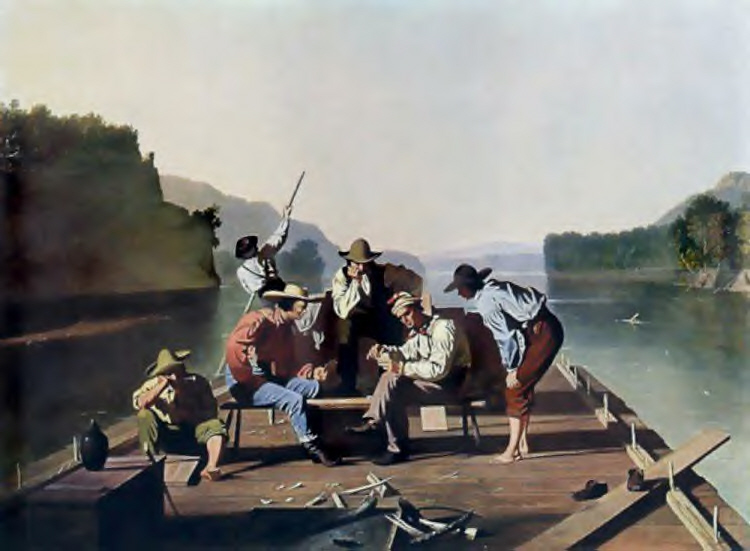
George Caleb Bingham (1811-1879). Raftsmen
Playing Cards.
Flatboat Fiddler. From Frank Leslie’s
Illustrated Newspapter, v. 50, April, 1880.
***
The Boatsman dance, the Boatsman sing,
The Boatsman do most everything.
And when the Boatsman get on shore,
Spends all his money and he work for more.
Cho:
Dance, Boatsman, dance. Dance, Boatsman, dance,
Stay out all night, 'til the broad daylight,
Coming home with the girls in the morning.
Hey, ho, the boatmen row,
Sail down the river on the Ohio.
Hey, ho, the Boatmen row,
Sail down the river on the Ohio.
***
Well, I never saw a pretty girl in my life,
But what she'd been some boatsman's wife.
When the Boatsman blows his horn,
Look out, men, your daughter's gone!
(Johnson)
***
The boatmen whistle and the boatmen sing,
And the boatmen tell me some good thing.
Way, oh, boatmen row,
Sailing down the river on the O‑hi‑o. (Bayard)
***
Sources for notated versions: Debbie
McClatchey (Spandaro), George Strosnider (an elderly Greene County, Pa., when
collected in the 1930's) [Bayard]; Melvin Wine [Silberberg]. Bayard (Dance to the Fiddle), 1981; No. 21, pgs.
25‑26 (appears as "Sailing Down the River on the O‑hi‑o").
Johnson (The Kitchen Musician: Occasional
Collection of Old‑Timey Fiddle Tunes for Hammer Dulcimer, Fiddle, etc),
No. 2, 1988 (revised 2003); pg. 3. Krassen (Appalachian
Fiddle), 1973; pg. 69 (appears as "Boatsman"). Phillips (Traditional American Fiddle Tunes, vol.
1), 1994; pg. 32. Scott (English Song
Book), 1926; pg. 78. Silberberg (Tunes I Learned at Tractor Tavern),
2002; pg. 14. Spandaro (10 Cents a Dance),
1980; pg. 28. Folk‑Legacy FSI‑38,
"Sara Grey with Ed Trickett" (1970). Kanawha Records 307, Frank
George ‑ "Traditional Music for Banjo, Fiddle, and Bagpipes."
Rounder CD0262, Mike Seeger - "Fresh Oldtime String Band Music"
(1988). Rounder CD 0382, Marvin Gaster - “Uncle Henry’s Favorites.” Rounder
1133, Ed Haley Vol 2 – "Grey Eagle".
BOATMAN [3], THE. (Fear a' bhàta). Scottish, Slow Air (3/4 time). B
Flat Major. Standard tuning. AABB. "This air sings delightfully and
expressively in Gaelic. The parties to the words were seemingly persons above
the ordinary rank. Whether the lady alludes to the cabin of his vessel or boat,
or to some apartment of her lover's residence, called the green chamber, she
mentions her delight at being there, where the best society met, to be
entertained with Spanish wine form the hand of her lover" (Fraser). A song
by this name appears in Allan Ramsay's ballad opera The Gentle Shepherd (1725), not performed until 1729. Francis
Collinson, in his Traditional and National Music of Scotland, says that
"Among a sea going island people like those of the
X:1
T:Boatman, The [3]
T:Fear a’bhàta
M:3/4
L:1/8
Q:140
S:Fraser Collection
(1874)
Z:AK/Fiddler’s Companion
K:B_
F>G | B2g2f>g | G2 Bz B>_A | G2F2B>F | G2 Bz d>e | f2g2f>e |
d2 gz f>e | d2B2c>B | B2 Bz :: d>c | B2 B>c d>F | G2 Bz g>f |
f2 f>g f>c | d2 fz d>e | f2 g2 f>e | d2 gz f>e | d2B2c>B | B2 Bz :|
BOATMAN [4], THE (Fear a' bhata). Scottish, Slow Air (3/4 time). E Minor.
Standard tuning. AA. A different tune than Fraser's (version #3). Martin (Ceol na Fidhle), vol. 2, 1988; pg. 6.
BOATMAN [5], THE. Old-Time. D Major. DDad or DDae tunings. ABC.
From western
X:1
T:Boatman [5]
M:C
L:1/8
S:Bruce Molsky
N:DDae tuning
N:ABC’s from a transcription by John Lamancusa, by permission. See http://www.mne.psu.edu/lamancusa/tunes.htm
Z:AK/Fiddler’s Companion
K:D
z2 (A2 A)B d2 || f4 ~e2d2 | A3 (d
(d)edB | AFDF ~E2 (D2 | D2) (A2 A)Bd2 |
f4 e2d2 | B3 (d d)edB | AFDF E2 (D2
| D2) (A2 A)Bd2 || f4 a3e |
fe d2 B3 (d | d)edB AFDF | ~E2 (D2
D2) D2 || (F4 F)EFG | (A4 A)B A2 |
(F4 F)EFE | (D4 D2) [D,2D2] | (F4
F)EFG | A2 (A2 A)BdB | ABAF E2 (D2 |
M:2/4
L:1/8
D2 dc |
M:C
L:1/8
B2G2 FGAd | BABG A2 dc | BAGB AFDF |
E2 D4 dc |
BABG FGAd | BABG ABdc | BAGB AFDF | E2D4
(A2 |
M:2/4
L:1/8
A)B d2 ||
BOATMAN [6], THE (Fir a bhàtd). Scottish, Air (3/4 time). G Major. Standard
tuning. One part. Morison (
X:1
T:Boatman [6], The
T:Fir a bhàtd
M:3/4
L:1/8
R:Air
N:”In rowing time”
S:Morison –
Z:AK/Fiddler’s Companion
K:G
G>E G2 AB | d>B d2e2 | F>E
E2 FA | B>E (ED) B,2 | d>B d2 (e>G) |
(AB) e2 d>B | (BA) G2 (Gd) |
B>A (A<G) G2 ||
BOATMAN [7], THE (Fir a bhàtd). Scottish, Air (3/4 time). G Major. Standard
tuning. One part. Morison (
X:1
T:Boatman [6], The
T:Fir a bhàtd
M:3/4
L:1/8
R:Air
N:”In rowing time”
S:Morison –
Z:AK/Fiddler’s Companion
K:G
D>
B,D E2 E>E | DE G2 AB | e>d B2
AG | F>B E2E2 ||
BOAT MAN [8], THE.
Scottish, Slow Air (4/4 time) and Jig. D Major. Standard tuning.
AABBCCDDEEFFGGHH. McGibbon (Scots Tunes,
book II), c. 1746; pgs. 46-47.
X:1
T:Boat Man [8], The
M:C
L:1/8
R:Air
N:”Slow”
S:McGibbon – Scots Tunes, book II, pgs. 46-47
(c. 1746)
Z:AK/Fiddler’s Companion
K:D
F>G | A3d ({B}A3) (G/F/) |
(GF)”tr”(ED) A3A | B>cd>e (f>g/2a/4 g)f | ({f}”tr”e4)E2F>G |
A3d ({B}A3) (G/F/) | {E/F/}(GF)”tr”(ED)
A3A | (B>c)(d>e) f(g/a/) Ac | ({c}d4)D2 :|
|: d2 | “tr”(B>AB)c d>efd |
{e/f/}(gf)”tr”(ed) e2 (AG) | F2A2 (d>e)(f>g) | ({f}”tr”e4E2F>G |
A3d({B}A3)G/F/ | (GF)”tr”(ED) A3
(G/F/) | G>BA>d (cd) ({f)e)(d/c/) | ({c}d4) D2 :|
|: F>G | A3 (B/c/4d/4) ({B}A3)
G/F/ | {E/F/}(GF)”tr”(ED) A3A | B/(d/c/)(e/ d/)(f/e/)g/ (fg/4a/4 g)f |
({f}”tr”e4) E2 (F/G/”tr”G>F/2G/4)
| A3 (B/c/4d/4) ({B}A3) G/F/ | (GF)”tr”(ED) A3A |
B/(d/c/)(e/ d/)(f/e/)g/ (f>g/2a/4)
Ac | ({c}d4)D2 :: d2 | “tr”(BA)(Bc) A3 (B/4/c/4d/8B/8c/8d/8) ({B}A3)G/F/ |
{E/F/}(GF)”tr”(ED) A3(G/F/) |
(G/A/B/)G/ Ad “tr”(c/B/c/)d/ ({f}e)(d/c/) | ({c}d4) D2 :|
M:6/8
L:1/8
N:”Quick”
F/G/ | AdA FDA | (d/c/B/c/ d) AFD |
“tr”F>GA def | “tr”e3E2A/G/ | (FDF) (AFA) |
BGB “tr”(cBA) | “tr”(fed) A(dc) |
d3D2 :: d/c/ | (Bc)A def | gfe agf | ecA EAc | A3”tr”G3 |
FAd dAF | GBe ecA | “tr”(fed) Adc |
d3D2 :: F/G/ | AdA FDA | (d/c/B/c/d) AFD |
F>GA (d/e/f/)(d/e/f) | e3E2A/G/ |
(F/E/D/E/F/)D/ A/G/F/G/A/F/ | B/A/G/A/B/G/ c/B/A/B/c/A/ |
(f/g/a/)(f/e/d/) Adc | d3D2 :: d/c/
| BcA d/e/f/d/e/f/ | g/f/e/g/f/g/ a/g/f/a/g/f/ | e/f/g/f/e/d/ c/d/e/d/c/B/ |
Ace “tr”G3 | (F/A/B/c/d) dBF |
(G/B/c/d/e) ecA | f/e/d/f/e/d/ Adc | dAF D2 :|
BOATMAN DANCE. AKA and see "Boatman [2]."
BOATMAN OF PITNACREE. AKA and see “The Pitnacree
Ferryman.” Scottish, Reel. D Major. Standard tuning. AB (Surenne): AAB
(Gow). Pitnacree is on the River Tay. "Very old." Carlin (The Gow Collection), 1986; No. 436. Gow
(Complete Repository), Part 3, 1806;
pg. 33. Surenne (Dance Music of
X:1
T:Boatman of Pitnacree, The
M:C|
L:1/8
R:Reel
S:Gow – 3rd Repository (1806)
Z:AK/Fiddler’s Companion
K:D
g|({g}f2) (AA) {A}e2 Ag|({g}f2) ef
dBB>g|f>A A/A/A e3g|f>e dB A/A/A A:|
B|A>F AB ~defd|e/e/e fd
({f}e>)d Bd|AFAB defd|efdB A/A/A A>B|
AFAB ~defd|efdf ({f}e)dBd|AFAB
defa|efdB ({B}A2)A||
BOATMAN'S DANCE [1]. AKA and see "Dance,
Boatman, Dance [1]." American (originally), English; Step-dance and
Morris Dance Tune (2/4 time). G Major (Wade). Standard tuning. AABB (Wade):
ABCC. An American minstrel tune with words, also used as a vehicle for step
dancing. In England “Boatman’s Dance” was employed as a vehicle for a morris
dance in North‑West Morris, for either polka step or single step. See
also "Boatman" [2] for version in old‑time
tradition. Wade (Mally’s North West
Morris Book), 1988; pg. 16. Cottey Light
Industries CLI-903, Dexter et al - "Over the Water" (1993. Appears as
part of the medley "Godley Hill").
X:1
T:Boatman's Dance [1]
S:Charles Pool 2009
M:2/2
L:1/4
R:Reel
K:D
G | [BG] [BG] [A3/2F3/2] [A/F/] | [BG] [BG] [A3/2F3/2] [A/F/] | [BG] [BG]
[AF] F | E [AD] [A3/2D3/2] G|
[BG] [BG] [A3/2F3/2] [A/F/] | [BG] [BG] [A3/2F3/2] [A/F/] | [BG] [BG]
[AF] F | E [DD] [D3/2D3/2] E||
F2 EF | [A3D3] [AD] | F2 EF | D3 E |FF FE/F/ | AA AF/A/ | BA FE | [D2D2] [D2D2]
||
|:[d2G2] [B3/2G3/2] [G/B/] | [AD][AD] F2 | F/F/ E/E/ D/D/ E/E/ |FE [DD] z :|
% Adlib Play D with 4th finger on G string for drone with open D string.
BOATMAN'S DANCE [2]. Scottish (?), "Sand Jig" (4/4 time). G Major. Standard
tuning. AABB. Kerr (Merry Melodies),
vol. 2; No. 400, pg. 45.
X:1
T:Boatman’s Dance [2]
M:C
L:1/8
R:Sand Jig
S:Kerr – Merry Melodies, vol. 2, No. 400
(c. 1880’s)
Z:AK/Fiddler’s Companion
K:G
D2|G>FG>B d2d2|e2e2
d4|e2d2B2G2|B2A2 (3fed (3cBA|G>FG>B d2d2|
e2e2d4|e2d2
gdBG|B2A2G2::d2|g2f2e2d2|e2d2B4|e2d2 cBAG|
FAag (3fed (3cBA|G>FG>B
d2d2|e2e2 d4|e2d2 gdBG|B2A2G2:|
BOATMAN'S REEL, THE. AKA and see "The Grey Frieze Breeches,"
"The Ladies
Pantalettes/Pantaloons/Pantaloos," "Leonard's Reel," "Pat the Fowler," "The Green Pantaloons."
BOB AND JOAN. See "Boban John," "Bobbing Joan," "Bobbing
Joe," "Hey for Stoney
Batter," "Fill the
Bumper Fair," "Love and
Whiskey,” “Stoneybatter [1]."
Irish, Air or March (9/8). G Major (Colclough): D Major (Kennedy). Standard
tuning. AB (Roche): AABB (Breathnach): AABB’ (Kennedy). A variant of the
Scottish tune "Boban John" in a different time. The air was used in
the opera The Wife of Two Husbands
for the song “Love and Whiskey,” to which Thomas Moore later wrote “Fill the
Bumper Fair.” Breathnach (1963) gives these words:
***
Hi for Bob and Joan,
Hi for Stoneybatter;
Leave your wife at home
Or surely I'll be at her.
***
Crofton Croker mentions “Bob and
Joan” in conjunction with James Gandsey (1769-1857), the famous Kerry piper (as
reported by Brendan Breathnach in The Man
and His Music {1997}). Gandsey, who
was nearly blind from smallpox contracted as an infant, nevertheless was an
incomparable talent of his time on his instrument, whose talents also included
telling a good story, singing a good song and holding his own at capping Latin
verses (a skill learned as a youth in a hedge school) with any educated person
in the county. Croker describes several
musical encounters with Gandsey at Gorham’s Hibernian Hotel, at one of which a
request was made of the piper for a lively song. “Come boy, scrape away,” said Gandsey to his son, a fiddler, and
responded by singing “Bob and Joan,” to which he had set his own words:
***
To Killarney we will go,
And see fair nature’s beauties,
The mountain topped with snow,
And covered with arbutus.
Oh! Then, to hear at night,
At Gorham’s, how entrancing,
Old Gandsey play his pipes,
Which steps the maids a dancing!
Tow, row, row, row, row etc.
***
Source for notated version: piper
Seán Potts (
X:1
T:Bob and Joan
M:3/4
L:1/8
S:Colclough – Tutor for the Irish
Union Pipes (c. 1830)
Z:AK/Fiddler’s Companion
K:G
BGGE G2 | BGGBAc | BGGE G2 |
D/E/F/G/ A/B/A/G/ FA :|
|: GBdG B2 | G/A/B/c/ d/e/f/g/ Bd |
GB d/e/d/c/ B2 cAADFA :|
|: gbdgBd | g/b/c’/b/ ag fa | gbef
gf/g/ | addd fa :|
|| G/E/B/E/ C/E/B/E/ G2 | G/B/d/g/
c/B/A/G/ F/G/A/B/ | G/E/B/E/ c/E/B/E/ G2 | F/G/A/B/ AD FA |
G/E/B/E/ C/E/B?E/ G2 | G/A/B/c/
d/e/d/c/ d>g | c’/b/a/g/ b/a/g/f/ g>f | eA A/B/A/G/ FA ||
X:2
T:Bob and Joan
M:3/4
L:1/8
S:William Vickers manuscript
(Northumberland, 1770)
Z:AK/Fiddler’s Companion
K:Am
ecAB c2|ecAc Bd|ecAB c2|BGGc Bd:|
|:cegf e2|cegf eg|agfe d2|BGGc Bd:||
BOB AND JOHN. See "Boban John." Scottish, Jig (3/2
time). A Aeolian. Standard tuning. AAB. A variant of the Scottish tune
"Boban John.” Carlin (The Gow
Collection), 1986; No. 478.
BOB CHADDUCH'S JIG. AKA and see "King Pin Jig."
American, "Sand Jig". A Major. Standard tuning. AABB. A "sand
jig" is a designation for a synchopated type of dance tune popular in the
mid-19th century. It received its name from the practice of sanding
the stage to reduce friction and facilitate the brushing of the shoes. “King Pin
Jig” is related in the first part. Cole (1000
Fiddle Tunes), 1940; pg. 80. Kerr (Merry
Melodies), vol. 2; No. 424, pg. 48. Ryan’s
Mammoth Colleciton, 1883; pg. 113.
X:1
T:Bob Chaduch’s
M:2/4
L:1/8
R:Sand Jig
S:Ryan’s Mammoth Collection (1883)
Z:AK/Fiddler’s Companion
K:A
EA/B/ c/>e/ z/e/ | f/e/c/e/
a({g}a | EA/B/ c/<e/ z/e/ | f/e/d/c/ B/e/^d/e/ |
z/ E/a/B/ c/<e/ z/e/ | f/e/^d/e/
f/a/g/a/ | (b/>.g/)(a/>.f/) e/c/A/B/ | z/ c/B/G/ A2 :|
|: A({g}a) A({g}a) | f/e/d/e/ f2/ | ze
e2 | (3c/B/A/ B/G/ A/c/B/A/ | E({^g}a z({g}a) |
f/e/^d/e/ f/a/g/a/ |
(b/>./)(a/>.f/) e/c/A/B/ | z/ c/B/G/ A :|
BOB JOHNSON'S MARCH
AND REEL. Canadian, March and Reel.
BOB LE SUEUR’S FANCY. Irish, Jig. D Dorian. Standard tuning. AABB. Source for notated
version: piper Kirk Lynch (
X:1
T: Bob le Sueur's Fancy
S: Kirk Lynch
Q: 325
R: jig
Z:Transcribed by Bill Black
M: 6/8
L: 1/8
K: Dmix
ded cAG | A3 BGE | D3 DEG | A3 cAG |
ded cAG | A3 BGE | D3 AGE | FGA D3 :|
ded fed | cAG c2 d | ded cAG | ^F3 AFD |
ded
fed | cAG c2 d | fed cAG | FGA D3 :|
BOB McQUILLAN’S. American, Reel. G Major. Standard tuning. AA’BB’. Although the tune has
been credited to
X:1
T:Bob McQuillan's
R:reel
C:Aly Bain
D:
Z:id:hn-reel-425
Z:transcribed
by henrik.norbeck@mailbox.swipnet.se
M:C|
K:G
~B3c dcBA|GABG D2DB|c2cd edcB|AGFE
D2dc|
~B3c dcBA|GABG D2ED|C2CD EDEG|1 FDEF
G2GA:|2 FDEF G2Bc||
|:d2Bd gagf|eccB c2AB|cAAc
~a3g|fdd^c d2B=c|
d2Bd gagf|eccB cege|dBGB cAFG|1 AGGF
G2Bc:|2 AGGF G2GA||
X: 2
T: Maud McQuillan's
C: Bob McQuillan
S: "Treoir"
M: 4/4
L: 1/8
R: Reel
Z: Transcribed by Bill Black
K: G
dc | B3 c dcBA | GABG D3 B | c3 d edcB | AGFE
D^cd=c |
BABc dcBA | GABG DCB,D | CEGE DFAF | GDBA G2 :|
dc | BGBd g3 f | eccB cBAB | cAce a3 g | fdd^c
d=cBc |
BGBd
g3 f | ec (3cBc ecge | dBGB cADF | AGGF G2 :|
BOB MORRIS. Scottish, Strathspey. B Flat Major. Standard tuning. AABB. Kerr (Merry Melodies), vol. 4; No. 155, pg.
18.
X:1
T:Bob Morris
M:C|
L:1/8
R:Strathspey
S:Kerr – Merry Melodies, vol. 4, No. 155
(c. 1880’s)
Z:AK/Fiddler’s Companion
K:Bb
B>FD>F
B>cd>B|e>dc>B (A<c) c2|B>FD>F B>cd>e|f<d c>d
B3d:|
|:f>gf>e
d>fb>a|g>fe>d (3cdB (3Adc|B>FD>F B>cd>e|f<d c>d
B3d:|
BOB O' DOOLY, THE. AKA and see "Carlin, Is Your Daughter
Ready?," “Jenny Cameron’s Rant,”
"Port Nan Con." Scottish, Strathspey.
A Mixolydian. Standard tuning. The tune is from a collection by Scottish
composer Robert Mackintosh. AAB (Athole): AABB (Hunter). Hunter (Fiddle Music of Scotland), 1988; No. 117
(arranged for string quintet by James Hunter). Stewart-Robertson
(The Athole Collection), 1884; pg.
14.
X:1
T:Port Nan Con
T:Bob o’ Dooly, The
M:C
L:1/8
S:Reel
B:Stewart-Robertson – The
Athole Collection (1884)
Z:AK/Fiddler’s Companion
K:A
A>ee>f e>d c2|A>ee>c d=GdB|A>ee>f edcA|BEEF =GABG:|
A>a a2 eaca|=G>=g ~=g2 dgBG|aAA2 eaca|BE~E>F =GABG|Aaa2 eaca|
B=GG2
dGB=G|aAAe f<eae|=gbeg dgB=G||
BOB OF DOWALLY, THE. AKA and see "The Bob
O' Dooly."
BOB OF FETTERCAIRN, THE. AKA and see “Braw Lads o’ Jethart,” “Braw Lads of Jedburgh,”
"Come Kiss
With Me, Come Clap With Me," "Had I the Wight," “I’ll Kiss the Lass/Wife, She
Bad(e) Me,” "Kail and Knockit
Corn" (Shetland), "Mrs.
Reneau's Reel" (Canada), "Newburn
Lads/Lasses." Scottish (orig.), Canadian; Reel. G Major. Standard
tuning. AB. A ‘bob’ in Scottish dialect is a patch of grass or a plot of grain.
Fettercairn, Aberdeenshire, is a village north of Brechin approached by a
wooded valley along which MacBeth is believed to have retreated after his
defeat at Dunsinane. It was the site of Kincardine Castle, whose history goes
back to the 10th century. A turreted arch commemorating the 1861
visit of Queen Victoria and Prince Albert survives at the entrance to the
village.
***
The tune is often played in Scotland
in a medley with "Caber Feidh/Fey." In Northumberland the tune has
been embroidered with arpeggi and re-titled "Newburn Lasses." Lisa
Ornstein finds variants in the Quebec
fiddler Joseph Allard’s “Reel de Madame Renault,”
and the eastern Kentucky old-time tune “Dr.
Humprey’s Jig” (in the repertoires of Jilson Setters {J.W. Day} and Ed
Hayley, among others). See also the related Cape Breton reel “Beul Iosait,” and the Scottish “A’ bean an gabh
thu fidhleir” (Woman take you the fiddler). Great Highland bagpipers sometimes
play a four-part strathspey version of the tune. Cairngorm Collection, Book
3. Carlin (The Gow Collection),
1986; No. 236. Gordon Highlanders Collection, vol. 1. Gow (Third Collection of Niel Gow’s Reels),
3rd ed., originally 1792; pg. 34. Honeyman (Strathspey, Reel and Hornpipe Tutor), 1898; pg. 13. Howe (Musician’s
Omnibus), 1864; pg. 119. Howe (1000 Jigs and Reels), c. 1867; pgs.
82 & 134. Kerr (Merry Melodies),
vol. 1; No. 3, pg. 24. MacDonald (The
Skye Collection), 1887; pg. 99. Scots Guards—Standard Settings, vol. 1.
Stewart-Robertson
(The Athole Collection), 1884; pg.
163. Philo 2001, "Jean Carignan."
X:1
T:Bob of Fettercairn, The
M:C|
L:1/8
R:Reel
B:Stewart-Robertson – The
Athole Collection (1884)
Z:AK/Fiddler’s Companion
K:G
B/c/|dBGB dBGB|dBdg f2df|ecAc ecAc|edef gage|dBGB dBGB|
DBdg f2df|aefd edBg|A/A/A Bd e2g2||dgBg dgBg|dgBg f2df|
ea^ca eaca|edef gage|dgBg dgBg|dgBg f2 df|aefd edBg|A/A/A Bd e2g2||
X:2
T:Bob of Fettercairn
B:Scots Guards - Standard Settings
Z:Nigel Gatherer
M:4/4
L:1/8
K:D
B | d>B G>B d>B G>B | d>B
d>g f2 d>f |\
e>c A>c a>c A>c | e2
e>f g>a g/f/e |
d>B G>B d>B G>B | d>B d>e
f2 e/f/g |\
a/g/f g>f e>d e/f/g | Bd>g B>g d>g
B>g | d>B d>g f2 d>f |\
e>a ca cf g>a g/f/e | e>a ca
ce f2 e/f/g |\
a/g/f g>f e>d e/f/g | Bd/B/B d<G B>A G>B |
de g2 eA2 e>A c>B A>c | e2 e>f g>a
g/f/e |
d/B/B d<G B>A G>B | de f2 e/f/g |\
a/g/f g>f e>d e/f/g | BB<G d<G B<G G/G/G | B<G d<G f2 dA2
e>A cA ca g>d |
B<G d<G B<G G/G/G | B<G d<G f2 e/f/g |\
a/g/f g>f e>d e/f/g | B
BOB RIDDEO. AKA ‑ "Bob Riddley." American, March (2/4 time). USA, southwestern
Pa. D Major. Standard tuning. AB. Bayard (1981) found this fif tune in the
Mount Pleasant Tablatures, 1950's. Bayard (Dance
to the Fiddle), 1981; No. 32, pgs. 30‑31.
BOB RID(D)LEY [1]. See "Bob
Riddeo."
BOB RIDLEY [2]. American, Jig. AKA and see "Captain
Collins."
BOB SHEAR HARVEST. AKA ‑ "Bob Sheer Harvest." English, Scottish; Old
Hornpipe? England, Northumberland. F
Major. Standard tuning. AABB. The title comes from "Robin Shure in
Hairst" (Robin Sheared in Harvest) {Seattle}. Mooney (Choicest Scots Tunes), 1982; pg. 2. Seattle (William Vickers), 1987, Part 2; No. 323.
BOB SIMMS. Scottish, Strathspey. G Major. Standard tuning. AA'BB. Composition credited
to Hugh Dunlop in Kerr. Kerr (Merry
Melodies), vol. 3; No. 51, pg. 8.
X:1
T:Bob Simms
M:C
L:1/8
R:Strathspey
S:Kerr – Merry Melodies, vol. 3, No. 51
(c. 1880’s)
Z:AK/Fiddler’s Companion
K:G
c|B<G G>D (E<G)
D2|C>B,A,>B, C>D E<c|B<G G>D (E<G) D2|1 B,>CD>G
A>G F:|2
B,>CD>c B<G G||:c|B<d
d>g e>gd>g|c>eB>d A>G F<D|B<d d>g
e>gd>g|g>de>c B<G G:|
BOB STEELE. AKA and see "The Miller O'
Dervil," "Auld Brig o'Ayr,"
"New Brig o'Dee," "Johnnie Steele," "Benholm Castle." Scottish,
Strathspey. D Major. Standard tuning. AAB. Composed by Barnet and Skinner.
Martin (Ceol na Fidhle, vol. 3),
1988; pg. 29.
BOB TAILED MULE. AKA – “Buckin’ Dun.” Old-Time, Breakdown. A Major. Standard or AEae
tunings. AABB. Source for notated version: Larry Shumway [Phillips]. Phillips (Traditional American Fiddle Tunes), vol.
1, 1994; pg. 33. Vigortone Records, Jim & Kim
Lansford – “Call Your Dogs” (2003. Learned from a 1943 field recording of
Snowflake, Arizona, fiddler Kenner Kartchner).
X:1
T:Bob Tailed Mule
M:C
L:1/8
R:Reel
S:Tom Sauber
N:AEae tuning
N:From a transcription by John Lamancusa, by permission. See http://www.mne.psu.edu/lamancusa/tunes.htm
Z:AK/Fiddler’s Companion
K:A
(AB |: c2) [c2e2] (Bc) c2 | e3 (f
e2) (AB | c2) [c2e2] (Bc) B2 |
A3 (B A2) (AB | c2) [c2e2] (Bc) c2 |
e3 (f e2) ee | f a2 (b a2) f2 |
e2c2 (BA)(AB) | c2 (ef) ec B2 |1 A3
(B A2) AB :|2 A3 (B A2) ee ||
|: fa2b a2 fe | fa2b a2e2 | fa2b
a2f2 | e3f e3e | fa2b a2f2 |
e2c2 BA(AB | c2) (ef e)c B2 |1 A3 (B
A2) ee :|2 A3 B A4 ||
BOB
TAYLOR’S CLOG. American, Clog. F Major. Standard.
AABB. Cole (1000 Fiddle Tunes), 1940;
pg. 121. Ryan’s Mammoth Collection,
1883; pg. 161.
X:1
T:Bob
Taylor’s Clog
M:2/4
L:1/8
R:Clog
S:Ryan’s Mammoth Collection (1883)
Z:AK/Fiddler’s Companion
K:F
(c/>.B/)
| (A/>.c/)(f/>.c/) A(c/>.B/) | A/>c/f/>c/ ag/>f/ |
e/>c/g/>e/ b/>g/e/>g/ | f/>a/g/>f/ e/>d/c/>B/ |
A/>c/f/>c/
Ac/>B/ | A/>c/f/>c/ ag/>f/ | e/>c/g/>e/ b/>g/e/>g/ |
faf :: (g/>.a/) | (b/>.g/)(b/>.g/) g/>e/g/>e/ |
a/>f/a/>f/
c/>A/c/>A/ | B/>c/d/>e/ f/>g/a/>b/ | .a.g ({a}g/^f/g/).a/ |
b/>g/b/>g/ g/>eg/>e/ |
a/>f/a/>f/
c/>A/c/>A/ | d/>c/=B/>c/ e/>d/_B/>G/ | Faf :|
BOB TAYLOR'S MARCH. Old-Time, Waltz. USA, Tennessee. D Major. Standard. AAB. The melody
comes from Bob Taylor, who, along with his brother Alf, was both a fiddler and
a Governor of Tennessee. The brothers, who belonged to different parties, were
friendly rivals and would even share a bed while out campaigning against
each other (they were each in
office at different times). The Taylor vs. Taylor campaign of 1886 was so
amicable, in fact, that it was called “The War of the Roses.” Bob Taylor’s
original name for the tune may have been “Streaking Old Fiddle,” a favorite
tune of his. Fiddlin’ A story goes that while Bob was Governor he attended a
fiddle contest in Memphis and competed with a young Fiddlin’ John Carson.
Taylor won, but when time came to award the prize he stepped forward and told
the assembly that he believed the judges had bestowed the prize upon him only
because he was the Governor of the state. He said he could never hope to play
like Fiddlin’ John, and so declined the award. (attributed to Collier:
“Fiddlin’ John on Broadway”, quoted by Gene Wiggins: “Fiddlin’ John Carson, His
Real World and the World of this Songs” {1989}). Another account of the contest
(attributed to Radio Digest of November 7th, 1925,
reprinted in Mark Wilson's notes to Rounder LP1003 Fiddlin' John Carson) goes:
***
.....Young Carson was declared winner and thereafter became
known as Fiddlin' John, while Governor Taylor was so delighted
with the young fellow's playing that right there on the spot, he
bestowed his fiddle on the proud victor.
***
John Carson became a friend of Bob’s
and used to campaign with him, fiddle in hand.
Source for notated version: Charlie Taylor (Tenn.) [Phillips]. Phillips
(Traditional American Fiddle Tunes),
vol. 2, 1995; pg. 243. CA-01, Charlie Acuff -
"Left Handed Fiddler" (1990. A privately issued cassette featuring
the 70 year old fiddler from Alcoa, Tennessee).
BOB THOMPSON'S FAVOURITE. AKA and see "The Coravat
Jig [1]," "Wiseman's Favourite,"
"The Mountain Lark [5],"
"Jackson's Trip to
Limerick," "Jackson's
Walk to Limerick," "Twice
Tricked," "Jackson's Coola,"
"The Piper's Frolic,"
"The Humours of Limerick
[2]," "Tuhy's Frolic,"
"The Geese in the Bog [2],"
"The Green Meadow [2]."
BOB WALKER. Old-Time, Breakdown. The tune was also recorded by Kentucky-born
William B. Houchens (1884-c.1955), who recorded a dozen tunes for the Starr
Piano Company of Indiana (including such chestnuts as “Arkansas Traveller” and
“Turkey in the Straw”). Houchens spent much of his adult life running a music
conservatory in Dayton, Ohio, where he taught a variety of stringed instruments
(Charles Wolfe). Significant was the fact that Houchens recorded his sides
prior to what is thought of as the first country music recordings by Fiddlin’
John Carson. Kerry Blech believes Georgia fiddler Lowe Stokes also recorded
“Bob Walker,” although the side was not issued.
BOB WALTER'S HORNPIPE. Old-Time, Hornpipe. D Major. Standard tuning. AA'AA'BB'BB'. Bob Walters
was a regionally influential fiddler from Nebraska whose hey-dey was the
mid-20th century. Source for notated version: Lynn Smith [Phillips]. Phillips (Traditional American Fiddle Tunes), vol.
2, 1995; pg. 182.
BOB WALTERS WALTZ, A. Old‑Time, Waltz. USA, Nebraska. G Major ('A' part), D Major ('B'
part) & C Major ('C' part). Standard tuning. ABC. Christeson's name for an
untitled waltz played by Nebraska fiddler Bob Walters. Source for notated
version: Bob Walters (Burt County, Nebraska) [Christeson]. R.P. Christeson (Old Time Fiddlers Repertory II), 1984;
pg. 159.
BOB WILLIAMSON. Scottish, Reel. B Flat Major.
Standard tuning. AB. Composed by the great Scots fiddler-composer J. Scott Skinner (1843-1927). Skinner (Harp and Claymore), 1904; pg. 127.
X:1
T:Bob Williamson
M:2/4
L:1/8
R:Reel
C:J. Scott Skinner (1843-1927)
S:Skinner – Harp and Claymore (1904)
Z:AK/Fiddler’s Companion
K:Bb
F/ | B .b/.f/ (=e/f/).d/.B/ |
c/A/B/G/ A/F/F/_A/ | G/E/B/G/ F/B,/D/F/ | E/C/F/E/ D/B,/B,/F/ | B b/f/
(=e/f/).d/.B/ |
c/A/B/G/ A/F/F/_A/ | G/E/B/G/ F/B/d/f/ | e/c/f/e/ d/B/B/ || b/ | a/b/=e/f/
^f/g/d/_e/ | =e/f/A/B/ d/c/c/b/ |
a/b/=e/f/ ^f/g/d/_e/ | =e/f/_e/c/
d/B/.B/.b/ | a/b/^f/g/ d/e/a/g/ | (=e/f/b/)B/ d/c/c/d/ | B/d F/B/ G/B/e/g/ |
=e/f/g/a/ d/B/B/ ||
BOB WINE'S TUNE. Old-Time, Breakdown. USA, West Virginia. D Major ('A' part) & A
Mixolydian ('B' part). Standard tuning. AA'B. Source for notated version:
Melvin Wine (W.Va.) [Phillips]. Phillips (Traditional
American Fiddle Tunes), vol. 1, 1994; pg. 33.
BOB WITH THE ONE HORN
[1]. Scottish; Reel or Rant. USA, New
England. G Minor. Standard tuning. AAB. Tolman probably got his version from
Kerr, who lists it at the end of his section of Irish reels. This seems either
to be a mistake, perhaps of the printer, for the reel appears to be Scottish,
or else it is an Irish reworking of the Scots tune “Ewie Wi’ the Crookit Horn.”
Tolman, taking his cue from Kerr, lists the tune as “Irish”. Kerr (Merry Melodies), vol. 4; No. 187, pg.
21. Tolman (Nelson Music Collection),
1969; pg. 21.
X:1
T:Bob with the One Horn [1]
M:C|
L:1/8
R:Reel
S:Kerr – Merry Melodies, vol. 4, No. 187
(c. 1880’s)
Z:AK/Fiddler’s Companion
K:Gmin
DGGF DGGA | F2 (AF) cFAF | DGGF DGGg
| fdcA (BG) G2 :|
|| g2 (bg) dgbg | f2 (af) cfaf | g2
(bg) dgbg | agfa g2 (ga) |
(3bag (3agf gfgd | AFFA cAFA | DGGF
DGGg | fdcA (BG) G2 ||
BOB WITH THE ONE HORN [2]. AKA and see "The Ewe Reel,"
"The Ew(i)e with the
Crooked Horn [1]," "The Foe,"
"Go See the Fun," "The
Kerry Lasses [1]," "The Lowlands of Scotland,"
"The Merry Lasses," "Miss Huntley's," "My Love is Far Away," "Peter Street [2],” "The Pretty Girl in Danger,"
"The Ram with the Crooked
Horn," "The Red Blanket,"
"Sweet Roslea and the
Sky Over It." Scottish, Irish; Reel. Version #1 in the major mode.
BOB WITH THE TWO HORNS, THE. Scottish, G Minor. Standard tuning. AABB’.
Kerr (Merry Melodies), vol. 4; No.
188, pg. 21.
X:1
T:Bob with the Two Horns, The
M:C|
L:1/8
R:Reel
S:Kerr – Merry Melodies, vol. 4, No. 188
(c. 1880’s)
Z:AK/Fiddler’s Companion
K:Gmin
d2 (BG) ddBG | ccAF f2 (=ef) | dcBA
GBdg | dcBA (BG) G2 :: DGBG dgBG |
cBAG FGAF |1 DGBG dGBG | dedc BGGF
:|2 GABc dcdg | dcBA (BG) G2 ||
BOBAN JOHN. AKA and see "Bob and John,"
"Bob and Joan." AKA ‑ "Bobbing
John," "Bobbin John." Scottish, March (?, 3/2 time). G
Mixolydian. Standard tuning. One part. Williamson (1976) says: "'Boban' or
'Bobbin John'... was a nickname for the Earl of Mar, a supporter of James
Stuart, The Old Pretender. Mar had
never been in the field before he raised James's standard at Castleton of
Braemar on the 6th of September, 1715, and proclaimed James King of Scotland,
England, France, Ireland, and so forth. The standard had been made by the
Earl's Lady, and it was an extremely elegant job featuring pennants, sub‑pennants,
and mottos in blue , white, and other colours of silk. Unfortunately, when it
was first erected, the ornamental ball on the top of the pole fell off. Many of
Mar's mostly Highland troops interpreted this as an evil omen. Nevertheless,
the Jacobite forces acquitted themselves well in many raids and skirmishes and
won a near victory over George's Redcoats at the battle of Sherriffmuir. The
Jacobites received much popular support from the people of Scotland and the
north of England who were not enamoured of the political juggling that had
placed George on the throne, but finally the highly disciplined Redcoats and
experienced English generals defeated the Jacobites at the battle of Preston in
Lancashire. James fled back to France, the leaders were executed, and the
rebellion was quelled, for a time." Printed by Robert Petrie in Fourth Collection of Strathspeys, Reels, and Jigs (1796). Gow (Complete Repository), Part 2, 1802; pgs.
22-23. Williamson (English, Welsh,
Scottish and Irish Fiddle Tunes), 1976; pg. 49.
X:1
T:Bobin John
M:3/2
L:1/8
R:Jig or March
S:Gow – 2nd Repository
(1802)
Z:AK/Fiddler’s Companion
K:Amin
e2(A2 A2)c2 B4|e2(A2A2)c2
BcdB|e2(A2A2)c2 B3c|d2G2G2d2 BcdB:|
c2 ef g2c2 e4|c2 ef g2 c2 e2 g2|a3f
g3f e4|d2G2G2d2 BcdB|
c2efg2 c2 e4|c2 ef g2c2e2g2|a3f
g3f~e4|d2G2G2d2 BcdB||
BOBBERS OF BRECHIN. AKA and see "The Strathbogie
Toast." Scottish, Reel. G Minor. Standard tuning. AB. Composed by William Marshall (1748-1833). The town of Brechin lies
in Angus, Scotland. To ‘bob’ has been a Scots term for dancing since the 16th
century (Consise Scots Dictionary), although it has other meanings. Charles
Gore’s index gives an alternate title as “Robbers of Brechin.” Gow (Complete Repository), Part 1, 1799; pg.
10. Surenne (Dance Music of Scotland),
1852; pg. 160.
X:1
T:Bober’s o’ Brechin
M:C
L:1/8
R:Reel
S:Gow – 1st Repository
(1799)
Z:AK/Fiddler’s Companion
K:Gmin
g|dg~g^f g2 d=f|cdfg dfcf|dgg^f ge
dg|fdc>A {A}G2 GB|Ggg^f g2 {fg}d=f|
c>dfg afcf|d^fga bag=f|dfc>A
{A}G2G||d|BGdG BGd=e|f>d c<f AFcA|BGdG BGdg|
fdc>A {A}G2 Gd|BGdG BGd=e|f.dcf
AfcA|GABc d=efg|f>dc>A {A}G2G||
BOBBIE CUTHBERTSON. Scottish, Canadian; Hornpipe. A Mixolydian/Dorian. Standard tuning.
AA’BBCCDD. Composed by John Wilson, a champion piper originally from Scotland
who emigrated to Canada about the time of World War II. The pipe setting is
straight mixolydian, though fiddler Fitzgerald flatted some of the ‘c’ notes in
the second and fourth part. Christine Martin (2002) notes that “Bobbie
Cuthbertson” is the most popular vehicle for solo hornpipe dancing in modern
Highland dancing competitions. Source for notated version: Winston Fitzgerald
(1914-1987, Cape Breton) [Cranford]. Cranford (Winston Fitzgerald), 1997; No. 63, pg. 28. Martin (Traditional Scottish Fiddling), 2002;
pg. 55.
|
See also listing at: Alan Snyder’s Cape Breton Fiddle Recording
Index |
BOBBI ROJO. New England, Reel. D Major. Standard tuning. AABB. A modern composition
by Peterborough, New Hampshire, composer, accordion and piano player Bob
McQuillen. McQuillen (Bob’s Notebook),
vol. 1; No. or pg. 10.
BOBBING-A-JOE. See "Bobbing Joe". English, Morris Dance Tune (6/8 time). G
Major (Mallinson): A Major (Bacon). Standard tuning. AABB, etc., AA. From the
village of Wheatley, Oxfordshsire, in England's Cotswolds. See note for “Bobby and Joan.” Bacon (The Morris Ring), 1974; pg. 307. Mallinson (Mally’s Cotswold Morris Book), 1988, vol. 2; No. 32, pg. 16. Topic TSCD458, John Kirkpatrick - “Plain Capers” (1976).
BOBBIN JOHN. See "Boban John," "Bobbing Joan," "Bob
and Joan."
BOBBING AROUND [1]. English, Reel. C Major. Standard tuning. AABB. Bayard (1981) says this is
taken from a stage piece of the same name, something of a take‑off on
rural courtship. His Pennsylvania collected set (No. 402, pg. 382) is similar
in the 'A' part. Raven (English Country
Dance Tunes), 1984; pg. 148.
BOBBING AROUND [2]. English, Morris Dance Tune (6/8 time). G Major (Mallinson): A Major
(Bacon). Standard tuning. AB (Bacon): ABB, x4 (Mallinson). Similar to version
#1. This version is from the village of Bampton, in England's Cotswolds. Bacon
(The Morris Ring), 1974; pg. 41.
Mallinson (Mally’s Cotswold Morris Book),
vol. 1, 1988; No. 6, pg. 10. Veteran VT111, Francis
Shergold - "Greeny Up" (1988. Recorded from Bampton morris
musicians.)
BOBBING FOR EELS. AKA and see “Bottle of Punch,”
“The Bowl of Punch,” "The Butchers of Bristol," “Dairymaid” [6], "Fishing for Eels," “The Glens of Mayo,” "The Humours of Milltown [2],”
"Ioc an Reicneail,” "Jackson's Bottle/Jug of
Punch/Brandy," “The Jug of Punch
[5],” "The Old Man's Jig,"
" Pay the Reckoning.” Irish,
Jig. A Major (Cole, Ryan): G Major (Miller). Standard tuning. AABB. Credited,
impropbably, to one C. Knowlton in Ryan’s
Mammoth Collection, though the tune can be found in older collections.
Olive Sharkey, in her book Old Days Old
Ways (O’Brien Press, 1985, pg. 170), talks about fishing in Ireland in the
late 19th and early 20th centuries and explains:
***
Eels were caught illegally with longlines, but a more usual practice was
to
bait them with balls of worms, a practice called ‘bobbing’.
***
Cole (1000 Fiddle Tunes), 1940; pg. 76. Miller (Fiddler’s Throne), 2004; No. 10, pg. 19. Ryan’s Mammoth Collection, 1883; pg. 107.
X:1
T:Bobbing for Eels
M:6/8
L:1/8
R:Jig
S:Ryan’s Mammoth Collection (1883)
Z:AK/Fiddler’s Companion
K:A
{E/F/G/}A2a .e(cA) | ({c}B)AB dcB |
({G}A2a .e(cA) | ({c}B)AB cAE |
({G}A2)a .e(cA) | ({c}B)AB cde |
(fa)f (ec)A |1 ({c}B)AB A2z :|2 ({c}B)AB A2 ||
|: e | (ac’)a (gb)g | (fa)f e(fg) |
aga bc’d’ | (c’d’)c’ (bg)e | (ac’)a (gb)g |
faf efg | agf edc |1 ({c}B)AB A2 :|2
({c}B)AB A2z ||
BOBBING JOAN. AKA and see "Bob and Joan,"
"Bobbing Joe," "Bobbing John," etc. English, Country Dance Tune. D Major. Standard tuning. AABB. Howe
(1000 Jigs and Reels), c. 1867; pg.
73. Beautiful Jo BEJOCD-36, Dave Shepherd & Becky
Price – “Ashburnham” (from the Winder manuscript, early 19th
century, Wyresdale, Lancashire).
X:1
T:Bobbing Joan, or Love and Whiskey
M:3/4
L:1/8
S:Howe – 1000 Jigs and Reels (c. 1867)
Z:AK/Fiddler’s Companion
K:D
(fd)(dB) d2 | (fd)(dB) (ce) | (fd)(dB) (df) | (ef)(ed) (ce) :|
|: (df).a.g .f2 | (df).a.g .f.a | (ba)(gf) (gf) | (e>f) (e/f/e/d/) (ce) :|
BOBBING JOE. AKA and see "Bobbing Joan(e),"
"Bob(by) and Joan/John," "Bobbin‑a‑Jo." English, Country Dance
Tune (6/4 time). A Minor. Standard tuning. AB (Sharp): AAB (Chappell, Raven):
AABB (Johnson). This air appears in John Playford's first (and every
subsequent) edition of his The English
Dancing Master (1651) and Musick's
Delight on the Cithren (1666, where it appears as “Bobbing Joan,” a
frequent title variation). Quite old, it was considered part of the traditional
repertoire in John Playford's day (Pulver, 1923), and may be related to the
morris tune "Bobbin‑a‑Joe." As "Bobbing Joane"
it appears in several ballad operas, including Gay's Polly (1729), The Bay's Opera
(1730), The Mad House (1737), and
A Cure for a Scold (1738). As a dance
tune it also appears in Walsh’s Compleat
Country Dancing Master, vol. 1 (1718) and vol. 3 (1731). Chappell (Popular Music of the Olden Time), vol.
1, 1859; pg. 312. Johnson (The Kitchen
Musician No. 14: Songs, Airs and Dances of the 18th Century),
1997; pg. 1. Raven (English Country Dance
Tunes), 1984; pg. 37 (a facsimile copy of Playford’s Dancing Master version). Sharp (Country
Dance Tunes), 1909/1994; pg. 36. Dorian 90238, The
Baltimore Consort – “A Trip to Killburn.” Maggie’s Music MMCD216, Hesperus -
“Early American Roots” (1997).
|
See also listing at: Jane Keefer’s Folk Music Index: An
Index to Recorded Sources |
X:1
T:Bobbing Joe
M:6/8
L:1/8
S:Sharp – Country Dance Tunes
Z:AK/Fiddler’s Companion
K:Amin
(A2e) .e2.d | (e>fg) (B>AG) | (A2B
c>dB) | (Ae2) A3 |
(A2e) .e2.d | (e>fg) (B>AG) |
(A2B c>dB) | (Ae2) A3 ||
(Bd2) G3 | (Bd2) G2(G | A2B c>BA
| c>de A3) |
(Bd2) G3 | (Bd2) G2(G | A2B c>BA
| c>de A3) ||
BOBBING JOHN. See "Bobbin' John."
BOBBITY DAWLY. Irish, Air (6/8 time). C Major. Standard tuning. AB. "...Obtained
from Fitzgerald, Cork" (Joyce). Joyce (Old
Irish Folk Music and Songs), 1909; No. 482, pg. 267.
X:1
T:Bobbity Dawly
M:6/8
L:1/8
R:Air
N:”Moderately slow”
S:Joyce – Old Irish Folk Music and Songs (1909)
Z:AK/Fiddler’s Companion
K:C
g/>f/ | e2c A>Bc | d2B G>AB
| c2c cde | f2e d2 g/f/ | e2c ABc | d2B G>AB |
c2f ege | c3c2 || f | efg abc’ |gfe
a2 g/f/ | efg abc’ | g3 c’2f | efg c’ba | gfe a2f |
e2d ege | c3 c2 g/f/ | e2e .e.g.e |
f2f .f.a.f | e2e .e.g.e | f3f2d | e2e ege |
f2f faf | e2d ege | c3c2 ||
BOBBY AND JOAN. AKA and see "Bobbing Joe."
English, Morris Dance Tune (6/8 time). G Major (Mallinson): A Major (Bacon). Standard
tuning. AABBBB, x4. From the Fieldtown (the
BOBBY CASEY'S HORNPIPE. AKA and see “Chuir
me Feisteas ar mo Theachsa,” “Humours of
Tullycreen/Tullycrine.” Irish, Hornpipe. A Dorian. Standard tuning. AABB. Green Linnet GLCD 3009, Kevin Burke - "If the Cap
Fits" (1978. Learned from Co. Clare musician Bobby Casey).
X:1
T:Bobby Casey’s Hornpipe
T:Humours of Tullycreen
L:1/8
M:4/4
Z:Transcribed by Jerome Colburn
K:Ador
AG | EAAB cBcd | eaag (3efg dB | c2
Ac BAGA | Bdde dBAG |\
EAAB cBcd | eaag (3efg dB | c2 (3ABc
BAGB | A2 AG A2 ::\
cd | eaab ageg | agab aged | c2 Ac
BAGA | Bdde dBAG |\
EAAB cBcd | eaag egdB | c2 (3ABc
dBGF | EAAG A2 :|**
X:2
T:Bobby Casey's Hornpipe
R:hornpipe
H:See also "The Humours of Tullycrine", #86
D:Kevin Burke: If the Cap Fits
Z:id:hn-hornpipe-34
Z:transcribed by henrik.norbeck@mailbox.swipnet.se
M:C|
L:1/8
K:Ador
ed|cAAB ~c3d|eaag (3efe dB|cAAc BAGA|Bdde dBAG|
AGAB c3d|eaag (3efe dB|cAAc dBGB|A2AG A2:|
(3Bcd|ea~a2 aged|ea~a2 aged|eg~g2 gedg|eg~g2 gedB|
AGAB c3d|eaag (3efe dB|cAAc dBGB|A2AG A2(3Bcd|
eaag aged|eaag aged|eggf ged2|(3efg fa gedB|
AGAB cBcd|eaag (3efe dB|cAAc dBGB|A2AG A2||
BOBBY CASEY'S JIG [1]. AKA – “Casey’s Jig.” AKA and see
"Scully Casey's (Jig) [1]."
Irish, Jig. A Mixolydian (Feldman & O’Doherty). Standard tuning. AABB.
Bobby Casey was a renowned fiddler from West Clare; Scully was his father. A
version is published as an untitled double jig published by Breathnach (Vol. 3,
1985; No. 16, pg. 9), from the playing of fiddler Kevin Burke and accordion
player Jackie Daly.
***
Irish guitarist Paul de Grae relates
the story of the north London pub called ‘The Case is Altered’ (actually there
were several pubs with that name), a name that stems from a centuries old
expression meaning “things are different now.” Another story exists for the
oldest of the ‘Case Altered’ pubs, that had supposedly been established by a
veteran from Wellington’s army during the Napoleonic Wars who had been
invalided out. The soldier had been
wounded during the Spanish campaign and had been hospitalized in a commandeered
villa called La Casa Alta, a name transformed and brought home. Bobby Casey liked to go to the pub on a
Sunday, says Paul, leading some to playfully refer to it as “Casey’s Altar!”
***
Source for notated version: fiddler Peter
Turbit [Feldman & O’Doherty]. Breathnach (CRÉ III), No. 16 (untitled). Bulmer & Sharpley (Music from Ireland), 1974, vol. 3, No.
60. Feldman & O’Doherty (The Northern
Fiddler), 1978; pg. 233b (appears as second “Untitled Jig” on page). Green Linnet SIF 3002, Kevin Burke & Jackie Daly –
“Eavesdropper” (1981).
BOBBY CASEY'S JIG [2]. AKA and see “Hag’s Purse,” “Roscommon Jig.”
BOBBY CASEY’S (REEL)
[1]. AKA and see “Crosses of Annagh [2],” “Hump in the Bed,” “Michael Dwyer’s Reel.” Irish, Reel.
Ireland, County Clare. D Major. Standard tuning. AABB. Source for notated
version: Tony Smith [Mulvihill]. Bulmer & Sharpley (Music from Ireland), 1974, vol. 2, No. 31. Mallinson (Essential), 1995; No. 58, pg. 26.
Mulvihill (1st Collection),
1986; No. 94, pg. 25 (appears as untitled reel). Sullivan (Session Tunes), vol. 3; No. 59, pg. 24. Green
Linnet SIF 3018, “Molloy/Peoples/Brady” (1978).
X:1
T:Bobby Casey’s [1]
L:1/8
M:C|
S:Mulvihill - 1st Collection (94)
K:D
DFAB B2 AB|~d2 fd edBd|DFAB B2
AB|dfgf edBd|
DFAB B2 AB|d2 fd efge|faaf g2
fe|defd edBc:|
|:d2 fd eA (3AAA|defg afef|dcdf eB
(3BAB|gB (3BAB dBAB|
d2 fd edef|defd edBd|ABdf bafb|afeg
fdd||
X:2
T:Bobby Casey's [1]
R:Reel
S:Bobby Casey
M:4/4
L:1/8
K:D
DFAB ~B2 AB | d2 fd edBA | DFAB ~B2 AB | df ~f2 edBA | DFAB ~B2 AB |
d3 f ee{f}eg | fgaf g2 fe | defd edBA :: d3 g eA ~A2 | defg afge | d3 g eA ~A2 |
gB
~B2 dBAB | d2 fd efge | d2 fd edBd | ABdf ef{g}fg | afeg fd{e}dB :|
BOBBY CASEY’S (REEL)
[2]. Irish, Reel. Seems related to “The Flowers of Limerick” family of
tunes. Source for notated version: Clare fiddler Bobby Casey [Bulmer &
Sharpley]. Bulmer & Sharpley (Music
from Ireland), vol. 4, No. 21.
BOBBY
CASEY’S (REEL) [3]. Irish, Reel. D Dorian. Standard tuning. AB. Treoir.
X: 1
T: Bobby Casey's (Reel) [3]
S: Treoir
M: 4/4
L: 1/8
Z: Transcribed by Bill Black
Q: 350
R: reel
K: Ddor
DE | FEDE FGAG | FEDF ECCE | FEDE FGAG | (3FED
EC A,DDE |
FEDE FGAB | cAGF ECCE | DEFG AddB | cAGc AD D2
||
(3d^cd Ad d=cAG | FEDF ECCc | (3ded Ad dcAG |
Addc d2 de |
fdec dcAG | FEDF ECCE | DEFG AddB | cAGF ED D2 ||
BOBBY CASEY’S (REEL) [4]. Irish, Reel. D Dorian. Standard tuning.
X:1
T:Bobby Casey's
R:Reel
M:4/4
L:1/8
K:D Dorian
dAGE F3 A | cAGc A~d3 | dAGE F3 d | (efde) cA ~d2 | dAGE F3 A | cAGc A~d3 |
dAGE F3 d | (efde) cA ~d2 | (Ad) (3ddd cAGD | (3EFG AB cAGc | (Ad) (3ddd cAGA |
(3Bcd eg fd{e}d2 | d2 (3ddd cAGD | EGAB cAGc | (Ad) (3ddd cAGA |
(3Bcd eg fd{e}dc | d2 (fd adfd) | c2 (ec gcec) | d2 (fd adfd) | dcAG Ad~d2 |
d2
(fd adfd) | Ac{d}cB cdeg | a3 g f3 e | dcAG Ad{e}dc |]
BOBBY GARDENER’S [1]. Irish, Polka. Ireland, West Kerry. A Major. Standard. AAB. Mac
Amhlaoibh & Durham (An Pota Stóir:
Ceol Seite Corca Duibne/The Set Dance Music of West Kerry), No. 35, pg. 26.
BOBBY GARDINER'S [2]. Irish, Jig. D Major. Standard. AABB. Bobby Gardiner was an accordianist
from County Clare; the unnamed jig comes from a record of his, and, lacking a
name, was called after him. Boys of the
Lough, 1977, pg. 26. Philo PH 1042, Boys of the
Lough ‑ "The Piper's Broken Finger." Transatlantic TRA 311,
Boys of the Lough, "The Piper's Broken Finger."
BOBBY HARVEY
STRATHSPEY. Scottish, Strathspey. Attributed to
Angus Fitchet.
BOBBY IN BED. See "Cailin Deas Donn
[2].".
BOBBY SHAFTOE/SHAFTO
[1]. English, New England; Polka, Reel
or Sword Dance. England, Northumberland. C Major (Karpeles, Peacock): D Major
(Brody, Raven): G Major (Barnes, Miller & Perron {polka}, Raven {sword
dance version}): B Flat Major (Stokoe). Standard tuning. AB (Raven &
Karpeles {sword dance versions}, Bruce & Stokoe): AAB (Brody): AABB (Miller
& Perron): AABBC (Barnes): AABBCCDD (Raven): AABBCCDDEEFFGG (Peacock).
“Bobby Shaftoe” is better known to recent generations as a nursery rhyme and
jump-rope song. There is a morris dance {called "Castlering"} from
Lichfield, England, which is performed to an altered version of this tune (tune
and dance printed in Raven, pg. 87). The 'B' part of the tune is the same as
"Ladies Briest/Breast
Knot(s)," "Bonny
Breast Knot(s) [1]," and, in America, "Jaybird," "Skip to My Lou,"
and "Daddy Shot a Bear."
The sword dance version is from the village of Askham Richard, England (Karpeles).
Perhaps the oldest known version of the tune is in the manuscript of Henry
Atkinson, dated 1694/95, under the title “Brave Wille Forster.” Atkinson was a
fiddler from Hartburn, Northumberland, in the North East of England (as
evidenced by the bow markings in the manuscript, and the local place names).
***
Bobby Shaftoe was a real
person—Robert Shafto (1732-1797), who was MP for County Durham from 1760 to
1768. He was a man of fashion who married two heiresses in turn and was known
for his charm and elegance. His sister was Doroty, Countess of Lisburne, who
married the 4th Viscoutn Lisburne, later (1766) the Earl of Liburne.
Her portrait was painted by Joshua Reynolds (however, the Robert Shafto whose
portrait was also painted by Reynolds was not Bonny Bobby Shafto—rather he was
the eldest son of Robert Shafto of Benwell and died in 1780).
***
Bobby Shaftoe's gaen to sea, Siller buckles on his knee;
He'll come back and marry me, Bonny Boddy Shaftoe.
Bobby Shaftoe's bright and fair, Combing down his yellow hair;
He's me awn for ever mair, Bonny Bobby Shaftoe.
(Northumbrian, Stokoe & Bruce)
***
Bobby
Shaftoe's gone to sea,
Silver
buckles at his knee:
He'll
come back and marry me,
Bonny
Bobby Shaftoe!
***
Bobby
Shaftoe's tall and slim,
Always
dressed so neat and trim;
The
ladies they all look at him,
Bonny
Bobby Shaftoe!
***
Bobby
Shaftoe's gone to sea,
Silver
buckles at his knee:
He'll
come back and marry me,
Bonny Bobby Shaftoe! (English, Time Hart)
***
Bobby
Shaftoe's gone to sea,
With
silver buckles on his knee;
He'll
come back and marry me,
Bonny
Bobby Shaftoe.
***
Bobby
Shaftoe's bright and fair,
Combing
down his yellow hair,
He's
ma' ain for ever mair,
Bonny
Bobby Shaftoe.
***
Bobby
Shaftoe's getten a bairn,
For
to dandle in his airm;
In
his airm, and on his knee,
Bobby Shaftoe loves me. (Scottish)
***
Source for notated version ‑ Dudley Laufman (N.H.) [Brody]. Barmes (Engish Country Dance Tunes, vol. 2),
2005; pg. 8 (appears as “Beamish Hall Revisited,” the name of a dance set to
the tune). Brody (Fiddler’s Fakebook),
1983; pg. 50. Bruce & Stokoe (Northumbrian
Minstrelsy), 1882; pg. 115. Karpeles & Schofield (A Selection of 100 English Folk Dance Airs), 1951; pg. 32. Kennedy
(Fiddlers Tune Book), vol. 1, 1951;
No. 52, pg. 26. Miller & Perron (101
Polkas), 1978; No. 100. Peacock (Peacock’s
Tunes), c. 1805/1980; No. 44, pg. 20. Raven (English Country Dance Tunes), 1984; pg. 161, pg. 87. Front Hall 03, Dudley Laufman‑ "Swinging on a
Gate." Front Hall 010, Fennigs All Stars‑ "The Hammered
Dulcimer Strikes Again."
X:1
T:Bobby Shaftoe [1]
L:1/8
M:2/4
S: Bruce & Stokoe – Northumbrian
Minstrelsy (1882)
Z:AK/Fiddler’s Companion
K:Bb
BB Be|df dB|FF FB|Ac AF|BA Be|df dB|ce cA|B2B2||
df
dB|df d2|ce cA|ce c2|df dB|df d2 ce cA|B2B2||
BOBBY SHAFTOE [2].
English, Sword Dance (2/2 time). G Major. Standard tuning. AB. It is the first
figure in the sword dance from the area of Sleights, England. "One of the
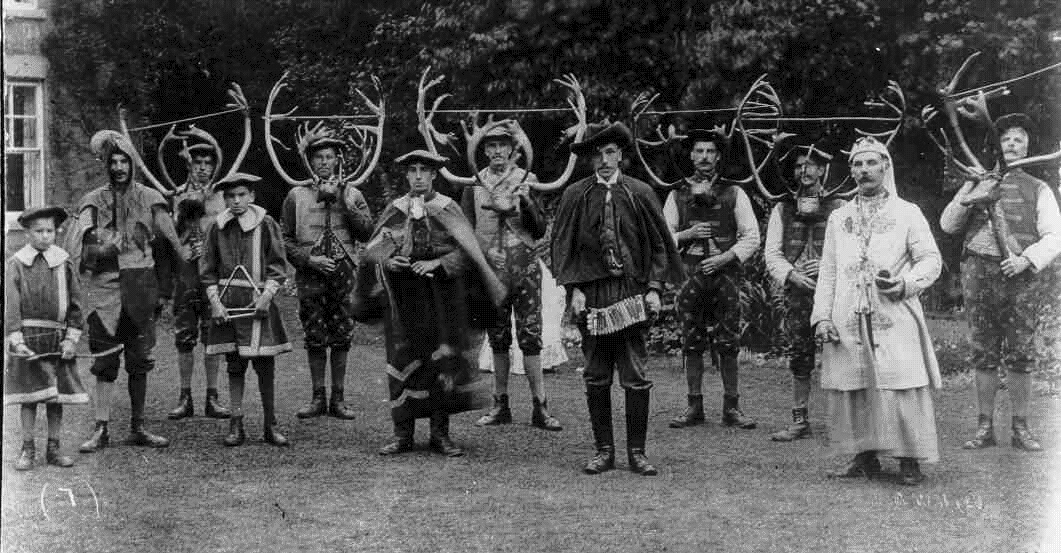
tune used in the Abbots Bromley (Stafforshire) horn
dance. "In an article published in 1933, Violet Alford noted the
dancers used 'Bobby Shaftoe' when she first encountered the horn dance. The
arrangement given here is used for the Sleights sword dance. Alford also noted
that the musician plays three tunes, 'Bobby Shaftoe,' 'Her Golden Hair' of
music hall memory, and a not un-pleasing nondescript tune in 2/4 time (pg.
206). I believe that the 'not un-pleasing ... tune in 2/4 time is Edie Sammons'
tune (see "Edie Sammons' Tune"),
which, until Sharp published Mr. Robinson's tune in 1911, was considered to be
the official music of the dance" [Bullen]. Andrew Bullen, Country Dance and Song, May 1987, vol.
17, pg. 11. Karpeles & Schofield (A
Selection of 100 English Folk Dance Airs), 1951; pg. 28. Raven (English Country Dance Tunes), 1984; pg.
73.
X:1
T:Bobby Shaftoe [2]
L:1/8
M:2/2
K:G
G2 BB A2B2|G2BB A2B2|G2e2d2B2|G2B2 A4|G2BB A2B2|
G2BB
A2B2|G2e2d2c2|(3BcB A2 G4||g3f g2e2|d2B2G4|
g3f
g2B2|A6d2|g3f g2B2|D4 d3c|B2G2A2F2|G4G4||
BOBBY VAN'S HORNPIPE. Arhoolie C‑334, Kenny Baker ‑
"Masters of the Folk Violin" (1989).
BOBBY WINSTON’S TUNE. Canadian, Reel. Canada, Cape Breton. A Major. Standard tuning. AABB.
The reel was possibly composed by the great Cape Breton fiddler Winston
“Scotty” Fitzgerald (1915-1987); Brenda Stubbert’s father, Robert Stubbert (b.
1923), learned it from a tape of Fitzgerald’s. Cranford (Brenda Stubbert’s), 1994; No. 8, pg. 4. Celestial
Entertainment CECS001, Brenda Stubbert (Cape Breton, N.S.) - “In Jig Time!”
(1995).
BOBERS OF BRECHIN. AKA and see “Bobbers of Brechin,”
"The Strathbogie Toast."
BOBOLINK, THE. American. USA, Michigan. Recorded by the
Library of Congress, 1938; Patrick Bonner, St. James, Beaver Island, Michigan.
BOB'S DOUBLE CLOG. New England, Clog or Hornpipe. B Flat Major. Standard tuning. AABB.
Page (Ralph Page Book of Contras),
1969; pg. 17.
BOB’S GARDEN OF
EARTHLY DELIGHTS. Irish, Reel. A Dorian. Standard
tuning. AABB. Composed (in G Dorian) by button accordion player John Whelan.
Black (Music’s the Very Best Thing),
1996; No. 176, pg. 93. John Whelan - “From the Heart.”
X:1
T: Bob's Garden of Earthly Delights
C: J. Whelan
Q: 350
R: reel
M: 4/4
L: 1/8
K: Ador
AB | cA A2 cAed | (3cBA BG DGBG | cA A2 EAcd | edef gedB |
cA A2 gedB | GB B2 dBGB | cABG AG=FD | EAAG A2 :|
AB | ea a2 gaba | ge e2 dBGB | cA A2 cAef | gfgb agba |
ge
e2 bage | dg g2 edcB | cABG AG=FD | EAAG A2 :|
BOBTAIL HOSS. American, Breakdown. G Major. Standard tuning. AABB. The beginning of
the ‘B’ part incorporates melodic material from Steven Foster’s song “Camptown
Races.” Ford (Traditional Music in America),
1940; pg. 33.
X:1
T:Bobtail Hoss
M:2/4
L:1/8
R:Breakdown
S:Ford – Traditional Music in America (1940)
Z:AK/Fiddler’s Companion
K:G
D|GB d>d|e(d d>)c|BB
B/A/G/B/|A3 D|GB d>d|e(d d>)c|BB A/F/A/F/|G3:|
|:D|G<G Bd|g3f|ef g/f/g/e/|d3
d|GB d>d|e(d d>c)|BB A/F/A/F/|G3:|
BOBTAILED MULE. American, Breakdown. A Major. AEae tuning. AA'BB. May be related to
"Bobtail Hoss." Source for notated version: Arizona fiddler Kenner C.
Kartchner (Arizona) [Shumway]. Shumway (Frontier
Fiddler), 1990; pg. 265.
BOC SA gCOILL, AN. AKA and see "Humors
of Ballingarry," "Out all night,"
"Molly's Favourite."
Irish, Double Jig. G Major. Standard tuning. ABC. Source for notated version:
flute player Sean Ó Braonain (Ireland) [Breathnach]. Breathnach (CRÉ I), 1963; No. 15, pg. 8.
BOC LIATH NAN GOBHAR (The Gray Buck). AKA and see "The Wedding Night." Scottish,
Quickstep (6/8 time). MacDonald, Gesto
Collection.
BOCHD LIATH NAN GOBHAR. Scottish, Jig. A Minor. Standard tuning. AABBCCDD. Flett & Flett (Traditional Dancing in Scotland), 1964; pg. 169.
BOCHUIDEAR. AKA and see "Balquhidder."
BOD ‘NA SHEASAMH. See note for “Duke Gordon.”
BODA WALTZ. AKA – “Bodavalsen.” AKA and see “Waltz
from Boda.”
BODAC AN DRANNTAIN. AKA and see "The
Grumbling Rustic."
BODACH FODAIR (The Straw Man). AKA and see “The Straw Man.” Canadian, Reel. Canada, Cape
Breton. AEae tuning. Rounder Records , John L.
MacDonald – “Formerly of Foot Cape Road: Scottish Fiddle Music in the Classic
Inverness County Style” (2005).
BODAIGH AN BHEURLA. AKA and see "The English Churls."
BODMIN RIDING. AKA and see “Grand Turk’s March,” “St. Ives Feast,” “St. Ives Well Procession,” “Ct. Brown’s March.” English, March (4/4
time). G Major. Standard tuning. AABB. Bodmin is a village in Cornwall. Bodmin
Riding refers to an ancient celebration dating back to the15th century, held
annually held on the Sunday and Monday after July 7th (on, St.
Thomas a Becket’s Day). The pagent is supposedly based on events that led to
the hanging of the town’s mayor. Simpson and Roud (Oxford Dictionary of English Folklore, 2000) say that accounts of
the pagent vary over its long history, but involved “a horseback procession
around the town, carrying two large garlands, and probably originated as a
Guild Riding custom.” In modern times Bodmin Riding ceased in the early 19th
century, but was revived in 1974 and continues to this day. The melody appears
in the 18th century musicians’ manuscripts of Benjamin Cooke (c.
1770, Leeds, west Yorkshire), Joseph Barnes (1762, Carlisle, Cumbria), and
James Biggins (1779, Leeds, west Yorkshire). Barry Callaghan (2007) also says
it is by repute in a manuscript by Thomas Quiller Couch of 1864. Callaghan (Hardcore English), 2007; pg. 30.
BOFFMAN’S REEL. D Major. Learned by Seattle fiddler Stuart
Williams from MidWest fiddler Bob Fast, who had moved to Oregon. Fast was the
nephew of Iowa fiddler Uncle Bob Walter, who was the source for so many of the
tunes in R.P. Christeson’s Old Time Fiddler’s Repertory. The melody is
that of a Scandinavian walking tune.
BOG, THE. See "Bog an
Lochan."
BOG AN LOCHA(I)N (The
Water-ouzel).
AKA and see "Athole Cummers,"
“Lady Grant of Grant,” “Lady
Grant’s Reel.” Scottish (orginally), Canadian; Strathspey. Canada, Cape Breton.
E Minor. Standard tuning. AABB'CD (Skye): AA’BCD (Gow). A pipe strathspey in A
dorian in two parts, fiddle versions in E dorian usually in four parts,
originally from one of Robert Bremner’s mid-18th century
collections. The melody is popular on
Cape Breton Island, especially for stepdancing. The Gaelic title translates as
‘water-ouzel’, a bird. Cape Breton fiddler Buddy MacMaster plays the tune as “Bog
on a Small Lake” on a recent video instructor. MacDonald gives “Athole Cummers”
as an alternate title, while Glasgow publisher James Aird gives “Lady Grant’s
Reel” (Lady Grant of Grant) as an alternate. John Shaw, who researched Cape
Breton music, gives a Gaelic song called “Bòg a’ Lochain” from the island of
Skye that goes:
***
|
Ciamar a nì mi ‘n damsa direach Ciamar a nì mi ‘n ruidhle
bòidheach Ciamar a nì mi ‘n damsa dìreach Dh’fhalbh a’ phrin’ às bonn mo
chòta |
How can I make a tidy dance How can I dance a bonny reel How can I make a tidy dance The pin went from the hem of my
coat |
***
Aird (Selection of Scotch,
English, Irish and Foreign Airs), vol. 6, 1802; pg. 14. Cairngorm
Collection, book 3. Gow (Complete
Repository), Part 1, 1799; pg. 16. Lowe’s Collection, 1844.
MacDonald (The Skye Collection),
1887; pg. 90. Culburnie Records CUL 121D, Alasdair
Fraser & Natalie Haas – “Fire and Grace” (2004). Green Linnet GLCD 1117,
Altan - "Harvest Storm" (1992. "Inspired" by the playing of
Cape Breton fiddler Bill Lamey). Shanachie 14002, Bill Lamey – “Classic
Recordings of Scottish Fiddling” (originally recorded c. 1950). Topic 12TS354,
Mike MacDougall - “Cape Breton Scottish Fiddle”(1978). Wildcat Records WILDCD
101, Ronan Martin – “Ronan Martin” (2008).
X:1
T:Bog an Lochan
T:Athole Cummers
M:C
L:1/8
S:MacDonald – Skye Collection
Z:AK/Fiddler’s Companion
K:Emin
F|:E/E/E ~E2 E>FB>F|E/E/E ~E2
F<D A>F|E/E/E ~E2 E>FB>A|1 B<d A>d F<DA>F:|2
B<dA<d F<D D>d||
|:B<E (B>A) B<E
E>e|B<E (B>A) (F<D) D>d|B<E B>A d>e(f>e)|1
(d/^c/)B/A/ d>A (F<D)
D>d:|2 (d/^c/)B/A/ d>A F<D D>f||e/e/e e2 (e>f)(b>f)|
e/e/e e2 f>da>f|e/e/e e2
(e>f)b>f|(g<e) b>e (df/g/) a>f|(g>e)(b>e) (g<e)
(b>e)|
(g<e) (b>e) (df/g/)
a<f|(g<e)(b<e) d>e(f>e)|(d/^c/)B/A/ d>A F<D D>d||
B<E (B>A) (B<E)
E>e|B<E (B>A) (F<D) D>d|B<E (B>A)
d>e(f>e)|(d/^c/)B/A/ d>A F<D D>d|
B<E (B>A) (B<E)
E>e|B<E (B>A) (F<D) D>d|B<E (B>A)
d>e(f>e)|(d/^c/)B/A/ (dA) F>DD||
BOG BLOSSOM, THE. Irish, Air (4/4 time, "gaily"). G
Major. Standard tuning. AB. O'Neill (O’Neill’s
Irish Music), 1915/1987; No. 51, pg. 34. O'Neill (Music of Ireland: 1850 Melodies), 1979; No. 74, pg. 13.
X:1
T:Bog Blossom, The
M:4/4
L:1/8
R:Air
N:”Gaily”
S:O’Neill – Music of Ireland (1903), No. 74
Z:AK/Fiddler’s Companion
K:G
d/c/ | BGGB c2 Ac | BGAG F D2 d/c/ |
BGGB c2 Ac | BGAB c3 (d/c/) |
BGGB c2 Ac | BGAG F D2 (B/c/) | dBcA
BG c>c | BGAF G3 || G |
GBAG FDDE | FGAB c2 AF | GBAG FEFG |
ABcA d2 (c/A/) |
GBAG FDDE | FGAB c3 (B/c/) | dBcA BG
c>c | BGAF G3 ||
BOG CARROT, THE. Irish, Reel. This is a two-part reel in Sliabh
Luachra related to “The Western Lasses.”
Jackie Daly added a third part and called the whole “The Bog Carrot.” As “The Game Cock” is appears set as a slide in
Breathnach’s CRÉ IV (1996, No. 62). Green Linnet SIF 1051, Jackie Daly, Seamus & Manus
McGuire - "Buttons and Bows" (1984).
BOG-DEAL BOARD, THE. AKA and see “Clar Bog Deil [1].”
BOG DOWN IN THE VALLEY. See “Rattlin’ Bog.”
BOG
OF ALLEN [1], THE. AKA – “Bogs of Allen.” AKA and see
"Along with the
girls I'd like to be,” "Bloody oul' hag is it
tay you want?" "The Boys of
Clones," “Brendan
Begley’s Jig,” "The Butcher's Jig,"
"The Butcher's March [2]."
Irish, Jig. G Major. Standard tuning. AABB. The tune was recorded for Victor in
1928 by County Leitrim fiddler Michael Cashin and County Mayo native Tom Doyle
on flute (along with an unidentified piano player). Reg Hall (1995) opines the
recording “has the rhythmic thrust of the best West of Ireland
country-house-dance music.” McGuire & Keegan (Irish Tunes by the 100, vol. 1), 1975; No. 25, pg. 7. Topic TSCD602, Michael Cashin & Tom Doyle – “Irish Dance
Music” (1995. A reissue of the 1928 original).
X:1
T:Bog of
Allen, The [1]
M:6/8
L:1/8
R:Jig
K:G
B | ded BAB
| dBA A2B | ded BAB | dBG G2B | ded BAB | dBG A2g |
faf gfe |
dBG G2 :: d | eAA fed | eAA ABd | eAA gfe | dBG G2d |
eAA fed | eAA A2g | faf gfe | dBG G2
:|
BOG OF ALLEN [2], THE. Irish, Reel. G Major. Standard tuning. AABB. Composed by the late Philadelphia, Pa./County Cavan fiddler Ed Reavy (1898-1988). This desolate region was mentioned in James Joyce’s piece “The Dead,” from The Dubliners. The Bog of Allen covers several hundred square miles in the central lowlands outside Dublin in the east almost to Galway in the west. It encompasses several peat bogs interspersed with patches of cultivable land, and peat is still harvested as a source of fuel. Two canals cross the region, the Grand and Royal.
***
The Bog of Allen.
***
Reavy (The Collected Compositions of Ed Reavy), No. 4, pg. 4.
X:1
T:The Bog of Allen
M:2/2
L:1/8
C:Ed Reavy
S:The Collected Compostions of Ed Reavy
R:Reel
N:Mentioned eloquently in Joyce's short story,
N:"The Dead" (in Dubliners). This desolate region reminds us of Yeats'
N:line "the drifting, indefinite bitterness of life" Ed has always felt
N:that far too much is made of Ireland's greenery and not enough said
N:of her terrible greyness. Ed has lived to see the whole of Ireland,
N:and he has tried to get as much of it as he could into his own tunes.
Z:Joseph Reavy
K:G
||:dc|BG (3AGF G=FDE|=F2 AF ^FDCB,|DG (3AGF GABc|dgfa gfdc|BG (3GF G=F
DE | [A,2=F2] AF ^FDCB,|DG (3AGF GABc |dgfd c2:|
||:Bc|dg (3gfg bgag|dggf dcBc| dg (3gfg ag (3gfg|defd c2 Bc|
dg (3gfg bgag|dggf dcBA|GABc defa|gefd c2:||
BOG OF ALLEN [3], THE (Móin Almhaine). AKA and
see “Banks of Allan.” Irish, Jig. D
Major. Standard tuning. AABB. The
melody appears under this title in the mid-19th century music
manuscripts of Church of Ireland cleric James Goodman (1828-1896). Goodman was
an Irish speaker and an uilleann piper who collected from tradition in Cork and
elsewhere in Munster, although he obtained tunes from manuscripts and printed
sources as well. See also Scottish versions under the title “Banks of Allan.” Source for notated
version: a music manuscript of one P. Enright, Áth Trasna, County Cork, dated
February 1862; loaned to Breathnach by Maurice O’Keeffe (Kishkeam, County Cork)
[Breathnach]. Breathnach (CRÉ V),
1999; No. 23, pg. 14. Shields/Goodman (Tunes
of the Munster Pipers), 1998; No. 49.
X:1
T:Bog of Allen, The [3]
M:6/8
L:1/8
S:James Goodman’s manuscript (mid-19th century)
K:D
F3 FED|FGA ABc|Bcd Bcd|BcB Bcd|F3 FED|
FGA ABc|BdB AGF|GEE E3::f3 fed|def agf|
efe edB|def agf|1 f3 fd|def agf|BdB AGF|GEE E3:|2
gbg faf|gfe dcB|BdB AGF|GEE E3||
BOG OF GIGHT, THE. Scottish; Strathspey. A Major. Standard tuning.
AB (Gow, Honeyman, Kerr, McGlashan, Skye): AA'BB' (Athole). One of the first
tunes composed by Scottish fiddler William Marshall (1748-1833), Steward for the
Duke of Gordon, who became an enthusiastic patron of Marshall’s musical work.
The Bog of Gight is a morass in the parish of Bellie in Banffshire, in the
middle of which stood for strategic reasons the former stronghold of the
Gordons and where Gordon Castle now stands. The castle was built on the Bog in
1479 by George Gordon, the 2nd Earl of Huntly, who was sometimes
referred to as “The Gudeman of the Bog.” Later the Duke of Gordon was known as
the "Cock of the North." "Cairney Burn," a famous song by
the poet Lady Nairne, was written to the melody. Carlin (The Gow Collection), 1986; No. 484. Gow (Complete Repository), Part 2, 1802; pg. 24. Honeyman (Strathspey, Reel and Hornpipe Tutor),
1898; pg. 19. Kerr (Merry Melodies),
vol. 2; No. 11, pg. 4. MacDonald (The
Skye Collection), 1887; pg. 31. McGlashan (A Collection of Reels), c. 1786; pg. 28. Stewart-Robertson
(The Athole Collection), 1884; pg. 16. Rounder
7059, Alex Francis MacKay with Gordon MacLean – “Gaelic in the Bow” (2005).
X:1
T:Bog o’ Gight, The
M:C
L:1/8
S:Strathspey
B:Stewart-Robertson - The Athole Collection (1884)
Z:AK/Fiddler’s Companion
K:A
e>fe>c A>c A<E|F>EF>A B/B/B B>c|1 e>fe>c A>c A<E|F>AE>C A,/A,/A, A2:|2
c<e f>e d>cB>A|G>AB>c A/A/A A2||a>b a<e a>ba<e|f>ef>a b/b/b b2|1
a/b a<e f<ac<a|B>A B<c A/A/A A2:|2 a>e f<a e>f c<e|B>AB>c A/A/A A2||
BOG OF RANNES, THE. Scottish, Jig. E Major. Standard tuning. AABB.
Composed by Alexander Walker. Walker (A
Collection of Strathspeys, Reels, Marches, &c.), 1866; No. 124, pg. 43.
BOG ON A SMALL LAKE. AKA and see “Bog an
Lochan.”
BOG RANGER'S WIFE, THE. AKA and see "The Moving Bog(s) [1],"
"New Tobacco,"
"Miss
Wallace [1]," "The Wallace Twins," "An Seomra in Uachtar."
BOG SIAR AN BOTHAR. AKA and see "Come West Along the Road,"
"Over the Moor to Peggy"
(Trasna an Mhointeain go Peige).
BOGADH FAOI SHÚSA (Motion Under a Blanket). AKA ‑ "Bugga Fee
Hoosa" (Englished title). Irish, Hop Jig. E Minor. Standard tuning.
AABBCCA'A'B'B' DDEEFFGGHH. A version of the well-known slip jig “Kid on the
Mountain.” "A favorite Munster dance‑tune. In Standford‑Petrie
there is a tune with this title, consisting of two short parts, which, although
in the same measure as this (9/8), can hardly be considered as the same air.
The version given here (in eight parts) from Mr. Deasy (through Forde) is the
one universally known in Munster" (Joyce). Joyce declined to translate the
bawdy title. Joyce (Old Irish Folk Music
and Songs), 1909; No. 479, pg. 265.
X:1
T:Bogadh Faoi Shúsa
M:9/8
L:1/8
R:Hop Jig
S:Joyce – Old Irish Folk Music and Songs (1909)
Z:AK/Fiddler’s Companion
K:Emin
EEE E2F G2B | EEE G2B AFD | EEE E2F
G2B | ABA AFD FGA :|
|: BcB ABA G2 | BcB BGE FGA | BcB
ABA G2B | ABA AFD FGA :|
|: BcB eBA G2A | BcB BGE FGA | BcB
eBA G2B | ABA AFD FGA :|
N:The next part is the first part
played an octave higher
N:The next part is the second part
played an octave highter
|:ddB dBA G2A | BcB BGE GAB | edB
dBA G2B | ABA AFD FGA :|
|: gfe efe g2e | gfe ege bge | gfe
efe g2b | aba afd fga :|
|: gfe fed edB | dBA BGE GAB | gfe
fed edB | ABA AFD FGA :|
|: B,EE B,FF B,GG | B,FF G2B AFD |
B,EE B,FF B,GB | ABA AFD FGA :|
|:gfe fed e2f | gfe g2a bge | gfe
fed edB | ABA AFD FGA :|
BOGANNACH, THE. AKA – “New Bob.” Scottish, Reel. B Minor (Gow,
MacDonald): A Minor (McGlashan). Standard tuning. AAB (Gow): AABB (MacDonald):
ABCD (McGlashan). Gow (Complete
Repository), Part 1, 1799; pg. 37 (appears as “The Boganuadh or the New
Bob”). MacDonald (The Skye Collection),
1887; pg. 62. McGlashan (A Collection of Reels), c. 1786; pg. 41.
X:1
T:Boganuadh
T:Bogannach, The
M:C
L:1/8
R:Reel
S:McGlashan – Reels (c. 1786)
Z:AK/Fiddler’s Companion
K:Amin
ABcd e2 dc|egde BGdB|ABcd e2 dc|BAGB A/A/A AG|A/B/c/d/ e2 dc|
E2 de cdeg|aega e2 dc|BAGB A/A/A AB||A/A/A ag a>bae|g>age c>dec|
dega e2 dc|BAGB A/A/A AG|A/A/A ag a>bae|g>aeg cdec|dega egdg|
BGgB A/A/A e2||ABcd e2 dc|BGdG gGdB|ABcd e2 dc|BGgB A/A/A e2|
ABcd e2 dg|BGdG gGdB|ABcd egdg|BGgB A/A/A AB||A/A/A ag aAae|
g>age cdec|dega egdg|BGgB A/A/A AB|A/A/A ag aAae|gaeg cdec|
dega
egdg|BGgB A/A/A e2||
BOGANUADH, THE. AKA and see “The New Bob.” Scottish, Reel. B Minor.
Standard tuning. AABB.
X:1
T:Boganuadh, The
T:New Bob, The
B:Gow's Repository, Bk 1
Z:Nigel Gatherer
M:4/4
L:1/8
K:Bm
f[|:Bcde f2 ea|c<AeA aAec|Bcde
faea c<Aa>c B/B/B f2:|]
B/B/B b^a bBbf|=a>baf defd|efab
faea|c<Aa>c B/B/B f2:|]
BOGAN’S REEL (Ríl Uí Bhogáin). Irish, Reel. D Major. Standard tuning. AB. Source
for notated version: collected by Liam Donnelly (County Tyrone) who noted it
was from fiddler William Jones (County Fermanagh) [Breathnach]. Breathnach (CRÉ IV), 1996; No. 107, pg. 56.
BOGAY HOUSE. Irish, Air. Composed by James
MacDafferty (Co. Derry, Ireland) in honor of a house in Derry owned by some
friends of his, the Agnews. Green Linnet SIF‑1084, Eugene O'Donnell & James
MacCafferty ‑ "The Foggy Dew" (1988).
BOGEY REEL. Irish, Reel. D Major. Standard tuning. AA’BB’.
X:1
T:Bogey Reel
R:Reel
S:From the playing of Brendan
Mulkere
Z:John Tait 04.08.98
Z:"corrected" abc by HN
M:4/4
L:1/8
K:D
GFE|:DEFA decd|BA^GB AFEF|DEFA
dafe|dBAF EA (3GFE|
DEFA dcde|fd (3ddd BAFA|(3Bcd ef
gece|1 dAFA dGFE:|2 dAFA d3f||
|:e2 (3cBA EAcf|eAce gbag|fd (3ddd
Adcd|fgaf d2 A2|
Be (3eee Befe|eBgB e2 fg|(3aba fa
gece|1 dAFA G3f:|2 dAFA G2FE||
BOGGY ROAD TO TEXAS. Old-Time, Breakdown. G Major. Standard tuning. AB. Source for notated
version: Hugh Farr [Phillips]. Phillips (Traditional
American Fiddle Tunes), vol. 2, 1995; pg. 23.
BOGMAN, THE. Irish, Slide (12/8 time). Green Linnet GLCD 1184, Patrick Street – “Made in Cork”
(1997).
BOGNIEBRAE. Scottish, Strathspey. A Major. Standard tuning. AAB. Composed by the
great Scots fiddler-composer J.
Scott Skinner (1843-1927, first printed in his Logie Collection. Skinner
(The Scottish Violinist), pg. 8.
X:1
T:Bogniebrae
M:C
L:1/8
R:Strathspey
Z:AK/Fiddler’s Companion
K:A
E | [CE>]F A>B {A/B/}c>B
A>F | E>F A>B (c>B) B>c |
A,>A A>B c>B A>F |
E>F A>E C<A, A, :|
|| f | e>a f<a e<a A<a |
c>e{g}a>e f<B B>f | e>a f<a e<a A<a |
C>EA>B c<A A>f | e>a
f<a e<a A<a | c>e{g}a>e f<B B>d |
c/e/a B/d/g A/c/f G/B/e | (3FBd
(3Gbe c<A [CA] ||
_______________________________
HOME ALPHABETICAL
FILES REFERENCES
© 1996-2009 Andrew Kuntz
Please help maintain the viability of the Fiddler’s
Companion on the Web by respecting the copyright.
For further information see
Copyright and Permissions Policy
or contact the author.