The Fiddler’s Companion
© 1996-2010 Andrew Kuntz
_______________________________
HOME ALPHABETICAL
FILES REFERENCES
|
PORT - POY |
|
Notation
Note: The tunes below are recorded in what
is called “abc notation.” They
can easily be converted to standard musical notation via highlighting with your
cursor starting at “X:1” through to the end of the abc’s, then
“cutting-and-pasting” the highlighted notation into one of the many abc
conversion programs available, or at concertina.net’s incredibly handy “ABC
Convert-A-Matic” at http://www.concertina.net/tunes_convert.html **Please note that the abc’s in the Fiddler’s
Companion work fine in most abc conversion programs. For example, I use
abc2win and abcNavigator 2 with no problems whatsoever with direct
cut-and-pasting. However, due to an anomaly of the html, pasting the abc’s
into the concertina.net converter results in double-spacing. For
concertina.net’s conversion program to work you must remove the spaces
between all the lines of abc notation after pasting, so that they are
single-spaced, with no intervening blank lines. This being done, the F/C
abc’s will convert to standard notation nicely. Or, get a copy of
abcNavigator 2 – its well worth it.
[AK] |
PORT... See also (the Gaelic)
"Puirt..." An Irish port, or
Gaelic puirt, was originally a common-time lesson or an air written for
the harp and akin to a planxty (Flood) or sometimes a vocal air, but it is also
the Gaelic word for 'jig.' Sanger & Kinnaird (Tree of Strings, 1992) say that there was actually no Irish
tradition of ports, and that only one, “Purth Clarseach” (a version of “Port
Gordon”) is recorded by Edward Bunting. The genuine ports that are contained in
Irish collections appear to all have Scottish connections. The first recorded
use of the word port, in a musical context, is in the poem by Donnachadh Mor of
Lennox, in the Book of the Dean of Lismore, dating it to before 1513-40. The
earliest datable port is perhaps “Port Robert,” in the Wemyss manuscript, going
back to the 16th century. Sanger & Kinnaird state that the
classic port seems to have been a “characteristically Scottish form of harp
music which had a fairly short-lived fashion between the mid 16th
and mid 17th centuries.” The form itself died out, its fortunes
linked to the profession of harper which also waned at the same time for both
political and musical reasons, thought the name lived on. In the 18th
century other types of tunes more strongly melodic were still being called
‘ports’, though they had little to do musically with the older form.
PORT
A’ BHODAICH. AKA and see “The Carle's Rant.” Scottish, Strathspey. A
Mixolydian. Standard tuning. AABB'CBB' (Kerr): ABCD (Athole, Gow, McGlashan).
John Glen (1891) finds the earliest appearance of this tune in print in Alexander 'King' McGlashan's 1780
collection. Gow (Complete Repository),
Part 1, 1799; pg. 6. Kerr (Merry Melodies),
vol. 1; Set 26, No. 5, pg. 16. McGlashan (Collection of Strathspey Reels), c. 1780/81; pg. 28. Stewart-Robertson (The Athole Collection), 1884; pg. 7.
X:1
T:Port a’ Bhodaich
M:C|
L:1/8
S:Strathspey
B:Stewart-Robertson – The Athole Collection (1884)
Z:AK/Fiddler’s Companion
K:A
e| A<Ae>B c>B A<a | A<Ae>c d>c B<e | A<Ae>B c<Ae>d | c<Ae<A d>cB>e |
A<Ae>B c>B A<a | A<Ae>c d>cBE | A<Ae>B c<Ae>d | c<Ae>c d>cB>e ||
c<Aa>g a<AA>e | c<Aa>f =g<BB>e | c<Aag a>AA>e | f<ae<=g d>c B<e |
c<Aa>g a<AA>e | cAfa =g<BB>e | c<Aa>g a>Aa>e | f/g/a e/f/=g d>cB<e ||
d/c/B/A/ A,>A c<AA<e | d/c/B/A/ A,>e d<BB>e | d/c/B/A/ A,>e d/c/B/A/ A,>e |
d/c/B/A/ A,>e d<BB<e | d/c/B/A/ A,>e c<AA>e | d/c/B/A/ A,>e d<BB>e |
d/c/B/A/ A,>A AA/B/ c>A d>cB<e || c<Aa>g a<AA>e | c<Aa>f =g<BB>e |
c<Aa>g a>Aa>e| f<ae<=g d>cB<e | c<Aa>g a<AA>e | c<Aa>f =g<BB>e | c<Aa>g a>Aa>e|f/g/a e/f/=g d>cB |]
PORT AN ACHRÉIDH. Irish, Single Jig. D Mixolydian. Standard tuning. AABB. Source for
notated version: whistle player Pat White/Padraic de Faoite (Ireland)
[Breathnach]. Breathnach (CRÉ I),
1963; No. 59, pg. 26.
PORT AN AIRD BHÁIN. AKA and see “The Banard Jig.”
PORT AN BARUNTACT. AKA and see "The Barony Jig
[2]."
PORT AN BHAILE CHAOIL. AKA and see "The Ballykeal Jig."
PORT AN BHRÁTHAR (The Monk’s Jig). AKA and see “The
Monk's Jig,” “The Reverend
Brother’s Jig.”
PORT AN DEORAI. AKA and see “Exile’s Jig.” Irish,
Slip Jig. E Minor. Standard. AAB. Cranitch (Irish
Fiddle Book), 1996; No. 32, pg. 137. Cranitch (Irish Session Tunes: Red Book), 2000; 32. Rounder
3067, Alan Stivell ‑ "Renaissance of the Celtic Harp" (1982).
PORT AN DREÓLIN. Irish, Slide. D Major. Standard. AABB. Source for notated version: set
dance music recorded at Na Píobairí Uilleann, mid-1980’s [Taylor]. Taylor (Music for the Sets: Yellow Book), 1995;
pg. 37.
PORT AN FHATHAIGH. AKA and see "Fahy's Jig [1]."
PORT AN FHIONNÁNAIGH. AKA and see “Fanning’s Jig.”
PORT AN GHALLÁIN. AKA and see "The Gullane Jig."
PORT AN POSTA. AKA and see "The Bridal
Jig [1]."
PORT AN PUCA. AKA and see "The Fairy Jig."
PORT AN REATA. AKA and see "The Runaway Jig."
PORT AN RIAGÁNAIGH. AKA and see “Regan’s Jig.”
PORT AN TEAMPALL. AKA and see "The Templehouse
Jig."
PORT AN tSAGAIRT (The Priest’s Jig). Irish, Double Jig. G Major. Standard. AABB.
The tune, from an unknown manuscript,
is related to O’Neill’s “Happy to Meet {and Sorry
to Part}.” Breathnach (CRÉ IV), 1996;
pg. 10.
PORT AN TÚIR MHÓIR. AKA and see “The Toormore Jig.”
PORT ANTOINE UI
FHREAGHAILE. AKA and see "Anthony Frawley's Jig."
PORT ARD, AN. AKA and see "The High Jig."
PORT ARTHUR BLUES. AKA and see "Blues de
Port Arthur, La." Cajun, Two-Step. D Major. Standard. AA'BBCC'. Port
Arthur is a town in Texas where many Cajuns migrated. “Valse des Vachers” is a triple-time setting
of the melody. Greenblatt (The Cajun
Fiddle Tune Book), 1985; pg. 19.
PORT ARTHUR STOMP. Cajun. Recorded by accordion player Marc Savoy. Pukka Records YOP 04, The Oyster Band ‑ "Lie Back and Think of
England."
PORT ARTHUR WALTZ (Valse de Port Arthur). Cajun, Waltz. USA, southwestern
Louisiana. D Major. Standard. AA'BB' (Phillips): One part (Francois). A related
tune is "Lake Arthur Waltz."
Source for notated version: Harry Choates (La.) [Phillips]; Aldus Roger &
Phillip Alleman (La.) [Francois]. Francois (Yé
Yaille Chere), 1990; pgs. 448-449. Phillips (Fiddlecase Tunebook), 1989; pg. 34. Arhoolie
5027, Harry Choates ‑ "The Fiddle King of Cajun Swing ‑
Original Recordings 1946‑1949."
PORT ATA-CUILINN. AKA and see "The Hollyford
Jig."
PORT ATHOL. AKA – “Port Atholl.” AKA and see "The Hawk of
Ballyshannon," "O'Moore's
Fair Daughter," "Katherine
O'More." Scottish/Irish, Air. Originally composed for a patron by
early 17th century Ulster-born (Francis O’Neill says he was born c. 1646,
though he is also recorded as having died around 1650) harper Rory Dall
O'Cahan, who travelled into Scotland and long played for the great families of
that country. Atholl is in central Perthshire. The blind Irish harper Turlough
O'Carolan (1670-1738) 'touched' "Port Athol" into his "O'Moore's
Daughter" (Flood, 1906). It was printed by Bunting. Several (four) early
versions of the melody appear in the Balcarres Lute manuscript, compiled in
1692-1694, and the tune appears to have been well-known by lutenists of the
era. There are, however, two distinctly different tunes with the name “Port
Atholl,” one printed by Bowie and Oswald.
PORT BAGARAC, AN. AKA and see "The Swaggering
Jig [1]."
PORT BALLANGOWNE. Scottish, Air. A harp tune appearing in the Skene Manuscript of c. 1615, collected for or by John Skene of Hallyards
in Midlothian, set in tablature for the mandora. Under the simple title “A
Port” the melody appears in Gordon of
Straloch’s Lute Book (also
called the Straloch Manuscript) of
1927-29, with the postscript “Finis Port Rorie Dall,” referring to the harper
Ruari (Dall) O Cathain. Finally, under the appelation “Port 6th” the
tune appears in the MacLean-Clephane
Manuscript of 1816, written by the seventeen-year-old Lady Margaret Wemyss,
a member of a prominent Lowland Scots family. "Ballangowne" is a Gaelic
place name variously called Balgowan, Balgonie, etc., meaning 'village of the
smith', and refers to Balgowan, which lies between two main parts of the Lude
estate, Inchmagrannoch and Monzie, on the River Tummel. Another suggestion
{from Sanger & Kinnaird (Tree of
Strings, 1992)}for the origins of the title is that it was perhaps composed
for Lady Elizabeth Ross, of the Rosses of Ballnagowan. Sanger & Kinnaird (Tree of Strings), 1992; pg. 179. Flying Fish, Robin Williamson ‑ "Legacy of the Scottish
Harpers, Vol. 2."
PORT BHEAN DE ROS. AKA and see “Mrs. Ross’s Jig.”
PORT BHRIAIN MHÓIR (Big Barney’s Jig). AKA and see “Big Barney('s Jig).” Irish, Jig. G
Major. Standard. AABB. Breathnach (CRE IV),
1996; No. 7, pg. 5.
PORT CAIT NI MATGAMNA. AKA and see "Kit
O'Mahony's Jig."
PORT CHILL CHAINNIGH. AKA and see "The Kilkenny Jig."
PORT
CIARRAÍOCH/CIARRAIG, AN. AKA and see "The Kerry Jig [1]."
PORT CILL-FINAIN. AKA and see "The Kilfinane
Jig."
PORT CORNAD MIC SEOIN. AKA and see "Jackson's
Rolling Jig."
PORT CROTUIR UI
CATASAIG. AKA and see "Con Casey's Jig."
PORT CUILLINN UI CHAOIMH. AKA – “Port Chuilinn.” Irish, Jig. D Major. Standard. AA’B. Treoir. Compass
Records 7 4407 2, Ciaran Tourish – “Down the Line” (2005. Learned from the
playing of Dermot and Tara Diamond).
X:
1
T:
Port Cuillinn ui Chaoimh
S:
"Treoir"
M:
6/8
L:
1/8
R:
jig
Z:
Transcribed by Bill Black
K:
D
F/A/
| BdB BAF | Add dFA | BdB BAF | AFE E2 F/A/ |
B3
BAF | Add dAF | G3 FAF |1 EDE D2 :|2 EDE D3 ||
DFA
d3 | dfd ecA | g3 fdB | AFA B3 |
Adf
a2 a | baf a2 f | gfe fdB | AFA B2 g ||
fdd
d3 | dfd ecA | g3 fdB | AFA B3 |
Adf
a3 | baf a2 f | gfe fdB | AFA B3 ||
PORT DALAIG [1]. Irish, Polka. Ireland, West Kerry. G Major. Standard. AABB. Apparently
the composition (with “Port Dalaig” [2]) or favorite tune of Tom ‘na Hinise’ O
Dalaig (Tom Daly, 1907-1989), a fiddler from Inishvickillane, Co. Kerry. Mac
Amhlaoibh & Durham (An Pota Stoir:
Ceol Seite Corca Duibne/The Set Dance Music of West Kerry), No. 1, pg. 13.
PORT DALAIG [2]. Irish, Polka. Ireland, West Kerry. A Dorian. Standard. AABB. See note
for “Port Dalaig [1]." Mac Amhlaoibh &
Durham (An Pota Stoir: Ceol Seite Corca
Duibne/The Set Dance Music of West Kerry), No. 4, pg. 14.
PORT DALAIG [3]. Irish, Polka. Ireland, West Kerry. D Major. Standard. AABB. See note
for “Port Dalaig [1]." Mac Amhlaoibh &
Durham (An Pota Stoir: Ceol Seite Corca
Duibne/The Set Dance Music of West Kerry), No. 10, pg. 16.
PORT DALAIG [4]. Irish, Polka. Ireland, West Kerry. E Dorian. Standard. AABB. The
melody, especially in the ‘A’ part, is similar to “Riding on a Load of Hay.” See note
for “Port Dalaig [1]." Mac Amhlaoibh &
Durham (An Pota Stoir: Ceol Seite Corca
Duibne/The Set Dance Music of West Kerry), No. 16, pg. 19.
PORT DALAIG [5]. AKA and see “Ballyoran Polka
[1]."
PORT DALAIG [6]. AKA and see “Ballyoran Polka,"
“(An) Gallope,” “Galop Hey,” “The
Kerry Polka,” “Paddy Spillane’s
[2]." Irish, Polka. Ireland, West Kerry. D Major. Standard. AABB. Like
“Port Dalaig [5]," this is a version of “Ballyoran [1]." Mac
Amhlaoibh & Durham (An Pota Stoir:
Ceol Seite Corca Duibne/The Set Dance Music of West Kerry), No. 54, pg. 34.
PORT DALAIG [7]. AKA and see “Off She Goes [1].”
PORT DALAIG [8]. Irish, Slide (12/8 time). Ireland, West Kerry. E Minor. Standard. AABB.
Mac Amhlaoibh & Durham (An Pota
Stóir: Ceol Seite Corca Duibne/The Set Dance Music of West Kerry), No. 78,
pg. 45.
PORT DHOMHNAILL MHIC
GUTHAGAIN. AKA and see “Donald MacGugan’s Rant.”
PORT EINON WHIM.
AKA and see “Mympwy
Portheinon.” English, Country Dance
Tune (2/4 time). England, Wales. G Major. Standard tuning (fiddle). AABB. In
Port Einon this tune was used to dance the Gower Reel.
X:1
T:Port Einon Whim / Mympwy Portheinon
M:2/4
L:1/16
K:G
B2Bc dedc|B2Bc dedc|B2G2 GABG|A2D2 D2dc|!
B2Bc dedc|B2Bc dedc|BdGB| AcFA|GFGAG4:||!
gfga gdBd|gfga gdBd|gfga b2g2|fefg afed|!
edef gece|dcde dBGB|AGAB cAFA|GFGAG4:||
PORT FIAGUIDE AN
SIONAIG. AKA and see "The Foxhunter's Jig [1]."
PORT GAEDEALAC, AN. AKA and see "The Hibernian
Jig."
PORT GAEL-LINN. AKA and see “Dash to
Portobello.” The title honors the Irish recording company.
PORT GORDON{AC} [1] (Gordon’s Tune). AKA and see "Mary of
Ballyhaunis." Scottish/Irish, Air (4/4 time, "with spirit"). G Dorian
(O’Neill): A Dorian (Ó Canainn). Standard. One part (Ó Canainn): AB (O’Neill).
A harp air composed for a Scottish patron by early 17th century Ulster-born
(Francis O’Neill says he was born c. 1646) harper Rory Dall O'Cahan, who
travelled into Scotland and long played for the great families of that country.
The tune was reworked a century later by blind Irish harper Turlough O'Carolan
(1670-1738) and later used for the Irish song "Maire beil ata h‑Amnair."
Several early Scottish versions of the melody appear in the (Crawford of) Balcarres Lute Manuscript, compiled in
1694. It can be found in Cooke’s Selection
of Twenty-one Favourite Original Irish Airs arranged for Pianoforte
(Dublin, 1793).
***
There are
actually several airs entitled “Port Gordon.” One of them is in John Bowie’s Collection of Strathspey Reels and Country
Dances (1789), a partial version of which (under the title “Port 2nd”)
also appears in the MacLean-Clephane Manuscript of 1816, written by the
seventeen-year-old Lady Margaret Wemyss, a member of a prominent Lowland Scots
family. The subject of one of them is likely to have been George Gordon, the
first Marquess of Huntly (1562-1636), maintain Sanger & Kinnaird (Tree of Strings, 1992), who defeated
Argyll at the battle of Balrinnes. It had been fortold that Argyll’s harp would
be played in the Gordon territory of Strathbogie, encouraging Argyll to attack
thinking his victory was assured; indeed the harp was so played—as the spoils
of war. Source for notated version: Chicago Police Sergeant and fiddler James
O’Neill, originally from County Down [O’Neill]. Ó Canainn (Traditional Slow Airs of Ireland), 1995; No. 61, pg. 55. O'Neill (Music of Ireland: 1850 Melodies),
1903/1979; No. 40, pg. 7. O’Neill (Waifs
and Strays of Gaelic Melody), 1922; No. 63.
X:1
T:Port
Gordon [1]
M:C
L:1/8
R:Air
S:O’Neill –
Music of Ireland (1903), No. 40
Z:AK/Fiddler’s Companion
K:Gmin
dc|B2 Bc B2
AG|G>A Bc d2 cA|G2 GF D2 D^F|G4 G2 dc|B2 Bc B2 AG|
G>A Bc d2 cA|G2 GF D2 D^F|G4 G2||GA|B2 c2 d3B|c2 d=e f2 d>g|
g>f dc
B2d2|c3B G2 dc|B2 Bc B2 AG|G>ABc d2 cA|G2 GF D2 D^F|G4 G2||
X:1
T:Port Gordon [2]
M:4/4
L:1/8
S:O'Farrell's Pocket Companion 1804-1810
Z:Paul Kinder
K:Dmin
DE|F2 FG A2 GF|G2 GA c2 AG|FEFG A2 GF|G3 F D2 DE|
F2 FG A2 GF|G2 GA c2 AG|A3 B A2 G2|A6 DE|
F2 FG A2 GF|G2 GA c2 AG|A2 AB AGFG|A4 f2 DE|
F2 FG F2 ED|EDEG A2 GE|D2 DE FED^C|D6||
de|f3 g fg a2|FEFG F2 ED|f3 g f>g a2|GFGA G2 fg|
a4 a2 gf|g4 agfe|fgfe defe|dA =cA/2G/2 A3 A|
d2 dc defe|dedc A2 AB|c2 cA cded|dcAG A2 AG|
F2 FG F2 ED|EDEG A3 c|dedc AGA^c|d6||
T:Port Gordon [2]
M:4/4
L:1/8
R:Air
S:Howe – 1000 Jigs and Reels (c. 1867)
Z:AK/Fiddler’s Companion
K:Gmin
c2d2f2dc | d3f dfdc | B4b4 | B2 B>c B2 AG | A2 A>B A2 G>^F |
G>A GF D2 DF | G4G2 :| f2 | b2 b>c’ b>c’ d’2 | B2 B>c B2G2 |
b2 b>c’ b>c’ d’2 | c2 c>d c2 (bc’) | d’2 d’2 d’2 (c’b) | c’2c’2c’2 (ba) |
b>c’ ba g>a ba | gagf dcdf | g2g2 gaba | g>a gf d2 d=2 | f2f2 f>g ag |
f>g fd c2 Bc | B2 B>c B2 A>G | A2 AB A2 G^F | GAGF D2 DF | G4 G2 ||
PORT ‘IC ARTAIR (MacArthur’s Tune). AKA and see “Antony Murray(‘s Reel),” “Hills of Cape Mabou,” “Lord Murray’s Strathspey.”
PORT INGEAN NI GREANTA. AKA and see "Miss
Grant's Jig."
PORT INGINE UÍ
MONGRUAIDE. AKA and see "Miss/Mrs. Monroe's Jig."
PORT JIMMY MHIC AN
BHAIRD. AKA and see "Jimmy Ward's Jig."
PORT LÁIRGE. AKA and see “Bhíosa lá I bport láirge,” "The Dainty Besom Maker," “Forgive the muse that
slumbered,” "The Gimlet," “I’d mourn the hopes that leave me,” “Johnny’s Grey Breeks [2],”
"The Old Lea Rigg,"
"Little Mary Cullinan,"
"Little Sheila Connellan,”
“Maureen from Giberland,” “Phelim O’Neill [2],” “The Rose Tree in Full Bearing,”
“The Rose Tree of Paddy’s Land."
Irish, Air and Polka. D Major. Standard. AABB. Port Láirge is the Gaelic name
for Waterford. Black (Music’s the Very
Best Thing), 1996; No. 234, pg. 125.
X:1
T: Port Láirge
Q: 300
R: polka
Z:Transcribed by Bill Black
M: 2/4
L: 1/8
K: D
f/e/ | dB AF | A>B AA | dd ed/e/ | fe ef/e/ |
dB AF | A>B AA | dd ed/e/ | fd d :|
e | f>e fg | a2 gf | eb b>a | be ef/e/ |
dB
AF | A>B AA | dd ed/e/ | fd d :|
PORT LENNOX. AKA – “The Duke of Lennox Port.” Scottish/Irish, Air. A harp air
composed for a patron by early 17th century Ulster-born (Francis O’Neill says
he was born c. 1646) harper Rory Dall O'Cahan, who travelled into Scotland and
long played for the great families of that country. Sanger & Kinnaird (Tree of Strings, 1992) say the tune was
almost certainly dedicated to Esme Stuart, created first Duke of Lonnox in
1581.
PORT LIADROMA. See “Leitrim Jig [1].”
PORT LIAM MHIC
CHOLMAIN. AKA and see "Willie Coleman's Jig."
PORT LIAM MHIC CORMAIC. AKA and see "Bill
McCormick's Jig."
PORT LIAM UÍ AIRT. AKA and see "Bill Harte's Jig [1]."
PORT LIAM UÍ CHOLMÁIN. AKA and see "Willie
Coleman's Jig."
PORT LUIMNIGH. AKA and see "The Limerick
Jig [1]."
PORT MABOU. AKA and see “Elizabeth’s Big
Coat.”
PORT MAOR MAELMOCEIRGE. AKA and see "Sergeant
Early's Jig."
PORT MHAIDC UÍ
CHEALLACHÁIN. AKA and see "Micky Callaghan's Jig."
PORT MHIC EOIN. AKA and see "Jackson's Jig
[3]."
PORT MHICÍ UÍ MHURCHÚ. AKA and see “Mickie
Murphy{’s Jig}.”
PORT MHIG SHEANLAOICH. AKA and see “Ganley’s Jig.”
PORT MHOLL UI
CHIOBHAIN.
AKA and see “The Maulykeavane Jig.”
PORT MOR NA LURGANN. Scottish, Strathspey. F Major. Standard. AABB'. Composed by James
Stewart-Robertson, the editor of The
Athole Collection. Stewart-Robertson (The
Athole Collection), 1884; pg. 206.
X:1
T:Port Mor na Lurgann
M:C
L:1/8
R:Strathspey
C:James Stewart-Robertson
B:Stewart-Robertson – The Athole Collection (1884)
Z:AK/Fiddler’s Companion
K:F
d | c<F c>A c>df>d | c<F c>A G>AB>d | c<F c>A c>df>g | a>f a/g/f/e/ ~f2 f: |
c | f>ag>a ~f>cA>c | f>ag>a b/a/g/f/ d>e| 1 f>ag>a ~f>cA>f | a>f a/g/f/e/ f2 f: |2
f>ag>b
a>fe>c | a>f a/g/f/e/ ~f2 f ||
PORT MUINE COININ. AKA and see "The Mooncoin Jig."
PORT MUINEACAIN. AKA and see "The Monaghan
{Jig}>."
PORT NA bPÚCAÍ (The Fairy Lament). AKA and see “Port na
Hinise.” Irish, Air (6/8 or 3/4 time). Ireland, West Kerry. The tonality
shifts between A Mixolydian/Dorian and G Major. Standard. AAB (Mac Amhlaoibh):
AA’B (Ó Canainn). A pouca, or in Irish púca, usually refers to a
magical being—a "water sprite,” or "mischievous fairy”—a word adapted
by Shakespeare for his character Puck in Midsummer Night’s Dream. Tony
McMahon says the air is about the death of one such spirit. There is a story that this tune was heard by
travellers or fisherman who stayed overnight on Inis Mhic Fhaolain in the
Blasket Islands (off the coast of County Kerry) and heard this tune coming from
the mists.
***
Is bean on slua si me do tainig tar toinn;
Is do toidead san oice me tamall tar lear;
Is Go bFuilim sa rioct so fe geasa mna si,
Is ni bead ar an saol so go nGlaofaid an coileac.
***
Sometimes the tune is described as
the sound of the wind blowing across the islands. Source for notated version:
Tom Daly/O Dalaig (1907-1989) [Mac Amhlaoibh & Durham]. Mac Amhlaoibh &
Durham (An Pota Stóir: Ceol Seite Corca
Duibne/The Set Dance Music of West Kerry), No. 93, pg. 53. Ó Canainn (Traditional Slow Airs of Ireland), 1995;
No. 68, pg. 60. CCE CL13, Tommy Peoples (1978).
Claddagh Records, Sean ‘Cheist’ Ó Cathain - “Beauty an oilean” (Ó Cathain was a
resident of Blasket Island until it was cleared in the 1950's). Compass Records
7 4407 2, Ciaran Tourish – “Down the Line” (2005). Compass Records 7 4446
2,Oisíin McAuley – “From the Hills of Donegal” (2007). Gael‑linn CEFCD
114, Tony MacMahon & Noel Hill - “ "I gCnoc na Graí” (1985). Ronan
Browne - “Drones and Chanters, vol. 2.” Ovation, Tommy Peoples – “Master Irish
Fiddle Player.” Shanachie 79033, Paddy Moloney & Sean Potts – “Tin
Whistles” (1974).
|
See also listings at: Alan Snyder’s Cape Breton Fiddle
Recording Index Jane Keefer’s Folk Music Index: An
Index to Recorded Sources Alan Ng’s Irishtune.info |
X:1
T:Port na bPúcaí.
M:3/2
L:1/4
Q:1/2=60
K:D
d>c A3 B | A{BA} G/E/ F2 G2
|A>B =c3{dc} B | A3/2{BA} G/ {AB}A4 |
d>c {AB}A3 B | A{BA} G/E/ {A}F2
{A}G2 |A{BA} G/F/ G4‑ | G{AG} F G4 :|
|: A>B c2 d2 | e f/g/ {fg}f2 g2
|{b}a{ba} g/f/ g2 e>f | {ef}e{fe} d/B/ c4 |
[1 {AB}A>B c2 d2 | {ef}e f/g/
{fg}f2 g2 |{b}a{ba} g/f/ g2 e>f | e{fe} d/c/ d4 :|
[2 d>c {AB}A3 B | {c}A{BA} G/E/
F2 G2 |A{BA} G/F/ G4‑ | G{AG} F G4 ||
PORT NA BUAICEÁLA. AKA and see “The Swaggering Jig
[1].”
PORT NA CAILLICHE. Scottish, Strathspey. E Minor. Standard tuning. AAB. Stewart-Robertson
(The Athole Collection), 1884; pg.
262.
X:1
T:Port na Cailliche
M:C
L:1/8
R:Strathspey
B:The Athole Collection
Z:AK/Fiddler’s Companion
K:Emin
B | G<E E>e G<E E>G | F<D D>d F<D D>F | G<E E>e G<E E>g | f<d a>f e/e/e e :|
f | g>be>b g>ee>g | f>da>d f<d d>f | g>be>b g<e e>g | f>da>f e/e/e e>f |
g>be>b
g<e e>g | f>da>d f<d d>f | g>ba>f g>ef>d |
e>Bd>F E/E/E ~E ||
PORT NA CORDAILE. AKA and see "The Cordal Jig."
PORT NA FAINNE. AKA and see "The Wedding Ring."
PORT NA GIOBÓIGE. Irish, Reel. G Major. Standard
tuning. AA’BB’. The title, says editor Jackie Small (CRÉ V), literally translates as ‘tune of the scrap/rag’. Source for
notated version: piper Séamus Ennis, who had the tune from singer Colm Ó
Caoidheáin (Glinsk, Connemara), who performed it as mouth music. “He had the
reel as part of a piece of raiméis
{nonsense} which the old people of the area would say when they had a couple of
drinks on a fair day” [Breathnach]. Breathnach (CRÉ V), 1999; No. 152, pg. 76.
PORT NA HINISE. AKA and see “Port na bPucai.”
PORT NA LUINNEOIGE. AKA and see "The Chorus
Jig [5]."
PORT NA mBOINEAD GORM. AKA and see "Blue Bonnets Jig."
PORT NA MUMHAN. AKA and see “The Munster Jig [1].”
PORT NA SHIGH (The Fairie’s Jig). Irish, Slip Jig. Ireland, County Donegal. D
Mixolydian. Standard tuning. AABB. According to Caoimhin Mac Aoidh (1994),
Donegal fiddler Mickey Doherty associated the tune and story to his uncles from
the tinkering McConnell clan and their travelling in and around Teelin,
Donegal.
X:1
T:Port na Shigh
T:Fairies’ Jig, The
M:9/8
L:1/8
S:Dermot McLaughlin (Catskills Irish
Arts Week, 2004)
Z:AK/Fiddler’s Companion
K:Dmix
{A/B/}A2G Add Add | ABA AFA fef |
{A/B/}A2G Add Add |
cAG {A/B/}A2G EDD :: ~a3 fab afd |
afd dfa baf |1 ~a3 fab afd |
cAG A/B/AG FDD :|2 a^ga baf =ged |
cAG A/B/AG EDD ||
PORT NAN CON. AKA and see "The Bob o' Dooly," "Carlin, Is Your
Daughter Ready?," “Jenny Cameron’s Rant.”
PORT
ONE-STEP. Old‑Time, Breakdown. USA,
Missouri. C Major. Standard tuning. AABB. Source for notated version:
African-American fiddler Bill Katon (Tebbetts, Missouri) [Christeson]. R.P.
Christeson (Old Time Fiddlers Repertory,
vol. 2), 1984; pg. 42.
PORT PADRAIG NA CARRA. AKA and see “The Reverend
Brother’s Jig,” “The Monk’s Jig.” Irish,
Jig. A Dorian. Standard tuning. AABB. See also the related “Gander in the Pratie Hole”
and accompanying note.
X:1
T:The Monk’s Jig
T:Port Padraig Na Carra
T:Lady Ann McGregory?
L:1/8
R:Jig
D:Joe Burke, "Galway's
Own"
Z:Lorna LaVerne
K:A dorian
e|: cAB ~c3 | ~d3 ede | ~A3 Ace |
dcA AGA |
EAB cAc | dcd ede | aba ged | cAA
A2e :|
|: eaa aba | gef ~g3 | eaa aba | ged
cAA |
eaa aba | gef
gfg | aba ged | cAA A2e :|
PORT PAT COCLAIN. AKA and see “Kesh Jig [1].”
Irish, Slide (12/8 time). Ireland, West Kerry. G Major. Standard tuning. AABB.
Source for notated version: West Kerry mouth organ player Pat Coughlan
(Coclain) [Mac Amhlaoibh & Durham]. Mac Amhlaoibh & Durham (An Pota Stóir: Ceol Seite Corca Duibne/The
Set Dance Music of West Kerry), No. 59, pg. 37.
PORT PATRICK (Cuain-Padraic). Scottish, Irish; Air or Double Jig. G Major
(O’Neill): A Mixolydian (Bremner). Standard tuning. AABB. John Glen (1891)
finds the earliest appearance of this tune in print in Robert Bremner's 1757 collection.
Bremner (Scots Reels), c. 1757; pg.
25. Gatherer (Gatherer’s Musical Museum),
1987; pg. 23. Kerr (Merry Melodies),
vol. 3; No. 251, pg. 28. O'Neill (Dance
Music of Ireland: 1001 Gems), 1907/1986; No. 356, pg. 73. Oswald, Caledonian Pocket Companion, Book 2 (c.
1758). Great Meadow Music GMM 2018, Frank Ferrel &
Joe Derrane – “Fiddledance” (2004. Learned from concertina player Tim Collins,
of the Kilfenora Ceili Band).
X:1
T:Portpatrick
M:6/8
L:1/8
R:Air or Jig
S:O’Neill – Dance Music of Ireland: 1001 Gems (1907), No. 356
Z:AK/Fiddler’s Companion
K:G
g|dBG GAB|c2B A2G|dBG GAG|A2B
c2g|dBG GAB|c2B A2G|B/c/dB cAd|BGG G2:|
|:d|ece dBd|ece def|gfe dBG|A2B
c2e|def gfe|dcB A2G|B/d/eB cAd|BGG G2:|
X:2
T:Port Patrick
M:6/8
L:1/8
R:Jig
S:Bremner – Scots Reels (1757)
Z:AK/Fiddler’s Companion
K:A Mixolydian
f | ecA ABc | d2c “tr”B2A | ecA ABA | B2c d2f | ecA ABc | d2c “tr”B2A |
(c/d/e)c (B/c/d)B | cAA A2 :: e | fdf ece | fdf ece | f^ga edc | B2c d2f |
ef^g agf | edc “tr”B2A | (c/de)c (B/c/d)B | cAA A2 :|
PORT PHÁDRAIG UÍ
FHATHAIGH. AKA and see "Paddy Fahy's Jig [1]."
PORT PHÁIDÍ UÍ BHRAOIN. AKA and see "Paddy Breen's Jig."
PORT ROBERT. AKA and see “Port Priest.” Scottish, Air.
The tune was likely composed for Robert Stewart, second son of John, 11th
Earl of Lennox, and his countess, Lady Elizabeth Stewart. The alternate title
for the melody comes from the Straloch Manuscript (collected between 1620-1627
by Robert Gordon of Straloch, the first person to receive the degree of Master
of Arts at the College of Aberdeen), and Stewart was a representative of the
church, though a supporter of the arts. The tune is printed by Sanger &
Kinnaird in Tree of Strings (1992,
pg. 176).
PORT ROIS. AKA and see “Portrush.”
PORT SCOLAÍ UÍ
CHATHASAIGH. AKA and see "Scully Casey's Jig [2]."
PORT SEUMAS UÍ BRIAIN. AKA and see "Jimmy
O'Brien's Jig."
PORT SHARAH BHEAIRTLE
RUA. Irish, Barn Dance (4/4 time). D
Major. Standard tuning. AB. Tubridy (Irish
Traditional Music, Book Two), 1999; pg. 11.
PORT SHEÁIN DAN NELL. Irish, Slide. E Dorian. Standard tuning. AABB. Source for notated
version: set dance music recorded at Na Píobairí Uilleann, mid-1980’s [Taylor].
Taylor (Music for the Sets: Yellow Book),
1995; pg. 36.
PORT SHEÁIN PLEAMONN. AKA and see "John Fleming's Jig."
PORT SHEÁIN tSEOSAIMH (John Joe’s Jig). AKA and see “John Joe’s Jig.”
PORT SHEÁIN UÍ RIAIN. AKA and see "Sean Ryan's Jig [1]."
PORT SHEAMUIS MHIC A
BHAIRD. AKA and see “Jim Ward’s Fancy.”
PORT SHÉAMAIS MHIC
MHATHÚNA. AKA and see “James McMahon’s Jig.”
PORT SHÉAMAIS MHIG
FHIONNÁIN. AKA and see “James Gannon’s [1].”
PORT SHEÁIN PLÉAMONN. AKA and see “John Fleming’s Jig.”
PORT SHEÁIN tSEOSAIMH. AKA - “Port Sheain Sheosaimh.” AKA and see “The Gullane Jig,” “John-Joe’s Jig,” “The Old Bush (Jig),” “Old Joe’s Jig.” Irish, Double
Jig. D Major. Standard tuning. AA’BB. Breathnach (CRE III), 1985; No. 23, pg. 12. Bulmer & Sharpley (Music from Ireland), 1974, Vol. 1,
No.58.
PORT SHEÁIN UÍ BHEIM (John Byrne’s Jig.). Irish, Jig. Ireland, County Donegal. Named for
fiddler James Byrne’s father, John. Caoimhin Mac Aoidh identifies it as a jig known
to the older generation of Donegal fiddlers, who consider it a Glencolmcille
tune.
X:1
T:John Byrne’s Jig
T:Port Sheáin Uí Bheim
M:6/8
L:1/8
S:James Byrne and Roisin McRory
K:G
GFG BcA|BGF GBc|dBG cAF|GDC B,CD|
GFG BcA|BGG fed|cAG FGA|1 BGF G2D:|2
BGF GBd||
gfg afd|cBc dBG|g2b afd|cBc def|
gdg fdf|ece gfe|ded BcA|1 BGF
GBd:|BFG G2D||
PORT SHEAN tSEÁIN (Old John’s Jig). AKA and see “Bank of Ireland [2],” “Old John’s Jig.”
PORT SHEÁNIN DAN NELL. AKA and see “Barrack Hill.” Irish, Slide. E Dorian. Standard tuning. AABB.
Source for notated version: set dance music recorded live at Na Píobairí
Uilleann, mid-1980’s [Taylor]. Taylor (Music
for the Sets: Yellow Book), 1995; pg. 36.
PORT SHEOSAIMH UÍ
DHEARÁIN. AKA and see "Joe Derrane's Jig."
PORT SHLIGIGH (Sligo Jig). AKA and see “The Sligo Jig.”
PORT ST. LUCIE. Canadian, Reel. Canada, Cape
Breton. Composed by Mabou, Cape Breton, fiddler, named for the Florida town where
the family often vacationed. Smithsonian Folkways
Records, SFW CD 40507, The Beaton Family of Mabou – “Cape Breton Fiddle and
Piano Music” (2004).
PORT TADG UÍ h-OGAIN. AKA and see "Tim Hogan's Jig."
PORT TAIM UÍ CHONCHÚIR. AKA and see "Tom Connor's
Jig."
PORT THAIDHGÍN AN
ASAIL. AKA and see “Taidhgín an Asail’s Jig.”
PORT THOMÁIS MHIC
AMHALAÍ. AKA and see "Tommy Cowley's Jig."
PORT TÍNEATHA (The Tynagh Jig). See “Tynagh
Jig.”
PORT TOM BILLY. AKA and see "Tom
Billy's {Jig} [1]."
PORT TOM MICK [1]. Irish, Polka. Ireland, West Kerry. D Major. Standard tuning. AABB. Mac
Amhlaoibh & Durham (An Pota Stóir:
Ceol Seite Corca Duibne/The Set Dance Music of West Kerry), No. 56, pg. 34.
X:1
T:Port Tom Mick [1]
Z:Transcribed by Bernard Chenery
M:2/4
L:1/8
K:D
D>E FA|BA FA|E>F GA|BA
FA|D>E FA|BA FA|EF GE| ED D2:|
d2 cd|BA FA|B2 Bc|BA FA|d2 cd|BA
FA|EF GE| ED D2:|
PORT TOM MICK [2]. Irish, Polka. Ireland, West Kerry. D Major. Standard tuning. AABB. Mac
Amhlaoibh & Durham (An Pota Stóir:
Ceol Seite Corca Duibne/The Set Dance Music of West Kerry), No. 56, pg. 34.
PORT TOM MICK [3]. Irish, Slide (12/8 time). Ireland, West Kerry. D Major. Standard
tuning. AABB. Mac Amhlaoibh & Durham (An
Pota Stóir: Ceol Seite Corca Duibne/The Set Dance Music of West Kerry), No.
81, pg. 46 (appears as “Gan Ainm” {untitled}).
PORT TOM MICK [4]. AKA and see “Ballynahulla No.
2.” Irish, Polka.
PORT UÍ CHEALLAIGH (Kelly’s Jig). AKA and see "The Killimor Jig." Irish, Double Jig.
G Major. Standard tuning. AABB. Source for notated version: piper Patrick Ó Broithe
(Ireland) [Breathnach]. Breathnach (CRE I),
1963; No. 11, pg. 6.
PORT UÍ CHUINN. AKA and see "Quinn's Jig."
PORT UÍ ELLIS. AKA and see "Ellis'(s) Jig."
PORT UÍ FHAOLÁIN (Whelan’s Jig). AKA and see “Bill Harte’s (Jig) [2],” “The Rookery [2],” “Sonny Brogan’s [1],” “Whelan’s Jig.”
PORT UÍ LAOCHDHA. AKA and see "Leahy's Jig."
PORT UÍ MHUIRGHEASA (Morrison’s Jig). AKA and see “Morrison’s Jig [1].”
PORT UÍ THOMHNRA. AKA and see "Tonra's Jig."
PORT UILLIAMIN UI
BREATNAIG. AKA and see "Willy Walsh's Jig."
PORTABELLA. English, Country Dance Tune (4/4 time). G Minor. Standard tuning
(fiddle). AABB. The melody dates to 1715. See also the similarly-titled “Porto Bello.” Barnes (English Country Dance Tunes), 1986.
PORTABELLO HORNPIPE. English, Hornpipe. G Major. Standard tuning (fiddle). AB. Knowles (A Northern Lass), 1995; p. 39.
PORTAFERRY BOYS. See "The Banks
of (the) Claudy."
PORTAIGH CHREATHACHA, NA. AKA and see "The Moving
Bog(s) [2]," "Courting
them all," "Bashful
Bachelor [2]," "Don't
Bother Me," "The Moving
Bog of Allen," "Rachel Rae."
PORTÁIN ANNSA SGILEID. AKA and see "Crabs in
the Skillet."
PORTÁIN SA
GHRÉISCPHOTA, NA. AKA and see “Crabs in the Greasepot.”
PÓRTAR DHÚLAINN. AKA and see "Dublin Porter."
PORTARLINGTON JIG, THE. AKA and see “Wheels of the World [3].”
PORTE DANS ARRIEVE, LA. AKA and see “Porte D’en Arriere.”
Cajun.
PORTE D'EN ARRIERE, LA (The Back Door). Cajun, Two-Step (4/4 time). A Major. Standard
tuning (fiddle). One part. A popular modern Cajun song. D.L. Menard’s version
is especially influential while Merlin Fontenot's "Hale Pour la Tienne" is a
related piece. Source for notated version: Doris Leon ("D.L.") Menard
and the Louisiana Aces (La.) [Francois]. Francois (Yé Yaille Chère), 1990; pp. 446-447. Arhoolie
CD433, Any Old Time String Band - “I Bid You Goodnight” (1978-1980). Bay 217,
Any Old Time ‑ "Ladies Choice." Rounder 6003, D.L. Menard.
Swallow SW-LP6038, D.L. Menard.
PORTE DU NORD, LA (The North Door). Cajun, Two-Step (4/4 time). USA, southwestern Louisiana.
D Major. Standard tuning (fiddle). One part. Source for notated version: Adam
Hebert (La.) [Francois]. Francois (Yé
Yaille Chère), 1990; pp. 262-263. Swallow Records
SW-LP6003, Adam Hebert.
PORTENCROSS CASTLE. Canadian, Strathspey. Canada, Prince Edward Island. A Dorian. Standard
tuning (fiddle). AA’BB. Composed by Bill MacDonald (b. 1925), a native of North
Lake, North-East Kings County, Prince Edward Island (now resident of East
Royalty, Queens County, PEI). Source for notated version: Bill MacDonald
[Perlman]. Perlman (Fiddle Music of
Prince Edward Island), 1996; p. 193.
PORTER’S JIGG. English. G Minor. Standard tuning (fiddle). AABB. The melody appears in Walsh’s Lancashire Jiggs, Hornpipes, Joaks, etc. (c. 1743).
X:1
T:Porter's Jigg
B:Walsh
R:Hornpipe
M:6/8
L:1/8
K:Gm
g3 G2 =B|c2 C C3|cgc =Bgc| =B3 _A G2|ceg c_ag| _a2 F F3|Bdf Bgf|g2 E E3|\
BdB BbB|BdB Bb_a| gfe fBd|e2 E E3:: bAB Bdf| f2 F F3| c'cc cef|g2 G G3|\
cgc
=Bgc|=B2 G G3|CGC ^B,GC |^B,2 A, G,3|gGc Dc=B|c2 C C3:|
PORTER’S LAMENTATION. English, Country Dance Tune
(6/4 time). F Major. Standard tuning (fiddle). AABB. “Porter’s
Lamentation” appears in the supplement to the 3rd edition of
John Playford’s Dancing Master
(London, 1657). It appeared again in the supplement to the Dancing Master reprinted in 1665, but then was dropped from the
long-running series of editions. One suspects that the porters referred to were
the carmen who bore the moneyed classes about Restoration London in
human-powered chairs-with-rails, or the men who conveyed goods and packages on
their backs. In either case their lamentation probably is an excessively heavy
burden! Barlow (Complete Country Dance
Tunes from Playford’s Dancing Master), 1985; No. 159, p. 46. Barnes (English Country Dance Tunes, vol. 2),
2005; p. 103.
X:1
T:Porter’s Lamentation
M:6/4
L:1/8
S:Playford – Dancing Master, supplement to the 3rd edition (1657)
K:F
F2F2 G>A F2F4|B2 BdcA G2G4|ABcABc
d3 cdA|Bc/B/ AF G>A F2F4:|
|:f2 fg/f/ ec d2 de/d/ cA|B2Bc/B/ AF
c6|c>B AG AF/E/|Dd d>c dA|Bc/B/ AF G>A F2 F4:|
PORTHOLE OF THE KELP. AKA and see “The Custom Gap,” “Mills
are Grinding [1],” “Tuttle’s Reel.” Irish,
Reel. D Dorian. Standard tuning (fiddle). AA’BB’. Clare fiddler Bobby Casey is
often credited with composing the tune. The tune appears under the “Porthole”
title on his album “Taking Flight.” Bobby Casey –
“Taking Flight.”
X:1
T:The Porthole of the Kelp
C:© Bobby Casey
D:Bobby Casey "Taking Flight"
D:Bakerswell
R:reel
Z:transcription Johannes Schiefner (jschiefner@web.de)
Z:id:js_806
M:C
L:1/8
K:Ddor
DE|:F2 DE FGAG|F2 DG ECCE|F2 DE FGAG|F/E/D EC A,DDE|
F2 DE FGAB|{d}cAGF ECCE|D2 E/F/G AddB|1cAGE EDDE:|2cAGE EDDA||
d2 Ad dcAG|(3FGF DG ECCA|d2 Ad dcAG|AB (3cBA d3e|
fded dcAB|{d}cAGF ECCE|D2 (3EFG AddB|1cAGE EDDA:|2cAGE EDD|]
PORTLÁIRGE. See “Port Láirge.”
PORTLAND FAIR. AKA
and see “Trip to the Heart.” American,
March (2/4 time). G Major. Standard tuning. AABB. The melody appears in David
Hazeltine’s Instructor in Martial Music (Exeter, N.H., c. 1810) and
Alvan Robinson’s Massachusetts Collection of Martial Musick (Hallowell,
Maine, 1818, republished in editions of 1820 and 1824). Mattson & Walz (Old Fort Snelling... Fife), 1974; pg.
77.
PORTLAND FANCY [1]. American, Canadian, English; Jig.
USA; New Hampshire, Maine. Canada, Cape Breton. A Major [Welling]: A Major ('A'
and 'B' parts) & D Major ('C' and 'D' parts) [Cranford, Ford, Kennedy,
Linscott, Miller & Perron, Phillips, Raven, Ruth, Sweet]. Standard tuning.
ABC (Phillips): ABCD (Kennedy, Miller & Perron, Raven, Sweet): AABBC (Ford,
Ruth): AA’BBCC (Cranford): AAABBCC (Linscott): AABB (Welling). Linscott (1939)
says it was derived from an Irish reel, though he does not specify which one he
thinks was the original. The tune is linked in New England with a country dance
of the same name, but Burchenal (1918) also prints the reels "Texarkana" and "Young America Hornpipe" as
"Portland Fancy" [1] and "Portland Fancy" [2] with the
dance in her collection, indicating the jig "Portland Fancy" was not
the only tune (or form) associated with the dance. The first three parts of the
melody appears in Elias Howe's Drawing
Room Dances (Boston, 1859), and the fourth part, anonymously composed, was
presumably added at some point after. Bayard (1981) thinks his Pennsylvania
collected untitled quadrille (No. 572, pg. 509) is a derivative of this tune,
and he prints an unusual version of the standard tune in waltz time (No. 641).
It was in the repertoire list of the elderly Mainer Mellie Dunham, who was
Henry Ford's champion fiddler in the late 1920's. The first two strains are popular among French‑Canadian
musicians in Quebec and northern New England, under various titles, for example
fiddler Joseph Allard's "La Gigue
des sucres" (who recorded it in the key of G on a 78 RPM disc). The
melody was danced to in August, 1914, during the 150 anniversary celebration of
the founding of the town of Lancaster, New Hampshire, according to a playbill of
the period. Michael McKernan remembers a more recent dance version of the
“Portland Fancy” can be seen in Charles Walters’1950 film Summer Stock, starring Judy Garland (her last film for MGM). The
scene begins in a barn in Connecticut which is the venue for a dour local
community dance group who dance Portland Fancy. Young people from New York
(including Gene Kelly), jump down from the hayloft, insinuate themselves into
the dance and eventually turn it into a swing session. Sources for notated
versions: Edson Cole (Freedom, N.H.) [Linscott]; the Plymouth Old Time Dance
Orchestra [Phillips]; Winston Fitzgerald (1914-1987, Cape Breton) [Cranford].
Cazden, 1955; pg. 25. Cranford (Winston
Fitzgerald), 1997; No. 175, pg. 70. DeVille (The Universal Favorite Contra Dance Album), 1905; No. 85. Ford (Traditional Music in America), 1940; pg.
77 (dance is also printed). Kennedy (Fiddlers
Tune Book), vol. 2, 1954; pg. 48. Linscott (Folk Music of Old New England), 1939; pg. 109 (dance is also
printed). Miller & Perron (New
England Fiddler’s Repertoire), 1983; No. 52. Phillips (Traditional American Fiddle Tunes), vol. 2, 1995; pg. 376. Raven (English Country Dance Tunes), 1984; pg.
104. Ruth (Pioneer Western Folk
Tunes), 1948; No. 125, pg. 43. Sweet (Fifer’s Delight), 1965/1981;
pg. 26. Welling (Welling’s Hartford Tunebook), 1976; pg. 10. Alcazar Dance Series FR 203, Rodney Miller ‑ "New
England Chestnuts" (1980). Okeh Records 45073 (78 RPM), Plymouth Vermont
Orchestra. Rounder Records, Carl MacKenzie - “Welcome to Your Feet Again.”
Smithsonian Folkways SFW CD 40126, Two Fiddles
– “Choose Your Partners!: Contra Dance & Square Dance Music of New
Hampshire” (1999).
X:1
T:Portland Fancy
M:6/8
L:1/8
K:A
E2A E2A|EAB c2c|dcd Bcd|f2e cAF|E2A E2A|EAB c2c|dcd EFG|AcB Ace||
A2a gag|fdf e2c|dcd Bcd|cde f2e|a2a gag|fdf e2c|dcd EFG|AcB AF=G||
K:D
ABc d2e|f2g a3|efg Ade|f2d AFG|ABc d2e|f2g a3|efg ABc|d2f d3||
F2A
F2A|FAd f3|ece gec|dfe dAG|F2A F2A|FAd f3|ece gec|d3 d3|]
PORTLAND FANCY REEL
[2].
American, Reel. USA, New Hampshire. G Major. Standard tuning. AABBCC. Source
for notated version: New Hampshire Fiddlers' Union [Phillips]. Phillips (Traditional American Fiddle Tunes), vol.
1, 1994; pg. 186.
PORTLAND HORNPIPE. Scottish, Hornpipe. F Major ('A' part): C Major ('B' part). Standard
tuning. AA'BB'. Composed by Carl Volti,
born Archibald Milligan in Glasgow in 1849. Volti, a fiddler, composed many
tunes found in the Kerr’s collections and also published several tutors, albums
of popular songs, national overtures, etc. (Nigel Gatherer). Kerr (Merry Melodies), vol. 2; No. 332, pg.
37.
X:1
T:Portland Hornpipe
M:C
L:1/8
R:Hornpipe
S:Kerr – Merry Melodies, vol. 2, No. 332
Z:AK/Fiddler’s Companion
K:F
(3AAA A2 (3AAA A2 | BABd c2f2 | afcA
fcAF | EGc=B dc_BG | (3AAA A2 (3AAA A2 |
BABd c2f2 | afcA cBGE |1 F2 [A2f2]
[A2f2] z2 :|2 F2 [A2f2] [A2f2] |: (ef) |
(3ggg g2 (3ggg g2 | ab^fb =fedc |
(3fff f2 (3fff f2 | afcA fcAF |
(3ggg g2 (3ggg g2 | ag^fg =fedc |
fagf edc=B |1 c2e2c2 :|2 cegf edc_B ||
PORTO BELLO. AKA and see “The Moudiewort,” “The
Mowdiewart.” English, Country Dance Tune (6/8 time). Printed by Walsh in his Caledonian Country Dances (book 3, c. 1740),
the title references the battle for Portobello, West Indies, taken from the
Spanish by the English fleet commanded by Admiral Vernon in November, 1739. See
also the similarly-titled “Portabella.”
PORTOBELLOW HORNPIPE. AKA – “Portobello Hornpipe.”
English, Hornpipe. G Major. Standard tuning. AABB. The tune appears in the
music manuscript papers of fiddler William Irwin (1838, Langdale, Cumbria) and
Joseph Barnes (1762, Carlisle, Cumbria). The tune perhaps honors the popular
English victory against Spain during the War of Jenkin’s Ear (1739-1748), when
Admiral Edward Vernon captured the Spanish town of Puerto Bello (now known as
Portobelo in the modern-day Panama). The victory was a sensation in England,
and in 1740 when Vernon returned to London, he was feted with a dinner in his
honor at which the song “God Save the King” was performed in public for the
first time. Callaghan (Hardcore English),
2007; pg. 22. FLP004CD, Florida – “Danse Macabre”
(1999).
X:1
T:Portobellow Hornpipe WI.096
M:C|
L:1/8
R Hornpipe
S:http://www.village-music-project.org.uk/abc/IRWIN.ABC
K:G
DE/F/|G2 GA G2 B,E|DCB,A,
G,A,B,G,|A,2 AB A2 GA|BABG EFGE|G2 GA G2 B,E|
DCB,A, G,2 Bc|dBGB cAFA|G2 GA
G2::Bc|d2 de d2 ef|gfed e2 ef|
edcB cBAG|FGAF D2 CB,|C2 DC B,2
DB,|A,2 CA, G,2 Bc|dBGB cAFA|G2 GA G2:|
X:2
T:Portobello Hornpipe
M:4/4
L:1/8
R:Hornpipe
K:G
(3DEF|G2G>F
G>Bd>e|d>cB>A G>AB>G|A2 A>G A2 G>A|B>A (3BAG E2
(3DEF|
G2G>F G>Bd>e|d>cB>A
G>AB>c|d>BG>B c>AF>A|A2G2G2:|
|:Bc|d2d2d2 e>f|g>fe>d
e3d|e>dc>B c>BA>G|F>GA>F D2B2|
c2e>c B2d>B|A>B (3cBA G2 B>c|d>BG>B c>AF>A|A2G2G2:|
PORTPATRICK. See "Port Patrick."
PORTREE BAY. Jig. Composed by J. MacKenzie. Celestial
Entertainment CECS001, Brenda Stubbert (Cape Breton) - “In Jig Time!” (1995).
PORTROE [1]. AKA and see "Banks of
Ahasnagh," "Crossing the
Bogs," “Mick Mulcahy’s [1],”
“Out on the Ocean [1],” “Over the Sea [2],” “O’Connell’s Jig on
the Top of Mount Everest.” Irish, Jig. G Major. Standard. AABB. Portroe is
a village near Nenagh, north County Tipperary, by Lough Derg, with a commanding
view of the surrounding countryside. Accordion player and composer Paddy
O’Brien (1922-1991) who perfected the B/C style, was originally from Portroe.
The tune “Portroe” is more commonly known today as “Out on the Ocean.” It was
recorded under the “Portroe” title by Clare fiddlers Paddy Canny and P.J.
Hayes. Another tune whose title mentions the village is Seán Ryan’s “Twilight in Portroe.” McGuire &
Keegan (Irish Tunes by the 100, vol. 1),
1975; No. 26, pg. 7. Miller & Perron (Irish
Traditional Fiddle Music), 1977; vol. 2, No. 30. Miller & Perron (Irish Traditional Fiddle Music), 2nd
Edition, 2006; pg. 33. Avoca 33‑AV‑121,
"Traditional Music of Ireland, VI." Shanachie 76001, Paddy Canny,
P.J. Hayes, Bridie Lafferty & Peader O’Loughlin – “An Historic Recording of
Irish Traditional Music from County Clare and East Galway.”
|
See also listings at: Alan Snyder’s Cape Breton Fiddle Recording
Index Jane Keefer’s Folk Music Index: An
Index to Recorded Sources Alan
Ng’s Irishtune.info |
T:Portroe Jig, The [1]
T:Out on the Ocean
R:Jig
M:6/8
L:1/8
K:G
GA|B3 BAG|BdB A2B|GED G2A|BAB GED| ~B3 BAG|
BdB A2B|GED G2A|BGF G:| Bd|efe edB|efe edB|d2d dBA|ded dBA|
G2A B2d|efe dBA|GED G2A|BGF G:|
PORTROWE [2], THE. Irish, Jig. D Major. Standard tuning (fiddle).
AABB. Mulvihill (1st
Collection), 1986; No. 96, p. 85 (learned from a recording by Canny and
Hayes).
PORTRUSH (Port Rois). Scottish, Irish; Slip Jig. A Major. Standard
tuning (fiddle). AABB. Source for notated version: Bernard Bogue (Counties
Monaghan and Tyrone) [Breathnach]. Breathnach (CRÉ IV), 1996; No. 31, pg. 19. Kerr (Merry Melodies), vol. 3; No. 235, p. 26.
X:1
T:Portrush
M:9/8
L:1/8
R:Slip Jig
S:Kerr – Merry Melodies, vol. 3, No. 235 (c. 1880’s)
Z:AK/Fiddler’s Companion
K:A
Ace agf ece | Ace agf e3|Ace agf
ecA|Bcd EFG A3 :|
|: EFE E2F GFE | ABA A2c ecA|dfa agf
ecA|Bcd EFG A3:|
PORT'S TUNE. American, Reel or March. USA, southwestern Pa. G Major. Standard tuning
(fiddle). AB. The tune was named for the fiddler, one Port from Huntingdon
County, Pa., from whom Bayard's source learned the tune. The editor says that a
general resemblance exists between this tune and "Sabbath Summons" in
McCurry, pg. 149. Source for notated version: George Reed (elderly fiddler from
Centre County, Pa., 1930's) [Bayard]. Bayard (Dance to the Fiddle), 1981; No. 26, p. 28.
PORTSMOUTH
[1].
English, Country Dance Tune (2/2 time). E Flat Major (Chappell): G Major
(Barnes, Raven, Sharp). Standard tuning (fiddle). AB (Chappell): AAB (Sharp):
AABB (Barnes, Raven). The air, probably a ballad tune according to Chappell,
appears in Playford's Dancing Master
(11th and all other editions); Barnes dates it to 1701. Walker (1924) mentions
it by name as one of the “splendid tunes” contained in the Dancing Master, “which, in the absence of any known accompanying
words, seem to have dropped into oblivion.” Happy to say, “Portsmouth” has
achieved a revival of sorts among English country dancing affectionados.
According to the Anglo-Saxon Chronicle,
in the year 501 a Saxon named Port landed at the area of Hampshire later known
as Portsmouth with his two sons and killed a young British nobleman. The first
docks were established in Portsmouth in 1194 by Richard I. The French burned
them in 1369, but it was Henry VII who developed a dockyard there in 1496 from
which Portsmouth’s growth began. Barnes (English Country Dance Tunes), 1986.
Chappell (Popular Music of the Olden
Times), vol. 2, 1859; pp. 88‑89. Raven (English Country Dance Tunes), 1984; pg. 13. Sharp (Country Dance Tunes), 1909; p. 72. Maggie’s Music MMCD216, Hesperus - “Early American Roots”
(1997).
X:1
T:Portsmouth
[1]
M:C
L:1/8
K:E_
B,2|E3F
GFED|C4 c4|B2G2 AGFE|F6 B,2|E3F GFED|
C4c4|B2G2
AGFG|E6B2|e3f gfed|e2B4G2|e2G2 AGFE|
F6B,2|E3F
GFED|C4c4|B2G2 AGFG|E6||
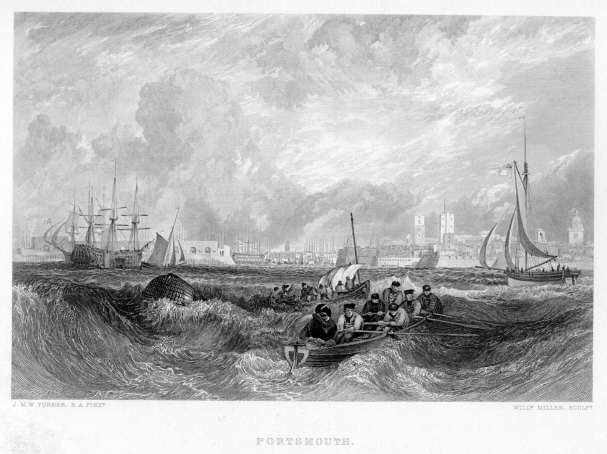
PORTSMOUTH
[2]. AKA
and see “Portsmouth Airs”?? Old-Time, Breakdown. A West Virginia/Kentucky
regional tune recorded on a 78 RPM for Brunswick in 1930 by West Virginia
fiddler Clark Kessinger (1896-1975), who probably learned the tune as a boy in
the Kanawha Valley. The title probably refers to the town of Portsmouth, Ohio,
on the Ohio River.
PORTSMOUTH AIRS. Old-Time, Breakdown. USA, Kentucky. G Major. Standard tuning (fiddle).
AABB (Titon): AA’BB’. Harmonica player John Lozier of Lewis County, Kentucky,
said regionally influential fiddler Ed Haley used to play it
in front of the Old Railroad YMCA in Portsmouth, Ohio (Hartford, 1996). Jeff
Titon (2001) calls the tune a northern-influenced type of melody that is sometimes
favored by fiddlers in the northeastern part of Kentucky. See also the
distantly related tune “Buffalo Gals.”
Source for notated version: Buddy Thomas, who learned it from Jimmy Wheeler, a
fiddler and instrument repairman who lived in Portsmouth, Ohio [Titon]. Titon (Old-Time Kentucky Fiddle Tunes), 2001;
No. 128, p. 155. Berea College Appalachian Center
AC007, Roger Cooper – “Snakewinder” (1993). Rounder 0376, Buddy Thomas (et al)
– “Traditional Fiddle Music of Kentucky, vol. 1: Up the Ohio and Licking
Rivers” (1997). Rounder 0032, Buddy Thomas (northeastern Ky.) ‑
"Kitty Puss: Old‑Time Fiddle Music From Kentucky” (1976). Rounder
0380, Roger Cooper (Lewis County, Ky.) - “Going Back to Old Kentucky” (1996).
Rounder 0392, John Hartford - “Wild Hog in the Red Brush (and a Bunch of Others
You Probably Never Heard)” {1996. Learned from John Lozier).
X:1
T:Portsmouth Airs
M:C|
L:1/8
S:Buddy Thomas, from a transcription
by Ed Baggott
K:G
gaga f3g | e2d2 dcBB | b2 ab agfg |
a2 ga gdef | g2 ag fgfd | e2 d4 AB |
cBcd cAFA |1 [G3B3] [GB] [G2B2] ef
:|2 [G3B3] [GB] [G2B2] (G,2 ||
|: G,)B, D2 B3d | e2d2 dcBd | cBAG
FGAc | BAGB AGEG | DB, D2 B3d |
e2 d4 AB | c2 cd cA F2 |1 [G3B3]
[GB] [G2B2] (G,2 :|2 [G3B3] [GB] [G2B2] ef ||\
PORTSMOUTH HARBOUR [1]. English, Air (3/2 time). D
Major. Standard tuning (fiddle). AABB. Geoghegan (Compleat Tutor for the Pastoral or New Bagpipe), c. 1745-46; p. 33.
X:1
T:Portsmouth Harbour [1]
M:3/2
L:1/8
S:Geoghegan – Compleat Tutor for the Pastoral or New Bagpipe (c. 1745-46)
Z:AK/Fiddler’s Companion
K:D
D4 FDAF dAfd | agfe dcdf edcB | A4
dABG AFGE | FDEC dfec A4 |
EGFG EGBd cBA^G | AcBc Aceg fedc |
dg bag fed cBAG | FAdG F2E2 D4 :|
|: A4 cAce agfe | dfeg fagf edcB | Aceg
fabf gefd | ecdB F2^A2 B4 |
AGFE DFA=c BAGF | EGBe gbge c4 |
dBAG FAdf agaf | edcB AGFE D4 :||
PORTSMOUTH HARBOUR [2]. English, Country Dance Tune (whole time). G Major. Standard tuning. AABB. The melody was originally published in Charles and Samuel Thompson’s Compleat Collection, vol. 3 (London, 1773). As with numerous tunes from the Thompson’s 1773 collection, it was entered into the 1788 music manuscript copybook of fiddlers John and William Pitt Turner (Norwich, Conn.). Thompson (Compleat Collection of 200 Favourite Country Dances, vol. 3), 1773; No. 152.
X:1
T:Portsmouth Harbour [2]
M:C
L:1/8
B:Thompson’s Compleat Collection of 200 Favourite Country Dances, vol. 3 (London, 1773)
Z:Transcribed and edited by Flynn Titford-Mock, 2007
Z:abc’s:AK/Fiddler’s Companion
K:G
G(B B)c/d/ ecec|G(B B)c/d/ cAcA|G(B B)c/e/ ecec|BGAF G2 [G,2G2]:|
|:B(d
d)e/f/ gdgd|B(d d)c/B/ cAcA|B(d d)e/f/ gdgd|BGAF G2 [G,2G2]:||
PORTSMOUTH HORNPIPE. AKA and see "Off/Going
to California [1]," "Fireman's
Reel." Irish, English?, American; Hornpipe. USA, New England. A Major.
Standard tuning. AABB. Al Smitley suggests the tune may possibly have been
named for the frigate Portsmouth, a
name that appears in American Clipper
Ships 1833-1858 by Howe and Matthews. However, if American, it may as
likely have been named for the harbor city of Portsmouth, New Hampshire.
***
Mellie Dunham. Photograph courtesy
of David Sanderson, Maine
***
Cole (1000 Fiddle Tunes), 1940; pg. 86. Ryan’s Mammoth Collection, 1883; pg. 120. Edison
34339‑2 (78 RPM), Mellie Dunham (Maine), 1926 (appears as "Lady of
the Lake"). John Edwards Memorial Foundation JEMF‑105, Neal Converse
‑ "New England Traditional Fiddling" (1978).
X:1
T:Portsmouth Hornpipe
M:2/4
L:1/8
R:Hornpipe
S:Ryan’s Mammoth Collection (1883)
Z:AK/Fiddler’s Companion
K:A
E|A/c/B/c/ A/F/F/E/|A/c/e/a/
.f(f/g/) | a/g/f/e/ f/e/c/A/|B/c/B/A/ .F.E|A/c/B/c/ A/F/E/F/|
A/c/e/a/ .f(f/g/)|a/g/f/e/
f/e/c/A/|BAA::(c/d/)|e/a/g/a/ f/e/c/e/|f/a/g/a/ .f(f/g/)|
a/g/f/e/ f/e/c/A/|B/c/B/A/
.F.E|A/c/B/c/ A/F/E/F/ | A/c/e/a/ .f(f/g/)|a/g/f/e/ f/e/c/A/| BAA :|
PORTSMOUTH ROUT.
English, Jig. B Flat Major. Standard tuning. AABB. The melody appears to
be unique to London publisher Charles and Samuel Thompson’s 1765 country dance
collection. Thompson (Compleat Collection of 200 Favourite Country
Dances, vol. 2), 1765; No. 125.
X:1
T:Portsmouth Rout
M:6/8
L:1/8
B:Thompson’s Compleat Collection of 200 Favourite Country Dances, vol. 2 (London, 1765)
Z:Transcribed and edited by Flynn Titford-Mock, 2007
Z:abc’s:AK/Fiddler’s Companion
K:Bb
fdB “tr”B3|fdB “tr”B3|bag fed|cde dcB|fdB “tr”B3|fdB “tr”B3|bag fed|edc B3:|
|:d=ef fef|c=ef fef|dBG cAF|=EGB A3|d=ef fef|c=ef fef|dBG cAF|BG=E F3|
fdB
“tr”B3|fdB “tr”B3|bag fed|cde dcB|fdB “tr”B3|fdB “tr”B3|bag fed|edc B3:||
PORTSMOUTH WINDER. Old-Time, Breakdown. USA, Kentucky. D Major. Standard tuning. AABB. The
title refers to Portsmouth, Ohio. Source Hilt learned the tune from his father
who called it “N....r Winder.” A ‘winder’ was an old-time dance form (as in ‘to
wind around’), related to the grapevine twist of modern square dancing. Rounder Heritage Series 1166-11592-2, Ray Hilt (et al) –
“The Art of Traditional Fiddle” (2001).
X:1
T:Portsmouth Winder
M:2/4
L:1/8
S:Ray Hilt (Rounder Heritage
1166-11592-2)
Z:AK/Fiddler’s Companion
K:D
[df].d [df].d | [d/f/]d/B/A/ FA | Ae
[Ae>]f | ge c/B/A | [df].d [df].d |
[d/f/]d/B/A/ FA |
[A,E][A,/E/][A,/E/] CE | D>E D2 :: AF AF | A/A/d/B/ AF |
.A,.E .C.E | A>B AF/G/ | AF AF |
A/A/d/B/ AF |.A,.E .C.E | D4 :|
PORTUGAISE, LA. French, Country Dance (6/8 time). B Flat Major. Standard tuning. AABB. From the contradance book (tunes with dance instructions) of Robert Daubat (who styled himself Robert d’Aubat de Saint-Flour), born in Saint-Flour, Cantal, France, in 1714, dying in Gent, Belgium, in 1782. According to Belgian fiddler Luc De Cat, at the time of the publication of his collection (1757) Daubat was a dancing master in Gent and taught at several schools and theaters. He also was the leader of a choir and was a violin player in a theater. Mr. De Cat identifies a list of subscribers of the original publication, numbering 132 individuals, of the higher level of society and the nobility, but also including musicians and dance-masters (including the ballet-master from the Italian opera in London). Many of the tunes are written with parts for various instruments, and include a numbered bass. Daubat (Cent Contredanses en Rond), 1757; No. 66.
X:1
T:Portugaise, La
M:6/8
L:1/8
N:”Allegro”
S:Daubat – Cent Contredanses en Rond (1757), No. 66
Z:AK/Fiddler’s Companion
K:Bb
BDE FBF | GBG AcA | Bfe dcB | ecB AGF | BDE FBF | GBA AcA |
Beg ecA | BFD B,2z :: Dff fdB | Egg gec | Dff fdB |
ecB AGF | Dff fdB | Egg gec | fdB ecA | BFD B,2 z :|
PORTUGUESE DANCE. AKA and see “Nine-Pins (Ninepins)[2]," “Oats and Beans,” “Oats, Peas, Beans [1].” English,
Jig. D Major. Standard tuning (fiddle). AABBC. Jamie Knowles notes that the
first strain, set in reel time, would be the same as the French-Canadian favourite
“La Bastringue.” The melody is contained
in the Joseph Kershaw manuscript. Kershaw was a fiddler who lived in Slackcote,
Saddleworth, North West England, in the 19th century, and his
manuscript dates from around 1820 onwards. The Joseph Kershaw Manuscript,
1993; No. 6.
PORTUGESE FANDANGO, THE.
English, Waltz. G Major. Standard tuning (fiddle). AABBCC. A generically
titled tune that perhaps has its origins in the British alliance with Portugal
during the Napoleonic Wars when Portugal was key to sustaining the Peninsular
Campaign. Kennedy (Fiddler’s Tune-Book:
Slip Jigs and Waltzes), 1999; No. 158, p. 41.
POSAD, AN. AKA and see "The Wedding [1]."
POSAD BRIGIDIN. AKA and see "Biddy's Wedding."
POSAD SEAGAN FADA. AKA and see "Long John's
Wedding."
POSAD SEAGANIN. AKA and see "Johnny's
Wedding."
POSSUM AND RACCOON. Old‑Time, Breakdown. USA, Mississippi. G Major. The tune was
recorded in 1939 for the Library of Congress by Herbert Halpert from the playing
of Simpson County, Mississippi, fiddler Enos Canoy and the Canoy Band.
POSSUM AND SWEET
'TATERS. AKA – “Possum and Taters” (?). Old‑Time,
Breakdown. The title appears in a list of traditional Ozark Mountain fiddle
tunes compiled by musicologist/folklorist Vance Randolph, published in 1954.
See note for “The
Old Stillhouse is a-Burning Down [2].”
POSSUM CREEK. Old‑Time, Breakdown. G Major. Standard tuning (fiddle). AABB.
Appears to be an old tune. Ford (Traditional
Music in America), 1940; p. 114.
POSSUM DIED LAUGHING. Old‑Time, Breakdown. USA, Alabama. Tune identified as distinct to
the Rocky Ridge, Alabama, region.
POSSUM HOLLOW. Old‑Time. Decca 5018 (78 RPM), Stripling
Brothers (Ala.) {1934}.
POSSUM IN THE SIMMON
TREE. AKA and see “Possum Up a ‘Simmon Tree [3]."
POSSUM IN THE WELL. Old-Time, Breakdown. D Major.
Standard tuning (fiddle). AABB. A modern ‘old-time’ composition by Randy
Marmouze.
POSSUM ON THE/A RAIL. Old‑Time, Breakdown. USA, Mississippi. G Major. Standard tuning
(fiddle). ABB. The record attributes composition of the tune to fiddler Lonnie
Ellis, who shared fiddling duties in the Mississippi Possum Hunters with fellow
fiddler John Holloway (although the two did not play fiddle together on record,
but one would switch to a different instrument while the other fiddled). Source
for notated version: fiddler Lonnie Ellis with the Mississippi Possum Hunters
[Phillips]. Johnson (The Kitchen Musician
No. 2: Occasional Collection of Old‑Timey Fiddle Tunes for Hammer
Dulcimer, Fiddle, etc.), 1982 (revised 1988 & 2003); p. 14. Kuntz,
Private Collection. Phillips (Traditional
American Fiddle Tunes), 1994; p. 186. County 528,
Mississippi Possum Hunters ‑ "Mississippi Breakdown: Traditional
Fiddle Music of Mississippi, vol. 1." Document 8028, The Mississippi
Possum Hunters – “Mississippi String Bands, vol. 2” (reissue). Victor 23595 (78
RPM), Mississippi Possum Hunters (1930).
|
See also listing at: Jane Keefer’s Folk Music Index: An
Index to Recorded Sources |
X:1
T:Possum on a Rail
M:2/4
L:1/8
S:Liz Slade
Z:Transcribed by Andrew Kuntz
K:G
(3D/E/F/|G)B/B/
A/A/B|[G/B/][Gc][G/c/] [Ec]>(A|B/)A/B/(A/ B/)c/B/(A/|
B/)AB/ A (3D/E/F/|G)B/B/ AB|B/cB/
c>(e|e/)A/d/A/ B/A/A|G/[GB]G/ [GB]:|
|:A|[G/B/](A/B/)(A/ B/)B/d|[Bg]>(f g2|1 [e2e2] c2|e>(f e>)A|[G/B/]A/[G/B/](A/ B/)A/B/c/|
d/B/d/(e/ g>)(A|B/)c/d/A/ BA|G/[GB]G/ [GB]:|2 b2g2|e>f e>e|gg/g/ g/a/g/(A/|B/)A/B/(c/ d>)(A|B/)c/d/A/ BA|[GB]||
POSSUM PIE. AKA‑ "Carve Dat
Possum [1]," "Bile
Them Cabbage Down." Old‑Time, Breakdown. USA. G Major. Standard
tuning (fiddle). One Part. The tune is identified by Thede as a Negro 'banjo
tune'.
***
Carve that 'possum Hannah,
Carve that possum soon;
For the pan is ready,
And I am the spoon.
***
Thede (The Fiddle Book), 1967; p. 69.
POSSUM SOP. Old‑Time. The title appears in a list of traditional Ozark
Mountain fiddle tunes compiled by musicologist/folklorist Vance Randolph,
published in 1954.
POSSUM TROT [1]. Old‑Time, Breakdown. USA, southwestern Va. D Major. Standard
tuning (fiddle). AA'BB. Tom Carter and Blanton Owen (1976) say the tune has not
been recorded outside of Patrick County, Va. They recorded it from Bill Shelor
who learned the tune from an uncle, Will Shelor, and who said the tune was
titled because it sounds very much like a possum trotting. A tune by this same
name was listed by the Troy Herald of
July 6, 1926, as having been played at a fiddlers' convention at the Pike
County (southeast Alabama) Fairgrounds. Source for notated version: Bill Shelor
[Phillips]. Phillips (Traditional
American Fiddle Tunes), vol. 1, 1994; p. 187. Rounder
0057, Bill Shelor (Meadows of Dan, Patrick County, Va.) ‑ Old Originals,
vol. 1" (1978).
POSSUM TROT [2].
Old-Time, Breakdown. USA, Missouri. D Major. Standard tuning (fiddle).
AABB. Composed by Missouri fiddler Art Galbraith (1909-1993) in the early
1950’s. No relation to “Possum Trot [1].” Source for notated version: Art
Galbraith (near Springfield, Mo.) [Beisswenger & McCann]. Beisswenger &
McCann (Ozark Fiddle Music), 2008; p. 41. Rounder
0157, Art Galbraith (Springfield, Mo.) - "Simple Pleasures” (1983).
POSSUM UP A GUM STUMP(, COONIE IN THE HOLLOW) [1]. AKA and see "Off/Going to California [1],"
"Whiskey You're the Devil,"
"Whiskey in the Jar [1],"
"Lexington," "Old Towser," "Gypsy Hornpipe [4]," "Fireman's Reel," "Buttermilk and Cider." Old‑Time, Breakdown. USA; Alabama,
north Georgia, Arkansas. D Major. Standard tuning (fiddle). AABB. The tune was
mentioned in chronicles before the year 1830 (Mark Wilson). It was cited as
having been played in a 1914 Atlanta, Ga. fiddlers' contest, and listed in the Northwest Alabamian of August 29, 1929,
as one of the tunes likely to be played at an upcoming fiddlers' convention.
The title appears in a list of traditional Ozark Mountain fiddle tunes compiled
by musicologist/folklorist Vance Randolph, published in 1954. See also related
tune family under "Dubuque,” and the
related “Green Back Dollar.”
***
Possum up a gum stump, coonie in the holler,
Little gal at our house, fat as she can waller.
Saddle up the old nag, martingale and collar,
Fetch her down to my house, I'll give you half a dollar. (Ford)
***
Charles Wolfe, in notes to Thomas
Talley’s Negro Folk Rhymes (1991),
says the first two stanzas of the song below were collected from both black and
white sources, although the last two stanzas are rather rare:
***
‘Possum up de gum stump,
Dat raccon in de holler;
Twis’ ‘im out, an’ git ‘im down,
An’ I’ll gin you a half a doller.
***
‘Possum up de gum stump,
Yes, cooney in de holler;
A pretty gal down my house
Jes as fat as she can waller.
***
‘Possum up de gum stump,
His jaws is black an’ dirty;
To come an’ kiss you, pretty gal,
I’d run lak a goobler tucky.
***
‘Possum up de gum stump,
A good man’s hard to fin’;
You’d better love me, pretty gal,
You’ll git de yudder kin’.
***
The tune/song appears in several
collections, including Brown (3:207), White (236-38), Scarborough (173),
Randolph (2:361) and Lomax and Lomax (American Ballads and Folk Songs), pg.
238. Source for notated version: Joe Hermann with the Critton Hollow String
Band (West Virginia) [Phillips]. Ford (Traditional
Music in America), 1940; pg. 29. Kuntz, Private Collection. Phillips (Traditional American Fiddle Tunes), vol.
1, 1994; pg. 187. Copper Creek CCCD-0196, Tom, Brad & Alice – “We’ll Die
in the Pig Pen Fighting.” Document 8039, “The Hill Billies/Al Hopkins and His Buckle Busters:
Compoete Recorded Works in Chronological Order, vol. 1” (reissue). Flying Fish
FF 355, Critton Hollow String Band ‑ "By and By" (1985).
Recorded Anthology of American Music, 1978 ‑ "Traditional Southern
Instrumental Styles." Vocalion 5118, 1926 (78 RPM), The Hill Billies (east
Tennessee).
X:1
T:Possum Up a Gum Stump
L:1/8
M:2/4
Z:Transcribed by Andrew Kuntz
K:D
(A,|A,)/B,/D/E/ F/G/F/E/|D/E/F/A/ BA|B/A/B/c/ d/c/d/B/|A/F/D/F/ E/D/B,/G,/|
A,/B,/D/E/ F/G/F/E/|D/E/F/A/ BA|B/A/B/c/ d/c/d/B/|A/G/F/E/ D:|
|:ff|f/ a f/ aa/g/|f/e/d/f/ e/d/B/A/|f/ a a/ ba|f/e/d/f/ ee/e/|f/ a f/ aa/g/|
f/e/d/f/
e/d/B/A/|B/A/B/c/ d/c/d/B/|A/G/F/E/ D:|
POSSUM
UP A GUM STUMP [2]. Old‑Time, Breakdown. C Major.
Standard tuning. AABB. See the related tunes “Big Footed N….r [2],” “Hell Broke Loose in Georgia,”
"Streak O' Lean,
Streak O' Fat." Source for notated version: fiddler Howard 'Howdy'
Forrester via John Hartford [Devil's Box,
Phillips]. The Devil's Box, vol. 23,
No. 1, Spring 1989; pg. 22. Phillips (Traditional
American Fiddle Tunes), 1994; pg. 187.
X:1
T:Possum Up
a Gum Stump
L:1/8
M:2/4
S:Howdy
Forrester, transcribed by John Hartford
K:C
e2g2|g/e/a/g/
e/g/g|e2 gg/a/|g/e/d/c/ A/c/c|e2g2|g/e/a/g/ eg/g/|c’b ag|e/g/a/g/ e/d/c:|
|:E/(c/c)
c>d|c/A/G/c/ A/B/c|G,/C/E/G/ A/B/c/d/|c/A/G/E/ D/A,/C|
G,/C/E/G/ A/B/c/d/|c/A/G/c/ A/c/c|e2
e>d|c/A/G/E/ D/C/C:|
POSSUM UP A GUM STUMP
[3]. Old-Time, Breakdown. G Major.
Standard tuning. AB (Silberberg): AABB (Phillips, Songer). Unrelated to the
previous tunes by this name. Source for notated version: Ruthie Dornfeld
(Seattle, Washington) [Phillips]; Marge Tonge [Silberberg]. Phillips (Traditional American Fiddle Tunes), vol.
1, 1994; pg. 188. Silberberg (Tunes I Learned at Tractor Tavern),
2002; pg. 120. Songer (Portland Collection), 1997; pg. 161.
POSSUM UP A GUM STUMP
[4].
AKA and see “Old Aunt Kate
[1].” Old-Time, Breakdown. Unrelated to the previous “Possum Up a Gum
Stump” tunes. Rounder 0529, Dwight Lamb – “Hell Agin
the Barn Door” (2005. Learned from a radio broadcast performance by Nebraska
fiddler Uncle Bob Walters).
POSSUM UP A GUM TREE. AKA - "Opossum Up a Gum Tree." American. Cecilia Conway (1995) finds references to the song "Opposum up a Gum Tree." An English performer, Charles Mathews, witnessed the tune being rendered by the noted tragedian and performer Ira Aldridge (1807-1867) at the African Grove Theater in New York. The theater was a venue for black performers, and at the conclusion of Hamlet (rendered in dialect) the audience had called for their favorite song; Aldridge obliged. Mathews (who later incorporated the material into a comic act for the British stage) made several transcriptions of the song, the tune of which appears to be similar to the "Turkey Buzzard" family of tunes. Ceclia Conway, in African Banjo Echoes in Appalachia (1995), states that "the song is apparently a variant of the dance tune 'Cooney in de Holler,' which was popular in Philadelphia and the Five Points dance halls and dives of New York during the time of 'Juba' Lane and Charles Dickens." Hans Nathan (Dan Emmett and Negro Minstrelsy, Univ. of Oklahoma Press, 1962), citing T. Allston Brown (The Origins of Minstrelsy), writes that the song was known to white boatmen and African-Americans in South Carolina. The song was published in London by J. Willis & Co. c. 1824:
***
Possum up a Gum-Tree,
Up he go, up he go
Racoon in the hollow
Down below, down below.
Him pull him by hims long tail,
Pully hawl, pully hawl,
Then how him whoop and hallow
Scream and bawl, scream and bawl.
Possum up a Gum Tree
Racoon in the hollow
Him pull him by hims long tail
Then how him whoop and hallow.
***
X:1
T:Possum Up a Gum Tree
M:C
L:1/8
R:Air
S:Willis & Co., London (c. 1824)
Z:AK/Fiddler’s Companion
K:A
EAA>B c2 {B}A2 | df B2 df B2 | EAA>B c2 {B}A2 | AcE2 AcEE |
EAAB c2 {B}A2 | dfB2 dfBE | EAA>B
c2{B}A2 | AcE2 Ac e2 |
e>f e>c B2A2 | f>g fd c2 Be
| efec {c}B2AA | AFGE EA3 ||
POSSUM UP A SIMMON
TREE [1]. AKA and see “Kitty Puss,” "Puncheon Camp(s)." Old-Time,
Breakdown. USA, Ky. A Major/Mixolydian (Phillips]. Standard tuning. AABB. The
melody is the same as Clyde Davenport's (Monticello, Ky.) "Puncheon
Camp(s)." Source for notated version: Buddy Thomas (Ky) [Phillips].
Phillips (Traditional American Fiddle
Tunes), vol. 1, 1994; pg 188. Rounder 0032, Buddy
Thomas (northeast Ky.) ‑ "Kitty Puss: Old‑Time Fiddle Music
From Ky."
POSSUM UP A 'SIMMON
TREE [2]. Old‑Time, Breakdown. G Major.
Standard tuning. AABB.
***
'Possum up a 'simmon tree
Raccoon on the ground.
Raccoon says: "You son‑of‑a‑gun,
Shake them 'simmons down!" (Ford)
***
Ford (Traditional Music in America), 1940; pg. 77.
POSSUM
IN THE SIMMON TREE [3]. Old-Time, Breakdown. USA, Arizona.
F Major. Standard tuning. ABC. Ruth (Pioneer
Western Folk Tunes), 1948; No. 64, pg. 23.
X:1
T:Possum in the Simmon Tree
L:1/8
M:2/4
S: Viola
“Mom” Ruth – Pioneer Western Folk Tunes
(1948)
Z:AK/Fiddler’s Companion
K:F
(3C/D/E/|F/E/F/G/
A/B/c/A/|B/A/B/c/ d/e/f/d/|c/=B/c/d/ c/A/F/G/|A/G/F/A/ G/E/D/(3C/D/E/|
F/E/F/G/
A/B/c/A/|B/A/B/c/ d/e/f/d/|c/=B/c/d/ c/A/F/G/|A/F/G/E/ Fc||
e/^d/e/f/
g/^f/g/e/|=f/e/f/d/ c>c|e/d/e/f/ g/^f/g/e/|=f/e/f/d/ c>A|B/A/B/c/
d/e/f/d/|c/A/F/A/ c>f|
e/d/c/B/
A/G/F/E/|FA F2||C/Ff/ c/d/c/A/|B/A/B/c/ d/e/f|C/Ff/ c/d/c/B/|
G/F/G/A/
G/E/C|C/Ff/ c/d/c/A/|B/A/B/c/ d/e/f/d/|c/B/c/d/ c/A/F/G/|A/G/F/E/ F2||
POSSUM’S TAIL IS BARE, THE. Old-Time, Breakdown & Song. D Major. Standard tuning. AABB. From Braxton County, West Virginia, fiddler Melvin Wine (1909-2003). Verses sung to this tune are numerous and include:
***
Squirrel’s
got a bushy tail, rabbit’s got the hair,
The old coon’s tail has rings all around, but the possum’s tail is bare.
***
Oh
the possum’s tail is bare, oh, the possum’s tail is bare,
The old coon’s tail has rings all around, but the possum’s tail is bare.
***
Take
an old possum by the tail, then we’ll skin him on a rail,
Never ever more will he be seen, grinning at the moon.
***
Grinnnin’
at the moon, grinning at the moon,
Never ever more will he be seen, grinning at the moon. (Melvin Wine)
***
Silberberg (Tunes I Learned at Tractor Tavern), 2002; pg. 121.
X:1
T:Possum’s Tail is Bare, The
M:C|
L:1/8
Z:AK/Fiddler’s Companion
K:D
DE|F2 FF FEDF|G2G2 B3B|A2F2 E2 (3EFE
D2|A,>A, [A,3E3] DE|
F2 FF FEDF|G2G2 B3B|A2F2E2C2|D4-D3:|
|:FE|DFF2 A2B2|[E3=c3]c d2dc|BG G2
Bc d2|A3A A2 (3ABc|
d2 dd dBAF|G2 G2 B3B|
A2F2E2C2|D4-D3:||
POST COACH, THE.
English, Country Dance Tune (2/4 time). G Major. Standard tuning. AABB.
Originally published by Charles and Samuel Thompson in their third country
dance collection (London, 1773). The melody appears in the 1788 music
manuscript copybook of fiddlers John and William Pitt Turner (Norwich, Conn.),
as do several from the Thompson’s 1773 collection. Thompson (Compleat
Collection of 200 Favourite Country Dances, vol. 3), 1773; No. 62.
X:1
T:Post Coach, The
M:2/4
L:1/8
B:Thompson’s Compleat Collection of 200 Favourite Country Dances, vol. 3 (London, 1773)
Z:Transcribed and edited by Flynn Titford-Mock, 2007
Z:abc’s:AK/Fiddler’s Companion
K:G
G|G
g2 f/e/|ddd>c|B/d/B/G/ A/c/A/F/|GGG>G|G g2 f/e/|d a2 g|fe/d/ A^c|ddd:|
|:d|d =f2 e/d/|ccc>c|c e2 d/c/|BBB>A|G g2 G/F/|E e2 d/c/|BA/G/
DF|G[DG][G,G]:||
POST HORN GALOP. Scottish, Galop (2/4 time). G Major ('A' part) & D Major ('B'
part). Standard tuning. AABB. It was customary for the mail stage-coach to
sound a trumpet or horn just prior to their arrival at a way-station, to
announce the mail. Kerr (Merry Melodies),
vol. 3; No. 445, pg. 51.
X:1
T:Post Horn Galop
M:2/4
L:1/8
R:Galop
S:Kerr – Merry Melodies, vol. 3, No. 445
(c. 1880’s)
Z:AK/Fiddler’s Companion
K:G
GGGG|GGGG|(Gd)(Gd)|(Gd)(Gd)|DDDD|DDDD|(DA)(DA)|(DA)(DA)|GGGG|
GGGG|(Gd)(Gd)|(Gd)(Gd)|DDDD|DDDD|(DA)(DA)|GzGz:|
K:D
f>ed>B|A>FA>B|A>EA>B|A>FA>d|f>ed>B|A>FA>B|A>df>d|ezaz|
f>ed>B|A>FA>B|A>EA>B|A>FA>d|f>ed>B|A>FA>B|A>df>e|dzdz:|
POST HORN REEL. American, Reel. D Major ('A' part) & A Major ('B' part). Standard
tuning. AABB. One of several tunes composed by one Frank Livingston contained
in Ryan’s Mammoth Collection (1883). Nothing is known about Livingston,
who may have been a journeyman composer in the New York-to-Boston area. Cole (1000 Fiddle Tunes), 1940; pg. 40. Ryan’s Mammoth Collection, 1883; pg. 67.
Sweet (Fifer’s Delight), 1965/1981;
pg. 70.
X:1
T:Post Horn
M:2/4
L:1/8
R:Reel
Z:AK/Fiddler’s Companion
K:D
f/g/ | a/b/a/f/ dc/d/ | e/f/e/c/
Ad/c/ | (3B/B/B(e/d/) (3c/c/c/(f/e/) | d/e/f/g/ af/g/ |
a/b/a/f/ dc/d/ | e/f/e/c/ Ad/c/ |
(3B/B/B/(e/d/) (3c/c/c/(f/e/) | d/d’/a/f/ d :|
K:A
c/d/ | (3e/e/e/(f/e/) c/e/c’/e/ |
(3e/e/e/ (f/e/) c/e/c’e/ | e/d’/b/g/ e/d/c/B/ | c/e/a/c’/ e’c/d/ |
(3e/e/e/(f/e/) c/e/c’/e/ |
(3e/e/e/(f/e/) c/e/c’/e/ | e/d’/b/g/ e/d/c/B/ | Aa a :|
POST-OAK GROVE. AKA and see "Sweet
Ellen/Ellum [2]." Old‑Time, Breakdown. D Major. Standard tuning.
AABB. Ford (Traditional Music in America),
1940; pg. 81.
POST OFFICE, THE. AKA ‑ "Tig‑Coimead
Litire." Irish, Hornpipe. G Major. Standard tuning. AABB. Michael Cooney
reports this tune has been suggested as a relative of the famous American
hoe-down "Turkey in the Straw."
O'Neill (Krassen), 1976; pg. 175. O'Neill (Music
of Ireland: 1850 Melodies), 1979; No. 1606, pg. 298.
X:1
T:Post Office, The
M:C|
L:1/8
R:Hornpipe
S:O’Neill – Music of Ireland (1903), No. 1606
Z:AK/Fiddler’s Companion
K:G
G/A/|B/d/d/e/ d/B/A/G/|B/c/d/e/
dB/A/|B/e/e/f/ e/d/B/A/|B/e/e/f/ ee|
g/a/b/g/ f/g/a/f/|g/f/e/d/ eg/e/|d/B/A/B/
d/B/A/B/|GG/G/ G:|
|:g/a/|b/a/b/g/ a/g/a/f/|g/a/b/g/
a/g/e/f/|g/f/g/e/ d/B/G/B/|B/A/A/G/ A z|
g/a/b/g/ f/g/a/f/|g/f/e/d/
eg/e/|d/B/A/B/ d/B/A/B/|GG/G/ G :|
POSTBOYS HORNPIPE. Irish, Hornpipe. G Major. Standard tuning. AABB. O'Neill (O’Neill’s Irish Music), 1915; No. 378,
pg. 181.
X:1
T:Postboy’s Hornpipe
M:C
L:1/8
R:Hornpipe
S:O’Neill – O’Neill’s Irish Music (1915)
Z:AK/Fiddler’s Companion
K:G
Bc | d>BG>G G3B | A>GF>E
D>CB,>A, | B,DGF E>cA>G | F2D2D2 B>c | d>BG>G G3B |
A>GF>E D>CB,>A, |
B,>DG>F E>cA>F | G2G2G2 :: B>c | d>Bc>e d>Bc>d |
e>dc>B c2 c>d | e>dc>B c>BA>G |
F>GF>E D>CB,>A, |
B,>DG>B, C>EA>E | F>Ad>F G>Bd>B | e>ce>c
B>AG>F | G2G2G2 :|
POSTMAN'S KNOCK [1]. English, Morris Dance Tune (6/8
time). D Major. Standard tuning. AB. Collected from the village of Adderbury,
Oxfordshire, England by Janet Blunt who noted it from the last of the old
dancers, William Walton, in 1917. The following bit of verse was sung during
the dance:
***
Every morning as true as the clock
Someone hears the postman's knock. (x2)
***
The Adderbury morris tradition has a
number of songs collected from it, for the morris team at the turn of the 19th
century was also a singing club. Bacon (The
Morris Ring), 1974; pg. 11. EMI/Harvest 7243 8
29861 2 6, Ashley Hutchings et al - "Son of Morris On" (1976/1994).
POSTMAN’S KNOCK [2], THE. See “(Le) Messe.”
POT POURRI DE MONT. French-Canadian, In the repertoire
of Gaspésie musician Yvon Mimeault (b. 1928, Mont-Louis), learned from his
father. Yvon Mimeault – “Y’etait temps!/It’s About
Time.”
POT-POURRI DES MARITIMES.
French-Canadian, In the repertoire of Gaspésie musician Yvon Mimeault
(b. 1928, Mont-Louis), from the ‘mouth music’ of his youth employed by he and
his brothers to memorize fiddle tunes heard on radio broadcasts from the
Maritime provinces. Yvon Mimeault – “Y’etait
temps!/It’s About Time.”
POT STICK. AKA and see "Lacrum Cosh,"
"Ligrum Cush," "The Marquis/Marquess of Granby,"
"Over the Water to Charlie,"
"The Quaker's Wife," "Sean Buidhe/Bui" (Yellow John [1]), "The Shambuy/Shambuie," "Wishaw's Delight." English,
Country Dance Tune (6/8 time). D Major. Standard tuning (fiddle). AABB. Pot
Stick = a plain round wooden porridge-stirrer. Slang usage for ‘pot stick’ meant
a staff. Frank Kidson (1890) traces this tune extensively throughout its
Scotch, Irish and English printings, but states the national origin of the
melody "would be a difficult matter to settle." He finds it earliest
in Johnson's 200 Country Dances of 1748
(vol. IV), although after that date it appears under the Irish title
"Shambuie" or "Shamboy" in Thompson's Country Dances (vol. I, c. 1759), Oswald's Caledonian Pocket Companion (vol. II) and others. As "The
Marquis of Granby," a song by G. A. Stevens, it is printed in James Aird's Selection of English and Foreign Airs (vol. I, c. 1775-76), and as
"Ligrum Cush" or "Lacrum Cosh" (another Irish title) it is
in Hime's Dances and Holden's Irish Airs. The Scots poet Robert Burns
mentions in a letter to George Thomson that "Ligrum Cush" is a title given to the
old Scotch melody, "The Quaker's Wife"
(see note for "The Quaker's Wife); they are not the same tunes, however,
there are similarities in the general phrasing and cadences. In Gow's 3rd Collection of Strathspeys Reels
(1792) it is called "Wishaw's Delight." It's most
famous attachment, however, is to the old song "Over the Water to Charlie,"
and under this title it appears in the Caledonian
Pocket Companion (Book 4, c. 1775), in Bremner's Reels (c. 1759), and in the aforementioned Gow publication 3rd Collection of Niel Gow’s
Reels (as “Original Set of O’er the Water to Charlie”). Kidson (Groves)
notes that the air was set to a song in the opera Midas, and that a number of
political songs were written to it in the 18th century, including a
“famous son on the victories of the Marquis of Granby, then a popular hero.”
Drinking songs as well were set to it, such as “Ye lads of true spirit lay
courtship to Claret” and “I love to see the bottles a’rolling.” Kidson (Old English Country Dances), 1890; p. 9.
X:1
T:Pot Stick
M:6/8
L:1/8
N:Johnson’s 200 Country Dances, IV, 1748
N:Via Kidson’s Old English Dances, p. 9
Z:Bruce Olson
K:D
D2A AFA |B/2c/2dF E2D|D2A AFA|B3d3:|
|:d/2e/2fd ecA|B/2c/2dF E2D|d/2e/2fd
ecA|B3d3|
d/2e/2fd ecA|B/2c/2dF E2D|DFA
AFA|B3d3:|]
POTATOES AND BUTTER. AKA and see "Daniel of
the Sun,” “Donal O’Grady.”
POTEAU BLANC, LE. AKA and see "The White Post."
POTEEN STILL, THE. AKA and see "The Poitin Still."
POTHOUGE. AKA and see “Polthogue.”
POTLICK, THE. AKA and see "Trim the Velvet," "The Humours of Flip," "Green Garters [2]," "Geehan's Reel," "The Grazier."
POTS AND PANS. English, Country Dance Tune (2/4 time). E Minor. Standard tuning
(fiddle). AABB. Composed by Ralph Smethurst. The tune was named after a
Lancashire rock formation in England’s Penines. Plain Brown Tune Book,
1997; p. 34.
POTTINGER'S REEL. AKA – “Willie Pottinger’s Reel.” Shetland, Reel. F Major. Standard
tuning (fiddle). AABB. Composed by Tom Anderson (1910‑1991?), originally
from Eshaness (Nor' West Mainland, Sheltand), for Willie Pottinger, a boat
carpenter, musician, composer and traditional fiddling enthusiast, whose
favorite key was ‘F’. Tom Anderson's book "Ringing Strings:
Traditional Shetland Music And Dance," includes a photograph of Willie
Pottinger playing a Stroh violin previously owned by a man named George Stark
(1877-1960), known as "the blind fiddler." Anderson was awarded the M.B.E. in 1977 for his
efforts on behalf of preserving traditional music of the Shetlands. Aly Bain
calls the melody “one of (Anderson’s) finest reels.” Anderson (The Thistle
Collection), 1972. Cranford (Jerry Holland: The Second Collection),
2000; No. 171, p. 64. Hunter (Fiddle
Music of Scotland), 1988; No. 263. Green Linnet
GLCD 3105, Aly Bain - “Lonely Bird” (1996). Topic 12TS379, Aly Bain & Tom
Anderson ‑ "Shetland Folk Fiddling, vol. 2" (1978). Jerry
Holland – “Crystal Clear” (2000).
|
See also listings at: Alan Snyder’s Cape Breton Fiddle
Recording Index Jane Keefer’s Folk
Music Index: An Index to Recorded Sources |
X:1
T:Pottinger's Reel
M:4/4
L:1/8
R:Reel
K:F
|:F3 c AFF3/2e/|fgfc AFF3/2 G/|GFGA BABd|{e }gfed ec ~c2|F3 c AFF3/2e/|
fgfc AFF3/2|A/2|BcdB ABcA|cBAG AF F2::{e}f2 cf Afcf|faga fc c2|
cg
{gag}f2 g a|bagf ec c2|{e}f2 cf Afcf|faga fc c2|{A}BcdB ABcA|cBAG AF F2:|
POUCA, THE.
Irish, Reel. D Major. Standard tuning (fiddle). AABB. The tune begins on the
relative minor. A pouca, or in Irish púca, usually refers to magical
beings—a "water sprite,” or "mischievous fairy,” for example (cf the
Pooka McPhellimy in Flann O'Brien's masterpiece At Swim Two Birds.
Shakespeare adapted the word for his character Puck in A Midsummer Night’s
Dream. McGuire &
Keegan (Irish Tune by the 100, vol. 1),
1975; No. 56, p. 15.
POULE, LA. AKA - "La Poole." English, Quadrille (6/8 time). “La
Poule” (the hen) is a portion of a many-part dance for four couples called a
quadrille. The quadrille is a five-part dance that was extremely popular on the
Continent prior to and during the Napoleonic era, reaching England by 1808. It
was introduced to Regency society by the Duke of Devonshire and became
fashionable by 1813; some few years later it was being danced regularly at
dances throughout the country. “La Poule” is always the third figure of the
quadrille, in ABACABA form and always in 6/8 time (the other figures are “Le
Pantalon” (trousers), “L’été” (summer), “La Pastourelle” (shepherdess) and
“Finale.” Thus there are various tunes used for “La Poule,” although the
structure and time signatures remain the same. Burks’ “La Poule” appeared in
America in John Carr’s The First Book of Cotillions (1801) and
William William’s New and Complete
Preceptor for the Fife (Utica, 1826). It also appears in the music copybook
of Frank Johnson, a black American musician who wrote out his manuscript and
presented it to Mrs. A. Rush, around the year 1820. The same melody was copied
into the manuscript of musician William Tildesley of Swinton, Lancashire, in
the 1860’s (No. 73), where it is a third part simply labelled “Quadrils” Maggie’s Music MMCD216, Hesperus - “Early American Roots” (1997).
POULES HUPPÉES, LES (The Crested Hens). AKA and see “The Crested Hens.” French, Bourree a Trois
Temps (3/8 time). D Mixolydian ('A' part) & D Minor ('B' part). Standard
tuning (fiddle). AABB. Composed by Gilles Chabenat. Stevens (Massif Central), 1987, vol. 1; No. 34.
POUND CAKE AND SUGAR. Old‑Time, Breakdown. USA, Mississippi. A Major. Recorded for the
Library of Congress in 1939 by Herbert Halpert from the playing of Lauderdale
County, Mississippi, fiddler Stephen B. Tucker (b. 1859).
POUND EACH WAY, A. Irish, Reel. D Major. Standard
tuning (fiddle). AABB. Composed by
fiddler and pianist Josephine Keegan (b. 1935), of Mullaghbawn, south County
Armagh. Keegan (The Keegan Tunes), 2002; p. 48.
POUND HILL. AKA and see “The Lodge Gate,” “The Jaunting Car,” “Russell’s Hornpipe,” “Woodcock Hill.” Irish, Hornpipe. Recorded by
the Ballinakill Ceili Band in 1931.
POUND OF TOW, THE. Irish, Air (6/8 time). D Mixolydian/D Major.
Standard tuning (fiddle). One part.
***
If your wife and my wife were in a boat together,
Fifty miles from every port without an oar or rudder,
Fifty miles from every port and there to let them go,
Never to return again to spin the pound of tow. (Joyce)
***
Source for notated version:
"...sent to me...during 1884 by Mr. Francis Hogan of south Lodge,
Brenormore, near Carrick‑on‑Suir, a good musician and a great
enthusiast in Irish music and songs" (Joyce). Joyce (Old Irish Folk Music and Song), 1909; No. 251, p. 121.
X:1
T:Pound of Tow, The
M:6/8
L:1/8
R:Air
S:Joyce – Old Irish Folk Music and Songs
(1909)
Z:AK/Fiddler’s Companion
K:D
A/B/c|d2d A2B|=c2c E2D|E2D D2D|(D3
D2)E|G2E DEG|A3 ABc|d2d e2e|(d3d2)G|
F2D F2G|A3 ABc|d2d e2c|A3 ABc|d2d
FGA|=c2c E2D|E2E D2D|(D3D2)||
POUND STREET LASSES. Irish, Reel. D Mixolydian. Standard tuning. AAB. Peter Kennedy believes
the title probably refers to a street in Cork. Kennedy (Traditional Dance Music of Britain and Ireland: Reels and Rants),
1997; No. 159, pg. 37.
POUR LA DERNIERE FOIS (For the Last Time). Cajun, Waltz. USA, southwestern Louisiana. A
Major. Standard tuning. One part. Source for notated version: Adam Hebert (La.)
[Francois]. Francois (Yé Yaille, Chère!),
1990; pgs. 450-451. Swallow Records SW-LP6065, Adam
Hebert.
POURING SOAPSUDS OVER
THE FENCE. AKA and see "Soapsuds Over the Fence."
Old‑Time. The title appears in a list of traditional Ozark Mountain
fiddle tunes compiled by musicologist/folklorist Vance Randolph, published in
1954.
POVERTY ON THE
YELLOWSTONE. Old-Time, Breakdown. A family tune
from fiddler Bob Beers.
POWDERHAM
CASTLE. English, Jig. England, North‑West.
D Major. Standard tuning. AABB. This stately manor is the historic home of the
Earl of Devon, and the dwelling of the Courtney family for over 600 years. It
is located in an ancient and extensive deer park in Exeter, southern England,
along the River Exe. Construction of Powderham Castle was started around
1390 by Sir Philip Courtenay, ancestor of the present Earl of Devon. It was
extensively damaged by the Parliamentarians during the English Civil War and
considerable restoration and alteration followed in the 18th and 19th
centuries.
***
Powderham Castle
***
Knowles (Northern Frisk), 1988; No. 95.
POWERS
OF PUNCH, THE (Cumacta na
Dig). Irish,
Double Jig. G Major. Standard tuning. AABBCCDD. The word ‘punch' derives
from a Hindi word, panch, meaning
‘five’, because of its five ingredients: spirits, water, lemon-juice, sugar and
spices. The word was first recorded in English in 1669. O'Neill (Dance Music of Ireland: 1001 Gems), 1907/1986; No. 352, pg. 72.
X:1
T:Powers of Punch, The
L:1/8
M:6/8
S:O’Neill – Dance Music of
Ireland: 1001 Gems (1907), No.
352
Z:AK/Fiddler’s Companion
K:G
E|DEF GBG|AEF G2E|DGA GBc|dec
Bcd|e/f/ge dBd|cBA BGE|DcB AGA|BGG G2:|
|:B|dBd gdB|cAG FGA|dBd gdB|def g2f|e/f/ge dBd|cBA BGE|DcB AGA|BGG G2:|
|:E|DGB cde|dge dBG|ce/f/g dBG|EFG A2d|gfe afd|e/f/ge dBG|EcB AGA|BGG G2:|
|:c|BAG AFD|GDC B,A,G,|G,GF
GDB,|A,AA A2a|bgb afa|gfe dBG|EcB AGA|BGG G2:|
POWERS OF WHISKEY. AKA and see "Kinnegad Slashers," "Land of Sweet Erin," "O! An Irishman's Heart," "O!
Merry Am I," "Paddy Digging For 'Goold.'"
POYNTIN’S WHIM. English, Country Dance Tune (4/4 time). F Major. Standard tuning. AABB. The melody appears in Walsh’s third collection of Lancashire tunes (Lancashire Jiggs, Hornpipes, Joaks, etc.) published in 1743.
cB| A2 F4 GA| Bcde fgab| e2 g4 fg| afge fdec| dBcA fdcB| A2 F4::\
fg| agaf bagf| edge fagf| e2 g4 fg| afge fdec| dBcA fdcB| A2 F4:|
_______________________________
HOME ALPHABETICAL
FILES REFERENCES
© 1996-2010 Andrew Kuntz
Please help maintain the viability of the Fiddler’s
Companion on the Web by respecting the copyright.
For further information see Copyright and Permissions Policy or
contact the author.