The Fiddler’s
Companion
© 1996-2009 Andrew Kuntz
_______________________________
Home Page
Fiddler’s Companion
Files References
|
TU |
|
Notation
Note: The tunes below are recorded in what
is called “abc notation.” They
can easily be converted to standard musical notation via highlighting with
your cursor starting at “X:1” through to the end of the abc’s, then
“cutting-and-pasting” the highlighted notation into one of the many abc
conversion programs available, or at concertina.net’s incredibly handy “ABC
Convert-A-Matic” at http://www.concertina.net/tunes_convert.html **Please note that the abc’s in the Fiddler’s Companion
work fine in most abc conversion programs. For example, I use abc2win and
abcNavigator 2 with no problems whatsoever with direct cut-and-pasting.
However, due to an anomaly of the html, pasting the abc’s into the
concertina.net converter results in double-spacing. For concertina.net’s
conversion program to work you must remove the spaces between all the lines
of abc notation after pasting, so that they are single-spaced, with no
intervening blank lines. This being done, the F/C abc’s will convert to
standard notation nicely. Or, get a copy of abcNavigator 2 – its well worth
it. [AK] |
TU ATTRAPES DU SIROP, LA (You Get Some Syrup There). AKA - "La Turtape de
Saroid." Cajun, Waltz. USA, southwestern Louisiana. D Major. Standard
tuning. One part. Amede Ardoin recorded the tune some time ago, though the
title was issued in mangled French as "La Turtape de Saroid." Source
for notated version: accordion player Amede Ardoin (La.) [Francois]. Francois (Yé Yaille, Chère!), 1990; pgs. 198-199. Old Timey Records OT-114, Amede Ardoin.
TU FEIN IS ME FEIN (Yourself and Myself). AKA and see "Yourself Along with Me" [2].
Irish, Air (6/8 time). A Minor. Standard tuning. AABBCC. Source for notated
version: the Irish collector Edward Bunting (in whose 1840 collection the tune
appears) noted the melody from "McDermott at Castlebar in 1802," whom
O'Sullivan (1983) belives is Edward MacDermott Roe, one of the Irish harpers at
the second Granard festival in March, 1782. O'Sullivan/Bunting, 1983; No. 17,
pgs. 25-26.
TU M'A JETE DEHORS. Cajun. Victor Vi-21770 (78 RPM), Mause LaFleur
& Leo Soileau (1928).
TU PEUX PAS CASSER MON
COEUR (You Can't Break My
Heart). Cajun,
Waltz. USA, southwestern Louisiana. D Major. Standard tuning. One part. Source
for notated version: Chester "Pee Wee" Broussard (La.) [Francois].
Francois (Ye Yaille, Chère!), 1990;
pg. 485.
TU PEUX t' BLAMER. See "Lovesick Waltz."
TU VAS M' FAIRE MOURIR (You'll Make Me Die). Cajun, Two-Step (4/4 time). USA, southwestern
Louisiana. D Major. Standard tuning. ABBB(Vocal)BBBBAABBAB(Vocal)ABBA. Related
tunes, according to Raymond Francois (1990), are Ed Juneau's "Lake Arthur Stomp [2]" (not
the usual tune associated with "Lake Arthur Stomp") and Rufus
Thibodeaux's "La Danse de Port
Arthur." Source for notated version: fiddler Wallace
"Cheese" Reed & accordion player Marc Savoy (La.) [Francois].
Francois (Yé Yaille, Chère!), 1990;
pgs. 301-302. La
Louisiane Records LL-8135, Wallace "Cheese" Reed.
TUAM NA FARRAIGE. AKA and see “The Atlantic Roar,” "The Atlantic Wave."
TUAMGREINE CASTLE. See “Tuamgraney Castle.”
TUAMGRANEY CASTLE. AKA - “Tuamgreine Castle.” AKA
and see “Biddy Mickey’s,” “The Humours of Tuamgraney.”
Irish, Hornpipe. G Major. Standard tuning. Gearóid Ó hAllmhuráin (1999) says the tune was collected by O’Neill
during a trip to East Clare in 1906, where, in the Sliabh Aughty area, he had
several tunes from fiddler Johnny Allen, a dance musician and contemporary of
Pat Canny and a blind fiddler named Paddy MacNamara. The latter taught music in
the region in the early part of the 20th century. See “Tomgraney Castle [1].” James Kelly - “The Ring Sessions.” Seamus Creagh - “Came the
Dawn” (appears as “Julia Clifford’s”).
X:1
T:Tuamgraney Castle
R:hornpipe
C:Trad.
M:4/4
L:1/8
Q:50
K:G
cB|:AGAB AGEG|AGAB cBcd|(3efg fa g2
ed |1 B2 G2 G2:|2 c2 A2 A2||
|:(3efg |agab ageg | agab a2 ge |
dega g2 ed |1 B2 G2 G2 cB:| [2 c2 A2 A2 (3efg:|
agab ageg | agab a2 ge | dega g2
ed|B2 G2 G2 cB|
AGAB AGEG|AGAB cBcd|(3efg fa g2 ed
|1 c2 A2 A2 (3efg:| [2 c2 A2 A2 z2||
TUAR MÓR POLKA [1], THE. AKA and see “The Gullane (Polka) [3], “Tony Lowe’s Polka [2],” “The Toormore Polka [2],” “The Tournmore Polka,” “Wallace’s Cross.” Irish, Polka. Ireland,
Sliabh Luachra region of the Cork-Kerry border. D Major. Standard tuning. AABB.
This polka, along with No. 2, was collectively known as the “Tuar Mór Polkas”
by source O’Leary. Tuar Mór is a village in west County Kerry, not far from
Killarney. An A Mixolydian tonality is suggested in the first part up until the
cadence on D Major, while the ‘B’ part is solidly in D. “Wallace’s Cross” is a
related tune, as is an untitled polka in Breathnach (CRÉ II), 1976; No. 123. Source for notated version: accordion
player Johnny O’Leary (Sliabh Luachra region), recorded in recital at Na
Píobairí Uilleann, February, 1981 [Moylan]. Bulmer & Sharpley (Music from Ireland), vol. 4; 72. Ceol, vol. 5, No. 1 (appears as “Back of
the Haggard”). Mallinson (100 Polkas),
1997; No. 73, pg. 28. Moylan (Johnny
O’Leary), 1994; No. 87, pg. 49. Topic 12T357,
Johnny O’Leary - “Music for the Set” (1977. Appears as first of “Tourmore
Polkas”).
TUAR MÓR POLKA [2], THE. AKA and see “The Back of the Haggard,” “Dan O’Leary’s [2],” “Johnny O’Leary’s,” “The Maids of Ardagh,” “Sliabh Mhachaire [1],” “The Toormore Polka [2],” “The
Tournmore,” “Wallace’s Cross.” Irish,
Polka. Ireland, Sliabh Luachra region of the Cork-Kerry border. D Major (‘A’
part) & A Mixolydian (‘B’ part). Standard tuning. AABB. Source O’Leary said
the alternate title, “Back of the Haggard,” was the name Jack Sweeney had for
the tune. Source for notated version: accordion player Johnny O’Leary (Slaibh
Luachra region) [Moylan]. Bulmer & Sharpley (Music from Ireland), vol. 4; 73. Ceol, vol. 5, No. 1 (appears as “Back of the Haggard”). Mallinson (100 Polkas), 1997; No. 74, pg. 28.
Moylan (Johnny O’Leary), 1994; No.
88, pg. 50. Tubridy (Irish Traditional
Music, Book Two), 1999; pg. 9. Topic 12T357,
Johnny O’Leary - “Music for the Set” (1977).
X:1
T:Tuar Mór Polka [2]
L:1/8
M:2/4
K:D
FG/A/ BA|de f2|fe/f/ gc|ed BA|FG/A/ BA|de
f2|fe/f/ gc|ed d2:|
|:ef/e/ ce|fe a2|ef/e/ ce|fe
c/B/A|ef/e/ ce|fe a2|ef/e/ dB|BA A2:|
TUAR MÓR POLKA [3], THE. AKA and see “Jim Keeffe’s (Polka) [3].”
Irish, Polka. D Major. Standard tuning. AABB. Source for notated version: set
dance music recorded at Na Píobairí Uilleann in the 1980’s [Taylor]. Mallinson
(100 Polkas), 1997; No. 75, pg. 28.
Taylor (Music for the Sets: Yellow Book),
1995; pg. 11.
TUB DANCE. English, Slow Air or Waltz (3/4 time). G Major. Standard tuning. AB.
Knowles, 1995; pg. 4.
TUBBER FAIR. Irish, Jig. G Major. Standard tuning. ABC. Composed by County
Cavan/Philadelphia fiddler and composer Ed Reavy (1898-1988). The title comes
from a reference by Synge to “Red Dan Sally’s ditch and drinking in Tubber
Fair.” Reavy (The Collected Compositions
of Ed Reavy), No. 94, pgs 105-106.
X: 1
T:Tubber Fair
R:jig
C:Ed Reavy
M:6/8
L:1/8
Z:Joe Reavy
N:Synge told us of the things of this world the
N:world of "Red Dan Sally's ditch and drinking
N:in Tubber Fair." Being a fiddler of sorts himself,
N:John would have relished this little jig in G.
N:He would have thought it a fitting tune to
N:be played at Tubber Fair.
K:G
G/2A/2 | BGA B2 f | gef gfe | BdB AGA | BGE EFG | BGA B2 f | gef gfe |
BdB AGA | BGF G2 A || BGA B2 f | gef gfe | BdB AGA | BGE E2 F |
GEG FEF | EFG B^cd | edB AGA | BGF G2 e/2f/2 || gba gfe | Bd^c def |
g2 f gfe | Be^d e2 f | gbg faf | gfe def | gfe BcA | BGF G2 e/2f/2 |
gba
gfe | Bd^c def | gbg afd | Be^d e2 f | gbg faf | gfe def | gfe BcA | BGF G2 ||
TUCKER'S OLD BARN [1]. AKA - "Tucker's Barn." AKA and see "Kitty Puss," "Puncheon Camp(s)," "Old Time Mockingbird."
Old-Time, Breakdown. USA, North Carolina. D Major ('A' part) & G Major ('B'
part). Standard tuning. AAB. The tonality constantly shifts from D Major to G
Major and back, and the 'A' part is irregular in metre, the ‘B’ part is 12
measures long. Source for notated version: Gaither Carlton (N.C.) [Phillips].
Phillips (Traditional American Fiddle
Tunes), vol. 1, 1994; pg. 244. Rounder CD 0371,
Mac Bendord and the Woodshed All-Stars - “Willow” (1996. Learned from North
Carolina musician Gaither Carleton).
X:1
T:Tucker’s (Old) Barn [1]
M:C|
L:1/8
K:D
(3ABc|d2 fd ecAc|d2 fd A2 (3ABc|d2
ef g2 ee|d2 BA G3G,-|
M:2/4
L:1/8
G2:||
M:C|
L:1/8
K:G
ef|g2 ee dB A2|G2 GG EDEF|G2BB
cBAG|FGAF D2 [DA][DA]|
FGAF D2 BA|G2BG EDEF|G2 BG cBAG|FGAF
D2 [DA][DA]|
FGAF D2 BA|G2 BG EDEF|G2BG cBAG|FGAF
D2||
TUCKER'S OLD BARN [2]. Old-Time, Breakdown. G Major. Standard tuning.
ABB'. The 'B' part is irregular. Not related to version #1. Source for notated
version: Armin Barnett (Seattle) [Phillips]. Phillips (Traditional American Fiddle Tunes), vol. 1, 1994; pg. 244.
TUCKER'S OLD PLACE. Old‑Time. The title appears
in a list of traditional Ozark Mountain fiddle tunes compiled by
musicologist/folklorist Vance Randolph, published in 1954. It is, perhaps,
"Tucker's Old Barn."
TUEHEY'S REEL. AKA and see "The
Gossan that beat his father," "The
Yeoman's Reel," "The Laurel
Bush," "The Castlebar
Traveller," "The Showman's
Reel," "Spence's Reel
[1]," "The Reel of Bogie,"
"The West Gale," "The Humours of Loughrea,"
"Lough Aisles Return."
TUESDAY AFTERNOON. Irish, Reel. D Major. Standard tuning. AABB. Taylor (Where’s the Crack?), 1989; pg. 5.
TUESDAY MORNING (Maidin De Mairt). Irish, Air. Ireland, Ulster. According to Ó
Canainn (1978) this is one of the great Northern songs in Irish tradition.
TUFFAN MASURKKA.
Finnish, Mazurka (3/4 time). G Major. Standard tuning. AABB. From the
southwestern coast of Finland. Fiddler Magazine, vol. 14, No. 4, 2007;
pg. 14. Tarkkanen (Leikarit Nuottivihko I), 1985.
TUGADH NA LÁMH. A clap dance performed in the Croaghs (Blue Stack Mountains), County
Donegal.
TUGBOAT. Old‑Time, Breakdown. USA; West Virginia, Virginia, Nebraska
Oklahoma, Texas. G Major. Standard tuning. AABB (Christeson, Phillips): AA'BBC
(Frets). Similar to “Sandy River
Belle.” Charles Wolfe (1997) states Kanawha County, West Virginia, fiddler
Clark Kessinger (1896-1975) first recorded the tune (in 1929 for Brunswick
under the name The Kessinger Brothers, although Clark’s accompanist was his
nephew, Luke). Other fiddlers learned
the tune from Kessinger’s recording, among them Texas fiddler Benny Thomasson,
who was instrumental in inserting the melody into the Texas contest tune
repertoire where it remains a popular piece. “Tugboat” was in the repertoire of
Missouri fiddler Cyril Stinnett, learned perhaps from Bob Walters, who probably
learned it from the Kessinger Brothers’ Brunswick record (Christeson, 1984).
The tune was also in the repertoire of West Virginia fiddler Edden Hammons, who
played it in standard tuning. See also the related “Ladies on the/a Steamboat.”
Sources for notated versions: Clark Kessinger (West Virginia.) [Christeson];
Mark O'Connor and Benny Thomasson (Texas) [Phillips]. R.P. Christeson (Old Time Fiddlers Repertory, vol. 2),
1984; pg. 75. Frets Magazine,
"Byron Berline: The Fiddle," June, 1988; pg. 55. Phillips (Traditional American Fiddle Tunes), vol.
1, 1994; pg. 244. Brunswick
Records (78 RPM), Kessinger Brothers. Missouri State Old Time Fiddlers'
Association, Bob Walters (1889-1960) - "Drunken Wagoneer." Sugar Hill
Records 3750, Byron Berline & John Hickman ‑ "Double
Trouble." Edden Hammons Collection, Disc 2.
TUGGERMAN'S JIG. Canadian (originally), American;
Jig. USA; New England, northern New York. D Major ('A' part) & A Major ('B'
part). Standard tuning. AABB (Bayard): AABB’ (Perlman). Perlman (1996) cites
the tunes provenance as the Canadian Maritimes. Sources for notated versions:
Bradley Grimshaw (northern N.Y., 1958) [Bayard]; Leonard McDonald (b. 1933,
Emyvale, Queens County, Prince Edward Island) [Perlman]. Bayard (Dance to the Music), 1981; No. 571, pg.
509. Perlman (The Fiddle Music of Prince
Edward Island), 1996; pg. 133. Folkways 8826,
Per's Four‑‑"Jigs and Reels."
TUHY’S FROLIC. AKA and see “Geese in
the Bog [2].” Irish, Jig. B Minor. Standard tuning. AABBCCDD. The tune was
originally printed in O’Farrell’s Pocket
Companion for the Irish or Union Pipes. A member of the “Geese in the Bog
[2]” family of tunes. O’Farrell (Pocket Companion, vol. II), c. 1806; pgs. 104-105. Treoir.
X: 1
T: Tuhy's Frolic
S: Treoir
N: from "O'Farrell's Pocket Companion for
the Irish Union Pipes"
Z: Transcribed by Bill Black
M: 6/8
L: 1/8
Q: 325
R: jig
K: Bm
A | dcd AGF | DED AGF | dcd AGF | EFA B2 c |
dfd AGF | DGD AGF | G3 FAd | EFA B2 :|
c | d2 e fdB | Bcd ecA | dfe fdB | ecA B2 c |
dfe fdB | Bcd ecA | dcB AGF | EFA B2 :|
c | dDD ADD | BDD AGF | dDD AGF EFA B2 c |
dDD ADD | BDD AGF | G3 FAd | EFA B2 :|
d | f/g/af fdB | efe ecA | f/g/af fdB | ecA B2 c
|
dfa
fdB | Bcd edc | dcB AGF | EFA B2 :|
TUIGE GAN GRÁ A'M DO
MHÁIRE?
AKA and see "Why
didn't I love Maire?"
TUILCEANAC, AN. AKA and see "The Luck Penny."
TUILE SA SPÉ, AN. AKA and see “The Spey in Spate.”
TUILLE SONAIS DUINN. AKA and see "More Luck to
Us."
TUÍODÓIR AERACH, AN. AKA and see “The Merry Thatcher.”
TUIREADH IAIN RUAIDH. AKA and see "Iain
Ruairidh's Lament."
TUIREAMH UI
RAGHALLAIGH (Lament for
O'Reilly). AKA
- "O'Reilly's Lament."
Irish, Air (4/4 time). F Major. Standard tuning. One part. The lamented
O'Reilly was one Maolmordha or Miles (surnamed 'The Slasher'), who was probably
the son of Maolmordha Dha (Deas), according to the Irish collector Edward
Bunting, and was also called 'Miles the handsome.' He was "'The Queen's
O'Reilly' in the reign of Elizabeth I of England and was colonel of horse in
the army commanded by Lord Castlehaven in the wars which followed the rebellion
of 1641. Miles the Slasher was slain while valiantly defending the bridge of
Finea against Monro's Scotch in 1644. O'Sullivan gives Bunting's MS version in
4/4 time, though the collector's 1840 volume gave the tune in 3/4 time.
***
The fate of the battle is past
O'Reilly stood firm to the last
Yet he still kept the day
Till he fell to the ground
There his bosom all gored
And still grasping his sword
O'Reilly was found. [Bunting]
***
Source for notated version: J. O'Reilly,
Esq., Belfast, 1806 [Bunting]. O'Sullivan/Bunting, 1983; No. 144, pgs. 201-202.
TÚIRÍN GARBH, AN. Irish, Jig. D Major. Standard
tuning. AABB. The title is a placename in the Sliabh Luachra region of Kerry,
Anglicised as Tureengarbh. Jackie Small
(CRÉ V) notes the tune was played by
famed Kerry fiddler and teacher Pádraig O’Keeffe. Small also identifies the
tune as “related to one that nowadays is usually called ‘Joe Cooley’s Jig’. Joe
Cooley called that jig ‘The Bohala Jig’, and it is called ‘Cruach Mhártain’ in
west Kerry.” Breathnach (CRÉ V),
1999; No. 44, pgs. 22-23.
TÚIRNE MHÁIRE (Mary’s Spinning Wheel). Irish, Slide (12/8 time). G Major.
Standard tuning. AABB. Cranitch (Irish
Fiddle Book), 1996; pg. 42. Tubridy (Irish
Traditional Music, Book Two), 1999; pg. 28.
X:1
T:Túirne Mháire
L:1/8
M:12/8
K:G
D2G G2G F2G A2c|B2c A2G F3 D3|D2G
G2G F2G A2c|B2c A2F G3 G3:|
|:B2d d2d d2d d2B|c2B A2G F3 D3|D2G
G2G F2G A2c|B2c A2F G3 G3:|
TÚISÉARA, AN. AKA and see "The Gauger."
TÚISÉARA AR A MHEISCE, AN (The Drunken Gauger). AKA and see “The Drunken Gauger [1].” Irish,
Jig. G Major. Standard tuning. AABB. Source for notated version: the late
fiddler Bobby Casey (County Clare) [Breathnach]. Breathnach (CRÉ III), 1985; No. 61, pg. 30.
TUISTIUN, AN. AKA and see "The Fourpenny
Bit."
TULCHAN LODGE. Scottish, Strathspey. A Major. Standard. AB. Composed by J. Scott
Skinner (1841-1927), appearing in his Logie
Collection. Tulcan Lodge, near Advie in Speyside, was the Scottish home
where J. Scott Skinner, early in his career as a
dancing master, taught the family of Lady Chetwode of Oakley. Source for notated
version: Winston Fitzgerald (1914-1987, Cape Breton) [Cranford]. Cranford (Fitzgerald), 1997; No. 98, pg. 41.
Hardie (Caledonian Companion), 1992;
pg. 56. Hunter (Fiddle Music of Scotland),
1992; No. 152. Skinner (The Scottish
Violinist), pg. 4.
X:1
T:Tulchan Lodge
M:C
L:1/8
C:J. Scott Skinner
Z:AK/Fiddler’s Companion
K:A
C<E A>B c>B A2 | D<F
B>c e>d B2 | C<E A>B c>A e>c | d/c/B A/G/F (3EFE (3DCB, |
C<E A>B c>B A2 | D<F
B>c d>c B2 | C<E A>B c>A a>f | (3efe (3dcB c<A [CA] ||
g | a<A c>e {g}a>g c>A |
D<F B>c d>ef>g | a<A c>e {g}a>e c>A | d/e/f B/c/d G/A/B
(3efg |
a<A c>e {g}a>e c>A |
D<F B>A {G/A/}GF {E/F/}E>D | C<E A>B c<A a>f | (3efe (3dcB
c<A [CA] ||
TULIP, THE. Scottish, March. Composed by James Oswald and
printed in his Airs for the Spring, c.
1747. Several song and dance tunes are descended from this one, including the
Irish anthem "The Wearing of the
Green" and the morris dance air "Balance the/a Straw [1]."
X:1
T:The Tulip
N:from James Oswald's 'Airs for the
Seasons'
N:'copyright 13 Oct 1747'
L:1/8
Q:112
M:C|
K:G
Z:Bruce Olson
d>c|{c/2}B2B>B
B>d~c>B|{B/2}A2A>A A2 B>c|\
B2(3dcB
~A>GA>B|G2G>GG2::g>f|\
~e2d4(3 GBd|{d/2} c2 B>B
B2g>f|
~e2d4c>B|~A>GA>B
D2d>c|{c/2}B2B2B>gd>B|\
{B/2}A2A2A>Bc>d|e>gd>B
A>cB>A|\
G2G>GG2:|]
TULLA REEL, THE (Ríl na Tulaí). AKA and see "Cooley's Reel [1]" “Joe Cooley’s Reel [2],” “Lutrell Pass.” E Minor. Standard. AABB. Source for notated version: accordion
player Sonny Brogan (County Sligo/Dublin, Ireland) [Breathnach]. Breathnach (CRÉ I), 1963; No. 200, pg. 77.
TULLAGH REEL, THE. AKA and see “Paddy Ryan’s Dream [1].” Irish,
Reel. A Dorian. Standard tuning. AB. Source for notated version: blind fiddler
Michael Duffy (Co. Clare, Ireland), who played at one of the Feis Ceoil
competitions in the early 20th century [Darley & McCall].
Cranitch (Irish Fiddle Book), 1996;
No. 77, pg. 154. Darley & McCall (Darley
& McCall Collection of Irish Music), 1914; No. 15, pg. 7. O’Neill (Dance Music of Ireland: 1001 Gems),
1907/1986; No. 461, pg. 89 (appears as “Paddy Ryan’s Dream”).
TULLAGHAN LASSIES. Irish,Reel. Ireland, County Donegal. See also the variants "Lough Island Castle" and "Sean sa Ceo/Cheo." Caoimhin Mac Aoidh (1994) identifies the parent of all these tunes to be the Scottish reel "Sleepy Maggy/Maggie," and relates that Simon (Ballinamore) Doherty (of the great musical Doherty family of Donegal) remarked that the melody came from the piping tradition of the many members of his family. Mac Aoidh finds further evidence for the tune's piping sources in Brendan Breathnach's 1965 field recording of other members of the Doherty family, fiddlers John and Mickey, in which Mickey droned an accompaniment employing double stops and trills while John played the melody; an imitation of the pipe sound. This style was repeated in the playing of the tune by Donegal fiddlers Francie Dearg and Mickey Ban O'Byrne, while fiddler Neillidh Boyle confirmed that the piece had piping origins.
TULLAGH’S (WALTZ). English,
Waltz. D Major. Standard tuning. AABB. Kennedy (Fiddler’s Tune-Book: Slip Jigs and Waltzes), 1999; No. 181, pg. 48.
TULLAMORE HARBOUR. Irish. The melody has been
attributed to Irish fiddler Dan Cleary (1918-2004), of Ballinamere,
County Offaly. Cleary played a number of instruments, including the uilleann
pipes, piano and tin whistle, and was a member of a number of céili bands in
the mid-20th century, notably the Ballinamere Céili Band, which won
All-Ireland titles in the mid-1950’s. Like “Trip to Durrow”, another of
Cleary’s compositions, this tune may stem from Cleary’s days as a young man
with the Colmcille Céili Band, of Durrow, Co. Offaly, who played regularly in
the Forresters Hall in Tullamore (see Treoir,
vol. 38, No. 2, 2006, pgs. 37-38).
TULLAMORE PIPER, THE (An Piobaire Ua Tulad-Moir). AKA and see "Bummer's Reel [1]," "Reilly's Own." Irish, Hornpipe. D
Major. Standard tuning. AABB. The hornpipe is often played as a reel in Cape
Breton, as in Andrea and Kinnon Beaton’s rendition on “The Beaton Family of
Mabou” (2004). Source for notated
version: Chicago musician Bernard Delaney [O’Neill]. O'Neill (Krassen), 1976;
pg. 215. O'Neill (Music of Ireland: 1850 Melodies), 1903/1979; No. 1773,
pg. 330. Smithsonian Folkways Records, SFW CD 40507,
The Beaton Family of Mabou – “Cape Breton Fiddle and Piano Music” (2004).
X:1
T:Tullamore Piper, The
M:C|
L:1/8
R:Hornpipe
S:O’Neill – Music of Ireland (1903), No. 1773
Z:AK/Fiddler’s Companion
K:D
fe|dfAd f2 fe|d2 ba ^gaed|ceAc
eAce|dfba ^ga=ge|dfAd f2 fe|d2 ba ^gaed|
ceAc eAce|d2f2d2||A2|B2c2d2 cB|BA^GA
F2 ed|ceAc eAce|dfba ^gafd|
B2c2d2 dB|BA^GA F2 ed|ceAc eAce|d2f2d2||
TULLEYNET/TULLEYMET
HALL. Scottish, Reel. A Dorian. Standard
tuning. AAB (Athole, Gow): AABB' (Kerr). One of the two most famous melodies
(with "Ayr Races") composed by Niel Gow's fourth son, John (1764-1826).
He, along with his older brother Andrew, established in 1788 the London branch
of the Gow family publishing concern, and was the distributor in that city for
the Gow publications (although they also printed other material). See "Lord Blantyre's.” for a “double tonic”
strathspey setting that is similar. Carlin (The
Gow Collection), 1986; No. 315. Kerr (Merry
Melodies), vol. 2; No. 73, pg. 10. Stewart-Robertson
(The Athole Collection), 1884; pg.
56.
X:1
T:Tullymet Hall
M:C|
L:1/8
R:Reel
B:Stewart-Robertson: The Athole Collection (1884)
Z:AK/Fiddler’s Companion
K:Amin
e|cAeA e2dg|BGgG Bdd>e|cAec dgde|cdBd cAA:|
^g|a^gae cAec|^fdgd BGG^g|a^gae cAec|^fd^ge aAAg|
a^gae
cAec|^fdgd BGdB|cA^GB AcBd|cedf eAA||
TULLICH FARM. American, Hornpipe. A Major.
Standard tuning. AABB. A modern composition by Alstead, New Hampshire, fiddler
and composer Randy Miller. Miller (Fiddler’s
Throne), 2004; No. 320, pg. 188.
TULLOCH. AKA and see "Huilichan." Scottish, Reel. A Mixolydian.
Standard tuning. AB. Cole (1000 Fiddle
Tunes), 1940; pg. 33. Honeyman (Strathspey,
Reel and Hornpipe Tutor), 1898; pg. 23. Ryan’s
Mammoth Collection, 1884; pg. 59.
X:1
T:Tulloch
M:C|
L:1/8
R:Reel
S:Ryan’s Mammoth Collection (1883)
Z:AK/Fiddler’s Companion
K:A
f|”tr”e2 (Ac/d/) ecAa|”tr”e2 (AB/c/)
dB=GB|”tr”e2 (Ac/d/) eAce|(BE) (cd/e/) dB=GB|
|”tr”e2 (Ac/d/) ecAa|”tr”e2 (AB/c/)
dB=GB|”tr”e2 (Ac/d/) eAce|(BE) (cd/e/) dB=GB||
“tr”(cA) (cd/e/)
“tr”(cA)(AB)|”tr”(cA) (cd/e/) dB=GB|”tr”cA) (cd/e/) cAcA|(BE) (cd/e/) dB=GB|
“tr”(cA) (cd/e/)
“tr”(cA)(AB)|”tr”(cA) (cd/e/) dB=GB|”tr”(cA) (cd/e/) “tr”(cA) (cd/e/)|(BE)
(cd/e/) dB=GB||
TULLOCH CASTLE. Scottish, Air (4/4 time). C Minor. Standard tuning. AAB. Composed by J. Scott Skinner (1842-1927) for a place he visited in
Scotland in September, 1890. Skinner (Harp
and Claymore Collection), 1904; pg. 16.
X:1
T:Tulloch Castle
M:C
L:1/8
R:”Pastoral” Air
C:J. Scott Skinner
N:”Wierdly and slowly.”
S:Skinner – Harp and Claymore (1904)
Z:AK/Fiddler’s Companion
K:Cmin
G | (e>d) (c>=B) ({B}c2) (_BA)
| (GB/A/) (G/F/) (E/F/) ({F}G2G .G | (e>d) (c>=B) c2 (_BA) |
G(B/A/) (G/F/) ({F}E/)D/ ({D}C2)
C:||G|(g/f/e/d/) (e/d/c/=B/) (c/=B,/C/D/) ({D}E/D/E/F/) |
(GB/A/) (G/F/E/F/) ({F}G2G .G |
(g/f/e/d/) (e/d/c/=B/) (c/=B,/C/D/) EF |
(GB/A/) (G/F/) ({F}E/D/) ({D}C2) C
G|(g/f/e/d/) (ed/c/=B/) (c/=B,/C/D/ E/D/E/F/) |
(GB/A/) (G/F/) (E/F/) (G2G)
.A/.=B/|(c/d/e/).c/ .g/.c/.c’/.c/ (e/d/c/=B/) c/C/E/F/|(G/=B/c/A/) (G/A,/G,/G/)
({G}C2)C||
TULLOCHGORUM/TULACH
GORM [1] (The Blue-Green
Hill). AKA ‑
"The Corn Bunting," "The
Blue Hill," "The Green Hill." Scottish, English; Rant or
Strathspey. England, Northumberland. G Mixolydian (most versions): G Major
(Johnson, Peacock, Plain Brown): F Mixolydian (Johnson). Standard
tuning. One part (Hunter): AB (Carlin/Gow, Cole, Gow, Hardie, Johnson/Emmerson,
Skinner, Surenne): AAB (Athole, Emmerson, Honeyman, S Johnson, Kerr, Skinner):
AA'B (Carlin/Master, Howe): AABB (Alburger, Bremner, Kennedy): ABC (Plain
Brown): AABBCCDD (Peacock). The title means "Blue‑Green
Hill" in Gaelic, and port-a-beul words have been set to “Tulach Gorm.” The
tune and song appear to be quite old; music historian Francis Collinson finds
that a tune in the Rowallan lute
manuscript (c. 1612-1628) called “Ouir the Deck Davy” has a “distinct
resemblance” to “Tullochgorum.” The earliest record of this tune appears in
David Young's Duke of Perth MS (AKA
the Drummond Castle MS) of 1734; it
is also found in the Gillespie Manuscript
of Perth (1768), and John Glen (1891) finds it in Robert Bremner's 1757
collection (2nd part, pg. 16); these early versions show little of the later
strathspey rhythm, at least as noted, and appear as rants. J. Scott Skinner (1904) notes:
“’Tullochgorum’ is stated by some authorities to have originally borne the
title of ‘Corn Bunting’. By others it is thought to be derived from the tune of
an old Scottish song…’Jockie’s fou and Jenny fain’…” Tullochgorm is also the
name of a Scottish dance of twelve steps, and was one of several taught by Cape
Breton fiddler Donald "the Tailor" Beaton of South West Margaree (who
was an itinerant tailor). The title appears in Henry Robson's list of popular
Northumbrian song and dance tunes ("The Northern Minstrel's Budget"),
which he published c. 1800. "Tullochgorum" was one of the tunes Niel
Gow played for Robert Burns in October, 1787, when Burns visited the fiddler at
his home in Dunkeld (see also "Loch
Erroch‑side," "Lament
for Abercairney"). In fact, it is one of the most famous tunes in the
repertoire, and must be mastered by every serious strathspey player, according
to Hunter (1979); Niel Gow and J. Scott Skinner
"built their reputations on the performance of it." Skinner wrote a
set of six famous variations on the tune, though those printed in the McGlashan Collection may be the
earliest. Words were set to it by the Rev. John Skinner (1721‑1807),
pastor of the Episcopal Chapel at Langside near Peterhead, which begin:
***
There needsna be sae great a phrase,
Wi' dringing dull Italian lays,
I wadna' gi'e our ain Strathspeys,
For half a hundred score o' 'em.
Douff and dowie, douff and dowie,
They're douff and dowie at the best
Wi' a' the variorum:
They're douff and dowie at the best,
Their allegros and a' the rest,
They canna please a Highland taste,
Compar'd wi' Tullochgorum. (The Songs of Scotland, 1887)
***
Hunter (1979) remarks that Rev.
Skinner came to the defense of Scottish folk music at a time when fashion ran
to the Italian musical influence among the middle and upper classes of
Scotland. Robert Burns ("Amang the trees") and Robert Fergusson (1750‑1774),
in "Daft Days" (in Scotland the 'daft days' are the Christmas‑New
Years holiday period), also joined his fight. "Daft Days" includes
the following excerpt:
***
Fiddlers! your pins in temper fix
And roset weel your fiddlesticks;
But banish vile Italian tricks
Frae out your quorum;
Gie's Tullochgorum.
***
Nigel Gatherer found the following passage in
an old book called The Fiddle in Scotland (n.d.) by Alexander G.
Murdoch, from an account by Peter Stewart, who accompanied Niel Gow during the
Burns visit:
***
Arriving at Dunkeld, [Burns]...put up at the
principal inn...[He] was
fortunate in making the acquaintance of Dr Stewart, an enthusiastic
amateur violin player. At the dinner table he quoted to his guests the
well-known local ditty-
. Dunkeld
it is a little toon,
. An' lies intil a howe;
. An' if ye want a fiddler loon,
. Spier ye for Niel Gow.
Burns expressed much delight at the proposal...a visit was at once
agreed to.
***
The greeting was a cordial one on both sides, and the meeting of Burns
and Gow - both geniuses of the first order in their respective lines -
was mutually worthy of each other. The magician of the bow gave them a
selection of north-country airs mostly of his own spirited composition.
The first tune was "Loch Erroch Side" which greatly delighted the
poet,
who long afterwards wrote for the same melody his touching lyric "Oh,
stay, sweet warbling woodlark, stay!"
At Burns's request, Niel next gave them his
pathetic "Lament for
Abercairney" and afterwards one of the best-known compositions in the
Highlands, "McIntosh's Lament". "Tullochgorum" was also
duly honoured,
after which the whole party adjourned to the little old-fashioned inn
at Inver, where there was a famous deoch, or parting friendly drink.
***
Sources for notated versions: Mary
MacDonald, who learned her setting from fiddler Sarah (Mrs. John Angus)
MacArthur of Mabou Coal Mines, Cape Breton [Dunlay & Greenberg]; a c. 1847
music manuscript by Ellis Knowles, a musician from Radcliffe, Lancashire,
England [Plain Brown]; Robert Petrie’s 4 Collection of Strathspeys, Reels, Jiggs and Country Dances
(Edinburgh, 1805) [S. Johnson]. Alburger (Scottish
Fiddlers and Their Music), 1983; Ex. 15, pg. 36. Bremner (A Collection of Scots Reels), 1757; pg.
16 (appears as “Tulloch Gorm”). Carlin
(Master Collection), 1984; No. 137,
pg. 84. Carlin (The Gow Collection),
1986; No. 226. Cole (1000 Fiddle Tunes),
1940; pg. 3. Dunlay & Greenberg (Traditional
Celtic Violin Music of Cape Breton), 1966; pg. 89. Emmerson (Rantin’ Pipe and Tremblin’ String),
1971; No. 58, pg. 149. Gow (The First
Collection of Neil Gow’s Reels), 1784 (revised 1801); pg.16. Gow (Beauties of Niel Gow), 1819; pg. 27.
Hardie (Caledonian Companion), 1992;
pg. 109. Henderson (Flowers of Scottish Melody),
1935. Honeyman (Strathspey, Reel and
Hornpipe Tutor), 1898; pg. 31. Howe (1000
Jigs and Reels), c. 1867; pg. 122. Hunter (Fiddle Music of Scotland), 1988; No. 86. Johnson (Scots Musical Museum), 1790; No. 289. S.
Johnson (The Kitchen Musician No. 10:
Airs and Melodies of Scotland’s Past), 1992 (revised 2001); pg. 19. S. Johnson (A Twenty
Year Anniversary Collection), 2003; pg. 20. Kennedy (Traditional
Dance Music of Britain and Ireland: Reels and Rants), 1997; No. 193, pg.
45. Kerr (Merry Melodies), vol. 1;
Set 15, No. 1, pg. 10. McGlashan (Collection
of Strathspey Reels), vol. 3, 1786; pg. 4. MacDonald (The Skye Collection), 1887; pg. 87. Peacock (Peacock’s Tunes), c. 1805/1980; No. 38, pg. 17. Petrie (Fourth Collection of Strathspey, Reels,
Jiggs and Country Dances), 1805; pg. 5. Plain Brown Tune Book, 1997;
pg. 40. Ryan’s Mammoth Collection,
1883; pg. 25. Skinner (The Scottish
Violinist, with six variations), pg. 26‑27. Skinner (Harp and Claymore), 1904; pgs. 68-69
(includes variation sets). Stewart-Robertson
(The Athole Collection), 1884; pg.
158. Surenne (Dance Music of Scotland),
1852; pgs. 6-7. Celtic CX 24, Alexander MacLean -
“Piano Stylings of the Cape Breton Scott.” CLM 1000, Carl MacKenzie - “Tullochgorum”
(1979). Topic 12TS280, J. Scott Skinner – “The Strathpspey King” (originally
recorded in 1905). Topic 12TS354, Mary MacDonald - “Cape Breton Scottish
Fiddle” (1978). NQD-5447, Doug MacPhee - “Cape Breton Master of the Keyboard.”
|
See also listings at: Alan Snyder’s Cape Breton Fiddle
Recording Index Jane Keefer’s Folk
Music Index: An Index to Recorded Sources |
X:1
T:Tullochgorum
M:C
R:Strathspey
L:1/8
B:Stewart-Robertson – The Athole Collection (1884)
Z:AK/Fiddler’s Companion
K:G
d/c/|:B<Gd<G c<=F A>c|B<Gd<G B>c d<g|B<Gd<G c<=F A>c|B<Gd<G A/B/c BA:|
G>gd>g =f<=F A2|G>gd>g B>gd>g|G>gd>g =f<=F A2|G>gd>B ~c2 BA|
G>gd>g =f<=F A2|G>gd>e !=f<c f>g|A/g/f/e/ =fd c<=FA<a|g>d g/a/b e>gd>g||
X:2
T:Tulloch Goirm
M:C
L:1/8
S:McGlashan – Strathspey Reels (1786)
Z:AK/Fiddler’s Companion
K:C
G>gd>e f>cA>F|G>gd>g B>gd>g|B>gd>e f>cA>F|G>gd>g B>GA>G|
G>gd>e f>cA>F|G>gd>e f>cf>a|g>efd cFAf|gdgb g2 de||
|:B>Gd>G c>Fc>A|B>Gd>G e>Gd>(g|g)>Gd>G c>Fc>A|B>Gd>G B2 AG:|
|:G>g a/g/f/e/ f>c d/c/B/A/|G>gd>g B>gd>g|G>g a/g/f/e/ f>c d/c/B/A/|
G>gd>g B>GA>G|G>g a/g/f/e/ f>c d/c/B/A/|B>g a/g/f/e/ f>cf>a|gefd cFA^f| g>dg>b g2 de:|
|:BG B/c/d/B/ cF A/B/c/A/|BGGA B/A/B/c/ dg|BG B/c/d/B/ cF A/B/c/A/|1
BGGc B2 AG:|2 GDDC B2 A,G,||
G>gd>e f>c f2|e>gd>g B>gd>g|B>gd>e f>c f2|e>gd>g B2 AG|Ggdg fc f2|
G>gd>e f>cf>a|gefd cFAf|gded B/d/d e2||
|:B,>GD>G, C>B,A,>C|B,>GD>G, E>G,D>G|G>G,D>G, C>B,A,>C| B,>GD>G, D2 C>B,:|
TULLOCH
GORM [2]. Scottish, Strathspey. A Minor.
Standard tuning. AB. A minor mode variant of version #1. O’Neill (1922)
erroneously attributes the tune to the Scottish fiddler/composer William
Marshall. Source for notated version: Chicago police officer and Highland piper
William Walsh [O’Neill]. O’Neill (Waifs
and Strays of Gaelic Melody), 1922; No. 100.
X:1
T:Tulloch Gorm [2]
M:4/4
L:1/8
S:Officer William Walsh
Z:Paul Kinder
R:Strathspey
K:Amin
a|c<Ae>A dG B2|c<Ae>A cAea|c<Ae>A d>G B2|c<Ae>A c2 B<a|
c<Ae>A dG B2|c<Ae>A cAea|cAeA dG B2|c<Ae>A c2 Bc||
A<a (3efg d>G B2|A<ae>a caea|ca (3efg d>G B2|A<ae>a c2 Bc|
A<a (3efg dG B2|A<ae>f g>ea>e|g>ag>e
d>GB>g|a>eg>e a3||
TULLYALLEN REEL, THE. The title appears in a list of tunes in his repertoire
brought by Philip Goodman, the last professional and traditional piper in
Farney, Louth, to the Feis Ceoil in Belfast in 1898 (Breathnach, 1997).
TULLYMET HALL. See “Tulleynet/Tulleymet Hall.”
TULLYVEOLAN MARCH. Scottish, March (4/4 time). D
Major (‘A’ and ‘B’ parts): G Major (‘C’ part). Standard tuning. AA’BB’CC’.
Composed by Scottish fiddler-composer J. Scott Skinner
(1843-1927). Skinner (Harp and Claymore),
1904; pg. 35.
X:1
T:Tullyveolan March
M:C
L:1/8
R:March
N:”Bold and firm.”
C:J. Scott Skinner (1843-1927)
S:Skinner – Harp and Claymore (1904)
Z:AK/Fiddler’s Companion
K:D
A2d2c2B2 | A2 B>c d2e2 | f2
f>g a2d2 | (f4 e2) A2 | A2d2c2B2 | A2 B>c d2 e2 |
f>ga>b a2 g>f |1
{d/f/}(e4d2) z2 :|2 (e4d2) A>B |: c2d2e2f2 | g6c2 | d2e2f2g2 |
a6 a2 | b3b a3a | a3g f2d2 |
B>cd>e f2 ({f}g>)f |1 (e4d2) A>B :|2 (e4d>)edB ||
N:”Trio”
K:G
(G4 G>)ed>B | (G4
G>)ed>B | G2A2B2d2 | g>d (3dcB A>ed>B | (G4G>)ed>B |
(g4g>)fg>a | b>f (3age
d>g B>e |1 (d2F2G>)ed>B :|2 (d2F2G4) ||
TULSA. American, Reel or Breakdown. A Major ('A' part) & E Major ('B'
part). Standard tuning. AABB. Source for notated version: Chet Hawley, c. 1931
(Tulsa, Oklahoma) [Pancerzewski]. Pancerzewski (Pleasures of Home), 1988; pg. 10.
TULSA WALTZ [1]. AKA ‑ "Tulsey Waltz." Old‑Time,
Waltz. USA; Arkansas, Oklahoma. C Major (Thede): D Major (Phillips). Standard
tuning. One part (Thede): AA' (Phillips). The tune was recorded for the Library
of Congress by musicologist/folklorist Vance Randolph, from the playing of
Ozark Mountain fiddlers in the early 1940's. Sources for notated versions: J.S.
Price (Pottawatomie County, Oklahoma) [Thede]; Howard Cawley with Jack Cawley's
Oklahoma Ridge Runners (Oklahoma) [Phillips]. Phillips (Traditional American Fiddle Tunes), vol. 2, 1995; pg. 316. Thede (The Fiddle Book), 1967; pg. 154.
TULSA WALTZ [2]. Old-Time, Waltz. G Major. Standard
tuning. AA'BCC'D. The 'D' part is the same as the 'B' part of "Keller's Waltz." Source for notated
version: Gary Lee Moore [Phillips]. Phillips (Traditional American Fiddle Tunes), vol. 2, 1995; pg. 317.
TUMBERLAND GAP. AKA and see "Cumberland Gap
[1]." For a few years this was the regional title around Round Peak,
North Carolina (an isolated area), of the tune "Cumberland Gap."
TUMBLE DOWN DICK.
English, Air (whole time). F Major. Standard tuning. AB. “Tumble Down
Dick” was printed by Johnson in his Choice Collection of 200 Favourite
Country Dances, vol. 3 (London, 1744) and by Walsh in the Compleat
Country Dancing Master, Volume the Fifth (London, 1754). The country dance
apparently derived from Henry Fielding’s (1707-1754) Tumble Down Dick; or,
Phaeton in Suds, a burlesque of a pantomime produced in London in 1736 in
the first year of Fielding’s tenure as the Little Haymarket theatre manager .
The melody also appears in the 1840 music manuscript collection of Cumbrian
musician John Rook.
X:1
T:Tumble Down Dick
M:C
L:1/8
R:Air
S:John Rook manuscript (Cumbria,
1840)
K:F
AB|cage f2 ed|c2 c4 Bc|dBAG cage|EF
G4 AB|cage fedc|
=Bc d4 ef|gedc fdc=B|c8||ged^c
dcBA|de f4 e2|fdcB cBcG|
cd e4f2|cAGF f2 ed|cd b4 ag|afge
c2e2|f6||
TUMBLE HER OVER AGAIN. English, Jig. England, Northumberland. G Dorian. Standard tuning. AABB.
The melody appears in the 1770 music manuscript copybook of Northumbrian
musician William Vickers, about whom little is known. The title is risqué.
Seattle (William Vickers), 1987, Part
3; No. 457.
X:1
T:Tumblir over again [sic]
M:6/8
L:1/8
R:Jig
S:William Vickers’ music manuscript
copybook, pg. 137 (1770)
Z:AK/Fiddler’s Companion
K:Gdor
A|BGA B2d|AFA cBA|BGA B2d|cAF G3:|
B2f fcB|AFA cBA|B2f fcB|Agf fcA|
B2f fcB|AFA cBA|BGA B2d|cAF G2||
TUMBLE THE JUG. Irish, Jig. E Dorian. Standard tuning. AB. Source for notated version:
"Copied from a MS. lent by Mrs. Woodroffe (of Cork?)" (Joyce). Joyce
(Old Irish Folk Music and Songs),
1909; No. 831, pgs. 402‑403.
X:1
T:Tumble the Jug
M:6/8
L:1/8
R:Jig
S:Joyce – Old Irish Folk Music
and Songs (1909), No. 831
Z:AK/Fiddler’s Companion
K:Edor
{c}B2E EFE | {c}B2A Bcd | B23E EFE |
BAG FED | B2E EFE |
{c/d/c/}B2A Bcd | AFA DFD | A2F FED
|| BEB EBE | B2A Bcd |
BEB EBE | BAG FED | BEB EBE | B2A
Bcd | AFA DFD | A2F FED ||
TUMBLE THE TAILOR (Leag an Táilliúir). Irish, Double Jig. G Major. Standard tuning.
AABB’. Breathnach (CRÉ IV), 1996; No.
13, pg. 8.
TUMBLE
THE TINKER. Irish, Double Jig. G Major.
Standard tuning. AA'BB'. O’Neill (1922) remarks: “An excellent double
jig called "Tumble the Tinker" was printed for the first time in the
enlarged edition of O'Neill's Irish Music
for Piano or Violin, issued in 1915. It was obtained from John McFadden a
clever traditional Irish fiddler of Chicago, who until then had forgotten the
tune since last leaving his native Mayo some forty years before. Since its
publication as stated, a spirited second finish has been developed. As varied
in the present setting ‘Tumble the Tinker’, heretofore so little known, is
assuredly worthy of preservation, and enhanced publicity.” See also the “Wollop the Potlid” family of tunes, and the
related “Trip to Killarney.” Source for notated version: fiddler
John McFadden (Chicago) [O’Neill]. O'Neill (O’Neill’s
Irish Music), 1915; No. 183, pg. 100. O’Neill (Waifs and Strays of Gaelic Melody), 1922; No. 180.
X:1
T:Tumble the Tinker
M:6/8
L:1/8
S:John McFadden, Chicago
Z:Paul Kinder
K:G
d/2c/2|:BAG GDG|GBd gdc|BAG GFG|A2 G Adc|
BAG GDG|GBd gdB|cec BdB|1A2 G Adc:|2A2 G GBc|
|:d3 BGB|def gdB|ded BGB|A2 G ABc|
1d2 d BGB|def gdB|cec BdB|A2 G ABc:|
2dBd def|gba gdB|cec BdB|A2 G Gdc||
TUMBLEDOWN. Irish, Jig. Composed by piper
and fiddler James O’Grady of Luton, England, who played with the County Clare
group Planxty O’Rourke. Patty Furlong – “Traditional
Irish Music on the Button Accordion” (1999).
TUMBLER’S HORNPIPE [1]. AKA and see “Washington Hornpipe [2].”
English, Hornpipe. G Major. Standard tuning. AABB. Sourced to the James Biggins
1779 manuscript (Leeds, west Yorkshire) held in the Leeds Central Library,
Yorkshire. Barry Callaghan (2007) finds it in the George Spencer (Leeds, west
Yorkshire), Joshua Burnett (Worsborough, south Yorkshire) and William Irwin
(Langdale, Cumbria) early 19th century collections as untitled tunes
and under the “Washington Hornpipe” title. Callaghan (Hardcore English), 2007; pg. 25.
TUMBLER’S HORNPIPE [2]. English, “Old” or Triple
Hornpipe. G Major. Standard tuning. AABBCC. The tune is from the 1779 James
Biggins music manuscript (Leeds, west Yorkshire). Callaghan (Hardcore English), 2007; pg. 79.
TUMBLIN'
CREEK LIZA JANE. AKA and see "Liza Jane [2]." Old‑Time,
Breakdown. G Major. Standard tuning. AABB. John Hartford supplies this note in
his transcription: "Raymond Toddy and Howdy's Uncle Bob were playing a
dance on Tumblin' Creek and swappin off, and Raymond played Liza Jane and ever
since then they called it 'Tumblin' Creek Liza Jane.'" See also J.P.
Fraley’s “Liza Jane” for another version. Source for notated version: Howdy
Forrester via John Hartford [The Devil's
Box]. The Devil's Box, vol. 23,
No. 1, Spring 1989; pg. 21.
X:1
T:Tumblin’
Creek Liza Jane
L:1/8
M:2/4
S:Howdy
Forrester, transcribed by John Hartford
K:G
G|g/a/g/e/ dB/c/|d/B/A/F/ G2|g/a/g/e/ dB|d>e dB/d/|g/a/g/e/ dB/d/|d/B/A/G/
E2| G/A/G/E/ DE|G>A G:|
|:A|B/A/B
B>G|A(G G2)|B/A/B/d/ AG|E>G E2|D/E/G B>G|A(G G2)| B/A/G/E/ DE|G>A
G:|
TUMBLING DOWN TEADY'S ACRE. Irish, Air (6/8 time). D Major. Standard
tuning. AB. This tune, collected in King’s County from A Mr. McDermott, is a
variant of "A Spailpin a Ruin,"
which itself is a variant of "The
Blackbird." Stanford/Petrie (Complete
Collection), 1905, No. 292, pg. 72.
TUNBRIDGE BEAUTIES.
English, Country Dance Tune (cut time). G Minor. Standard tuning. AABB.
The melody first appears in Walsh and Randall’s New Country Dancing Master,
2nd Book (London, 1710) and in Walsh and Hare’s Second Book of
the Compleat Country Dancing Master (London, 1719, republished in 1735 and
1749). John Young picked up the tune for his second volume of the Dancing
Master, first published in London in 1713 (with later editions in 1714, 1718
and 1728). The town of Tunbridge Wells (where presumably beauties were to be
found) was a spa town whose heydey was in the Georgian era, where the posh
would flock to take the waters. It had a famous promenade, the Royal Walks,
paved with Pantiles. There were several 18th century dance melodies
that refer to Tunbridge in the title. Barnes (English Country Dance Tunes,
vol. 2), 2005; pg. 133. Hobgoblin Records, Boldwood –
“Feet Don’t Fail Me Now” (2007).
TUNBRIDGE ROUT.
English, Country Dance Tune (cut time). A Major. Standard tuning. AABB.
The melody is unique in published works to Charles and Samuel Thompson’s 1757
country dance collection (London). It appears in the music manuscript
commonplace book of Cheapside, London, musician Walter Rainstorp, begun in
1747. Thompson (Compleat Collection of 200 Favourite Country Dances,
vol. 1), 1757; No. 68.
X:1
T:Tunbridge Rout
M:C|
L:1/8
B:Thompson’s Compleat Collection of 200 Favourite Country Dances, vol. 1 (London, 1757)
Z:Transcribed and edited by Flynn Titford-Mock, 2007
Z:abc’s:AK/Fiddler’s Companion
K:A
a2
gf ecAe|eBAG AECA,|agaf ec (AB/c/)|dBAG A2 A,2:|
|:e(c c)d/e/ fd f2|d(B B)c/d/ ec e2|cA AB/c/ d/c/B/A/ Gf|edcB A2 A,2:||
TUNE FOR ANDY, A. Old-time. In the repertoire of
fiddler J.P. Fraley of Rush, Ky, and of bluegrass fiddler Kenny Baker.
TUNE FOR GLENDALE, A. Canadian, Strathspey. Canada, Cape Breton. D Major/Mixolydian. Standard
tuning. AAB. Composed by fiddler Jerry Holland (Inverness, Cape Breton).
Cranford (Jerry Holland’s), 1995; No.
97, pg. 29.
TUNE
FOR MAIRAID AND ANNA NI MHAONAIGH. Irish. F Major. Composed by County
Derry guitarist Daithi Sproule for Mairaid Ni Mhaonaigh, fiddler for the band
Altan, and her sister (both cousins of Sproule). Culburnie
Records CUL110, Abby Newton – “Crossing to Scotland” (1997).
TUNE FOR THE ROAD, A. Irish, Reel. Composed by
Nenagh, County Tipperary, fiddler Seán Ryan (d. 1985). Ryan (The Hidden Ireland), 34.
TUNE
THE FIDDLE. AKA and see "Cailleach an Tuirne,"
"Cailin A' Tuirna," "Garrett
Barry{‘s Jig}," "Gearoid de Barra," "Is Maith Le Nora Ciste" (Nora
Likes Cake), "Kiss Me, darling,"
"The Ladies' Fancy [6]", "The Maid at the Spinning Wheel,"
"Maire an Phortair," “Noran Kista,” “Nora’s
Purse,” "Norickystie," "The Road to Lurgan," “Sergeant Early's Jig," “The Spinning Wheel [4],"
"Tune the Fiddle,” "The Wild
Irishman [4]", "Wreathe the Bowl.” Irish, Double Jig. G Major.
Standard tuning. AABBCC (McGuire & Keegan): AABBCCDD (Mallinson):
AA'BB'CC'DD' (Taylor). "Tune the Fiddle" can be found in Carl
Hardebeck’s (1869-1945) collection of Irish music. It has a large number of
variants, however, “Tune the Fiddle” is perhaps the most popular name for this
melody in modern times. David Taylor (1992) believes "Norah, with the
Purse," a two-part version of the tune, is very old. A version of the tune
is associated with the great Clare piper Garret Barry (d. 1899). See also the
related tunes “Sergeant Early’s Jig” and “Port an Achréidh.”
***
There is a
story about the famous American old-time musician from Georgia, Fiddlin’ John
Carson, whose hey-day was in the 1920’s. Carson was on his death-bed and so
weak he could no longer speak clearly.
He summoned the energy to gesture to his nearby fiddle, which was
immediately brought to him with those in attendance thinking it would comfort
him. Carson’s concern, however, was that it was it tune, and having plucked the
open strings he reassured himself that it still rang true. This last thing put
in order, he relaxed and passed on. Mallinson (Enduring), 1995; No. 27, pg. 11.
McGuire & Keegan (Irish Tunes
by the 100, vol. 1), 1975; No. 5, pg. 2. Taylor (Where’s the Crack), 1989; pg. 23.
X:1
T:Tune the
Fiddle
M:6/8
L:1/8
R:Jig
K:G
D | GFG B2G
| BcA B2A | GFG cAG | FGA AFD | GFG B2G | BcA B2g |
fed cAF |
(G3G2) :: c | BAG AFD | DED AFD | DED AFD | EFG ABc |
BAG AFD |
DED D2g | fed cAF | (G3G2) :: B | GBd gba | gdB ecA |
dBG cAG | F2G AFD | GBd gba | gdB ecA
| fed cAF | G3 DEF :|
TUNE THE OLD COW DIED
OF, THE. AKA and see "The Nutting Girl." American, Air and
Dance Tune (4/4 time). USA; northern W.Va., southwestern Pa. D Major. Standard
tuning. One part. Bayard (1981) states that a comic song to this tune was
popular in the southern Pa./northern W.Va. region about a cow so entranced by a
farmer's song that she danced herself to death. The title became for a time a
phrase characterizing any extremely bad piece of music. Source for notated
version: S Hall (fiddler from Pa., 1930's) [Bayard]. Bayard (Dance to the Fiddle), 1981; No. 95, pgs.
56‑57.
TUNEFUL NIGHTENGALE, THE. English, Country Dance Tune (4/4 time). D
Major. Standard tuning. AABB. "The nightingale has been since early times
a bird of romantic association. The may Day celebrations of Robin Hood, the
Lord of Misrule, featured 'merritotters' (seesaws), 'merribowks' (vats of milk
punch), and numerous "mad‑merry" marriages, under the greenwood
tree. "Mad‑merry" was another name for Maid Marian, and the
custom was for dancers to leave the village green and wander into the woods to
build love‑bowers. This was called "going to hear the nightingale
sing." These marriages were blessed by some self‑styled Friar Tuck,
and sometimes they were later reconfirmed in church, but children "merry‑begot"
were often disclaimed by the father (Williamson, 1976)." Williamson (English, Welsh, Scottish and Irish Fiddle
Tunes), 1976, pg. 36.
TUNES FROM HOME
SCHOTTISCHE. Old‑Time, Schottische. USA. G
Major ('A' a,d 'B' parts), C Major ('C' part). Standard tuning. AABBCC. Source
for notated version: Bob Walters (Burt County, Nebraska) [Christeson]. R.P.
Christeson (Old Time Fiddlers Repertory,
vol. 1), 1973; pg. 158.
TUNTURISATU. Finnish, Waltz. G Dorian. Standard tuning. ABC. A traditional Finnish
waltz. Source for notated version: Ruth Anne Fraley (Palo Alto, CA), who had
the tune from some visiting Finn musicians in the mid-1980's [Matthiesen].
Matthiesen (Waltz Book II), 1995; pg.
61.
TUOHEY'S FAVOURITE
REEL (Rogha Phadraig Ui
Thuathaigh).
AKA and see "Jenny's/Jennie's
Wedding." Irish, Reel. E Minor. Standard tuning. AB. O’Neill (1922)
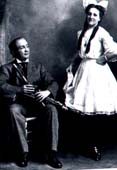
says this reel is a “special setting” of “Pat Tuohey’s” reel in his Dance Music of Ireland (1907). Patsy and Mae Tuohey (sometimes spelled Touhey or Tuhy)
toured the vaudeville circuit around in the late 19th and early 20th
century (photo c. 1900). Sources for notated versions: piper Sean Potts
(Ireland) [Breathnach]; a manuscript in the possession of famed piper Patsy
Tuohey [O’Neill]. Breathnach (CRÉ I),
1963; No. 178, pg. 70. O’Neill (Waifs and
Strays of Gaelic Melody), 1922; No. 292.
X:1
T:Touhey's Favorite Reel (#292)
M:4/4
L:1/8
S:Patsy Touhey manuscript
Z:Paul Kinder
R:Reel
K:Edor
dc||BE ~E2 BAFE|D2 FD ADFD|BE ~E2 BAFA|(3Bcd eg fddc|
BE ~E2 BAFE|DAFA DAFA|BE ~E2 BAFA|(3Bcd eg fddA||
d2 fd adfd|(3Bcd ef gfec|d2 fd adfd|(3Bcd eg fddc|
d2 fd affd|(3Bcd ef g2 fg|afge fdec|(3Bcd eg fd d2||
TUPELO BLUES. AKA and see "Florida Blues."
Old‑Time, Country Blues. USA, Mississippi. C Major. Standard tuning. AAB.
The tune was learned by fiddler Hoyt Ming from fellow Mississippi fiddler
Forrest Quinn of Sturgis, Mississippi as "Florida Blues;" but
recording director R.S. Peer did not think the title appropriate for a
Mississippi band, so he had it changed. Source for notated version: Hoyt Ming
(Miss.) [Phillips]. Phillips (Traditional
American Fiddle Tunes), vol. 2, 1995; pg. 152. County
528, Floyd (Hoyt) Ming & His Pepsteppers ‑ "Mississippi
Breakdown: Traditional Fiddle Music of Mississippi, vol. 1."
TUQUE BLEUE, LA (The Blue Cap). AKA and see "Blue Cap Reel," “The Blue Garters,” “Reel de (la) Tuque
Bleue,” “The Snowshoers Reel [1].”
AKA – “La Touque Bleu.” French‑Canadian, Reel. G Major (Miller &
Perron, Page): F Major (Cranford/Holland). Standard tuning. AABB. From the
repertoire of Québec fiddler Joseph Allard (1873-1947), who recorded it in Nov.
1929 for Victor records (accompanied by piano and a jew’s harp). “Down East”
Canadian radio and TV fiddler Don Messer’s version of the tune was called “The
Snow Shoers.” The reel has long been a popular staple for American contra
dancing. Source for notated version: fiddler Dawson Girdwood (Perth, Ottawa
Valley, Ontario) [Begin]. Begin (Fiddle
Music in the Ottawa Valley: Dawson Girdwood), 1985; No. 6, pg. 20. Carlin (Master Collection), 1984; No. 70, pg.
49. Cranford (Jerry Holland: The Second Collection), 2000; No. 178, pg.
67 (appears as “La Touque Bleu”). Cuillerier (Joseph Allard), 1992; pg. 16. Miller & Perron (New England Fiddlers Repertoire), 1983;
No. 159. Page (Ralph Page Book of Contras),
1969; pg. 3. Victor 263674-a (78 RPM), Joseph Allard
(1865-1947).
|
See also listings at: Alan Snyder’s Cape Breton Fiddle
Recording Index Jane Keefer’s Folk
Music Index: An Index to Recorded Sources |
Joseph Allard Virtual Gramaphone |
X:1
T:Reel de la
Tuque Bleue
L:1/8
M:C|
S:From a
transcription by Carmelle Begin of the playing of fiddler Dawson Girdwood.
K:F
({e/}f2) c>f a2 (gf)|eceg bg(eg)|f2 cf fagf|e>dc>B AFF>(e|f2) c>f f>a gf|
eceg bge(g|f2) cf fagf|1 e>dcB A>FF>e:|2 e>dc>B A>FF>c||
|:AFcF AFGA|BGdG BGGB|AFcF AFGA|B2 (cB) AF F>c|A>Fc>F A>FG>A|
BG
d2B2 c>B|Acd>e f>dc>B|1 AFGD F3 c:|2 A>FG>D F2 e2||
X:2
T:Reel de la
Tuque Bleue
C:Joseph
Allard
M:2/4
L:1/16
Z:Transcribed
by Bruce Osborne
K:F
f2cf
fagf|eceg bgge|f2cf fagf|edcB AFAc|!
f2cf
fagf|eceg bgge|f2ce fagf|edcB AFF2:|!
|:AFcF
AFGA|BGdG BGGB|AFcF AFGA|BdcB AFFB|!
AFcF AFGA|BGdG BGGB|AFcF AFGA|BdcB
AFF2:|!
X:3
T:Toque Bleue, La
M:C|
L:1/8
K:G
d2BG d2BG|FG AB cB AG|d2BG d2BG|FG AF G4:|
|:G2GG
FG AB|cA cd Bc AF|G2GG BG dc|Bc AF G4:||
TUQUE CARREAUTÉE, LA (The Plaid Tuque/Cap). French-Canadian, Reel. F Major.
Standard tuning. AA’BB’. A ‘crooked’ tune composed by fiddler Daniel Lemieux
(originally from Mont-Louis on the Gaspé peninsula. The title is a play on the
tune titles “La Tuque Rouge” and “La Tuque Bleue.” Remon & Bouchard (25 Crooked Tunes, vol. 1: Québec Fiddle
Tunes), 1996; No. 12.
TURAS GO DARMHAGH, AN (The Trip to Durrow). AKA and see “Trip to Durrow.”
TURAS GO DI'N IOSDAN. AKA and see "(A) Trip
to the Cottage."
TURAS GO GAILLIM. AKA and see "(A) Trip to Galway."
TURAS GO YORKSHIRE, AN. AKA and see “Yorkshire Trip.”
TURAS
UÍ CHONAILL GO DTÍ AN PHARLAIMINT. AKA and see "O'Connell's Trip to
Parliament [1]."
TURAS ‘UN TÍ. AKA and see “Trip to the Cottage [1].”
TURASA BLARNAIG. AKA and see "Blarney
Pilgrim."
TURBIT AND VENISON. English, Jig. D Major. Standard
tuning. AABB. The melody is unique to London publishers Charles and Samuel
Thompson’s 1757 country dance collection. Turbit is a breed of fancy pigeon,
while venison is deer meat. Thompson (Compleat Collection of 200
Favourite Country Dances, vol. 1), 1757; No. 141.
X:1
T:Turbit and Venison
M:6/8
L:1/8
B:Thompson’s Compleat Collection of 200 Favourite Country Dances, vol. 1 (London, 1757)
Z:Transcribed and edited by Flynn Titford-Mock, 2007
Z:abc’s:AK/Fiddler’s Companion
K:D
D2A
D2c|dcB AGF|G2 B E2B|G2B E2B|F2A D2c|dcB AGF|GAB A,DC|(D3 D3):|
|:A2a A2g|A2f ecA|(f/g/a)f ecA|(f/g/a)f ecA|(B/c/d)B AFD|(B/c/d)B A2g|fed
edc|d3 D3:||
TUREENGARBH. Irish, Jig. Breathnach (CRÉ V), 1999; No. 44.
TUREENGARBH GLEN (Gleann an Tuairín Ghairbh). AKA and see “All along the river bank.”
Irish, Polka. G Major. Standard tuning. AAB (Taylor): AABB’ (Mallinson): AA'BB
(Breathnach). Sources for notated versions: accordion player Denis Doody
(Ireland) [Breathnach]; set dance music recorded at Na Píobairí Uilleann in the
1980’s [Taylor]. Breathnach (CRÉ III),
1985; No. 77, pg. 37. Mallinson (100
Polkas), 1997; No. 98, pg. 38. Taylor (Music
for the Sets: Yellow Book), 1995; pg. 11. Mulligan
Records LUN 019, "Denis Doody Kerry Music" (1978).
TURF BANK, THE. Irish,
Reel. Giblin (Collection of Traditional
Irish Dance Music), 1928; 45.
TURF HOUSE REEL. Irish, Reel. D Major. Standard tuning. AB. A member of a large tune
family. One version of a tune, usually played in the key of ‘G’, is called “Mayo Lasses” (Breathnach, CRE 1, 80) and “The Old Maid(s) of Galway”
(O’Neill, DMI 654). Kerry fiddlers Denis Murphy and Julia Clifford
recorded it as "Johnny
when you die" [1]. Cape Breton fiddlers known it as "The West Mabou Reel,” sometimes
attributed to Dan Beaton {Domhnull Iain an Táillear} (1856-1919), although it
is probably Irish in origin. See note for “Johnny When You Die” [1]. Green Linnett SIF 1184,
Patrick Street - “Made in Cork” (1997).
X:1
T:Turf House
R:reel
S:Patrick Street
D:CD "Made in Cork"
Z:Barney
M:4/4
L:1/8
K:D
|B2 GB A2 FD|E2 DE FA A2|BcdB A2
FD|~E2 DE FD D2|
BAGB AGFD|~E2 ED EFGA|BcdB A2 FD|~E2
DE FD D2||
dfed B2 A2|dfed cd e2|dfed B2 AF|~E2
DE FD ~D2|
dfed B2 A2|dfed cd e2|fdec dBAF|~E2
DE FD D2||
TURF LODGE. Scottish. Composed by Pipe Major Angus MacDonald (d. 2000). Tannahill Weavers – “Dancing Feet.”
TURF MAN FROM ARDEE, THE. AKA and see “Bold Jack Donoghue,” “Donegal, the Pride
of All.” Irish, Air. John McGettigan recorded the tune on an old 78 RPM disc.
TURF MAN’S UNION, THE. Irish, Reel. A Major. Standard
tuning. AB. “Recorded in England” [Mulvihill]. Mulvihill (1st Collection), 1986; No. 218, pg. 59.
TURK AND NO TURK. English, Jig. England, Shropshire. A Major. Standard tuning. AABB.
Source for notated version: a c. 1837-1840 MS by Shropshire musician John Moore
[Ashman]. Ashman (The Ironbridge Hornpipe),
1991; No. 91b, pg. 37.
TURKEY BUZZARD. AKA and see "Shoot
That Turkey Buzzard." Old‑Time, Breakdown. USA; east Tennessee,
Arkansas. G Major. Standard tuning. AABB. The title appears in a list of
traditional Ozark Mountain fiddle tunes compiled by musicologist/folklorist
Vance Randolph, published in 1954. A tune by this title was in the repertoire
of fiddler Munsey Gaultney, originally from Ashe County, North Carolina,
remembered for his shuffle bowing and timing. John Hartford (2001) says it is
“damn near the same as ‘Georgia Boys,’ ‘Seneca Square Dance’ and ‘Raccoon Tail’.” The latter was a tune in the
repertoire of Dr. Jimmy Gray, a fiddler from Missouri who played in many of the
contests back in the heyday of the great Jefferson City radio fiddle
conventions. Source for notated version: Joe Greene [Phillips]. Phillips (Traditional American Fiddle Tunes), vol.
1, 1994; pg. 245. Spandaro (10 Cents a
Dance), 1980; pg. 27. Biograph 6007, Ebenezer ‑
"Tell it to Me." Rounder 0442, John Hartford – “Hamilton Ironworks”
(2001). Silver Circle 002, Doug Phillips & Hilary Dirlam -
"Waggoner."
TURKEY CREEK BREAKDOWN. Old-Time, Breakdown. Voyager 340, Jim Herd -
"Old Time Ozark Fiddling."
TURKEY-EGG, THE. American, Reel. USA; W.Va., southwestern Pa. G
Major. Standard tuning. AB. Bayard (1981) collected a rhyme with the tune which
went:
***
Ben stole the turkey‑egg, run around the medder with it,
Throwed it in the creek, and swore he never meddled with it.
***
Source for notated version: James
Taylor (fiddler from Greene County, Pa., and Wetzel County, W.Va., 1930's)
[Bayard]. Bayard (Dance to the Fiddle),
1981; No. 6, pg. 19.
TURKEY GOBBLER [1],
THE. Old-Time,
Breakdown. USA, Kentucky. G Major. Standard tuning. AA'BB. Source for notated
versions: Buddy Thomas (1934-1974, Emerson, Lewis County, Ky.), who learned the
tune from Jimmy Richmond, his maternal grandfather, via his mother’s whistling
of it [Phillips, Titon]. Phillips (Traditional American Fiddle Tunes), vol.
1, 1994; pg. 245. Titon (Old Time Kentucky Fiddle Tunes), 2001; No. 160,
pg. 185. Rounder 0376, Buddy Thomas (et al) –
“Traditional Fiddle Music of Kentucky, vol. 1: Up the Ohio and Licking Rivers”
(1997).
TURKEY GOBBLER [2],
THE. The tune
by this name that appears in American Veteran Fifer bears a general
resemblance to "O'Connell's
Welcome {To Parliament} [1]," "Maid(en) On the Green," and
others of that group of tunes, according to Bayard (1981). American Veteran Fifer, 1927; No. 41.
TURKEY IN A PEAPATCH. AKA and see “Buzzard in a
Pea Patch.” Old‑Time, Breakdown. USA, Kentucky. D Major. Standard
tuning. AABB'. See also Fred Stoneking’s version, recorded under the title
“Buzzard in a Pea Patch,” although he learned it originally from Buddy Thomas’s
recording. Sources for notated versions: Ruthie Dornfeld [Phillips]; Buddy
Thomas (1934-1974, Emerson, Lewis County, Ky.), who learned the tune from his
mentor, Morris Allen [Titon]. Phillips (Traditional
American Fiddle Tunes), vol. 1, 1994; pg. 245. Songer (Portland
Collection, vol. 2). Titon (Old Time Kentucky Fiddle Tunes), 2001;
No. 161, pg. 186. PP-006, Charlie Walden – “Patt n’
Possum.” Rounder 0032, Buddy Thomas (northeastern Ky.) ‑ "Kitty
Puss: Old Time Fiddle Music From Kentucky" (1976).
TURKEY IN THE
COTTONWOODS. American, Reel or Breakdown. B Flat
Major ('A' part) & F Major ('B' part). Standard tuning. AABB. Source for notated
version: fiddler Chet Hawley (Tulsa, Oklahoma) [Pancerzewski]. Pancerzewski (Pleasures of Home), 1988; pg. 11.
TURKEY IN THE STRAW. AKA and see "Old Zip Coon,"
"Natchez Under the Hill [1],"
"The Old Bog Hole." Old‑Time,
Breakdown: Irish, English, Canadian; Reel or Hornpipe. USA, Widely known and
has even entered English country dance tradition. Canada, Prince Edward Island
(where Ken Perlman says it is a very popular tune). G Major (Bayard, Brody,
Linscott, O'Neill, Perlman, Phillips, Raven, Ruth, Shaw, Sweet): C Major
(Ford): D Major (Bayard, Moylan). Standard tuning. AB (Bayard, Shaw): AABB
(most versions).
***
An overwhelmingly popular tune in
American fiddle tradition. Bayard (1981) suggests that a Scottish tune called
"The (Bonny) Black Eagle" (also called "The Way to
Edinburgh" by Oswald) resembles "Turkey in the Straw" in in both
parts. Besides Samuel Bayard, Alan Jabbour, Winston Wilkinson, George Pullen
Jackson and others think that a tune with an even stronger resemblance in the
first part to the first part of Turkey is "The Rose Tree [1]" (Maureen ni
Cullenaun). Their apparent conclusion is that the Turkey tune is a composite of
two older Scottish tunes, the 'A' part of "The Rose Tree" and the 'B'
part of "The (Bonny) Black
Eagle." There are other speculations: Nathan ("Dan Emmett,"
pg. 168) gives an Irish reel which seems to bear close resemblance to the 'A'
part of Turkey, while Dreamer (in the Oxford
Book of Carols, pg. 252) gives a "little known Scottish melody"
with a second section equivlent to that of Turkey (Bayard wonders if this
particular strain has long been a floater). According to Linscott (1939) the
tune is based on the old song "My Grandmother Loved on Yonder Little
Green." Michael Cooney lists a
number of fiddle tunes to which "Turkey in the Straw" is supposed to
have been related, including "Glasgow
Hornpipe" (Irish), "Haymaker's Dance" (English), "The Post Office" (Irish), "Lady
Shaftsbury's Reel" (Scottish), "Rose Tree in Full Bearing"
(Irish), "Old Mother Oxford"
(a morris dance tune known in England and Scotland), and "Kinnegad Slashers" (Irish).
Captain Francis O’Neill, in Waifs and
Strays of Gaelic Melody suggested the latter was the original source of
“Turkey,” although most reviewers dismiss this as an incidental resemblance
only based on some similarities in the first part.
***
Whatever its origins, it was
"undoubtedly in American folk tradition before the 19th century,"
says Bronner (1987), and that popular theater and minstrel groups during the
19th century helped consolidate and spread its popularity (it was often called
"Old Zip Coon" in minstrel tradition). Fuld reports the title
"Turkey in de Straw" appeared in 1861 attached to the tune through
new song lyrics, copyrighted by one Dan Bryant, the melody labelled only an "old
melody," presumably referring to “Old Zip Coon.”
***
Mention of the tune in playlists,
periodicals and literature abound. “Turkey” was cited as having commonly been
played for Orange County, New York, country dances in the 1930's (Lettie
Osborn, New York Folklore Quarterly);
Bronner (1987) agrees that it was commonly played in New York state for dances
in the early 20th century. It was in the repertory of Buffalo Valley, Pa.,
region dance fiddlers Harry Daddario and Ralph Sauers. It was one of the tunes
listed by the Clarke County Democrat
of May 9, 1929, that was predicted would "be rendered in the most approved
fashion" at an upcoming contest in Grove Hill, Alabama (Cathen, 1990).
“Turkey” was played at a fiddlers' contest in Verbena in 1921 according to the Union Banner of October 27, 1921, and
was one of the melodies listed as an example of an "acceptable old‑time
number for a fiddlers' convention in Fayette, Alabama (Northwest Alabamian, September 4, 1930) {Cauthen, 1990}. Cauthen
(1990) further cites a 1925 University of Alabama master's thesis by S.M.
Taylor entitled "A Preliminary Survey of Folk‑Lore in Alabama"
in which the tune is listed, and found it mentioned by Lamar County, Alabama,
fiddler D. Dix Hollis in the Opelika
Daily News of April 17, 1926, as one of "the good old tunes of long
ago." The title appears in a list of the repertoire of Maine fiddler
Mellie Dunham (the elderly Dunham was Henry Ford's champion fiddler in the late
1920's). Catskill Mountain region fiddler Harry Robinson (Lackawack, New York)
was recorded in the field in 1944 by Benjamin A. Botkin (AFS 7759) playing an
unaccompanied version of "Turkey in the Straw." The tune was recorded
for the Library of Congress by musicologist/folklorist Vance Randolph, from the
playing of Ozark Mountain fiddlers in the early 1940's, while Texas fiddler Eck
Robertson's (with Henry
Gilliland) recording of the piece (backed with "Ragtime Annie")
was the third best-selling country music record of 1923. It was in the
repertoire of Virginia's Fiddlin' Cowan Powers and Family in the 1920's, and
West Virginia fiddler Edden Hammons played a version. Paul Gifford remarks
that, around the Sault Ste. Marie area of northern Michigan and Ontario,
“Turkey in the Straw” is played in the tradition in the key of B Flat Major.
The Skillet Lickers (in the configuration of Gid Tanner and Clayton McMichen on
fiddles, Riley Pucket on guitar and vocals, and Fate Norris on banjo) recorded
the song in Atlanta on April 17th, 1926, one of eight sides for
Columbia records. Wayne W. Daniel (in his book Pickin’ on Peachtree: A History of Country Music in Atlanta, Georgia,
1990) opines: “The output from this historic recording session makes for a
rather unimpressive list of what even there were long-familiar tunes and songs:
“Hand Me Down My Walking Cane,” “Bully of the Town,” “Pass Around the Bottle
and We’ll All Take a Drink,” “Alabama Jubilee,” “Watermelon on the Vine,”
“Don’t You Hear Jerusalem Moan,” “Ya Gotta Quit Kickin’ My Dog Aroun’,” and
“Turkey in the Straw.””
***
Burl Hammons, son of Edden Hammons
mentioned above, played the tune and related this story about it (printed in
the booklet with The Hammons Family:
Traditions of a West Virginia Family and Friends):
***
Well, I was—where we lived, we lived down on the Williams River, when
the—when I
saw this thing, and so--. And we always went to bed pretty early, my dad
did, and—about
eight o’clock we always went to bed—and I laid down and I, didn’t seem
like I could go
to sleep. And I laid there a while and just directly I heard the click,
open come the door,
and in walked this skeleton of a man, Lord, I’ve—he was really tall,
a-must’ve been six
or seven feet tall or looked like that. And he had—I noticed he had a fiddle
in his hand
when he walked in; and he walked about the middle of the floor where I
was a-sleeping.
And he took off on that Turkey in the Straw, and boys I
never heard nothing played like
that in my life. And I shut my eyes to keep from looking at the skeleton
of a man, but I
was still listening at that tune. And, when I opened my eyes, he’d—I
waited till he finished
the tune before I opened my eyes, but he—when he finished it he was
still a-standing but
he just turned and walked to the door, and just ‘click’ open come the
door and out he went.
***
And the next morning I was a-tellingmy dad about that. “Ah,” he said,
“that’s a bunch of
foolishness. Quit.” He said, “That was only just a dream or something you
had,” he said.
“Quit thinking of such stuff as that.” “|No,” I said, “it was the
truth.” I said, I wished I
could’ve played Turkey in the Straw like that.
“Ah,” he said, “that’s foolishness.” And I
never told no more about it, but I can still mind that—what ever it was,
I don’t know
whether it was a dream or not, but I tell you I can still mind about it.
A six or seven—a
fellow only six or seven year old and still can mind that just as well
as it was the day, you
know it’s bound to be pretty plain, now—or he couldn’t have minded that.
***
A 1927 newspaper cartoon lampooned Henry
Ford’s championing of “old-time” music and dance.
***
The tune
was popular enough that even Irish-American bands recorded it: O’Leary’s Irish
Minstrels, from Boston, recorded it in 1928, and that same year the Flanagan
Brothers recorded a medley in New York featuring “Turkey” along with “Chicken
Reel” and “Arkansas Traveller.” Captain Francis O’Neill printed a version of
“Turkey” that was recorded in more modern times by the Irish band De Dannan (on
“Song for Ireland”). Scottish band-leader and accordion player Jimmy Shands
recorded “Turkey” in a 1939 medley with “Chicken Reel.” “Turkey” was recorded and played by Sliabh
Luachra (Rushy Mountain region, County Kerry/Cork) fiddler Denis Murphy and
accordion player Johnny O’Leary, who learned it from influential fiddler
Padraig O’Keeffe, although where he learned the tune is unknown. O’Neill (1922)
remarks in a long note: ‘Turkey in the Straw’, or ‘Old Zip Coon’, as
played nowadays may suit the rapid movements of buckdancers, but the frenzied
rhythm is ruinous to the melody. Rendered after the manner of the famous Dan
Emmett of Bryant's Minstrels, in slow reel time, this popular tune acquires a much
enhanced appeal. Emmett, it will be remembered, was the author of the immortal
‘Dixie’, and it was his version of
‘Turkey in the Straw’ which we obtained from (fiddler) John McFadden of
the Chicago Irish Music Club, that is here presented. The origin of this
favorite of our fathers is wrapped in even deeper mystery than that of ‘Yankee
Doodle’. Under the title ‘Old Zip Coon’ the tune appeared in Howe's Collections
about the middle of the 19th Century, and possibly earlier. The first gleam of
light on the question of how the old title eventually yielded to the popularity
of the new name, came through a chance conversation while fishing in 1920 with
a northern tourist at Ocean Springs, Mississippi. The latter confidently
informed me that Alderman Silas Leachman of Chicago, a native of Kentucky, was
the author of ‘Turkey in the Straw’ - both words and music! The melody I knew
was older than the Alderman's grandfather, yet here was a lead worth
investigating, for it was his melodious voice that first brought him to
prominence. An interview with the talented official at Chicago a month later
confirmed the statement that he was indeed the author of one song of that name,
the best of several others on the same theme. One question was settled. The
popularity of the modern song relegated to obscurity the name of the ancient
tune. The pioneers or early settlers of West Virigina, Kentucky and Tennessee
were largely of Irish ancestry, and obviously their music or tunes more or less
varied by fancy, and defective memorizing from one generation to another, were
of Irish origin. Fiddling and dancing being inseparable from all festivities
and important events, the tunes became much more diversified, but the swing and
spirit of the Gael however was always discernable in their reels and
quadrilles, and so continues to the present day. For the convenience of musical
antiquaries who may be interested in the subject, an old Irish March, or Jig,
‘The Kinnegad Slashers’ to which is sung ‘The Land of Sweet Erin’, is herewith
submitted as a tune from which ‘Old Zip Coon’ or ‘Turkey in the Straw’ could
have been derived or evolved. A third part added later by musicians is not
essential in this illustration.”
***
Lyrics set to the tune usually go
something like the following:
***
As I went down the new‑cut road,
I met Miss Possum and I met Mr. Toad.
And every time the toad would sing,
The possum cut the pigeon‑wing.
Chorus:
Turkey in the straw, haw! haw! haw!
Turkey in the hay, hey! hey! hey!
The bull‑frog danced with his mother‑in‑law,
And they played 'em up a tune called turkey in the straw. (Ford)
***
Bryant’s 1861 verses begin:
***
As I was a-going down the road
With a tired team and a heavy load
I crack'd my whip and the leader sprung
I says day-day to the wagon tongue
***
Chorus:
Turkey in the straw, turkey in the hay
Roll 'em up and twist 'em up a high tuckahaw
And twist 'em up a tune called Turkey in the
Straw
***
African-American collector Thomas
Talley, in his work Negro Folk Rhymes
(1922, reprinted in 1991 edited by Charles Wolfe), printed an unusual version
called “A Day’s Happiness.” Wolfe notes that while there were dozens of
recordings of the tune by early country musicians there were very few by
blacks. Talley’s song goes:
***
I went out to milk an’ I didn’ know how,
I milked dat goat instid o’ dat cow;
While a Nigger a-settin’ wid a gapin’ jaw,
Kept winkin’ his eye at a tucky in de straw.
***
I went out de gate an’ I went down de road,
An’ I met Miss ‘Possum an’ I met Mistah Toad;
An’ ev’y time Miss ‘Possum ‘ould sing,
Mistah Toad ‘ould cut dat Pigeon’s Wing.
***
I went in a whoop, as I went down de road;
I had a bawky team an’ a heavy load.
I cracked my whip, an’ ole Beck sprung,
An’ she busted out my wagin tongue.
***
Dat night dere ‘us a-gittin’ up, shores you’re born,
De louse go to supper, an’ de flea blow de horn.
Dat raccoon paced, an’ dat ‘possum trot;
Dat old goose laid, an’ de gander not.
***
Sources for notated versions: Edson
Cole (Freedom, N.H.) [Linscott]; Les Weir and Ken Kane, 1976 (Central New York State),
Charley Hughes, 1973 (Central New York State), and John McDermott, 1926
(Central New York State) [Bronner]; eight southwestern Pa. fiddlers [Bayard];
Thadelo Sullivan via accordion player Johnny O’Leary (Sliabh Luachra region of
the Cork-Kerry border) [Moylan]; Johnny Morrissey (1913-1994, Vernon River,
Queens County, Prince Edward Island) [Perlman].
***
Adam, 1928; No.
22. Bayard (Dance to the Fiddle),
1981; No 320A‑H, pgs. 276‑279. Brody (Fiddler’s Fakebook), 1983; pg. 280. Bronner (Old Time Music Makers of New York State), 1987; No 3, pgs. 21‑22,
No. 31, pg. 121, No. 39, pg. 145. Cazden, 1955; pg. 26. DeVille, 1905; No. 78
& 97. Ford (Traditional Music in
America), 1940; pg. 59. Howe (Diamond
School for the Violin), 1861; pg. 44. Howe (School for the Violin), 1851; pg. 43. Kerr (Merry Melodies), vol. 1, pg. 23. Linscott (Folk Songs of Old New England), 1939; pg. 84‑85. Messer (Way Down East), 1948; No. 52. Moylan (Johnny O’Leary), 1994; No. 247, pg. 142.
O'Malley, 1919; pgs. 13 & 40. O'Neill (Krassen), 1976; pg. 155. O'Neill (Music
of Ireland: 1850 Melodies), 1903/1979; No. 1520, pg. 281. O'Neill (Dance
Music of Ireland: 1001 Gems),
1907/1986; No. 739, pg. 129. O’Neill (Waifs
and Strays of Gaelic Melody), 1922; No. 237. Perlman (The Fiddle Music of Prince Edward Island), 1996; pg. 65. Phillips (Fiddlecase Tunebook), 1989; pg. 43.
Phillips (Traditional American Fiddle
Tunes), vol. 1, 1994; pg. 246. Raven (English
Country Dance Tunes), 1984; pg. 166. Robbins, 1933; No. 26 & No. 158. Roche Collection, 1982, Vol. 3; No. 215,
pg. 81 (Irish march version). Ruth (Pioneer
Western Folk Tunes), 1948; No. 18, pg. 8. Ryan’s Mammoth Collection, 1883; pg. 48. Shaw (Cowboy Dances), 1943; pg. 389. Sweet (Fifer’s Delight), 1965/1981; pg. 79. Thede (The Fiddle Book), 1967; pg. 113. White's Excelsior Collection, 1907; pgs. 33 & 73. White's Unique Collection, 1896; No.
173. BlueBird 6844 (78 RPM), Arthur Smith Trio
(appears as "Straw Breakdown"). Brunswick 235 (78 RPM), The Kessinger
Brothers. CCF2,
Cape Cod Fiddlers – “Concert Collection II” (1999). Champion 15522 (78 RPM), Red Fox Chasers. Columbia 15084-D (78
RPM), Gid Tanner and the Skillet Lickers (1926). Conqueror 7741 (78 RPM), Doc Roberts. Document DOCD 8056, The Skillet Lickers (reissue). Edison 51278 (RPM), Jasper Bisbee
(Michegan), 1923 (appears as last tune in "Girl I Left Behind Me"
Medley). Flying Fish 102, New Lost City Ramblers ‑ "20 Years/Concert
Performances" (1978). Folkways FA 2337, Clark Kessinger‑ "Live
at Union Grove." Folkways FA 2381, "The Hammered Dulcimer as played
by Chet Parker" (1966). Front Hall, Fennigs All Star String Band ‑
"Fennigmania" (1981). Gennett (78 RPM), The Tweedy Brothers (1924.
W.Va. string band). MCA‑116 {formerly Decca DL7‑4896}, Bill Monroe‑
"Bluegrass Time." Missouri State Old Time Fiddlers' Association,
Cyril Stinnett - "Plain Old Time Fiddling." Paramount 3015 (78 RPM),
John Baltzell (Mt. Vernon, Ohio), 1927. Paramount 33153 (78 RPM), Dr. D. Dix
Hollis (Alabama, 1861‑1927), 1924. PearlMae Muisc 004-2, Jim Taylor –
“The Civil War Collection” (1996). Rounder 0117, "Blaine Sprouse." Sonyatone
201, Eck Robertson‑ "Master Fiddler." Supertone 9163 (78 RPM), Red Fox Chasers. Victor 19149 (78 RPM), Eck Robertson (West
Texas), 1922. Edden Hammons Collection, Disc 2.
X:1
T:Turkeys in the Straw
M:C|
L:1/8
R:Reel
S:O’Neill – Dance Music of
Ireland: 1001 Gems (1907), No.
739
Z:AK/Fiddler’s Companion
K:G
BA|G E2 F EDB,C|DEDB, DEGA|BABc
dBGA|B A2G AcBA|G E2 F EDB,C|
DEDB, DEGA|B d2 e dBGA|BGAF G2||GA|B
d2 e dBGA|Bdde dcBA|
Bdef gfed|BA (3Bcd e2 ef|gfge
dged|BdAG E2 GA|BdAG EDB,D|E G2 A G2||
X:2
T:Turkey in the Straw
M:4/4
L:1/8
S:John McFadden
Z:Paul Kinder
R:Reel
K:G
sBAs|G E2 F EDB,C|DEDB, DEGA|"tr"sBAsBc dBGA|B A2 G AcBA|
G E2 F EDB,C|DEDB, DEGA|B d2 e dBGA|BGAF G2||
GA|B d2 e dBGA|Bdde dcBA|Bdef gfed|BA (3Bcd e2 ef|
"tr"gfge dged|BdAG E2 GA|BdAG EDB,D|E G2 A G2||
X: 3
T:Turkey in
the Straw
R:reel
M:2/4
L:1/16
Z:Transcribed
by Bruce Osborne
K:D
fe|dcde
dAFG|ABAF A2de|f2fg fede|feef e2fe|
dcde
dAFG|ABAF A2de|fa2b afde|fddc d2:|
|:f2|fa2f
a2a2|fa2f a4|gb2g b2b2|gb2g b2bc'|
d'2d'2
a2a2|fgfd e2de|fa2b afde|fddc d2:|
TURKEY KNOB. Old‑Time, Breakdown. USA, Missouri. A Major. Standard tuning
(fiddle). AABB (Christeson): AA’BB’ (Beisswenger & McCann). “Turkey Knob”
is one of the ‘100 essential Missouri fiddle tunes’ according to Missouri
fiddler Charlie Walden. Drew Beisswenger (2008) points out similarities to “Dance Around Molly,” and says that
the ‘A’ part shares melodic material with the ‘B’ parts of tunes such as “Fort Smith” and “Lonesome Polly Ann.” Source for
notated version: Dean Johnston (1919-2007, Lamar, Barton County, Mo.), learned
from Cyril Stinnett (Oregon, Mo.) [Beisswenger & McCann]. Beisswenger &
McCann (Ozarks Fiddle Music), 2008; p. 76. R.P. Christeson (Old Time Fiddler’s Repertory, vol. 2),
1984; p. 19. Rounder
0436, Dean Johnston – “Traditional Fiddle Music of the Ozarks, vol. 2: On the
Springfield Plain” (2000. Various artists).
TURKEY RUN. American, Reel. A Mixolydian.
Standard tuning (fiddle). AABB. Composed by Vermont fiddler Pete Sutherland.
Sutherland (Bareface), 1984; p. 14.
TURKEY SAG. Old-Time, Breakdown. The title is taken from a geographical feature.
TURKEY TRACKS. Old-Time, Breakdown. USA, Missouri. C Major.
Standard tuning (fiddle). AB. Composed by Missouri fiddler Lacey Hartje (b.
1926, Joplin, Mo.). Source for notated version: Lacey Hartje [Beisswenger &
McCann]. Beisswenger & McCann (Ozark Fiddle Music), 2008; p. 52. Rounder 0436, Lacey Hartje – “Traditional Fiddle Music of
the Ozarks, vol. 2: On the Springfield Plain.”
TURKEYLONEY. English, Country Dance Air (6/4 time). G Dorian (Raven): E Dorian
(Chappell). Standard tuning. One part (Raven): ABBCCDD (Chappell). This dance
tune, one of the most popular of the latter sixteenth century, appears in
William Ballet's Lute Book (1590).
Chappell (1859) quotes a reference to the tune in Nashe's "Have with you
to Saffron‑Walden:"
***
Dick Harvey...having preacht and beat downe three pulpits in
inveighing against dauncing, one Sunday evening, when his
wench or friskin was footing it aloft on the greene, with foote
out and foote in, and as busie as might be at 'Rogero', 'Baselino',
'Turkelony', 'All the flowers of the broom', 'Pepper is black',
'Greene Sleeves', 'Peggy Ransey', came sneaking behind a tree,
and lookt on," etc.
***
Chappell (Popular Music of the Olden Time), vol.
1, 1859; pgs. 237‑238. Raven (English
Country Dance Tunes), 1984; pg. 8.
X:1
T:Turkeylony
L:1/8
N:”Fast”
S:Chappell
– Popular Music of the Olden Time
(1859)
Z:AK/Fiddler’s Companion
K:D
F6 F6 | F6 F6 | G4 F2 G4A2 | (B6 B6) | A6 A6 |
B4
B2 A4 G2 | F4 E2 ^D3^C D2 | (E6 E6) ||
TURKISH JIGG. English, Jig. G Major. Standard
tuning. AABBCCDD. The melody also appears in print in John Johnson’s 200
Favourite Country Dances, vol. 8 (London, 1758). In America, the tune can
be found in the c. 1770 commonplace book of fiddler Thomas Aborn. Thompson (Compleat
Collection of 200 Favourite Country Dances, vol. 1), 1757; No. 109.
X:1
T:Turkish Jigg
M:6/8
L:1/8
B:Thompson’s Compleat Collection of 200 Favourite Country Dances, vol. 1 (London, 1757)
Z:Transcribed and edited by Flynn Titford-Mock, 2007
Z:abc’s:AK/Fiddler’s Companion
K:G
BGG BGG|GBd gfg|BGG BGG|DEF G3::Bdd Bd|^ceg fed|afa gea|AB^c d3:|
|:Bcd
efg|ABc def|GAB cde|DEF G3::dBG ecA|fdf g3|ecA dBG|DEF G3:||
TURKISH QUICK STEP. English, March (6/8 time). England, Yorkshire. G Major. Standard
tuning. AABBCCDD. Source for notated version: an MS collection by fiddler
Lawrence Leadley, 1827-1897 (Helperby, Yorkshire) [Merryweather & Seattle].
Aird (Selection), vol. 1, c. 1782; pg. 10. C Merryweather & Seattle (The Fiddler of Helperby), 1994; No. 70,
pg. 45.
X:1
T:Turkish Quick Step
M:6/8
L:1/8
R:March
K:G
BGG BGG|GBd gfg|BGG BGG DEF G3:|
|:Bdd Add|^ceg fed|agb gfa|AB^c d3:|
|:Bcd efg|ABc def|GAB cde|DEF G3:|
|:dBG ecA|fdf g3|ecA dBG|DEF G4:|
TURK'S MARCH [1], THE. English, March. This march was played by the American forces under General Benjamin Lincoln at their surrender at Charleston on May 12, 1780. The choice was "no doubt Lincoln's attempt to avoid the complete humiliation inherent in performing an American march under these circumstances" (Camus, 1976, pg. 154). It is perhaps the "Turkish March" in 2/4 time printed by Ralph Sweet (1965/1981; pg. 79). A "Turkish March" appears in G. Goulding's New and Complete Instructions for the Fife (1787-1799, pg. 8) published in London, England, and appears under the title "Turkish March in the Battle of Prague" in several other manuscripts (see “March in the Battle of Prague”). Longman, Lukey & Co. printed it in their Compleat Instructions for the Fife (London, 1770), and Thompson & Son included it in Compleat Tutor for the Fife (London), editions of 1760, 1770 and 1786. David Rutherford printed it in his Compleat Tutor for the Fife (London, 1756). Fiddler and poet John Clare (Helpston, Northants) included two versions in his c. 1820 music manuscript; one as “Turk’s March,” and another as “Quickstep in the Battle of Prague,” and Ensign Thomas Molyneaux (6th Regmt.) noted it in his copybook in Shelburne, Nova Scotia, in 1788, with the alternate title “or, The Church Call”. Aird (1782) prints two “Turks March” tunes, the first being the same as the “Turk’s March” in Clare’s ms. David Murray, in his excellent book Music of the Scottish Regiments (Edinburgh, 1994), explains that the music of the Ottoman empire began to influence Europe and the military band in the 17th and 18th centuries, particularly through Austria, whose troops associated the “often intimidating sound of the Turkish martial music” with the Corps of Janissaries, composed of Christian boys, captured and brought up as Muslims and rigorously trained as elite troops. Particularly of note in this music was the use of percussion, with drums of various sizes and timbres, cymbals and triangles. Murray says that these Janissary bands were at times presented whole to various European heads of state, and, as time wore on, when members died they were replaced by local musicians, “and the Turkish reed and brass instruments were discarded in favour of oboes, horns, trumpets and bassoons,” although the percussion section was retained. In fact, writes Murray, “there is evidence that it was a standard element in Prussian military bands by about 1777. “British military bands were not behindhand in acquiring the elements of the Turkish or Janissary percussion. Another Continental fashion taken up with enthusiasm by the British in the 18th century, was the enlistment of black youths to play these exotic Turkish percussion instruments, rather than fresh-faced lads from the plough tail or the slums, which were even then beginning to proliferate in the wake of the industrial revolution” (pg. 86). There was a surplus of black lads due to the British emancipation of slaves, and the consequent turning out of servants so as to not have to pay them wages. Murray suggests that certain military affectations (such as the twirling of the bass drum sticks, and the wearing of tiger and leopard skins) stemmed from the practice of encouraging costumes and capering by these musicians. “But at least one turned out to be a proper soldier. Drummer Charles Bogle was a ‘man of colour’, a fact sedulously concealed by the Victorian chroniclers of his regiment. He died at the Siege of Burgos in 1812, fighting most gallantly, wielding his drummer’s broadsword in single combat with a French soldier, who died equally gallantly. Their bodies were recovered, the Frenchman run through with Charlie’s sword, his bayonet through Charlie’s body.”
***
American musicians also played the “Turk’s March [1].” It appears in the music manuscript copybookx of Silas Dickinson (Amherst, Mass., c. 1800), John Turner (Norwich, Conn., 1788)
Source for notated version: John Clare (Helpston, Northants) [Callaghan]. Aird (Selection), vol. II, c. 1785; pg. 3, No. 6. Callaghan (Hardcore English), 2007; pg. 52.
X:1
T:Turks March [1]
M:C|
L:1/8
S:Aird, vol. II
Z:AK/Fiddler’s Companion
K:G
Bc|dcde d2c2|BABc B2A2|GFGA GAB[Gc]|A4 D2 Bc|dcde d2c2|
BABc B2 g2|f2 ed e2 dc|(d4 d2)||d2|g2d2B2 AG|e2e2 d2 cB|c2 de dcBc|
{B}A4 D4|GFGA BABc|d2 ef g2c2|BAGA D2F2|G4 G2||
TURK’S MARCH [2]. English, March (4/4 time). G Major. Standard tuning (fiddle). AABB. Aird (Selection), vol. II, c. 1785; p. 3, No. 7. Callaghan (Hardcore English), 2007; p. 52.
X:2
T:Turks March [2]
M:C|
L:1/8
S:Aird, vol. II
Z:AK/Fiddler’s Companion
K:G
GA | B2G2G2(AB) | c2A2A2 (dc) | B2 (AG) F2G2 | (AG)(FE) D2 (GA) |
B2G2G2 AB | c2A2A2 dc | BAGA D2F2 | G6 :: Bc | dcde d2 e=f | e2c2 c4 |
edef efga | f2d2 d3c | B2G2G2 AB | c2A2A2 dc | A2 (AG) F2G2 |
(AG)(FE) D2 GA | B2G2G2AB | c2A2A2 dc | BAGA D2F2 | G3 :|
TURK’S MARCH [3]. AKA – “Turkish March in the Battle of Prague.” English, March (4/4 time). D Major. Standard tuning (fiddle). AAB. The melody has been used for the song “Billy Bones.” The melody was included in the music manuscript collections of H.S.J. Jackson (Wyresdale, Lancashire, 1823), John Fife (Perthshire, Scotland, 1780), It appears in print in Bland’s New and Compleat Instructions for the Clarionet (London, 1798), John Preston’s Entire New and Compleat Instructions for the Fife (London, 1796), Preston & Son’s Complete Instructions for the Bassoon (London, 1790), Wilson’s Pocket Preceptor for the Fife (London, 1805), Andrew’s Complete Instructions for the Fife (London, 1808).
***
“Turk’s March [3]” was extremely popular with American musicians as well, and it can be found in the commonplace books of Jeremiah Brown (Seabrook, N.H., 1782), John Beach (Gloucester, Mass., 1801), John W. Stiles (1807), a copybook entitled Selection of Music as Performed by the Pierian Sodality (Cambridge, Mass., 1810), and Eben Irving’s music copybook of 1796 (Middletown, N.Y.). Printed versions are even more numerous: it appears in Bacon’s Complete Preceptor for the Clarinet (Philadelphia, 1818) and Joshua Cushing’s Fifer’s Companion No. 1 (Salem, Mass., 1805), James Hulbert’s Complete Fifer’s Museum (Greenfield, Mass., c. 1811), Joseph Herrick’s Instrumental Preceptor (Exeter, N.H., 1807), Norris & Sawyer’s Village Fifer (Exeter, N.H., 1808), and Klemm’s New & Complete Preceptor for the Clarinet (Philadelphia, Pa., 1825), and several other similar publications. Aird (Selection), vol. II, c. 1785; p. 3, No. 7. Callaghan (Hardcore English), 2007; p. 52.
X:1
T:Turk’s March [3]
M:2/4
L:1/8
R:March
K:D
a>g ff|f>e dd|ed ec|d/e/f/e/ d/e/f/g/|a>g ff|f>e dd|e>d ec d2z2:|
e2f2|gg/f/ ee|f2g2|aa/g/ fa|ag gf|ag gf|ab/a/ gf|f>e e2|
a>g ff|f>e dd|ed ec|d/e/f/e/ d/e/f/g/|a>g ff|f>e dd|e>d ec|d2 z2||
TURLOUGH, THE BRAVE (Toirdhealbhach Treun). AKA and see "The Barony Jig [1]," "The Fisherman's Jig," "The Green Gates [2]," "Redican's Mother," "The
River Lee," “Trealoch Lauder.”
Irish, Air (9/8 time, "animated"). D Major. Standard tuning (fiddle).
AABBCC. O’Neill seems to have taken the melody note-for-note from O’Farrell’s Pocket Companion (1806), where is
appears as “Trealoch Lauder,” a corruption of the Irish name. O'Neill (Music
of Ireland: 1850 Melodies), 1903/1979; No. 409, p. 71.
X:1
T:Turlough, the Brave
M:9/8
L:1/8
R:Air
N:”Animated”
S:O’Neill – Music of Ireland (1903), No. 409
Z:AK/Fiddler’s Companion
K:D
A|F/G/A>F G2 B AFD|FAF G2A
B2E|F/G/A>F G2B AFD|EFE EFA B2:|
|:d|gag fdB BAF|gfe fdB B2A|gag fdB
AFd|EFE EFA B2:|
|:c|dFd FdB AFD|ded def g2e|ded fdB
AFD|EFE EFA B2:|
TURLUTE
ACADIENNE. French-Canadian, Reel. G Major (‘A’
part) & G Mixolydian (‘B’ part). Standard tuning. AABB. Source for notated
version: flute player Daniel Roy who found this ‘mouth-music’ tune on an old
Acadian archive recording from the La Mecque area of New Brunswick [Remon &
Bouchard]. Remon & Bouchard (25
Crooked Tunes, vol. 1: Québec Fiddle Tunes), 1996; No. 11. 30 Below TB 001CD, Les têtes de violon (Bouchard et al) –
“Airs Tordus/Crooked Tunes” (1998).
TURN AGAIN,
WHITTINGTON. AKA and see "The Bells of Osney." English, Air
(6/8 time). G Major. Standard tuning. AB. The air appears in Pills to Purge Melancholy (1707) and
Hawkins' transcripts for the virginal. The title alludes to a story which,
according to Chappell (1859), is of Eastern origin and concerns a poor
traveller whose fortunes are reversed by the performance of his cat. A story
with a similar theme can be found in Arlotto's Italian novels, around 1483,
but, by the time of its English popularity, the 'poor man' was replaced by
Richard Whittington, Lord Mayor of London and a knight's son. Chappell also
notes a 'cat' was term for a certain class of trading ship, and with this
meaning it is made more likely that a Lord Mayor would come into riches upon
the profitable return of his investment. Several ballads on the subject were
entered at Stationers' Hall in 1605, and others appear in collections of the
17th and 18th centuries. Chappell (Popular
Music of the Olden Time), vol. 2, 1859; pg. 89.
X:1
T:Turn Again, Whittington
L:1/8
M:6/8
S:Chappell – Popular Music of the Olden Time (1859)
Z:AK/Fiddler’s Companion
K:G
Gdc BdA|Gdc B2A|Gdc BdA|Gdc B2A||edc
BdA|Gdc B2A|edc BdA|Gdc B2A||
TURN BACK THE COWS
DUNCAN (Till an crodh a
Dhonna chaidh!). Scottish, Air (4/4 time). C Major. Standard
tuning. ABC. Morison (Highland Airs and
Quicksteps, vol. 2), c. 1882; No. 31, pg. 17.
X:1
T:Till an crodh a Dhonna chaidh!
T:Turn back the cows, Duncan
M:C
L:1/8
R:Air
N:”Briskly”
S:Morison – Highland Airs and Quicksteps, vol. 2, No. 31 (c. 1882)
Z:AK/Fiddler’s Companion
K:C
CD/E/ G>A AG/E/ G>A | CD/E/
G>A GE/C/ D>D | C/D/E G>A A/G/E G>A | C/D/E G>A G/E/D D ||
D | CD/E/ cB/A/ A/G/E G>A | CD/E/
cB/A/ GE/C/ D>D | CD/E/ cB/A/ G>E G>A | CD/E/ cB/A/ GE/C/ D>D ||
CD/E/ cd/e/ GE/G/ cd/e/ | CD/E/
ed/c/ G/E/C D>D | CD/E/ cd/e/ G/E/G cd/e/ | CD/E/ ed/c/ G/E/C DD ||
TURN DOWN THE KIVVER. Old‑Time. The tune was recorded for the Library of Congress by
musicologist/folklorist Vance Randolph, from the playing of Ozark Mountain
fiddlers in the early 1940's.
TURN OF DA BURN. AKA and see "Benort
da Daecks" (Unst, Shetland). Shetland, Shetland Reel. Shetland, Yell.
TURN ROUND THY
FAITHFUL HEAD. See “Cuir a chinn dileas.”
TURNA, AN. AKA and see "The Spinning
Wheel [2]."
TURNHAM GREEN FROLICK.
English, Country Dance Tune (2/4 time). G Major. Standard tuning
(fiddle). AABB. The melody is unique to London publisher Charles and Samuel
Thompson’s 1765 collection. At the time Turnham Green was a village on the main
road linking London with the west. It has since been incorporated into the city
limits and is now part of Chiswick. Thompson (Compleat Collection of
200 Favourite Country Dances, vol. 2), 1765; No. 63.
X:1
T:Turnham Green frolick
M:2/4
L:1/8
B:Thompson’s Compleat Collection of 200 Favourite Country Dances, vol. 2 (London, 1765)
Z:Transcribed and edited by Fynn Titford-Mock, 2007
Z:abc’s:AK/Fiddler’s Companion
K:G
D|G(B/c/d)B|eAAB|G(B/c/d)B|cegc|BdgB|aAAB|G(B/c/d)B|ce d:|
|:(g/a/)|(b/a/g/f/)
gd|dBgB|dBgB|aA A(g/a/)|(b/a/g/f/) gB|dBgB|A(B/c/B)A|G[G,G] [G,G]:||
TURNING OF THE TIDE, THE. Irish, Reel. A Minor (‘A’ part) & A
Mixolydian (‘B’ part). Standard tuning (fiddle). AABB. A modern composition by
Irish fiddler Maire Breathnach. Songer (Portland
Collection), 1997; pg. 203. Fresh Fish - “Turning
of the Tide” (1992).
TURNIP GREENS AND POT
LICKER. Old‑Time, Breakdown. USA,
North Georgia. Vocalion 5430 (78 RPM), A.A. Gray
{North Georgia} (appears as middle tune of "A Georgia Barbecue at Stone
Mountain").
TURNIP JIG, THE. AKA and see “Dan Patsy’s Slide,” “Jimmy Doyle’s (Slide),” “John Dore’s Favourite,” “Paudy Scully’s,” “Tournafulla Slide.” Irish, “Fast”
Slide (12/8 time). G Major. Standard tuning (fiddle). AABB. A popular Sliabh
Luachra slide going by a variety of titles, usually the particular musician’s
source for the tune. Breathnach collected it from Cork fiddler Jack Connell and
printed it in CRÉ II (“Gan ainm” No.
87, pg. 46). Source for notated version: Session musicians in Newmarket, County
Cork [Sullivan]. Sullivan (Session Tunes),
vol. 3; No. 21, p. 8. Topic Records, Jackie Daly.
X:1
T:Dan Patsy’s
T:Paudy Scully’s
T:The Turnip
Z:transcribed by Robert Eckert
R:jig
M:6/8
K:G
Bc|d2B BAB|g2e f2e|d2B {d}BAB|e3
efg|\
d2B {d}BAB|g2e f2e|d2B {d}cAF|1 G3
G:|2 G3 G||Gg|\
f2a e2g|f2a e2f|d2B {d}BAB|e3 e2g|\
f2a e2g|fga e2f|d2B {d}cAF|G3 G:|
X:2
T:Turnip Jig
T:Dan Patsy’s Slide
R:slide
M:12/8
L:1/8
K:G
d2B BAB ~g2e ~f2e|d2B BAB e3 efg|d2B BAB ~g2e ~f2e|1
d2B ABA G3 GBc:|2 d2B ABA G3 G2 g|| fga e2g fga efe|
d2B BAB e3 e2g|fga e2g fga efe|1 d2B ABA G3 G2 g:|2 d2B ABA G3 GBc||
TURNISKEY LASSES. Irish, Reel. Ireland, northern Ireland. E Minor. Standard tuning
(fiddle). AABB. See also the related “Patsy
Tuohey’s Favourite.” Source for notated version: fiddler Peter Turbit
[Feldman & O’Doherty]. Feldman & O’Doherty (The Northern Fiddler), 1979; p. 241.
TURNPIKE, THE. AKA and see “Turnpike
Reel.”
TURNPIKE BEND. American, Quickstep (2/4 time). G Major. Standard tuning (fiddle). AABB. The melody appears in Bruce and Emmett’s Drummers’ and Fifers’ Guide, published in 1862 to help codify and train the hordes of new musicians needed in Union Army service early in the American Civil War. George Bruce was a drum major in the New York National Guard, 7th Regiment, and had served in the United States Army as principal drum instructor at the installation at Governor’s Island in New York harbor. Emmett was none-other than Daniel Decatur Emmett, a principal figure in the mid-19th century minstrel craze and composer of “Dixie” (ironically turned into a Confederate anthem during the war) and “Old Dan Tucker,” among other favorites. Emmett had been a fifer for the 6th U.S. Infantry in the mid-1850’s. Bruce & Emmett’s Drummers’ and Fifers’ Guide, 1862; pg. 57.
X:1
T:Turnpike Bend
M:2/4
L:1/8
R:Quickstep March
S:Bruce & Emmett’s Drummers’ & Fifers’ Guide (1862)
Z:AK/Fiddler’s Companion
K:G
D | G>B A/G/E/G/
| G/B/d/f/ gf/g/ | a/f/d/f/ g/d/G/d/ | e/c/A/G/ F/A/D | G>B A/G/E/G/ |
G/B/d/f/
gf/g/ | a/f/d/f/ g/d/G/d/ | e/c/A/F/ G :: D | DF/D/ A/D/F/A/ | GB/G/ d/G/B/d/ |
A^c/A/
e/A/c/e/ | d/f/a/f/ g>f | g/f/e/d/ e/d/c/B/ | c/e/d/f/ gf/g/ | a/f/d/f/
g/d/B/d/ | e/c/A/F/ G :|
TURNPIKE GATE [1], THE. Irish, Reel. G Major. Standard tuning. AB. Roche Collection, 1982, vol. 1; No. 194, pg. 74.
TURNPIKE GATE [2], THE. AKA and see "The London Lasses [1]," "Gardiner's Favourite [1],"
"The Bird in the Cage,"
"The Maid in the Rushes."
Irish, Reel. A Mixolydian. Standard tuning. AB. Roche Collection, 1982, vol. 1; No. 195, pg. 74.
TURNPIKE GATE [3], THE. AKA and see "The Moving Bog(s) [1]," "Killannan's Fancy," "Ryan's Reel." Irish, Reel. G Major.
Standard tuning. AB. There is some superficial but distinct resemblance to
version #1. The tune is often played with "The
Ten Pound Float." The alternate title “Ryan’s” honors Clare fiddler
Joe Ryan who recorded it with Mícheál Ó hAlmhain on a 1970 Comhaltas LP,
according to Paul de Grae. Bulmer & Sharpley (Music from Ireland), 1974, vol. 1, No. 23. Mulvihill (1st Collection), 1986; No.
39, pg. 10 (appears as “The Turnpike”). Taylor (Through the Half-door), 1992; No. 3, pg. 5. Shaskeen - "Joys of Life." Shanachie Records, Frankie Galvin
& Alec Finn – “Masters of Irish Music” (appears as first tune of “Ryan’s
Reel” set).
TURNPIKE GATE [4]. English, Jig. C Major (Harding): D Major (Gibbons, Winnington): G Major
(Kennedy). Standard tuning. AB (Harding): AABB (Gibbons, Kennedy). The jig
“Turnpike Gate” appears in print in dancing master Thomas Wilson’s Companion
to the Ball Room (London, 1816). In manuscript collections it can be found
in Joshua Gibbons (Lincolnshire, c. 1823) copybook, and, in America, Daniel
Henry Huntington’s copybook (Onondaga, N.Y., 1817). Source for notated version:
the 1823-26 music mss of papermaker and musician Joshua Gibbons (1778-1871, of
Tealby, near Market Rasen, Lincolnshire Wolds) [Sumner]. Harding’s All Round Collection, 1905; No. 82, pg. 26. Kennedy
(Traditional Dance Music of Britain and Ireland: Jigs & Quicksteps,
Trips & Humours), 1997; No. 189, pg. 44. Sumner (Lincolnshire
Collections, vol. 1: The Joshua Gibbons Manuscript), 1997; pg. 13.
X:1
T:Turnpike Gate [4]
M:6/8
L:1/8
R:Jig
S:Harding’s All Round Collection (1905)
Z:AK/Fiddler’s Companion
K:C
cdc | e2c f2d | g2e cdc | d2f B2d | c2G
cdc | e2c f2d | g2e cdc | d2f GAB | c2z ||
gag | g2e e2e | f2d dcd | e2c cBc |
d2G GAB | c2c cdc | e2e ede | gag gag | g2 z ||
X:2
T:Turnpike Gate [4]
M:6/8
L:1/8
R:Jig
S:Joshua Gibbons ms (1823-26)
Z:AK/Fiddler’s Companion
K:D
ded f2d|g2e a2f|ded e2g|B2e c2A|ded
f2d|g2e a2f|ded e2g|ABc d3:|
|:a2f fgf|g3 ege|f2d ded|c2A ABc|dcd
ede|fef gfg|aba agf|e3 d3:|
X:3
T:Turnpke Gate [4]
M:6/8
L:1/8
S:From Ann Winnington’s music
manuscript book (No. 21), from the early 19th century.
N:Winnington was an American,
probably a pianist, who resided in England.
Z:AK/Fiddler’s Companion
K:D
ded | f2d g2e | a2f ded | e2g B2e |
c2A ded | f2d g2e | a2f ded | e2g ABc2 | d2z ded |
f2d g2e | a2f ded | e2g B2e | c2A
ded | f2d g2e | a2f ded | e2g ABc | d3 aba |
TURNPIKE REEL. AKA and see “The Halfway House,”
“Lardners' [1].” Irish, American; Reel or
Hornpipe. A Major. Standard tuning (fiddle). AABB. 2nd strain is similar to
"Lardner's" and "Comin' Down From Denver"‑‑1st
strain similar to "Leviathan
Hornpipe" and "Cowboys [2].
" See also “Tommy Peoples’
(Reel) [5].” Nigel Gatherer believes a part of the tune may be related to
the Scots melody “Clean Pea(se)
Straw/Strae.” Cole (1000 Fiddle Tunes),
1940; pg. 7. Ryan’s Mammoth Collection,
1883; p. 30. Taylor (Traditional Irish Music: Karen Tweed’s Irish Choice),
1994; p. 38 (hornpipe setting). Caney Mountain Records
CEP 207 (privately issued extended play LP), Lonnie Robertson (Mo.), c. 1965‑66.Green
Linnet SIF‑1094, Capercaillie ‑ "Sidewaulk" (1989). Green
Linnet SIF 1113, De Dannan – “1/2 Set in Harlem.” Lochshore CDLDL 1215, Craob
Rua - “The More that’s Said the Less the Better” (1992). Nimbus NI 5320, Paula
Doohan, Liz Doherty - “Fiddle Sticks: Irish Traditional Music from Donegal”
(1991). Mairead Ni Mhaonaigh and Frankie Kennedy – “Ceol Aduaidh” (appears as
“Tommy Peoples”, their source for the tune).
K:A
A2cA B2AF |
E3F ABce | a2ge faec | cBBA B2cB |!
A2cA B2AF |
E3F ABce | a2ge faec | BABc A4 :|!
E2GE BEGE |
A2cA eAcA | B2^dB fBdB |e2ge bege |!
agae faec |
defg a2fg | a2ge faec | BABc A4 :|!
TURNPIKE SIDE. Kicking Mule KM216, Strathspey ‑
"New England Contra Dance Music" (1977).
TURPA GHAIDHEALACH, AN. AKA and see "The Highland Troop."
TURPIN HERO. English; Air, Country Dance (2/2 time). G Dorian. Standard tuning
(fiddle). One part. This tune is from an 18th century broadsheet ballad
entitled "O Rare Turpin Hero," produced on highwayman Dick Turpin, a
legend in his own lifetime. Much like the dime-novel exploits of Calamity Jane
or Wild Bill Hickock in the American west, Turpin's adventures caught the
popular imagination, especially after the publication of the novel Rookswood (1834) by Harrison Ainsworth
in which the highwayman appeared as a character. Similar to American wild west
outlaws (or near outlaws), the English tales of highwaymen tended to run
together. Williamson (1976) remarks that the tale of Turpin's ride from London
to York on his trusty mare "Black Bess" was also attributed to
another notorious highwayman, John Nevison, alias Nicks, in the days of Charles
II. "Nicks, to establish an alibi, rode form Gads Hill near London to
York. One hundred ninety miles in about fifteen hours!" He was thereafter
known admiringly as Swift Nick.
***
***
The ballad claims that Turpin was
from Dublin, but the facts differ. Dick Turpin was born in 1706 at Hempstead near
Saffron Walden, Essex. The son of an innkeeper, he was apprenticed to a butcher
after which he set up business operating a butcher shop—and stealing sheep,
lambs and cattle. Discovered at this, Turpin tried his luck as a publican but
also joined a gang called the Essex or Gregory Gang, who forcibly entered farm
houses and bullied the terrified female inhabitants into revealing their
valuables. Williamson’s version is that as a young man he was suspected of some
paltry crime, and fled to join a gang of deer thieves and smugglers in the
wilds of Essex. When the gang broke up, Dick went into partnership with one Tom
King, a dashing highwayman of local repute whose turf was Epping Forest. This
relationship ended when, after the robbery of a horse, a shootout occurred with
constables—Turpin’s shot missed his intended target and hit instead his partner
King, who died as a result. Turpin was finally forced to leave when he murdered
a gamekeeper of Epping Forest named Morris in 1737, escaping to Yorkshire, fast
on the heels of his legend. He set up under an assumed name as a Yorkshire
horse dealer, however, Turpin was too set in his ways and too volatile a
personality for this to last long, and he soon renewed his criminal activities.
One day after an unsuccessful outing hunting with the local minor gentry he
returned home and shot his landlord’s rooster—when the aggrieved man
complained, Turpin threatened to shoot him as well. The law was summoned and Dick was taken into custody, although
his identity was only discovered when he wrote a letter to his brother-in-law.
In what was an early instance of forensic indentification, his identity was
discovered when the letter was returned to the post office as undelivered and
the document was there reviewed by chance by his old schoolmaster, who had
originally taught him to write. Turpin was tried and sentenced, and, as was the
value of the times, went gamely and flamboyantly to his death. He bought a new suit of fustian cloth and new
pumps, and paid five men to act as mourners. The York Courant for April 7th, 1739, reported that “with
undaunted courage (he) looked about him, and after speaking a few words to the
topsman, he threw himself off the ladder and expired in about five minutes.”
Williamson (English, Welsh, Scottish and
Irish Fiddle Tunes), 1976; pg. 30.
X:1
T:Turpin Hero
L:1/8
M:2/2
K:Gdor
D2|G2D2A2D2|BABc d2D2|GF G2A2
D2|BABc d2 ef|g2d2f2d2|
gage f2 ga|g2d2 dcBd|cBGF G2F2|G4
d4|c2A2 cAGF|GABc d4|
cA F2 G4|GABc d2 Bd|c2 Ad cAGF|GABc
dcBd|cBGF G2:|
TURRET, THE.
See “Jackson’s Turret.”
TURRIFF HUNT, THE. Scottish, Strathspey. G Minor. Standard.
AAB. The ancient town of Turriff is in
Aberdeenshire, an area associated with the titles of many of Robert Petrie’s tunes. Turriff was the scene in 1639 of the first
serious bloodshed of the English Civil War, when Covenanters and Royalist
forces clashed in an encounter known as the Trot
of Turriff. Petrie (Collection of Strathspey
Reels and Country Dances), c. 1790; pg. 4.
X:6
T:Turriff
Hunt
C:Robert
Petrie
S:Petrie's
Collection of Strathspey Reels and Country Dances &c., 1790
Z:Steve
Wyrick <sjwyrick'at'astound'dot'net>, 3/5/04
N:Petrie's
First Collection, page 4
L:1/8
M:C
R:Strathspey
K:Gm
G<Gd>c
A<cd>g | f=e/f/ d<f c<fA>F | G<GTd>c A>cd<g |
f<df>A BGG2 :|
GgTg>f
d>f Tg2 | d>fc>f B>fA<F
| GgTg>f d>fg>a | f<df>A
B<GG>A |
GgTg>f
df Tg2 | d>fc>f B>fA<F | G<GTd>c A>cd<g |
f<df>A B<G G2 |]
T-URSAL TAOB NA TEINNE, AN. AKA and see "The Tongs
by the Fire [1]."
TURTAPE DE SAROID, LA. See "La Tu Attrapes du Sirop."
TURTLE, THE.
AKA and see “Bonny Kitty.”
English, Country Dance Tune (2/4 time). G Major. Standard tuning. AABB. The
melody was originally published by Charles and Samuel Thomposon in their Compleat
Collection, vol. 2 (London, 1765) under the title “Bonny Kitty.” It was
re-titled for their vol. 3 as “The Turtle.” As with numerous other tunes from
the Thompson’s 1773 collection, it was entered into the 1788 music manuscript
copybook of fiddlers John and William Pitt Turner (Norwich, Conn.). Thompson (Compleat
Collection of 200 Favourite Country Dances, vol. 3), 1773; No. 163.
X:1
T:Turtle, The
T:Bonny Kitty
M:2/4
L:1/8
B:Thompson’s Compleat Collection of 200 Favourite Country Dances, vol. 3 (London, 1773)
Z:Transcribed and edited by Flynn Titford-Mock, 2007
Z:abc’s:AK/Fiddler’s Companion
K:G
[G,D]|[G,G][G,G] G/A/B/c/|[Dd][Dd]-d/g/f/e/|d/e/d/c/ B/c/B/A/|[G,G][G,G][G,G][G,D]|G(G G/)A/B/c/|
[Dd][Dd]-d/g/f/e/|d/e/d/c/ B/c/B/A/|[G,G\][G,G][G,G]::(g|g/)f/e/d/ c/B/A/G/|[Ec][Ec][Ec]a|
a/g/f/e/
d/c/B/A/|[GB][GB][GB](g|g/)f/e/d/ c/B/A/G/|[Ec][Ec][ce]g|ed/c/
B/c/A/B/|[G,G][G,G][G,G]:||
TURTLE TAIL TWOSTEP. Cajun, Twostep. A Cajun standard. Swallow
SW-6131, The Tracy Schwarz Trio - “Mes Amis!”
TURTLE THUS WITH
PLAINTIVE CRYING. AKA and see "Le printemps rappelle aux
armes." English, Air. The air appears under this title in John Gay's Beggar's Opera of 1728. Kidson (1922)
was unable to trace the tune. Raven (English
Country Dance Tunes), 1984; pg. 54.
TURUS GO TIR NA N-OG. Irish, Air (4/4 time). G Mixolydian. Standard. AB. Roche Collection, 1982, vol. 1; No. 35, pg. 17.
TUSCALOOSA WALTZ. Old‑Time, Waltz. C Major. Standard. ABC. Source for notated
version: James Bryan (Ala.) [Phillips]. Phillips (Traditional American Fiddle Tunes), Vol. 2, 1995; pg. 318. Document 8028, The Mississippi Possum Hunters – “Mississippi
String Bands, Vol. 2” (reissue). Rounder 0175, James Bryan ‑
"Lookout Blues" (1983. Learned from a 78 RPM recording by the Ray
Brothers of Mississippi).
TUSHKAR/TUSHKER, DA. Shetland, Reel. A Major. Standard. AABB'. Composed by Ronny/Ronnie
Cooper (d. 1982) of Lerwick, an accomplished self‑taught Shetland
accordion player and piano accompanist. A tushkar is the name of a tool in
Shetland for the cutting of peat, and Cooper got the inspiration for the melody
at his local smithy, watching the forging of the instrument by the owners of
the establishment, the famous Shetland fiddlers Willie Hunter Senior and
Junior. The tune has become popular throughout Britain and especially among
Scottish dance bands. Anderson & Georgeson (Da Mirrie Dancers), 1970; pg. 35. Hunter (Fiddle Music of Scotland), 1988; No. 231. Martin & Hughes (Ho-ro-gheallaidh), 1990; pg. 26.
TUSTIN'S FAVORITE. AKA and see "Old Number One" (Pa.). American,
March (6/8 time). USA, southwestern Pa. D Major (Bayard): G Major (Bayard).
Standard. AB. The tune was a martial‑band piece, drummed in "stop
beat," and named for "Old John Tustin," a reknowned fiddler,
fifer, singer, and "character" in early twentieth century Greene
County, Pennsylvania. Source for notated version: Hiram Horner (fifer from
Westmoreland and Fayette Counties, Pa., 1944, 1960), and Ananias Bittner via
Samuel Wiltrout (fifer from Fayette County, Pa., 1944) [Bayard]. Bayard (Dance to the Fiddle), 1981; No. 624A‑B,
pgs. 548‑549.
TUSTO BARTO, LA. French, a "Scottish" (2/4 time). G Major. Standard. AA'BB'.
Composed by Pierre Ladonne. Stevens (Massif
Central), 1988; No. 15.
TUTTLE'S REEL.
AKA and see "Bearna 'N Aonaig," “The Custom Gap,” “Mills are Grinding,” “Porthole of the Kelp.” Irish,
Reel. A Minor. Standard. AA’BB’. "Dunmore
Lasses" is a related tune, certainly in the ‘A’ part though the 'B'
parts differ somewhat. The melody erroneously appears under the title “The Jug of Punch [2]” in Bulmer &
Sharpley (Music from Ireland), vol.
4; No. 29. Fiddler Paddy Sweeney recorded the tune on a 78 RPM recording under
the title “The Custom Gap.” The “Tuttle’s Reel” title comes from Clare fiddler
Bobby Casey, who had the tune from his friend, fiddler John Joe Tuttle, however,
Tuttle himself said he had it from the Paddy Sweeney recording. Breathnach (CRÉ II); No. 223, pg. 116 (appears as
“Gan ainm--untitled”). Green Linnet SIF 1052,
Kevin Burke - “Up Close.” Rounder 0175, James Bryan ‑ "Lookout
Blues" (1983. Learned from County Clare fiddler Bobby Casey). Bobby Casey
(County Clare) – “Taking Flight.”
X:1
T:Tuttle’s Reel
R:Reel
M:4/4
L:1/8
K:A Minor
A,2 DE (F3 G) | (3AcA Gc AcGc | A,2 DE FAdB | cAGE (3FED EC | A,2 DE ~F3 G |
(3AcA Gc Adde | fd{e}dc dcAB | cAGE ED{E}D2 :| d3A ~c3 A | ~d3 A cAGA |
d2{e}dA cedc | {d}cAGE {F}EDFA | A(dcd) A(cBc) | A(dcd) cAGA | fd{e}dc dcAB |
cAGE EDFD| d2D A c2 DA | ~d3 A cAGA | d2{e}dA cedc | {d}cAGE {F}EDFA |
d2 (3DDD c2 (3DDD | d2 (3DDD cAGA | fd{e}dA dcAB | {d}cAGE EDD2 ||
_____________________________________________
Home Page Fiddler’s Companion Files References
© 1996-2009 Andrew Kuntz
Please help maintain the viability of the Fiddler’s
Companion on the Web by respecting the copyright.
For further information see Copyright and Permissions Policy or contact the author.