The Fiddler’s
Companion
© 1996-2010 Andrew Kuntz
_______________________________
HOME
ALPHABETICAL FILES REFERENCES
|
EN - EU |
|
Notation Note: The tunes below are recorded in what
is called “abc notation.” They
can easily be converted to standard musical notation via highlighting with
your cursor starting at “X:1” through to the end of the abc’s, then
“cutting-and-pasting” the highlighted notation into one of the many abc
conversion programs available, or at concertina.net’s incredibly handy “ABC
Convert-A-Matic” at http://www.concertina.net/tunes_convert.html **Please note that the abc’s in the
Fiddler’s Companion work fine in most abc conversion programs. For example, I
use abc2win and abcNavigator 2 with no problems whatsoever with direct
cut-and-pasting. However, due to an anomaly of the html, pasting the abc’s
into the concertina.net converter results in double-spacing. For
concertina.net’s conversion program to work you must remove the spaces
between all the lines of abc notation after pasting, so that they are
single-spaced, with no intervening blank lines. This being done, the F/C abc’s
will convert to standard notation nicely. Or, get a copy of abcNavigator 2 –
its well worth it. [AK] |
EN PASSANT LA RIVIERE. French, Bourree a Deux Temps (2/4 time). D Major. Standard tuning.
AABB. Stevens (
ENCHANTED GLEN. AKA and see "Dawning
of the Day [1]."
ENCHANTED LADY, THE. AKA and see “Maid of
Athlone,” “Morrison’s (Reel)
[4].” Irish, Reel. D Major. Standard tuning. AB. Vallely (
T:Enchanted Lady, The
MC|
L:1/8
K:D
A3G FAdB | A2 FD E~A3 | ABAG FAdB | ABde fedB |….
ENCHANTED
ENCHANTED VALLEY [1] (An Gleann Draoideacta). Irish, "Very Slow" Air
(2/4 time). G Dorian (O’Neill): E Minor (Stanford/Petrie). Standard. AB.
Stanford (1902) notes this is a variant of “Oh Fair John My Love.” Source for
notated version: “set from Mary O’Malley, Arran More,
X:1
T:Enchanted Valley [1]
M:2/4
L:1/8
R:Air
N:”Very Slow”
S:O’Neill – Music of
Z:AK/Fiddler’s Companion
K:G Minor
G>A B/c/d/=e/|f2 gd/B/|{d}c>B
GE|F2 D=E/^F/|G>A B/c/d/=e/|f2 df|
ga bg|{b}ag fd|d{e/d/}c BB|AG {A/G/}
FD|G/A/B/c/ d{e/d/}c/>A/|GG Gz/||
g/|Bc d/c/A/B/|GG G>G|Bd
g/f/d/c/|dg gg/a/|b/a/g/f/ g/d/d/>c/|BA/G/ F/D/D|
G/A/B/c/ dd|b/g/f/d/ c/A/F|GA
B{c/B/}A/G/|A>G FD|G/A/B/c/ d{e/d/}c/>A/| GG Gz||
ENCHANTED VALLEY [2]. Irish, Air (6/8 time). D Minor. Standard. One part. A triple time
setting of the “
ENCHANTED WHITE DUCK, THE. Irish, Air (slow, 6/8 time). G Minor.
Standard. One part. "A little boy is changed by draiodheacht or
enchantment into a white duck, and in this disguise he is killed and eaten by
his own family. Our servant Biddy Hickey used to tell the whole story,
sometimes reciting, sonetimes singing, sometimes chanting in a monotone: but it
has all faded from my memory except the following weird little fragment with
its tune, which took strong hold of my childish fancy.
***
My mamma cut me and put me in the pot;
My dada said I was purty and fat;
My three little sisters they picked my small bones,
And buried them under the marble stones.
***
The English folk‑tale called
'The Story of Orange' (for which see 'Journ. of the Folk‑Song Soc.' Vol.
II. p. 295) corresponds with this, and some versions of the words come very
close to the verse I give here. But there is nothing in the English air that in
the least resembles our Irish tune" (Joyce). Joyce (Old Irish Folk Music and Songs), 1909; No. 108, pg. 55.
X:1
T:Enchanted White Duck, The
L:1/8
M:6/8
S:Joyce – Old Irish Folk Music and Songs
(1909)
Z:AK/Fiddler’s Companion
K:G Minor
G/A/|B3 G A F|D G G G2 G/A/|B3 A G
F|D F F F2 D|G G A B B c|
d e d d2 c|B A G D =E F|G2G G2||
ENCHANTMENT OF FIN
MACCOOL, THE. AKA and see “Slieve Gullan [3].”
END OF THE DAY, THE (Deiread An Lae). Irish, Double Jig. G Major. Standard
tuning. AABB. O'Neill (Music of Ireland:
1850 Melodies), 1903/1979; No. 950, pg. 176. O'Neill (Dance Music of
X:1
T:End of the Day, The
M:6/8
L:1/8
R:Jig
S:O’Neill – Dance Music of
Z:AK/Fiddler’s Companion
K:G
A|:B>ABG2D|G>AG GBd|cBA
GFG|Ade dcA|
B>AB G2D|GAG GBd|gfe dcB|AFA
cBA:|
|:B2d ded|dBd gdc|B2d ded|ece
afd|B2d ded|ded def|gfe dcB|AFA cBA:|
END OF THE LANE. AKA and see “Winder Slide.” AKA
– “End of the Layne.” Old-Time, Breakdown. The title supposedly came about
because it was the last piece on a privately-circulated tape recording of
old-time fiddler Bert Layne, of Skillet Lickers fame. The tune was not
introduced or otherwise identified and, since it was at the end of the tape, it
was dubbed “End of the Layne.” The original title is Winder Slide, composed by
Joe LaRose.
END OF THE
ENFANTS D'UN PAUVRE
HOMME, LES. French, Bourree.
***
On
A bringing North Hall Water to the Town;
Said I, fair Maiden, you’re heavily laden,
I’ll light and give you ease in a Green Gown;
Says she, ‘tis good Sir, to stir the Blood, Sir,
For the Green-sickness, Friend, will make me like it;
Then in a Minute I left my Gennett,
And went aside with her into a Thicket:
Then with her leave there, a Dose I gave her,
She straight confess’d her Sickness I did nick it.
***
“Enflied Common” was included in the music manuscript book of
X:1
T:
M:3/2
L:1/8
S:Playford – Dancing Master (1701)
K:D Minor
f2g2e2|f2d4 a2 b2g2|a2 f4
a2g2e2|f2d2 e2A2 d2^c2|d2 D4:|
|:e2f2ed2|g2e4c2e2c2|f2c4
A2c2A2|d2B2G2g2d2e2|f2F4f2 A2c2|
B2d4g2=B2d2|^c2e4a2e2g2|f2d2e2A2d2^c2|d2D4:|
ENGINE
ON A MOGULL. AKA ‑ "Engineer on the
Mogull" (John Carson's original title). AKA and see (related to) "Shoot That Turkey Buzzard,"
“Davy Dugger,” "Greasy String [1]," "Old Coon Dog [1]," "Higher Up the Monkey Goes."
Old‑Time, Breakdown.
***
Source for
notated version: Jay Ungar (
X:1
T:Engine on
a Mogull
L:1/8
M:2/4
B:Kuntz – Ragged but Right
K:A
E[AA]
[Ac]>[Ac]|[AB] [A3c3]|(E/A/A/[A/B/] [Ac]>[Ac]|[AB] [A3A3]|
E[AA]
[Ac]>[Ac]|[AB] [A2c2] (f|f/)a/f/e/ c>c|B A3|E[AA] [Ac]>[Ac]|
[AB]
[A3c3]|E/A/A/[A/B/] [Ac]>[Ac]|[AB] A3|EA [Ac]>[Ac]|[AB][A2c2](f|
f/)a/f/e/ c>c|BA3||
|:aa
a>f|e c3|b2 b>a|g e2(e|a)a a>f|e c2 e|afae c>c|B A3:|
ENGLISH CHURLS, THE (Bodaigh An Bheurla). Irish, Air (6/8 time). G Major.
Standard tuning. AB. Source for notated version: Hugh O'Beirne, professional
fiddler of Ballinamore, Co. Leitrim (1846) {Joyce}. Joyce (Old Irish Folk Music and Songs), 1909; No. 793, pg. 386.
ENGLISH ECHO. AKA and see "Mall Sims."
ENGLISH MARCH. English, March. Musicians performed valuable service in old armies by
playing tunes identifying troops or signalling movements. King Charles I issued
a warrent in 1632, directing this favored tune be learned (by the English army
musicians) and "'preserved as a pattern and precedent to all
posterity'...It may just be possible that 'The English March' goes back to the
Hundred Years War" (Winstock, 1970). Tune appears in Winstock (Music of the Redcoats), 1970.
ENGLISH SAILOR. See “Matelot
Anglois.”
ENNIS LASSES. Irish, Highland. A Mixolydian.
Standard tuning. AABB. Kennedy (Traditional
Dance Music of Britain and Ireland: Reels and Rants), 1997; No. 44, pg. 12.
ENNISKILLEN DRAGOON(S)
[1], THE (Dragunide
Inis-Cetlenn).
AKA – “Scilléd dubh.” Irish, Air or March (2/4 or 4/4 time). D Major (Joyce,
O'Neill). Standard tuning. One part. "This song, though of Ulster origin,
was a great favourite in Munster, where I learned it when very young: it was
indeed sung all over Ireland. I published the words more than fifty years ago
in a newspaper called The Tipperary Leader, and I have several copies
printed on ballad‑sheets. Some few years ago I gave a copy of the air‑‑as
I had it in memory‑‑to Dr. Sigerson, who wrote a new song to it
which was published in Mr. A.P. Graves's Irish
Song Book; and in that publication‑‑so far as I know‑‑the
air appeared in print for the first time" (Joyce). O’Neill (1913) points
out that this belongs to a category of tunes which are formed of four parts of
equal length; a first and last part which are nearly identical, a second part
which ascends in scale and becomes “bold, energetic and impassioned,” and a
third part which is a variant of the second. Tunes with similar structures are
“Billy Byrne of Ballymanus,”
“The Colleen I’m Courting
Just Now,” “Father Tom O’Neill,”
“The Foggy Dew [1],” “Good Morning, Fair Maid,” “Irish Molly-O,” “The Maid of Sweet Gurteen,” “The Roving Pedlar [2],” “Seamus Mo Mile Stor,” “Sweet Beaulieu Grove,” and “The Tossing of the Hay.” The melody
was played by the late Donegal fiddlers Johnny and Mickey Doherty in a famous
set in which “Enniskillen” was the first tune paired with “Nora Criona” (Wise Nora) and “Miss McLeod’s” (though
sometimes “The Piper of Keadue” was
substituted for “McLeod’s”). The fiddle tuning for the set was ADae and
required playing in position. Caoimhin Mac Aoidh (1994) sees this set as
rendered by the Dohertys “a classic piece of pipe imitation.”
***
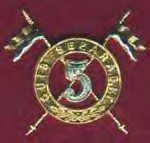
Regimental Badge of the 5th Royal
Irish Lancers. The motto of the Order of St Patrick is on the badge "Quis
Separabit" (Who shall seperate us).
***
The lands of Enniskillen, County
Fermanagh, were anciently held by the Maguire clan, but under James I they were
granted to William Cole and settled by the English. The town and surrounds
became one of the principal strongholds of the English plantation during the
late 17th century and remained loyal to William III. Enniskillen men
formed a backbone of William’s Irish forces and participated in the victory of
the Boyne. Various regiments of Lancers were formed from these units: the 5th
Royal Irish Lancers were raised in 1689 as Wynne’s Regiment of Enniskillen
Dragoosn. The 5th saw action in Flanders, Spain and Ireland before
being disbanded in 1799. It was raised again in 1858 and served in the Boer War
and World War I. Two present-day regiments of the British Army (the 27th
Foot/Royal Inniskilling Fusiliers and the Royal Inniskilling Dragoons) trace
their lineage to the Williamite Enniskillen men.
***
Joyce (Old Irish Folk Music and Songs), 1909; No. 399, pgs. 208‑209.
O'Neill (Music of Ireland: 1850 Melodies),
1979; No. 411, pg. 72. Stanford/Petrie (Complete
Collection), 1905; Nos. 1243-1245, pg. 313 (appears as “Scilléd dubh”).
X:1
T:Enniskillen Dragoons, The [1]
M:2/4
L:1/8
R:Air
M:”Moderate”
S:O’Neill – Music of Ireland (1903), No. 411
Z:AK/Fiddler’s Companion
K:D
A/F/|D>D E>F|G>A
c>B|(3AGE D>D|D3 A|d>d B>d|c>A B>G|(3EDE c>B|
A3 A|d>d B>d|c>A
B>G|(3EDE c>B|A3 G/E/|D>D E>F|G>A c>B|(3AGE D>D|D3||
X:2
T:Scilléd Dubh
M:C
L:1/8
R:Air
S:Stanford/Petrie – Complete Collection, No. 1243 (1905)
Z:AK/Fiddler’s Companion
K:Eb
B>G|E2 FG AF BG|F>G EE E3
B/c/4d/4|e2 ce dB c=A|F G=A B3 B/c/4d/4|
ee ce dB c=A|F2 G=A B3
{G/_A/}F|E>E FG AF BG|F>G EE E2||
X:3
T:Scilléd Dubh
M:C
L:1/8
R:Air
S:Stanford/Petrie – Complete Collection, No. 1244 (1905)
Z:AK/Fiddler’s Companion
K:G
dB|G2 AB cAdc|A2 GG G2 de/f/|g2 eg
fdec|A2 B^c d2 de/f/|
g2 eg fd ec|A2 B^c d2 =cA|GG AB
cAdc|A2 GG G2||
X:4
T:Scilléd Dubh
M:C
L:1/8
R:Air
S:Stanford/Petrie – Complete Collection, No. 1245 (1905)
Z:AK/Fiddler’s Companion
K:Eb
BG|E2 FG AF BG|F>G EE E2 Bc/d/|e2
ce dB cA|F2 G=A B2 Bc/d/|
E2 ce dB cA|F2 G=A B2
_A{G/A/}F|E>E FG AF BG|F>G EE E2||
ENNISKILLING DRAGOON
[2], THE. Irish,
Air. F Major (Stanford/Petrie): G Major (Kerr). Standard tuning. One part.
“From P. Carew’s MSS” (Stanford/Petrie). Stanford notes: “This tune appears to
be a variant of ‘Skillet dubh’.” Kerr (Merry Melodies), vol. 1;
pg. 41. Stanford/Petrie (Complete
Collection), 1905; No. 547, pg. 139.
X:1
T:Enniskilling Dragoon, The [2]
M:2/4
L:1/8
S:Stanford/Petrie (1905), No. 547
Z:AK/Fiddler’s Companion
K:F
F | FG/A/ B/G/c/B/ | GF/F/ Fc/d/4e/4
| fd/f/ e/c/d/=B/ | GA/=B/ || cd/e/ |
fd/f/ e/c/d/=B/ | GA/=B/
c/>_B/A/G/ | FG/A/ B/G/c/B/ | GF/F/ F :|
ENRICHEZ VOUS. American, Waltz. F Major. Standard tuning. AA'B (Matthiesen): AABB’
(Barnes). Composed by Edith Farrar (Seatle, Washington), 1986, the title of
which was suggested to her as meaning 'enjoy or enrich yourself', but
apparently not meaning anything in proper French. Barnes (English Country Dance Tunes, vol. 2), 2005; pg. 39. Matthiesen (Waltz Book I), 1992; pgs. 60‑61. Sage Arts 1101, Erin Shrader & Edith Farrar - “Enrichez
Vous” (1991). Wild Asparagus ‑ "Music from a Little Known
Planet."
ENRICO. AKA – “Henryco,” “Water Loo Fair.” AKA and see "Jacob." English, Reel. D Major. Standard
tuning. AABB. The melody's original title was "Jacob," but was
re-titled by English author and musician Thomas Hardy. It was said to have been
his favorite tune (although “Soldier’s Joy” also is credited as such). The
title appears in Hardy's (who was also an accomplished accordion player and
fiddler) drama The Dynasts:
***
Let us go and look at the dancing. It is 'Voulez‑vous danser'
‑ no, it
is not, ‑ it is 'Enrico' ‑ two ladies between two gentlemen.
***
According to Hardy’s biography, the
four-year old Hardy would sometimes burst into tears when his father played
this and other tunes to him on the fiddle. Hardy, around the year 1925, wrote
that “Enrico” was the usual vehicle for the country dance called Bonnets of
Blue, or in Dorset when he was young, Hands Across. In his novel Under the
Greenwood Tree the dance is described (but not named) as the one in which
Shiner refuses to cast off (E.F.D.S. News, No. 12, Sept., 1926). The 19th
century Welch family (Bosham, Sussex) music
manuscripts gives the alternate title “Water Loo Fair” (whilst calling
“Enrico” by the name “Henryco”). The Rev. Robert Harrison (Brampton, Cumbria,
1820) music manuscript gives the title as “Errico,” and W. Cock’s
(Northumberland) manuscript collection has it as “Henrico.” James Haslingden
(Midlands?, 1827), Miss Best (c. 1850), and a manuscript of unknown date and
origin (called MS36) all contain the melody under the “Enrico” title. Barnes (English Country Dance Tunes, vol. 2),
2005; pg. 42 (appears as “Fast Packet”, the name of a dnacy by Bob Lily set to
the tune). Trim (Thomas Hardy), 1990;
No. 13 (appears as “Jacob”). Beautiful Jo Records
BEJOCD-28, The Mellstock Band – “The Dance at Pheonix: Village Band Music from
Hardy’s Wessex and Beyond” (1999). EFDSSCD13, Julian Goodacre – “Hardcore
English” (2007. Various artists). Mrs. Casey Records 3991, Eliza Carty &
Nancy Kerr (1993. Appears as “
X:1
T:Jacob
T:Enrico
M:4/4
L:1/8
Q:1/4=90
S:Mobberley session
R:English reel
N:Posted to the woodenflute mailing list November 2001
Z:Steve Mansfield January 2001
K:D
A2 | d2 fe dcdB | ABAG F2 A2 | d2 ef gfgf | e2 a2 a2 A2 | d2 fe dcdB | ABAG F2
A2 |
B2 gf edec | d2 d2 d2 :: fg | a2 ag fgfe | dedc B2 B2 | gagf efed | cdcB A2
(3ABc |
d2 d2 cecA | d2 d2 cecA | d2 f2 edec | d2 d2 d2 :|
X:2
T:44 Water Loo Fair or The Henryco
C:Welch MS
I:abc2nwc
M:2/4
L:1/16
K:D
A2|d2fd dcdB|A2A2 F2F2|d2fe defd|e2a2 a2A2| d2fe dcdB|A2A2 F2F2|d2ef gedc|d2d2
d2:|
|:z2|a2ag|f2fe|d2de fdef|gagf efed|cdBc ABcA| d2d2 cecA|d2d2 cecA|dcde
fedc|d2d2 d2:|
ENT 'ANARA GARDA. French, Bourree (3/8 time). France, Auvergne
Province, central France. D Dorian/C Major. Standard tuning. AABB. Stevens (Massif Central), 1987, vol. 1; No. 46.
ENTERPRISE AND BOXER, THE. AKA ans see "Miss
McLeod's/MacLeod’s Reel [1]."
ENTERPRISE HORNPIPE. English, Hornpipe. The tune is
credited in Kohler’s Violin Repository (Edinburgh 1881-1885) to the
great 19th century hornpipe composer and fiddler James Hill, of
Tyneside, Newcastle.
ENTERPRISING BOXER. AKA and see "Miss/Mrs.
McLeod's/MacLeod's Reel."
ENTERRE-MOI PAS. See "Devillier
Two-Step."
ENTERRE-MOI PAS DANS
L' CIMETIERE. See "Devillier Two-Step."
ENTRY, THE. English, Country Dance Tune. A Minor. Standard
tuning. One part. A modern composition by Michael Raven. Raven (English Country Dance Tunes), 1984; pg.
198.
EOCHAILL. Irish, Slow Air (4/4 time). G Major. Standard tuning. One part. The
title appears in a list of tunes in his repertoire brought by Philip Goodman,
the last professional and traditional piper in Farney, Louth, to the Feis Ceoil
in Belfast in 1898 (Breathnach, 1997). Ó Canainn (Traditional Slow Airs), 1995; No. 39, pg. 36.
EOGAN UA MAOILEOIN. AKA and see "Owen Malone."
EOGHAN DHU. Canadian, Reel. Canada, Cape Breton.
Composed by Mabou, Cape Breton, fiddler Kinnon Beaton. Smithsonian
Folkways Records, SFW CD 40507, The Beaton Family of Mabou – “Cape Breton
Fiddle and Piano Music” (2004).
EOGHANN RUAIRIDH. See "Hughie Rory
MacKinnon."
EPHEMERAL EMPEROR, THE.
English, Reel. A Major. Standard tuning. AABBCC. Something ‘ephemeral’
lasts only briefly, and, when used as an adjective for a ruler (emporer)
indicates a short, brief reign. Given the date of publication of Cahusac’s
volume, it is perhaps a hopeful reference to Napoleon Bonatparte, Emporer of
France from 1804-1814 (when he was exiled to Elba). Cahusac (Annual
Collection of Twenty Four Favorite Country Dances for 1809), 1809; No. 12.
X:1
T:Ephemeral Emporer, The
M:2/4
L:1/8
B:Cahusac - Annual Collection of
Twenty Four Favorite Country Dances for 1809, No. 12 (London)
N:”With proper Directions to each Dance as they are performed at
N:Court, Bath, and all Public Assemblies.”
Z:Transcribed and edited by Flynn Titford-Mock, 2007
Z:abc’s:AK/Fiddler’s
Companion
Z:AK/Fiddler’s Companion
K:A
a>e c/A/e/c/|d/c/B/A/
G/B/B/e/|a>e c/A/e/c/|G/A/B/c/ AA:|
|:A,/C/E/A/ c/A/e/c/|B/G/E/c/
B/G/E/z/|A,/C/E/A/ c/A/e/c/|d/B/G/B/ AA:|
|:e/c/a/g/ f/e/d/c/|B/G/E/c/
B/G/E/z/|A,/B,/C/D/ E/A/c/A/|d/B/e/G/ AA:||
EPHEY M'NAB. AKA ‑ "Eppie M'Knab," "Euphie McNab."
Scottish, Country Dance Tune (6/8 time). A Dorian. Standard tuning. AABB. John
Glen (1891) finds the earliest printing of the melody in Robert Bremner's 1768 2nd collection
(pg. 111), however, the melody (under the title “Euphie McNab”) had much
earlier appeared in the Drummond Castle
Manuscript (in the possession of the Earl of Ancaster at Drummond Castle),
inscribed "A Collection of Country Dances written for the use of his Grace
the Duke of Perth by Dav. Young, 1734." Instructions for a country dance
to this tune were written down in 1752 by John McGill, dancing master in
Girvan. Aird (Selections of Scotch, English, Irish and Foreign Airs), vol. II,
1785; No. 163, pg. 60.
X:1
T:Eppie
McNabb
M:6/8
L:1/8
S:Aird,
vol. II (1785)
Z:AK/Fiddler’s Companion
K:Ador
B/d/ | e>ge edB | A2A A2B | d>ed dBA | G2G G2f |
g>fg efg | aga dga | bag edB | e2A A2 :|
|: e/g/ | aba aec | aec A2f | g>ag fdB | gdB G2f |
g>fg
efg | aga dga | bag edB | e2A A2 :|
EPPIE M'KNAB. See "Ephey M'Nab."
EPPING FOREST. English, Country Dance Tune (6/8 time). B Flat Major/G Dorian. Standard tuning. AABC (Barnes, Sharp): AABBCC (Raven). The tune dates to 1670. The name Epping is derived from the Anglo-Saxon word Uppingas, meaning the people of the upland (Matthews, 1972). Epping Forest, originally called Walthamstow, was an ancient forest which once stretched from the Thames to the Wash. It contains several Iron Age and old British fortifications, and it was reputedly where the rebel leader Boudica fought her last battle against the Romans (she committed suicide when it was clear she had lost). Epping was long considered a royal hunting forest, although in 1226 Henry II allowed the citizens of London to hunt in it on Easter Monday, a privilege they enjoyed until 1882. The infamous highwayman Dick Turpin and his dashing partner, Tom King, had their lair in a cave in the forest and for a time robbed nearly every traveler who ventured by (see note for “Turpin Hero”). Barnes (English Country Dance Tunes), 1986. Karpeles & Schofield (A Selection of 100 English Folk Dance Airs), 1951; pg. 20‑21. Raven (English Country Dance Tunes), 1984; pg. 21. Sharp (Country Dance Tunes), 1909/1994; pg. 64.
X:1
T:
L:1/8
M:6/8
S:Sharp – Country Dance Tunes (1909)
K:Gdor
|:z|d2d c>BA|BA>G ^F2e|f>ed c2B|(A3 A2)d|f>ed c2A|
B>AG ^F2D|E>=FG G2^F|(G3 G2):|
||B/c/|d3c3|(B3 B2) d/e/|f3 e3|(d3 d2) B/c/|d3 c3|(B3 B2) d/e/|
f3 e3|(d3 d2)||d|d>ed c>BA|B>AG ^F2D|E>=FG G2^F|(G3 G2)d|
d>ed
c>BA|B>AG ^F2D|E>=FG G2^F|(G3 G2)||
EPSOM NEW WELLS. AKA and see "The Pursuit.”
English, Country Dance Tune (2/2 time). E Minor. Standard tuning. ABB. The tune
dates to 1728. The Medicinal Waters of Epsom in the 17th century
made it the first spa town in England, and gave rise to Epsom Salts (hydrated
magnesium sulphate) as a
curative. The popularity of the waters is attributed to Lord North, who in 1637
was the first to have told the English court of the use of Tonbridge and Epsom
waters for health and cure, adding that it was a lot cheaper than travelling to
a spa on the Continent. The title is to differentiate the melody from “Epsom
Wells, or, “Wa’ is Me, What Mun I do?”, published in Henry Playford’s
supplement to the 9th edition of the Dancing Master (1696). A
stage production by Thomas Shadwell was titled Epsom Wells (1676), with
music by English composer Henry Purcell. Barnes (English Country Dance Tunes), 1986. Sharp (Country Dance Tunes), 1909/1994; pg. 48.
X:1
T:Epsom New Wells
T:Pursuit, The
L:1/8
M:2/4
S:Sharp – Country Dance Tunes (1909)
Z:AK/Fiddler’s Companion
K:Emin
G2|E3F G2B2|d3e dedc|B2d2g2B2|A4
E2E2|G3A B2d2|g3a g2e2|g3a gage|d2 B4||
|:ba|g3a g2 ba|g3a gage|dedB dedB|A2
e4 f2|g3a g2 fe|d3e d2 cB|G3A B2 e2|d2 B4:|
EPSOM WELLS. See “Wa’ is me, what mun I do?”
ERCHLESS CASTLE MARCH. Scottish, March. Smithsonian Folkways Records, SFW CD 40507, The Beaton
Family of Mabou – “Cape Breton Fiddle and Piano Music” (2004).
ERIC McEWAN. Canadian, Reel. Canada, Cape Breton. A Major. Standard tuning. AABB.
Composed by fiddler Brenda Stubbert (b. 1959, Point Aconi, Cape Breton).
Cranford (Brenda Stubbert’s), 1994;
No. 33, pg. 12. Brenda Stubbert - “House Sessions”
(1992).
ERIE EXTENSION, THE. AKA and see "Old Lake Erie.” American, Jig. USA,
southwestern Pa. G Major. Standard tuning. AAB. Samuel Bayard (1981) thinks it
Irish or Scottish, but was not able to trace it. The name Erie is
derived from the name of a local Native American people who called themselves
the panthers. The native word was recorded by the French as Yenris, but was
later simplified to Erie (Matthews, 1972). The Erie Extension is a chunk of land in the northwestern corner of the
state of Pennsylavania, that allows access to Lake Erie. The city of Erie, Pa.,
is on the shore of the Erie Extension. Source for notated version: Hogg (Pa.,
1948) [Bayard]. Bayard (Dance to the
Fiddle), 1981; No. 533B, p gs. 475‑476.
ERIE HORNPIPE. American, Hornpipe. D Major. Standard tuning. AABB. The name Erie is derived from the name of a local Native American people, the Erielhonan, literally meaning “long tail” and referring to the mountain lion, cougar or panther. The native word was recorded by the French as Yenris, but was later simplified to Erie (Matthews, 1972). The title may refer to the Great Lake itself or to the port city of Erie, Pennsylvania, settled at the end of the 18th century. Growth occurred during the War of 1812 when Erie served as the port for Commodore Perry’s fleet before the battle of Lake Erie in 1813, and continued with the Erie Extension Canal in 1844, and a small oil boom in the 1860’s. Erie was the freshwater fishing capital of America in the mid-19th century, but was in decline as a port since 1900. I once wrote that “The tune sounds American, to my ears, and it should not be forgotten that numerous tunes in Ryan’s Mammoth Collection have black-face minstrel origins. The “Erie Hornpipe” may be one, especially since nearby Buffalo was the origin of the minstrel troupe, with the formation of the Virginia Serenaders in 1844 in that city, and early minstrel performances were recorded in Erie.” Since then, Seattle fiddler, researcher and publisher Vivian Williams has found the “Erie Hornpipe” in a violin tutor by George Saunders, a self-described “Professor of Music and Dancing,” entitled New and Scientific Self-Instructing School for the Violin (Providence, Rhode Island, 1847, No. 20, pg. 55; reprinted by Oliver Ditson in the 1850’s). Therein ‘Professor’ Saunders credits himself with composing the “Erie Hornpipe.” Vivian writes: “I think Saunders probably did compose the tunes he claimed. In his book he seems quite conscientious about marking his tunes with his initials, and leaving the rest unmarked. He comments that he wrote all the cotillion sets himself, and they are all initialled…On the other hand, he didn’t initial any of the standard ‘Contra, Spanish and Fancy Dances’ in the book, including his very idiosyncratic version of ‘Durang’s Hornpipe’, which is very different from the usual ‘book’ versions.” The ‘B’ part opens with similar melodic content with Frank McCollum’s “Home Ruler.” Cole (1000 Fiddle Tunes), 1940; pg. 105. Ryan’s Mammoth Collection, 1883; pg. 141.
X:1
T:Erie Hornpipe
M:2/4
L:1/8
R:Hornpipe
S:Ryan’s Mammoth Collection (1883)
Z:AK/Fiddler’s Companion
K:D
(A,/D/) | F(F/A/) G/F/E/D/ | F/A/A/B/ A(F/A/) | A/F/d/F/ G/F/E/D/ | C/D/E/F/ E(D/E/) |
F(F/A/) G/F/E/D/ | F/A/A/B/ A(3e/f/g/ | f/d/e/c/ d/c/B/A/ | B/d/A/F/ D :|
|: (3e/f/g/ | a/f/d/A/ b/a/f/d/ | A/B/A/F/ G/F/E/D/ | A,/D/B,/D/ A,/D/F/A/ | A/B/A/F/ E(3e/f/g/ |
a/f/d/A/ b/a/f/d/ | A/B/A/F/ G/F/E/D/ | .D/(d/c/d/) F/A/E/A/ | D/d/A/F/ D :||
X:2
T:Erie Hornpipe
M:2/4
L:1/8
C:George Saunders
B:Saunders - New and Scientific
Self-Instructing School for the Violin (Providence, Rhode Island, 1847, No.
31, pg. 28).
Z:AK/Fiddler’s Companion
K:D
(A,/D/)|FF/A/ G/F/E/D/|F/A/A/B/
A(F/A/)|(A/F/)(d/F/) (G/F/)”tr”(E/D/)|C/D/E/F/ E(D/E/)|
F(F/A/) G/F/E/D/|F/A/A/B/
A(3e/f/g/|f/d/e/c/ d/c/B/A/|B/d/A/F/ D:|
|:(3e/f/g/|a/f/d/A/
b/a/f/d/|A/B/A/F/ (G/F/)”tr”(E/D/)|A,/D/B,/D/ A,/D/F/A/|A/B/A/F/ {F}E(3e/f/g/|
a/f/d/A/ b/a/f/d/|A/B/A/F/ (G/F/)”tr”(E/D/)|.D/(d/c/d/) F/A/E/A/|.D/(b/a/f/) d:||
ERIN GO BRAUGH (Ireland for Ever). AKA and see "I'm Sick To the Heart." Irish,
Air (6/8 time, "with spirit"). G Major. Standard tuning. AB. The
melody appears in O’Farrell’s collections Pocket
Companion for the Irish or Union Pipes and Collection of National Irish Music for the Union Pipes. O'Neill (Music of Ireland: 1850 Melodies),
1903/1979; No. 372, pg. 65.
ERIN GO BRAGH (Ireland for Ever). Irish, English; Air and Reel. England,
Northumberland. D Major. Standard tuning. AB.
***
My name's Duncan Campbell from the shire of Argyle,
I've travelled this country for many's the mile
I've travelled through Ireland, Scotland and a'
and the name I go under's bold Erin go Bragh
***
One night in old Reekie as I walked down the street old Reekie=
a saucy big police I chanced for to meet
he glowered in me face, and he gi' me some jaw
sayin' when came you over, bold Erin go Bragh
***
Well I am not a Pat, though in Ireland I've been
nor am I a Paddy, though Ireland I've seen
and were I a Paddy, that's nothin' at a'
for there's many the bold hero from Erin go Bragh
***
Well I know you're a Pat by the cut o' your hair
but you all turn to Scotsmen as soon as you're here
you left your own country for breakin' the law
so we're seizing all stragglers from Erin go Bragh
***
Well if I were a Pat and you knew it were true
or if I were the devil, then what's that to you?
If not for the stick that you hold in your paw
then I'd show you a game played in Erin go Bragh
***
Then a lump o' blackthorn that I held in my fist
around his big body I made it to twist
and the blood from his napper I quickly did draw
I paid him stock and interest for Erin go Bragh
***
Then the people came 'round like a flock o' wild geese
sayin' "Catch that damned rascal, he's killed the police."
and for every friend I had, I'd swear he had twa,
it was terrible hard times for Erin go Bragh
***
til I found me a wee boat that sailed in the forth
so I packed up me gear and I steered for the north
farewell to old Reekie, your police and a'
and the devil gang wi' ye says Erin go Bragh
***
So come all you young people, wherever you're from
I don't give a damn to what place you belong
I come from Argyle, in the highlands so bra,
but I ne'er took it ill bein' called Erin go Bragh
***
Hall & Stafford (Northumbrian Minstrelsy), 1974; pg. 16. Green Linnet SIF 3062, Dick Gaughan – “Handful of Earth.”
Exiles – “The Hale and the Hanged.”
ERIN MY COUNTRY [1]
(Eirinn Mo Tirsa). Irish, Air (3/4 time). D Major. Standard tuning. AB. Source for notated
version: Chicago Police Sergeant James O’Neill, a fiddler originally from
County Down and Francis O’Neill’s collaborator [O’Neill]. O'Neill (Music of Ireland: 1850 Melodies),
1903/1979; No. 124, pg. 22. O'Neill (O’Neill’s
Irish Music), 1915/1987; No. 4, pg. 12.
X:1
T:Erin My Country [1]
M:3/4
L:1/8
R:Air
N:”Moderate”
S:O’Neill – Music of Ireland (1903), No. 124
Z:AK/Fiddler’s Companion
K:D
A2|D3E F2|G2
c3B|A2D2E2|F2G3A|d2c2d2|A2F2A2|G2F2D2|C3 zA2|D3E F2|
G2c2B2|A2D2E2|F2G2A2|d2c2d2|A2F2A2|G2F2D2|D4||A2|d3cB2|c2A3G|
F2D2E2|F2G3A|d2c2d2|A2F2A2|G2F2D2|C3z
A2|D2E2F2|G2c2B2|A2D2E2|
F2G2A2|d2c2d2|A2F2A2|G2F2D2|D4||
ERIN MY COUNTRY [2]. Irish, Air (4/4 time). C Major.
Standard tuning. AB. Source for notated version: Ballinamore, Co. Leitrim,
professional fiddler Hugh O‑Beirne, 1846, via Forde (Joyce). Joyce (Old Irish Folk Music and Song), 1909;
No. 582, pgs. 304‑305.
ERIN MY COUNTRY [3],
OH. Irish, Air
(6/8 time). G Dorian. Standard tuning. AB. Source for notated version: Mr. J.
Snowe, Cork. "This air seems to have been sung with the words of the old
song:
***
Oh Erin, my country, although thy harp slumbers,
And dwells in oblivion in Tara's old hall. (Joyce)
***
Joyce (Old Irish Folk Music and Song), 1909; No. 664, pgs. 332‑333.
..............
ERIN REEL. American, Reel. Flying Fish FF 70572, Frank
Ferrel – “Yankee Dreams: Wicked Good Fiddling from New England” (1991. From
Nova Scotia fiddler Tom Doucet).
..............
ERIN'S GROVES. AKA and see "The Castlecomer Lasses," "Down the Groves," "The Gay Fellow's Favourite,"
"The Good Fluter," "The Green Fields of Erin [1],"
“The Green Groves of Erin [1],”
"The Groves of Erin," "The Heather Breeze," “The Low Highland,” "Mary in the Mall," "Miss Shaw's Reel," “Miss Stewart of Grantully
[2],” “Padaí Bhilli
na Rópaí’s Highland,” "The
Queenstown Lasses." Irish, Reel. G Major ('A' part) & A Dorian
('B' part). Standard tuning. AAB. The earliest appearance of the tune in print
is in Church of Ireland cleric James Goodman’s mid-19th century
manuscripts. Goodman (1828-1896) was an uilleann piper, and an Irish speaker
who collected locally in County Cork and elsewhere in Munster. He also obtained
tunes from manuscript and printed sources. Joyce obtained the melody from the
Pigot collection. Goodman’s version is identical to the one later printed by
Joyce. Joyce (Old Irish Folk Music and
Songs), 1909; No. 725, pg. 361. Shields/Goodman (Tunes of the Munster Pipers), 1998; No. 95, pg. 41.
X:1
T:Erin’s
M:C
L:1/8
R:Reel
S:Joyce – Old Irish Folk Music and Songs, No. 725 (1909)
Z:AK/Fiddler’s Companion
K:G
G2 BG dBAB|G2 gf gedB|G2 BG
dBAB|AGED EA A2:||
A2 ag eaag|ef g2 ef g2|a2 ag
eaag|efga gfed|
eaab aged|egga gfed|dega bgaf| gedB
AcBA||
ERIN'S HOPE (Docas
h-Eireann).
Irish, Reel. G Major. Standard tuning. AA'BB'. O'Neill (Dance Music of Ireland: 1001 Gems), 1907/1986; No. 651, pg. 117.
X:1
T:Erin’s Hope
M:C|
L:1/8
R:Reel
S:O’Neill – Dance Music of Ireland: 1001 Gems (1907), No. 651
Z:AK/Fiddler’s Companion
K:G
dc |: (3BcB AG (3Bcd AG | FADA FADc |1 (3BcB AG BdAG |
FDEF GBdc:|2 (3BcB AG (3gfe dc |
BdAF G2 ||
|:f2|~g3d BGBd | gfeg fgaf |1 ~g3d
(3Bcd AG |
FADA FADF :|2 (3gab af gedc | BdAG
FAdc ||
ERIN'S LOVELY HOME. Irish, Air (4/4 time). E Flat
Major. Standard tuning. AB. O'Neill (O’Neill’s
Irish Music), 1915; No. 85, pg. 49.
X:1
T:Erin’s Lovely Home
M:4/4
L:1/8
R:Air
S:O’Neill – O’Neill’s Irish Music (1915)
Z:AK/Fiddler’s Companion
K:E_
ec | B3c B2 G2 | c2B2G2 cB| A2G2E2E2
| E6 ef | g2g2a2g2 | f3 e/f/ g2f2 |
e2 ed c2 BG | B6 || ef | g2 gf/g/
a2g2 | f2 fe/f/ g2f2 | e2 dcB2 {c/B/A/B/}eG |
B6 ec | B3cB2G2 | A3Bc2BG | F3EE2E2
| E6 ||
ERISKAY LOVE LILT, AN. AKA and see "Gradh
Geal Mo Chridhe."
ERNESTINE. Cajun. A version of “Robe Barree,” with words by Will Balfa via his
daughter. Swallow SW-6131, The Tracy Schwarz Trio -
“Mes Amis!” Boisec & Canray - “La Musique Creole.”
L’ERNESTINE. French, Country Dance (2/4 time). G Major. Standard tuning. AABB. From the contradance book (tunes with dance instructions) of Robert Daubat (who styled himself Robert d’Aubat de Saint-Flour), born in Saint-Flour, Cantal, France, in 1714, dying in Gent, Belgium, in 1782. According to Belgian fiddler Luc De Cat, at the time of the publication of his collection (1757) Daubat was a dancing master in Gent and taught at several schools and theaters. He also was the leader of a choir and was a violin player in a theater. Mr. De Cat identifies a list of subscribers of the original publication, numbering 132 individuals, of the higher level of society and the nobility, but also including musicians and dance-masters (including the ballet-master from the Italian opera in London). Many of the tunes are written with parts for various instruments, and include a numbered bass. Daubat (Cent Contredanses en Rond), 1757; No. 10.
X:1
T:Christine, La
M:2/4
L:1/8
S:Daubat – Cent Contredanses en Rond (1757), No. 10
Z:AK/Fiddler’s Companion
K:G
BdcB | efgG | cBAG | e2d2 | (Bd) (cB) | efgG | cBAB | G2 G,2 :|
|: _B2 GB | {e}d2 Gd | (_ed)(^fg) | c4 | _B2 GB | {e}d2 Gd | (_ed) (^fg) |
^c4
| dc_BA | D2G2 | C_EDC | _B,A, G,2 | {e}dc_BA | D2g2 | ^fgaf | g4 :|
ERNIE ARSENAULT’S FAVORITE.
Canadian, Reel. Canada, Cape Breton. B Flat Major. Standard tuning. AAB.
Composed by Nova Scotia fiddler Elmer Briand (1922-), born in Richmond County,
Cape Breton, but who lived much of his live in Halifax. Cranford (Jerry
Holland: The Second Collection), 2000; No. 51, pg. 21. Atma Classique 22522, Suzie Leblanc – “Tout Passe—Chants
D’Acadie” (2007). Celtic Records SCX-58, “Elmer Brian and His Cape Breton
Fiddle” (196?).
|
See also listings at: Alan Snyder’s Cape Breton Fiddle
Recording Index |
ERNIE GOODMAN’S WALTZ. Australian, Waltz.
T:Ernie Goodman's Waltz
M:3/4
L:1/8
S:Ernie Goodman, collected by John
Meredith
R:Waltz
A:Mudgee district, New South Wales,
B:Published in Folk Songs of Australia
(Vol.2)
B:(1987) John Meredith, Roger Covell
and Patricia Brown,
B:New South Wales University
Press (ISBN 0 86840 018 1)
Z:Transcribed into ABC by John
Furlonger
K:D
D/2E/2|F2 A2 F2|E2 D2 E2|D2 d2
c2|B6|A2 F2 F2|F2 E2 D2|E6-|E2 z2 D>E|!
F2 A2 F2|E2 D2 E2|D2 d2 c2|B6|A2 d2
F2|E2 D2 E2 D6-|D2 z2 A2|!
f3 e f2|e2 D2 E2|B2 c2 d2|A2 F2
D2|E2 B2 E2|F2 A2 F2|G6-|G2 z2 A2|!
d3 e f2|e2 B2 A2|B2 c2 d2|A4 A2|B2
c2 d2|e2 B2 c2|d2 z2 dd|d2 z2||
ERRATIC DUO, THE. Canadian, Hornpipe. Canada, Cape Breton. B
Flat Major. Standard tuning. AA’BB’. Composed by fiddler Jerry Holland
(Inverness, Cape Breton). Cranford (Jerry
Holland’s), 1995; No. 48, pg. 14.
ERRIGAL BRAES. Irish, Reel. Ireland, northern Ireland. D Major (‘A’ part) & D
Mixolydian (‘B’ part). Standard tuning. AB. See also the related “Paddy Taylor’s [1].” Source for
notated version: fiddler Peter Turbit [Feldman & O’Doherty]. Feldman &
O’Doherty (The Northern Fiddler),
1979; pg. 236.
ERROL
ON THE GREEN. English, Country Dance Tune (2/4
time). D Major. Standard tuning. Composed by English collector, choreographer,
musician, dancer and teacher Pat Shaw. The ‘A’ part is traditional. Barnes (English Country Dance Tunes, vol. 2),
2005; pg. 40.
ERSKINE'S LAMENT. AKA ‑ "Master Erskine's Lament, Killed at the Battle of
Pinkie." Scottish. Williamson relates that a "lover's goodnight"
called "Departe, Departe" was written to this tune, perhaps by
Alexander Scott in the mid‑16th century. The original title is given as
the alternate. One Arthur Erskine was the Master of Mary Queen of Scots'
household, but since the battle of Pinkie was fought when she was a little girl
it is unlikely that this was the Erskine referred to. Williamson suggests it
may have been his father who was killed. Henry VIII endeavoured to force a
union between the young Mary and his son Edward in the so‑called
"Rough Wooing" in which his troops made a series of military
expeditions into Scotland to "kill, burn, and spoil." After Henry
died the warfare was contunued by Protector Somerset, as Henry's son Edward
(VI) was too young; it was Somerset who defeated a Scottish force at the battle
of Pinkie, near Musselburgh, in 1547. Flying Fish,
Robin Williamson ‑ "Legacy of the Scottish Harpers, vol. 2."
ERSTER SCHOTTISCH. German, Schottishe. Boehme dates this tune as from the end of the
1700's. Boehme, 1886; No. 251, pg. 159.
ERYRI WEN (White Snowdon). Welsh, Air. G Major. Standard tuning. AABB. The
tune first appears in Edward Jones' Musical
and Poetical Relicks of the Welsh Bards, 2nd ed., 1794. The title refers to
Mount Snowdon, a 3,559 foot peak located in North Wales; the tallest in Wales,
if not England, and a favorite climb of hikers. On a clear day one can see
Ireland from the top, which is also accessible by geared railway.
***
***
X:1
T:Eryri Wen
T:White
M:C|
L:1/8
R:Air
S: Jones – Welsh Bards (1794)
K:G
e/f/ |
gef^d eBBc | B<GF>B (G2 E)g/a/ | bgaf gdec | BA/G/DF G3 :|
|: d/c/ | BdGd/c/ BdGB | e>gfe e2
^db/a/ | gef^d eBBc | B<G F>G E3 :|
ESKIMO WALTZ. AKA and see "Ookpik Waltz."
ESKIMOS, LES. See “Reel des Esquimaux [2].”
ESKIMO REEL. See “Reel des Esquimaux [1].”
ELSLER’S CRACOVIENNE. ????, Polka. C Major. Standard tuning. AB. Howe (Complete Preceptor for the Accordeon), 1843; pg. 36.
X:1
T:Esler’s Cracovienne
M:2/4
L:1/8
R:Polka
S:Howe – Complete Preceptor for the Accordeon (1843)
Z:AK/Fiddler’s Companion
K:C
C | B,DFA | GE E2 | G(3G/A/G/ FD | CEEC | B,DFA |
GE E2 | G(3G/A/G/ FD | DC C2 | FAcA | GE E2 | G(3G/A/G/ FD |
CEEC | FAcA | GE E2 | G(3G/A/G/ FD | DC C2 ||
C2 EG | B2 AB | cFEG | DA/F/C z | C2 EG | B2 AB |
CFEG
| F2 z2 | D2 FB | ddc=B | c2 Az | C2 EG | B2 AB | cFEG | F2 z ||
ESME. Scottish, Air (6/8 time). B Flat Major. Standard tuning. AB. The tune
was composed by Bert Murray (b. 1913, Aberdeen), dedicated to pianist Esme
Shepherd. Neil (The Scots Fiddle),
1991; No. 94, pg. 127.
ESMERALDA, THE. American, Polka. D Major ('A' part) & A
Major ('B' part). Standard tuning. AB. Ford (Traditional Music in America), 1940; pg. 168.
ESSENCE OF CINNAMON
SEED. American, ("Slow") Dance
Tune. D Major. Standard tuning. AA'B. Cole (1000
Fiddle Tunes), 1940; pg. 24. Ryan’s Mammoth Collection, 1883.
X:1
T:Essence of Cinnamon Seek
M:C
L:1/8
N:”Slow”
N:The triplet repeated sixteenth
notes in measure 3 and again
N:in the second part should be
tremelo’d notes for the time indicated.
N:A stage dance vehicle
B:Ryan’s Mammoth Collection
(1883)
Z:AK/Fiddler’s Companion
K:D
A,B,C|(D>D) (F>A) [Fd][Fd][Fd]
(3dba|(3^gaf (3cdF (3EA,C (E>F)|(3G/G/G/G/G/G/ [G2c] (3F/F/F/F/F/F/
(.B>.f|1
(3efd (3cdB (3ABG (3FGE:||2
(^A>.A) (3ABc B2 (3=ABc||(d>.d) (3cde d2 (Bc^d|(e>e) (^def
e3f|(3g/g/g/g/g/g/ B>g (3f/f/f/f/f/f/ A>f|
(3efd (3cdB (3ABG (3FGE|D>d (3cde
d2 (3Bc^d|e>e (^def e3f|(3gfg (3bag (3fge (3cdB|(3ABG (3FGE D2||
ESSENCE OF OLD
KENTUCKY. American, ("Slow") Jig. F
Major. Standard tuning. AB. Cole (1000
Fiddle Tunes), 1940; pg. 24. Ryan’s Mammoth Collection, 1883.
X:1
T:Essence of Old Kentucky
M:6/8
L:1/8
N:”Slow”
N:A stage dance vehicle
B:Ryan’s Mammoth Collection
(1883)
Z:AK/Fiddler’s Companion
K:F
CDE|FzG AzB|cf2 z2f|fzd Bzd|c2z
CDE|FzG AzB|cf2 z2f|g2^f g2a|
g2z CDE|FzG AzB|cf2 z2f|f2d B2d|cAz
a2a|a3 c’2a|g3 b2g|azb gza|f2 z||
cde|f3 a2f|e3 g2e|d^cd fed|cAz
z2A|(d3 d)zd|(c3 c)zA|G2^F G2A|G3 cde|
f3 a2f|e3 g2e|d^cd fed|cAz
z2[Aa]|[d3d’3]-[dd’] z[dd’]|[c3c’3]-[cc’] z[Aa]|[G2g][^F^f]
[G2g][Aa]|[=F3=f3]||
ESSENCE OF OLD
VIRGINNY. American, ("Slow") Jig. G
Major. Standard tuning. AABB. Hans Nathan (Dan
Emmett and Negro Minstrelsy, Univ. of Oklahoma Press, 1962, pg. 93)
explains that some minstrel dancing involved slow steps: “Dances featuring such
jumps and leaps were called ‘essences’ from about the (eighteen)fifties on, of
which the ‘Essence of Old Virginny’, frequently accompanied by Emmett’s tune
‘Root, Hog or Die’, is the best known example. Dan Bryant’s famous rendition
must have been highly realistic, for the press referred to it as ‘a dance
characteristic of the rude and untutored black of the old plantation’. In
‘essences’ the dancer sometime held his ‘palms…at right angles with the wrists,
while the arms were extended in a sort of pushing gesture…’ but this was
apparently at a later time.” Another performer, named Mert Sexton, “‘the
great original essence of old Virginia,’ (who) was a variety and minstrel
performer of some note. He was connected with Fox & Warden’s Minstrels,
1859” (William L. Slout, Broadway Below
the Sidewalk, Borgo Press, California, 1994, pg. 72). Frank Dumont, in an article in the New York Clipper (Dec. 19, 1914), called
“The Golden Days of Minstrelsy,” writes: “From time to time dwarfs appeared
with the troupes and excited attention, notably Japanese Tommy, a colored
dwarf, who was quite funny as a ‘prima donna’ and in the ‘Essence of Old
Virginy’.”
Cole (1000 Fiddle Tunes), 1940; pg. 24.
X:1
T:Essence
of Old Virginny
M:6/8
L:1/8
R:”Slow”
Jig
S:Ryan’s Mammoth Collection (1883)
Z:AK/Fiddler’s Companion
K:G
D | {F}E2D G2A | {B}d3 d2e | d2B A2G | {E}(G3 G2)D | {F}E2D G2A |
B2c ^c2d | fed cBA |1 G2z [B2g2] :|2 G2z [B2g2] |: d | g2b a2g | {e}(g3g2)e |
D2B A2G | {E}(G3 G2)d | g2b a2g | e2f g2d | fed cBA |1 G2 z [D2B2g2] :|2 (G3 G2)D ||
ESSENCE OF SUGAR CANE. American, ("Slow") Jig. C Major. Standard tuning. AA'BB
(Cole): AA'AA'BB (Phillips). The tune is written as a jig in Phillips
collection, and as a slow 4/4 dance in Cole's; it has a dotted rhythm similar
to a clog or hornpipe, which can be rendered in either duple or triple time.
John Hartford believes the tune similar to "Darkey’s/Darkie’s Dream."
Bayard (1981) sees a general resemblance to "Fred Wilson's Clog" or
"Harvest Home." See also the
variant “Acorn Stomp,” recorded by the
East Texas Serenaders in 1928, and the Irish barndance derivative “Offally Favorite.” Source for notated
version: Jehile Kirkhuff (Pa.) [Phillips]. Cole (1000 Fiddle Tunes), 1940; pg. 24. Phillips (Traditional American Fiddle Tunes), Vol. 2, 1995; pg. 364.
ESSENCE OF TAMPA. American, Reel or March (2/4 time). G Major ('A' part) & E Minor
('B' part). Standard tuning. AABB. The melody resembles "The Big Chief." The Company of Fifers and Drummers, '76, 1974; pg. 24. Sweet (Fifer’s Delight), 1964/1981; pg. 51.
X:1
T:Essence of
M:2/4
L:1/8
R:March
Z:AK/Fiddler’s Companion
K:G
D | GG/B/ AA/B/ | GG/B/ A2 | Gg/e/
d/B/G/B/ | A/G/A/B/ G/E/D | GG/B/ AA/B/ |
GG/B/ A2 | gg/e/ d/B/G/B/ | A/G/A/B/
G :: z | e>f gf | B/Bc/ B/A/G/F/ | E>F GA |
B/^A/B/c/ B2 | e>f gf | B/Bc/
B/A/G/F/ | E>F GA | B/A/G E :|
ESSEX
MAZURKA.
English, Mazurka. G Major. Standard. AABB. Composed by Dave Roberts.
X:1
T:Essex Bazurka
C:Dave Roberts
Z:Anahata (anahata@treewind.co.uk)
M:3/4
K:G
"D"(3DED ^CD EF | "G"GA Bc ^cd | "D"ed c2 A2 |
"G"ed B2 G2 |
"D"(3DED ^CD EF | "G"GA Bc ^cd | "D"ed cd Fd | G2
G4 :|
|: (3gfg ag fe | (3ded Be dB | d^c =cA FA | (3GFG Bc ^cd |
(3gfg ag fe | (3ded Be dB | d^c =cd Fd | G2 G4 :|
ESSEX'S LAST GOODNIGHT. English, Air
(6/4 time). C Major. Standard tuning. AB. Chappell (1859) finds the air in Elizabeth Rogers' Virginal Book, a lute
MS. at the University of Cambridge, and a MS. in the British Museum. The ballad
appears in the Pepys and Roxburghe collections, while in other collections the
tune appears under different names with different lyrics, including a 1661
Christmas carol. The name Essex derives from the people who invaded the region
during the dark ages, and who claimed the land for the East Saxons (Matthews, 1972).
Chappell (Popular Music of the Olden Time),
Vol. 1, 1859; pg. 132.
..............
ESTER’S REEL. AKA and see “Esther’s Reel.”
ESTHER'S REEL. AKA - “Ester’s Reel.” Irish, Reel. Green
Linnet SIF-1051, Jackie Daly, Seamus & Manus McGuire - "Buttons and
Bows" (1984). Shanachie SH-78010, Solas - “Sunny Spells and Scattered
Showers” (1997).
ESTWOOD DAVIDSON. Canadian, Strathspey. Canada, Cape Breton. B Flat Major. Standard
tuning. AB. Composed February 23, 1953, by Cape Breton fiddler and composer Dan
R. MacDonald (1911-1976). Cameron (Trip
to Windsor), 1994; pg. 11.
..............
ET LITE BARN SAA LYSTELIG (A Little Child). Norwegian. Solas
– “The Hour Before Dawn.”
..........................
ETHEL FRASER’S. Canadian, Strathspey. Canada, Cape Breton. A Major. Standard tuning.
AAB. Composed by fiddler Brenda Stubbert (b. 1959, Point Aconi, Cape Breton,
Nova Scotia). Cranford (Brenda Stubbert’s),
1994; No. 21, pg. 8. Brenda Stubbert - “House
Sessions” (1992).
..........................
ETIOLE, L'. French, Bourree a Trois Temps (3/8 time). D Major. Standard tuning.
AABB. Traditional tune from central France. Stevens (Massif Central), 1987, Vol. 1; No. 32.
..........................
ETTRICK BANKS. AKA – “Etrick Banks.” Scottish, Air (4/4 time). G Major (O’Farrell): F
Major (McGibbon). Standard tuning. AAB (O’Farrell): AABB (McGibbon). James
Oswald used the tune as the second section of his sonata which appears in Curious Collection of Scots Tunes (c.
1739), though it had been first published in Orpheus Caledonuis in 1725 as the tune of a song by Ramsay. It also
appears in the 1768 Gillespie Manuscript
of Perth. Robin Williamson thinks it was "undoubtedly old in its
day." Robert Burns wrote his love song “The Bonnie Lass of Ballochmyle” to
the tune, an ode to Wilhelmina Alexander (1750-1843), the fourth daughter of
the laird of the estate of Ballochmyle of Ayr, whom he spied walking one day in
1786. He sent a copy of the song to her along with a pandering letter, and
asked her permission to use it in a second edition of his poems, but the lass
declined to even answer him. Rebuffed, Burns sniffed that Wilhelmina was ‘too
fine a lass to notice so plain a compliment’, but the truth is that Wilhelmina
never married, and it is said the love poem became her most prized possession
later in life. It is included, along with other Scots songs and dance melodies,
in the music manuscripts of Setauket, Long Island, painter and fiddler William
Sydney Mount (1807-1868). Mount played
a good amount of music for dancing and his own pleasure, and had access to both
printed and local sources. O’Farrell (Pocket Companion, vol. II), c. 1806; pg. 86 (appears as “Etrick
Banks”). McGibbon (Scots Tunes, Book 1) c. 1746; pg. 13. Flying Fish, Robin Williamson ‑ "Legacy of the
Scottish Harpers, vol. 2."
M:C
L:1/8
R:Air
N:The oddities
of phrasing are Mount’s
S:The
William Sydney Mount music manuscripts (c. 1840’s)
Z:AK/Fiddler’s Companion
K:D
(F>E) |
D3C B,2 (FA) | BA) (FA) B3d | A2 (GF)
d2F2 | {G}F2 (ED) E2 (F>E) |
D3C B,2 (dc) | B3A F2c2 | (d>ed) c (Bcd) B | A2 (F>G) F2 :: A2 | d3e d2D2
|
(F>G)
(A>B) A2 (GF) | d3e d2 (cB) | (c>de) f e2 (de) | f2 (e>d) d2D2 |
F2A2 f3e | (d>ed) c (B>cd) B | A2 (F>G) F2 :|
X:2
T:Etrick Banks
M:C
L:1/8
R:Air
S:O’Farrell – Pocket Companion, vol. II (c. 1806)
Z:AK/Fiddler’s Companion
K:G
GAB | G2 FG E2 Bd | edBd e3g | d2 cB g2B2 | cBAG AcBA | G2 FG E2 Bd |
edBd e3f | g3f efge | d2 Bc B2 :| def | g3a g2G2 | Bcde d2 cB | gfga {a}g2 fe |
fgab a2 ga | b2 ag g2G2 | B2d2b2a2 | g2f2 efge | d2 Bc B2 ||
X:3
T:Etrick
banks
M:C
L:1/8
R:Air
N:”Slow”
S:McGibbon
– Scots Tunes, Book 1 (c. 1746)
Z:AK/Fiddler’s Companion
K:F
(F/G/A) |
“tr”F3E D2 (Ac) | (dc)(Ac) d3f | c2A2f2A2 | (BA)”tr”(GF) G2 (F/G/A) |
“tr”F3E D2
(Ac) | (dc)(Ac) d3e | f3e (d>ef)d | c2 (A>B) A2 :: (c/d/e) | f3g f2F2 |
(AB)(cd) c2
“tr”(BA) | “tr”(fef)g f2 “tr”(ed) | (ef)(ga) g2 (f>g) | a2 “tr”(gf) f2F2 |
A2c2a3g |
f3e (d>ef)d | c2 (A>B) A2 :|
ETTRICK SHEPHERD. Scottish, Air. The words are by James Hogg, setting by Niel Gow junior,
the son of Nathaniel and grandson of Niel Gow. He was "a keen amateur
musician" who entered the medical profession, but died at age 28.
ETTRICK WATER. Scottish, Air (6/8 time). D Major/Minor. Standard tuning. One part.
Composed by Alan Fernie (b. 1960), a player, composer and conductor, especially
of brass and wind band settings. The Ettrick is a fast‑flowing river in
Scotland's Border region which streams through a wild and rugged valley until
it merges with the Yarrow. The site ancient ballad "Tamlane" or
"Tam Lin," which relates a mortal's capture by fairies, is in
Carterhaugh, in the valley, where Tamlane's well can still be found (Neil,
1991). Neil (The Scots Fiddle), 1991;
No. 50, pg. 69.
EUCHDAG, AN. AKA and see "The
Sequestered Beauty."
EUGÈNE. French-Canadian, Reel. A Minor. Standard
tuning. AA’B. Source for notated version: Montréal accordion player Arthur
Pigeon (1884-1966), via twin grandsons, Marcel & Phylias Pigeon (b. 1931)
[Hart & Sandall]. Hart & Sandall (Danse
ce Soir), 2000; No. 72, pg. 107. Marcel &
Phylias Pigeon – “Accordéons diatoniques” (1989).
EUGENE O'DONNELL. Irish, Air. Composed by James MacCafferty in honor of fiddler Eugene
O'Donnell (Derry/ Philadelphia). Green Linnet SIF‑1084,
Eugene O'Donnell & James MacCafferty ‑ "The Foggy Dew"
(1988).
EUGENE STRATTON. Scottish, Hornpipe. B‑Flat Major. Standard tuning. AABB. Composed
by the famous Scots composer and fiddler J. Scott
Skinner (1843-1927), recorded by him on a 78 RPM disc in the 1920's, at the
end of his career, as part of “The Celebrated Hornpipes” medley. New York-born
Eugene Stratton (1861-1918) came to England with a minstrel troupe and
established himself as a solo music hall performer, whose act included
blackface routines at which times he was styled as “The Dandy Coon,” or “The
Whistling Coon.” His most famous song was “Lily of Laguna.” He was the
President of the Grand Order of the Water Rats in 1896. This charitable group
began in 1887 with several music hall performers who owned a trotting pony
called Magpie which was winning many races around London. The proceeds from
such victories were used to help troubled and distressed music hall stars, and
to help sustain soup kitchens in London’s east end. The name of the group came
about when, during a torrential downpour, the pony was being returned to
stabling. A horsedrawn taxi driver, seeing the sodden beast shouted: “Blimey,
wot you got ‘ere?” The trainers replied they had a trotting pony. “Trotting
pony!,” barked the cabbie, “looks more like a bleedin’ water rat.”
***
Edward Le Roy Rice, in his book Monarchs of Minstrelsy (New York, 1911)
gives this brief bio:
***
EUGENE STRATTON (Ruhlman), who is at the present time one of the most
pronounced favourites
in England of any man that ever blacked his face, began his stage career
about 1878 as one of the
Four Arnold Brothers. On the 21st day of October, that year,
he opened at Chicago with Haverly’s
Original Mastodon Minstrels. He was a member of that company when they
opened at the Drury
Lane Theatre, London, England, July 31, 1880. Shortly after this event
he went to Moore and
Burgess’ Minstrels in the same city, where he remained about ten years.
In addition to being a
good song and dance man, he also developed into a fine comedian. Eugene
Stratton was born in
Buffalo, N.Y., about 1864. (pg. 320).
***
Sources for notated versions: Jean
Carignan (Montreal, Canada) [Phillips]; Winston Fitzgerald (Cape Breton)
[Cranford]. Brody (Fiddler’s Fakebook),
1983; pg. 100. Cranford (Winston
Fitzgerald), 1997; pg. 3. Henderson (Flowers
of Scottish Melody), 1935. Phillips (Traditional
American Fiddle Tunes), 1989; pg. 18. Flying Fish
FF 70572, Frank Ferrel – “Yankee Dreams: Wicked Good Fiddling from New England”
(1991). Folkways FG3531, Jean Carignan‑ "Old Time Fiddle Tunes"
(appears as the second tune of 'Bank'). Great Meadow Music GMM 2002, Rodney
Miller & David Surette – “New Leaf” (2000). Philo 2001, "Jean
Carignan" (appears as the second tune of 'Banks Medley'). Regal Gramaphone
Record G.6616, J. Scott Skinner. Rounder RO 7023, Natalie MacMaster - “No
Boundaries” (1996. Learned from Dave MacIsaac). Topic 12T280, J. Scott Skinner‑
"The Strathspey King.´Patty Furlong – “Traditional Irish Music on the
Button Accordion” (1999. Learned from box player P.J. Hernon, originally from
Connemara).
EUNICE TWO-STEP. AKA and see "Jolie Catin" [2]. Cajun, Two‑Step.
A well‑known traditional Cajun dance tune named for Eunice, Louisiana,
home of the Yambilee Festival. The tune is from Amede Ardoin, a black accordion
player who recorded in the 1930's. “Love
Bridge Waltz” is a triple-time setting of the melody. Flying Fish FF‑275, "Blue Flame Stringband"
(1982). Swallow Records SW-10141, Maurice Berzas & the Louisiana
Rhythmaires.
EUNICE WALTZ. See "Daylight Waltz."
EUPHIE McNAB. AKA and see "Eppie M'Knab."
EUREKA. American, Hornpipe. B Flat Major (Cole, Ryan): G Major (Miller).
Standard tuning. AABB. According to the Oxford
Dictionary of Phrase and Fable (2000), Eureka is “a cry of joy or
satisfaction when one finds or discovers something. Recorded from the early 17th
century, and said to have been uttered by Archimedes when he hit upon a method
of determining the purity of gold (Greek heureka
‘I have found it’).” It is possible the tune was named for the clipper ship Eureka, a name that appears in American Clipper Ships 1833-1858 by Howe
and Matthews. The Eureka was also a New York City concert saloon operated by
Lee and Hatstatt at 544 Broadway. Brooks McNamara, in his book The New York Concert Saloon: The Devil’s Own
Nights (2002, pg. 46), says (and quotes from the Clipper, an era periodical):
***
(The Eureka)…still had only a piano in 1874, “played by one of the Smith
family,” who seem to have been professional musicians. At length “Mr.
Smith [perhaps Walter again] was persuaded to sing a Dutch [German]
song which was translated into English as near as our limited language
of the Faderland would admit.” The song was printed with the Clipper
article:
***
Beer boys, beer, is the liquor we should stick to,
Beer, boys, beer, of a well reputed brand;
Beer, boys, beer, no more of idle sorrow,
At six cents a pint now it sparkles through the land.
***
Cole (1000 Fiddle Tunes), 1940; pg. 94. Miller (Fiddler’s Throne), 2004; No. 284, pg. 170. Ryan’s Mammoth Collection, 1883; pg. 129.
X:1
T:
M:C
L:1/8
R:Hornpipe
S:Ryan’s Mammoth Collection (1883)
Z:AK/Fiddler’s Companion
K:B_
(3fga | bfdf BdFd | ecAF EFCE | DfdB
Ggec | BAcA F2 (3fga | bfdf bdef |
ecAF EFCE | Dgfe dfAc | B2d2B2 ::
(3fga | bgfd BGFD | CEG=B cdef |
gecA FECA, | B,DFB dfbf | gEGB egbg
| fDFB dfbF | Ggfe dfAc | B2d2B2 :|
EUROPA. English, Country Dance Tune (2/4 time). G Major. Standard tuning. AABB.
One of the "missing tunes" from William Vickers' 1770 Northumbrian
dance tune manuscript. A different tune by this name is in John Young’s third
volume of the Dancing Master (London, 1726). Thompson (Compleat
Collection of 200 Favourite Country Dances, vol. 2), 1765; pg. 88. Thompson
(Compleat Collection of 200 Favourite Country Dances, vol. 3),
1773; No. 29.
X:1
T:Europa
M:2/4
L:1/8
B:Thompson’s Compleat Collection of 200 Favourite Country Dances, vol. 3 (London, 1773)
Z:Transcribed and edited by Flynn Titford-Mock, 2007
Z:abc’s:AK/Fiddler’s Companion
K:G
b|g
d2 c|B G2 D|GB A/B/c/A/|B G2 d|e c2 e|d B2 d|gdcB|B2 A:|
|:G|F A2 c|B G2 c|B d2 =f|e c2 B|A a2 g|f2 gc|BGAF|G2 G:||
_______________________________
HOME
ALPHABETICAL FILES REFERENCES
© 1996-2010 Andrew Kuntz
Please help
maintain the viability of the Fiddler’s Companion on the Web by respecting the
copyright.
For further information see Copyright and Permissions Policy or contact the author.
[COMMENT1]This was
Font/Pitch 1,10 - Off.
[COMMENT2]This was Font/Pitch 1,10 - On.
[COMMENT3]This was Font/Pitch 1,10 - Off.
[COMMENT4]Note: The change to pitch (12) and font (1) must be converted manually.