The Fiddler’s
Companion
© 1996-2009 Andrew Kuntz
_______________________________
HOME
ALPHABETICAL FILES REFERENCES
|
CCU - CETT |
|
Notation
Note: The tunes below are recorded in what
is called “abc notation.” They
can easily be converted to standard musical notation via highlighting with
your cursor starting at “X:1” through to the end of the abc’s, then
“cutting-and-pasting” the highlighted notation into one of the many abc
conversion programs available, or at concertina.net’s incredibly handy “ABC
Convert-A-Matic” at http://www.concertina.net/tunes_convert.html **Please note that the abc’s in the Fiddler’s
Companion work fine in most abc conversion programs. For example, I use
abc2win and abcNavigator 2 with no problems whatsoever with direct
cut-and-pasting. However, due to an anomaly of the html, pasting the abc’s
into the concertina.net converter results in double-spacing. For
concertina.net’s conversion program to work you must remove the spaces
between all the lines of abc notation after pasting, so that they are
single-spaced, with no intervening blank lines. This being done, the F/C
abc’s will convert to standard notation nicely. Or, get a copy of
abcNavigator 2 – its well worth it.
[AK] |
CCUIMIN LEAT?, A. Irish, Air (3/8 time). E Flat Major. Standard tuning. AB. Petrie notes
in pencil “Remember thee, yes while there’s life in this heart.” Source for
notated version: Mary Madden [Petrie]. Stanford/Petrie (Complete Collection), 1905; No. 1514, pg. 379.
CE BHEADH SA TINE NACH
N-EIREODH?
AKA and see "Sugradh na hOiche Areir," "Hush the cat from under the
table," "Paddy be aisy,"
"Last Night's Fun [2],"
"Miss Brown's Fancy [3],"
"Wink and she'll follow
you."
CEAD BLIADHAIN O SHIN. Irish, Pipe Air.
CEAD LA BEALTEINE, AN. AKA and see "The First of
May."
CEAD LA MARTA, AN. AKA and see "The First of
March."
CEAD
CEAD MI SAMRAD, AN. AKA and see "The First
Month of Summer."
CEAD OIDCE ANN
C(H)EAD PHUNNANN, AN.
AKA and see “Jimmy Ward’s Jig.”
CEADBLIADAIN NUAD, AN. AKA and see "The New Century [2]."
CEAN DE NA BUACAILLIB. AKA and see "One of the Boys."
CEAN DUB DILÍR [1]. Irish, Air (6/8 time).
X:1
T:Cean Dub Dílir [1]
M:6/8
L:1/8
R:Air
B:Stanford/Petrie – Complete
Collection, No. 1061 (1905)
Z:AK/Fiddler’s Companion
K:Eb
E/F/|GGE AGA|Bcd efe|_dBG A2
B/A/|GEE E2:||z|
BBc/d/ e2f|gfe dBB|ggG
aaG|bc’/b/a/g/ ab/a/g/f/|gfe fed|
EEE E2F|GGE AGA|BB/c/d/e/
f/g/a/f/e/c/|_dB A/G/ AAB/A/|GEE E2||
CEAN DUB DILÍR [2]. Irish, Air (6/8 time).
X:1
T:Cean Dub Dílir [2]
M:6/8
L:1/8
N:”Allegretto”
R:Air
B:Stanford/Petrie – Complete
Collection, No. 1062 (1905)
Z:AK/Fiddler’s Companion
K:Eb
z|eBB e2f|gag f2 e/d/|eBA/G/ A2
B/A/|GEE E2:|
|:E/F/|GGE AGA|Bcd efe|_dBG A2
B/A/|GEE E2:||
CEANN AN FHEIDH. AKA and see "The Fraser Arms."
CEAN DUB OILIR. AKA and see "Black‑Haired
Dearie."
CEANC
AGAR COILEAC A D’IMTIG LÉ CÉILE. Irish, Air (6/8 or 12/8 time). G
Major/Mixolydian: E Flat Major. Standard tuning. AB. Source for notated
version: “From T. Mac Mahon” [Petrie]. Stanford/Petrie (Complete Collection), 1905; Nos. 1508-1509, pg. 377.
X:1
T:Ceanc Agar Coileac a D’imtig lé
céile [1]
M:6/8
L:1/8
N”From T. MacMahon”
B:Stanford/Petrie – Complete
Collection , No. 1508 (1905)
Z:AK/Fiddler’s Companion
K:Eb
B|GFG EFG|AGA B2e|AFF GEE|AFF F2
B/A/|GFG EFG|
AGA B2e|dBB A2F|GEE E2||G/F/|EGB
ede|fed e2c|
BBA GFG|AFF F2 B/A/|GFG EFG|AGA
B2e|dBB A2F|GEE E2||
X:2
T:Ceanc Agar Coileac a D’imtig lé
céile [2]
M:12/8
L:1/8
N:”Gaily”
B:Stanford/Petrie – Complete
Collection , No. 1509 (1905)
Z:AK/Fiddler’s Companion
K:G
d/c/|BGB cAG FGA cBc|dcd ecA ABc
dd/c/|BGB cAG FGA cBc|
de=f ecA {GB}A>GG G2||G/A/|Bcd
=fdc Bcd gfg|afd dcB AB^c dd/>=c/|
BGB cAG FGA cBc|de=f ecA {GB}AGG G||
CEANGA(I)L NA RIBÍNÍ. AKA and see "Tie the
Ribbons [1]."
CEANGAL AN BOINEAD. AKA and see "Tie the Bonnet."
CEANGAL AN COTA-MNA
NIOS DAINGNE. AKA and see "Tie the Petticoat Tighter."
CEANGAL NA RIBINI. AKA and see "Tie the
Ribbons [2]."
CEANGULLA POLKA. AKA and see “Ceanngulla Polka.” Irish,
Polka.
CEANN DUBH DILIS. AKA and see "Black Headed
Dearie," "The Auld Jew."
CEANN IS FEARR ANNSA
MALA. AKA and see "The Best in the Bag."
CEANN NA DROCHAID BIG (The Head of the Little Bridge). Scottish, Pipe Pibroch. This
well-known pipe pibroch was likely composed by one of Montrose’s pipers,
according to Francis Collinson (1975), in celebration for the victory at
Inverlocy on
CEANNABHÁIN BHÁNA, NA (The Little Fair Cannavans). AKA and see “The Cotton Grass
Flowers.” Irish, Air or Slip Jig. D Major. Standard tuning. AABB. The melody
was lilted as an infant-dawdling song, with appropriate lyrics, and was
collected in
***
Gairm fhéin,gairm fhéin,gairm fhéin,
Gairm fhéin Micil is Máire
Gairm fhéin,gairm fhéin,gairm fhéin,
Seo iad na ceannabháin Bhana.
Cuirfidh
mé,Cuirfidh mé,Cuirfidh mé,
Cuirfidh mé suas ag sadbh Sheáin thú
Cuirfidh mé,Cuirfidh mé,Cuirfidh mé,
Is Cuirfidh sí buirín sa ngleann ort.
***
Translated it goes something like this (according to the Cran album liner notes):
***
Good for you, Mical and Maire!
They are the white headed Canavans.
I will send you up to Sean's Sive
And she will put a spancel on you in the glen.
***
Tubridy (Irish Traditional Music, Book Two), 1999; pg. 41. Black Rose Records BRRCD003 Cran – “Lover’s Ghost” (2000).
Comhaltas Records, Tommy Keane (1983. Learned from Seamus Ennis). CCF 30, Liam
O'Flynn, Sean Keane & Matt Molloy – “The Fire Aflame.” Piping Pig Records
PPPCD001, Jimmy O’Brien- Moran – “Seán Reid’s Favourite” (1996).
X:1
T:Na Ceannabháin Bhána
L:1/8
M:9/8
R:Slip Jig
Z:Transcribed by Karen Lowe
K:G
BGG AGE GED|EGD DEG A2c|BGG AGE
GED|EGD DEF G2c:|
Bdd edd BAG|Bdd edB A2c|Bdd edd
BAG|GED DEF G3:|
CEANN-RARA. AKA and see "Kinrara."
CEANNGULLA POLKA, THE. AKA and see "Banks of Inverness." Irish,
Polka. D Major. Standard tuning. AAB. The title is source O’Leary’s, named for
a village located between the abodes of fiddlers Denis Murphy and Padraig
O’Keeffe, as he could not remember from which he obtained the tune. Source for
notated version: accordion player Johnny O’Leary (Sliabh Luachra region),
recorded in recital at Na Piobairi Uilleann, November, 1990 [Moylan]. Moylan (Johnny
O’Leary), 1994; No. 166, pgs. 95-96.
CEANNGULLA SLIDE. AKA and see “Baile Bheachain,”
“Gleanntán Frolics [2].” Irish,
Slide (12/8 time). Ireland, Sliabh Luachra, County Kerry. D Major. Standard
tuning. AABB. This tune is the second in a set of three slides recorded by
Seamus Ennos from the playing of Sliabh Luachra fiddle great Padraig O’Keeffe.
Source for notated version: fiddler and fiddle-maker Andrew McCarthy via
accordion player Johnny O’Leary (Sliabh Luachra region of the Cork-Kerry
border) [Moylan]. Moylan (Johnny O’Leary),
1994; Nos. 308A&B, pgs. 177-178. RTE CD174, “The
Sliabh Luachra Fiddle Master Padraig O’Keeffe” (appears as “Gleanntan Frolics”
[2]). Spin CD 1001, Eoghan O’Sullivan, Gary Harrington, Paul De Grae - “The
Smoky Chimney” (1996. Appears as “Gleanntan Frolics”).
CEANNUIDE SUGAC, AN. AKA and see "The Merry
Merchant."
CEANNUIGHE O'N EARNA, AN. See "The Merchant
from the Erne."
CEANNUIGHE/CEANNAIDHE
SUGACH, AN AKA and see "The Jolly Pedlar."
CEAPACH NA FASACH (Keppoch a Wilderness).
Scottish, Slow Air (9/8 time). E Minor. Standard tuning. AA. "Ceapach na
Fasach" was composed by the Reverend Patrick Macdonald of Kilmore,
Argyllshire, who was the compiler of the first setting for Highland pipe tunes
for the violin and piano (according to Josephine Macdonell), though his brother
Joseph, who was also an accomplished musician, may have been responsible for
the work. Neil (1991) relates the story the tune commemorates (also the theme of
a poem entitled "Murt Na Ceapaich" by one Iain Lom), regarding an
infamous 17th century murder in which the next in line of the family of
Macdonell of Keppoch conspired to slay his two brothers, in order to inherit
both lands and clan title. The title comes from the fact that the fields of
Inverlair (the area the murderers inhabited) had their field sowed and
harrowed, while the acreage of the murdered men in Keppoch lay fallow and
desolate, there being none to manage. Iain Lom was a contemporary of the Highlandmen
involved in the crime and was tireless in his pursuit of justice, resting only
when the murderers were caught and executed. Another melody inspirated by the
same poem was Simon Fraser's 1816 "Cheapuich Na Fasoch" (Keppoch Desolate), and Neil thinks both
airs may have been written as the music for Lom's work. Neil (The Scots Fiddle), 1991; No. 159, pg.
205.
CEARBHALL BÁN MO CHROI. Irish, Slow Air. The tune to a ballad of the Rising of 1798, composed
by Fenian poet John Keegan Casey (1846-1870), although Gearóid Ó hAllmhuráin (1999) thinks it may have been based on an older sean nós air. The song tells the tale of a woman grieving for her lover, who
has been executed by hanging for his part in the rebellion. It begins:
***
It was in the town of Wexford, they sentenced
him to die,
And in the town of Wexford, they built his
gallows high;
It being one summer’s morning, as beamed the
gentle dawn,
Upon that cursed gibbet they hung my Cearbhall
Bán.
***
Celtic
Crossings CD0299-02, Gearóid Ó hAllmhuráin & Patrick Ourceau – “Tracin”
(1999. Learned from Ó hAllmhuráin’s father Francie, who had it from Killnamona
fiddler Joe Commane in the 1940’s).
CEARC
AGAR COILEAC A D’IMTIG LE CEILE. AKA and see “(A) Hen and a Cock Went
Out Together.”
CEARC
AGUS COILLEACH A D-IMTHIGH LE CHEILE. AKA and see "(A) Hen and a Cock Went
Out Together."
CEARDCA UI CATAIL. AKA and see "Cahill's
Workshop."
CEART NA CINE DAONA. AKA and see "Rights of Man."
CEASE NOT TO ROW BRAVE
BOYS (Fhearaibh mo rùin na
diultaibh iomairt). Scottish, Jig. C Major. Standard tuning. AAB. This tune "was
acquired from Dr. Morison, formerly mentioned as a native of Lews; the words
describe a boat or vessel in imminent hazzard, and the hands overpowered with fatigue,
whilst one of the number strikes up this ditty to cheer them up, and keep time,‑‑
alluding to the knowledge and skill of their steersman, and the power of
Providence to send them instant relief,‑‑ the sure way to obtain
which, was by every man performing his duty" (Fraser). Fraser (The Airs and Melodies Peculiar to the
Highlands of Scotland and the Isles), 1874; No. 197, pg. 82.
X:1
T:Cease not to row, brave Boys
T:Fhearaibh mo rùin na diultaibh iomairt
M:6/8
L:1/8
R:Jig
S:Fraser Collection
Z:AK/Fiddler’s Companion
K:C
C|CEE E2G|(EG)F EDC|(CE)E E2c|B>A^G A2c|(CE)E E2G|E(GF) EDC|
CEE Ece|dcB A2c:|
c>eg ceg|(c/B/c/d/)e/f/ gec|cec’ (a/g/)f/e/d/c/|deg ~a2 c’|
c>eg ceg|(c/B/c/d/e/f/) gec|(f/e/)d/c/B/A/ GF/E/D/C/|DEG A2e|c>eg ceg|
(c/B/c/d/e/f/) gec|cec’ (a/g/)f/e/d/c/|deg ~a2c’|ceg (e<c)e|(d<B)d c>de|
(CE)E
(EA)c|B>A^G A2c||
CEASE, RUDE BOREAS. AKA and see "The
Sailor's Complaint." Ritson states this song, to the tune of "The
Sailor's Complaint" was written by G.A. Stevens.
CEASE YOUR FUNNING [1]. AKA and see "Lofty Mountains,"
"Constant Billy."
English, Air (6/8 time). The song appears in John Gay's Beggar's Opera (1729) and The
Fashionable Lady (1730). Chappell reminds us that the tune is, as are all
the tunes in Gay's famous work, older than the opera. Kidson (1922) dates the
tune to the late 17th century where he finds it on half‑sheet music
attached to the song "Constant Billy." In fact, the air appears as "Constant Billy" in the
third volume of Playford's Dancing Master.
Sharp (1907) explores the relationship between “Constant Billy” and “Cease Your
Funning,” and points out that Gay was not a musician himself and employed the
services of a German, Pepusch, by name, to note down and arrange the airs which
Gay sang to him. “It needs but a cursory examination of this opera to see that
the airs are anything but faithful transcriptions of genuine peasant-tunes…”
and concludes that Gay or Pepusch, or both, were guilty of alterations or
‘improvements.’ “The rhythm of the fine old melody ‘Constant Billy’ is changed
that it might fit the metre of the new words of ‘Cease Your Funning’, and the
tune adorned with a dominant modulation at the middle cadence.”
***
In the Beggar’s Opera the untitled lyric goes:
***
Cease your funning, Force or cunning,
Never shall my heart trepan;
All these sallies Are but malice
To seduce my constant man.
‘Tis most certain, But their flirting,
Women oft have envy shown;
Pleas’d to ruin Others’ wooing,
Never happy in their own.
***
There have been some claims that
“Cease Your Funning” was derived (‘stolen’) from the Welsh tune “The Ash Grove,” despite the fact that the
latter first appeared in print in the
***
Chappell (Popular Music of the Olden Time), vol. 2, 1859; pgs. 119‑120.
Raven (English Country Dance Tunes),
1984; pg. 61. Sharp (English Folk-Song),
1907; pg. 113.
X:1
T:Cease Your Funning [1]
L:1/8
M:6/8
S:Sharp – English Folk-Song (1907)
Z:AK/Fiddler’s Companion
K:Bb
B2f dB2|e2c AF2|d2B GE2|cFA B3|B2f dB2|e2c AF2|d2B GEG|cFA B3:|
||B2b b2f|B2g g2e|A2f fBA|Gf =e f3|B2f dB2|e2c AF2|d2B GEG|cFA B3||
CEASE YOUR FUNNING [2]. Scottish, Reel. B Flat Major. Standard tuning. AAB. This melody first
appeared in Joseph Lowe's Collection of
Reels, Strathspeys and Jigs, Book 5 (c. 1846). Source for notated version:
J. Murdoch Henderson, 1902-1972 (Aberdeen, Scotland) [Hardie]. Hardie (Caledonian Companion), 1986; pg. 40.
CEASUL DIN ROGOZ. AKA and see “The Rogoz Clock.”
CECIL McEACHERN'S JIG. Canadian, Jig. D Major. Standard
tuning. AABB. Composed by Canadian guitarist and fiddler Cecil “Cec” McEachern,
who joined radio and TV fiddler Don Messer’s band in 1947. Messer (Anthology of Favorite Fiddle Tunes),
1980; No. 151, pg. 100.
X:1T:Cecil McEachern's JigM:6/8L:1/8C:Cecil McEachernR:JigZ:http://ca.geocities.com/cfalt@rogers.com/Fiddle/CFtunes1.abcK:DF/2G/2|"D"ABA "A7"GFE|"D"DFA d2f|"A7"Ace g2a|"D"Adf a2F/2G/2|!ABA "A7"GFE|"D"DFA d2f|"A7"Ace gac|"D"d3 d2:|!|:a|"A7"g2a e2g|"D"f2a d2f|"A7"e2g "F#7"c2e|"Bm"d2f B2c|!"E7"d2e B2d|"A"c2e A2c|"E7"dB^G EFG|"A"A3 A2:|
CECILIA [1]. Irish, Air (?). G Major. Standard tuning. AABB. O’Farrell (Pocket Companion, vol. III), 1808; pg. 24.
X:1
T:Cecilia
M:C
L:1/8
S:O’Farrell – Pocket Companion, vol. III (c. 1808)
Z:AK/Fiddler’s Companion
K:G
d>edB d>edB | G2 g2 (ag)(fe) | de(fg) dB”tr”AB | G6 :: d |
fgfd fgfd | g2 gb ag(fe) | d>edB degB | B3G A2 (G/A/) |
(Bc)BG dedB |(cB)ce ag(fe) | db (a/g/)f/(g/4e/4) dB”tr”AB | G6 :|
CECLIA [2]. English, Country Dance Tune (cut time). A Minor. Standard tuning. AAB. The name of a dance composed by English collector, choreographer and folk dance teacher Pat Shaw. Barnes (English Country Dance Tunes, vol. 2), 2005; pg. 18.
CEDAR GAP. Old-Time, Breakdown. G Major. Standard tuning. AABB. Source for notated
version: Owen “Snake” Chapman [Phillips]. Phillips (Traditional American Fiddle Tunes), vol. 1, 1994; pg. 45.
CEDARS OF LEBANON, THE. Irish, Reel. Composed by County
Tipperary fiddle player Seán Ryan (d. 1985), who lived much of his life in
County Laois. Bulmer & Sharpley (Music
from Ireland), vol. 4; 45 (appears as untitled reel). Ryan (The Hidden Ireland); 29. Cló Iar Chonnachta CICD 165, John Wynne & John McEvoy –
“Pride of the West” (2007).
CÉDULI.
French-Canadian, Reel. F Major. Standard tuning. An irregular, or
‘crooked’, tune composed by Chicoutimi fiddler and story-teller Louis “Pitou”
Boudreault (1905-1988). As a young man in the 1920’s and 1930’s Boudrealt was
much in demand as a performer in the Saguenay-Lac-St-Jean region, but retired
from public appearances thereafter. In the 1970’s, after a hiatus of 35 years
Bourealt was encouraged to compete in a fiddle contest in Montréal. He was a
surprise winner, and a revival of his musical career followed, with several
appearances at the Mariposa folk festival, recordings, and a documentary
film. Éric
Favreau & Mario Landry – “Reel à Deux” (1998).
CEILEABRAD CAOINE, AN (The Sad Lament). Irish, Air. From the Roche Collection Airs and Fantasies. Green Linnet GLCD 1128, Brendan Mulvihill & Donna Long -
“The Morning Dew” (1993).
CEILI BANDIT, THE. Irish, Hornpipe. A modern composition by
Clodagh Warnock and Eoghan O’Brien. Green Linnet SIF
1173, Deanta – “Whisper of a Secret” (appears as part of “Paddy and the Bandit”
set).
CEILI NA gCNOC. See “Ceo na gCnoc.”
CEILIDH TRAIL SCHOOL.
Canadian, Reel. Canada, Cape Breton. D Major. Standard tuning. AABB.
Composed by the late Cape Breton fiddler and composer Jerry Holland
(1955-2009). Cranford (Jerry Holland: The Second Collection), 2000; No.
82, pg. 33.
CEILIER, THE. Irish, Reel. G Major/Mixolydian. Standard
tuning. AABB. A “double tonic” tune composed by County Cavan/Philadelphia
fiddler and composer Ed Reavy (1898-1988). Reavy (The Collected Compositions of Ed Reavy), No. 17, pg. 18.
X:1
T:The Ceilier
M:2/2
L:1/8
C:Ed Reavy
R:Reel
N:He would come with his fiddle to "make his ceili."
N:And he would never come without a new tune or some new version of an
N:old tune he heard since his last visit. He could also tell an odd
N:good story or two.
Z:Joe Reavy
K:G
Bc | d<GBd c=Fac | BGBd gfdc | Bcde =fdeg | ^fdBd c=Fac |
BGGF GABc | d<GBd c2 Bc | dgfa gbag | fdcA G2 :||
|: Bc | dggf g2 gf | dgBg dcBc | de=fe f2 fe | d=fcf dcBc |
dggf gfga | (3bag (3agf gfde | =f2 fe fdeg | ^fdcA G2 :||
CEIMSIOS PARAIS. AKA and see "The Downfall
of Paris."
CEIRTLÍN SNÁITHE IN
AIMHRÉIDH, AN (The Ravelled
Hank of Yarn). AKA
and see “The Ravelled Hank of
Yarn.”
CEITHRE THURRAING, AN. AKA and see "The Four Shoves."
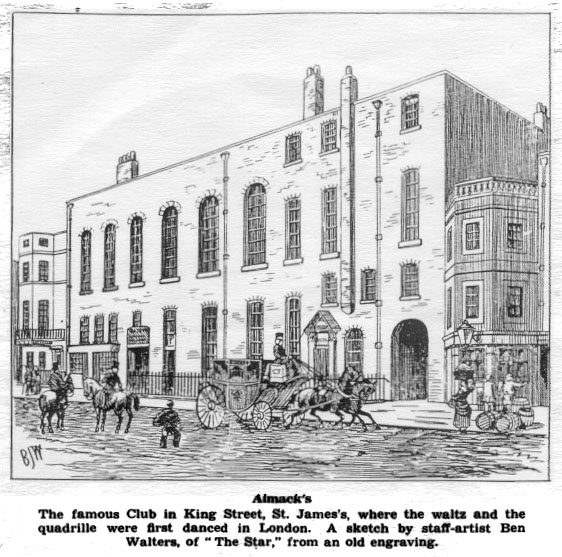
CELEBRATED ALMACKS’ WALTZ, THE. English, Waltz. D Major. Standard tuning. AABBCCDDAABB. The melody can be found in George Saunders’ (a self-described “Professor of Music and Dancing”) violin tutor entitled New and Scientific Self-Instructing School for the Violin (Providence, Rhode Island, 1847, No. 32, pg. 28; reprinted by Oliver Ditson in the 1850’s). Although the origin of the tune’s name is unknown, it should be noted that Almack’s Assembly Rooms (popularly known as Almack’s), King Street, London, was one of the most exclusive establishments of Regency society, and a center for fashionable popular dancing and entertainments. The rules were strict and entry was as guarded as any exclusive modern nightclub—the doors were manned by the manager and a well-known doorkeeper, Willis, and they closed at eleven-thirty promptly. Admissions vouchers had to be shown upon entry (Thompson, Dancing Through Time, 1998, pg. 131). The name Almack’s derived from its owner, William Macall, who reversed the syllables of his last name because he thought his real name sounded too Scottish, and thus unfashionable. The rooms (which consisted of a ballroom, supper rooms and game rooms) opened in 1765 and continued to be a center of social life through the mid-19th century. The doors were finally closed in 1863.
X:1
T:Celebrated Almacks’ Waltz, The
M:3/4
L:1/8
R:Waltz
B:Saunders
- New and Scientific
Self-Instructing School for the Violin (Providence, Rhode Island, 1847, No. 32, pg.
28)
N:Play AABBCCDDAABB
Z:AK/Fiddler’s Companion
K:D
(A>A)|A2 z2 (A>A)|A2 z2
(fe|dcBAGF)|(A2G2) (A>A)|A2 z2 (A>A)|A2 z2 (gf|edcBAc)|d2z2:|
|:A2|A2 A>A A2|(cdec) A2|d2 (fedc)|(BAGF)(ED)|B2 B>B
B2|(A2d2).F2|(EFGA)(Bc)|d2 z2:|
|:A2|{A}f4e2|(4dced (3cdB|A6|(F4A2)|{A}a4g2|(f3e)d2|e6|(e4 ^e2)|f4
f4|(g3f)e2|d4c2|B4e2|A4 A2|(A2B2).c2|(e6|d4):|
|:A2|{A}e4d2|.c2.B2.A2|f6|d4A2|e4
d2|.c2.B2.A2|f6|(dABc)(de)|f4 f2|(g3f)d2|d4c2|B4e2|A4 A2|(A2B2).c2|(e6|d2)z2:||
CELEBRATED GERMAN MINUET, THE.
Scottish, Slow Air (3/4 time). D Major. Standard tuning. AABCCDEEF. Gow
notes the variation sets of the tune are by “the late Mr. Nisbet of Dirleton,
and John Shaw Stewart Esquire.” The variations Gow prints were, in part,
composed by Mr. William Nisbet of Dirleton. William (1747-1822) was an
East Lothian landowner and army
officer, who married Mary Manners, daughter of Lord Robert Manners, and
grand-daughter of the Duke of Rutland. Their only child and daughter was Mary
Nisbet (b. 1778) of Dirleton, Countess of Elgin. In 1784 William acceded to the
barony of Dirleton upon the death of his father, also William. The Nisbets were hugely wealthy, and at her
birth Mary became one of the richest heiresses in the world. The family seat
was the manor of Archerfield, in Dirleton, some eighteen miles east of
Edinburgh. Father William was an amateur musician who was a member of the
Edinburgh Musical Society for much of his life. Gow (Third Collection of
Niel Gow’s Reels), 3rd ed., originally 1792; pgs. 34-35.
X:1
T:Celebrated German Minuet, The
M:3/4
L:1/8
R:Minuet or Slow Air
B:Gow – Third Collection of Niel
Gow’s Reels (1792)
Z:AK/Fiddler’s Companion
K:D
A,2|[D4F4]
[C2E2]|[B,2D2][A,2G2][A,2F2]|E>FGEFD|(FE)(DC)(B,A,)|[D4F4]
[C2E2]|[B,2D2][A,2G2][A,2F2]|
(EG)(FB)AC|{C}D4:||(d>c)(de)(fd)|(fe)(dc)(B^A)|”tr”B^ABcdB|(dc)(BA)(GF)|”tr”G>FGABG|(BA)(GF)(ED)|
“tr”E>FGEFD|(FE)(DC)(B,A,)|
|[D4F4] [C2E2]|[B,2D2][A,2G2][A,2F2]|”tr”(E>F)GEFD|(FE)(DC)(B,A,)|
|[D4F4]
[C2E2]|[B,2D2][A,2G2][A,2F2]|(EG)(FB)AC|{C}D4||A,2|A,[DF][DF][DF]
[CE][CE]|[B,D][B,D][A,G][A,G][A,F][A,F]|
“tr”E>F {A}GF/E/|(F/D/)(A/>F)|(FE)(DC)(B,A,)|A,[D/F/][.D/F/]
[.D/F/][.D/F/][.D/F/][.D/F/]
[.C/E/][.C/E/][.C/E/][.C/E/]|[.B,/D/][.B,/D/][.B,/D/][.B,/D/]
[.A,/G/][.A,/G/][.A,/G/][.A,/G/]
[.A,/F/][.A,/F/][.A,/F/][.A,F]|EGFBAC|{C}D4||A2|(d/e/)d/c/ (d/e/)f/d/
(g/f/)e/d/|(e/f/)(d/e/) (c/d/)(B/c/) ^A2|(B/c/).B/.A/ (B/c/).d/.c/
(e/d/).c/.B/|(c/d/)(B/c/) (A/B/)(G/A/) F2|
(G/A/)G/F/ (G/A/)B/A/
(c/B/)A/G/|(A/B/)(G/A/) (F/G/)(E/F/) D2|”tr”(E/D/)(E/F/) (G/A/)(E/G/)
(F/A/)(D/F/)|(FE)(DC)(B,A,)||
(D/F/)(B/F/) (D/F/)(A/F/)
(C/E/)(A/E/)|(B,/D/)(G/D/) (B,/D/)G/D/ A,/D/F/D/|”tr”(E/D/E/.F/ (G/A/)(E/A/)
(F/A/)(D/A/)|(F/A/)(E/A/) (D/A/)(C/A/) (B,/G/)(A,/C/)|
.D/(F/A/B/) (A/F/”tr”E/D/)
C/E/A/C/|[B,2D2][A,2G2][A,2F2]|(EG)(FB)(AC)|{C}D4||A2|(d/e/).d/.c/ (d/e/).f/.e/
(g/f/).e/.d/|(e/f/)d/e/ (c/d/)(B/c/) (^A/B/).c/.A/|
(B/c/).B/^.A/ (B/c/).d/.c/
(e/d/).c/.B/|(c/d/)(B/c/) (A/B/)(G/A/) (F/G/).A/.F/|(G/A/).G/.F/ (G/A/).B/.A/
(c/B/)/.A/.G/|(A/B/).G/.e/ (F/d/).E/.c/ (D/E/).F/.D/|
“tr”(E/D/).E/.F/ (G/e/)(E/G/)
F/d/D/F/|(F/d/)(E/c/) D/B/C/A/ B,/G/.A,/.C/||
CELEBRATED OPERA REEL, THE. AKA and see “Doon Reel [3],” "Haye's Fancy," "Gleann Eoghain." Not to be confused
with “Opera Reel.”
CELEBRATED STRATHSPEY
MINUET, THE. AKA and see "Mrs. Biggs (of Newcastle's) Delight."
Scottish, Dance Tune. A strathspey‑minuet was an 18th century creation in
which a twosome danced to a strathspey. The tune appears in Watlen's collection
of Celebrated Circus Tunes (1791),
inscribed "The celebrated Strathspey Minuet as danced by Mr. Lassells and
Mrs. Parker at the Royal Circus, London and Edinburgh."
CELEBRATED STOP
HORNPIPE. American, Hornpipe. B Flat major
(Cole, Ryan): D Major (Miller). Standard tuning. AABB. Probably a late 19th
century stage-hornpipe novelty. Cole (1000
Fiddle Tunes), 1940; pg. 86. Miller (Fiddler’s
Throne), 2004; No. 280, pg. 168. Ryan’s
Mammoth Collection, 1883; pg. 119.
X:1
T:Celebrated Stop Hornpipe
M:2/4
L:1/8
R:Hornpipe
N:The notes with the asterisk before
them are to be held extra length,
N:as the dancer chooses.
S:Ryan’s Mammoth Collection (1883)
Z:AK/Fiddler’s Companion
K:Bb
(F/E/) | D/d/c/B/ A/g/f/e/ | g/f/
*d2 f | (f/e/)(e/d/ (d/c/)(c/B/) | B/d/ *F2 (F/E/) |
D/d/c/B/ A/g/f/e/ | g/f/ *d2 (f/g/)
| f/e/c/A/ .F(G/A/) | BdB :: b/g/ |
f/d/B/F/ D/F/B/d/ | e/c/A/F/
E/F/C/E/ | D/F/B/A/ G/B/e/d/ | c/=B/c/d/ .c(b>g) |
f/d/B/F/ D/F/B/d/ | e/c/A/F/ E/F/C/E/
| D/F/B/F/ G/e/c/A/ | BdB :|
CELEBRATED TRUMPET TUNE, THE.
Scottish, Slow Air (3/4 time). A Major. Standard tuning. AABB. The Gows
remark: “Very Old. Upon the Circuits in Scotland this Air is played by his
Majesty’s Household Trumpeters attending the Lords of Justiciary, when that
high (Solemn) Court has occasion to Exercise its most painful Duty.” In
addition to his other talents, Nathaniel Gow was an accomplished trumpet player
and taught the instrument in Edinburgh. Carlen (Gow Collection), 1986;
No. 590. Gow (Fifth Collection of Strathspey Reels), 1809; pg. 22.
X:1
T:Celebrated Trupet Tune, The
M:3/4
L:1/8
R:Air
N:”Very slow and pathetic”
N:”Very Old”
N:” Upon the Circuits in Scotland
this Air is played by his
N: Majesty’s Household Trumpeters
attending the Lords of Justiciary,
N: when that high (Solemn) Court has
occasion to Exercise its most painful Duty.”
B:Gow – Fifth Collection of
Strathspey Reels (1809)
Z:AK/Fiddler’s Companion
K:A
A>B|c>B c>B c>B|(A2E2)
A>B|c2 dcBA|B4 ~A>B|c>B c>B c>B|(A2 E)z A>B|~c>d
.e.c.d.B|A4 :|
|:~c>d|e2 (fedc)|d2 (edcB)|c2
(dcBA)|{c}B4 A>B|c>B c>B c>B|(A2E) A>B|~c>d .e.c.d.B.|A4:||
“2nd Trumpet part”
|:C>E|A>E A>E A>E C2 A,2
C>E|A2 BAEC|E4 C>E|A>E A>E A>E|C2 A,z C>E|~A>B
.c.A.B.E|C4:|
|:A>B|c2 (dcBA)|B2 (cBAE)|A2
(BAEC)|E4 C>E|A>E A>E A>E|(C2 A,)z C>E|A>B .c.A.B.E|C4:||
CELIA CONNELLAN (Sigile Ni Conallain). AKA and see “My Love’s the Fairest Creature,”
“My Only Joe and Dearie O.”
Irish, Slow Air (2/4 time). D Minor/F Major (O’Neill): A Minor (Heymann).
Standard tuning. AB. Bunting says the composer of this air is Irish harper
Thomas Connellan (c. 1640-1700), and published two versions in his Ancient Music of Ireland (1840). A
Scottish version is found as “My Only Jo(e) and Dearie O,” says Heymann, but
the relationship (at least between O’Neill and Gow’s “My Only…”) seems distant
at best. As “Shiely Ni Conolan” it was one of the tunes recorded in the Belfast
Northern Star of July 15, 1792, as having been played in competition by one
of ten Irish harp masters at the last great convocation of ancient Irish
harpers, the Belfast Harp Festival, held that week. Heymann (Off the Record), 1990; pgs. 26-28.
O'Neill (Music of Ireland: 1850 Melodies),
1903/1979; No. 596, pg. 105. Clairseach Records 2381, Ann Heymann – “Ann’s Harp” (1981).
X:1
T:Celia Connellan
M:2/4
L:1/8
R:Air
N:”Slow”
S:O’Neill – Music of Ireland (1903), No. 596
Z:AK/Fiddler’s Companion
K:Dmin
A/4B/4 A/G/|Ad dd/4e/4f/4e/4|{^c}d2
d=c/A/|{=B}c2 G/E/G/A/|
{=B}c2 d/c/ {A/B/}A/G/|Ad
dd/4/e/4/f/4/e/4|{^c}d2 d=c/A/|{B}c2 E>D|
CA, CD/E/|F2 z||FG/A/ cA/4G/4F|E2
A/G/F/E/|D>E DA,|DE F/G/F/G/|
Ad/e/
fe|{^c}d2 d=c/A/|{B}c2 AG/E/|G/F/E/D/ D>D| D3||
CELIA O'GARA (Sighile ni Ghadharadh). AKA and see "The Kilruddery Hunt," "The Irish Hunt," "Oh! Had We Some
Bright Little Isle." Irish, Air (3/4 time). G Mixolydian/Major. Standard.
AB. A song, "The Kilruddery Hunt," was written to this air in 1744 by
Thomas Mozeen and Owen Bray of Loughlinstown, Co. Dublin. It soon became
enormously popular, according to Grattan Flood (1906), and was called by Ritson
"The Irish Hunt" (who incorrectly ascribed it to St. Leger). Kane
O'Hara used the tune in his "Midas" in 1760. The "Kilruddery Hunt," was a
"prime favorite" of the Irish patriot Theobald Wolfe Tone, and Thomas
Moore used the air in 1813 for his song "Oh had We some Bright Little Isle
of our Own." O'Neill (Music of Ireland: 1850 Melodies), 1903/1979;
No. 366, pg. 63.
X:1
T:Celia O’Gara
M:3/4
L:1/8
R:Air
N:”Moderate”
S:O’Neill – Music of Ireland (1903), No. 366
Z:AK/Fiddler’s Companion
K:G
BA|G2B2B2|A2c2c2|G2B2B2|c4
BA|G2B2d2|c2A2d2|B2G2G2|g4||
D2|GABCde|=f4 ag|^f2d2B2|c4
BA|G2B2d2|g4 ag|f2d2f2|g4 BA|
G2B2B2|A2c2c2|G2B2B2|c2e2g2|ed cB
AG|FG AB cA|B2G2G2|G4||
CELINA LE BLANC. AKA and see "Flannigan's
Polka." Canadian, Polka. Canada, British Columbia. C Major ('A' part)
& G Major ('B' part). Standard tuning. AA'BB'. Source for notated version:
Ned Landry (White Rock, British Columbia) via Joe Pancerzewski (northwestern
USA) [Reiner & Anick]. Reiner & Anick (Old‑Time Fiddling Across America), 1989; pg. 150. Voyager VRLP‑306, Joe Pancerzewski ‑ "The
Fiddling Engineer."
CELLAR DOOR KEY, THE. English, Old Hornpipe? (3/4 time). England,
Northumberland. G Mixolydian. Standard tuning. AABB. In Vickers' MS. the time
signature was 6/8 but notes were grouped in 3/4 (Seattle). See also the closely
related “Jack Lintel’s Jig.” Seattle (William
Vickers), 1987, Part 2; No. 377.
CELLO. American, March (?. 4/4 time). USA; Ohio, Michigan. A Minor ('A' part)
& C Major ('B' part). Standard tuning. AAB. The title is pronounced with a
soft 'C', as in "celebrity." Al Smitley collected the tune from an
elderly fiddler by the name of Ray Shepard whom (in May, 2000) was still
playing in his 80th decade. Smitley says: “Shepard grew up in
southern Ohio and it was there that he learned the tune. He moved to Michigan (south of Saline) when
he was a young man.” Source for notated version: fiddler Al Smitley of
Michigan’s Ruffwater Stringband [Johnson]. Johnson (The Kitchen Musician's No. 7: Michigan Tunes), vol. 7, 1986‑87;
pg. 12.
CELTIC CEILIDH. Canadian, Reel. Canada, Cape Breton. Composed by Cape Breton fiddler
and composer Dan R. MacDonald (1911-1976). Atlantica
Music 02 77657 50222 26, Carl MacKenzie - “Atlantic Fiddles” (1994). CLM
Records, Carl MacKenzie - “Celtic Ceilidh” (1986). Rounder Records 7057, Jerry
Holland – “Parlor Music” (2005).
CELTIC HUMOR. Irish? Jig. A Minor. Standard tuning. ABB. Harding’s All Round Collection, 1905; No. 104, pg. 33.
X:1
T:Celtic Humor
M:6/8
L:1/8
R:Jig
B:Harding’s All Round Collection, No. 104 (1905)
Z:AK/Fiddler’s Companion
K:Amin
c/d/|efe dBd|cBA ABc|dBc dBA|GAG
Gef|gfe dBd|
e^f^g aba|gfe dBe|AAA Aef||gfe
dBd|e^f^g aba|gfe dBe|ABA A2:|
CELTIC SOCIETY'S
QUICKSTEP, THE. Scottish, March (2/4 time). A
Mixolydian. Standard tuning. AAB (Lerwick): AABB (Kerr). Kerr (Merry Melodies), Vol. 3 (c. 1885); No.
416, pg. 46. Lerwick (The Kilted Fiddler),
1985; pg. 67. Green Linnet SIF 1047, John Cunningham -
"Fair Warning" (1983).
X:1
T:Celtic Society’s Quickstep, The
M:4/4
L:1/8
R:March
K:Amix
e2 | A2 AA c2 BA | c2 e2 e2 a2 | A2
AA c2 BA | dcBA GABG |\
A2 AA c2 BA | c2 e2 e2 g2 | B2 AB
GABd | e2 A2 A2 :: e2 |\
a2 e2 c2 BA | c2 e2 e2 ^g2 | a2 e2
c2 BA | g2 B2 B2 g2 |1\
a2 e2 c2 BA | c2 e2 e2 g2 | B2 AB
GABd | e2 A2 A2 :|2\
a2 ^gf g2 fe | f2 ed e2 dc | B2 AB
GABd | e2 A2 A2 ||**
CELINA REEL [1]. French Canadian, Reel. B Flat Major. Standard. AABB. Carlin (Master Collection), 1984; pg. 44, No.
59. Voyager 322, Louis Boudreault - "Old Time
Fiddler of Chicoutimi, Québec" (1977-1993).
CELINA REEL [2]. French-Canadian, Reel. G Major. Standard. AABB. Source for notated
version: Sara Hiebert via Dan Compton (Portland, Oregon) [Songer]. Songer (Portland Collection), 1997; pg. 47. “Québec Pure Laine.”
CENNEAG MOR. Scottish, Country Dance Tune (4/4 time). D Major. Standard. AABB.
X:1
T:Cenneag Mor
D:Wick S.C.D., A Call From the North (1973)
O:Scotland
Z:Nigel Gatherer
L:1/8
M:4/4
K:D
z|f2 f>e d>BA>B|d2 e>d B2 A2|f2 f>e d>BA>B|d>BA>B d2
d:|
A|d2 e<f a>fe<f|a>fe<f e>dB<A|d2 e<f
a>fe<f|a>Af>e d2 d:|
CENTENARY, THE. Irish, Jig. D Major. Standard tuning. AABB.
McNulty (Dance Music of Ireland),
1965; pg. 17.
CENTENARY MARCH, THE. AKA and see “St. Patrick’s (March).” Irish, March
(2/4 time). D Major. Standard tuning. AB. Sean Maguire’s recording of the
melody popularized this tune for Ceili band sessions. However, it apparently
was composed by one Arthur Kearney from Drumquin, County Tyrone, according to
his grand-daughter Emma O’Neill, to commemorate the Christian Brothers having
been in Omagh for 100 years. The march has become quite popular with East
Anglia trad. musicians as well as elsewhere in Britain, according to Barry
Callaghan (2007). The ‘A’ part has melodic similarities to that of “Bonaparte Crossing the
Rhine,” ”An Comhra Donn” and ”Caledonian March,” and can be found
in the British Isles and North America as well as Ireland. Callaghan (Hardcore English), 2007; pg. 31. O’Brien
(The Golden Eagle). Sullivan (Dublin Banjos). Old
Hat Music OH!02, "Old Hat Dance Band" (1992). Outlet OLP 1001, Tom
McHaile (1969). Outlet SOLP 1031, Sean Maguire (1977). Gallowglass Ceili Band.
X:1
T:Centenary March, The
R:March
M:2/4
L:1/8
K:D
FG|A2 A>B|AF ED|f2-f>d|ed
Bd|A2 A>B|AF ED|E2 E>F|E2 DF|!
A2 A>B|AF ED|f2-f>d|ed Bd|A2
d>e|fe dc|d2 d>e|d2||!
Ad|f>e fa|Ad fa|g2 f2|e2
f>g|af dA|FA GF|E2 E>F|E2 FG|!
AD FA|dF Ad|fa gf|ed cB|Aa ^ga|ge
cA|d2 d>e|d2||
CENTENNIAL, THE. AKA and see "The Home Town Band." USA,
southwestern Pa.
CENTENNIAL BREAKDOWN, THE. Canadian, Reel. B Flat Major ('A' part) &
F Major ('B' part). Standard tuning. AABB. Presumably composed in honor of the
Canadian Centennial in 1967. Messer (Anthology
of Favorite Fiddle Tunes), 1980; No. 17, pg. 16.
CENTENNIAL HORNPIPE
[1]. American, Hornpipe. B Flat major.
Standard tuning. AABB. The title presumably honors the United States’ Centennial
of 1876. “As performed by R. Tyson,” notes Ryan. "Can be used as a
Clog." Cole (1000 Fiddle Tunes),
1940; pg. 99. Ryan’s Mammoth Collection,
1883; pg. 135.
X:1
T:Centennial Hornpipe
M:C|
L:1/8
R:Hornpipe
S:Ryan’s Mammoth Collection (1883)
Z:AK/Fiddler’s Companion
K:Bb
(dc) | B>Fd>c B>Fd>c |
B>Fe>d c2 (fe) | d>fB>d c>eA>c | B>ba>g f>ed>c |
B>Fd>c B>Fd>c |
B>Fe>d c2 (fe) | d>f(Bd) c>eA>c | B2d2B2 :: (AB) |
c>f=e>g f2 (AB) |
c>f=e>f f2 (AB) | c>=eg>b a>gf>e | f>=ef>g f2 (AB) |
c>f=e>g f2 (AB) |
c>f=e>g f2 (AB) |
c>=eg>b a>gf>=e |1 f2a2f2 :|2 {g}f>=ef>g f>_ed>c
||
CENTENNIAL HORNPIPE
[2].
Canadian, Hornpipe. Composed by Sarnia, southwestern Ontario, fiddler
John(ny) Durocher (1934-1989) in honor of the 1967 Canadian Centennial. John
was born the youngest of sixteen children, to a modest family of few resources.
He quit school in his young teens to help make family ends meet and remained a
factory worker for most of his life, not even possessing a drivers license.
John came to fiddling when he found a broken fiddle in the trash one day and
asked the owner for permission to retrieve it; with some repair work he had his
first instrument. A few lessons from a local teacher (which served to teach him
how to read and write music), were all the formal music education John
received. He was a prolific composer of fiddle tunes, however, and named them
for sports and current events, family and friends and topics of his day,
explains Ritchie. Durocher’s music was picked up by radio fiddler Don Messer,
who included many of his tunes in his broadcasts and printed collections,
helping Durocher to become quite influential in the Ontario scene for his over
400 compositions. [For more see Ron Ritchie, “John Durocher: A Gifted
Composer,” Fiddler Magazine, vol. 12,
No. 2, Summer 2005, pgs. 25-27].
CENTENNIAL POLKA. Canadian, Polka. Composed by Sarnia,
southwestern Ontario, fiddler John(ny) Durocher (1934-1989) in honor of the
1967 Canadian Centennial. John was born the youngest of sixteen children, to a
modest family of few resources. He quit school in his young teens to help make
family ends meet and remained a factory worker for most of his life, not even
possessing a drivers license. John came to fiddling when he found a broken
fiddle in the trash one day and asked the owner for permission to retrieve it;
with some repair work he had his first instrument. A few lessons from a local
teacher (which served to teach him how to read and write music), were all the
formal music education John received. He was a prolific composer of fiddle
tunes, however, and named them for sports and current events, family and
friends and topics of his day, explains Ritchie. Durocher’s music was picked up
by radio Don Messer, who included many of his tunes in his broadcasts and
printed collections, helping Durocher to become quite influential in the
Ontario scene fonr his compositions. [For more see Ron Ritchie, “John Durocher:
A Gifted Composer,” Fiddler Magazine,
vol. 12, No. 2, Summer 2005, pgs. 25-27].
CENTENNIAL WALTZ. Canadian, Waltz. B Flat Major. Standard tuning. AABB. Composed by
Maritime fiddler Don Messer (1909-1973), probably in honor of the Canadian
Centennial in 1967. Messer was born in Tweedside, New Brunswick, and became
widely popular throughout Canada as a result of his radio broadcasts and
long-running television show, Don Messer’s Jubilee (which debuted in
1959). Fiddler Magazine, Winter 2005/06, vol. 12, No. 4; pg. 50. Messer
(Anthology of Favorite Fiddle Tunes),
1980; No. 177, pg. 123. MCA Records MCAD 4037, “The Very
Best of Don Messer” (1994). Voyager 310, Gerry Robichaud‑‑"Down
East Fiddling."
X:1
T:Centennial Waltz
M:3/4
L:1/8
R:Waltz
C:Don Messer
K:Bb
DE|F3d ^cd|B2F2D2|E3 G E/D/C|G,4
B,2|A,3G, A,C|F3 G/F/ =EF|1 G2F2e2|
d4 DE:||2 G2 “tr”F2A2|B4 de||f3b ab|d4
ed|c3g ec|(G4 G)G|“tr”F2A2c2|f3”tr”f =ef|
g2f2b2|d4 de|f2b2d2|f4 ed|c2e2c2|G4
G2|”tr”F2A2c2|f3 “tr”f =ef|g2g2A2|B6||
CENTERVILLE [1]. American, March (2/4 time). USA,
Pennsylvania. D Major. Standard tuning. AABB. This fife march is recognizable
in the 'B' part to the 'B' part of version No. 2, which may be a variant.
Source for notated version: Hoge MS, No. 24, 1944 [Bayard]. Bayard (Dance to the Fiddle), 1981; No. 383, pg.
367.
CENTERVILLE [2]. Old‑Time, Breakdown. USA, Nebraska.
A Major. Standard or ADae tunings. AABBCC. Source for notated version: Bob
Walters (Burt County, Nebraska, 1951) [Christeson]. R.P. Christeson (Old Time Fiddlers Repertory, vol. 2),
1984; No. 15, pg. 12.
CENTURY HORNPIPE. American (?), Hornpipe. D Major. Standard
tuning. AABB. In the music manuscripts of American painter William Sydney Mount
(Long Island, New York), with the notation: “As played by my Uncle. Jan. 1st,
1802.”
X:1
T:Century Hornpipe
M:C
L:1/8
R:Hornpipe
S:William Sydney Mount music
manuscripts
N:”As played by my Uncle. Jan. 1st,
1802.”
Z:AK/Fiddler’s Companion
K:D
(AG) | F2D4 EF | G2E4 FG | Adcd BAGF
| G2E4 AG | F2D4EF |
G2E4A2 | BGBd cAce | d2d2d2 :: e2 |
(fA).f.a (fA).f.a | (eA).e.g (eA).e.g |
(fA).f.a (fA).f.a | (fd).a.f e2 fg |
(fA).f.a (fA).f.a | (eA).e.g (eA).e.g |
.f.d.c.B AGFE | D2d2D2 ||
CEO DRAOIGHEACHTA, AN. AKA and see “The Magic Mist.”
CEO NA gCNOC. AKA – “Ceili na gCnoc.” Irish, Reel. A Dorian. Standard tuning. AA’BB’.
The tune was collected in Connemara by Seamus Ennis and popularized by him.
Piper Jimmy O’Brien-Moran also has a slightly different version.
X:1
T:Ceo na gCnoc
M:4/4
L:1/8
K:Ador
g|:eA~A2 efge|dG~G2 DGBd|eA~A2 efge|dBGA BAAg|
eA~A2 efge|1 dG~G2 (3BAG Bd|eA~A2 efge|dBGA
BAAg:|
[2 dBGA BABd|eA~A2 efge|dBGA BABd||
|:ea~a2 agag|eaag e2dg|ea~a2 agaf|gedB GABd|
ea~a2 agag|eaaf ~g3a|agbg abga|1 edgd BAAd:|2 edgd BAA||
CEOL
AN MALA. AKA – “Ceol a’ Mhála.” Irish,
Single and Double Jig. G Major. Standard tuning. AABB. McNulty (Dance Music of Ireland), 1965; pg. 17.
Tubridy (Irish Traditional Music, Book
Two), 1999; pg. 29.
X:1
T:Ceol a’ Mhála
L:1/8
M:6/8
K:G
A|BAB G2D|GAG GAG|BAB GDG|A2B c2A|BAB G2D|GAG GBc|ded dcB|A2B c2:|
|:A|B2d ded|ded ded|B2d ded|e2f g3|B2d ded|ded def|gfe dcB|A2B c2:|
CEOL NA gCEARTAN (Music in the Forge). AKA and see “Irishman’s Love [2],” “Music in the Forge,” “My Sweetheart Jane,” "Peigin Leitir Mor," “The Pretty Girls of Mayo,” "Sweeney's Reel," "Sweet Biddy of Ballyvourney." Irish, Reel. G Major.
Standard tuning. AB. Source for notated version: piper Willie Clancy
(1918-1973, Miltown Malbay, west Clare) [Mitchell]. Mitchell (Dance Music of Willie Clancy), 1993; No.
50, pg. 58.
CEO NA gCNOC. Irish, Reel. Collected by piper Séamus Ennis from Pat Phatch Ó
Ceannabháin. Piping Pig Records PPPCD 001, Jimmy
O’Brien- Moran – “Seán Reid’s Favourite” (1996).
CEOL NA SEILGE. See "The Sport of the Chase."
CEOL SA CHISTIN (Music in the Kitchen).
Irish, Reel. Composed by County Tipperary fiddler Seán Ryan (d. 1985).
Ryan (Seán Ryan’s Dream); 10.
CEOLCHUMANN, AN (The Music Society). AKA and see “The Music Society.”
CEÓLTA CRUIT (The melody of the Harp). Irish, Air (3/4 time). B Flat
Major. Standard tuning. AB. Stanford/Petrie (Complete Collection), 1905; No. 1066, pg. 270.
X:1
T:Ceólta Cruit
M:3/4
L:1/8
R:Air
B:Stanford/Petrie – Complete
Collection, No. 1066 (1905)
Z:AK/Fiddler’s Companion
K:Bb
B/c/ dc|B2 AG F>D|F3 F GA|G2 GF
GA|B3 B/>c/ dc|B2 AG FD|
F3 F GA|Ge d>c BA B3||B Bc|d3d
ed|c3 c/d/ ef|B2 AG FD|
D3 B/c/ dc|B2 AG FD|F3 F G>A|Ge dc BA|B3||
CEOLTÓIR FÁNACH, AN (The Wandering Minstrel). AKA and see “The Wandering Minstrel,” "Willy Walsh's Jig," "The Merry Maiden [1]," "The Dandy Scholar."
CERES GREEN. Scottish, Strathspey. A Major. Standard tuning. AAB. MacDonald (The Skye Collection), 1887; pg. 19.
X:1
T:Ceres Green
M:C
L:1/8
R:Strathspey
S:MacDonald – Skye Collection (1887)
Z:AK/Fiddler’s Companion
K:A
E|A2 c>A e2 c>A|B>AB>c
B2c2|A>2 c>A e2 c>A|B>A B>c A2 z:|
e2 e>c f2f2|d>f e>c B2B2|e2
e>c f2f2|a>g f>g a4|e2 e>c f2f2|e>f ec B2B2|
AA B>B c>c d>d|e>d
c>B A4||
CERVENY SATECEK (Red Handkerchief). Bohemian, Air. Frankie Yankovic remade this
Bohemian tune as "Blue Shirt Waltz," which became a hit among ethnic
music aficionados in the northern mid-west United States in the mid-20th
century.
C'EST PAS LA PEINE TU
BRAILLES (It's No Use for You
to Cry). Cajun,
Waltz. USA, southwestern Louisiana. G Major. Standard tuning. One part. A
related song is fiddler Dennis McGee's "Bebe
Creole." Francois (Yé Yaille
Chère!), 1990; pgs. 350-351.
CETTE-LA J'AIME (The One I Love). Cajun, Waltz. USA, southwestern Louisiana. G
Major. Standard tuning. One part. Source for notated version: Adam Hebert (La.)
[Francois]. Francois (Yé Yaille Chère!),
1990; pgs. 352-353. Swallow Records SW-LP6065, Adam
Hebert.
_______________________________
HOME
ALPHABETICAL FILES REFERENCES
© 1996-2009 Andrew Kuntz
Please help maintain
the viability of the Fiddler’s Companion on the Web by respecting the
copyright.
For further information see Copyright and Permissions Policy or contact the author.
[COMMENT1]This was
Font/Pitch 1,10 - Off.
[COMMENT2]This was Font/Pitch 1,10 - On.
[COMMENT3]This was Font/Pitch 1,10 - Off.
[COMMENT4]Note: The change to pitch (12) and font (1) must be converted manually.