2019-12-30
|
Added engineering-drawing titles and marked
illegible scans in LEM aperture-card box 502.
(Thanks, Hartmuth!) This actually completes the
indexing for all LEM aperture-card boxes that have been
scanned so far, >15K scans ... but keep in mind
that's only 8 boxes out of the 280 total LEM boxes.
Unfortunately, the aperture-card scanner broke down a couple
of weeks ago, and I'm not privy at present to the proposed
scheduling for getting it fixed. Actually, what with
the intervening Holidays and various other coincidental
conditions, I'm not even sure that the scheduling has been
addressed yet at NARA. Well, it'll be fixed when it
will be fixed, and for now we'll have what we'll have.
In the interim, I'm hoping to go back and scan (with a
different, slower scanner) the drawings which proved
partially or completely illegible on the first
attempt. That's about 400 scans. But again,
we'll have to see.
|
2019-12-29
|
- Added engineering-drawing titles and marked illegible
scans in LEM aperture-card box 509.
- I've noticed somewhat belatedly that our Virtual AGC
home page, which brags quite a bit about — excuse me, I
mean humbly mentions, almost as an aside — the various
materials the project provides, failed to mention the
LEM engineering drawings. I've corrected that
oversight.
|
2019-12-27
|
Added engineering-drawing titles and marked
illegible scans in LEM aperture-card box 508. |
2019-12-23
|
Added engineering-drawing titles and marked
illegible scans in LEM aperture-card box 507. Fixed
a number of erring revision codes and sheet numbers in boxes
503-506 as well.
|
2019-12-22
|
Retroactively marked the illegible scans in
LEM aperture-card box 504. Apparently this had also
been done for box 505 as well, although I was too daft to
note it, so the upshot of that is that all of the LEM boxes
to which drawing titles have been completely added (namely
503-506, as opposed to the boxes still being processed) have
also had their illegible scans marked for later
rescanning. Each future LEM box will have drawing
titles and illegible-scan markings added concurrently.
|
2019-12-20
|
- The engineering-drawing titles for LEM aperture-card box 506 have
been added. I've also started inventorying and
marking scans which are too illegible for one reason or
another (usually due to being too light to fully read),
so that's been done here as well.
- Retroactively marked the illegible scans in LEM
aperture-card box 503, to which I had previously added
the titles a week ago, as well as finding/fixing an
incorrect drawing number or two that I missed on the
first pass through the box.
|
2019-12-19
|
- A table of 50 or so LEM engineering drawings that was
previously gratuitously stuck at the end of the page for miscellaneous
G&N engineering drawings, for lack of a better
place to put it, has now been removed to its own
dedicated page
for miscellaneous LEM engineering drawings.
I suppose this reorganization doesn't need any serious
justification ... nevertheless, it was done because I
now recognize the need to eventually rescan a fairly
significant number of LEM aperture cards whose initial
scans are not legible enough. The new
miscellaneous LEM page will be a good place for those
rescans to live.
- Although there will be no "search engine" for the LEM
engineering-drawing scans like the one for the G&N
scans — simply because the search database would be too
big to reasonably load into a browser with the current
situation vis-à-vis network
bandwidth, computer memory, and so on — I've belatedly
realized that there's no reason I can't provide such an
index as a non-browser file that you can explicitly
download, load into a spreadsheet, etc. So I've
added a master LEM
engineering-drawing index file. I expect
this file will eventually exceed 60MB in size — which
should give you some idea why I don't think you'd want
to load it into your browser — though right now it's in
the neighborhood of just 2MB. Since the project of
scanning the LEM drawings and indexing them is ongoing,
the master-index file is naturally a work-in-progress as
well!
- Added the titles for engineering drawings in LEM
aperture-card box
505.
|
2019-12-16
|
Added the scans of LEM engineering drawings
from aperture-card Box
509.
|
2019-12-14
|
Added the engineering-drawing titles for LEM
Box 504.
|
2019-12-13
|
- Added the scans of LEM engineering drawings from
aperture-card Box
508.
- Added the engineering-drawing titles in LEM Box 503.
This is the first LEM box whose title-addition has been
completed (though Hartmuth is working on Box 502 as
well), and as such is likely to have some teething
problems ... but whether or not that turns out to be the
case, it's still a lot better than having no
titles. A handful of drawing numbers and/or titles
are missing or partial for a variety of reasons, such as
the scan just being too light or the sheets containing
the titles being in aperture-card boxes that haven't yet
been scanned. So expect there will be still be
some improvements in that area in the coming months or
years as additional scans dribble in.
|
2019-12-11
|
Added the scans of LEM engineering drawings
from aperture-card Box
507. Corrected the engineering-drawing titles in
G&N aperture-card boxes 471 and 472. Modulo any
boo-boo's on my part, that means that the drawing titles in
all of the G&N aperture-card boxes are now up-to-date.
|
2019-12-10
|
The drawing titles were corrected for
aperture-card boxes 457 and 468-470. For all of these
boxes other than 468, as well as for box 456 (yesterday),
there were additionally dozens of corrections in each box to
drawing numbers (rather than just drawing
titles). Perhaps the scanner had become dirty at that
point without my noticing, and thus was reading the punched
aperture-card metadata unreliably. Or whatever.
Well, live and learn! Fortunately the mistakes were
very regular, so they were relatively easy to spot.
(All the ones I spotted related to 9's having turned into
8's.) Still, I suppose it's possible I missed some of
them.
|
2019-12-09
|
Drawing titles corrected for aperture-card
boxes 454, 455, and 456.
|
2019-12-07
|
Drawing titles corrected for aperture-card
boxes 451, 452, and 453.
|
2019-12-06
|
Drawing titles corrected for aperture-card
box 450.
|
2019-12-05
|
Added several boxes of LEM engineering
drawings: Box
504, Box 505,
Box 506. As
indicated in previous comments, the indexes won't initially
include drawing titles, since those have to be manually
input.
|
2019-12-03
|
Added a couple of RTCC-related mission-specific
documents (AS-207/208 and AS-503A/504A) to the
document library.
|
2019-11-30
|
With the completion of scans of the MIT
G&N System engineering drawings last week, scanning of
GAEC (Grumman) LM engineering drawings has now
commenced.
I've had second thoughts about my earlier comments, wherein
I said that I wouldn't bother to index any of the LM
drawings, and have decided to go ahead and provide a
dedicated index page for each box of LM drawings.
Nevertheless, for technical reasons it's still the
case that I don't intend to add any of these LM drawings to
the master engineering search engine or to provide assembly
drilldowns. So the drawings will still be a trifle
trickier to access than the G&N drawings in some
cases. At any rate, the first couple of boxes are now
available, namely Box
502 and Box 503.
We won't be reaching the drawing-number range containing the
top-level drawings for the LM until boxes 518 through 528,
though, which hopefully will happen sometime in January
2020, depending on the breaks. Due to the fact that
the metadata for the LM drawings is completely different in
form from the metadata I was working with for the G&N
system, the process of creating these indices is very much a
work in progress that will undoubtedly experience a few
initial hiccups.
Unfortunately, the drawing metadata (drawing number,
revision code, etc.) on which the box-index pages are
necessarily based turns out to be incorrect much more often
than I've been accustomed to in the earlier (G&N system)
scans. There are dozens of such errors in boxes 502
and 503 alone. The usual error is an incorrect drawing
number. Thus it is often the case that due to being
mislabeled, a drawing may not only be in the wrong position
in the index table for any given box, but may even be in the
wrong box entirely. I've made an attempt at correcting
these, but given the vast number of scans involved, there's
just no way I can do it whilst still performing scans of
additional boxes. In other words, I had to give up
pretty quickly. Perhaps they can be corrected in the
future ... perhaps by someone much more interested in the
LEM drawings than I personally am. (Hint!) But
don't hold your breath waiting for me to do more than a
handful of them myself.
Possibly even worse, the aperture-card punch-data doesn't
list any of the drawing titles at all, not even the
abbreviated titles as the G&N punch-card metadata
did. So at present, all (or almost all) drawing titles
are simply listed as blank. Over the course of time,
perhaps, those drawing titles can be manually added to the
index pages. (Again, hint! Hint!!) As a
rule of thumb, I'd say that any entries having a non-blank
title in the index have also been double-checked or correct
insofar as their other metadata.
|
2019-11-22
|
Finished correcting all engineering-drawing
titles for aperture-card boxes 474-477. That doesn't
mean that all titles for all scanned boxes are corrected yet
— even though 477 is the last box scanned so far — but it
does mean that all Job Description Card (JDC) titles have
now been corrected. I just happened to think those
were more interesting than the "regular" drawings I've
scanned in earlier boxes but haven't corrected yet, so I
decided to do them tout suite. 
|
2019-11-21
|
Completed scanning aperture-card box 476, plus box 477. Note that
boxes 431-477 are the entirety of the Apollo G&N System
engineering drawings stored at the National Archives
Southwest branch in Forth Worth, Texas, and thus I've now
scanned all available CM/LM G&N drawings.
As far as we know. There's always the possibility of
aperture-cards being stashed in the wrong boxes and
therefore remaining undiscovered — indeed, I found a dozen
or so such drawings today — but admittedly, it may be a very
long time (if ever) before such misplaced drawings are
revealed. In other words, I wouldn't hold my
breath! At any rate, the grand total so far is about
90K scans of about 12K unique drawing numbers.
That doesn't mean the work on these G&N drawings has
finished. Many of the indices for the boxes still need
to have their drawing titles corrected to agree with the
drawings' title blocks (as opposed to the aperture cards'
punched metadata), and many assemblies represented by the
drawings still need to have their bill-of-material
information digitized to allow accurate assembly drilldowns;
plus, those electrical drawings being transcribed to CAD
still need transcription. Nevertheless, the initial
work of physically scanning the drawings has finished, and
the remaining work on them can proceed without regard to
physical access to the archives.
It also doesn't mean that scanning is complete,
either. While scanning of guidance & navigation
drawings has finished, many additional (non-G&N)
unscanned boxes of aperture cards remain. The next
step is to scan Grumman's LM engineering drawings, boxes
241-333 and 502-688. A quick calculation shows that
there are 280 LM boxes (over 500K scans) vs the 47 G&N
boxes (90K scans) ... so it may take quite a while.
There are additionally many hundreds of North American CSM
boxes, but I'm not currently planning to scan any of those
personally; I have reason to believe they may eventually
become available via other mechanisms without any
intervention be me (thank goodness!), but "eventually" is a
rather open-ended concept in this case.
Incidentally, box 477 contained a group of drawings (over
500 of them) not conforming to the pattern of the other
G&N drawings. The group included such things as IRNs
(Interface Revision Notices) and TDRRs (Technical Data
Releases or Revisions). Right now, it's hard for me to
deal with these anomalous drawings in the same kind of
context (i.e., master
engineering search engine or aperture-card box index
pages) as the other drawings. As a result, instead of
including them on the
box 477 page, I've segregated them onto a
separate "Additional Engineering Drawing" portal, from
which you can still view the scan without any expectation of
them being pre-digested by me. Several other groups of
anomalous drawings (from boxes 431 and 472, and elsewhere)
have been included on that portal as well. I expect
that the Grumman LM drawings whose scanning will commence
soon will be handled in that same way, simply because it
would be incredibly time-consuming for me to treat them
comparably to the G&N drawings. In other words,
I'm willing to scan non-G&N drawings, but not to fuss
with them endlessly. That will be left as an exercise
for the reader.
|
2019-11-20
|
Completed scanning aperture-card box 475 and about
95% of box 476.
|
2019-11-19
|
Completed scanning aperture-card box 474 and about
80% of box 475. |
2019-11-18
|
Finished updating JDC document titles in box
473, as well as a few in 474.
|
2019-11-17
|
Updated various JDC document titles in box
473.
|
2019-11-15
|
Completed scanning aperture-card box 473 and about
50% of box 474. |
2019-11-14
|
Completed scanning aperture-card box 472 and about
40% of box 473.
Box 472 is actually the end of the Apollo G&N
engineering drawings as such, and box 473 marks the
beginning of a series of boxes containing Job Description
Card (JDC) documents. The documents themselves
represent things like test procedures for Apollo G&N
equipment, process instructions pertaining to that
equipment, and so on. Box 472 also contains a couple
dozen Grumman Aircraft Engineering Corporation "interface
revision notices" for the Lunar Module. I don't
understand the system for designating those notices, so
while we link to an archive
of their scans, I've made no attempt to actually index
any of them.
|
2019-11-13
|
Corrected the engineering-drawing titles for
aperture-card boxes 447, 448, and 449. Unfortunately,
for box 449, just as there was for box 444 (see the entry
below for 2019-11-11), there is a range of roughly 150 scans
with randomly mispunched aperture-card metadata. I
think I've corrected them, but there were so many of them
that I'm bound to have made a few errors along the
way. Nor (due to the effort involved) did I bother to
move all of the corrected scans around to their proper
positions on the index
page for box 449. In other words, drawing-index
table on the box 449 page is somewhat out of order.
Fortunately, all of the scans are within 5-10 rows in the
index table from where they should actually be located, and
finding them hopefully isn't too much trouble.
Probably I'll revisit that page at some point and finish
fixing it all up nicely.
|
2019-11-12
|
Corrected drawing titles for aperture-card
boxes 445 and 446. Various mil-spec
drawings added, as referenced by recently-added
engineering drawings.
|
2019-11-11
|
Corrected drawing titles for aperture-card
boxes 443 and 444. In box 444, there was a
previously-missing drawing (1020428) with mispunched
aperture-card data that had incorrectly identified it (as
1010428). Unfortunately, due to the vast number of
scans being made, time-pressure has so far caused me to
often trust the drawing numbers punched in the
aperture cards, and to assume that only the drawing titles
need to be corrected. In other words, since the titles
are the same for all cards with the same drawing number, I
haven't typically needed to look at every single scan, and
hence haven't really had any way to detect scans with
miscoded drawing numbers or revision codes. Over the
past few days, though, I've been finding such miscodings,
which have usually ended up in the wrong boxes (as 1020428
did), rendering them undiscoverable afterward if the drawing
numbers aren't corrected. So at some point, sadly, I'm
going to have to revisit these scans and look at every
single one of them to see if their drawing numbers and/or
revision codes match the index. At the moment there
are over 80K scans ... and soon to be over 100K for the
Apollo G&N system alone. I can't say I'm looking
forward to that. Anyone to wants to volunteer to help
with that double-checking would be welcomed eagerly.
|
2019-11-10
|
Corrected drawing titles for aperture-card
boxes 441 and 442.
|
2019-11-09
|
Corrected the drawing titles for
aperture-card boxes 439 and 440 to match the drawings rather
than the aperture-card metadata. Quite aside from the
error-prone nature of this activity, due to it being almost
entirely manual, there was an additional difficulty for box
439. As you may recall, the microfilm slides of the
drawings are taped into "aperture cards", which are computer
punch-cards into which metadata such as the drawing number,
revision code, etc., has been punched. Well, it looks
for all the world as if (back when the aperture cards were
created, whenever that may have been) whoever was
doing it may have dropped a hundred or so of the microfilm
frames on the floor prior to taping them into the cards, and
then picked them up and taped them into the cards without
checking that the slides were still in the correct
order. So for this range of 100 or so scans, the
metadata usually does not match the drawings. The
drawing numbers are often right (but not always) on the
messed-up cards, but the revision codes were usually
wrong. Yikes! (Or Yipe! if you prefer.)
Well, I "corrected" all of that on the box 439 index page,
but with so many of the scans needing to be fixed, who knows
how many errors I missed! What can I say? It's a
process.
|
2019-11-08
|
Completed scanning Apollo G&N engineering
drawings from aperture-card box 470, added the
entire box 471,
and about 5% of box
472. Unfortunately, in the case of the latter
two boxes, the scanner began degrading very rapidly toward
the end of the process ... i.e., the scanner requires
cleaning. When that happens, it tends to mean that the
metadata scanned from the cards is often incorrect, which is
precisely what happened in this case. That metadata
(drawing number, revision, sheet number, frame number, etc.)
is used to form the index tables for their respective
web-pages, so errors in the metadata result in a corrupted
index. I've corrected many hundreds of entries in the
indices for boxes 471 and 472 so far, but there's no
guarantee I've caught all of the errors. Hopefully, if
there are errors remaining in the index, they'll be caught
and corrected in the reasonably near future. For now
(alas!) I'm going to curtail scanning activities until the
scanner has been cleaned, because finding/correcting the
drawing index is quite a laborious process. Hopefully
I'll be able to resume scanning again around the middle of
next week.
My short-term goal is to finish scanning all of the Apollo
G&N boxes (i.e., through box 477) by November 21, which
is the last day the U.S. government (and hence the National
Archives) is funded. In other words, if the government
shuts down on the 21st, then scanning will be impossible for
the duration of the shutdown. Personally, I think a
shutdown is highly likely. News reports, on the other
hand, are so far discounting that possibility. Well,
we'll see; I'd be happy to be wrong. At any rate,
after box 477 is scanned, then scanning of the (hopefully!)
complete set of Grumman Lunar Module aperture cards will
commence. I expect that process to take the next
couple of years.
|
2019-11-06
|
Completed adding Apollo G&N engineering
drawings from aperture-card box 469 and added almost
(but not quite) all of box 470. |
2019-11-05
|
Completed adding Apollo G&N engineering
drawings from aperture-card box 468 and added
about the initial 90% of box 469. |
2019-11-04
|
Completed adding Apollo G&N engineering
drawings from aperture-card box 457 and added
about the initial 75% of box 468.
(Boxes 458-467 had already been scanned previously.)
|
2019-11-03
|
Corrected all engineering-drawing titles in
drawing index for and assembly drilldowns for Box 438 ...
i.e., change them to match the titles on the drawings
themselves rather than the abbreviated titles from the
aperture-card metadata. I used a new software tool to
ease the burden slightly, so I hope that hasn't introduced
any errors on its own. Visual inspection and HTML lint
tools don't reveal any obvious errors, so the new tool
probably works. At any rate, I'm working upward (in
box/drawing numbering), and it will take quite a while
before the corrections catch up the the ongoing scanning.
|
2019-11-01
|
- Completed adding Apollo G&N engineering drawings
from aperture-card box
456 and added about the initial 60% of box 457. A
handful of additional assemblies were also added to the
assembly
drilldowns.
- Modified the instructions for building Virtual AGC on
the Raspberry Pi for the latest version of the operating
system (Raspbian Buster).
|
2019-10-31
|
Completed adding Apollo G&N engineering
drawings from aperture-card box 454, added the
entire box 455,
and added about the initial 25% of box 456. A
handful of additional assemblies were also added to the assembly
drilldowns.
|
2019-10-29
|
Completed adding Apollo G&N engineering
drawings from aperture-card box 453, and added
the first 95% or so of box
454, and added some additional assemblies to the assembly
drilldowns.
|
2019-10-28
|
Completed adding Apollo G&N engineering
drawings from aperture-card box 452, and added
the first 80% or so of box
453. |
2019-10-25
|
Completed adding Apollo G&N engineering
drawings from aperture-card box 451, and added
the first 60% or so of box
452. |
2019-10-24
|
Completed adding Apollo G&N engineering
drawings from aperture-card box 450, and added
the first third or so of box 451. We've
now surpassed 60K scans of engineering drawings in the
library, though that's a little less than 8K unique drawing
numbers.
|
2019-10-23
|
I had intentionally, temporarily omitted 78
scans of North American Aviation "Interface Revisions
Notices" from aperture-card
Box 431. I had been confused about how to
present them, given the fact that they follow a different
numbering system than all of the other engineering drawings
scanned so far, and that the aperture-card metadata isn't
entirely accurate. Well, a lot of time has passed, and
my confusion persists. So in the end I've handled it
by simply adding a link to their raw scans at our Internet
Archive site, without any attempt to systematically present
them in indexed form at all. Too bad, but better than
nothing! If anybody can figure them out systematically
enough to provide me with a reasonable index of them, I'd be
happy to post it.
|
2019-10-22
|
|
2019-10-21
|
Completed scans from aperture-card Box 447, along with
almost all of of Box
448. As usual, the hyperlinks at our Internet
Archive site may take a while to become "live". The G&N
assembly drilldowns were regenerated. |
2019-10-18
|
Completed scans from aperture-card Box 446, along with
the initial half (and a tad more) of Box 447. As
usual, the hyperlinks at our Internet Archive site may take
a while to become "live". The G&N
assembly drilldowns were regenerated.
|
2019-10-17
|
Completed scans from aperture-card Box 445, along with
the initial half (and a tad more) of Box 446. As
usual, the hyperlinks at our Internet Archive site may take
a while to become "live". Various assemblies were also added
to the G&N
assembly drilldowns. |
2019-10-16
|
Completed scans from aperture-card Box 444 and scanned
the initial 25% or so of Box 445. At
this writing, some of the uploading and online processing at
the Internet Archive is still being performed, so some links
may take a while to become "live". Various related things
(assemblies and individual parts) were also added to the G&N
assembly drilldowns. |
2019-10-15
|
Added scans from remainder of Apollo G&N
engineering drawings from aperture-card Box 442, the
entirety of Box 443,
and the initial 5% or so of Box 444. As
usual, some of these are still in the process of being
uploaded to the Internet Archive or else are still being
processed there at the time I write this, and so may only
become gradually available online. Various related things
(assemblies and individual parts) were also added to the G&N
assembly drilldowns.
|
2019-10-14
|
Updated the drawing titles for aperture-card
boxes 431 and 432, as well as
associated engineering-drawing search engine and assembly
drilldowns. In the process, I found a weird situation
in which three drawing scans were miscoded (in terms of
drawing number) and swapped between boxes 431 and 463.
I only discovered those by accident, since I can't literally
check every scan ... after all, there are nearly
45,000 engineering-drawing scans right now! The net
result of this particular error was that we had a later
revision of one drawing than we actually knew about, and two
documents which we had thought were incomplete were actually
complete after all. So it's entirely possible that
some additional missing drawings are hidden amongst the
scans, and we'll only find them by chance unless somebody
steps up and does some checking. Well, that's life, I
guess.
|
2019-10-12
|
Added the remainder of the Apollo G&N
engineering drawings from aperture-card Box 441, plus about
the initial 80% of Box
442. Some additional updates to assembly
drilldowns.
|
2019-10-11
|
Added the remainder of the Apollo G&N
engineering drawings from aperture-card Box 440, plus about
the initial 60% of Box
441. Some additional updates to assembly
drilldowns. As usual, these may still be in
process at our Internet Archive site, and hence may not be
fully available online until that processing has been
completed.
|
2019-10-10
|
Scanned remainder of Box 439 and initial
40% of Box 440 of
Apollo G&N engineering drawings. Some updates to
the assembly
drilldowns, though not fully current yet. Note
that at the time I'm writing this, Box 439 is still in the
process of being prepared to push to archive.org, and Box
440 hasn't been fully processed at archive.org yet, so links
to them in the engineering-drawing search engine and on the
box's index page may not work for another day or so.
|
2019-10-09
|
Scanned Apollo G&N engineering drawings
from aperture-card Box
438 (full contents) and Box 439 (initial
15%) added. Plus ongoing updates related to the
process of trying (but not managing fully) to keep indexed
drawing titles and G&N System assembly drilldowns
current with respect to recently-added engineering drawings.
|
2019-10-06
|
Important note: Email is no longer being
received on the main email account (info@sandroid.org)
associated with this website. I have been trying to
resolve it with my provider for about a week. If
you've sent an email and I have not responded, I apologize
... I haven't seen it yet. My provider claims to be
working on it. But the upshot is that right now it's a
mess. If you are too impatient to wait for a
resolution of the problem, you can email me at r b u r
k e y 2 0 0 5 @ e a r t h l i n k . n e t.
(You'll have to remove the spaces from the address, which
I've added in a half-hearted attemped to foil malicious
bots.)
On a more-positive note:
- Several new MSC internal notes (64-FM-55, 65-FM-57,
and 64-FM -74) were added to the
Gemini section of the document library. They
relate to algorithms (with flowcharts) for computation
of trajectories. Though these were written for
Gemini, they apparently remained the gold standard for
Apollo, and are referenced in some of the Apollo docs
recently added to the library.
- Scans for NARA-SW aperture-card Boxes 431 (partial), 432, 433, 436, and 437 have been
added to the collection of engineering drawings.
Box 431 is particularly notable because it contains a
number of Rework Instruction Bulletins (RIB), of which
very few have been available previously. Box 431
also physically contains a few dozen Interface Control
Drawings from North American Aviation, but because these
follow a different numbering convention than all of the
MIT/AC/Ratheon/etc. aperture cards scanned so far, I
have not yet worked out how they should be processed or
presented, so I've not yet made them available online
... which is the reason that Box 431 is listed as being
only "partial". Besides that, because of the bulk
of scans that have been added (~9000 microfilm
slides), I've not had the opportunity to fix up the
titles of most of the drawings. For now, most of
the titles just show up in the index in the 21-character
abbreviated forms punched into the aperture cards.
I'll fix them up some time, but it's an ongoing process
and I won't promise any specific time-table.
Note that while the newly-added engineering drawings have
been used to update the
drawing-index page and the
various assembly drilldowns for different G&N System
configurations, the latter have only been partially
updated because their bills-of-material have not yet been
transcribed ... i.e., newly added assemblies are
not yet drilled down. The additions to the
drilldowns have the most impact on Block I G&N
Systems, but all Block II and LM G&N Systems have been
affected to one degree or another as well.
|
2019-09-28
|
- NARA-SW aperture-card Box 434 has now
been scanned. This box contains just a handful of
items (though with lots of revisions and pages each), so
I'll list them all here. They're all Apollo
guidance & navigation system checkout procedures for
various spacecraft:
- Document ND1002323 (revisions J and later), for the
LM, running AURORA software.
- Document ND1002324 (all revisions), for the Block I
CM (specifically, CM-014), running SUNSPOT
software. According to this document (p.
15), CM-014 was used only for testing and was
eventually scrapped in 1977. Since the CM was
never used for anything other than testing, it's
entirely possible that its AGC still had SUNSPOT ropes
in it when the CM scrapped, and thus it seems possible
that that Block I AGC (or its rope-modules separately)
are still floating around somewhere. In other
words, SUNSPOT may be recoverable by dumping the
contents of those rope modules, if they (and/or their
AGC) are ever found. Unfortunately, I neither
know where the AGC nor its rope modules are, nor do I
know of anyone who has successfully dumped the
contents of Block I rope modules. I wish I did.
- Document ND1002325 (revisions W and earlier), for
the Block II CM, running SUNDIAL C or D software.
- Similarly, the first half of NARA-SW
aperture-card Box
433 has also been scanned. It contains many
more documents than Box 434, so I won't list them all
here. They are principally process specifications
and testing procedures. The most-notable document,
I think, is ND1002319, "ACE-S/C Computer Subprogram
Specifications for Apollo CM and LM G&N Testing",
but only through revision L. (Revisions through U
will be in the second half of the box, not yet
available.)
|
2019-09-27
|
- There has been a document
talking about something called "SIMFAM" in our
document library for a quite a while. This is a
memory adapter for the AGC, for ground testing, based on
something called "braid memory" rather than core
memory. Unfortunately, I was unable to find out
much about braid memory myself, but Nikki Stevens
(thanks, Nikki!) has now sent me some info about it, and
I've naturally incorporated an explanation into my
descriptions. (Alas! The info comes from a 1966
IEEE paper, which I fear is still under copyright even
though not so marked, so I don't post the entire paper.)
- Various new documents have been added to the document
library, most of them newly scanned (so their
full-resolution scans are in our Internet Archive site
in addition to the low-resolution links below), although
the first one on the list below actually came from NTRS:
|
2019-09-22
|
Mike has pulled a hat-trick
by reconstructing the LUMINARY
163 and LUMINARY 173 source code. Of course,
I've also taken the much simpler step of adding support for
them to the VirtualAGC GUI program.
These were the first and second revisions of LUMINARY
targeted for the Apollo 14 mission, and their memory modules
were manufactured but not flown. (Instead, LUMINARY 178, the
final released version, which Mike managed to finish
reconstructing a few days ago, was actually flown.) So
in just a few days, we've gone from having essentially
nothing for the Apollo 14 Lunar Module, software-wise, to
having pretty much everything you'd ever need to know!
It probably goes without saying, but beyond just their
intrinsic interest on their own, having the complete set
(163 & 173 & 178) further increases our confidence
in the reconstruction of each of them individually.
That's because the reconstruction of 163 is based on
173, while the reconstruction of 173 is based on
178. We have confidence in the reconstruction of 178
because its checksums are correct ... but there's a small
though non-zero chance that an incorrect memory bank could
still have a correct checksum. However, it's still
unlikelier that you could modify an incorrect memory
bank (from 178) having a correct checksum and
somehow obtain another bank (from 173) that also had a
correct checksum, and then modify that bank again to get
still a third bank (from 163) having a correct
checksum. Admittedly, that argument doesn't apply to all
of the memory banks in the program, since not all of them
needed to be reconstructed for each of these software
revisions, but it applies to enough of them to give us a
good feeling that the reconstruction process does exactly
what we hope it's doing.
|
2019-09-18
|
- Mike Stewart has managed a true tour de force,
by reconstructing and contributing the reconstructed LUMINARY 178
source code. LUMINARY 178, you may recall is the
LM's AGC program for the Apollo 14 mission. It has
been a sore spot for me for a while, in that we've had
the LUMINARY code for all other flown missions —
i.e, Apollo 10-13 and 15-17 — for a long time ... but
not Apollo 14. It has been the only one
missing. This is quibbling a little bit, I admit,
since it ignores Apollo 5 and Apollo 9. But
technically those missions didn't use LUMINARY; Apollo 5
used SUNBURST (which we have!) and Apollo 9 used
SUNDANCE (which we don't!). So I guess the missing
SUNDANCE will now become the sore spot. But I
digress. Finally filling in the gap for Apollo 14
is great no matter how you look at it, but what makes it
a tour de force, is the vast gap that
this fills in terms of software changes. The
Apollo 13 and 15 LM software were LUMINARY 131 and
210, respectively ... that's 79 revisions in between,
with Apollo 14 being smack dab in the middle.
Amazing! So the reconstruction requires figuring
out the changes for something like 30-50
revisions. Getting to the end of that process is
like finding the missing link. It makes the slogan
you see in the website logo ("Apollo Digital
Archaeology") seem quite appropriate. Not only is
the code in
the software repository now, but support for it
has been added to the VirtualAGC GUI.
- On a lesser note, I've finally finished proofing the LVDC source code's program
comments. Experience suggests there are still
quite a few errors I missed. Nevertheless, given
that the code has been proofed, and assembles to exactly
the expected core-rope image, I'm finally willing to put
my stamp of approval on it and say that it's
"ready". If only ITAR concerns allowed me to
freely provide it to you .... Sigh!
Well, a lawyer's working on it, and will perhaps
discover that the ITAR fears are overblown. Or
not. At any rate, you can still apply to me on an
individual basis to get the code if you're a "U.S.
person" under the law. Next step:
simulation.
|
2019-09-16
|
A few more documents scraped from NTRS have
been added to the library (thanks to Hartmuth
Gutsche). I won't detail them here (just look for
the  icon on the document-library page),
but the one that particularly stands out for me is
Raytheon's 1969 "Final
Report: Apollo Guidance Computer Program Block I (100) and
Block II". Don't be confused by the title referring to
the "program", since the report is not about
software. The report is a nice way of getting a
pretty-detailed understanding of all the different hardware
Raytheon produced for the program, including all the AGCs,
DSKYs, and associated ground-support equipment, which is
pretty hard to get piecemeal from other documentation.
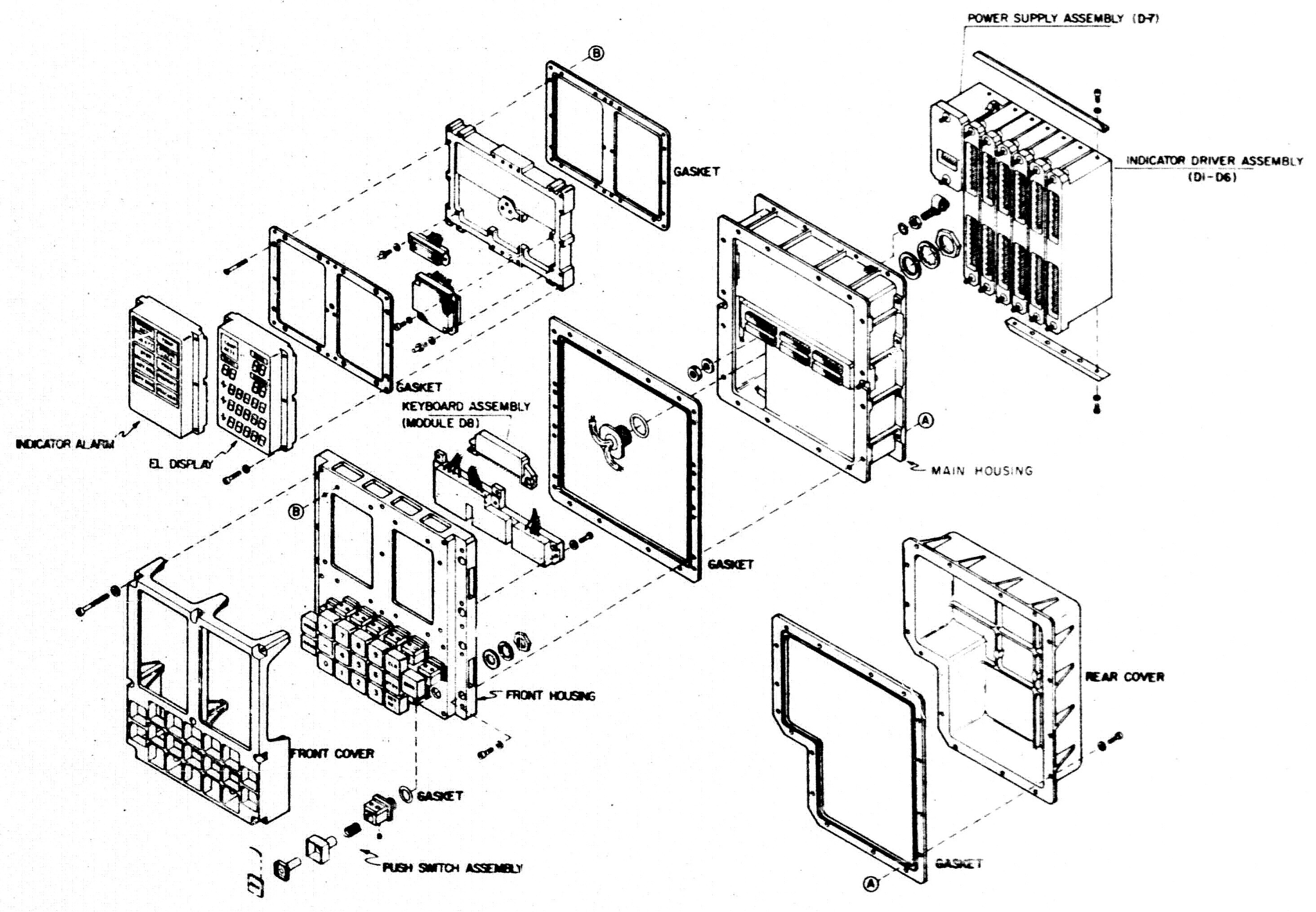
I was particularly enamored of an exploded diagram for the
Block II DSKY that I don't recall having seen before,
to the extent that I even pulled it out of the report and
added it to the DSKY page.
I'm sure there's nothing in the diagram that you can't get
already from the many DSKY engineering
drawings we have, but it may be useful for those of
you who have been working on constructing your own DSKYs.
icon on the document-library page),
but the one that particularly stands out for me is
Raytheon's 1969 "Final
Report: Apollo Guidance Computer Program Block I (100) and
Block II". Don't be confused by the title referring to
the "program", since the report is not about
software. The report is a nice way of getting a
pretty-detailed understanding of all the different hardware
Raytheon produced for the program, including all the AGCs,
DSKYs, and associated ground-support equipment, which is
pretty hard to get piecemeal from other documentation.
I was particularly enamored of an exploded diagram for the
Block II DSKY that I don't recall having seen before,
to the extent that I even pulled it out of the report and
added it to the DSKY page.
I'm sure there's nothing in the diagram that you can't get
already from the many DSKY engineering
drawings we have, but it may be useful for those of
you who have been working on constructing your own DSKYs.
|
2019-09-15
|
I've unfortunately discovered that our one
LVDC program listing does not form a complete LVDC
program. Or at least, that's the conclusion I've come
to, and until there's some reasonable independent review of
the code, I fear that my inferences are the only ones that
count. Hopefully I'll eventually turn out to be wrong.
When I say it's incomplete, I don't mean that there
are pages missing from the program listing, or anything of
that nature. The Flight Program listing we have is
completely self-contained, and can be assembled without
error ... or at least could be assembled without
error if a handful of undebugged problems in this
engineering (as opposed to released) version of the code
were fixed.
No, what I mean is that the Flight Program was not the only
program that needed to be loaded into LVDC core memory to
get a complete working system. At the present time, I
believe that the missing program would have been the
Preflight Program. The Flight Program and Preflight
Program would have interacted via certain addresses
hard-coded into those programs. Unfortunately, right
now, when the Flight Program calls routines that are
supposed to reside at those addresses, there's simply
nothing there, and chaos would ensue.
For example, I think that one thing the Preflight Program
probably had was the self-test routine. Very
handy! And very unhandy not to have it. By the
same token, a self-test routine is hardly essential
to the operation of the system, and it might be possible to
make the Flight Program happy simply by sticking some kind
of relatively-simple replacement for it at its specified
hard-coded address. And all of the other problematic
addresses I've seen similarly relate to code that might be
painlessly worked around. But I don't have a complete
survey of all the offending missing code, and can't really
make too positive a claim at this point. Time will
tell how serious a problem this turns out to be.
As usual, I've written
all this up in more detail on the LVDC page itself.
|
2019-09-13
|
Lots more updates to descriptions of LVDC i/o ports and command words
transmitted to the rocket from mission control.
|
2019-09-11
|
Lots of changes to descriptions of LVDC i/o ports and telemetry.
|
2019-09-10
|
More updates to description of LVDC assembly
language. |
2019-09-09
|
Usage
of the LVDC assembler, yaASM.py, has been documented.
|
2019-09-08
|
Mike Stewart has sent in dumps of rope images
of 4 SUNDANCE physical memory-rope modules. You may
recall that SUNDANCE
306 was the AGC software for the Apollo 9 Lunar
Module, and that we have no copy of the SUNDANCE source
code, but have 3 prior dumps of physical rope-modules.
There are 6 rope modules in total (denoted B1 through B6),
so we now have dumps of every module (plus an extra dump,
which happens to be of module B3). Unfortunately, the
modules that have been dumped are from a mismatched set of
SUNDANCE revisions (292, 302, and 306), and thus don't form
a complete working SUNDANCE 306. In fact, used
together as-is, they don't form a set of ropes that works at
all. Nevertheless, it's entirely possible that one may
be able to create working software from them using judicious
reverse engineering. We'll see!
|
2019-09-07
|
"Final" corrections to my draft description
of LVDC assembly
language, specifically the DFW
pseudo-op. Modulo any oversights on my part, I think
the description is probably more-or-less correct, since the
new LVDC assembler produces a word-for-word correct assembly
of the AS-206RAM LVDC source code. However, given that
I haven't yet documented the new assembler itself, nor even
put the finishing touches on it, that don't expect that the
presentation of it is perfect by any means.
|
2019-09-05
|
- Added a copy of the
Apollo 11 Operations Checklist to the document
library. This was already available at the Apollo
Flight Journal, so please feel free to examine
there instead.
- Scanning of the final half of aperture-card Box
435 from NARA SW has now been completed.
This batch contains "post-installation checkout
procedures for the the G&N system. The rate of
scanning aperture-care boxes has slowed down somewhat
recently due to circumstances, but is due to pick up
again to a much higher rate in the near future.
|
2019-09-01
|
- More updates to descriptions
of LVDC assembly language, AS206RAM program structure,
and so on.
- It turns out that my instructions for downloading
a Virtual AGC "installer" for Windows may have
been a tad thin in terms of explaining how to actually
run the program once it has been downloaded. So
I've pepped up that explanation to make it a lot more
explicit.
|
2019-08-28
|
Don Eyles has sent us a couple of Apollo 14
related documents, which are useful for information about
the pad loads, as well as for deducing the locations in
memory of certain variables, which may or may not assist in
the current attempt of reconstructing various AGC software
versions:
|
2019-08-26
|
- Manoel has submitted a couple more 3D models,
2004739A-000 and -021, DSKY front cover. This is
significant because it turns out that model 2004929
(also DSKY front cover) added a couple of weeks ago was
not the one called out for DSKY model 2003994-121 at
all, and that 2004739 is what should be used. This
was not just an oversight, though! The problem is
that drawing 2004739 simply isn't dimensioned very
thoroughly, whereas 2004929 is dimensioned quite
thoroughly, so the hope was that 2004929 would be a good
substitute. Alas, it was not! Some of the
dimensions (specifically the width and height of
openings for the indicator lamps) from drawing 2004929
are not compatible with the other constituent assemblies
in DSKY 2003994-121. Thus while the new models for
2004739 are intended to be exact representations of the
original drawing, there's not enough detail on the
original drawing to insure that; so the new models
contain both elements from 2004929, as well as
measurements which were fortunately able to be gotten
from a physical 2004739 module. Nevertheless, the
potential for error remains and thus the models may need
to be further adjusted over time.
- 10 new document scans from NARA SW have been
added. Many of them relate to RTCC software
flowcharts for various Apollo 14 G&N computations,
and to GSOP changes from Apollo 13 to 14. Rather
than enumerate those documents here, I'd suggest looking
for the icon on the
document-library page.
|
2019-08-22
|
- Corrected my confused
description of LVDC instructions HOP*, TRA*,
TMI*, TNZ*: I've belatedly realized
that there should be no such instructions in the LVDC
source code, and that the asterisks are added in the
assembly listing to highlight that certain workarounds
have been transparently performed.
- Manoel has added a few more 3D
models for DSKY parts. It should be noted
that the first two of those models listed below are
created from the external dimensional properties
of "Specification Control Drawings" (SCD). That's
significant because the these assemblies were
manufactured independently, and while they are really
themselves assemblies, the internal characteristics of
the assemblies are (well, were) known only to
the manufacturers of the assemblies. In other
words, there are no available drawings describing their
internal structures. Consequently, you can't
simply 3D print them and expect that they'll do anything
for you, particularly since they contain circuitry not
represented by the 3D models. They'll need to be
reverse engineered in order to reproduce their
electrical and behavioral characteristics. The
third model is also problematic, because we don't have
the latest revision of its original drawing.
That's significant, because most DSKY's specify use of
configuration -001 of the part, while the most-recent
drawing we have covers only up to configuration
-000. Consequently, the 3D model also conforms
only to configuration -000 rather than to the necessary
-001, and therefore also likely requires modification.
- 1006315A, electroluminescent digital indicator
- 1006387D, alarm indicator
- 2004699A, indicator frame cover
|
2019-08-18
|
Updated descriptions of
more LVDC pseudo-ops: ORGDD, DOGD. |
2019-08-17
|
Fixed description of
various LVDC pseudo-ops: DEQS, DEQD,
USE INST, USE DAT.
|
2019-08-16
|
- Manoel has added a few more 3D
models for DSKY parts. I forgot to mention
yesterday that these are parts for DSKY model
2003994-121 (the final CM DSKY model), though the parts
Manoel has submitted so far seem applicable to all Block
II DSKY models I've checked so far. (Admittedly
not every single one!) I probably should have
mentioned too that the models being added so far are
intended to precisely capture the original Apollo
engineering drawings, and hence do not include any
optimizations for (for example) 3D printing; alternate
3D models with such optimizations may be added in the
future. Also, for those who haven't stayed atop
the behind-the-scenes discussions, it's perhaps useful
information that the models are in STEP
format, which can be imported into most 3D modeling
programs, but specifically into the open-source FreeCAD
modeler. I probably should summarize what those
parts are, too, rather than forcing you to figure it out
for yourself. Here's the complete list so far:
- 2004900A, rear cover
- 2004919E, adapter plate
- 2004920-, digital indicator connector plate
- 2004921A, alarm indicator connector plate
- 2004929A, front cover
- 2004968E, front housing
- Mike has confidently reconstructed yet another AGC
software version, this time Artemis 71.
As you may recall, Artemis 72 is the software actually
flown in the Apollo 15 through 17 Command Modules.
But Artemis 71 was originally intended to do so.
Artemis 72 flew instead, because of a bug fix. As
with all these software reconstructions that have been
appearing lately, we have no actual assembly listing of
Artemis 71 to work from. Nevertheless, the clues
present in the Artemis 72 assembly listing, in concert
with the Artemis 71 memory-bank checksums (which we have
from engineering drawing 2021154), allow us not only to
infer the required changes, but to verify them
afterward. Great work, Mike! The VirtualAGC
GUI program now supports Artemis 71 as well, so you can
run Artemis 71 or browse its source code in VirtualAGC
if you like.
- The
Apollo G&N system assembly drilldowns now
include links to the appropriate 3D models of the
associated parts wherever possible (similar to the way
they have already been including links to CAD
transcriptions of associated electrical schematics).
|
2019-08-15
|
- Reworked a lot of the discussion of
LVDC assembly-language coding, on the basis of my
improved understanding of it, and particularly an
explanation of the LVDC preprocessor.
- We've had our first submission of 3D
models to our mechanical-drawing repository, for
some DSKY parts. They look pretty swell to
me. Thanks, Manoel da Silva Casquilho!
- Unfortunately, Manoel had to deal with some pretty
poorly-written instructions in so far as the
requirements on the 3D models, as well as practically
non-existent instructions on how to actually submit them
to the repository, so I've rewritten quite a lot of the
section on our electro-mechanical page describing
that stuff. Hopefully it's better, but knowing
myself I can't claim to be 100% confident that it is.
|
2019-08-13
|
- A handful of documents added to the library a few
weeks ago have now been removed. Well, perhaps a
handful and a half. For the most part, I've done
this by expunging the files themselves, but leaving the
hyperlinks on the document library
page and striking them out (
thusly)
so that it's easy to see what has been removed.
These documents originally came from NTRS, but were
removed from NTRS when it was decided by NASA that they
hadn't been approved for release; so now they've been
removed from Virtual AGC too. Sweet! I don't
actually know if it was necessary to remove them, but it
has been done as a precaution. Of the 1000+
documents we provide, who knows how many have thus been
(or will be) taken retroactively out of the public
domain, with no practical way for us to even know about
it or react to it? (Hint: We don't.) Can you
spell "time bomb waiting to go off"? (Hint:
You don't have to. I just spelled it out for
you.) Or perhaps, "closing the stable door after
the horse has bolted"? (Hint: Ditto.)
For what it's worth, I think the documents are available
on The Wayback
Machine's cache of NTRS, if you can figure out how
to find them, and with luck perhaps they'll return here
at some point.
- Speaking of secret knowledge, I've finished my first
pass at transcribing the LVDC AS-206RAM assembly listing
to source code, but am afraid now to post it publicly
because of ITAR and the danger that North Koreans may
start pelting us with Saturn V or Saturn IB rockets if
they get hold of this 50-year-old software
listing. (The projected cost of a Saturn V
in 2019 dollars is around $726M, but that of a Saturn
IB such as would have been used for the AS-206RAM
mission is probably only around $220M. A bargain,
to a thrifty hawk! To be fair, when I wrote those
sentences, they were intended to be biting sarcasm, but
given that LGM-118
Minuteman ICBMs would cost perhaps $110M in 2019
dollars it doesn't even seem that far-fetched that some
nut-job would spend $200M for a Saturn IB as an ICBM,
does it?) Fortunately, anyone (who can prove
they're an American) can naturally apply directly to me
to get a copy of the transcribed software.
However, you might want to wait until it's decently
proofed first and the assembler itself is ready.
|
2019-08-08
|
|
2019-07-31
|
- Mike has added yet another AGC software
reconstruction, this time of the Comanche 51 source
code. Comanche 51 was the program that was
first targeted for the Apollo 11 Command Module, though
it was Comanche 55 that eventually flew in the
mission. Reconstruction of all these intermediate
AGC software versions may strike you as merely an
intellectual game, which I suppose it is in some ways,
but it has serious benefits as well. For example,
I'll remind you that a few days ago we got the Luminary
69/2 reconstruction, and this was actually mission
software (for the Apollo 10 LM) that we hadn't had
originally. In the case of Comanche, the Holy
Grail would be reconstruction of Comanche 45/2, which is
the missing mission software for the Apollo 10 CM.
Having Comanche 51 rather than just Comanche 55 gets us
that much closer to the goal. Even so, getting
from Comanche 51 to 45/2 is quite hard, since we don't
have the level of supporting documentation for Colossus
that we do for Luminary. A reconstruction of 45/2
would be ever so much easier if Margaret Hamilton just
gave us her copy of Comanche 44 ... though that, sadly,
seems less likely with every passing year. But
we'll see what we'll see!
- The
G&N assembly drill-downs are once again
up-to-date with respect to all of the
engineering-drawing scans (and CAD transcriptions)
collected so far.
|
2019-07-29
|
- Mike has added reconstructions
of the Luminary 97 and 98 source code, following
the same procedure as for the Luminary 130 and 69 rev 2
reconstructions over the last couple of days.
There's slightly less confidence in the Luminary 98
reconstruction than in the 97 reconstruction, since back
in 1969 Luminary 98 was just development software en
route from 97 to 99, so its ropes were never
manufactured nor its memory-bank checksums
recorded. However, if Mike's Luminary 98
reconstruction were in error, his 97 reconstruction
would probably be in error as well ... which is unlikely
since all of its memory-bank checksums are
correct! In other words, while we're less
confident of the Luminary 98 reconstruction than in the
97 reconstruction, we still have a pretty high degree of
confidence in it.
- On our Luminary page, I long ago hyperlinked the raw
scans of AGC assembly listings stored at our Internet
Archive site. But in some sort of strange mental
conniption, I belatedly find that I never did that on our Colossus page! I
guess it's because so much data was pouring in from Don
Eyles at the time that I was thinking only about the
Lunar Module and not about the Command Module at
all. Well, I have finally taken care of it now!
|
2019-07-28
|
- Mike has added a reconstruction
of the Luminary 130 source code, following the
same process as for yesterday's reconstruction of
Luminary 69 rev 2. Admittedly not quite as
exciting as yesterday's reconstruction if you're only
interested in software actually flown. On the
other hand, it is becoming increasingly obvious that the
more software versions we collect the easier it is to
fill in the gaps between them, so it's nothing to be
pooh-poohed by any means! (Excuse me, I mean
P00H-P00H'ed.) Plus, various Apollo 13 documents
referenced Luminary 130 anyway, and were never revised
for 131, as far as we know.
- The VirtualAGC GUI program has been updated for both
Luminary 69 rev 2 and for Luminary 130.
- I've adjusted the size of the youtube video
thumbnails I've embedded in the tables on the Luminary
and Colossus pages, since I notice they were so big that
when the windows were made smaller the text overflowed
to the right and needed scrollbars to see. I can't
get rid of this effect entirely, but making the
thumbnails smaller mitigated it somewhat.
- On the FAQ page,
I've added links to Ken Shirriff's writeup of his
article about bitcoin mining on the AGC, as well as to
David Given's writeup of his port of his Cowgol
programming language to the AGC, as well as the
subsequent creation of a lunar lander game (Cowlark)
written in Cowgol. In other words, Cowlark is a
lunar lander game which can be run on the AGC. Fun
stuff, though I'm not sure programming in Cowgol
actually gives you "the AGC programmer experience".
|
2019-07-27
|
As you may have noticed in looking at the Luminary and Colossus pages, it sometimes
happens that when somebody gives us a listing of an AGC
program, it may not be quite the software revision
used in a flown mission, but since I figure we're never
going to get the exact revision I end up just shrugging and
saying it's good enough. But you know, my "figuring"
has been known to be wrong ... from time to time. Such
is the case with the Lunar Module software for Apollo
10. The actual flown revision was really Luminary 69
Rev 2, whereas the printout we got from Don Eyles was simply
Luminary 69. Does Luminary 69 work when you fly a
simulated Apollo 10 mission? Certainly, no
problem! But it would even better to have the precise
revision used, wouldn't it?
That's were some of the engineering drawings I (my sole
contribution to this discussion!) scanned a couple of days
ago come in. These drawings, 2021151
through 2021154, astoundingly list all of the
memory-bank checksums for lots of AGC programs ... including
lots of revisions of programs that we don't have. This
information, which may seem rather pointless on the face of
it, actually opens up the door for reconstructing a lot of
software revisions we don't have. Why? Well, we do
have source code for an increasingly-large number of
Luminary and Colossus software revisions, and we
often have LUMINARY Memos or COLOSSUS Memos that tell us in
a descriptive way which changes were made between successive
revisions of the software. This is especially true for
Luminary. Thus from the descriptions of the
changes, we can attempt to back-port those changes (as
observed in later revisions of the software) into earlier
versions of the software and then check if those
changes produced the proper memory-bank checksums!
We've done this in the past in the handful of cases where we
knew the checksums of unavailable software revisions, but we
never had such checksums for a large number of missions to
work with before.
In the case of Luminary 69
Rev 2, Mike Stewart has stepped in and reconstructed it
overnight, using exactly the method described above.
Thanks, Mike, once again! So while yesterday we had
Apollo 10 LM software that was "close enough", today we are
pretty sure we have the exact software used in the mission.
|
2019-07-26
|
- Added G&N engineering drawing scans from NARA SW
aperture-card boxes 467 (final 2/3)
and 435 (first
half). Box 435 contains a lot of G&N
system post-installation checkout procedures from North
American Aviation. It has been scanned out of
order because some of the procedures relate to using
SUNDIAL. Another notable procedure therein uses
SOLARIUM for checking out the Block I systems for Apollo
4 and 6. All index pages and the
engineering-drawing search engine have been updated, but
the assembly drilldowns have not yet.
- Added three new documents to the
library (thanks, Graham!) concerning AS-503A (an
unflown alternative mission) and Skylab.
- Replaced the
LVDC software sample images with higher-quality
ones of the same pages.
- Don Eyles has sent along some scans of two data-card
booklets: an earlier one for the Retread
50, Aurora, and Sundial B & C software, and a
later one for just the Aurora 88
and Sundial C software. Since Aurora and
Sundial were used for checkout of the LM and CM guidance
systems, respectively, I infer from that Retread must
also have been used for system checkouts at some point,
but was then obsoleted. As usual, the full-quality
scans are at our Internet Archive site. (Thanks,
Don!)
|
2019-07-24
|
- Yesterday's edition of The
Orbital Mechanics podcast is an interview with me,
talking about the Virtual AGC project. It sounded
good in my head when I said it, so *cough* *cough* it
must be good on the podcast too!
- A few more miscellaneous documents have been added to
the library (thanks, Graham!). Just look for
the icon.
|
2019-07-23
|
- It turns out that my comments yesterday about SUNDIAL
D vs SUNDIAL E in the 2TV-1 mission were
misguided. What I should have been saying
was that the fixed-memory modules (which are what holds
the SUNDIAL program) were different than what what the
engineering documentation led us to believe:
specifically, if you're interested, MIT's AGC contains
software assembly 2021104-051 rather than the
2021104-041 we expected. However, Mike has managed
to find documentation that both of those assemblies held
SUNDIAL E software anyway, so it hardly matters which
one was installed in the computer. Thus I can
happily contradict what I said in yesterday's
entry: We truly do have the software for the 2TV-1
mission! I've altered the description on the
COLOSSUS page to reflect that fact.
- The VirtualAGC GUI program has now been updated (at
GitHub) to have the 2TV-1 mission as one of the options.
- Added a series of documents (thanks, Graham Donald!)
to the library, concerning potential applications of the
LM. Also, quite by chance, I found a grayscale scan of document
R-700 online that's fantastic, compared to the
B&W scans we already had, because you can actually see
the photographs; naturally I snatched it and stuck it in
the document library too.
|
2019-07-22
|
- Much like with the RETREAD 50 AGC software we added a
few weeks ago, the AGC
Restoration team has now dumped the rope memory
from the MIT Museum's AGC and has given us the AGC
program SUNDIAL E. This is our first look at
SUNDIAL. SUNDIAL E is close to, but presumably not
exactly the same as, the SUNDIAL D software used for the
2TV-1 mission, so that's
how I've categorized it on our COLOSSUS page.
In a larger sense, I think that SUNDIAL was generally
used for system checkout of Command Modules, much as
AURORA was for Lunar Modules. We don't have the
source code yet, since the restoration team has been so
busy, but presumably Mike will churn it out for us in
the reasonably-near future by comparing to similar
program versions and judicious disassembly. The
binary is apparently ready-to-run in yaAGC, though I
have not made the necessary changes yet to do so within
the VirtualAGC GUI environment.
- At the same time, 3 out of the 6 rope modules for the
program SUNDANCE 302 were dumped, and have been added to
the
GitHub repository. I've not written up
anything about it on the LUMINARY page yet, though,
because I haven't figured out yet how to go about
describing half of a program. The idea, of
course, is to try and find the other half of it later.
- In thrashing out whether SUNDIAL E was or was not used
in 2TV-1, it became apparent that some of the
compatibility tables in documents ND-1021042 and
ND-1021043 could be used to fill in a couple of
missing-link engineering drawings related to
configurations of SUNDIAL and AURORA, so I've now done
that and regenerated the assembly drilldowns of the
engineering drawings accordingly.
|
2019-07-21
|
- Added another couple of documents to the library, this time
peripherally related to Apollo 13. Incidentally, I
was remiss yesterday in not thanking Graham Donald for
sending these docs over to me.
- Yesterday's edition of The London
Podcast by presenter Adrian Lacey, among other
things features me talking about the Virtual AGC
Project.
|
2019-07-20
|
Added a handful of notes on lunar descent,
and particularly delta guidance, to the
document library. I won't itemize them
individually here. Just look for the icon.
|
2019-07-17
|
The scan of the assembly listing of the LVDC
AS-206RAM flight program is now ready. Or at least, a
perfectly legible scan is ready, though I may make a better
one later. I've actually been taking this opportunity
to try out different digitizing methods, so I've scanned the
thing 4 times so far. That's because I've been very
dissatisfied with the AGC listings I scanned in the past,
and I wanted to perfect my method once and for all.
But because I'm experimenting, the scans aren't quite as
pretty yet as I'd like. Getting better, though.
As I
explain in more detail on the LVDC page, we are not
certain yet about the ITAR
status of this assembly listing: Maybe ITAR restricts
who the program can be given to ... and maybe it
doesn't. I kind of think it doesn't. I hope
we'll eventually find out for sure that it doesn't, and I'll
then be able to post the scans online. Unfortunately,
until/unless the legal issue is resolved, it's a close
enough call that I'll have to assume by default that ITAR does
restrict access. So if you want the scanned program
listing, you'll not only have to email me directly
apply to me in person, but you'll also have to
provide reasonable proof that you're a U.S. citizen,
tolerate the fact that I'll send you only an encrypted,
identifiable, watermarked PDF, and be okay with the fact
that I'll retain a permanent record of you and of the proof
you provided. That's because ITAR restricts access to
foreigners but explicitly allows distribution to U.S.
citizens. The upshot is that if it turns out ITAR does
restrict access and the listing does end up somehow in
foreign hands, and somebody does show up at my door with a
subpoena ... well, my personal posterior will be
covered, because I will have handed the program only
to verifiable U.S. citizens.
I've also done a preliminary pass on looking through the
listing and have written up all my observations and
inferences about the the syntax and pseudo-operations of
LVDC assembly language, as well as about the AS-206RAM
program itself. That's a prerequisite for getting a
working LVDC assembler, which along with transcribing the
listing's source code is hopefully the next step. (And
no, sorry, once I have transcribed the source code, it won't
be freely distributable either until ITAR questions are
resolved for the better.)
|
2019-07-15
|
The full assembly listing of the 1967 LVDC
flight program mentioned over the course of the last week or
so has suddenly and unexpectedly become available.
Page-image scans haven't been prepared yet, but this
availability has necessitated quite a few changes in the LVDC page, as various
speculations have suddenly been converted either to facts or
fantasies. Obviously, many additional relevant changes
are expected in the year future.
|
2019-07-13
|
|
2019-07-12
|
I've added still more flesh
to my inferences about the LVDC assembly listings. I
have, however, noticed some holes in my descriptions of
whole-line comments and of how SIMPLEX vs DUPLEX memory
works, so its clear that not all of what I've written is
100% correct. |
2019-07-11
|
- Updated the
description of the LVDC's TLC interrupt with a bit
of anecdotal info.
- The description
of the LVDC's STO instruction was shockingly
deficient in terms of how it covers subroutine linkages
— namely, it didn't, and indeed provided
misleading information — so I've fixed it up.
- I've added a
lot of descriptive material about what I infer (or
more politely, guess) from the LVDC sample code
about the syntax of LVDC assembly language. This
is particularly true for the many assembly-language
pseudo-ops that have appeared that we've never seen any
references to before ... but it applies to the regular
code as well.
|
2019-07-10
|
A handful of additional source-code pages
from the
1967 LVDC flight program mentioned yesterday have been
added. Alas! All things considered, they've
added more to my confusion than they've subtracted.
|
2019-07-09
|
- Added a link to Ken Shirriff's delightfully absurd
blog article "Bitcoin
mining on an Apollo Guidance Computer: 10.3 seconds
per hash" to the
AGC-restoration page. He does his mining on
the restored physical AGC, but shows you how to do it
with Virtual AGC too.
- And another great treat, our
first actual IBM LVDC source code, from a 1967
version of the LVDC flight program! It's just a
few pages of trig and square root routines, but you can
see from the snapshots that there's a full (or at least
very substantial) program listing beyond just those few
samples. It probably does not conform 100% to the
syntax of the assembler I wrote for it a decade ago, but
obviously at some point I'll fix up the assembler.
Unfortunately, my anonymous informant does not
indicate that we will be receiving the full listing, and
indeed implies very strongly that we will not. So
I can't you promise anything further. Which is
disappointing. But the very positive takeaway is
that assembly listings of the LVDC flight program do
still exist ... a possibility which previous informants
have poo-pooed up to now.
|
2019-07-08
|
- I've removed some anecdotal bits of info from the LVDC page, relating to who
wrote the software and how it was written, because I no
longer have confidence in those anecdotes. None of
the technical info has changed.
- Added the CAD transcription for drawing 2010062F
(Block II CDU power supply).
|
2019-07-03
|
Added CAD transcription for drawings 2005938C
(electrical schematic for most Block II AGC rope-driver
modules) and 2005930A (clock oscillator module for several
Block II AGC configurations).
|
2019-07-01
|
Finally finished updating all of the
assembly-drilldown support for the engineering drawings
added last week, and specifically for the Block II
IMU. In other words, all engineering-drawing support
is now up-to-date again, until I bring in a new batch of
scans in a few weeks.
|
2019-06-28
|
Updated all drawing titles for the scans
added yesterday, so that they correspond to the actual title
blocks of the drawings rather than to abbreviated titles
from the aperture-card metadata on the index pages and in
the engineering-drawing search engine. Some (but not
yet all) assembly-drilldown support was added for
the new drawings as well. The new drawings, by the
way, relate somewhat to the CDU, but largely to the
IMU. The total number of engineering-drawing scans is
close to 22,000 now.
|
2019-06-27
|
Some work done on adding engineering-drawing
scans from NARA SW aperture-card boxes 466 (final 4/5 of
box) and 467 (initial 1/3 of box). This is work in
progress and not yet completed.
|
2019-06-25
|
Added the electrical CAD transcription for
drawing 2010094-, which is the READ COUNTER MODULE of
apparently all Block II Coupling Data Units (CDUs). In
other words, it is our first CAD transcription of a G&N
schematic not for the AGC or DSKY. It's a real
monster, too, at least in terms of physical size, 130"×34",
though that's mainly because they didn't choose to split the
drawing into multiple sheets, even though physically it
consists of 4 separate, almost-independent
"quadrants". Go figure!
If you've never given the CDU any thought — and I know I
hadn't! — it's interesting and eerie the way it shadows the
AGC design. In particular, it consist of "modules",
plugged into a backplane, with each module being either a
regular analog circuit or else a "logic-flow" circuit
consisting entirely of NOR gates. I suppose it's
reasonable that once they had a design paradigm they'd
probably stick with it, but it's still fun to see. The
CDU itself converts data from whatever forms it's available
in the spacecraft to whatever digital format the AGC needs,
and vice-versa, so you can think of it crudely as a set of
A/D and D/A converters ... but from an era where such things
didn't just come off-the-shelf but had to be designed and
implemented anew with each project.
But it's also based on a circuit-design practice that we
associate only with Block I and early Block
II. For example, the schematic shows no pin numbers
for the NOR gates, nor distinguishes between the "A" and "B"
gates of the dual-NOR-gate chips. For that information
you have to look at an entirely separate drawing, the
so-called "signal wiring" diagram. That design
practice fortunately fell out of favor quickly in the AGC
schematics (thank heaven!), but unfortunately persisted to
the very end in the CDU schematics ... or at least in the
CDU READ COUNTER MODULE. As a result, I can't claim
total confidence of the NOR-gate pin numbers used in the CAD
transcription, due to the difficulty of proofreading them;
on the up side, though, probably nobody will ever notice if
I didn't get some of them quite right!
|
2019-06-24
|
A couple of problems have cropped up with the
process building Virtual AGC from source:
- Somehow, one of the files needed for Retread50 hadn't
gotten into the repository, and this killed the entire
build as soon as it got to that point in the
process. Weird, since our GitHub repository is set
up to do a trial build whenever a commit to it is
performed (which it did, and naturally, failed), and to
email me about failures (which it didn't, as far as I
can tell). At any rate, I've added the missing
file now.
- Also, building Virtual AGC on newer Macs with clang
(which, having only old Macs, I've never had any means
to try) weren't working. But a
couple of extra instructions have now been added
that may do the trick. Is it a complete fix?
Time will tell.
At any rate, thanks to Gavin Eadie for pointing out the
problems and at least part of the fix! |
2019-06-22
|
The
discussion of "signal wiring diagrams" had to be
modified slightly for the case of CDU logic-flow diagrams,
and I took the opportunity to make the description easier to
use during the actual CAD-transcription process.
|
2019-06-21
|
For maintainability reasons, some general
information about the scans of the G&N engineering
drawings that had been duplicated on each of the
engineering-drawing index pages has been removed from them
and put in a
centralized location on the electro-mechanical page.
Plus, the Internet Archive has finally finished its
processing of drawing-box 465, so all of the hyperlinks to
the drawings should now be working.
|
2019-06-20
|
As far as I know, the engineering-drawing
indices, search engine, and G&N assembly drilldowns are
now 100% up-to-date with respect to all so-far-collected
drawing scans, and in particular with respect to the set of
drawings added a couple of days ago. Unfortunately,
the so-called "derive" operation that the Internet Archive
uses to process these drawings has not yet
completed, so hyperlinks into the latter portion of
aperture-card box 465 may not yet be functional.
(Links into box 466, on the other hand, are okay.)
Hopefully it won't take too much longer for the hyperlinks
in box 465 to become available. At any rate, at last
count the collection of engineering-drawing scans stands at
about 19.6K.
|
2019-06-18
|
Aperture-card scans for the final 90% of Box
465 and the initial 20% of Box 466 added on a trial
basis. (Processing not completed yet at archive.org,
titles not fixed yet in drawing index/search, not all
assembly-data entered yet, etc.)
|
2019-06-17
|
- We have been given a version of the AGC software that
we didn't previously have! The program is RETREAD
50, and you may recall that we already had gotten the
similar program RETREAD 44 from Don Eyles.
However, we've gotten RETREAD 50 in a way completely
different from all other AGC software. We have not
been given an assembly listing for RETREAD 50.
Rather, the AGC-restoration project (which you may have
gotten wind of) was allowed to borrow core-rope modules
containing RETREAD 50 from the Computer History Museum,
thus allowing them to obtain a dump of the ropes, and
(for good measure) regenerating the source code for
it. And we're the beneficiaries! See our LUMINARY page
and/or our
GitHub software repository.
- In order to properly described how and why we managed
to get RETREAD 50, I found myself writing an entire page devoted to just
a description of the AGC restoration effort.
You'll see that a link to it now appears at the bottom
right of the banner across the top of all our
pages. It's not quite complete yet, but feel free
to check it out!
|
2019-06-14
|
- Finally have the G&N assembly drilldown fully
up-to-snuff ... just in time to go get more scans next
week and to fall behind with it again.
- Added various more Grumman LM drawings to the miscellaneous
drawing index page.
|
2019-06-13
|
Once again, lots more updates to the G&N
assembly drilldowns. I'm almost up-to-date
with all of them, but there's still a tiny bit left to do.
Corrected my misspelling of Tim Good's name. (D'oh!
It's a short name, so it seems like it would have been easy
enough to get right the first time.)
|
2019-06-12
|
Lots more updates to the G&N assembly
drilldowns, along the lines mentioned a couple of days
back, I think the Block I drilldowns really are
up-to-date with respect to the drawing collection we have so
far, but that there's still quite a bit of catching up to do
for Block II. On the other hand, that's what I said
about the Block I drilldowns before, so time will tell.
|
2019-06-11
|
Some of the textual formatting the
engineering-drawing search engine does in showing its
results has been pepped up some of the new types of drawing
numbers (like Grumman and MIL).
|
2019-06-10
|
- In doing some semi-automated checking of the G&N
assembly drilldowns, I've discovered to my horror that a
lot of drawings that you'd never suspect were assemblies
actually are assemblies. Maybe 90% of them!
I mean, really, who would suspect that something called
a "cover" or a "plate" is really an assembly? I
ask you. I never even bothered to look at
them. The upshot of that is that the assembly
drilldowns I've made are actually nowhere near as
complete as I imagined, since I didn't have any support
for drilling down a bunch of those non-assembly
assemblies (with apologies to Woodward &
Bernstein). So I've made a tentative new beginning
with some updates to the drilldowns, but there's a long
way to go.
- But there's a bit of a treat today as well: We've gotten a few
top-level LM engineering drawings from the
aperture-card boxes at NARA-SW, and perhaps someday
we'll be able to explore the LM engineering drawings in
much the same way we're now exploring the G&N
engineering drawings. Check them out! One
drawback with them is that while each drawing calls out
the drawings for its sub-assemblies, it does so only by
drawing number and no drawing name. Furthermore,
the drawings themselves have only numbers in their title
blocks, and have no actual titles. So I can't
personally tell you what most of the assemblies
are. Anyone who wants to offer up a solution to
this conundrum, please do so, since it will make
figuring out these assemblies quite difficult!
|
2019-06-08
|
I've completed all of the assembly-drilldown
support for the new box 464/465 drawings, though there are
undoubtedly bugs in the drilldowns that still need to be
detected and fixed. With the box 464/465 additions, we
now have around 17,500 Apollo G&N engineering-drawing
scans. Next batch ... a couple of weeks from now.
|
2019-06-07
|
All of the drawing titles in the recent scans
for aperture-card boxes 464 & 465 are now fully updated
(i.e., they now correspond to the drawing title blocks
rather than the punches on the aperture cards) in the
drawing search engine, the drawing index pages, and the
drawing drill-down pages. Those new drawings, by the
way, turn out to have been primarily for the SCT (scanning
telescope), SXT (sextant), and ground-support equipment
(GSE) like the AGC's computer test set, calibration cart,
and so on. I have also progressed further with the
assembly drilldowns for that stuff, though since the
drilldowns only cover the on-spacecraft G&N systems, I
mean that there's a lot of new drilldown material for stuff
like the SCT and SXT but there is presently no support
whatever for any GSE drilldowns.
|
2019-06-06
|
Lots more updates of indexes and assembly
drilldowns related to the ~1900 engineering-drawing scans
from boxes 464/465 added yesterday.
|
2019-06-05
|
Partial update with respect to the
completion of scans for aperture-card box 464 and the
beginning of box 465. I.e., some stuff related to
those boxes works and some does not yet.
|
2019-06-04
|
Added electrical CAD transcriptions for
drawings 2005934A and 2005942-, though stupidly (on my part)
it turns out that I was confused and didn't realize that the
latter isn't actually used in any of the major assemblies
I'm providing drilldowns for.
|
2019-06-03
|
Added links to the AGC/DSKY/G&N
engineering drawings for all missions on the Luminary and Colossus pages. I was
unable fill in the Apollo 1 engineering drawings on the
Colossus page, because with the current information there's
no way to narrow it down to less than a half-dozen or so
configurations. Perhaps after more revisions of the Block I
drawings are scanned, I'll be able to narrow it down a lot
further.
|
2019-06-02
|
I realize I've been somewhat lax about
linking in relevant engineering drawings on some of the web
pages that could actually benefit from them, in particular
the Block I and yaDSKY pages, so I've fixed up
those pages somewhat. In some roundabout fashion, that
also rubbed my nose in a couple of DSKY assemblies I forgot
to provide enough info to drill down, so I've fixed them as
well. Comments have also been added to the yaDSKY page
concerning using the engineering drawings for very accurate
recreations of DSKY physical dimensions, coloring,
brightness, and so on. Gene Dorr (thanks, Gene!) has
created an authentic font for DSKY lettering from the
engineering drawings, and thus his font has been linked to
the explanations. Lots of new mil-specs related to
visual DSKY authenticity have been provided as well.
|
2019-05-31
|
The
Apollo G&N assembly drilldowns have now been
proofed and corrected. That's not to say that they're
100% perfect, though, since even after laboriously proofing
the part lists ("FIND" tables) about 400 assemblies, I still
managed to find an error in the drilldown of the very first
assembly I looked at! Well, that's how these things
go, I suppose. Even in spite of that I'd say the
drilldowns are now probably pretty reliable with respect to
the engineering drawings we've been able to collect so far,
and hopefully whatever remaining problems there are won't
cause too much pain.
|
2019-05-27
|
The
new Apollo G&N assembly drilldowns that I
mentioned in my previous note have now been completed, and
have been fleshed out with lots of mil-spec parts as
well. I've chosen to go ahead and simply remove the
old manually-created drilldowns ... not that they had
nothing to offer, but I don't think they had enough to offer
to justify the added confusion of the presentation.
Both the old and new drilldowns had some errors with respect
to each other, but neither seemed to be obviously better in
that respect. It will be some time before I'm able to
fully debug the new drilldown.
|
2019-05-25
|
I haven't made many changes the last couple
of weeks because I've been drastically revamping the
way the electro-mechanical page displays the hierarchy of
engineering drawings. I won't bore you with
details, except to say that generation of this hierarchical
representation is now automated, whereas before it was
entirely manual, and that this will have (and already does
have) tremendous advantages. There is still a lot of
stuff to check (and presumably fix!) in the new
representation, and in particular the Block I data is very
incomplete. Nevertheless, I've decided to take it live
rather than to keep dragging my feet on it. The older,
manually-generated presentation continues to be provided as
a fallback, and will remain until the new presentation firms
up a bit. The presentation-generation software may
also be useful to some users, particularly if they need to
have part-count data, since the software outputs JSON in
addition to HTML. Moreover, there's a comparison
program that can compare two different assemblies, given
their JSON.
The new representation appears to have a lot more missing
drawings in it than the old one does, but that's a bit
misleading. Many of the missing drawings are SCDs or
drawings for G&N components we just haven't been
collecting until recently, and therefore the gaps will
hopefully fill in significantly as the effort of scanning
the engineering-drawing microfilm at NARA SW proceeds.
Naturally, they'll never fill in completely.
|
2019-05-24
|
|
2019-05-12
|
It turns out that there have been serious
problems in the top-level AGC and DSKY part numbers for the
LM that I had listed in my big
AGC/DSKY drilldown table. Hopefully those
problems are fixed now, but there is still work to be done
on checking the CM portion of the table. This fix has
the side effect of adding drawing-drilldowns for several
AGC/DSKY parts for which that wasn't previously
possible. Additionally, though, it has been determined
that all of the Block II AGC part numbers previously missing
from the table due to a lack of drawings are really related
to parts with available drawings via external
changes to the AGC rather than internal ones. This has
provided the opportunity to add drilldowns for all of those
previously-missing part numbers as well ... at least
nominally.
A side effect of these problems was that on the
yaDSKY page of the website, the mission-by-mission
arrangements of the DSKY indicator lamps and their colors
that I posted yesterday also had errors, because they were
based on the wrong DSKY part numbers. That has been
fixed, with the result (not too surprisingly) that the
Apollo 12 LM did have the same indicator lamp arrangement as
the other missions, rather than a different one as I claimed
yesterday, and Apollo 5 did as well.
This issue with Apollo 5 is actually slightly interesting,
in that it turns out there were engineering drawings both
for the configurations MIT delivered
to NASA and separate engineering drawings for those NASA
actually installed
in the spacecraft. These two configurations usually
call out different AGC and DSKY part numbers. That
distinction, along with some other subtleties, escaped me
when creating the drilldown table. For example, MIT
delivered DSKY 2003985-051 for Apollo 5 (or rather for
G&N system 603 for LM-1), which has a rather funky
indicator-lamp arrangement; but NASA ended up installing
DSKY 2003985-081, which has a "normal" arrangement.
Who knew? Well, obviously, a lot of people other than
me! There are changes like that across the board,
though only this one involved a change in the DSKY's
lamps. Just one more reason to be careful, I suppose.
|
2019-05-11
|
- The approaching 50th anniversary of Apollo 11 has
sparked interest from various writers, and in reviewing
some of our online materials so as not to make a
complete fool of myself when talking to them, I can't
help but notice various stuff that is out of date on the
website. Hopefully I've been able to make a dent
in those, though I'm sure I haven't caught everything.
- Speaking of which, I had apparently forgotten to make
any comments here about the new article by Brian Hayes
in American Scientist magazine, "Moonshot
Computing". In particular, Virtual AGC gets a
short section of it's own. But size, I've heard,
isn't everything ... so check it out. It's a
terrific article!
- On the
yaDSKY page, the mission-by-mission arrangements
of the indicator lamps and their colors were previously
speculative. But by navigating through our
recently-created engineering-drawing
tree, I was able to fill them in for every
mission. It turns out there had been errors in the
DSKY indicator lamps for Apollo 12 and 17, and that I
had never gotten around to specifying the colors at
all. I haven't actually made any changes to the
software related to this fix, but I'll get around to it
at some point. Probably.
|
2019-05-10
|
More scans of Apollo G&N engineering
drawings (from aperture-card boxes at NARA SW) added:
These boxes mostly continue with electrical and
mechanical drawings of CM/LM guidance-system components
like the CDU (coupling data unit), PIPA (pulsed
integrating pendulum accelerometer), SXT (sextant), SCT
(scanning telescope), and so on.
I also eliminated some information that was redundant
across all of the box-index pages, because that info
(however well-intentioned) was making it quite difficult
to add new index pages.
|
2019-05-08
|
- Added the CAD
transcription for drawing 2005973- (indicator
driver module D1-D6 for Block II DSKY 2003994).
See also the renderings of the
CAD as image files. But wait, you
say, didn't you just add a different drawing
(2005940A) yesterday and say exactly the same thing
about it?!!! Why yes, I did, thank you for
noticing. DSKY 2003994 is one of only a handful of
cases I've encountered in which there's an inconsistency
in its drawing tree as to which schematic is
applicable. The indicator driver module assembly
(2003952-031) for DSKY 2003994 calls out schematic
drawing 2005940, whereas the relay circuit assembly
(2003910-021) of that selfsame indicator driver module
assembly calls out schematic drawing 2005973
instead. The two schematics are almost, but not
quite, identical. Unfortunately there's no way to
know for certain which is which with the information we
have at present. Often in this case, we'd resort
to looking at AC Electronics document ND-1021042, but it
is also inconsistent, calling out schematic
2005973 in some places, but showing circuitry from
2005940 in others. Nevertheless, there are quite a
few circumstantial reasons to believe that 2005973 is
the correct one ... not least of which that its
signatures are dated later. You can read all of my
reasoning on that, in my usual boring detail, on any of
the
DSKY 2003994 drawing-tree pages.
- Back when I originally did the engineering-drawing
drill-downs for the various AGC and DSKY models that are
listed on the
electro-mechanical page, there were a number of
drill-downs I couldn't complete, due to missing
drawings. Well, there are still missing drawings,
but in the meantime we've acquired lots and lot more
scans than before, so it should be possible to fill in some
of those gaps. While it's still early in the
process of filling in the gaps, here are some of the
assemblies whose drill-downs have been addressed so far:
- Added MIT/IL
document E-1186 to the document library.
Chapter 4 will tell you everything you want to know, I
would suppose, about TDRR's, and will help to explain
the TDDR numbers that pepper the revision blocks in the
Apollo engineering drawings.
|
2019-05-07
|
- Added the CAD
transcription for drawing 2005971 (power-supply
module A30-A31 for Block II AGC 2003993). See also
the renderings of the CAD as
image files. Unlike my normal practice, I took
some liberties with this one, in that the latest
revision of the original drawing 2005971 we have is "A",
but it is missing its 2nd sheet (the bill of
materials). I therefore transcribed sheet 1 from
the original 2005971A, but I transcribed sheet 2 from
the original 2005971-, thus producing a hybrid revision
that I call "2005971-A". I've compared the
resistor, capacitor, and inductor values between the two
sheets to insure there are no obvious revision
mismatches between the two sheets, but there's no way to
detect incorrect part numbers for things like diodes and
transistors. Not that it matters too much, since
you probably can't get those diodes or transistors any
longer, but I still don't like it.
- Added the CAD
transcription for drawing 2005940A (indicator
driver module D1-D6 for Block II DSKY 2003994).
See also the renderings of the
CAD as image files.
|
2019-05-06
|
|
2019-05-04
|
The AGC/DSKY/G&N engineering-drawing
index pages I've been creating (i.e., the miscellaneous drawings page
et al.), and the associated engineering-drawing search engine,
have had some errors in the drawing titles that have been
getting on my nerves. Recall, there are presently 13K+
scans, and it's really difficult to find the errors!
At any rate, I've created a little python program to track
down certain types of obvious problems in the drawing
indices, and I've been fixing those. Mostly they've
just been trivial things like missing commas that don't make
any difference, but it did manage to find and fix 10-12
drawing titles that were previously completely wrong,
so I'm happy! I'm sure there are still other errors
that I haven't been able to find yet that will only be
detected over the course of time. I only hope I didn't
break the search engine in the process ... but it still
seems to be working for me.
|
2019-05-02
|
|
2019-05-01
|
|
2019-04-30
|
Added the CAD
transcription for drawing 2005273- (Block II AGC
2003200 module A24 electrical schematics). See also the renderings of the CAD as image
files. |
2019-04-29
|
- Hartmuth Gutsche tells me that the
Apollo online digital archive of the University of
Alabama at Huntsville, having apparently been
offline for a couple of years, has returned from
whatever limbo it may have been in. It contains
around a thousand documents. I've leafed through
all of them and pulled down 40 or so for our own digital library page
just in case the UAH site decides to disappear
again. You can find them in our library by looking
for the icon. As you might imagine, though,
given that almost all of this stuff came from Marshall
Space Flight Center, most of the UAH documents relate to
the big rocket, and mostly have little direct relevance
to what's going on here at Virtual AGC. Most of
the ones I pulled relate to Saturn IV-B stage
(containing the Instrumentation Unit, containing the
Launch Vehicle Digital Computer), or to the Apollo
Telescope Mount (Skylab), or to press materials for
Apollo 4 through 7. thanks, Hartmuth!
- Thymo van Beers sent me a list of various boo-boos in
my own AGC developer documentation that need to be
fixed, and after lazily sitting on that list for a while
— a couple of months, it looks like — I've finally
gotten around to incorporating his suggestions.
Thanks, Thymo!
|
2019-04-22
|
The titles in the box 462 index and in the
drawing search engine (and thus all available
engineering drawings) now again correspond to those given in
the drawing title blocks rather than in the aperture-card
metadata.
|
2019-04-21
|
The new engineering-drawing aperture-card
scans mentioned yesterday (all of box 458, remaining
half of box 461,
and first 95% of box
462) are now posted and available online, and the
links to them on the associated index pages work. The
engineering-drawing search engine
has been updated to include the new scans. However,
the titles shown in the index for box 462 or in the search
engine are still the 21-character abbreviated names from the
aperture-card metadata, rather than the full ones from the
drawings' actual title blocks. So that's something
I'll still want to fix up, hopefully in the near future.
|
2019-04-19
|
- Updated the discussion of aperture cards in the FAQ.
- Added engineering-drawing index pages for
aperture-card boxes 458 and 462, and updated the page
for box 461 to include the previously-unscanned final
half of the box. The changes are completely
preliminary, and probably error-ridden, since although I
have all of the scanned drawings in hand, I haven't
posted them online yet. So the new/updated box
indexes aren't actually of any use yet.
|
2019-04-17
|
Added the CAD
transcription for drawing 2005272- (Block II AGC
2003200 module A23 electrical schematics). See also the renderings of the CAD as image
files. |
2019-04-16
|
- Somewhat pepped up the
engineering-drawing search page I added yesterday,
so that the search results have much more intuitively
obvious search titles and URLs. Of course, as
always on this site, I make no pretense that "more
intuitively obvious" is the same as merely "intuitively
obvious", and in fact as I recall being taught in
school, I should probably be saying something like "less
intuitively unobvious". But you get the idea.
- Added the CAD
transcription for drawing 2005268- (Block II AGC
2003200 module A18 electrical schematics). See
also the renderings of the CAD
as image files.
|
2019-04-15
|
Added a new search page for our large,
growing collection of Apollo G&N engineering-drawing
scans. Basically, you can enter a drawing number or a
search term for the drawing titles, and get back a list of
links directly to the individual scans. It's not
perfect, but it holds the promise of being a lot more
convenient that the method we've had so far of just browsing
around on a selection of overlapping drawing-index pages
until you find what you want. Check it out!
|
2019-04-13
|
Little problems in the
electrical CAD transcriptions of AGC/DSKY schematics
had been bothering me, such as wires that weren't precisely
vertical or horizontal, extraneous junctions (fat dots) that
were present because of tiny unnecessary wire segments, tiny
jogs in a wire, and so forth. So I created a little
program (which I cleverly call "eelint") to locate such
problems in the schematic files, after which I then went
through and "fixed" all of them. I also reran ERC
(electrical rule check), netlist generation, and image
rendering on the schematics I fixed, just to make sure I
didn't break stuff in the process of fixing it. I ran
into the slight problem that KiCad ERC had itself broken in
the meantime, so I had to wait a few days for a kind KiCad
developer to make it work for me again.
"Fixed" is in quotes earlier, because I imagine few other
people would be bothered by such trivial stuff, and probably
just think it was unnecessary grinding on my part. On
the plus side, though, KiCad's ERC capability (once it was
working again) had advanced somewhat since I had originally
run it on these schematics, so it also found a handful of
actual electrical problems for me that I was able to
fix. Thus the exercise wasn't entirely
pointless. For anyone unlucky enough to have hardcoded
some links or shortcuts to the PNG files in
our rendered CAD folder, I'm pretty sure that I ended
up changing the names of a few of those files, so you might
want to check your links. My apologies for that.
|
2019-04-10
|
|
2019-04-09
|
|
2019-04-08
|
- Added the CAD
transcription for drawing 2005252- (Block II AGC
2003200 module A7 electrical schematics). See also
the renderings of the CAD as
image files. There's no electrical
difference from 2005252A (for AGC 2003993).
- Added the CAD
transcription for drawing 2005256- (Block II AGC
2003200 module A9 electrical schematics). See also
the renderings of the CAD as
image files. The difference between this rev
"-" and rev "A" (for AGC 2003993) is that in the latter,
several previously-disconnected gates are connected to
backplane signals, with the net result that the
backplane STRT2 signal is wire-NOR'd with the backplane
signals CLROPE, ROPER, ROPES, and ROPET. However,
this is a change only on the backplane wiring and not
within the module itself, so it is not an electrical
change within the module.
|
2019-04-07
|
The miscellaneous
engineering-drawing index had been formatted fine for
the situation in which it was the only drawing
index, but has become inconsistently formatted with respect
to what are becoming the main drawing index tables (for
aperture card boxes 459, 460, 461, etc.). I have
reformatted it to be consistent with those other index
tables. (This is really less significant for a user of
the website and more significant for the situation I'm
in, of needing to cut-and-paste, merge, and sort to create a
master index table that doesn't explicitly appear on the
website ... but still, it is a change.)
|
2019-04-05
|
- Added the CAD
transcription for drawing 2005263- (Block II AGC
2003200 timer module A6 electrical schematics).
See also the renderings of the
CAD as image files.
- Our
GitHub repository now has a "mechanical" branch,
into which I semi-confidently expect 3D models of AGC,
DSKY, and perhaps other G&N system component
fabricated parts (such as baseboards, faceplates,
covers, and so on) to be placed ... hopefully starting
in the relatively near future. But it's just empty
right now except for a README that covers my hopes and
expectations in more detail. There's also a place
there for storing 2D CAD transcriptions of scans of the
original Project Apollo mechanical drawings, but people
have expressed so little interest in that (compared to
interest in 3D models) that we'll probably be able to
count them on the fingers of one toe.
|
2019-04-04
|
- Added yet another clever trick (to supplement those
added yesterday to the Box 459, Box 460, Box 461, and miscellaneous G&N
engineering-drawing pages) for fooling our Internet
Archive site into letting you download full-resolution
imagery.
- Because of teething difficulties at the beginning of
this process of scanning entire boxes of aperture cards,
there are several instances in type 02 documents in
which page 18 was misinterpreted as page 1, and thus the
page 18 scan overwrote the page 1 scan; similarly, in
which page 28 overwrote page 2 and page 38 overwrote
page 3. This has been fixed in the Box 459, Box
460, and Box 461 indices. I hope. There are
also related cases in which multiple microfilms of the
same drawing appear in the aperture-card boxes, but only
once in our collection due to overwriting of files of
the same name; this will be eliminated in future boxes
(i.e., we'll have access to all of the scans, duplicate
or not), but it doesn't seem worth it to try and fix the
problem in boxes that have already been scanned.
|
2019-04-03
|
- Fixed up the (currently partial) index for
aperture-card Box
461 the full titles of the drawings.
- As some sort of asinine tribute to the sickening power
of cut-and-paste for evil, I had apparently titled
drawings 2005251 through 2005273 in Box 460 as
"signal wiring diagrams", when they are really "logic
flow diagrams". That's fixed.
- On the various engineering-drawing index pages, which
usually provide links to our Internet Archive site for
the individual drawing scans, there are warnings that
using the Internet Archive's "save image as" function
will usually give you an inferior image quality.
However, I've found much better workarounds for that
problem than when I originally wrote the warning, so
I've modified those pages to give better advice about
the workarounds.
- Added the CAD
transcription for drawing 2005262- (Block II AGC
2003200 stage branch decoding module A4 electrical
schematics). See also the
renderings of the CAD as image files.
- Added the CAD
transcription for drawing 2005261- (Block II AGC
2003200 cross point generator no. I module A5 electrical
schematics). See also the
renderings of the CAD as image files.
|
2019-04-02
|
For the pages used to provide indices for the
drawings scanned from NARA SW aperture-card Box 459 and Box 460, I've
replaced the abbreviated, error-laden drawing titles
originally taken from the aperture-card punches with the actual
titles taken from the title blocks of the drawings. I
haven't had a chance yet to do that for Box 461,
however. I've also changed the titles of the "type 02"
documents (Configuration and Acceptance Test Requirements
documents) on the Miscellaneous
drawing index page to more-accurately reflect what
those documents are. The upshot is that the affected
drawing-index pages now correspond better to the drawings
themselves, and should thus be easier to use.
|
2019-04-01
|
- I've removed the "experimental page" warning at the
top of the pages for Box 459 and Box 460 MIT/IL
engineering drawings, since as far as I can tell
(without literally checking all 3600 index entries) the
indices are fine. It's definitely worth noting,
though, that the indices were generated from the punches
on the aperture cards holding the microfilms of the
drawings, and that not only is the metadata punched
there not 100% perfect or consistent, but more
importantly, the scanner manufacturer's software that
reads the punches during the scan is subject to all
kinds of problems ... specifically, systematic
substitution of some characters for other
characters. Thus my index-generation software has
to undo a lot of errors introduced by the scanning
software, and that's impossible to do 100%
perfectly. So I just hope it's good enough!
So far, I think it is. Ask me again if I think so
10 boxes or 100 boxes from now.
- I've added a page for the scans from Box 461,
although the box is presently incomplete due to issues
with the scanner, which I hope will be resolved fairly
quickly, but am unsure enough of that to post the
partial contents that have already been scanned ...
about half the box. Or to put it more bluntly, the
scanner is broken and needs to be repaired. Box
461 gets into a lot of G&N components we've ignored
previously (IMU, SCT, PIPA, CDU) but it's only a taste
of what's to come.
- Added the CAD
transcription for drawing 2005260- (Block II AGC
2003200 timer module A2 electrical schematics).
See also the renderings of the
CAD as image files.
- Added the CAD
transcription for drawing 2005251- (Block II AGC
2003200 SQ register and decoding module A3 electrical
schematics). See also the
renderings of the CAD as image files.
|
2019-03-31
|
Since we're now beginning to have engineering
drawings for G&N system components other than just the
AGC and DSKY, it's appropriate to begin adding drilldowns
into their assembly hierarchy as well ... or at least
to add drilldowns for components that someone has expressed
particular interest in. While I'm as OCD as the next
guy, and sadly probably more so, it's actually quite a lot
of work to provide these drilldowns. And since I'm
pretty work-averse, I'm probably not going to do it for too
many of these G&N components at first. For now,
I've just made the beginning steps associated with adding
support for the CDUs (Coupling Data Units) in the
not-too-distant future. The CDUs manipulate data from
the spacecraft into a format in which the AGC can input it,
and conversely to manipulate data output by the AGC into a
form in which the spacecraft can use it. Think of it
as a set of analog-to-digital and digital-to-analog
converters. In modern terms that sounds like a big "so
what?" But in the Project Apollo era there were no
dedicated ADC or DAC chips, and the CDU is a big deal.
|
2019-03-30
|
As a background task, I'm in the process now
of trying to scan the complete set of MIT/IL
electrical and mechanical engineering drawings stored at
NARA SW. Up to now, I have only been picking and
choosing the drawings I thought were absolutely needed, in
order to save time and effort. However, complete scans
have the advantage of overlooking nothing, and of producing
much-more-legible scans. The process will take
years. NARA SW has 1200 boxes, nominally of 2000
"aperture cards" each, with each aperture card holding a
microfilm slide of one scanned page. Only 47 of those
boxes (#431 through #477) have specifically been associated
so far with the MIT/IL G&N drawings for
Apollo. Many of the other boxes are known to be for
Grumman, NAA/Rockwell, etc. So it's unclear just how
many will need to be scanned in the end ... somewhere
between 47 and 1196. The first two of these
complete boxes, #459 and #460, have now become
available. In order to keep our web-pages containing
the drawing indexes from spiraling too far out of
control, this has necessitated a change to the structure of
the drawing indexes. Instead of a single, huge
drawing-index page such as we had previously (which had
about 5000 entries before complete boxes started becoming
available), there will now be a series of such index pages,
each relatively limited in scope:
Since each aperture-card box corresponds to a specific,
known drawing-number range, hopefully this will still be a
relatively easy system to navigate.
I know that most people would handle this by setting up a
database, so as to be able to find everything by browsing
or searching the database rather than having hard-coded
HTML tables of link data, but I'm philosophically
committed to having a standalone website that doesn't need
any software on the backend server, and hence could be
(for example) downloaded to anybody's local system.
Unfortunately, since (due to storage requirements) almost
all of the engineering-drawing scans have been put onto
our Internet Archive site rather than this main Virtual
AGC site anyway, that principle is already
invalidated. But still, my philosophy, website-wise,
is "the dumber the better" in terms of its software
requirements. And I'm sure that's obvious to anyone
looking at this site who's au fait on such stuff.
|
2019-03-27
|
Added the CAD
transcription for drawing 2005259- (Block II AGC
2003200 scaler module A1 electrical schematics). See
also the renderings of the CAD as
image files. This is a closely related drawing
to the previously-transcribed 2005259A (for Block II AGC
2003993), so I corrected various bugs in the existing
2005259A transcription at the same time. Which is good
since I hadn't really proofed 2005259A very well,
apparently, and can now regard it as "proofed".
However, I was unable to find any differences whatever
between 2005259- and 2005259A, other than the fact that the
latter had a different revision written in its revision
block, so it's unclear to my why they felt called upon to
release revision A at all. They certainly could have
save me some bother if they hadn't bothered.
|
2019-03-26
|
Incidentally, unless I'm confused somehow, I think these
are the last CAD transcriptions of electrical schematics
for the early Block II AGC model 2003100.
|
2019-03-25
|
- Added the CAD
transcription for drawing 2005914- (Block II AGC
2003100 erasable-memory sense-amplifier modules B13-B14
electrical schematics). See also the renderings of the CAD as
image files. This is a closely related
drawing to 2005920B (for Block II AGC 2003200), so I
corrected various bugs in the existing 2005920B
transcription at the same time.
- Added the CAD
transcription for drawing 2005010F (Block II AGC
2003100 power-supply modules A30-A31 electrical
schematics). See also the
renderings of the CAD as image files. This
is a closely related drawing to 2005916A (for Block II
AGC 2003200), so I made some corrections to 2005916A at
the same time. I also noted that several of the
web-pages for Block II AGC model 2003993 mistakenly
called out drawing 2005010 due to ambiguities in the
original drawings, and so fixed those pages to call out
what I think is the correct drawing (2005971) instead.
|
2019-03-22
|
CAD transcriptions of the electrical schematics for the
Block I DSKY relay modules D7-D14 have been added:
Because the availability of the original drawings for the
Block I DSKYs isn't 100% complete at present, I can't state
with 100% certainty that these relay-module CAD
transcriptions cover all models. But as far as
I can tell with from the available drawings, they do.
The two implementations appear identical at a glance, but
have some pretty significant differences when you start
looking at the details. Unfortunately, they fall into
a kind of "uncanny valley" (yes, I know I'm using the term
incorrectly) in which they are so similar that I felt I
should create 1005780 by adapting the CAD for 1006161, and
yet at the same time so different that I may have ended up
spending more time correcting the adaptation than I would
have simply by transcribing 1005780 from scratch.
Which would make no difference to you, Dear Reader, I
suppose, other than the fact that it means that it would
have been all to easy for me to miss out on
seeing/correcting errors in 1005780 ... which could still be
lurking. On the good side, I suppose, it means that
when I proofed 1005780 I was really doing an extra proofing
of 1006161 by proxy, and thus was able to see (and correct)
errors in it that I hadn't seen in my first proofing of
it. On yet a third hand, however, both of them are so
complex that I won't feel too confident in either of them
until I've seen a simulation of some kind. (The nature
of which is yet to be determined.)
This actually completes the CAD transcription of all Block I
DSKY schematics, and given that CAD transcription of the
Block I AGC schematics had already been completed a couple
of weeks ago, that means that I've now finished all of the
Block I electrical CAD. Of course, you have to take
that "all" with a grain of salt, since there's at least one
known missing original drawing (later-model NAV DSKY keypad)
which I obviously have not transcribed, and I haven't
bothered with creating a schematic for the wiring that
interconnects all of the DSKY modules. But I'm
pronouncing it "done" anway.
The next goal is filling in all of the gaps in the Block II
electrical CAD transcriptions. I had completed Block
II AGC model "2003200" (without any specific dash number)
about 4 months ago, but the state of our knowledge of the
specific engineering-drawing trees for the different
AGC/DSKY models was primitive back then ... indeed,
practically non-existent. So the task now is to get
CAD transcriptions for the drawings for all of the
specific Block II AGC & DSKY models we're
supporting.
The
electrical
schematics for drawing 2005028A (Block II AGC alarm module
B8) have been transcribed to CAD. See
also: the renderings of the
CAD as image files. This is for AGC p/n
2003100-021 only, since all other model/dash-numbers
for which we have the corresponding drawings use other
alarm-module circuits from drawings 2005922 or 2005927
instead.
|
2019-03-20
|
The
electrical
schematics for drawing 1006162B (Block I NAV&MAIN DSKY
decoding module D1-D6 electrical schematics) have been
transcribed to CAD. See also: the renderings of the CAD as image
files. This drawing appears in earlier Block I
DSKY models. It is unclear whether or not it applies
to later models, because we don't presently have the drawing
of the parent assembly that would tell us whether or not it
does.
|
2019-03-19
|
For some reason, even though we acquired the
basic Block I electrical schematics and document ND-1021041
last year, it never occurred to me to update the Block I page with little
details like that. D'oh! I've just been spending
so much effort acquiring engineering drawings and doing CAD
transcriptions that it slipped my mind. Time sure
flies. Anyway, I've update the Block I page somewhat,
but it looks to me as though it may need a thorough-going
overhaul at some point, if/when I get the time to to so.
|
2019-03-18
|
Added
the CAD transcription for drawing 1005730B, which
contains the electrical schematics for the Block I MAIN DSKY
G&N failure-detection module. As near as I can
tell, this module appears only the later MAIN DSKY models,
and doesn't appear in the earlier models or in the NAV DSKY
at all. Of course, it makes sense that the NAV DSKY
wouldn't need it. See also: the renderings of the CAD as image
files. |
2019-03-15
|
CAD transcriptions of the electrical schematics for the
Block I DSKY power-supply module have been added:
Because the availability of the original drawings for the
Block I DSKYs isn't 100% complete at present, I can't
state with 100% certainty that these CAD transcriptions
cover all models. But as far as I can tell
with from the available drawings, they do.
|
2019-03-14
|
Sadly, we don't actually have the electrical-schematic
drawings for later models of either of these Block I
DSKYs. It's worth noting that document ND-1021041 does
have schematics in it for modules D17
and D18,
which presumably do represent the final models of the
DSKYs. I've not compared 1006160E and 1006150D in
detail to the schematics in ND-1021041, though a superficial
comparison does show that our schematics for D17 are
definitely not the final form of the design (though D18 may
be).
|
2019-03-13
|
Unless I've slipped up somewhere, which is entirely
possible, this completes the CAD transcriptions for all
electrical schematics for all supported Block I AGC
models. (Not DSKYs ... I haven't started on those
yet.) Since it's easy to read this statement as
meaning that all Block I AGC schematics have been
converted to CAD, which isn't true, let me parse it out a
little more fully. We "support" only the 8 different Block
I AGC models listed on the
electro-mechanical page. For two of those
models (1003469-011 & 1003700-011) we don't even have
the specific original electrical schematics for module A23
(namely drawing 1006125), while for two other models
(1003700-051 & -071) we don't have the electrical
schematics for module A29 (drawing 1005763), so naturally
there are no CAD transcriptions for those particular
modules in those particular AGC models.
Nevertheless, that's a lot of drawings transcribed to CAD,
and remarkably good coverage of the Block I AGC electrical
design! I'm sure there are still plenty of boo-boos,
such as slightly inconsistent signal names from one module
to the next, that will need to be worked out over time.
|
2019-03-12
|
- Added (to NARA finding aids on the Quest for Info page) a
document that purports to list all documents processed
by the JSC technical library up to 1988.
- Added a handful of new
AGC/DSKY engineering-drawing scans which Mike
Stewart and Craig Keithley contributed. Alas,
there's really no good way to point out which ones these
are, so I'd just suggest doing a numerical or textual
search to see if anything you're looking for is there.
|
2019-03-11
|
Added the CAD transcription for the Block I
AGC sense amplifier modules B13 & B14. Different
versions of this circuit apply to different Block I AGC
variants, with drawing
1006118F (plus image files)
applying to AGC p/n 1003186 and drawing
1006187A (plus image files)
applying to all the rest. The differences between
these two, as far as I noticed, are trivial: a single
resistor value and a few extra connector pins connected to
ground.
|
2019-03-08
|
The
electrical
schematics for Block I AGC drawing 1006098H, power-supply
control module B12, have been transcribed to CAD.
See also: the renderings of
the CAD as image files. |
2019-03-07
|
The
electrical
schematics for Block I AGC drawing 1006086F, erasable
drivers module B10 and B11, have been transcribed to CAD.
See also: the renderings of
the CAD as image files.
This turned out to be a bit trickier than usual because of a
conundrum I ran into in the process, namely that the
connector pins in the schematic are numbered in an
impossible way. Literally. And having no idea
what that meant, it brought me to a screeching halt,
mid-transcription. I was tempted to just call it all a
mistake on the original engineer's part, and renumber the
connector pins as I liked in the transcribed CAD. But
that strategy was a bit tricky to rationalize, since the
original drawing was at revision "F" and thus had already
been through multiple revisions without this problem (if it
was one!) having been detected and corrected. Not only
that, but the partial schematics that had been redrawn in AC
Electronics document ND-1021041 agreed with the
impossible numbering in the schematic, to the extent that
ND-1021041 deigned to provide those kind of details.
So what was happening? It was maddening! Had the
spacetime continuum become not merely warped, but completely
bent? Was it a sign at last that those fakers back in
the 60's had slipped up, and I finally had the evidence in
hand to out the whole fraudulent "moon landing" hoax as a
public disgrace? Had I, indeed, finally slipped into
madness or senility and needed to be carted away to an
institution of some appropriate flavor where I would only be
fed soft foods in perpetuity and given pills in little paper
cups to be swallowed under the watchful eyes of white-coated
people?
Fortunately, no. I asked for help in resolving the
problem, and as it often turns out in these situations, Mike
Stewart (thanks, Mike!) happened to know something that I
didn't know, namely that this circuit module, of which two
are used in the Block I AGC, is plugged in backwards
in slot B11, even though it is plugged in forwards in slot
B10. Thus the pin numbering for module B11 is the
opposite of that for module B10, even though the two are
physically identical. This entirely resolves the
paradox.
And that, children, is how my sanity, the integrity of the
Project Apollo, and indeed the entire structure of
spacetime, were saved on this day, the Nones of March, in
the year of our Lord (or not, if you disagree) 2019!
|
2019-03-04
|
The
electrical
schematics for Block I AGC drawing 1006061C, erasable
memory stick, have been transcribed to CAD. See
also: the renderings of the
CAD as image files. |
2019-03-02
|
The
electrical
schematics for Block I AGC drawing 1006074B,
current-switching stick for erasable memory, have been
transcribed to CAD. See also: the renderings of the CAD as image
files. |
2019-03-01
|
The
electrical
schematics for Block I AGC drawing 1006082F, driver
service module B7, have been transcribed to CAD.
See also: the renderings of
the CAD as image files. |
2019-02-28
|
The
electrical
schematics for Block I AGC drawing 1006140L, clock
oscillator module B6, have been transcribed to CAD.
See also: the renderings of
the CAD as image files. |
2019-02-26
|
- The
electrical
schematics for Block I AGC drawing 1006097F,
power-switch module B2, have been transcribed to CAD.
See
also: the renderings of
the CAD as image files.
- All of the CAD drawings so far transcribed for the
Block I and Block II AGC that have depended on reusable
circuit blocks have been "reannotated". The
modules in question are basically all of the analog "B"
modules (as opposed to the digital "A" modules).
What this nonsense statement means is that the reference
designators have been corrected to hopefully agree with
those physically marked on the original modules, as
opposed to using many reference designators arbitrarily
assigned by the KiCad program. If that still
sounds completely opaque ... well, it's something that's
only really meaningful to someone working with actual
AGC B-modules, and not useful to someone who simply
wants to casually look through the schematics (which I
expect is 99% of anybody interested in these CAD
transcriptions of the original schematics at all), so I
won't clutter up this space with further
explanation. Suffice it to say that it's a fix for
an inconsistency with respect to the original design
that has been bugging me for months and months,
so I'm glad that it has finally been taken care of.
|
2019-02-24
|
The
electrical
schematics for Block I AGC drawing 1006147B, rope-driver
module B32 & B33, have been transcribed to CAD.
See
also: the renderings of the
CAD as image files.
|
2019-02-20
|
A small but useful batch
of engineering-drawing scans from NARA SW was
added. Particularly useful was a much newer revision
of drawing
6014999 (the index of LM guidance systems) than we had
had before, because this later revision removes all of the
guesswork (and even some literal TBDs) about the flight
models of the LM AGC and DSKY that had previously infested
the electro-mechanical page. I even had to add a
couple of part numbers (AGC
2003993-041 and DSKY
2003994-041) that I had not previously provided
drill-downs for. The whole situation for drilling down
in the LM AGC/DSKY drawing trees is far more satisfactory
than before.
|
2019-02-14
|
The
electrical
schematics for Block I AGC rope strand select module,
namely drawing 1006199-, have been transcribed to CAD.
See also: the renderings of
the CAD as image files. This drawing is for the
later Block I AGC models, 1005565 and 1003700, and completes
the set of module B31 CAD schematics begun yesterday.
The fact that it was almost identical to yesterday's drawing
1006148E (only circuits 40516 an 40517 differing a bit, I
think) sped up the transcription process considerably.
|
2019-02-13
|
The
electrical
schematics for Block I AGC rope strand select module,
namely drawing 1006148E, have been transcribed to CAD.
See also: the renderings of
the CAD as image files. Note that this is for
the early Block I AGC models 1003186 and 1003469 only,
whereas the later models 1005565 and 1003700 use a different
drawing for module B31 (1006199) that I haven't transcribed
yet.
|
2019-02-10
|
The
electrical
schematics for Block I AGC rope strand select module,
namely drawing 1006099A, have been transcribed to CAD. See
also: the renderings of the
CAD as image files. Like all of the analog
modules transcribed so far that are based on reusable
hierarchical circuit blocks, I haven't yet adjusted the
reference designators in the child circuit blocks to
correspond to those shown on the associated insulator
drawings. When I get around to that, there will be a
script to do the job in an automated fashion. For now,
though, that means that those reference designators on the
child sheets have been chosen arbitrarily by KiCad.
However, in the PNG renderings of the CAD files, they show
up as identical to those shown on the original drawings, and
you have to actually edit those components in KiCad to find
out the actual reference designators used in the netlists.
|
2019-02-08
|
CAD transcriptions of the electrical
schematics of interface modules A20/A40 for the later-model
Block I AGCs (1003700, 1003565) can
be
now be found in our CAD schematics repository.
There is also a folder of visual
renderings of those CAD files as images.
Combined with the early-model transcriptions from the 6th, I
think that all Block I AGC models now have transcriptions
for modules A20/A40. |
2019-02-07
|
CAD transcriptions of the electrical
schematics of interface modules A19/A39 for the later-model
Block I AGCs (1003700, 1003565) can
be
now be found in our CAD schematics repository.
There is also a folder of visual
renderings of those CAD files as images.
Combined with the early-model transcriptions from the 5th, I
think that all Block I AGC models now have transcriptions
for modules A19/A39.
|
2019-02-06
|
CAD transcriptions of the electrical
schematics of interface modules A20/A40 for the
earliest-model Block I AGCs (1003186, 1003469) can
be
now be found in our CAD schematics repository.
There is also a folder of visual
renderings of those CAD files as images.
Specifically, these are transcriptions of drawings 1006535B,
1006009G, and portions of 1006088A. The circuitry for
later Block I AGC models (1003700, 1003565) were from a
different drawing which has not yet been transcribed. |
2019-02-05
|
CAD transcriptions of the electrical
schematics of interface modules A19/A39 for the
earliest-model Block I AGCs (1003186, 1003469) can
be
now be found in our CAD schematics repository.
There is also a folder of visual
renderings of those CAD files as images.
Specifically, these are transcriptions of drawings 1006534C,
1006087B, and portions of 1006088A. The circuitry for
later Block I AGC models (1003700, 1003565) were from a
different drawing which has not yet been transcribed.
|
2019-02-03
|
The
electrical
schematics for Block I AGC module A38, namely drawing
1006551-, have been transcribed to CAD. See
also: the renderings of the
CAD as image files. This happens to be the last
of the Block I AGC logic modules (as opposed to analog and
interface modules) — i.e., all of the logic modules have now
been transcribed to CAD.
|
2019-02-02
|
- In the very first Block I AGC schematic drawing I
transcribed to CAD I had stupidly misread a
connector-pin number, and since that very same block of
circuitry appeared identically in the subsequent 17
Block I AGC schematics I've transcribed, I had ended up
propagating the error into 18 CAD drawings. Yay,
me! At any rate, that's now fixed, and shouldn't
have had any effect on anybody anyway, since it was an
"AGC 4" pin number rather than an "AGC 5" pin
number. Still ....
- The
electrical
schematics for Block I AGC module A37, namely drawing
1006550F, have been transcribed to CAD. See
also: the renderings of
the CAD as image files. This was actually quite a
monster of a task, because the "signal wiring diagram"
associated with it (drawing
1006130-), which is needed for determining
reference designators and input-pin assignments for the
NOR gates, was essentially illegible regardless of how I
attempted to post-process it. Check it out if you
think I'm exaggerating the horrific quality of this
drawing! Of course, I could have just
ignored the wiring diagram completely and arbitrarily
assigned these values without affecting the electrical
functionality in any way, as I've already done for a
couple of schematics in which the wiring diagrams were
missing completely. But for some reason I got the
idea in my head that I could extract the NOR-gate
reference designators and input-pin assignments from the
wiring diagram in spite of the fact that the
drawing itself was illegible. And indeed, it
turned to be almost possible to do that
perfectly. In the end, it turned out that only two
gates which were wired in parallel couldn't be
distinguished from each other, so that for them I had
two reference designators and two gates and didn't know
which went with which. Hardly the worst problem
one could have! In other words, overall the
reverse-engineering of the wiring diagram worked out
quite well. Pointless, I know, since it would seem
so totally unnecessary to anyone not obsessed with
authenticity, but weirdly satisfying in a
digital-archaeology sense.
|
2019-01-31
|
|
2019-01-30
|
|
2019-01-29
|
The
electrical
schematics for Block I AGC modules A30-31, namely drawing
1006548-, have been transcribed to CAD. See
also: the renderings of the
CAD as image files. |
2019-01-25
|
The
electrical
schematics for Block I AGC module A29, namely drawing
1006559D, have been transcribed to CAD. See
also: the renderings of the
CAD as image files. |
2019-01-21
|
The
electrical
schematics for Block I AGC module A27, namely drawing
1006544B, have been transcribed to CAD. See
also: the renderings of the
CAD as image files. |
2019-01-20
|
The
electrical
schematics for Block I AGC module A25, namely drawing
1006554-, have been transcribed to CAD. See
also: the renderings of the
CAD as image files. Because no signal-wiring diagram
was available for the transcription, the NOR-gate reference
designators and input-pin assignments were unknown and had
to be made arbitrarily. But neither the electrical
functionality nor the visual appearance of the schematic is
affected by that problem, and it's only of interest to
someone interested in duplicating the original physical
layout of the electrical components of the module. |
2019-01-19
|
- A couple of files whose names differed only in their
case ("device.lib" and "Device.lib") had crept into the
"schematics" branch of our git repository, where they
would sabotage attempts to checkout the schematics in
case-insensitive files-systems (like for Windows or Mac
OS X); I never noticed it, since I use Linux, whose
file-systems aren't crippled in that way.
But kidding (or is it?) aside, the reason I'm
mentioning this relatively unimportant fix is that it
involved elimination of a folder of KiCad symbol-library
files, msSchematics/libs/, in which there's a remote
chance someone could be interested in the future.
If so, just consult the
original issue report to see how to find the
folder in the repository history.
- The
electrical
schematics for Block I AGC module A24, namely drawing
1006555A, have been transcribed to CAD. See
also: the renderings of
the CAD as image files.
|
2019-01-17
|
The
electrical
schematics for Block I AGC module A23, namely drawing
1006545-, have been transcribed to CAD. See
also: the renderings of the
CAD as image files. Because no signal-wiring
diagram was available for the transcription, the NOR-gate
reference designators and input-pin assignments were unknown
and had to be made arbitrarily. But neither the
electrical functionality nor the visual appearance of the
schematic is affected by that problem, and it's only of
interest to someone interested in duplicating the original
physical layout of the electrical components of the module.
|
2019-01-16
|
The
electrical
schematics for Block I AGC module A22, namely drawing
1006553E, have been transcribed to CAD. See
also: the renderings of the
CAD as image files. |
2019-01-14
|
The
electrical
schematics for Block I AGC modules A1-A16, namely drawing
1006540A, have been transcribed to CAD, and
cross-checked/corrected against the
CAD
schematics previously recovered from document ND-1021041
before the original drawing became available. The usual PNG renderings of the CAD files for
both versions are available. The two
implementations do differ slightly, with the difference
being that one backplane signal in the ND-1021041 version
has a higher drive capacity. You
can read the writeup about the discrepancies here, if
you like. This is actually a case where the
availability of the official schematic doesn't necessarily
obviate the need for the ND-1021041 schematic, because the
latter contains a lot of information about backplane signals
that the former does not. In fact, between the two, it
contains most of the information on that
topic.
Only the pages for AGC models 1003700-051
and 1003700-071 have been
updated with this information, because we don't actually
have the particular assembly drawings for the other Block I
AGC models that would tell us that 1006540 is the proper
schematic and 1006120 is the proper wiring diagram.
By the way, this is the last of the schematics that
I "recovered" from ND-1021041 prior to the availability of
the true original Block I drawings, so I am now officially
caught up and can begin transcribing schematics for Block I
AGC/DSKY modules that haven't been dealt with yet. My
final judgement on the schematics recovered from ND-1021041
is that ND-1021041 has a lot of errors in it, particularly
in so far as connector pins are concerned, so it's good
thing we now have the original drawings. But in spite
of that, ND-1021041 is almost always correct about
everything else, and is a fantastic resource when working
with this material. Furthermore, most of the
connector-pin errors seemed to have been the result of
accidentally occasionally using pin numbers from an earlier
version of the device, which is probably not a problem that
would occur with the analogous Block II document
ND-1021042. Only a couple of things were uncovered
that I interpreted as actual electrical errors in
ND-1021041, though I had only recovered 7 modules, and 7
modules do not an AGC make. So all in all, good job AC
Electronics!
|
2019-01-12
|
- The
electrical
schematics for Block I AGC module A17, namely drawing
1006543D, have been transcribed to CAD, and
cross-checked/corrected against the
CAD
schematics previously recovered from document
ND-1021041 before the original drawing became
available. The usual PNG
renderings of the CAD files for both versions are
available. While the two implementations
differ slightly, I believe that that's just due to
errors in ND-1021041, but you
can read the writeup about the discrepancies here
if you like.
- It turns out that the
master MIT/IL engineering-drawing index page had
immensely more garbage in it than I imagined
yesterday. It's still big, but it's now a fraction
of the size it was yesterday, as well as eliminating
loading of an external stylesheet I hadn't known about,
so it hopefully will be a tad more responsive than
before. Plus, its table borders had disappeared
when viewed in Chrome for some reason, and I've brought
them back.
- The
electrical
schematics for Block I AGC module A17, namely drawing
1006543D, have been transcribed to CAD, and
cross-checked/corrected against the
CAD
schematics previously recovered from document
ND-1021041 before the original drawing became
available. The usual PNG
renderings of the CAD files for both versions are
available. The two implementations differ,
primarily in that there are 7 NOR-gates which are wired
up differently, resulting in 7 changes of polarity in
the backplane signals. Therefore, I think there is
probably a later revision of the schematic that we don't
have. You
can read the full writeup of the discrepancies here
if you like.
|
2019-01-11
|
|
2019-01-10
|
|
2019-01-09
|
|
2019-01-06
|
As foreshadowed in the last note, I have
completed my automated comparison (using a
newly-written Python script) between the
CAD
files for Block I AGC module A33-A34 that I transcribed
from figures in AC Electronics document ND-1021041 (which
I call 1006547r), vs the
CAD
files I transcribed from the official MIT/IL drawing
1006547G. After fixing up errors in both CAD
files that I found in this process, shockingly few
discrepancies remained. In point of fact, the only
unresolvable discrepancy is that there is one NOR gate being
used as an inverter between two pins on the backplane
connector for which the backplane signal names for the input
and output differ in the two different implementations of
the CAD files ... so the process of recovering the schematic
from ND-1021041 worked quite well for this module. A
full writeup about the discrepancy has been made.
I
don't claim the automated comparison is perfect, of course,
but I'm happy that it found stuff for me to fix. At
any rate, I'd now consider both these versions of the
A33-A34 schematic to be checked and reasonably reliable, and
will move on the next module rather than tarrying further
with this module.
|
2019-01-04
|
The schematic for the Block I AGC scalar
module (namely drawing 1006547G) has been manually
transcribed to KiCAD placed into our git schematics
repository, along with the usual
PNG rendering thereof. This is the first actual
Block I schematic drawing transcribed, since the previous
Block I CAD files (including the scaler module) had instead
been "recovered" from AC Electronics document
ND-1021041. Instead of proofing the CAD transcription,
I think I'll do an automated comparison of its netlist vs
the netlist of the "recovered" schematic (which I had called
1006547r). That may take some doing, since the
reference designators and pin numbers for the NOR gates
won't match between the two, but I think it will be quite
instructive since it will both be checking the transcription
and the accuracy of ND-1021041 at the same time.
|
2019-01-01
|
Completed writing the
explanation
about how Block I signal wiring diagrams work on the
electro-mechanical page ... which I think finally brings the
electro-mechanical page to completion, if not necessarily
perfection.
|
 — you'll recall Dan's name
from the context of our XPL/I compiler that's
used to compile our HAL/S compiler. Our own XPL/I
compiler is actually an XPL/I-to-C translator, and while Dan
did not participate in the development of the XPL/I
compiler, he had pioneered that kind of thing long before
with his own XPL-to-C translator, alas unfortunately
incapable of compiling the HAL/S compiler, although Dan
hadn't the information (or source code) available back then
to know that. More importantly for us at the moment,
in conjunction with his XPL-to-C translator he had developed
a fine lightweight IBM System/360 emulator that I was able
to use as the cornerstone for validating the XPL/I compiler,
and which I felt would be the basis of a great AP-101S
emulator. Hence my suggestion to him to develop one.
— you'll recall Dan's name
from the context of our XPL/I compiler that's
used to compile our HAL/S compiler. Our own XPL/I
compiler is actually an XPL/I-to-C translator, and while Dan
did not participate in the development of the XPL/I
compiler, he had pioneered that kind of thing long before
with his own XPL-to-C translator, alas unfortunately
incapable of compiling the HAL/S compiler, although Dan
hadn't the information (or source code) available back then
to know that. More importantly for us at the moment,
in conjunction with his XPL-to-C translator he had developed
a fine lightweight IBM System/360 emulator that I was able
to use as the cornerstone for validating the XPL/I compiler,
and which I felt would be the basis of a great AP-101S
emulator. Hence my suggestion to him to develop one. to add Verilog simulation
capability. The
to add Verilog simulation
capability. The 
 Well, that went freakishly fast! Mike
has sent over the reconstructed source code for Comanche 67,
so it's also available to you now in our software
repository. And I've changed yesterday's
Well, that went freakishly fast! Mike
has sent over the reconstructed source code for Comanche 67,
so it's also available to you now in our software
repository. And I've changed yesterday's 
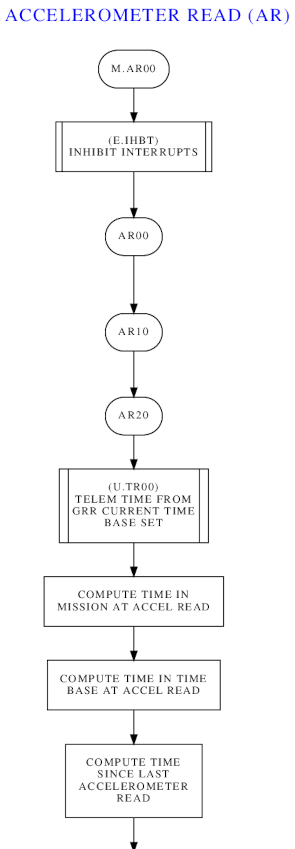
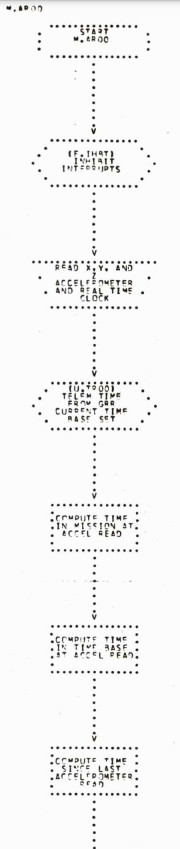
 Meanwhile, Cooper
(thanks!) has sent over yet another tranche of Apollo
documents for the library, and this time I really (truly!)
am going to take my time processing them. However,
Meanwhile, Cooper
(thanks!) has sent over yet another tranche of Apollo
documents for the library, and this time I really (truly!)
am going to take my time processing them. However,  To give you an
example, Console no. 37 is "AGC/CMC Support", the image of
which I've reproduced in a tiny form at the upper right, but
which
To give you an
example, Console no. 37 is "AGC/CMC Support", the image of
which I've reproduced in a tiny form at the upper right, but
which 
 By the way, I understand why many folks
mightn't be too interested in PCRs, and might be
doubly-uninterested in just lists of PCRs without even
having the PCRs themselves. Why would we want them,
other then from pure obsessiveness? (Or is it
compulsiveness? Or perhaps some less flattering, but
even more dismissive buzzword?) From my own
perspective, the PCRs, PCNs, and Software Anomaly Reports
are the principal resources you have, other than the
memory-bank checksums, when you're forced into the position
of having to reconstruct an AGC software version because you
haven't an actual listing of the source code. Even
just the title of the PCR (without the text) can be very
useful. How it works is this: From the
PCR/PCN/Anomaly (or even just its title), you may be able to
isolate which portions of the AGC code are relevant.
For example, if a PCR's title is about something called THROTLAG,
there are only a few portions of any given AGC program that
deal with THROTLAG. If you have earlier
version of AGC code in which the PCR has not been
implemented, as well as a later version in which the PCR has
been implemented, you can then compare them to see how they
differ. You then can pull the THROTLAG-related
changes into the software revision you're trying to
reconstruct. Voila! Your reconstruction
now has corrected THROTLAG code! In practice
it's often much trickier than that, but that's the basic
idea.
By the way, I understand why many folks
mightn't be too interested in PCRs, and might be
doubly-uninterested in just lists of PCRs without even
having the PCRs themselves. Why would we want them,
other then from pure obsessiveness? (Or is it
compulsiveness? Or perhaps some less flattering, but
even more dismissive buzzword?) From my own
perspective, the PCRs, PCNs, and Software Anomaly Reports
are the principal resources you have, other than the
memory-bank checksums, when you're forced into the position
of having to reconstruct an AGC software version because you
haven't an actual listing of the source code. Even
just the title of the PCR (without the text) can be very
useful. How it works is this: From the
PCR/PCN/Anomaly (or even just its title), you may be able to
isolate which portions of the AGC code are relevant.
For example, if a PCR's title is about something called THROTLAG,
there are only a few portions of any given AGC program that
deal with THROTLAG. If you have earlier
version of AGC code in which the PCR has not been
implemented, as well as a later version in which the PCR has
been implemented, you can then compare them to see how they
differ. You then can pull the THROTLAG-related
changes into the software revision you're trying to
reconstruct. Voila! Your reconstruction
now has corrected THROTLAG code! In practice
it's often much trickier than that, but that's the basic
idea.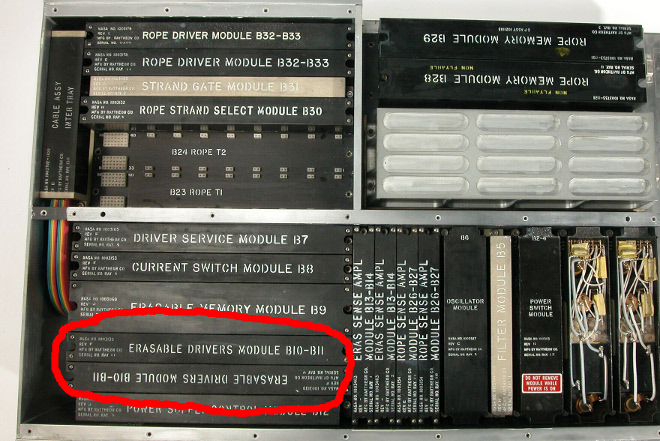



.dot.ps.png)