Old Plank Road

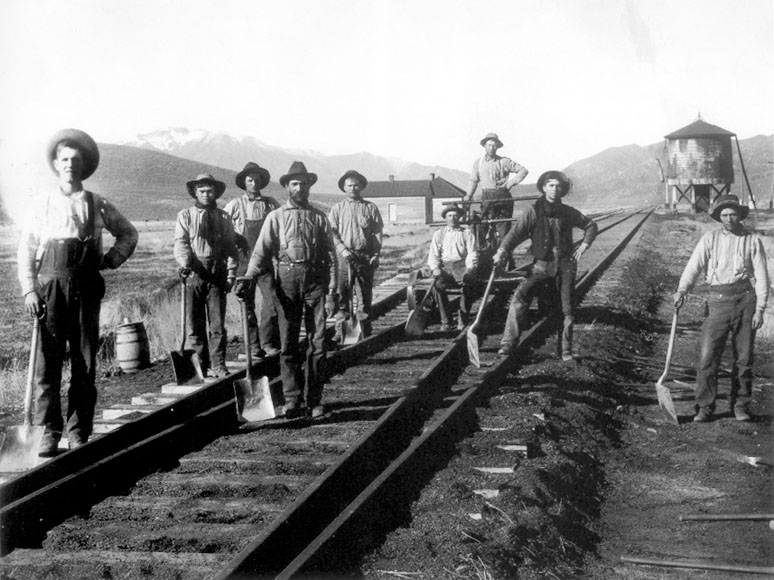
Uncle Dave Macon “The Dixie Dew Drop,” recorded this song on 5-string banjo, with guitar by Sam McGee in New York City on April 14, 1926. Macon was born in 1870, the son of proprietors of the Macon Hotel, a theatrical boarding house, where he learned many songs from hotel guests. By 1888 he had become a professional entertainer and would record over a hundred songs between 1932 – 1938. This is one of the chain gang songs he performed. It’s a wild interpretation with lots of shouting. The chorus “Won’t get drunk no more” echoes his regret for being busted and having a ball and chain, but doesn’t smack of true remorse.
Lyrics:

Roughly in the key of D playing the melody

Rather be in Richmond with all the hail and rain
Than to be in Georgia boys wearin’ that ball and chain

Won’t get drunk no more
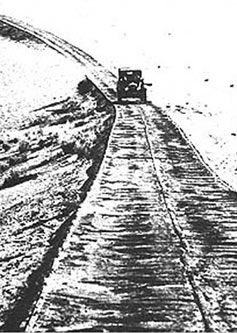
Way down the Old Plank Road

I went down to Mobile, but I got on the gravel train
Very next thing they heard of me, had on that ball and chain

Won’t get drunk no more
Way down the Old Plank Road

Doney, oh dear Doney, what makes you treat me so
Caused me to wear that ball and chain, now my ankle’s sore

Won’t get drunk no more
Way down the Old Plank Road

Knoxville is a pretty place, Memphis is a beauty
Wanta see them pretty girls, hop to Chattanoogie

Won’t get drunk no more
Way down the Old Plank Road

I’m going to build me a scaffold on some mountain high
So I can see my Doney girl as she goes riding by

Won’t get drunk no more
Way down the Old Plank Road

My wife died on Friday night, Saturday she was buried
Sunday was my courtin’ day, Monday I got married

Won’t get drunk no more
Way down the Old Plank Road

Eighteen pounds of meat a week, whiskey here to sell
How can a young man stay at home, pretty girls look so well

Won’t get drunk no more
Way down the Old Plank Road

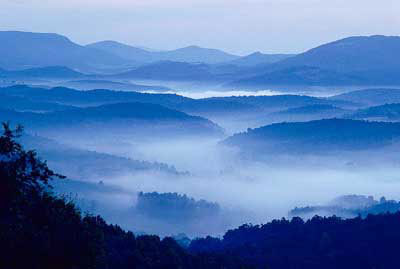
My Home’s Across The Smokey Mountains

This is a joyful sounding song that belies its lyrics. It really doesn’t sound like he’s never going to see his lover anymore, or if that’s the case he’s pretty darn happy about it. I played it on 5-string banjo, 12-string and 6-string guitars. I remember when I was going to the Old Town School of Folk Music in Chicago, that my guitar and banjo teacher Frank Hamilton traveled to New York to record this and other songs on an album with Pete Seeger called: Nonsuch We were all so proud of Frank!
Lyrics:

[G] My home’s across the Smokey Mountains
My home’s across the Smokey [D7] Mountains
[G] My home’s across the Smokey Mountains
And I’l [D7] never get to see you any [G] more more more
I’l [D7] never get to see you any [G] more

Goodbye honey sugar darlin’ X3
And I’l never get to see you any more more more
I’l never get to see you any more

Rock by baby feed her candy X3
And I’l never get to see you any more more more
I’l never get to see you any more

Oh Where’s that finger ring I gave you X3
And I’l never get to see you any more more more
I’l never get to see you any more

My home’s across the Smokey Mountains X3
And I’l never get to see you any more more more
I’l never get to see you any more

My home’s across the Smokey Mountains X3
And I’l never get to see you any more more more
I’l never get to see you any more

Nobody Knows You When You’re Down And Out

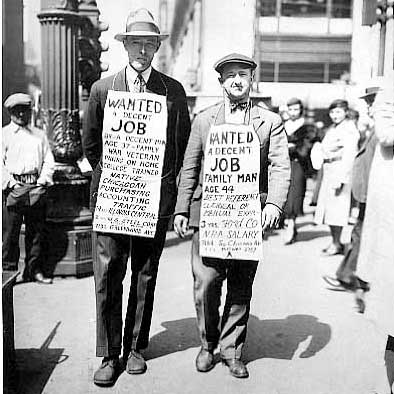
Written in the 1920s before the Great Depression by Jim Cox and made popular by Bessie Smith’s hit record, this song was prophetic of events to transpire in the United States and the world.

Now almost 100 years later – here we are again! I played this in the key of B on my Martin D-12-42RM, 5-string banjo and mandolin. The chord notation is in C.

Lyrics:

(by Jimmie Cox)

[C] Once I lived the [E7] life of a [A7] millionaire,
[d min.] Spending all my [A7] money, I didn’t [d min.] care.
[F] Takeing my [B7] friends [C] for a mighty fine [A7] time,
[D7] Buying bootleg liquor, [G7] champagne and wine.

Then I began to fall so low,
Lost all my good friends, had no place to go.
If I ever get my hands on a dollar again,
I’m gonna hold on to it till that eagle grins.

‘Cause no, no, nobody knows you
When you’re down and out.
In your pocket, not one penny,
And all your good friends, you haven’t any.

If you ever get back on your own two feet again,
Everybody’s going to want to be your old long-lost friend.
It’s mighty strange, without a doubt,
Nobody knows you when you’re down and out.

If you ever get back on your own two feet again,
Everybody’s going to want to be your old long-lost friend.
It’s mighty strange, without a doubt,
Nobody knows you when you’re down and out.

No Payday In Detroit

The Packard factory (pictured above) closed in 1956. My grandfather bought one of their last models, being a life long Packard enthusiast. They had been overrun by the big three. Now we are at the point where the big three’s future is in question. This is a traditional song about a mine disaster but it’s fitting for the US auto industry at this time. I changed the lyrics a bit to bring it up to speed and played it on banjo and mandolin.

Lyrics:

1. [A] Payday, it’s payday, oh, payday,
[D] Payday in Detroit no [A] more,
[D] Payday in Detroit no [A] more.

2. Bye bye, bye bye, oh, bye bye,
Bye bye, my woman, I’m gone,
Bye bye, my woman, I’m gone.

3. You’ll miss me, you’ll miss me, you’ll miss me,
Baby gonna miss me when I’m gone,
Baby gonna miss me when I’m gone.

4. Easy rider, easy rider, oh easy rider,
Won’t be ridin’ easy any more,
Won’t be ridin’ easy any more.

1. Payday, it’s payday, oh, payday,
Payday at Detroit no more,
Payday at Detroit no more.

Go Tell It On The Mountain

I bought a mandolin in Ft. Worth Texas on this tour and decided to use it here. I remember hearing this song on a vinyl two record set with a pop-up Christmas scene called “Home For Christmas,” sung by Mahalia Jackson. It has always been a favorite.

More From Wikipedia:

“Go Tell It on the Mountain” is an African-American spiritual dating back to at least 1865 that has been sung and recorded by many gospel and secular performers. It is considered a Christmas carol because its original lyric celebrates the Nativity: “Go tell it on the mountain, over the hills and everywhere; go tell it on the mountain, that Jesus Christ is born.”

In 1963, Peter Yarrow, Noel “Paul” Stookey, and Mary Travers, along with their musical director, Milt Okun, adapted and rewrote “Go Tell It on the Mountain” as “Tell It on the Mountain”, their lyrics referring specifically to Exodus and employing the line “Let my people go,” but implicitly referring to the Civil Rights struggle of the early ’60s. The song was recorded by Yarrow, Stookey and Travers on their Peter, Paul and Mary album In the Wind and was also a moderate hit single for them. (US #33 pop, 1964). Civil rights activist Fannie Lou Hamer used this rewritten version of the song as an anthem during the mid-1960s.

Other artists, besides Peter, Paul and Mary, who have recorded the song (chiefly on either Christmas-themed music albums or collections of spirituals or folk songs) include:

* The New Christy Minstrels
* Simon & Garfunkel
* Bob Marley
* Mahalia Jackson
* Fred Hammond
* Kirk Franklin
* Candi Staton
* Frank Sinatra & Bing Crosby
* James Taylor
* Cece Winans
* Anne Murray
* Vanessa L. Williams
* Jewel
* Dustin Kensrue
* Bruce Cockburn
* Little Big Town
* Sherill Milnes
* John Rutter and the Cambridge Singers
* Sara Evans
* Jim Nabors
* Toby Keith
* Peter Tosh
* The Blind Boys of Alabama
* Oh Susanna – for the holiday compilation album, Maybe This Christmas Too? (2003)
* Dolly Parton
* Carola Häggkvist
* Bobby Darin
* Art Paul Schlosser (who rewrote the lyrics for kids with the title, “Go Tell it On the Swingset”)
* The Gas House Gang

Lyrics:

Refrain
[F] Go, tell it on the mountain,
[C] Over the hills and [F] everywhere
Go, tell it on the mountain,
That [F] Jesus [C] Christ is [F] born.

[C] The shepherds feared and [F] trembled,
[C] When low above the [F] earth,
[C] Rang out the angels chorus
That [G7] hailed our Savior’s [C] bi–rth.
Refrain

While shepherds kept their watching
o’er silent flocks by night,
Behold, throughout the heavens
There shone a holy li–ght
Refrain

And lo! When they had heard it,
They all bowed down to pray,
Then travelled on together,
To where the Baby la–y.
Refrain

Down in a lowly manger
The humble Christ was born
And God sent us salvation
That blessed Christmas mo–rn.
Refrain

500 Miles

Hedy West (April 6, 1938 – July 3, 2005) was an American folksinger and songwriter. Her song “500 miles,” has been covered by Bobby Bare (a Billboard Top 10 hit in 1963), The Highwaymen, The Kingston Trio, Peter, Paul and Mary, Peter & Gordon, The Brothers Four and many others. A great number of Hedy’s songs, including the raw materials for “500 Miles” came from her paternal grandmother Lily West who passed on the songs she had learned as a child.

This has a sweet melody and a sad story of poverty and desolation.

Lyrics:

[A] If you miss this train I’m on [F#m] then you’ll know [Bm] that I have [D] gone
You can [Bm] hear the whistle [E] blow a hundred miles
[A] A hundred miles [F#m] A hundred miles [Bm] A hundred miles [D] A hundred miles
You can [Bm] hear the whistle [E] blow a hundred [A] miles

Lord I’m one Lord I’m two Lord I’m three Lord I’m four
Lord I’m five hundred miles from my home
Five hundred miles five hundred miles five hundred miles five hundred miles
Lord I’m five hundred miles from my home

Not a shirt on my back not a penny to my name
Lord I can’t go on home this a-way
This a-way this a-way this a-way this a-way
Lord I can’t go on home this a-way

[A] If you miss this train I’m on [F#m] then you’ll know [Bm] that I have [D] gone
You can [Bm] hear the whistle [E] blow a hundred miles
[A] A hundred miles [F#m] A hundred miles [Bm] A hundred miles [D] A hundred miles
You can [Bm] hear the whistle [E] blow a hundred [A] miles

Joshua Fit The Battle of Jericho

Joshua Fit de Battle is one of the best known examples of “Negro Spiritual” music.
These were songs created by an enslaved people – African Americans who lived in this land for over 300 years – just about the same length of time that the Hebrew people were enslaved in Egypt. American slaves were forbidden to read or write or to gather in groups.

Jericho is one of the oldest cities in the world. Located on the Jordan river, one of the few sources of water in a hot dry land, and on major trade routes, it has been battled over many, many times. If you go to Jericho today you find a barren, high hill overlooking the modern city. This hill, or “tell” is a human, not a natural, landmark. It was created by successive destruction and rebuilding of the city.

Lyrics:

[Em] Joshua fit de battle of Jericho, [D] Jericho, [Em] Jericho,
[Em] Joshua fit de battle of Jericho, and the [Am] walls came a [G] tumbalin’ down.

[Em] You may talk about your men of Gideon,
you may talk about your men of Saul,
but there’s none like good old [Am] Josh-a-ua,
at the [G] battle of [Em] Jericho, that morning;

VERSE 2
Joshua rose early in the morning,
that is when the trumpets blew,
they marched around the city,
at the battle of Jericho.

VERSE 3
Right up to the walls of Jericho,
he marched with spear in hand,
Joshua commanded the children to SHOUT,
and the walls came a tumbalin’ down, down, down, down;

LAST REFRAIN
Joshua fit de battle of Jericho, Jericho, Jericho,
Joshua fit de battle of Jericho, the trumpets they did blow, so,
Joshua fit de battle of Jericho, and the walls came a tumbalin’ down.

ENDING
Joshua fit de battle of Jericho, now you know, Jericho,
Joshua fit de battle of Jericho, and the walls came a tumbalin’ down.
Now you know who tore the wall down,
now you know who tore the wall down, down, down,
Joshua!(in a whisper)

Darlin’ Corey

Darlin’ Cory
From Wikipedia, the free encyclopedia

“Darlin’ Cory” (Roud 5723) is a well-known folk song about a banjo-picking, moonshine-making mountain woman. The first known recording of it was by Clarence Gill as “Little Corey” on 6 January 1927, but it was rejected by the record company and never released.[1] A few months later, folk singer Buell Kazee recorded it as “Darling Cora” on 20 April 1927 (Brunswick 154).[2] Later the same year, it was recorded by B. F. Shelton as “Darlin’ Cora” on 29 July 1927 (Victor 35838) [3] . Other early recordings are “Little Lulie” by Dick Justice (1929) and “Darling Corey” (released as a single) by the Monroe Brothers in 1936.[4] Burl Ives recorded it on 28 May 1941[5] for his debut album Okeh Presents the Wayfaring Stranger. Since then, many artists have recorded it: Roscoe Holcomb, Doc Watson, Bruce Hornsby, The Weavers, Crooked Still, Bill Monroe,[6] Harry Belafonte (as “Darlin’ Cora,” attributed to Fred Brooks),[7], Pete Seeger, and Kingston Trio (on their album At Large, 1959).

Lyrics:

Wake [D] up, wake up darling Corey
What makes you [A] sleep so sound
The [D] revenue officers are coming
They’re gonna tear you [A] still-house [D] down

Well the first time I seen darling Corey
She was sitting by the banks of the sea
Had a forty-four around her body
And a five-string on her knee.

Go away go away darling Corey
Quit hanging around my bed
Your liquor has ruined my body
Pretty women gone to my head.

Dig a hole dig a hole in the meadow
Dig a hole in the cold damp ground
Dig a hole dig a hole in the meadow
We’re gonna lay darling Corey down.

Can’t you hear them bluebirds a-singing
Don’t you hear that mournful sound
They’re preaching darling Corey’s funeral
In some lonesome graveyard ground.

Skip To My Lou

In early America, respectable folk in Protestant communities have always regarded the fiddle as the devil’s instrument and dancing as downright sinful. Faced with such a religious prejudice for socializing, young people of the frontier developed the “play-party,” in which all the objectionable features of a square dance were removed or masked so that their grave elders could approve.
No instruments were permitted – the dancers sang and clapped their own music. In time, the play-party acquired a life of its own. It became an ideal amusement for teenagers and young married couples. In many a frontier community, the bear hunters, Indian fighters, the rough keel-boat men and the wild cowboys could be seen dancing innocently with their gals, like so many children at a Sunday school picnic.
“Skip to My Lou” is a simple game of stealing partners. It begins with any number of couples hand in hand, skipping around in a ring. A lone boy in the center of the moving circle of couple sings, “Lost my partner what’ll I do?” as the girls whirl past him. The young man in the center hesitates while he decides which girl to choose, singing, “I’ll get another one prettier than you.” When he grasps the hand of his chosen one, her partner then takes his place in the center of the ring and the game continues. It’s an ice-breaker, a good dance to get a group acquainted to one another and to get everyone in the mood for swinging around.
It’s interesting to note that “loo” is the Scottish word for “love.” The spelling change from “loo” to “lou” probably happened as our Anglo ancestors, and the song, became Americanized.

I decided that since I was allowed to play musical instruments, I would use guitar and banjo on this song.

Source: The Folk Songs of North America, by Alan Lomax, Doubleday.
Recordings on file by: Carter Family, Lead Belly, Mike & Peggy Seeger, Pete Seeger.

Lyrics:

[G] Lost my partner,

What’ll I do?

[D] Lost my partner,

What’ll I do?

[G] Lost my partner,

What’ll I do?

[D] Skip to my lou, my [G] darlin’.

[G] Skip, skip, skip to my Lou,

[D] Skip, skip, skip to my Lou,

[G] Skip, skip, skip to my Lou,

[D] Skip to my Lou, my [G] darlin’.

I’ll get another one

Prettier than you,

I’ll get another one

Prettier than you,

I’ll get another one

Prettier than you,

Skip to my Lou, my darlin’

Skip, skip, skip to my Lou,

Skip, skip, skip to my Lou,

Skip, skip, skip to my Lou,

Skip to my Lou, my darlin’.

Can’t get a red bird,

Jay bird’ll do,

Can’t get a red bird,

Jay bird’ll do,

Can’t get a red bird,

Jay bird’ll do,

Skip to my Lou, my darlin’.

Skip, skip, skip to my Lou,

Skip, skip, skip to my Lou,

Skip, skip, skip to my Lou,

Skip to my Lou, my darlin’.

Fly’s in the buttermilk,

Shoo, fly, shoo,

Fly’s in the buttermilk,

Shoo, fly, shoo,

Fly’s in the buttermilk,

Shoo, fly, shoo,

Skip to my Lou, my darlin’.

Skip, skip, skip to my Lou,

Skip, skip, skip to my Lou,

Skip, skip, skip to my Lou,

Skip to my Lou, my darlin’.

Cat’s in the cream jar,

Ooh, ooh, ooh,

Cat’s in the cream jar,

Ooh, ooh, ooh,

Cat’s in the cream jar,

Ooh, ooh, ooh,

Skip to my Lou, my darlin’.

Skip, skip, skip to my Lou,

Skip, skip, skip to my Lou,

Skip, skip, skip to my Lou,

Skip to my Lou, my darlin’.

Off to Texas,

Two by two,

Off to Texas,

Two by two,

Off to Texas,

Two by two,

Skip to my Lou, my darlin’.

Skip, skip, skip to my Lou,

Skip, skip, skip to my Lou,

Skip, skip, skip to my Lou,

Skip to my Lou, my darlin’.

Going Down The Road Feeling Bad


Artwork By Bob Dylan

Kind of a poignant traveling song. Originally done in 2/4 time, I’ve recorded it in 4/4 with lots of chiming 12-string lead guitar.
Lyrics:

[G] Going down the road feeling bad
[C] Going down the road feeling [G] bad
[C] Going down the road feeling [G] bad
[Em] Lord, [D7] I ain’t gonna be [Am] treated this [G] way

Going where the water tastes like wine
Lord, I ain’t gonna be treated this way

Going where the climate feels fine
Lord, I ain’t gonna be treated this way

Going where the people treat me right
Lord, I ain’t gonna be treated this way

Going down the road feeling bad
Lord, I ain’t gonna be treated this way