Whup Jamboree

This is a song I recorded with the Chad Mitchell Trio in 1961. It’s a cotton screwing shanty. There was a time in the 1800s when, with the approach of winter, Irish crews would desert their Western Packet ships to head south to work in the cotton stowing ports like Mobile or New Orleans.
Lyrics:
[Em] Whup Jam [G] boree, whup jambo [D] ree
[Em] Oh a long-tailed sailor man comin’ up [D] behind
[Em] Whup Jam [G] boree, whup jambo [D] ree
[Em] Come an’ get your [D] oats me [Em] son

The pilot he looked out ahead
The hands on the cane and the heavin’ of the lead
And the old man roared to wake the dead
Come and get your oats me son

Whup Jamboree, whup jamboree
Oh a long-tailed sailor man comin’ up behind
Whup Jamboree, whup jamboree
Come an’ get your oats me son

Oh, now we see the lizzard light
Soon, me boys, we’ll heave in sight
We’ll soon be abreast of the Isle of Wight
Come and get your oats me son

Whup Jamboree, whup jamboree
Oh a long-tailed sailor man comin’ up behind
Whup Jamboree, whup jamboree
Come an’ get your oats me son

Now when we get to the black wall dock
Those pretty young girls come out in flocks
With short-legged drawers and long-tailed frocks
Come and get your oats me son

Whup Jamboree, whup jamboree
Oh a long-tailed sailor man comin’ up behind
Whup Jamboree, whup jamboree
Come an’ get your oats me son

Wel,, then we’ll walk down limelight way
And all the girls will spend our pay
We’ll not see more ’til another day
Come and get your oats me son

Whup Jamboree, whup jamboree
Oh a long-tailed sailor man comin’ up behind
Whup Jamboree, whup jamboree
Come an’ get your oats me son

Perry’s Victory

This song has the same tune as “St. Patrick’s Day in the Morning.” The first part of the tune also sounds a lot like “Squid Jigging Ground,” which was obviously influenced by “St. Patrick’s Day in the Morning.”

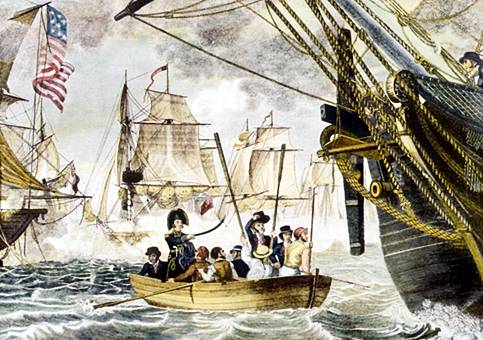
It’s about a famous battle that took place on Lake Erie during the War of 1812. Charlotte, wife of George III, was reputed to enjoy a nip of “Perry,” or pear brandy; which may have affected her judgment causing the British to lose the battle.

Bill Lee adds this bit of history from his 12 years in Ohio schools:

Although facing many adverse conditions, including lack of men and materials, Perry and his men successfully completed six vessels by July 1813. These six were joined by others from Buffalo. Two months later, on September 10, 1813, the American squadron commanded by Perry fought a British squadron commanded by Captain Robert Barclay, RN.

The Battle of Lake Erie began with Perry aboard his flagship LAWRENCE. In the early stages of the battle, however, LAWRENCE and her crew took most of the enemy’s fire. LAWRENCE was severely damaged and over 80 percent of Perry’s crew were killed or wounded by concentrated British gunfire. In an attempt to change defeat to victory, Perry, carrying his battle flag emblazoned with Captain Lawrence’s dying words, “Don’t Give Up The Ship,” transferred from LAWRENCE to the lightly damaged NIAGARA in a small boat. He took command of NIAGARA and sailed her into the British battle line. The British had also taken heavy casualties from the Lawrence’ fire. Broadsides from the fresh NIAGARA compelled their surrender within 15 minutes of Perry’s transfer.

Immediately following his victory at the Battle of Lake Erie, Perry penned the famous words, ‘We have met the enemy and they are ours…” in his report to General William Henry Harrison.

Lyrics:
PERRY’S VICTORY

(Andrew C. Mitchell circa. 1813)

[F] As old Queen Charlott, a [Dm] worthless old varlet
[Gm] Our brave naval forces was [Bb F] scor-ning,
[F] She wished to be merry, so [Dm] called for some Perry,
[Gm] September the tenth in the [Bb F] mor-ning.
[Dm] When brisk Perry came, she [Am] found him true game,
[Dm] To her cost too, he gave her a [Gm C] warning,
[F] So let us be merry [Dm] remembering Perry
[Gm] September the tenth in the [Bb F] morning.

It was on Lake Erie, when all hands were cheery,
A fleet was descried in morning,
‘Twas Queen Charlott’s fleet, so handsome and neat,
In bold line of battle were forming;
But when evening came, though the fleet were the same
That our brave naval forces were scorning,
They were beat, so complete, that they yielded the fleet,
To the one they despis’d in the morning.

Now let us remember the tenth of September,
When Yankees gave Britons a warming,
When our foes on Lake Erie, were beaten and weary,
So full of conceit in the morning;
To the skillful, and brave, who our country did save,
Our gratitude ought to be warming,
So let us be merry, in toasting of Perry,
September the tenth in the morning.

As old Queen Charlott, a worthless old varlet
Our brave naval forces was scorning,
She wished to be merry, so called for some Perry,
September the tenth in the morning.

Every Time I Feel The Spirit

The other day I heard Camilla playing an old African American spiritual. She was having such a great time singing it at her keyboard, that I thought I’d do it for the Folk Den.
Lyrics:
Every [Bb] time I feel the [F] Spirit moving in my [Dm] heart [C] I will [F] pray
Every time I feel the Spirit moving in my heart I will pray

[F] Up on that mountain the Lord spoke
Out of His mouth come [C] fire and [F] smoke
I look around me it look so shine
I asked the Lord if [C] it was [F] mine

Every time I feel the Spirit moving in my heart I will pray

X3

The Jordan River it runs so cold
It chills the body not the soul
There aint but one train on this track
It runs to Heaven don’t come back

Every time I feel the Spirit moving in my heart I will pray

X3 – Fade

Katie Morey

Bob Gibson sang this on his “Folk Songs of Ohio” album in the early 1950s. It’s funny because it points out the age old adage that a man will chase a woman until she catches him. Men think they have it all under control and are always amazed to find that they have invariably been outwitted by clever, creative women. But hey, what a way to go!
Lyrics:
A] Come all you young and [E] foolish lads who [A] listen to my [E] story
I’ll [A] tell you how I [E] fixed a plan to [B7] fool miss Katie [E] Morey
Come-a-two-dit-a-rye-do-two-dit-a-ray come-a-two-dit-a-ry e-do-[C#m] dandy
[E] I’ll tell you how I [A] fixed a plan to [B7] fool miss Katie [E] Morey

I told her that my sister Sue was in yon lofty tower
And wanted her to come that way to spend a pleasant hour
But when I got her to the top, say nothing is the matter
But you must cry or else comply, there is no time to flatter
Come-a-two-dit-a-rye-do-two-dit-a-ray come-a-two-dit-a-rye-do-dandy
I’ll tell you how I fixed a plan to fool miss Katie Morey

She squeezed my hand and seemed quite pleased
Saying “I have got no fear sir, but father he has come this way
He may see us here sir. If you’ll but go and climb that tree
Till he has passed this way sir, we may gather our grapes and plumbs
We will sport and play sir.”
Come-a-two-dit-a-rye-do-two-dit-a-ray come-a-two-dit-a-rye-do-dandy
I’ll tell you how I fixed a plan to fool miss Katie Morey

I went straight way and climbed the tree not being the least offended
My true love came and stood beneath to see how I ascended
But when she got me to the top she looked up with a smile sir
Saying “you may gather your grapes and plumbs
I’ll run quickly home sir.”
Come-a-two-dit-a-rye-do-two-dit-a-ray come-a-two-dit-a-rye-do-dandy
I’ll tell you how I fixed a plan to fool miss Katie Morey

I straight way did descend the tree coming with a bound sir
My true love got quite out of sight before I reached the ground sir
But when the fox hide did relent to see what I’d intended
I straight way made a wife of her, all my troubles ended
Come-a-two-dit-a-rye-do-two-dit-a-ray come-a-two-dit-a-rye-do-dandy
I’ll tell you how I fixed a plan to fool miss Katie Morey

Time to stop this foolish song, time to stop this rhyming
Every time the baby cries, I wish that I was climbing
Come-a-two-dit-a-rye-do-two-dit-a-ray come-a-two-dit-a-rye-do-dandy
I’ll tell you how I fixed a plan to fool miss Katie Morey

Pretty Polly

On our way up to Oriental North Carolina for a concert, we stopped for “Carolina Bar-B-Que” at a place called “Prissy Polly’s” just south of Winston Salem. The name reminded me of a song we recorded in the Byrds on the “Sweetheart of the Rodeo” album called “Pretty Polly.” I’d known the song since my days at the Old Town School of Folk Music and had always loved the modal tuning on the banjo and guitar in spite of the morbid lyrics. This is a good example of a song used for spreading the news of the day, way back before radio, television or the Internet. The content of the news today is however strikingly similar.
Lyrics: [G modal tuning]

There used to be a gambler who courted all around
He courted Pretty Polly such beauty had never been found

Pretty Polly, Pretty Polly come go along with me
Before we get married some pleasures to see

She jumped up behind him and away they did go
Down into the valley that was far below

They went a little further and what did they spy?
But a new dug grave with a spade lying by

Oh Willy dear Willy, I’m afraid of your way
I’m afraid you might lead my poor body astray

Pretty Polly, Pretty Polly you’ve guessed it just right
I dug on your grave the better part of last night

He stabbed her in the heart til her heart’s blood did flow
Down into the grave Pretty Polly did go

Now a debt to the Devil that Willy must pay
For killing Pretty Polly and running away

Molly Malone

http://ibiblio.org/jimmy/folkden/php/music/Molly_Malone.mp3
3596297
audio/mpeg

Sean Murphy has composed a nicely detailed page on Molly Malone. He writes:

As well as being known and sung internationally, the popular song ‘Cockles and Mussels’ has become a sort of unofficial anthem of Dublin city. The song’s tragic heroine Molly Malone and her barrow have come to stand as one of the most familiar symbols of the capital. In addition, Molly’s international pulling power is shown by the fact that she scores hundreds of ‘hits’ on the Internet, many of them relating to ‘Irish pubs’ bearing her name. It seems perfectly natural therefore that Molly should have been commemorated by erecting a statue to her in Dublin, which monument has become a familiar landmark at the corner of Grafton Street and Suffolk Street. Let us now travel back in time to see what we can find out about the real Molly Malone.

Read the rest of his story here:
http://homepage.eircom.net/~seanjmurphy/irhismys/molly.htm

Special thanks to Sonnet Simmons for her wonderful vocal on Molly Malone. And Happy Birthday too!

Wikipedia: http://en.wikipedia.org/wiki/Molly_Malone

Lyrics:
G] In Dublin’s Fair [Em] City
Where the [Am] [D] girls are so pretty
[G] I first laid my [Em] eyes on sweet [Am] Molly [D] Malone
[G] As she wheel’d her [Em] wheel barrow
Through [Am] streets broad and [D] narrow
Crying [G] cockles and [Em] mussels [Am] alive, [D] alive [G] o!

Chorus
[G] Alive, alive [[Em] o!, [Am] alive, alive [D] o!
Crying [G] cockles and [Em] mussels [Am] alive, [D] alive [G] o!

She was a fishmonger
But sure ’twas no wonder
For so were her father and mother before
And they each wheel’d their barrow
Through streets broad and narrow
Crying cockles and mussels alive, alive o!

Chorus

She died of a fever
And no one could save her
And that was the end of sweet Molly Malone
But her ghost wheels her barrow
Through streets broad and narrow
Crying cockles and mussels alive, alive o!

Chorus X3

Greensleeves

La ghirlandata (1873)
Londra, Guildhall Art Gallery

. . . Greensleeves . . . Text below from: http://soundexp.com/history.html

In the 15th through the early 17th centuries, music began to be printed and sold. Musical themes spread rapidly throughout Europe, particularly those developed by the troubadours of Provence in earlier centuries. With the coming of the Renaissance, the Church lost some of its power to control ideas. The notion of courtly love, so despised by the clergy, was celebrated once again. Of course it was hardly taken seriously, but its imagery was still powerful and it sounded good.

There is a long standing debate over whether England’s King Henry VIII (circa: ) did, in fact, write “Greensleeves,” one of the most celebrated, and certainly most frequently performed, love songs ever written. It’s doubtful whether we can ever know for sure. This much we do know: Henry VIII was well educated and thought of himself as quite the Renaissance man. He played several instruments including organ, harp, and virginals, so he certainly could have picked out the melody. We have a love letter written by him to Anne Boleyn which displays an eloquence (and impatience) that leads one to believe he could have written the song’s lyrics. Lines from this letter such as “struck by the dart of love” sound a bit trite, but it shows he probably knew a decent metaphor when he heard one. Most likely the tune already existed and Henry simply added his own lyrics since this was a perfectly acceptable practice in those days. Henry, no doubt thought of himself as a latter day troubadour wooing his lady love. But, as Anne was to find out, like some other troubadours of olde, Henry was a fickle lover and quickly moved on the next muse.

Punning sexual allusions and bawdy language were quite common in the love songs of this period. The Renaissance delighted in images of outdoor lovemaking and thinly disguised it by employing the metaphor of dancing as in Thomas Morley’s song, “Now Is the Month of Maying” (‘Barley-break’ is Renaissance-speak for ‘a roll in the hay’)

The Spring, clad all in gladness,
Doth laugh at Winter’s sadness, fa la,
And to the bagpipe’s sound
The nymphs tread out their ground, fa la.
Fie then, why sit we musing,
Youth’s sweet delight refusing, fa la.
Say, dainty nymphs, and speak,
Shall we play at barley-break? fa la.

During the reign of Elizabeth I, Shakespeare, like other playwrights, sprinkled songs throughout his stage plays. We don’t have know the original melodies but, like Greensleeves, they were probably sung to well-known tunes of the day, whichever ones the actors happened to know. Although Shakespeare’s love sonnets are deeply moving, the love songs in his plays tend to be more for laughs. Slow ballads probably didn’t go over well with a rambunctious live audience just waiting for an excuse to throw rotten vegetables!
. . .

Lyrics:
. . . [Em] Alas, my love, you [D] do me wrong,
To [C] cast me off [B7] discourteously.
[G] For I have loved you [D] well and long,
[C] Delighting [B7] in your [Em] company.

Chorus:
[G] Greensleeves was all my [D] joy
[C] Greensleeves was my [B7] delight,
[G] Greensleeves was my [D] heart of gold,
And [C] who but my [B7] lady [Em] greensleeves.

Your vows you’ve broken, like my heart,
Oh, why did you so enrapture me?
Now I remain in a world apart
But my heart remains in captivity.

chorus

If you intend thus to disdain,
It does the more enrapture me,
And even so, I still remain
A lover in captivity.

chorus

My men were clothed all in green,
And they did ever wait on thee;
All this was gallant to be seen,
And yet you wouldst not love me.

chorus

You couldst desire no earthly thing,
but still you hadst it readily.
Your music still to play and sing;
And yet you wouldst not love me.

chorus

Ah, Greensleeves, now farewell, adieu,
To God I pray to prosper thee,
For I am still thy lover true,
Come once again and love me. . . .

Wade in the Water

C01U.jpg

Camilla and I were on the road when I remembered this song and thought it would be a good one to record. I used my iBook and free cross platform software called Audacity along with my Samson C01U USB microphone. This is a great mic for the road because you don’t need an interface of any kind to record. You just plug into the USB jack and you’re good to go.

We discussed the song and decided make some changes. The original meaning of the song was inspired by John 5:4 in the Bible. “For an angel went down at a certain time into the pool and troubled the water. Then whoever first stepped in after the troubling of the water was made whole of whatever disease he had.” We changed the meaning to reflect Deuteronomy 31:3 “The LORD thy God, he will go over before thee, [and] he will destroy these nations from before thee, and thou shalt possess them: [and] Joshua, he shall go over before thee, as the LORD hath said.”

Lyrics:
[Am] Wade in the water
[Dm] Wade in the water [Am] children
[Am] Wade in the water
[C] God’s gonna [G] part the – [G] wa [Am] ter

Wade in the water
Wade in the water children
Wade in the water
God’s gonna part the – water[C]

Well who those children [G] dressed in [Am] red?
[C] God’s gonna [G] part the – [G] wa [Am] ter
[C] Must be the [G] children that Joshua [Am] led
[C] God’s gonna [G] part the – [G] wa [Am] ter

I said wade in the water
Wade in the water children
Wade in the water
God’s gonna part the – water

Nowl who those children dressed in black?
God’s gonna part the water
Goin’ to the promised land and never comin’ back
God’s gonna part the water

Said wade in the water
Wade in the water children
Wade in the water
God’s gonna part the – water

Well who those children dressed in green?
God’s gonna part the water
They’re marching to a land they never have seen
God’s gonna part the water

Wade in the water
Wade in the water children
Wade in the water
God’s gonna part the – water

Well who those children dressed in white?
God’s gonna part the water
They must be the children called Israelites
God’s gonna part the water

I said wade in the water
Wade in the water children
Wade in the water
God’s gonna part the – water

Wade in the water
Wade in the water children
Wade in the water
God’s gonna part the – water

(c) 2006
New lyrics by Roger McGuinn – McGuinn Music (BMI)
Camilla McGuinn – April First Music (ASCAP)

Mary Had A Little Lamb

marie.jpg

Thomas Edison, the father of audio recording recited the first stanza of this poem in testing his new invention, the phonograph in 1877, making this the first audio
recording to be successfully made and played back. It was all done on tin foil.

They say the song springs from a true story:

As a girl, Mary Sawyer (later Mrs. Mary Tyler) kept a pet lamb, which she took to school one day at the suggestion of her brother. A commotion naturally ensued.

Lyrics:
Written By: Sarah Josepha Hale, editor of Godey's Lady's Book, 1830's
Copyright Unknown

[G] Mary had a little lamb,
[D] Little lamb, [G] little lamb,
Mary had a little lamb,
Its [D[ fleece was white as [G] snow

And everywhere that Mary went,
Mary went, Mary went,
Everywhere that Mary went
The lamb was sure to go

It followed her to school one day
School one day, school one day
It followed her to school one day
Which was against the rules.

It made the children laugh and play,
Laugh and play, laugh and play,
It made the children laugh and play
To see a lamb at school

And so the teacher turned it out,
Turned it out, turned it out,
And so the teacher turned it out,
But still it lingered near

And waited patiently about,
Patiently about, patiently about,
And waited patiently about
Till Mary did appear

'Why does the lamb love Mary so?'
Love Mary so? Love Mary so?
'Why does the lamb love Mary so?'
The eager children cry

'Why, Mary loves the lamb, you know.'
Loves the lamb, you know, loves the lamb, you know
'Why, Mary loves the lamb, you know.'
The teacher did reply

St. Clair's Defeat

St_Clair_Campaign.jpg

I first heard this song at the Gate of Horn in Chicago. Bob Gibson and Bob Camp were a duo for a short time and this was one of thier most intense songs. It’s about The Battle of Wabash River. It was also known as ‘St. Clair’s Defeat’ which was fought on November 4, 1791 between the United States and an American Indian confederacy, as part of the Northwest Indian War (also known as ‘Little Turtle’s War’). The American Indians were led by Michikinikwa (‘Little Turtle’) of the Miamis and Blue Jacket of the Shawnees. The Americans were led by General Arthur St. Clair. The Indian confederacy was victorious. The battle was the most severe defeat ever suffered by the United States at the hands of American Indians; indeed, in proportional terms it was the worst defeat that United States forces have ever suffered in battle. As a result, President George Washington forced St. Clair to resign his post, and Congress initiated its first investigation of the executive branch.
More information at these URLs:
wikipedia.org
QM Museum
Ohio
britannica.com
Lyrics:
[Em] Was November the fourth in the [G] year of ninety-[D] one
[Em] We had a sore engagement near [D] to [Em] Fort [D] Jeffer [Em] son
[G] Sinclair was our commander, which [Bm] may remembered be
[Em] But we left nine hundred soldiers in [D] that [Em] Western Terri[D] tory[Em]At Bunker’s Hill and in Quebec, where many a hero fell
Likewise out on Long Island, it is I the truth can tell
But such a dreadful carnage, never did I see
As happened all out on the plains, near the River St. Marie

Our militia was attacked, just as the day did break
And soon were overpowered, and forced into retreat
They killed major Ouldham, and major Briggs likewise
While horrid yells of anguished souls resounded through the skies

Major Butler he was wounded the very second fire
His manly bosom swelled with rage they forced him to retire
Like one distracted he appeared, when thus exclaim-ed he
Ye hounds of Hell shall all be slain but what revenged I’ll be

We had not very long been broke, when General Butler fell
He cries my boys I’m wounded, pray take me off this field
My word says he, what shall we do, we’re wounded every man
Go charge your valiant heros and beat them if you can

He leaned his back against a tree, and there resigned his breath
And like a valiant soldier, sunk into the arms of death
When blessed angels did await, his spirit to convey
Into celestial fields, he did quickly bend his way

We charged again and took our ground, which did our hearts elate
But there we did not tarry long, they soon made us retreat
They killed our major Ferguson, which caused his men to cry
Stand to your guns says valiant Ford, we’ll fight until we die

Our cannon balls exhausted, artillery men all slain
Our musketeers and riflemen, their fire they did sustain
Three hours more we fought like men, and they were forced to yield
While three hundred bloody warriors lay stretched across the filed

Says colonel Gibson to his men, my boys be not dismayed
I’m sure that true Virginians were never yet afraid
Ten thousand deaths I’d rather die, than they should gain this field
With that he got a fatal shot, causing him to yield

Says major Clark, my heros, we can no longer stand
We shall strive to form in order, and retreat the best we can
The word retreat being passed around, they raised a dreadful cry
Then helter skelter through the woods like wolves and sheep they fly

We left the wounded on the field, O heavens what a shock!
And many bones were shattered, and strewn across the rock
With scalping knives and tomahawks, they robbed some of their breath
While raging flames of torment, tortured other men to death

Was November the fourth in the year of ninety-one
We had a sore engagement near to Fort Jefferson
Sinclair was our commander, which may remembered be
But we left nine hundred soldiers in that Western Territory