Follow The Drinking Gourd

gourd.gif

Special thanks to Nedra Talley Ross (of the Ronettes) for background vocals.
http://www.history-of-rock.com/ronettes.htm

FOLLOW THE DRINKING GOURD DECODED

[A] Follow the [Em] drinking gourd!
[A] Follow the [Em] drinking gourd.
For the [G] old man is [D] waiting to [C] carry you to [D] freedom
[Em] Follow the [D] drinking [Em] gourd.

The old man in this chorus was Peg Leg Joe, a sailor-turned-carpenter who had lost part of his right leg in an accident at sea. Joe wintered in the South doing odd jobs, from plantation to plantation. When he wasn’t working he taught the slaves this song containing a secret escape route to freedom in the North.

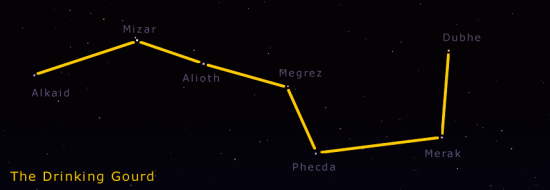
The Drinking Gourd is not a gourd, but the Big Dipper with its two pointer stars (Dubhe and Merak) that visually lead to the North Star.
By following the North Star the slaves were able to consistently navigate northward.

When the sun comes back and the first quail calls,
Follow the drinking gourd,
For the old man is waiting to carry you to freedom
If you follow the drinking gourd.

Each year when the quails migrated south, the slaves were told to begin their journey northward, which entailed crossing the unnavigable Ohio River. It was too swift and wide to cross, except in winter, when it was frozen and slaves could walk to the other shore on the ice.

The riverbank makes a very good road,
The dead trees will show you the way,
Left foot, peg foot traveling on,
Following the drinking gourd.

Peg Leg Joe marked one bank of the Tombigbee River in Mississippi with his easily identifiable footprints. By following them and the dead trees along the riverbank, the slaves could have a safe journey free from plantation owner’s hounds.

The river ends between two hills,
Follow the drinking gourd,
There’s another river on the other side,
Follow the drinking gourd.

When the Tombigbee ended, the slaves were told to continue northward, over the hills, to the Tennessee River where the Underground Railroad would help them.

Lyrics:
FOLLOW THE DRINKING GOURD

[Em] When the sun goes back and the [C] first quail calls
[Em] Follow the [D] drinking [Em] gourd
[Em] The old man is a-waitin’ for to [C] carry you to freedom
[Em] Follow the [D] drinking [Em] gourd

[A] Follow the [Em] drinking gourd!
[A] Follow the [Em] drinking gourd.
For the [G] old man is [D] waiting to [C] carry you to [D] freedom
[Em] Follow the [D] drinking [Em] gourd.

The river bed makes a mighty fine road,
Dead trees to show you the way
And it’s left foot, peg foot, traveling on
Follow the drinking gourd

CHORUS

The river ends between two hills
Follow the drinking gourd
There’s another river on the other side
Follow the drinking gourd

CHORUS

I thought I heard the angels say
Follow the drinking gourd
The stars in the heavens gonna show you the way
Follow the drinking gourd

CHORUS

Let The Bullgine Run

Bullgine.jpg

The term bullgine was derisive shipboard slang for an engine. Sailors didn’t like them much, and many still don’t today.
I recorded this song on the album ‘Judy Collins 3’ on Elektra Records in 1963. This is a slightly different version,
but my banjo part is pretty close to the one I played on Judy’s record. This is a rollicking halliards chantey. The Margot Evans was a packet ship, one of the first vessels to guarantee delivery of its mail packets across the Atlantic in a specified amount of time.
Lyrics:
[Em] Oh the smartest clipper [G] you can [Am] find
[G] Heave away, [D] haul away
Is the [Em] Margot Evans of the [G] Blue Cross [Am] Line
[G] So clear away the [D] track and let the [Em] bullgine run!

[Em] Tell me, are you most done?
[G] Heave away, [Am] haul away
[Em] With Liza Lee all [G] on my [Am] knee,
[G] So clear away the [D] track and let the [Em] bullgine run!

O the Margot Evans of the Blue Cross Line,
Heave away, haul away
She’s never a day behind her time
So clear away the track and let the bullgine run!

Tell me, are you most done?
Heave away, haul away
With Liza Lee all on my knee,
So clear away the track and let the bullgine run!

Oh, when I come home across the sea,
Heave away, haul away
It’s Liza, will you marry me?
So clear away the track and let the bullgine run!

Tell me, are you most done?
Heave away, haul away
With Liza Lee all on my knee,
So clear away the track and let the bullgine run!

Oh the smartest clipper you can find
Heave away, haul away
Is the Margot Evans of the Blue Cross Line
So clear away the track and let the bullgine run!

Cindy

Cindy.jpg

This is one of the great American folk songs that I learned at the Old Town School of Folk Music in Chicago. I love playing banjo on this song, which according to John Lomax is originally from North Carolina. Cindy is a widely known frolic tune, appearing in many folk music collections and even old elementary school songbooks.
Lyrics:
CINDY

[C] You ought to see my Cindy
She lives away down [G] south
[C] She’s so sweet the [F] honeybees
[C] Swarm [G] around her [C] mouth.

cho: Get along [F] home, Cindy Cindy
Get along [C] home.
Get along [F] home, Cindy Cindy
I’ll [C] marry [G] you some [C] day. (I’m a-gonna leave you now)

Wish I was an apple
Hangin on a tree
An’ every time that Cindy passed
She’d take a bite o’ me

cho: Get along [F] home, Cindy Cindy
Get along [C] home.
Get along [F] home, Cindy Cindy
I’ll [C] marry [G] you some [C] day. (I’m a-gonna leave you now)

She took me to the parlor
She cooled me with her fan
She said I was the prettiest thing
In the shape of mortal man

cho: Get along [F] home, Cindy Cindy
Get along [C] home.
Get along [F] home, Cindy Cindy
I’ll [C] marry [G] you some [C] day. (I’m a-gonna leave you now)

Now Cindy got religion,
She had it once before
When she heered my old banjo
She’s the first one on the floor.

cho: Get along [F] home, Cindy Cindy
Get along [C] home.
Get along [F] home, Cindy Cindy
I’ll [C] marry [G] you some [C] day. (I’m a-gonna leave you now)

Now Cindy got religion,
She wheeled round and round
She got so full of glory
That she knocked the preacher down

cho: Get along [F] home, Cindy Cindy
Get along [C] home.
Get along [F] home, Cindy Cindy
I’ll [C] marry [G] you some [C] day. (I’m a-gonna leave you now)

[C] You ought to see my Cindy
She lives away down [G] south
[C] She’s so sweet that [F] honeybees
[C] Swarm [G] around her [C] mouth.

cho: Get along [F] home, Cindy Cindy
Get along [C] home.
Get along [F] home, Cindy Cindy
I’ll [C] marry [G] you some [C] day. (X2)

Some additional verses:

Cindy in the summertime
Cindy in the fall
If I can’t have Cindy all the time
Have no one at all.

Cindy is a pretty girl
Cindy is a peach;
Threw her arms around my neck
Hung on like a leach.

Cindy got religion,
Tell you what she done:
Walked up to the minister
Chawed her chewin’ gum.

Cindy got religion,
She had it once before
When she heered my old banjo
She’s the first one on the floor.

Cindy got religion
She really went to town;
Got so full of glory, Lord,
Shook her stockin’s down.

If I had a pretty gal
I’d put her on a shelf;
Ev’ry time she smiled at me,
I’d jump right up myself.

Cindy had one blue eye
She also had one brown
One eye looked in the country
The other one looked in town

Wish I had a needle and thread
Wish that I could sew
I’d sew that gal to my coat tails
And down the road we’d go

alt chorus:
Git along home, Cindy
Git along home to stay
Git along home, Cindy
One more night ‘n’ day

alt cho: It’s kiss me, gal
Kiss me once again.
Oh, it’s kiss me, gal
All night long.

The First Noel

Noel.gif

One of my fondest childhood memories is of standing around the piano with my mother and father at my grandparents’ house in Chicago. My grandfather and grandmother sat at the keyboard. Every Christmas we would go through the small book of carols. The tree in the next room was decorated with lots of nineteenth century ornaments, and tin toys from Germany were abundantly scattered around the blanket of white material made to look like snow. This is one of the prettiest carols I remember from that time. An English Carol from before 1823.
Lyrics:
The First Noel

[D] The first Noel the [G] angel did [D] say,
Was to [G] certain poor [D] shepherds in fields as they lay;
In fields where they lay [G] keeping their [D] sheep,
On a [G] cold winter’s [D] night that was [A] so [D] deep.

[D] Noel, [Bm] Noel, [G] Noel, [D] Noel,
[G] Born is the [D] King of Is [A] ra [D] el

They looked up and saw a star
Shining in the east, beyond them far,
And to the earth it gave great light,
And so it continued both day and night.

Noel, Noel, Noel, Noel,
Born is the King of Israel

And by the light of that same star
Three Wise Men came from country far;
To seek for a king was their intent,
And to follow the star wherever it went.

Noel, Noel, Noel, Noel,
Born is the King of Israel

Then let us all with one accord
Sing praises to our heavenly Lord
Who hath made heaven and earth of naught,
And with His blood all mankind hath bought.

Noel, Noel, Noel, Noel,
Born is the King of Israel

Noel, Noel, Noel, Noel,
Born is the King of Israel

The John B's Sails

sloop.jpg

This is a sea song from around Nassau. We recorded this at Ridley Pearson’s house at the beginning of the Rock Bottom Remainders Wannapalooza 2004 Tour. Riddley, Dave Barry, Greg Iles, and I were the vocalists. Ridley played bass, and I played 6-string acoustic and Rickenbacker 12-string electric guitars.

Carl Sandburg says:

‘John T. McCutcheon, cartoonist and kindly philosopher, and his wife Eveleyn Shaw McCutcheon, mother and poet, learned to sing this song on their Treasure Island in the West Indies. They tell of it, ‘Time and usage have given this song almost the dignity of a national anthem around Nassau. The weathered ribs of the historic craft lie embedded in the sand at Governor’s Harbour, when an expedition, especially set up for the purpose in 1926, extracted a knee of horseflesh and a ring-bolt. These relics are now preserved and built into the Watch Tower, designed by Mr. Howard Shaw and built on our southern coast a couple of points east by north of the star Canopus.’

In his book, ‘ FOLKSONGS OF NORTH-AMERICA,’ John Lomax offers short bits of descriptive prose to set the scene for his collected works.

Here is his entry for ‘THE JOHN B’s SAILS’:

‘The small boat piers of Nassau Harbor form the market-place of the Bahamas. The dirty, sea-scarred sloops, tethered on the pale blue water, are like so many country wagons loaded with produce for sale in the capital. A sixteen-footer stands in towards the dock, its deck only a few inches above the waves, carrying a cow, five goats, a dozen hens, four women, six children, and four of five sailors. This crowded little boat is ending a journey from an island, perhaps two or three hundred miles away. As it noses into the pier, a similar craft lifts its ragged sail and departs, its deck packed with passengers and freight, for some coral islet far down the chain toward Haiti.

These vessels carry no charts, no compasses, and no auxiliary engines, yet few of them come to grief, for the Bahaman is at home in his reef-filled azure seas. They tell and believe a story about an old sea pilot, grown blind, who could stick his finger in the water and tell precisely where his boat lay.’

Lyrics:
THE JOHN B’s SAILS

[D] We come on the sloop John B,
my Grandfather and me.
Around Nassau town we did [A7] roam.
Drinkin’ all [D] night.
Got into a [G] – [Em] fight.
Well, I [D] feel so break up, [A7] I want to go [D] home.

Chorus:
Hoist up the John B’s sails.
See how the main sails set.
Call for the captain ashore, let me go home.
Let me go home.
I want to go home.
Well, I feel so break up, I want to go home.

First mate, he got drunk.
Broke up the people’s trunk.
Constable had to come and take him away.
Sheriff John Stone,
why don’t you leave me alone?
Well, I feel so break up, I want to go home.

Chorus

Well, the poor cook he caught the fits.
Throw away all of my grits.
Then he took and he ate up all of my corn.
Let me go home.
I want to go home.
This is the worst trip since I’ve been born.

Chorus

Spanish Ladies

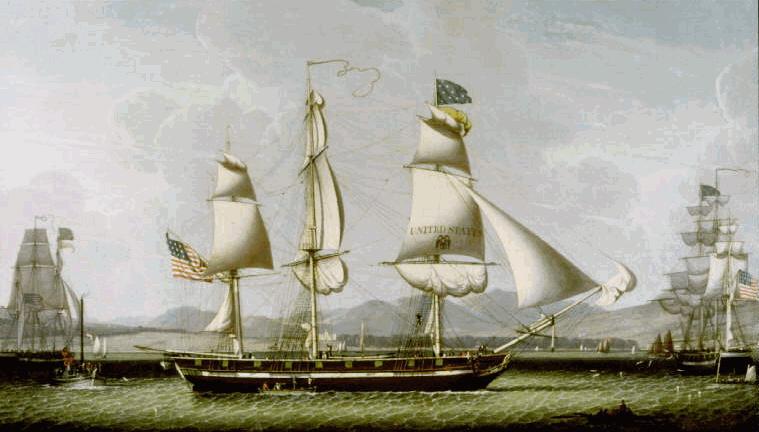
Argonaut.jpg

This song gives a vivid picture of the sailing ships in the English Channel. The ‘Grand Fleet’ was an old name for the Channel Fleet. ‘Deadman’ and ‘Fairlee’ are sea names for Dodman Point near Plymouth and Fairlight Hill near Hastings, and Ushant is the Ile d’Ouessant off Brest in France. Source: http://ingeb.org/folksong.html
Lyrics:
[Em] Farewell and adieu unto [G] you Spanish [D] ladies,
[Em] Farewell and adieu to you [G] ladies of [D] Spain;
[Em] For it’s we’ve received [D] orders for to [C] sail for old [Em] England,
[Em] But we hope very [D] soon we shall [C] see you [Em] again.

Then we hove our ship to the wind at sou’-west, my boys,
We hove our ship to our soundings for to see;
So we rounded and sounded, and got forty-five fathoms,
We squared our main yard, up channel steered we.

Now the first land we made it is called the Deadman,
Then Ram Head off Plymouth, Start, Portland and Wight;
We sailed by Beachy, by Fairlee and Dungeness,
Until we came abreast of the South Foreland Light.

We’ll rant and we’ll roar like true British sailors,
We’ll rant and we’ll roar across the salt seas,
Until we strike soundings in the Channel of old England,
From Ushant to Scilly is thirty-five leagues.

Then the signal was made for the grand fleet for to anchor,
All in the downs that night for to meet;
Then it’s stand by your stoppers, see clear your shank-painters,
Haul all your clew garnets, stick out tacks and sheets.

We’ll rant and we’ll roar like true British sailors,
We’ll rant and we’ll roar across the salt seas,
Until we strike soundings in the Channel of old England,
From Ushant to Scilly is thirty-five leagues.

Now let every man toss off a full bumper,
And let every man toss off a full bowl;
And we’ll drink and be merry and drown melancholy,
Singing, here’s a good health to all true-hearted souls.

We’ll rant and we’ll roar like true British sailors,
We’ll rant and we’ll roar across the salt seas,
Until we strike soundings in the Channel of old England,
From Ushant to Scilly is thirty-five leagues.

Oh Freedom

This is a great old spiritual. I recorded it during a thunder storm in Florida and decided to leave the thunder on the track to give it more ambiance. Freedom is often taken for granted, but is sorely missed when it’s gone.

Happy Juneteenth!!!

Lyrics:
[G]Oh freedom [D]Oh freedom [G]Oh freedom [D]over me
[G] And before I’ll be a [Em] slave, [C] I’ll be burried in my [Am] grave
[G] And go home to my [D] Lord and be [G] free

[G]No more moanin’ [D]No more moanin'[G]No more moanin’ [D]over me
[G] And before I’ll be a [Em] slave, [C] I’ll be burried in my [Am] grave
[G] And go home to my [D] Lord and be [G] free

[G]No more weepin’ [D]No more weepin'[G]No more weepin’ [D]over me
[G] And before I’ll be a [Em] slave, [C] I’ll be burried in my [Am] grave
[G] And go home to my [D] Lord and be [G] free

[G]No more shootin’ [D]No more shootin'[G]No more shootin’ [D]over me
[G] And before I’ll be a [Em] slave, [C] I’ll be burried in my [Am] grave
[G] And go home to my [D] Lord and be [G] free

[G]There’ll be singin’ [D]There’ll be singin'[G]There’ll be singin’ [D]over me
[G] And before I’ll be a [Em] slave, [C] I’ll be burried in my [Am] grave
[G] And go home to my [D] Lord and be [G] free

[G] And before I’ll be a [Em] slave, [C] I’ll be burried in my [Am] grave
[G] And go home to my [D] Lord and be [G] free

Haul Away Joe

Sailor.jpg

This is a tack and sheet, short haul chantey. There are many verses and it may have been used as a halyard chantey as well. Sheet chanties were usually no longer than three or four verses. Sometimes the word ‘pull’ or ‘haul’ was used instead of Joe.

Although the chantey was known earlier among British sailors, it was not well-known on Yankee ships until the period between 1812 and the Civil War. It was obviously sung after the French Revolution.

Lyrics:
[Am] When I was a [Em] little lad
And [Dm] so my mother [Em] told me,
[Am] Way, haul [Em] away, we’ll [Dm] haul [E] away, [Am] Joe!
[Am] That if I did not [Em] kiss the gals
Me [Dm] lips would all grow [Em] moldy.
[Am] Way, haul [Em] away, we’ll [Dm] haul [E] away, [Am] Joe!

Way, haul away, the good ship is a-bolding,
Way, haul away, we’ll haul away, Joe!
Way, haul away, the sheet is now unfold-ing,
Way, haul away, we’ll haul away, Joe!

King Louis was the king of France
Before the revolution…
Way, haul away, we’ll haul away, Joe!
But then he got his head cut off
Which spoiled his constitution…
Way, haul away, we’ll haul away, Joe!

Way, haul away, we’ll haul for better weather…
Way, haul away, we’ll haul away, Joe!
Way haul away, we’ll haul away together
Way, haul away, we’ll haul away, Joe!

The cook is in the galley boys
Making duff so handy
Way, haul away, we’ll haul away, Joe!
The captain’s in his cabin lads
Drinking wine and brandy
Way, haul away, we’ll haul away, Joe!

Way, haul away, I’ll sing to you of Nancy…
Way, haul away, we’ll haul away, Joe!
Way, haul away, she’s just my cut and fancy…
Way, haul away, we’ll haul away, Joe!

Way, haul away, we’ll haul for better weather…
Way, haul away, we’ll haul away, Joe!
Way haul away, we’ll haul away together
Way, haul away, we’ll haul away, Joe!

Down by the Riverside

This is a great old spiritual that has new meaning every time there is a conflict in the world. We recorded this live at the Fairfield concert hall in Croydon England on June 30, 2004. The audience is singing very well.
Lyrics:
[G] Gonna lay down my sword and shield
Down by the riverside
[D] Down by the riverside
[G] Down by the riverside
Gonna lay down my sword and shield
Down by the riverside
Down [D] by the [G] riverside
refrain
I ain’t gonna [C] study war no more,
I ain’t gonna [G] study war no more,
Study war no [D] more.
I ain’t gonna [C] study war no more,
I ain’t gonna [G] study war no more,
Study [D] war no [G] more.
Gonna walk with the Prince of Peace
Down by the riverside
refrain
Gonna put on my long white robe;
Down By the riverside
Down by the riverside
Gonna put on my long white robe; Down by the riverside
Down by the riverside
Gonna lay down my sword and shield
Down by the riverside
Gonna lay down my sword and shield
Down by the riverside

Salty Dog Blues

poodereck.jpg

This is one of the songs I recorded in 1958 at my house at 57 E. Division Street in Chicago. It's a country blues. I was speaking with a man from a radio station in Belgium who mentioned that his favorite songs from the Folk Den were these historical recordings, so I went into my archive and found one.
Lyrics:
CH:
[G] Oh salty [E7] dog, oh salty [A] dog, well you're [D7] sly as a fox
you salty [G] dog

[G] Well [E] God made a woman, made her might funny
Made the [A] stuff around her lips taste like honey
[D7] Won't you be my salty [G] dog?

CH:
Oh salty dog, oh salty dog, well you're sly as a fox you salty dog

Well I got a nickel you got a dime, you spend yours and I'll save mine
Honey won't you be my salty dog?

CH:
Oh salty dog, oh salty dog, well you're sly as a fox you salty dog

Down by the wild wood sittin' on a log, singin' a song about a salty dog
Honey won't you be my salty dog?

CH:
Oh salty dog, oh salty dog, well you're sly as a fox you salty dog

[Spoken]
You know, one time I took my girl to a real fine restaurant, thought
I'd buy her something real nice – got the most expensive thing on the menu.
Well that turned out to be some kind of tongue with fancy dressing on it. When my girl
saw that man, she really flipped! She said, 'I ain't gonna eat nothing that
comes out of no animal's mouth.' So I called over the waiter. I said
'Waiter, bring her a hard boiled egg.'

CH:
Oh salty dog, oh salty dog, well you're sly as a fox you salty dog

Well I got a nickel you got a dime, you spend yours and I'll save mine
Honey won't you be my salty dog?

CH:
Oh salty dog, oh salty dog, well you're sly as a fox you salty dog